

The IRS runs its own calendar. So does the Social Security Administration, the Centers for Medicare & Medicaid Services, the ACA Marketplace, and the agency behind flood insurance — and none of them publish a single, unified list of the dates that actually affect an ordinary household’s money in a given year. A taxpayer who tracks their April filing deadline closely can still miss the January estimated tax payment that avoids a penalty, the March deadline to spend down an FSA, or the December cutoff for a Required Minimum Distribution that carries one of the steepest penalties on this entire list. Each agency assumes you already know its specific dates; almost nobody actually does, because nobody hands you all of them together in one place.
This calendar collects the major federal financial and insurance deadlines that fall within calendar year 2027 — organized by the month you’ll actually encounter them, from January through December — and for each one, explains exactly what it is, who it applies to, precisely what you need to do and how, any grace period or extension available, and the specific, real consequence of missing it. Every date here is either fixed by statute or regulation and verified against official government sources, or clearly flagged where it’s a typical pattern rather than a locked-in date — several 2027-specific figures, like the next Social Security COLA and the next Medicare Part B premium, simply haven’t been announced yet as of this writing, and this guide tells you exactly which entries fall into that category rather than presenting an estimate as settled fact. This is educational information, not personalized tax, legal, or financial advice — a handful of these deadlines carry real state-by-state variation, and a professional who knows your specific situation should have the final say on anything with real money attached.
Key Takeaways
Not every deadline on this calendar is a hard date you can circle once and forget. A handful — the PATH Act refund hold, the Social Security COLA announcement, the National Flood Insurance Program’s reauthorization status — move from year to year or depend on Congress acting in time, so this calendar flags exactly which dates are locked by statute and which ones are the normal pattern rather than a guarantee.
Missing a tax deadline almost never means losing everything at once. The failure-to-file penalty runs roughly ten times steeper than the failure-to-pay penalty, which is exactly why filing for a free extension the moment you know you’ll be late is almost always worth doing, even if you can’t pay what you owe yet.
Some deadlines offer a second chance and some genuinely don’t. You can still file an extended tax return in October, but a missed 2026 IRA or HSA contribution deadline on April 15, 2027 is gone permanently, with no mechanism to retroactively fund a prior year afterward.
Medicare alone runs on four different enrollment calendars, not one. Your personal Initial Enrollment Period, the January-to-March Medicare Advantage Open Enrollment Period, the January-to-March General Enrollment Period, and the October 15-to-December 7 Annual Enrollment Period all serve different situations, and using the wrong window at the wrong time can cost you months of coverage.
A two-year lag hides inside one of the most expensive Medicare surprises there is. A large one-time income event in 2026 — a Roth conversion, a big capital gain, a home sale — can quietly raise Medicare Part B and Part D premiums through IRMAA in 2028, two years later, long after the decision that caused it is forgotten.
December 31 is not one deadline, it’s at least four. Required Minimum Distributions, Roth conversions, Qualified Charitable Distributions, and tax-loss harvesting trades all close out on the same date, and each one requires enough lead time before December 31 that waiting until the last week of the year is genuinely risky for at least one of them.
A federal program you may never have thought about can quietly affect whether you can close on a home. The National Flood Insurance Program has needed dozens of short-term reauthorizations since 2017 rather than permanent funding, and a lapse blocks new flood policies entirely — exactly the kind of deadline that has nothing to do with your own paperwork and everything to do with Congress’s.
2027 Deadline Quick Reference
| Date | Deadline | Who It Affects | Key Note |
|---|---|---|---|
| January 1 | Medicare Advantage Open Enrollment & General Enrollment Periods begin | Medicare beneficiaries | Runs through March 31 |
| January 15 | Q4 2026 estimated tax payment due | Self-employed, gig, investment income | Safe harbor: 90% of 2026 tax or 100%/110% of 2025 tax |
| January 15 | ACA Marketplace Open Enrollment final deadline (Feb 1 coverage) | Marketplace shoppers | State-based exchanges may run later |
| February 1 (shifted from Jan 31) | W-2 / 1099 deadline to recipients and IRS | Employees, contractors, employers/payers | Missing form? Contact the issuer directly |
| Mid-to-late February | PATH Act refund hold lifts | EITC / Additional Child Tax Credit filers | No fixed date; check “Where’s My Refund” |
| March 15 | S-corp and partnership tax return deadline | Business owners, partners, shareholders | Extension via Form 7004 to Sept 15 |
| March 15 | FSA grace period deadline (if your plan has one) | FSA holders | Confirm your specific plan design |
| March 31 | Medicare Advantage OEP & General Enrollment Period end | Medicare beneficiaries | Next window: fall AEP |
| April 15 | Federal individual tax filing deadline (tax year 2026) | Nearly everyone | Failure-to-file penalty: 5%/month up to 25% |
| April 15 | Last day for 2026 IRA and HSA contributions | Retirement and HSA savers | No extension available; permanent cutoff |
| April 15 | Q1 2027 estimated tax payment due | Self-employed, gig income | Same day as the tax filing deadline |
| April 15 | Form 4868 extension, gift tax return (709), FBAR (114) | Extension filers, large gift-givers, foreign account holders | FBAR auto-extends to October 15 |
| May 31 | Form 5498 arrives from your IRA custodian | IRA holders | Informational only; no action required |
| June 15 | Q2 2027 estimated tax payment due | Self-employed, gig income | Covers a 2-month period, not 3 |
| June 15 | Filing deadline for Americans living abroad | Expats, military stationed overseas | Extends filing only, not payment |
| July (personalized) | Turning 65 in 2027? Your Initial Enrollment Period | Anyone turning 65 in 2027 | 7-month window around your birthday |
| August (seasonal) | Flood insurance 30-day waiting period reminder | Homeowners in flood-prone areas | Buy before peak storm season, not during it |
| September 15 | Q3 2027 estimated tax payment due | Self-employed, gig income | Good time to recalculate if income shifted |
| September 15 | Extended S-corp and partnership deadline | Business owners, partners | K-1s may arrive close to this date |
| October 1 | FAFSA opens for 2028–29 school year | Students and families | Recent years have opened late; watch StudentAid.gov |
| October 15 | Extended individual tax filing deadline | Anyone who filed Form 4868 | Last chance before failure-to-file penalty applies |
| October 15 | Medicare Annual Enrollment Period begins | Medicare beneficiaries | Runs through December 7 |
| Mid-October | SSA announces the 2028 COLA | Social Security recipients | Typically mid-October; can slip |
| November 1 | ACA Marketplace Open Enrollment begins (2028 coverage) | Marketplace shoppers | Runs through January 15, 2028 |
| Mid-to-late November | Medicare Part B premium & IRMAA thresholds announced | Medicare beneficiaries, higher earners | IRMAA uses income from 2 years earlier |
| November (employer-set) | Workplace benefits open enrollment | Employees with job-based benefits | Dates set by each employer individually |
| December 7 | Medicare Annual Enrollment Period ends | Medicare beneficiaries | Hard cutoff for 2028 coverage changes |
| December 15 | ACA deadline for January 1, 2028 coverage | Marketplace shoppers | After this, coverage starts February 1 instead |
| December 31 | Required Minimum Distribution deadline | Retirees 73 and older | 25% excise tax penalty on the amount missed |
| December 31 | Calendar-year FSA plan year ends | FSA holders without a grace period or carryover | Expense must be incurred by this date |
| December 31 | Roth conversions, QCDs, tax-loss harvesting, 529 deadline | Investors, retirees, donors, 529 account owners | Four separate deadlines converging on one date |
| Ongoing through 2027 | National Flood Insurance Program reauthorization watch | Homeowners with or shopping for flood coverage | Currently authorized only through Dec 11, 2026 |
| January 18, 2028 (look-ahead) | Q4 2027 estimated tax payment due | Self-employed, gig income | Shifted from Jan 15 because of the weekend and MLK Day |
How This Calendar Is Organized
The calendar runs month by month, January through December 2027, in the order you’ll actually encounter these dates in real life rather than grouped by agency or topic. Within each month, entries are ordered by date, and a few entries that don’t tie to one fixed date — a personalized Medicare enrollment window, a seasonal insurance reminder, an agency announcement that “typically” lands in a given month — are placed where they’re most useful to think about, with that flagged clearly in the entry itself. The Quick Reference table above gives you the full list at a glance; the sections below give you the detail behind each one — what it is, exactly what to do, any grace period, and the real consequence of missing it. A closing section addresses what this calendar deliberately leaves out (state and local deadlines vary too much for one national list to cover), followed by common misconceptions, frequently asked questions, and full sourcing.

January
January 1, 2027 — Medicare Advantage Open Enrollment and General Enrollment Periods Begin
Two separate Medicare enrollment windows open on the same day, January 1, 2027, and both run through March 31, 2027 — a scheduling overlap that confuses a lot of people, since the two windows serve completely different groups. The Medicare Advantage Open Enrollment Period (MA OEP) is for people already enrolled in a Medicare Advantage plan as of January 1, 2027. It lets you make exactly one change during the window: switch to a different Medicare Advantage plan, or drop Medicare Advantage entirely and return to Original Medicare, adding a stand-alone Part D drug plan if you do. It is not an entry point for someone who wants to join Medicare Advantage for the first time — that enrollment happens during your own Initial Enrollment Period or the fall Annual Enrollment Period instead.
The Medicare General Enrollment Period (GEP) serves a different population: people who missed their personal Initial Enrollment Period, the seven-month window centered on their 65th birthday, and still need to sign up for Medicare Part A and/or Part B. Under a rule that took effect January 1, 2023, from the Consolidated Appropriations Act, 2021, coverage for a GEP enrollee now starts the month after they enroll. That’s a real improvement worth knowing about if you remember the old system, where anyone who signed up during the GEP had to wait until July 1 of that year for coverage to begin, sometimes leaving a gap of six months or more with no Part B at all.
The cost of delay here is permanent, not temporary. Anyone who was eligible for Part B and didn’t enroll when first eligible, and who doesn’t qualify for a Special Enrollment Period (typically tied to active employer coverage), faces a late-enrollment penalty: 10% added to the standard Part B premium for every full 12-month period they went without coverage while eligible. That penalty doesn’t expire on its own — it’s charged for as long as the person has Part B, which for most people means for the rest of their life.
January 15, 2027 — Fourth-Quarter 2026 Estimated Tax Payment Due
January 15, 2027, a Friday, is the due date for the fourth and final quarterly estimated tax payment covering the 2026 tax year — specifically, the installment covering income earned from September through December 2026. This applies to anyone whose income isn’t fully covered by paycheck withholding: self-employed workers, freelancers, gig-economy drivers and contractors, landlords, and retirees drawing on untaxed pension or investment income. You can pay through IRS Direct Pay or EFTPS online, or by mail with a check and the Form 1040-ES payment voucher for the correct tax year and quarter.
Skipping this payment is riskier than it might seem, even if you’re confident you’ll square everything up when you file your full return in April. The IRS calculates underpayment penalties on a quarter-by-quarter basis, so if this specific fourth-quarter installment goes unpaid, that gap can generate a penalty even if your total 2026 tax bill ends up paid in full by April 15 — the penalty is tied to when the money should have arrived, not just how much you eventually pay in total.
There’s a safe harbor worth knowing about. You generally avoid the underpayment penalty entirely if your total withholding and estimated payments for the year equal at least 90% of what you owe for 2026, or 100% of what you owed for 2025 (110% if your 2025 adjusted gross income was above $150,000), whichever of those two figures is smaller. Hitting either threshold protects you even if your final tax bill turns out higher than you expected.
January 15, 2027 — Last Call for ACA Marketplace Open Enrollment (February 1 Coverage)
The federal ACA Marketplace at HealthCare.gov runs its Open Enrollment Period for 2027 coverage from November 1, 2026 through January 15, 2027, and the date you enroll by determines when your coverage actually starts. Enroll by December 15, 2026, and coverage begins January 1, 2027. Enroll between December 16, 2026, and January 15, 2027, and coverage instead begins February 1, 2027 — a full month later, with no coverage in between. January 15, 2027, is therefore the hard outer deadline: it’s the last day to enroll in or change a marketplace plan for 2027 through the federal exchange.
Miss it, and your options narrow sharply. Outside of qualifying for a Special Enrollment Period — triggered by a specific life event such as losing job-based coverage, having a baby or adopting a child, getting married, or moving to a new coverage area — you generally cannot enroll in ACA marketplace coverage again until the next annual Open Enrollment Period, which won’t affect coverage until 2028. That’s potentially a full year without marketplace coverage, or paying full price for a plan outside the exchange with no access to premium tax credits.
One important wrinkle: January 15 is the federal deadline used by most states, but several state-based marketplaces run their own, later windows. Covered California’s enrollment period extends through January 31, and New York State of Health also stays open past the federal cutoff. If you buy coverage through a state-run exchange rather than HealthCare.gov, check that state’s specific deadline directly rather than assume the federal date applies to you.
February 1, 2027 — W-2 and 1099 Deadline for Employers and Issuers
Employers and payers face an annual deadline of January 31 to send Form W-2 to employees and most Form 1099 variants — 1099-NEC for independent contractor payments, 1099-INT for bank interest, 1099-DIV for dividends, 1099-K for payments processed through platforms used for business transactions, among others — to the people who received the income. Because January 31, 2027, falls on a Sunday, the deadline shifts to the next business day: Monday, February 1, 2027. The same forms generally must also be filed with the IRS by this date, either electronically or on paper.
For most readers, this date matters as a checkpoint rather than an action item. If you haven’t received a W-2 from your employer, or a 1099 you’re expecting from a bank, brokerage, client, or payment platform, by early February, that’s your signal to contact the issuer directly rather than wait. A missing form can hold up your own tax filing, since you need the exact reported figures to file an accurate return, and guessing at the numbers risks a mismatch against what the IRS separately receives from the same issuer.
The deadline also runs the other way for readers who are small business owners, landlords, or anyone who paid a contractor $600 or more during 2026 — they’re the ones required to issue these forms, not just receive them. Missing it carries real cost on the business side: the IRS charges a tiered per-form penalty that increases the later you file, and because it applies per form, a business with a dozen contractors or vendors can rack up a substantial bill for what looks like a single missed deadline.

February
Mid-to-Late February 2027 — PATH Act Refund Hold Lifts for EITC/ACTC Filers
Federal law — specifically the PATH Act — requires the IRS to hold the entire refund, not just the portion tied to the credit itself, for any return that claims the Earned Income Tax Credit (EITC) or the Additional Child Tax Credit (ACTC). That hold applies even to a return filed on the very first day the IRS opens filing season in late January. There’s no single fixed date for when the hold lifts: the IRS states that most of these refunds generally aren’t available until the first few days of March, and the “Where’s My Refund” tool typically updates with a personalized deposit date for early filers — those using direct deposit with no other issues on the return — sometime in mid-to-late February.
The rule exists for a specific reason: it gives the IRS extra time to cross-check what’s reported on a return against the W-2 and 1099 data that employers and payers separately file, before the refund goes out the door. The EITC and ACTC are among the credits most frequently targeted by fraudulent claims and identity theft, so this hold functions as a fraud check built directly into the refund timeline rather than an arbitrary delay.
For a reader relying on that refund, the practical implication is straightforward: don’t plan on having the money in hand for a specific bill, rent payment, or expense until it actually posts to your account. This particular delay catches a lot of early filers off guard every year, especially anyone used to seeing refunds land in early February — the EITC/ACTC hold means your money can arrive weeks later than a comparable return without those credits, even though you filed just as early.

March
March 15, 2027 — S Corporation and Partnership Tax Return Deadline
March 15, 2027, a Monday, is the federal filing deadline for S corporations (Form 1120-S) and partnerships, including most multi-member LLCs (Form 1065), covering the 2026 tax year — a full month earlier than most readers expect, since it lands two and a half months ahead of the individual April deadline. It matters to Banktimer readers well beyond business owners themselves: anyone who’s a partner in a business or an S-corp shareholder receives a Schedule K-1 reporting their share of that entity’s income, and the K-1 typically can’t be finalized until after the business return itself is filed — which means a late business return can hold up the owner’s own personal Form 1040 further down the line.
These are pass-through entities, so the business itself usually doesn’t owe tax directly, but the late-filing penalty applies regardless: it’s calculated per partner or shareholder, per month the return is late, up to a maximum of 12 months. That structure makes the penalty scale with the size of the business rather than with any tax owed — a partnership with five partners accumulates a penalty five times larger than a single-owner entity for the same number of months late, even if the business had no taxable income that year at all.
Business owners who need more time can file Form 7004 for an automatic six-month extension, pushing the deadline to September 15, 2027. Given how the per-partner penalty structure punishes even short delays, that’s worth doing proactively rather than scrambling to file accurately at the last minute.
March 15, 2027 — FSA Grace Period Deadline (If Your Plan Has One)
Some employers give Flexible Spending Account holders a grace period, running through March 15 of the following year, to spend down money left over from the prior plan year — so a March 15, 2027 deadline would apply specifically to unused 2026 FSA funds. This is an optional plan design, not a universal rule. Employers generally structure it one of three ways: a grace period like this one, a limited carryover (typically a capped dollar amount that rolls automatically into the new plan year with no spending deadline attached), or neither — a hard “use it or lose it” cutoff at December 31 with nothing beyond that date.
Because all three models are common and look similar from the outside, check your own plan documents or benefits portal directly rather than assume the grace-period rule applies to you. Assuming the wrong model is exactly how people end up forfeiting money they thought they still had time to spend — confirming your specific plan’s rule takes a few minutes and prevents a mistake that can’t be undone afterward.
The consequence of missing whichever deadline actually governs your plan is total and final: unspent FSA money reverts to your employer permanently. It isn’t refunded, credited toward a future year, or recoverable through any appeal. The moment the deadline passes, that money is simply gone, which is why FSA holders whose plan includes a grace period should treat mid-March, not December 31, as their real spending deadline.
March 31, 2027 — Medicare Advantage and General Enrollment Periods End
Both Medicare enrollment windows that opened January 1, 2027, close on March 31, 2027, a Wednesday: the Medicare Advantage Open Enrollment Period, for people already in a Medicare Advantage plan who wanted to switch plans or return to Original Medicare, and the Medicare General Enrollment Period, for people who missed their Initial Enrollment Period and needed to sign up for Part A and/or Part B for the first time.
If you meant to make a change during either window and didn’t act, your options narrow considerably after this date. Someone who wanted to switch Medicare Advantage plans generally has to wait for the fall Annual Enrollment Period (October 15 through December 7, 2027) for a change that would take effect January 1, 2028. Someone who still needs to enroll in Part A or Part B has to wait for the next General Enrollment Period, which won’t reopen until January 1, 2028, unless a qualifying life event — such as losing employer coverage — opens a Special Enrollment Period in the meantime. Either way, a missed deadline here typically means a multi-month wait, not a quick fix.

April
April 15, 2027 — Federal Individual Tax Filing Deadline (Tax Year 2026)
This is the deadline that anchors the entire calendar: your federal Form 1040 for the 2026 tax year is due to the IRS by April 15, 2027, a Thursday, with no shift this year since the date falls on a weekday and doesn’t coincide with a qualifying holiday. Filing means submitting your completed return, either electronically through IRS Free File, commercial tax software, or a paid preparer, or by mail postmarked by the deadline if you’re filing on paper. If you owe tax, payment is due the same day regardless of whether you file on time or request an extension — an extension only buys you more time to file the paperwork, not more time to pay, so underpaying by April 15 starts interest and a separate late-payment penalty accruing immediately even if your actual return isn’t due until October.
Missing this deadline without requesting an extension triggers a failure-to-file penalty of 5% of the unpaid tax per month, up to 25%, on top of a smaller failure-to-pay penalty and interest that compounds daily. The failure-to-file penalty alone runs roughly ten times steeper than the failure-to-pay penalty, which is exactly why filing Form 4868 for a free, automatic extension is almost always worth doing if you genuinely can’t finish your return in time — even if you can’t pay everything you owe yet. If you’re due a refund, there’s technically no penalty for filing late, but you have to file within three years of the original deadline to claim it at all, or the refund is forfeited to the U.S. Treasury permanently.
April 15, 2027 — Last Day for 2026 IRA and HSA Contributions
Contributions to a Traditional or Roth IRA, or a Health Savings Account (HSA), for the 2026 tax year must be made by April 15, 2027 — and this deadline is fixed to the regular filing deadline, not the extended one. Filing Form 4868 for an October extension on your tax return does not buy extra time to fund a 2026 IRA or HSA; that window closes April 15 regardless of whether your return itself is extended. For 2026, the IRA contribution limit is $7,500, or $8,600 if you’re 50 or older, including a $1,100 catch-up contribution. The 2026 HSA contribution limit is $4,400 for self-only coverage or $8,750 for family coverage, plus an additional $1,000 catch-up contribution if you’re 55 or older.
The mechanical detail that trips people up: when you make a contribution between January 1 and April 15, 2027, you have to specifically tell your IRA or HSA custodian that it’s a prior-year (2026) contribution. Left undesignated, the custodian defaults to recording it as a 2027 contribution instead — a genuinely common, costly mix-up that can leave your 2026 contribution short of what you intended while also eating unnecessarily into your 2027 limit.
Unlike several other deadlines on this calendar, this one offers no extension and no do-over. Once April 15, 2027, passes, the opportunity to contribute for 2026 is gone permanently — there’s no mechanism to retroactively fund a prior tax year after the deadline, so if you’re weighing whether to max out a 2026 IRA or HSA, this date is the real, final cutoff.
April 15, 2027 — First-Quarter 2027 Estimated Tax Payment Due
The first estimated tax installment for the 2027 tax year — covering income earned January through March 2027 — is due April 15, 2027, the same day as the deadline for filing and paying your full 2026 return. For self-employed filers and others who pay quarterly, that overlap creates a real trap: you could be paying a balance due on your 2026 taxes and your first 2027 estimated payment on the exact same day, effectively two separate payments that need to be made and tagged to the correct tax year rather than lumped together.
The general mechanics of estimated tax — who owes it, how to pay it, and the underpayment penalty for skipping a quarter — are covered in the January 15 entry above. What’s specific here is the calendar collision: budget for both payments landing at once, since treating April 15 as a single tax bill rather than two can leave your first 2027 quarter underfunded even if your 2026 return is paid in full.
April 15, 2027 — Extension, Gift Tax, and FBAR Deadlines You Might Also Have
April 15, 2027, carries three more deadlines beyond the core filing date, each relevant to a different slice of readers. First, Form 4868 is due if you need an automatic six-month extension on your individual return, pushing your filing deadline to October 15, 2027. It’s genuinely automatic — no explanation or justification required — but it only extends the time to file the paperwork, not the time to pay. If you owe tax, you should still estimate and pay that amount along with your extension request, since interest and the failure-to-pay penalty start accruing on any unpaid balance from April 15 regardless of the extension.
Second, Form 709, the gift tax return, is due April 15, 2027, for gifts made during 2026 that exceeded the annual gift tax exclusion of $19,000 per recipient. Most people who file this form don’t actually owe any gift tax, because a much larger lifetime exemption absorbs the excess — but the form itself is still legally required once you’ve given any one person more than the annual exclusion in a calendar year, separate from whether tax is ultimately due.
Third, FBAR — FinCEN Form 114 — is required for any U.S. person with foreign financial accounts that together totaled more than $10,000 at any point during 2026. It’s technically due April 15, 2027, but comes with an automatic extension to October 15, 2027, that requires no separate request, unlike the Form 4868 extension for your regular tax return. FBAR is worth taking seriously: civil penalties for a willful violation can run into the tens of thousands of dollars, and even a non-willful violation — one where you simply didn’t realize the rule applied to you — carries a real penalty of its own, making this one of the highest-stakes, least-understood deadlines on this entire calendar for anyone with a foreign bank or investment account.

May
May 31, 2027 — Form 5498 Arrives From Your IRA Custodian
IRA custodians are required to send Form 5498 to both account holders and the IRS by May 31 each year — May 31, 2027, falls on a Monday — reporting the prior year’s contributions, any rollovers, and the account’s fair market value as of the end of 2026. This one is purely informational: there’s nothing to do by this date, and you don’t attach Form 5498 to your tax return at all.
What confuses people is the timing itself: a document reporting 2026 activity that shows up in late May 2027, a full six weeks after the April tax deadline most filers have already met. That’s intentional, not an error — custodians need the extra time to finalize contribution and rollover data for the entire prior year, including any late contributions made right up to the April 15 cutoff. When it arrives, the useful thing to do is check it against your own contribution records, since it’s effectively the IRS’s own copy of what you actually put into the account, and a mismatch is worth catching and resolving before it becomes a bigger issue.

June
June 15, 2027 — Second-Quarter 2027 Estimated Tax Payment Due
The second estimated tax installment for 2027 is due June 15, 2027, a Tuesday. This one covers a shorter stretch than the others — just April and May 2027, two months instead of three — an IRS quirk that trips people up if they assume all four “quarters” are equal in length. In practice, the four periods run roughly three, two, three, and four months respectively, tied to the filing deadline dates rather than the calendar’s actual quarters.
The full mechanics of who owes estimated tax, how to pay it, and the penalty for underpaying a given quarter are covered in the January 15 entry above. The only thing to adjust here is the math: since this installment covers a shorter income window, base your payment on what you actually earned in April and May rather than defaulting to the same dollar figure you paid for a full three-month quarter.
June 15, 2027 — Filing Deadline for Americans Living Abroad
U.S. citizens and resident aliens who are living outside the United States on April 15, 2027, receive an automatic two-month extension to file their federal tax return, moving their effective deadline to June 15, 2027, a Tuesday. Unlike the domestic Form 4868 extension, this one requires no form and no request — it applies automatically based on where you’re living on the regular deadline, covering U.S. citizens and green card holders working or residing abroad, including military personnel stationed outside the country.
The catch is one that trips up a lot of expats: this is an extension to file, not an extension to pay. Any tax owed on your 2026 return still started accruing interest on April 15, 2027, even though your paperwork isn’t due until June. If you know you’ll owe money, paying an estimate by April 15 — even without filing the full return yet — avoids interest accumulating for those extra two months.
If June 15 still isn’t enough time, filers abroad can submit Form 4868 by that date for a further extension to October 15, 2027, the same extended deadline available to domestic filers. That gives Americans overseas, who often deal with foreign income reporting, foreign tax credits, or FBAR requirements that complicate their returns, meaningfully more runway than the standard April-to-October extension window most domestic filers work with.
July
Turning 65 in 2027? Your Personal Medicare Enrollment Window
Unlike every other entry in this calendar, this one isn’t tied to a date on the calendar — it’s tied to your own birthday. Everyone gets an Initial Enrollment Period (IEP) for Medicare: a 7-month window built around the month you turn 65, covering the 3 months before your birthday month, your birthday month itself, and the 3 months after. This is a completely separate window from the calendar-fixed Annual Enrollment Period (October 15–December 7), the Medicare Advantage Open Enrollment Period (January–March), or the General Enrollment Period — all covered elsewhere in this calendar — and it’s the window where most people actually make their first Medicare decision.
This entry sits in July as a mid-year check-in. If you’re turning 65 later in 2027, July is a reasonable moment to start mapping out your own 7-month window so you’re not scrambling in the fall. If you already turned 65 earlier this year, July is a good moment to confirm you didn’t let your window quietly close — it’s easy to assume there’s plenty of time and then realize the window has already passed.
Signing up during the 3 months before your birthday month generally gets your coverage started the month you turn 65. Waiting until your birthday month itself, or the months after, can delay when coverage actually starts, sometimes by a month or more depending on when you enroll.
Missing your IEP entirely, without qualifying for a Special Enrollment Period (available if you had qualifying employer coverage through active work), carries a permanent financial consequence. Part B carries a late-enrollment penalty of 10% of the premium for every full 12-month period you were eligible but didn’t enroll, and that penalty generally applies for as long as you have Part B, which for most people means for life. Part D prescription drug coverage carries its own separate late-enrollment penalty, calculated differently but just as durable. Neither is a one-time fee; both become a permanent tax on delay.
August
Hurricane Season and the 30-Day Flood Insurance Waiting Period
The Atlantic hurricane season runs June through November, with the most active stretch from mid-August through October, which makes August less a single deadline than a last practical window. A brand-new National Flood Insurance Program (NFIP) policy, and most private flood policies as well, comes with a standard 30-day waiting period before coverage actually takes effect, with only a few narrower exceptions, such as a policy tied directly to a new mortgage closing. That waiting period is the entire point of this entry: flood insurance is not something you can effectively buy once a storm is already forecast to hit your area in the next week or two. By the time many people think to call about coverage, a storm is already on the radar, and a new policy bought then simply won’t be in force in time to help with that specific storm.
That makes August the practical “it’s not too late, but it’s getting late” moment on the calendar for anyone in a flood-prone area without coverage, or whose coverage limit hasn’t kept pace with what it would actually cost to rebuild their home today. Waiting until September or October, once a specific storm is already forming, removes the option entirely for that season.
It’s worth restating plainly, because so many homeowners get this wrong: flood damage is generally not covered by a standard homeowners or renters insurance policy at all. Wind damage, fire, and most other perils are covered; rising water from a storm surge, an overflowing river, or a flash flood generally is not, no matter how comprehensive the policy sounds. Flood coverage requires this separate policy, purchased in advance, with its own 30-day clock — and the gap between what people assume is covered and what’s actually covered is one of the most consequential and common coverage gaps in American home insurance.

September
September 15, 2027 — Third-Quarter 2027 Estimated Tax Payment Due
The third of four 2027 estimated tax installments is due September 15, 2027, a Wednesday, covering income earned from June through August. If you’re self-employed, a freelancer, an investor with significant unearned income, or otherwise don’t have enough withheld from a paycheck, this runs on the same quarterly system already covered earlier in this calendar — the same Form 1040-ES mechanics, the same safe-harbor rule for avoiding an underpayment penalty. What matters specifically about this installment is timing: it falls in the middle of the year, when income from a strong summer, a bonus, a capital gain, a good quarter of self-employment income, is most likely to have shifted your estimate upward since your last payment. If your income picture changed since then, September 15 is the moment to recalculate rather than just repeating the same number a fourth time in January.
September 15, 2027 — Extended S-Corp and Partnership Deadline
September 15, 2027, also a Wednesday, is the final deadline for S corporations and partnerships that filed Form 7004 back in March for a 6-month extension on their 2026 tax year return, mechanics already covered in this calendar’s March entry. What deserves attention here is the downstream effect on individual taxpayers who aren’t remotely involved in running the business. If you’re a partner in a partnership or a shareholder in an S corporation that used this extension, your Schedule K-1, the form reporting your share of the business’s income, deductions, and credits, may not arrive until close to this date. Since you need that K-1 to finish your own personal return, this can leave you finishing your individual filing, even if you’ve already extended it to October 15, in a genuinely tight final window rather than the comfortable runway an extension is supposed to buy.

October
October 1, 2027 — FAFSA Opens for the 2028–29 School Year
Under the FAFSA Deadline Act, signed into law in December 2024, the U.S. Department of Education is legally required to release the Free Application for Federal Student Aid for a given academic year by October 1 of the prior year. That makes October 1, 2027, a Friday, the required opening date for the FAFSA covering the 2028–29 school year.
Filing early matters in a way that has nothing to do with the FAFSA deadline itself: a meaningful share of state and institutional financial aid, grants, need-based scholarships, some work-study allocations, is awarded first-come, first-served until the money runs out. Two families with identical income, assets, and financial need can end up with different aid packages simply because one filed in October and the other filed in January, after a school’s limited pool of first-come aid was already committed.
Treat the October 1 date as a target rather than a guarantee, because the Department of Education’s recent record on hitting it is genuinely mixed. The 2024–25 FAFSA opened roughly three months late, in December 2023, due to a troubled rollout of a new FAFSA processing system, and the 2025–26 cycle opened about two months late, in December 2024, for related reasons. The 2026–27 cycle recovered and opened on schedule in September 2025. Despite the new legal deadline, there’s no real enforcement mechanism if the Department misses it again — no penalty, no automatic consequence for the agency. The practical move is to watch StudentAid.gov for the actual announcement rather than building your financial-aid timeline around an assumption that October 1 is locked in.
October 15, 2027 — Extended Individual Tax Filing Deadline
October 15, 2027, a Friday, is the final deadline for anyone who filed Form 4868 back in April for a 6-month extension on their 2026 individual return. It’s worth repeating clearly, because it’s the single most common misunderstanding about tax extensions: this was never an extension to pay. Any tax owed was due back on April 15, 2027, regardless of the extension, and interest has been accruing on any unpaid balance every day since then.
Missing this date carries a real, escalating cost on top of that. For most individual filers, there’s no further extension available past October 15 — this is the end of the line. Continuing to not file after this date starts the far steeper failure-to-file penalty, 5% of the unpaid tax per month up to a maximum of 25%, layering on top of whatever failure-to-pay penalty and daily-compounding interest has already been building since April. Someone who owed a substantial balance and simply never filed by this point can end up owing significantly more than the original tax bill.
This date also closes out two other extended deadlines covered earlier in this calendar: the automatically extended FBAR (FinCEN Form 114), for anyone reporting foreign financial accounts, and Form 709, the gift tax return, for anyone who needed the extra six months on either one.
October 15, 2027 — Medicare Annual Enrollment Period Begins
The Medicare Annual Enrollment Period (AEP), sometimes called Medicare Open Enrollment and not to be confused with the ACA Marketplace’s Open Enrollment covered later in this calendar, runs October 15, 2027 through December 7, 2027, for coverage effective January 1, 2028. During this window, anyone with Medicare can switch between Original Medicare and Medicare Advantage, move from one Medicare Advantage plan to another, or change Part D prescription drug plans, for any reason at all, with no special circumstance required.
This window matters more than a lot of people assume, including people who feel satisfied with their current plan. Medicare Advantage and Part D plans can change their costs, covered drug list, and provider network from one year to the next, even for someone who doesn’t touch a single election — a plan that fit well in 2027 isn’t guaranteed to still be the best fit, or even a reasonable fit, in 2028. AEP is the one guaranteed annual chance to review those changes and switch without needing a qualifying life event, which makes it worth an active look even for a plan you’ve been happy with.
This is distinct from the narrower Medicare Advantage Open Enrollment Period, covered earlier in this calendar, which runs January through March and only allows existing Medicare Advantage enrollees a single plan switch, a much more limited tool than the full AEP window.
Mid-October 2027 — Social Security Announces the 2028 COLA
The Social Security Administration typically announces the following year’s Cost-of-Living Adjustment (COLA) in mid-October, based on third-quarter inflation data from the Bureau of Labor Statistics, so the 2028 COLA would typically be announced around mid-October 2027, taking effect for benefits paid starting January 2028. There’s no action required from readers here; this is a watch-and-plan entry rather than a deadline.
It’s worth watching because the COLA announcement moves more than just the number on a monthly benefit statement. The Social Security wage base, the amount of income subject to Social Security payroll tax each year, typically adjusts alongside it, which matters for higher earners and for anyone running payroll. The earnings limits that apply to people who claim benefits before their full retirement age while still working also typically move with it, which can affect how much of a working retiree’s benefit gets temporarily withheld.
Treat “mid-October” as the normal pattern rather than a guaranteed date. The announcement has occasionally slipped due to events like a government shutdown affecting the agencies that produce the underlying data, so a delay of a week or two into November wouldn’t be unprecedented.

November
November 1, 2027 — ACA Marketplace Open Enrollment Begins
The federal ACA Health Insurance Marketplace (HealthCare.gov) Open Enrollment Period for 2028 coverage begins November 1, 2027, and runs through January 15, 2028. Enrolling by December 15, 2027, gets coverage started January 1, 2028, with no gap; the final January 15, 2028, cutoff falls just outside this 2027 calendar’s scope, but it’s worth knowing about now while you’re already thinking through your coverage.
Even someone who’s happy with their current Marketplace plan should actively shop rather than let it auto-renew. Premiums, available plans, and subsidy amounts can all change from one year to the next, and a plan that auto-renews without a fresh look can quietly get more expensive or drop a provider you rely on, sometimes both at once, without any active decision on your part. Comparing plans during this window, rather than passively accepting whatever your current insurer defaults you into, is the single most effective way to avoid an unpleasant surprise once the new plan year starts.
Mid-to-Late November 2027 — Medicare Part B Premiums and IRMAA Thresholds Announced
The Centers for Medicare & Medicaid Services (CMS) typically announces the following year’s standard Medicare Part B premium, along with the IRMAA income thresholds, in mid-to-late November, so the 2028 figures would typically be announced around November 2027.
IRMAA, the Income-Related Monthly Adjustment Amount, is worth understanding clearly because of how easily it catches people off guard. It’s a surcharge that higher-income Medicare beneficiaries pay on top of the standard Part B and Part D premiums, and it’s based on income from a tax return filed two years earlier, meaning a 2028 IRMAA determination is based on 2026 income, not current income. That two-year lag is the trap: a large one-time income event now, like a Roth conversion, a big capital gain, or the sale of a home, can quietly raise Medicare premiums two years down the road, at a point when the connection to that earlier decision isn’t obvious at all.
If a specific qualifying life event affected your income, retirement or the death of a spouse among others, an IRMAA determination can be appealed through Social Security’s appeal process, rather than being locked in based on a tax return that no longer reflects your actual circumstances.
November — Open Enrollment Season for Workplace Benefits
Most employers run their own open enrollment period for the following year’s health insurance, FSA elections, life insurance, and other workplace benefits sometime in November, but the exact dates are set by each employer individually, not by any federal deadline, and they vary company to company.
This deserves its own entry even without a fixed date because of what’s actually at stake: for most employees, this is the only time all year they can change their health plan elections or FSA contribution amount without a qualifying life event like marriage, a new child, or a job change. Miss your own employer’s window, and you’re generally stuck with whatever you elected for another full plan year, regardless of whether your circumstances or costs have changed. Check your own HR system or benefits portal for your company’s specific dates rather than assuming any date in this calendar applies to your workplace benefits, because it won’t.
December
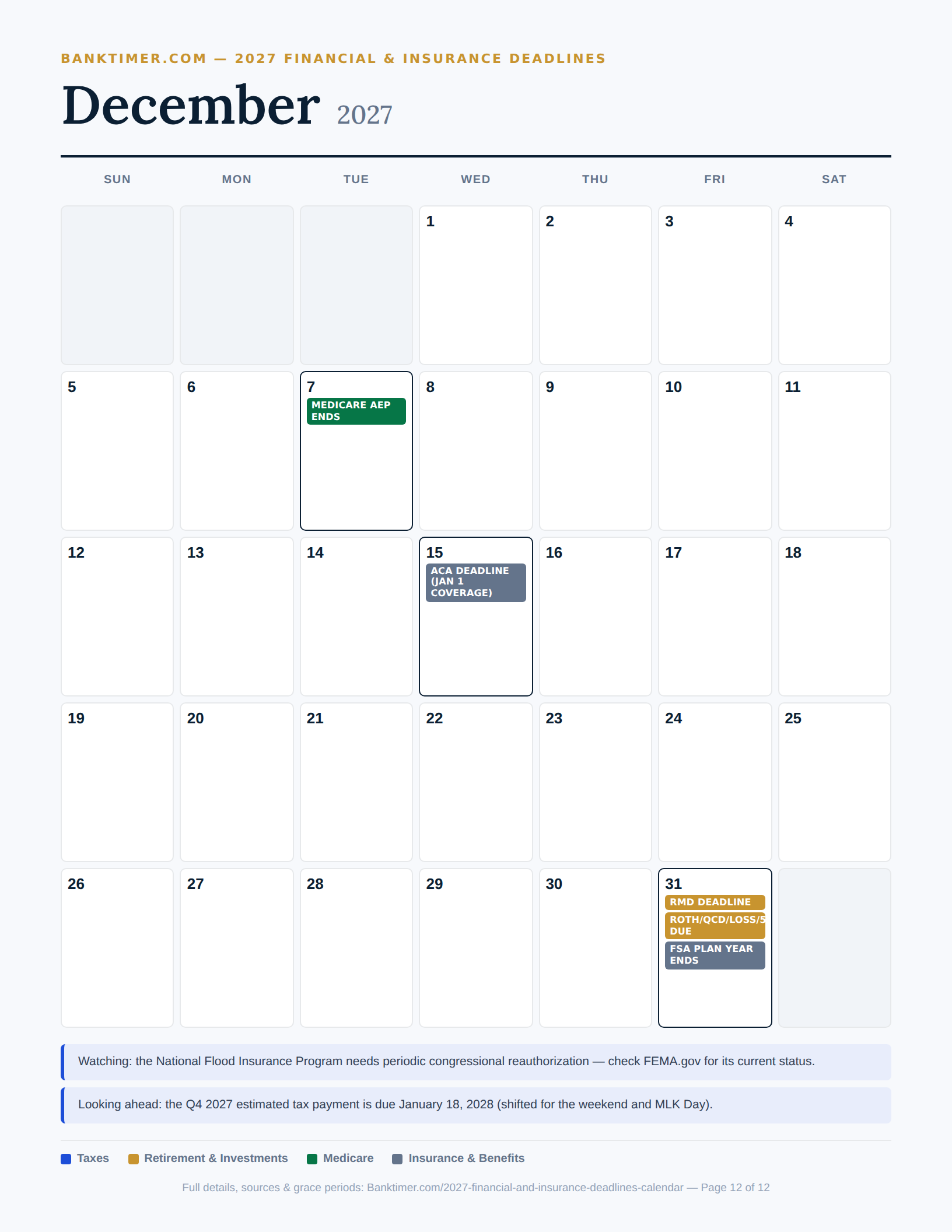
December 7, 2027 — Medicare Annual Enrollment Period Ends
December 7, 2027, a Tuesday, is the hard cutoff for the Medicare Annual Enrollment Period that opened October 15. Any switch between Original Medicare and Medicare Advantage, any change from one Medicare Advantage plan to another, and any change of Part D prescription drug plan needs to be locked in by this date to take effect January 1, 2028.
After December 7, the options narrow considerably. Changes generally require a Special Enrollment Period tied to a specific qualifying event, such as moving, losing other coverage, or a plan leaving the Medicare program, or waiting for the next full AEP a year later. The one exception is the narrower Medicare Advantage Open Enrollment Period, which reopens in January through March and allows one additional switch, but only for people already enrolled in Medicare Advantage.
December 15, 2027 — ACA Marketplace Deadline for January 1, 2028 Coverage
December 15, 2027, is the deadline to enroll in or change an ACA Marketplace plan through HealthCare.gov if you want coverage effective January 1, 2028, with no gap — the enrollment window itself, covered earlier in this calendar, opened November 1.
Miss this date, and you still have until the final cutoff of January 15, 2028, to enroll or switch plans, but the coverage effective date shifts accordingly. Enrolling after December 15 pushes your coverage start to February 1, 2028, instead of January 1, which means a full month, all of January, with no Marketplace coverage in place at all.
December 31, 2027 — Required Minimum Distribution Deadline
December 31, 2027, a Friday, is the deadline for anyone already required to take Required Minimum Distributions (RMDs) to take their 2027 RMD from tax-deferred retirement accounts: Traditional IRAs, SEP and SIMPLE IRAs, 401(k)s, and similar employer-sponsored plans. The RMD starting age is currently 73 under SECURE 2.0, a threshold that’s scheduled to rise to 75 starting in 2033 but doesn’t change for 2027.
There’s one exception, and it comes with a trap worth understanding before using it. Someone taking their very first RMD ever gets until April 1, 2028, instead of December 31, 2027, the “required beginning date.” But delaying to that later date means taking two RMDs in 2028: the delayed 2027 distribution and the regular 2028 distribution, both landing in the same tax year. Stacking two years of distributions into one can push someone into a meaningfully higher tax bracket for that year, so the delay option, while legal and available, isn’t automatically the smarter move just because it’s allowed.
The penalty for missing an RMD altogether is among the steepest on this entire calendar: a 25% excise tax on the amount that should have been withdrawn but wasn’t, reduced to 10% if the shortfall is corrected within a certain window under SECURE 2.0, but 25% is still the default if the mistake goes uncorrected.
December 31, 2027 — Calendar-Year FSA Plan Year Ends
For anyone whose employer runs a calendar-year Flexible Spending Account with no grace period and no carryover option, December 31, 2027, a Friday, is the hard use-it-or-lose-it cutoff, distinct from the grace-period extension covered earlier in this calendar’s March entry, which only applies to employees whose specific plan actually offers that grace period or a carryover feature. Check your own plan documents, because not every FSA works the same way.
What “use” means here trips people up regularly: the expense needs to be incurred, meaning the service actually received or the item actually purchased, by December 31, not merely submitted for reimbursement by December 31. Submitting a claim in January for an eligible expense that happened back in December is completely fine. Scheduling a procedure or making a purchase in January and trying to apply it against 2027’s FSA money is not, no matter how quickly the claim gets filed afterward.
December 31, 2027 — Other Year-End Money Moves: Roth Conversions, Charitable Distributions, Tax-Loss Harvesting, and 529 Contributions
Four separate year-end deadlines converge on December 31, and each deserves its own attention.
Roth conversions, moving money from a Traditional IRA or 401(k) into a Roth account, must be completed by December 31 to count for the 2027 tax year. Unlike a regular IRA contribution, which you can technically make up until the following April, there’s no extension available for a conversion; once the year closes, that year’s opportunity closes with it. A conversion creates taxable income in the year it happens, so the amount converted, and its timing relative to your other income that year, is worth deciding deliberately rather than defaulting to a round number in late December.
Qualified Charitable Distributions (QCDs), a direct transfer from an IRA to a qualifying charity, available starting at age 70½, must also be completed by December 31 to count toward that year’s RMD and be excluded from taxable income. The word “completed” matters here: your IRA custodian needs enough lead time to actually process and send the transfer to the charity, not just receive your instruction. Waiting until the last week of December is genuinely risky — a delay on the custodian’s end can push the transfer into January, and a QCD that lands in the wrong tax year doesn’t count for the year you needed it to.
Tax-loss harvesting, selling investments at a loss to offset capital gains elsewhere in your portfolio, requires the trade to actually settle, not just be placed, by December 31. A sell order entered on December 30 that doesn’t settle until early January misses the year. Watch the wash-sale rule too: repurchasing a “substantially identical” investment within 30 days before or after the sale disqualifies the loss for tax purposes.
529 education savings plan contributions round out the list, with a state-specific wrinkle worth flagging clearly: many states tie a state income tax deduction to contributions made by December 31, but this genuinely varies by state, and a handful of states allow contributions made as late as the following spring to still count toward the prior year’s deduction. Check your own state’s specific rule rather than assuming December 31 is a universal cutoff, because for 529 plans, it isn’t.
Watching the National Flood Insurance Program’s Reauthorization
This isn’t a single-date deadline; it’s an ongoing risk worth checking on periodically throughout 2027. The National Flood Insurance Program (NFIP) hasn’t been permanently authorized by Congress since 2017. Instead, it’s been kept alive through dozens of short-term reauthorizations, often passed at the last possible moment. As of the most recent research, NFIP’s authority was tied to a continuing government-funding resolution extending only through December 11, 2026, which means Congress will already need to have acted again just to keep the program running before this 2027 calendar year even gets underway, and further short-term extensions, or an actual lapse, remain a real possibility at multiple points during the year.
A lapse isn’t just a paperwork problem. During a lapse, the NFIP generally cannot sell new flood insurance policies, cannot increase coverage limits on existing policies, and cannot renew policies that are expiring, though policies already in force generally continue to pay valid claims. That combination can directly stall home sales in flood zones where a lender requires flood insurance to close, and it can leave homeowners whose policy expires mid-lapse with no coverage at all, at the exact moment a storm doesn’t care whether Congress has done its job.
The program has always eventually been reauthorized so far, sometimes within days of a deadline. That track record is reassuring, but it isn’t a guarantee, and it isn’t a reason to stop checking. Anyone with NFIP coverage, or anyone shopping for a home in a flood zone during 2027, should check FEMA.gov periodically for the program’s current authorization status rather than assuming the status quo holds automatically.
Looking Ahead: What Carries Into January 2028
This calendar closes at the end of 2027, but a few obligations tied to the 2027 tax and benefits year don’t actually come due until just after. The fourth-quarter 2027 estimated tax payment is due January 18, 2028, not January 15 — January 15, 2028, falls on a Saturday, and the next business day, January 17, is Martin Luther King Jr. Day, a federal holiday, which pushes the actual deadline to Tuesday, January 18, 2028. W-2s and 1099s reporting 2027 wages and income are due to recipients by January 31, 2028.
It’s worth keeping in mind that “the tax year” and “the calendar year” aren’t quite the same thing. The obligations tied to 2027 don’t fully wrap up the moment the ball drops on New Year’s Eve — a handful of them spill a few weeks into the new year, worth having on your radar before 2028 planning takes over.
What This Calendar Doesn’t Cover (and Why That Matters)
This calendar focuses on federal deadlines that apply nationwide, because those are the ones that hold regardless of where you live. That focus means several genuinely important dates are deliberately left out or only briefly flagged, and it’s worth knowing what’s missing before you treat this as your only calendar.
State income tax filing deadlines aren’t covered here in detail. Most states that levy an income tax align their filing deadline with the federal April date, but not universally — a handful set their own date, and state extension rules don’t always mirror the federal Form 4868 process exactly. Check your own state’s department of revenue directly rather than assume your state deadline matches April 15, 2027 automatically.
State insurance regulation isn’t covered here either, beyond the federal National Flood Insurance Program. Auto insurance renewal timing, homeowners insurance non-renewal notice periods, and state-specific insurance grace periods are set by each state’s Department of Insurance and by individual insurers, not by a single federal calendar — there’s no national standard to list the way there is for Medicare or the ACA Marketplace.
Property tax deadlines are set at the county or municipal level in nearly every state, with enormous variation even within a single state, so they sit outside the scope of a national calendar entirely. Check your local county assessor or tax collector’s website directly.
A handful of entries in this calendar are flagged throughout as estimates or typical patterns rather than confirmed 2027-specific dates — the 2028 Social Security COLA announcement, the 2028 Medicare Part B premium announcement, and the exact status of the National Flood Insurance Program’s reauthorization all fall into this category, because the agencies involved simply hadn’t made those announcements as of when this calendar was researched. Where a date is confirmed by statute, like April 15 or October 15, that confirmation is stated plainly; where it’s a pattern rather than a lock, that’s stated plainly too.
Finally, this guide is educational information, not personalized tax, legal, financial, or insurance advice. Deadlines, penalty amounts, and eligibility rules can change with new legislation, and your own specific situation — your state, your income, your account types, your filing status — can shift which of these deadlines actually apply to you and how. Treat this as the map, not the final word, and confirm anything with real money attached against the primary source or a qualified professional before acting.
Common Misconceptions About Financial and Insurance Deadlines
“An extension gives me more time to pay, not just to file.” This is backwards, and it’s the single most expensive misunderstanding on this whole calendar. Form 4868 and its business equivalents extend the paperwork deadline only — any tax owed is still due on the original date, and interest plus a failure-to-pay penalty start accruing immediately on anything unpaid, whether or not you’ve filed an extension.
“The Medicare Annual Enrollment Period is the only chance I’ll ever get to change my coverage.” Medicare actually runs on four separate enrollment calendars — your personal Initial Enrollment Period, the January-to-March Medicare Advantage Open Enrollment Period, the January-to-March General Enrollment Period, and the fall Annual Enrollment Period — plus Special Enrollment Periods tied to specific life events. AEP is simply the best-known one, not the only one.
“If I don’t owe any additional tax, missing the April 15 deadline doesn’t really matter.” There’s technically no penalty for filing late if you’re due a refund, but that’s not the same as “it doesn’t matter” — you have to file within three years of the original deadline to claim that refund at all, or it’s forfeited to the U.S. Treasury permanently, and you won’t know for certain you don’t owe anything until you actually calculate it.
“My FSA money is safe as long as I submit my reimbursement claim before the deadline.” What actually matters is when the expense was incurred — the service received or the item purchased — not when you filed the paperwork for it. Submitting a claim in January for a December expense is fine; getting a procedure done in January and trying to apply it against last year’s FSA money is not.
“Flood insurance is only something I need to think about if I live in a mapped high-risk flood zone.” FEMA’s own flood maps are conservative estimates, not guarantees, and homes outside the highest-risk zones flood too, sometimes in meaningful numbers, which is exactly why the 30-day waiting period on a new policy matters even for someone who doesn’t think of themselves as “in a flood zone” at all.
“A federal deadline is a federal deadline everywhere in the country.” Several of the dates in this calendar are federal defaults, not universal ones — state-based ACA marketplaces, state tax filing deadlines, and state insurance rules can all differ from the federal date, sometimes by weeks. Check your own state’s specific rule before assuming the national date applies to you.
Banktimer Bottom Line
Nearly every deadline on this calendar is really two things at once: a specific date, and a specific consequence attached to missing it. The date without the consequence is trivia; the consequence without the date is useless. Knowing that April 15 is Tax Day matters less than knowing that missing it without an extension costs five times more per month than missing it with one — and knowing that December 31 is “FSA season” matters less than knowing your specific plan might actually give you until mid-March. The deadlines that cost people real money are rarely the ones they didn’t know existed; they’re the ones they knew about in the abstract but never pinned down the actual date, actual grace period, and actual penalty for. This calendar exists to close that specific gap, one month at a time.
Frequently Asked Questions
What’s the single most important deadline on this calendar?
For most people, it’s April 15, 2027 — the federal individual tax filing deadline. It carries the steepest and most universal consequences of any date here, and it also anchors several other deadlines (the IRA/HSA contribution cutoff and the first quarterly estimated tax payment) that land on the exact same day.
Does filing a tax extension give me more time to pay?
No. Form 4868 and its business equivalents extend only the deadline to file your paperwork, not the deadline to pay. Any tax owed is still due on the original date, and interest plus a failure-to-pay penalty accrue from that date regardless of whether you’ve extended your filing deadline.
What happens if I miss the Required Minimum Distribution deadline?
The IRS charges a 25% excise tax on the amount you should have withdrawn but didn’t, reduced to 10% if you correct the shortfall within a certain window under SECURE 2.0. It’s one of the steepest percentage penalties on this entire calendar.
I’m turning 65 in 2027 — which Medicare window actually applies to me?
Your personal Initial Enrollment Period: a 7-month window covering the 3 months before your birthday month, your birthday month, and the 3 months after. It’s separate from the Annual Enrollment Period, the Medicare Advantage Open Enrollment Period, and the General Enrollment Period, all of which serve different situations.
What’s the difference between the Medicare Annual Enrollment Period and the Medicare Advantage Open Enrollment Period?
The Annual Enrollment Period (October 15–December 7) is open to anyone with Medicare and allows a full range of changes for any reason. The Medicare Advantage Open Enrollment Period (January 1–March 31) is much narrower: it’s only for people already enrolled in a Medicare Advantage plan, and it allows exactly one additional switch.
Can I still contribute to my 2026 IRA or HSA after April 15, 2027?
No. Unlike the tax filing deadline itself, the prior-year IRA and HSA contribution deadline doesn’t extend even if you file Form 4868 for your tax return. Once April 15, 2027 passes, the opportunity to fund a 2026 IRA or HSA is gone permanently.
What happens if I miss the ACA Marketplace open enrollment deadline?
Outside of qualifying for a Special Enrollment Period through a specific life event, you generally can’t enroll in marketplace coverage again until the next annual Open Enrollment Period, which wouldn’t take effect until the following year — potentially a full year without marketplace coverage or premium tax credits.
Is my state’s tax deadline the same as the federal one?
Usually close, but not guaranteed. Most states with an income tax align with the federal April date, but some set their own deadline or handle extensions differently. Confirm directly with your state’s department of revenue rather than assuming.
What’s the safe harbor rule for estimated taxes?
You generally avoid the underpayment penalty if your total withholding and estimated payments equal at least 90% of what you owe for the current year, or 100% of what you owed the prior year (110% if your prior-year adjusted gross income was above $150,000), whichever of those two figures is smaller.
Why does my FSA money disappear even though I filed my claim on time?
Because what counts is when the expense was incurred, not when the claim was filed. An expense from December, claimed in January, is fine. An expense from January, meant to apply against the prior year’s FSA balance, isn’t — the service or purchase itself has to fall within the plan year.
What is IRMAA and why does it matter two years later?
IRMAA is a surcharge higher-income Medicare beneficiaries pay on top of standard Part B and Part D premiums, calculated from a tax return filed two years earlier. A large one-time income event now — a Roth conversion, a big capital gain, a home sale — can raise your Medicare premiums two years down the road, long after the decision that caused it.
Is the FAFSA guaranteed to open on October 1, 2027?
It’s legally required to under the FAFSA Deadline Act, but the Department of Education’s recent record is mixed — the 2024–25 and 2025–26 cycles both opened months late. Treat October 1 as the target and watch StudentAid.gov for the actual announcement.
What happens if the National Flood Insurance Program lapses?
During a lapse, the NFIP generally can’t sell new policies, increase coverage on existing ones, or renew policies that are expiring, though policies already in force continue paying valid claims. A lapse can stall home sales in flood zones requiring flood insurance to close.
Do I need to do anything about the May 31 Form 5498?
No. It’s purely informational, reporting your prior-year IRA contributions and account value to you and the IRS. Check it against your own records, but you don’t file it with anything or take any action by that date.
If I live outside the U.S., do these deadlines still apply to me?
Some shift. U.S. citizens and resident aliens living abroad on April 15 automatically get until June 15 to file (though not to pay — interest still starts April 15), and can request a further extension to October 15 the same as domestic filers. Most other deadlines on this calendar apply the same regardless of where you live.
What’s the real penalty difference between missing the April 15 tax deadline outright versus filing an extension and paying late?
Filing on time (or extending) and paying late costs a failure-to-pay penalty of 0.5% of the unpaid tax per month, plus interest. Not filing at all costs a failure-to-file penalty of 5% per month, up to 25% — roughly ten times steeper. The paperwork, not the payment, is what triggers the harsher penalty.
Are the 2027 figures in this calendar final?
Most are — dates fixed by statute (April 15, October 15, the Medicare and ACA enrollment windows) don’t change year to year. A few figures, clearly flagged throughout, hadn’t been officially announced as of this calendar’s research date, including the 2028 COLA, the 2028 Medicare Part B premium, and the National Flood Insurance Program’s authorization status beyond December 11, 2026 — check the relevant agency directly for the final number when the time comes.
Sources
- IRS — Filing Season Information
- IRS — Form 1040-ES, Estimated Tax for Individuals
- IRS — Get an Extension to File Your Tax Return
- IRS — Retirement Topics: Required Minimum Distributions (RMDs)
- IRS — Retirement Topics: IRA Contribution Limits
- IRS Publication 969 — Health Savings Accounts
- IRS — Tax Inflation Adjustments for Tax Year 2026
- IRS — Patriots’ Day and Tax Deadlines
- eCFR — 26 CFR 301.7503-1, Time for Performance of Acts Where Last Day Falls on Saturday, Sunday, or Holiday
- IRS — U.S. Citizens and Resident Aliens Abroad: Automatic 2-Month Extension
- FinCEN — FBAR Due Date
- Medicare.gov — Open Enrollment
- Medicare.gov — When Does Medicare Coverage Start
- HealthCare.gov — Health Coverage Dates and Deadlines
- Federal Student Aid — StudentAid.gov
- Congress.gov — FAFSA Deadline Act (H.R. 8932)
- Social Security Administration — Cost-of-Living Adjustment Information
- CMS — Medicare Parts B Premiums and Deductibles
- FEMA — NFIP Congressional Reauthorization
- Congressional Research Service — NFIP: Status and Remaining Issues (IN10835)
Your next step
Pick the single deadline on this calendar closest to today’s date that actually applies to your situation, and put it on your own calendar right now with a reminder set at least two weeks in advance — not the deadline itself, but two weeks before it, so you have real time to act rather than discovering it the day it’s due. That one habit, repeated as each new deadline approaches through the year, is what actually turns a reference document like this one into fewer missed deadlines rather than just an interesting read.