

ACH Transfer: Mistakes to Avoid and a Practical Recovery Plan can look straightforward until fees, timing, eligibility, and fine print start interacting. This Banktimer guide explains ACH transfer problems in practical terms and shows which details deserve verification before you act. You will see realistic examples, common mistakes, questions worth asking, and the trade-offs that matter for different financial situations. Where rates, policies, insurance terms, laws, or eligibility can change, the article points readers to current official sources instead of treating a temporary answer as permanent. Read the full guide before you apply, switch, transfer, dispute, or escalate based on a single headline claim.
ACH transfers move in batches, not instantly. A standard transfer typically settles within one to two business days, and even Same Day ACH just moves that same batch process into the same calendar day — it doesn’t make an ACH transfer behave like a card swipe.
How much you’re liable for an unauthorized ACH debit depends almost entirely on how fast you report it. Regulation E caps your loss at $50 if you report within two business days, at $500 if you report within 60 days of your statement, and offers no cap at all after that window closes.
A transfer you authorized yourself — even one you were tricked into sending — isn’t “unauthorized” under federal law. That’s exactly why Regulation E won’t undo an ACH payment sent to a scammer the same way it can undo a stolen debit card charge.
Nacha’s operating rules give an originator five banking days to reverse a genuinely erroneous or duplicate ACH entry. That’s a completely separate process from the return codes your bank uses and the formal dispute process built for actual fraud.
Same Day ACH’s per-transaction dollar limit has climbed fast: from $25,000 at its 2016 launch to $10 million today. That growth doesn’t mean every bank routes every transfer through the same-day rail by default.
The return code your bank cites tells you which repair process actually applies. Confusing R01 (insufficient funds) with R10 (“I never authorized this”) when you call your bank can slow the entire process down.
Key Numbers to Know
| Figure | Value | Why it matters |
|---|---|---|
| Same Day ACH per-transaction dollar limit (current, 2025 increase) | $10 million | Up from $1 million (2022), $100,000 (2020), and $25,000 at the service’s 2016 launch |
| Reg E liability if you report within 2 business days | $50 cap | The lowest liability tier under 12 CFR § 1005.6 |
| Reg E liability if you report within 60 days of your statement | Up to $500 | Still capped, but ten times higher than the fastest-reporting tier |
| Reg E liability after the 60-day statement window closes | Potentially unlimited | Applies to unauthorized transfers occurring after that window |
| Standard timeline for a bank to investigate a Reg E error claim | 10 business days | Can extend to 45 days total if provisional credit is issued within the first 10 |
| Standard ACH return window (codes R01–R04, R09) | 2 banking days after settlement | Covers routine issues like insufficient funds or a closed account |
| Extended return window for a genuinely unauthorized consumer debit (R05, R07, R10, R11) | Up to 60 calendar days | Recognizes that fraud isn’t always caught within two days |
| Nacha’s deadline for an originator to reverse an erroneous or duplicate entry | 5 banking days after settlement | A separate fix from a bank-initiated return or a formal Reg E dispute |
What an ACH Transfer Actually Is — and Why It Isn’t Instant
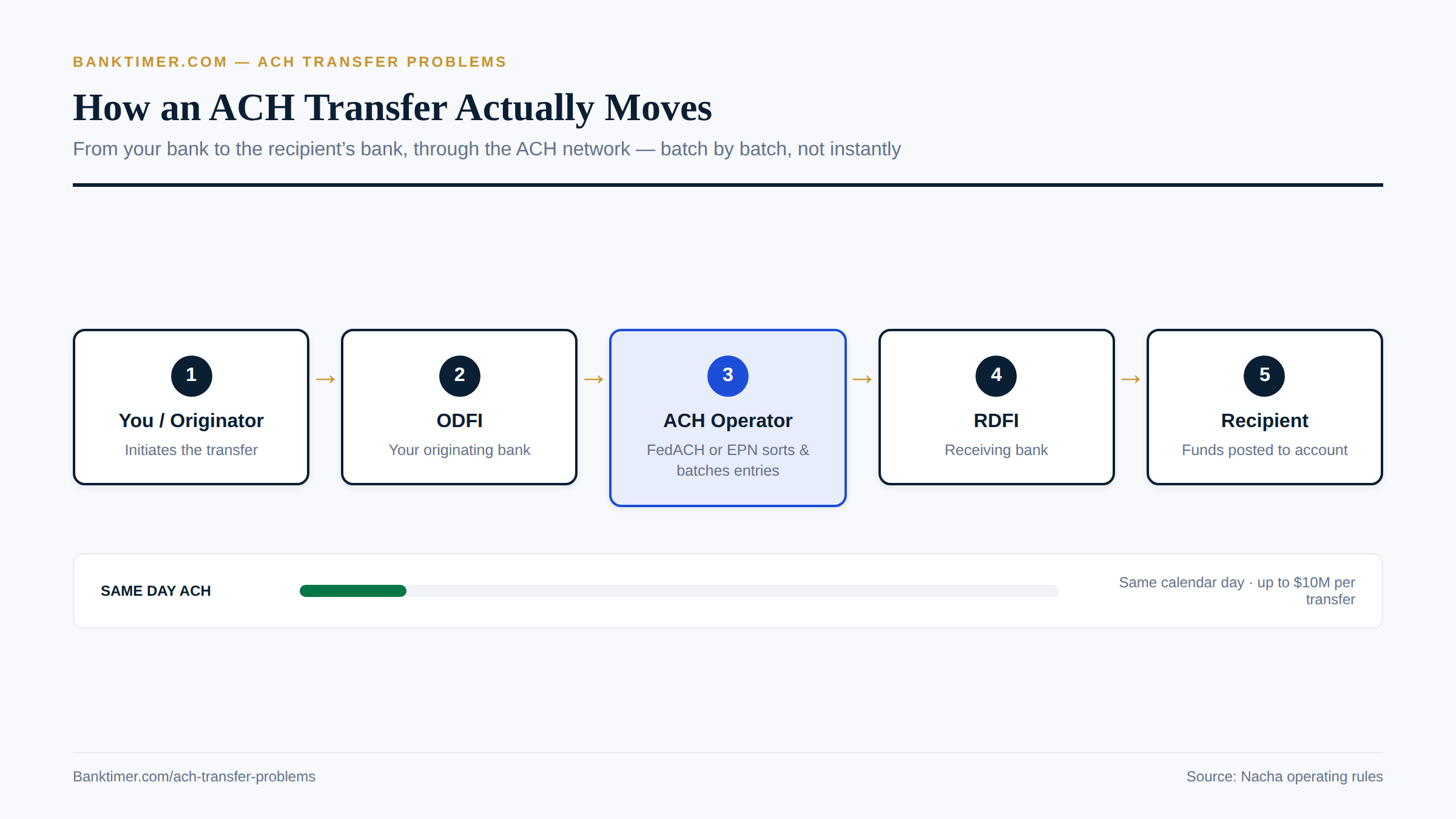
How an ACH transfer actually moves between two banks
An ACH transfer moves money between U.S. bank accounts through the Automated Clearing House network, a batch-processing system governed by Nacha’s operating rules rather than a single instant wire. Your bank collects a day’s worth of ACH entries, bundles them, and sends the batch to an ACH operator — either the Federal Reserve’s FedACH service or The Clearing House’s Electronic Payments Network — which sorts entries by receiving bank and forwards them on. Because the system processes in batches instead of one transaction at a time, “when will this arrive” has always been a schedule question, not a speed question.
How the ACH Network Actually Moves Money
Every ACH transfer has an Originating Depository Financial Institution (the ODFI, your bank if you’re sending money) and a Receiving Depository Financial Institution (the RDFI, the bank on the other end). The ODFI submits the entry to an ACH operator, the operator sorts it, and the RDFI posts it to the recipient’s account once it settles. Because settlement happens in batches at scheduled windows throughout the day rather than continuously, a transfer submitted late in the afternoon often doesn’t process until the next business day’s first window — a delay that has nothing to do with anything going wrong.
Same Day ACH vs. Standard ACH
Standard ACH typically settles within one to two business days. Same Day ACH, launched in 2016 for credits and expanded to debits in 2017, processes that same batch on the same calendar day instead, as long as it’s submitted before the relevant cutoff window. The service has grown considerably since launch: its per-transaction dollar limit started at $25,000, rose to $100,000 in 2020, jumped to $1 million in 2022, and now sits at $10 million following Nacha’s most recent increase. That growth matters for businesses moving large payroll or vendor batches, but it doesn’t guarantee your own transfer used the same-day rail — many banks still default to standard processing unless you specifically request faster handling, so confirm which one applied before assuming a transfer is simply slow.
ACH Credit vs. ACH Debit
An ACH credit pushes money into an account — your paycheck landing via direct deposit, or a bill payment you initiate through your bank. An ACH debit pulls money out — a gym membership charge, a mortgage autopay, or a bill you’ve authorized a company to collect automatically. This distinction matters because the rules protecting you differ: a credit you’re expecting either arrives or it doesn’t, while a debit someone else initiates against your account carries specific rights around authorization, revocation, and disputing an entry you never approved.
Weekends, Holidays, and Bank Processing Calendars
ACH only processes on banking days, which excludes weekends and the same federal holidays your bank branch observes. A transfer submitted Friday evening frequently doesn’t enter a processing batch until Monday, and if Monday happens to be a federal holiday, it slides again to Tuesday. This is one of the single most common sources of “where’s my money” confusion, since nothing has actually gone wrong — the calendar itself is doing exactly what it’s supposed to do. Before assuming a delayed transfer signals a problem, check whether a weekend or holiday sits between the day you submitted it and today, since that alone frequently explains an extra day or two of waiting.
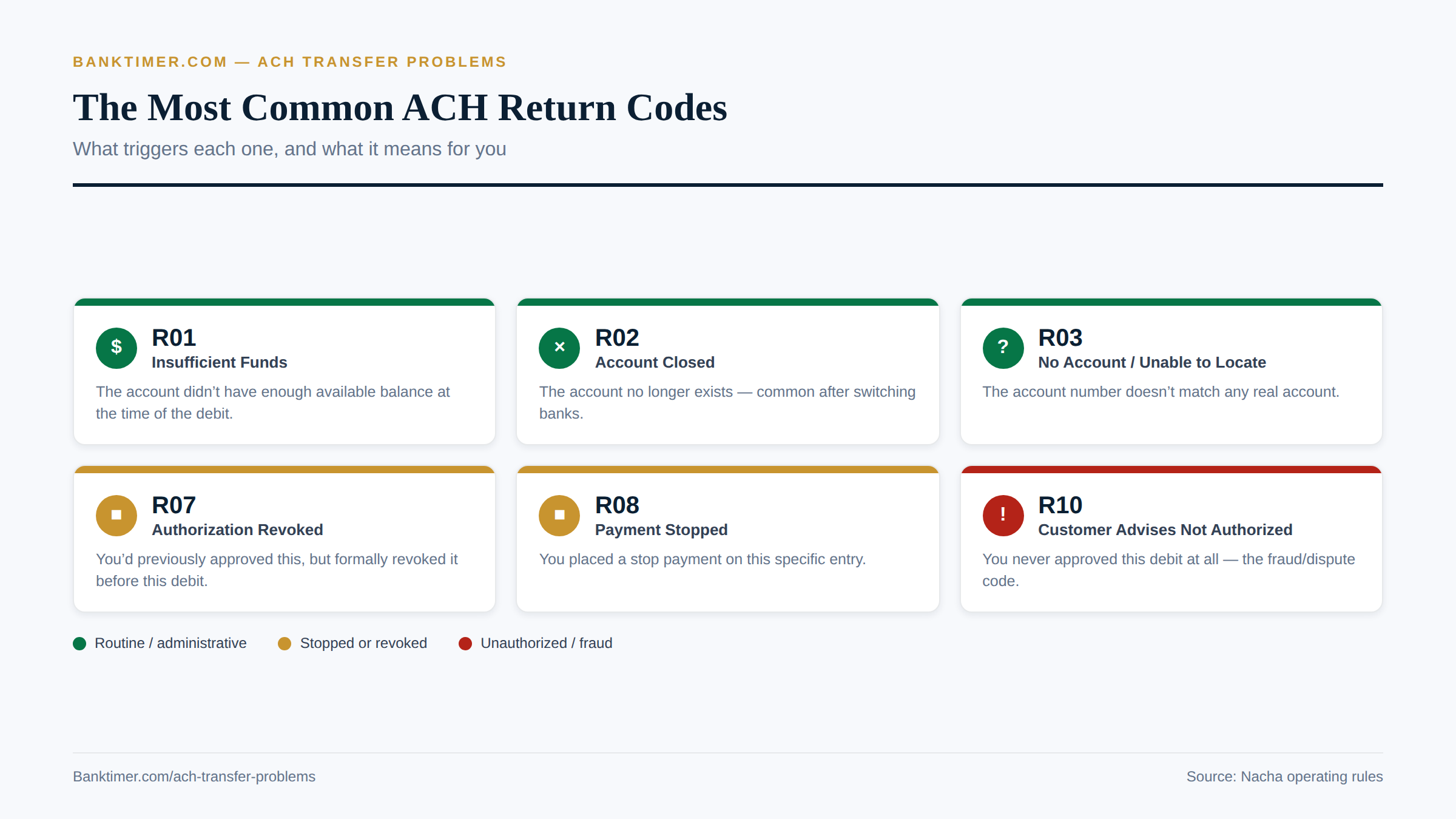
The most common reasons a bank returns an ACH transfer
Diagnosing Your Specific ACH Transfer Problem
Insufficient Funds or a Closed Account (R01, R02)
The most common ACH transfer problems aren’t fraud at all — they’re straightforward mismatches between what an entry expects and what an account can deliver. An R01 return means the account didn’t have enough available balance when the debit hit; an R02 means the account has been closed entirely, often because someone switched banks without updating a recurring payment’s account details.
A Mistyped Routing or Account Number (R03, R04)
Entering one wrong digit in a routing or account number produces an R03 (no account found) or R04 (an invalid account number format) return. These are data-entry problems, not disputes — the fix is almost always confirming the correct numbers and resubmitting, not filing a formal complaint.
A Genuinely Unauthorized Debit (R05, R10, R29)
This is the scenario Regulation E exists for: a debit hit your account that you never approved, from an originator you may not even recognize. R05 specifically covers a consumer account debited using a business-level authorization code without proper consent; R10 covers a broader “I don’t know this originator or never approved this” claim; R29 is the business-account equivalent. None of these assume you did anything wrong — they assume the debit itself was the problem.
A Duplicate or Erroneous Payment You Did Authorize
A landlord’s software double-submits July’s rent debit. A merchant’s system glitches and charges you twice for the same order. You did authorize the underlying payment — the error is that it happened more than once, or for the wrong amount. This is a materially different problem from an unauthorized debit, and it has its own faster fix, covered later in this guide.
A Stop Payment or Revoked Authorization (R07, R08)
R07 means you’d previously authorized recurring debits from an originator but formally revoked that authorization before this specific debit hit. R08 means you placed a stop payment on a specific, individual entry. Both assume some prior authorization existed — they’re not the same claim as “I never authorized anything from this company,” and describing them accurately when you call your bank speeds up the fix.
A Transfer Stuck in Processing or Held for Review
Occasionally a transfer sits in a pending state longer than expected — often because it landed outside a same-day processing window, triggered an automated fraud review, or involved an unusually large amount relative to your typical account activity. This isn’t necessarily a problem requiring escalation; it’s frequently just the batch schedule or a routine risk check working as intended, and it resolves within a business day or two in most cases.
A Large Transfer Held for a Fraud or Risk Review
Banks run automated risk models against ACH activity the same way they do against card transactions, and a transfer that’s unusually large relative to your typical balance or history can trigger a manual hold even though nothing is actually wrong. This happens more often with a first-time large transfer to a newly added external account than with a recurring payment to a recipient you’ve paid many times before. If your bank flags a transfer this way, it will typically reach out directly — by phone, secure message, or app notification — to confirm you initiated it; responding promptly to that specific outreach is usually what releases the hold fastest, faster than calling in cold and asking a representative to track down why a transfer is delayed.
Payroll Direct Deposit Sent to a Closed or Outdated Account
Switching banks without updating your payroll direct-deposit form is a surprisingly common, entirely avoidable ACH problem. Your paycheck arrives as an ACH credit aimed at an account that no longer exists, triggering an R02 return back to your employer’s payroll provider — which then has to manually reissue the payment, often adding several business days before you actually see the money. Because this return runs through your employer’s payroll system rather than your own bank, the fix isn’t a dispute with your bank at all; it’s updating your direct-deposit information with your employer’s HR or payroll department and asking specifically how the returned funds will be reissued.
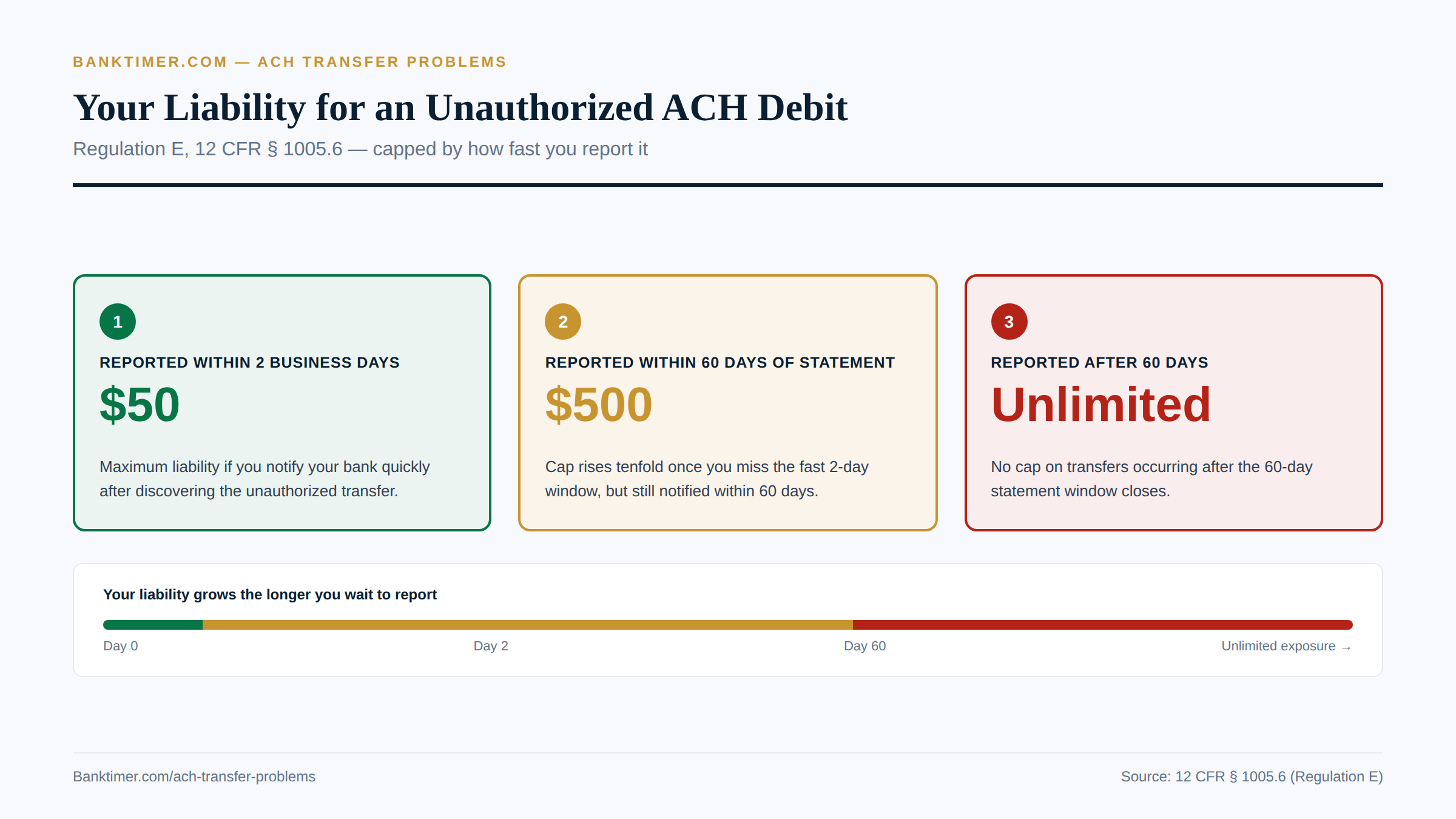
Your liability for an unauthorized ACH debit depends on how fast you report it
Your Rights: What Federal Law Requires vs. What’s Bank Policy vs. What’s a Nacha Rule
Regulation E’s Error-Resolution Timeline
Under 12 CFR § 1005.11, once you notify your bank of a suspected unauthorized transfer, the bank generally has 10 business days to investigate and report its findings. If it needs more time, it can take up to 45 days total, but only if it credits your account provisionally within that initial 10-business-day window while the investigation continues. This isn’t a courtesy your bank extends — it’s a federal requirement with a specific clock attached.
The Three Liability Tiers
Your maximum loss on a genuinely unauthorized ACH debit depends on timing, not on how the fraud happened. Report within two business days of discovering it, and your liability caps at $50. Miss that window but report within 60 days of the statement showing the unauthorized transfer, and the cap rises to $500. Miss the 60-day window entirely, and liability for transfers after that point can be unlimited. The math rewards speed far more than it rewards being right about every detail on the first call.
Nacha Return-Code Timing Isn’t the Same Clock as Reg E
A standard administrative return — insufficient funds, a closed account, a bad account number — must go back within two banking days of settlement. A return tied to a genuinely unauthorized consumer debit gets an extended window of up to 60 calendar days, recognizing that fraud isn’t always caught within 48 hours. These are Nacha operating-rule deadlines governing how banks process returns between themselves; they run alongside, not instead of, your own Regulation E reporting deadlines as a consumer.
What’s Just a Bank’s Internal Policy
The specific form your bank asks you to sign, whether a branch visit is required versus a phone call, and how quickly a provisional credit actually appears in your available balance are set by that bank’s own procedures, not by federal law directly. Two banks handling what looks like an identical unauthorized-debit claim can move at noticeably different speeds because of this — which is exactly why getting a specific timeline in writing from your own bank matters more than assuming a industry-wide standard applies.
Consumer ACH vs. Business ACH: Two Very Different Rulebooks
Why Regulation E Doesn’t Cover Every ACH Transaction
Everything covered so far in this guide about Regulation E — the $50/$500 liability tiers, the 10-business-day investigation clock — applies specifically to consumer accounts used primarily for personal, family, or household purposes. A payment moving between two business accounts, or a business account debited by a vendor, generally falls outside Regulation E’s protections entirely, even though it travels through the exact same ACH network using the exact same return codes.
UCC Article 4A and Commercially Reasonable Security Procedures
Business-to-business ACH and wire activity is instead typically governed by Article 4A of the Uniform Commercial Code, which allocates fraud risk very differently. Rather than a fixed statutory liability cap, UCC 4A generally asks whether the bank and the business followed a “commercially reasonable” security procedure — multi-factor authentication, callback verification, dual-approval requirements — that both parties agreed to in advance. If the bank’s procedure was commercially reasonable and was actually followed, the business, not the bank, often bears the loss from a fraudulent transfer, a materially harsher outcome than the capped liability an individual consumer faces under Regulation E for the same type of fraud.
What This Means If You Run a Small Business
A sole proprietor or small-business owner using a personal checking account for business payments may retain Regulation E’s consumer protections, while the same person using a dedicated business checking account generally doesn’t. This distinction is worth confirming directly with your bank before you need it, since discovering which rulebook applies only after a fraudulent transfer has already happened is far too late to negotiate a better security procedure.
Verifying a New Recipient Before You Send an ACH Transfer
Micro-Deposit Verification
The traditional way to confirm you have the right account and routing numbers before sending or authorizing an ACH transfer is micro-deposit verification: your bank or a payment platform sends one or two small deposits, often just a few cents, to the external account, and you confirm the exact amounts back through the platform to prove you control that account. This process typically takes one to two business days and directly prevents the R03/R04 return-code problems covered earlier in this guide, since it catches a wrong account number before a full-size transfer ever attempts to use it.
Instant Account Verification
Many banks and fintech apps now offer instant verification instead, where you log into your other bank’s online account directly through a secure connection to confirm ownership immediately rather than waiting for micro-deposits to post. This is faster, but it’s still worth confirming you’re logging in through your actual bank’s real interface rather than a look-alike page, since this verification step is exactly the kind of moment a phishing attempt tries to intercept.
Why Skipping Verification Causes Real Problems
Entering a new recipient’s account and routing numbers manually, without any verification step, is where most of the data-entry mistakes covered earlier in this guide originate. A single transposed digit produces a return at best, or — in rarer but more serious cases — a successful transfer to a stranger’s account at worst, since the ACH network generally matches on the account number itself rather than cross-checking the name attached to it. Using your bank’s built-in verification step, even when it feels like an extra delay, is one of the simplest ways to prevent an ACH transfer problem before it ever starts.
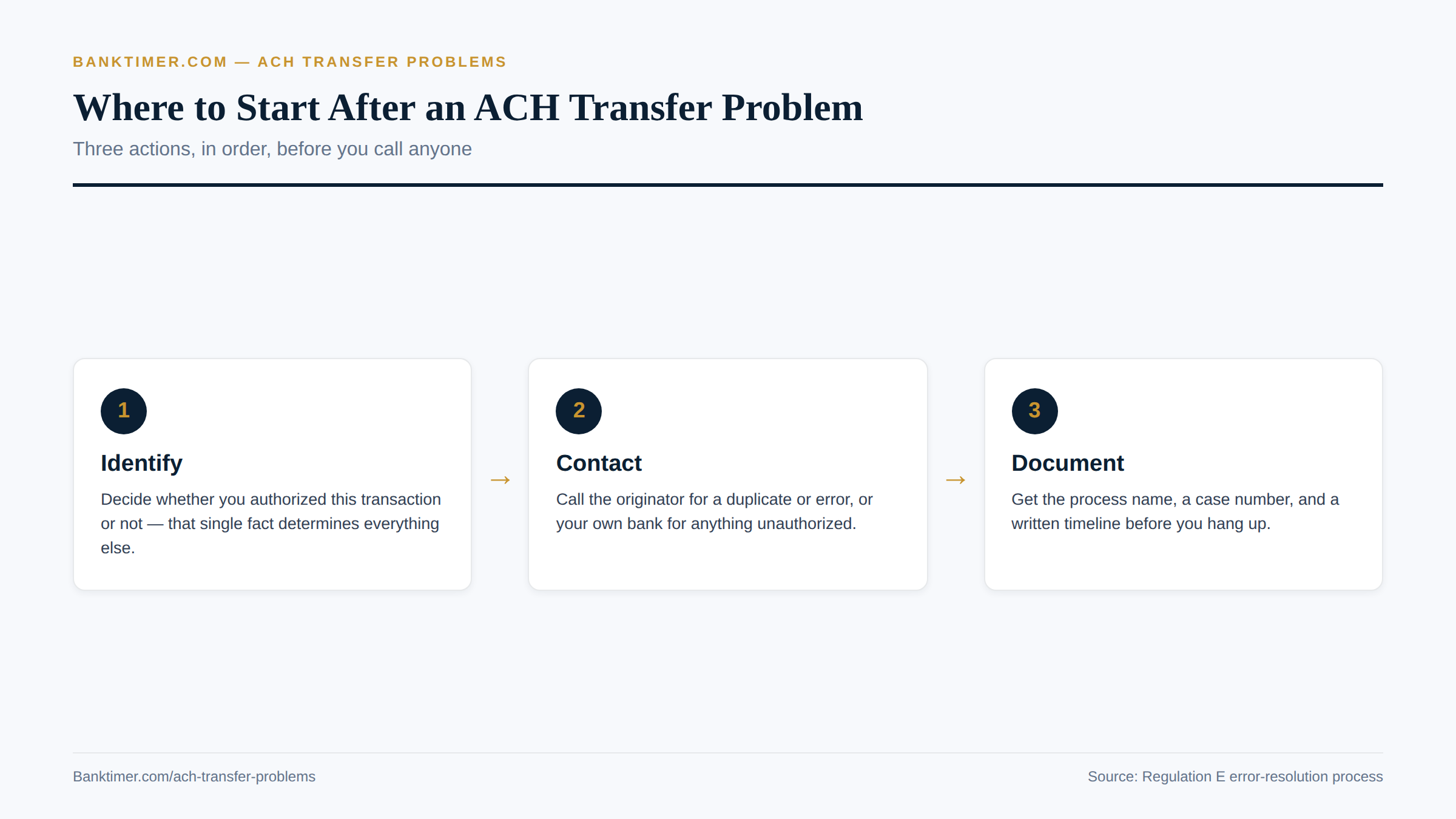
Where to start once you’ve spotted the problem
Step-by-Step: What to Do When an ACH Transfer Goes Wrong
Step One: Identify Whether You Authorized This Transaction at All
Before calling anyone, decide honestly which category this falls into: a transaction you knowingly approved (even if you were deceived about why), a transaction you approved once but that repeated without permission, or a transaction you never approved in any form. This single distinction determines which entire process applies.
Step Two: Gather the Exact Date, Amount, and Any Reference Number
Pull up your statement or online banking record and note the settlement date, the exact dollar amount, the originator’s name as it appears on the transaction, and any trace or reference number attached to the entry. Vague descriptions slow down every step that follows.
Step Three: Contact the Originator Directly if the Problem Is a Duplicate or Error
For a duplicate charge or an amount error on a transaction you did authorize, contact the company or person who initiated it first. Ask specifically whether they’ll submit a Nacha reversing entry — remember, this only works within five banking days of the original settlement date, so speed matters here more than almost anywhere else in this process.
Step Four: Contact Your Own Bank for Anything Involving Unauthorized Access
For a transaction you never approved, contact your bank — not the originator — since Regulation E’s protections run through your relationship with your own financial institution. State plainly that the transaction was unauthorized, provide the specific details from Step Two, and ask for a formal error-resolution investigation to be opened, not just a general inquiry.
Step Five: Ask Your Bank Which Specific Process It’s Using
Explicitly ask whether your bank is treating this as a standard return, a request for a Nacha reversal, or a formal Regulation E investigation, since these carry different timelines and different documentation requirements. A bank representative who can’t answer this clearly is worth escalating past.
Step Six: Revoke Future Authorization in Writing if the Debits Are Recurring
If an originator has standing authorization to debit your account and you want that to stop going forward, revoke it in writing — an email or a dated letter works — rather than relying only on a verbal call. A written revocation is what supports an R07 return if the originator debits you again anyway.
What to Document From the Start
Keep a simple running log: every call’s date, the representative’s name, what was said, and any reference or case number provided. Save a copy of the statement showing the disputed transaction, and screenshot the transaction detail in your banking app while it’s still visible, since some interfaces limit how far back detailed transaction views go. If you send a written revocation of authorization or a formal dispute letter, keep a dated copy and, where possible, proof it was received — a delivery confirmation, a read receipt, or a bank’s own acknowledgment. This documentation becomes the difference between a quick resolution and a drawn-out disagreement about what was actually said on a call three weeks ago.
Same Day ACH and the $10 Million Limit: What Actually Changed
Same Day ACH wasn’t always built for large transfers. When it launched in September 2016, credits only could move same-day, capped at $25,000 per transaction — a limit clearly aimed at smaller consumer and business payments, not payroll runs or large vendor settlements. Nacha expanded the service to debits in 2017, then raised the per-transaction ceiling three times in five years: to $100,000 in March 2020, to $1 million in March 2022, and most recently to $10 million. Each increase reflected growing demand to move genuinely large payments same-day instead of relying on a wire transfer.
What hasn’t changed is that Same Day ACH is a capability banks opt into offering, not something automatically applied to every transfer you make. Some banks pass the same-day speed through by default for eligible transfers; others still require you to specifically request faster processing, sometimes for an added fee. If a transfer you expected to move quickly instead took the standard one-to-two-day path, the more likely explanation is that it simply used standard ACH rather than Same Day ACH — not that something went wrong. Confirming which rail a specific transfer used, directly with your bank, is worth doing before assuming a delay is an error.
What ACH Transfers Actually Cost
Standard ACH Is Usually Free for Consumers
Most banks don’t charge consumers for a standard ACH transfer between their own linked accounts or for an ACH bill payment initiated through online banking — it’s one of the cheapest ways to move money precisely because it settles in a batch rather than requiring the individualized handling a wire does. This is worth knowing specifically because a fee appearing on an otherwise-routine ACH transfer is itself worth double-checking rather than assuming it’s standard.
Same Day ACH Can Carry a Fee, But Not Always
Where a fee does show up, it’s often tied to requesting faster, same-day processing rather than to the ACH transfer itself. Some banks pass this fee directly to the consumer requesting expedited handling, commonly in a modest single-digit-to-low-double-digit dollar range, while others absorb it or don’t offer consumer-initiated Same Day ACH at all. Confirming whether a specific transfer will carry a same-day fee before you request faster processing avoids an unpleasant surprise on your statement.
How ACH Fees Compare to Wires and Instant P2P Apps
A domestic outgoing wire transfer commonly costs noticeably more than even an expedited ACH transfer, reflecting the wire’s same-day finality and the more manual verification involved on the bank’s side. Instant transfers through P2P apps typically charge a percentage-based fee for immediate access to funds, rather than a flat fee, which can cost more than a standard ACH transfer in dollar terms for a larger amount even though it feels like a small percentage. None of these figures are fixed industry-wide — each bank and app sets its own fee schedule — so comparing your specific options before a large or recurring transfer is worth the few minutes it takes.
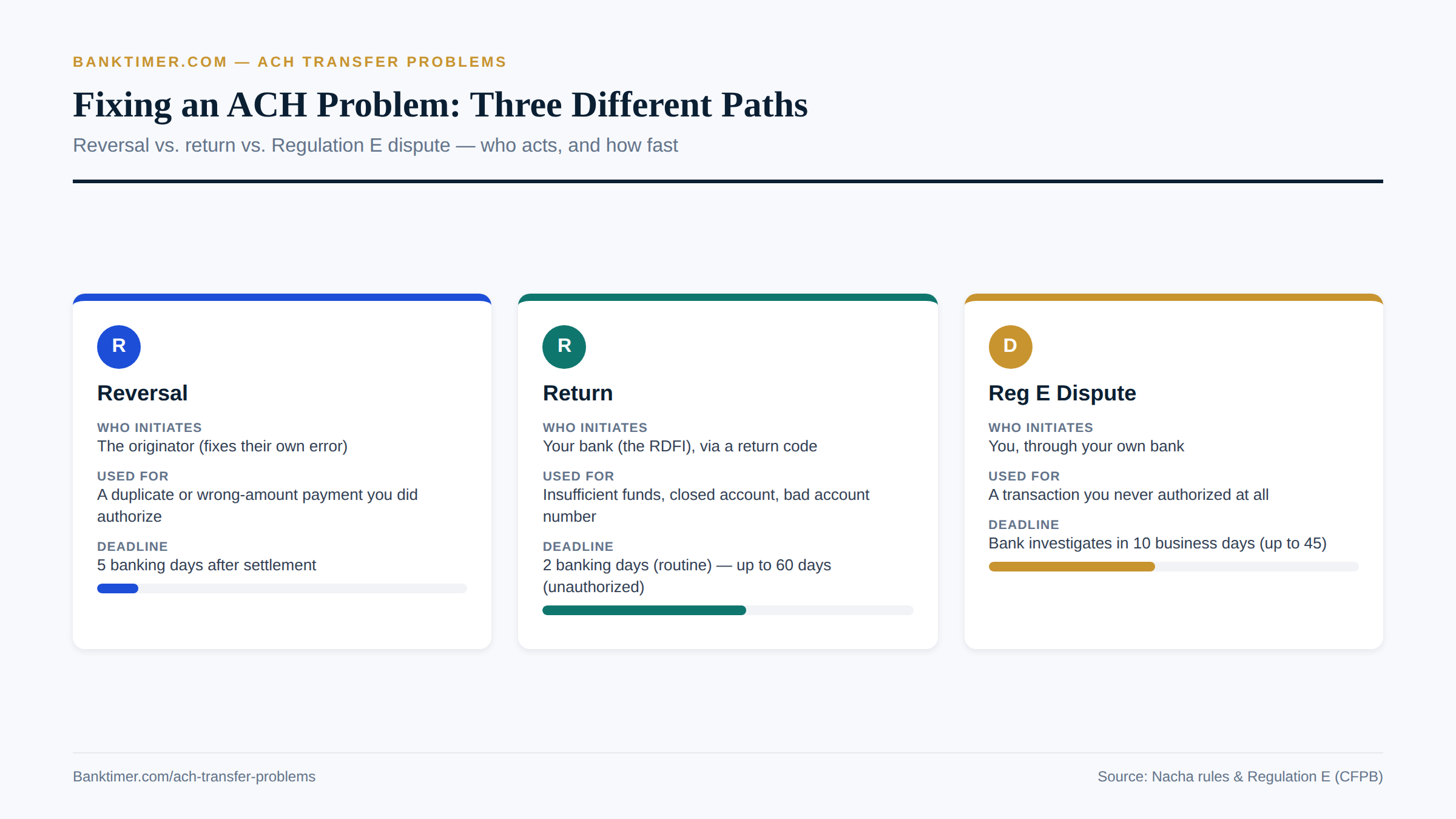
Three different problems need three different fixes
Reversals vs. Returns vs. Disputes: Three Different Fixes for Three Different Problems
These three terms get used almost interchangeably in casual conversation, but they describe three distinct legal and operational processes, each with its own timeline and its own party responsible for initiating it.
A Reversal Corrects the Originator’s Own Mistake
A reversal is something the originator — the party who created the entry, like your landlord’s property manager or a merchant’s payment processor — initiates to correct their own duplicate or erroneous entry. Nacha’s rules require this within five banking days of the original entry’s settlement date, and the reversing entry must carry the word “REVERSAL” in its description field along with the same amount, entry class code, and company identification as the original. Because you didn’t create the error, you generally don’t need to prove anything beyond that the duplicate or wrong-amount charge actually happened.
A Return Is How a Bank Sends an Entry Back
A return happens when the RDFI — your bank, if money was debited from your account — sends the entry back to the originating bank using one of the standard return codes covered earlier in this guide. Some returns happen automatically (insufficient funds, a closed account); others happen because you specifically told your bank the debit was unauthorized or that you’d revoked authorization, triggering an R10 or R07 return on your behalf.
A Dispute Is Your Formal Claim Under Federal Law
A dispute, in the Regulation E sense, is the formal error-resolution process you invoke with your own bank for a transaction you’re asserting was unauthorized. It comes with the specific rights covered above: a defined investigation timeline, provisional credit rules, and the tiered liability caps tied to how quickly you reported it. Unlike a reversal or a routine return, a dispute exists specifically because federal consumer-protection law requires banks to offer it — it isn’t just an internal bank courtesy.
A Realistic Comparison: How Different ACH Transfer Problems Get Fixed
| Problem type | Who initiates the fix | Typical mechanism | Typical timing | What you need to provide |
|---|---|---|---|---|
| Your account lacked sufficient funds | Your bank, automatically | Standard return (R01) | Within 2 banking days of settlement | Nothing — but expect an NSF fee |
| A data-entry mistake in account or routing numbers | Your bank or the originator | Standard return (R03/R04) or manual correction | Often the same processing cycle to a few banking days | Confirmation of the correct account details |
| A duplicate or wrong-amount charge you did authorize | The originator | Nacha reversing entry | Must be initiated within 5 banking days of settlement | Proof of the duplicate or error, request to the originator |
| A transaction you never authorized at all | You, through your own bank | Regulation E error-resolution investigation | Bank has 10 business days (up to 45 with provisional credit) | Written notice within 60 days of the statement |
| A company kept debiting after you revoked authorization | You, through your bank | R07 return, supported by your written revocation | Within 2 banking days once the return is filed | Proof you revoked authorization in writing |
A Real-World Example: Three ACH Transfer Problems
A property management company’s software glitches and submits the same tenant’s monthly rent debit twice in one week. The tenant notices the duplicate within two days and calls the property manager directly, who confirms the error and requests a Nacha reversing entry from their bank — well within the five-banking-day window — and the extra debit is reversed without the tenant ever needing to invoke a formal dispute.
A gym member cancels a membership in writing, but the gym’s billing system incorrectly “reactivates” the account four months later and resubmits a debit using the member’s old payment authorization. The member notices within a week, reports it to their own bank as unauthorized, receives provisional credit while the investigation proceeds, and the bank rules in the member’s favor within its 10-business-day window once the gym can’t produce a valid current authorization.
Someone renting an apartment they’ve only seen in photos is told by the “landlord” to send the deposit by ACH transfer instead of a card, since a card payment can be “reversed too easily.” They send the routing and account numbers directly, and the landlord disappears immediately afterward. Because this person authorized the transfer themselves — even though they were deceived about who they were sending it to — Regulation E’s unauthorized-transfer protections don’t apply the way they would to a stolen debit card. This case illustrates one of the sharpest limits in this entire area of consumer protection: authorization, not good faith, is the legal line that determines what recourse exists.
A worker switches banks in January but forgets to update the direct-deposit form on file with payroll. Their first paycheck at the new employer goes out as an ACH credit aimed at the closed account, bounces back to the payroll provider as an R02 return, and sits in limbo for nearly a week while payroll manually reissues it to the correct account — a delay that traces entirely back to one unchanged form, not to any failure of the ACH network itself.
A small business owner authorizes a new vendor’s ACH debit for a recurring service without micro-deposit or instant verification, relying only on the account and routing numbers the vendor emailed over. A single transposed digit in the account number sends the first payment to an unrelated stranger’s account instead of the vendor’s, and because the transfer succeeded rather than bouncing back as a return, recovering the misdirected funds requires the receiving bank’s cooperation rather than a simple reversal — a direct illustration of why verifying a new recipient before the first transfer matters more than it might seem.
Common Mistakes People Make With ACH Transfers
A frequent mistake is treating every ACH problem as fraud and filing a formal Regulation E dispute when the situation is actually a duplicate or erroneous payment that would resolve faster through a direct reversal request to the originator. Another is assuming ACH behaves like an instant P2P app, then panicking about a “missing” transfer that’s simply still inside its normal one-to-two-business-day settlement window. A third is confusing a request to stop future recurring debits (which calls for a written revocation and, if needed, an R07 return) with a dispute over a single past payment (which calls for a different return code and a different explanation to the bank). A fourth is waiting past the 60-day statement window to report something that actually was unauthorized, converting what could have been a $50 loss into an uncapped one. A fifth is assuming that because a payment was made by ACH rather than by wire, it’s automatically easy to claw back — reversibility depends on whether the payment was authorized and how quickly the error is caught, not on the payment rail alone. A sixth is skipping micro-deposit or instant verification when adding a new external account, treating it as an unnecessary delay rather than the single easiest way to prevent a misdirected transfer in the first place. A seventh, specific to small-business owners, is assuming Regulation E’s consumer liability caps automatically apply to a business checking account — when a business’s ACH and wire fraud risk is generally governed by UCC Article 4A’s commercially-reasonable-procedure standard instead, which can leave a business bearing far more of a fraud loss than an individual consumer would.
Red Flags Worth Slowing Down For
Someone Insisting on ACH Specifically Because “It’s Harder to Reverse”
A legitimate transaction rarely requires a specific payment method chosen for its resistance to reversal. When a counterparty steers you toward a bank transfer instead of a card or platform with built-in buyer protections, treat that steering itself as worth questioning.
A Request for Your Routing and Account Number From an Unverified Stranger
Sharing bank account details with someone you’ve only interacted with online — especially under time pressure — removes your ability to stop a transfer once it’s sent, since you authorized it, however you were persuaded to do so.
An Unfamiliar Recurring Debit Using a Corporate Authorization Code
A debit appearing under an R05-eligible corporate code, from a company you don’t recognize authorizing at all, is worth reporting to your bank promptly rather than assuming it will resolve itself.
A “Confirm Your Bank Details Again” Message via Text or Email Link
Any unsolicited request to re-enter your account or routing number through a link — rather than by logging into your bank’s app or website directly — deserves independent verification with your bank before you respond.
An Unexpectedly Large Incoming Credit Followed by Pressure to Send Part of It Back
A common scam pattern involves an ACH credit arriving that’s larger than expected, followed by urgent pressure to wire back the “overpayment.” The original credit can later be reversed or returned once discovered as fraudulent, potentially leaving you responsible for money you already sent elsewhere.
A “Guaranteed” Investment or Loan Requiring ACH Authorization Instead of a Card
Any offer that specifically insists on an ACH debit authorization — rather than a credit card, which carries its own separate dispute rights — while promising guaranteed, unusually high returns or a loan approval regardless of credit history, combines two red flags at once: an outsized promise and a payment method chosen specifically for how hard it is to unwind.
Questions to Ask Before You Dispute or Escalate an ACH Transfer Problem
Before you dispute or escalate
- ☐ Do I know whether this was a transaction I authorized (even under false pretenses) or one I never approved at all?
- ☐ Am I still within 60 days of the statement showing this transaction?
- ☐ Do I have the exact date, amount, and any reference or trace number for the transfer?
- ☐ Have I contacted the originator directly to ask about a reversal before assuming I need a formal dispute?
- ☐ Have I revoked authorization in writing if I want future debits from this originator to stop?
- ☐ Am I asking my bank for the right thing — a return, a reversal request, or a formal Regulation E investigation?
- ☐ Have I kept a written record of every call, name, and reference number involved so far?
- ☐ If this involves a business account rather than a personal one, have I confirmed whether Regulation E or UCC Article 4A actually governs this transaction?
Alternatives Worth Comparing
Wire Transfer for Same-Day, Largely Irrevocable Payments
A wire transfer settles the same day and is generally treated as final once sent, with far more limited reversal rights than ACH — useful when certainty of delivery matters more than the ability to unwind a mistake, but riskier if you’re uncertain about the recipient.
Instant P2P Apps for Smaller, Immediate Transfers
Apps built around instant person-to-person transfers move money in seconds, but share a similar boundary problem with ACH push-payment fraud: a transfer you authorize yourself, even to a scammer, generally isn’t covered the way a genuinely unauthorized transaction would be.
Paper Checks for a Built-In Pause and Paper Trail
A check takes longer to clear and can sometimes still be stopped before it does, giving a natural pause that instant and next-day electronic methods don’t offer — useful for a payment you want extra time to reconsider.
Push-to-Debit-Card Transfers for Speed With Card-Network Rules
Some services move money using debit card rails instead of ACH, often settling faster than standard ACH while operating under a different set of network dispute rules than either ACH or a standard wire.
Asking Your Bank for a Courtesy Reversal
For a clear, promptly reported error, some banks and credit unions will informally reverse a transaction faster than the formal Nacha or Regulation E process requires, purely as a customer-service matter — it’s not a guaranteed right, but it’s worth asking for directly before assuming only the formal process applies.
A Cashier’s Check or Money Order for a Pre-Verified, Funds-Guaranteed Payment
For a large, one-time payment to someone you don’t have an established payment history with — a security deposit, a private vehicle sale — a cashier’s check or money order guarantees the funds are already secured by the issuing institution, at the cost of losing the speed and convenience an electronic transfer offers.
Verified ACH Through an Established Platform Instead of Manual Entry
Sending an ACH transfer through a platform that verifies the recipient’s identity and account ownership first — rather than typing in a stranger’s routing and account numbers directly — adds a layer of protection against exactly the kind of scam described earlier in this guide, since the platform itself has already confirmed who actually controls the receiving account.
Escalating When Your Bank’s Response Falls Short
If your bank won’t open a formal investigation, misses its own stated timeline, or denies a claim you believe is valid, start by requesting the denial or delay in writing along with the bank’s specific reasoning. The Consumer Financial Protection Bureau accepts complaints about electronic fund transfer problems and can involve itself when a bank appears to be mishandling a legitimate Regulation E claim. For a federally chartered bank, the Office of the Comptroller of the Currency is a relevant regulator; for a state-chartered bank, your state’s banking regulator plays that role; for a credit union, the National Credit Union Administration handles complaints. Keep escalating in writing, referencing your case number and the specific timeline your bank already committed to, rather than repeating the same phone call and hoping for a different representative.
A written complaint tends to move faster than a phone call precisely because it creates a record the bank has to formally respond to, rather than a conversation that can get lost between shifts or representatives. When you file a complaint with a regulator, include the specific dates you first reported the problem, the case or reference number your bank assigned, copies of any denial letter, and a clear, one-sentence statement of the outcome you’re requesting — a completed investigation, a specific credit amount, or a corrected statement. Regulators generally aren’t positioned to resolve a dispute on the spot, but a documented pattern of a bank missing its own Regulation E deadlines is exactly the kind of evidence that prompts closer scrutiny of that institution’s practices more broadly, which can work in your favor even beyond your own individual case.
Preventing Future ACH Transfer Problems
Reviewing your bank statement promptly after it posts — rather than only when something looks obviously wrong — is what actually keeps you inside the fast, low-liability reporting windows this guide describes. Keeping a simple list of every company with standing authorization to debit your account makes it far easier to spot an unfamiliar debit immediately instead of months later. Revoking authorization in writing whenever you cancel a recurring service closes the specific gap that let the gym-membership example above happen in the first place. And treating any pressure to move money quickly by ACH — especially to someone you haven’t independently verified — as a reason to slow down, not speed up, addresses the single riskiest pattern in this entire guide.
Updating your direct-deposit and autopay account details the same day you switch banks, rather than “getting to it later,” prevents the payroll-misdirection scenario covered earlier from happening to you. Using your bank’s built-in micro-deposit or instant-verification step every time you add a new external account — even one you’re confident is correct — catches a mistyped digit before it becomes a returned payment or, worse, a successful transfer to the wrong person. If you run a small business, confirming directly with your bank which legal framework, Regulation E or UCC Article 4A, applies to your specific account type means you’re negotiating your security procedures in advance instead of discovering the gap only after a loss has already happened.
Who This Guide Suits
This guide is most useful to anyone who has spotted an unfamiliar ACH debit on their statement and isn’t sure whether it’s fraud, a billing error, or something in between. It’s equally relevant to someone who made a duplicate or mistaken ACH payment themselves and wants the fastest legitimate path to get it corrected, and to anyone trying to understand why a transfer that seemed simple is taking longer — or moving faster — than they expected. It’s also directly relevant to a small-business owner setting up ACH payment acceptance or vendor payments for the first time, since the consumer-focused Regulation E protections most people assume apply everywhere often don’t extend to a dedicated business account in the way this guide’s earlier section explains.
Frequently Asked Questions
How long does a standard ACH transfer take to settle?
Typically one to two business days, since the network processes transfers in scheduled batches rather than continuously — a transfer submitted late in the day often doesn’t process until the next available window.
What is Same Day ACH, and how is it different from standard ACH?
Same Day ACH processes the same batch-based transfer within the same calendar day instead of the next one, as long as it’s submitted before the relevant cutoff. Its per-transaction dollar limit has grown from $25,000 at its 2016 launch to $10 million today, though not every bank routes every transfer through it by default.
Can I reverse an ACH transfer I made by mistake?
You can request a reversal from the originator’s bank, but Nacha’s rules require that request within five banking days of the original settlement date, and the reversal has to correct a genuine error or duplicate — it isn’t a general-purpose “undo” button.
What’s the difference between an ACH return and an ACH reversal?
A return is initiated by the receiving bank using a standard code (like R01 for insufficient funds), often automatically. A reversal is initiated by the originator specifically to correct their own duplicate or erroneous entry, and it runs on a much shorter five-banking-day clock.
How much am I liable for if someone made an unauthorized ACH debit from my account?
Under Regulation E, your liability caps at $50 if you report it within two business days of discovering it, rises to $500 if you report within 60 days of your statement, and can become unlimited for transfers occurring after that 60-day window closes.
What happens if I sent money via ACH to someone who turned out to be a scammer?
Because you authorized that transfer yourself, even under false pretenses, it generally isn’t treated as an “unauthorized transfer” under Regulation E, which significantly limits your recovery options compared to a transaction you never approved at all.
What does an ACH return code like R01 or R10 actually mean?
R01 means the account lacked sufficient funds; R02 means the account is closed; R03 and R04 point to an incorrect account number; R07 means previously authorized debits were revoked; R08 means a specific stop payment was placed; R10 means the customer says they never authorized the debit at all.
Can a company keep debiting my account after I cancel a subscription?
It shouldn’t, but billing errors happen. If it does, revoking authorization in writing and asking your bank to process an R07 return on the specific debit is the direct fix, rather than assuming the company will simply stop on its own.
Is Same Day ACH available for every transfer I make?
No — it depends on whether your bank offers it for that type of transfer and whether it’s specifically selected or applied, so a transfer that settles on the standard one-to-two-day schedule instead isn’t necessarily an error.
What should I do if my bank won’t investigate or reverse an unauthorized ACH debit?
Request the bank’s decision in writing, then escalate to the Consumer Financial Protection Bureau or your bank’s specific federal or state regulator, referencing your case number and the timeline the bank already committed to under Regulation E.
Does ACH work the same way as a wire transfer?
No — ACH moves through Nacha’s batch-based network with return codes, reversal windows, and Regulation E protections built in, while a wire settles the same day through a different system and is generally treated as final once sent, with far more limited reversal rights.
Can a business dispute an unauthorized ACH debit the same way an individual consumer can?
Generally not on the same terms. Regulation E’s liability caps apply to accounts used primarily for personal, family, or household purposes; a dedicated business account is typically governed instead by UCC Article 4A, which asks whether commercially reasonable security procedures were followed rather than applying a fixed dollar cap.
What is micro-deposit verification, and does it actually prevent ACH problems?
It’s a process where a bank or platform sends one or two small deposits to a new external account, and you confirm the exact amounts to prove you control it. It directly prevents the account-number data-entry errors that cause many routine ACH returns, though it takes a day or two longer than skipping verification entirely.
Does closing my bank account stop an unwanted recurring ACH debit?
It stops that specific account from being debited, but it doesn’t cancel the underlying authorization with the originator, and it can trigger fees or collection activity from that company for a payment they still believe is owed — revoking authorization directly with the originator, in writing, is the more complete fix.
Do I have to pay a fee for a standard ACH transfer?
Usually not — most banks don’t charge consumers for a standard ACH transfer between linked accounts or for an ACH bill payment. A fee is more likely to show up specifically for expedited Same Day ACH processing, and even then it varies by bank rather than being a fixed, universal charge.
How to Verify These Numbers Yourself
Nacha publishes its current Same Day ACH rules and dollar-limit history directly at nacha.org, including the schedule of increases described in this guide. The Consumer Financial Protection Bureau publishes the full text of Regulation E, including the liability tiers in 12 CFR § 1005.6 and the error-resolution procedure in § 1005.11, at consumerfinance.gov. Nacha’s own rules pages describe the standard ACH return codes and the five-banking-day reversal deadline for erroneous entries. Because Same Day ACH’s dollar limits and processing windows have changed multiple times in recent years, confirm the current figures directly with Nacha or your own bank before relying on a specific number for an active decision.
Key Terminology
| Term | What it means |
|---|---|
| ACH (Automated Clearing House) | The U.S. batch-processing network used to move money electronically between bank accounts |
| Nacha | The organization that writes and enforces the operating rules governing the ACH network |
| ODFI | Originating Depository Financial Institution — the bank that sends an ACH entry into the network |
| RDFI | Receiving Depository Financial Institution — the bank that receives and posts an ACH entry |
| Same Day ACH | A same-calendar-day version of standard ACH processing, subject to cutoff times and a per-transaction dollar limit |
| Return code | A standardized code (like R01 or R10) a bank uses to send an ACH entry back and explain why |
| Reversal | An originator-initiated correction of its own erroneous or duplicate ACH entry, required within 5 banking days of settlement |
| Regulation E | The federal rule implementing the Electronic Fund Transfer Act, including error-resolution rights and liability limits for unauthorized transfers |
| Provisional credit | A temporary credit a bank issues to your account while it investigates a disputed transaction |
| UCC Article 4A | The commercial law generally governing business-to-business ACH and wire transfers, using a “commercially reasonable security procedure” standard instead of Regulation E’s fixed liability caps |
| Micro-deposit verification | A process of sending one or two small test deposits to a new external account so the owner can confirm control of it before larger transfers are allowed |
Banktimer Bottom Line
An ACH transfer problem is rarely as simple as “the money didn’t show up” or “someone took my money” — it’s almost always one of a handful of specific, well-defined situations, each with its own fix and its own clock. Knowing whether you’re dealing with a routine return, an originator’s own error calling for a reversal, or a genuine case of unauthorized access calling for a formal Regulation E dispute is what determines whether your problem resolves in days or drags on for weeks. Reporting fast, describing the problem accurately to your bank, and keeping a written record of everything along the way are the three habits that consistently produce the fastest, most complete outcomes.
Sources
- Nacha — Same Day ACH
- Nacha — ACH Reversals and Enforcement
- Consumer Financial Protection Bureau — Regulation E, § 1005.6: Liability of Consumer for Unauthorized Transfers
- Consumer Financial Protection Bureau — Money Transfers Consumer Tools
- eCFR — 12 CFR Part 1005, Electronic Fund Transfers (Regulation E)
- Checking Account: How It Works, What It Costs, and What to Check
Your next step
Call your bank’s fraud or disputes line today, state the exact date, amount, and reference number of the problem transfer, say plainly whether you did or didn’t authorize it, and ask directly whether they’re opening a standard return, a Nacha reversal request, or a formal Regulation E investigation — then ask for written confirmation of which process was opened and by what date you’ll hear back.

