

A checking account is a deposit account built for everyday spending. Paychecks go in. Money goes out by debit card, bill payment, check, or transfer. The bank owes you the balance on demand, and the FDIC insures it up to $250,000 per depositor, per bank, per ownership category (the NCUA does the same at a credit union). What the account costs depends less on the product than on your habits: whether you meet a fee waiver, whether you overdraw, and where you withdraw cash. Federal rules, mainly Regulation E and Regulation CC, set your fraud protections and deposit timing. Fees and overdraft policy come from the bank’s own agreement.
What matters most before you open or change an account
Behavior beats the sticker price. The national average rate on interest checking is 0.07%, about $1 a year on $1,500. One missed fee waiver costs $144 or more. Pick the account whose waiver you will meet without thinking about it.
Deposited is not the same as available. Cash handed to a teller, direct deposits, and wires must be available the next business day. Many checks take longer, and new accounts get tighter treatment for their first 30 days.
Overdraft coverage is a setting, not a given. For ATM withdrawals and one-time debit purchases, a bank needs your opt-in before it can charge an overdraft fee. Checks and automatic payments follow the deposit agreement instead.
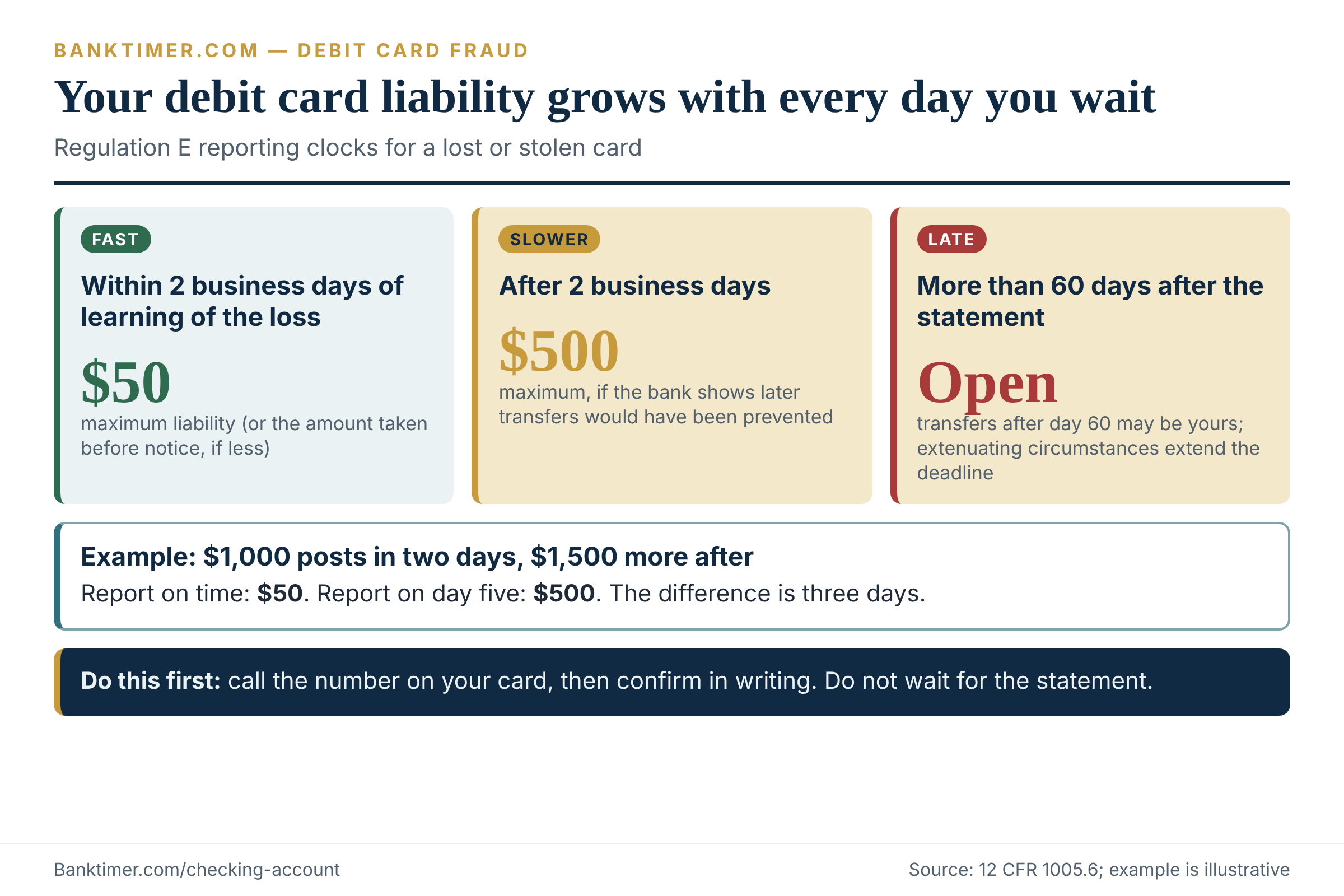
Fraud rights run on a clock. Report a lost or stolen debit card within two business days and your loss is capped at $50. Wait longer and the cap rises to $500. After the 60-day statement window, later losses can become yours in full.
Insurance protects against bank failure, not mistakes. FDIC and NCUA coverage is automatic up to $250,000 per category. It does not refund money you sent to a scammer, and it can fall short for large joint balances.
The rules moved recently. Congress repealed the CFPB’s overdraft fee rule in May 2025, and some states are filling the gap. Read your own bank’s current agreement, not last year’s headline.
The numbers that anchor every checking account decision
Eleven figures do most of the work. The legal ones come from regulations and rarely change. The survey figures drift every year, so treat them as a range rather than a quote.
| Item | Figure | What it means for you | Source and date |
|---|---|---|---|
| FDIC insurance | $250,000 per depositor, per insured bank, per ownership category | Single, joint and retirement accounts insure separately | FDIC, checked Oct 2026 |
| Credit union insurance | $250,000 per member-owner, per credit union, per category | Same idea, different agency | NCUA, checked Oct 2026 |
| Lost or stolen debit card | $50 cap if reported within 2 business days; up to $500 after | Speed sets your exposure | 12 CFR 1005.6 |
| Unauthorized transfer on a statement | Report within 60 days of the statement | Later losses can be yours | 12 CFR 1005.6(b)(3) |
| Next-day availability | Cash at a teller, direct deposit, wires; first $275 of other checks | The floor a bank must meet | 12 CFR 229.10; amounts effective July 1, 2025 |
| Large-deposit and new-account line | $6,725 per banking day | Above it, holds can run longer | 12 CFR 229.13 |
| Average overdraft fee | $26.77 (Bankrate, summer 2025); $30.82 (MoneyRates, Jan 2026) | Different samples, same neighborhood | Bankrate; MoneyRates |
| Average monthly fee | $13.95 (MoneyRates); $15.65 on interest checking (Bankrate) | Applies only to accounts that charge | MoneyRates, Jan 2026; Bankrate 2025 |
| Out-of-network ATM | $4.86 average, split $3.22 surcharge and $1.64 bank fee | Two charges for one withdrawal | Bankrate 2025 survey |
| National average interest checking rate | 0.07% | $1.05 a year on a $1,500 balance | FDIC rates via FRED, Sept 2026 |
| U.S. households without an account | 4.2%, about 5.6 million | Minimum balances and fees keep people out | FDIC 2023 survey |
Notice the pattern. The protections are federal and fairly stable. The costs are set by each bank and vary widely. That split drives almost every choice in this guide.
The same paycheck, three annual bills
The routine being priced
Take one illustrative household. Two direct deposits land each month, $3,200 in total. Rent and bills go out by automatic payment and debit card. The owner withdraws cash once a month and keeps an average balance near $1,500.
The fee assumptions are illustrative too, not quotes from any bank. The monthly fee is $12, waived when direct deposits qualify. An overdraft costs $27, close to the Bankrate average. An out-of-network ATM costs $4.86. Interest follows the 0.07% national average.
Three setups, three bills
In Setup A, the waiver is met, the owner uses in-network ATMs, and the balance never dips below zero. In Setup B, the waiver is missed. Maybe the employer changed payroll providers and the new deposits no longer count. The owner also starts paying the ATM fee each month. Setup C adds an overdraft habit: eight overdrafts a year, the kind that happen when a bill posts the day before payday.
| Setup | Monthly fee | ATM fees | Overdraft fees | Annual cost |
|---|---|---|---|---|
| A. Waiver met, in-network ATMs, no overdrafts | $0.00 | $0.00 | $0.00 | $0.00 |
| B. Waiver missed, one out-of-network ATM use a month | $144.00 | $58.32 | $0.00 | $202.32 |
| C. Setup B plus 8 overdrafts a year | $144.00 | $58.32 | $216.00 | $418.32 |
| Reference: $5 fee that cannot be waived, no overdraft fees | $60.00 | $0.00 | $0.00 | $60.00 |

What the gap tells you
Interest earned in all three setups is $1.05 (0.07% on $1,500). Setup C costs about 397 times that. In other words, the rate printed in the account’s marketing is the least important number on the page. The monthly fee waiver, the ATM network, and the overdraft setting decide the outcome.
The reference row shows a different trade. An account with a flat $5 fee costs $60 a year, which is more than Setup A and far less than Setup C. For someone who cannot reliably meet a waiver, a small predictable fee can beat a “free” account with a tripwire. The rest of this guide explains how to price those tripwires before you hit them.
How a checking account works, from deposit to payment
A deposit is a promise from the bank, not a box with your name on it
When you deposit money, the bank does not set it aside in a vault. The balance becomes a liability on the bank’s books: a promise to pay you on demand. That is why the law calls a checking account a demand deposit. Regulation E, the federal rule for electronic transfers, describes a covered account as “a demand deposit (checking), savings, or other consumer asset account” held primarily for personal, family or household purposes.
The bank uses deposits to fund loans and investments. It can do that safely only if depositors do not all demand cash at once. Deposit insurance exists to keep that promise credible, which is why the FDIC and NCUA sections later in this guide matter more than they first appear.
Ledger balance, available balance, and pending items
Your app may show two numbers. The ledger balance counts posted transactions. The available balance subtracts pending card authorizations and any holds on deposits. Only the available balance tells you what you can safely spend.
Here is an illustrative example. Your ledger balance is $1,000. A restaurant authorization of $120 is pending, and $300 of a check deposit is on hold. Your available balance is $580. If a $600 automatic payment arrives, you are $20 short even though the ledger looks fine.
Ask the bank which balance it uses for overdraft decisions, and in what order it posts transactions. The deposit agreement should say. The answer matters most when your balance is thin.
From swipe to settlement: the life of a payment
A card payment starts as an authorization. The merchant asks your bank whether the money is there, and the bank reserves it as a pending item. Hours or days later the merchant settles, and the final amount posts. In between, the pending amount can differ from the final one. A fuel pump or a hotel can authorize more than the final bill, which temporarily shrinks your available balance.
ACH payments move in batches. The sender’s bank submits a paycheck or an autopay, and your bank posts it on its own schedule. Paper checks mostly travel as images now, and a check you wrote last week can arrive on the day your balance is lowest. You control when you write a check. You do not control when it posts.
The practical lesson is that your balance on any given day is a forecast, not a fact. Before a large payment, add up what is pending and what is scheduled to post in the next three days. That ten-second habit prevents more overdrafts than any fee waiver.
Five ways money moves in and out
Each payment rail has different speed, different dispute rights, and a different chance of being undone. Knowing which rail you are using tells you which rulebook applies if something goes wrong.
| Rail | Common use | Who sets the dispute rules | Can you undo it? |
|---|---|---|---|
| Debit card | Purchases, ATM withdrawals | Regulation E plus the bank’s agreement | Dispute unauthorized or erroneous charges within the Reg E clocks |
| ACH transfer | Direct deposit, autopay, bill pay | Regulation E for consumer accounts, plus network rules | Stop recurring payments with notice, or dispute unauthorized debits |
| Paper check | Rent, checks from clients | State law (the Uniform Commercial Code) plus the agreement | Stop payment before it is paid |
| Wire transfer | Home closings, large payments | The bank’s wire agreement | Built to be final; ask for a recall at once, with no guarantee |
| Real-time and peer-to-peer | Instant payments between people | The app or bank’s terms; Reg E covers unauthorized transfers | Generally final once the recipient has the money |
Real-time payments are newer. The Federal Reserve’s FedNow service went live on July 20, 2023, and runs around the clock. Whether your bank offers it is the bank’s choice. The practical point is speed: faster payments leave less time to catch a mistake. The instant bank transfer guide covers limits and fees in detail.
What a checking account is not
It is not a savings tool. The 0.07% national average rate means a balance barely grows. A checking versus savings comparison shows when to split the two.
It is not insurance against fraud. FDIC coverage responds to a bank failure. Reg E and your bank’s policies respond to unauthorized transactions. The sections on fraud and insurance explain the difference.
It is also not the whole category. “Bank account” includes savings, money market accounts and certificates of deposit. The bank account pillar guide maps the full set.
The Banking Act of 1933, signed June 16, 1933, created the FDIC and, through what became Regulation Q, barred banks from paying interest on checking accounts. The FDIC’s temporary fund opened in January 1934 insuring $2,500 per depositor. It became permanent that July at $5,000.
Banks found workarounds in the 1970s with NOW accounts, which behaved like interest-bearing checking, and access widened after 1980. Congress repealed the ban itself in 2011 through the Dodd-Frank Act. Repeal did not start a rate war in checking. The national average still sits at 0.07%.
Who has an account, and who still does not
The FDIC’s 2023 household survey, released in November 2024, found that 4.2% of U.S. households, about 5.6 million, had no bank account. Another 14.2%, about 19.0 million, had an account but also used alternatives such as money orders or check cashing.
The reasons are practical. Among unbanked households, 42.3% cited not having enough money to meet minimum balance requirements, and 23.3% named it as the main reason. Another 15.7% named distrust of banks as the main reason. Nearly half of unbanked households, 47.4%, had held an account before.
Meanwhile, 48.3% of banked households used mobile banking as their primary way to access an account. The FDIC’s most recent household survey data used in this guide is from 2023.
The takeaway is not that banking is broken. It is that fees and minimums are the barrier, which is exactly where product design differs the most. Later sections cover accounts built to lower those barriers.
How your bank earns money on a checking account
Banks do not run accounts as charity, and the revenue map explains where fees show up. Some money comes from your balance, some from your card swipes, and some from your mistakes.
The spread on your balance
Your deposits fund the bank’s lending. The bank pays you 0.07% on average and earns more when it lends the money out. Take an illustrative case: the bank earns 6.00% on loans funded by your deposits and pays you 0.07%. On a $2,000 average balance, the gross spread is $118.60 a year, before the bank’s costs. The 6.00% is an assumption, not a market quote.
That spread is why banks like balances. It is also why some fee waivers hinge on keeping a minimum balance or a direct deposit, which signals that the bank is your primary account.
Interchange on every swipe
Each time you pay with a debit card, the merchant pays a fee, and part of it flows to your bank. That is interchange. Regulation II caps it for large issuers. The Federal Reserve’s page says a covered issuer may not receive more than $0.21 plus 0.05% of the transaction value.
The Fed’s 2024 data shows the practical effect. Covered issuers averaged $0.23 per transaction (0.47% of value). Exempt issuers, which include smaller banks and credit unions, averaged $0.51 (1.21%). Suppose you make 40 debit purchases a month. That is about $110.40 a year for a covered bank and $244.80 for an exempt one. The Fed proposed lowering the cap in October 2023, so check the current Regulation II before relying on these figures.
Fees, the most volatile line
Fee revenue has swung more than any other source. The CFPB reported that overdraft and non-sufficient funds (NSF) revenue at banks with more than $1 billion in assets fell from $11.96 billion in 2019 to $5.83 billion in 2023, a 51% drop. The CFPB said most of the reduction reflected policy changes banks made in 2022, because quarterly fees were flat through 2023.
Advocacy research tells a larger story. The National Consumer Law Center’s June 2026 report estimated more than $12 billion in overdraft and NSF fees in 2025 across banks and credit unions. The two numbers measure different universes, so do not subtract one from the other.
What the revenue map means for you
Where a bank earns from your balance and swipes, it wants more of both. Expect direct-deposit requirements, debit card rewards, and relationship pricing. Where it earns from mistakes, the incentives conflict with your interests. That is the reason to read the overdraft section of the agreement as carefully as the monthly fee.
| Revenue source | How it works | Who pays | Illustrative scale | What it means for you |
|---|---|---|---|---|
| Balance spread | Bank lends your deposits at a higher rate than it pays | The borrower, indirectly | $118.60 a year on a $2,000 balance (assumed 6.00% loan rate) | Larger balances matter to the bank |
| Debit interchange | Merchant fee shared with your bank | The merchant, passed into prices | $110.40 to $244.80 a year at 40 swipes a month | Rewards and free accounts are often funded here |
| Overdraft and NSF fees | Per-event charge when a payment exceeds your funds | You | $27 per event (illustrative) | The most avoidable cost |
| Monthly service fee | Flat charge unless you meet a waiver | You | $13.95 to $15.65 where charged (survey averages) | Often waived with direct deposit |
| ATM and service fees | Out-of-network, wires, stop payments, paper statements | You | $4.86 average out-of-network ATM use | Varies by bank; read the fee schedule |
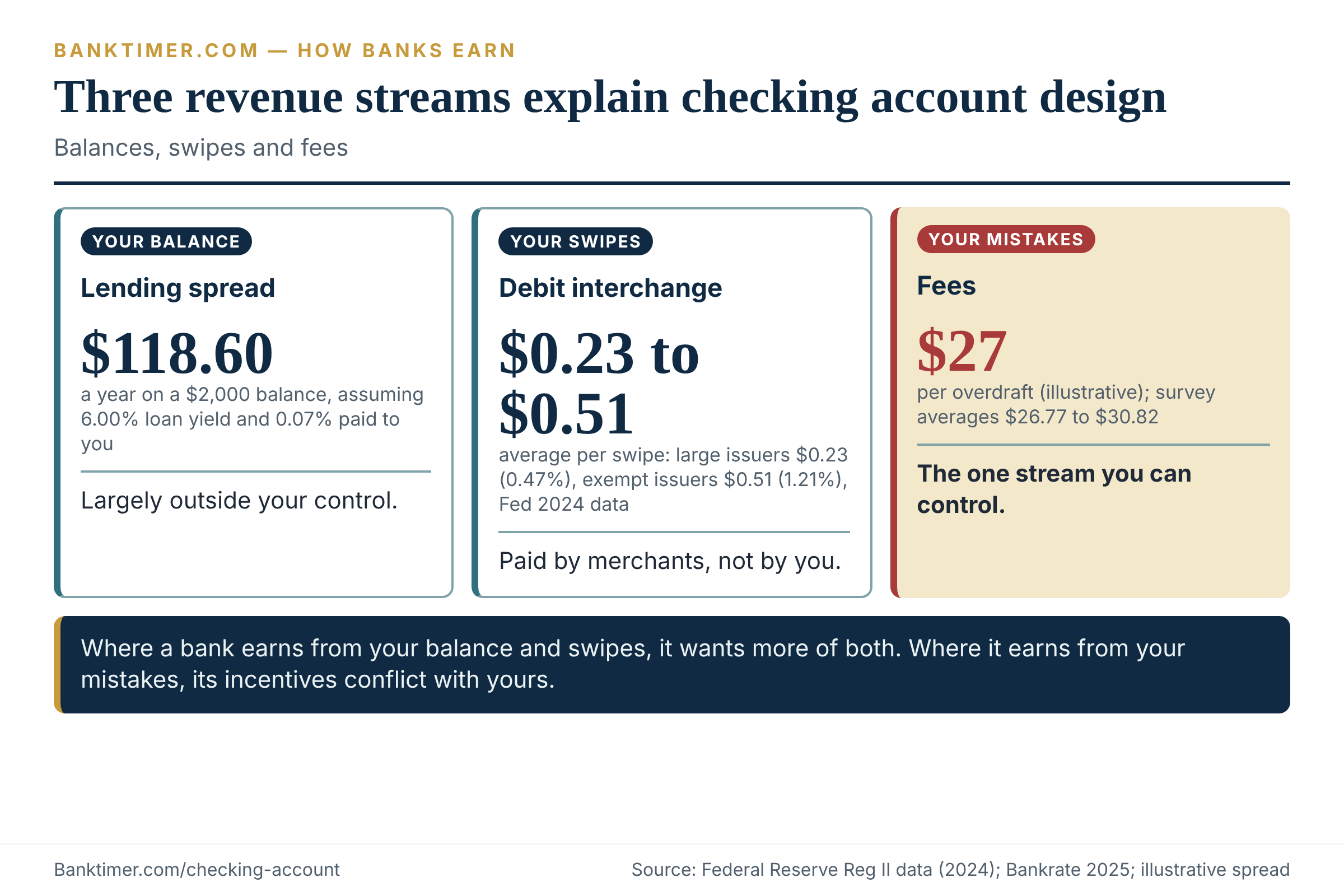
Only one stream in that table, fees, is mainly in your control. You do not pay the spread or interchange directly. You pay fees by choice or by accident, and the next sections help you choose.
Types of checking accounts and who each one fits
Account types are really bundles of three things: a fee structure, an access model, and a risk profile. The labels on a bank’s website blur them. Sort accounts by those three things and the choice gets simpler.
Standard checking at a branch bank
This is the default account at most large banks. It usually carries a monthly fee that you can waive, often with a minimum direct deposit or a minimum balance. You get branches, teller deposits, and a large ATM network.
Fee surveys give a feel for how common waivers are. Bankrate’s 2025 survey of 245 institutions found that 47% of non-interest checking accounts had no monthly fee. Another 48% charged a fee that a requirement such as direct deposit could waive. MoneyRates’ January 2026 survey found 37% fee-free, but its sample leaned toward large institutions: 50 of its 100 were among the largest U.S. retail depositories. Same market, different samples.
Interest-bearing checking
An interest-bearing account pays a rate on your balance, but the national average is only 0.07%. Bankrate’s 2025 survey also found an average monthly fee of $15.65 on interest checking. Those two numbers rarely favor you.
Run the numbers with an illustrative case. A $5,000 balance earning a promotional 2.00% yields $100 a year. If the account charges $15.65 a month, the fee alone is $187.80. You end up $87.80 behind before you buy anything. Interest checking pays off only when the fee is waived and the rate is competitive. Otherwise a separate savings account is the better home for idle cash. The high-yield savings guide covers that side.
Online banks and fintech accounts
Online-only banks and app-based accounts often advertise no monthly fee and no minimum. The trade-offs show up elsewhere: limited cash deposits, thinner ATM networks, and no teller to talk to. A large bank’s online checking page, read on October 6, 2026, states no monthly fee, no minimum balance, and no overdraft fees, with a choice of three overdraft settings.
The bigger question for fintech apps is who actually holds your money. Many apps are not banks. They partner with an insured bank, and your coverage depends on how the funds are held and recorded. The insurance section below explains what to verify. For product-level detail, see the guides on online bank accounts and opening a bank account online.
Credit unions versus banks
Credit unions are member-owned. You usually need a qualifying connection to join, such as where you live, your employer, or an association. Deposits at a federally insured credit union carry NCUA coverage of $250,000 per member-owner, per ownership category, so the safety structure matches a bank’s.
The economics differ in one measurable way. The Federal Reserve’s 2024 data shows exempt debit issuers, which include many smaller institutions, earned an average of $0.51 per debit transaction, versus $0.23 for large covered issuers. That helps explain how some smaller institutions sustain low-fee accounts. It does not guarantee lower fees, so compare fee schedules line by line. Also check the ATM network and whether the credit union participates in shared branching.
Second-chance and Bank On certified accounts
Second-chance accounts exist for people denied a standard account because of past problems reported to screening agencies. The CFPB notes that many banks and credit unions offer checking and prepaid accounts designed to reduce risk for both sides, often by preventing overdraft and its fees. Some require you to pay an old balance first.
Bank On is a certification, run by the Cities for Financial Empowerment Fund, for low-cost accounts. Its 2025-2026 national standards require an opening deposit of $25 or less, a monthly fee of $5 or less (or $10 or less if it can be waived in at least two ways), and no overdraft or NSF fees. They also cap out-of-network ATM fees at $2.50, or $3.00 with a partner network. Certification is voluntary, so verify a specific bank’s status.
Student, teen and joint accounts
Many student accounts trim or waive fees while you are enrolled. The details vary, and so does what happens at graduation, so ask. The banking for college students guide walks through documents and common traps.
Joint accounts add a risk that has nothing to do with fees. To qualify for separate FDIC coverage, each co-owner must have withdrawal rights on the same basis. In practice, either owner can usually move the entire balance. The joint bank account guide covers how to decide whether that trust is warranted.
Business checking is a different product
Regulation E covers accounts established primarily for personal, family or household purposes. A business account generally falls outside it. Fraud on a business account therefore follows the deposit agreement and state law, which can mean shorter reporting windows and less generous loss limits.
The FDIC also treats corporation, partnership and unincorporated association accounts as their own ownership category. If you freelance or run a side business, a separate business account protects your records as well as your legal position.
When a checking account is not available
Some households use other tools. The FDIC’s 2023 survey found that 5.9% of households used prepaid cards, 8.0% bought nonbank money orders, and 2.7% used check cashing. Among unbanked households, the shares were 21.6%, 26.3% and 18.2%. Per-transaction charges for those services can exceed what a low-cost account costs. FDIC insurance can extend to prepaid cards if certain requirements are met, so check the card’s terms.
| Option | Best for | Main upside | Main downside | What to verify |
|---|---|---|---|---|
| Standard branch checking | People who deposit cash or checks and want branches | Teller access, large ATM network | Monthly fee unless a waiver is met | What counts as a qualifying deposit |
| Interest-bearing checking | Larger balances at a bank with a fee waiver | Earns something on idle cash | Fee often exceeds interest | Rate tiers, balance rules, fee |
| Online or fintech account | App-first users with direct deposit | Low or no fees | Cash deposits, ATM access, who holds the funds | Insured bank named, cash deposit options |
| Second-chance or Bank On account | Anyone denied a standard account | Low fee, no overdraft fees | Fewer features, possible old balance | Certification, upgrade path |
| Student account | Enrolled students | Fee relief during school | Fee returns after graduation | What triggers the end of the waiver |
| Joint account | Partners sharing bills | Shared access, equal FDIC treatment | Either owner can drain it | Who can close it, how fees are split |
| Business checking | Anyone earning self-employment income | Clean records, fitting terms | Reg E generally does not apply | Fraud reporting window, transaction caps |
Checking account pros and cons, weighed honestly
A checking account is the right tool for moving money and the wrong tool for most other jobs. The trade-offs are lopsided in a useful way: the benefits are fixed by law and design, while the costs depend on you.
What a checking account does well
It makes payments possible. Rent, utilities, payroll and card purchases all run through it, and direct deposit is how most paychecks and federal benefits arrive. It also protects you better than cash. A stolen debit card reported within two business days caps your loss at $50, while a lost envelope of cash is simply gone.
Insurance adds another layer. Up to $250,000 per depositor, per bank, per category is covered if the institution fails. And in the best case, the account is free to run. Setup A in the opening example costs nothing at all for a household that meets its waiver and avoids overdrafts.
Where a checking account costs you
The costs sit in the tripwires. The same routine can cost $418 a year in Setup C, more than 397 times the $1.05 the account earns in interest. Holds delay access to money you counted on. Scam exposure is real: the FTC reported $12.5 billion in fraud losses for 2024, with bank transfers and cryptocurrency leading all other payment methods combined.
Fees also fall unevenly. The NCLC found 79% of overdraft and NSF fees came from 9% of accounts. And a single account is a single point of failure. A freeze, a closure or a bad screening report can interrupt your income until it is fixed.
When a checking account is the wrong tool
Idle savings belong elsewhere. At 0.07% on average, a checking balance barely grows, while a savings account may pay many times more. Balances above the insurance limit need to be split. Money you will not touch for years has other homes. And if you cannot reliably meet a waiver, a low-fee account built for that situation beats a free account with a tripwire.
A quick verdict by situation
For most people, the answer is yes, hold one, and choose carefully. For households that run thin at the end of the month, the verdict is yes to a no-overdraft-fee account. For people with large cash reserves, the verdict is yes to a small checking balance and a bigger savings balance. For freelancers, the verdict is yes to two accounts, one personal and one for business.
What a checking account really costs: fees, minimums and the break-even math
Checking account charges fall into four buckets. Fixed charges hit every month. Conditional charges apply unless you meet a requirement. Event charges fire when you do something specific. Convenience charges pay for extras. The mix matters more than any single line.
| Cost item | Trigger | Typical basis | Avoidable? |
|---|---|---|---|
| Monthly service fee | Every statement cycle unless waived | $13.95 average (MoneyRates, Jan 2026); $15.65 on interest checking (Bankrate 2025) | Often, with direct deposit or a balance |
| Overdraft fee | A payment the bank pays beyond your funds | $26.77 average (Bankrate 2025); $30.82 (MoneyRates 2026) | Yes, by opting out or keeping a buffer |
| NSF or returned-item fee | A check or autopay is rejected for lack of funds | $16.82 average (Bankrate 2025) | Yes, with alerts and a buffer |
| Out-of-network ATM | Withdrawing at another bank’s machine | $4.86 average, in two parts | Yes, by using the network |
| Paper statement | Choosing mailed statements | Varies; the Bank On standard allows $2 or less | Yes, with e-statements |
| Wire, stop payment, check printing | Using those services | Varies by bank; read the fee schedule | Partly |
Monthly service fees and the waiver trap
Survey averages hide a split. Many accounts charge nothing. The rest charge roughly $14 to $16 a month and offer ways out. The ways out are the point. A large bank’s Total Checking page, read on October 6, 2026, listed a $15 monthly service fee and four routes to avoid it. They were $500 or more in qualifying electronic deposits, a $1,500 balance at the beginning of each day, a $5,000 average beginning-day balance (alone or combined with linked accounts), or linking to a qualifying checking account.
The phrase to scrutinize is “qualifying electronic deposits.” Does a payroll deposit count? A peer-to-peer transfer from a friend? A deposit from a gig platform? Each bank defines it in its own documents. A changed employer, a new payroll provider, or a shift to freelance income can quietly drop you below the line. Setup B in the opening example is exactly that story.
Banks must also give notice before changes hurt you. Under Regulation DD, a depository institution must give at least 30 calendar days’ advance notice of a change that may reduce your yield or otherwise adversely affect you. The exceptions are variable-rate interest changes, check printing fees, and certain short time accounts. If a bank raises a fee, you get a window to switch before it takes effect.
Minimum balances: price the cushion
A minimum balance requirement forces you to park money in the account. Price it. Say the fee is $15 a month, or $180 a year, and the waiver requires a $1,500 daily balance. Holding that cushion in checking instead of a savings account paying an illustrative 3.50% forgoes $52.50 a year. After the $1.05 the checking account pays, the net cost is $51.45.
Run it backward. The $180 fee equals a 12.0% return on $1,500. If you already hold $1,500 of idle cash, meeting the requirement is far cheaper than paying the fee. If you would have to scrape together the money, a different account is the better answer. The FDIC’s household survey explains why this matters: not enough money to meet minimum balances was the most commonly cited reason for being unbanked.
ATM fees come in two parts
An out-of-network withdrawal can trigger two charges. The ATM owner adds a surcharge, and your own bank may add its fee. Bankrate’s 2025 survey found an average total of $4.86, made up of $3.22 and $1.64. One out-of-network withdrawal a month adds up to $58.32 a year.
Plan around it. Find your bank’s fee-free network. Withdraw larger amounts less often. Ask whether the bank reimburses out-of-network fees, and whether it caps how many.
Overdraft and returned-item fees
These are the costly ones, and they have their own section below. For now, note the difference. An overdraft fee is charged when the bank pays a transaction you could not cover. An NSF or returned-item fee is charged when the bank refuses it. Under Regulation DD, banks must show the total of each category on your periodic statement, for the statement period and for the year to date. That line is the fastest audit you can do.
Interest on checking and your tax return
Interest from a checking account is taxable. The IRS says most interest credited to an account you can withdraw from without penalty is taxable income in the year it becomes available. You must report it even if you never receive a Form 1099-INT. A bank files that form when interest reaches $10 or more.
Take an illustrative case. A $2,000 average balance earning 1.50% produces $30 in interest. You owe tax on it at your own rate, and you should keep your statements as records. Small interest rarely changes a decision, but it shows why chasing a rate while paying a $15 monthly fee makes no sense.
Sign-up bonuses: do the net math
Banks sometimes advertise a cash bonus for opening a checking account. The bonus comes with conditions, usually a minimum direct deposit total, a required number of transactions, and a deadline. Treat it as a one-time discount against the first year’s costs, not as income.
Take an illustrative $300 bonus. Assume the account charges $15 a month until the direct deposit condition is met, and it takes three months to qualify. That is $45 in fees. If you also have to keep $1,500 in the account for 90 days instead of holding it in a savings account at an illustrative 3.50%, you forgo about $13.13 in interest. The net is roughly $241.87 before tax, which is still positive.
Now change one assumption. If the bonus requires you to move a paycheck you would have kept elsewhere, and you close the account within the required holding period, the bank may claw the bonus back. Read the terms for the holding period. The IRS generally treats bonuses for opening an account as interest income, so expect a Form 1099-INT and report the amount. Confirm the treatment of your own bonus with the bank’s tax form and a tax professional.
A ten-minute fee schedule audit
Find two documents on the bank’s site: the fee schedule and the deposit account agreement. Then answer six questions.
- What is the monthly fee, and exactly which deposits or balances waive it?
- What does an overdraft cost, how many can be charged per day, and is there a grace amount or a grace period?
- What is the NSF fee, and can the bank charge it again if a merchant resubmits the payment?
- What do out-of-network ATMs cost, and which networks are free?
- What do wires, stop payments, paper statements and replacement cards cost?
- How and when will the bank tell you if any of this changes?
Write the answers down. If an answer is missing, call and ask. A bank that cannot state its own fee waiver in one sentence is a red flag. The bank account fees guide goes deeper on comparing schedules.
Opening a checking account: identification, screening and the first 30 days
Opening an account takes minutes, but three gates stand in the way. The bank must verify who you are. It will often check a screening report. And federal rules treat brand-new accounts more strictly for 30 days.
Identity verification: what banks must collect
Under the federal customer identification rule, a bank must collect four items for an individual: name, date of birth, address, and an identification number. For a U.S. person, the number is a taxpayer identification number. For a non-U.S. person, the rule allows alternatives such as a passport number and country of issuance, or another government-issued document showing nationality or residence and bearing a photograph.
The bank must also verify what you provide, using risk-based procedures. That can mean a photo ID. It can also mean database checks, a call to you, or references from another institution. The rule sets the floor. Which documents a particular bank accepts, including whether it takes an Individual Taxpayer Identification Number, is bank policy, so ask before you apply.
Screening reports: ChexSystems and Early Warning Services
Banks often check a specialty report, not your credit report, before approving a checking account. The two major companies are ChexSystems and Early Warning Services. The CFPB says they collect negative information that traditional credit bureaus do not, such as an unpaid negative balance after an involuntary closure, suspected fraud, or trouble on a joint account.
You have rights here. If a bank denies you based in part on a screening report, it must give you a notice naming the company. You are entitled to a free report. You can dispute errors with both the reporting company and the bank that supplied the information. The CFPB’s guidance says negative entries can stay on a report for up to seven years, and some companies stop reporting them after five.
If a bank says no
Treat a denial as a data problem to solve, not a verdict. Start with the notice, then take these steps in order.
- Request the free report from the company named in the notice.
- Check every entry. Dispute errors with the reporting company and the bank.
- If the entry is accurate, ask the bank that reported it what it would take to settle or pay the balance.
- Apply for a second-chance account, a Bank On certified account, or a credit union account in the meantime.
Many second-chance accounts block overdrafts entirely, which keeps the old problem from repeating. They may also have fewer features. Ask whether the account can graduate to a standard one after a clean period.
Documents and details to have ready
| Document or detail | Why the bank asks | Notes | Keep it for |
|---|---|---|---|
| Government photo ID | Identity verification | Some banks accept alternatives; ask | Account opening only |
| SSN, ITIN, or other ID number | Customer identification rule | Alternatives exist for non-U.S. persons; bank policy varies | Tax reporting on interest |
| Proof of address | Confirm the address you gave | Utility bill or lease are common; requirements vary | Until the account is verified |
| Opening deposit | Fund the account | Bank On standard caps it at $25; others vary | Receipt for your records |
| Direct deposit form | Route your paycheck | Your employer’s payroll system uses it | Confirmation of the first deposit |
| Joint owner details | Add a co-owner | Each owner signs; see the joint account guide | Signed agreement copy |
| Beneficiary information | Name who inherits | See the beneficiary designation guide | Updated whenever life changes |
The first 30 days: where new accounts get stricter
Regulation CC treats an account as new for the first 30 calendar days. Cash and electronic payments, such as direct deposit, still must be available the next business day. For the special check types (Treasury checks, cashier’s checks and similar), the bank must give next-day treatment only on the first $6,725 deposited per banking day. The rest can wait until the ninth business day.
The part many people miss: the federal schedules for ordinary personal checks do not apply to new accounts at all. The bank’s own policy governs. An account is not “new” if each customer on it had another account at the same bank for at least 30 days within the 30 days before opening.
The practical move is to fund a new account with direct deposit, cash, or a cashier’s check. Keep a cushion for the first month, and read the bank account hold guide before you deposit a large check.
Deposits, holds and when the money is really yours
Why a deposit is not instantly spendable
Regulation CC (12 CFR Part 229) sets the outer limit on how long a bank may hold deposited funds. A bank may release money sooner. It may not hold it longer unless an exception applies. The rule counts time in business days, which exclude Saturdays, Sundays and federal holidays. That is why a Tuesday deposit can feel slower than a Monday one.
Cut-off times matter too. A bank may set a daily cut-off for deposits at 2:00 p.m. or later. Anything received after that counts as deposited on the next banking day. Check your bank’s cut-off, especially for mobile and ATM deposits.
Cash, direct deposit and wires: next business day
Cash deposited in person to a bank employee must be available no later than the business day after deposit. Cash that is not deposited in person, such as at an ATM, gets up to the second business day.
Electronic payments follow the strictest rule. Direct deposits (ACH credits) and wires must be available no later than the business day after the bank receives the payment in collected funds. Many banks post paychecks earlier than that. Early posting is a bank policy, not a legal right, so do not build a budget around it.
Direct deposit timing: the rule, the policy and the plan
The legal floor is the next business day after the bank receives the payment in collected funds with the account information it needs. Anything earlier is the bank’s policy. If a bank advertises early pay, ask what happens when an employer’s payment is later returned or reversed, because you may owe the money back.
Your employer controls the pay date. Ask for the date the payment is sent, which can differ from the date you expect it. Give your employer the routing and account numbers from your own bank, and test with a split deposit before you move the whole paycheck. If a deposit seems to be missing, ask your employer to confirm the date and amount, then ask your bank to search for it. The direct deposit guide covers setup and troubleshooting.
Checks: next day, second day, fifth day
Certain checks also get next-business-day treatment, with conditions. They include Treasury checks deposited by the payee, and U.S. Postal Service money orders, Federal Reserve Bank checks, and state or local government checks. Cashier’s, certified and teller’s checks qualify as well. Most conditions require that you deposit in person to a bank employee. Checks drawn on the same bank qualify when the branches share a state or check-processing region.
For every other check, a bank must make the first $275 available the next business day. The rest follows the general schedule. A local check must be available by the second business day. A nonlocal check must be available by the fifth. A bank may extend by one business day the time for withdrawing cash, but it must make $550 available for cash by 5:00 p.m. on the day the funds become available. Checks deposited at a nonproprietary ATM can take up to five business days.
Mobile deposits are not made “in person to an employee.” A cashier’s check deposited by phone therefore falls to the second business day, not the next. The mobile check deposit guide explains the limits and security side.
Exceptions that stretch the wait
Five exceptions let a bank hold longer than the schedule, and each has limits.
- New accounts. The first 30 calendar days, as covered above.
- Large deposits. Any amount above $6,725 deposited by check on one banking day.
- Redeposited checks. A check that was returned unpaid and deposited again, unless it was returned only for a missing endorsement or a postdate.
- Repeated overdrafts. If an account was negative on six or more banking days in the past six months, or negative by $6,725 or more on two or more days, the schedules do not apply for six months after the last overdraft.
- Reasonable cause to doubt collectibility. The bank needs facts that would give a reasonable person a well-grounded belief the check will not be paid. It cannot rely on the type of check or depositor.
Emergency conditions, such as equipment failures or communications interruptions, also allow delays.
The written notice, and the fee rule behind it
When a bank invokes an exception, it must give you a written notice. The notice states an account code, the deposit date, the delayed amount, the reason, and the date funds will be available. It must come at the time of deposit, unless you did not deposit in person or the facts surfaced later. In that case the bank must send it by the next business day after the deposit or after the facts became known, whichever is later.
There is a fee consequence too. If a bank delays a deposit for reasonable cause and does not give written notice at the time of deposit, it generally may not charge overdraft or returned-check fees that the delay caused, provided the check is eventually paid. A bank can still assess such fees if it includes a notice explaining your right to a refund. If a hold caused an overdraft, ask about this in writing.
| Deposit type | Federal minimum availability | What can extend it | What to do |
|---|---|---|---|
| Cash handed to a teller | Next business day | Emergency conditions | Keep the receipt |
| Cash at an ATM or not in person | Second business day | Up to the fifth business day at nonproprietary ATMs | Use your own bank’s ATMs |
| Direct deposit, ACH credit, wire | Next business day after the bank receives collected funds | Emergency conditions | Confirm posting policy with the bank |
| Cashier’s, certified, teller’s, Treasury, state or local government checks, in person | Next business day, if conditions are met | New accounts: only the first $6,725 per day | Prefer these for large amounts |
| Other checks | First $275 next business day; rest by the second (local) or fifth (nonlocal) business day | Large deposit, new account, repeated overdrafts, reasonable cause | Ask how the bank classifies the check |

You open an account and deposit a $9,000 cashier’s check in person at a branch on Tuesday, November 3, 2026, before the bank’s cut-off. The first $6,725 must be available Wednesday, November 4. The remaining $2,275 must be available by the ninth business day. Veterans Day on November 11 does not count as a business day, so the deadline is Tuesday, November 17.
If the same amount were an ordinary personal check in the same new account, the federal schedule would not apply at all. The bank’s own policy would govern, and it must tell you the timing in writing. In an established account, an ordinary check could be held beyond the normal schedule only for the amount above $6,725, because of the large-deposit exception.
Available is not the same as final
When a bank makes check funds available, it does not guarantee the check will clear. If the check bounces days later, the bank can reverse the credit and charge it back. You owe the money, and your account may go negative with fees on top. Counterfeit-check scams exploit this gap. They persuade you to spend money from a check the bank has made available but not verified. The fake check scam guide explains the pattern and how to respond.
The safest habit for large or unfamiliar checks is to ask the bank when the check actually clears, not just when funds are available. For payments you rely on, such as a rent deposit, request a wire, cashier’s check or direct deposit instead.
Overdrafts, NSF fees and the settings you control
What happens when a payment exceeds your funds
A payment that is larger than your available balance can end three ways. The bank can pay it and charge an overdraft fee. The bank can refuse it and charge an NSF (non-sufficient funds) or returned-item fee. Or the bank can decline it at the register and charge nothing, which is how many debit card purchases work.
Which outcome you get depends on the payment type and on your settings. A card swipe can be declined on the spot. A check or automatic payment is different, because it arrives after the fact and the bank must decide whether to pay it.
What the opt-in rule covers and what it does not
Regulation E requires your opt-in before a bank can charge an overdraft fee on ATM withdrawals and one-time debit card purchases. The bank must give you a written notice, a reasonable chance to say yes, and written confirmation. You can revoke consent at any time, and the bank must act as soon as reasonably practicable.
The rule has firm limits. It does not cover checks, ACH payments and other transaction types, so those follow your deposit agreement. A bank also cannot make payment of check or ACH overdrafts conditional on opting in for card transactions. And it must give you the same account terms whether or not you opt in. So opting out gives you a free decline at the register, but it does not protect you from a returned-check fee.
Four ways banks handle a shortfall
The CFPB describes three alternatives to standard overdraft coverage: decline the transaction, transfer money from a linked savings account, or draw on a line of credit. Some banks add a fourth, a no-fee overdraft. Each has a different cost and a different failure mode.
| Option | How it works | Typical cost | Main risk | Best fit |
|---|---|---|---|---|
| Decline (opt out) | The card is generally declined | $0 on debit and ATM; checks and ACH may still draw NSF fees | A declined payment at a bad moment | People with a buffer who want no surprise fees |
| Standard overdraft coverage | The bank pays and charges a fee | $26.77 average (Bankrate 2025); the CFPB says most charge $30 or more | Repeated fees on small purchases | Rarely the best choice |
| Linked savings transfer | Money moves from savings to checking | A transfer fee, usually lower than an overdraft fee, per the CFPB | Drains savings; may not cover all items | People who keep a savings cushion |
| Overdraft line of credit | The bank lends the shortfall | Interest on the amount borrowed | Debt that carries; check the rate | Occasional short gaps |
| No-fee overdraft | The bank covers some items without a fee | One bank’s page states no overdraft fees | Policies can change; limits apply | Anyone whose bank offers it |
Practices worth asking about
Three fee practices drew regulatory attention in New York. In a July 12, 2022 industry letter, the Department of Financial Services described them as deceptive or unfair: charging an overdraft fee when the balance was positive at authorization (sometimes called authorize positive, settle negative), charging both an overdraft protection transfer fee and an overdraft fee on the same item, and charging several NSF fees when a merchant resubmits the same payment.
The letter binds institutions that New York regulates, but the questions apply everywhere. Ask your bank whether it charges a fee when your balance was sufficient at authorization. Ask what happens when a merchant retries a payment. Ask how many fees can hit in one day.
Posting order can change how many fees you pay
Banks apply a day’s transactions in a particular order. Some post items in the order they arrive, some post smallest first, and some post largest first. The deposit agreement should say which. The order matters when a day’s items exceed your balance.
Here is an illustrative case. Your balance is $100, and three items post on the same day: $15, $20 and $90. Posted smallest first, the balance goes to $85, then $65, then negative $25. That is one overdraft and a $27 fee. Posted largest first, the $90 clears, leaving $10. The $15 item takes you to negative $5, and the $20 item to negative $25. That is two overdrafts and $54.
The same items and the same balance produced double the fees. Ask your bank for its posting order in writing, and if it posts largest first, keep a larger buffer on busy days.
The cost of a $27 fee in plain math
An overdraft fee is a very expensive short loan. Say you are $40 short for four days until payday, and the bank charges $27. The fee equals 67.5% of the amount covered. Annualized with simple math, that is about 6,159%. The same $40 for four days on a card charging an illustrative 25% APR costs about $0.11.
Banks do not quote overdraft fees as an APR, and the comparison is a framing, not a disclosure. But the arithmetic explains why a few overdrafts cost so much more than interest on any alternative.
Who pays most of these fees
Overdraft fees fall hardest on a small group. The National Consumer Law Center’s June 2026 report, which is advocacy research, found that 79% of bank overdraft and NSF fees were borne by 9% of accounts. Those accounts had median balances under $350. The same report put the average overdraft fee around $27 and estimated that about a quarter of people live in households that incur such fees each year.
The CFPB’s April 2024 analysis estimated that fee cuts saved the average overdrafting household about $185 a year. Both findings point the same way. The accounts with the thinnest cushions pay the most, so the cheapest fix is often timing, not income.
A timing gap, not an income problem
Here is an illustrative month. Rent of $900 is due on the 1st. Payday is the 3rd, and your net paycheck is $1,030. You start the month with $300. Assume the bank pays every item and charges $27 per overdraft. Many banks cap the number of fees per day or skip small overdrafts, which varies.
| Day | Event | Amount | Balance after | Overdraft fee |
|---|---|---|---|---|
| 1st | Rent autopay | -$900 | -$600 | $27 |
| 2nd | Coffee | -$18 | -$618 | $27 |
| 3rd | Paycheck | +$1,030 | $412 | $0 |
| 4th | Groceries | -$70 | $342 | $0 |
Two fees in four days cost $54. Repeated each month, that is $648 a year. Moving the rent due date to the 4th removes both fees, because the paycheck lands first. Many landlords and billers will change a due date when asked. The fix costs nothing and has nothing to do with earning more.
Where the rules stand in October 2026
At the federal level, the biggest change was a repeal. The CFPB’s 2024 overdraft lending rule would have limited overdraft fees at institutions with more than $10 billion in assets to $5, or let them choose other options such as cost-based fees or treating overdrafts as loans under Truth in Lending. President Trump signed a Congressional Review Act resolution repealing it on May 9, 2025.
In May 2025, the CFPB also withdrew 67 guidance documents. They included Circular 2022-06 on unanticipated overdraft fees and Circular 2024-05 on improper overdraft opt-in practices. The underlying Regulation E opt-in rule at 12 CFR 1005.17 remains in the regulations.
States have moved in different directions. California enacted two laws in 2024. SB 1075 requires notices for credit union overdraft and NSF fees, and from January 1, 2026 caps those fees at $14 or the CFPB amount if lower. AB 2017 bars certain banks and credit unions from charging NSF fees on transactions that are declined instantly. New York’s regulator proposed broader rules in January 2025. Whether your state has a rule depends on where your bank is chartered and where you live, so check with the state banking department.
A decision tree: should you opt in to debit card overdraft coverage?
The tree below asks three questions in order. It does not tell you what to choose. It tells you which trade-off you are actually making.

Most people who can absorb an occasional declined card will do best by opting out. The decline costs nothing. A few people cannot afford a declined payment, such as a traveler far from home or a parent buying medicine. For them, a linked savings transfer or an overdraft line of credit is usually cheaper than a flat fee. The overdraft protection guide compares those backstops, and the overdraft fees guide covers the fee mechanics in more depth.
Fraud, errors and the legal protections behind your debit card
What Regulation E covers
Regulation E protects consumers who use electronic fund transfers. That includes debit card purchases, ATM withdrawals, direct deposits and ACH debits from a consumer account. The account must be established primarily for personal, family or household purposes. A business account is outside the rule.
The regulation defines an unauthorized transfer as one initiated by a person other than you, without actual authority, from which you receive no benefit. The CFPB’s official commentary adds two useful points. A transfer by someone who got your card or code from you through fraud or robbery counts as unauthorized. But if you hand your card to a relative or co-worker and they exceed the permission you gave, you are fully liable until you tell the bank their authority has ended.
The liability clock: $50, $500 and the 60-day rule
Your maximum loss depends on how fast you report. For a lost or stolen card, code or other access device, the clock starts when you learn of the loss.
| Situation | Your maximum liability | What triggers it | What to do |
|---|---|---|---|
| You report within 2 business days of learning the device is lost or stolen | The lesser of $50 or the unauthorized transfers before notice | Timely notice | Call the number on your card, then confirm in writing |
| You report after 2 business days | Up to $500 | Late notice: $50 plus later transfers the bank shows would have been prevented | Report at once; do not wait for the statement |
| An unauthorized transfer appears on your statement and you report within 60 days of the bank sending it | No liability for later transfers | The 60-day window | Review each statement when it posts |
| You miss the 60-day window | Transfers after day 60 that the bank shows you could have prevented | Late notice after the statement | Dispute anyway and ask about extenuating circumstances |
| You were delayed by a long trip or hospital stay | The bank must extend the deadlines to a reasonable period | Extenuating circumstances | Document the reason |
The rule is a floor. A bank can offer better terms in its agreement, never worse. The agreement will usually describe the process, but the federal numbers apply regardless.
A thief takes your debit card on Friday. Charges of $1,000 post before the close of the second business day, and $1,500 more post afterward. If you report within two business days, your liability is capped at $50. If you report on day five, the bank can hold you to the lesser of $500 or the sum of $50 plus the $1,500 it proves you could have prevented. That is $500. The difference is three days of delay.
What the bank must do once you report
Report a problem within 60 days after the bank sends the statement showing it. The bank then has 10 business days to determine whether an error occurred, and one business day after that to correct it. If it needs more time, it must provisionally credit your account within 10 business days. It can then take up to 45 days to finish. It must report results within three business days of completing the investigation.
Newer accounts and certain transfers get longer clocks. For a new account, meaning a transfer within 30 days of the first deposit, the initial period is 20 business days. For point-of-sale debit transactions, transfers started outside the state, and new accounts, the extended investigation can run up to 90 days.
Keep a record of every contact. If the bank denies the claim, ask for the documents it relied on, and note the dates in writing.
How to word a fraud report
How you describe the problem affects how the bank classifies it. Use plain, specific language. Say that a transaction was unauthorized, not that you “do not recognize” it. Give the date you first noticed it, the amount, the merchant or payee as it appears on the statement, and the date of the last transaction you did authorize.
Then ask for four things before you hang up. Ask for a claim or reference number. Ask for the date by which the bank will decide, which should fall within the investigation clocks above. Ask whether a provisional credit applies and when it posts. Ask whether the bank wants written confirmation. A bank may require written confirmation of an oral report if it tells you so and gives an address, so send it promptly and keep a copy.
Request a replacement card or new account numbers in the same call if a card, an online login or an ACH debit authorization may be compromised. Changing the credentials after you report, rather than before, keeps the sequence of dates clear. If you gave a scammer your one-time passcode or login yourself, say so honestly. The bank treats those facts differently, and a candid report is better than one that unravels during the investigation.
What Regulation E does not do
First, it does not cover payments you authorize. If you tell your bank to send money, a later regret is not an unauthorized transfer. Second, it does not cover business accounts. Third, it covers electronic transfers, not traditional paper checks (a check converted to an electronic transfer can fall under it). Check fraud follows the Uniform Commercial Code, state law and your deposit agreement, and the reporting deadlines in those documents can be shorter than 60 days. Read yours.
Debit versus credit card fraud
Credit cards have their own cap. Under Regulation Z, a cardholder’s liability for unauthorized use cannot exceed the lesser of $50 or the amount of the unauthorized charges made before you notify the issuer. The practical difference is whose money is exposed. A fraudulent credit card charge uses the issuer’s money while you dispute it. A fraudulent debit charge drains your own cash, and you wait for the provisional credit. Either way, report fast. The debit card fraud guide covers the steps.
Scams you authorize yourself
The FTC reported that consumers lost more than $12.5 billion to fraud in 2024, a 25% increase over 2023. It also found that consumers reported losing more money to scams paid by bank transfer or cryptocurrency than by all other payment methods combined.
That pattern matters because many of these losses involve payments the victim initiated. If you send the money yourself, even under false pretenses, Regulation E’s unauthorized-transfer protection may not apply. Recovery then depends on the bank’s policies and on how fast you move.
Treat any request to move money to a “safe” account as a red flag. Stop, hang up, and call the number printed on your card or statement. The guides on bank impersonation scams, account takeover and Zelle payment scams explain the patterns and the first steps.
Stopping a payment before it posts
Different payment types have different stop rules, and the deadlines are shorter than people expect.
| Payment type | How to stop it | Deadline | Rule |
|---|---|---|---|
| Recurring ACH or autopay | Oral or written notice to the bank | At least 3 business days before the scheduled date | Regulation E, 12 CFR 1005.10(c) |
| Paper check | Stop-payment order describing the check | Before it is paid; a written order lasts six months | UCC 4-403 (state law) |
| One-time debit purchase | Generally cannot be stopped; dispute it afterward | Reg E error clocks | Regulation E |
| Wire or real-time payment | Ask for a recall immediately | No guaranteed right to a recall | Bank agreement |
Under Regulation E, the bank may require written confirmation within 14 days of an oral stop request. Under the UCC, an oral stop-payment order lapses after 14 calendar days unless confirmed in writing, and a bank is not obliged to pay a check presented more than six months after its date. See the stop payment guide for fees and tactics.
Monitoring your account: statements, alerts and security settings
Reading a monthly statement in ten minutes
A statement has three parts that matter. The summary shows your beginning balance, total deposits, total withdrawals, fees and ending balance. The transaction list shows each item with a date. The fee lines show what you paid for services. Under Regulation DD, the overdraft and returned-item totals for the month and the year to date must appear there.
Scan the list for three things. Does every deposit match a paycheck or transfer you expect? Does every merchant look familiar? Small unfamiliar charges can signal that a thief is testing a card number. Then look at fees. If a fee surprises you, ask about it now.
The Regulation E clock for reporting an error runs from when the bank sends the statement. Do not wait for a paper copy to arrive. Check online statements as soon as they post. The bank statement guide goes line by line.
Alerts worth turning on
Alerts turn a monthly surprise into a same-day signal. Which ones exist depends on the bank and app, so check the settings menu.
Set a low-balance alert just above your largest upcoming bill. If rent is $900, an alert at $950 gives you time to move money. Add a large-transaction alert at an amount that would hurt. Add alerts for card-not-present purchases, new payees, password changes and contact-detail changes if the bank offers them. Keep your phone number and email current, or the alerts go nowhere.
Security settings that matter
Use a unique password for your bank, and turn on multi-factor authentication. Treat any request for a one-time code as a red flag, even if the caller sounds like your bank. Many apps let you lock a card instantly, which is useful if it goes missing. Review which devices and third-party apps can access your account, and remove the ones you no longer use.
A five-minute weekly routine
Pick a day, such as Friday. Open the app and check three things: your available balance against the bills due in the next seven days, any pending items you do not recognize, and any alert or message from the bank. Five minutes a week catches most problems inside the 60-day window and well inside the two-business-day window that caps card losses.
How safe is the money? FDIC and NCUA insurance, step by step
The core rule: $250,000 per depositor, per bank, per category
The FDIC insures deposits up to $250,000 per depositor, per insured bank, for each account ownership category. You do not apply or pay. Coverage is automatic when you open a deposit account at an FDIC-insured bank. Checking accounts, savings accounts, money market deposit accounts and certificates of deposit are covered. Prepaid cards can be covered if certain requirements are met.
The FDIC recognizes several ownership categories: single accounts, certain retirement accounts, joint accounts, trust accounts, employee benefit plan accounts, corporation, partnership and unincorporated association accounts, and government accounts. Each category insures separately at the same bank. Since April 1, 2024, the revocable and irrevocable trust categories have been combined into one.
How balances add up
Everything you own in the same category at the same bank is added together. A checking balance and a savings balance in your own name both sit in the single-account category. They share one $250,000 limit.
Joint accounts follow a different count. Under the FDIC’s rule, each co-owner’s interests in all qualifying joint accounts at the bank are added together and insured up to $250,000. Interests are presumed equal unless the bank’s records say otherwise. To qualify, all co-owners must be natural persons, each must have signed a deposit account signature card, and each must have withdrawal rights on the same basis.
| Example (illustrative) | Balances at one bank | Insured | Uninsured | Why |
|---|---|---|---|---|
| One owner, checking and savings | $40,000 checking plus $230,000 savings | $250,000 | $20,000 | Same single-account category, one limit |
| Couple, joint account | $420,000 joint | $420,000 | $0 | Each owner’s share is $210,000 |
| Couple, larger joint account | $620,000 joint | $500,000 | $120,000 | Each owner’s share is $310,000, over the limit by $60,000 |
| Same couple plus a single account | $620,000 joint plus $100,000 in one spouse’s name | $600,000 | $120,000 | The single account insures separately; the joint excess remains |
| One owner, two separately chartered banks | $155,000 at each of two banks | $310,000 | $0 | Each bank has its own limit |

Credit unions and the NCUA
Credit unions use the National Credit Union Administration’s Share Insurance Fund instead. It insures up to $250,000 per member-owner, per federally insured credit union, per ownership category. The fund is backed by the full faith and credit of the United States. The same style of arithmetic applies. A person with $260,000 in single-owner shares at one federally insured credit union has $10,000 exposed.
Some state-chartered credit unions are not federally insured. Look for NCUA insurance in the credit union’s disclosures before you deposit.
Fintech and app accounts: verify who holds the money
Insurance covers the failure of the insured bank. It does not cover the failure of an app that sits between you and that bank. Many fintech accounts hold customer money in pooled accounts at a partner bank. Whether you receive pass-through insurance depends on how the funds are held and how well the records track your share.
The risk is not hypothetical. After the 2024 bankruptcy of Synapse, a fintech middleware firm, the FDIC proposed new recordkeeping requirements for custodial deposit accounts, published October 2, 2024. Check the FDIC’s website for the current status of that rulemaking.
Before you put significant money in an app account, ask three questions. Which bank holds the funds, and is it named in your agreement? Are the deposits held in your name or in a pooled account? What records does the app keep to show your share?
What deposit insurance does not cover
Deposit insurance responds to a bank failure. It is not designed to refund theft, fraud or a bad payment decision. Those losses fall under Regulation E, your agreement, and sometimes state law, as covered in the fraud section above.
Investments sold through a bank, such as stocks, bonds and mutual funds, are generally not deposits. The FDIC says that not every product a bank offers is covered. For amounts above the limit, the FDIC points to separate ownership categories or accounts at different banks. Its online Electronic Deposit Insurance Estimator tests a specific setup. The FDIC insurance limit guide covers trusts, retirement accounts and edge cases.
The FDIC says it acts quickly when a bank fails so that access to insured deposits is not interrupted. Specific timing differs by failure, so do not plan around a number you cannot find in writing.
Checking account rules side by side: your protections
Different rulebooks answer different questions, and mixing them up leads to wasted calls. Regulation CC answers when you can spend a deposit. Regulation E answers who pays for an unauthorized transfer. Deposit insurance answers what happens if the bank fails. Your deposit agreement answers almost everything else.
| Protection | Question it answers | Key numbers | Applies to | What it does not do |
|---|---|---|---|---|
| Regulation E (12 CFR 1005) | Who pays for unauthorized or erroneous electronic transfers? | $50 and $500 tiers; 60-day report window; 10 business days to investigate | Consumer accounts: debit, ATM, ACH | Cover payments you authorize or business accounts |
| Regulation CC (12 CFR 229) | When can I spend a deposit? | Next business day for cash and electronic deposits; $275; $6,725 | Deposits at U.S. banks | Guarantee that a check will clear |
| Regulation DD (12 CFR 1030) | What was I told about fees and terms? | 30 days’ notice of adverse changes; overdraft and returned-item totals on statements | Deposit accounts at banks | Cap any fee |
| UCC Articles 3 and 4 (state law) | Who is responsible when a paper check goes wrong? | Written stop-payment order lasts six months; stale-check rule at six months | Paper checks | Apply uniformly, since states adopt versions |
| FDIC and NCUA insurance | What if my bank or credit union fails? | $250,000 per depositor, institution and category | Deposits at insured institutions | Refund fraud, scam or error losses |
| Deposit agreement | Everything the rules leave open | Fees, posting order, overdraft policy, closing terms | Your account | Override the minimum federal protections |

The map is simple once you see it. If a deposit is stuck, think Regulation CC and read your hold notice. If money left that you did not approve, think Regulation E and watch the clock. If the bank itself is in trouble, think FDIC or NCUA. If the issue is a fee or a policy, read the agreement and the Regulation DD notices.
Current context: what changed by October 2026
Several developments in the past two years shift the details of this guide. Most do not change the core rules, but they do change what you can expect from regulators and from banks.
| Date | Change | Status as of October 2026 | Why it matters to you |
|---|---|---|---|
| May 9, 2025 | Congress repealed the CFPB overdraft lending rule through the Congressional Review Act | Repealed; the Reg E opt-in rule is unchanged | No federal $5 benchmark; fee levels come from banks and states |
| May 2025 | CFPB withdrew 67 guidance documents, including two overdraft circulars | Withdrawn | Less federal guidance on which overdraft practices cross the line |
| July 1, 2025 | Reg CC dollar thresholds rose to $275, $550 and $6,725 | In effect | Slightly more money available next day; higher new-account line |
| Sept 30, 2025 | Executive order (March 25, 2025) directed Treasury to stop issuing most paper checks | Directed, with exceptions for people lacking access | Federal payments increasingly flow into accounts |
| Jan 1, 2026 | California capped credit union overdraft and NSF fees at $14 (SB 1075) | In effect per the statute | One example of states acting where federal rules stopped |
| Aug 2025 to Aug 2026 | CFPB reconsidering its Section 1033 open banking rule; a court injunction blocks enforcement; a new proposal went to White House review on August 6, 2026 | Rule codified but enjoined; proposal not yet public as of late September 2026 reports | Your rights to share account data with apps remain unsettled |
| 2025 and 2026 surveys | Overdraft and monthly fees edged down; ATM fees hit records | Bankrate summer 2025; MoneyRates January 2026 | Fees are drifting, not collapsing |
Three practical points follow. First, do not assume a federal cap on overdraft fees. Compare banks directly, and check your state’s rules. Second, if you receive federal benefits or a tax refund, make sure you have an account set up for electronic payment, because paper checks are being phased out. Third, when a budgeting or payment app asks to connect to your bank, read what data it can access and how to revoke it. The rules governing that access are in flux.
A decision framework: which checking account should you choose?
No account wins for everyone. The right one depends on your pay pattern, your balance low point, and how you deposit money. This framework turns those into a 12-month cost you can compare. It takes about twenty minutes with a bank’s fee schedule open.
Step 1: Map your month
Write down three facts from your last three statements. First, your lowest balance in each month. Second, how money arrives: direct deposit, mobile check deposits, cash, or transfers from apps. Third, how you take money out: card only, regular ATM cash, checks, or automatic payments.
The lowest balance is the most revealing. If it dips under $100 more than once a quarter, overdraft design matters more than the monthly fee. If it never drops under $1,500, a balance-based waiver may cost you nothing.
Step 2: Score five features that move cost
Feature by feature, ask the question in the table. Mark each as clear, unclear, or a red flag. Unclear answers count against an account until the bank puts the answer in writing.
| Feature | Why it moves cost | Question to ask | Red-flag answer |
|---|---|---|---|
| Fee waiver | A missed waiver is a fixed charge every month | Exactly which deposits or balances qualify? | “It depends” with no written definition |
| Overdraft policy | Event fees dwarf monthly fees | Do I need to opt in? How many fees per day? | No cap on daily fees; no opt-out for debit |
| ATM access | Out-of-network use costs about $4.86 each | Which networks are free? | Few fee-free machines near you |
| Deposit methods and holds | Slow availability causes overdrafts | When are checks, mobile deposits and cash available? | Long routine holds on small checks |
| Safety and service | Failure and fraud risk are rare but costly | Is the institution FDIC or NCUA insured? Who holds the funds? | Cannot name the insured bank |
Step 3: Run the 12-month cost
Add four numbers for each account you are considering. First, the monthly fee you will actually pay times twelve. Second, expected ATM fees. Third, expected overdraft and NSF events times the fee. Fourth, the interest you give up on any balance you must hold, minus what the account pays.
Here is an illustrative comparison. Account P charges $0 a month with direct deposit, but you expect one out-of-network ATM use a month at $4.86. That costs $58.32 a year. Account Q charges a flat $5 a month, which cannot be waived, but has a large fee-free ATM network and no overdraft fees. That costs $60.00 a year. The difference is $1.68. It is too small to matter, so decide on branch access, app quality and how you deposit.
A balance-based waiver changes the math. Suppose Account R is free when you keep $1,500. At an illustrative 3.50% savings yield, holding that cushion costs about $51.45 a year net of the account’s own interest. If you would hold the money anyway, R is effectively free. If you would not, R is the most expensive of the three.
Stress-test the cheapest-looking account
A low monthly fee can hide a high event cost. Take Account P from the example above, which costs $58.32 a year in ATM fees. Now assume it also charges an illustrative $27 per overdraft. If your balance slips below zero four times a year, that adds $108. The total becomes $166.32.
Account Q, with its flat $5 monthly fee and no overdraft fees, still costs $60.00. The gap is now $106.32 in Q’s favor. The cheaper-looking account lost because of a rare but costly event. That is the pattern to look for. Ask how many times you were close to zero in the last year, and price those moments at the bank’s actual overdraft or returned-item fee.
Run the same test in the other direction. If your low balance never falls under $1,500 and you rarely use an ATM, the $60 flat fee is the more expensive choice, because Account P would cost you close to nothing. The honest answer depends on your own statements, not on the account’s marketing.
Step 4: Route by situation
Use the routing below as a starting point, not a prescription.
- Direct deposit of at least a few hundred dollars a month, rarely a low balance: a standard or online account with a clear waiver fits.
- Low balance often, or a history of overdrafts: pick an account with no overdraft fees, such as a Bank On certified account, even if it has a small monthly fee.
- Regular cash deposits: favor a branch bank or credit union with in-person deposit access.
- Large checks from clients: ask for the written hold policy and the cut-off time before you open.
- Balances near or above $250,000: split across institutions or ownership categories.
- Self-employment income: open a separate business account.
If more than one route applies, weight the one that protects against your costliest risk. For most households, that risk is overdraft fees, not the monthly fee.
Step 5: Review once a year
Accounts drift. Fees change, waivers lapse, and your life changes. Once a year, read the fee schedule again and compare it with your last twelve statements. Total the fees you paid. Check that your overdraft setting still matches your buffer. Confirm that your balances respect FDIC limits and that your beneficiary designations are current. Banks must give 30 days’ notice of adverse changes, so notices in your mail or app are the trigger to run this review early.
Seven illustrative situations, worked through
These scenarios are illustrative. They are not real customers, and the numbers are assumptions chosen to show how the rules interact. Use them to test your own situation.
The freelancer waiting on a client check
A designer receives a $4,800 personal check from a client on Monday. Rent of $1,900 is due on Thursday, the third business day. The bank classifies the check as nonlocal. Under the federal minimum, only the first $275 must be available the next business day. The rest can wait until the fifth business day. If the bank uses the maximum, $1,625 of the rent is uncovered ($1,900 minus $275) unless she has other funds.
Many banks release funds faster than the federal limit, so the first step is to ask for the written policy. The cheaper fixes are upstream. Ask clients to pay by ACH or wire, which must be available the next business day. Deposit checks the day they arrive. Hold one month of rent in reserve. The $4,800 check is below the $6,725 large-deposit line, so that exception does not apply. A separate business account also keeps client money away from personal spending.
The first-year college student
A student opens a first account with a $900 monthly deposit from a campus job and parent transfers. Her main risks are small and frequent: overdraft fees on small purchases, and peer-to-peer payment scams. Choose an account that blocks or caps overdraft fees, and turn on low-balance alerts.
Student accounts often waive the monthly fee while you are enrolled. Suppose the standard fee afterward is an illustrative $10. That is $120 a year, so put the graduation date in your calendar. If a parent is added as a joint owner, remember that each owner can usually withdraw the whole balance.
The household that lives paycheck to paycheck
The household in the timing-gap example paid $54 in two days of fees. Over a year, that is $648. Compare it with a Bank On style account at $5 a month, which is $60 a year with no overdraft fees. The difference is $588.
The tempting fix is building a buffer, but the buffer needed is large. To avoid both fees that month, the starting balance would have to be $918, so $618 more than the household had. The fix that costs nothing is moving the due date. After that, add low-balance alerts, choose an account with no overdraft fees, and build a buffer slowly. The budget by paycheck guide walks through the timing method.
The emergency fund parked in checking
Someone keeps $8,000 in checking because it feels safe and handy. At the 0.07% national average rate, that earns about $5.60 a year. At an illustrative 3.50% savings yield, the same money would earn $280. The gap is $274.40 a year.
The case for leaving it is friction. Money in checking is easy to spend. The case for moving it is cost, and a linked savings account at the same bank makes transfers simple. A middle path keeps about one pay cycle of fixed bills in checking and the rest in savings. The emergency fund guide explains how much to hold and where. FDIC limits apply to the combined balance in the same ownership category.
The retiree on Social Security
A retiree receives $1,900 a month from Social Security by direct deposit. Federal rules require a bank to protect a set amount of federal benefits when a garnishment order arrives. The bank must review the account within two business days of receiving the order. The protected amount is the lesser of the benefits posted during the previous two months or the current balance. With two deposits totaling $3,800 and a balance of $5,100, $3,800 is protected and $1,300 is exposed. With a $2,500 balance, the whole balance is protected.
Two cautions follow. Adding an adult child as a joint owner gives that person full withdrawal rights. A payable-on-death designation is usually the cleaner way to name an heir, and the beneficiary designation guide explains it. And if a freeze happens, the frozen account guide covers the steps.
The sole proprietor using a personal account
A freelancer pays business expenses from a personal account for convenience. If someone makes an unauthorized $3,200 ACH withdrawal, Regulation E’s liability limits are tied to accounts used primarily for personal purposes. If the bank treats the account as a business account, the agreement and state law control, and the reporting window can be shorter.
Separating accounts protects the paper trail as well. Clean records make tax time easier and give the bank a clear basis for the right fraud protections. Ask the bank how it classifies the account, and get the answer in writing.
The couple merging their finances
Two partners with separate accounts decide to combine household bills into one joint account. One earns $4,200 a month and the other $3,100. They plan to route both paychecks to the joint account and pay rent, utilities and groceries from it. The setup is convenient, but it changes the legal picture in three ways.
First, either owner can usually withdraw the full balance, so the account is exposed to the other person’s choices and, in some cases, to the other person’s creditors. Second, FDIC insurance counts joint accounts under their own category, at $250,000 per co-owner, so a shared balance of $90,000 is well inside the limit. Third, overdraft fees and a negative balance belong to both owners.
Many couples settle on a hybrid. They keep one joint account for shared bills and a smaller personal account each, so a surprise purchase or a late payment on one side cannot drain the household. Agree on a monthly contribution, set a low-balance alert both of you receive, and name who watches the account. If the relationship ends, a joint account can be frozen or contested, so keep your own account open from the start.
Switching or closing a checking account without missing a payment
A six-week switching plan
The safest way to switch is to run the new account alongside the old one for a full statement cycle. That overlap costs nothing if both accounts are fee-free and prevents the two most common failures: a bounced autopay and a stranded outstanding check.
The plan has six stages. Each one exists to prevent a specific failure.
- Week 1: open and test. Open the new account and fund it with a small deposit. This confirms the account works before you rely on it. Learning about a problem after your paychecks have moved is the expensive way to find out.
- Weeks 1 to 2: redirect direct deposit. Start with a split, such as $200 of each paycheck, so a partial deposit tests the routing. If it lands correctly, move the rest. Skipping the test risks a paycheck landing in a closed or wrong account.
- Weeks 2 to 3: move autopays and bills, one at a time. Each biller needs your new authorization. Missing one means a late fee and sometimes a returned payment.
- Weeks 3 to 5: keep the old account open with a small balance. Outstanding checks and last-minute debits still need somewhere to clear. Closing early leads to bounced items.
- Weeks 5 to 6: confirm a quiet statement cycle. A full cycle with no activity in the old account proves nothing is still routing there. Surprise debits after closing are harder to unwind.
- Week 6: close the old account in writing. Request confirmation that the balance is zero. That record protects you from a later fee or a negative balance claim.
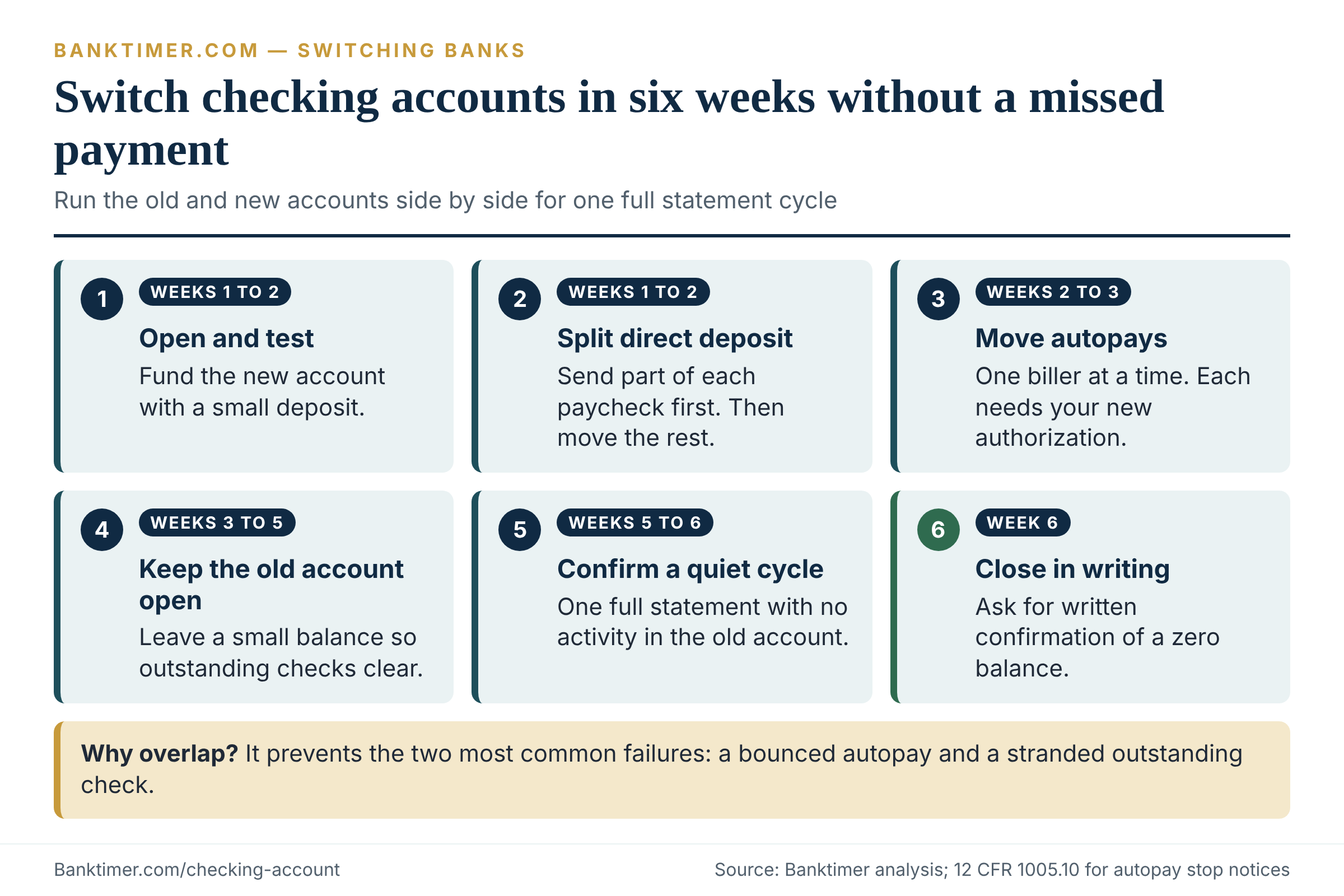
Autopays, checks and the final statement
Regulation E says preauthorized electronic transfers must be authorized by a writing signed or similarly authenticated by the consumer. Expect each biller to ask you to set up the new account. To stop the old one, you must tell the old bank at least three business days before the scheduled date, so do not leave it to the last day.
Outstanding paper checks are a quieter risk. A bank is under no obligation to pay a check presented more than six months after its date, but it may still pay one. Keep a list of checks you issued, and make sure they clear before you close the account. When you close, ask for a final zero-balance statement and whether any early-closure or dormant-account fees apply.
Questions to ask before you close
Closing is permanent enough that a short call is worth making. Ask whether any early-closure fee applies to an account opened recently, and whether a sign-up bonus has a holding period you would break. Ask how the bank returns a remaining balance, by check, transfer or cash, and how long that takes. Ask what happens to a pending deposit or a payment that arrives after closing. Ask whether the closure will be reported to a screening company, and in what circumstances. A voluntary closure with a zero balance should not trigger a report, but you should hear the bank say so.
When the bank closes your account
A bank can close an account under the terms of the deposit agreement, and the notice requirements differ by bank and state. If the closure leaves a negative balance and it goes unpaid, the CFPB notes it can appear in a checking account screening report and block your next application. Ask for the reason in writing, pay or negotiate any balance, and request your report. The guide on a bank closing your account covers the escalation path.
Joint accounts, dormant accounts and unclaimed property
On a joint account, the Uniform Commercial Code says that one authorized person can stop payment on an item or close the account, even where more than one signature is needed to withdraw. Decide with your co-owner how to handle a closure.
Money left in an inactive account does not vanish. Each state runs an unclaimed property program, and each sets its own rules for when an inactive account is transferred. If you cannot find an old account, search your state’s unclaimed property office, and check under every owner’s name if the account was shared.
Mistakes, myths and red flags that cost real money
Most checking account losses come from a handful of misunderstandings. Some are about fees. Some are about timing. A few are about who protects what. The first table lists the myths. The second lists signals worth acting on.
Seven myths worth correcting
| Myth | Reality | Why it matters |
|---|---|---|
| Free checking has no fees | “Free” often means the monthly fee can be waived. Overdraft and ATM fees still apply | The tripwires are where the money goes |
| Available funds mean the check cleared | Availability is a legal deadline. The check can still bounce and be charged back | Counterfeit-check scams exploit it |
| FDIC insurance covers fraud | It covers bank failure, up to $250,000 per category | Fraud losses follow Regulation E and the agreement |
| Opting out of overdraft stops all fees | It stops overdraft fees on ATM and one-time debit transactions. Check and ACH payments follow the agreement | You can still pay NSF fees |
| Interest checking will grow my money | The national average is 0.07%, and fees can exceed interest | A savings account does the saving |
| Regulation E covers any payment I regret | It covers unauthorized or erroneous transfers, not payments you authorize | Scam losses are harder to recover |
| A joint account is insured to $250,000 in total | Each co-owner’s share is insured up to $250,000 | Large joint balances can be partly uninsured |
Red flags to act on
| Red flag | Why it matters | What to ask | Safer next step |
|---|---|---|---|
| A waiver described as “qualifying activity” with no definition | You cannot plan around it | Where is it written? | Choose an account with a stated rule |
| A bank charging debit overdraft fees but unable to show your opt-in | Reg E requires consent for these fees | When and how did I opt in? | Request the record and revoke consent |
| An app that cannot name its partner bank | Insurance depends on the bank holding the funds | Which bank holds my deposits? | Hold small balances until you know |
| Someone asks you to deposit a check and send part of it back | A classic counterfeit check pattern | Has the check actually cleared? | Do not send money; ask your bank |
| A hold with no written notice | The bank must provide written notice for exception holds | What is the reason and the release date? | Ask for the notice and fee refund rights |
| A request to move your money to a “safe” account | A common impersonation pattern | Can I verify through the number on my card? | Stop, hang up, call your bank directly |
The pattern behind the red flags
Most of these signals share one feature: a missing written answer. A real fee waiver has a definition. A real hold has a notice. A real overdraft opt-in has a record. When a bank or app cannot show you the document, treat the term as unreliable until it can.
The second pattern is urgency. Scammers manufacture it, and so do some sales pitches. A legitimate bank can wait while you call back on the number printed on your card. Slowing down is almost always free, and speed usually favors the other side.
Five quiet habits that cost the most
Some of the most expensive behaviors do not feel like mistakes. They feel like routine. Each of these is cheap to fix once you notice it.
- Never reading the monthly statement. Regulation E’s 60-day reporting window starts when the bank sends the statement. An unauthorized charge you notice in month three may be harder to recover than one you caught in week two. Skim every statement, even when the balance looks right.
- Treating the app balance as spendable cash. The ledger balance ignores pending items. Spending to the ledger number is how a $120 restaurant authorization becomes a $27 overdraft fee.
- Letting the waiver lapse silently. A new job, a new payroll provider or a shift to freelance income can quietly drop you below a direct deposit threshold. Check the fee line on your next statement after any income change.
- Leaving old autopays attached to a closed or neglected account. A forgotten gym membership or software subscription can drain a low-balance account and trigger fees. List your recurring charges twice a year.
- Ignoring change-of-terms notices. The bank must give 30 days’ notice of adverse changes, but only if you read it. A notice buried in a statement insert is still a notice. The window to switch accounts closes before the change takes effect.
None of these requires a financial plan. Each needs about five minutes, once or twice a year, and a willingness to open the mail or the app notification.
Questions to ask before you open, switch or keep a checking account
Take this list to a branch, a chat window, or a phone call. Ask for answers in writing when the answer changes what you pay. If the bank cannot answer, that is information too.
- ☐ What is the monthly fee, and exactly which deposits or balances waive it?
- ☐ Do peer-to-peer transfers, gig payouts or mobile deposits count as qualifying deposits?
- ☐ Do I need to opt in or out of overdraft coverage for debit card purchases, and what is the per-item fee and daily cap?
- ☐ Do you charge an overdraft fee when my balance was positive at authorization?
- ☐ How many NSF fees can one returned payment trigger if a merchant tries again?
- ☐ Which ATMs are fee-free, and do you reimburse out-of-network fees?
- ☐ When will cash, direct deposits, mobile deposits and checks become available, and what is the daily cut-off time?
- ☐ What is your policy for new-account holds and for deposits above $6,725?
- ☐ Which institution holds my money, and is it insured by the FDIC or the NCUA?
- ☐ If this is an app, which partner bank holds the deposits, and are they in my name?
- ☐ Will applying trigger a credit inquiry or a screening report, and which one?
- ☐ How are joint owners’ rights defined, and can either owner close the account?
- ☐ How and when will you notify me about fee or policy changes?
- ☐ What do wires, stop payments, paper statements, replacement cards and early closure cost?
- ☐ How do I report fraud, and what is the deadline in the agreement?
- ☐ Can I set low-balance and large-transaction alerts?
Keep the answers with your statements. If a bank changes a term later, you will know what you were told.
When something goes wrong: documentation and the escalation path
Document first, then escalate
Problems with a checking account are easier to resolve when you can show what happened and when. Keep screenshots of the transaction and the app, the statement page, the date and time you reported the issue, and the name or reference number of each person you spoke with. Note which clock applies: the Regulation E 60-day window for errors, the two-business-day card rule, or the hold notice for a deposit.
Written follow-up matters. After a phone call, send a secure message or letter summarizing what you reported and what the bank said. In a Regulation E dispute, that record shows the date you notified the bank, which sets your liability.
The escalation path
Most disputes end at the first or second step. Move up only when the bank stalls or refuses without explanation.
| Step | Who | What to say or send | Typical timing | Notes |
|---|---|---|---|---|
| 1 | Bank customer service, by phone, then secure message | What happened, the amount, the date; ask for a reference number | Same day | For fraud, call immediately |
| 2 | The bank’s written dispute channel | Written summary; ask for the provisional credit date | Within the Reg E clocks | Keep copies |
| 3 | The bank’s complaints or executive office | Case reference and the documents; ask for a written final answer | Days to weeks | Many banks list this contact in the agreement |
| 4 | Regulators: the CFPB, and the agency that supervises your bank or credit union | Your complaint, the bank’s response, your evidence | Weeks | The CFPB hotline is (855) 411-2372; state banking departments also take complaints |
| 5 | An attorney, legal aid, or your state attorney general’s consumer office | The full file | Varies | Consider this for large losses |
If you are not sure which regulator supervises your bank, your statement, the bank’s website, or your state banking department can tell you. Credit unions that are federally insured answer to the NCUA, and many banks answer to the FDIC, the Federal Reserve or the OCC depending on charter. The fraud sections of this guide cover the first steps if the problem is a scam rather than a bank error.
What a strong written complaint contains
A complaint works best when a stranger can understand it in two minutes. Start with a one-sentence summary of the problem and the outcome you want. Then list the facts in date order, with amounts and the name or reference number for each prior contact. Attach the statement page, the hold notice or the denial letter. State the rule you believe applies, such as the Regulation E investigation clock, only when you can point to it. Citing a rule you have misread weakens an otherwise good complaint.
Keep the tone factual. Describe what the bank did and what you need it to do. Ask for a written answer by a specific date, and say where you will take the issue next if you do not get one. Regulators and executive offices read hundreds of these, and the ones with dates, documents and a clear request are the easiest to act on.
Glossary of checking account terms
| Term | Plain-English meaning | Why it matters | Common confusion |
|---|---|---|---|
| ACH (Automated Clearing House) | The batch network behind direct deposit and autopay | Most recurring bills and paychecks move this way | Not the same as a wire or a card payment |
| Authorization hold | A temporary reduction in available balance for a pending card purchase | Lowers what you can spend before the purchase posts | Not a charge; it may drop off or change in amount |
| Available balance | Ledger balance minus pending items and deposit holds | The number that decides whether a payment goes through | Often differs from the ledger balance |
| Banking day | The part of a business day when a bank is open to the public | Deposit timing is counted from banking days | Differs from a calendar day |
| Business day | Any day except Saturday, Sunday or a federal holiday | Reg CC and Reg E clocks count business days | Saturdays often feel like banking days online |
| Cashier’s check | A check the bank issues against its own funds | Often gets next-day availability when deposited in person | Not guaranteed to be genuine; counterfeits exist |
| Demand deposit | A deposit the bank must pay out when you ask | The legal category for checking | Different from a time deposit such as a CD |
| Direct deposit | An electronic payment from an employer or agency | Must be available no later than the next business day after the bank receives it | Early posting is a bank policy, not a right |
| FDIC insurance | Federal protection for deposits if an insured bank fails | $250,000 per depositor, per bank, per category | Does not cover fraud or scam losses |
| Interchange | The fee merchants pay on card swipes, partly shared with your bank | Helps fund free accounts and rewards | Not a fee you see on a statement |
| Ledger balance | The balance of posted transactions only | The figure on a statement | Not necessarily what you can spend |
| NCUA insurance | Federal protection for credit union members’ shares | $250,000 per member-owner, per credit union, per category | Not all state-chartered credit unions are federally insured |
| NSF (non-sufficient funds) fee | A fee when the bank returns a payment for lack of funds | Separate from an overdraft fee | Sometimes charged again on a retry |
| Opt-in | Your consent to overdraft fees on ATM and one-time debit card transactions | Required by Regulation E | Does not cover checks or ACH |
| Overdraft fee | A fee when the bank pays more than your balance covers | The most avoidable cost | Different from NSF; the bank paid the item |
| Ownership category | The legal way the account is held for insurance purposes | Each category has its own $250,000 limit | Not the same as account type |
| Payable on death (POD) | A designation naming who receives the account when you die | Avoids probate for that account in many cases | Different from a joint owner, who has access now |
| Posting order | The sequence in which a bank applies transactions each day | Can change the number of overdraft fees | Set by the bank’s agreement |
| Provisional credit | Temporary funds the bank gives you during a Reg E investigation | Keeps you whole while the bank investigates | Not a final decision in your favor |
| Regulation CC | Federal rule on when deposited funds must be available | Sets maximum hold times | Does not guarantee a check clears |
| Regulation E | Federal rule protecting consumers in electronic transfers | Sets $50 and $500 liability tiers and error procedures | Does not cover business accounts |
| Representment | A merchant presenting a returned payment again | Can trigger repeat NSF fees at some banks | Not a new purchase |
| Screening report | A report on past checking account problems, from ChexSystems or Early Warning Services | Can cause an application to be denied | Separate from your credit report |
| Second-chance account | A checking account for people with past banking problems | Often blocks overdrafts and has a low fee | May have fewer features |
| Stop payment | An instruction to the bank not to pay a specific check or recurring payment | Rules and fees differ by payment type | Cannot stop a completed card purchase |
Frequently Asked Questions
What is a checking account and how does it work?
A checking account is a deposit account for everyday spending and bill paying. You deposit paychecks, then pay with a debit card, checks, automatic payments or transfers. The bank owes you the balance on demand.
Deposits are insured up to $250,000 per depositor, per bank, per ownership category. Fees and policies vary by bank, while protections such as Regulation E and Regulation CC are federal.
How much does a checking account cost per month?
It costs nothing at many banks and roughly $14 to $16 a month at those that charge. MoneyRates’ January 2026 survey averaged $13.95, and Bankrate’s 2025 survey averaged $15.65 on interest checking.
Most charging accounts offer a waiver, such as a minimum direct deposit or balance. Overdraft, NSF and ATM fees come on top, so calculate your own annual cost from your habits.
Can I have more than one checking account?
Yes, in general. Banks typically let you hold more than one, though each bank sets its own limits. Some people use a second account for bills or for self-employment income.
Keep two things in mind. Each account may carry a fee or minimum. And FDIC limits apply per bank per ownership category, so accounts in the same category at the same bank share one $250,000 limit.
How long does a deposited check take to become available?
Under federal rules, the first $275 of most checks must be available the next business day. A local check must be available by the second business day and a nonlocal check by the fifth. Cashier’s, certified and Treasury checks deposited in person qualify for next-day availability.
Banks often release funds sooner. New accounts, deposits above $6,725 and a few other situations allow longer holds.
Why is my deposit on hold?
A bank can extend a hold if an exception applies. The exceptions are a new account, a large deposit, repeated overdrafts, a redeposited check, reasonable cause to doubt the check will be paid, or emergency conditions.
The bank must give you written notice with the reason and the date funds will be available. Ask for the notice. If a hold caused an overdraft, ask whether you are entitled to a fee refund.
What is the difference between an overdraft fee and an NSF fee?
An overdraft fee is charged when the bank pays a payment that exceeds your balance. An NSF fee is charged when the bank refuses the payment for lack of funds.
Both are separate fees. A merchant retrying a returned payment can trigger more than one NSF fee at some banks, so ask about that policy.
Do I have to opt in to overdraft coverage?
For ATM withdrawals and one-time debit card purchases, yes. Regulation E requires your opt-in before the bank can charge an overdraft fee on those transactions, and you can revoke consent at any time.
The opt-in does not cover checks or ACH payments. Those follow your deposit agreement, so you can still pay a returned-item fee even if you opted out.
Is my checking account FDIC insured, and for how much?
If the bank is FDIC-insured, yes. Coverage is up to $250,000 per depositor, per bank, per ownership category. A joint account insures each co-owner’s share up to $250,000.
Credit unions use NCUA insurance with the same limit. For app-based accounts, confirm which insured bank holds the money.
How much can I lose if someone uses my debit card?
Your loss is capped at $50 if you report a lost or stolen card within two business days of learning about it. After that, it can rise to $500. If you miss the 60-day statement window, later losses can become yours.
Some banks promise better terms in their agreements. Report as fast as you can, then follow up in writing.
Can a bank close my checking account?
Yes, in most cases the deposit agreement lets a bank close an account. Notice requirements differ by bank and state.
If a closure leaves a negative balance that goes unpaid, it can appear in a screening report and block your next application. Ask for the reason in writing, resolve the balance, and request your report.
Does opening a checking account affect my credit score?
Usually not. Banks often check a specialty screening report from ChexSystems or Early Warning Services instead of your credit report. Some banks may run a credit check, especially for linked credit products.
Ask before you apply whether the application triggers a hard credit inquiry.
Do I pay taxes on checking account interest?
Yes. The IRS says most interest credited to an account you can withdraw from without penalty is taxable income in the year it becomes available. You must report it even if you do not receive a Form 1099-INT.
Banks file Form 1099-INT when interest reaches $10 or more.
Can I open a checking account without a Social Security number?
It depends on the bank. The federal customer identification rule requires an identification number for each customer. For U.S. persons that is a taxpayer identification number. For non-U.S. persons it can be a passport number, an alien identification card number, or another government-issued document number.
Which of these a particular bank accepts is bank policy. Ask before you apply.
How do I get my ChexSystems report for free?
Nationwide checking account reporting companies must provide one free report per year on request. If a bank denies you in part based on a screening report, it must give you a notice naming the company.
Request the report from that company. Check every entry, and dispute errors with both the company and the bank that reported them.
How much should I keep in my checking account?
Keep enough to cover the bills due before your next paycheck, plus a cushion matching your lowest balance dip. Look at your last three statements to find that low point.
As an illustration, if one rent payment would overdraw you, hold at least that much above your usual balance. Move surplus cash to savings, where it can earn more.
Can I stop a check or an automatic payment?
Yes, with different deadlines. For a recurring ACH payment, tell the bank at least three business days before the scheduled date. For a paper check, place a stop-payment order before it is paid. A written order lasts six months under the Uniform Commercial Code.
A completed card purchase generally cannot be stopped, but you can dispute it.
Is a credit union checking account safer than a bank’s?
Not inherently. Both are insured up to $250,000, by the FDIC for banks and by the NCUA for federally insured credit unions. The structure of protection is similar.
Check that your credit union is federally insured. The real differences are fees, membership rules and services, so compare the fee schedules.
Before your next payday, open your bank’s fee schedule and deposit agreement and find the one sentence that defines your monthly fee waiver. Then check your last three statements to see whether you met it every month. If you missed it even once, price Setup B from the opening example with your own numbers.
A checking account is a payments tool, not an earner, so the goal is to avoid paying for it. The variable that matters most is whether the account’s tripwires line up with your month: the monthly fee and its waiver, the overdraft setting, ATM networks, and the day a deposit becomes available. Pick a waiver you will meet without effort. Opt out of debit overdraft unless a declined payment would truly hurt you, and keep a cushion as large as your lowest balance dip. Treat a deposit as spendable only when the bank says it is available, and a check as final only after it clears. Report card fraud within two business days. The account governs everyday money movement and nothing else: emergency savings belong in a savings account, and an app that cannot name its insured bank should hold only a small balance.
Related reading
- Dormant Bank Account: Fees, Escheat and Getting It Back
- ChexSystems Report: Free Copy, Disputes, How Long It Stays
- Debanking: What It Is, Your Rights, and Next Steps
Methodology
This guide draws on federal regulations at the eCFR, FDIC and NCUA consumer pages, CFPB and Federal Reserve publications, IRS and FTC guidance, state legislative records, and published fee surveys. Regulatory text and agency pages were read on October 6, 2026. Provider product pages were read the same day and are dated examples, not endorsements or quotes.
Survey figures come from Bankrate (June 2 to July 3, 2025), MoneyRates (January 9, 2026) and the National Consumer Law Center (June 2026). They use different samples, so we present them as ranges. The NCLC report is advocacy research and is labeled that way.
All dollar scenarios are illustrative. They use assumptions stated in the text and were calculated and rechecked in a script. They are not offers, quotes or predictions. Fee levels, policies and rules change, so verify current terms with your bank before you decide. This guide is not legal or financial advice. For a specific problem, consult your bank, a state regulator, or a qualified professional. The guide does not rely on testing any bank’s products.
Sources
Primary official sources
- FDIC: Your Insured Deposits. Checked October 6, 2026.
- FDIC: Deposit insurance overview. Checked October 6, 2026.
- FDIC: Financial products insured. Checked October 6, 2026.
- FDIC: 2023 National Survey of Unbanked and Underbanked Households. Checked October 6, 2026.
- NCUA: Share insurance coverage. Checked October 6, 2026.
- 12 CFR 1005.2 definitions, with CFPB official interpretation of comment 2(m). Checked October 6, 2026.
- 12 CFR 1005.6: Consumer liability for unauthorized transfers. Checked October 6, 2026.
- 12 CFR 1005.10: Preauthorized transfers. Checked October 6, 2026.
- 12 CFR 1005.11: Procedures for resolving errors. Checked October 6, 2026.
- 12 CFR 1005.17: Requirements for overdraft services. Checked October 6, 2026.
- 12 CFR 229.2: Definitions (Regulation CC). Checked October 6, 2026.
- 12 CFR 229.10: Next-day availability. Checked October 6, 2026.
- 12 CFR 229.12: Availability schedule. Checked October 6, 2026.
- 12 CFR 229.13: New accounts and exceptions. Checked October 6, 2026.
- 12 CFR 229.19: Miscellaneous provisions. Checked October 6, 2026.
- Consumer Compliance Outlook: Regulation CC dollar thresholds effective July 1, 2025. Checked October 6, 2026.
- 12 CFR 1030.5: Subsequent disclosures (Regulation DD). Checked October 6, 2026.
- 12 CFR 1030.11: Periodic statement disclosures. Checked October 6, 2026.
- 31 CFR 1020.220: Customer identification program for banks. Checked October 6, 2026.
- 12 CFR 330.9: Joint ownership accounts. Checked October 6, 2026.
- 31 CFR 212.3 and 212.5: Garnishment of accounts with federal benefit payments. Checked October 6, 2026.
- 12 CFR 1026.12: Credit card liability limits (Regulation Z). Checked October 6, 2026.
- CFPB: Know your overdraft options. Checked October 6, 2026.
- CFPB: Denied for a bank account? Here is what you should know. Checked October 6, 2026.
- CFPB: Consumer guide to being denied a checking account. Checked October 6, 2026.
- CFPB data spotlight: Overdraft and NSF revenue in 2023. Checked October 6, 2026.
- CFPB: Bank account consumer tools. Checked October 6, 2026.
- Federal Reserve: Regulation II average interchange fee, 2024 data. Checked October 6, 2026.
- Federal Reserve: FedNow service overview. Checked October 6, 2026.
- Federal Reserve History: The Glass-Steagall Act. Checked October 6, 2026.
- Federal Reserve History: Regulation Q and interest rate controls. Checked October 6, 2026.
- IRS Tax Topic 403: Interest received. Checked October 6, 2026.
- FTC: New data show a big jump in reported fraud losses, $12.5 billion in 2024. Checked October 6, 2026.
- Federal Register: Personal Financial Data Rights Reconsideration, August 22, 2025. Checked October 6, 2026.
- New York DFS industry letter on overdraft and NSF fees, July 12, 2022. Checked October 6, 2026.
- FDIC national rate: Interest checking, via FRED. Checked October 6, 2026.
Provider documents (dated examples)
- Chase Total Checking product page. Read October 6, 2026.
- Capital One 360 Checking product page. Read October 6, 2026.
Research and surveys
- Bankrate: 2025 checking account and ATM fee survey. Checked October 6, 2026.
- MoneyRates: 2026 checking account fee survey. Checked October 6, 2026.
- National Consumer Law Center: The $12 Billion Overdraft Trap, June 2026. Advocacy research. Checked October 6, 2026.
- Bank On National Account Standards, Cities for Financial Empowerment Fund. Checked October 6, 2026.
Legal and secondary context
- UCC 4-403: Customer’s right to stop payment (Cornell Legal Information Institute). Checked October 6, 2026.
- UCC 4-404: Bank not obliged to pay stale checks (Cornell Legal Information Institute). Checked October 6, 2026.
- California SB 1075 (2024), credit union overdraft and NSF fees. Checked October 6, 2026.
- California AB 2017 (2024), NSF fees on instantly declined transactions. Checked October 6, 2026.
- Holland & Knight: CFPB overdraft and digital payment rules repealed, May 2025. Checked October 6, 2026.
- Consumer Finance Monitor: Trump signs resolution nullifying CFPB overdraft rule. Checked October 6, 2026.
- Winston & Strawn: CFPB withdrawal of guidance documents. Checked October 6, 2026.
- Consumer Finance Monitor: CFPB sends new Section 1033 proposal to OIRA, August 2026. Checked October 6, 2026.
- ABA Banking Journal: Executive order phases out Treasury paper checks, March 2025. Checked October 6, 2026.
By the Banktimer Editorial Team · Published
Banktimer is an independent U.S. consumer-finance publication. Our editors draw on primary and official sources first, such as the CFPB, FDIC, Federal Reserve, and FTC, along with statutes, regulations, and providers’ own agreements and fee schedules. Then we add worked examples and decision tools. Our goal is the most useful, best-supported explanation the sources available to us at the time of writing allow.
This article is general information, not legal, tax, investment, insurance, or financial advice, and reading it does not create a professional relationship with Banktimer. Rates, fees, limits, and rules change, and they vary by state, provider, and contract, so confirm current terms with your bank, lender, insurer, or the agency named in the article before you act. Examples are illustrative unless labeled otherwise. Banktimer is not a bank, lender, insurer, or financial advisor, and we are not responsible for decisions or losses that result from relying on this content. For advice about your own situation, talk to a licensed professional.