

By the Banktimer Editorial Team · Published
Banktimer is an independent U.S. consumer-finance publication. Our editors draw on primary and official sources first, such as the CFPB, FDIC, Federal Reserve, and FTC, along with statutes, regulations, and providers’ own agreements and fee schedules. Then we add worked examples and decision tools. Our goal is the most useful, best-supported explanation the sources available to us at the time of writing allow.
This article is general information, not legal, tax, investment, insurance, or financial advice, and reading it does not create a professional relationship with Banktimer. Rates, fees, limits, and rules change, and they vary by state, provider, and contract, so confirm current terms with your bank, lender, insurer, or the agency named in the article before you act. Examples are illustrative unless labeled otherwise. Banktimer is not a bank, lender, insurer, or financial advisor, and we are not responsible for decisions or losses that result from relying on this content. For advice about your own situation, talk to a licensed professional.
Banking for college students means holding a checking account, usually with a debit card and a savings account, to receive aid refunds and paychecks and to pay rent and bills. You need a government photo ID, a Social Security number or other tax ID (international students have alternatives), and a mailing address. You are never required to use the account your school promotes. Pick one with no monthly fee that you can keep after graduation, and turn off overdraft coverage on debit purchases.
Six things to settle before you open anything
The fee is the smallest line. A $0 monthly fee tells you little. Overdraft charges, fee waivers that end at graduation, and out-of-network ATM fees decide what the account really costs.
You choose where refunds go. Federal rules require your school to tell you in writing that you do not have to open a particular account. Any existing account works.
Ownership decides who is on the hook. On a joint account with a parent, either owner can withdraw everything, and both answer for overdrafts.
Decline overdraft on debit purchases. Without your opt-in, the bank cannot charge an overdraft fee on ATM or one-time debit card transactions. Declined is cheaper than covered.
Ask what happens at graduation. Some student accounts add a monthly fee when you graduate or hit an age limit. Learn the date and the fee now.
Your own payments are the weak spot. If you send money to a scammer yourself, federal unauthorized-transfer protections may not help. Fake checks and fake jobs target students for exactly this reason.
Why a free student account is the smallest part of the decision
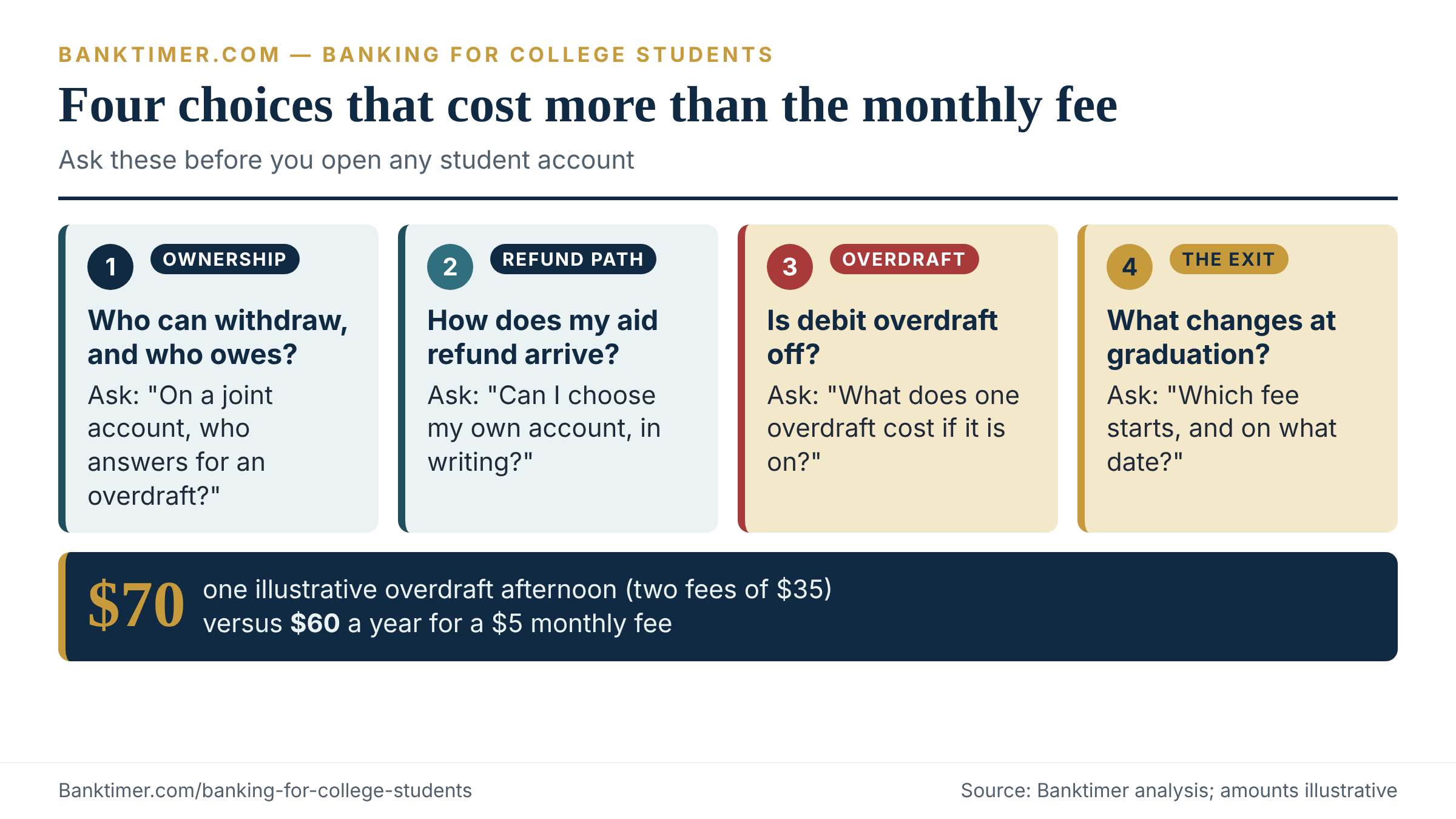
Most advice about banking for college students starts with a comparison of monthly fees. That makes sense on the surface, because a fee you can see is easy to rank. But a $5 monthly charge is $60 a year. Two overdraft fees at $35 each cost more than that in a single afternoon. The expensive moments come from a stack of avoidable events.
Picture an illustrative first semester. Your school sends a $2,450 refund. A parent asks to be added to the account “just in case.” A part-time job starts depositing $240 every other week. A roommate asks for a payment-app transfer. Each event touches a different rule, and none of them depends on whether the account advertises a $0 monthly fee.
The four decisions that matter more than the fee
The first decision is ownership: whether the account is yours alone, joint with a parent, or run by a custodian. The second is the refund path, meaning how your leftover aid reaches you and whether your school’s partner account is involved. The third is overdraft behavior, which determines whether a small mistake costs $0 or $35. The fourth is the exit, the terms that apply when you graduate, leave school, or turn a certain age.
The first infographic in this guide puts those four decisions side by side, with the question to ask for each.
What this guide covers and what it leaves out
This guide treats banking for college students as checking and everyday savings at U.S. colleges, including for international students. It explains the rules by source: federal law, school policy under federal aid rules, bank policy, and Banktimer’s own illustrative examples. It does not recommend a specific bank, and it does not quote live rates.
Credit cards, student loans, and investing are separate topics. Where they touch an account, you will find a short pointer, such as the later section on student credit cards and the under-21 rule, and student loan repayment.
The numbers that anchor everything else
Student banking has a handful of figures worth memorizing. Most come from federal regulation, a few from federal research, and one from a bank’s own published terms. The table separates them, because a bank’s policy can change next month while a regulation cannot.
| Item | Value | Type of rule | Where it comes from |
|---|---|---|---|
| Aid credit balance payout | Within 14 days | Federal regulation (school duty) | 34 CFR 668.164(h) |
| Overdraft on debit purchases | Needs your opt-in | Federal regulation (bank duty) | 12 CFR 1005.17 |
| Lost-card liability if reported in 2 business days | Up to $50 | Federal regulation | 12 CFR 1005.6 |
| Deposit insurance, per bank, per ownership type | $250,000 | Federal insurance (FDIC, NCUA) | FDIC and NCUA |
| “New account” period for check holds | First 30 calendar days | Federal regulation | 12 CFR 229.13(a) |
| Average annual fee on college-partnered accounts | $12.36 (award year 2022-23) | CFPB research, not a rule | CFPB, December 2024 |
| Credit card applicants under 21 | Need income or a cosigner | Federal regulation | 12 CFR 1026.51(b) |
Read the table as a map. The first five rows protect you no matter which bank you pick. The last two describe the market and the credit-card gate, which is a separate conversation. Every figure was checked in October 2026, and the Methodology section lists the sources.
What banking for college students means in practice
Put plainly, a student account is a regular deposit account with a student-friendly wrapper. The wrapper might waive a monthly fee while you are enrolled, lower a balance requirement, or add budgeting tools. The account underneath still follows the same federal rules as any checking account.
Student checking versus regular checking
“Student account” is a product label, not a legal category. Each bank sets its own eligibility, usually an age range or proof of enrollment, and its own terms. Some providers sell no separate student product because their standard checking already has no monthly fee. Capital One’s 360 Checking page, for instance, lists no monthly fee, no minimum balance and no overdraft fees as of October 2026. Treat that as a dated example, not a recommendation.
That matters for one reason: the student version can be the worse deal after you leave school. A regular no-fee account has nothing to expire. A student account often does. For the full mechanics of everyday accounts, see our checking account guide, and for the student-specific cornerstone, see student banking.
Who sells student accounts
Four kinds of providers compete for you, and they behave differently.
- Large national and regional banks sell student checking with branch and ATM access. Fee waivers usually last while you are enrolled.
- Credit unions are member-owned. You join through a school, employer, or community connection, and many offer low-fee starter accounts.
- Online banks have no branches, often charge no monthly fee, and rely on ATM networks and mobile deposit.
- Campus-partnered providers work with your school under a contract. These are the accounts tied to your student ID or your aid refund.
The last group deserves separate treatment. Federal aid rules give you specific protections there, and a federal agency has measured what those accounts cost. Both appear in the refund section below.
Where savings fits
Your checking balance should cover the next one or two months of bills. Anything beyond that earns more elsewhere. A savings account at the same bank makes transfers easy, and it can link to checking as a free overdraft backstop. If you are building a first cushion, our guide to the high-yield savings account shows how rates and limits work.
Keep one rule in mind: insured does not mean profitable. Deposit insurance protects your money if a bank fails. It does nothing about fees.
What you can skip as a first-year student
You do not need a checking account with a branch on every corner if you live on campus and use an app. You do not need a premium account with perks. You do not need to add a credit card in the first month, and nobody should pressure you to. Ask whether a feature earns its cost, then take only what does.
Documents and identity checks: what banks ask for and why
Banking for college students starts with an identity check. Every U.S. bank must run an identification program before it opens an account. The federal rule behind it, the Customer Identification Program rule, sets a floor. Banks can ask for more, and many do. Credit unions run parallel programs under their own regulator.
What federal rules require a bank to collect
The rule requires four items before a bank opens an individual account: your name, your date of birth, a residential address, and an identification number. For a U.S. person, that number is a taxpayer identification number, usually a Social Security number. The bank then verifies you, commonly with an unexpired government-issued photo ID such as a driver’s license or passport.
The rule also lets a bank open an account while a tax ID application is pending, and collect the number within a reasonable time afterward. That detail helps students who just applied for a number. Whether a specific bank uses that flexibility is a bank policy, so ask.
Typical documents for domestic and international students
Banks differ, but the same short list covers most openings. The table separates what is usually required from what is only sometimes requested.
| Document | Domestic student | International student | Why it matters |
|---|---|---|---|
| Government photo ID | Driver’s license, state ID or passport | Passport, often with visa | Satisfies the identity check |
| Tax ID | Social Security number | Passport number or ITIN; SSN if you have one | Federal rule asks for an ID number |
| Proof of address | Lease, utility bill, dorm letter, or mail | Same, plus home-country address often accepted | Residential address is required |
| Proof of enrollment | Student ID or enrollment letter | Student ID, I-20 or DS-2019 | Qualifies you for student pricing |
| Opening deposit | Often $0 to $100 | Often $0 to $100 | Varies by provider |
A bank’s list of accepted documents is policy, not law. If one branch turns you away, a second branch or a different bank may accept the same papers. Keep that in mind before assuming you are ineligible.
International students: the Social Security number question
Many international students worry they cannot bank without a Social Security number. The federal identification rule does not require an SSN for a non-U.S. person. It accepts a taxpayer identification number, a passport number and country of issuance, an alien identification card number, or another government-issued document number.
The Department of Homeland Security’s Study in the States site, in an older but still-hosted page, says F-1 and M-1 students do not need an SSN to open a bank account. Students become eligible for an SSN only in specific circumstances, such as authorized on-campus work. An Individual Taxpayer Identification Number, or ITIN, exists for people who cannot get an SSN and need to file U.S. taxes.
If you give a bank no tax ID at all, interest it pays may face 24% backup withholding, according to the IRS. Providing a passport-based ID at opening does not always settle the tax-reporting side. Ask the bank what form it wants, and ask your school’s international office before you file anything.
Under 18 and the age-of-majority wrinkle
Most college students are adults, but not all. The age of majority is 18 in most states, 19 in Alabama and Nebraska, and 21 in Mississippi, according to Cornell’s Legal Information Institute. A dual-enrollment student or a young first-year may need a joint account with a parent or a custodial arrangement.
Custodial accounts under state Uniform Transfers to Minors Act laws hand control to the young adult at an age that varies by state. If you hold one, ask the custodian and the bank when control transfers, and what happens to the balance on that day.
If a bank says no: ChexSystems and second-chance accounts
Banks check your history with specialty reporting companies such as ChexSystems and Early Warning Services. Students rarely have a history, but a prior account closed with an unpaid overdraft can surface. The Consumer Financial Protection Bureau (CFPB) says you can get a free copy of your report every 12 months, and you receive one if a bank denies you based on it.
If a denial comes, ask which company the bank used, request the free report, and dispute errors with both the company and the bank. Some banks offer lower-risk accounts designed to prevent overdrafts. For a look at the account-opening steps from the application side, see our guide to how to open a bank account online.
In banking for college students, ownership sounds like a form field. It is a legal decision about who can move the money, who answers for a negative balance, and who gets to see activity. Change it later and you may have to open a new account.
Five ownership structures compared
The table uses the same four questions for every structure. “Typical” matters here: the deposit agreement and state law control the details, so read the agreement before you sign.
| Structure | Who can withdraw | Who answers for overdrafts | FDIC treatment | Often fits |
|---|---|---|---|---|
| Individual (single) | You only | You | Your single-account category | Most adult students |
| Joint with a parent | Either owner, any amount | Typically both owners | Each owner’s share counts as joint | Students who want a parent’s oversight |
| Custodial (UTMA/UGMA) | The custodian, for the minor | Varies by state law and bank terms | Depends on how the bank titles it; ask | Minors with gifted funds |
| Authorized signer or convenience signer | Owner plus signer | The owner | Owner’s funds, owner’s category | A parent helping an adult student |
| Parent-owned account with a student card | Parent controls limits | The parent | Parent’s category | Very early, supervised use |
Two rows deserve more attention, because families blur them: joint ownership and authorized signing. They look alike at the ATM and behave very differently in a dispute.
Joint account with a parent: where it helps and where it bites
A joint account gives a parent real visibility. They can see deposits, spot a fraud alert, and move money in a hurry if your card is lost. For a first-year student far from home, that has value.
The cost is shared exposure. FDIC rules for joint coverage require that all co-owners have equal rights to withdraw and have signed a signature card. That same equal right means either owner can take the whole balance. If a parent’s creditor or a student’s overdraft becomes a problem, both names are on the account. State law and the deposit agreement decide how far that goes, so ask the bank how it treats a co-owner’s debts. Our joint bank account guide covers the mechanics in depth.
Deposit insurance by ownership type
The FDIC insures $250,000 per depositor, per insured bank, for each account ownership category. A single account and a joint account at the same bank are separate categories. For joint accounts, the FDIC says each co-owner is insured up to $250,000 for the combined amount of his or her interests in all joint accounts at that bank, and it presumes equal shares unless records say otherwise.
For a student, the limit rarely bites. Balances stay small. It starts to matter when a parent parks a large tuition payment in a joint account for a few weeks, so check the total across every account the parent holds at that bank.
Credit unions have a parallel system. The National Credit Union Administration insures accounts up to $250,000 per member-owner, per insured credit union, per account category. Look for the NCUA sign or check the credit union’s status on the agency’s site before you join.
Fintech apps and prepaid cards are not automatically insured
Many student-friendly apps are not banks. They partner with a bank that holds the money. FDIC insurance applies to a prepaid card only when certain FDIC requirements are met, according to the agency. Ask which bank holds your funds, whether the account is set up for deposit insurance, and what happens to your balance if the app company fails.
Parents, privacy and FERPA
FERPA, the Family Educational Rights and Privacy Act, is the law families most often cite, and it does not apply to banks. It governs education records at schools that receive federal funding. Once you turn 18 or attend a postsecondary school, those rights pass from your parents to you. Schools may still share records with parents of a dependent student, as defined by federal tax law.
Your bank account is a different matter. A parent sees your transactions only if they are an owner, a signer, or you share your login. The deposit agreement and the bank’s privacy notice control who can see what. Keep the two ideas separate, because “my parents can’t see my grades” says nothing about your checking account.
Signers, powers of attorney and beneficiaries
A parent who needs to help from a distance has options short of joint ownership. An authorized signer can transact without owning the money. A financial power of attorney gives an agent legal authority, and it works only if you sign the document and the bank accepts it. Our guide to the financial power of attorney explains the document and its limits.
You can also name a payable-on-death beneficiary on most accounts. That choice decides who receives the balance if you die. If you have never filled one out, ask the bank how to add one and who it would pay.
Financial aid refunds, campus cards and your right to choose
This is the part of banking for college students that most guides skip, and it is where federal rules protect you most clearly. If your school sends you money, a federal regulation controls how and when. It also controls what the school may do to steer you toward an account.
How a refund is created
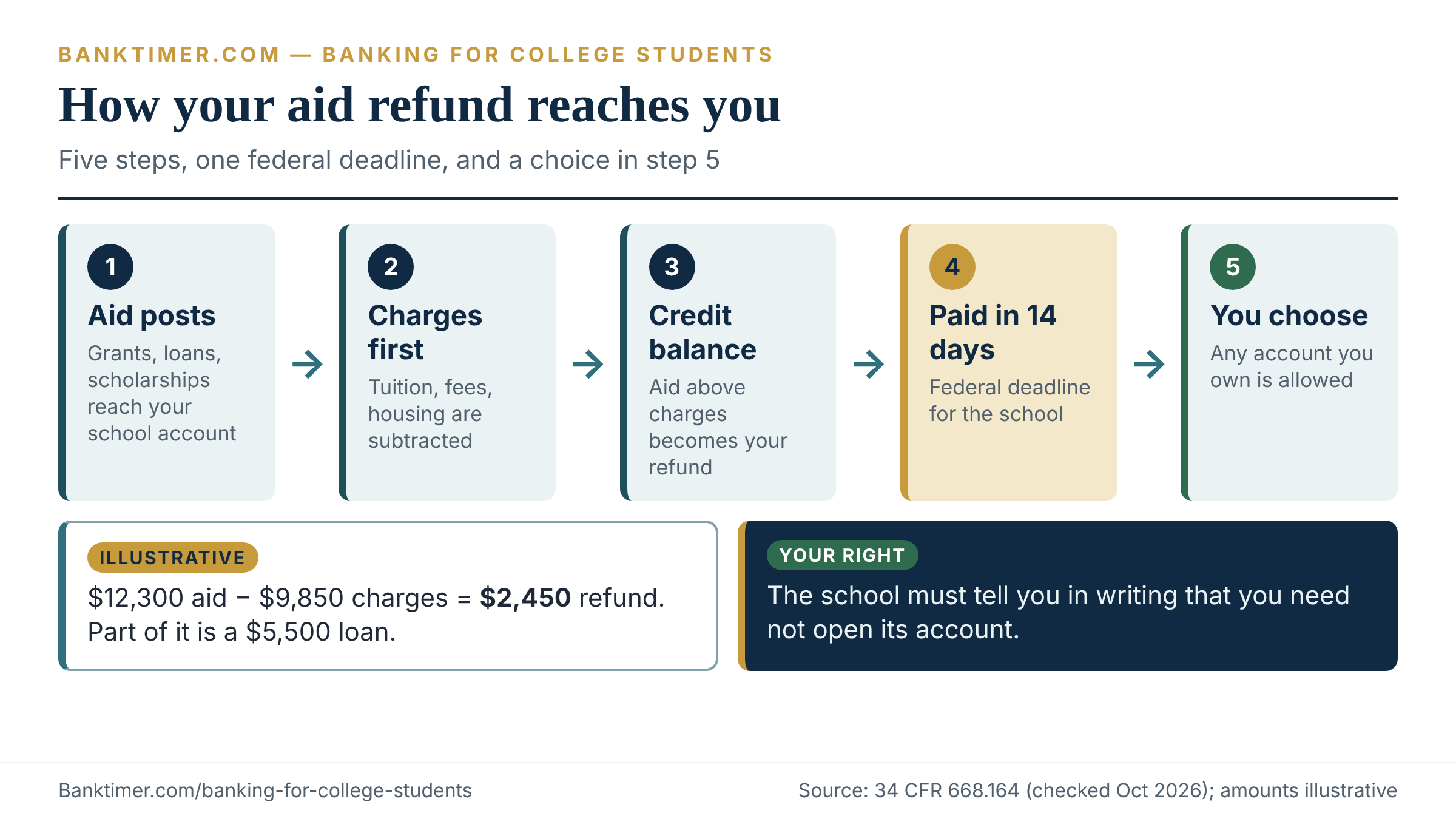
A credit balance appears when federal student aid posted to your school account exceeds your allowable charges. The school pays you the difference. Allowable charges include tuition, required fees, and room and board billed by the school.
A student’s fall charges are $9,850: $6,350 for tuition and fees and $3,500 for housing and meals. Aid posted is $12,300: a $4,000 grant, a $5,500 federal loan and a $2,800 scholarship. The credit balance is $2,450.
Spread over a 16-week term, that is about $153 a week. After a $380 book bill and a first month’s rent of $850, $1,220 remains. The loan portion of this aid is 44.7% of the total, which means part of the refund is borrowed money.
The point of the arithmetic is the last sentence. A refund is not income. Some of it may be a loan you will repay with interest, so budget it as a fixed pot over the term, not a windfall. Our monthly budget guide shows a simple way to split a lump sum across weeks.
The 14-day payout rule
Under the federal cash management rule, a school must pay a credit balance “as soon as possible, but no later than 14 days” after the balance occurs or after the first day of class, whichever applies. That gives you a date to hold your school to. If your refund has not arrived two weeks after your aid posted, contact the bursar and ask where the payment stands.
Two kinds of school-account arrangements
The regulation sorts school-linked accounts into two tiers. In a Tier One arrangement, a third-party servicer handles the school’s payments to students. In a Tier Two arrangement, a bank markets accounts directly to students, often with the school’s name attached. Both carry requirements, and the rules are stricter than most students realize.
- No cost to open the account.
- Convenient access to funds through a surcharge-free national or regional ATM network, with a looser version for Tier Two.
- A required review of fees every two years, so they stay at or below prevailing market rates.
- Public disclosure of the contract and the money that changes hands.
- For Tier One: no credit extensions and no overdraft fees.
Those are floors, not guarantees. A school can meet them and still have an account that costs more than a competitor’s. The federal government’s own research shows how that plays out.
Your right to choose, in writing
The rule says a school offering these accounts must run a student selection process. It must tell you in writing that you are not required to open or obtain a particular account. It must present options in a clear, fact-based and neutral manner. It must make payment to your existing account as timely and no more onerous than the other options. It may not preselect an account for you. And you may change your choice later with reasonable notice.
In practice, the school emails a “choose how to receive your refund” prompt. If you ignore it, the school still has to pay you by a standard method, and the regulation limits how long it can take. So you can bank with anyone and still receive your refund.
What the CFPB found about campus accounts
The CFPB reports to Congress each year on college banking agreements. Its December 2024 report covers award year 2022-23 and reviewed 517 colleges and 919,173 active student accounts. Students paid $11,359,312 in fees, an average of $12.36 per account. A year earlier, in the report covering 2021-22, the average was $26.52 across 652,599 accounts. The average fell by more than half.
That is good news, with caveats. One provider, BankMobile, held 727,060 of those accounts, about 79.1%, and the report says it charged a $2.99 monthly maintenance fee. Overdraft fees on partnered accounts ran from $0 to $36, and non-sufficient funds (NSF) fees from $0 to $36. The report notes that combined overdraft and NSF charges per day ran from a $102 maximum to no limit at some institutions.
An earlier CFPB release, from October 2022, gave a sharper example. Some agreements let providers charge five overdraft or NSF penalties a day, which at $35 each is $175. Monthly service fees applied to accounts with under $300 in qualifying deposits a month, and financial aid disbursements did not count toward that total.
The December 2023 report adds a behavioral point. It says students “trust and rely on” their schools’ offering of these products as financial advice. That trust is the reason the written-choice rule exists.
How to redirect your refund
You do not need to refuse anything or argue with the bursar. The steps are routine.
- Open your bank account first, or confirm you have one.
- Find your school’s refund-preference page in the student portal.
- Select direct deposit to an existing account and enter the routing and account numbers.
- Confirm the account is in your name, so the refund does not bounce.
- Check the deposit date against the 14-day rule, and keep the confirmation email.
If the school’s page offers only its partner account, ask the bursar in writing how to select an outside account. A school with one of these arrangements must treat a transfer to your own account as no more onerous than its partner option.
Work-study and campus job pay
Federal Work-Study works differently from an aid refund. Schools must pay work-study compensation at least once a month. They can pay by check, by electronic transfer to a bank account you designate, or by crediting your school account if you authorize it in writing. Federal Student Aid says most schools offer direct deposit, and your work-study earnings are not counted as income on later FAFSA calculations.
Link your paycheck to the account you actually use. A work-study check that goes to a campus card you never open is a common way for small amounts to sit idle.
Why a refund check can sit on hold
If your school mails a paper refund check, the bank’s funds availability rules apply. These come from the Federal Reserve’s Regulation CC. During the first 30 calendar days of a new account, the usual check-hold schedule does not apply, so the bank may hold an ordinary check longer than it would for an established customer.
Cash and electronic payments, including direct deposit, must still be available the next business day. For certain official checks, such as cashier’s and certain government checks, the bank must generally make the first $6,725 per day available the next business day. Some conditions depend on how you deposit. The Federal Reserve raised that figure from $5,525 effective July 1, 2025. For the bank’s own policy, read its funds availability disclosure.
The takeaway is practical: if rent is due the day after you open the account, do not rely on a freshly deposited personal check. Choose direct deposit for the refund, or wait until the check has cleared before you pay anything that depends on it. Our guide to mobile check deposit explains holds and limits for deposits you make by phone.
What banking for college students costs: fees, overdraft and the graduation switch
In banking for college students, costs hide in triggers, not in headline prices. A fee schedule lists a dozen charges, but a student usually meets only three or four of them. The table ranks the ones that matter most for students and shows whether you can avoid each.
Fee anatomy for a student account
| Cost item | What triggers it | Typical basis | Avoidable? |
|---|---|---|---|
| Monthly maintenance | Falling short of a balance, deposit or enrollment condition | $0 to $12 in the CFPB’s college-partnered sample | Usually, with the right account |
| Overdraft | A payment is covered when your balance is too low | $0 to $36 in the CFPB sample; many banks charge $30 or more | Yes, for debit purchases |
| Non-sufficient funds (NSF) | A payment is returned unpaid | $0 to $36 in the CFPB sample | Partly |
| Out-of-network ATM | Using an ATM outside your bank’s network | Varies; the ATM owner may add its own fee | Yes |
| Outgoing wire or cashier’s check | Requesting the service | Varies by provider | Often |
| Foreign transaction fee | Spending abroad or on foreign sites | Varies by provider | Often |
| Graduation or “sunset” fee | Graduating, leaving school or reaching an age | Varies by provider | Only if you switch first |
Pay attention to the last row. It is the one students learn about after it has charged them. The CFPB reports that some institutions impose extra fees when a student graduates, leaves school, or reaches a certain age.
Fee waivers and the monthly-deposit trap
Many accounts waive the monthly fee if you meet a condition. Common conditions include a minimum balance, a minimum monthly direct deposit, or proof of enrollment. Each one fits some students and fails others.
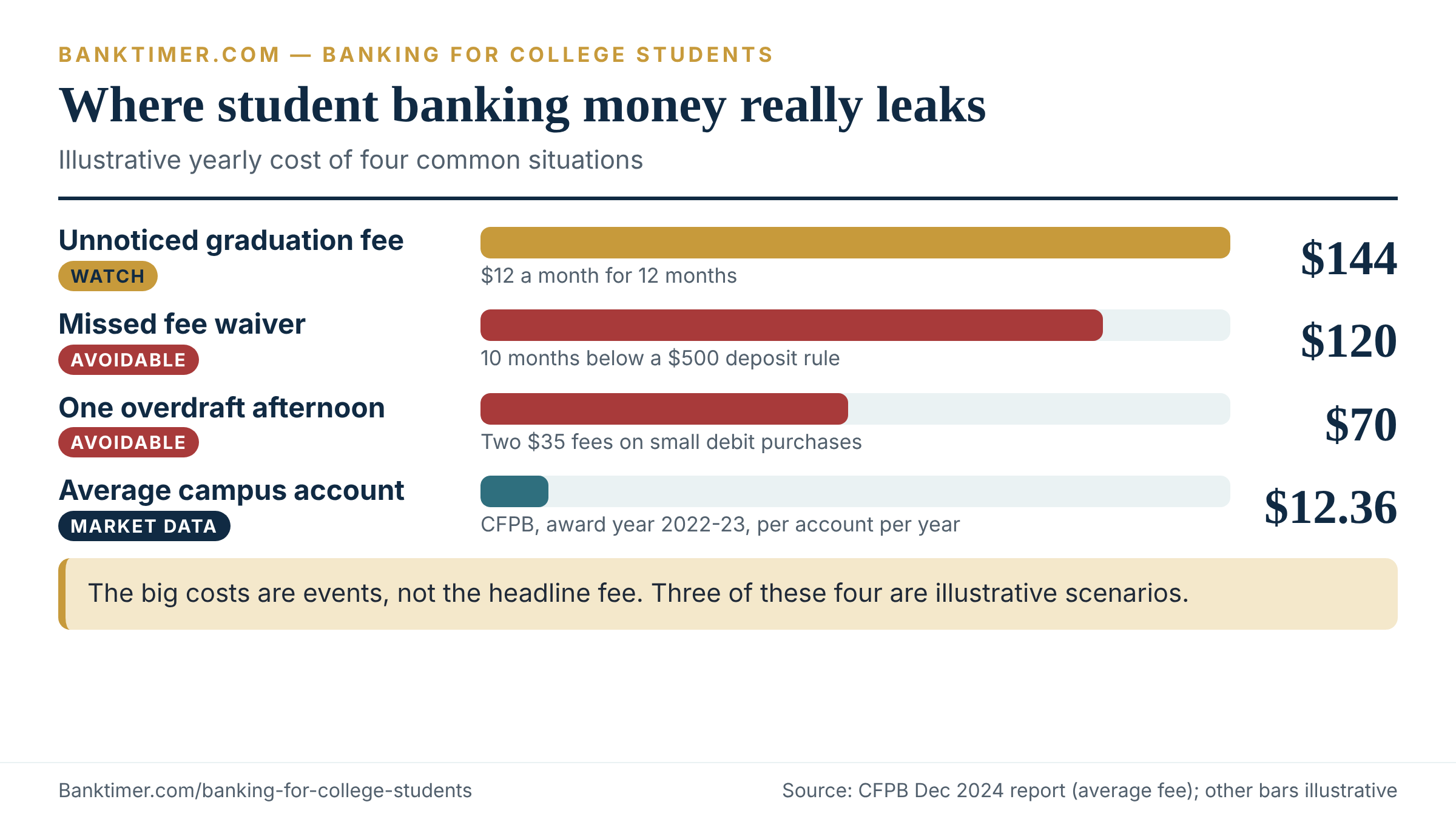
A student earns $11 an hour for 12 hours a week. Gross pay is $264 per biweekly check, and we assume $240 reaches the account after withholding. The account charges $12 a month unless direct deposits reach $500.
With 26 paychecks a year, ten months bring two checks ($480) and two months bring three ($720). The student misses the $500 mark in 10 months and pays $120 in fees. Fixing it takes either a second deposit source or a different account.
The lesson is general. Compare the waiver condition with your actual income pattern, not with a calendar month in which you hope to earn more. And check whether aid refunds count as qualifying deposits, because the CFPB found at least one structure where they did not.
Overdraft: what the federal opt-in covers and what it does not
Federal Regulation E (12 CFR 1005.17) blocks a bank from charging an overdraft fee on ATM and one-time debit card transactions unless you opt in. The bank must give you a written notice, confirm your consent, and tell you that you can revoke it. It must offer the same account terms whether you opt in or not.
Read the scope carefully. The opt-in applies to ATM and one-time debit card transactions. It does not give you a federal right to decline overdraft fees on checks, automatic payments or recurring debits. A bank may still pay those and charge a fee, subject to its own policy and the account agreement. That is why rent paid by check or autopay can overdraw an account even after you opt out.
Your balance is $40. You buy lunch for $22, a textbook rental for $15, a snack for $9 and a pizza for $31, all by debit card. The overdraft fee is $35.
With overdraft coverage on, the first two purchases clear. The third overdraws you by $6 and costs $35. The fourth costs another $35. Total purchases are $77, total fees are $70, and you owe the bank $107. With coverage off, the third and fourth purchases decline, you pay $0, and you finish with $3.
The CFPB’s consumer guidance says many banks and credit unions charge $30 or more per overdraft and that opting out generally means your debit card is declined instead. For a deeper look at the alternatives, such as linking savings, see our guide to overdraft protection. You can change the setting at any time.
Out-of-network ATMs, wires and study-abroad fees
ATM fees stack. Your own bank may charge for using a foreign ATM, and the ATM owner may add a second fee. Choose an account with a large surcharge-free network, or find in-network ATMs near campus before you pick.
Wires and cashier’s checks usually carry a flat fee. Foreign transaction fees matter if you study abroad or buy from overseas sellers. Look at each charge on the fee schedule, not just the monthly one.
The graduation switch
The end of enrollment is a pricing event. A fee that was waived for four years can start the month after your last class, sometimes without a separate notice.
A student account waives a $12 monthly fee while the holder is enrolled. After graduation the waiver ends. If the graduate does nothing, the annual cost is $144, and two years of inaction costs $288. If the graduate switches after eight months, the cost is $96.
Moving a checking account takes effort: direct deposit, autopays and any linked savings. That effort is why many people leave the account where it is. Set a reminder six months before graduation. The CFPB’s guidance on moving your checking account lists the steps.
Four scenarios side by side
The table pulls the illustrative numbers together. These figures use the assumptions stated above and are not quotes from any provider.
| Scenario | Assumptions | Cost | What reduces it |
|---|---|---|---|
| Overdraft afternoon, coverage on | $40 balance, four purchases, $35 fee | $70 in fees | Opt out of debit coverage |
| Missed deposit waiver | $240 biweekly checks, $12 fee, $500 rule | $120 a year | Pick an account with no waiver condition |
| Unnoticed graduation fee | $12 monthly fee, no waiver after graduation | $144 a year | Switch within a month |
| Average college-partnered account (CFPB) | Award year 2022-23, all partnered accounts | $12.36 a year | Compare with a no-fee account |
Notice the gap. An average campus account costs about $12 a year, a figure the CFPB measured. A single bad afternoon costs six times that. The cheapest account is the one that makes the expensive events impossible.
Current context as of October 2026
Five developments change what you can assume. Each was checked against an official or primary source in October 2026.
What changed recently
- Overdraft rule repealed. In May 2025, the President signed a Congressional Review Act resolution nullifying the CFPB’s 2024 overdraft rule, which would have applied to banks with more than $10 billion in assets. Result: no new federal overdraft fee cap exists, and the Regulation E opt-in rule above remains the baseline.
- Payment-app supervision rule repealed. The same action nullified a CFPB rule that would have given the agency supervisory authority over larger nonbank payment apps.
- Campus account fees fell. The CFPB’s latest report listed on its page, published in December 2024, shows average fees of $12.36 per account, down from $26.52.
- Regulation CC thresholds rose. The new-account amount is now $6,725, effective July 1, 2025.
- Cash management rule unchanged. The eCFR text of 34 CFR 668.164, current through October 1, 2026, still shows the tiers, the student-choice process and the 14-day payout.
Treat the repeal as a reason to read your own account’s terms. If a bank can charge $35 per overdraft, federal law does not cap it. Competition may, and the CFPB notes that accounts without overdraft fees are increasingly available.
How to choose a setup: a decision framework
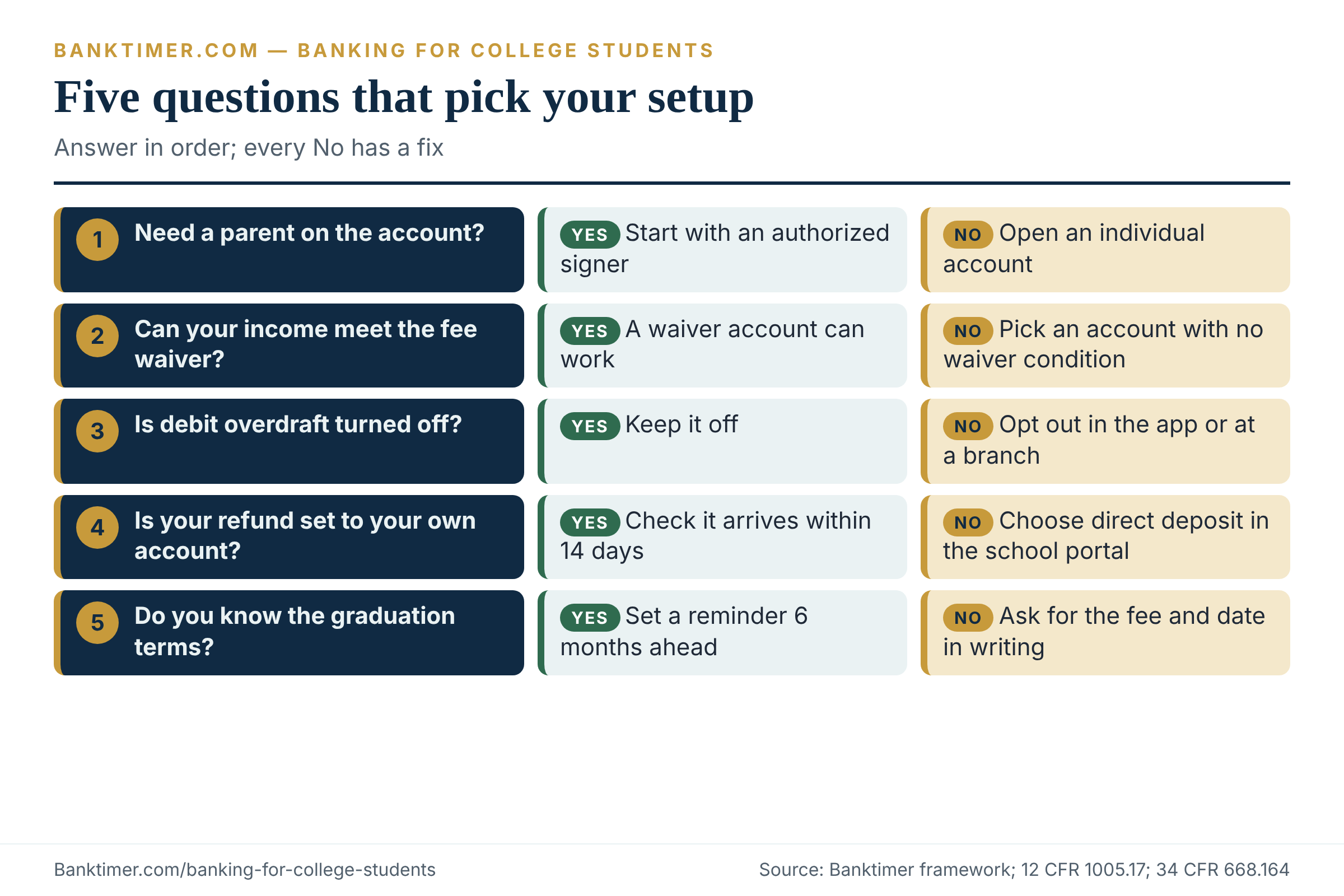
You now have the pieces of banking for college students. The remaining work is matching them to your situation. The framework below runs in five steps, and each step removes options.
Step by step: five questions in order
- Do you need a parent on the account? If not, open an individual account. If yes, decide between joint ownership and an authorized signer.
- Where will your money arrive? Aid refund, paychecks, parent transfers. Make sure the account accepts direct deposit and ACH.
- Can you hit the waiver condition with your real income? If not, pick an account with no condition.
- What is the overdraft setting? Decline debit coverage unless you have a specific reason.
- What happens at graduation or leaving school? If the answer is a new fee, put the date in your calendar.
Account types compared on the same criteria
The matrix compares provider types on identical criteria. No type wins everywhere, so read the final column before the “best for” one.
| Provider type | Best for | Main upside | Main downside | What to verify |
|---|---|---|---|---|
| National or regional bank | Students who want branches | Branch and ATM access, in-person help | Student perks may expire at graduation | Conversion terms and fee waivers |
| Credit union | Students near a branch | Member ownership, often lower fees | Often a smaller ATM network; membership rules | NCUA insurance, ATM network, app quality |
| Online bank | Students comfortable with apps | Often no monthly fee | No branches; cash deposits harder | Overdraft policy, cash deposit method |
| Campus-partnered account | Students who want one ID-linked card | Convenience | Can cost more than open-market options | Fees against a no-fee alternative |
| Prepaid card | Students who struggle with overdrafts | Cannot overdraw | Fees, lower limits, insurance conditions | FDIC status, fee schedule, rules |
Prepaid cards deserve one caution. The CFPB’s prepaid account rule gives protections such as error resolution and a $50 liability limit on unauthorized charges. The FDIC lists prepaid cards as insured only when its requirements are met. Check both before you load a refund onto one.
Which setup fits which student
Real students rarely match a type. Use the table as a starting point and adjust.
| Student profile | Suggested setup | Why | Check first |
|---|---|---|---|
| Adult, lives on campus, light spending | Individual no-fee account, overdraft off | Simple and low-cost | ATM network near campus |
| First-year with parent oversight | Individual account plus parent as authorized signer, or joint with limits | Parent can help without co-owning debts | Co-owner liability terms |
| Has a work-study or part-time job | Account with no deposit minimum | Paychecks stay modest | Direct deposit setup, fee waivers |
| International student without an SSN | Bank that accepts passport and I-20 | Federal rule allows non-SSN IDs | Tax ID form the bank wants |
| Prior account closed for overdraft | Second-chance or credit union account | Lower risk for the bank | ChexSystems report, free copy |
| Expects a large aid refund | Existing account or one opened a week early | Avoids new-account check holds | Direct deposit option, 14-day date |
A rule of thumb follows from the table. Open the account before the refund arrives, not after. Direct deposit avoids the check-hold problem, and an early start keeps you from accepting a campus account only because it was the one available that day.
Protecting your account: card fraud, payment apps and scams aimed at students
Students are a target because they are new to banking, often short on cash, and active on social media. The FTC’s data spotlight, using 2021 reports, found that adults aged 18 to 59 were 34% more likely than people 60 and older to report losing money to fraud. Younger adults were about five times as likely to report job-scam losses. Nearly 40% of fraud loss reports from Gen Z and younger millennials began on social media.
Scams are the part of banking for college students that no fee schedule shows. That does not mean students are careless. It means the scams fit student life: a sudden job offer, a school-sounding email, a roommate payment. The protections below depend on one distinction, so start there.
Unauthorized versus authorized: the distinction that decides who pays
Regulation E protects you from unauthorized electronic fund transfers. The CFPB defines one as a transfer initiated by someone other than you, without actual authority, from which you receive no benefit. That includes a transfer a fraudster starts through a peer-to-peer app. The CFPB’s FAQs also say a transfer is still unauthorized when a fraudster tricks you into giving up your login and then uses it.
A payment you decide to send is different. If someone convinces you to send money yourself, that transfer is generally treated as authorized, and the unauthorized-transfer rules may not apply. Some banks and apps offer goodwill or their own protections, but they are policy, not a federal right. This gap is the reason fake-check and fake-job scams work.
Reporting deadlines and liability caps
| Rule | Applies when | Exception or catch | Source | Your action |
|---|---|---|---|---|
| $50 maximum liability | You report a lost or stolen card within 2 business days | The bank must still find the transfer unauthorized | 12 CFR 1005.6 | Report the same day |
| Up to $500 | You report after 2 business days | Rises further if you wait past 60 days | 12 CFR 1005.6 | Do not wait for the statement |
| Unlimited after 60 days | Unauthorized transfers appear on a statement you ignored | Extenuating circumstances can extend the time | 12 CFR 1005.6 | Review statements every week |
| Investigation period | Bank investigates your error claim | 10 business days, or 20 if the account is under 30 days old | CFPB guidance | Provide details in writing |
| Fraudster-initiated transfer | Includes P2P app use and login theft | Does not cover payments you chose to send | CFPB EFT FAQs | Report fast, then freeze access |
New accounts get a longer investigation window. The CFPB says banks have ten business days to investigate, or 20 if the account is under 30 days old. A temporary credit is common while they work, so keep the account active and document everything.
Fake checks: why “available” does not mean “cleared”
A fake check scam usually asks you to deposit a check and send part of it somewhere. The FTC explains that banks must make deposited funds available quickly, so you see the money in your account. Fake checks can take weeks to be discovered. When the bank finds the fraud, you owe it the money.
A student starts with $150. A “new employer” sends a $2,400 check and asks the student to send $1,900 to a vendor. The balance reads $650 after sending. Nine days later the bank reverses the check, taking the balance to negative $1,750, and a $12 returned-deposit fee brings it to negative $1,762.
The student has lost $1,912 against the starting balance and owes the bank. The money sent to the “vendor” is the problem, not the check.
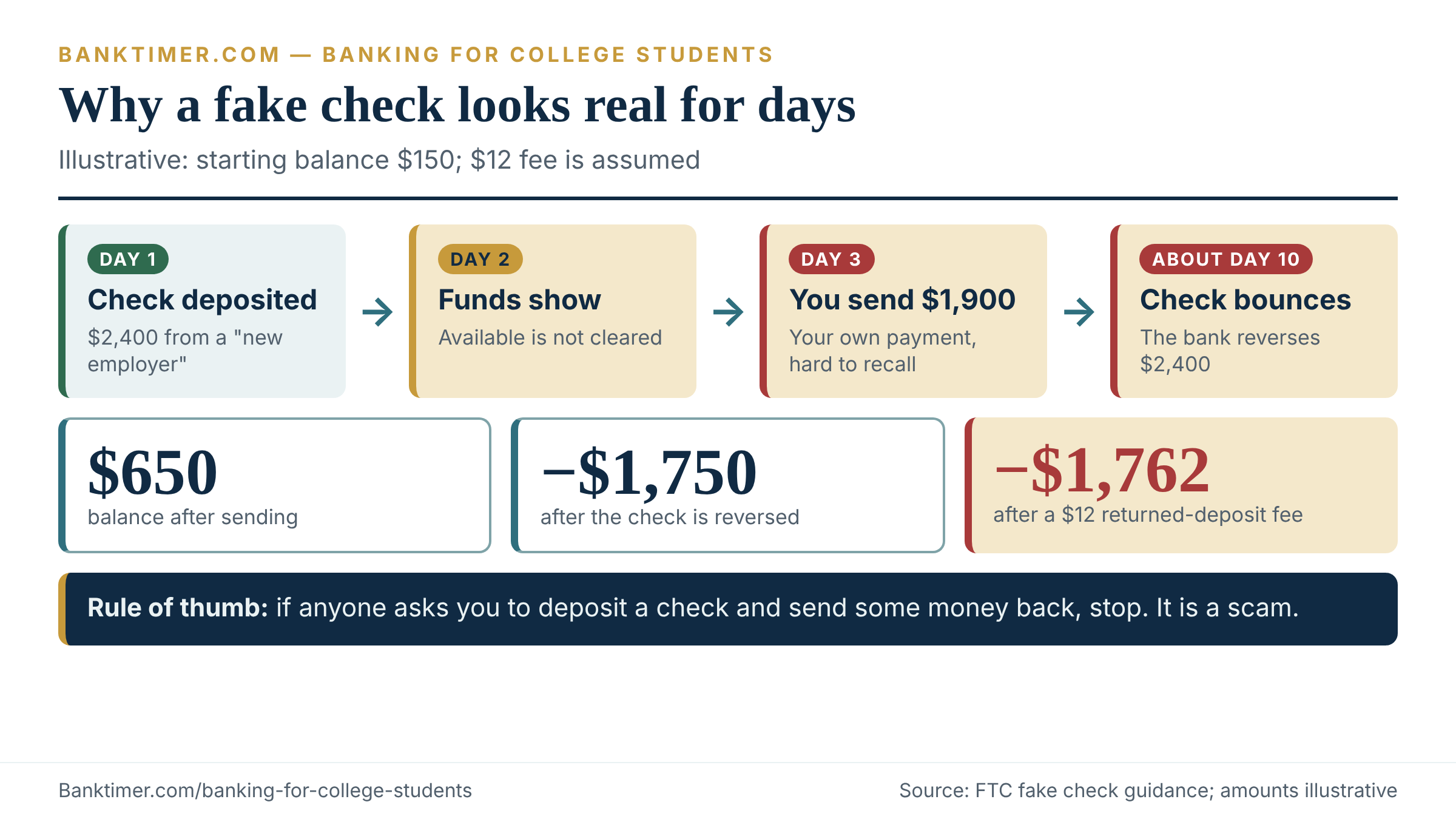
The FTC’s student job-scam advice is blunt: if anyone tells you to deposit a check and use some of the money for any reason, that is a scam. It also says never pay to get a job.
Fake jobs, scholarship fees and tuition calls
Three other scripts are common enough to recognize. A job offer arrives by text or email, often posing as a recruiter or even a professor. A scholarship offer asks for a processing fee or a card number, and the FTC points out that the federal aid form, the FAFSA, is free. A tuition call claims you owe money and threatens to drop your classes unless you pay immediately.
The FTC’s 2024 alert on tuition calls advises checking your student portal, or calling the school at a number you already know. Do not trust caller ID. Never pay unexpected school-related demands with wire transfers, crypto, gift cards or payment apps.
Payment apps, roommates and look-alike names
Payment apps are convenient and unforgiving. A payment sent to the wrong name or to a scammer is hard to recover, because you authorized it. Confirm the recipient’s username, send a small test, and turn on app-level locks. For the details of how recovery works, read our guides to the payment app scam and the bank impersonation scam.
Account security basics worth ten minutes
Turn on multi-factor sign-in, set transaction alerts for every debit and every transfer, and use a unique password for your bank. Never give a code to anyone who calls you, even if they know your name. Our guides to mobile banking security and two-factor authentication for banking cover the options.
Taxes you may actually meet as a student
Most banking for college students involves little tax, but four items surface. Treat this section as orientation, not tax advice. Rules and thresholds change, and your own return depends on your whole situation.
Scholarships and grants
The IRS says scholarship money is tax-free when you are a degree candidate and you use it for tuition and fees required for enrollment, or for fees, books, supplies and equipment required for courses. Amounts used for room and board, travel or optional equipment are taxable, and so are payments for required services.
A student receives a $14,000 scholarship. Required tuition, fees and books total $9,400, and housing is $4,600. The tax-free portion is $9,400. The remaining $4,600 is generally taxable and must be reported. Whether tax is owed depends on total income.
Form 1098-T and education credits
Your school issues Form 1098-T, usually by early the next February. IRS Publication 970 says the amount on the form may differ from what you actually paid. Qualified expenses paid by a dependent you claim are treated as paid by the parent. The American opportunity credit offers up to $2,500 per eligible student for four tax years. Keep your own payment records.
Interest and payment-app income
The IRS says to report all taxable interest even if you receive no Form 1099-INT. A form is issued at $10 of interest or more. On an illustrative $1,800 balance earning 0.50%, interest is about $9 a year. At an illustrative 4.00%, the same balance earns $72. Both are reportable.
Payment apps can also generate paperwork. The reporting threshold for Form 1099-K is back to more than $20,000 and more than 200 transactions. Personal payments between friends are not business income, but paid work through an app is income whether or not you receive a form.
International students and taxes
Nonresident students follow different rules and forms, and some income may be treated differently. Ask your school’s international office before you file. Do not assume that a tax preparer ad on social media understands your visa status.
Credit cards under 21 and why banking comes first
Banking for college students often leads to credit-card offers. Federal rules limit them for good reason. Under the CARD Act rule at 12 CFR 1026.51(b), a card issuer cannot open an account for someone under 21 without a written application and either financial information showing independent ability to make payments or a cosigner aged 21 or older.
Build your cash habits first. A debit card never charges interest, and a credit card does. To see how the cost of carrying a balance works, read our guide to credit card APR. If you want a layer of protection against opened-in-your-name fraud, our credit freeze guide explains how.
Mistakes and red flags in banking for college students
| Red flag | Why it matters | What to ask | Safer next step |
|---|---|---|---|
| Refund account you did not choose | The school must offer a choice in writing | “Where is the option to receive funds in my own account?” | Select an existing account |
| “Free” with an expiry | Waivers can end at graduation | “What fee starts, and on what date?” | Record the date and a switch plan |
| Overdraft turned on by default | Debit overdraft needs your opt-in | “Is debit overdraft off for my account?” | Opt out in the app or at a branch |
| Co-owner with unclear liability | Both names may answer for debts | “Who owes an overdraft on a joint account?” | Consider a signer instead |
| Check deposit before rent | New accounts can have longer holds | “When will this check clear?” | Use direct deposit or wait |
| Job that sends you a check | Fake checks bounce after you send money | “Why not pay me by direct deposit?” | Do not deposit it; report it |
| Payment details demanded by “the school” | The FTC says to verify balances in your portal | “Can I check this in the portal myself?” | Use the portal or call a known number |
Many of these errors cluster in the first 30 days. The account is new, balances are thin, and everything feels urgent.
- ☐ What is the monthly fee, and exactly what condition waives it?
- ☐ Do financial aid refunds or work-study deposits count toward that condition?
- ☐ Is overdraft coverage on debit purchases off by default, and can I confirm that in writing?
- ☐ What does the bank charge for overdrafts, NSF items and out-of-network ATMs?
- ☐ When I graduate or leave school, what changes, and on what date?
- ☐ Which ATMs are surcharge-free near my campus and home?
- ☐ If I add a parent, who answers for an overdraft?
- ☐ How long will the bank hold a paper check in the first 30 days?
- ☐ Is my money insured by the FDIC or NCUA, and which bank holds it?
- ☐ How do I receive a financial aid refund in this account?
Your first 30 days: a timeline
In banking for college students, order matters more than speed. This timeline shows who controls each step so you know whom to contact when something stalls.
| Stage | Typical timing | Who controls it | What you do |
|---|---|---|---|
| Pick an account | Before aid posts | You | Use the decision framework; read the fee schedule |
| Open and fund | Day 1 to 3 | You and the bank | Bring ID, tax ID and proof of address |
| Set safety options | Day 1 | You | Turn off debit overdraft; set alerts and multi-factor sign-in |
| Choose refund method | When the school prompts you | You and the school | Select direct deposit to your account |
| Refund arrives | Within 14 days of the credit balance | The school | Contact the bursar if it is late |
| Set up paycheck | Before first work-study payday | The employer and you | Give routing and account numbers |
| Review the first statement | End of month 1 | You | Check every line and report errors |
Do the account-opening steps in the first three days and the safety options immediately. Later you can refine.
Frequently Asked Questions
What is banking for college students, and how does it work?
It is the set of accounts and services, mainly checking, a debit card and savings, that students use for aid refunds, paychecks, rent and bills. A bank checks your identity, opens the account, and applies its fee schedule. Student accounts add perks, such as a waived monthly fee while you are enrolled.
The account follows the same federal rules as any other. Student status changes the price, not your rights.
Do I need a Social Security number to open a bank account as a college student?
No, not always. Federal identification rules accept a passport number and country, an alien identification card number, or another government-issued document number for a non-U.S. person. Many banks also ask for a student ID or enrollment proof, but that is bank policy. An ITIN or a pending-application arrangement may also work, depending on the bank.
Can I get my financial aid refund in my existing bank account?
Yes. A school that offers account arrangements must tell you in writing that you do not have to open a particular account. It must treat direct deposit to your own account as no more onerous than the other options. Provide the routing and account numbers through the school’s refund page.
Do I have to use the debit card or account my school gives me?
No. The federal cash management rule bars schools from preselecting an account and requires them to say you are not required to open one. You may also change your selection later with reasonable notice. Compare the fees against open-market accounts before you decide.
How long does my school have to pay a financial aid refund?
No later than 14 days after the credit balance occurs, or after the first day of class, whichever applies. The deadline is in 34 CFR 668.164(h). If your refund is late, contact the bursar and ask for the date aid posted. Keep the reply.
Should I open a joint account with a parent?
Only if you want a parent to have full access and share responsibility. Joint owners typically each have equal rights to withdraw, and both names are on any overdraft. An authorized signer or a parent-monitored app can offer oversight with less exposure. Ask the bank how it treats each owner’s debts.
Are student checking accounts worth it?
Sometimes. They are worth it if the fee waiver covers your whole enrollment and the conversion terms are reasonable. They are not worth it if a regular no-fee account exists, because the student version may add a fee at graduation. Compare the two on fees, ATM access and the date any waiver ends.
Can my parents see my bank account because of FERPA?
No. FERPA covers school education records, not bank accounts. Your parents see your account only if they are an owner or signer, or if you share your login. Separately, schools may share education records with parents of dependent students under FERPA’s dependent exception.
Is my money in a student account FDIC insured?
Yes, if the bank is FDIC insured, up to $250,000 per depositor, per bank, per ownership category. Credit unions have parallel NCUA coverage. Apps that partner with banks need separate checking, because prepaid cards are insured only when the FDIC’s requirements are met. Look for the name of the bank that holds the funds.
Does opening a student account affect my credit score?
Not in the usual way. Banks screen applicants with checking account reports from companies such as ChexSystems and Early Warning Services, which the CFPB describes as collecting negative banking history. These are not credit scores. Ask the bank whether it also checks credit, which can apply to overdraft lines of credit.
What should I do if I think I was scammed?
Contact your bank right away, using the number on your debit card, and ask about the dispute process. Report the scam at ReportFraud.ftc.gov. If you shared a login, change it immediately. If you sent money yourself, tell the bank anyway, because recovery options vary by payment method.
What is the best time to open an account before the semester starts?
Open it a few weeks before your aid is scheduled to post. That gives you time to confirm direct deposit details and to avoid new-account check holds on a paper refund. It also lets you compare accounts without pressure from a school deadline.
Open your school’s student portal today and find the refund-preference page. Confirm that it lets you receive money by direct deposit to an account you own, and save a screenshot of the options.
Banking for college students comes down to four decisions, and the monthly fee is the smallest of them. Who owns the account, how your financial aid refund arrives, what happens when the balance runs short, and what the account turns into after graduation all matter more than the name on the debit card. Put each answer in writing before the first refund lands. A $0 monthly fee with no waiver condition protects you from the biggest hidden cost, and declining debit overdraft protects you from the second. Check the graduation terms now, because a fee that starts when you leave school is easy to miss. Treat a stranger’s check as a scam until it has fully cleared. These choices cover the account itself. Your financial aid, taxes and credit card eligibility follow their own rules, and each needs its own check.
Methodology
This guide to banking for college students was researched on October 6, 2026. Federal regulations were read in the Electronic Code of Federal Regulations, which showed them as current through October 1 or 2, 2026. Agency guidance, research reports and consumer pages were read on their official sites on the same date.
Dollar examples in this article are illustrative. They use stated assumptions and are not quotes, live rates or provider fee schedules. The one provider mentioned, Capital One’s 360 Checking page, is a dated example of a published no-fee account and is not a recommendation. Banktimer did not open, test or call any account for this guide.
Federal law, school rules under federal aid regulations, bank policy and Banktimer’s examples are labeled separately where they appear. State laws, deposit agreements and school policies vary, and you should read yours. This article is general education. It is not legal, tax or financial advice, and Banktimer is not a lawyer or a financial advisor. For personal questions, contact your school’s financial aid or international student office, your state’s financial regulator, or a licensed tax professional.
Sources
Primary official sources (checked October 2026)
- 34 CFR 668.164, Disbursing funds (cash management)
- CFPB, 2024 College Banking and Credit Card Agreements (December 2024) and the full report PDF
- CFPB, College Banking and Credit Card Agreements (December 2023 report)
- CFPB, report finds high fees on student banking products endorsed by colleges (October 2022)
- 31 CFR 1020.220, Customer identification program for banks
- 12 CFR 1005.17, Requirements for overdraft services
- CFPB, Regulation E section 1005.6, liability for unauthorized transfers
- CFPB, how to get your money back after an unauthorized transaction
- CFPB, Electronic Fund Transfers FAQs
- CFPB, know your overdraft options
- CFPB, denied for a bank account: what you should know and how to get your checking account report
- CFPB, direct deposit availability
- CFPB, prepaid account rule announcement
- 12 CFR 229.13, new accounts (Regulation CC) and the Federal Reserve’s 2025 dollar-threshold adjustments
- 12 CFR 1026.51, ability to pay and applicants under 21
- FDIC, your insured deposits, joint accounts and products covered
- NCUA, share insurance coverage
- U.S. Department of Education, FERPA overview
- Federal Student Aid, 8 things to know about Federal Work-Study and FSA Handbook 2026-27, Volume 6, Chapter 2
- DHS Study in the States, do I need a Social Security number?
- IRS, Topic 421 scholarships, Topic 403 interest received, Topic 307 backup withholding, Publication 970, taxpayer identification numbers and Form 1099-K threshold FAQs
- FTC, college students and job scams, fake check scams, unpaid tuition calls, scholarship and financial aid scams and who experiences scams (data spotlight)
Provider documents
Secondary context