
By the Banktimer Editorial Team · Published
Banktimer is an independent U.S. consumer-finance publication. Our editors draw on primary and official sources first, such as the CFPB, FDIC, Federal Reserve, and FTC, along with statutes, regulations, and providers’ own agreements and fee schedules. Then we add worked examples and decision tools. Our goal is the most useful, best-supported explanation the sources available to us at the time of writing allow.
This article is general information, not legal, tax, investment, insurance, or financial advice, and reading it does not create a professional relationship with Banktimer. Rates, fees, limits, and rules change, and they vary by state, provider, and contract, so confirm current terms with your bank, lender, insurer, or the agency named in the article before you act. Examples are illustrative unless labeled otherwise. Banktimer is not a bank, lender, insurer, or financial advisor, and we are not responsible for decisions or losses that result from relying on this content. For advice about your own situation, talk to a licensed professional.
If you think you are caught in a bank impersonation scam, stop and hang up. Do not send money, read out a code, or install anything. Then call your bank using the number printed on your card or statement, not any number the caller or a text gave you. Tell the bank exactly what moved and how.
Your rights depend on how the money left. If a scammer used your login, codes, or card details, federal rules treat the transfers as unauthorized, and strong protections apply. If you sent the money yourself, recovery depends on the payment type and the bank’s policy. Speed matters in both cases.
The First 10 Minutes: What to Do Right Now
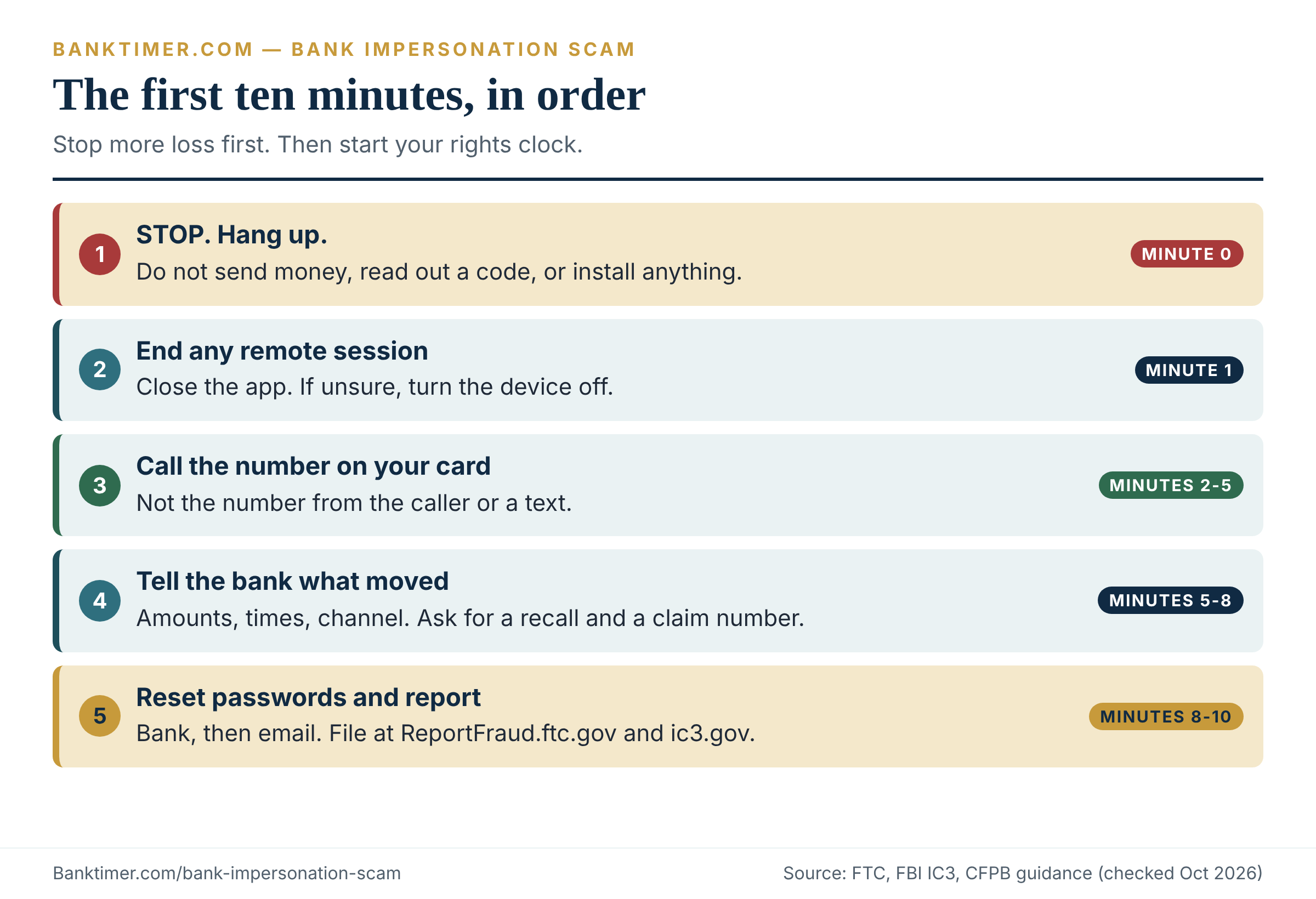
Read this section first, even if you are not sure the call is a bank impersonation scam. Each step takes a minute or two. The order matters because the first goal is to stop more money from leaving, and the second is to start the clock on your protections.
Steps 1 and 2: Stop the Call and End Any Remote Session
Step 1. Stop. Hang up. Do not “stay on the line while you check.” The caller’s main tool is time pressure, and you take it away by ending the call.
Step 2. End the session. If the caller asked you to install an app or share your screen, close it now. If you are unsure how, turn the device off. A scammer who can see your screen can see your banking login.
Do not press keys, text a reply, or tap a link in any message the caller sent. Do not read out a verification code, even to someone who says they are from your bank. The FTC’s rule of thumb is blunt: never share a verification code with someone you did not contact first.
Steps 3 and 4: Reach the Real Bank and Lock Things Down
Step 3. Call the real bank. Use the number on the back of your debit or credit card, on a paper statement, or inside your own banking app. If the scammer’s call reached your phone, use a different phone when you can.
Step 4. Tell the bank what happened, in plain words. Say which accounts and cards are involved. Say what moved, how it moved (Zelle, wire, card, crypto machine), the amounts, and the times. Then ask for four things:
- Stop or flag any pending transfers.
- Request a recall or return for any payment already sent.
- Lock or replace the affected cards and change the account numbers if needed.
- Open a fraud claim, and give you a claim or reference number.
Write down the representative’s name, the time, and the reference number. You will need them later.
Steps 5 and 6: Change Credentials and Report It
Step 5. Change your passwords from a clean device. Start with online banking, then email, because email resets the rest. If you shared access to your computer, update your security software and run a scan, as the FTC advises in its guide on what to do if you were scammed.
Step 6. Report it. File at ReportFraud.ftc.gov. If money left your account, also file at ic3.gov, the FBI’s Internet Crime Complaint Center. Reporting does not get your money back by itself, but it creates a record and feeds law enforcement data.
Hang up first. Read the rest of this guide afterward. A real fraud team will not be offended that you called back on your own. If anyone tells you hanging up will make things worse, that is the pressure tactic, not a bank procedure.
Ending the call is a complete first step. You lose nothing by hanging up and calling your bank back on a number you trust.
How the money left decides your rights. Transfers a scammer made with your credentials are unauthorized under federal rules. Payments you sent yourself are treated differently.
Debit and bank-account protections run on short clocks. Reporting within two business days caps your loss at $50 in the standard tier. Reporting within 60 days of the statement is the outer limit.
Credit cards give the strongest recourse. Your liability for unauthorized use is capped at $50, and you can dispute billing errors without paying the disputed amount.
Wires, crypto machines and gift cards rarely come back. Report within minutes, because speed is the only lever you have.
Report, then repair. File with the FTC and FBI, freeze your credit if personal data was exposed, and secure your accounts and phone number.
The Numbers and Deadlines Behind a Bank Impersonation Scam Claim
Deadlines in this area are short, and they come from different places. Some are federal regulations. Others are bank or network policies. The table below separates them, so you know which clock you are racing.
| Clock or limit | The number | Applies to | Type |
|---|---|---|---|
| Report unauthorized debit or account transfers | 2 business days to cap your loss at $50 | Debit cards and electronic transfers (Regulation E) | Federal regulation |
| Outer reporting limit | 60 days from the statement showing the transfer | Same accounts | Federal regulation |
| Written follow-up | 10 business days after an oral report, if the bank asks | Same accounts | Federal regulation |
| Bank investigation | 10 business days, or up to 45 days with a provisional credit | Same accounts | Federal regulation |
| Longer investigation | 90 days (new accounts and some other cases) | Same accounts | Federal regulation |
| Credit card unauthorized use | $50 maximum liability | Credit cards (Regulation Z) | Federal regulation |
| Credit card billing error notice | In writing within 60 days of the first statement showing it | Credit cards | Federal regulation |
| Reimbursement for “qualifying” impersonation scams | Varies by bank and network | Zelle payments you sent yourself | Network and bank policy |
| Wire recall | No fixed deadline; minutes and hours matter | Wire transfers | Practice; state-law framework |
| Fraud alert and credit freeze | Alert lasts 1 year (7 years extended); freeze is free | Credit reports | Federal law, as described by the FTC |
The pattern in this table is the point. The firm federal deadlines sit on the unauthorized transfer side. For payments you sent yourself, there is no federal clock and no guaranteed refund. That gap is why the next sections spend so much time on classification.
How a Bank Impersonation Scam Actually Works
This section describes the pattern, not a playbook. Knowing the shape of the con helps you spot it mid-call, when a clear head is hardest to find. The details change from one crew to the next. The structure rarely does.
The Core Move: A Believable Emergency With a “Safe” Exit
Every bank impersonation scam has two parts. First, a problem that sounds urgent and specific: suspicious charges, a login from another state, a compromised card. Second, a solution that conveniently requires you to act. The solution usually involves moving money, sharing a code, or letting someone onto your device.
The FTC describes the common thread in its 2026 analysis of 2025 data. Some of the costliest impersonation scams, it says, start with a fake security alert, often from a bank, and people are convinced to move money to “protect” it. The logic is backwards. Your bank protects money by blocking and reversing transactions inside its own systems. It does not need you to send funds anywhere.
Notice what the story does to your options. If you believe your account is under attack, hanging up feels risky and complying feels safe. The script is built so that the dangerous choice feels like the careful one.
Four Ways the First Contact Arrives
The opening move of a bank impersonation scam varies by channel. The destination is the same: a phone call or a form that gets you to hand over credentials, codes, or money.
| Channel | What you see | Why it feels real | Safer response |
|---|---|---|---|
| Phone call | A caller ID showing your bank’s name or a local number | The caller knows your name and may know recent activity | Hang up. Call the number on your card |
| Text message | A “fraud alert” asking you to reply YES or NO or to call a number | The format mimics real bank alerts | Do not reply or call. Open your banking app yourself |
| A “security notice” with a button to review activity | Logos and layout are easy to copy | Do not click. Go to the bank’s site by typing the address | |
| Fake site or search ad | A page that looks like your bank’s login | It can appear above real results in a search | Use your saved bookmark or the official app |
| Pop-up or “support” call | A warning that your computer is hacked, with a number to call | The alarm feels like it came from your device | Close it. Legitimate tech companies do not cold-call you |
The text channel deserves a note. The FTC’s data spotlight on 2024 text scams found that fake fraud alerts were the third most reported text-scam type. Those texts often look like they come from a bank or Amazon and may ask you to reply YES or NO about a large charge. Total reported losses to text scams in 2024 were $470 million, more than five times the 2020 figure.
Why Caller ID and “Verification” Prove Nothing
Caller ID can be faked. The FCC explains that spoofing means a caller deliberately falsifies the information shown on your display, and it advises hanging up on unexpected callers and calling back an official number. A familiar name on your screen is a coincidence of software, not proof of identity.
Scammers also borrow the vocabulary of security. They may ask you to “verify” your identity by reading a code that your bank just texted. Reading that code aloud can hand them what they need to get into your account.
The CFPB’s own examples describe this tactic precisely. In its Regulation E FAQs, the agency lists a caller who pretends to be from your financial institution and tricks you into providing your login information, a texted account confirmation code, or your debit card number. That is the pattern in the wild.
A common twist hands you off mid-call. The first voice says it is the bank, then “transfers” you to someone claiming to be from a regulator or law enforcement. The FTC has warned about fake “agents” with badge numbers who appear after a fake bank call. A second authority adds credibility, and it also means the whole call is one coordinated story. Real agencies do not connect you to someone who tells you to move money.
Remote Access and the “Phantom Hacker” Variation
Some bank impersonation scams add a technical layer. The FBI’s Internet Crime Complaint Center described a three-stage version in a September 2023 public service announcement. The first contact poses as tech support and asks you to install remote-access software. The second poses as your bank or brokerage, claims your accounts were breached, and urges you to move money to a “safe” account. The third poses as a government employee and keeps the pressure going.
The numbers in that alert are dated but instructive. For January through June 2023, the IC3 received about 19,000 tech support scam complaints with $542 million in losses. Nearly half the victims were over 60, and they accounted for 66% of the losses.
The practical lesson is simple. Remote-access software gives the other side a live view of your screen. If you ever approved it, treat the device and every password you typed as exposed.
Why Careful People Still Get Caught
A bank impersonation scam works on routine, not ignorance. Three ordinary instincts do the damage.
- Authority. A caller who sounds like a bank professional triggers deference.
- Loss aversion. The threat is losing money you already have, which feels sharper than any gain.
- Narrowing attention. Under time pressure, people stop checking and start following steps.
None of this is a character flaw. Professional crews rehearse these calls and refine them against what works. Treating a loss as a failure of intelligence adds shame to the financial harm, and shame keeps people from reporting quickly. Speed is where recovery lives, so this guide treats reporting as a skill to practice, not a confession.
Warning Signs, Ranked by How Fast They Cost You Money
Not every warning sign of a bank impersonation scam carries the same weight. Some signal a nuisance. Others signal that irreversible money is about to move. Sort what you see by two questions: how urgent is it, and can the damage be undone?
Stop-Now Red Flags
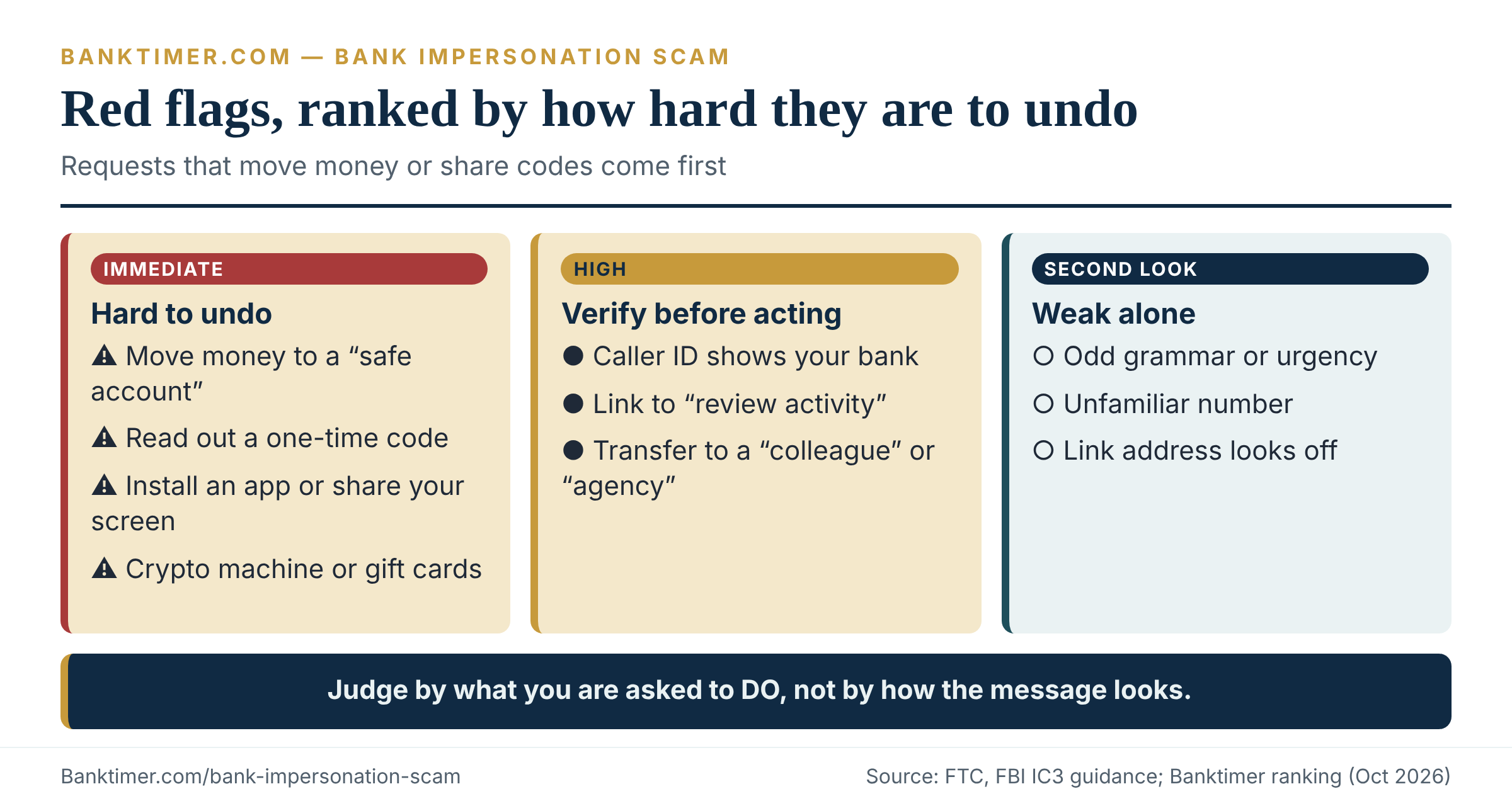
Any one of these is enough to hang up or close the message. You do not need a second sign.
- Someone asks you to move money to a “safe,” “temporary,” or “protected” account.
- Someone asks you to read out a code sent to your phone or email.
- Someone asks you to install an app or share your screen.
- Someone tells you to buy cryptocurrency, gift cards, or a cashier’s check, or to feed cash into a machine.
- Someone tells you not to tell bank staff, family, or anyone else why you are moving money.
- Someone insists you stay on the line while you act.
The last two matter more than they look. Secrecy and line-holding exist to stop the single thing that breaks the spell: a second opinion. The FTC’s four-sign test for any scam fits here. Scammers pretend to be from an organization you know, describe a problem, pressure you to act now, and tell you to pay in a specific way.
Red Flags in Order of Urgency and Reversibility
The table ranks common signals. “Reversibility” means how likely the harm can be undone if you act on the signal and then realize the truth.
| Red flag | Why it matters | What to do | Urgency |
|---|---|---|---|
| A request to move money to a “safe account” | Sent money may be unrecoverable, and you may have authorized it | Refuse. Call the number on your card | Immediate |
| A request to read out a one-time code | Gives access to your account, and may enable new devices | End the contact. Change your password if you already shared | Immediate |
| An app download or screen-sharing request | Exposes everything you type or see | Close the session. Scan the device | Immediate |
| Instructions to use a crypto machine or buy gift cards | Payments are nearly impossible to reverse | Stop. Report to the operator or issuer right away if you paid | Immediate |
| Caller ID shows your bank’s name | Easy to fake, so it proves nothing alone | Hang up. Call back on a trusted number | High |
| A text or email with a link to “review activity” | May lead to a fake login page that captures credentials | Do not click. Open the app yourself | High |
| A transfer to a “colleague” or “agency” | One story, several actors | Hang up. Real agencies do not direct transfers | High |
| Odd grammar, urgency, or a vague greeting | Common, but not reliable on its own | Treat as a prompt to verify, not as proof | Moderate |
Notice that the most urgent rows describe what you are asked to do, not how the message looks. Polished scams pass every appearance test. They fail the behavior test.
Weaker Signals That Still Deserve a Second Look
Some clues are only suggestive. A text from an unfamiliar number is one. A link whose address does not match the bank’s site is another. A greeting that does not use your name is a third, though many real alerts also skip it.
Use these as prompts, not verdicts. If a message feels off but you cannot say why, verify through a channel you control. Open the banking app. Call the number on your card. The cost of checking is a few minutes.
What a Genuine Bank Contact Looks Like
Banks do contact customers about suspicious activity. A real alert often asks you to confirm or deny a specific recent transaction. What it does not need is the secret half of your login.
Use this practical test, which reflects the FTC and CFPB guidance above rather than any one bank’s policy. A genuine fraud team can work entirely inside the bank’s systems. It can block cards, flag transactions, and reverse errors without your help. So a caller who needs you to do something outside the bank is describing a task the bank has no reason to assign.
Policies differ across institutions, so this is a rule of thumb, not a law. When in doubt, hang up and call back.
Your Rights Depend on How the Money Left Your Account
Consumer rights after a bank impersonation scam are not one rule. They are several overlapping systems: federal regulations, state law, payment-network rules, and your bank’s own policy. Which one governs your loss depends on the payment type and on one deceptively simple question.
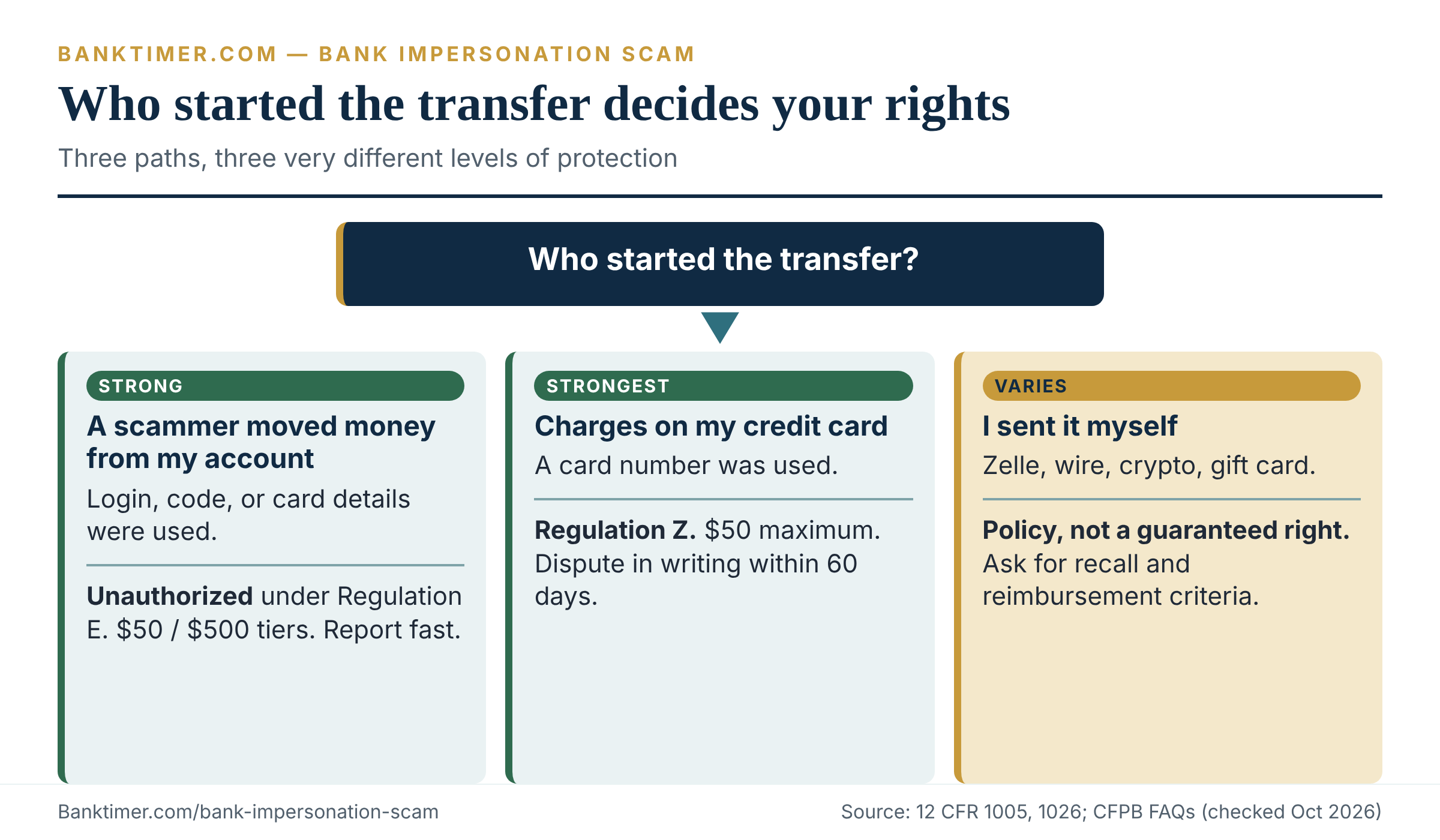
The First Question: Who Started the Transfer?
Federal rules draw a sharp line. Under Regulation E, an unauthorized electronic fund transfer is one initiated by a person other than you, without actual authority to do so, and from which you receive no benefit. The CFPB’s interpretation adds that a transfer is also unauthorized when someone obtained your access device from you through fraud or robbery.
If a scammer, using your stolen login or card details, moves money, that is the unauthorized category. If you open your app and send the money yourself because a caller told you to, banks generally treat that as authorized, even though you were deceived. Zelle’s own materials use that framing. They describe reimbursement for “certain qualifying imposter scams where the customer authorized the transaction.”
Many real cases mix both categories. A caller gets your code, then talks you into approving a payment. When facts blur, say everything to your bank and ask it to decide each transfer separately, in writing.
Debit Cards and Bank-Account Transfers Under Regulation E
Regulation E implements the Electronic Fund Transfer Act. It covers electronic transfers to or from a consumer’s account, including debit card purchases, ATM transactions, and many online and phone-initiated transfers. It excludes checks and wire transfers, which follow other rules.
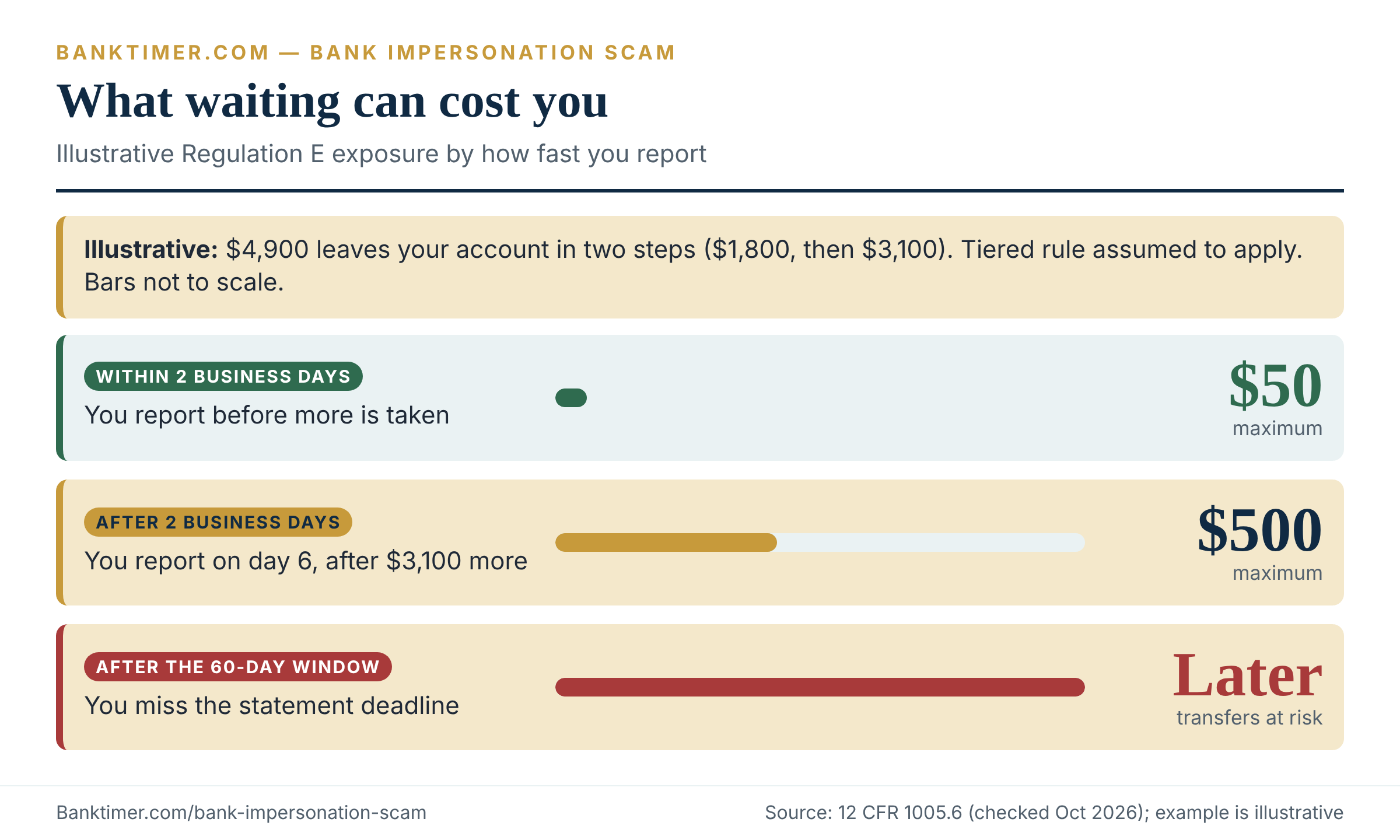
For unauthorized transfers, your maximum liability depends mainly on how fast you report:
- Within two business days of learning of the loss or theft: the lesser of $50 or the amount taken before you told the bank.
- After two business days: up to $500, built from the first $50 plus transfers after the two-day mark and before notice.
- After the statement window: if you do not report within 60 days of the statement that shows the transfer, you can be liable for later unauthorized transfers.
The tiers are written around the loss or theft of an access device. Banks and customers can disagree about how they apply to stolen login details. Reporting fast is the safe choice either way.
Extenuating circumstances can extend the deadlines. The regulation tells banks to extend the time to a reasonable period if something like a long hospital stay prevented you from reporting. You can report in person, by phone, or in writing.
When the Scammer Used Your Login, Codes, or Card Details
This is the situation the CFPB addressed directly. In its Regulation E FAQs, the agency says that when a third party fraudulently induces a consumer to share account access information and uses it to initiate a transfer, the transfer is unauthorized under Regulation E. The examples include a caller impersonating the consumer’s financial institution to obtain login information, a texted confirmation code, or a debit card number.
Four related points from the same FAQs matter in a dispute:
- Negligence does not shift liability. A bank cannot use your carelessness to impose greater liability than Regulation E permits.
- Network finality does not override the law. Private rules saying a transfer is final and irrevocable do not reduce your protections for unauthorized transfers.
- Giving credentials to a scammer is not “furnishing” an access device. The FAQs say a consumer fraudulently induced to provide account information has not furnished an access device, so the bank cannot call the transfers authorized on that ground.
- Your account agreement cannot waive the law. The statute bars agreements that waive rights it confers, and the FAQs apply that bar to contract language about sharing account information.
Treat the FAQs as the agency’s reading of the regulation, not as a statute. The regulation itself is binding. The FAQs were last modified in January 2025 and were still posted without a withdrawal notice when this article was checked in October 2026.
When You Pressed Send Yourself
If you initiated the payment, Regulation E’s unauthorized-transfer protections generally do not apply on their face. Your path runs through the payment network’s policy, your bank’s discretion, and complaint channels.
For Zelle, the picture has three parts. Zelle says money goes directly into the recipient’s bank account and urges users to treat it like cash. Zelle also says it requires reimbursement for certain qualifying imposter scams where the customer authorized the transaction. And its guidance tells victims to contact their own bank or credit union first, because qualifying scams “may be eligible for reimbursement.”
Two caveats follow. The published pages do not define “qualifying,” so eligibility details sit in network rules and your bank’s terms. Ask your bank which criteria it applied. Second, the outcomes data is limited and dated.
A July 2024 Senate subcommittee staff report examined three large banks. For 2023, it reported reimbursement rates of 38% for Zelle disputes over unauthorized transactions and 12% for disputes over scams that customers had authorized. It also reported that, after a June 2023 policy expansion, about $18.3 million was reimbursed in six months. That figure was roughly 15% to 20% of scam disputes network-wide. These figures describe a past period and three banks, not today’s practice.
The CFPB sued Zelle’s operator and three large banks in December 2024. The Bureau voluntarily dismissed the case in March 2025, and the court dismissed it the next day. No court ruled on the merits. That means the question of how far the law requires banks to reimburse authorized-but-induced payments remains open, not settled.
Credit Cards: The Strongest Protection
After a bank impersonation scam, credit cards sit at the top of the protection ladder. Under Regulation Z, your liability for unauthorized use is capped at the lesser of $50 or the value obtained before you notify the issuer. Often it is $0.
You also have billing-error rights. You must send a written notice to the creditor’s designated address no later than 60 days after the first statement that shows the error. The creditor must acknowledge within 30 days and resolve the matter within two billing cycles, and in no event later than 90 days. While the dispute is pending, you need not pay the disputed amount, and the creditor may not try to collect it. Your card issuer’s app may offer a faster dispute form, but the written notice protects your rights.
For deeper coverage of card-specific cases, see our guide to credit card fraud and the companion piece on debit card fraud.
Wires, Crypto Machines, Gift Cards, and Cashier’s Checks
These are the hardest rails to unwind. Wires are generally outside Regulation E and governed by Article 4A of the Uniform Commercial Code, which states adopt. Under that framework, a bank often does not have to reimburse a wire you authorized.
In 2024, the CFPB took the position in court that some consumer wires count as electronic fund transfers. It moved to withdraw that statement on March 25, 2025, so the traditional view stands. The FTC says of wiring money that “once you send it, you usually can’t get it back.”
Cryptocurrency payments generally cannot be reversed, according to the FTC. Gift card issuers sometimes help if you contact them quickly. For a cashier’s check or money order, ask the issuing bank at once whether a stop or recall is possible. Policies vary.
| Payment path | Main rules | Reversible? | Your first move |
|---|---|---|---|
| Debit card or account transfer you did not authorize | Regulation E | Often, through the bank’s investigation | Call the bank and report today |
| Credit card charge you did not authorize | Regulation Z | Yes, with strong protections | Call the issuer, then follow up in writing |
| Zelle or P2P payment you sent | Network and bank policy; limited Regulation E | Sometimes, if eligible | Report to your bank first, then ask for the criteria used |
| Wire transfer | UCC Article 4A (state law) | Rarely; a recall is possible if fast | Ask your bank to request a recall now |
| Crypto machine or exchange | Little consumer-law protection | Rarely | Contact the operator immediately, then report to the FTC and IC3 |
| Gift card | Issuer policy | Sometimes | Call the issuer with the card and receipt |
| Cashier’s check or money order | Issuer terms and state law | Varies | Call the issuing bank immediately |
The table above explains why the same loss can have very different outcomes. Two victims who lost the same amount to the same story can land on opposite sides of the line. One paid by credit card. The other paid by wire.
Rules and Exceptions at a Glance
This table keeps the legal sources and the exceptions in one place, so you can tell what is law and what is policy.
| Rule | Applies when | Exception | Source type | What you do |
|---|---|---|---|---|
| Unauthorized transfers: $50 or $500 caps | Someone without actual authority initiated the transfer | Transfers you initiated or authorized | Federal regulation (Reg E) | Report fast, in writing too |
| Credentials obtained by fraud are unauthorized | A caller tricks you into sharing login, code, or card details | The bank may dispute the facts | Agency interpretation (CFPB FAQ) | Describe exactly what you shared |
| Provisional credit | Bank cannot finish in 10 business days | Written confirmation not received; up to $50 may be withheld | Federal regulation | Send written confirmation |
| Credit card unauthorized use: $50 cap | Someone else used your card or number | Charges you made or benefited from | Federal regulation (Reg Z) | Notify the issuer; dispute in writing |
| Wire transfers | Fedwire-type transfers | Outside Regulation E; UCC 4A governs | Federal regulation plus state law | Request a recall immediately |
| “Qualifying” imposter scam reimbursement | You sent a Zelle payment | Eligibility is defined by network and bank | Network and bank policy | Ask your bank for its criteria in writing |
| State law protections | Varies by state | Varies | State law | Ask your state attorney general or banking regulator |
Five Illustrative Scenarios: How the Rules Play Out
The following examples show how a bank impersonation scam can unfold. They are illustrative. They use made-up people and round numbers to show how the rules above interact. They are not real cases, and outcomes in real disputes depend on facts, bank policy, and sometimes state law.
Scenario 1: A Texted Code and a Same-Day Report
A caller says a large charge is pending. The customer reads out a code that arrives by text. Within minutes, $2,400 leaves a checking account. The customer calls the bank on the number on the debit card the same afternoon.
What the rules point to. A transfer made with credentials obtained through fraud is unauthorized under the CFPB’s reading. Because the customer reported within two business days, the tiered rule caps liability at the lesser of $50 or the amount taken, which is $50 here. If the bank cannot finish in 10 business days, it must generally provisionally credit the account. It may withhold up to $50 if it has a reasonable basis to believe the transfer was unauthorized. The credit would then be $2,350, and the bank can take up to 45 days to finish.
Scenario 2: Waiting a Week to Report
Another customer gives up credentials to a caller. Over the next several days, $1,800 leaves in the first two business days and $3,100 more leaves afterward, for $4,900 total. The customer reports on day six.
What the rules point to. If the tiered rule applies, the customer’s exposure is the lesser of $500 or the first $50 plus the $3,100 taken after two business days. That is $500. The $50 or $500 cap is the regulation’s ceiling, and the bank still must investigate. The gap between $50 and $500 is the cost of four days. If the customer misses the 60-day statement window, later unauthorized transfers can fall on the customer.
Scenario 3: A Zelle Payment to a “Safe Account”
A caller convinces a customer that her account is compromised. She sends $8,500 by Zelle to a “safe account.” She realizes the story is false when the caller stops answering. She reports to her bank within the hour.
What the rules point to. She initiated the payment, so Regulation E’s unauthorized-transfer protections generally do not apply on their face. The bank’s decision turns on Zelle network rules and its own policy for qualifying imposter scams. Three outcomes are possible: full reimbursement, partial reimbursement, or denial. A denial leaves her out the full $8,500. She can ask for the criteria in writing and file complaints with regulators.
Scenario 4: A Wire for $15,000
A customer wires $15,000 after being told his funds are “at risk.” Wires fall outside Regulation E, so there is no regulatory reimbursement clock. He asks his bank to request a recall within an hour.
What the rules point to. Whether any money returns depends on whether the receiving account still holds it. The FBI’s 2025 report shows that its Recovery Asset Team process froze about $679 million of $1.16 billion in attempted theft across 3,900 referred incidents, a 58% success rate. That is a rate for incidents referred through that process, not a promise for every victim.
Scenario 5: Charges on a Credit Card
A scammer who got a card number charges $3,200. The cardholder sees it on the app and calls the issuer that evening.
What the rules point to. Liability for unauthorized use is capped at $50, and often it is zero. The cardholder follows up in writing within 60 days of the statement showing the charge. During the dispute, the cardholder does not have to pay the disputed $3,200 and the issuer may not try to collect it.
What the Five Scenarios Show Side by Side
| Scenario | How the money left | Main protection | Illustrative exposure | What changes the result |
|---|---|---|---|---|
| 1. Code shared, reported same day | Scammer-initiated debit transfer | Regulation E | $50 cap on a $2,400 loss | Speed; written follow-up |
| 2. Reported on day six | Scammer-initiated transfers | Regulation E, later tier | Up to $500 on $4,900 | Days of delay; the 60-day window |
| 3. Zelle to a “safe account” | Customer-initiated | Network and bank policy | $0 to $8,500, depending on reimbursement | Bank criteria; speed |
| 4. Wire at caller’s direction | Customer-initiated | UCC Article 4A; recall effort | Up to $15,000 | Minutes; whether funds remain |
| 5. Card number given away | Scammer-initiated charges | Regulation Z | $50 or less on $3,200 | Written dispute within 60 days |
Look at the exposure column. The scenarios share one lesson. The faster you report, the more rules and recall options remain available. The payment type then sets the ceiling.
Which Move Fits: A Decision Framework for Wait, Call, Dispute, or Escalate
Use this decision framework when you are not sure what level of response a situation needs. Start at the top and stop at the first rule that fits.
- Call the bank now if money moved, or if you shared a code, a password, card details, or device access. There is no scenario where waiting helps. Ask for the fraud department and a reference number.
- Verify, do not engage, if you only received a message. If you did not click, reply, or share anything, open your banking app directly and look for alerts. Forward scam texts to 7726 and report to ReportFraud.ftc.gov. You do not need a dispute, because no transfer occurred.
- Dispute in writing if the bank does not act. For debit and account transfers, send written confirmation within 10 business days of an oral report if the bank asks. For credit cards, send the billing-error notice within 60 days.
- Escalate when the answer is no, late, or unexplained. Ask for the written findings the regulation requires if the bank decides no error occurred. Then take the next step on the ladder below.
The escalation ladder, in order:
- A supervisor or the fraud department’s dispute team at the bank.
- A written complaint to the bank, which creates a record.
- A complaint to the CFPB, the bank’s primary regulator, and your state attorney general or banking department.
- For large losses, a consultation with a consumer attorney or a legal aid office.
Escalation does not guarantee a reversal. It does create a paper trail, and complaints also feed regulators’ data.
What Happens After You Report: A Realistic Timeline
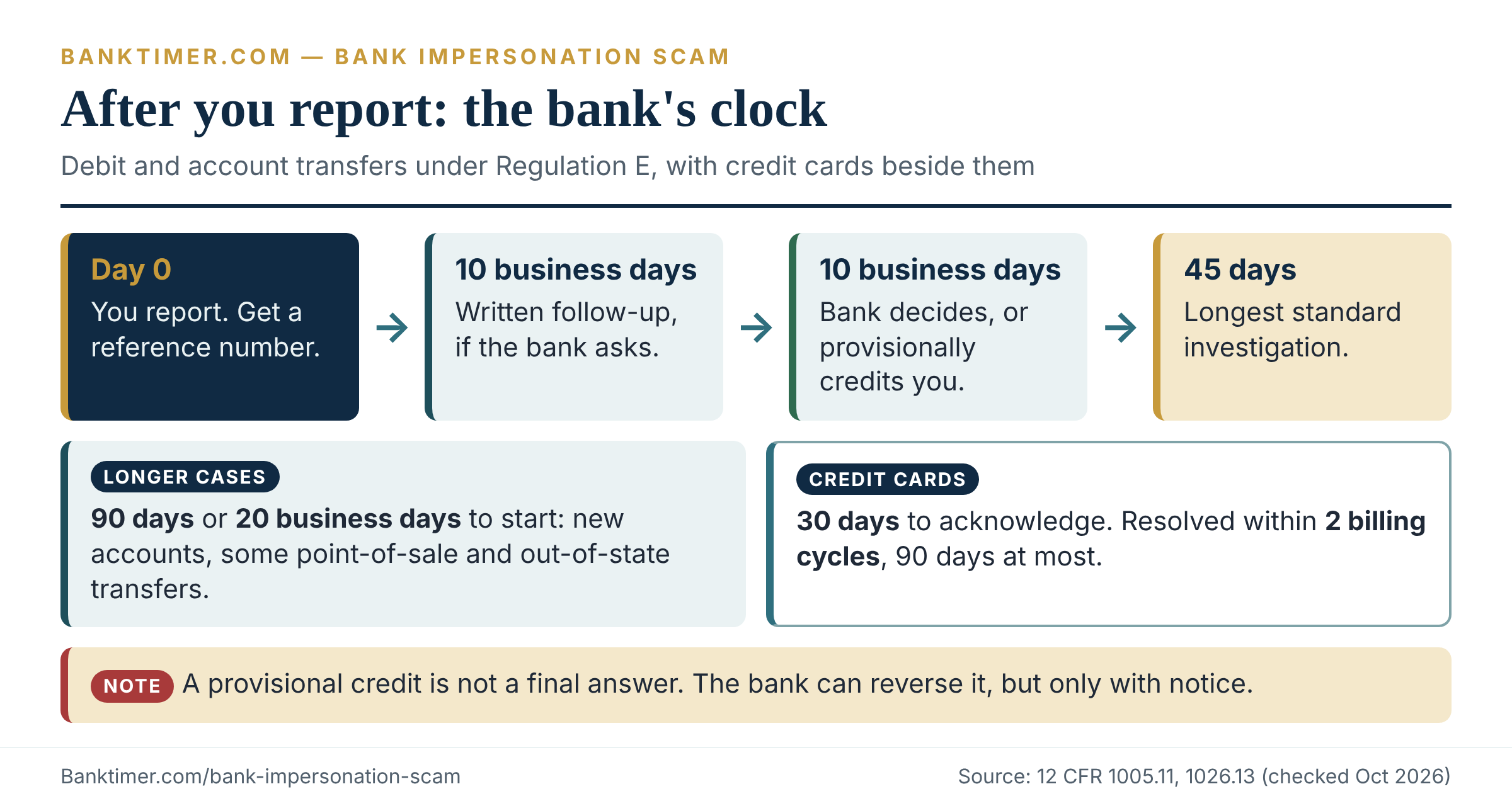
Once you report an unauthorized transfer, the bank’s clock starts. Knowing the stages helps you tell a normal wait from a missed deadline. The timeline below follows Regulation E for debit and account transfers, with credit card and complaint timelines alongside.
| Stage | Typical timing | Who controls it | Your action |
|---|---|---|---|
| Report by phone, app, or in person | Day 0 | You | Get a reference number |
| Written confirmation, if the bank requires it | Within 10 business days of your oral report | You | Send it. Skipping it can cost you the provisional credit |
| Bank decision or provisional credit | Within 10 business days (20 for accounts under 30 days old) | Bank | Track the date from your report |
| Notice that a provisional credit was made | Within 2 business days after the credit | Bank | Keep the notice |
| Full investigation | Up to 45 days; up to 90 days in some cases | Bank | Respond to requests for information |
| Results reported | Within 3 business days after the investigation ends | Bank | Read the written findings carefully |
| Correction if an error is found | Within 1 business day of the finding | Bank | Confirm your balance |
| Credit card dispute acknowledgment | Within 30 days | Issuer | Keep your written notice and proof |
| Credit card dispute resolution | Within two billing cycles, no later than 90 days | Issuer | Withhold only the disputed amount |
Two details deserve emphasis. The 20-business-day and 90-day extensions apply to newly opened accounts, point-of-sale debit card transactions, and some out-of-state or foreign transfers. And a provisional credit is a bridge, not a verdict. The bank can reverse it if it finds no error, but only with notice.
If the Bank Says the Transfer Was Authorized
A denial should come in writing. Under Regulation E, a bank that finds no error must give a written explanation of its findings and note your right to request the documents it relied on. Ask for them. If the bank takes back a provisional credit, it must tell you the date and amount, and it must honor certain payments to third parties for five business days after the notice without overdraft charges.
Compare the bank’s reasoning against what you actually did. Did you read out a code, share a login, or approve a device? The CFPB treats transfers made with credentials obtained by fraud as unauthorized. If the denial depends on a fact you dispute, say so in writing and escalate.
Why a Slow Answer Is Not Always a Violation
Banks sometimes ask for more information, and the investigation can legally run 45 or 90 days. What the regulation requires is the provisional credit when the 10-business-day deadline passes, with the limited exceptions noted. If the bank is silent past its deadline, send a written reminder that cites the date of your report. Then file a complaint.
The Evidence to Gather and Keep
Good records speed up any bank impersonation scam claim. They also protect you if the facts are later disputed. Start gathering while memories are fresh, but never call a scammer back to collect evidence.
| Item | Why it matters | Where to get it | How long to keep |
|---|---|---|---|
| Bank reference number and representative names | Proves when you reported | Your notes from the call | Until the claim closes |
| Screenshots of texts, emails, and pop-ups | Shows what you were told | Your phone or computer | Until the claim closes |
| Phone call log with times and numbers | Anchors the timeline | Phone settings or carrier account | Until the claim closes |
| Transaction records and confirmation numbers | Identifies each transfer and recipient | Banking app, statements, receipts | Keep copies afterward |
| Statements covering the period | Starts the 60-day clock; shows all activity | Bank portal | Keep copies afterward |
| Copy of any written dispute and proof of sending | Satisfies written-notice rules | Your files; certified mail receipt | Keep copies afterward |
| Device scan results | Shows whether malware or remote-access tools were present | Security software | Until the claim closes |
| FTC and IC3 report numbers | Supports complaints and identity-theft recovery | Confirmation pages and emails | Keep copies afterward |
Create one folder, digital or paper, and keep everything in it. Write a short timeline in plain language: when the contact began, what you were told, what you did, and when you reported. Dates and times beat summaries.
Where to Report, and What Each Report Does
Reporting a bank impersonation scam reaches different agencies, and none of them can promise a refund. Reporting still matters. It builds the record that regulators, banks, and law enforcement draw on.
| Where | Use it for | Notes |
|---|---|---|
| Your bank or card issuer | Stopping transfers and starting your claim | Always first. Use the number on your card |
| ReportFraud.ftc.gov | Reporting the scam to the FTC | Feeds national fraud data |
| ic3.gov (FBI) | Reporting internet-enabled fraud, especially when money moved | Complaints may be referred to law enforcement. The IC3 cannot respond to every complaint |
| CFPB complaint portal | Complaints about the bank’s response | Companies generally respond in 15 days, sometimes with a final response in 60 |
| Your state attorney general | State consumer-protection complaints | Rules and remedies vary by state |
| The bank’s regulator (state, OCC, FDIC, or NCUA) | Complaints about how a bank handled your claim | Which one applies depends on the bank’s charter |
| FCC | Spoofed caller ID | Optional, and does not recover money |
| DOJ Elder Justice Hotline, 1-833-372-8311 | Victims age 60 and over | Listed in an FBI alert |
| IdentityTheft.gov | A recovery plan if personal information was exposed | Use it alongside the steps in the next section |
The CFPB’s complaint page said in October 2026 that it was accepting complaints. The agency’s priorities and resources have shifted since 2025, so treat it as one channel among several. A complaint to your state regulator or attorney general can reach the same bank from a different direction.
After a loss, impersonators sometimes pose as the FBI or IC3 and offer to recover your money for a fee or an upfront payment. A July 2026 FBI alert warned of this, including fake social media profiles and deepfake video. The FBI says IC3 never asks for payment to recover lost funds and does not investigate through Facebook or Telegram. Type the address ic3.gov yourself.
Repair the Damage: Secure Your Accounts, Phone, and Credit
After a bank impersonation scam, stopping the loss is step one. Step two is closing every door the scammer may still hold. Work through these in order, from a device you trust.
Reset the Keys: Passwords and Sign-In Methods
Change your online banking password first, then your email password. Email matters because most “forgot password” links land there. Use a unique password for each. If you reused the old one anywhere else, change it there too.
Upgrade your sign-in method if your bank offers options. The FTC explains that text-message codes can be intercepted if someone takes over your number through a SIM card swap. Authenticator apps are safer, and physical security keys are the strongest method it describes. Do not share any code with someone who contacted you first.
Protect Your Phone Number
If a scammer had your device or your carrier login, check your mobile account. Look for added users, forwarding settings, or unfamiliar devices. Ask your carrier what extra protections it offers on your account, such as a PIN for changes. Terms vary by carrier. Our guide to the SIM swap scam covers the number-takeover pattern in more detail.
Freeze Your Credit if Personal Data Was Exposed
A credit freeze stops most new accounts from being opened in your name. The FTC says freezes are free, and you place them with each of the three credit bureaus. A fraud alert is lighter. An initial alert lasts one year, and the bureau you contact tells the other two. An extended alert lasts seven years and requires an FTC identity theft report.
If you shared your Social Security number, a driver’s license image, or full account details, freezing is the better choice. If you only shared a code that has since expired, you may not need it. Read more in our guides to a credit freeze and a fraud alert.
The CFPB’s company listing says ChexSystems, which collects checking-account history, will freeze your report on request. Confirm the current terms with ChexSystems before relying on it.
Check Your Accounts and Linked Services
Look for new payees, new linked devices, changed contact information, and any alert settings that were turned off. Ask your bank whether to change account numbers and replace cards. Review statements for the next 60 days, since each statement starts the clock for reporting new problems.
If a scammer controlled your device, consider a full reset. Then restore only what you need.
When Personal Information Was Shared
IdentityTheft.gov builds a personal recovery plan after you report. Our guides on identity theft and identity theft recovery walk through the longer process. If a scammer gained control of your accounts, the account takeover guide covers the specific steps.
Recovery Realism: When Money Comes Back and When It Does Not
You deserve a straight answer about recovery from a bank impersonation scam. Some losses are reversed quickly. Many are not. The difference usually comes down to the payment type, the speed of your report, and who initiated the transfer.
What Improves Your Odds
Five factors move the needle:
- Reporting within minutes or hours, when funds may still be sitting in the receiving account.
- Precise facts, including the amounts, times, and payment channel.
- Correct classification, because a transfer made with your stolen credentials sits in a different legal category from one you sent yourself.
- Written notices, which trigger the deadlines in your favor.
- Escalation after a denial, since a first answer is not always the final one.
What the Data Shows About Payment Paths
The FTC’s August 2025 analysis of large losses reported by older adults in 2024 shows where money tends to go. Cryptocurrency, mostly through Bitcoin ATMs, accounted for 33% of reports. Bank transfers were 20%, and cash was 16%. Those channels share a feature: once the money lands, reversal is difficult.
The FBI’s 2025 report counted 13,460 cryptocurrency ATM and kiosk complaints with $389 million in losses. Dividing one by the other gives an average of roughly $28,900 per complaint. That figure is Banktimer’s arithmetic on IC3’s totals, and averages hide a wide range.
The FBI’s Recovery Asset Team process froze about $679 million of $1.16 billion in attempted theft in 2025. By Banktimer’s arithmetic, the domestic average frozen per incident was about $141,870, and the international average was about $527,517. Those incidents were cases referred through banks and the FBI, so they skew large and fast. A typical consumer’s recall request is a different animal.
When the Money Is Probably Gone
If you paid through a crypto machine, mailed cash, or sent gift card numbers long ago, recovery is unlikely. Say so to yourself plainly, then move to what still helps. Report the scam. Secure your accounts. Freeze your credit if data was exposed. And ignore anyone who offers to recover the money for a fee.
This is also the moment to talk to someone. Losses are hard on people for reasons beyond the dollar amount. A family member, a trusted friend, or a legal aid office can help you think clearly. If you are 60 or older, the DOJ Elder Justice Hotline at 1-833-372-8311 is listed in a 2026 FBI alert.
Current Context (as of October 2026)
Several developments shape what you can expect from a bank impersonation scam claim right now. They change the odds at the margins, not the basic structure of your protections.
- Reported losses are at record highs. The FTC reported in June 2026 that about $16 billion was lost to fraud in 2025, up roughly 25% from 2024. Imposter scams accounted for $3.5 billion, and nearly one in three fraud reports involved an imposter. Bank impersonators had the highest reported losses among business impersonators.
- The FBI’s count is larger. Its 2025 report logged 1,008,597 complaints and $20.877 billion in losses. Government impersonation drew 32,424 complaints and about $798 million.
- The Zelle lawsuit ended without a ruling. The CFPB’s December 2024 case against Zelle’s operator and three banks was dismissed in March 2025 after the Bureau dropped it.
- Federal wire guidance reversed. The CFPB withdrew its position that consumer wires are electronic fund transfers.
- The CFPB trimmed its guidance. It withdrew 67 guidance documents in May 2025. The Regulation E FAQs cited here were still posted in October 2026, but guidance can change. The regulation itself is what binds banks.
- The FTC is looking at platforms. The Impersonation Rule took effect April 1, 2024. In late September 2026, the FTC issued an advance notice asking whether to add rules aimed at how platforms’ ad tools can further impersonation scams. That could curb scam ads, but it does not change your refund rights.
The practical takeaway: the old protections still do the heavy lifting, and speed is still the variable you control.
Common Mistakes That Raise Your Losses
Most expensive errors in a bank impersonation scam come from good instincts applied in the wrong place. Watch for these.
- Staying on the line “to check.” It gives the scammer time to finish.
- Calling back a number from the text or the caller. It leads right back to the scam.
- Waiting to see if the charge clears. Time is the main cost under the tiered rule.
- Describing the event vaguely. Say what you were told, what you shared, and what you did. Let the bank classify it.
- Skipping the written follow-up. The 10-business-day written confirmation can affect your provisional credit.
- Missing the 60-day statement window. Read each statement as soon as it arrives.
- Securing the bank login but not the email account. Email is the master key.
- Paying a “recovery” service. The FBI warned in July 2026 that impersonators target past victims with recovery offers.
- Assuming no one can help because you “sent it yourself.” Some banks reimburse qualifying imposter scams, and you can always escalate.
- ☐ Which of the transfers do you treat as unauthorized, and which as authorized? Please explain in writing.
- ☐ On what date did you log my report, and by what date will you decide?
- ☐ Will you issue a provisional credit, and when?
- ☐ Do you need written confirmation, and where should I send it?
- ☐ Can you request a recall or return from the receiving bank today?
- ☐ Does your policy or the network’s cover imposter scams for payments I sent? What are the written criteria?
- ☐ If you deny the claim, can you send me the documents you relied on?
- ☐ Should I change my account numbers or replace my cards?
- ☐ Can you add extra verification to my account?
- ☐ Who handles appeals, and what is the escalation path?
Protecting Yourself and Your Family Before the Next Call
You cannot stop a bank impersonation scam call from arriving. You can make the call fail. These habits work because they remove the decision from the moment of maximum pressure.
Habits That Make the Call Fail
- Own the callback. Any call about money ends, and you place the next call yourself, using the number on your card.
- Save the real number. Put your bank’s fraud line in your contacts from the back of your card.
- Prefer authenticator apps or security keys to text-message codes when your bank offers them.
- Turn on transaction alerts, so a transfer you did not make reaches you in minutes. Alerts also help you meet the 60-day window.
- Ask about limits. Some banks let you set transfer limits or require extra confirmation for new payees. Terms vary.
- Use call-blocking tools, as the FTC recommends.
Helping an Older Relative
Large losses are a particular pattern for older adults. The FTC found that reports of losses over $100,000 rose nearly sevenfold between 2020 and 2024 among older adults. The FBI’s September 2023 phantom hacker alert found people over 60 were nearly half of victims and 66% of losses in the period it covered. A calm conversation beats a lecture. Agree on one rule: any request to move money gets a second voice, ideally a family member, before anything is sent.
Our guides on elder financial abuse, bank phishing texts, payment app scams, Zelle scam recovery, and wire transfer scams go deeper on each channel.
Frequently Asked Questions
What should I do if I have a bank impersonation scam problem?
Hang up, then call your bank on the number printed on your card or statement. Tell the bank what moved, how, and when, and ask for a fraud claim and a reference number. Then change your passwords from a clean device, report to ReportFraud.ftc.gov, and file at ic3.gov if money left your account.
Do these in order and in minutes, not days. The first call decides how many of your options stay open.
Will my bank refund money if I sent it myself?
Not automatically. Regulation E’s unauthorized-transfer protections generally apply when someone else initiated the transfer. If you sent the payment, your outcome depends on the payment type and the bank’s or network’s policy.
Zelle says it requires reimbursement for certain qualifying imposter scams where the customer authorized the payment. The criteria are not published on its pages, so ask your bank for the written criteria it used.
How long do I have to report an unauthorized transfer?
Report within two business days to hold your loss to $50 under the tiered rule, and no later than 60 days after the statement that shows the transfer. Waiting longer can expose you to larger losses, including later transfers.
The regulation lets banks extend the time if something like a long hospital stay prevented you from reporting. Do not rely on that. Report as soon as you notice.
Can my bank refuse because I gave the scammer a code?
Not on that ground alone, according to the CFPB. The agency says that when a consumer is fraudulently induced to share account access information and a third party uses it to initiate a transfer, the transfer is unauthorized under Regulation E.
The CFPB’s FAQs also say a bank cannot rely on your negligence to impose greater liability than the regulation allows. Banks can still dispute the facts, so describe exactly what you shared and when.
Does Zelle reimburse imposter scams?
Sometimes. Zelle says participating institutions are required to reimburse customers for certain qualifying imposter scams where the customer authorized the transaction. The word “qualifying” matters, and the details sit in network rules and your bank’s terms.
Report to your bank first. Zelle’s own guidance tells victims to contact their bank or credit union, because qualifying scams “may be eligible for reimbursement.”
Can a wire transfer be reversed?
Possibly, but rarely, and only if you act within minutes or hours. Wires are generally outside Regulation E. Your bank can ask the receiving bank to return the funds, and success depends on whether the money is still there.
The FBI’s Recovery Asset Team froze about $679 million of $1.16 billion in attempted theft in 2025 across 3,900 referred incidents. Treat that as proof the process works sometimes, not as a promise.
Should I freeze my credit after a bank impersonation scam?
Yes, if you shared personal information such as your Social Security number, ID details, or full account data. A freeze is free and blocks most new credit accounts. You place it with each of the three credit bureaus.
If you only shared a one-time code and nothing else, a fraud alert may be enough. Read more about when each fits in our guide to identity theft.
How can I tell if a call from my bank is real?
You cannot tell from the call itself, because caller ID can be faked. End the call and phone the number on your card. If the bank really has a concern, it will have a record of the alert, and the fraud team can talk to you then.
A caller who needs you to move money, read a code, or install software is describing a task outside the bank’s systems. That is your signal to stop.
Will reporting to the FTC or FBI get my money back?
Not by itself. Reports build national fraud data and may be referred to law enforcement. The IC3 says it cannot respond to every complaint it receives.
Report anyway. A report number supports your bank claim, identity-theft recovery steps, and complaints to regulators.
What if the victim is an older relative?
Take the same first steps: stop contact, call the bank on a trusted number, and report. Stay calm and avoid blame, because shame delays reports. For people 60 and older, the DOJ Elder Justice Hotline at 1-833-372-8311 is listed in an FBI alert.
Beyond the immediate response, set up transaction alerts and agree on a rule that any request to move money gets a second voice before anything is sent.
Open the banking app on your phone today, and save your bank’s fraud line from the back of your card into your contacts. Then you will never need to trust a number someone else gives you.
In a bank impersonation scam, two facts decide almost everything: who started the transfer, and how fast you report. If a scammer moved money with your stolen credentials, Regulation E protects you, and reporting within two business days keeps your liability lowest. If you sent the money yourself, protection depends on the payment type and your bank’s policy, and no one can promise recovery. Either way, stop talking to the caller, end the session, and call the number printed on your card, not the one the caller gives you. Then lock down your accounts, save the texts and call logs, and report to your bank and the FTC. A credit freeze and a fraud alert guard new credit, not the accounts you already have. You control the clock, the facts you give and the paper trail.
Methodology
This article draws on primary sources: the text of 12 CFR Parts 1005 and 1026 on the eCFR, CFPB guidance and enforcement pages, FTC consumer advice and 2025 data, FBI Internet Crime Complaint Center reports, and Zelle’s published pages. Secondary sources, including a Senate subcommittee staff report as summarized by its chair and law-firm summaries of the CFPB’s wire position, supply context only. All sources were checked on October 6, 2026.
Scenarios and calculations are illustrative. They use round numbers and made-up people, and they do not represent real cases or current market data. Derived averages are Banktimer’s arithmetic on published totals. Rules vary by account type, payment type, state law, and the terms of your bank or network. Facts such as statistics and agency positions can change. Banktimer is not a law firm or a financial advisor, and this article does not provide legal or personalized financial advice. If you need advice on a specific loss, consult your bank’s fraud team, a consumer attorney, or a legal aid office.
Sources
Primary official sources:
- 12 CFR 1005.3, Coverage (eCFR)
- 12 CFR 1005.6, Liability of consumer for unauthorized transfers (eCFR)
- 12 CFR 1005.11, Procedures for resolving errors (eCFR)
- 12 CFR 1026.12, Special credit card provisions (eCFR)
- 12 CFR 1026.13, Billing error resolution (eCFR)
- CFPB, Electronic Fund Transfers FAQs (last modified January 16, 2025)
- CFPB, Enforcement action: Early Warning Services, Bank of America, JPMorgan Chase, Wells Fargo
- CFPB, Submit a complaint
- FTC, What To Do if You Were Scammed
- FTC, Credit Freezes and Fraud Alerts
- FTC, press release on 2025 imposter scam data (June 15, 2026)
- FBI IC3, 2025 Internet Crime Report
Provider and network documents:
Secondary context (not the sole support for any rule or deadline):