By the Banktimer Editorial Team · Published
Banktimer is an independent U.S. consumer-finance publication. Our editors draw on primary and official sources first, such as the CFPB, FDIC, Federal Reserve, and FTC, along with statutes, regulations, and providers’ own agreements and fee schedules. Then we add worked examples and decision tools. Our goal is the most useful, best-supported explanation the sources available to us at the time of writing allow.
This article is general information, not legal, tax, investment, insurance, or financial advice, and reading it does not create a professional relationship with Banktimer. Rates, fees, limits, and rules change, and they vary by state, provider, and contract, so confirm current terms with your bank, lender, insurer, or the agency named in the article before you act. Examples are illustrative unless labeled otherwise. Banktimer is not a bank, lender, insurer, or financial advisor, and we are not responsible for decisions or losses that result from relying on this content. For advice about your own situation, talk to a licensed professional.
Buy Now, Pay Later: Hidden Fees and Expensive Details to Check can look straightforward until missed payments, stacked loans across several apps, and provider-specific fine print start interacting. This Banktimer guide explains buy now pay later fees in practical terms and shows which details deserve verification before you check out. You will see realistic examples, common mistakes, questions worth asking, and the trade-offs that matter for different financial situations. Where provider terms, credit-bureau reporting practices, or regulations can change, the article points readers to current official sources instead of treating a temporary answer as permanent. Read the full guide before you split your next purchase into four payments, open a second BNPL app, or assume a missed installment costs only what the app’s app screen shows.
Pay-in-4 plans are usually genuinely interest-free if you pay on time, but a missed payment can trigger a provider late fee, a bank overdraft or NSF fee, and — increasingly — a mark on your credit file, turning a $20 shortfall into $50 or more in combined charges.
Late fees vary enormously by provider: Affirm charges none on its interest-bearing loans, Klarna caps Pay-in-4 late fees around $7, Afterpay caps combined late fees at the lesser of 25% of the order or $68, and Sezzle’s late and failed-payment fees run meaningfully higher than most competitors — reading the specific provider’s fee schedule before checkout is not optional if you want to know your real worst case.
Longer BNPL installment loans are a different product from Pay-in-4, and they are not free: monthly plans from Affirm, Afterpay, Klarna, and PayPal can carry real APRs up to roughly 35–36%, comparable to a high-rate credit card, even though the app’s checkout screen still uses the friendly “pay over time” framing.
Only some BNPL providers report to the major credit bureaus. Affirm reports to Experian and TransUnion, while Klarna and Afterpay generally do not report standard Pay-in-4 activity — meaning the same missed payment can hurt your credit file on one app and stay invisible on another, purely based on which company processed the purchase.
Federal oversight of BNPL has weakened rather than strengthened recently: the CFPB’s 2024 rule extending credit-card-style dispute and refund rights to BNPL loans is still technically on the books, but the agency announced in May 2025 that it will not prioritize enforcing it and is considering formally rescinding it — so the legal protection you assume exists may not be actively enforced.
Using several BNPL apps at once is easy to lose track of because each provider evaluates your application independently, with no shared, real-time view of your other open BNPL loans — a habit researchers call loan stacking, and one 2025 survey found 26% of users had made a late payment on a BNPL loan, with 64% of those late payers charged an extra fee as a result.
Key Numbers to Know
| Figure | Value | Why it matters |
|---|---|---|
| Share of Americans who used BNPL in 2025 | 16%, up from 15% in 2024 and 12% in 2022 | Usage keeps climbing and skews younger — 21% of adults under 45 versus 9% of those 60 and older |
| BNPL credit issued in the U.S. in 2025 | Roughly $156.7 billion | Shows how large the “invisible” installment-loan market has become outside traditional credit reporting |
| Share of BNPL users who made a late payment | 26% in 2025, up from 24% in 2024 | Late payments are common enough that assuming you’ll always pay on time is optimistic, not realistic planning |
| Share of late payers charged an extra fee | 64% | Most missed payments carry a real financial consequence, not just a reminder notification |
| Afterpay late fee | Up to $8 per missed payment, capped at the lesser of 25% of the order or $68 total | One of the more moderate fee structures among major providers, but still a real cost on a small purchase |
| Sezzle late payment fee | Up to $16.95, capped at 25% of the order amount | Notably higher than most competitors — the provider matters as much as the purchase amount |
| Longer-term BNPL installment loan APR range | Roughly 0% to 36% | Monthly and multi-year BNPL plans are not automatically interest-free the way Pay-in-4 usually is |
| Providers reporting standard Pay-in-4 activity to major bureaus | Generally only Affirm (to Experian and TransUnion), as of late 2026 | Klarna and Afterpay’s mainstream Pay-in-4 activity typically stays off your core credit file |
| Share of users who regretted a BNPL purchase after seeing the full cost | 26% | A meaningful share of users discover the real cost only after committing to the payment plan |
What “Buy Now, Pay Later” Actually Means
Buy Now, Pay Later is a short-term financing product, offered at checkout by companies including Affirm, Klarna, Afterpay, PayPal, Zip, and Sezzle, that splits a purchase into a small number of payments instead of one. It sits in an unusual spot between a credit card and a traditional installment loan: it’s originated instantly, tied to one specific purchase, and — for the most common version — free of interest if you keep to the schedule. That last part is genuinely true for the product most people mean when they say “BNPL.” It stops being automatically true the moment you either miss a payment or choose a longer-term plan instead of the standard four-payment structure.
Pay-in-4 vs. Longer-Term Installment Loans
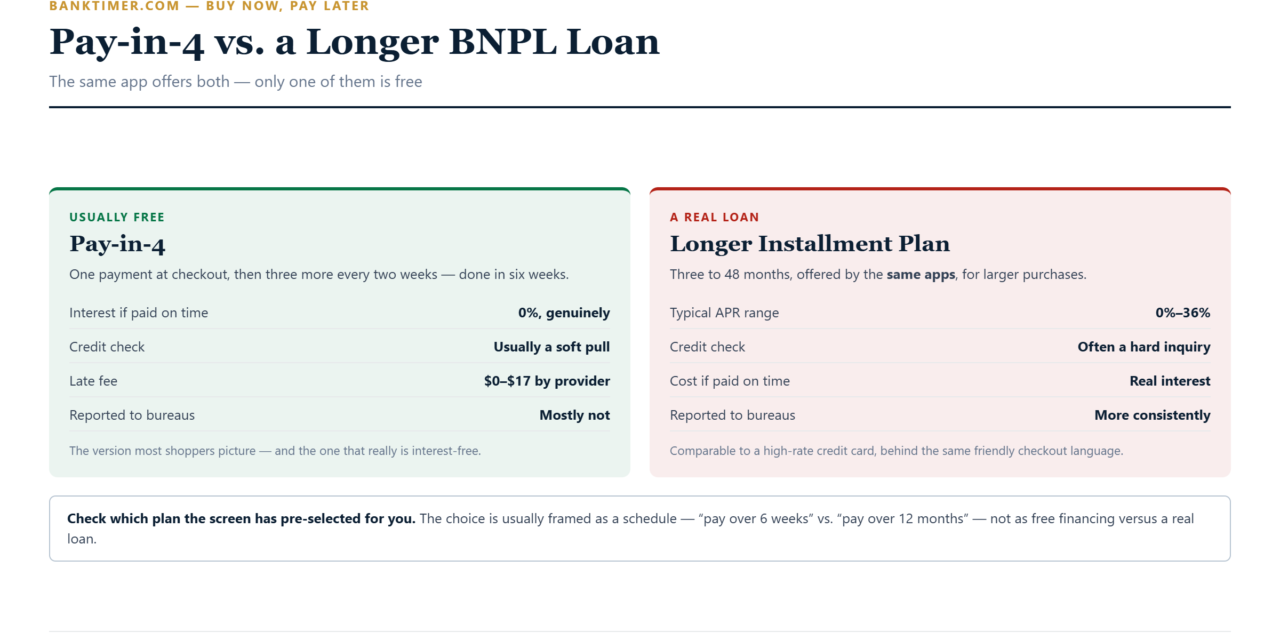
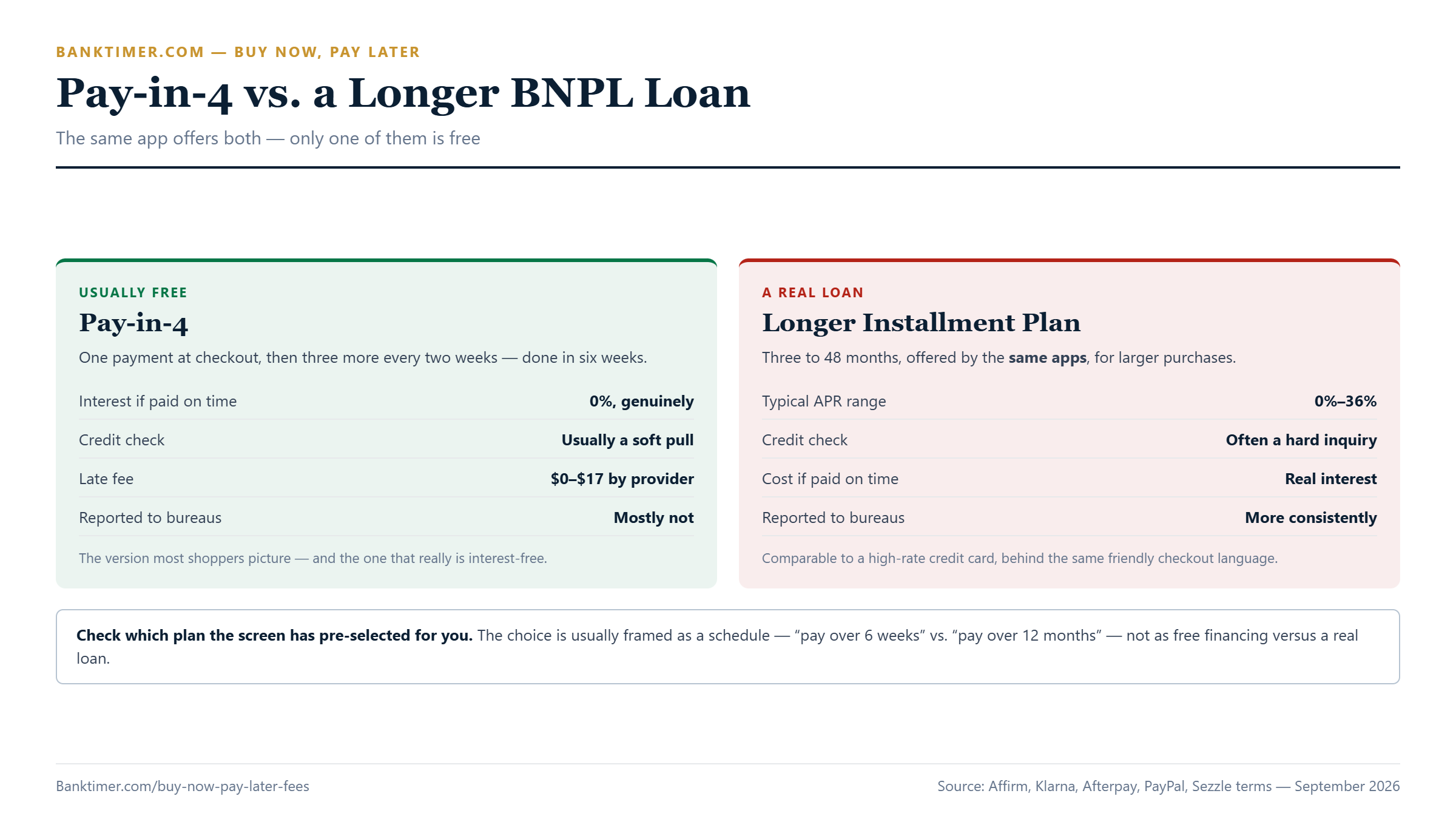
The product most shoppers picture is Pay-in-4: one-quarter of the purchase price charged at checkout, then three more equal payments every two weeks, finishing the balance in six weeks with no interest if every payment lands on time. Every major provider covered in this guide offers some version of this structure, and it is the version most likely to be genuinely free. The second, less-discussed product is a longer installment loan — three, six, twelve, even up to 48 months — offered by the same apps for larger purchases. These longer plans behave like a real consumer loan: many carry an actual APR, some carry an origination fee instead of interest, and the marketing language rarely draws a hard line between “the free kind” and “the kind that charges you” inside the same app.
Soft Pull vs. Hard Pull at Checkout
Most Pay-in-4 approvals rely on a soft credit check, which doesn’t affect your credit score and often happens in the background in under a second. Larger, longer-term BNPL loans are more likely to involve a genuine hard inquiry, similar to applying for a personal loan, because the provider is extending real, sizable credit rather than a small four-payment plan. Because this varies by provider and purchase size — a topic covered in more detail in Banktimer’s guide to how a hard inquiry works — it’s worth checking directly at checkout which type of check a specific offer uses, especially if you’re planning other credit applications soon.
Who Actually Extends the Credit
The BNPL company itself is usually the lender of record for Pay-in-4, though some programs route the underlying loan through a partner bank, similar to how many neobanks partner with a chartered bank behind the scenes. For longer installment loans, the provider frequently discloses a specific issuing bank in the loan agreement — worth reading, since your legal rights and dispute process can depend on which entity technically extended the credit, not just which app’s logo you see at checkout.
Merchant Fees: The Cost Hiding in the Price, Not the Payment Plan
Why “Free” Financing Still Has to Be Paid for by Someone
A Pay-in-4 plan being interest-free to you doesn’t mean it’s free to produce. BNPL providers charge participating merchants a processing fee for every transaction, and that fee runs meaningfully higher than a standard credit card swipe: commonly in the range of 8% to 10% of the sale, compared with roughly 2% to 4% for a typical credit card transaction. On a $400 purchase, that gap is the difference between a retailer paying around $36 to the BNPL provider versus roughly $12 to a card network — a $24 difference the retailer has to recover from somewhere.
How That Gap Reaches Every Customer, Not Just BNPL Users
Retailers generally don’t absorb that higher cost quietly. The common pattern, according to retail-pricing researchers, is that merchants offset elevated BNPL processing costs by raising shelf prices broadly, trimming promotional discounts, or scaling back seasonal sales — changes that apply to the store’s general pricing, not to a surcharge added only at BNPL checkout. The practical result is that the cost of offering “free” financing to some shoppers lands, at least partially, on every customer who walks through the door, including the ones paying cash or a debit card who never touch a BNPL plan at all. This is worth knowing not because it should stop you from using BNPL, but because it explains why the product can be genuinely interest-free for you individually while still not being free in any absolute sense — the cost hasn’t disappeared, it’s just been redistributed into the shelf price rather than itemized on your BNPL statement.
The Zero-Interest Pitch: What “0% APR” Actually Covers
Which Plans Are Genuinely Interest-Free
Standard Pay-in-4 plans from every major provider in this guide are genuinely 0% APR if every payment arrives on time — this is not a marketing exaggeration, and it’s the single most accurate thing most BNPL advertising says. The economics work for the provider because the merchant pays a fee for offering the option (similar in spirit to a credit card’s interchange fee), not because the shopper is quietly subsidizing the “free” financing through a hidden markup on the item’s price in most cases.
Which Plans Carry a Real APR
Longer, monthly-style BNPL plans are a different story. Affirm’s monthly plans run 0% to roughly 36% APR depending on the merchant and your approval terms. PayPal’s Pay Monthly option runs roughly 9.99% to 35.99% APR. Afterpay’s Pay Monthly plans run 0% to 35.99% APR. Sezzle’s monthly plans, which stretch as long as 48 months, run 0% to roughly 34.99% APR. None of these numbers are hidden exactly — they appear in the loan agreement — but they rarely appear as prominently as the “0% interest” banner that defines the shorter Pay-in-4 product sitting right next to them in the same app.
Why the Same App Can Offer Both
A single BNPL provider commonly offers both an interest-free short plan and an interest-bearing long plan side by side, with the choice presented mainly as a payment-schedule decision (“pay over 6 weeks” vs. “pay over 12 months”) rather than as a decision between free financing and a real loan. Reading which specific plan a checkout screen has pre-selected for you — rather than assuming every BNPL option behaves like the free four-payment version — is the single highest-value five seconds you can spend before confirming a BNPL purchase.
Late Fees and Failed-Payment Penalties: The Real Numbers by Provider
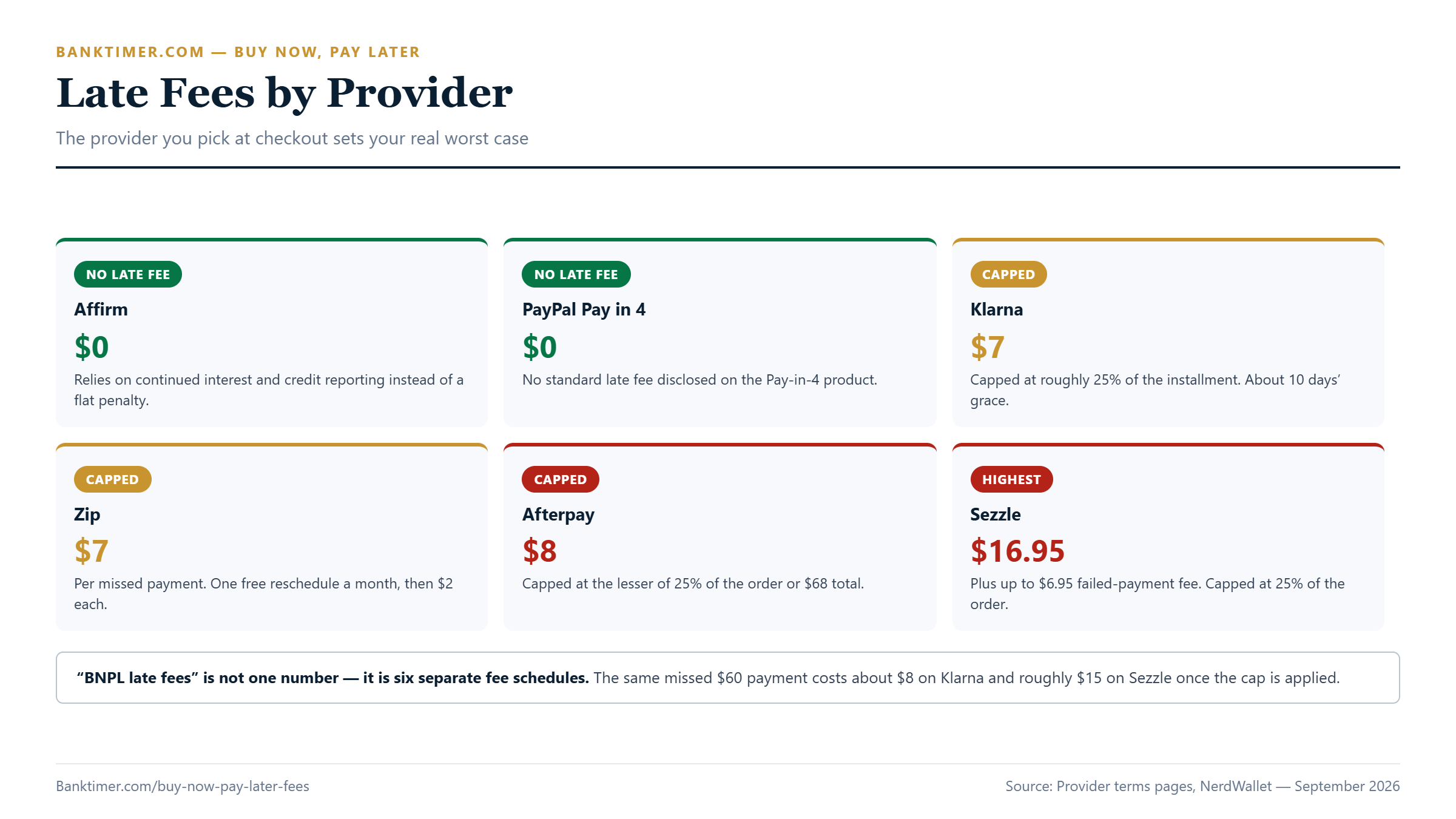
Every major BNPL provider charges some version of a late or failed-payment fee, but the amounts, caps, and grace periods differ enough that “BNPL late fees” isn’t a single number worth memorizing — it’s six or more separate fee schedules.
| Provider | Late / failed-payment fee | Cap | Typical grace period |
|---|---|---|---|
| Affirm | None on standard loans | Not applicable | Not applicable — interest continues to accrue on interest-bearing plans instead |
| Klarna | Up to $7 on Pay in 4 | Roughly 25% of the installment amount | About 10 days |
| Afterpay | Up to $8 per missed payment | Lesser of 25% of the order value or $68 total | About 10 days |
| PayPal Pay in 4 | None disclosed as a standard late fee | Not applicable | Not applicable |
| Zip | Up to $7 per missed payment | Provider-set, order-dependent | Varies by plan |
| Sezzle | Late fee up to $16.95; failed-payment fee up to $6.95 | 25% of the order amount | Varies by plan |
Affirm’s approach is structurally different from the others: rather than layering a separate late fee on top of a missed payment, it relies on the loan’s existing interest structure and credit reporting to create the consequence, which is one reason Affirm frequently markets itself as charging “no late fees” — a true statement that doesn’t mean a missed payment is free of consequence, just that the consequence shows up as continued interest and a credit-report entry rather than a flat penalty charge.
Grace Periods Are Short and Provider-Specific
A roughly 10-day grace period, common across several providers, sounds generous until you account for how BNPL payments are scheduled: a Pay-in-4 plan’s four payments already land only two weeks apart, so a 10-day grace period on one installment can bump directly into the due date of the next one, compounding the number of payments at risk if a single paycheck delay throws off your schedule.
Fee Schedules Change More Often Than Shoppers Check
BNPL providers periodically revise their fee schedules, caps, and grace periods as they respond to competition, regulatory pressure, and their own default-rate data — the numbers in the comparison table above reflect each provider’s terms as published in September 2026, and they are not guaranteed to stay fixed. A provider that charged no late fee last year can add one, and a provider with a higher cap can lower it, without necessarily sending a prominent notification highlighting the change. Because the specific dollar figures matter directly to how much a missed payment actually costs you, checking a provider’s current terms page immediately before a purchase — rather than relying on a figure from a review article, including this one, from more than a few months ago — is the only way to know your real worst case with confidence.
Rescheduling Isn’t Always Free Either
Several providers allow you to push a payment date, but the accommodation isn’t unconditional. Zip, for example, allows one free reschedule per calendar month, then charges $2 for each additional change — a modest fee, but one that adds up if your pay schedule and a provider’s fixed biweekly due dates don’t naturally align.
The Overdraft Chain Reaction: When a Missed Installment Costs More Than It Looks Like
How Autopay Failures Trigger Two Separate Penalties
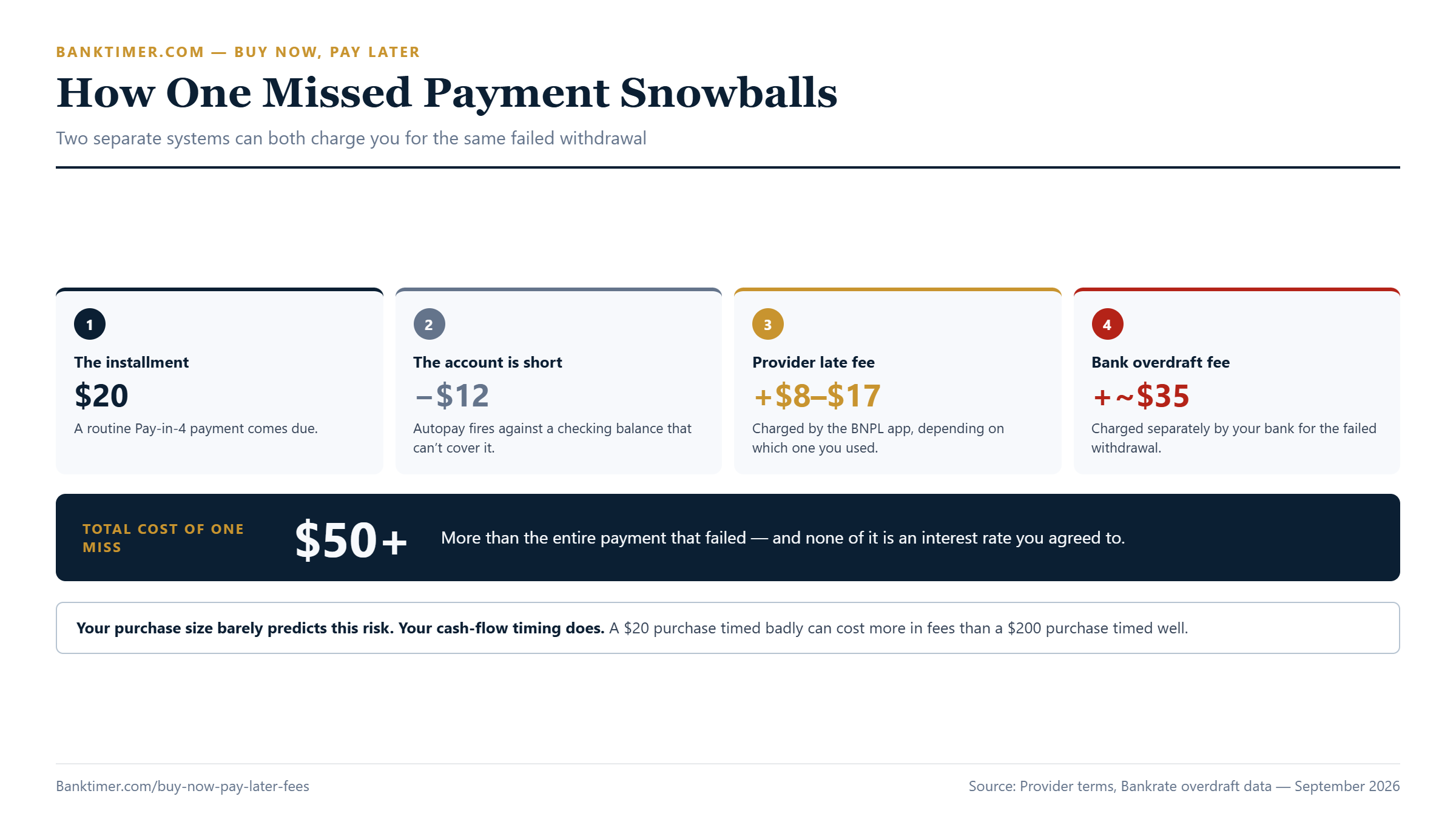
Nearly every BNPL provider defaults to automatic withdrawal from a linked debit card or bank account on the due date. When the account doesn’t have enough funds, two independent systems can both charge you for the same missed payment: the BNPL provider assesses its own late or failed-payment fee, and your bank separately charges an overdraft or non-sufficient-funds fee for the failed withdrawal attempt. One widely cited real-world illustration of this dynamic: a single missed $20 installment payment can result in more than $50 in combined fees once both penalties are added together — meaning the total cost of the miss can exceed the entire size of the payment that failed.
Why Timing Your Due Dates Matters More Than the Purchase Price
Because the overdraft side of this equation depends entirely on your bank balance on a specific date, not on how much you originally financed, a $20 BNPL purchase timed badly against your pay schedule can end up costing more in fees than a $200 purchase timed well. This is the least intuitive part of BNPL’s real cost structure: the size of your purchase barely predicts your risk. Your cash-flow timing on each individual due date does.
A Practical Fix That Costs Nothing
Checking your linked account’s balance a day or two before each scheduled BNPL withdrawal, and rescheduling a payment proactively if funds are tight, avoids both penalties entirely in most cases — a habit that costs nothing but attention, compared with a reactive fix after a failed payment has already triggered two separate charges.
Loan Stacking: Why Four “Pay-in-4” Purchases Can Mean Eight Payment Dates a Month
The Specialty Credit File Problem
Because BNPL applications are typically evaluated instantly and independently, one provider generally has no real-time visibility into how many other BNPL loans you already carry with different companies. Historically, BNPL activity has often lived in separate “specialty” credit files rather than the core credit file most lenders pull, meaning the same purchase can be invisible to one lender and visible to another depending entirely on which company processed it — and, more importantly for this section, meaning no single company can see your full BNPL picture across apps even if it wanted to.
How Stacking Multiple Apps Hides Your Real Monthly Obligation
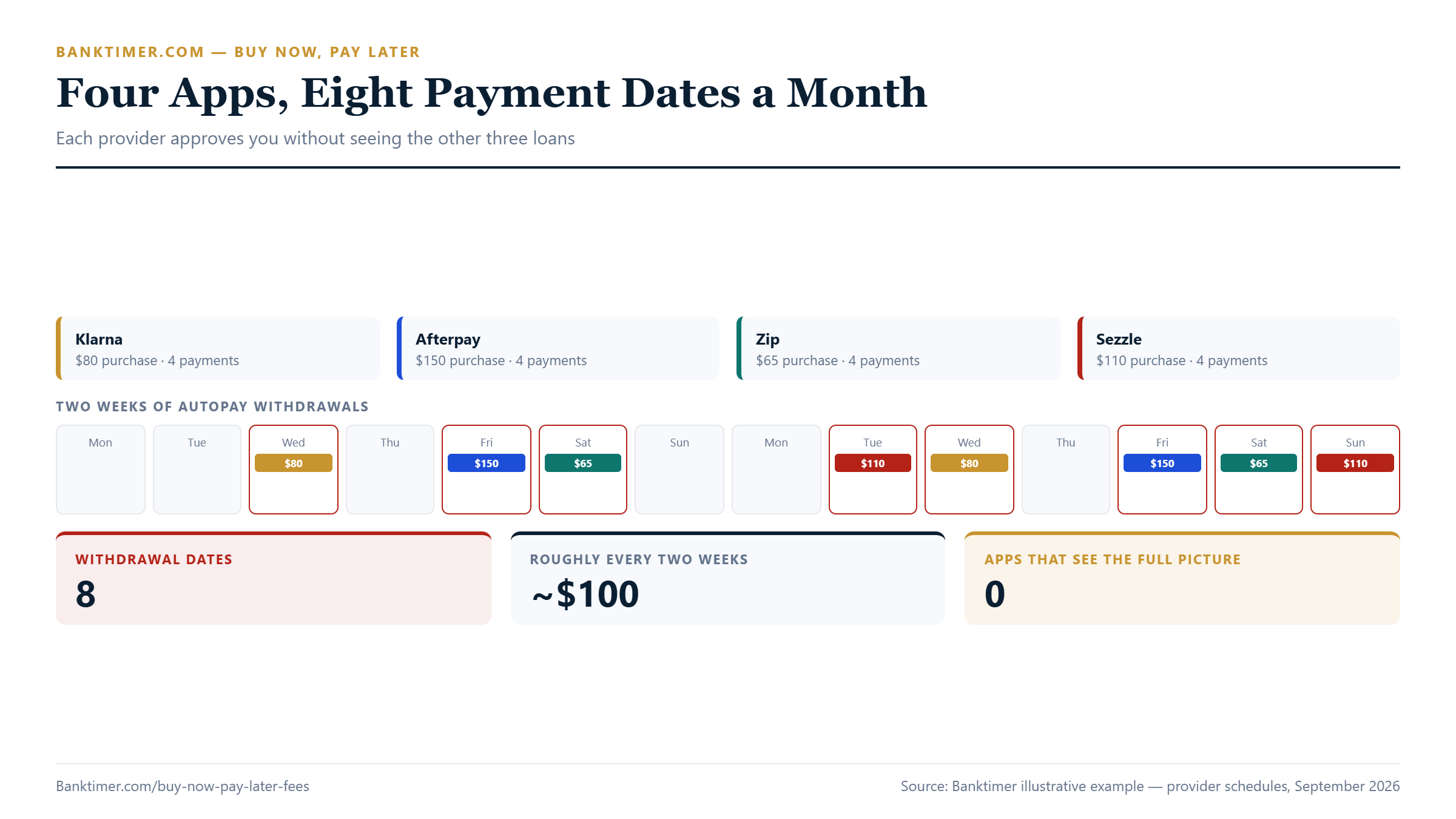
Four separate Pay-in-4 purchases across four different apps, opened even a few days apart, can produce roughly eight separate payment dates inside a single month once you account for each plan’s own biweekly schedule — a genuinely easy number to lose track of when no single dashboard shows all four apps’ obligations together. Because each individual payment is small, the cumulative monthly total is easy to underestimate until several due dates land in the same week and collectively strain a budget that looked fine when each purchase was considered on its own.
Why Stacking Risk Spikes Around the Holidays
Loan stacking isn’t evenly distributed across the calendar — it concentrates heavily around high-spending periods like the winter holidays and back-to-school shopping, when a shopper is more likely to make several separate purchases across several retailers within a short window, each with its own “Pay in 4 available” prompt at checkout. The same underlying behavior that feels manageable in isolation during a normal month — one BNPL purchase here, one there — compounds quickly during a two-to-three-week shopping stretch, which is exactly when several apps’ payment schedules are most likely to overlap and produce the multiple-payment-dates-in-one-week pattern this section describes. Treating a holiday shopping season as a period requiring more, not less, attention to your running BNPL list is a reasonable adjustment given how seasonal this specific risk actually is.
A Simple Habit That Prevents This
Keeping a single running list — even a basic note on your phone — of every open BNPL plan, its provider, its remaining payments, and its next due date is the most effective, lowest-effort defense against stacking-related surprises, precisely because no provider or credit bureau is currently doing this consolidation for you automatically.
How BNPL Now Touches Your Credit Score
FICO Score 10 BNPL and FICO Score 10 T BNPL
In 2025, FICO introduced two new scoring models — FICO Score 10 BNPL and FICO Score 10 T BNPL — specifically built to incorporate Buy Now, Pay Later loans as their own category of short-term installment debt rather than leaving them invisible to lenders. A notable design choice: because FICO’s research found many consumers open several BNPL loans in a short window, the new models aggregate separate BNPL loans together when calculating certain scoring variables, an approach FICO says increases scores for some BNPL borrowers compared with treating each small loan as a separate, isolated account. The new scores became available to lenders starting in the second half of 2025, offered alongside — not instead of — existing FICO score versions, at no additional fee from FICO itself.
Which Providers Actually Report
Whether any of this affects you in practice depends entirely on which BNPL provider you used. Affirm reports repayment data to Experian and TransUnion, making its loans visible on your credit report and eligible to factor into the newer BNPL-aware FICO scores. Klarna and Afterpay generally do not report standard Pay-in-4 activity to the major U.S. credit bureaus as of late 2026 — Afterpay has stated publicly it won’t begin reporting until it’s confident doing so will help its customers’ scores more than hurt them. The practical result: the exact same kind of purchase, financed the exact same way, can be entirely invisible to one lender and fully visible to another, purely based on which app processed the transaction.
A Missed Payment’s Score Impact Compared With a Credit Card
Where a BNPL loan does report — currently, primarily through Affirm — a missed payment carries credit consequences broadly comparable to a missed credit card payment once it’s reported as delinquent, according to consumer-finance researchers tracking this shift. That’s a meaningful change from BNPL’s earlier reputation as a low-stakes, off-the-books way to spread out a purchase; for a reporting provider, “off the books” is no longer an accurate description once a payment is late enough to be reported.
Returns, Disputes, and Refund Timing: What Protection Actually Exists
The 2024 CFPB Interpretive Rule and Its Current Status
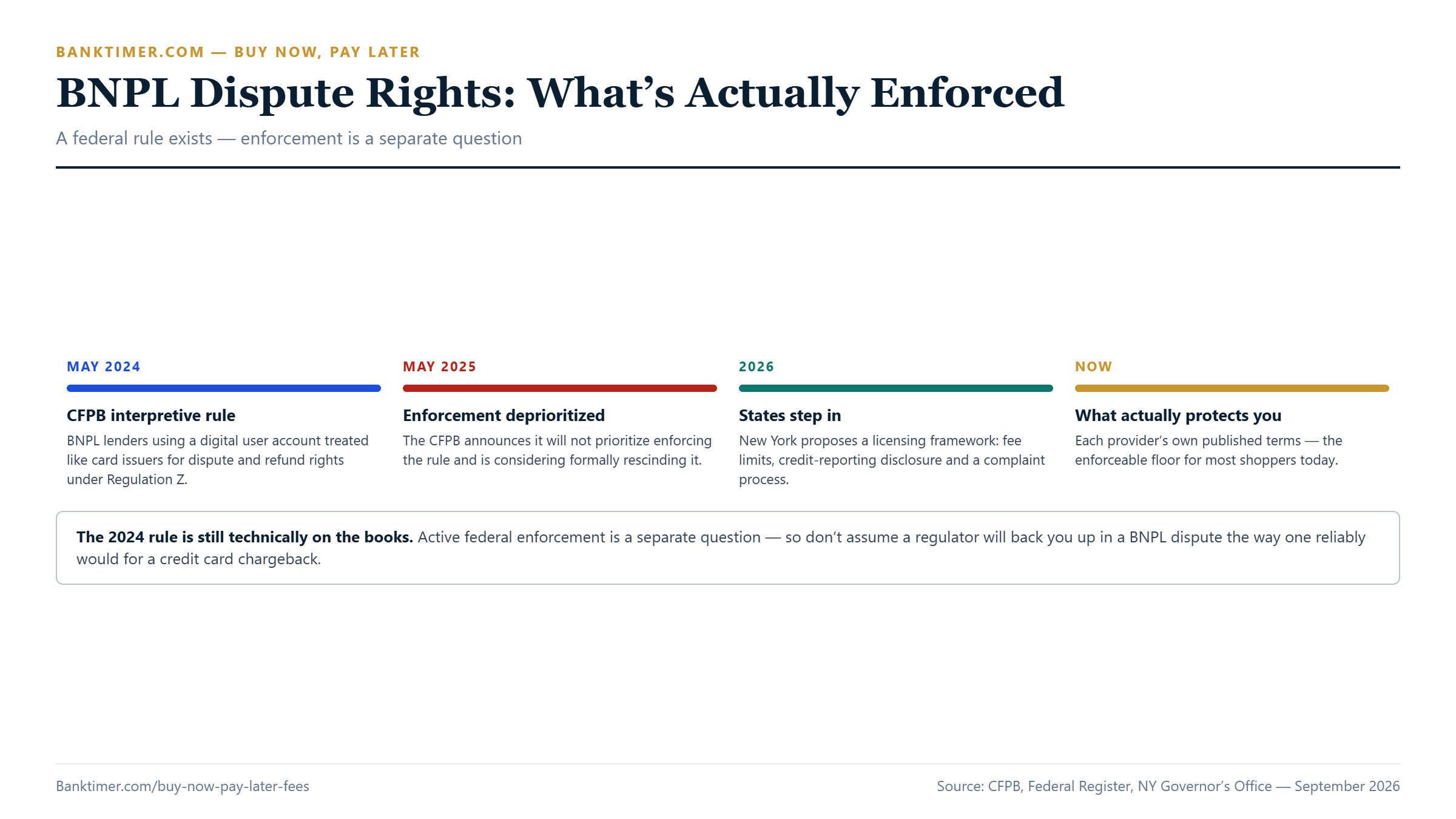
In May 2024, the CFPB issued an interpretive rule stating that BNPL lenders offering credit through a digital user account should be treated similarly to credit card issuers under Regulation Z for certain purposes — specifically, the right to dispute a charge and receive a refund, along with related disclosure and periodic statement requirements. The rule explicitly did not extend other credit card protections, such as penalty fee limits or ability-to-repay requirements, to BNPL lenders. As of this guide’s writing, that rule’s status has shifted: on May 6, 2025, the CFPB announced it would not prioritize enforcement actions based on the rule and is contemplating formally rescinding it, redirecting enforcement resources elsewhere. In practical terms, the dispute-and-refund framework the rule described is not currently being actively enforced at the federal level, even though it technically remains on the books — a gap worth knowing about before assuming a federal regulator will automatically back you up in a BNPL dispute the way one reliably would for a credit card chargeback.
What Happens When You Return an Item Mid-Installment Plan
Provider practices vary, but the general pattern is that returning an item financed through BNPL doesn’t automatically cancel your remaining payments — you typically continue paying on the original schedule until the merchant processes the refund, at which point the BNPL provider applies the refunded amount against your remaining balance or issues you the difference if you’ve already paid more than the refunded amount. The timing gap between “I returned this” and “my payment plan reflects that” can be one to two billing cycles in practice, meaning a scheduled BNPL payment can still be withdrawn from your account even after a legitimate return is in progress.
Chargeback Rights on a Linked Debit Card vs. a BNPL Loan Directly
If you funded a BNPL down payment with a debit card and a merchant dispute arises, your card network’s standard dispute process may offer a separate path alongside — or instead of — the BNPL provider’s own resolution process, depending on how the specific transaction was structured. Because this varies by provider and by how a specific purchase was routed, contacting the BNPL provider directly and, separately, checking your card issuer’s dispute window is worth doing in parallel rather than assuming only one avenue exists.
State-Level Rules Are Starting to Fill the Gap
New York’s Buy Now, Pay Later Act
With federal enforcement of the CFPB’s BNPL interpretive rule deprioritized, states have begun building their own frameworks. New York has moved furthest: state regulators have proposed what’s been described as a nation-leading regulatory framework for BNPL lenders, which would require licensing and supervision for any entity engaged in BNPL activity in New York, prohibit excessive fees including certain convenience charges, limit late fees and other penalty fees, require lenders to disclose whether a loan will be reported to credit bureaus, and establish a formal process for resolving consumer complaints. As of this guide’s writing, the rule has moved through preproposal and public comment periods, with a full public comment period beginning upon its publication in the State Register and a compliance window of roughly 180 days after the rule’s formal adoption, including a transition period for BNPL providers already operating in the state.
What a State Licensing Framework Can (and Can’t) Guarantee You
A state-level rule like New York’s applies only to activity that falls within that state’s jurisdiction, so a shopper elsewhere in the country doesn’t automatically receive the same protections just because a national BNPL app happens to also comply with New York’s requirements for its New York customers. Watching whether your own state follows New York’s lead — and, until it does, treating provider-level fee caps and disclosures as your actual, currently enforceable protection rather than a federal or state backstop — is the realistic posture for most BNPL users through the remainder of 2026.
Other States Are Watching Before They Act
Beyond New York, several other state legislatures and regulators have introduced or discussed BNPL-specific bills in recent sessions, generally focused on similar themes: licensing BNPL lenders the way other consumer lenders are licensed, requiring clearer fee and credit-reporting disclosures, and in some proposals extending ability-to-repay-style underwriting expectations that the federal interpretive rule explicitly left out. None of these proposals had reached New York’s level of detail or progress as of this guide’s writing, and most consumer protection in practice still comes down to each individual provider’s own terms rather than a uniform state or federal floor. Checking whether your own state has introduced BNPL-specific legislation — most state legislature websites make bill tracking searchable by keyword — is a reasonable step for anyone using BNPL regularly and wanting to know what, if anything, currently backs up a provider’s promises beyond its own terms of service.
Point-of-Sale Financing for Bigger Purchases: A Different Risk Profile
Medical and Dental Financing
BNPL-style financing has expanded well beyond retail checkout into medical and dental offices, often presented as a way to spread out a procedure’s cost. These loans are frequently larger than a typical retail Pay-in-4 purchase, more likely to carry a real APR, and more likely to involve a genuine hard inquiry given the loan size — worth treating with the same scrutiny as a personal loan application rather than the lighter-weight framing of a $50 retail purchase.
Furniture and Electronics Installment Loans
Larger household purchases — furniture, appliances, electronics — commonly offer point-of-sale financing through the same major BNPL brands, typically as the longer, interest-bearing product rather than Pay-in-4, given the purchase size. The “no interest if paid in full within X months” promotional structure common in this category carries a specific trap: many of these plans charge deferred interest, meaning if the full balance isn’t paid off by the promotional deadline, interest is charged retroactively on the entire original amount, not just the remaining balance — a materially worse outcome than a simple ongoing interest rate would produce.
Travel Bookings and Event Tickets
Airlines, booking platforms, and ticketing sites have increasingly added BNPL options at checkout, letting a shopper split a flight, hotel stay, or concert ticket into installments the same way they would a pair of shoes. The risk profile is genuinely different here: travel and event purchases are frequently non-refundable or only partially refundable, so a canceled trip or a missed event doesn’t necessarily cancel your remaining BNPL payments the way returning a physical product might eventually adjust your balance. A traveler who finances a $600 flight through Pay-in-4 and then needs to cancel for a reason the airline doesn’t cover can end up owing the full remaining balance on a trip they never took, with the BNPL provider’s refund process depending entirely on whether and how much the airline itself refunds — a dependency worth understanding before financing a purchase you might need to cancel.
Why a Larger Loan Often Means a Real Hard Inquiry
Because these bigger purchases represent more risk to the lender, they’re more likely to involve full underwriting and a genuine hard inquiry rather than the instant, low-friction soft check typical of a $40 Pay-in-4 purchase. If you’re planning a mortgage, auto loan, or other major application in the near future, a large point-of-sale financing application is worth sequencing carefully rather than treating as a routine, inquiry-free checkout step.
A Realistic Comparison: BNPL vs. a Credit Card vs. a Personal Loan
| Approach | Typical cost if paid on time | Typical cost if a payment is missed | Credit reporting | Best fit |
|---|---|---|---|---|
| BNPL Pay-in-4 | $0 interest | Provider late fee (roughly $0–$17) plus possible bank overdraft fee | Inconsistent — mainly Affirm reports; Klarna/Afterpay generally don’t | Small, planned purchases you’re confident you can repay in six weeks |
| BNPL longer installment plan | 0%–36% APR depending on provider and merchant | Continued interest accrual, possible fee, credit-report risk if reported | More consistently reported than Pay-in-4, provider-dependent | Larger purchases where you want fixed, predictable payments over months |
| Credit card (paid in full) | $0 interest if paid by the due date | Interest on the full revolving balance going forward | Reported to all three major bureaus | Ongoing spending flexibility plus rewards, for disciplined full-balance payers |
| Credit card (carrying a balance) | Average APR commonly in the low-to-mid 20% range | Compounding interest plus a possible late fee | Reported to all three major bureaus | Rarely the cheapest option — usually a fallback rather than a plan |
| Personal loan | Fixed APR, commonly single digits to around 36% depending on credit | Late fee plus credit-report risk | Reported to all three major bureaus | Larger, planned expenses where a fixed schedule and predictable total cost matter |
A Realistic Total-Cost Example
Consider a shopper who makes a $200 purchase through a Pay-in-4 plan: four payments of $50 every two weeks, $0 interest if every payment lands on time. Paid exactly as scheduled, the total cost is $200 — genuinely free financing. Now suppose the third $50 payment fails because the linked checking account is short by $12 that day. The BNPL provider charges a late fee (commonly $7 to $17 depending on the provider), the bank separately charges a $35 overdraft fee for the failed withdrawal attempt, and the missed payment triggers a rescheduled attempt a few days later. The original $200 purchase has now cost $242 to $252 — a 21% to 26% increase driven entirely by one mistimed payment, not by any interest rate the shopper agreed to.
Extend the same shopper’s month to include three more Pay-in-4 purchases at other retailers, each opened within the same two-week window: $150, $90, and $60. Across four apps, that shopper now owes roughly eight separate payments over the following six weeks, several of which land within days of each other, with no single provider aware of the other three obligations. If two of those eight payments fail for the same reason as the first — a temporarily tight checking account — the shopper faces a repeat of the same $40-plus combined penalty on each, potentially adding $80 to $100 in fees on top of the original $500 in purchases, none of which reflects an interest rate at all.
A Real-World Example: Three BNPL Scenarios
A shopper buys a $120 pair of shoes through Klarna’s Pay-in-4 plan, pays all four installments on time by keeping the due dates in a calendar reminder, and pays exactly $120 total — the plan works exactly as advertised, with no fee of any kind.
A second shopper finances a $900 laptop through a 12-month Affirm plan carrying an 18% APR because they wanted a lower monthly payment than a single lump sum. They make every payment on time, and by the end of the term they’ve paid roughly $985 total — a real, disclosed financing cost that a Pay-in-4 plan for the same laptop would not have carried, had a Pay-in-4 option for that amount been available.
A third shopper uses four different BNPL apps across a two-week holiday shopping stretch — Klarna, Afterpay, Zip, and Sezzle — financing $80, $150, $65, and $110 respectively, without realizing the combined biweekly payments now total roughly $100 every two weeks across four separate autopay withdrawals. A tight paycheck two weeks later causes two of the four withdrawals to fail on the same day, triggering two separate late fees and two separate bank overdraft fees — over $90 in combined penalties stacked onto roughly $405 in original purchases, entirely because no single app showed them their full BNPL picture.
A fourth shopper finances a $2,400 dental procedure through a point-of-sale BNPL loan carrying a real hard inquiry and a 24-month term at 15% APR. Three months later, when applying for an auto loan, the shopper is surprised to see the dental financing listed as an open installment loan on their credit report, affecting their debt-to-income calculation in a way a Pay-in-4 purchase for a much smaller amount never would have.
A fifth shopper misses a single Sezzle payment during a temporary income gap. Because Sezzle’s late fee runs meaningfully higher than several competitors’ — up to $16.95, capped at 25% of the order amount — the shopper’s $60 purchase incurs a $15 late fee once the cap is applied, a cost that would have been closer to $7 to $8 had the same purchase been financed through Klarna or Afterpay instead, underscoring how much the specific provider chosen at checkout affects the actual worst-case cost.
Common Mistakes People Make With Buy Now, Pay Later
A common mistake is assuming every BNPL plan inside a given app behaves like the free four-payment version, when the same app frequently also offers a longer, interest-bearing plan with a real APR presented in similar, friendly checkout language. Another is linking BNPL autopay to a checking account without checking the balance beforehand, turning a manageable missed payment into a doubled penalty once the bank’s own overdraft fee stacks on top of the provider’s late fee. A third is opening several BNPL plans across different apps in a short window without keeping a consolidated list, since no provider or credit bureau currently aggregates that view for you automatically. A fourth is assuming a missed BNPL payment is invisible to lenders the way it may have been a few years ago, when in fact a growing share of BNPL activity — starting with Affirm — now reports to major credit bureaus and factors into newer, BNPL-aware FICO scores. A fifth is treating a larger point-of-sale financing loan, for something like dental work or furniture, with the same casual attention as a $40 retail Pay-in-4 purchase, when the larger loan is more likely to carry real interest, a genuine hard inquiry, and a lasting entry on your credit report.
Red Flags Worth Slowing Down For
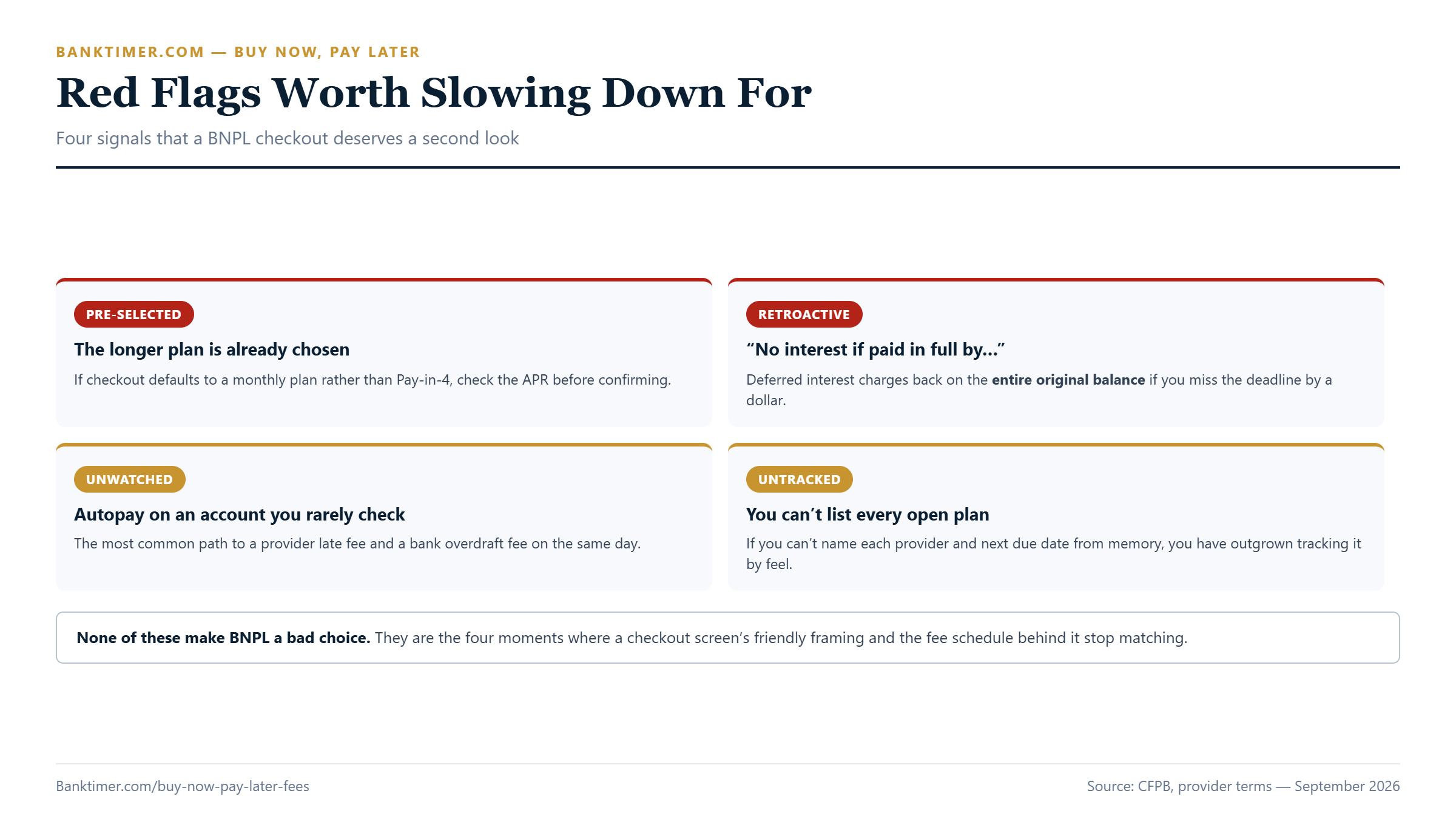
A Checkout Screen That Pre-Selects the Longer, Interest-Bearing Plan
If a BNPL option defaults to a monthly plan rather than the standard four-payment structure, check the APR before confirming — the interface may not clearly flag that you’ve moved from the free product to the financed one.
Deferred-Interest Promotional Financing
A “no interest if paid in full by [date]” offer on a larger purchase can charge interest retroactively on the entire original balance if you miss the deadline by even a few dollars or a few days — treat any deferred-interest offer as carrying real risk, not as a safer version of standard financing.
Autopay Linked to an Account You Don’t Actively Monitor
Linking BNPL payments to an account you rarely check for balance is one of the most common paths to a stacked late fee and overdraft fee combination — actively monitoring the linked account before each due date removes most of this risk.
Losing Track of How Many BNPL Plans You Currently Have Open
If you can’t quickly list every open BNPL plan, its provider, and its next due date from memory, that’s a sign your current number of simultaneous plans has outgrown what you can reliably track without a dedicated list.
Questions to Ask Before You Use Buy Now, Pay Later
- ☐ Is this specific plan the interest-free Pay-in-4 version, or a longer plan that carries a real APR?
- ☐ What is this provider’s specific late or failed-payment fee, and what is its cap?
- ☐ Does my linked account have enough of a buffer to cover this payment on its exact due date, not just today?
- ☐ How many other BNPL plans do I currently have open across other apps, and when is each one’s next payment due?
- ☐ Does this provider report to the major credit bureaus, and would a missed payment show up on my credit report?
- ☐ If this is a larger point-of-sale loan, have I confirmed whether it involves a hard inquiry before applying?
- ☐ If I need to return this item, do I understand how the refund will be applied to my remaining payments?
Alternatives Worth Comparing
A 0% Intro APR Credit Card
For a planned purchase you’re confident you can pay off within a set window, a credit card’s introductory 0% APR offer can provide a longer interest-free period than a six-week Pay-in-4 plan, plus stronger, more consistently enforced dispute rights than BNPL currently carries.
Saving First for a Short Delay
Delaying a non-urgent purchase by a few weeks to pay in full removes fee risk, interest risk, and credit-reporting risk entirely — the least glamorous alternative, but the one with the fewest moving parts to track.
Layaway
Some retailers still offer old-fashioned layaway, where you pay over time but don’t receive the item until it’s fully paid off — the inverse risk profile of BNPL, since there’s no debt or fee exposure, only the inconvenience of waiting.
A Personal Loan for Larger, Planned Expenses
For financing needs larger than a typical BNPL purchase, a personal loan offers a fixed rate, a single predictable payment, and full reporting to all three credit bureaus — a more transparent structure than juggling multiple point-of-sale loans across providers.
Employer Purchase or Advance Programs
Some employers offer purchase assistance or early-wage-access programs that can cover a timing gap without the fee structure of BNPL or the overdraft risk of a mistimed autopay withdrawal — worth checking before defaulting to a retail installment plan.
A Secured or Starter Credit Card for Building Credit Deliberately
For someone using BNPL partly to build a credit history, a secured or starter credit card that reports consistently to all three bureaus offers a more reliable credit-building path than hoping a specific BNPL provider happens to report.
Who This Guide Suits
This guide is most useful to anyone who has used, or is considering using, a Buy Now, Pay Later plan and wants to understand what the checkout screen’s friendly framing doesn’t show — the specific fee schedule behind a missed payment, which plans carry real interest, and how differently each provider treats credit-bureau reporting. It’s equally relevant to someone already juggling multiple open BNPL plans across different apps who wants a practical way to track their real monthly obligation before it produces a stacked, avoidable fee.
Frequently Asked Questions
Is Buy Now, Pay Later really interest-free?
Standard Pay-in-4 plans genuinely are interest-free if every payment arrives on time, but longer monthly installment plans from the same providers can carry real APRs up to roughly 35–36%, so the answer depends entirely on which specific plan you selected at checkout.
What happens if I miss a BNPL payment?
You’ll typically face a provider-specific late or failed-payment fee, and if the payment was withdrawn automatically from an account without enough funds, your bank may separately charge an overdraft or NSF fee on top of it — a combination that can exceed $50 on a single missed installment.
Does Buy Now, Pay Later affect my credit score?
It depends on the provider — Affirm reports to Experian and TransUnion, so its loans and any missed payments can affect your score, while Klarna and Afterpay generally don’t report standard Pay-in-4 activity to the major bureaus as of late 2026.
Can I have multiple BNPL loans at once?
Yes, and providers generally can’t see each other’s outstanding loans when approving a new one, which is exactly why tracking your own total obligation across apps is your responsibility rather than something any single provider manages for you.
Are BNPL late fees the same across every provider?
No — they vary meaningfully, from providers charging no separate late fee at all to others charging up to roughly $17 per missed payment, each with its own cap and grace period, so checking the specific provider’s terms matters more than assuming a standard industry fee.
Is BNPL regulated the same way as credit cards?
Not consistently. A 2024 CFPB rule extended certain credit-card-style dispute and refund protections to some BNPL loans, but the agency deprioritized enforcing that rule in 2025 and is considering rescinding it, so federal protection is currently weaker in practice than the rule’s text suggests.
What happens to my BNPL payments if I return the item?
Payments typically continue on the original schedule until the merchant processes the refund, after which the BNPL provider applies it against your remaining balance — expect a gap of one to two billing cycles before your payment plan fully reflects the return.
Do BNPL loans show up as a hard inquiry on my credit report?
Usually not for standard Pay-in-4 purchases, which typically rely on a quick soft check, but larger point-of-sale loans for things like dental work, furniture, or electronics are more likely to involve a genuine hard inquiry given the larger amount financed.
Is a longer BNPL plan cheaper than a credit card?
It depends on the specific APR each offers you — a longer BNPL plan’s rate can run comparable to, higher than, or lower than a credit card’s rate depending on the provider, the merchant, and your individual approval terms, so comparing the actual disclosed APR is necessary rather than assuming BNPL is automatically cheaper.
Can a BNPL provider send my account to collections?
Yes — a sufficiently delinquent BNPL balance can be referred to collections just like any other unpaid consumer debt, and depending on the provider and the size of the loan, that referral can also appear on your credit report.
What is “deferred interest,” and why does it matter for BNPL?
Deferred interest is a promotional structure, common on larger point-of-sale financing, where no interest is charged if you pay the full balance by a set date — but if you miss that deadline by even a small amount, interest is charged retroactively on the entire original balance, not just what’s left.
Does using BNPL responsibly help build my credit?
Only if the specific provider you use reports your on-time payments to the credit bureaus — a well-managed BNPL plan through a non-reporting provider builds no credit history at all, while the same discipline through a reporting provider like Affirm can be reflected positively.
Is it safe to link BNPL autopay to a debit card instead of a bank account directly?
Either can work, but a debit card link draws from the same checking account balance either way, so the real safeguard is confirming sufficient funds before each due date rather than which specific payment method you selected.
Are BNPL loans a good way to build an emergency financing option?
Not really — BNPL approval and available credit lines are typically tied to a specific purchase at checkout rather than functioning as an accessible credit line you can draw on later, unlike a credit card’s available limit.
What’s the single most important thing to check before using BNPL?
Confirm which specific plan you’re being offered — the interest-free Pay-in-4 version or a longer plan with a real APR — since that one detail determines whether the purchase is genuinely free or a real loan wearing a friendly checkout interface.
How to Verify These Numbers Yourself
The Consumer Financial Protection Bureau publishes current guidance on Buy Now, Pay Later products directly at consumerfinance.gov, including its compliance resources page and its research on BNPL market size and usage. Each provider’s own terms page — Affirm, Klarna, Afterpay, PayPal, Zip, and Sezzle each publish their current fee schedules, APR ranges, and credit-reporting practices directly — is the most reliable source for that specific provider’s current numbers, since fee structures and reporting practices continue to change. FICO’s investor relations site documents its BNPL-specific scoring models directly. Because BNPL fee schedules, reporting practices, and applicable regulations are all still actively evolving, verify current figures directly against these sources before assuming any number in this guide still applies at the time you’re reading it.
Key Terminology
| Term | What it means |
|---|---|
| Pay-in-4 | The standard BNPL structure: one payment at checkout plus three more every two weeks, typically interest-free if paid on time |
| Deferred interest | A promotional financing structure that charges interest retroactively on the full original balance if it isn’t paid off by a set deadline |
| Loan stacking | Holding multiple BNPL loans across different providers simultaneously, without any single provider having visibility into the others |
| Specialty credit file | A separate credit file, distinct from your core credit report, where some BNPL activity has historically been recorded |
| Hard inquiry | A credit check tied to a new credit application that can affect your score, more common on larger BNPL point-of-sale loans than on small Pay-in-4 purchases |
| Point-of-sale financing | Credit offered directly at checkout, in-store or online, for a specific purchase, including both retail BNPL and larger installment loans for things like medical care or furniture |
| Interpretive rule | A type of regulatory guidance, like the CFPB’s 2024 BNPL rule, that explains how an agency interprets existing law without creating a brand-new regulation from scratch |
| Grace period | The short window after a due date during which a payment can still be made before a late fee applies |
Buy Now, Pay Later’s core Pay-in-4 product genuinely delivers what it advertises — interest-free financing for a small purchase, as long as every payment lands on time. The real cost lives in the details a checkout screen doesn’t emphasize: a missed payment can trigger both a provider fee and a bank overdraft fee, longer installment plans from the same apps can carry real double-digit APRs, credit-bureau reporting differs enormously by provider, and federal dispute protections are currently enforced less consistently than the underlying rule’s text suggests. None of this makes BNPL inherently a bad choice — it makes it a product whose real cost only becomes visible once you check the specific plan type, the specific provider’s fee schedule, and your own linked account’s balance before confirming the purchase, rather than assuming every “Pay in 4” button behaves identically.
Sources
- Consumer Financial Protection Bureau — What Is a Buy Now, Pay Later (BNPL) Loan?
- Consumer Financial Protection Bureau — Buy Now, Pay Later (BNPL) Products Compliance Resources
- Federal Register — Truth in Lending (Regulation Z): Use of Digital User Accounts To Access Buy Now, Pay Later Loans
- Holland & Knight — CFPB Provides Status Update Regarding Buy Now, Pay Later Interpretive Rule
- FICO — FICO Unveils Groundbreaking Credit Scores That Incorporate Buy Now, Pay Later Data
- Governor Kathy Hochul — New York Announces Nation-Leading Regulation to Establish Consumer Protections for Buy Now, Pay Later Loans
- NerdWallet — Afterpay Buy Now, Pay Later Review
- NerdWallet — Sezzle Buy Now, Pay Later Review
- NerdWallet — Zip Buy Now, Pay Later Review
- The Points Guy — A Comparison of Buy Now, Pay Later Services
Methodology
Provider fee, APR, and repayment-term figures in this guide reflect a survey of each named provider’s own current terms pages and independent reviews (NerdWallet, The Points Guy) accessed in September 2026; these figures change as providers update their terms, so verify the current schedule directly with the specific provider before relying on any number here. Usage and missed-payment statistics reflect published 2025 survey research current as of access in September 2026. The regulatory status of the CFPB’s 2024 BNPL interpretive rule and New York’s proposed BNPL regulatory framework reflect their respective public status as of September 2026 and are both actively evolving — check the CFPB’s and New York State’s own current publications before treating either as final. This guide is educational and does not constitute financial or legal advice.
Before your next BNPL purchase, open the provider’s actual terms page — not just the checkout screen — and confirm three things in under two minutes: whether this specific plan is interest-free Pay-in-4 or a longer plan with a real APR, what the exact late or failed-payment fee and grace period are, and whether your linked account has enough buffer to cover the first payment on its exact due date.