
By the Banktimer Editorial Team · Published
Banktimer is an independent U.S. consumer-finance publication. Our editors draw on primary and official sources first, such as the CFPB, FDIC, Federal Reserve, and FTC, along with statutes, regulations, and providers’ own agreements and fee schedules. Then we add worked examples and decision tools. Our goal is the most useful, best-supported explanation the sources available to us at the time of writing allow.
This article is general information, not legal, tax, investment, insurance, or financial advice, and reading it does not create a professional relationship with Banktimer. Rates, fees, limits, and rules change, and they vary by state, provider, and contract, so confirm current terms with your bank, lender, insurer, or the agency named in the article before you act. Examples are illustrative unless labeled otherwise. Banktimer is not a bank, lender, insurer, or financial advisor, and we are not responsible for decisions or losses that result from relying on this content. For advice about your own situation, talk to a licensed professional.
Credit Freeze vs. Fraud Alert. Choosing between a credit freeze and a fraud alert comes down to a single question: do you want lenders warned, or do you want them blocked? A fraud alert is a flag on your credit file asking creditors to verify your identity before extending credit. A credit freeze restricts access to the file itself, so a prospective lender generally can’t pull it and therefore won’t approve a new account. Both are free, both are federal rights, and both are widely misunderstood — including the part where neither one protects the accounts you already have. This Banktimer guide compares them on what they actually stop, how fast each one goes on and comes off, which situations call for which, and the specialty credit bureaus most people never think to freeze.
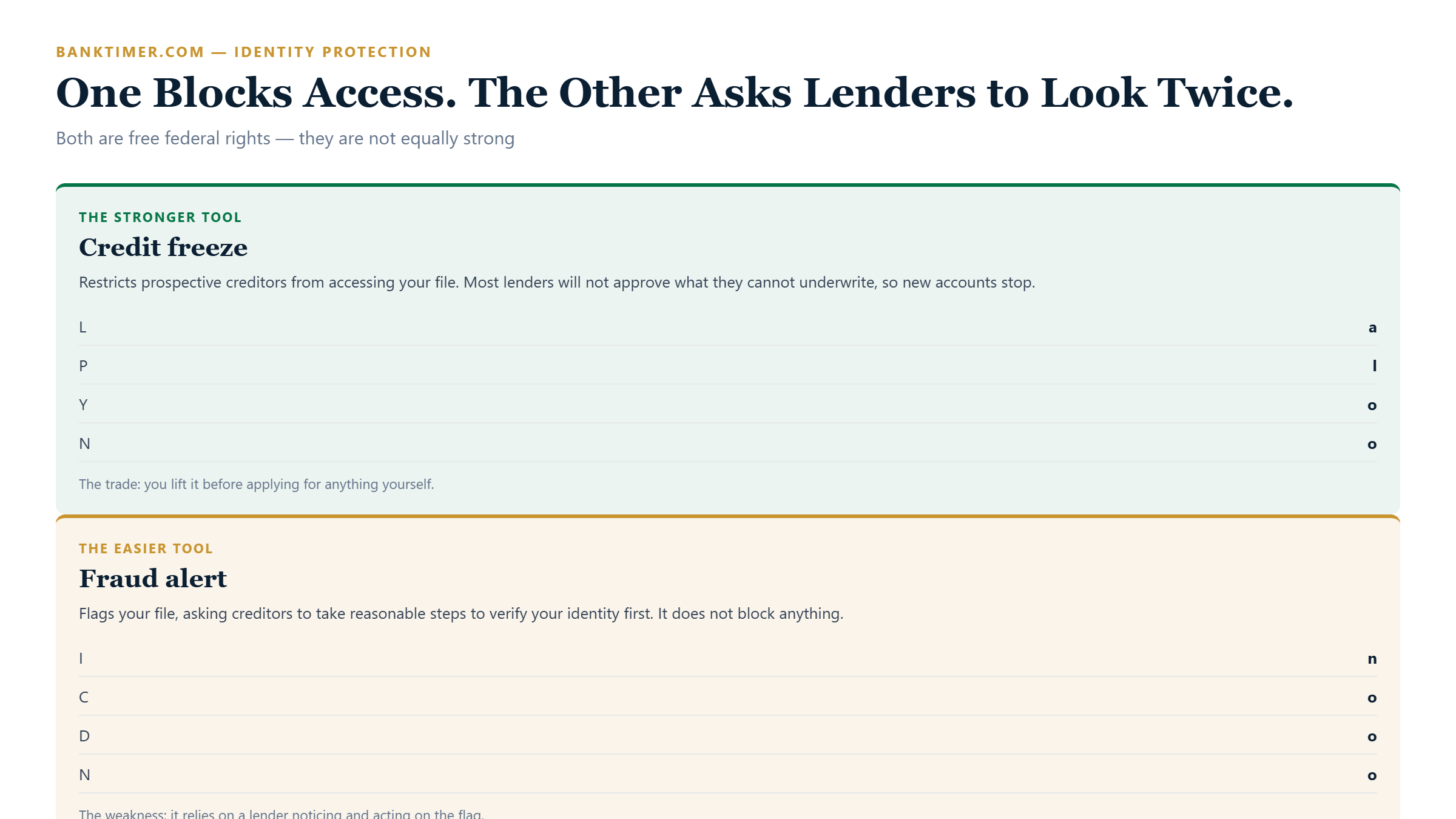
A credit freeze blocks access; a fraud alert requests verification. The freeze is the stronger protection by a wide margin, and since September 2018 it has been free by federal law at all three nationwide credit bureaus.
You must place a freeze with each bureau separately. A fraud alert only needs one call. The bureau you contact for an alert is required to notify the other two; there is no equivalent relay for freezes.
A freeze lifts in as little as one hour when you request it by phone or secure electronic means. The “it’s too inconvenient” objection is largely out of date — lifting a freeze before a loan application takes minutes, not days.
Neither one protects your existing accounts. A frozen credit file does nothing to stop a thief using your current credit card, draining your checking account, or filing a tax return in your name. Those need separate defenses.
A credit freeze has no effect on your credit score. The CFPB states it plainly: security freezes do not impact your credit scores in any way whatsoever.
A “credit lock” is a product, not a right. Locks are offered by the bureaus themselves, sometimes for a fee and sometimes bundled with other services. The CFPB’s position is direct: locks are no more effective than security freezes, which are free and which you have a right to by law.
Freezing the big three does not cover everything. Bank accounts, utilities, and phone service are often opened through specialty reporting agencies that the big-three freeze doesn’t touch — a gap most guidance skips entirely.
The Short Answer
| Your situation | Use this | Why |
|---|---|---|
| Your identity was actually stolen | Freeze all three, plus an extended fraud alert | You need blocking, and the extended alert runs seven years |
| Your data appeared in a breach | Freeze all three | Exposure without confirmed misuse still warrants blocking, not a warning |
| You don’t plan to apply for credit soon | Freeze all three and leave them on | Free, no score effect, and lifts in about an hour when you need it |
| You’re rate shopping or applying this month | Fraud alert, or a freeze you temporarily lift | An alert doesn’t block lenders; a lifted freeze is just as workable |
| You’re deploying with the military | Active duty alert, and consider a freeze too | Lasts a year, renewable for the deployment, and removes you from prescreened offers |
| Protecting a child | Freeze, requested by the parent or guardian | Children under 16 can be frozen, and the bureau must create a file to freeze if none exists |
| You just want to be careful generally | Freeze | There’s no meaningful downside, and an alert expires while a freeze doesn’t |
If you read no further: for most people, most of the time, the freeze is the better tool. The fraud alert’s main advantages are that one call covers all three bureaus and that it doesn’t interrupt an application already in progress. Those are convenience advantages, not security advantages.
Key Numbers to Know
| Figure | Value | Why it matters |
|---|---|---|
| Cost of a credit freeze or fraud alert | $0 | Free by federal law since September 2018, at every nationwide bureau |
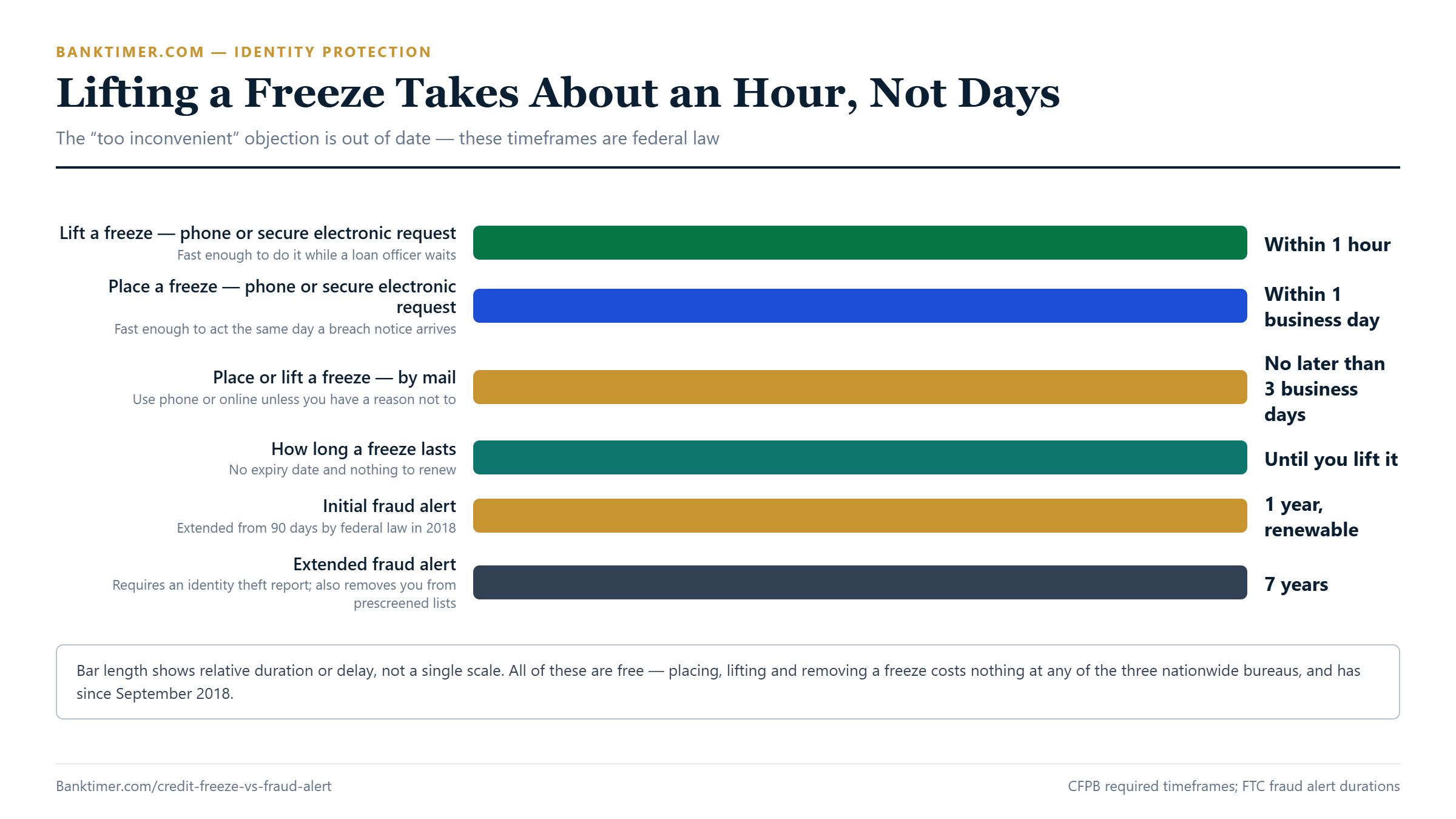
| Time to place a freeze, phone or secure electronic request | Within one business day | Fast enough to act the same day you learn of a breach |
| Time to lift a freeze, phone or secure electronic request | Within one hour | Removes the main practical objection to keeping one on permanently |
| Time to place or lift by mail | No later than three business days | Use phone or online unless you have a reason not to |
| How long a freeze lasts | Until you lift it | No expiry date and no renewal to remember |
| Initial fraud alert duration | One year, renewable | Extended from 90 days by federal law in 2018 |
| Extended fraud alert duration | Seven years | Requires an identity theft report; also removes you from prescreened offer lists |
| Active duty alert duration | One year, renewable for the deployment | Built for service members who can’t monitor their file while deployed |
| Bureaus you must contact for a freeze | All three, separately | Equifax, Experian and TransUnion each hold their own file |
| Bureaus you must contact for a fraud alert | One | That bureau is required to tell the other two |
| Effect of either on your credit score | None | Neither is visible to scoring models as a negative |
| Age below which a parent can freeze a child’s file | 16 | The bureau must create a file solely to freeze it if none exists |
Credit Freeze vs. Fraud Alert, Side by Side
The two tools sit at different points on the same spectrum. Understanding exactly where they differ makes the choice obvious in most situations.
| Criterion | Credit freeze | Fraud alert |
|---|---|---|
| What it does | Restricts access to your credit file | Flags the file, asking creditors to verify identity |
| Strength | Blocking — lenders generally can’t pull the file | Advisory — a request that relies on the lender acting on it |
| Cost | Free | Free |
| Bureaus to contact | All three, separately | One — it must notify the other two |
| How long it lasts | Until you lift it | One year initial, seven years extended, one year active duty |
| Time to activate | Within one business day by phone or online | Effectively immediate at the bureau you contact |
| Time to remove | Within one hour by phone or online | Can be removed on request; otherwise expires |
| Effect on your credit score | None | None |
| Effect on applying for credit yourself | You must lift it first, or the application will likely be declined | None, beyond a possible identity verification step |
| Effect on prescreened credit offers | Not automatically stopped — opt out separately | An extended alert removes you from those lists for five years |
| Proof required | Identity verification only | An identity theft report for the extended version |
| Protects existing accounts | No | No |
Two rows carry most of the decision. “Blocking versus advisory” is the security difference: a freeze doesn’t depend on a lender noticing anything or choosing to act. “All three versus one” is the effort difference, and it’s smaller than it sounds — three online forms, roughly fifteen minutes total, done once.
How a Credit Freeze Actually Works
A security freeze restricts prospective creditors from accessing your credit file. Because most lenders won’t approve an application they can’t underwrite, the practical effect is that new accounts can’t be opened in your name — by a thief or by you — while the freeze is on.
Who Can Still See Your File
A freeze isn’t absolute, and knowing the exceptions prevents false confidence. Your existing creditors and their debt collectors can still access the file for account review. Government agencies can access it in connection with a court order, subpoena, or child support enforcement. Companies you already do business with can review the relationship. And you can always get your own reports.
That last point matters: freezing does not block you from pulling your own credit reports free at AnnualCreditReport.com, and you should keep doing so. Banktimer’s guide to credit report errors covers what to look for when you read them.
What It Costs You in Practice
Almost nothing, with one caveat worth planning around. When you apply for a mortgage, auto loan, credit card, or sometimes a rental or a new phone contract, you need to lift the freeze first. If you know which bureau the lender uses, you can lift only that one; if not, lift all three. Either way the process takes minutes online with the PIN or account credentials you set up when you froze.
The realistic failure mode isn’t inconvenience — it’s losing your PIN or account access. Store the credentials for all three bureaus somewhere you’ll actually find them in two years, ideally a password manager rather than a note in a drawer.
Freezing a Child’s Credit File
Child identity theft is unusually damaging because it often goes undetected for years — a teenager discovers it when applying for a first student loan. Federal law lets a parent or guardian freeze the file of a child under 16, and if the child has no credit file, the bureau must create one solely so it can be frozen. That record can’t be used for credit while frozen. You’ll need documentation of your authority and the child’s identity; each bureau publishes its own list.
Freezing the File of Someone You Care For
A guardian, conservator, or person holding a valid power of attorney can request a freeze on behalf of an incapacitated adult, with documentation. This is one of the more effective protections available for an older relative at risk of financial exploitation, and it costs nothing.
How Fraud Alerts Actually Work
A fraud alert is a notice on your credit file telling prospective creditors to take reasonable steps to verify your identity before extending credit. It doesn’t block the file, and it doesn’t require the lender to reach you by any particular method — the obligation is to take reasonable verification steps.
The Three Types
| Type | Duration | Who it’s for | What it requires |
|---|---|---|---|
| Initial fraud alert | One year, renewable | Anyone who suspects they may be at risk | Nothing beyond identity verification — no proof of theft needed |
| Extended fraud alert | Seven years | Confirmed identity theft victims | An identity theft report, typically from IdentityTheft.gov or a police report |
| Active duty alert | One year, renewable for the deployment | Deployed service members | Proof of active duty status |
The extended alert carries a benefit the others don’t: it removes you from prescreened credit and insurance offer lists for five years, which cuts off a genuine source of mail-theft-based fraud. The active duty alert does the same for two years.
The Weakness Worth Naming
A fraud alert depends on a lender seeing the flag and choosing to act on it properly. Most do. But the obligation is to take reasonable steps, not to reach you personally, and a determined thief with your full identifying information can sometimes satisfy a verification process. That’s the structural reason a freeze is stronger: it doesn’t ask anyone to do anything.
What Neither One Protects
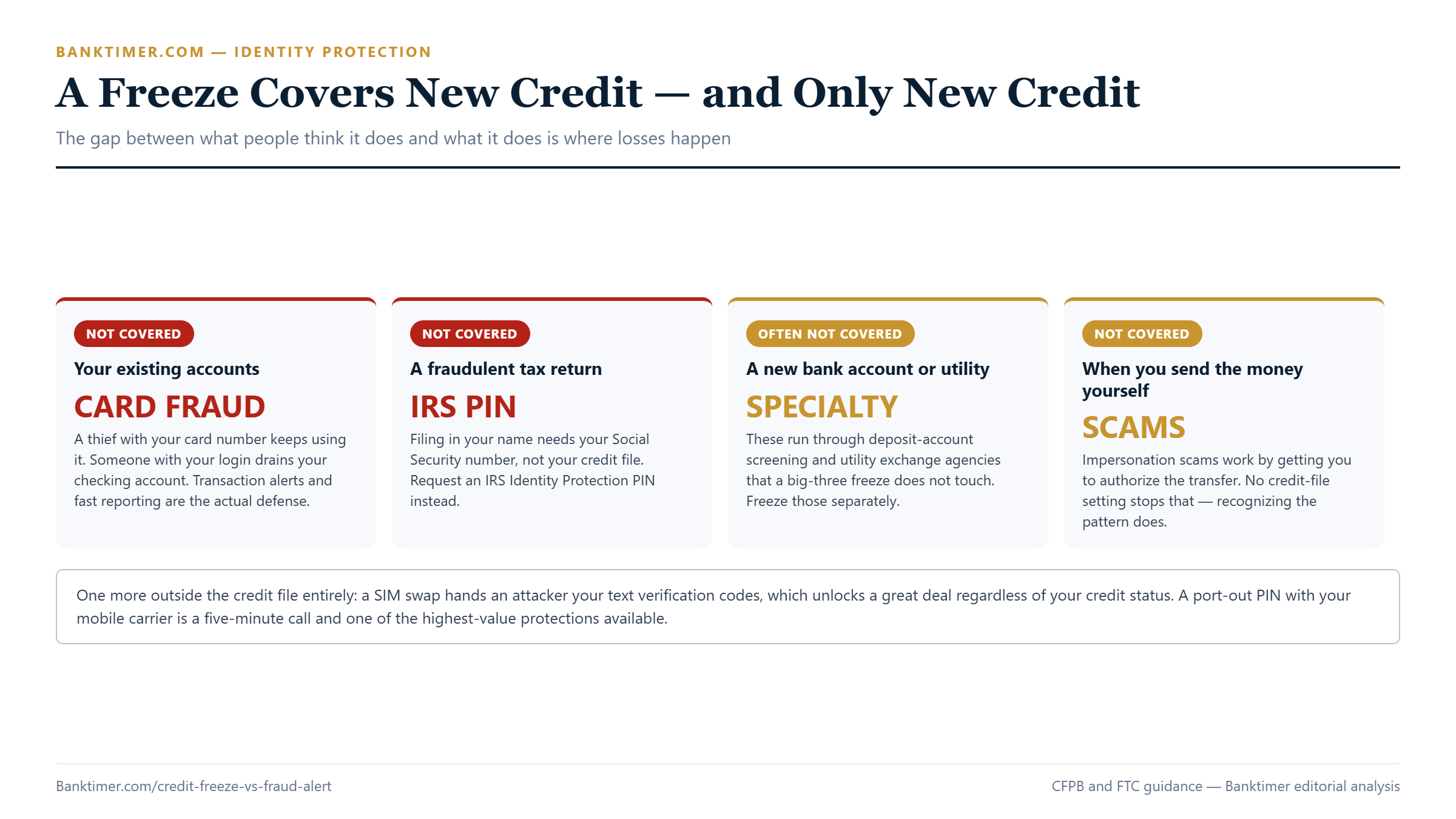
This is the most important section in the guide, because the gap between what people think a freeze does and what it actually does is where real losses happen. A credit freeze governs one thing: access to your credit file for the purpose of opening new credit. Everything below sits outside it.
Your Existing Accounts
A thief with your card number can keep using your existing credit card. Someone with your debit card or account credentials can drain your checking account. A freeze does nothing about either. Those are protected by card-network rules, federal error-resolution requirements, and your own monitoring — Banktimer’s guides to debit card fraud recovery and to bank impersonation scams cover the deadlines that actually matter there.
Tax Refund Fraud
Filing a fraudulent return in your name requires your Social Security number, not your credit file. The defense is an IRS Identity Protection PIN, which you can request from the IRS and which blocks a return filed without it. Banktimer’s guide to tax refund direct deposit problems covers the adjacent failure modes.
Medical and Insurance Identity Theft
Someone using your identity to obtain medical care generally isn’t opening a credit account, so no freeze applies. Reviewing explanation-of-benefits statements is the practical detection method.
Social Security and Government Benefits
A freeze doesn’t protect your Social Security account. Creating your own account at the Social Security Administration’s site — before someone else does — is the relevant step there.
Account Takeover Through You
No freeze stops you from being talked into authorizing a transfer. Impersonation scams work by getting the account holder to move the money themselves, which is precisely why they’re so effective and so hard to reverse. Banktimer’s guide to phishing texts that look like your bank covers the pattern.
| Threat | Does a freeze stop it? | What actually does |
|---|---|---|
| New credit card or loan opened in your name | Yes — this is what it’s for | Freeze at all three bureaus |
| Charges on your existing credit card | No | Transaction alerts and prompt dispute under card rules |
| Your checking account drained | No | Alerts, strong credentials, and reporting fast — liability rises with delay |
| Fraudulent tax return filed in your name | No | An IRS Identity Protection PIN |
| A new bank account opened in your name | Often not | Freeze the specialty bank-screening agencies too |
| Utility or mobile phone account opened in your name | Often not | Freeze the utility-exchange agency; add a carrier PIN |
| Medical care obtained in your name | No | Review explanation-of-benefits statements |
| You are persuaded to send the money yourself | No | Recognizing the scam pattern; verifying through a number you look up |
The Bureaus Most People Forget to Freeze
Freezing Equifax, Experian, and TransUnion blocks most new credit accounts. It does not block a new checking account, a utility connection, or a mobile phone contract, because those decisions are often made using entirely different reporting agencies. This is the single largest gap in standard identity-theft advice.
Bank Account Screening
Banks commonly check a deposit-account screening agency before opening a checking account. A thief opening an account in your name to receive stolen funds is not applying for credit, so the big-three freeze doesn’t apply. These agencies accept freeze or security-freeze requests directly.
Utility and Telecom Exchanges
Utility and phone companies often use a shared exchange rather than a nationwide credit bureau. Freezing it closes a route that’s frequently used for service fraud, which can be both costly and slow to unwind.
The Fourth Nationwide Bureau
Beyond the big three, another nationwide consumer reporting agency operates and is used by some lenders. It offers its own freeze, and it’s worth adding to the list once you’re already doing the others.
Insurance and Public Records Data
Specialty agencies compile insurance claim histories and public-records data used in underwriting. Some accept freeze requests and all must provide you a free file disclosure on request.
| Agency type | What it gates | Covered by a big-three freeze? | Priority |
|---|---|---|---|
| Equifax, Experian, TransUnion | Credit cards, loans, mortgages | Yes — this is the big three | Do these first |
| Deposit-account screening agency | New checking and savings accounts | No | High — closes the mule-account route |
| Utility and telecom exchange | Utility connections, mobile phone contracts | No | High — service fraud is common and slow to unwind |
| Fourth nationwide credit bureau | Some lending decisions | No | Moderate |
| Insurance and public-records specialty agencies | Insurance underwriting and identity verification | No | Lower, but request your file disclosure |
| Your mobile carrier account | SIM swaps that defeat text-based two-factor codes | No | High — set a port-out PIN with the carrier |
The CFPB maintains a published list of consumer reporting companies, including the specialty agencies, with contact details and which ones accept freeze requests. That list is the authoritative place to find current names and procedures, which change more often than the big three do.
The last row isn’t a credit bureau at all, and it belongs here anyway. A SIM swap hands an attacker your text-message verification codes, which unlocks a great deal regardless of what your credit file says. A port-out PIN with your carrier is a five-minute call and one of the highest-value protections on this entire list.
A Decision Framework: Which One, and When
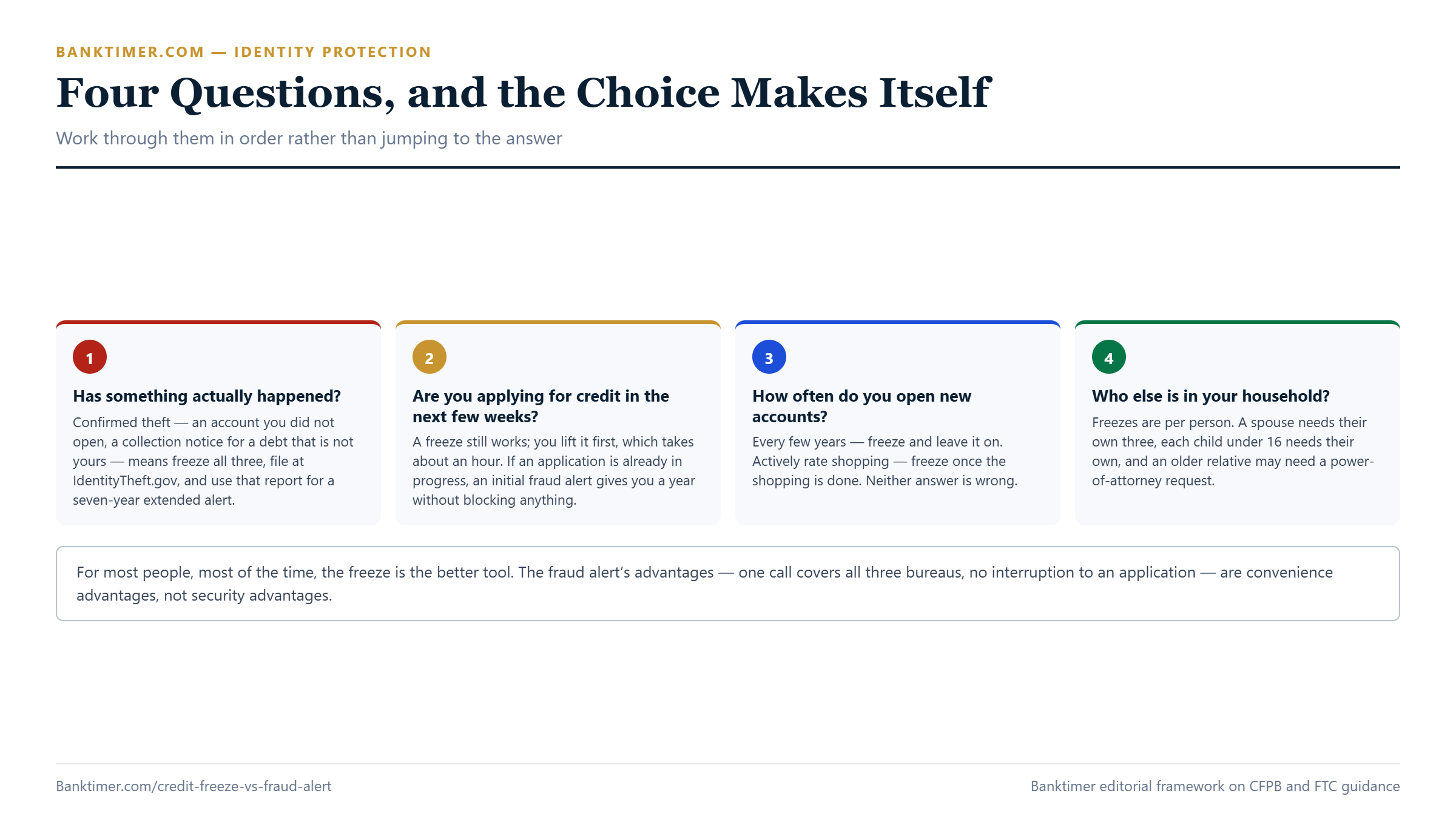
Four questions settle it, and they’re worth working through in order rather than jumping to the answer.
Question 1: Has Something Actually Happened?
If you have confirmed identity theft — an account you didn’t open, a collection notice for a debt that isn’t yours, a denial you can’t explain, which Banktimer’s credit score guide can help you interpret — you’re in recovery mode. Freeze all three, file a report at IdentityTheft.gov to create an identity theft report, and use that report to place an extended seven-year alert. The freeze blocks; the extended alert persists long after you’d otherwise stop paying attention.
Question 2: Are You Applying for Credit in the Next Few Weeks?
If yes, a freeze still works — you just lift it first, which takes about an hour. If the application is already in progress and you’d rather not interrupt it, an initial fraud alert gives you a year of coverage without blocking anything. Banktimer’s guide to hard inquiries covers the rate-shopping windows that affect this timing.
Question 3: How Often Do You Open New Accounts?
Someone who opens a card every few years should freeze and leave it frozen. Someone actively rate-shopping across several lenders may prefer to freeze after the shopping is done. Neither answer is wrong; the freeze is simply less convenient during an active application period and no less convenient the rest of the time.
Question 4: Who Else Is in Your Household?
Freezes are per person, so a spouse’s file needs its own three requests, and each child under 16 needs their own. An older relative you help manage money for may need a guardian- or power-of-attorney-based request. Doing the whole household in one sitting takes an afternoon and doesn’t need repeating.
| If this is true | Do this | Then this | Time required |
|---|---|---|---|
| Confirmed identity theft | Freeze all three immediately | File at IdentityTheft.gov; place a 7-year extended alert | About an hour |
| Your data was in a breach notice | Freeze all three | Add the specialty agencies; set a carrier port-out PIN | About 30 minutes |
| Mid-application for a mortgage | Place an initial fraud alert | Freeze once the loan closes | Under 10 minutes |
| No plans to borrow | Freeze all three and leave them on | Store the PINs in a password manager | About 15 minutes |
| Deploying with the military | Place an active duty alert | Consider a freeze as well; arrange a trusted contact | Under 15 minutes |
| You have children | Freeze each child’s file | Gather guardianship and identity documents first | An afternoon, once |
| Helping an older relative | Freeze under a power of attorney or guardianship | Add account alerts and a trusted contact at their bank | Varies with documentation |
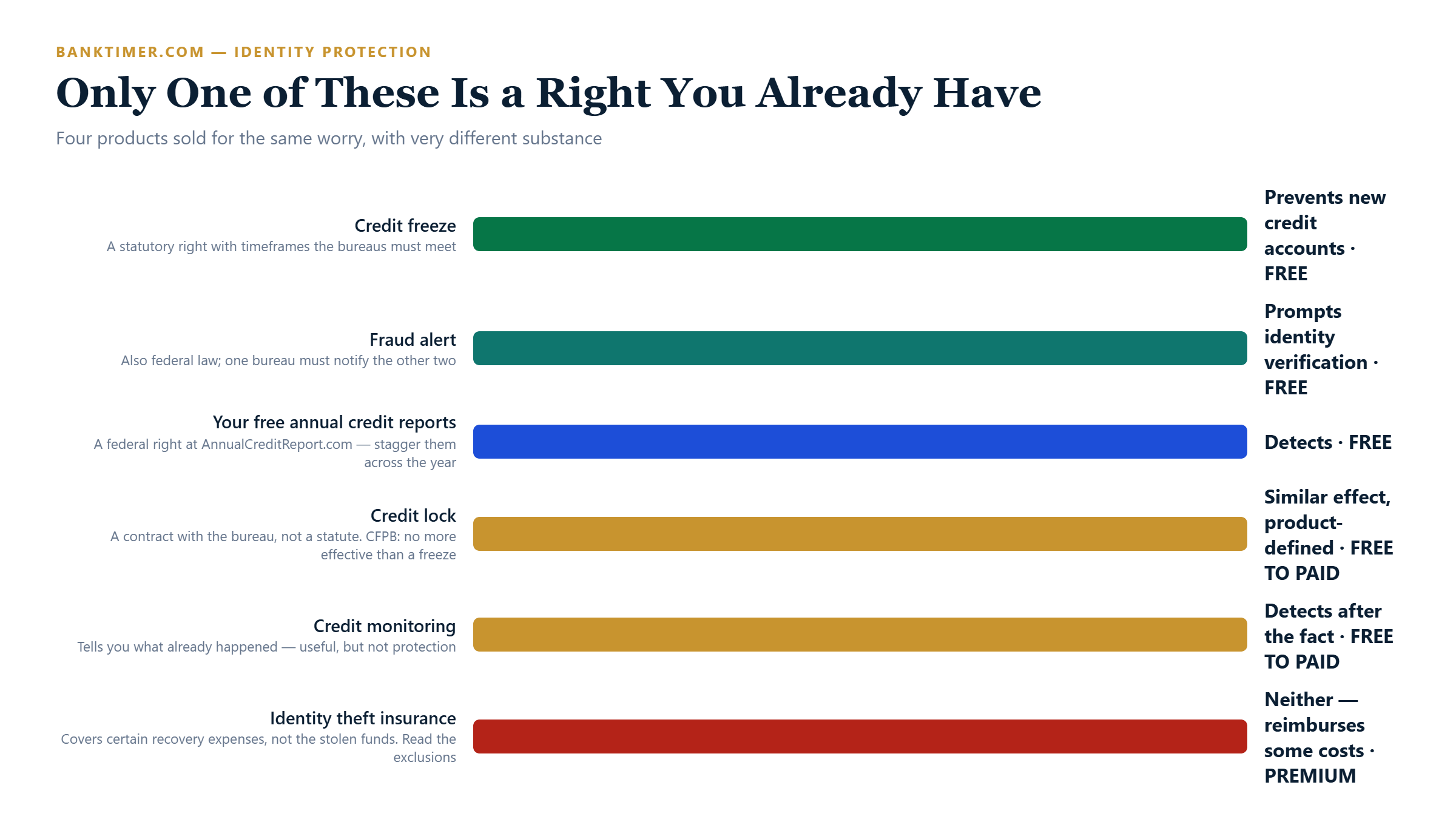
Freeze, Lock, Monitoring, or Insurance?
Four products get sold or recommended for roughly the same worry, and only one of them is a legal right you already have.
Credit Freeze
A statutory right, free, and the strongest of the four at blocking new credit accounts. Governed by federal law, with defined timeframes the bureaus must meet.
Credit Lock
A product the bureaus offer, sometimes free and sometimes bundled into a paid subscription, governed by the terms of that contract rather than by statute. Locks are typically toggled in an app, which is genuinely convenient. The CFPB’s assessment is worth quoting directly: credit locks are no more effective than security freezes, which are free and which you have a right to by law. Read what a lock’s terms say about liability and cancellation before paying for one.
Credit Monitoring
Monitoring detects rather than prevents, much as watching your credit utilization tells you what already reported rather than stopping it. It tells you after something appeared on your report, which is useful but is not protection. Free monitoring is widely available, including through some credit card issuers, and you can approximate it yourself by staggering your three free annual reports across the year.
Identity Theft Insurance
Typically reimburses certain out-of-pocket recovery costs rather than the stolen funds themselves, and often carries exclusions worth reading closely. It’s a supplement to prevention, never a substitute.
| Option | Prevents or detects? | Cost | Backed by |
|---|---|---|---|
| Credit freeze | Prevents new credit accounts | Free | Federal law, with required timeframes |
| Fraud alert | Prompts verification | Free | Federal law |
| Credit lock | Similar effect, product-defined | Free to subscription | A contract with the bureau |
| Credit monitoring | Detects after the fact | Free to subscription | A service agreement |
| Identity theft insurance | Neither — reimburses some costs | Premium or bundled | An insurance policy with exclusions |
| Your own free annual reports | Detects | Free | Federal law, at AnnualCreditReport.com |
If you’re paying for one of the middle rows and haven’t done the free top row, the money is being spent in the wrong order.
What to Do in the First 48 Hours After a Breach or Theft
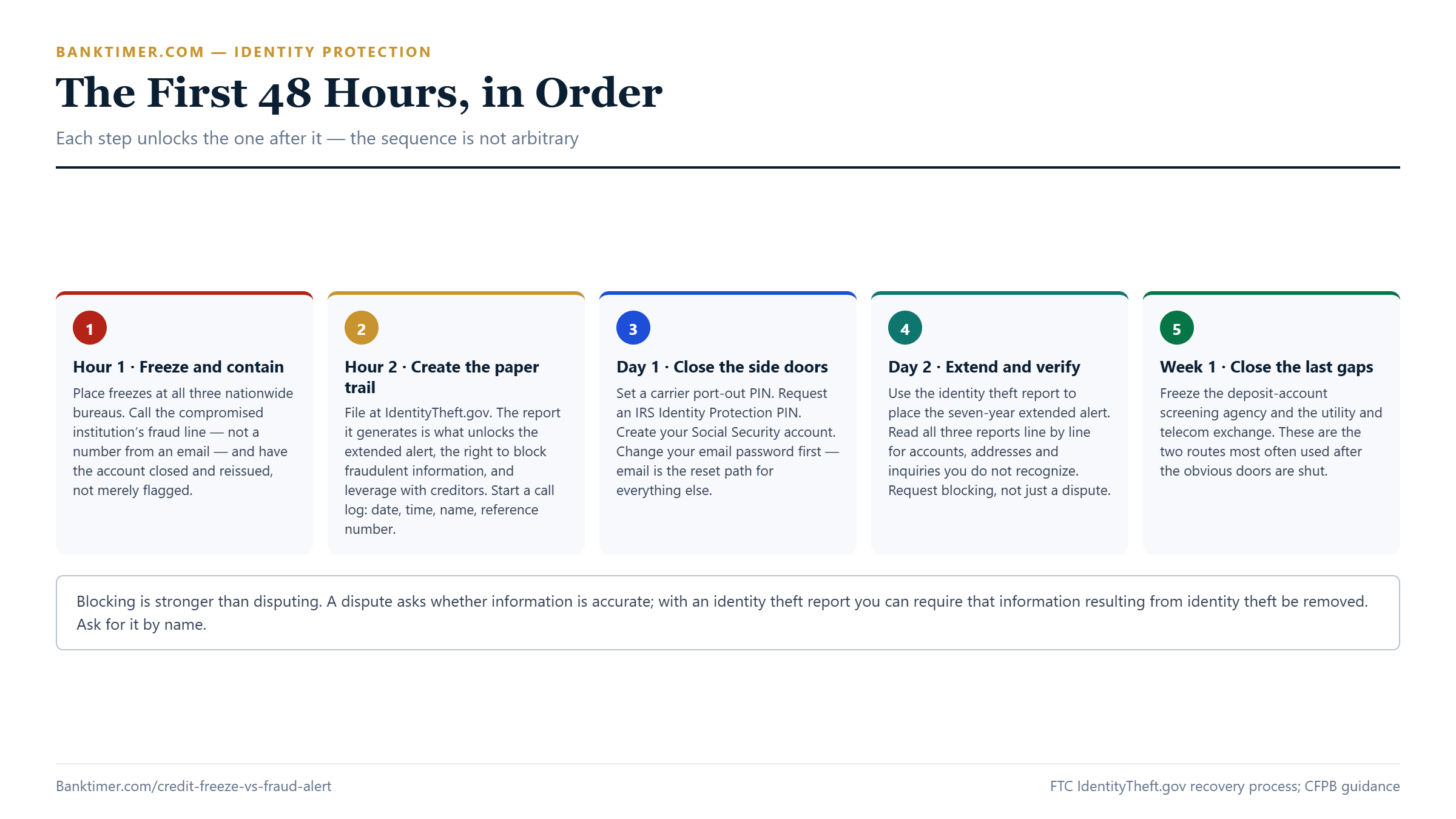
Order matters here, because some steps unlock others. Work down the list.
Hour One: Freeze and Contain
Place freezes at all three nationwide bureaus. If a specific account has been compromised, call that institution’s fraud line — not a number from an email or text — and have the card or account closed and reissued rather than merely flagged.
Hour Two: Create the Paper Trail
File at IdentityTheft.gov. The report it generates is the identity theft report you’ll need for an extended fraud alert, for blocking fraudulent information on your credit reports, and for pushing back on creditors. Add a police report if a creditor or your state requires one. Write down every call: date, time, name, reference number.
Day One: Close the Side Doors
Set a port-out PIN with your mobile carrier. Request an IRS Identity Protection PIN. Create your Social Security account if you haven’t. Change passwords on email first — email is the reset path for everything else — and turn on app-based rather than text-based two-factor authentication where offered.
Day Two: Extend and Verify
Use the identity theft report to place the seven-year extended alert. Pull all three credit reports and read them line by line for accounts, addresses, and inquiries you don’t recognize. Dispute anything fraudulent in writing, and request that fraudulent information be blocked rather than merely disputed — that’s a distinct right under federal law for identity theft victims.
Then: Add the Specialty Agencies
Freeze the deposit-account screening agency and the utility and telecom exchange. These are the two gaps most likely to be exploited after the obvious doors are closed.
| When | Action | Why it’s in this position |
|---|---|---|
| Hour 1 | Freeze all three bureaus; close compromised accounts | Stops further losses before anything else |
| Hour 2 | File at IdentityTheft.gov; start a call log | The report unlocks the extended alert and blocking rights |
| Day 1 | Carrier port-out PIN; IRS IP PIN; secure email | Closes the routes that defeat two-factor codes and tax filing |
| Day 2 | Place the 7-year extended alert; read all three reports | Requires the report from step two |
| Week 1 | Dispute and request blocking of fraudulent entries | Blocking is a stronger remedy than an ordinary dispute |
| Week 1 | Freeze the specialty reporting agencies | Closes bank-account and utility fraud routes |
| Month 1 and beyond | Re-pull reports; keep every record | Fraudulent accounts sometimes surface months later |
Three Situations, Worked Through
The same two tools produce different plans depending on timing and what has already happened.
A Breach Notice, No Evidence of Misuse
Someone receives a letter saying their Social Security number was exposed in a vendor breach, along with an offer of two years of free monitoring. Nothing has happened yet. The monitoring is worth accepting since it’s free, but it detects rather than prevents, so it isn’t the main move.
The plan: freeze all three bureaus the same day, add the deposit-account screening and utility exchange agencies, set a carrier port-out PIN, and opt out of prescreened offers. Skip the fraud alert entirely — a freeze already blocks what an alert would merely flag, and the alert would expire in a year while the freeze won’t. Total time, about forty minutes, all of it free.
A Collection Notice for a Loan You Never Took
This is confirmed identity theft, and the sequence matters. Freeze all three immediately, then file at IdentityTheft.gov to generate the identity theft report. Use that report to place a seven-year extended alert and to request blocking of the fraudulent account rather than a routine dispute. Notify the collector in writing that the debt resulted from identity theft and enclose the report. Request the application records from the lender that opened the account, because the address and phone number used will tell you whether this was bulk data or someone closer to home.
Mid-Mortgage, and the Card Issuer Just Called About Suspicious Activity
Freezing now would stall an application in progress, and the underwriter may need to re-pull credit before closing. The workable plan is an initial fraud alert, which protects for a year without blocking, plus closing and reissuing the compromised card immediately and turning on transaction alerts. Tell the loan officer what happened, since a fraud alert may add an identity verification step they should expect. Once the loan closes, place the freezes. Banktimer’s guide to mortgage preapproval covers how sensitive that final stretch is to credit-file changes.
| Situation | Freeze? | Alert? | The step people skip |
|---|---|---|---|
| Breach notice, no misuse yet | Yes, all three | Not needed | The specialty agencies and the carrier port-out PIN |
| Collection notice for an unknown debt | Yes, immediately | Extended, seven years | Requesting blocking rather than a routine dispute |
| Mid-mortgage with a compromised card | After closing | Initial, one year | Telling the loan officer, so verification steps don’t surprise anyone |
| Child’s file, no known problem | Yes, per bureau | Not applicable | Gathering guardianship documents before starting |
| Older relative at risk of exploitation | Yes, under a power of attorney | Optional | Naming a trusted contact at their bank and brokerage |
The final column is the useful one. In every case the freeze is the easy part; what gets missed is the step just outside the credit file — the specialty agency, the phone carrier, the written notice to a collector, the conversation with a loan officer.
Common Mistakes and Red Flags
The most common mistake is freezing one bureau and assuming it covers all three. Freezes don’t relay; only fraud alerts do. A second is placing an initial fraud alert and forgetting it expires in a year, leaving a gap nobody notices.
A third is losing the freeze PINs, which turns a one-hour lift into an identity-verification process at the worst possible moment. A fourth is believing a freeze protects existing accounts. A fifth is paying for a credit lock or monitoring subscription without first placing the free freezes.
A sixth is freezing only the big three and leaving the deposit-account and utility agencies open. A seventh is freezing your own file while leaving a child’s or an at-risk relative’s untouched — those are often the more attractive targets precisely because nobody is watching them.
| Red flag | Why it matters | Safer next step |
|---|---|---|
| A site charging to place a credit freeze | Freezes are free by federal law at all three bureaus | Go directly to each bureau’s own site; pay nothing |
| A caller offering to “unfreeze” your credit for you | Only you can lift your own freeze, with your credentials | Hang up; never share a freeze PIN with a caller |
| A breach notice urging you to click a link to enroll | Breach notifications are a common phishing pretext | Navigate to the company’s site yourself and verify |
| A credit denial you can’t explain | May indicate accounts you don’t know about | Read the adverse action notice; pull all three reports |
| Mail for accounts you never opened | A classic early signal of new-account fraud | Freeze immediately and file at IdentityTheft.gov |
| Your phone loses service unexpectedly | A possible SIM swap that captures your verification codes | Contact the carrier from another line at once |
| A child receiving pre-approved credit offers | Suggests a credit file exists in their name | Check for a file at each bureau and freeze it |
Questions to Ask Before You Choose
Work through this before you place anything
- ☐ Do I have confirmed identity theft, or exposure without confirmed misuse?
- ☐ Am I applying for credit in the next 30 days, and with which lender?
- ☐ Where will I store the freeze PIN or account credentials for each bureau?
- ☐ Have I frozen all three, or only the one I happened to start with?
- ☐ Do I need to freeze the deposit-account screening and utility exchange agencies too?
- ☐ Does anyone else in my household need this — a spouse, a child, an older relative?
- ☐ Do I have a mobile carrier port-out PIN set?
- ☐ Have I requested an IRS Identity Protection PIN?
- ☐ If I already pay for monitoring or a lock, have I done the free freezes first?
- ☐ If I place an initial fraud alert, where will I record the date it expires?
How New-Account Fraud Actually Starts
Knowing the routes helps you judge which protection matters for your situation, because different entry points defeat different defenses.
Bulk Data From a Breach
The most common starting point. Name, date of birth, Social Security number, and address are enough to attempt a new account almost anywhere. A freeze is the direct counter, because no amount of accurate personal information helps if the lender can’t pull a file.
Mail Theft
Prescreened credit offers, replacement cards, and statements taken from an unlocked mailbox provide both data and, sometimes, a usable application. Opting out of prescreened offers removes a large share of this supply, and it’s a separate step from either a freeze or an alert.
Phishing and Impersonation
A convincing text or call collects the missing pieces directly from you — a one-time code, a security answer, the last four digits that turn partial data into a complete identity. No credit-file protection stops this, which is why recognizing the pattern matters more than any setting.
SIM Swap
An attacker persuades a carrier to move your phone number to their device, capturing every text-based verification code. This defeats two-factor authentication on accounts you already have, and a credit freeze is irrelevant to it. A port-out PIN is the counter.
Insider and Family Access
A meaningful share of identity theft involves someone with legitimate access to your documents — including relatives. This is the main reason to freeze a child’s file, and it’s also why a freeze you place yourself is worth more than a monitoring product someone in the household can see and disable.
| Entry point | What it gets the attacker | Does a freeze help? | The specific counter |
|---|---|---|---|
| Breached database | Full identifying information | Yes, directly | Freeze all three plus specialty agencies |
| Mail theft | Offers, cards, statements | Yes, partly | Opt out of prescreened offers; use a locking mailbox |
| Phishing text or call | Codes, passwords, the missing pieces | No | Verify through a number you look up yourself |
| SIM swap | Your text verification codes | No | Carrier port-out PIN; app-based two-factor |
| Someone with household access | Documents and mail directly | Yes, if they can’t lift it | Freeze with credentials only you hold; secure documents |
| Synthetic identity using your SSN | A fabricated identity built on your number | Partly | Freeze plus reviewing all three reports for unknown names or addresses |
The pattern across that table is worth naming. A freeze is excellent at one thing and irrelevant to several others. That isn’t an argument against it — it’s an argument for placing it and then spending five more minutes on the port-out PIN and the prescreened-offer opt-out, which cover the rows it doesn’t.
Your Rights If Fraud Happens Anyway
Federal law gives identity theft victims a specific set of rights that go well beyond placing an alert, and most people never use them because nobody tells them the rights exist.
Free Reports and an Extra Look
Placing an initial fraud alert entitles you to a free credit report from each bureau beyond your normal free reports. An extended alert entitles you to two free reports from each bureau within the following twelve months. Use them — read the addresses and inquiries, not just the accounts.
Blocking, Not Just Disputing
An ordinary dispute asks a bureau to investigate whether information is accurate. Blocking is stronger: with an identity theft report, you can require that information resulting from identity theft be removed from your file, and the bureau must generally act within a defined period. Ask for blocking explicitly rather than filing a generic dispute, because the two requests go down different paths. Banktimer’s guide to credit report errors walks through the ordinary dispute process for comparison.
Documents From the Fraudster’s Application
You have the right to request, from a business where a fraudulent account was opened, the application and transaction records relating to that account. This is how you find out what address, phone number, or employer the thief used — information that often explains how it happened and helps with other cleanup.
Stopping Collection on a Fraudulent Debt
If a debt collector contacts you about an account opened in your name, you can tell them in writing that the debt resulted from identity theft and provide your identity theft report. A collector who has been notified generally may not continue collecting or report the debt while the claim is being evaluated.
Where to Escalate
If a bureau or creditor won’t act, file a complaint with the Consumer Financial Protection Bureau, which forwards it to the company and requires a response. For a bank, you can also escalate to its primary regulator — Banktimer’s guide to who regulates banks, insurance and investments explains how to identify the right one.
Living With a Freeze
The objection people raise is friction. In practice the routine is small, and a few habits remove almost all of it.
Keep the Credentials Somewhere Real
All three bureaus, in a password manager, with the account email noted. This single step converts every future lift from a verification ordeal into a two-minute task.
Ask Which Bureau the Lender Uses
Many lenders will tell you if you ask. Lifting one instead of three saves time and leaves the other two protections in place throughout.
Lift for a Window, Not Forever
Most bureaus let you lift temporarily for a set number of days. Use that rather than a permanent removal, so the freeze resumes on its own if you forget.
Expect the Occasional Surprise
Some transactions you wouldn’t think of as credit involve a credit pull: a new mobile phone contract, some rental applications, occasionally a utility connection or an insurance quote. If something is declined unexpectedly, the freeze is worth checking first.
Re-check After Major Life Events
Marriage, divorce, a move, a death in the family, or turning 16 for a child whose file you froze are all moments to confirm the freezes are still in place and the contact details on file are current.
Who This Guide Suits
This guide is most useful to anyone who just received a data breach notice, anyone who has found an account they didn’t open, and anyone who has been meaning to freeze their credit and wants to know whether it’s worth the trouble. It’s equally relevant if you’re already paying for identity protection and want to know what you’re actually getting.
Anyone worried about money in the bank rather than credit in their name should read Banktimer’s guide to FDIC insurance limits, which covers a different failure entirely. Someone in active recovery from identity theft will get the most from the 48-hour sequence and the specialty-agency section, since those are where recovery efforts most often leave gaps. Someone simply being prudent will get the most from the comparison table and the freeze mechanics, since the real question there is whether a permanent freeze is worth the occasional hour to lift — and for most people it is. Banktimer’s personal finance basics guide covers where this sits among the other protective steps worth taking once.
Frequently Asked Questions
What’s the difference between a credit freeze and a fraud alert?
A freeze restricts access to your credit file so lenders generally can’t pull it, which stops new accounts from being opened. A fraud alert flags the file and asks creditors to verify your identity first, but doesn’t block anything. The freeze is stronger; the alert is easier to place because one bureau notifies the other two.
Is a credit freeze free?
Yes. Placing, lifting, and removing a freeze is free at all three nationwide credit bureaus, and has been since federal law made it so in September 2018.
Does a credit freeze hurt my credit score?
No. The CFPB states that security freezes do not impact your credit scores in any way whatsoever.
How long does it take to unfreeze my credit?
Within one hour if you request it by phone or secure electronic means, and no later than three business days if you request it by mail.
Do I have to freeze all three credit bureaus?
Yes, if you want meaningful protection. Each bureau maintains its own file, and freezing one has no effect on the others. This is the opposite of a fraud alert, where contacting one bureau is enough.
Can I still use my credit cards with a freeze in place?
Yes. A freeze affects new credit applications only. Your existing accounts keep working normally, and your existing creditors can still review your file.
Will a freeze stop someone from using my stolen card number?
No. A freeze does nothing about existing accounts. Card fraud is handled through your issuer’s dispute process, and the practical protection is transaction alerts plus reporting quickly.
How long does a fraud alert last?
An initial fraud alert lasts one year and can be renewed. An extended fraud alert, which requires an identity theft report, lasts seven years. An active duty alert lasts one year and can be renewed for the length of a deployment.
Do I need a police report for a fraud alert?
Not for an initial alert — that requires only identity verification. An extended alert requires an identity theft report, which you can generate at IdentityTheft.gov; some creditors or states may also want a police report.
Can I freeze my child’s credit?
Yes. A parent or guardian can freeze the file of a child under 16, and if the child has no credit file, the bureau must create one solely so it can be frozen. You’ll need documentation of your authority and the child’s identity.
Is a credit lock the same as a credit freeze?
No. A freeze is a legal right governed by federal law with required timeframes. A lock is a product governed by a contract with the bureau, sometimes carrying a fee. The CFPB’s position is that locks are no more effective than freezes, which are free and which you have a right to by law.
Does a freeze stop prescreened credit card offers?
Not automatically. To stop those, opt out separately through the industry opt-out service. An extended fraud alert does remove you from prescreened lists for five years, and an active duty alert for two.
Can a landlord or employer still check my credit if it’s frozen?
Generally not, if they use one of the frozen bureaus, so lift the freeze before an application that involves a credit check. The one-hour electronic lift makes this manageable, but it does need to happen first.
What if I lose my freeze PIN?
Each bureau has a recovery process requiring identity verification, which takes longer than a normal lift. Store the credentials in a password manager rather than relying on finding a letter later.
Should I freeze my credit if I’ve never had a problem?
For most people, yes. It’s free, has no effect on your score, lifts in about an hour when needed, and the main cost is a small amount of friction on the rare occasions you apply for new credit.
Does freezing my credit stop existing lenders from lowering my limit?
No. Existing creditors can still review your file for account management, which includes decisions about limits and terms. A freeze governs access by prospective creditors.
I froze all three bureaus. Why was an account still opened?
The most likely explanations are that the creditor used a bureau or specialty agency you didn’t freeze, or that the account isn’t credit at all — a bank account, utility connection, or phone contract opened through a different reporting agency. Check the specialty agencies and report the fraudulent account immediately.
Can I place a freeze if I don’t have a credit file yet?
Yes. If a bureau has no file for you, it must create one solely so the freeze can be applied — the same rule that lets a parent freeze a young child’s non-existent file. That record can’t be used for credit while frozen.
Does a freeze affect my ability to get a job?
It can, where an employer runs a credit check as part of background screening and uses a frozen bureau. Employment screening generally requires your written authorization, so you’ll know it’s coming — lift the freeze before you sign the authorization rather than after a delay appears.
What if a bureau refuses to place or lift my freeze?
The timeframes are set by federal law, not company policy. Document the request and the refusal, escalate within the bureau, and file a complaint with the Consumer Financial Protection Bureau, which forwards complaints to the company and requires a response.
Should I freeze my credit before or after I dispute fraudulent accounts?
Before. The freeze stops additional accounts from being opened while you work through the disputes, and disputing takes weeks. Freezing first also means the fraudulent activity you’re cleaning up is the complete set rather than a moving target.
Do I need to lift the freeze to refinance with my current lender?
Usually yes. A refinance is a new loan and involves a new credit pull even with the same institution, so treat it like any other application and lift the freeze first.
How to Verify These Numbers Yourself
Everything in this guide traces back to three official sources. The Consumer Financial Protection Bureau publishes consumer guidance on security freezes, including the required timeframes for placing and lifting them and its position on credit locks. The Federal Trade Commission’s consumer site sets out the three fraud alert types and their durations and runs IdentityTheft.gov, which generates the identity theft report that unlocks the extended alert and the right to block fraudulent information. The CFPB also publishes a list of consumer reporting companies, including the specialty agencies, with contact details and which ones accept freeze requests.
The durations and timeframes described here are set by federal statute and regulation rather than by company policy, so they’re stable. What changes more often is the specialty-agency landscape — names, ownership, and freeze procedures — so use the CFPB’s current list rather than a saved copy when you get to that step.
Key Terminology
| Term | What it means |
|---|---|
| Security freeze (credit freeze) | A restriction on prospective creditors’ access to your credit file; free and lasts until lifted |
| Fraud alert | A flag asking creditors to verify identity before extending credit |
| Extended fraud alert | A seven-year alert available to identity theft victims with a report |
| Active duty alert | A one-year alert for deployed service members, renewable for the deployment |
| Identity theft report | The report generated at IdentityTheft.gov, or a police report, that unlocks stronger remedies |
| Credit lock | A bureau product with a similar effect, governed by contract rather than statute |
| Temporary lift (thaw) | Removing a freeze for a set period or a specific creditor, then letting it resume |
| Specialty consumer reporting agency | A reporting company outside the big three, used for bank accounts, utilities, or insurance |
| Blocking | A victim’s right to have information resulting from identity theft removed from a report |
| Prescreened offer | A credit or insurance solicitation based on a bureau list; you can opt out separately |
| Port-out PIN | A code your mobile carrier requires before transferring your number, blocking SIM swaps |
| IRS Identity Protection PIN | A number that must appear on your tax return, blocking fraudulent filings |
Banktimer Bottom Line
A credit freeze blocks; a fraud alert asks. For most people, most of the time, the freeze is the right tool — it’s free, it has no effect on your credit score, it never expires, and it lifts in about an hour when you actually need to apply for something. The fraud alert’s real advantages are convenience: one call covers all three bureaus, and it won’t interrupt an application already underway. Use the extended seven-year alert alongside a freeze if you’re a confirmed victim, because it persists long after you stop watching. And remember the boundary of what either one does: they govern new credit accounts, and nothing else. Your existing cards, your checking account, your tax return, and the phone number that receives your verification codes all need their own defenses — and the deposit-account and utility reporting agencies need their own freezes.
Sources
- Consumer Financial Protection Bureau — What Is a Credit Freeze or Security Freeze?
- Consumer Financial Protection Bureau — Free Credit Freezes Are Here
- Federal Trade Commission — What to Know About Credit Freezes and Fraud Alerts
- Federal Trade Commission — IdentityTheft.gov
- Federal Trade Commission — Free Credit Freezes and Yearlong Fraud Alerts (September 2018)
- Consumer Financial Protection Bureau — List of Consumer Reporting Companies
- AnnualCreditReport.com — Free Credit Reports From All Three Bureaus
- Internal Revenue Service — Get an Identity Protection PIN
Methodology
Freeze timeframes — placement within one business day and removal within one hour for phone or secure electronic requests, and no later than three business days for mail requests — together with the statements that freezes are free and do not affect credit scores, and the rules permitting a parent or guardian to freeze the file of a child under 16, are drawn from Consumer Financial Protection Bureau consumer guidance accessed in September 2026. Fraud alert durations of one year for an initial alert, seven years for an extended alert, and one year renewable for an active duty alert, together with the rule that contacting one bureau for an alert obliges it to notify the other two, are drawn from Federal Trade Commission consumer guidance. The September 2018 effective date for free freezes and yearlong initial alerts reflects the Federal Trade Commission’s announcement of the federal law change. The CFPB’s comparison of credit locks and security freezes is quoted from its published guidance. Descriptions of specialty consumer reporting agencies are deliberately generic because names, ownership, and freeze procedures in that sector change; consult the CFPB’s current published list of consumer reporting companies for contact details and procedures rather than a saved copy. Nothing in this guide is a description of any specific bureau’s current web interface or phone menu, which each company controls and changes independently. This guide is educational and does not constitute legal advice; identity theft victims with significant losses may want to consult an attorney or a legal aid organization.
Your next step
Set aside twenty minutes and place freezes at all three nationwide bureaus, storing each PIN or login in a password manager as you go. Then make one phone call to your mobile carrier and set a port-out PIN. Those two actions cost nothing, take less than half an hour combined, and close the two routes that most new-account and account-takeover fraud actually uses. Everything else on this page is refinement.