
By the Banktimer Editorial Team · Published
Banktimer is an independent U.S. consumer-finance publication. Our editors draw on primary and official sources first, such as the CFPB, FDIC, Federal Reserve, and FTC, along with statutes, regulations, and providers’ own agreements and fee schedules. Then we add worked examples and decision tools. Our goal is the most useful, best-supported explanation the sources available to us at the time of writing allow.
This article is general information, not legal, tax, investment, insurance, or financial advice, and reading it does not create a professional relationship with Banktimer. Rates, fees, limits, and rules change, and they vary by state, provider, and contract, so confirm current terms with your bank, lender, insurer, or the agency named in the article before you act. Examples are illustrative unless labeled otherwise. Banktimer is not a bank, lender, insurer, or financial advisor, and we are not responsible for decisions or losses that result from relying on this content. For advice about your own situation, talk to a licensed professional.
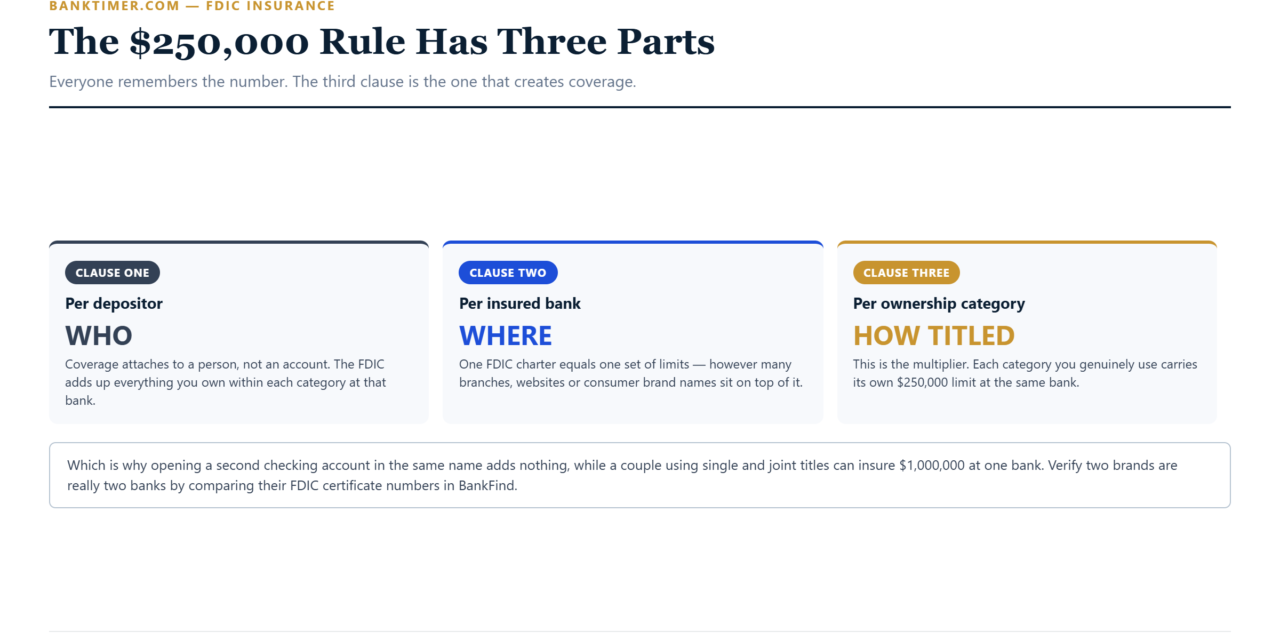
FDIC insurance limits are usually described in six words: $250,000 per depositor, per insured bank. That summary is accurate and badly incomplete, because it omits the third clause that does most of the work — per ownership category. Those three words are why a married couple with a joint account and two individual accounts at one bank can be fully covered on $1 million, and why someone with $400,000 spread across three accounts in the same name at the same bank is uninsured on $150,000 of it. This Banktimer guide explains how the limit is actually calculated, the ownership categories that multiply it, what deposit insurance never covers no matter how the account is titled, and the specific rules that catch people out when banks merge or fail.
The standard limit is $250,000 per depositor, per insured bank, for each account ownership category. All three clauses matter, and the third is the one that creates room for far more than $250,000 of coverage at a single institution.
Adding accounts in the same name does nothing. Three single-name accounts at one bank are added together and share one $250,000 limit. Changing the category — a joint account, a retirement account, a trust account — is what adds coverage.
Different branches of the same bank are one bank. Moving money between two branches, or between a bank and an online brand it owns under the same charter, does not create a second $250,000 limit — and this is one of the most common and most expensive misunderstandings in the whole subject.
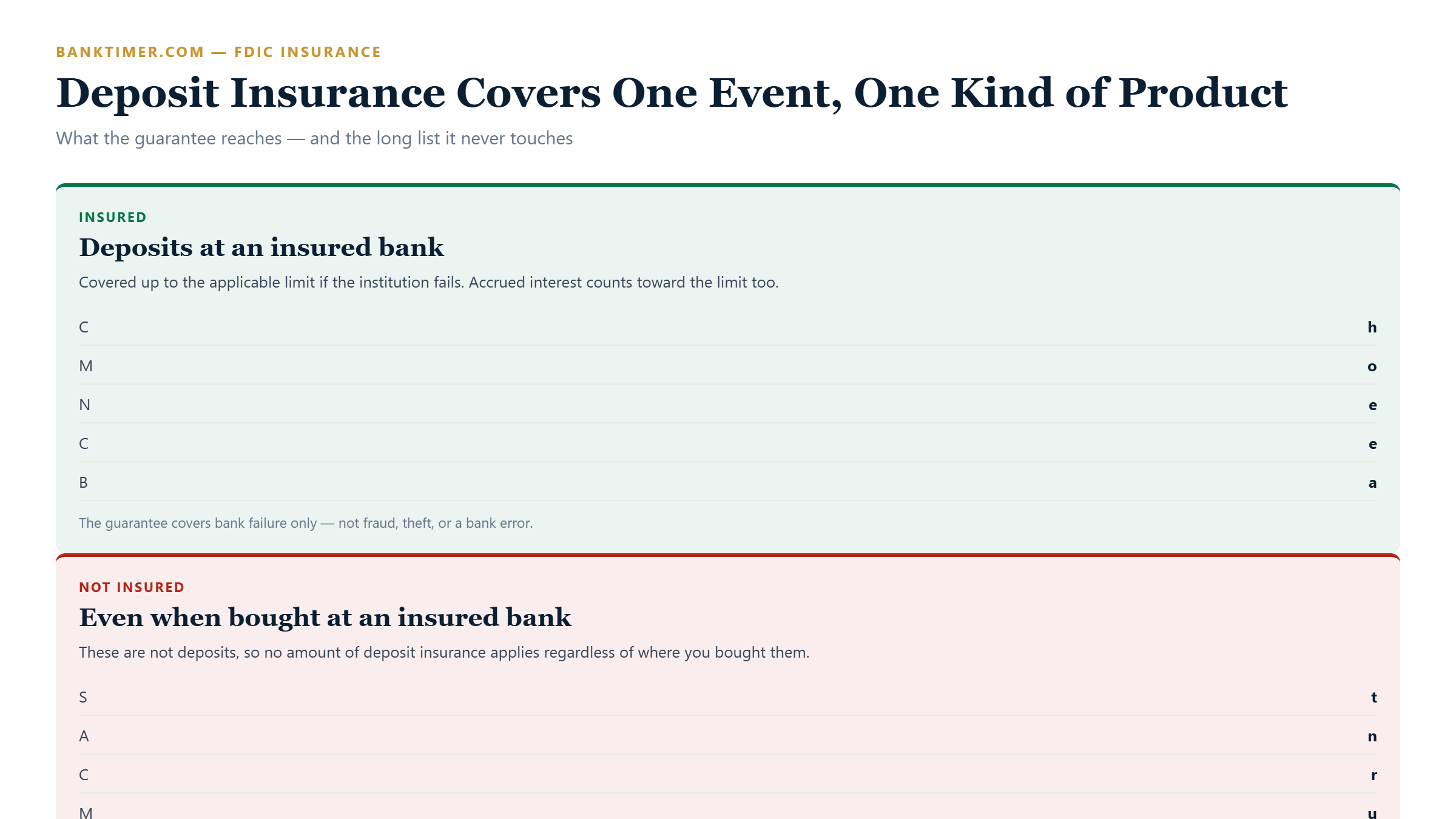
Deposit insurance covers bank failure. It does not cover investment losses, fraud, theft, or a bank error. Stocks, bonds, mutual funds, annuities, crypto assets, and the contents of a safe deposit box are not insured at all, whatever else the bank told you about being FDIC-insured.
Since April 1, 2024, trust accounts follow one simplified rule: $250,000 per unique beneficiary, capped at $1,250,000 per owner per bank. That cap is new relative to the old open-ended calculation, and anyone who structured payable-on-death accounts around six or more beneficiaries before it took effect should recheck their coverage.
If your two banks merge, your separate coverage does not end immediately — but it does end. Deposits from the acquired bank stay separately insured for at least six months, with a longer grace period for certificates of deposit. After that, you’re at one bank with one set of limits.
Key Numbers to Know
| Figure | Value | Why it matters |
|---|---|---|
| Standard maximum deposit insurance amount | $250,000 | Applies per depositor, per insured bank, per ownership category — not per account |
| Joint account coverage | $250,000 per co-owner | A two-owner joint account can hold $500,000 fully insured |
| Certain retirement accounts, including IRAs | $250,000 per owner | Separate from your single-account limit, regardless of how many beneficiaries you name |
| Trust accounts, since April 1, 2024 | $250,000 per unique beneficiary, maximum $1,250,000 per owner | Coverage stops growing after five beneficiaries at the same bank |
| Corporation, partnership, or unincorporated association | $250,000 per entity | Separate from the owner’s personal accounts if the entity is genuinely separate |
| Employee benefit plan accounts | $250,000 per participant’s non-contingent interest | Coverage follows each participant, not the plan as a whole |
| Separate branches of one bank | Not separately insured | One charter equals one set of limits, however many buildings or brand names |
| Grace period after two insured banks merge | At least six months | Your window to restructure before two limits become one |
| Typical time to access insured funds after a failure | Usually within a few days | Often the next business day in practice, when another bank assumes the deposits |
| Coverage for stocks, bonds, mutual funds, annuities, crypto | $0 | Not deposits, so not insured — even when sold through an insured bank |
One row in that table is worth pausing on. The line about branches is where real money gets lost, because the intuition is so reasonable: two locations feel like two banks. They aren’t. And in an era where a single charter can operate several consumer brands, the only reliable way to know whether two accounts are at two banks is to check the FDIC certificate number rather than the name on the app.
What FDIC Insurance Actually Is
The Federal Deposit Insurance Corporation is an independent federal agency that insures deposits at participating banks and savings associations. If an insured bank fails, the FDIC makes insured depositors whole up to the coverage limit — not by asking Congress for money, but from an insurance fund the banks themselves pay into.
That structure matters for how you should think about the guarantee. Deposit insurance is not a promise that your bank will stay solvent, and it is not a promise that nothing bad can happen to your money. It is a specific, narrow guarantee against one specific event: the failure of the institution holding your deposit.
The One Event It Covers
When a bank fails, its primary regulator closes it and appoints the FDIC as receiver — Banktimer’s guide to who regulates banks explains how to identify your own institution’s regulator. From there, one of two things happens. Most commonly, another insured bank assumes the failed bank’s deposits, and customers find their accounts simply working at a new institution — often by the next business day. Less commonly, the FDIC pays depositors directly. The agency’s own guidance describes payments as usually beginning within a few days of closing.
Either way, the insured portion of your money is not at risk in a failure. That’s the entire promise, and it has held through every insured-bank failure since the agency’s creation. What it doesn’t cover is a much longer list.
The Many Events It Does Not Cover
Deposit insurance does nothing about investment losses, because investments aren’t deposits. It does nothing about fraud, theft, or an unauthorized transaction on your account — those are handled by a completely different set of rules, the error-resolution and liability provisions that govern electronic transfers, and Banktimer’s guide to debit card fraud recovery covers how that process actually works. It does nothing about a bank error, a disputed fee — an overdraft charge is a contractual matter, not an insurance one — or a payment that went to the wrong place.
It also doesn’t cover the products banks increasingly sell alongside deposits. A mutual fund, an annuity, a life insurance policy, a municipal bond, or a crypto asset purchased through a bank or a bank-affiliated brokerage is not a deposit and carries no deposit insurance, regardless of where you bought it or how the marketing was worded.
| Insured deposit products | Not insured, even at an insured bank |
|---|---|
| Checking accounts | Stocks and bonds |
| Savings accounts | Mutual funds, including money market mutual funds |
| Money market deposit accounts (MMDAs) | Annuities and life insurance policies |
| Negotiable order of withdrawal (NOW) accounts | Crypto assets |
| Certificates of deposit (CDs) | Municipal securities |
| Bank-issued cashier’s checks and money orders | The contents of a safe deposit box |
| Prepaid card balances held in an insured deposit account, when structured that way | U.S. Treasury securities — backed by the federal government directly, but not FDIC-insured |
The last row confuses people reasonably often. A Treasury bill is not FDIC-insured, and that’s fine — it carries the direct backing of the U.S. government, which is a stronger guarantee than deposit insurance, not a weaker one. “Not FDIC-insured” is a statement about the mechanism, not automatically a statement about risk.
Credit Unions Use a Different Fund
The FDIC does not insure credit unions. Federally insured credit unions are covered by the National Credit Union Share Insurance Fund, administered by the National Credit Union Administration, at the same standard limit of $250,000 per member, per credit union, per ownership category. The structure mirrors the FDIC closely enough that most of this guide’s logic transfers, but the agency name and the fund are different, and you verify a credit union’s coverage through the NCUA rather than the FDIC.
The Three Clauses That Decide Your Real Limit
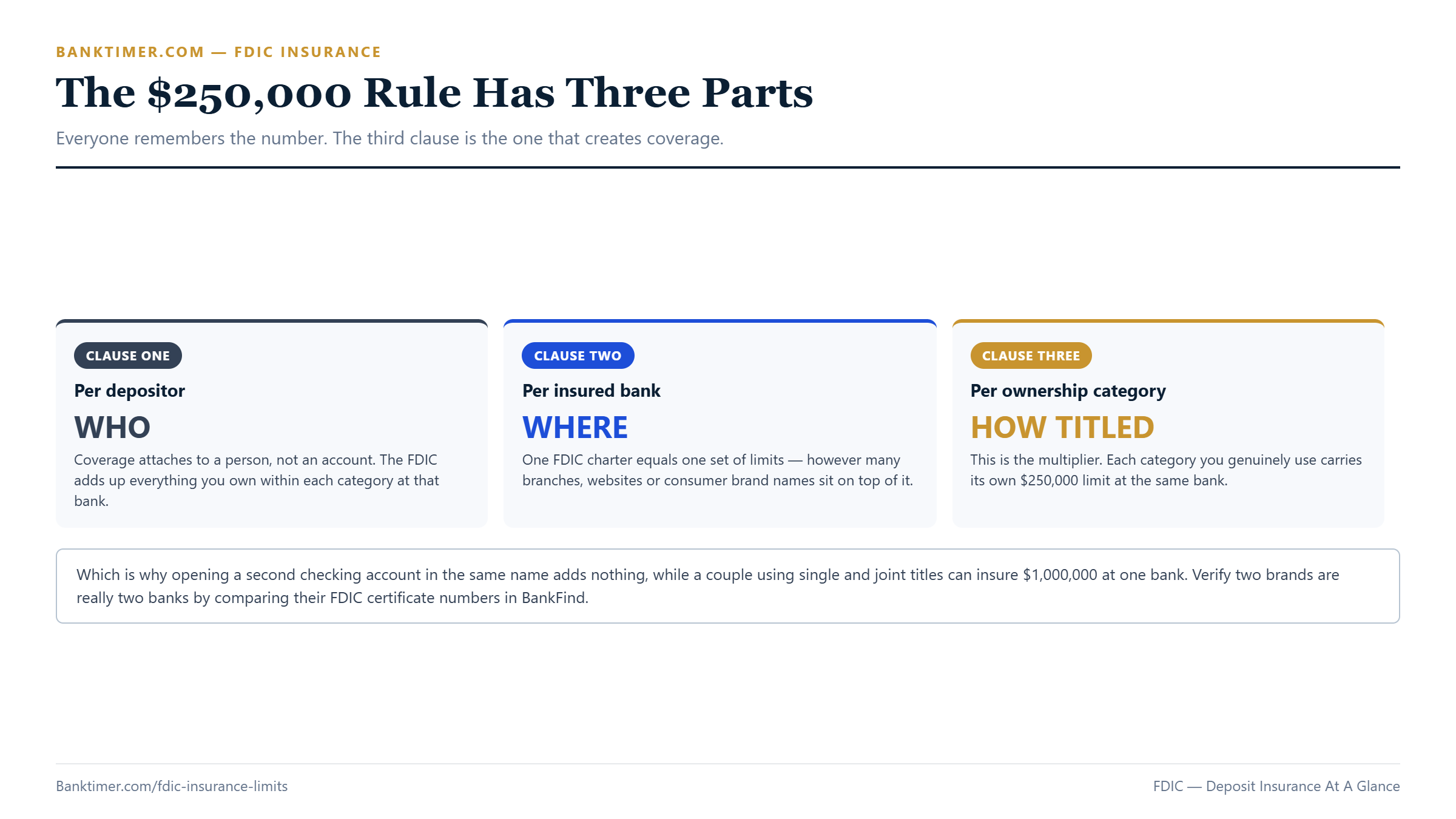
Every coverage question resolves into the same three-part test. Work through it in order and the answer falls out.
Clause One: Per Depositor
Coverage attaches to a person, not to an account. The FDIC identifies who owns the money and adds up everything that person owns within each category at that bank. This is why opening a second checking account changes nothing: the same depositor, the same bank, the same category.
Clause Two: Per Insured Bank
Coverage is calculated separately at each insured institution — and “institution” means a distinct FDIC-insured charter, not a distinct building, website, or brand. Two accounts at two genuinely separate banks give you two $250,000 limits in each category. Two accounts at two brands operating under one charter give you one.
You can verify this in about a minute using the FDIC’s BankFind tool, which shows each institution’s FDIC certificate number. Two brands sharing a certificate number share a limit. If you hold large balances across several online banking brands, this check is worth doing before you assume you’re diversified. Banktimer’s overview of the largest banks in North America is a useful starting point for seeing which brands sit under which parent.
Clause Three: Per Ownership Category
This is the clause that creates coverage. The FDIC recognizes several distinct categories of ownership, and your balances in each one get their own $250,000 limit at the same bank. A single person with money in three different categories at one bank has three separate limits.
The categories are not something you choose from a menu — they follow from how the account is actually titled and owned. You cannot get extra coverage by relabeling a personal account; you get it by genuinely changing the ownership structure, which has real legal consequences beyond insurance.
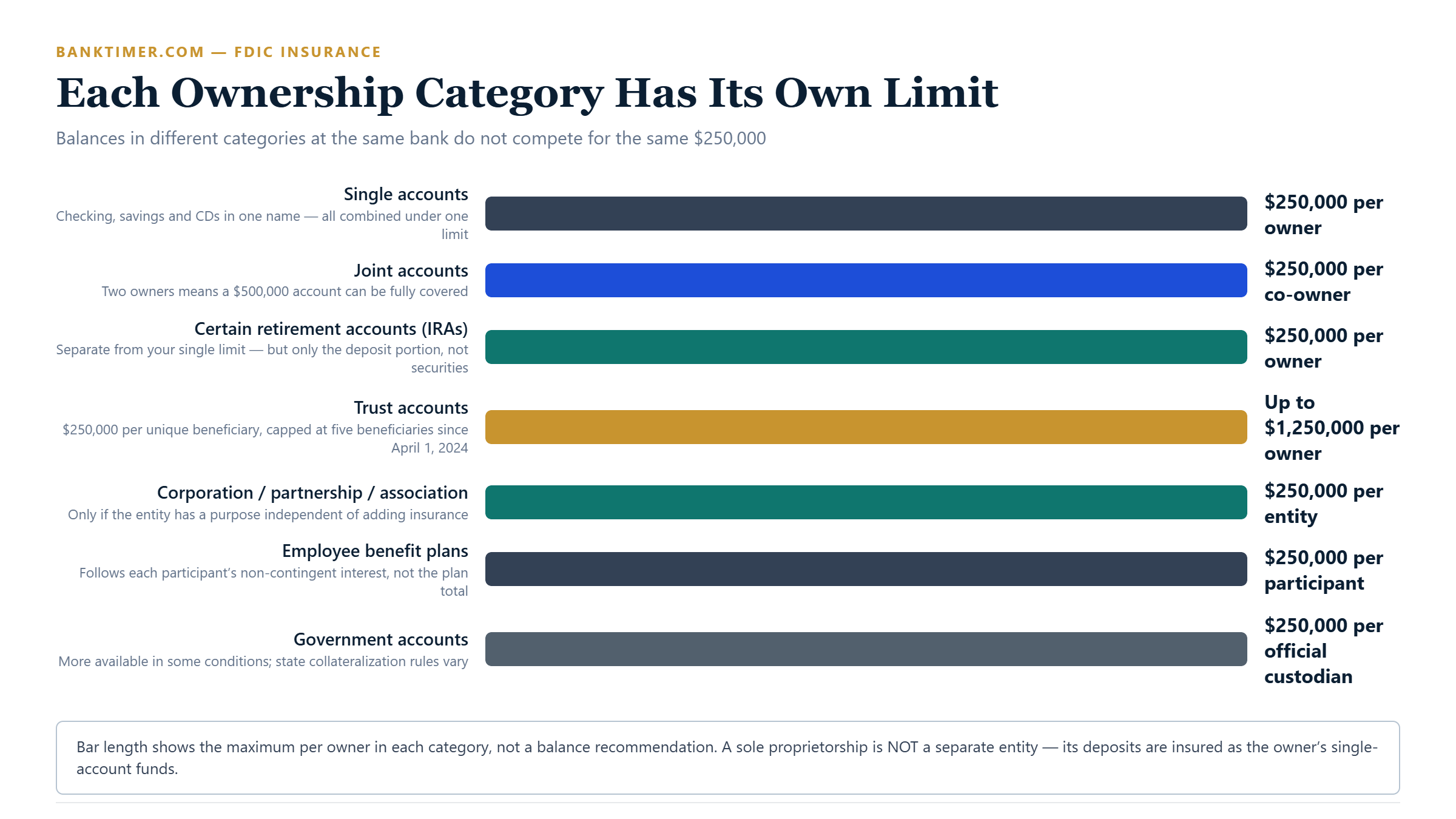
| Ownership category | Coverage limit | Typical examples | What to verify |
|---|---|---|---|
| Single accounts | $250,000 per owner | Checking, savings, and CDs in one name with no beneficiaries | That all single accounts at the bank are being added together |
| Joint accounts | $250,000 per co-owner | An account titled in two or more names with equal withdrawal rights | That each co-owner has equal rights and has signed the signature card |
| Certain retirement accounts | $250,000 per owner | Traditional and Roth IRAs, certain self-directed plans, held in deposits | That the IRA holds deposits, not securities — securities are not insured |
| Trust accounts | $250,000 per unique beneficiary, max $1,250,000 per owner | Payable-on-death, in-trust-for, and formal revocable and irrevocable trusts | The exact number of unique beneficiaries named at that bank |
| Corporation, partnership, unincorporated association | $250,000 per entity | A business operating account, a club or association account | That the entity exists for a purpose other than increasing insurance |
| Employee benefit plan accounts | $250,000 per participant’s non-contingent interest | Pension and profit-sharing plan deposits | How each participant’s interest is determined and documented |
| Government accounts | $250,000 per official custodian, with more available in some conditions | Deposits of a state, county, municipality, or school district | Whether collateralization applies in your state |
The row worth reading twice is the corporation line. An entity account is insured separately only when the entity is real and operates for an independent purpose. Creating a shell company to multiply coverage does not work, and the FDIC applies that test at the point of failure, when it’s too late to restructure.
How Joint Accounts Multiply Coverage
Joint accounts are the simplest way most households get above $250,000 at one bank, and the arithmetic is worth doing properly because the FDIC’s method is not “the account is covered to $500,000.” It’s per-owner.
The Calculation, Step by Step
The FDIC divides each joint account’s balance by the number of co-owners, then adds up each person’s share across every joint account at that bank. Each person’s total share is insured to $250,000. That means a two-owner joint account holding $500,000 is fully covered — $250,000 attributed to each owner — but a two-owner joint account holding $700,000 leaves $200,000 uninsured.
A Worked Example
Take an illustrative couple, Mary and John, with two joint accounts at one insured bank: a money market deposit account holding $230,000 and a savings account holding $250,000. The FDIC splits each account in half. Mary’s share is $115,000 plus $125,000, or $240,000. John’s share is identical. Both are under $250,000, so all $480,000 is fully insured.
Now add $60,000 to the savings account. Each person’s share rises to $270,000, which puts $20,000 per owner — $40,000 total — outside the limit. The account balance grew by $60,000 and the uninsured exposure grew by $40,000, because the split is proportional.
| Account | Balance | Mary’s share | John’s share |
|---|---|---|---|
| Joint money market deposit account | $230,000 | $115,000 | $115,000 |
| Joint savings account | $250,000 | $125,000 | $125,000 |
| Total joint-category share | $480,000 | $240,000 — fully insured | $240,000 — fully insured |
| Same couple, savings raised to $310,000 | $540,000 | $270,000 — $20,000 uninsured | $270,000 — $20,000 uninsured |
Illustrative example. Two conditions have to hold for the joint category to apply: every co-owner must be a living person, and each must have equal withdrawal rights and have signed the signature card. An account where one person’s name was added for convenience, without those rights, may not qualify — which is exactly the kind of detail that only surfaces at the worst moment. Banktimer’s guide to joint bank accounts covers the liability side of that decision.
Stacking Single and Joint Together
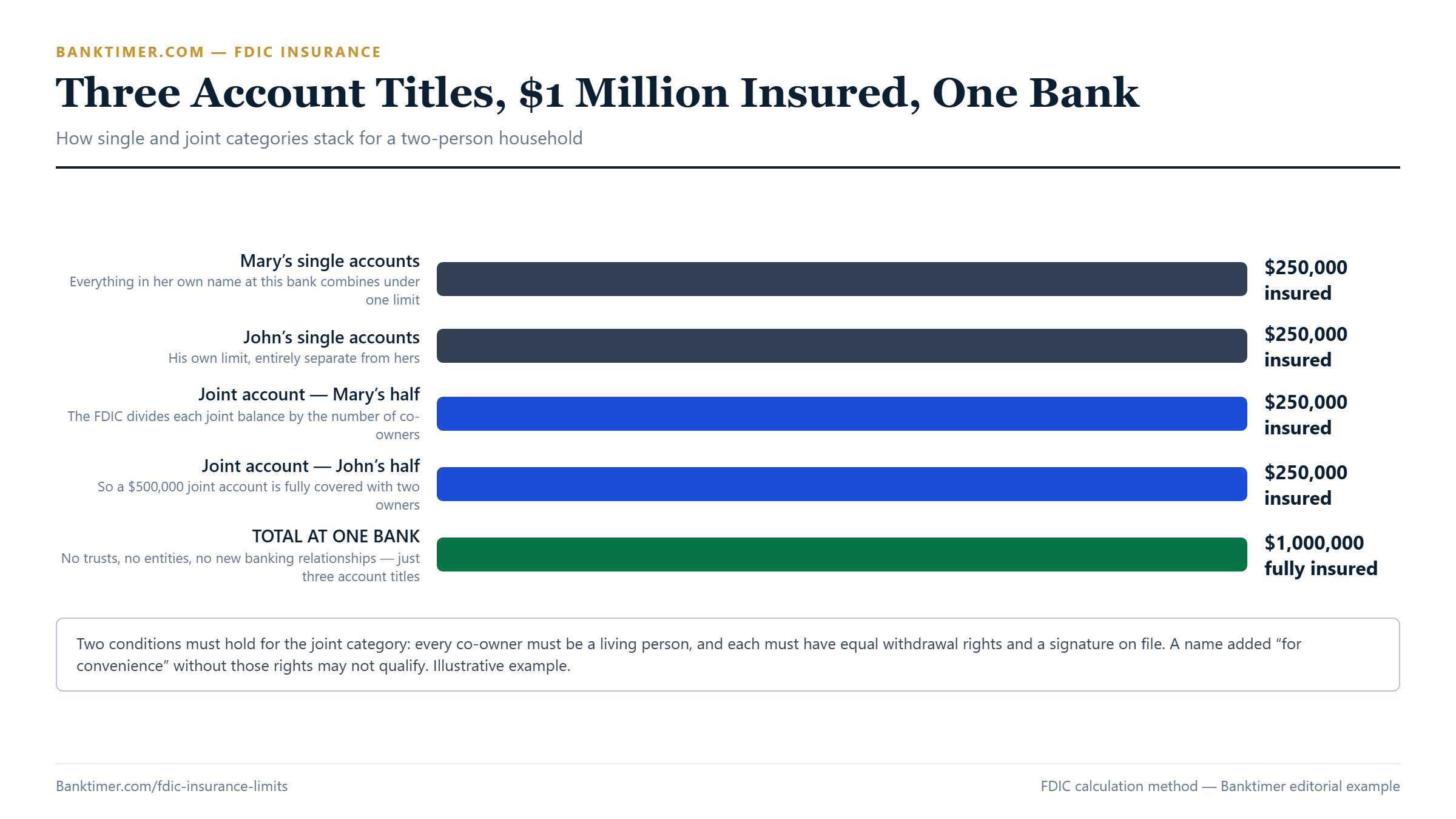
Because single and joint are different categories, they add. Mary alone can hold $250,000 in her own name, John alone can hold $250,000 in his, and together they can hold $500,000 jointly — $1 million fully insured at one bank, with no trusts, no entities, and no complexity beyond three account titles.
That figure is the practical answer to most household coverage questions, and it’s the reason the “spread money across many banks” advice is often unnecessary work. Before opening accounts at four institutions, check whether restructuring titles at one covers the balance.
The Trust Rule That Changed on April 1, 2024
Trust accounts used to be the most complicated corner of deposit insurance, with different rules for revocable and irrevocable trusts and an open-ended calculation that could produce very large coverage figures. The FDIC replaced all of it with one rule, effective April 1, 2024, and the simplification cuts both ways.
The New Formula
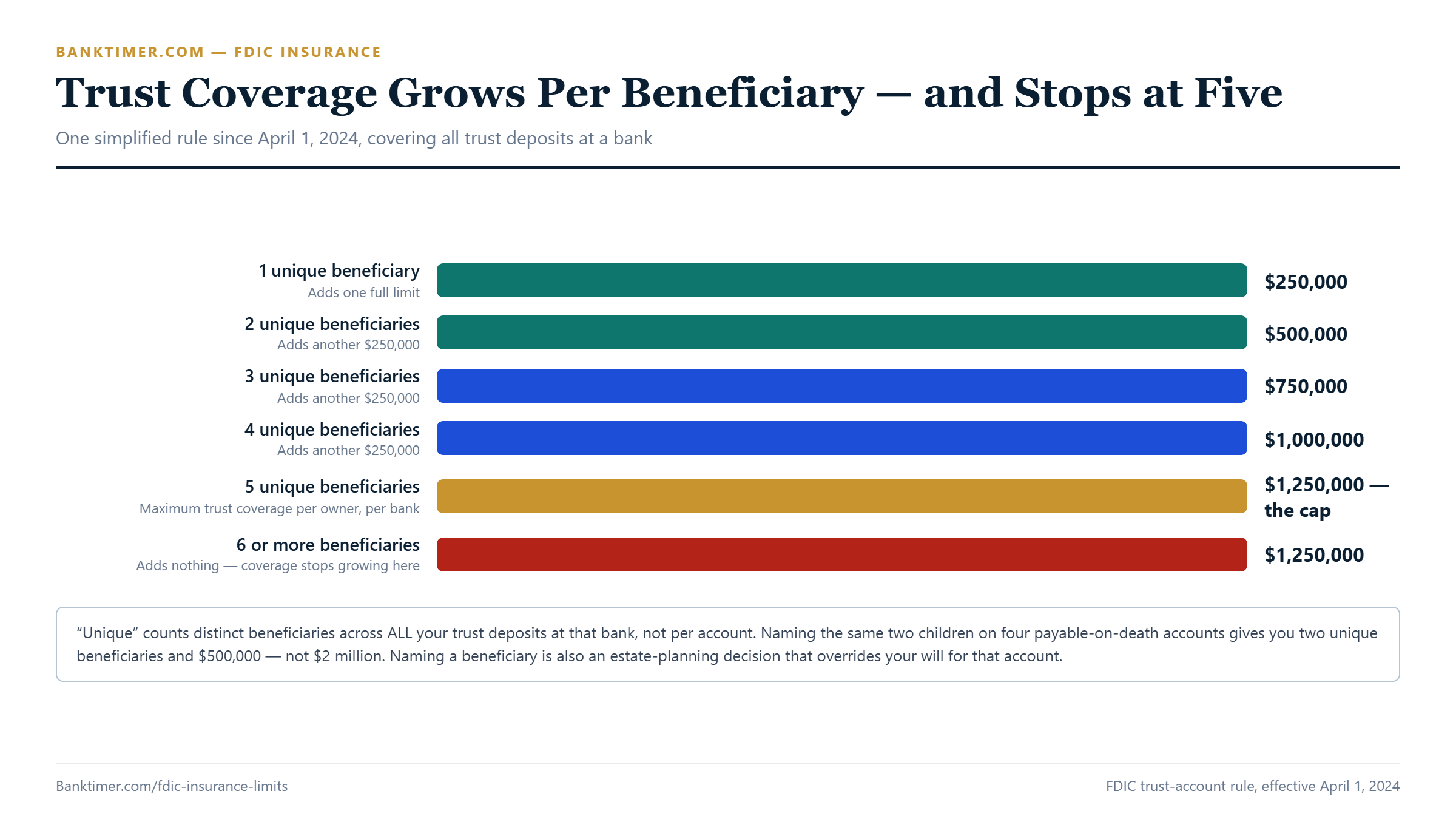
Coverage equals $250,000 multiplied by the number of unique beneficiaries, capped at $1,250,000 per owner, per insured bank. The same rule now applies to all trust deposits at that bank — formal revocable trusts, informal payable-on-death and in-trust-for accounts, and irrevocable trusts alike — and it applies to CDs regardless of maturity date.
The cap is the part that changed the answer for some people. Coverage stops increasing after five unique beneficiaries. Naming eight grandchildren on a payable-on-death account produces the same $1,250,000 as naming five.
| Unique beneficiaries named | Trust-category coverage, one owner | Marginal coverage added |
|---|---|---|
| 1 | $250,000 | — |
| 2 | $500,000 | $250,000 |
| 3 | $750,000 | $250,000 |
| 4 | $1,000,000 | $250,000 |
| 5 | $1,250,000 — the cap | $250,000 |
| 6 or more | $1,250,000 | $0 — coverage stops growing |
What “Unique” Means, and Why It Trips People Up
The count is of distinct beneficiaries across all your trust deposits at that bank, not per account. Naming the same two children on four separate payable-on-death accounts gives you two unique beneficiaries, not eight — so four accounts produce $500,000 of trust-category coverage, not $2 million.
The reverse error also happens: people assume adding a beneficiary to an existing account is purely an insurance move, when it is also an estate-planning decision that overrides what a will says about that account. Banktimer’s guide to beneficiary designation mistakes covers the consequences worth understanding before you name anyone for coverage reasons alone.
How to Cover More Than $250,000
If your balance exceeds a category limit, you have five practical routes. They differ in effort, in side effects, and in whether they create legal consequences beyond insurance.
Retitle Into Additional Categories
The cheapest fix, and usually the first one to try. Moving part of a balance from a single account into a joint account, or into an IRA held in deposits, creates a new $250,000 limit at the same bank with no new relationships to manage. The constraint is that the retitling has to be genuine — you’re changing who legally owns or can withdraw the money.
Open Accounts at Genuinely Separate Banks
Simple and reliable, with one verification step: confirm the two institutions have different FDIC certificate numbers. This is the route that fails silently when two online brands turn out to share a charter.
Use a Deposit Network or Sweep Program
Some banks and brokerages participate in programs that spread a large deposit across many insured institutions, keeping each slice under the limit while you deal with one provider. These can work well, but read the structure: the coverage depends on the money actually sitting in insured deposit accounts at the network banks, and the program’s disclosures should state that plainly.
Hold Treasury Securities Instead
For balances well above insurance limits held for safety rather than transactions, Treasury bills and notes carry the direct backing of the federal government with no per-account cap. They aren’t deposits, you can’t spend them from a debit card, and their market value moves before maturity — but as a place to park a large reserve, the credit question mostly disappears.
Accept the Uninsured Exposure Deliberately
Sometimes the honest answer. A business that needs $800,000 in one operating account for payroll may reasonably decide that restructuring is more operational risk than it’s worth. The distinction that matters is whether you chose the exposure or discovered it.
| Approach | Effort | Main side effect | Best fit |
|---|---|---|---|
| Retitle into another ownership category | Low — one visit or form | Changes legal ownership or withdrawal rights for real | Households moderately above the limit |
| Add a second, genuinely separate bank | Moderate — new onboarding | More logins, statements, and transfers to manage | Anyone whose categories are already used up |
| Deposit network or sweep program | Low once set up | Coverage depends on the program’s structure and disclosures | Large balances with one banking relationship |
| Treasury bills and notes | Moderate | Not spendable; market value moves before maturity | Reserves held for safety rather than daily use |
| Accept the exposure knowingly | None | Real loss risk if the institution fails | Operational balances where restructuring costs more than it saves |
| Create an entity purely to add coverage | High | Does not work — an entity must have an independent purpose | No one; the FDIC applies this test at failure |
If you’re deciding where the excess should live, the yield question matters too — a large reserve — see Banktimer’s guide to sizing an emergency fund — sitting in a low-rate account loses real value to inflation whether or not it’s insured. Banktimer’s guide to high-yield savings accounts and the explainer on certificate of deposit fees cover the trade-offs between access and rate.
What Happens When a Bank Actually Fails
Deposit insurance is a promise about a specific event, so it’s worth knowing what that event looks like from a customer’s side. The experience is usually far less dramatic than people expect.
The Typical Sequence
A bank’s primary regulator closes it, usually on a Friday, and appoints the FDIC as receiver. In most failures the FDIC has already arranged for another insured bank to assume the deposits, which means customers wake up Monday with the same balances at a new institution — same account numbers in many cases, with new checks and cards following later. Where no acquirer is found, the FDIC pays insured depositors directly, and its guidance describes those payments as usually beginning within a few days of closing.
Your Uninsured Balance Is Not Automatically Gone
Amounts above the insurance limit become claims against the receivership. Uninsured depositors typically receive a receivership certificate and are paid from the proceeds as the failed bank’s assets are sold, which can produce a partial recovery over months or years. That’s meaningfully better than a total loss — and meaningfully worse than insured funds, which arrive in days with no uncertainty.
Loans Don’t Disappear
If you had a mortgage or auto loan at the failed bank, you still owe it. The loan becomes an asset of the receivership and is typically sold to another institution, which will tell you where to send payments. Keep paying on schedule during the transition and keep proof of every payment, because servicing transfers are a common source of misapplied payments.
| Stage | Typical timing | Who controls it | What you should do |
|---|---|---|---|
| Bank is closed by its regulator | Often a Friday afternoon | The chartering regulator | Nothing yet; don’t initiate large transfers into the account |
| FDIC appointed receiver | Same day | FDIC | Read the FDIC’s notice for your specific institution |
| Deposits assumed by another bank, or paid directly | Often the next business day; payments usually begin within a few days | FDIC and the acquiring bank | Confirm direct deposits and automatic payments still route correctly |
| Insured funds fully available | Days | FDIC | Verify the balance matches your records before the transition |
| Uninsured balance claim | Months to years, partial recovery | The receivership | Keep the receivership certificate and all statements |
| Your loans transferred | Weeks to months | The receivership and the buyer | Keep paying on schedule; document every payment during the handover |
The Merger Rule Almost Nobody Plans For
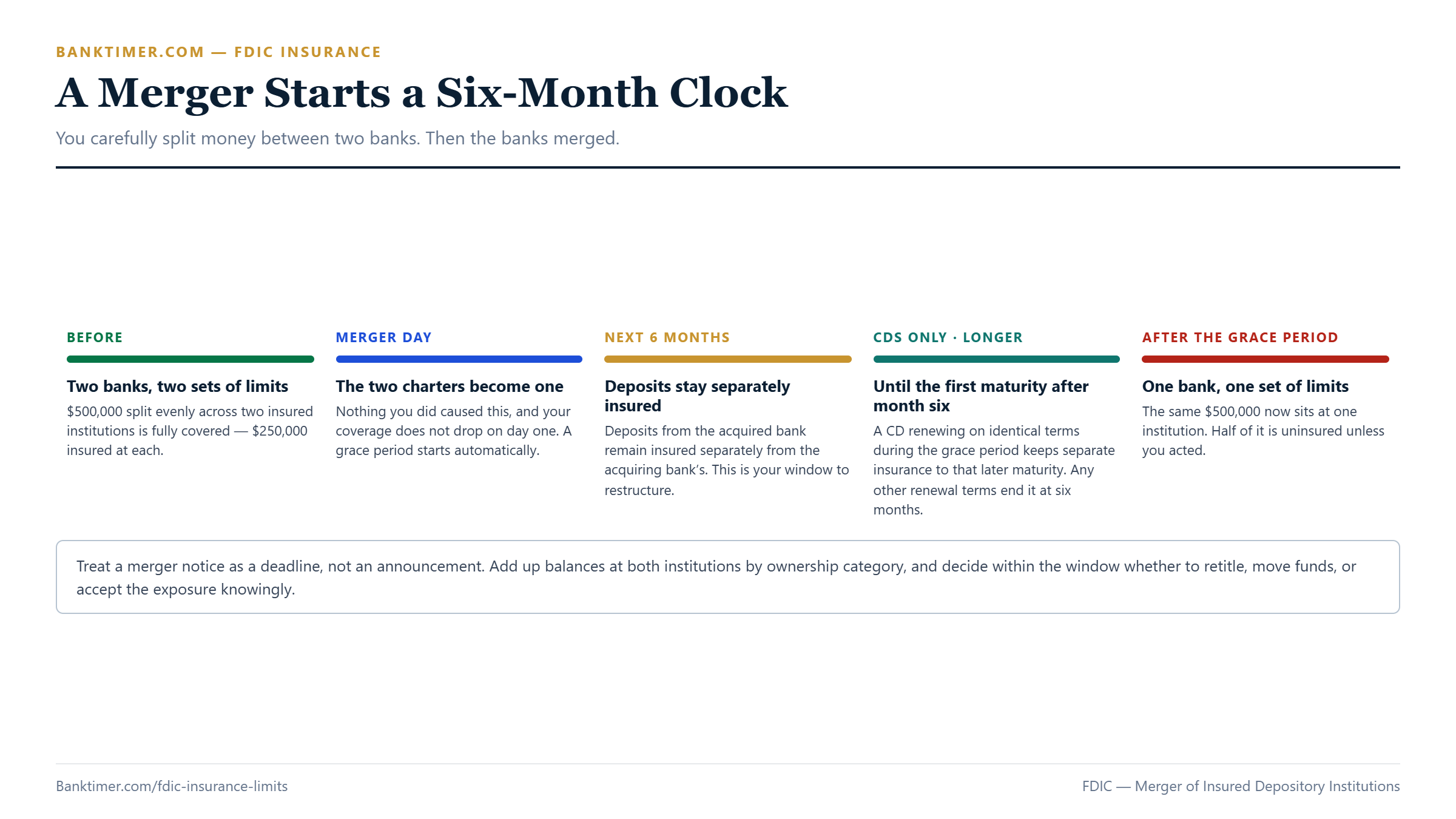
Here’s a failure mode that has nothing to do with a bank failing. Someone carefully splits $500,000 between two banks to stay under the limit at each. Then the two banks merge. Suddenly the same person holds $500,000 at one institution, with $250,000 of it uninsured — and nothing they did caused it.
The FDIC builds in a grace period for exactly this. Deposits from the acquired institution remain separately insured from the acquiring bank’s deposits for at least six months after the merger, giving you time to restructure. Certificates of deposit get a longer window: a CD from the acquired bank stays separately insured until the first maturity date after the six-month period ends. If it matures during the grace period and renews on identical terms, the separate insurance continues to that later maturity; renew on any other terms and the separate protection ends with the six months.
What to Do When You Get a Merger Notice
Treat the notice as a deadline, not an announcement. Add up your balances at both institutions by ownership category, work out whether the combined total exceeds any category limit, and if it does, decide now whether you’ll retitle, move funds, or accept the exposure. Six months is generous, and it passes quietly.
How to Check Your Own Coverage in Ten Minutes
Two free official tools answer nearly every question in this guide for your specific situation, and neither requires talking to anyone.
Confirm the Bank Is Insured, and Which Bank It Is
The FDIC’s BankFind tool shows whether an institution is insured and gives its FDIC certificate number. Use it for every bank and every online banking brand where you hold a meaningful balance. Two brands with the same certificate number are one bank for coverage purposes — that’s the check that catches the most expensive mistake in this subject.
Calculate Your Coverage With EDIE
The FDIC’s Electronic Deposit Insurance Estimator, known as EDIE, lets you enter your actual accounts and balances at a single bank and returns your insured and uninsured amounts by category. It’s the authoritative answer, it takes a few minutes, and it removes the guesswork from the ownership-category arithmetic.
Ask the Bank in Writing
If your structure is unusual — a trust with several beneficiaries, an entity account, an employee benefit plan — ask the bank to confirm in writing how the account is titled for insurance purposes and how many beneficiaries it has recorded. Records are what the FDIC uses at failure, so a discrepancy between what you believe and what the bank recorded is worth finding now.
Common Mistakes and Misconceptions
The most common mistake is adding accounts rather than categories. Opening a second and third checking account in the same name at the same bank adds no coverage at all, because the FDIC combines them under one $250,000 single-account limit.
A second is treating branches or brands as separate banks. One charter is one bank no matter how many locations, websites, or consumer brand names sit on top of it. A third is assuming the limit is per account rather than per depositor per category — a $400,000 CD in one name is insured to $250,000, not in full.
A fourth is believing deposit insurance covers fraud, theft, or a bank error. It covers institutional failure only; unauthorized transactions run through an entirely separate set of consumer protections. A fifth is assuming investments bought at an insured bank are insured — a mutual fund or annuity sold in a bank lobby carries no deposit insurance.
A sixth is over-naming beneficiaries after the 2024 rule change, on the belief that more beneficiaries always means more coverage. Past five, it doesn’t. A seventh is ignoring a merger notice, which quietly converts two limits into one after six months. An eighth is forgetting that accrued interest counts toward the limit — a CD sitting at exactly $250,000 will exceed the limit as interest posts, leaving a small uninsured sliver that grows each period.
Red Flags Worth Slowing Down For
| Red flag | Why it matters | What to ask or check |
|---|---|---|
| A product marketed as “FDIC-insured” that pays a market-linked return | Deposits don’t carry market risk; if the return varies with an index, look closely at the structure | Is the principal held in an insured deposit, and which institution holds it? |
| A fintech app describing itself as FDIC-insured | Apps are not banks; coverage depends on funds actually sitting in an insured partner bank | Which insured bank holds the deposit, and is the account titled in my name there? |
| Two online brands you believe are separate banks | Shared charters are common and silently halve your assumed coverage | Look up both FDIC certificate numbers in BankFind |
| Advice to form an LLC purely to add coverage | An entity must have a purpose independent of increasing insurance | Does this entity operate a real business or activity? |
| A merger notice filed away unread | Separate coverage ends after roughly six months | Recalculate combined balances by category and set a calendar reminder |
| A CD left to sit at exactly the limit | Accrued interest counts toward coverage and pushes you over | Fund CDs modestly below the limit so interest has room |
| Someone offering to “insure” a deposit for a fee | FDIC coverage is automatic and free at insured banks | Treat any charge for deposit insurance itself as a scam signal |
Questions to Ask Before You Assume You’re Covered
- ☐ Is every institution holding my money FDIC-insured, or NCUA-insured if it’s a credit union?
- ☐ Do any two of my banking brands share the same FDIC certificate number?
- ☐ What is my total balance at each bank, broken down by ownership category rather than by account?
- ☐ Does every co-owner on my joint accounts have equal withdrawal rights and a signature on file?
- ☐ How many unique beneficiaries has each bank recorded across all my trust and payable-on-death accounts?
- ☐ Are any of my IRA deposits actually invested in securities, which carry no deposit insurance?
- ☐ Will accrued interest push any CD or savings balance above a category limit before maturity?
- ☐ If I use a fintech app, which insured bank holds the funds and how is the account titled there?
- ☐ Have I run my actual numbers through the FDIC’s EDIE calculator rather than estimating?
Where the Money Actually Sits: Apps, Sweeps, and Pass-Through Coverage
A growing share of Americans hold balances through something that isn’t a bank. Payment apps, neobanks, brokerage cash accounts, and payroll cards all display a balance, and many of them display the FDIC logo. Whether that logo means anything for your money depends on a structure the app rarely explains clearly.
How Pass-Through Coverage Works
When a non-bank holds customer funds at an insured bank, coverage can “pass through” to the individual customer — but only if specific conditions are met. The funds have to actually be deposited at an insured institution, the account records have to identify the individual owners and their interests, and the relationship has to be disclosed as a custodial or agency arrangement. When those conditions hold, each customer is insured up to $250,000 as though they held the deposit directly.
When they don’t hold, the picture changes. Funds sitting on a non-bank’s own balance sheet, or pooled in a way that doesn’t identify individual owners, may not be insured at all — and the customer generally has no way to tell from the app interface which situation applies.
The Two Questions That Settle It
Ask the provider, in writing, two things. First: which insured bank or banks hold my funds, and can you give me the FDIC certificate number? Second: are the account records maintained so the FDIC can identify me as the owner of my specific balance? A provider that answers both clearly is describing a genuine pass-through arrangement. A provider that answers neither is describing marketing.
There’s a second-order issue worth knowing. If a provider spreads your balance across partner banks and you also hold accounts at one of those same banks directly, the balances combine for coverage purposes. Someone with $200,000 at a bank and an app balance swept into the same bank can be uninsured without either relationship exceeding the limit on its own.
Brokerage Cash Is Its Own Category of Confusion
A brokerage account may hold idle cash in an insured bank deposit sweep, in a money market mutual fund, or in a free-credit balance covered by a different protection scheme entirely. These have genuinely different protections, and the default setting varies by firm. If a meaningful cash balance sits in a brokerage account, find out which of the three it is rather than assuming deposit insurance applies.
Three Households, Worked Through
Coverage questions get much easier with the arithmetic done. The three illustrative cases below use the same rules in different structures, and each one shows a different lever.
A Single Person With $400,000 at One Bank
Held entirely in checking and savings in her own name, only $250,000 is insured. Splitting it across three accounts in the same name changes nothing, because they combine under one single-account limit. Two fixes work: move $150,000 to a genuinely separate bank, or add a payable-on-death beneficiary to a portion, which shifts that slice into the trust category with its own $250,000 limit. The second option is free and takes one form — but it also determines who inherits that account, which is a decision worth making on its merits rather than for coverage alone.
A Couple With $900,000 at One Bank
Structured as a $600,000 joint account plus $150,000 in each individual name, everything is covered: each spouse’s joint share is $300,000 — $50,000 over the per-owner limit — while their individual accounts are comfortably inside their own limits. Moving $100,000 out of the joint account and $50,000 into each individual account brings every category under the cap and insures the full $900,000 at one institution, with no new relationships and no trust paperwork.
A Retiree With $1.6 Million Across Two Banks That Just Merged
Previously $800,000 at each, comfortably covered by a mix of single, joint, and payable-on-death accounts at two institutions. After the merger, the categories combine and roughly half the balance falls outside the limits — but not for six months. Within that window, the practical options are to move a tranche to a third bank, expand into the trust category up to the $1,250,000 cap, or shift the excess into Treasury securities. Doing nothing is also a choice, and it’s the one the grace period is designed to prevent.
| Household | Structure | Uninsured before | Cheapest fix |
|---|---|---|---|
| Single person, $400,000, one bank | All in her own name across three accounts | $150,000 | Add a POD beneficiary to part of it, or move $150,000 to a separate bank |
| Couple, $900,000, one bank | $600,000 joint plus $150,000 each individually | $100,000 — $50,000 per co-owner | Shift $50,000 from joint into each individual account |
| Retiree, $1.6 million, two banks that merged | Mixed single, joint and POD at both institutions | Roughly half, once the grace period ends | Move a tranche to a third bank within six months, or expand trust coverage |
| Small business, $500,000 operating account | One corporate account for payroll | $250,000 | A second operating bank, or a deposit network program |
Illustrative examples using the published limits. Each one makes the same point from a different angle: the first question is never “how many banks do I need?” It’s “which ownership categories am I already entitled to and not using?”
Business, Entity, and Trustee Accounts
Coverage for anything other than a personal account turns on documentation rather than intent, and the FDIC applies its tests using the bank’s records at the moment of failure — not what anyone meant to arrange.
The Independent Purpose Requirement
A corporation, partnership, or unincorporated association gets its own $250,000 limit, separate from its owners’ personal accounts, provided the entity is engaged in an independent activity. An operating business, a homeowners association, a church, or a social club all qualify. The fee structure on business accounts differs from personal ones too, which is worth comparing at the same time. An entity formed solely to create an additional insurance bucket does not, and the deposit collapses back into the owner’s personal coverage.
Sole Proprietorships Are Not Separate
A sole proprietorship’s deposits are insured as the owner’s single-account funds, because legally there is no separate entity. A freelancer with $200,000 in a business account and $150,000 in personal savings at the same bank holds $350,000 in one category, with $100,000 uninsured — a structure that feels separate and isn’t.
Fiduciary and Trustee Accounts Need Identifiable Interests
When someone holds funds for others — an attorney’s client trust account, a property manager’s tenant deposits, a benefit plan’s participant balances — pass-through coverage to each underlying beneficiary requires that the account be titled to show the fiduciary relationship and that records identify each person’s interest. Where those records are incomplete, the FDIC may treat the whole balance as the fiduciary’s single account, insured once. Anyone holding money for others should confirm in writing that the bank’s records satisfy the requirement.
What Happens to Coverage After a Death, Divorce, or Move
Ownership categories follow legal ownership, so any event that changes who owns an account changes the coverage arithmetic — usually without anyone at the bank pointing it out.
After a Co-Owner Dies
A joint account with two owners is insured to $500,000 while both are living. When one dies, the account typically becomes a single account of the survivor, and the coverage falls to $250,000. The FDIC applies a six-month grace period following the death of an owner, treating the account as though the deceased owner were still living for insurance purposes, so the survivor has time to restructure. That window is easy to lose in the middle of settling an estate, which is exactly when a large balance is most likely to be sitting in one place.
After a Divorce or a Removed Name
Taking a name off a joint account converts it to a single account at that moment, halving the category coverage. If the balance was relying on two co-owners to stay insured, the excess becomes uninsured as soon as the retitling posts. Check this before the paperwork, not after.
After Consolidating Accounts
Simplification usually reduces coverage. Closing a second bank relationship, combining two CDs into one, or removing beneficiaries to tidy up an estate plan each shrink the number of limits available. None of those are wrong decisions — they just deserve a coverage check alongside the convenience gain.
After Moving Between States
Federal deposit insurance does not vary by state, so a move changes nothing about your limits. What can change is which institutions are available to you and whether a regional bank you relied on operates where you now live. Government-account collateralization requirements do vary by state, which matters for public funds but not for personal accounts.
Why the Limit Is $250,000
The figure isn’t arbitrary, and knowing where it came from helps calibrate how much to expect it to move.
Federal deposit insurance began in 1933 with a limit of $2,500, created in response to the bank runs of the early 1930s. The limit rose in steps over the following decades as prices and account sizes grew. It reached $100,000 in 1980 and stayed there for nearly three decades.
During the 2008 financial crisis the limit was raised to $250,000 on a temporary basis, and the Dodd-Frank Act made that increase permanent in 2010 and applied it retroactively to failures after the start of 2008. The law also provides for periodic consideration of inflation adjustments, which means the figure is not frozen forever — but it has now been stable long enough that planning around $250,000 is reasonable, while assuming it will never change is not.
The practical takeaway is modest: don’t build a structure that only works if the limit rises, and do recheck the current figure if you’re reading this years after publication. The FDIC publishes the standard maximum deposit insurance amount directly, and it is the only figure that governs.
What Deposit Insurance Has and Hasn’t Delivered
No insured depositor has lost insured funds in a bank failure since the FDIC began operating — a record worth stating plainly because it explains why the system commands as much trust as it does. Bank failures still happen, including large ones, and they remain disruptive for uninsured depositors, borrowers mid-transaction, and anyone whose payments route through the institution. The guarantee is narrow and it has held; treating it as broader than it is remains the main way people get hurt.
Who This Guide Suits
This guide is most useful to anyone whose balance at a single bank is approaching or past $250,000, anyone who has received a merger notice, and anyone who structured payable-on-death accounts before April 1, 2024 and hasn’t rechecked the math since. It’s equally relevant if you use several online banking brands and want to confirm they’re actually separate institutions.
Someone well under the limit will get the most value from the section on what deposit insurance doesn’t cover, since the practical risk at that balance level isn’t bank failure — it’s assuming insurance protects against fraud or investment losses when it doesn’t. A business owner or trustee will get the most from the ownership-category table and the entity-account caveat, since those are the structures where small titling details change the answer by hundreds of thousands of dollars. Readers building a broader plan around this will find the context in Banktimer’s personal finance basics guide. Banktimer’s banking basics guide covers the broader account-selection decisions this sits inside.
Frequently Asked Questions
What is the FDIC insurance limit?
$250,000 per depositor, per insured bank, for each account ownership category. The third clause is what allows the same person to be insured for more than $250,000 at one bank.
Can I get more than $250,000 insured at one bank?
Yes. Balances in different ownership categories each carry their own $250,000 limit. A married couple using single and joint accounts can cover $1 million at one bank, and adding trust accounts can push that higher still.
Are two accounts at the same bank each insured for $250,000?
No, if they’re in the same ownership category. The FDIC adds all single accounts together under one limit, all joint accounts together under a per-owner limit, and so on. More accounts in the same category add no coverage.
Are different branches of the same bank separately insured?
No. Funds in separate branches of the same insured bank are not separately insured. The same is true of separate consumer brands operating under a single FDIC charter.
Is a joint account insured for $500,000?
Effectively yes with two owners, because each co-owner’s share is insured to $250,000. The FDIC divides the balance by the number of co-owners and applies the limit per person, so a two-owner joint account holding $500,000 is fully covered.
How many beneficiaries do I need for maximum trust coverage?
Five. Since April 1, 2024, trust coverage equals $250,000 per unique beneficiary up to a maximum of $1,250,000 per owner, per bank, so naming more than five adds nothing at that institution.
Does FDIC insurance cover fraud or a stolen debit card?
No. Deposit insurance covers bank failure. Unauthorized transactions are handled under separate consumer-protection rules, with their own reporting deadlines and liability limits that depend on how quickly you report.
Are money market funds FDIC-insured?
Money market deposit accounts at a bank are insured. Money market mutual funds are securities and are not insured, even when purchased through an insured bank. The two products have similar names and different protections.
Is my IRA covered separately from my checking account?
Yes, if the IRA holds deposits. Certain retirement accounts are their own ownership category with a $250,000 limit separate from your single-account limit — but the coverage applies only to the deposit portion, not to any securities held inside the IRA.
How long does it take to get my money if my bank fails?
Payments to insured depositors usually begin within a few days of closing, and in most failures another bank assumes the deposits, so accounts often keep working by the next business day.
What happens to the money above the limit?
It becomes a claim against the receivership. You typically receive a receivership certificate and may recover part of it as the failed bank’s assets are sold — a process measured in months or years, with no guaranteed amount.
What happens if my two banks merge?
Deposits from the acquired bank stay separately insured for at least six months, and CDs stay separately insured until the first maturity after that period. After the grace period you hold one set of limits, so use the six months to restructure if the combined balance exceeds them.
Are credit unions FDIC-insured?
No. Federally insured credit unions are covered by the National Credit Union Share Insurance Fund through the NCUA, at the same $250,000 standard limit per member, per credit union, per ownership category.
Do I need to apply for FDIC insurance?
No. Coverage is automatic at an insured institution and costs the depositor nothing. Anyone charging a fee to “insure” your deposit is not offering FDIC coverage.
Is a fintech app’s balance FDIC-insured?
It depends entirely on the structure. Apps are not banks; coverage exists only if your funds are held in an insured deposit account at a partner bank, titled so the FDIC can identify you as the owner. Ask which bank holds the money and how the account is recorded, because the answer determines whether coverage applies at all.
Does accrued interest count toward the limit?
Yes. Interest posted to the account is part of the balance for insurance purposes, which is why funding a CD at exactly $250,000 leaves a growing uninsured sliver as interest accumulates. If you hold several maturities, Banktimer’s guide to CD ladder fees covers the other details worth checking.
How to Verify These Numbers Yourself
Every figure in this guide comes from the FDIC’s own published materials, and the agency maintains three resources worth using directly. Its deposit insurance brochures set out the ownership categories and limits; BankFind confirms whether an institution is insured and gives its certificate number; and EDIE, the Electronic Deposit Insurance Estimator, calculates your specific coverage from your actual account structure. For credit unions, the equivalent verification runs through the NCUA.
The standard $250,000 limit and the ownership categories are stable, long-standing rules rather than figures that move annually — but the trust rule changed on April 1, 2024, which is a useful reminder that even stable rules get revised. Before relying on an unusual structure, confirm the current treatment against the FDIC’s own page rather than against a summary, including this one.
Key Terminology
| Term | What it means |
|---|---|
| Standard maximum deposit insurance amount | The $250,000 figure applied per depositor, per insured bank, per ownership category |
| Ownership category | A legal classification of how an account is owned, each carrying its own limit |
| Insured depository institution | A bank or savings association whose deposits the FDIC insures, identified by a certificate number |
| FDIC certificate number | The unique identifier for one insured charter; shared numbers mean one bank for coverage |
| Receiver | The role the FDIC takes on to wind down a failed bank and pay its claims |
| Receivership certificate | The claim document an uninsured depositor receives for the amount above the limit |
| Payable on death (POD) / in trust for (ITF) | An informal trust account naming beneficiaries, insured under the trust category |
| Unique beneficiary | A distinct person or entity named across your trust deposits at one bank, counted once |
| EDIE | The FDIC’s Electronic Deposit Insurance Estimator, which calculates your actual coverage |
| BankFind | The FDIC tool that confirms insured status and shows certificate numbers |
| NCUSIF | The National Credit Union Share Insurance Fund, the credit union equivalent of FDIC coverage |
| Deposit network or sweep program | An arrangement spreading one large deposit across several insured banks to stay under limits |
The number everyone remembers is $250,000, but the words that decide your actual coverage are “per ownership category.” Adding accounts in the same name changes nothing; changing how an account is owned adds a fresh $250,000 limit at the same bank, which is why a couple using single and joint titles can insure $1 million at one institution without opening a single new relationship. Two checks are worth doing today: look up your banks’ FDIC certificate numbers to confirm they’re genuinely separate institutions, and run your real balances through the FDIC’s EDIE calculator rather than estimating. And remember what the guarantee is for — it covers the failure of the bank, not fraud, not a bank error, and not anything you bought in the lobby that wasn’t a deposit.
Sources
- Federal Deposit Insurance Corporation — Deposit Insurance At A Glance
- Federal Deposit Insurance Corporation — Your Insured Deposits
- Federal Deposit Insurance Corporation — Deposit Insurance FAQs
- FDIC — Electronic Deposit Insurance Estimator (EDIE)
- FDIC — BankFind Suite
- FDIC — Priority of Payments and Timing in a Bank Failure
- FDIC — Merger of Insured Depository Institutions
- National Credit Union Administration — Share Insurance Coverage
Methodology
Coverage limits, ownership categories, and procedural details in this guide reflect the Federal Deposit Insurance Corporation’s published consumer materials, accessed in September 2026. The standard maximum deposit insurance amount of $250,000 per depositor, per insured bank, per ownership category, and the category-specific limits described, are drawn from the FDIC’s Deposit Insurance At A Glance and Your Insured Deposits publications. The trust-account rule described — $250,000 per unique beneficiary up to a maximum of $1,250,000 per owner, applied uniformly to revocable and irrevocable trusts and to informal payable-on-death arrangements — took effect April 1, 2024. The six-month grace period following a merger of insured institutions, and the longer treatment of certificates of deposit, reflect FDIC guidance. Credit union coverage figures reflect National Credit Union Administration share insurance rules. The joint-account example follows the FDIC’s own calculation method with illustrative balances; all dollar figures in examples are Banktimer editorial illustrations, not quotes for any specific account. Coverage of a fintech or non-bank app depends entirely on that provider’s structure and disclosures and cannot be assumed from marketing language. This guide is educational and does not constitute financial, legal, or tax advice — confirm any unusual structure with the FDIC’s EDIE tool and with your own institution in writing.
Do two things this week. Look up every bank and banking brand where you hold a meaningful balance in the FDIC’s BankFind tool and write down the certificate numbers — any two that match are one bank for coverage purposes. Then run your actual accounts and balances through EDIE for each institution. If it reports an uninsured amount, your cheapest fix is almost always retitling into another ownership category rather than opening a relationship somewhere new.