
By the Banktimer Editorial Team · Published
Banktimer is an independent U.S. consumer-finance publication. Our editors draw on primary and official sources first, such as the CFPB, FDIC, Federal Reserve, and FTC, along with statutes, regulations, and providers’ own agreements and fee schedules. Then we add worked examples and decision tools. Our goal is the most useful, best-supported explanation the sources available to us at the time of writing allow.
This article is general information, not legal, tax, investment, insurance, or financial advice, and reading it does not create a professional relationship with Banktimer. Rates, fees, limits, and rules change, and they vary by state, provider, and contract, so confirm current terms with your bank, lender, insurer, or the agency named in the article before you act. Examples are illustrative unless labeled otherwise. Banktimer is not a bank, lender, insurer, or financial advisor, and we are not responsible for decisions or losses that result from relying on this content. For advice about your own situation, talk to a licensed professional.
Overdraft fees are one of the few bank charges that can cost more than the purchase that triggered them. Buy a $6 coffee with $3 left in checking, and the bank can cover the difference and charge you roughly $27 for the favor — an effective cost that dwarfs anything you’d pay on a credit card. This Banktimer guide explains what overdraft fees actually are, which transactions your bank is allowed to charge them on, why a federal cap on the fee no longer exists, and the specific steps that get one refunded. You’ll find realistic dollar examples, the difference between an overdraft fee and an NSF fee, the bank policies that change the math, and a straight answer on whether you should turn overdraft coverage on or off.
The average overdraft fee was $26.77 as of Bankrate’s checking-account survey published September 10, 2025, and there is currently no federal limit on how much a bank can charge. A proposed federal cap of $5 was nullified by Congress in 2025, so the number is set entirely by your bank’s fee schedule.
You had to opt in before your bank could charge an overdraft fee on an ATM withdrawal or a one-time debit card purchase — but that protection does not extend to checks, ACH payments, or recurring automatic debits. That gap is the single most misunderstood part of the whole system.
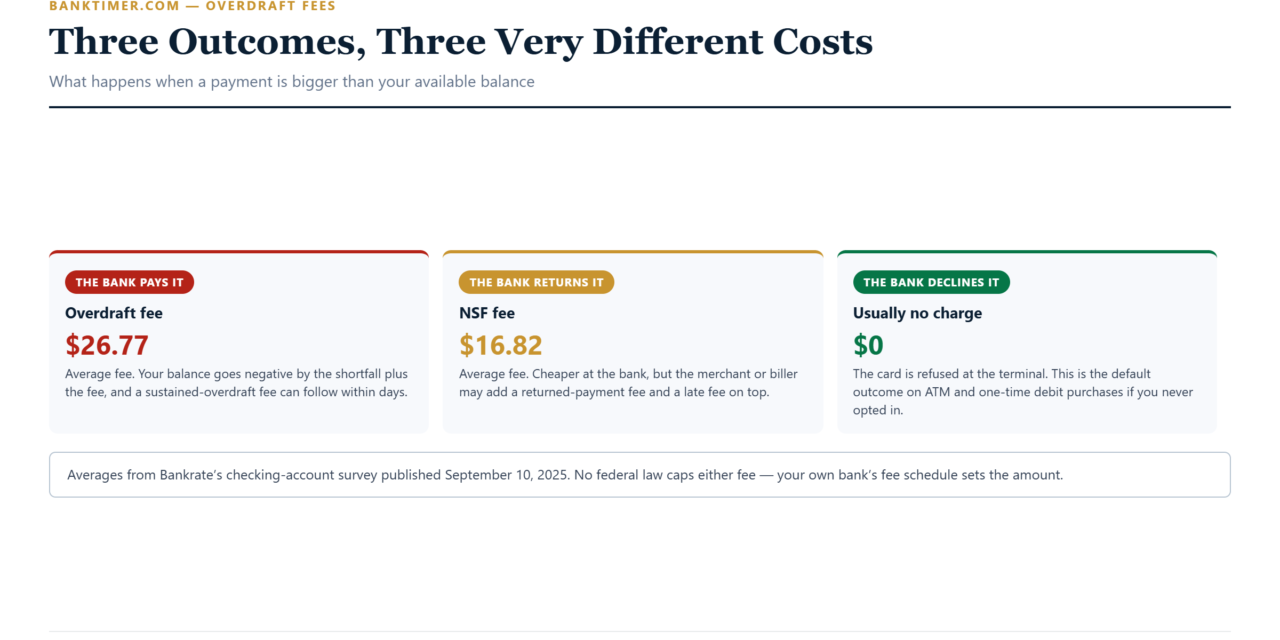
An overdraft fee and a non-sufficient funds (NSF) fee are charged for opposite outcomes. An overdraft fee means the bank paid the transaction and you now owe a negative balance plus the fee. An NSF fee means the bank refused the transaction and charged you anyway — and the merchant or biller may add a returned-payment fee of their own on top.
Nothing in federal law limits how many overdraft fees a bank can charge in a single day. Most large banks now cap themselves at three to six per day as a matter of internal policy, not law — and a self-imposed cap can be changed with notice.
Asking for a refund works more often than most people expect, particularly on a first occurrence. Banks routinely waive fees as a retention decision, and there is a specific way to ask that makes a yes more likely.
Households paid more than $12 billion in combined overdraft and NSF fees in 2025, according to the National Consumer Law Center — a reminder that this is a core revenue line for many institutions rather than an incidental charge, and a reason to read your own fee schedule rather than assume your bank matches the average.
Key Numbers to Know
| Figure | Value | Why it matters |
|---|---|---|
| Average overdraft fee | $26.77 | Bankrate survey published September 10, 2025 — your bank’s own schedule is what actually binds you |
| Average NSF (returned item) fee | $16.82 | Charged when the bank declines the payment instead of covering it |
| Federal cap on the fee amount | None | The 2024 rule that would have capped it at $5 for large institutions was nullified in 2025 |
| Federal cap on fees per day | None | Daily caps of 3 to 6 are bank policy, not law, and can be revised |
| Opt-in required before charging on ATM and one-time debit | Yes — since July 2010 | Regulation E requires your affirmative consent for those two transaction types only |
| Opt-in required for checks, ACH, recurring debits | No | Your bank can charge an overdraft fee on these whether or not you opted in |
| Combined overdraft and NSF fees paid by households, 2025 | More than $12 billion | National Consumer Law Center analysis — the scale of a charge many people assume is rare |
| Share of checking accounts in the survey charging an overdraft fee | 94% | Fee-free overdraft exists but remains the exception, not the norm |
| Typical sustained or extended overdraft fee | Varies; commonly charged after 5 to 7 days negative | A second fee layered on top of the first if you don’t bring the balance positive quickly |
Two things in that table deserve a second look. The absence of any federal cap means the phrase “standard overdraft fee” has no legal content at all — it describes industry habit, not a ceiling. And the split between transaction types in the opt-in rows explains most of the surprise fees people report: a customer who declined overdraft coverage at account opening can still be charged when an automatic insurance payment or a mailed check hits a thin balance.
What an Overdraft Fee Actually Is
An overdraft fee is a flat charge your bank applies when it pays a transaction your available balance could not cover, pushing the account negative. The bank is not extending you a courtesy in the ordinary sense — it is advancing its own money for a few days and charging a fixed price for that advance, regardless of whether the shortfall was $2 or $200.
That flat structure is what makes the cost so uneven. A $27 fee on a $150 shortfall repaid in three days is expensive. The same $27 fee on a $4 shortfall repaid in three days is, in annualized terms, a number that would be illegal for a licensed lender to charge. The fee doesn’t scale with the size of the advance, which is exactly why small transactions do the most damage per dollar.
Overdraft Fee vs. NSF Fee vs. a Simple Decline
Three different things can happen when a payment arrives and the money isn’t there, and each carries a different cost. Confusing them leads people to fight the wrong charge with the wrong argument.
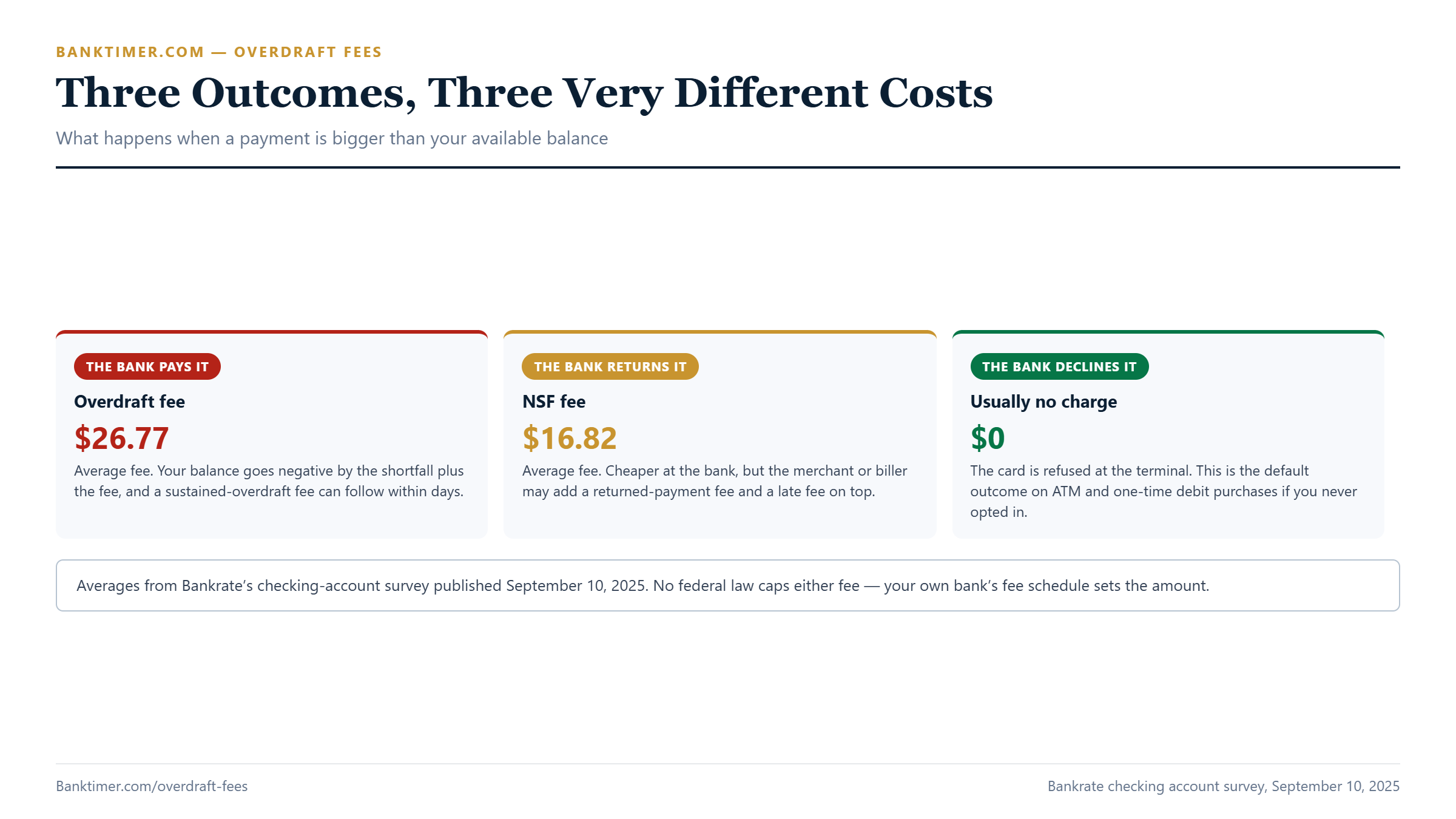
If the bank pays the transaction into a negative balance, that’s an overdraft, and the charge is an overdraft fee. If the bank returns the transaction unpaid, that’s a non-sufficient funds event, and the charge is an NSF fee — sometimes labeled a returned-item fee on your statement. If the bank simply declines a debit card swipe at the terminal, in most cases nothing is charged at all; the purchase just doesn’t go through.
The third outcome is the cheapest, and it’s the outcome you get by default on ATM withdrawals and one-time debit purchases if you never opted in. That is the practical value of the opt-in rule: it converts a potential $27 charge into a declined transaction and a mildly awkward moment at the register.
| Outcome | What the bank did | Typical charge | Second-order cost |
|---|---|---|---|
| Overdraft | Paid it, balance went negative | About $27 average | A sustained-overdraft fee if you stay negative for several days |
| Non-sufficient funds (NSF) | Returned it unpaid | About $17 average | A returned-payment fee from the merchant or biller, plus possible late fee |
| Declined at the terminal | Refused the authorization in real time | Usually nothing | None, beyond needing another payment method |
| Overdraft protection transfer | Moved money from your linked savings or credit line | $0 to about $12 per transfer, varies by bank | Interest on a linked credit line; savings drawn down |
| Represented item | The same payment was submitted again after being returned | Potentially a second fee on the same original transaction | This is a strong candidate for a refund request — ask specifically about representment |
The bottom row is the one worth memorizing. When a payment is returned for insufficient funds, the biller often resubmits it automatically a few days later. If your balance is still short, some banks charge again — a second fee on what the customer experiences as one failed payment. Regulators have scrutinized this practice heavily, and several large institutions changed their policies in response, but practices still vary by institution. If you see two fees traceable to one original payment, name the word “representment” when you call.
The Sustained Overdraft Fee Most People Miss
Many banks charge a second, separate fee if your account stays negative for a set number of days — commonly five to seven, though the trigger and the amount are both set by the deposit agreement rather than by law. It appears on statements under names like extended overdraft fee, sustained overdraft fee, or continuous negative balance fee.
This is the charge that turns a bad week into an expensive month. The original fee is a one-time event you can plan around; the sustained fee compounds the problem, because the account is now negative by the shortfall plus the first fee, which makes bringing it positive harder. If you can only fix one thing after an overdraft, fix the negative balance before the sustained-fee clock runs out.
Who Actually Sets the Number
Your overdraft fee is set by your bank or credit union in its fee schedule, a document you agreed to at account opening and that the bank can amend with advance notice. No federal agency sets the amount. Some states regulate aspects of state-chartered institutions’ fees, and federal credit unions operate under their own regulatory structure, but for the large national banks most people use, the number in the fee schedule is the number.
That means the single highest-value action in this entire guide takes about four minutes: find your bank’s current fee schedule — usually titled something like “Personal Schedule of Fees” or “Deposit Account Agreement” — and read the overdraft section. Averages tell you whether your bank is unusual. Only your own schedule tells you what you’ll be charged. Banktimer’s guide to bank account fees walks through the other charges hiding in the same document.
The Opt-In Rule: The Single Most Important Setting to Check
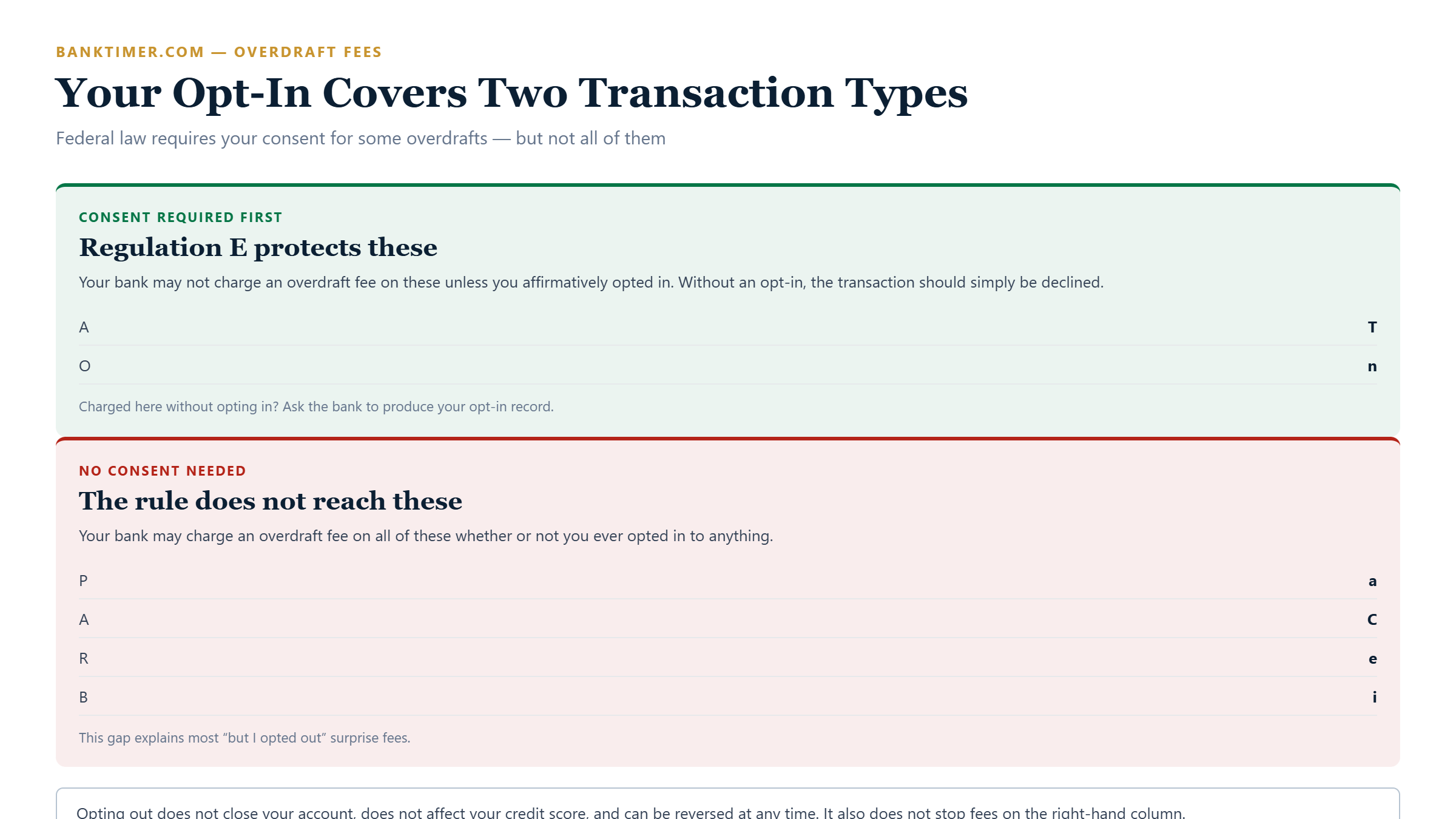
Since July 2010, Regulation E has required banks to get your affirmative consent — an opt-in — before charging an overdraft fee on an ATM withdrawal or a one-time debit card purchase. The rule exists because those are the transactions where a customer would almost always rather be declined than pay $27 to complete a small purchase.
What Regulation E Actually Covers
The opt-in requirement is narrow and specific. It applies to two things: cash withdrawals at an ATM, and one-time debit card transactions — the ordinary swipe, tap, or online purchase. For these, if you never opted in, your bank is not permitted to charge you an overdraft fee. It should decline the transaction instead.
The consent also has to be real consent. The bank must give you a segregated notice describing the service and the fee, and get an affirmative response. It cannot bury the opt-in in a stack of account-opening paperwork as a default setting, and it cannot condition other account features on your agreeing to it.
What the Rule Does Not Cover
Here is the gap that produces most unexpected fees. The opt-in rule does not apply to:
- Paper checks you write against the account.
- ACH debits — the electronic pulls used by utilities, insurers, lenders, and landlords.
- Recurring debit card payments, such as a subscription billed to your card on the same day each month.
- Bill payments you schedule through the bank’s own bill-pay service.
For all of those, your bank may charge an overdraft fee whether or not you ever opted in to anything. A customer who firmly declined overdraft coverage and believes they’re immune can still get charged when a $180 auto-insurance draft lands the day before payday. If you want to understand why the timing of these pulls is so hard to predict, Banktimer’s explainer on ACH transfer problems covers the settlement mechanics.
| Transaction type | Opt-in required first? | If you never opted in | Source of the rule |
|---|---|---|---|
| ATM cash withdrawal | Yes | Should be declined, no fee | Federal regulation (Regulation E) |
| One-time debit card purchase | Yes | Should be declined, no fee | Federal regulation (Regulation E) |
| Paper check | No | Bank may pay it and charge an overdraft fee, or return it and charge NSF | Bank policy and your deposit agreement |
| ACH debit (utility, insurer, lender) | No | Bank may charge either fee | Bank policy and your deposit agreement |
| Recurring debit card payment | No | Bank may charge either fee | Bank policy and your deposit agreement |
| Scheduled bank bill-pay | No | Bank may charge either fee | Bank policy and your deposit agreement |
How to Check and Change Your Setting
Your current opt-in status is visible in online banking, usually under account settings with a label like “overdraft coverage,” “debit card overdraft service,” or a bank-specific brand name. If you can’t find it, call and ask directly: “Am I opted in to overdraft coverage for ATM and one-time debit card transactions, and can you read me my current setting?”
You can change your election at any time, in either direction, and the bank has to honor it. Opting out does not close your account, does not affect your credit, and does not stop the bank from charging overdraft fees on the transaction types the rule doesn’t cover — a limitation worth repeating, because a customer who opts out and then gets charged on an ACH pull often assumes the bank broke the rule when it didn’t.
Why There’s No Longer a Federal Cap on the Fee
For a brief period it looked as though the size of an overdraft fee was about to be regulated directly. It isn’t, and the reason matters — both because you may have read headlines about a $5 cap that no longer exists, and because it tells you where the real limits on this charge come from.
What the 2024 Rule Would Have Done
In December 2024 the Consumer Financial Protection Bureau finalized a rule aimed at overdraft lending at very large institutions. Its central mechanism treated above-cost overdraft coverage as credit, which would have brought it under lending-disclosure rules, while offering a benchmark fee amount institutions could charge without triggering those obligations. The Bureau’s own estimate put household savings at roughly $5 billion a year — about $225 annually for families who pay overdraft fees, according to figures cited by the National Consumer Law Center.
What Changed in 2025
Congress used the Congressional Review Act to pass a joint resolution of disapproval nullifying that rule, and the President signed it in May 2025. A rule nullified under the Congressional Review Act is treated as though it had never taken effect, and the agency is barred from issuing a substantially similar rule without new authorization from Congress. The practical result is direct: there is no federal ceiling on the dollar amount of an overdraft fee, and no near-term administrative path to one.
What Still Protects You
Several things survive the repeal, and they’re worth knowing precisely because the headline protection is gone:
- The Regulation E opt-in rule is untouched. The repeal concerned fee amounts, not consent. Your right to refuse overdraft coverage on ATM and one-time debit transactions is unchanged.
- Fee disclosure requirements remain. Your bank must disclose its fees and give advance notice before raising them.
- Unfair, deceptive, or abusive practices remain prohibited. Charging a fee in a way that contradicts your own disclosures — or in a way a customer could not reasonably avoid — remains actionable regardless of the fee’s size.
- Competition is doing real work. A meaningful number of banks and credit unions have cut, capped, or eliminated overdraft fees as a product decision, and switching institutions remains the most reliable way to reduce the charge to zero.
The last point is the one with leverage. Because the fee is a bank-by-bank decision rather than a regulated number, it varies enormously — which means it is one of the few bank charges you can eliminate simply by moving your direct deposit somewhere else. Banktimer’s guide to choosing a checking account covers what to compare before you move.
What an Overdraft Really Costs, in Dollars
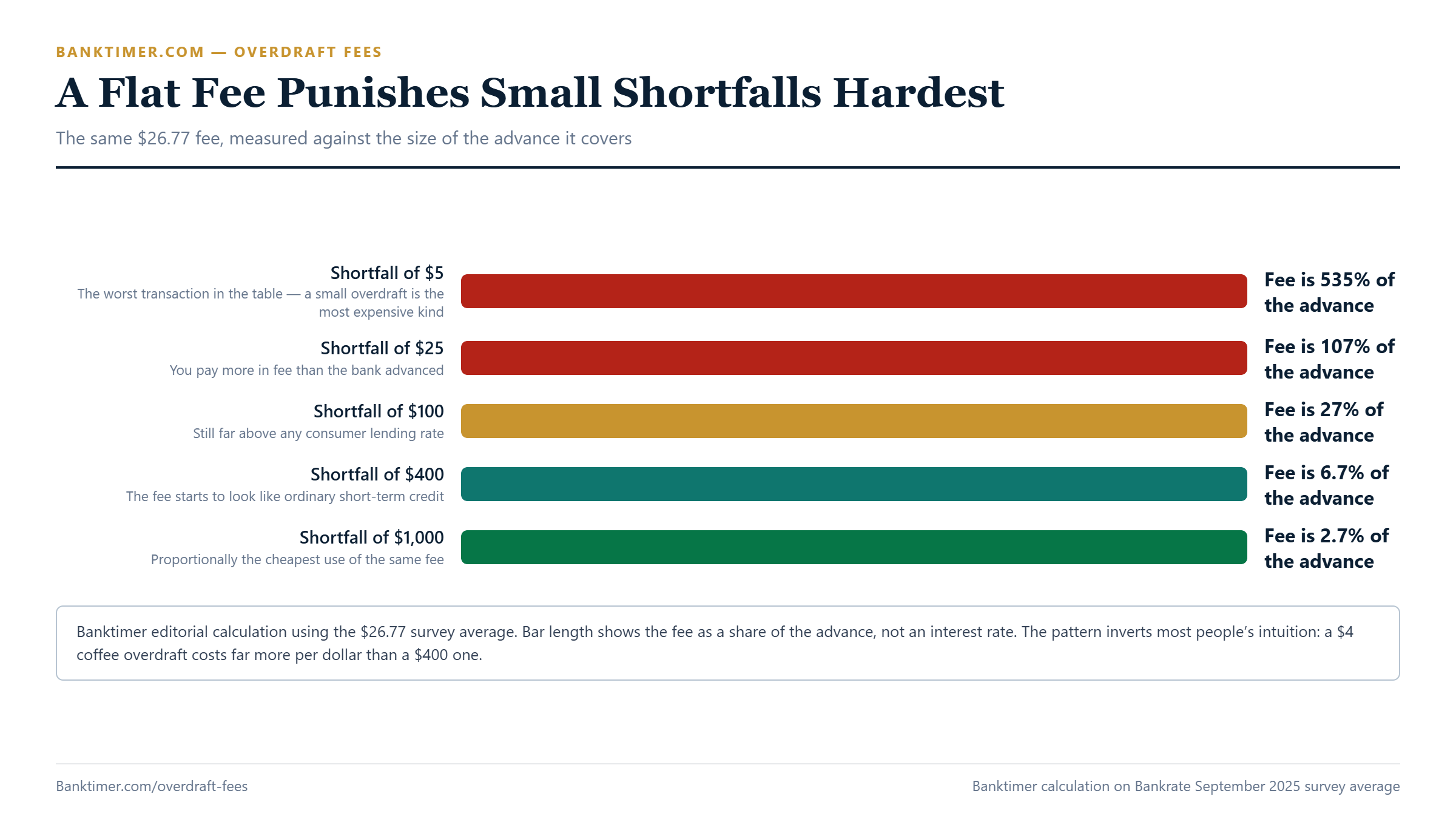
The flat-fee structure makes this charge unusually expensive on small amounts, and the clearest way to see that is to convert it into the language banks use for every other form of credit. The figures below are Banktimer editorial calculations using a $26.77 fee, the survey average, held for the stated number of days. They are illustrative arithmetic, not a rate any bank quotes.
| Shortfall covered | Fee | Fee as a share of the advance | Illustrative annualized cost if repaid in 5 days |
|---|---|---|---|
| $5 | $26.77 | 535% | Roughly 39,000% |
| $25 | $26.77 | 107% | Roughly 7,800% |
| $100 | $26.77 | 27% | Roughly 1,950% |
| $400 | $26.77 | 6.7% | Roughly 490% |
| $1,000 | $26.77 | 2.7% | Roughly 195% |
Read the last column as a sense of scale rather than a quoted rate — nobody markets overdraft coverage as a loan, and the annualized framing breaks down at very short durations. The decision-relevant insight is the pattern: the smaller the shortfall, the worse the deal, which inverts most people’s intuition that a small overdraft is a small problem. A $4 coffee overdraft is the single worst transaction in the table.
It also explains why the comparison to a credit card is so lopsided. Carrying $100 on a card at a 24% annual percentage rate for five days costs about 33 cents in interest. The same $100 shortfall covered by overdraft costs $26.77. If you have available credit and the choice is between the two, the card wins by a factor of roughly eighty. Banktimer’s explainer on how credit card APR works shows where that math stops being favorable.
How One Small Shortfall Becomes Four Fees
The multi-fee day is where overdraft costs stop being annoying and start being financially serious. It happens because of posting order and timing, not because of four separate mistakes.
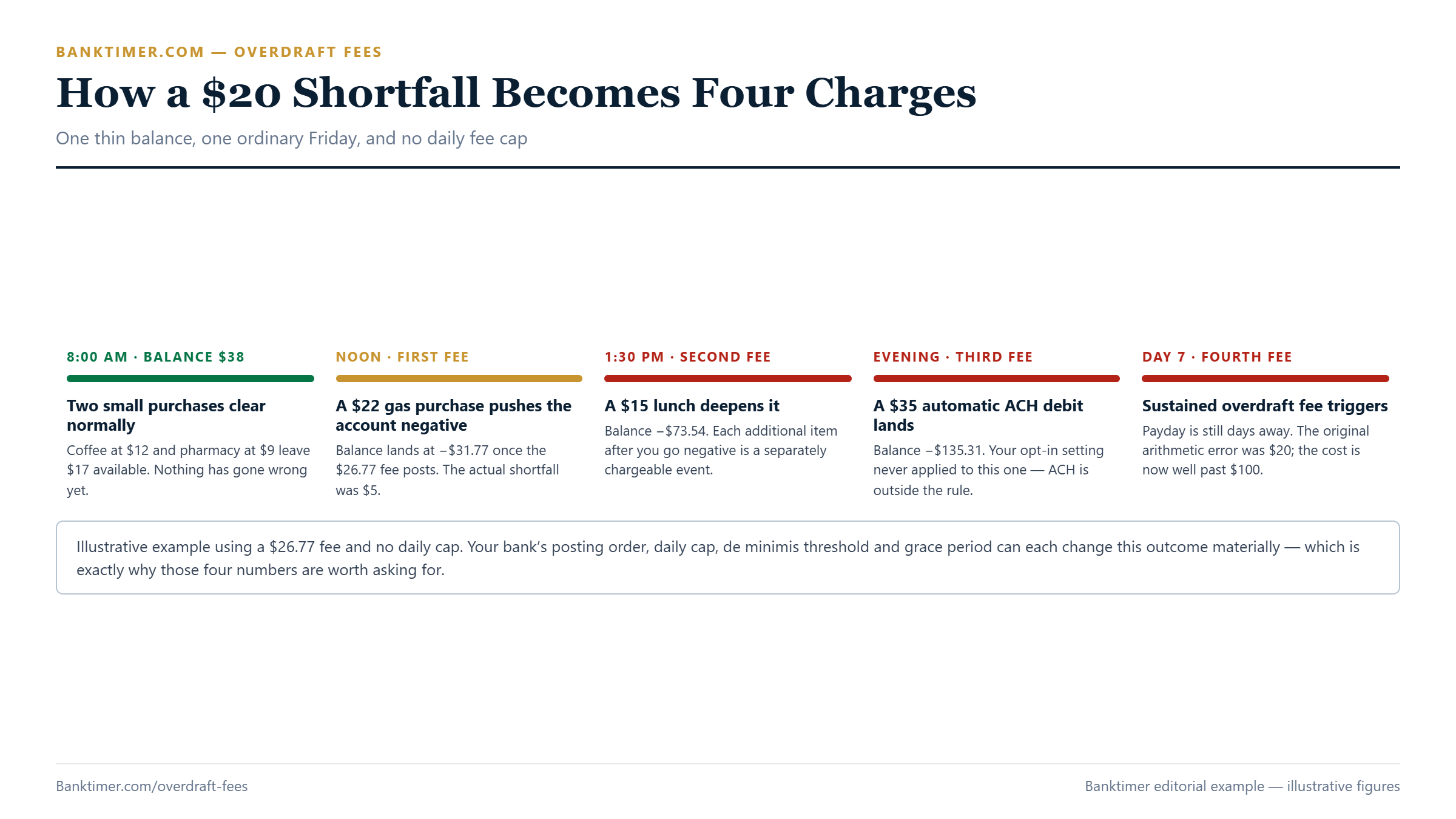
Consider an illustrative account with $38 available on a Friday morning. Four small debit transactions clear that day — $12, $9, $22, and $15 — totaling $58. Under a straightforward posting sequence, the first two clear fine, the third pushes the account negative, and the fourth deepens it. Two overdraft fees at $26.77 turn a $20 shortfall into a $73.54 hole. Add a $35 rent-related ACH pull the same evening and it’s three fees and a $108 negative balance.
Now add the sustained fee. If payday is the following Friday and the bank charges an extended overdraft fee after seven negative days, a fourth charge lands before any deposit arrives. The original arithmetic error was $20. The cost is well north of $100.
| Step | Transaction | Running balance | Fee charged |
|---|---|---|---|
| Start of day | Available balance | $38.00 | — |
| 1 | Coffee and snack, $12.00 | $26.00 | — |
| 2 | Pharmacy, $9.00 | $17.00 | — |
| 3 | Gas, $22.00 | −$31.77 after fee | $26.77 |
| 4 | Lunch, $15.00 | −$73.54 after fee | $26.77 |
| 5 | Automatic ACH debit, $35.00 | −$135.31 after fee | $26.77 |
| 6 | Day 7 still negative | Deeper by the sustained fee | Extended overdraft fee, amount varies |
Illustrative example using a $26.77 fee, no daily fee cap, and a straightforward posting sequence. Your bank’s posting order, daily cap, and de minimis threshold can all change the outcome materially — which is the point of the next section.
Why Posting Order Matters
The sequence in which a bank processes a day’s transactions determines how many of them land after the balance goes negative. Processing the largest item first can produce more fees than processing in the order transactions actually occurred, because one large debit empties the account and every small one behind it becomes a separately chargeable event.
High-to-low posting drew sustained regulatory and litigation pressure, and many institutions changed their practice. But posting order is a bank policy set in the deposit agreement, not a federally mandated sequence, so it remains worth asking about directly: “In what order do you post debits on a single business day?” A bank that won’t answer clearly is telling you something.
Bank Policies That Change the Math Completely
Two customers with identical spending can pay wildly different amounts because of policies that never appear in a rate comparison. These are the five settings that matter most, and all five are bank policy rather than law — meaning they can differ between institutions and change with notice.
The De Minimis Threshold
Many banks now skip the fee entirely if the account is overdrawn by less than a set amount, commonly $5 to $50. This single policy eliminates most of the worst-value fees in the cost table above, because it removes the tiny-shortfall cases where the fee dwarfs the advance. Ask for the exact figure: “Below what negative balance do you waive the overdraft fee?”
The Grace Period
Some institutions give you until the end of the next business day — or a fixed 24 hours — to bring the account positive before the fee sticks. A grace period is materially valuable if you can move money quickly. It’s worth nothing if you can’t, so pair the question with a realistic look at how fast you could actually transfer funds in.
The Daily Fee Cap
Because federal law sets no limit, the bank’s self-imposed cap is the only thing standing between you and a genuinely unbounded fee day. Caps of three to six per day are common. A bank with no cap at all is a meaningful risk factor if your balance regularly runs thin.
The Cutoff Time
Every bank has a daily cutoff after which a deposit counts for the next business day. Deposit money at 6:00 p.m. to cover a transaction that posts overnight and you may still be charged, because the deposit was credited the following day. The cutoff is often earlier than people assume, and weekends and federal holidays extend it. Banktimer’s guide to instant transfer fees covers when paying for speed is worth it.
Available Balance vs. Ledger Balance
Your ledger balance is what has fully posted. Your available balance subtracts holds — including authorization holds from gas stations, hotels, and restaurants that can exceed the actual charge. Banks generally assess overdraft against the available balance, which is why an account that “looks” positive in an app can still overdraw. Banktimer’s explainer on debit card holds explains where the gap comes from.
| Policy | Typical range | What to ask | Why it matters to you |
|---|---|---|---|
| De minimis threshold | $0 to $50 | Below what negative balance do you waive the fee? | Eliminates the worst-value small overdrafts entirely |
| Grace period | None to next business day | How long do I have to cure before the fee is final? | Turns a fee into a warning if you can move money fast |
| Daily fee cap | None to 6 per day | What is the maximum number of overdraft fees per day? | The only limit on a multi-fee day; no federal cap exists |
| Sustained overdraft fee | Varies; often after 5 to 7 days | Is there an extended overdraft fee, and when does it trigger? | Sets your real deadline to bring the balance positive |
| Posting order | Varies by institution | In what order do you post same-day debits? | Determines how many transactions land after you go negative |
| Deposit cutoff time | Often mid-to-late afternoon | What time must a deposit arrive to count today? | Decides whether a rescue deposit actually rescues anything |
| Representment practice | Varies; many banks changed policy | Do you charge a second fee if a returned item is resubmitted? | Two fees can otherwise stem from one failed payment |
Overdraft Protection: Three Different Things Banks Call the Same Name
The phrase “overdraft protection” is used for at least three arrangements with very different costs, and the marketing rarely distinguishes them. Knowing which one you have is the difference between a $0 outcome and a $27 one.
A Linked Savings or Second Checking Account
The bank pulls from your own money in another account to cover the shortfall. Some banks charge a transfer fee, commonly up to about $12; a growing number charge nothing. This is almost always the cheapest form of coverage if you keep any cushion at all — and pairing it with a high-yield savings account means the cushion earns something while it sits there.
The catch is that it only works while the linked account has money. A linked savings account with $8 in it provides eight dollars of protection, after which you’re back to the standard fee.
A Linked Line of Credit
The bank advances from a small revolving credit line and charges interest rather than a flat fee. On a larger shortfall held for a while, this is frequently the cheapest option in absolute dollars. It requires a credit application, may carry an annual fee, and shows up on your credit report as a credit account — which is not automatically bad, though it does add an inquiry when you apply.
Standard Overdraft Coverage
This is the bank simply deciding, case by case and at its discretion, to pay the item and charge you the fee. The important word is discretion: standard overdraft coverage is not a guarantee. The bank can decline the transaction anyway, which means you cannot rely on it as a payment method for something that must go through.
| Arrangement | Typical cost | Main limitation | Best fit |
|---|---|---|---|
| Linked savings transfer | $0 to about $12 per transfer | Only works while the linked account holds funds | Anyone who keeps even a small cushion |
| Linked line of credit | Interest on the advance, possible annual fee | Requires approval; adds a credit account | Larger or longer shortfalls |
| Standard overdraft coverage | About $27 per item | Discretionary — the bank can still decline | Rarely the best option when any alternative exists |
| Opted out entirely | $0 on ATM and one-time debit | Does not stop fees on checks, ACH, or recurring debits | Anyone who would rather be declined than charged |
| An account with no overdraft fee | $0 | May decline items rather than cover them | Anyone whose balance runs thin regularly |
The comparison points somewhere specific. If your balance regularly runs thin, the highest-value move is not choosing better protection — Banktimer’s guide to building an emergency fund covers the buffer that removes the problem, and the next-best move — it’s choosing an institution that doesn’t charge the fee. That converts a recurring $27 risk into zero, permanently, without requiring you to predict your own cash flow perfectly.
How to Get an Overdraft Fee Refunded
Fee reversals are common, and the reason is unglamorous: keeping a customer is worth more to the bank than $27. That gives you real leverage — but only if you ask in a way that makes saying yes easy for the person on the phone.
Do It Quickly
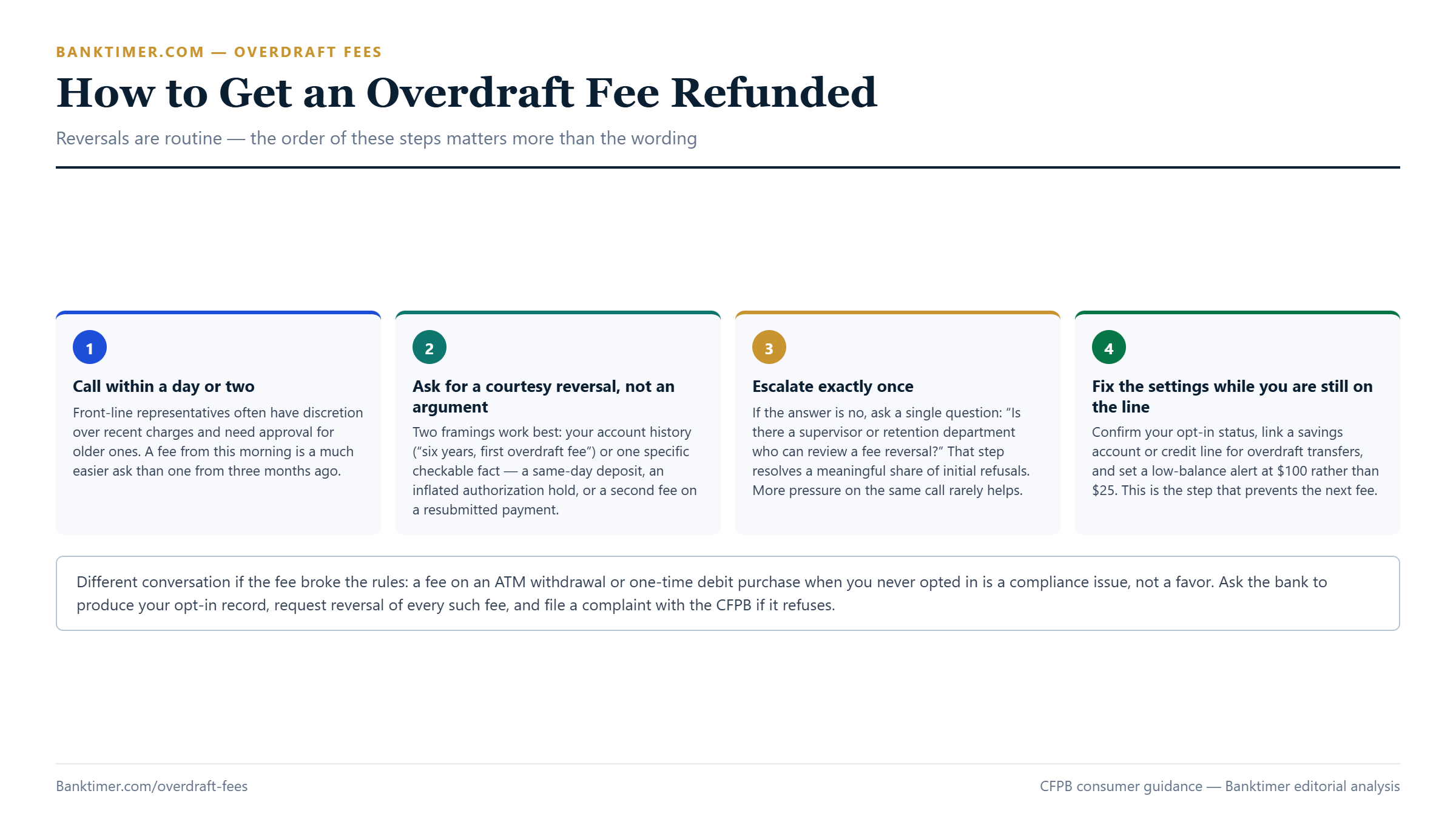
Call within a day or two. A fee from three months ago is a harder ask than one from this morning, partly because front-line representatives often have discretion over recent charges and need approval for older ones.
Ask for a Courtesy Refund, Not an Argument
Two framings work far better than the rest. The first is history: “I’ve been a customer for six years and this is my first overdraft fee — would you reverse it as a courtesy?” The second is a specific, checkable fact: a deposit that arrived the same day, a hold that inflated the shortfall, or a second fee on a resubmitted payment. Naming a concrete circumstance gives the representative a reason to log rather than a complaint to absorb.
Escalate Once, Politely
If the first answer is no, ask one question: “Is there a supervisor or retention department who can review a fee reversal?” That single step resolves a meaningful share of initial refusals. Beyond that, further pressure on the same call rarely helps.
Ask for the Setting Change in the Same Call
This is the step most people skip, and it’s the one that prevents the next fee. While you have someone on the line, do three things: confirm your opt-in status, ask to link a savings account or credit line for overdraft transfers, and turn on low-balance alerts at a threshold that gives you room to react — $100 is more useful than $25.
If the Fee Was Charged Against the Rules
A fee charged on an ATM withdrawal or one-time debit purchase when you never opted in is a different conversation from a courtesy request. Say so plainly, ask the bank to produce your opt-in record, and if it can’t, ask for reversal of every such fee — not just the most recent one. If the bank still refuses, you can file a complaint with the Consumer Financial Protection Bureau, and you can escalate to your institution’s primary regulator; Banktimer’s guide to who regulates banks explains how to identify yours.
Cheaper Ways to Cover a Shortfall
Every option below costs less than a $27 flat fee in most circumstances. The right one depends on how much time you have and what you already have access to.
Move Money From Savings Yourself
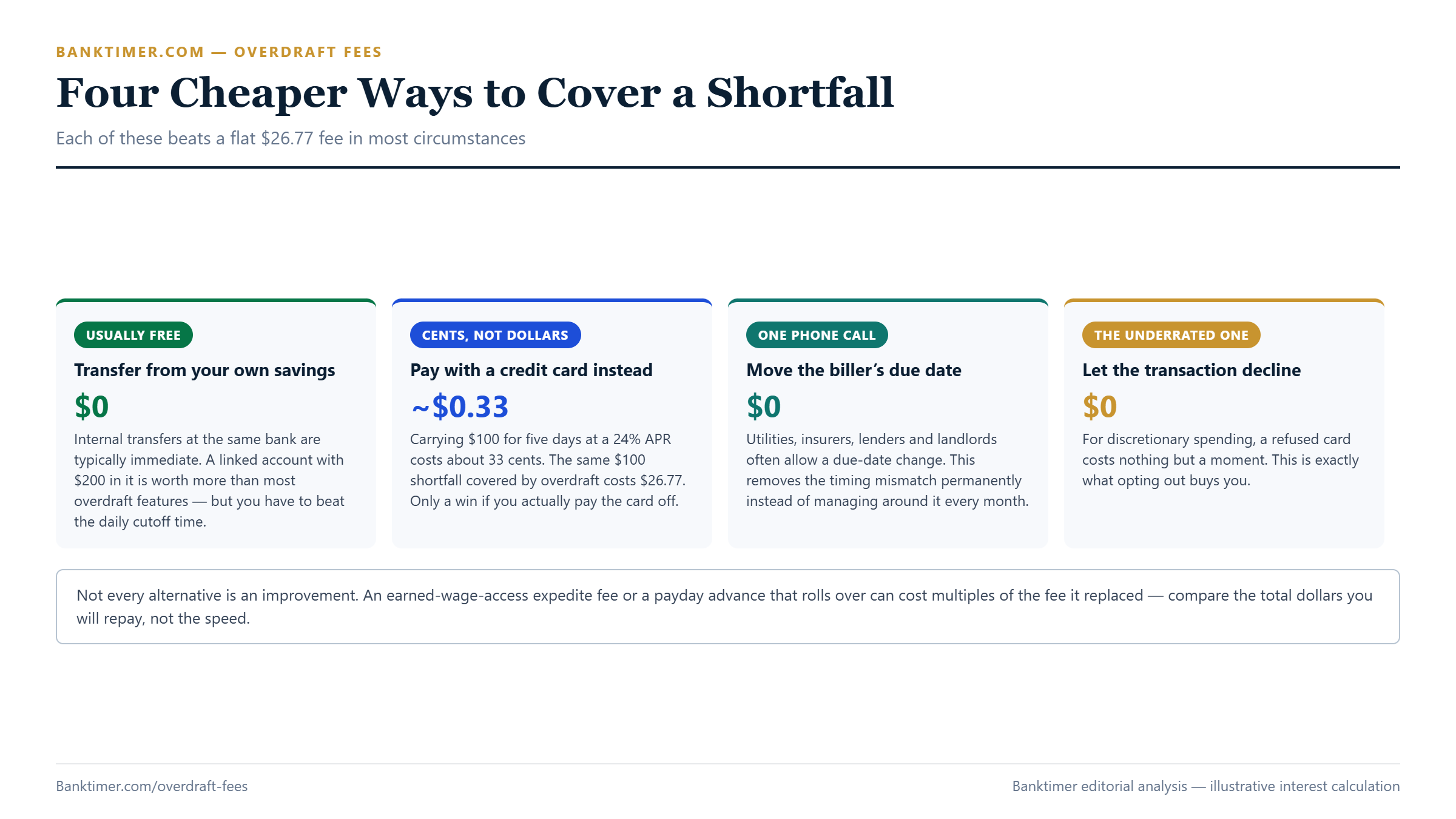
An internal transfer between accounts at the same bank is usually immediate and free. If you can see the shortfall coming before the cutoff time, this is the cleanest fix — and it’s the reason a linked savings account with even $200 in it is worth more than most overdraft features.
Use a Credit Card Instead
For a purchase, paying with a credit card and covering the balance at the next statement costs pennies in interest compared with an overdraft fee. This works only for card-accepting purchases, and only if you actually pay it off — a $27 fee avoided is not a win if it becomes a revolving balance at 24%.
Ask the Biller to Move the Date
Underused and often free. Utilities, insurers, lenders, and landlords frequently allow a due-date change to align with your pay cycle. One phone call can permanently remove the timing mismatch that causes the overdraft in the first place, which beats managing around it every month.
Earned Wage Access or a Small Employer Advance
Some employers and third-party apps advance a portion of already-earned wages. Costs vary widely — some charge an optional “tip” or an expedite fee that, annualized, rivals the overdraft it replaces. Read the fee structure before treating this as free, and check whether a no-fee delivery option exists.
A Credit Union Small-Dollar Loan
Many credit unions offer small short-term loans at capped rates specifically to replace high-cost options. They require membership and a short application, so this is a fix to arrange before you need it, not during.
Let It Be Declined
The most underrated option. For a discretionary purchase, a declined debit card costs nothing but a moment of inconvenience. This is what opting out buys you, and for many people it’s worth more than the coverage.
| Alternative | Typical cost | Speed | Main catch |
|---|---|---|---|
| Transfer from your own savings | Usually $0 | Immediate within the same bank | Requires a cushion and beating the cutoff time |
| Pay with a credit card | Cents in interest if paid at statement | Immediate | Only for card purchases; costly if it revolves |
| Move the biller’s due date | Usually $0 | Takes one billing cycle | Not every biller allows it |
| Linked overdraft line of credit | Interest, possible annual fee | Automatic once set up | Needs approval in advance |
| Earned wage access app | Varies — free to expensive | Minutes to a day | Expedite fees and tips can rival the overdraft |
| Credit union small-dollar loan | Capped rate, modest fee | Same day to a few days | Requires membership set up beforehand |
| Let the transaction decline | $0 | Immediate | Not viable for a payment that must clear |
| Payday loan or advance at triple-digit cost | Frequently worse than the fee | Fast | Rollover risk can exceed the problem it solves |
The last row is there deliberately. Not every alternative to an overdraft fee is an improvement, and a short-term loan that rolls over can cost multiples of the fee it replaced. Compare the total dollars you’ll repay, not the speed.
A Decision Framework: Should You Turn Overdraft Coverage On or Off?
There’s no universal answer, because the right choice depends on what you’d rather have happen when money is short. Work through these four questions in order.
Question 1: Would a Declined Transaction Ever Cause Real Harm?
For most everyday spending, no — a declined card is an inconvenience. But consider specific cases: a prescription you can’t leave without, a tow truck, a deposit that holds an apartment. If you can name a realistic scenario where a decline creates a genuine problem, coverage has value. If you can’t, opting out is the cheaper default.
Question 2: Do You Have a Cushion You Could Link?
If yes, a linked savings transfer outperforms standard coverage on cost in nearly every case. Set that up and the opt-in question mostly stops mattering, because the transfer handles the shortfall before the fee logic ever runs.
Question 3: How Often Has Your Balance Gone Below $50 in the Past Six Months?
This is the honest diagnostic. If the answer is more than two or three times, the issue isn’t which coverage to pick — it’s that you’re carrying a recurring $27 risk. The fix is either a fee-free account or a larger buffer, and Banktimer’s guide to building a monthly budget covers how to find the room.
Question 4: Can You Reach the Money Within the Grace Window?
If your bank offers a grace period and you can reliably transfer funds the same day, a fee becomes a warning rather than a charge. If your savings sit at a different institution and take two business days to arrive, the grace period is decorative. Answer this based on how fast money actually moves for you, not how fast it theoretically could.
| Your situation | Recommended setup | Why | What to verify |
|---|---|---|---|
| Balance rarely dips low; you keep savings at the same bank | Opt out, link savings | Transfers cost little or nothing and cover the rare miss | Transfer fee amount; whether transfers are automatic |
| Balance runs thin most months | Move to an account with no overdraft fee | Removes a recurring charge permanently rather than managing it | Whether items are declined instead, and any monthly fee |
| You can name a real scenario where a decline would hurt | Linked line of credit | Coverage without a flat fee, priced as interest | Annual fee, rate, and minimum advance |
| Income is irregular or arrives on unpredictable dates | Opt out plus alerts plus a due-date shift | Attacks the timing mismatch rather than paying for it monthly | Which billers will move a due date |
| Shared or joint account with another person spending | Opt out plus alerts for both parties | Neither person can see the other’s pending transactions in real time | Whether both owners can receive independent alerts |
A joint account deserves its own line because the failure mode is structural rather than behavioral: two people spending against one available balance cannot see each other’s pending authorizations, so the shortfall arrives without either party making a mistake. Banktimer’s guide to joint bank accounts covers the other shared-liability details.
Common Mistakes People Make With Overdraft Fees
A frequent mistake is assuming that declining overdraft coverage makes you immune to overdraft fees. It only covers ATM withdrawals and one-time debit purchases; checks, ACH pulls, and recurring debits remain fully chargeable. A second is trusting the balance shown in a banking app, which may not reflect pending authorizations or holds that reduce the available balance the bank actually measures against.
A third is depositing money after the cutoff time and assuming the account is cured — the deposit credits the next business day, and the fee posts overnight. A fourth is not asking for a refund at all, on the belief that fees are non-negotiable; reversals are routine, especially on a first occurrence.
A fifth is treating a small overdraft as a small problem. The flat fee structure means a $4 shortfall is the most expensive kind, and people who mentally file it as minor often repeat it. A sixth is leaving a linked savings account nearly empty, which provides the illusion of protection without the substance. A seventh is ignoring the sustained overdraft fee deadline — bringing an account positive on day nine when the extended fee triggers on day seven costs a charge that two days of urgency would have avoided.
An eighth, and the most expensive over time, is staying at an institution whose fee schedule doesn’t fit how you actually manage money. Overdraft pricing varies enormously between banks precisely because no regulator sets it, and that variation is an opportunity rather than a fact of life.
Red Flags Worth Slowing Down For
| Red flag | Why it matters | What to ask | Safer next step |
|---|---|---|---|
| A fee on an ATM or one-time debit transaction you never opted in for | Federal regulation requires your affirmative consent first | Can you produce my opt-in record and its date? | Request reversal of all such fees; file a CFPB complaint if refused |
| Two fees traceable to one failed payment | The biller may have resubmitted a returned item | Is this a representment fee on the same original transaction? | Ask for reversal of the second charge specifically |
| No daily cap on the number of fees | Nothing in federal law limits the count | What is your maximum per day, in writing? | Treat an uncapped account as a material risk if your balance runs thin |
| A fee charged after you deposited funds the same day | Cutoff times and grace policies decide this, and both are checkable | What is your cutoff, and do you offer a cure window? | Cite the deposit timestamp and request reversal |
| Overdraft coverage described as guaranteed | Standard coverage is discretionary; the bank can still decline | Is payment of an overdraft item guaranteed or discretionary? | Don’t rely on it for a payment that must clear |
| An app offering to “protect” you from overdrafts for a monthly subscription | A recurring fee can exceed the overdrafts it prevents | What does this cost per year versus my actual fee history? | Compare 12 months of subscription against 12 months of real fees |
Questions to Ask Your Bank Before the Next Shortfall
- ☐ What is my current overdraft fee, and what is the NSF fee?
- ☐ Am I opted in to overdraft coverage for ATM and one-time debit card transactions?
- ☐ What is the maximum number of overdraft fees you can charge in one day?
- ☐ Is there a negative-balance threshold below which you waive the fee?
- ☐ Do I have a grace period to bring the account positive, and how long is it?
- ☐ Is there a sustained or extended overdraft fee, and after how many days does it trigger?
- ☐ What time is your daily deposit cutoff, and how do weekends and holidays affect it?
- ☐ Can I link a savings account or a line of credit for overdraft transfers, and what does each transfer cost?
- ☐ Can you set a low-balance alert at $100 and confirm which phone number or email it goes to?
Who This Guide Suits
This guide is most useful to anyone who has paid an overdraft fee and wants to know whether it was avoidable, anyone whose balance runs thin near payday, and anyone who declined overdraft coverage and got charged anyway and can’t work out why. It’s equally relevant if you’re comparing checking accounts and want to know which fee policies actually move the total.
Someone who keeps several months of expenses in checking will get less from the fee mechanics and more from the section on available versus ledger balance, since holds are the main way a well-funded account still overdraws. Someone managing a tight cash-flow cycle will get the most from the alternatives table and the decision framework, since the highest-value change there is usually structural — a different account or a moved due date — rather than tactical.
Frequently Asked Questions
How much is an overdraft fee?
The average was $26.77 in Bankrate’s checking-account survey published September 10, 2025, with individual banks commonly charging between roughly $25 and $36. No federal law caps the amount, so your bank’s fee schedule is the only figure that binds you.
Can a bank charge more than one overdraft fee per day?
Yes. Nothing in federal law limits the number. Most large banks set their own daily cap, commonly three to six, but that is internal policy rather than a legal ceiling and can be changed with notice.
What’s the difference between an overdraft fee and an NSF fee?
An overdraft fee is charged when the bank pays a transaction your balance couldn’t cover, leaving you negative. An NSF fee is charged when the bank refuses the transaction and returns it unpaid. The NSF route is usually cheaper at the bank but can trigger a returned-payment fee from the merchant or biller on top.
Can I get an overdraft fee refunded?
Often, yes. Call within a day or two, ask for a courtesy reversal, and mention either your account history or a specific circumstance such as a same-day deposit. If the first representative declines, ask once whether a supervisor or retention team can review it.
I opted out of overdraft coverage — why was I still charged?
Because the opt-in rule only covers ATM withdrawals and one-time debit card purchases. Checks, ACH debits, recurring card payments, and bank bill-pay transactions can all be charged an overdraft fee regardless of your election.
Does an overdraft hurt my credit score?
An overdraft itself is not reported to the credit bureaus, so it doesn’t directly affect your score. The risk is indirect: an unpaid negative balance can eventually be charged off and sent to collections, and a collection account does appear on your credit report. Banktimer’s credit score guide covers what actually gets reported.
Is there still a $5 cap on overdraft fees?
No. A federal rule finalized in December 2024 would have introduced a benchmark fee for very large institutions, but Congress nullified it under the Congressional Review Act and the President signed that resolution in May 2025. There is currently no federal cap.
How long do I have before a second fee is added?
That depends on your bank’s sustained or extended overdraft fee policy, commonly triggered after five to seven consecutive negative days. Ask for your specific trigger, because it functions as your real deadline to bring the balance positive.
What happens if I can’t bring my account positive at all?
Banks generally close accounts that stay negative for an extended period — often around 60 days, though the timeline is set by policy — and may refer the balance to collections. The account closure can also be reported to a deposit-account screening database, which can make opening a new account harder for several years.
Can a bank close my account for overdrafting too often?
Yes. Repeated overdrafts are a common reason for involuntary closure, and no law requires a bank to keep an account open. If you receive a closure notice, ask what the payoff figure is and whether the balance will be reported, because resolving it before referral is easier than after.
Are overdraft fees the same at credit unions?
Not necessarily. Credit unions charge them too, but amounts are often lower and daily caps more generous, and many offer small-dollar loan programs specifically to replace high-cost coverage. Compare the actual fee schedule rather than assuming the institution type settles it.
Do online banks and fintech accounts charge overdraft fees?
Many do not, and some offer a small fee-free overdraft cushion with conditions such as a qualifying direct deposit. Read what happens when you exceed the cushion, since some accounts simply decline the transaction — which is usually the outcome you want anyway.
Should I close my account and switch banks over overdraft fees?
If you’ve paid more than two or three in the past year, switching is likely the single highest-value change available, because it converts a recurring charge into zero rather than requiring perfect cash-flow timing. Before you move, confirm the new account’s monthly fee, direct-deposit requirement, and what it does when a payment exceeds your balance.
Can I dispute an overdraft fee the way I’d dispute a fraudulent charge?
Not through the same process. Fraud disputes follow the error-resolution procedures for unauthorized transactions; a fee you were legitimately charged under your deposit agreement is a customer-service request, not an error claim. The exception is a fee charged in violation of the opt-in rule or contrary to the bank’s own disclosures — that is worth raising as a compliance issue rather than a favor.
How to Verify These Numbers Yourself
Three checks cover almost everything in this guide. First, your bank’s own fee schedule — search its site for “schedule of fees” or open the deposit account agreement — gives you the binding numbers for your account, which is the only figure that matters for your decisions. Second, the Consumer Financial Protection Bureau publishes consumer guidance on overdraft and on your opt-in rights at consumerfinance.gov, and its complaint database lets you see how a specific institution handles these disputes. Third, for the regulatory history, the Congressional Research Service page on the overdraft rule repeal documents what changed and when.
Fee averages move. The $26.77 and $16.82 figures in this guide come from a survey published September 10, 2025, and Bankrate updates that survey annually, so check the live page before treating either number as current. Your own bank may sit well above or below the average in either direction.
Key Terminology
| Term | What it means |
|---|---|
| Overdraft fee | A flat charge for the bank paying a transaction your balance couldn’t cover |
| NSF fee (returned item fee) | A charge for the bank refusing and returning a payment for insufficient funds |
| Sustained overdraft fee | A second fee applied after the account stays negative for a set number of days |
| Opt-in (Regulation E) | Your affirmative consent, required before a fee on ATM or one-time debit overdrafts |
| Available balance | Your balance minus holds and pending items — the figure banks assess overdraft against |
| Ledger balance | The balance of fully posted transactions, often higher than the available balance |
| Posting order | The sequence a bank uses to process a day’s debits, which affects how many fees occur |
| Representment | A returned payment resubmitted by the biller, which can trigger a second fee |
| De minimis threshold | A negative-balance amount below which the bank waives the fee, set by policy |
| Overdraft protection transfer | An automatic pull from your linked savings or credit line to cover a shortfall |
| Cutoff time | The daily deadline after which a deposit is credited the next business day |
| Congressional Review Act | The statute Congress used to nullify the 2024 federal overdraft-fee rule |
An overdraft fee is a flat charge for a tiny short-term advance, which makes it cheapest on large shortfalls and brutally expensive on small ones. No federal law caps the amount or the number per day, so the only binding limits are the ones in your own bank’s fee schedule — which means the most valuable four minutes you can spend is reading that document and calling once to confirm your opt-in status, your daily cap, your de minimis threshold, and your deposit cutoff. If your balance runs thin more than two or three times a year, the durable fix isn’t better overdraft coverage; it’s a linked cushion or an account that doesn’t charge the fee at all.
Sources
- Consumer Financial Protection Bureau — Bank Accounts and Services
- Consumer Financial Protection Bureau — Consumer Complaint Database
- Congressional Research Service — Congress Repeals CFPB’s Overdraft Rule
- Federal Deposit Insurance Corporation — Deposit Insurance Resources
- Bankrate — Checking Account and ATM Fee Survey (published September 10, 2025)
- National Consumer Law Center — Overdraft and NSF Fees Rise Above $12 Billion
- Bankrate — Banks That Have Cut or Eliminated Overdraft Fees
Methodology
Fee averages in this guide come from Bankrate’s checking account and ATM fee survey published September 10, 2025, based on fieldwork conducted June 2 through July 3, 2025; that survey reports an average overdraft fee of $26.77 and an average NSF fee of $16.82, and it is updated periodically, so both figures should be reconfirmed against the live source. Aggregate fee-revenue figures reflect National Consumer Law Center analysis of 2025 data. The regulatory history of the December 2024 CFPB overdraft rule and its nullification under the Congressional Review Act in May 2025 reflects Congressional Research Service documentation. The opt-in requirement for ATM and one-time debit card overdrafts reflects Regulation E as in effect since July 2010. Cost-per-dollar and annualized-cost figures in the cost table are Banktimer editorial calculations using the $26.77 survey average over the stated holding periods; they are illustrative arithmetic to show relative expense and are not rates quoted by any institution. All fee amounts, daily caps, de minimis thresholds, grace periods, posting orders, and cutoff times described as typical are bank policy rather than law, vary by institution, and can change with notice — verify yours in your own deposit account agreement. This guide is educational and does not constitute financial or legal advice.
Call your bank once this week and get four numbers in writing: your overdraft fee, your daily fee cap, the negative-balance threshold below which the fee is waived, and your deposit cutoff time. Then set a low-balance alert at $100 and link a savings account for overdraft transfers. Those two settings, done once, prevent more fees than any amount of careful balance-watching.