By the Banktimer Editorial Team · Published
Banktimer is an independent U.S. consumer-finance publication. Our editors draw on primary and official sources first, such as the CFPB, FDIC, Federal Reserve, and FTC, along with statutes, regulations, and providers’ own agreements and fee schedules. Then we add worked examples and decision tools. Our goal is the most useful, best-supported explanation the sources available to us at the time of writing allow.
This article is general information, not legal, tax, investment, insurance, or financial advice, and reading it does not create a professional relationship with Banktimer. Rates, fees, limits, and rules change, and they vary by state, provider, and contract, so confirm current terms with your bank, lender, insurer, or the agency named in the article before you act. Examples are illustrative unless labeled otherwise. Banktimer is not a bank, lender, insurer, or financial advisor, and we are not responsible for decisions or losses that result from relying on this content. For advice about your own situation, talk to a licensed professional.
An emergency fund is money set aside to absorb a shock — a job loss, a car that won’t start, a deductible you have to pay before insurance does anything. The Federal Reserve’s most recent household survey found that 55% of adults had set aside enough to cover three months of expenses, unchanged from the prior year and down from a high of 59% in 2021, while 12% said they could not cover a $400 emergency expense by any means. This Banktimer guide skips the generic target and builds a number you can actually defend: which costs to count, how long a runway your situation calls for, where to keep the money so it earns something without being too easy to spend, and how to sequence saving against paying down expensive debt.
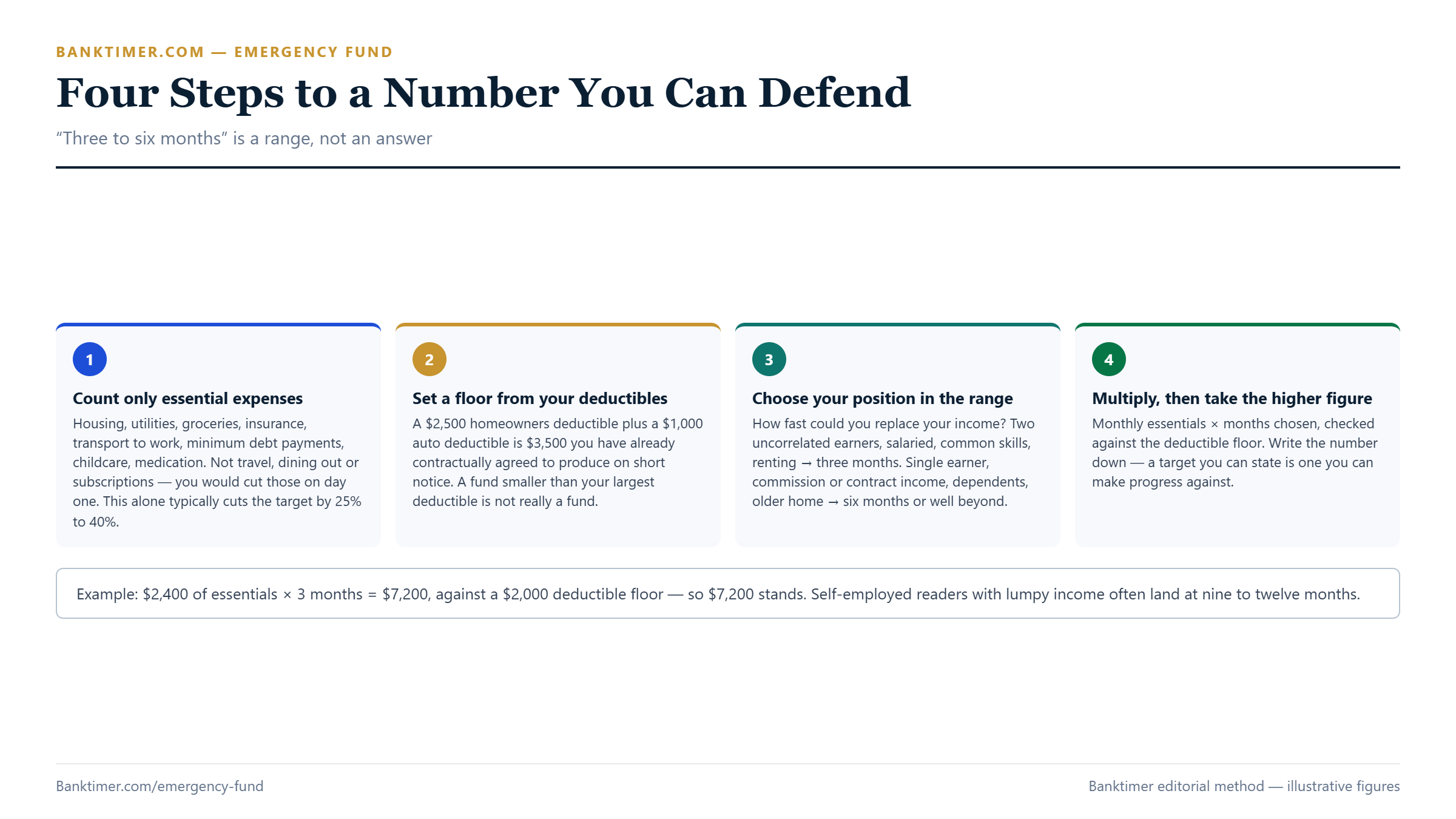
Size the fund from essential expenses, not income. Rent or mortgage, utilities, groceries, insurance, transportation, minimum debt payments, and medication. Subscriptions and restaurant meals are not part of the number you’re protecting.
Your insurance deductibles set a hard floor. If your homeowners deductible is $2,500 and your auto deductible is $1,000, you have already contractually committed to producing $3,500 in cash on short notice. Any fund smaller than your largest deductible isn’t really a fund.
A $1,000 starter fund comes before aggressive debt payoff — then the debt comes before the full fund. Without a buffer, the next surprise goes straight back onto a credit card, and you end up paying interest on the same emergency twice.
Three to six months is a range, not a rule, and your position within it is determined by how replaceable your income is. A two-earner household in a common profession sits at the low end. A single earner on commission, self-employed, or in a specialized field belongs at the high end or beyond.
A known future cost is not an emergency. Car registration, holiday spending, annual insurance premiums, and a roof you can see aging are predictable. Those belong in separate savings, not in the fund that protects you from things you can’t forecast.
Where you keep it matters more than most people assume. A federally insured account paying a competitive yield preserves purchasing power; the same money in a checking account loses ground to inflation every year and is far easier to spend by accident.
Using the fund is the fund working, not a failure. The only thing that matters afterward is having a deliberate plan to rebuild it — which is a very different reaction from treating the drawdown as a setback.
Key Numbers to Know
| Figure | Value | Source and why it matters |
|---|---|---|
| Adults with three months of expenses saved | 55% | Federal Reserve household survey, 2025 data — unchanged from 2024, below the 59% high in 2021 |
| Adults who would cover a $400 expense with cash or its equivalent | 63% | The most-cited single measure of short-term financial slack |
| Adults who would put a $400 expense on a card and pay over time | 15% | The group for whom a small emergency becomes an interest-bearing balance |
| Adults who could not cover a $400 expense by any means | 12% | Shows how narrow the margin is for a meaningful share of households |
| Three-month savings rate, ages 18 to 29 | 36% | Federal Reserve Bank of St. Louis, September 2025 — readiness rises steadily with age |
| Three-month savings rate, ages 60 and over | 72% | Twice the rate of the youngest group |
| Commonly cited target range | Three to six months of essential expenses | A planning range, not a rule — your position in it depends on income stability |
| Practical minimum starter fund | About $1,000, or one month of essentials | Enough to keep the next surprise off a credit card |
| Federal deposit insurance limit | $250,000 per depositor, per insured bank, per ownership category | Relevant only for very large reserves; see the note on where to keep it |
The two rows worth sitting with are the 15% and the 12%. Together they describe more than a quarter of adults for whom a $400 problem — a tire, a copay, a broken appliance — either becomes debt or simply cannot be solved. That’s the specific outcome an emergency fund exists to prevent, and it’s why the first thousand dollars matters more than the last thousand.
How Much You Actually Need
The standard answer is three to six months of expenses. The useful version replaces two vague words with specifics: which expenses, and which end of the range.
Step One: Count Only Essential Expenses
Your target is built from what you’d still have to pay if your income stopped tomorrow, not from your normal spending. That means housing, utilities, groceries, insurance premiums, transportation to work, minimum debt payments, childcare, and medication. It does not mean travel, dining out, subscriptions, or gifts — all of which you’d cut immediately in a genuine emergency.
This distinction routinely cuts the target by 25% to 40%, which matters because an unreachable number gets abandoned. Someone spending $5,200 a month might have essentials of $3,400, making a six-month fund $20,400 instead of $31,200. The smaller figure is both more accurate and more achievable.
Step Two: Set Your Floor From Your Deductibles
Before you think in months, add up the deductibles you’ve already agreed to. A $2,500 homeowners deductible, a $1,000 auto deductible, and a health plan with a $4,000 out-of-pocket maximum represent contractual commitments to produce cash on short notice. If your fund is smaller than the largest of those, a single ordinary claim empties it.
This is the most concrete anchor available, and it’s specific to you rather than a national average. Banktimer’s guides to homeowners insurance deductibles and car insurance deductibles cover how those numbers get set, including the percentage-based deductibles that can be far larger than people expect.
Step Three: Choose Your Position in the Range
Where you land between three and six months — or beyond it — depends almost entirely on how quickly you could replace your income. Score yourself on the factors below, and let the answer move you up or down.
| Factor | Points toward three months | Points toward six months or more |
|---|---|---|
| Number of earners | Two incomes that don’t rise and fall together | One income, or two in the same industry |
| How income arrives | Salaried, predictable | Commission, tips, contract, or seasonal |
| How replaceable your role is | Common skills, many local employers | Specialized, or few employers within commuting distance |
| Dependents | None | Children, or an adult who depends on you |
| Health and insurance | Good coverage, low out-of-pocket maximum | High deductible plan, or ongoing medical costs |
| Housing | Renting, with a landlord responsible for repairs | Owning, especially an older home |
| Other backstops | Accessible taxable savings beyond this fund | This fund is the only liquid money you have |
| Stage of life | Early career, flexible, low fixed costs | Approaching retirement, where re-employment can take longer |
Count how many rows land on the right. Zero to two suggests three months is reasonable. Three to five suggests four or five months. Six or more suggests six months as a floor rather than a target, and self-employed readers with lumpy income often find nine to twelve months is the number that actually lets them sleep.
Step Four: Do the Arithmetic
Multiply your monthly essentials by your chosen number of months, then check the result against your deductible floor and take the higher figure. That’s your target. Write it down, because a target you can state is one you can make progress against.
Three Households, Sized Properly
The same method produces very different answers, which is the point. These are illustrative examples using round figures.
A Renter With One Salaried Job
Monthly essentials of $2,400 — rent, utilities, groceries, transit, phone, a student loan minimum. No dependents, renting, common professional skills, decent health coverage with a $2,000 out-of-pocket maximum. Two factors land on the right-hand column, so three months is defensible: $7,200. The deductible floor of $2,000 is comfortably inside that, so $7,200 stands.
A Homeowner Family With One Income
Monthly essentials of $4,600. Single earner, two children, a 1970s house, a $2,500 homeowners deductible, a $1,000 auto deductible, and a health plan with a $6,000 family out-of-pocket maximum. Five factors point right, so five months: $23,000. The combined deductible exposure of $9,500 sits well inside that, but it’s worth noting that a bad year could consume 40% of the fund through deductibles alone before any income disruption.
A Self-Employed Contractor
Monthly essentials of $3,800, income arriving in irregular project payments, no employer benefits, a high-deductible health plan with an $8,000 out-of-pocket maximum, and a work vehicle. Nearly every factor points right. Nine months is reasonable: $34,200. That figure looks daunting, which is exactly why the build sequence in the next section matters more for this household than the target does.
| Household | Monthly essentials | Months chosen | Target | Deductible floor |
|---|---|---|---|---|
| Renter, one salaried job | $2,400 | 3 | $7,200 | $2,000 |
| Homeowner family, one income | $4,600 | 5 | $23,000 | $9,500 combined |
| Self-employed contractor | $3,800 | 9 | $34,200 | $8,000 plus vehicle |
| Two earners, different industries, renting | $3,900 | 3 | $11,700 | $3,000 |
| Near-retiree, owns home outright | $2,900 | 6 | $17,400 | $7,500 combined |
Illustrative examples. Notice that the household with the lowest essentials doesn’t have the lowest target — the near-retiree’s longer expected re-employment timeline pushes the multiplier up even though the monthly number is modest.
The Build Order: Fund First, or Debt First?
This is the question that stalls more people than the target does, and the answer is a sequence rather than a choice.
Stage One: A Starter Fund
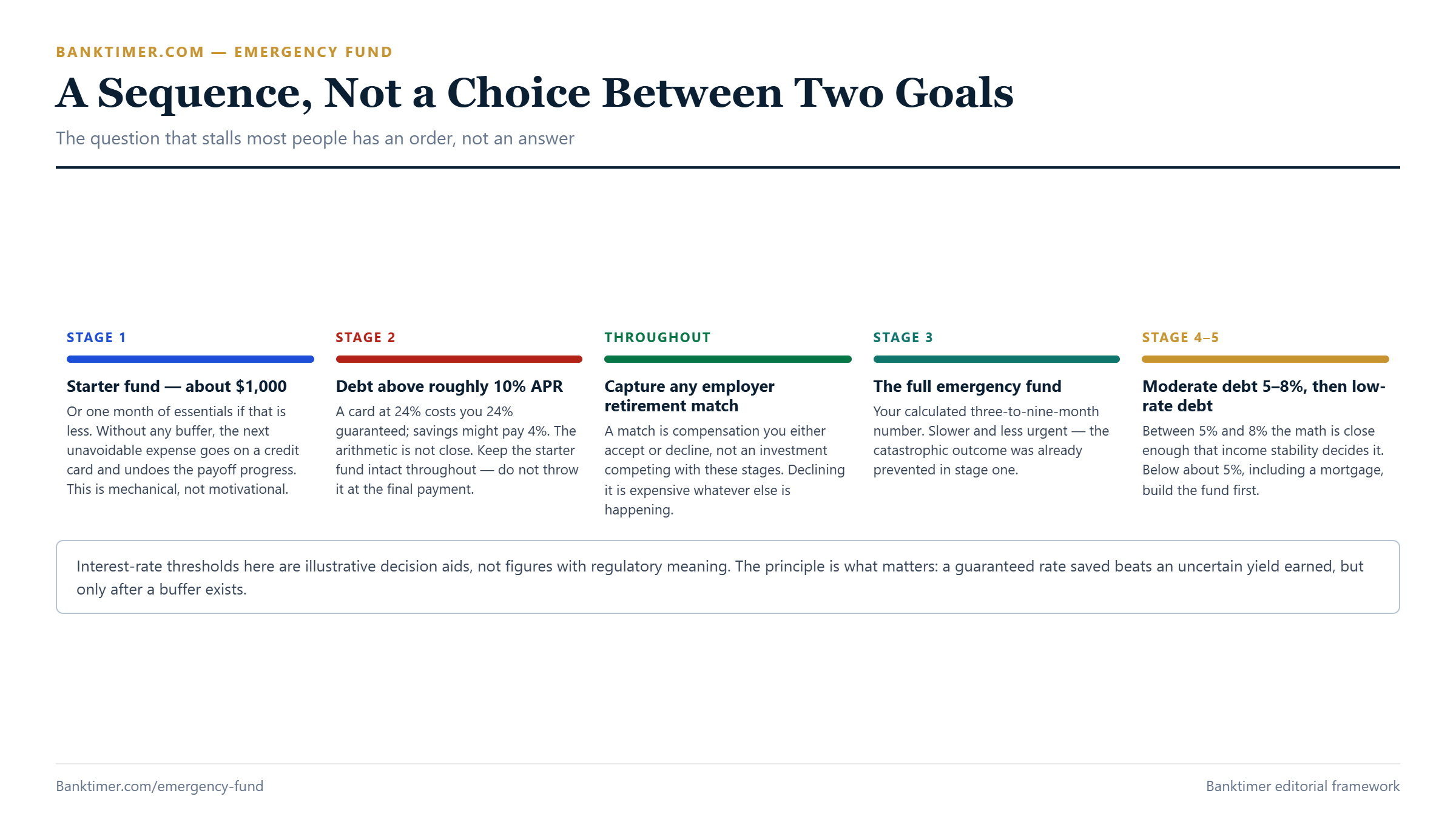
Build roughly $1,000, or one month of essentials if that’s less, before attacking debt aggressively. The reason is mechanical rather than psychological: without any buffer, the next unavoidable expense goes on a credit card, which undoes the payoff progress and adds interest. A starter fund keeps the emergency from becoming debt in the first place.
Stage Two: High-Interest Debt
Once the starter fund exists, paying down debt above roughly 8% to 10% beats saving, and the arithmetic isn’t close. A credit card at 24% costs you 24% guaranteed; a savings account might pay 4%. Every dollar moved from the card to savings during this stage costs you the difference. Banktimer’s explainer on how credit card APR works shows how quickly that gap compounds.
Keep the starter fund intact throughout. Don’t throw it at the balance in a final push — that’s precisely how people end up back at the beginning.
Stage Three: The Full Fund
With expensive debt cleared, build toward your real target. This stage is slower and less urgent, and that’s fine — the catastrophic outcome was already prevented in stage one.
What About Moderate-Rate Debt?
Between roughly 5% and 8% — many auto loans, some personal loans, some student loans — the arithmetic gets close enough that other factors decide. If your income is unstable, favor the fund, because liquidity has value the interest calculation doesn’t capture. If your income is secure, favor the debt. Below about 5%, particularly a mortgage, build the fund first.
| Stage | Target | Why this order | What not to do |
|---|---|---|---|
| 1. Starter fund | About $1,000, or one month of essentials | Keeps the next surprise off a credit card | Don’t skip it to pay debt faster |
| 2. Debt above ~10% APR | Zero balance on high-rate cards | A guaranteed 24% saved beats a 4% yield earned | Don’t drain the starter fund into the final payment |
| 3. Full emergency fund | Your calculated three-to-nine-month number | The catastrophic case is already covered; build steadily | Don’t let perfect be the enemy of partially funded |
| Alongside, if offered | Capture any employer retirement match | A match is an immediate return no savings rate matches | Don’t forgo free money to accelerate any of the above |
| 4. Moderate-rate debt, 5% to 8% | Judgment call | Close arithmetic; income stability decides it | Don’t agonize — the difference is small either way |
| 5. Low-rate debt, under 5% | Pay as scheduled | Liquidity is usually worth more than the rate saved | Don’t prepay a mortgage while under-reserved |
The employer match row sits outside the sequence deliberately. A match is not an investment decision competing with these stages — it’s compensation you either accept or decline, and declining it is expensive no matter what else is happening.
Where to Keep It
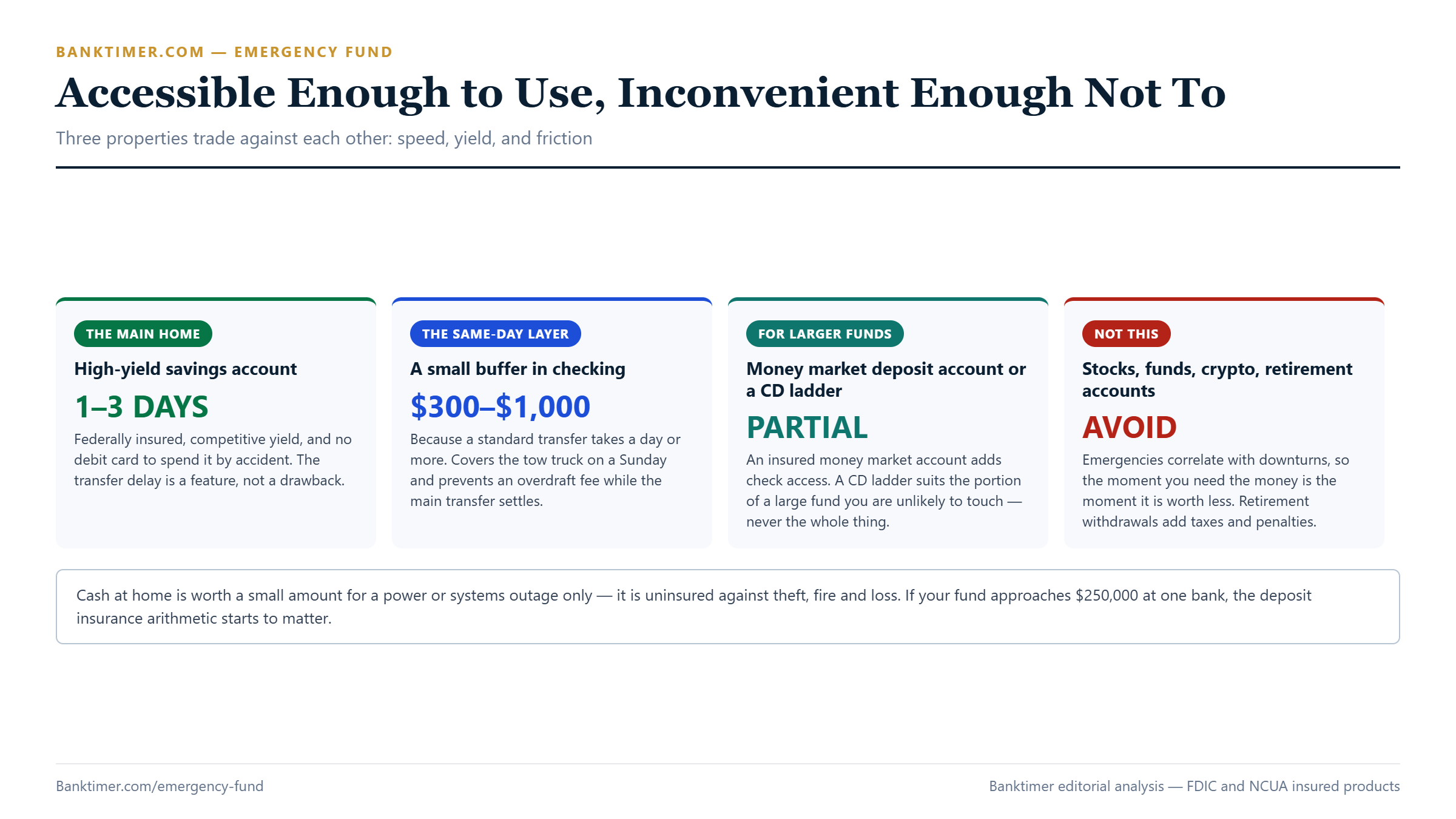
Three properties matter, and they trade against each other: you need the money quickly, you want it to keep pace with inflation, and you want a small amount of friction so it isn’t spent by accident.
High-Yield Savings Account
The default answer for most people. Federally insured, competitive yield, and typically one to three business days to reach your checking account by standard transfer. The friction is a feature — money you can’t spend from a debit card at a checkout is money that stays put. Banktimer’s guide to high-yield savings account fees covers what to check before opening one.
A Small Buffer in Checking
Because a standard transfer takes a day or more, keeping $300 to $1,000 in checking covers the genuinely same-day problems and prevents an overdraft fee while the main transfer settles. Paying for an instant transfer is an option, and Banktimer’s guide to instant transfer fees covers when the speed is worth the cost.
Money Market Deposit Account
Similar insured status to savings, sometimes with check-writing or a debit card attached. The added access can be convenient or can be a temptation, depending on how you use it.
Certificates of Deposit and CD Ladders
A CD pays more in exchange for locking the money up, and early withdrawal usually costs several months of interest. That makes a single CD a poor home for a fund you might need tomorrow. A ladder — several CDs maturing at staggered intervals — is a reasonable structure for the portion of a large fund you’re unlikely to touch, provided some of it stays liquid. Banktimer’s guides to CD fees and CD ladders cover the penalties that decide whether this works.
What Not to Use
Stocks, funds, and crypto are the wrong home for this money, and the reason isn’t caution for its own sake. Emergencies correlate with downturns — layoffs cluster when markets fall — so the moment you need the money is disproportionately likely to be the moment it’s worth less. Retirement accounts are also poor choices, since early withdrawals generally trigger taxes and penalties, and taking money out permanently removes contribution room you can’t replace.
| Where | Access speed | Principal at risk? | Best use |
|---|---|---|---|
| High-yield savings account | 1 to 3 business days standard | No, within insurance limits | The main body of the fund |
| Checking buffer | Immediate | No, within insurance limits | $300 to $1,000 for same-day problems |
| Money market deposit account | Immediate to a few days | No, within insurance limits | An alternative main home if you want check access |
| Short-term CD or CD ladder | At maturity, or with a penalty | No, but early exit costs interest | The portion of a large fund you’re unlikely to need |
| Treasury bills | At maturity, or sell at market | Market value moves before maturity | Very large reserves above insurance limits |
| Stocks, funds, or crypto | Days, plus settlement | Yes, and worst exactly when you need it | Not an emergency fund |
| Retirement account | Slow, with paperwork | Taxes and penalties usually apply | Not an emergency fund |
| Cash at home | Immediate | Uninsured against theft, fire or loss | A small amount for a power or systems outage only |
If your fund is large enough to approach $250,000 at one institution, the insurance arithmetic starts to matter. Banktimer’s guide to FDIC insurance limits explains how ownership categories let you cover more at a single bank without opening new relationships.
What Counts as an Emergency
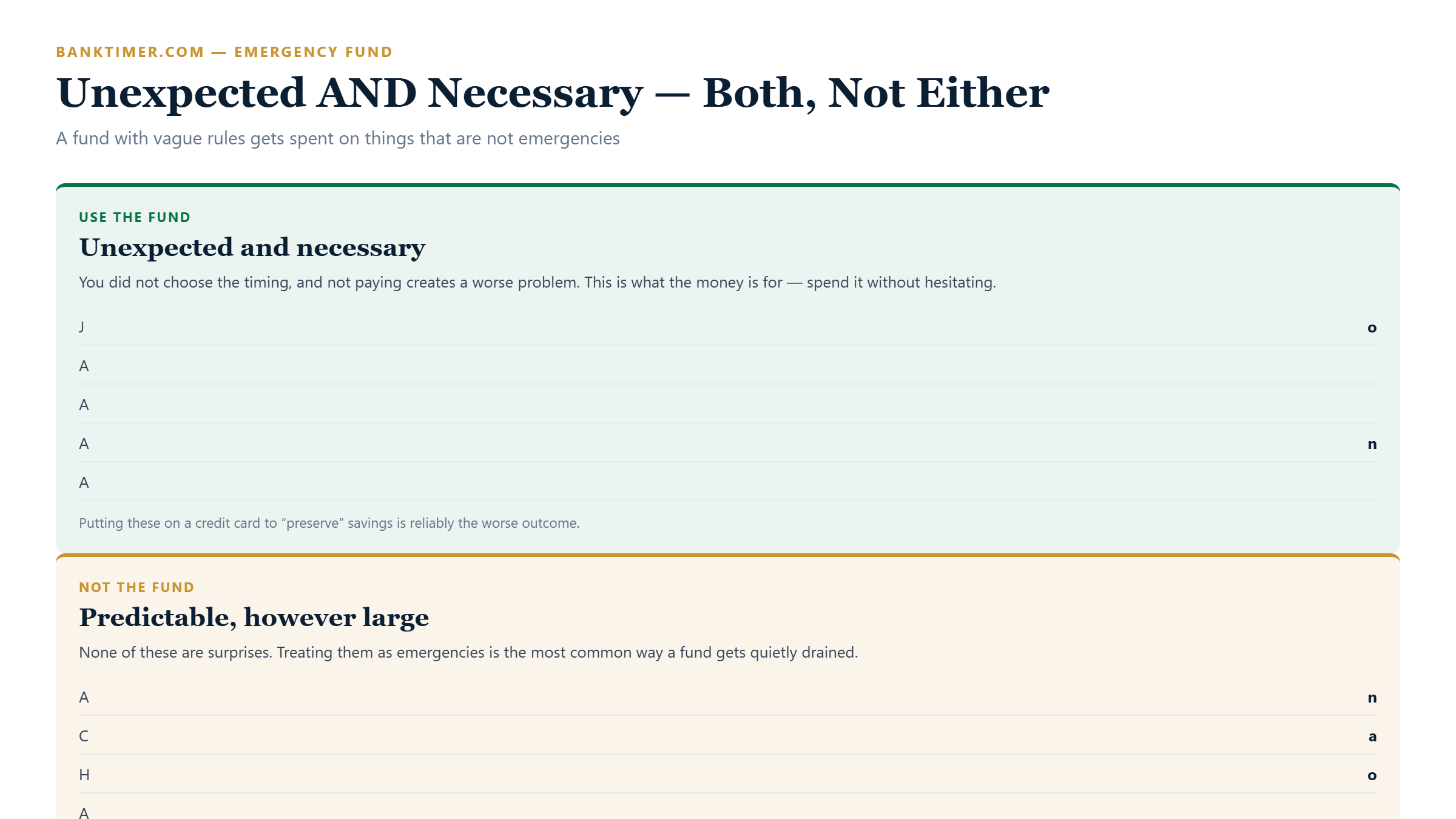
A fund with vague rules gets spent on things that aren’t emergencies, and then isn’t there for things that are. The workable test has two parts: the expense must be unexpected, and it must be necessary. Both, not either.
Unexpected and Necessary
A job loss or hours cut. A car repair you need to get to work. A medical or dental bill. An insurance deductible after a claim. An emergency trip for a family illness. A furnace failing in January. These share a shape: you didn’t choose the timing, and not paying creates a worse problem.
Expected, Even If Large
Annual insurance premiums, car registration, holiday spending, a vacation, property taxes, a wedding, a roof you can see aging. None of these are surprises. They belong in separate, purpose-named savings, and treating them as emergencies is the most common way a fund gets quietly drained. Banktimer’s guide to sinking funds covers the structure that handles predictable irregular costs.
The Awkward Middle
Real life produces cases that don’t sort cleanly. A car that has been unreliable for months finally dies — unexpected in timing, foreseeable in substance. A medical bill you knew was coming but not the amount. The honest approach is to use the fund and then adjust the plan, rather than either agonizing at the moment of need or pretending the category was clear.
One rule prevents most of the drift: name the fund. An account labeled “Emergency — do not touch” is measurably harder to raid than one called “Savings,” and separating predictable costs into their own named accounts removes the ambiguity entirely.
| Expense | Unexpected? | Necessary? | Where it should come from |
|---|---|---|---|
| Job loss or reduced hours | Yes | Yes | Emergency fund |
| Car repair needed to get to work | Yes | Yes | Emergency fund |
| Insurance deductible after a claim | Yes | Yes | Emergency fund — this is the core use case |
| Emergency room visit or urgent dental work | Yes | Yes | Emergency fund |
| Annual insurance premium | No | Yes | A sinking fund |
| Holiday spending | No | No | A sinking fund, or the monthly budget |
| A vacation | No | No | Dedicated savings |
| Replacing a roof you know is aging | No | Yes, eventually | A home maintenance sinking fund |
| A limited-time purchase opportunity | Yes | No | Not the emergency fund |
How to Build It When Money Is Tight
The target is the easy part. Getting from zero to it is where most plans stall, and the fixes that work are structural rather than motivational.
Automate a Small Amount First
An automatic transfer on payday, before you see the money, outperforms saving whatever is left at month end — because at month end there usually isn’t any. Start with an amount small enough that you won’t cancel it. $25 a week reaches $1,300 in a year, which clears the starter-fund bar comfortably.
Send Irregular Money Straight In
Tax refunds, bonuses, a rebate, a side-job payment, the proceeds of selling something. This money isn’t in your monthly rhythm, so redirecting it costs no lifestyle adjustment at all. A single tax refund often does more than six months of small transfers.
Bank the Difference When a Cost Ends
A car loan paid off, a subscription cancelled, a childcare stage ending — each frees a specific monthly amount your budget has already absorbed. Redirecting it immediately, before the money finds another use, is the least painful way to raise your savings rate.
Use a Separate Institution if Needed
If money in a savings account at your main bank keeps migrating back to checking, opening the savings account somewhere else adds a day of friction that is often enough. Banktimer’s guide to building a monthly budget covers finding the room in the first place.
Set Milestones, Not Just a Target
A $23,000 goal is demoralizing at $400. The same path broken into $1,000, then one month of essentials, then three months, gives you four moments of visible progress instead of one distant finish line. Each milestone also genuinely reduces risk, so they’re not arbitrary.
| Monthly amount saved | Time to $1,000 | Time to $7,200 | Time to $23,000 |
|---|---|---|---|
| $50 | 20 months | 12 years | Not realistic without other sources |
| $100 | 10 months | 6 years | About 19 years |
| $250 | 4 months | About 2 years 5 months | About 7 years 8 months |
| $500 | 2 months | About 1 year 3 months | About 3 years 10 months |
| $250 plus a $2,000 annual tax refund | 4 months | About 1 year 8 months | About 4 years 7 months |
Illustrative timelines using simple arithmetic and ignoring interest, which shortens them modestly. The last row makes the point about irregular money: adding a single annual refund to the $250 column cuts nearly three years off the largest target without changing anything about monthly life.
A Twelve-Month Plan From Zero
If you’re starting with nothing, the first year has a natural shape. None of it requires a budgeting system you’ll abandon by March.
Month One: Measure and Open
Pull three months of statements and total only the expenses you’d still owe with no income. Find your deductibles. Calculate the target and write it down. Open a federally insured high-yield savings account — at a different institution if money tends to migrate back to checking — and set up an automatic transfer for payday. Pick an amount low enough that you’re confident you won’t cancel it.
Months Two to Four: Reach the Starter Fund
Aim for $1,000, or one month of essentials if that’s less. Send any irregular money — a refund, a rebate, a reimbursement — straight in. This is the milestone that does the most work per dollar, because it’s what stops the next surprise becoming debt.
Months Five to Eight: Handle Expensive Debt
If you carry balances above roughly 10% APR, this is where they get attention, with the starter fund left intact throughout. If you don’t, keep building and skip ahead. Capture any employer retirement match the whole way through, regardless of which stage you’re in.
Months Nine to Twelve: Build and Separate
Continue toward the full target, and open separate named accounts for the predictable costs that would otherwise raid it — annual premiums, car registration, holidays, home maintenance. This separation is what keeps the fund at its target rather than drifting down a few hundred dollars at a time.
Month Twelve: Review
Recalculate essentials, check whether your deductibles changed at renewal, compare your account’s yield against current offers, and confirm the automatic transfer is still the right size. Then set a calendar reminder to do the same thing next year, which is the entire ongoing maintenance requirement.
| Period | Goal | The one thing that matters most |
|---|---|---|
| Month 1 | Calculate the target; open the account | Setting the automatic transfer, at any amount |
| Months 2 to 4 | Reach about $1,000 | Routing irregular money straight in |
| Months 5 to 8 | Clear debt above ~10% APR | Leaving the starter fund untouched while you do it |
| Months 9 to 12 | Build toward the full target | Opening separate accounts for predictable costs |
| Month 12 and annually | Review and resize | Checking whether deductibles changed at renewal |
Using It, and Rebuilding It
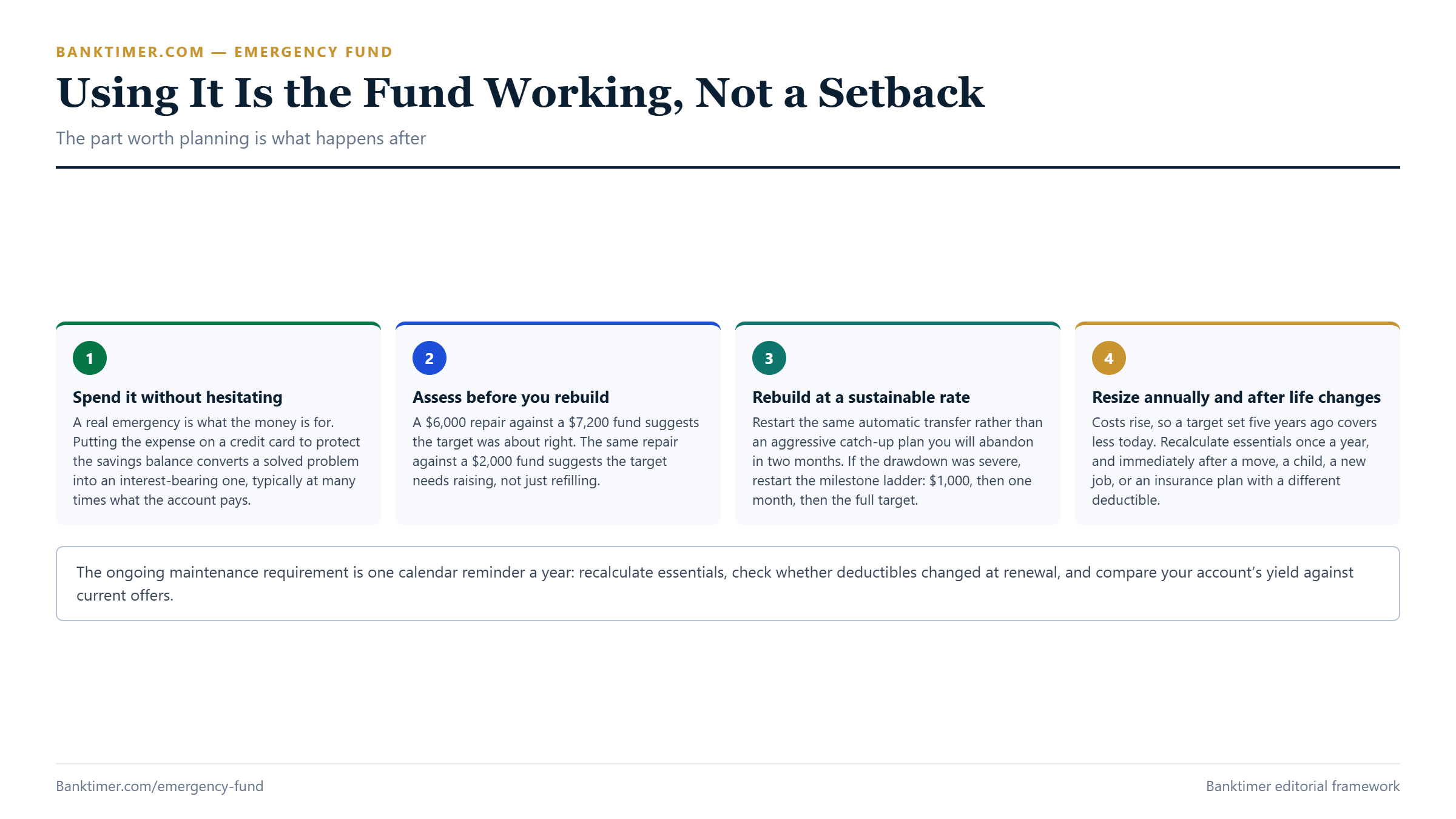
A fund that gets used is a fund doing its job. The part worth planning is what happens next.
Spend It Without Hesitating
When a real emergency arrives, using the fund is correct. Putting the expense on a credit card to “preserve” the savings converts a solved problem into an interest-bearing one — and typically at a rate many times what the savings account pays. That’s a reliably worse outcome, not a cautious one.
Assess Before You Rebuild
Once the immediate problem is handled, ask whether the emergency revealed something about the target. A $6,000 repair against a $7,200 fund suggests the fund was about right. The same repair against a $2,000 fund suggests the target needs raising, not just refilling.
Rebuild at a Sustainable Rate
Return to the same automatic transfer rather than an aggressive catch-up plan that competes with everything else. If the drawdown was severe, restart the milestone ladder: back to $1,000 first, then one month, then the full target. The sequencing logic that applied the first time applies again.
Resize It Annually
Costs rise, and a fund that covered six months of expenses five years ago covers fewer today. Recalculate your essentials once a year — and after any life change that moves them: a move, a child, a new mortgage, a job change, a new insurance plan with a different deductible.
| Stage | What to do | What to avoid |
|---|---|---|
| The emergency happens | Use the fund; that’s what it’s for | Don’t use a credit card to protect the savings balance |
| Immediately after | Pause new discretionary spending briefly | Don’t treat the drawdown as a failure |
| Within a week | Ask whether the target was right, or too low | Don’t refill to a number the event just disproved |
| Rebuilding | Restart the automatic transfer; use milestones again | Don’t set a catch-up rate you’ll abandon in two months |
| Annually | Recalculate essentials; check deductibles haven’t changed | Don’t leave a five-year-old target unexamined |
| After a life change | Resize immediately — a move, a child, a new job or plan | Don’t assume the old number still fits the new situation |
Where Americans Actually Stand
Context helps calibrate a target, and the Federal Reserve’s household survey is the most reliable picture available.
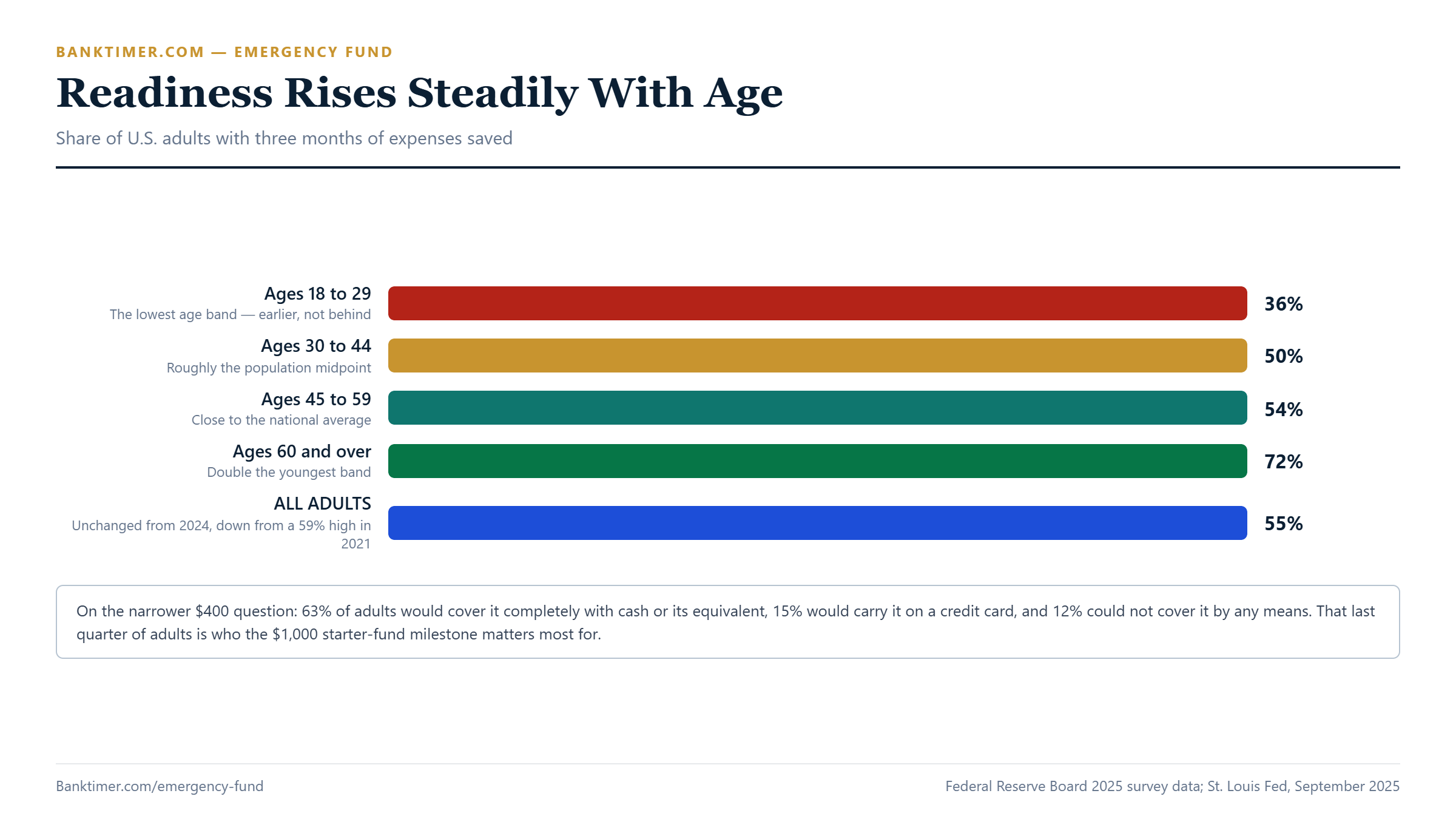
In the 2025 survey data, 55% of adults reported having set aside enough money to cover three months of expenses — unchanged from 2024 and down from a high of 59% in 2021. On the narrower $400 question, 63% said they would cover the expense completely using cash or its equivalent, 15% would put it on a credit card and pay it off over time, and 12% said they would not be able to cover it by any means.
The age pattern is stark. Federal Reserve Bank of St. Louis analysis published in September 2025 found that 36% of adults aged 18 to 29 had three months of expenses saved, rising to 50% for ages 30 to 44, 54% for ages 45 to 59, and 72% for those 60 and over. Roughly 30% said they could not cover three months of expenses by any means at all.
What the Numbers Do and Don’t Tell You
They tell you the median household is thinner on reserves than the standard advice assumes, which is worth knowing if you’ve been treating “three to six months” as a bar everyone else clears. They don’t tell you what your number should be — national figures describe a population, and your target depends on your own income stability, dependents, housing, and deductibles.
The age gradient is also less about discipline than about time and circumstance. Reserves accumulate; earnings generally rise; housing costs stabilize. Someone at 27 with a smaller fund than someone at 62 is not behind in any meaningful sense — they’re earlier.
| Measure | Share of adults | What it means in practice |
|---|---|---|
| Three months of expenses saved | 55% | Just over half clear the lowest end of the standard advice |
| Would cover $400 with cash or equivalent | 63% | Includes paying by card and clearing it immediately |
| Would carry a $400 expense on a card | 15% | A small emergency becomes an interest-bearing balance |
| Could not cover $400 at all | 12% | The starter-fund milestone matters most for this group |
| Three months saved, ages 18 to 29 | 36% | The lowest age band |
| Three months saved, ages 30 to 44 | 50% | Roughly the population midpoint |
| Three months saved, ages 45 to 59 | 54% | Close to the national average |
| Three months saved, ages 60 and over | 72% | Double the youngest band |
When Standard Advice Doesn’t Fit Your Situation
The three-to-six-month convention assumes a salaried job, predictable expenses, and a working-age household. Several common situations break at least one of those assumptions.
Irregular or Seasonal Income
If your income arrives in uneven lumps — contract work, commission, tips, a seasonal trade — you’re carrying two distinct risks: the emergency itself, and the ordinary gap between payments. Keeping both in one account makes it impossible to tell whether you’re covered.
The cleaner structure is two accounts. An income-smoothing buffer holds roughly one to two months of essentials and is meant to be drawn down and refilled routinely as work ebbs and flows. The emergency fund sits behind it, untouched by normal fluctuation. Without that separation, a slow quarter looks identical to a crisis, and people either panic or quietly deplete their reserve without noticing.
You’re Retired or Near Retirement
The fund’s purpose shifts from replacing employment income to avoiding forced asset sales. A large unplanned expense met by selling investments during a market decline permanently locks in a loss, which is a meaningfully worse outcome than the same expense met from cash. That’s the argument for holding a larger cash reserve in retirement than the working-age convention suggests, and it’s a risk-management decision rather than a savings target.
You Have Variable Housing Costs
A homeowner’s essential expenses include maintenance that doesn’t appear on any statement until it happens. An older roof, an aging HVAC system, or a house in a region prone to severe weather all argue for both a larger fund and a separate home-maintenance sinking fund. Percentage-based deductibles are the specific trap here: a deductible expressed as a share of the dwelling coverage rather than a flat dollar amount can be several times larger than people expect.
You Support Someone Else
A dependent adult, an aging parent, or a child with ongoing medical needs adds costs that don’t pause when income does, and often adds a second household’s emergencies to your own. Size for the combined essentials, not just yours.
You’re on a Visa or Between Immigration Statuses
Where employment authorization is tied to a specific employer, a job loss can carry consequences well beyond lost income, and the timeline to resolve it is often outside your control. A longer runway is a reasonable response to a risk that isn’t primarily financial.
| Situation | What breaks the standard advice | Adjustment |
|---|---|---|
| Irregular or seasonal income | Normal gaps look like emergencies | A separate smoothing buffer plus a larger fund behind it |
| Retired or near retirement | No employment income to replace; asset sales carry timing risk | Hold more cash to avoid selling into a decline |
| Older home or severe-weather region | Maintenance and percentage deductibles are invisible until they hit | Add a maintenance sinking fund; check the deductible basis |
| Supporting a dependent adult | Two households’ essentials, one income | Size against combined essentials |
| Employment-tied immigration status | Job loss has non-financial consequences on a fixed clock | Extend the runway well beyond six months |
| Two earners in the same industry | The incomes fall together, so two jobs act like one | Treat the household as single-income for sizing |
The last row is the one most couples miss. Two salaries feel like diversification, but if both work for the same employer or in the same sector, a downturn removes both at once. Diversification requires the incomes to be genuinely uncorrelated.
What an Emergency Fund Is Really Buying
It’s worth naming what the money actually does, because the benefit isn’t primarily the interest it earns.
It Converts a Crisis Into an Inconvenience
A $1,500 transmission repair is a bad week for a household with a funded reserve and a months-long problem for one without — the same event, two completely different trajectories. The fund doesn’t prevent the repair; it prevents the cascade of late fees, interest, and missed payments that follows when the repair can’t be paid.
It Removes the Worst Options From the Table
Without cash, the available responses to an urgent expense are a high-rate card, a payday advance, a retirement withdrawal with taxes and penalties, or simply not fixing the problem. Every one of those is expensive, and some are difficult to unwind. Cash makes all of them unnecessary.
It Protects Decisions You’ve Already Made
A funded reserve is what lets you keep an insurance deductible high in exchange for a lower premium, decline an extended warranty you don’t need, or turn down a bad job offer because you don’t have to take the first thing available. Those are real financial advantages, and none of them appear as a yield.
It Reduces the Cost of Everything Else
Someone who never carries a card balance because surprises are covered in cash avoids interest entirely, which over years is typically worth far more than any difference in savings rates. The fund’s return isn’t the APY — it’s the interest and fees you never pay. Banktimer’s guide to credit utilization covers the related effect on your credit score, since a reserve is also what keeps balances low when something goes wrong.
Common Mistakes
The most expensive mistake is sizing the fund from gross income rather than essential expenses, which produces a target so large it gets abandoned before the first milestone. The second is keeping the money in checking, where inflation erodes it and a debit card makes it spendable by accident.
A third is investing the fund for a better return, which reliably fails at exactly the wrong moment, since job losses and market declines tend to arrive together. A fourth is paying off all debt before building any buffer, which sends the next surprise straight back onto a card.
A fifth is letting predictable costs — premiums, registration, holidays — drain the fund, which is what separate sinking funds are for. A sixth is never resizing it, so a target set five years ago quietly covers less each year. A seventh is treating a drawdown as a failure and losing momentum afterward, when the correct response is to rebuild and possibly raise the target.
An eighth, less discussed, is ignoring access speed. A fund at an online bank with a three-business-day transfer is fine for a job loss and useless for a tow truck on a Sunday. A small checking buffer alongside the main account solves it.
Red Flags Worth Slowing Down For
| Red flag | Why it matters | Safer next step |
|---|---|---|
| A product marketed as a higher-yield “emergency fund alternative” | Extra yield usually means principal risk or a lock-up | Ask whether principal is federally insured and how fast you can withdraw |
| An app balance described as FDIC-insured | Apps aren’t banks; coverage depends on the underlying structure | Ask which insured bank holds the funds and how the account is titled |
| A savings account paying far below the market | The gap compounds quietly against a multi-year balance | Compare yields annually; moving takes an afternoon |
| A fund smaller than your largest insurance deductible | One ordinary claim empties it completely | Raise the floor, or reconsider the deductible at renewal |
| Repeatedly dipping in for non-emergencies | Usually means predictable costs have no home of their own | Split off named sinking funds for those specific costs |
| A fund that exists only as available credit | Limits can be cut precisely when conditions deteriorate | Treat credit as a backstop to cash, never a replacement |
| Keeping the whole fund at one bank above $250,000 | The excess sits outside deposit insurance | Use additional ownership categories or a second institution |
The credit-as-a-fund row deserves emphasis. A home equity line or an unused card feels like a reserve, and in calm conditions it behaves like one. Lenders reduce and freeze lines during downturns, which is exactly when a household is most likely to need them — so available credit is a useful second layer behind cash, and a poor substitute for it.
Questions to Ask Yourself Before You Start
Answer these nine and you have a plan, not a goal
- ☐ What are my essential monthly expenses, excluding anything I’d cut immediately?
- ☐ What are my homeowners or renters, auto, and health deductibles, and which is largest?
- ☐ How many of the stability factors point toward six months rather than three?
- ☐ What is my target number, and where have I written it down?
- ☐ Do I have any debt above 10% APR that should come before the full fund?
- ☐ Am I capturing my full employer retirement match, if one is offered?
- ☐ Which account will hold this, what does it yield, and how long does a transfer take?
- ☐ How much should sit in checking for genuinely same-day problems?
- ☐ What automatic transfer amount is small enough that I won’t cancel it?
Who This Guide Suits
This guide is most useful to anyone starting from zero who wants a target they can actually justify, anyone deciding whether to save or pay down debt first, and anyone whose fund has been sitting in checking earning nothing. It’s equally relevant if you have a fund and have never checked it against your own insurance deductibles.
Someone with irregular income will get the most from the sizing factors and the build-order section, since those are where standard advice fits worst. Someone who already has six months saved will get the most from the placement comparison and the annual resizing habit, since at that point the open question is whether the money is working rather than whether it exists. Banktimer’s personal finance basics guide covers where this sits among the other foundations.
Frequently Asked Questions
How much should I have in an emergency fund?
Three to six months of essential expenses for most households, with the position in that range set by how quickly you could replace your income. Single earners, self-employed people, and those in specialized fields often need six to twelve months. Whatever you calculate, it should be at least as large as your biggest insurance deductible.
Should I pay off debt or build an emergency fund first?
Build a starter fund of about $1,000 first, then attack debt above roughly 10% APR, then build the full fund. Skipping the starter fund means the next unavoidable expense goes on a credit card and undoes the progress.
Where should I keep my emergency fund?
A federally insured high-yield savings account for the bulk of it, plus a few hundred dollars in checking for same-day needs. The savings account should pay a competitive yield and take a day or two to access — enough friction that it isn’t spent casually.
Is $1,000 enough for an emergency fund?
As a starting milestone, yes — it covers many common surprises and keeps them off a credit card. As a final target it’s too small for most households, and it’s smaller than many homeowners and health deductibles.
Can I invest my emergency fund to earn more?
It’s a poor fit. Emergencies correlate with downturns, so the moment you need the money is disproportionately likely to be the moment it’s worth less. Keep this money in insured deposits and take investment risk with money you won’t need on short notice.
Does an emergency fund include my regular bills?
It covers essential bills if your income stops — housing, utilities, groceries, insurance, transportation, minimum debt payments, medication. It isn’t a general spending account, and predictable irregular costs like annual premiums belong in separate savings.
What counts as an emergency?
Something both unexpected and necessary: a job loss, an urgent car or home repair, a medical bill, an insurance deductible. A known future cost isn’t an emergency, however large, and a limited-time purchase opportunity isn’t either.
How long does it take to build an emergency fund?
At $250 a month, about four months to reach $1,000 and roughly two and a half years to reach $7,200. Irregular money — a tax refund, a bonus, the proceeds of a sale — shortens that substantially without changing your monthly budget.
Should my emergency fund be in the same bank as my checking account?
Either works. Same-bank transfers are faster, which helps in a genuine emergency; a separate institution adds friction that helps if you tend to dip into savings. If you use a separate bank, keep a small checking buffer for same-day needs.
Do I need an emergency fund if I have credit available?
Yes. Credit lines can be reduced or frozen during exactly the conditions that cause emergencies, and borrowing converts a one-time problem into an interest-bearing balance. Treat available credit as a second layer behind cash, not a replacement for it.
Can a couple share one emergency fund?
Yes, and most do. Size it against combined essential expenses and both sets of deductibles, and agree in advance on what qualifies as an emergency — that conversation prevents most of the friction. Note that if you hold it jointly, both parties can withdraw the full balance.
How do I keep myself from spending it?
Separate it from checking, name the account explicitly, remove any debit card access, and give predictable costs their own named accounts so they never compete for the same money. The structural fixes work better than willpower.
Should retirees keep an emergency fund?
Yes, though the purpose shifts. Instead of replacing lost employment income, it covers large irregular costs — medical bills, home repairs, a vehicle — without forcing asset sales at a bad moment. Many retirees find a larger cash reserve appropriate for exactly that reason.
What if I can only save $20 a month?
Start there. The habit and the automatic transfer matter more at the beginning than the amount, and the figure can rise as costs end or income grows. Redirecting a tax refund into the same account will likely outpace the monthly total in year one.
Should I stop retirement contributions to build the fund faster?
Not to the point of losing an employer match, which is compensation rather than an investment decision. Beyond the match, temporarily reducing contributions to establish a starter fund is a defensible trade — but restore them once the buffer exists.
Should my emergency fund be bigger if interest rates are high?
Not because of rates themselves, but the environment matters indirectly. Higher rates make carrying a card balance more expensive, which raises the cost of not having a fund, and they also mean your savings account should be paying more — so it’s worth checking your yield against current offers rather than assuming the account you opened years ago is still competitive.
Is it worth keeping an emergency fund if inflation erodes it?
Yes. A fund in a competitive insured account loses far less to inflation than a single avoided credit card balance would cost in interest. The alternative isn’t a higher return — it’s borrowing at a much higher rate when something breaks. That said, the inflation point is a real argument against leaving the money in a checking account paying nothing.
Can I keep my emergency fund in a joint account?
Yes, and most couples do. Be aware that either owner can withdraw the entire balance without the other’s consent, which is a feature when one of you is dealing with an emergency alone and a risk if the relationship is under strain. Some households keep a shared fund plus a small individual reserve each.
How does an emergency fund affect my credit score?
Not directly — savings balances aren’t reported to the credit bureaus. The indirect effect is substantial, though: a funded reserve is what keeps an unexpected expense off a credit card, which keeps your utilization low and your payments on time, and those are the two largest scoring factors.
Should I use a credit card’s 0% promotional period instead of a fund?
As a replacement, no. A promotional rate ends on a fixed date whether or not you’ve repaid the balance, and the rate afterward is typically high. A promotional offer can be a reasonable way to handle a specific emergency you’re confident you can clear within the window, but it’s a tool for a moment rather than a standing reserve.
How to Verify These Numbers Yourself
The household statistics in this guide come from the Federal Reserve Board’s annual Report on the Economic Well-Being of U.S. Households, published each May, and from Federal Reserve Bank of St. Louis analysis of the same survey. Both are freely available and updated on a predictable schedule, so check the current edition rather than relying on figures quoted anywhere — including here — once a year has passed.
Everything else in this guide is arithmetic you should do with your own numbers. Your essential monthly expenses come from three months of your own bank and card statements, not from a national average. Your deductibles come from your own policy declarations pages. The only external figure you need is the yield on whatever account holds the money, which changes with market rates and is worth comparing annually.
Key Terminology
| Term | What it means |
|---|---|
| Emergency fund | Liquid savings set aside for unexpected, necessary expenses and income disruption |
| Essential expenses | Costs you’d still have to pay if income stopped — the basis for sizing the fund |
| Starter fund | A first milestone, around $1,000, built before aggressive debt payoff |
| Sinking fund | Savings for a known future cost, kept separate from emergency savings |
| Deductible | What you pay before insurance pays, and a hard floor for your fund |
| Out-of-pocket maximum | The most you’d pay for covered health care in a plan year |
| Liquidity | How quickly money can be converted to spendable cash without loss |
| Annual percentage yield (APY) | The effective yearly return on a savings account, including compounding |
| Money market deposit account | An insured deposit account, distinct from an uninsured money market mutual fund |
| Early withdrawal penalty | Interest forfeited for cashing a CD before maturity |
| Employer match | Retirement contributions an employer adds — compensation, not an optional investment |
| Runway | How many months your fund would cover essentials with no income |
Banktimer Bottom Line
Build the target from essential expenses rather than income, and check the result against your largest insurance deductible — a fund smaller than the deductible you’ve already agreed to isn’t really a fund. Where you land between three and six months depends on how fast you could replace your income, not on a rule. Sequence matters as much as the number: a starter fund of about $1,000 comes before aggressive debt payoff, expensive debt comes before the full fund, and an employer match sits outside the queue entirely. Keep the money in a federally insured account paying a competitive yield, with a few hundred dollars in checking for same-day problems. And when you use it, use it — spending the fund on a real emergency is the fund succeeding, and the only thing that matters afterward is restarting the transfer.
Sources
- Federal Reserve Board — Economic Well-Being of U.S. Households in 2025: Savings and Investments
- Federal Reserve Board — Release of the 2025 Household Economic Well-Being Report
- Federal Reserve Bank of St. Louis — When the Unexpected Happens, Be Ready With an Emergency Fund (September 2025)
- Consumer Financial Protection Bureau — Save for an Emergency
- Federal Deposit Insurance Corporation — Deposit Insurance
- National Credit Union Administration — Share Insurance Coverage
Methodology
Household savings statistics in this guide are drawn from the Federal Reserve Board’s Report on the Economic Well-Being of U.S. Households covering 2025 survey data and published in May 2026, and from Federal Reserve Bank of St. Louis analysis published September 2, 2025. Specifically: 55% of adults reported having set aside money sufficient to cover three months of expenses, unchanged from 2024 and down from 59% in 2021; on the $400 expense question, 63% would cover it completely with cash or its equivalent, 15% would carry it on a credit card, and 12% could not cover it by any means; the age breakdown of 36%, 50%, 54% and 72% reflects St. Louis Fed analysis. These figures are updated annually and should be reconfirmed against the current report. All dollar amounts in household examples, sizing calculations, and savings timelines are Banktimer editorial illustrations using round figures, not data from any real household, and the timeline table ignores interest, which shortens the periods modestly. The three-to-six-month range and the roughly $1,000 starter fund are widely used planning conventions rather than rules published by any federal agency; the stability factors used to position a household within that range are Banktimer editorial criteria. Interest-rate thresholds used to sequence debt payoff against saving are illustrative decision aids, not thresholds with regulatory meaning. Deposit insurance limits referenced reflect current FDIC and NCUA rules. This guide is educational and does not constitute financial advice; a reader with significant debt, an unstable income, or a complex situation may benefit from a conversation with a nonprofit credit counselor or a fee-only financial planner.
Your next step
Open three months of bank statements and add up only the expenses you’d still owe if your income stopped. Then find your homeowners or renters, auto, and health deductibles and note the largest one. Those two numbers give you a target within about ten minutes. Set an automatic transfer for an amount small enough that you won’t cancel it, and send the next tax refund or bonus to the same account — that combination does more than any amount of deciding to save more.