

By the Banktimer Editorial Team · Published
Banktimer is an independent U.S. consumer-finance publication. Our editors draw on primary and official sources first, such as the CFPB, FDIC, Federal Reserve, and FTC, along with statutes, regulations, and providers’ own agreements and fee schedules. Then we add worked examples and decision tools. Our goal is the most useful, best-supported explanation the sources available to us at the time of writing allow.
This article is general information, not legal, tax, investment, insurance, or financial advice, and reading it does not create a professional relationship with Banktimer. Rates, fees, limits, and rules change, and they vary by state, provider, and contract, so confirm current terms with your bank, lender, insurer, or the agency named in the article before you act. Examples are illustrative unless labeled otherwise. Banktimer is not a bank, lender, insurer, or financial advisor, and we are not responsible for decisions or losses that result from relying on this content. For advice about your own situation, talk to a licensed professional.
A car insurance deductible is the amount you pay toward a covered collision or comprehensive claim before your insurer pays the rest. It is not a fee. You owe it only when you file a claim, and it applies to each claim separately.
According to one state regulator, raising it from $500 to $1,000 can cut that part of your premium by up to about 20%. On an illustrative $700 collision-and-comprehensive premium, that is $140 a year. You would need roughly 3.6 claim-free years to earn back one extra $500. The variable that matters most is cash: can you pay the deductible within days of a crash? Liability coverage has no deductible, and a few states limit deductibles on glass.
The deductible is a loan from you to the insurer. You accept a larger share of small and medium claims, and in return you pay a smaller premium. The price of that trade is visible. The risk is not, until the claim arrives.
Break-even is usually three to five years, not forever. At a 20% discount on a $700 premium, the extra $500 pays back in about 3.6 years. At a 10% discount it takes about 7.
Most of the risk sits in one bad year. A higher deductible rarely loses money over a decade. It loses badly when a claim lands early, or when you cannot cover the bill without borrowing.
Your lender may set the ceiling. If you finance or lease, the loan contract can cap your deductible and require collision and comprehensive coverage. Check it before you shop for savings.
Glass is the exception in some states. Florida, South Carolina and Arizona treat windshield or safety-glass deductibles differently from everything else on the policy.
The Numbers That Frame the Decision
Before the mechanics, here are the figures that anchor every example in this article. Two sources give discount ranges for raising a deductible, and they measure different steps. Neither explains its method, which is the first clue that your own quote is the only number that counts.
| Measure | Latest figure | Why it matters here | Source (checked Oct 2026) |
|---|---|---|---|
| Savings, $500 to $1,000 deductible | “As much as 20 percent” | Upper bound for the swap most drivers consider | Texas Department of Insurance |
| Savings, $200 to $500 deductible | 15% to 30% of collision and comprehensive cost | Shows the first step buys more than the second | Triple-I (Insurance Information Institute) |
| Collision claim frequency, 2024 | 4.16% of policyholders | Roughly 1 in 24 files a collision claim each year | Triple-I, citing ISO |
| Average collision claim, 2024 | $5,489 | A $1,000 deductible is about 18% of it | Triple-I, citing ISO |
| Average comprehensive claim, 2024 | $2,306 | A $1,000 deductible is about 43% of it | Triple-I, citing ISO |
| Average premium, 2023 | $463.69 collision; $238.21 comprehensive | Sizes the premium your deductible can reduce | NAIC data, Maryland Insurance Administration |
| Motor vehicle insurance CPI, 12 months to Aug. 2026 | -5.1% | Premiums are falling nationally, on average | Bureau of Labor Statistics |
| Motor vehicle repair CPI, 12 months to Aug. 2026 | +5.2% | Repair bills are rising while premiums fall | Bureau of Labor Statistics |
| Adults who could cover a $400 expense with cash | 63% | A deductible is a bigger test than $400 | Federal Reserve, 2025 survey |
What the table says about the $500 versus $1,000 choice
Three things stand out. First, the discount you can expect is a range, not a promise. Neither source states how it was measured. Second, claims are infrequent but expensive, so the deductible protects you from a rare event. Third, a fixed-dollar deductible takes a smaller bite from a rising repair bill each year. Repair costs are up 5.2% over twelve months, while your $1,000 stays $1,000.
None of this tells you which deductible to pick. It tells you what to measure: the discount in your own quote, the cash you hold, and how you behave after a small accident.
What a Car Insurance Deductible Is and Which Coverages Have One
A deductible is the portion of a covered loss you pay out of pocket before the policy pays. The National Association of Insurance Commissioners (NAIC) describes it as “the amount paid out-of-pocket before insurance kicks in.” The mechanism is simple. The complications come from which coverage applies, how the payout is calculated, and who ends up responsible.
The mechanics in one claim
The Texas Department of Insurance (TDI) gives a clean example. Suppose you have a $1,500 collision claim and a $500 collision deductible. The insurer subtracts $500 and pays you $1,000. You cover the remaining $500 yourself, either at the repair shop or by receiving a smaller check.
If the damage is smaller than the deductible, the policy pays nothing. A $400 dent under a $500 deductible is simply your cost. That is why a higher deductible quietly turns small claims into self-insured expenses.
Collision and comprehensive: where the deductible lives
Collision coverage pays for damage to your car from hitting another vehicle or object. A consumer guide hosted by Tennessee’s insurance department also lists potholes and rollovers. Comprehensive coverage handles non-collision losses, such as theft, hail, windstorm, flood, fire and hitting an animal.
Each coverage carries its own deductible, and the two can differ. Many drivers set both to the same amount. Some choose a lower comprehensive deductible because comprehensive claims tend to be smaller. Your declarations page lists each figure. The broader coverage menu is in our guide to car insurance coverage.
Liability coverage has no deductible
Liability coverage pays for injuries and property damage you cause to other people. Those payments go to the other party. A standard personal auto policy does not subtract a deductible from them. This matters for one reason: the coverage most states require is the coverage where deductible shopping does not apply. Liability car insurance is its own decision, with its own limits.
Other coverages that can carry a deductible
Some optional coverages use deductibles in some states. Florida requires insurers to offer personal injury protection (PIP) deductibles of $250, $500 and $1,000. They apply to 100% of covered expenses before the $10,000 benefit begins, per section 627.739 of the 2026 Florida Statutes. Oregon’s statute for uninsured motorist property damage excludes the first $200 of damage, or the first $300 in a hit-and-run.
Those are state examples, not national rules. Whether your policy has a deductible on medical payments, PIP or uninsured motorist property damage varies. It depends on your state and policy form. The table sorts what is typical from what varies.
Which coverages use a deductible, and what to verify
The pattern is easy to remember. Coverage that repairs your own car usually has a deductible. Coverage that pays other people does not. The gray area is the optional and state-specific coverage in the middle.
| Coverage | Deductible? | What it pays for | What to verify |
|---|---|---|---|
| Collision | Yes, usually | Damage to your car from a collision or rollover | Dollar amount on your declarations page |
| Comprehensive | Yes, usually | Theft, hail, fire, flood, animal strikes | Whether glass is treated differently in your state |
| Bodily injury liability | No | Injuries you cause to others | Your limits, not a deductible |
| Property damage liability | No | Damage you cause to others’ property | Your limits, not a deductible |
| Uninsured motorist property damage | Varies by state | Your car when an uninsured driver hits it | State statute; Oregon sets $200 or $300 |
| Personal injury protection | Varies by state | Your medical costs and some lost income | Florida offers $250, $500 or $1,000 options |
| Rental reimbursement | Varies by policy | Rental car while yours is repaired | Daily dollar cap and day limit |
The Oregon figures come from ORS 742.510 as reproduced on a public-law site. Check the current official text if you rely on them. The Florida figures come from the state’s own legislative site. For uninsured drivers specifically, see uninsured motorist coverage.
Per claim, not per year
A car insurance deductible resets with every claim. TDI explains that the insurer subtracts the same deductible from each separate claim. If you file three claims in a year with a $500 deductible, you owe $1,500 in total.
Health plans work the opposite way. A health deductible is an annual threshold that you meet once, then coverage kicks in. Readers who carry both sometimes assume auto works the same way. It does not, and the difference is covered in our explainer on the health insurance deductible.
A deductible is not a fee
Many searches on this topic mention “fees,” so precision helps. A deductible is not a fee, a surcharge or a premium. You do not pay it monthly or at renewal. You pay it only when you file a covered claim, and only up to the amount of the loss.
The real costs sit nearby. They include the premium difference between deductible levels and the possible rate increase after a claim. They also include interest if you finance the deductible. The rest of this article prices each one.
How the Deductible Changes Your Premium
Insurers price the car insurance deductible as part of the whole policy. The NAIC lists “chosen coverages and deductibles” among the rating factors. Others include location, driving record, claims history, vehicle type and miles driven. So the deductible is one dial among many, and its effect depends on the others.
What the sourced ranges say
Two public sources put numbers on the discount. TDI says that switching from a $500 deductible to a $1,000 deductible “can save as much as 20 percent.” Triple-I says that moving from $200 to $500 could cut collision and comprehensive cost by 15% to 30%. It adds that a $1,000 deductible “can save you 40 percent or more.”
Read those carefully. The 20% figure is a ceiling, not an average. The Triple-I page is undated and does not say how the percentages were measured. And both apply to the collision and comprehensive portion of your premium, not the whole bill. If liability is half your premium, a 20% cut on the other half lowers your total by about 10%.
Why the first $500 usually buys the biggest discount
The usual logic runs like this. Most claims are small, and most small claims fall in the first few hundred dollars. A deductible removes those claims from the insurer’s cost. That makes the early steps worth more than the later ones. By $1,000 or $2,000, you are asking the insurer to shed fewer and fewer claims. Each extra dollar of deductible buys less discount.
That is reasoning, not a published rule. Rate filings differ by insurer and state, and some insurers discount deeper steps more than others. It does fit the pattern in the sources. Triple-I’s 15% to 30% for the $200 to $500 step is larger than TDI’s “as much as 20 percent” for the $500 to $1,000 step.
An illustrative deductible ladder
The table below prices four deductible levels with a simple, labeled model. The base is a $700 premium for collision and comprehensive combined at a $500 deductible. That figure sits near the NAIC’s 2023 countrywide averages of $463.69 for collision and $238.21 for comprehensive, which add up to $701.90.
The model applies TDI’s 20% ceiling to the step from $500 to $1,000. It treats the step from $250 to $500 as a 20% discount too. It assumes a 15% further cut at $2,000, which no source supports, so treat that last row as a thought experiment. The expected cost uses the 2024 national claim rates of 4.16% for collision and 3.95% for comprehensive. Combined, they imply about a 7.95% chance of at least one claim a year.
| Deductible | Illustrative annual premium | Expected deductible cost per year | Expected total per year | Worst year with one claim | Cash needed within days |
|---|---|---|---|---|---|
| $250 | $875 | $19.86 | $894.86 | $1,125 | $250 |
| $500 | $700 | $39.73 | $739.73 | $1,200 | $500 |
| $1,000 | $560 | $79.46 | $639.46 | $1,560 | $1,000 |
| $2,000 | $476 | $158.91 | $634.91 | $2,476 | $2,000 |
Every figure here is illustrative, and none is a quote. The expected cost assumes any claim exceeds the deductible and that you face average national odds.
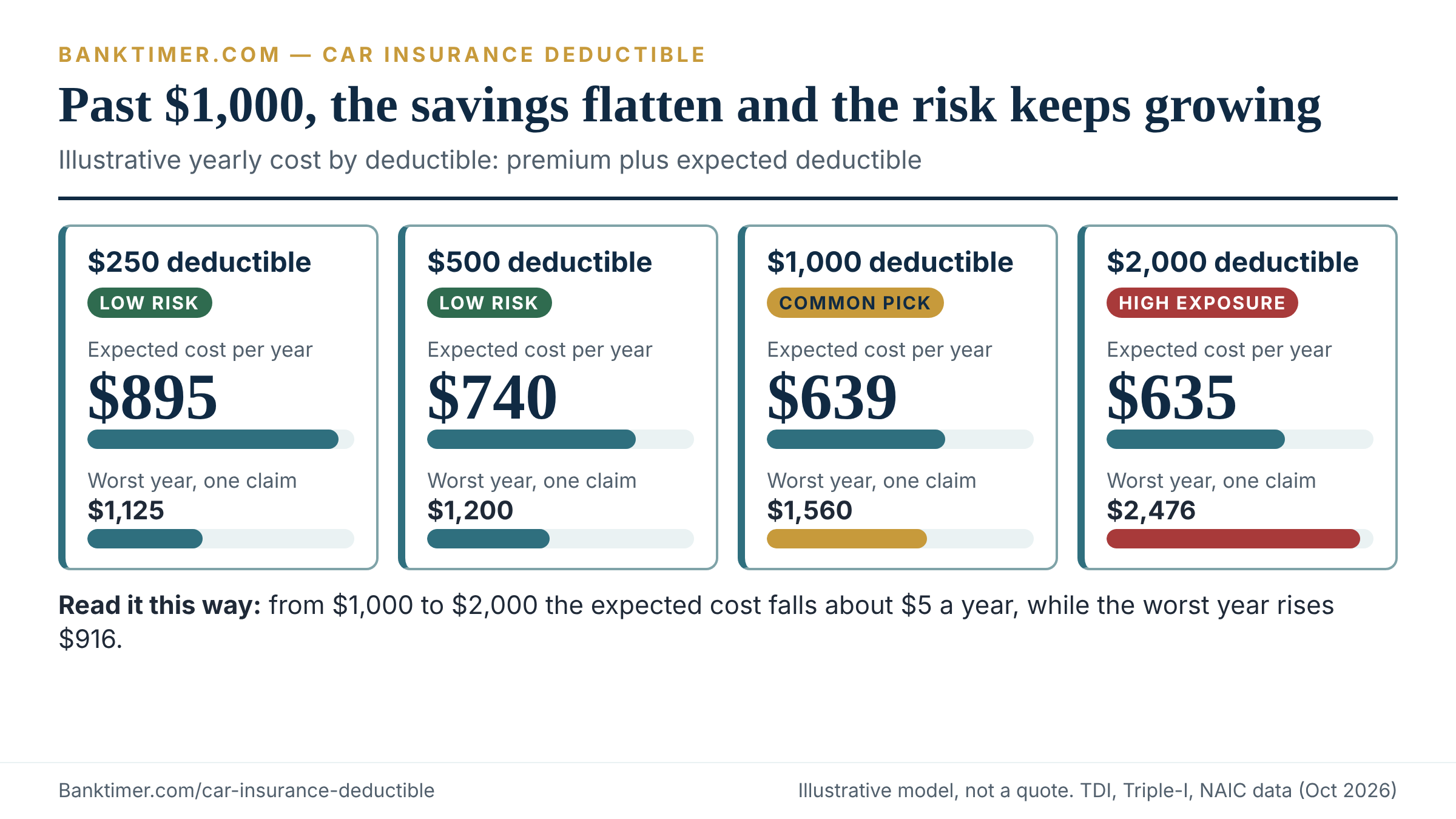
The insight is in the last two rows. Moving from $1,000 to $2,000 saves about $4.55 a year in expected cost and adds $916 to the worst-case year. In this model, that is a poor trade. The step from $500 to $1,000 saves about $100 a year in expected cost. That is why it is a common choice.
Why quotes with different deductibles are not comparable
When you shop, match everything. The NAIC advises asking each company for a revised estimate “using matching coverages/limits” if the quotes differ. A quote with a $2,000 deductible beside one with $500 is a comparison of two different products.
A practical way to do it: request each quote at two deductible levels, such as $500 and $1,000. You then see both the base price and each company’s discount for the step. A company with the lowest price at $1,000 may not be the lowest at $500.
What else moves the number
Your state controls part of the pricing machinery. States regulate auto rates through filing systems, and the details differ. You can usually confirm which insurers are licensed, and sometimes their complaint records, through your state insurance department. Our companion piece on an insurance premium increase covers why renewal prices change even when you file nothing.
For this decision, one point matters: do not treat a deductible discount as permanent. Insurers reprice at renewal, and the percentage you earn this year may not hold next year.
Break-Even Math: How Many Claim-Free Years Pay Back the Extra $500
Break-even answers a narrow question. Suppose you raise your car insurance deductible by $500 and never file a claim. How long until the premium savings equal the extra $500 you would have owed? The formula is simple: extra deductible divided by annual premium savings.
The simple payback
With a $700 premium for collision and comprehensive, the payback depends entirely on the discount you receive. At the 20% ceiling, you save $140 a year and break even in 3.57 years. At 10%, you save $70 and need 7.14 years.
| Discount for $500 to $1,000 | Annual savings on a $700 premium | New premium | Years to earn back $500 | Annual claim chance that erases the gain |
|---|---|---|---|---|
| 10% | $70 | $630 | 7.14 | 14% |
| 15% | $105 | $595 | 4.76 | 21% |
| 20% | $140 | $560 | 3.57 | 28% |
| 30% | $210 | $490 | 2.38 | 42% |
The last column is the useful one. It shows how often you would need to file a claim for the higher deductible to cost more than it saves. At a 20% discount, that is a claim about once every 3.6 years. National data show roughly one collision claim per 24 policyholders each year. A typical driver is far below that line.
The base premium matters too. At a 20% discount, a $500 premium pays back in five years, and a $1,200 premium in about two.
Adding the odds of a claim
Payback in claim-free years is a floor, not a forecast. Odds help. Using the 2024 national rates, the chance of at least one collision or comprehensive claim in a given year is about 7.95%. Over ten years, the chance of at least one claim is about 56%. The expected number of claims is about 0.8.
That means more than half of ten-year periods contain a claim. Many of them still come out ahead, because one extra $500 is smaller than ten years of $140 savings. The next section shows where it flips.
The year of the claim decides the outcome
The extra $500 is a one-time cost when a claim lands, while the savings accrue steadily. So the sequence matters more than the average. A claim in year one leaves you $360 behind. A claim in year four leaves you $60 ahead.
| Year of your first claim | Premium savings to date | Extra deductible owed | Net result |
|---|---|---|---|
| Year 1 | $140 | $500 | -$360 |
| Year 2 | $280 | $500 | -$220 |
| Year 3 | $420 | $500 | -$80 |
| Year 4 | $560 | $500 | +$60 |
| Year 6 | $840 | $500 | +$340 |
| Year 10 | $1,400 | $500 | +$900 |
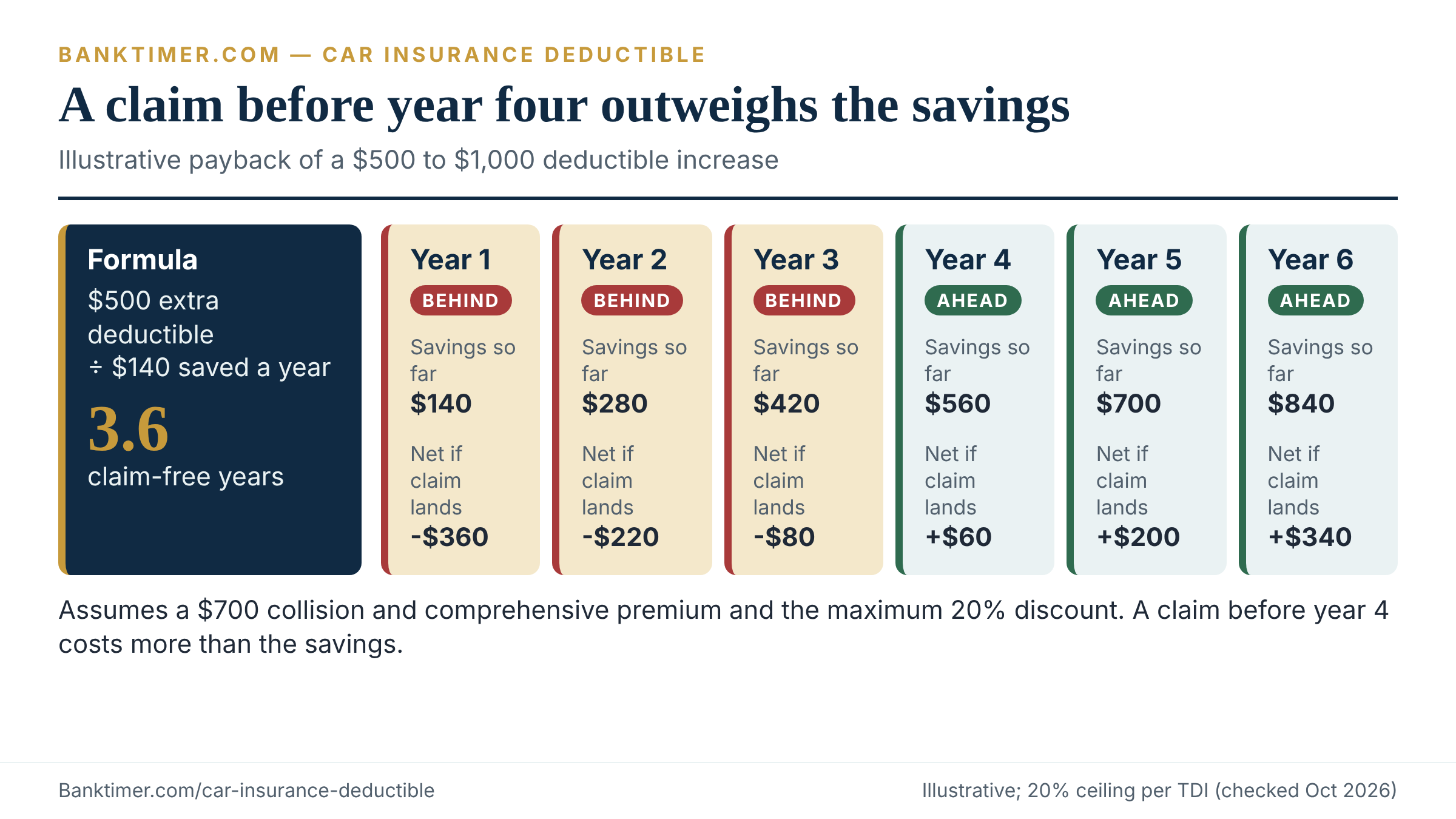
Run the odds through that table and a pattern appears. Under the same assumptions, you have about a 22% chance of being behind after three years. That falls to about 5% after five years and about 4% after ten. Later years rarely hurt, because it takes several claims to erase a decade of savings.
Where the math can mislead you
Five caveats keep this from being a guarantee.
- Averages hide your record. National claim rates blend careful and accident-prone drivers. If you have filed two claims in five years, use your own history.
- Small claims change the extra cost. If a claim falls between $500 and $1,000, the higher deductible costs you less than $500 extra. The lower deductible would have paid less too.
- The discount percentage is a guess until you get a quote. It may be well below 20%.
- A claim can raise your premium. That is a separate cost, covered later in this article.
- Repricing can erase the discount. The saving only exists while the insurer keeps offering it.
A household has a three-year-old sedan with a $700 collision-and-comprehensive premium at a $500 deductible. They raise both deductibles to $1,000 and receive a 20% discount, saving $140 a year. This is an illustrative example, not a quote.
In year two, hail causes $5,200 of damage. Under the $500 deductible they would have paid $500. Under the $1,000 deductible they pay $1,000, so the choice costs them $500 extra. They have collected $280 in savings, so they are $220 behind at that point.
If the hail had arrived in year six, they would be $340 ahead. The deductible did not change. Only the timing did.
The reverse trade: paying to lower the deductible
The same math runs backward. Dropping from $1,000 to $500 costs you $140 a year in this model. That buys you $500 less exposure on any claim. To come out ahead, you would need to file a claim more often than once every 3.6 years.
Lowering a deductible can also make sense for a reason other than math. Suppose a $1,000 bill would push you onto a high-interest card or delay a repair. Then the extra premium is buying liquidity insurance. Pricing it at $140 a year is reasonable for some households. The point is to choose it deliberately.
How the Deductible Is Applied to a Payout
The car insurance deductible is subtracted from what the insurer owes, not from what you spent. That distinction matters in three places: repair estimates, total losses, and any gap between the insurer’s valuation and your loan balance.
Repair claims: estimate minus deductible
For a repairable car, the insurer agrees to a covered repair amount. Your deductible comes off that amount. If the shop estimate is $3,800 and your deductible is $500, the insurer pays $3,300. At $1,000 it pays $2,800.
Two cautions apply. The covered amount is what the policy allows, which may differ from the shop’s bill. Colorado’s insurance division suggests asking whether the policy pays for original manufacturer parts or aftermarket parts. If it pays for aftermarket parts and you insist on original ones, you may owe the difference. That comes on top of the deductible.
Total loss: actual cash value minus deductible
When repairs would cost more than the car is worth, the insurer declares a total loss and pays actual cash value (ACV). Maryland’s insurance administration defines the settlement as the fair market value of the car just before the loss. It states plainly: “You will be responsible for payment of your deductible.”
Taxes and fees are state-specific. Maryland says the insurer “must include all applicable taxes and registration fees in the cash settlement offer.” Illinois takes a different route. The company owes sales tax and transfer and title fees if you buy a replacement within 30 days. It owes only the tax you actually incur. Check your own state before assuming either.
A worked total-loss example
A driver owes $15,800 on a car valued at $12,400. The state requires $900 of taxes and fees in the offer. The driver’s deductible is either $500 or $1,000. The figures are illustrative, and the taxes-and-fees line stands in for whatever your state requires.
The table shows how the deductible flows into the shortfall.
| Line item | $500 deductible | $1,000 deductible | Note |
|---|---|---|---|
| Actual cash value | $12,400 | $12,400 | Illustrative valuation |
| Taxes and fees included | $900 | $900 | Varies by state |
| Deductible subtracted | -$500 | -$1,000 | Your choice |
| Insurer payout | $12,800 | $12,300 | ACV plus fees, minus deductible |
| Loan payoff owed | $15,800 | $15,800 | Illustrative loan balance |
| Shortfall you still owe | $3,000 | $3,500 | Payoff minus payout |
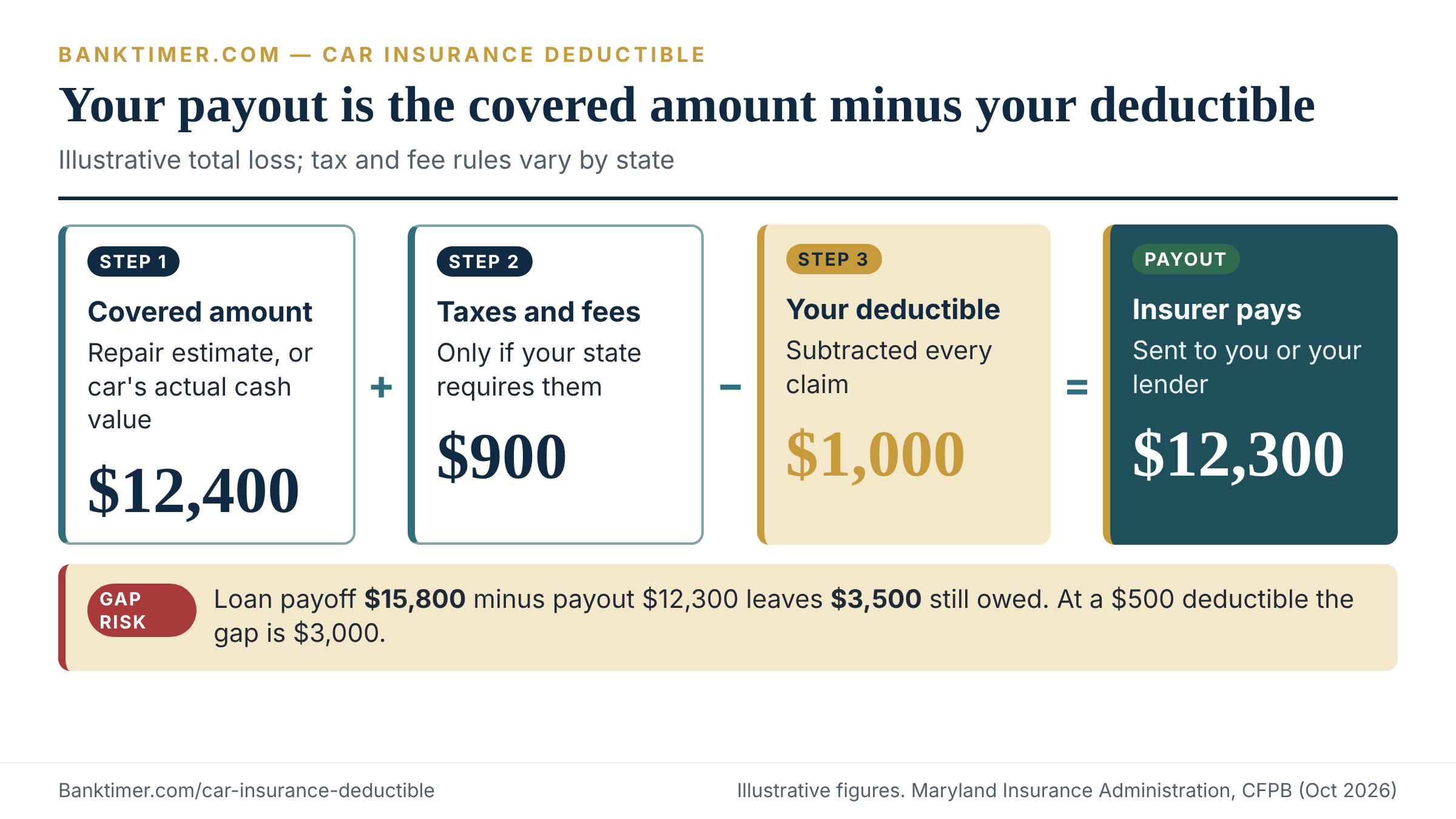
The deductible is dollar-for-dollar in the shortfall. Raising it by $500 raises the gap by $500, and that gap is yours unless another product covers it. If the state did not require taxes and fees in the offer, this example’s shortfall would be $4,400 at a $1,000 deductible.
Wear, depreciation and betterment deductions
Insurers can reduce a payout for wear and tear, and rules vary. Illinois, for example, allows deductions for wear, missing parts and rust. It caps that deduction at $500, and the insurer must itemize each one. TDI’s guide says a settlement is the car’s value “minus depreciation.”
Those adjustments sit on top of the deductible, not inside it. A low ACV from a valuation tool is the most common dispute. Maryland tells owners to answer with comparable-vehicle quotes and ads. It also says the insurer must respond to a written request for its valuation method within seven business days. Our guide to replacement cost versus actual cash value shows how the two settlement bases differ.
Rental reimbursement and loss of use
A deductible does not cover the cost of being without a car. Rental reimbursement is separate coverage. Colorado’s guide notes that policies usually cap both the daily dollar amount and the number of days. Oregon’s uninsured motorist property damage statute explicitly excludes loss of use.
So a longer repair can cost you more than the deductible. A $1,000 deductible plus ten days of rental beyond your cap is a bigger bill than $1,000. Ask the shop how long the repair will take before you decide how to proceed.
Loan payoff and GAP coverage
If you owe more than the car is worth, a total loss leaves a gap. The Consumer Financial Protection Bureau (CFPB) explains guaranteed asset protection (GAP) insurance. It “covers the difference (or gap) between the amount you owe on your auto loan and what your insurance pays.” The CFPB also notes that lenders or dealers generally cannot require you to buy it.
Whether a GAP contract reimburses your deductible varies by contract. Ask directly. A $1,000 deductible may or may not be part of what GAP picks up.
Flat, Percentage and Diminishing Deductibles
Most readers meet the car insurance deductible as a single dollar figure on the declarations page. That is the norm in the state guides cited here, and TDI’s collision example uses a flat $500. But other structures exist, and they change the risk.
Flat dollar amounts are the standard
A flat deductible is a fixed amount for each covered loss, such as $500 or $1,000. It does not change with the size of the claim. A $1,000 deductible is 43% of an average comprehensive claim of $2,306. It is 18% of an average collision claim of $5,489.
Percentage deductibles tie the amount to a share of a value, often of the insured property. They are more familiar on homeowners policies for wind and hail, and our article on the homeowners insurance deductible covers that structure. If your auto policy shows a percentage or a separate hail deductible, ask the agent for the dollar amount on your car.
Diminishing deductible features
Some insurers advertise features that shrink your deductible over time, usually after claim-free periods. The idea is appealing: keep a higher car insurance deductible for the discount, and watch it fall each year you stay out of claims.
Banktimer has not verified any specific insurer’s program for this article, and terms vary by company and state. Evaluate any such feature against five questions:
- How much does the deductible fall each claim-free year?
- Is there a floor, and does it reach zero?
- Does any claim, including a not-at-fault one, reset it?
- Does it apply to collision, comprehensive, or both?
- What does the feature cost in premium?
The final question is the one that decides value. A feature that costs $60 a year and reduces your deductible by $100 each year takes years to pay for itself. Run the same break-even math used earlier.
Glass Coverage: Where State Law Can Change the Deductible
Glass is the one area where state law can override the car insurance deductible on your policy. The rules vary a lot. A driver who learned about “free windshield replacement” in one state may find it does not exist in another.
What Florida, South Carolina and Arizona require
Florida’s statute is the most direct. Section 627.7288 says that the deductible provisions of an auto policy with comprehensive coverage “shall not be applicable to damage to the windshield.” South Carolina’s Code at 38-77-280(B) states that “any automobile physical damage insurance coverage deductible or policy deductible does not apply to automobile safety glass.”
Arizona works differently. A.R.S. 20-264 requires insurers that write comprehensive coverage to offer, as an option, complete coverage for damaged safety equipment without regard to any deductible. Safety equipment includes glass in the windshield, doors and windows, plus the glass, plastic or other material in the lights. The option is something you choose, and the insurer may charge for it.
| State | Rule | What it covers | Catch | Source type |
|---|---|---|---|---|
| Florida | Deductible does not apply | Windshield | Other glass is not addressed by this statute | State statute, s. 627.7288 |
| South Carolina | Deductible does not apply | Automobile safety glass | Rule sits in the physical-damage coverage section | State statute, 38-77-280(B) |
| Arizona | Insurer must offer zero-deductible option | Windshield, doors, windows, lights | Optional; may cost extra | State statute, A.R.S. 20-264 |
| Tennessee | Company practice | Windshield repair | “Some companies” waive it; no statutory rule shown | State insurance department guide |
| Most other states | Policy terms control | Varies | Glass usually follows your comprehensive deductible | Your policy form |
Banktimer did not verify a glass rule for every state, so the last row is a default, not a survey. If your state is not listed, the safe assumption is that glass follows your comprehensive deductible unless your policy says otherwise.
What this means for the deductible you choose
Glass claims are often small, and a high car insurance deductible swallows them. A $480 windshield replacement under a $500 deductible produces no payout at all. Under a $1,000 deductible, the same is true.
In Florida or South Carolina, that same windshield costs you nothing under the statute, regardless of your comprehensive deductible. In Arizona, it costs nothing only if you bought the safety-equipment option. Tennessee’s guide says only that some companies skip the glass deductible, which is a company choice you must confirm.
Questions worth asking about glass
Ask whether glass has its own deductible. Ask whether repair and replacement are treated differently. Check whether a zero-deductible rule covers side and rear windows or only the windshield. Ask too whether a glass claim is rated against you at renewal. State practices differ, and the answer is policy- and state-specific.
Fault, Subrogation and Getting Your Deductible Back
A car insurance deductible feels different when someone else caused the crash. You did nothing wrong, yet the first dollars of repair come from you. Whether you recover them depends on a process called subrogation. It also depends on whether the at-fault driver can be found and insured.
You pay first, even when you are not at fault
Nebraska’s insurance department puts it bluntly. In its words, “you will have to pay this deductible any time you file a claim with your insurance company – even if you are not at fault for the damage.” That describes a claim under your own collision coverage.
You have another route. TDI notes that “you don’t have to pay a deductible for claims against another driver’s insurance company.” If the other driver is insured and clearly at fault, you can pursue their liability coverage and skip your deductible. The trade-off is speed and control. You depend on another insurer’s investigation. A fault dispute can leave you without a car or a check for weeks.
How subrogation returns your deductible
Suppose your insurer pays your claim and the other driver was at fault. Your insurer can then seek reimbursement from that driver’s insurer. The NAIC’s model claims-practices regulation covers this. Insurers shall, “upon the claimant’s request, include the first party claimant’s deductible, if any, in subrogation demands.” It adds that recoveries “shall be shared on a proportionate basis” with you, unless the deductible was otherwise recovered. It also bars expense deductions from your deductible share unless an outside attorney is retained.
That language comes from a model regulation. Each state decides whether to adopt it and in what form. Pennsylvania’s regulation, 31 Pa. Code 146.8, uses nearly identical wording. Ask your insurer how it handles deductible recovery, and ask your state insurance department if the answer is vague.
A worked recovery example
Proportionate sharing means a partial recovery returns only part of your deductible.
A repair totals $4,200. Your deductible is $1,000, and your insurer pays $3,200. The table shows what happens if the at-fault side covers different shares of the loss. All figures are illustrative.
| Share of loss recovered | Amount recovered | Returned to you | Insurer keeps | Your net deductible cost |
|---|---|---|---|---|
| 100% | $4,200 | $1,000 | $3,200 | $0 |
| 80% | $3,360 | $800 | $2,560 | $200 |
| 50% | $2,100 | $500 | $1,600 | $500 |
| 0% | $0 | $0 | $0 | $1,000 |
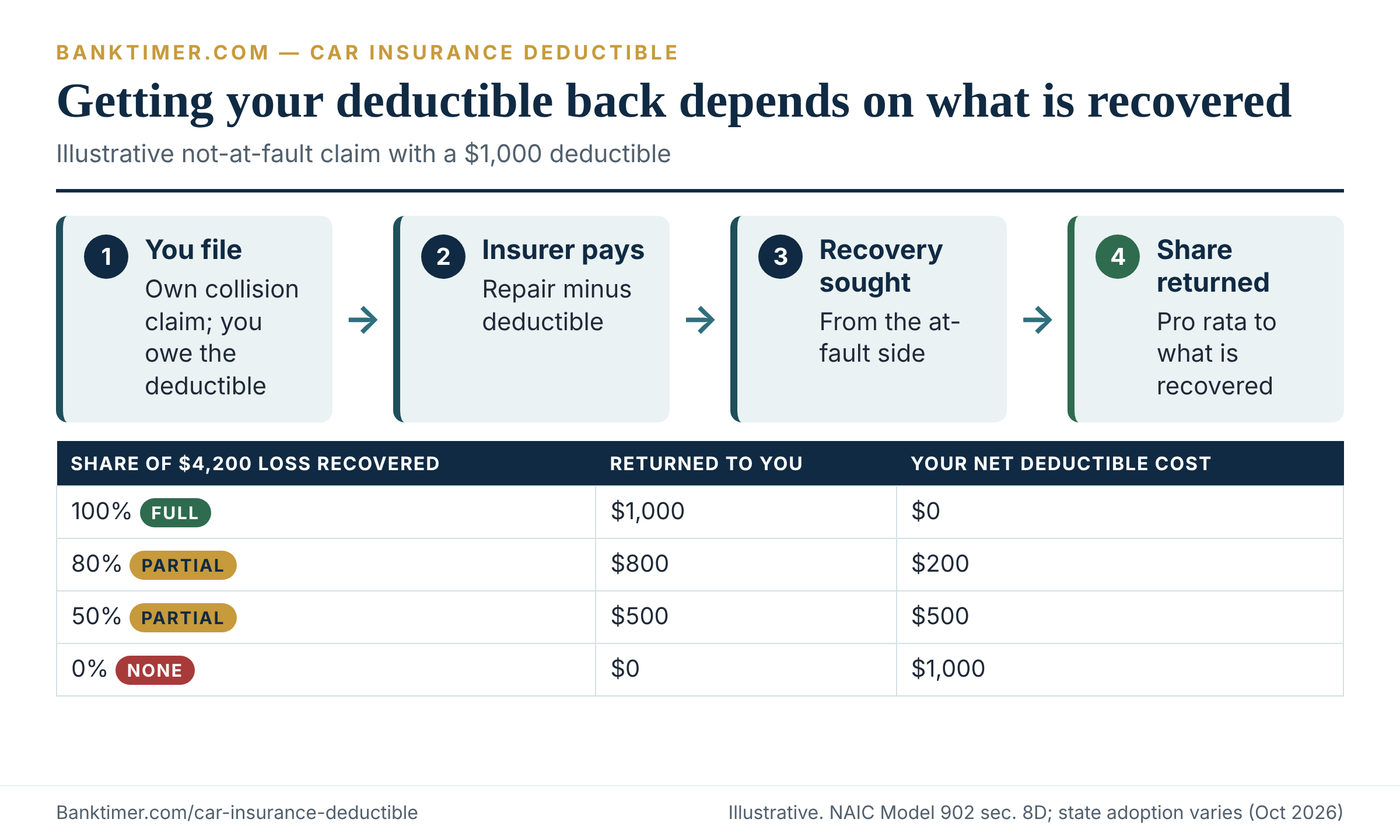
Shared fault is a common reason for a partial result. In states that split blame by percentage, a 20% share for you can cap recovery near 80%. Recovery can also take months. Do not count on it when you decide how much cash to keep available.
When recovery fails
If the other driver is uninsured or unidentified, recovery may be zero. A driver insured only for a state-minimum amount may produce a partial result. Two products address that gap, and both are state-specific.
Uninsured motorist property damage (UMPD) coverage pays for your car when an uninsured driver hits it. It often has its own deductible. Oregon’s statute, for instance, excludes the first $200, or $300 in a hit-and-run. A collision deductible waiver is a different product that waives your collision deductible when another driver causes the damage. Progressive’s help page says it offers waivers only in California and Massachusetts. It adds that in California you typically choose between a waiver and UMPD. That is one insurer’s current policy, not a rule for every company. For the broader coverage, see our guide to uninsured motorist coverage.
Why recovery changes the deductible decision
Recoverable claims matter less for deductible choice. If you are rear-ended by an insured driver, a $1,000 deductible is likely a temporary loan, not a loss. Unrecoverable claims, including at-fault collisions, hail, theft and deer strikes, are where the deductible is a final cost.
So weigh your risk by claim type. A driver in hail country may face more comprehensive risk. A city driver who parks on the street may face more hit-and-run damage. A rural commuter may face more animal strikes. In each case, the deductible you pick works as a stop-loss on losses you cannot pass to someone else.
Should You File at All? Claims, Surcharges and the Small-Claim Trap
A higher car insurance deductible changes your behavior, and that is where much of its value comes from. A $1,000 deductible discourages you from filing a $1,400 claim, which would pay only $400. The Tennessee-hosted consumer guide calls a higher deductible “a good way to save money on your auto insurance premium,” and notes it can mean fewer claims.
The surcharge arithmetic
Filing a claim can raise your premium for several years. Texas regulators say most home and auto claims can trigger an increase. The size varies by insurer and state, so the next calculation is illustrative.
Assume a $1,500 annual premium and a 25% surcharge for three years after an at-fault claim. The surcharge costs $1,125. That makes the true cost of filing the deductible plus $1,125. For a $1,000 deductible, a claim has to exceed about $2,125 to leave you ahead on paper.
| Claim size | Insurer pays after $1,000 deductible | Illustrative 3-year surcharge | Net benefit of filing |
|---|---|---|---|
| $1,400 | $400 | $1,125 | -$725 |
| $2,000 | $1,000 | $1,125 | -$125 |
| $3,000 | $2,000 | $1,125 | +$875 |
| $5,000 | $4,000 | $1,125 | +$2,875 |
At a $500 deductible, the break-even claim size in this model is $1,625. That is why the deductible and the claim threshold move together. Pick a higher deductible and you are, in effect, deciding to pay for small losses yourself.
What state regulators say about rate effects
TDI’s consumer page lists claims that cannot raise your premium. One example is a claim the company did not pay, such as a denial for damage the policy does not cover. The page adds that calling your company or agent with questions cannot trigger an increase. It also points out that insurers can see nationwide claim records through CLUE reports.
Those rules come from Texas. Another state may treat not-at-fault claims, glass claims or comprehensive claims differently. If your claim could go either way, ask your agent a hypothetical question before filing. TDI says a call with questions cannot trigger an increase in Texas, and you should confirm the same for your state. Our guide on insurance premium increases goes deeper into the rating side.
What to do with a claim just above the deductible
Claims just over the deductible are the hardest call. A $1,200 repair under a $1,000 deductible pays you $200 and may cost you $1,125 in later premium. Many households skip that claim and pay the shop directly.
Skipping a claim does not mean skipping reporting. Some policies require prompt notice of an accident. A delayed report can complicate a later claim if the other driver files one. Read your policy’s notice clause, or ask your insurer how it wants a “report only” accident handled. Our insurance claim process guide covers the steps.
Lenders, Leases and State Minimums: Who Sets the Floor
Your freedom to choose a car insurance deductible has limits. The first is the law, which sets a floor for liability coverage. The second is your loan or lease. It can set a ceiling on the deductible and a floor on the coverage.
State minimums versus lender requirements
The NAIC notes that most states require a basic level of liability coverage, made up of bodily injury and property damage. Collision and comprehensive are optional by law, but lenders may require them, according to the same page. That means a driver with a paid-off car can decide freely, while a borrower often cannot.
So the “required” label depends on whom you ask. The state requires liability, and the lender requires collision and comprehensive. Neither requires a particular deductible by law. A cap on the deductible, if any, is in your loan or lease contract and varies. Our guide to full coverage car insurance explains why that popular phrase is vague.
What happens if you let required coverage lapse
If your loan requires insurance and you do not keep it, the lender can buy a policy and bill you. The CFPB calls this force-placed insurance. It says the coverage “protects only the lender, not you.” It also says it is “usually a lot more expensive than what you can obtain by finding an insurance policy yourself.” Raising a deductible to cut your premium is fine. Dropping required coverage to save money is not.
Should you drop collision on an older car?
Triple-I offers a rule of thumb: “If your car is worth less than 10 times the premium, purchasing the coverage may not be cost effective.” The rule is a prompt to check, not a verdict. The table uses an illustrative $460 collision premium, close to the national average, and a $1,000 deductible.
| Car value | Maximum payout after $1,000 deductible | Premium as share of maximum payout | Value divided by premium | Passes the 10x rule? |
|---|---|---|---|---|
| $3,000 | $2,000 | 23.0% | 6.5x | No |
| $5,000 | $4,000 | 11.5% | 10.9x | Barely |
| $8,000 | $7,000 | 6.6% | 17.4x | Yes |
| $15,000 | $14,000 | 3.3% | 32.6x | Yes |
On a $3,000 car, you pay $460 a year to insure at most $2,000 of loss. If you cannot afford to replace the car without that payout, dropping collision is risky. If you could replace it from savings, dropping it may be rational.
Consider what you give up. You lose payment for damage from an at-fault crash or from hitting a pole. You also lose payment for any collision that the other driver’s insurance does not cover. You also lose coverage that a lender may require. And the math tightens on a cheap car: a $1,000 deductible on a $3,000 car caps the payout at $2,000 before any other adjustment.
Can You Actually Pay It? Cash Buffers and the Cost of Financing a Deductible
A car insurance deductible is only as good as your ability to pay it. A $1,000 deductible that you cannot cover turns a covered claim into a delayed repair. It can also become a payment-plan negotiation or a credit card balance. The savings from the higher deductible shrink fast when interest enters.
What the Federal Reserve survey shows about cash on hand
The Federal Reserve’s 2025 household survey came out in May 2026. It found that 63% of adults would cover a hypothetical $400 emergency expense using cash, savings or a credit card paid off at the next statement. That share is unchanged from the prior three years and below the 68% recorded in 2021.
The survey also found that 59% of adults had a major unexpected expense in the prior twelve months. A major vehicle repair or replacement was the most common, reported by 30% of adults. A $1,000 deductible is two and a half times the $400 test. If roughly a third of adults cannot cover $400 from cash, at least that many cannot cover $1,000 without borrowing. A monthly set-aside closes that gap, and the monthly budget guide shows how to build one.
The cost of putting a deductible on a credit card
Borrowing to pay a deductible has a price. The table uses an illustrative 22% annual percentage rate (APR), which is not a quote and not a current market average. It assumes equal monthly payments and no new purchases on the card.
| Deductible financed | Repayment term | Monthly payment | Total interest |
|---|---|---|---|
| $500 | 6 months | $88.76 | $32.57 |
| $500 | 12 months | $46.80 | $61.57 |
| $1,000 | 6 months | $177.52 | $65.14 |
| $1,000 | 12 months | $93.59 | $123.13 |
| $2,000 | 6 months | $355.05 | $130.28 |
| $2,000 | 12 months | $187.19 | $246.27 |
Financing a $1,000 deductible over a year costs about $123 in this example. That is nearly the entire $140 annual premium saving from raising the deductible. A claim paid for on a card can erase most of a year’s benefit. Our explainer on credit card APR shows how card interest compounds.
A sizing rule that works in practice
A practical test is whether you could pay the deductible within seven days from cash, without skipping a bill or touching a card. If yes, the deductible fits your finances. If you would need three to four weeks to gather it, choose a lower one.
Think of the premium savings as a savings plan. If a higher deductible saves $140 a year, set that $140 aside in a separate savings account. After about 3.6 years, you have funded the extra $500. In effect, you become your own insurer for the bottom layer of risk. Our guide to how much to hold in an emergency fund sizes the buffer. The piece on an emergency fund savings account covers where to keep it.
Current Context as of October 2026
Two numbers from the Bureau of Labor Statistics (BLS) shape how the car insurance deductible decision looks this fall. Both come from the consumer price index (CPI) release for August 2026, published September 11.
Premiums are falling while repair costs rise
The BLS reports that the motor vehicle insurance index declined 0.8% in August after falling 0.3% in July. Over the twelve months ending in August, the index was down 5.1% on an unadjusted basis. Over the same twelve months, the index for motor vehicle maintenance and repair rose 5.2%.
The BLS fact sheet explains that its insurance index follows premiums for policies with unchanging driver and vehicle characteristics. It covers collision, comprehensive, liability, medical payments, uninsured motorist and personal injury protection. So the -5.1% is a national, same-policy price measure. Your own renewal depends on your state, insurer and record, and may move in either direction.
What the gap means for a deductible decision
Three practical points follow, and none requires predicting the market.
- A fixed deductible covers less of each repair. With repair prices rising, your $1,000 pays a shrinking fraction of a typical bill. This works in your favor on small claims you never file. It works against you when you compare coverage over years.
- Dollar savings from a higher deductible may be smaller. If a $700 premium falls 5% to $665, a 20% discount saves $133. Payback then stretches from 3.57 to 3.76 years. The change is small, but the direction matters.
- Falling premiums are a reason to re-quote. Get quotes at $500 and $1,000 from your current insurer and at least two others. Triple-I’s advice is to “get at least three price quotes.” A lower base price changes the dollar value of every discount.
What to refresh before you rely on these numbers
The CPI figures update monthly, and the August numbers will be superseded by later releases. Claim frequency and severity figures come from 2024 data. The NAIC premium averages are for 2023. Treat all of them as context, not a forecast. Check your renewal notice for the actual price of each deductible option.
Decision Framework: Five Checks Before You Choose a Car Insurance Deductible
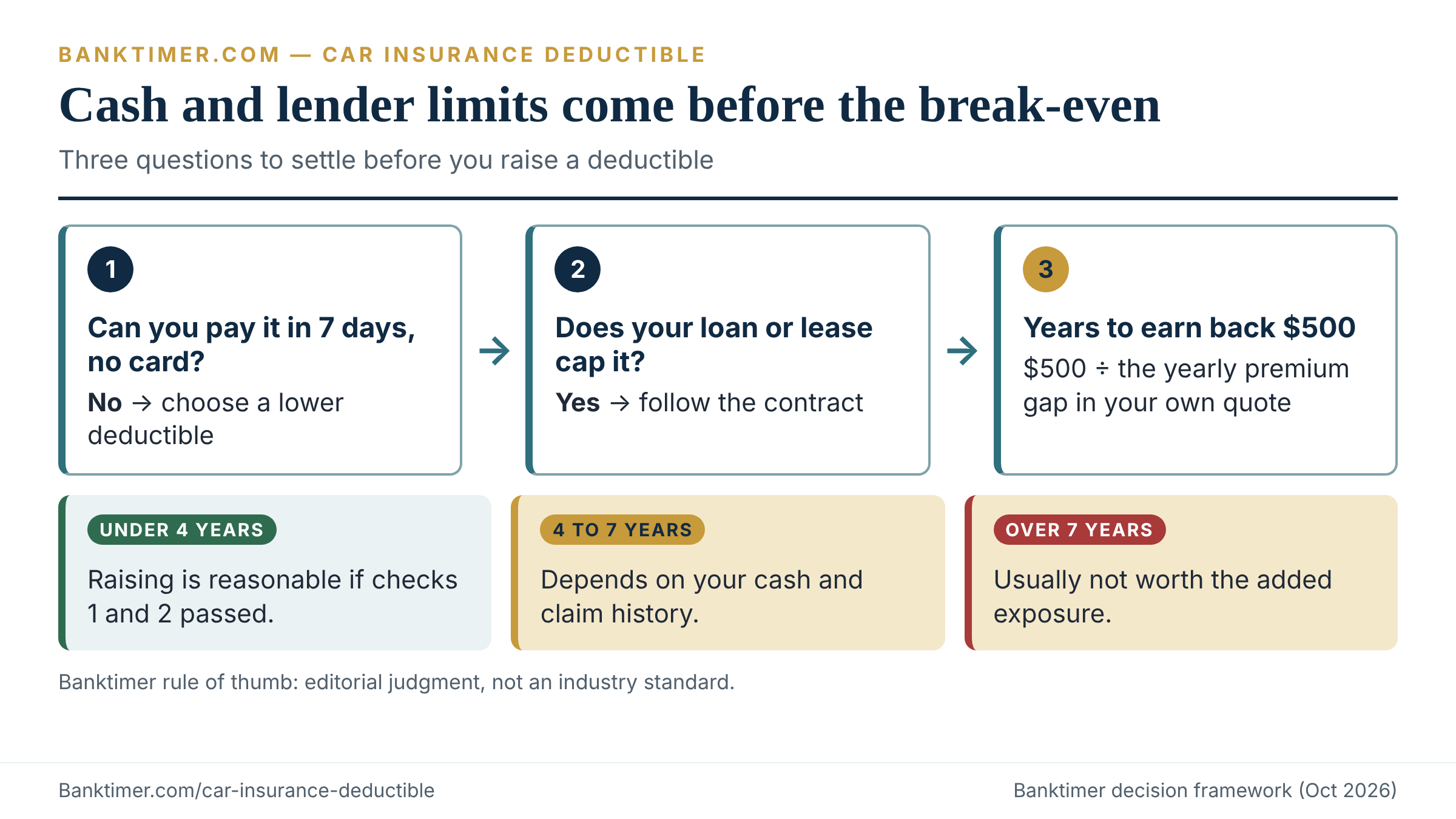
Use these five checks in order. The first two are limits, and the last three are optimizations. If you fail a limit check, stop there.
Check 1: Can you pay it in a week?
Count cash you can reach in seven days without a credit card. If the deductible exceeds that amount, move to a lower option. This check overrides every other check.
Check 2: Does your loan or lease cap it?
Read the insurance clause in your financing contract. It may require collision and comprehensive coverage, and may state a maximum deductible. The amount varies by contract. If you cannot find it, ask the lender in writing.
Check 3: What does the break-even say?
Get the premium at $500 and $1,000 from your own quote. Divide $500 by the annual difference. Here is Banktimer’s rule of thumb. It is editorial judgment, not an industry standard. Under four years is reasonable if you pass Checks 1 and 2. Four to seven years depends on your cash and claim history. Over seven years is rarely worth the added exposure.
Check 4: What kind of claims are likely for you?
Look at your history and surroundings. Hail, theft and animal strikes fall under comprehensive. There, a high deductible swallows a larger share of the average claim. Collision claims are larger on average, so the deductible takes a smaller share. Glass rules in your state can also matter.
Check 5: Does the vehicle value still justify the coverage?
For an older car, compare value, deductible and premium using the earlier table. If the car is worth less than ten times the collision premium, ask whether keeping the coverage still makes sense. If a lender requires it, that decision is not yours.
How the checks play out for different households
The matrix shows leanings for six common situations. These are not recommendations for any individual. They show which variable usually decides.
| Situation | Leaning | Main upside | Main downside | What to verify |
|---|---|---|---|---|
| Paid-off car, $3,000+ in savings, no recent claims | Consider $1,000 | Lower premium; fewer small claims | One bad early year costs $500 extra | Quoted discount for the step |
| Under $1,000 in accessible cash | Keep $500 or lower | Repair stays affordable | Higher premium | Whether the premium gap is modest |
| Financed new car | Follow the contract | Avoids lender-placed coverage | Less freedom to optimize | Maximum deductible in the loan |
| Hail-prone or theft-prone area | Check comprehensive separately | Targets the riskiest coverage | Comprehensive savings are usually smaller | Whether your policy has a special wind or hail deductible |
| Older, low-value car | Compare value to premium | May justify dropping collision | Loss of own-damage coverage | Lender requirement; replacement cash |
| Florida or South Carolina driver | Windshield deductible is waived by statute | Raising comprehensive costs you less on glass | Other comprehensive claims still pay less | Statute applies to your policy |
Mistakes and Red Flags That Cost Real Money
Most car insurance deductible mistakes are not exotic. They come from comparing the wrong quotes, forgetting about a lender, or assuming the deductible works like a health plan.
| Red flag | Why it matters | What to ask | Safer next step |
|---|---|---|---|
| Low premium paired with a very high deductible and minimum liability | Price looks great, but both ends of the policy are thin | What do my limits and deductible look like together? | Fix liability limits first, then tune the deductible |
| Quotes at different deductibles | The cheaper quote may simply carry more of your risk | Can you re-run it at $500 and $1,000? | Request matching coverage and limits |
| A shop offers to “cover” or waive your deductible | Your policy and your state’s rules may not allow it | Will you put that in writing, and does my insurer know? | Ask your insurer and state insurance department first |
| Deductible larger than your cash | A covered claim becomes a debt | What could I pay in seven days? | Choose a lower deductible |
| Raised deductible on a financed car | May breach the loan contract | Does the contract cap it? | Read the insurance clause before changing |
| Assuming glass is always free | Only some states and policies waive glass deductibles | Is glass separate on my policy? | Check your state’s rule and your policy |
| Expecting a not-at-fault claim to be free | The deductible is paid first; recovery can be partial | How does my insurer pursue recovery? | Ask for subrogation handling in writing |
| Owing more than the car is worth | Deductible adds to the shortfall | Do I have GAP, and does it cover the deductible? | Compare payoff to current value |
A policy built on a $2,000 deductible and state-minimum liability limits can show the lowest price on a comparison page. It also leaves you with the highest cash burden after a crash. And it gives the least protection if you injure someone. Price liability limits first. Then choose the deductible as a separate decision.
The costliest error is usually the first one. It happens when a driver compares price, not the structure of the car insurance deductible and limits. Our broader guide to car insurance shows the full coverage menu and the order in which to decide.
Questions to Ask Before You Change Your Deductible
These questions work for an agent, a call center or an online chat. Write down the answers, or ask for them in an email.
- ☐ What is the annual premium for collision and comprehensive at $500, $1,000 and $2,000, side by side?
- ☐ Are my collision and comprehensive deductibles separate, and can they differ?
- ☐ Is there a different deductible for glass, wind, hail or theft?
- ☐ Does my loan or lease contract set a maximum deductible?
- ☐ Will the new deductible apply to claims filed after the change date only?
- ☐ How will you handle my deductible if another driver is at fault?
- ☐ Do you include my deductible in subrogation demands, and how do you share the recovery?
- ☐ Does a claim below $1,500 usually change my premium at renewal?
- ☐ Is there a diminishing deductible feature, and what does it cost?
- ☐ If my car is totaled, how is its value set and are taxes and fees included?
- ☐ Does my rental reimbursement coverage have a daily cap and a day limit?
- ☐ Does my GAP coverage, if I have it, reimburse the deductible?
How the claim process runs, and who controls each step
Timelines vary by state, insurer and the size of the loss. The table shows the order of events and where your deductible enters. Specific deadlines are mostly set by state rules and your policy.
| Stage | Typical timing | Who controls it | What you do |
|---|---|---|---|
| Accident or loss | Same day | You | Photograph the scene; get contact and insurance details |
| Report to insurer | Per your policy’s notice terms | You | Report promptly; ask about the deductible and rental |
| Inspection and estimate | Varies by insurer and shop | Insurer, shop | Get your own estimate if you disagree |
| Total-loss valuation | Varies; Maryland requires a response within 7 business days to a written request | Insurer, state rules | Gather comparable listings; request the valuation in writing |
| Repair and payment | Varies by repair | Shop, insurer | Pay your deductible as directed; keep receipts |
| Subrogation recovery | Varies; can run well after repair | Insurer, other insurer | Ask for updates; confirm your deductible was included |
Documents that protect your deductible and your payout
Good records protect two things: the payout and your claim to a share of any recovery. The table lists what to collect.
| Document | Why it matters | Where to get it | How long to keep it |
|---|---|---|---|
| Declarations page | Shows deductible amounts, limits and endorsements | Insurer’s portal or agent | Until the next renewal replaces it |
| Photos and video of damage | Supports the estimate and fault | Your phone, at the scene | Until the claim and any recovery close |
| Police or incident report | Establishes facts and fault | Local police or state portal | Until the claim and any recovery close |
| Repair estimates and invoices | Shows covered amount and your payment | Shop | Until the claim and any recovery close |
| Total-loss valuation and comparable listings | Supports a challenge to ACV | Insurer; online listings | Until settlement is final |
| Loan statement or payoff letter | Quantifies any shortfall | Lender | Until the loan is closed and the claim is settled |
| Rental receipts | Shows costs against your cap | Rental company | Until reimbursement is complete |
Frequently Asked Questions
How much does a car insurance deductible cost?
A deductible has no price of its own. You pay it only when you file a covered claim, and only up to the loss. The real costs are the premium difference between deductible levels, any rate increase after a claim, interest if you borrow to pay it, and the small claims you absorb. On a $3,800 repair, a $500 deductible means you pay $500 and a $1,000 deductible means you pay $1,000.
Is a $500 or $1,000 deductible better?
Neither wins everywhere. A $1,000 deductible can lower collision and comprehensive premium by as much as 20%, according to Texas regulators. That is $140 a year on a $700 premium in our illustrative model. It pays back the extra $500 in about 3.6 claim-free years. That holds only if you can pay $1,000 quickly and your lender allows it.
Is the deductible per claim or per year?
It is per claim. Texas Department of Insurance guidance explains that the insurer subtracts the same deductible from each separate claim. Three claims in a year with a $500 deductible mean $1,500 out of pocket. Health insurance often uses an annual deductible instead, which is why the two are easy to confuse.
Does liability coverage have a deductible?
No, not in a standard personal auto policy. Liability coverage pays other people for injuries and property damage you cause. Your deductible does not reduce those payments. Collision and comprehensive are the usual deductible coverages. Some states also use deductibles on optional coverages such as uninsured motorist property damage or personal injury protection.
Do I still pay the deductible if the crash was not my fault?
If you claim under your own collision coverage, yes. You pay the deductible first. Your insurer may then seek recovery from the at-fault driver’s insurer and return your share in proportion to what it collects. If you pursue the at-fault driver’s insurer directly, there is no deductible, but the process can be slower.
Does the deductible apply if my car is a total loss?
Yes. The insurer pays the car’s actual cash value, plus taxes and fees where your state requires them, minus your deductible. If you owe more than that payout, you still owe the difference to your lender. GAP coverage may cover it. Ask whether GAP reimburses the deductible.
Can I have different deductibles for collision and comprehensive?
Usually yes. Each coverage has its own deductible, and your declarations page shows both. Some drivers choose a lower comprehensive deductible because comprehensive claims, such as glass and theft, tend to be smaller. Check whether your insurer applies a separate deductible to glass, wind or hail.
Does my deductible apply to windshield damage?
It depends on your state and policy. Florida’s statute says a comprehensive policy’s deductible does not apply to windshield damage. South Carolina’s code says the deductible does not apply to safety glass. Arizona requires insurers to offer a zero-deductible safety-equipment option. Elsewhere, glass usually follows your comprehensive deductible.
Should I file a claim that is just above my deductible?
Often not. A $1,200 repair under a $1,000 deductible pays you $200 and may raise your premium for years. Texas regulators say most auto claims can trigger an increase. Run the illustrative surcharge math in this article with your own numbers, and ask your agent before filing. Still read your policy’s notice terms.
Can my lender require a specific deductible?
Your loan or lease contract can. Lenders may require collision and comprehensive coverage, and the contract may state a maximum deductible. The amount varies. If you let required coverage lapse, the lender can buy coverage for you. The CFPB says that force-placed insurance protects only the lender and usually costs more.
Ask your current insurer for collision and comprehensive premiums at both $500 and $1,000. Divide $500 by the yearly difference. If the answer is under four years and you could pay $1,000 this week, take the higher deductible seriously.
Choose your car insurance deductible by cash first and discount second. In the illustrative model, moving from $500 to $1,000 saves about $140 a year and pays back in roughly 3.6 claim-free years. That math works only if you can write the check within a week, and only if your lender does not cap the deductible. The right number is the one you can pay without borrowing. A deductible applies per claim, and glass, towing and comprehensive rules vary by state and by policy, so check yours before you change anything. A higher deductible lowers the premium. It does not lower the risk of a claim, and it never replaces adequate liability limits. Get quotes at two deductible levels, and keep a small repair fund so that a claim never forces a hard choice.
Methodology
This article draws on primary and official sources checked on October 6, 2026. They include Bureau of Labor Statistics CPI data and NAIC consumer pages. They also include an NAIC model regulation and state statutes from Florida, South Carolina and Arizona. Consumer guides from the Texas, Colorado, Tennessee, Nebraska, Maryland and Illinois insurance regulators round out the set. We also used Federal Reserve survey data and CFPB guidance. Triple-I statistics are secondary summaries of ISO and NAIC data.
All dollar scenarios are illustrative. They use a $700 collision-and-comprehensive premium and a 20% maximum discount drawn from TDI. They also use 2024 national claim rates from Triple-I, citing ISO, and a 22% credit card APR chosen for illustration. Calculations were run in Python and rechecked. The ladder row for a $2,000 deductible uses an assumed extra 15% discount that no source supports.
Rules, deductible discounts and provider terms vary by state, insurer and policy form. This article does not rate any insurer, and quotes are never guaranteed. It is general education, not legal or financial advice. Banktimer is not a lawyer or a financial advisor. For a decision about your own policy, confirm terms with your insurer, your lender and your state insurance department.
Sources
- U.S. Bureau of Labor Statistics, Consumer Price Index news release, August 2026
- U.S. Bureau of Labor Statistics, CPI Table 2, detailed expenditure categories, August 2026
- NAIC, Auto Insurance consumer topic page
- NAIC, Unfair Property/Casualty Claims Settlement Practices Model Regulation (Model 902)
- Florida Statutes, section 627.7288, deductible not to apply to motor vehicle glass (2026)
- Arizona Revised Statutes, section 20-264, damaged safety equipment deductible optional
- South Carolina Code of Laws, Title 38, Chapter 77, section 38-77-280
- Texas Department of Insurance, Deductibles
- Maryland Insurance Administration, Understanding Total Loss
- Consumer Financial Protection Bureau, Am I required to purchase GAP insurance from a lender or dealer?
- Federal Reserve, Economic Well-Being of U.S. Households in 2025 (May 2026)
- Triple-I, Facts + Statistics: Auto insurance