

By the Banktimer Editorial Team · Published
Banktimer is an independent U.S. consumer-finance publication. Our editors draw on primary and official sources first, such as the CFPB, FDIC, Federal Reserve, and FTC, along with statutes, regulations, and providers’ own agreements and fee schedules. Then we add worked examples and decision tools. Our goal is the most useful, best-supported explanation the sources available to us at the time of writing allow.
This article is general information, not legal, tax, investment, insurance, or financial advice, and reading it does not create a professional relationship with Banktimer. Rates, fees, limits, and rules change, and they vary by state, provider, and contract, so confirm current terms with your bank, lender, insurer, or the agency named in the article before you act. Examples are illustrative unless labeled otherwise. Banktimer is not a bank, lender, insurer, or financial advisor, and we are not responsible for decisions or losses that result from relying on this content. For advice about your own situation, talk to a licensed professional.
A beneficiary designation is the instruction on file with a bank, brokerage, retirement plan or insurer that names who receives an account when you die. It works outside probate. The holder pays the named person directly, usually after a death certificate and a claim form. It does not reread your will, your divorce decree or your family’s expectations.
Dana named her then-husband as beneficiary of her 401(k) in 2012. They divorced in 2019. She rewrote her will to leave everything to her two children, but she never touched the 401(k) form. When she dies in 2026, the plan holds $380,000 and her savings account holds $45,000.
The will controls the $45,000. The plan pays the $380,000 to her former husband, because the plan’s records still name him. This is an invented scenario, not a real case, but the rule behind it is real and we trace it in the divorce section below.
The short answer, and the figures worth knowing
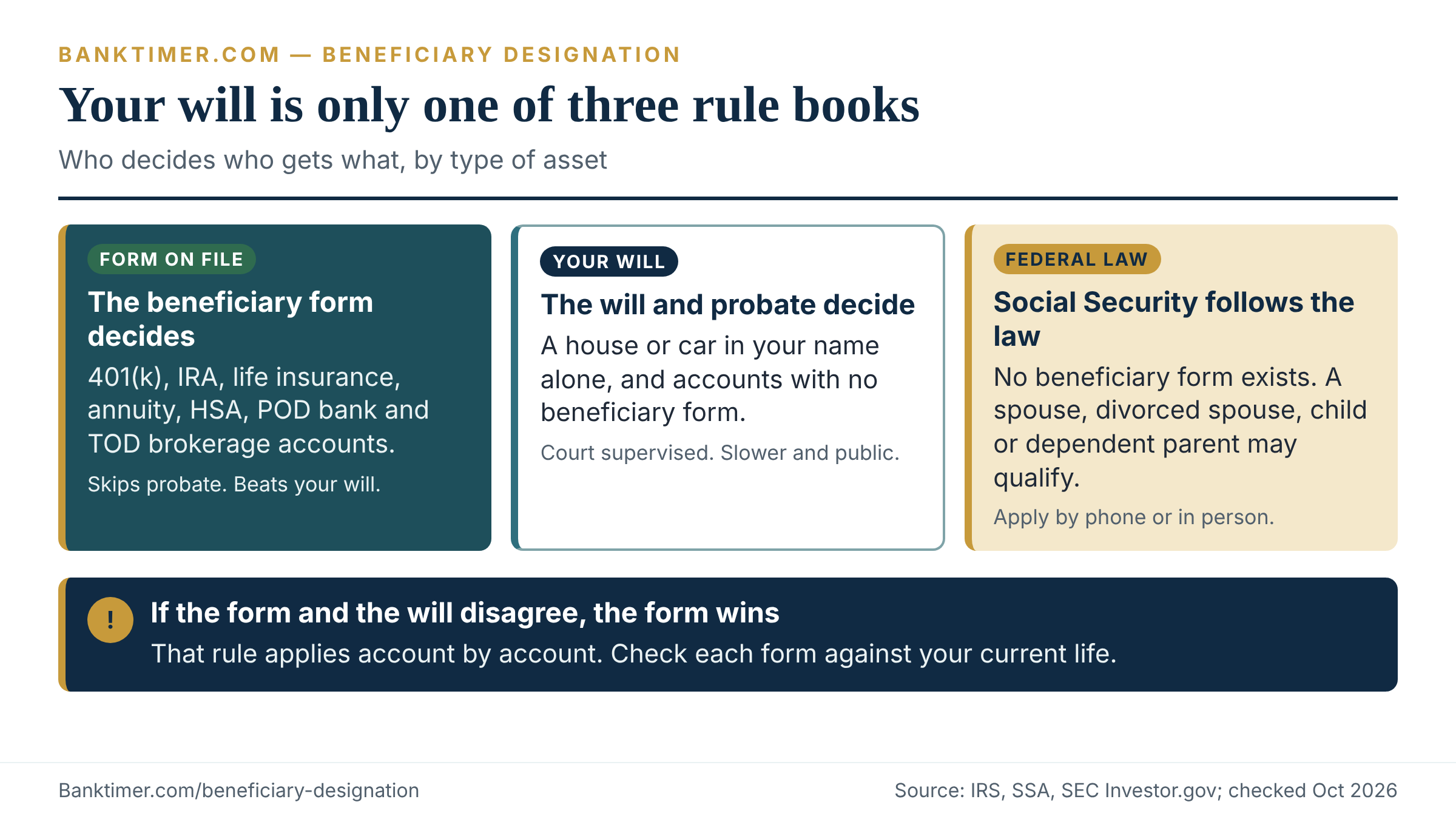
A beneficiary designation is a binding instruction attached to an account or policy. It names who receives that asset at your death. The asset passes straight to that person, outside probate, and in most cases the form beats your will. Retirement accounts, life insurance, annuities, health savings accounts and many bank and brokerage accounts use one. Social Security does not: federal law decides who qualifies for survivor benefits. Check every form against your current life, name backups, avoid naming a minor directly, and keep proof that each update went through.
Six points to remember
The form wins. For accounts with a beneficiary designation, the holder pays whoever its records name. Your will, a handwritten note or a family promise does not change that.
Divorce does not always fix it. Employer retirement plans governed by federal law pay according to plan documents. State laws that cancel an ex-spouse’s designation may not reach them.
Backups matter. A contingent beneficiary decides where money goes if your first choice has died or cannot be found.
Minors need a plan. A child cannot easily receive a large payout directly. A custodian, a trust or a court-supervised guardian usually steps in.
Tax follows the asset. Life insurance proceeds are generally not income. Inherited pre-tax retirement accounts generally are, and most heirs face a deadline.
Paper proof protects you. Keep the confirmation, the date and a copy. Disputes turn on what the institution recorded.
Key figures and dates as of October 2026
Most of the dollar amounts and deadlines in this guide come from a handful of official sources. The table collects them so you can see which ones change a decision.
| Item | Current figure or rule | Why it matters | Source |
|---|---|---|---|
| FDIC coverage for payable-on-death (POD) accounts | $250,000 per owner per beneficiary, up to $1,250,000 per owner at one bank | Large POD balances can exceed coverage | FDIC trust account rules, effective April 1, 2024 |
| Payout deadline for most adult heirs of retirement accounts | Empty the account by December 31 of the 10th year after death | Sets a tax-planning clock | IRS Publication 590-B (2025) |
| Penalty for a missed required distribution | 25% of the shortfall, or 10% if corrected within two years | Some heirs owe annual withdrawals | IRS RMD FAQs (reviewed January 2026) |
| Spousal consent to name someone else on a 401(k) | Written, witnessed by a notary or plan representative | A form without it can be void | IRS; 26 U.S.C. § 417 |
| Benefit decision on a pension-plan claim | Within 90 days, extendable once by up to 90 more | Sets expectations for retirement-plan claims | 29 C.F.R. § 2560.503-1 |
| Social Security lump-sum death payment | $255, only for a qualifying spouse or child; apply within 2 years | Survivor benefits follow rules, not forms | Social Security Administration |
| Federal estate tax exclusion | $15,000,000 per person for 2026 | Few estates owe federal estate tax; forms still decide who gets paid | IRS |
| Life insurance matched by the NAIC locator | $16.99 billion through July 31, 2026 | Lost policies are a common problem | NAIC |
What a beneficiary designation is and why it outranks your will
A contract instruction, not an estate document
When you sign a beneficiary designation, you are adding a term to a contract. The contract might be a deposit agreement, a retirement plan document, an IRA custodial agreement or an insurance policy. That contract says the holder will pay a specific person when you die.
Because the money moves by contract, it never becomes part of your probate estate. Probate is the court-supervised process that applies your will or your state’s default inheritance rules. Assets passing by beneficiary form skip it. That is why they often arrive faster and more privately than assets left in a will.
Who appears on the form
Every beneficiary designation has the same cast, even though the forms look different.
- The owner is the person who controls the account and signs the form.
- The primary beneficiary is first in line to receive the money.
- The contingent beneficiary receives it if the primary has died, cannot be found or declines.
- The holder is the bank, plan administrator, custodian or insurer that pays out.
Some forms add a trustee, a custodian for a minor or a tax-exempt charity. Each of those changes how the payout works, and later sections cover them.
Why the holder will not read your will
A bank teller or plan administrator is not a judge. Their legal duty is to pay the person named in their own records. If they guess wrong and pay someone else, they can face a second claim for the same money. So they follow the paperwork.
For employer retirement plans, federal law makes this explicit. The Employee Retirement Income Security Act (ERISA) requires plan administrators to follow the plan’s governing documents. The Supreme Court applied that rule in 2009 when it let a plan pay a former spouse who was still the named beneficiary. We return to that case in the divorce section.
David Egelhoff named his wife as beneficiary of a Boeing life insurance policy and pension. They divorced in 1994, and he died two months later without changing either form. A Washington law automatically cancelled an ex-spouse’s beneficiary status after divorce. In Egelhoff v. Egelhoff (2001), the Supreme Court held that ERISA overrides that state law for employer plans. His former wife kept the roughly $46,000 in insurance proceeds, and his children from an earlier marriage did not.
What your will still does
None of this makes a will pointless. A will governs everything without a beneficiary form: a house titled in your name alone, a checking account with no POD designation, vehicles, personal property and anything the other documents forgot. It also names an executor and, if you have minor children, a guardian.
Treat the will and each beneficiary designation as one system. The will cannot rescue an account whose form names the wrong person. And the forms cannot appoint a guardian for your children. If your estate plan has a gap, it is usually where one document assumes the other covers it.
Which accounts use a beneficiary designation, and which never will
A beneficiary designation goes by different names. Banks say payable-on-death, brokers say transfer-on-death, and retirement plans just say beneficiary. The function is the same, but the rule book behind it is not. Federal law governs some, state law governs others, and a few depend mostly on the provider’s own agreement.
| Asset | Form or term | Main rule book | If nobody is named or nobody survives | Skips probate? |
|---|---|---|---|---|
| Bank account (checking, savings, CD) | Payable-on-death (POD) | State law, deposit agreement, FDIC or NCUA rules | Varies by bank and state; commonly the estate | Yes, if a named beneficiary survives |
| Brokerage account | Transfer-on-death (TOD) registration | State law and the broker’s agreement | Varies; commonly the estate | Yes, if the broker offers TOD |
| 401(k), 403(b), pension | Beneficiary designation | ERISA, Internal Revenue Code, plan document | Plan document sets the order; often spouse first | Yes |
| IRA or Roth IRA | Beneficiary designation | IRS rules and the custodian’s agreement | Custodian’s agreement decides; often the estate | Yes |
| Life insurance | Beneficiary designation | Policy contract and state insurance law; ERISA if employer-provided | Policy terms decide; often the estate | Yes |
| Annuity | Beneficiary designation | Contract terms; Internal Revenue Code § 72(s) | Contract terms decide | Yes |
| Health savings account (HSA) | Beneficiary designation | IRS rules and the custodian’s agreement | Custodian’s agreement decides | Yes |
| Social Security | None | Federal law | Not applicable | Not applicable |
| Home, vehicle, other titled property | Title; a transfer-on-death deed or title where your state allows one | State property law | Will or state default rules | Only with a TOD deed or similar |
The “if nobody is named” column explains why a blank form is rarely harmless. Defaults exist, but they are the provider’s defaults, not yours.
Bank accounts: payable-on-death
A POD designation on a checking account, a high-yield savings account, a money market account or a certificate of deposit tells the bank to pay a named person when the owner dies. The beneficiary usually presents a death certificate and identification. The money does not wait for an executor.
Joint ownership is a different tool. A joint bank account with survivorship rights passes to the surviving owner automatically, while an account titled as tenants in common follows the will or state default rules, according to the CFPB. If you want a co-owner to have access during your life, joint titling fits. If you want someone to receive the money only after death, POD fits better. Our guide to a bank account after death walks through what the survivor does next.
How naming beneficiaries changes FDIC coverage
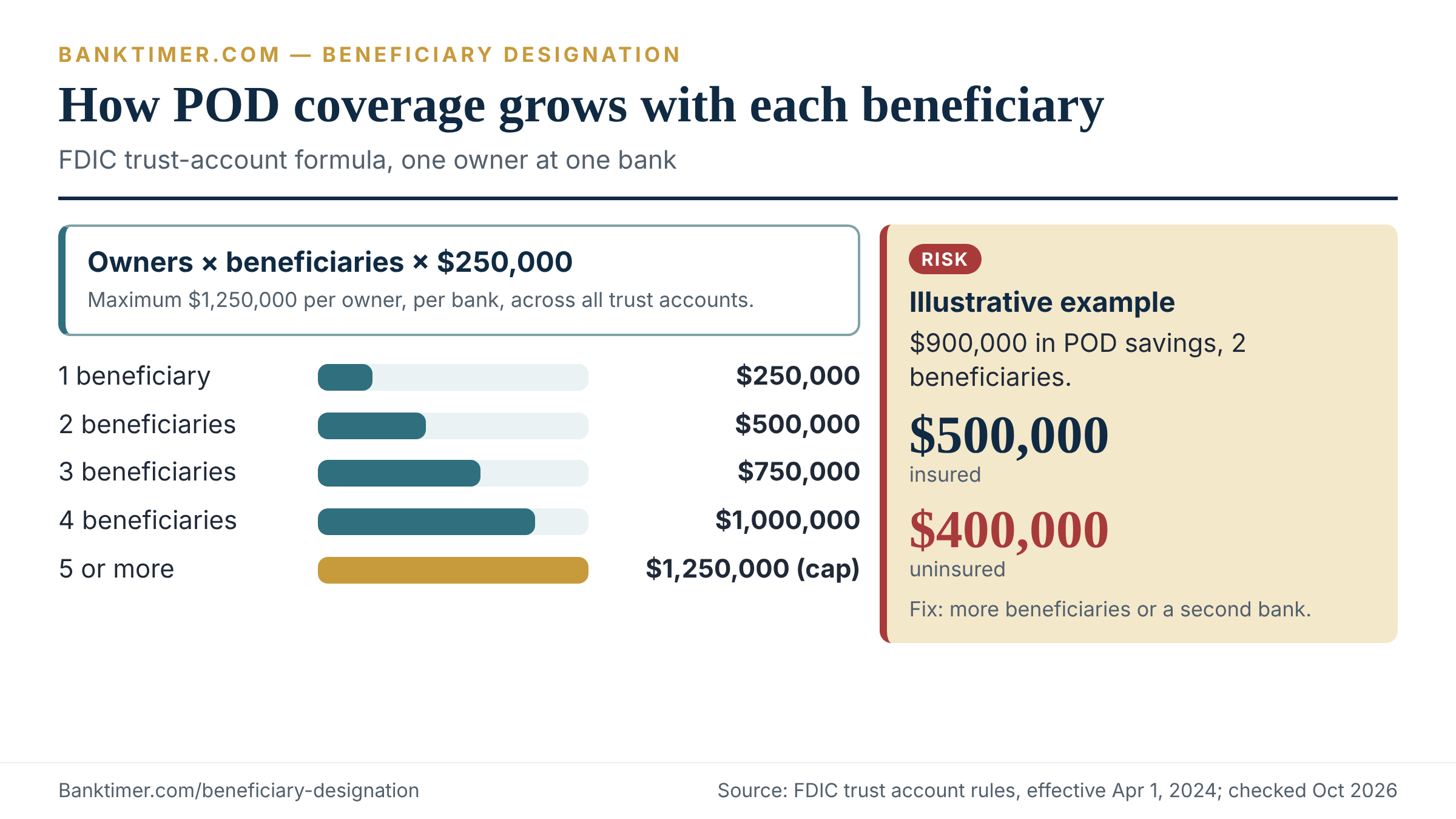
The Federal Deposit Insurance Corporation treats POD accounts as informal revocable trusts. Since April 1, 2024, the coverage formula is the number of owners, times the number of beneficiaries, times $250,000. The cap is $1,250,000 per owner at one insured bank, across all trust accounts.
Two details matter. Beneficiaries must be named in the bank’s own records. And only natural persons and charities or non-profits recognized under the Internal Revenue Code count. If a primary beneficiary is alive when the bank fails, the FDIC counts only the primary, not the contingent.
The table below uses invented balances to show the effect. Money in your own single-owner accounts at the same bank is insured separately, so these figures cover only the POD and trust category.
| Illustrative scenario | Owners | Beneficiaries | Coverage cap | POD balance | Insured | Uninsured |
|---|---|---|---|---|---|---|
| One child named | 1 | 1 | $250,000 | $300,000 | $250,000 | $50,000 |
| Two children named | 1 | 2 | $500,000 | $900,000 | $500,000 | $400,000 |
| Four beneficiaries named | 1 | 4 | $1,000,000 | $900,000 | $900,000 | $0 |
| Joint POD, two children | 2 | 2 | $1,000,000 | $900,000 | $900,000 | $0 |
| Six beneficiaries named | 1 | 6 | $1,250,000 | $1,500,000 | $1,250,000 | $250,000 |
The second row is the common trap. A parent with $900,000 in POD savings at one bank and two children is $400,000 over the line. Adding beneficiaries is one fix. Spreading the balance across banks is the other. Credit unions are insured by the National Credit Union Administration (NCUA) under its own rules, so ask the credit union how it treats POD accounts.
Brokerage accounts: transfer-on-death registration
Transfer-on-death (TOD) registration lets securities pass to a named person without probate, according to the Securities and Exchange Commission’s investor education site. The beneficiary re-registers the securities by sending a death certificate and an application to the transfer agent or broker. State law governs TOD registration, and a brokerage can decide not to offer it.
That last point surprises people. If you assumed your brokerage account had a beneficiary, check the account statement or the registration page. Many accounts do not, and an account without one generally falls into the probate estate.
Employer plans: 401(k), 403(b) and pensions
Employer retirement plans are where beneficiary designation rules carry the most weight. They often hold the largest balance a person owns, and ERISA adds a layer that other accounts lack.
Two features stand out. First, the plan follows its own documents, so the form in the recordkeeper’s system controls. Second, a married participant’s spouse has built-in rights, which we cover in the spouse section. If you changed jobs several times, you may have several old plans, each with its own form. Each one needs a review.
The Department of Labor runs a free Retirement Savings Lost and Found database for your own forgotten plans. It searches only by your own Social Security number, so it cannot trace a deceased person’s benefits.
IRAs and Roth IRAs
An individual retirement arrangement is not an employer plan, so ERISA’s spousal-consent rules generally do not apply. The IRA custodian’s agreement governs, along with IRS distribution rules and state law. Some custodians provide a default order if you name no one, such as spouse first and then the estate. Others do not.
This matters most for married owners in community property states, where state law may give a spouse an interest that the form does not mention. Nine states follow community property rules, according to IRS Publication 555: Arizona, California, Idaho, Louisiana, Nevada, New Mexico, Texas, Washington and Wisconsin. Other states have optional versions. If you live in one, ask an estate attorney how it interacts with your IRA.
Life insurance and annuities
A life insurance policy pays its death benefit to the beneficiary on file with the insurer. An employer-provided policy is typically governed by ERISA. An individual policy follows state insurance and contract law. The difference matters after a divorce, as the next section shows. For coverage types, exclusions and claim mechanics, see our guide to the life insurance beneficiary.
Annuities work similarly, with extra tax rules. For a non-qualified annuity, federal law generally requires the contract’s value to be paid out within five years of the holder’s death. A named beneficiary may instead take life-expectancy payments that begin within one year, and a surviving spouse may step into the owner’s shoes. Check the contract itself, because the issuer’s terms control the options.
Health savings accounts
An HSA with a spouse as beneficiary becomes the spouse’s own HSA. Any other beneficiary receives a different result. Under IRS Publication 969, the account stops being an HSA, and its fair market value becomes taxable to the beneficiary. Qualified medical expenses that the beneficiary pays for the decedent within one year reduce the taxable amount. If the estate is the beneficiary, the value lands on the decedent’s final income tax return.
Social Security has no beneficiary form
There is no Social Security beneficiary designation. The law defines who qualifies. According to the Social Security Administration, a surviving spouse, surviving divorced spouse, unmarried child or dependent parent may be eligible for monthly survivor benefits based on the worker’s earnings.
There is also a one-time lump-sum death payment of $255. It goes to a qualifying spouse or child, and the application must be filed within two years of the death. Survivors apply by phone at 1-800-772-1213 or in person at a local office. Online applications are not available for survivor benefits, according to SSA’s FAQ.
What passes by will instead
Anything without a beneficiary form or survivorship title falls into the probate estate. Typical examples include a house in your sole name, a checking account without a POD, vehicles, jewelry, furniture and a brokerage account with no TOD registration. Some states let you extend the transfer-on-death idea to real estate through a recorded deed. Rules and recording requirements vary widely, so confirm your state’s version before relying on it.
Primary, contingent and per stirpes: how to word the form
Most beneficiary designation problems start with wording, not with law. A form that names “my kids” or leaves a share blank can send money somewhere you never intended. The details below take five minutes to get right.
How primary beneficiaries share the money
You can name one primary beneficiary or several. With several, you assign percentages, and the percentages must total 100%. A form that totals 90% or 110% may be rejected or paid under the provider’s default rule. Some providers split equally when you leave percentages blank. Others send the form back and leave the old one in place.
Equal shares are not always the fair choice. A child who needs more support, a child you have already helped with a house, and a charity may call for different percentages. Whatever you choose, write the percentages explicitly. Do not assume the form will divide things the way you would.
Contingent beneficiaries are your backup plan
A contingent beneficiary receives the money only if every primary beneficiary has died or declined. Without one, the account falls to a default. For many accounts, the default is your estate. That sends the money into probate, exposes it to the estate’s creditors and, for an IRA, can shorten the payout window. IRS Publication 590-B applies the five-year rule to an estate that inherits an IRA from an owner who died before the required beginning date.
Name at least one contingent beneficiary on every account. If you have grandchildren, consider whether you want them to inherit when a child dies first. That is where per stirpes comes in.
Per stirpes, per capita and the wording trap
Per stirpes is Latin for “by roots” or “by branch.” If a named child dies before you, that child’s share passes to the child’s own descendants. Under a “surviving beneficiaries” or per capita style of wording, the share instead goes to the other named beneficiaries. Providers define these terms differently, so read the definition printed on your form.
A parent leaves a $300,000 IRA to her three children equally: Ana, Ben and Cal. Cal dies before her, leaving two children, Dee and Eli. Whether Dee and Eli inherit anything depends on one word on the form. The amounts below are invented for illustration.
| Wording on the form | Ana | Ben | Dee | Eli | What happened to Cal’s third |
|---|---|---|---|---|---|
| Children equally, per stirpes | $100,000 | $100,000 | $50,000 | $50,000 | Split between Cal’s two children |
| Children equally, surviving beneficiaries only | $150,000 | $150,000 | $0 | $0 | Redistributed to Ana and Ben |
| Cal’s children named as contingents for his share | $100,000 | $100,000 | $50,000 | $50,000 | Same result, written out by name |
| Three names, form silent on a deceased child | Varies | Varies | Varies | Varies | The provider’s default decides |
The last row is the honest one. If the form says nothing, you are relying on a default you have probably never read. Per stirpes is not better in every family, either. If you would rather your surviving children share everything, say so on the form.
Naming people precisely
A beneficiary designation is only as clear as its names. Use full legal names, dates of birth and relationships. Providers often ask for a Social Security number so they can locate the person years later, and a missing number can delay a claim.
Class wording such as “my children” or “my spouse” creates its own risks. A class can leave out a stepchild you consider your own, include a child born after you signed, or point to a spouse you no longer have. Naming each person individually avoids those disputes. If you name a trust, use its exact title and date as they appear on the trust document, and name the trustee.
Shares can drift without anyone noticing
An unequal split can quietly change over time. Suppose you name one child for 50% and two others for 25% each, and the 50% child dies. Some forms spread that share proportionally among the survivors. Others pay it to the estate. The result may be an outcome nobody would have chosen.
Review each beneficiary designation after every death in the family, not only after weddings and divorces. A funeral changes a beneficiary list as surely as a divorce does.
Spouses, divorce and remarriage: who can override your form
Marriage and divorce create the biggest gap between what people think a beneficiary designation does and what it does. The rules differ sharply by account type, so this section separates federal law, state law and provider policy.
Federal law gives a spouse default rights in employer plans
Under ERISA and the Internal Revenue Code, a married participant in a pension plan generally owes the spouse a survivor benefit. The plan pays it unless the spouse gives up the right in writing. A 401(k) or other defined contribution plan can avoid the annuity rules if it pays the full death benefit to the surviving spouse unless the spouse consents to another beneficiary, according to the IRS.
In practice, that means a married 401(k) participant who wants to name someone else needs the spouse’s signed consent. The consent must be witnessed by a plan representative or a notary public. A narrow exception applies if there is no spouse or the spouse cannot be located, as 26 U.S.C. § 417(a)(2) provides. Plan documents add their own procedures, so ask the plan for its consent form rather than writing your own.
Marco, 58, has a $620,000 401(k) naming his daughter from his first marriage. He remarries and never updates the plan. Under the federal rules, paying anyone other than the new spouse generally requires her written, witnessed consent.
If Marco wants his daughter to receive most of the 401(k), he and his wife need to complete the plan’s consent form together. If he wants his wife to receive it and his daughter to inherit other assets, he can name the wife and plan around it elsewhere. Either way, doing nothing leaves the outcome to the plan’s rules. This is an invented scenario.
IRAs and community property work differently
ERISA’s spousal-consent rules generally do not apply to individual retirement arrangements. An IRA owner can usually name anyone, and the custodian will honor the form. State community property law may still give a spouse a claim, and that is where outcomes diverge.
For employer plans, the Supreme Court has limited that claim. In Boggs v. Boggs (1997), it held that ERISA preempts Louisiana community property law to the extent that law let a deceased non-participant spouse leave an interest in undistributed pension benefits by will. If you live in one of the nine community property states, an attorney should review any plan to leave a spouse out of an IRA.
Divorce does not automatically change a retirement-plan beneficiary designation
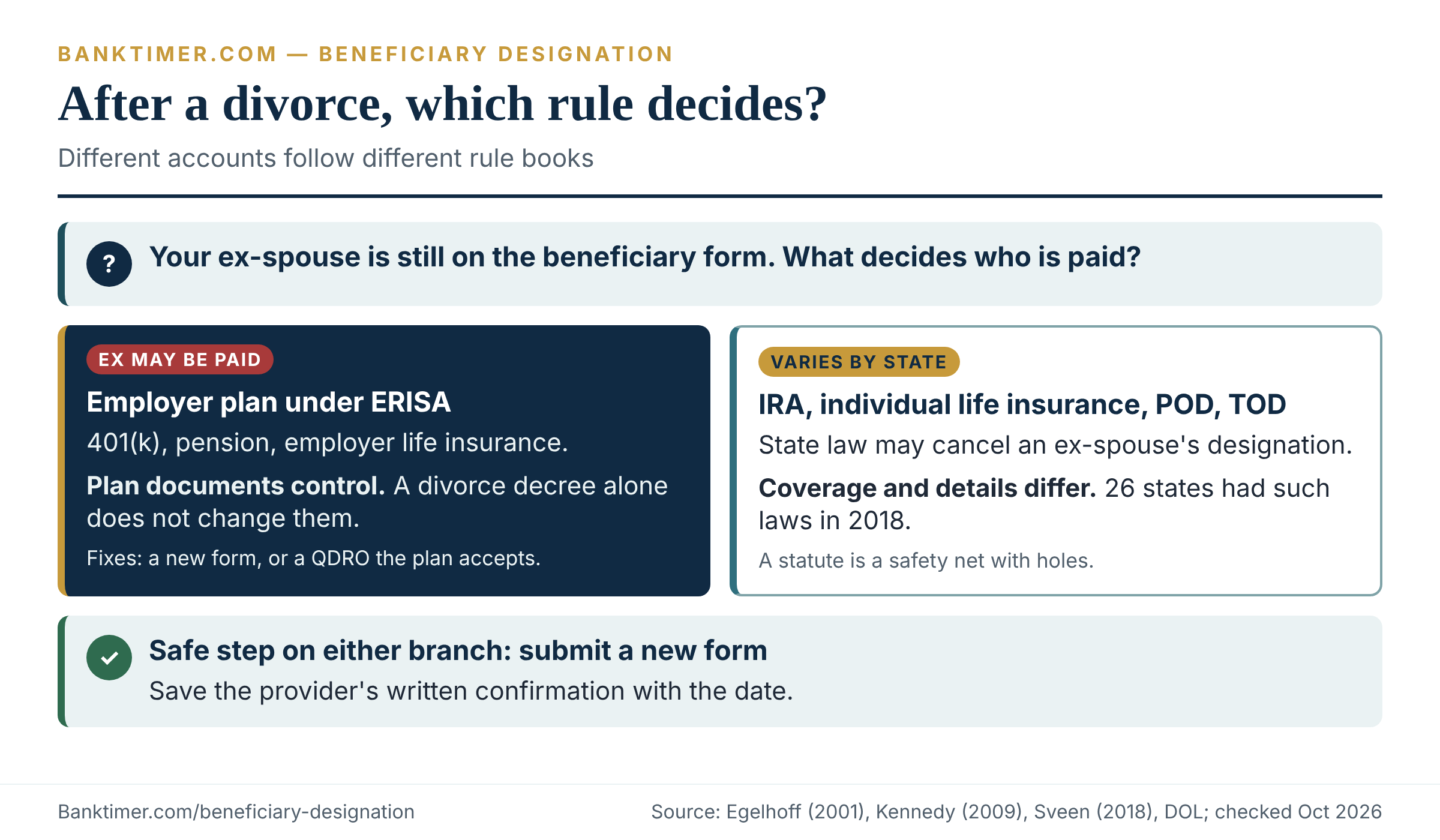
The most expensive version of this problem is the ex-spouse who stays on the form. For employer plans governed by ERISA, the answer is stark. The plan administrator pays according to the plan’s documents, even if a divorce decree or a state law says otherwise.
Two Supreme Court cases set that rule. In Egelhoff v. Egelhoff (2001), the Court held that ERISA overrides a Washington statute that automatically cancelled an ex-spouse’s beneficiary status. In Kennedy v. Plan Administrator for DuPont Savings and Investment Plan (2009), the Court held that a plan administrator acted correctly by paying about $400,000 to a former spouse because the plan documents named her. The decree in that case had given up her rights, but the plan documents still controlled.
The one tool that does bind an ERISA plan
A qualified domestic relations order (QDRO) is a domestic relations order that the retirement plan itself qualifies under its own rules. The Department of Labor explains that only the plan can confirm the alternate payee’s right to benefits. Without a QDRO, an ERISA plan pays under its written terms regardless of what the divorce decree says.
If your decree awards your former spouse a share of your retirement plan, a QDRO is how it gets delivered. If your decree takes your ex-spouse out of the picture, a new beneficiary form is how that gets delivered. The two documents do different jobs, and divorces often need both.
State revocation-on-divorce laws cover other accounts
For life insurance, IRAs, POD accounts and other assets outside ERISA, state law may step in. Many states have statutes that treat an ex-spouse as if he or she had died before you. In Sveen v. Melin (2018), the Supreme Court noted that 26 states had adopted revocation-on-divorce laws substantially similar to the Uniform Probate Code’s. It upheld Minnesota’s version for a life insurance policy, and it observed that the insured can override the rule by sending a change-of-beneficiary form.
State laws differ in what they cover, whether they reach a former spouse’s relatives and whether they apply to accounts opened before the law passed. Do not treat a state statute as a substitute for a new form. It is a safety net with holes.
| Asset | If you change nothing after divorce | Governing rule | Source | What to do |
|---|---|---|---|---|
| 401(k) or ERISA pension | Plan generally pays the ex-spouse if still named | ERISA plan-documents rule | Egelhoff, Kennedy | Submit a new form; use a QDRO if the decree divides benefits |
| Employer-provided life insurance | Same as above | ERISA | Egelhoff | Submit a new form |
| Individual life insurance | Depends on your state’s statute | State revocation-on-divorce law | Sveen | Submit a new form regardless |
| IRA or Roth IRA | Depends on state law and the custodian’s agreement | State law; custodial agreement | State probate code | Submit a new form |
| Bank POD or brokerage TOD | Depends on state law and the account agreement | State law; account agreement | State probate code | Submit a new form |
| Social Security survivor benefits | Not controlled by a form | Federal law | SSA | Ask SSA about divorced-spouse eligibility |
The table makes one point repeatedly. The only column that is the same for every account is the last one. A new form beats guessing about legal rules.
A checklist for the weeks after a divorce
Do not wait for the final decree to start. Many people lose track of old forms during a move or a job change.
- List every account that could have a designation, including old employer plans.
- Request a current copy of each form or a screenshot of the online record.
- Submit new forms. If your decree requires you to keep your ex-spouse as beneficiary on a policy, follow the decree and ask your attorney.
- Ask each plan whether a QDRO is needed or already on file.
- Save the confirmation for each change with the date.
Why the cost of waiting is lopsided
A new form takes minutes. The cost of missing one can be the entire balance. A death that happens before you get around to it freezes the old designation in place. Nothing in the law gives a grieving family an easy path to undo it.
Minors, trusts and estates as beneficiaries
Not every beneficiary can simply receive a check. Children, trusts and estates each change how the payout works, and each can undo a plan that looked tidy on paper.
Why naming a child directly causes trouble
A young child cannot manage a large payout, and most holders will not hand one over. If a minor is named outright, the insurer or plan often requires a court-appointed guardian or conservator before paying. That process takes time, adds legal costs and puts the money under court oversight. When the child reaches the age of majority, the child usually receives whatever is left in one lump sum.
The rules differ by state, by provider and by the size of the payout. A small amount may move more easily than a large one. The safe assumption is that naming a minor directly is a choice with strings attached, even if the form technically allows it.
Three routes to a minor, compared
You can solve the problem in advance by choosing who manages the money and for how long.
| Option | How it works | Best for | Main downside | What to verify |
|---|---|---|---|---|
| Custodian under your state’s Uniform Transfers to Minors Act (UTMA) | An adult you name manages the money for the child until the state’s termination age | Modest sums and simple families | The child gets full control at the termination age; no conditions | Your state’s termination age, which varies |
| Trust for the child | A trustee follows your written rules, such as staggered payouts | Larger sums, blended families, special needs | Cost to draft and maintain; must be coordinated with every form | Trustee choice, trust title and date on the form |
| Trusted adult named outright | The adult receives the money and is expected to use it for the child | Rarely a good idea | No legal duty to the child; the money is exposed to that adult’s creditors and taxes | Whether you could name a custodian instead |
| Minor named directly | A court-supervised guardian or conservator often steps in | Only when no better option exists | Delay, court costs and an outright payout at majority | The holder’s rules for minor beneficiaries |
The third row deserves a warning. A “we’ll sort it out” arrangement feels informal and generous. It leaves the child dependent on one adult’s honesty and finances.
How a custodian arrangement works
Under a UTMA custodianship, you name a custodian on the form with wording like “Jordan Lee as custodian for Mia Lee under the [state] Uniform Transfers to Minors Act.” The custodian manages the funds for Mia. The custodianship ends at the age set by state law, commonly 18 or 21, with some states allowing a later age. The new Uniform Law Commission version recommends allowing up to 25, but the ABA report we cite in the current-context section found no state had enacted it yet.
A custodian is simple and inexpensive. It also gives the child full ownership at the end, with no conditions on how the money is used. If that worries you, a trust gives more control.
When a trust makes sense as the beneficiary
A trust can receive an account at death and distribute it under your rules. It fits when you want staggered payouts, protection for a beneficiary with creditor or relationship problems, or care for a beneficiary with special needs. It also fits a blended family where you want to provide for a spouse now and children later.
A trust works only if it exists and is named correctly. The CFPB notes that a living trust is ineffective until someone puts money or property into it. Naming a trust on a beneficiary form is one way to move an account into it at death. The form must use the trust’s exact title and date, and the trustee needs to know the account exists.
Trusts as beneficiaries of retirement accounts
Retirement accounts add a technical layer. The IRS regulations treat a qualifying “see-through” trust as passing through to its individual beneficiaries, and the payout deadline depends on who they are. A trust that fails the requirements is treated as having no designated beneficiary, which can mean a faster payout and a larger tax bill.
This is not a do-it-yourself area. An estate attorney should draft the trust language and confirm it works with the plan’s rules. Ask the attorney to review each retirement form after the trust is signed.
Why your estate is usually a poor beneficiary
If you name your estate, or leave the form blank and a default sends the money there, the account enters probate. That means delay, public filings and exposure to the estate’s creditors. For an IRA, the estate has no life expectancy, so the payout can be compressed. Under IRS Publication 590-B, an estate inheriting from an owner who died before the required beginning date must empty the IRA within five years.
There are rare cases where naming the estate is deliberate, such as when it needs cash to pay taxes. But for most people, a person or a trust is a better choice than the estate.
A beneficiary who receives public benefits
An inheritance paid outright can affect eligibility for programs with asset limits, such as Medicaid and Supplemental Security Income. A trust built for a beneficiary with disabilities can protect both the inheritance and the benefits. Rules are technical, and mistakes are hard to reverse. Talk to an elder law or special-needs attorney before you name anyone in this situation.
State Medicaid recovery can reach beyond probate
Medicaid is another reason not to assume a beneficiary form shields an account. Federal law requires states to seek repayment of certain long-term care costs from the estates of people who received Medicaid at age 55 or older. States cannot recover from the estate of someone survived by a spouse, a child under 21 or a blind or disabled child of any age.
The definition of “estate” matters. Federal law lets states define it to include assets passing outside probate, including by survivorship or a living trust, under 42 U.S.C. § 1396p(b)(4). Whether your state does depends on its own law, so check with your state Medicaid agency or an elder law attorney.
Inherited retirement accounts: the 10-year rule and the tax clock
Retirement accounts are where a beneficiary designation meets the tax code. The form decides who gets the account. The tax rules decide how fast that person must empty it and how much they will owe. This area changed with the SECURE Act, which applies to owners who die after December 31, 2019.
Two facts decide the payout schedule
The first fact is who the beneficiary is. The second is whether the owner had reached the required beginning date (RBD), which is when required minimum distributions start. For most people that is April 1 after the year they reach age 73. Combine those two facts and you get the beneficiary’s deadline.
IRS rules sort beneficiaries into three groups. A designated beneficiary is an individual named on the form. An eligible designated beneficiary is a designated beneficiary who falls into a special category. Everyone else, such as an estate or a trust that fails the requirements, has no designated beneficiary.
Who counts as an eligible designated beneficiary
Five categories qualify, according to IRS Publication 590-B and the final regulations. They are:
- the owner’s surviving spouse;
- the owner’s own child who has not reached the age of majority;
- a disabled individual;
- a chronically ill individual;
- anyone not more than 10 years younger than the owner.
Two details trip people up. For the minor-child category, the regulations set the age of majority at 21, not the state’s age. The 10-year period then starts when the child turns 21. And a grandchild does not qualify as the owner’s child.
Disabled and chronically ill beneficiaries must give the plan administrator documentation by October 31 of the year after the owner’s death. Miss that date and the category may not apply.
The 10-year rule for most adult heirs
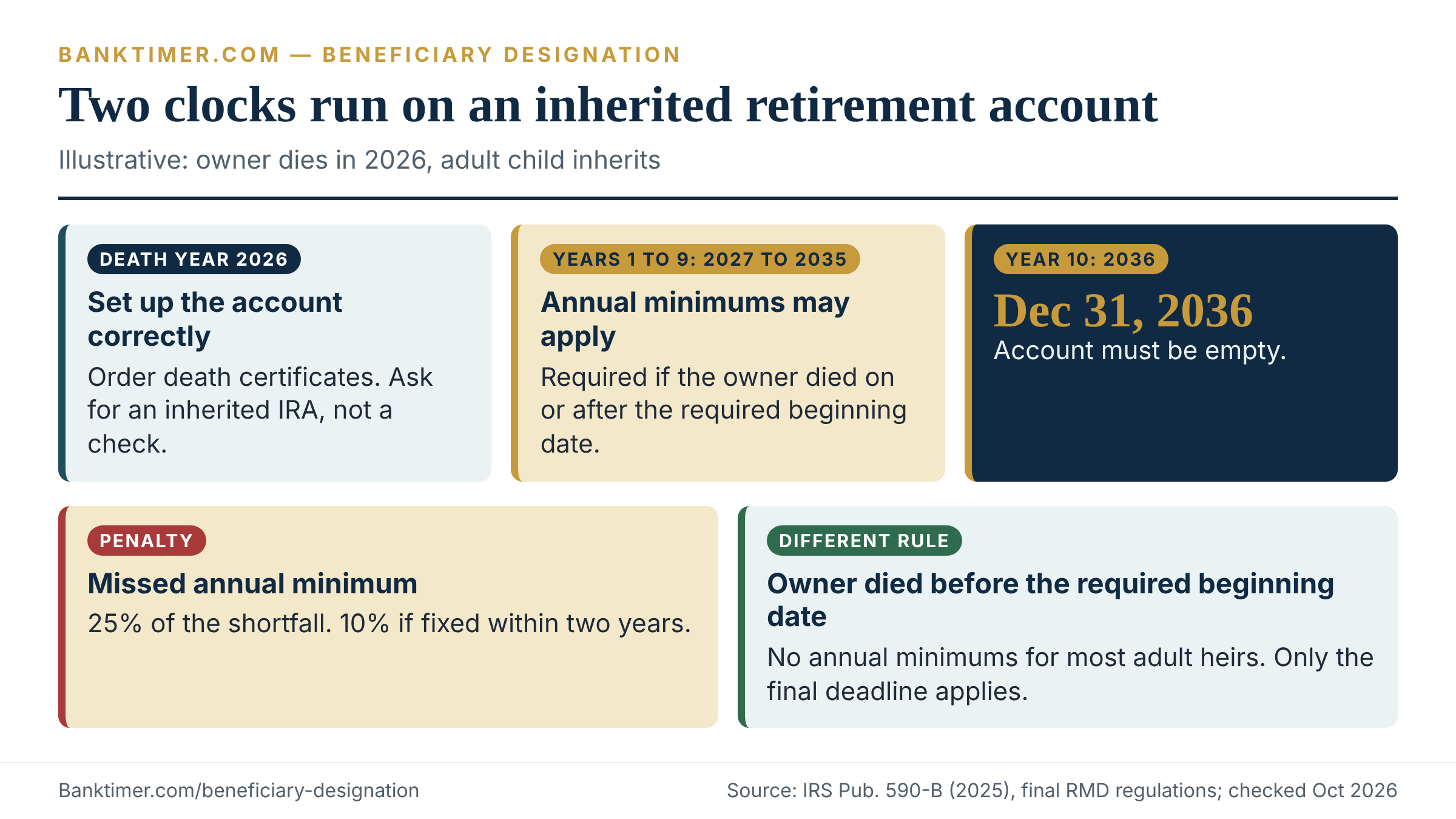
An adult child, sibling who is more than 10 years younger, friend or other designated beneficiary who is not an eligible designated beneficiary must empty the account by December 31 of the year containing the 10th anniversary of the owner’s death. Death in 2026 means a deadline of December 31, 2036.
The rule sounds generous, but it creates a tax planning problem. Every dollar in a pre-tax account is taxed as ordinary income when withdrawn. Waiting until year 10 can push a large balance into one tax year.
Annual minimums inside the 10 years
Here is the part many families miss. If the owner died on or after the required beginning date, the beneficiary must take annual distributions in years one through nine and still empty the account by the end of year ten. That comes from the final regulations, which apply starting in 2025. If the owner died before the required beginning date, the beneficiary generally can take the money at any pace as long as the account is empty by the deadline.
The annual minimum is the prior year-end balance divided by a life-expectancy factor from the IRS tables in Publication 590-B. The factor drops by one each year. The penalty for missing a year is steep: 25% of the shortfall, or 10% if corrected within two years.
Priya inherits a $500,000 traditional IRA from her father, who died after his required beginning date. Suppose the IRS table gives an illustrative factor of 36.0 for her age. Her first-year minimum is $500,000 divided by 36.0, or $13,889.
If she misses it, the 25% tax is $3,472. If she withdraws the shortfall within the correction window, the 10% rate applies, or $1,389. The factor is invented for illustration. Look up your own in Publication 590-B.
Roth accounts follow different timing
A Roth IRA owner has no required distributions during life, so a Roth owner is treated as having died before the required beginning date. Beneficiaries of Roth IRAs still face a payout deadline, but annual minimums generally do not apply to most adult heirs inside the 10 years. The tax treatment differs, too: qualified Roth distributions can be tax-free, subject to the five-year holding period. Ask the custodian which category applies.
| Beneficiary type | Payout window | Annual minimums? | Main trap |
|---|---|---|---|
| Surviving spouse | Treat as own, roll over or remain a beneficiary | Depends on the choice | Treating it as your own brings your own age-based rules into play |
| Owner’s minor child | Life-expectancy payments, then 10 years after age 21 | Yes, during the first phase | Grandchildren do not qualify |
| Disabled or chronically ill person | Life expectancy, or the 10-year option in some cases | Yes, on the life-expectancy path | Documentation due October 31 of the year after death |
| Person not more than 10 years younger | Life expectancy | Yes | Easy to overlook as a category |
| Adult child or other non-eligible person | 10 years | Yes if the owner died on or after the RBD; no if before | Missing an annual minimum |
| Estate or non-qualifying trust | Five years if the owner died before the RBD; otherwise the owner’s remaining life expectancy | Varies | Compressed schedule and a bigger tax bill |
What a surviving spouse can choose
A surviving spouse has more options than anyone else, according to IRS Publication 590-B. The spouse can treat an inherited IRA as their own, roll it into their own IRA, or stay a beneficiary rather than becoming the owner.
Each path has trade-offs. Treating the account as your own can simplify life if you are over 59½. If you are younger, you may face the 10% early-withdrawal tax on money you take out. Remaining a beneficiary keeps the death exception to that tax. A tax professional can compare the paths using your age and cash needs.
Non-spouse heirs and the right way to move the money
Anyone other than a spouse cannot treat an inherited traditional IRA as their own, according to the IRS. They cannot contribute to it, and they generally cannot roll it into their own IRA. They can transfer it trustee to trustee into a properly titled inherited IRA.
That detail matters. If the custodian writes a check to the heir instead, the heir may be unable to put the money back. The distribution is then taxable in that year. Tell the custodian you want an inherited IRA before anything is paid out.
The tax bill depends on timing
Withdrawals from an inherited traditional IRA or 401(k) are ordinary income. The 10% early-withdrawal tax generally does not apply to beneficiaries, because death is an exception. If estate tax was paid on the account, the beneficiary may deduct it, as the IRS describes for income in respect of a decedent.
The table below compares four withdrawal plans for the same invented $500,000 inheritance. The tax rates are illustrative blended rates, not real brackets. Rows one and two ignore growth. Rows three and four assume 5% annual growth.
| Plan (illustrative) | Growth assumed | Gross withdrawn | Assumed blended tax rate | Total tax | Net after tax |
|---|---|---|---|---|---|
| Lump sum in year 1 | None | $500,000 | 35% | $175,000 | $325,000 |
| $50,000 a year for 10 years | None | $500,000 | 24% | $120,000 | $380,000 |
| Level pace, 5% growth, empty in year 10 | 5% a year | $660,339 | 24% | $158,481 | $501,858 |
| Nothing until year 10, 5% growth | 5% a year | $814,447 | 35% | $285,057 | $529,391 |
The lesson is the gap between rows one and two. Spreading the same $500,000 saved $55,000 in this model because the assumed rate fell from 35% to 24%. Row four shows the other side. Deferral produced the biggest net amount but also the biggest tax bill, and it carries risk if rates rise or a large sum lands in one year. The tax rate you assume matters more than the schedule you pick.
Inherited IRAs and creditors
Federal bankruptcy law protects some retirement funds. In Clark v. Rameker (2014), the Supreme Court unanimously held that funds in an inherited IRA are not “retirement funds” for the federal bankruptcy exemption. Some states protect inherited IRAs under their own laws, and others do not. If you inherit one while you have debts, ask a bankruptcy or estate attorney before you assume it is protected.
What a beneficiary designation costs: taxes, penalties and the price of a wrong form
Completing a beneficiary designation is rarely expensive. Getting it wrong, or leaving the account to default rules, can be. The costs below fall into three groups: money lost to the wrong payee, taxes and penalties on inherited accounts, and friction costs such as probate and paperwork.
| Cost item | Trigger | Typical basis | Illustrative example | Avoidable? |
|---|---|---|---|---|
| Wrong payee from a stale form | Death before the form is updated | The whole balance of that account | $380,000 401(k) paid to a former spouse | Yes, by updating |
| Income tax on a pre-tax retirement account | Any withdrawal by the beneficiary | Ordinary income rates | $500,000 at an assumed 24% blended rate is $120,000 | Partly, through timing |
| Missed annual distribution | Skipping a required minimum | 25% of the shortfall; 10% if corrected within two years | $13,889 shortfall means $3,472 or $1,389 | Yes |
| Uninsured POD balance | Bank failure | Balance above the FDIC formula | $400,000 above the cap in the two-child example | Yes, with more beneficiaries or banks |
| Non-spouse HSA inheritance | Account holder’s death | Fair market value, less qualifying medical expenses paid within a year | $12,000 at an assumed 22% is $2,640, or $1,980 after $3,000 of expenses | Partly, by naming a spouse |
| Probate when the estate is the beneficiary | Blank form or estate named | Court and legal costs, set by state | Varies by state and estate size | Yes, by naming a person or trust |
| Certified death certificates | Each claim | Fee per copy, set by the vital records office | Varies by state and county | No, but order only what you need |
| Attorney review of a trust or blended family | Complex designations | Hourly or flat fee, set by the attorney | Varies by market | Optional |
Every dollar figure in the table is an invented example except the rates tied to a rule, such as 25% and 10%. Use the structure, not the numbers, to size your own risk.
Income tax by asset type
Taxes differ sharply by account, and the beneficiary form does not change them. Four rules cover most cases.
- Life insurance. Proceeds paid because of the insured’s death are generally excluded from income. Interest paid on those proceeds is taxable, according to IRS Publication 525.
- Brokerage and other inherited property. The basis of inherited property is generally its fair market value on the date of death, per IRS Publication 551. That “step-up” can erase gains that accrued during the owner’s life. An executor can elect an alternate valuation date.
- Pre-tax retirement accounts. Withdrawals are ordinary income to the beneficiary. No step-up applies.
- HSAs. The rules above apply: spouse as owner, others taxed on fair market value.
Annuities depend on how the owner funded them. If the contract was bought with pre-tax money, more of the payout is taxable. Ask the issuer for the cost basis and the tax reporting form before you decide how to take the money.
Federal estate tax rarely decides the question
The federal estate tax basic exclusion amount is $15,000,000 per person for 2026, up from $13,990,000 for 2025. Congress set the 2026 figure in a law signed July 4, 2025, according to the IRS. Most households fall well below it, so federal estate tax is not usually the reason to update a beneficiary form.
Some states levy their own estate or inheritance taxes at much lower thresholds. Check your state revenue department if your estate is large or you hold property in more than one state.
What beneficiaries owe, and what they do not
Becoming a beneficiary does not make you liable for the owner’s debts. The CFPB explains that debts are generally paid from the money or property left in the estate. You may owe a debt if you co-signed, held a joint account or live in a state with spousal debt-responsibility rules. Whether creditors can reach assets that pass outside probate depends on state law.
If a collector contacts you about a relative’s debt, our guide to credit card debt explains your options. Do not pay a debt out of a beneficiary payout without confirming you owe it.
Why the cost of ignoring the form is real
The Department of Labor’s ERISA Advisory Council studied beneficiary problems in retirement and life insurance plans in 2012. It listed outdated designations, divorce disputes and lost forms among the persistent problems. It also reported that 40% to 60% of participants in some plans had no completed designation on file. That report is old, and the numbers varied by plan. Treat them as a sign of how common the gap is, not as a current average.
How to review and update your beneficiary designations, step by step
Reviewing each beneficiary designation is mostly detective work. The hard part is finding every account that has a form, because the forms live with different companies and several of them may be years old.
Build a one-page inventory
Start with a single list. For each account, record where the form lives, who is named, when you last checked and what proof you saved. The rows below show the layout with invented entries.
| Account | Where to find the form | Primary | Contingent | Last reviewed | Proof to keep |
|---|---|---|---|---|---|
| Current employer 401(k) | Plan website, beneficiary tab | Spouse | Two children, per stirpes | March 2026 | Confirmation email as PDF |
| Old employer 401(k) from 2014 | Former employer’s recordkeeper | Unknown | Unknown | Never | Request a copy of the record |
| Traditional IRA | Custodian’s online profile | Spouse | Trust for children | January 2025 | Dated screenshot |
| Employer life insurance | Benefits portal | Spouse | Children’s trust | Open enrollment | Printed confirmation |
| POD savings account | Bank branch or online | Daughter | None | Account opening | Signed form copy |
| Health savings account | Custodian’s website | Spouse | Estate | Account opening | Dated screenshot |
The “Unknown” row is the point of the exercise. An inventory finds the forgotten accounts, and forgotten accounts are the ones most likely to name an ex-spouse or a deceased parent.
Find accounts you forgot you had
Several sources help. Old tax forms show retirement accounts: a 1099-R reports distributions and a Form 5498 reports IRA contributions. Previous employers’ benefit offices can point you to a former plan. The Department of Labor’s Retirement Savings Lost and Found database searches for your own forgotten plans at no charge. State unclaimed property programs can surface dormant bank accounts, and NAUPA runs MissingMoney.com as a free multistate search.
If an account turns up, do two things. First, confirm it is yours and see what the provider’s records say. Second, replace the form if it is stale.
How to change a beneficiary designation
Providers vary in their steps, but most changes follow the same order.
- Get the provider’s current form or open the online profile. Do not use an old form.
- Enter full legal names, dates of birth, relationships and any required identification numbers.
- Name at least one contingent beneficiary and make percentages total 100%.
- Attach spousal consent if your plan requires it, with the required witness or notary.
- Sign, date and submit it by the method the provider specifies.
- Ask for written confirmation, and follow up if none arrives within the provider’s stated timeframe.
- Save a copy and note where your executor can find it.
If your form changes who receives a large account, confirm in writing that the provider processed it. An unsent online form and an unprocessed paper form look identical until someone needs them.
What proof to keep
The provider’s record controls, so your proof is only useful if it matches. The best evidence is a confirmation generated by the provider that lists the beneficiaries and a date. A screenshot of the online profile after the change works too. For a spousal consent, keep the signed and witnessed form.
Store proof where your executor or spouse can find it, and note the location in a document your family knows about. Do not store account numbers and Social Security numbers in an unprotected note.
When to review
Set a recurring reminder, then add events that trigger an immediate check. The Department of Labor’s 2012 advisory council report recommended that plans re-ask participants about beneficiaries every two to three years. That is a reasonable pace for individuals too.
| Life event | What to check | Why it matters |
|---|---|---|
| Marriage | Spousal rights on employer plans; new primary and contingent | Federal rules give a spouse default rights in many plans |
| Divorce | Every account, including old plans | Ex-spouses can remain payees |
| Birth or adoption | Add the child or a trust; update class wording | New children can be left out |
| Death of a beneficiary | Contingents and percentages | Shares can shift in ways you did not choose |
| Job change or rollover | Old plan, new plan, new IRA | Each account has its own form |
| New account or transfer | Whether the new account has a blank form | A blank form means a default |
| Major health change | Whole inventory, plus power of attorney | Fix gaps while you can act |
Privacy and who gets told
Beneficiaries are not notified when you name them. The holder generally shares the information only when someone makes a claim. That privacy is useful, but silence can cause conflict after a death. Many families prefer to tell the people involved, or at least tell the executor where the documents are.
Treat the paperwork as sensitive. A beneficiary designation form can include a Social Security number and a date of birth. Send it only through the provider’s own secure channel. If you suspect your information has been exposed, our identity theft guide covers the next steps.
When someone else manages your money
If an agent holds your power of attorney, ask the provider whether that agent may change beneficiaries. The power of attorney document and the provider’s own policy both matter, and providers differ. Our guide to financial power of attorney explains the document itself.
Family members should pay attention to sudden beneficiary changes after a caregiver or new agent takes over an older person’s money. That pattern can be a warning sign of elder financial abuse, and our elder financial abuse guide explains what to do.
Young adults and first accounts
The first beneficiary question many people see is on a first account. A student bank account or an account you open online may treat the beneficiary field as optional. Skipping it means a default will decide. If the account holds more than pocket change, take two minutes to name someone.
If you are the beneficiary: documents, claim steps and timelines
Being named does not mean the money arrives on its own. Each holder runs its own claim process, and some of them move slowly. Knowing what to bring and who decides saves weeks.
The first two weeks
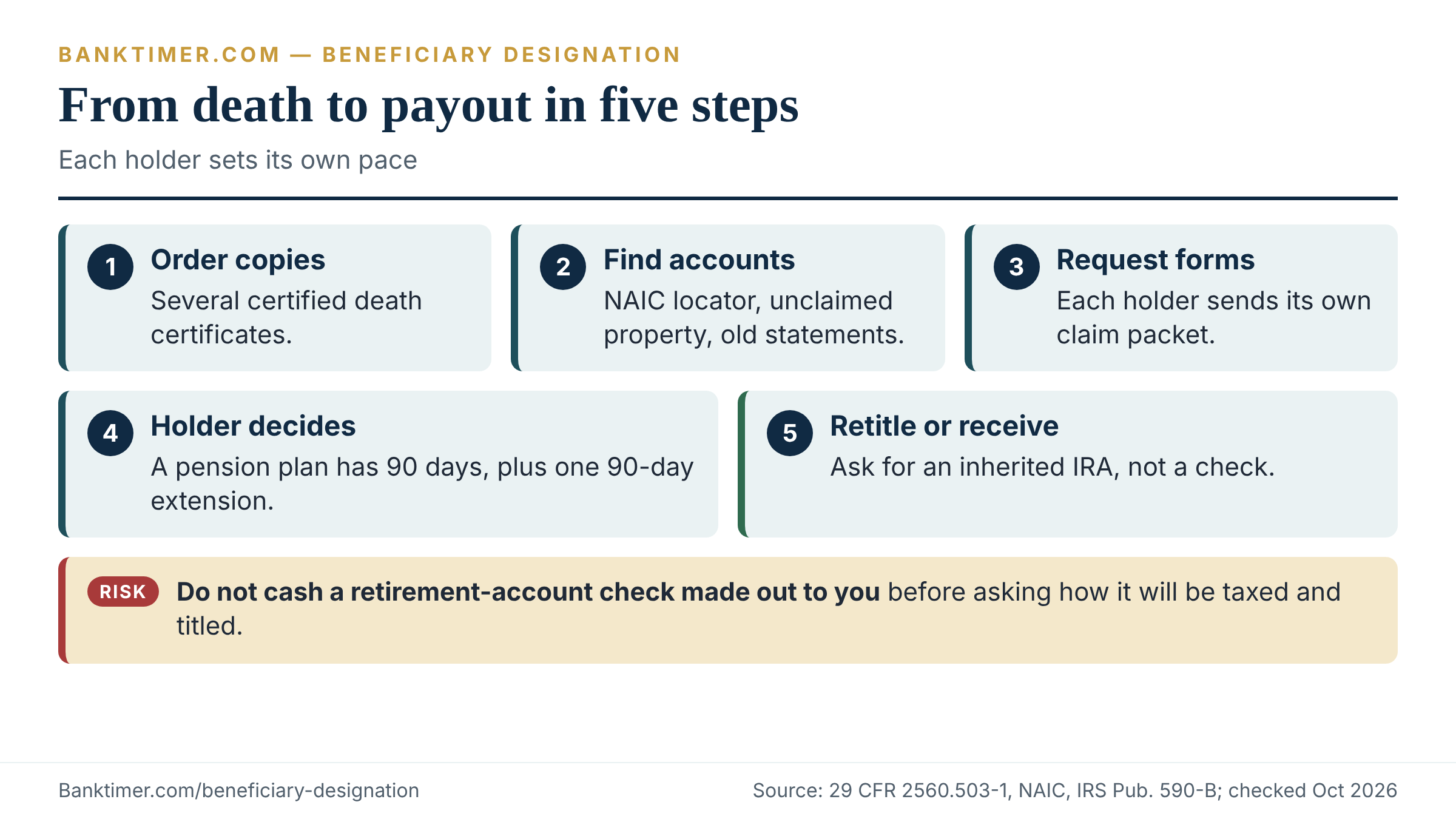
Order several certified copies of the death certificate. Vital records offices in the state where the death occurred issue them, and the CDC maintains a directory of state and territory offices. Fees and processing times vary. Many holders ask for a certified copy rather than a photocopy, and some keep it.
Then contact each holder in writing or through its claims line, and ask for the claim packet. Our guide to a bank account after death covers the bank side in more detail.
Slow down on anything irreversible. Do not cash a check from a retirement account before you know how it will be titled. Do not pay the decedent’s bills from inherited money until you know whether you owe them. And be skeptical of any unsolicited offer to “release” an inheritance for an upfront fee.
Documents you will typically need
Requirements vary by holder, but the same few items appear again and again.
| Document | Why it matters | Where to get it | Notes |
|---|---|---|---|
| Certified death certificate | Proves the owner died | State or local vital records office | Order several copies; fees vary |
| Your government-issued photo ID | Confirms you are the named person | You already have it | Some holders want it notarized or copied |
| Holder’s claim form | Starts the payout | The bank, plan, insurer or custodian | Ask whether it needs a signature guarantee |
| Your Social Security or tax ID number | Needed for tax reporting | You | Used for 1099 forms |
| Account or policy number | Speeds the search | Statements, mail, online records | If missing, give the owner’s name and Social Security number |
| Trust or court documents | Shows who has authority | Attorney or probate court | Only if a trust, estate or minor is involved |
Claim steps by asset, and who decides
The holder controls timing. The table gives the usual path and the one hard deadline that applies to retirement plans.
| Asset | What you do | Who decides | Timing |
|---|---|---|---|
| Bank POD account | Present death certificate and ID | The bank, under its deposit agreement | Varies by bank |
| Life insurance | File the claim form with a certified death certificate | The insurer | Varies by insurer and state |
| 401(k) or pension | Submit a claim to the plan administrator | The plan administrator | Decision within 90 days, extendable once by up to 90 more |
| IRA or Roth IRA | Complete the custodian’s beneficiary claim form; ask for an inherited IRA | The custodian | Varies by custodian |
| Brokerage TOD account | Send a death certificate and re-registration application | The broker or transfer agent | Varies |
| HSA | Complete the custodian’s forms | The custodian | Varies |
| Social Security survivor benefits | Apply by phone or in person | SSA | Apply for the $255 payment within two years |
How retirement plans handle claims
Under Department of Labor rules, a plan administrator must decide a pension-plan claim within a reasonable period, and no later than 90 days after receipt. The plan may extend that once for up to 90 more days if special circumstances apply. If the plan denies the claim, you must have at least 60 days to appeal. That deadline is short enough to miss during a hard month, so put it on a calendar the day you receive a denial.
Finding policies and accounts you did not know about
Many families discover accounts months after a death. Four free tools can help.
- NAIC Life Insurance Policy Locator. You enter the deceased’s Social Security number, legal name, date of birth and date of death. Participating insurers search their records and contact the beneficiary directly if they find a match. The NAIC reports that the tool has matched more than $16.99 billion through July 31, 2026, from more than 1.5 million requests. The NAIC says responses can take 90 or more business days, and it does not reply if there is no match or the requester is not the beneficiary.
- State unclaimed property. State governments hold most unclaimed money, according to USA.gov. NAUPA’s MissingMoney.com searches several states at once and is free.
- Department of Labor Lost and Found. It searches only your own Social Security number, so it cannot trace a deceased person’s benefits. Contact the former employer’s plan administrator instead.
- Paper clues. Premium notices, bank statements and tax forms often reveal policies and accounts that databases miss.
Be wary of anyone who charges a fee to “find” this money for you. The official tools above do not charge for a search.
When two people claim the same account
Conflicts arise from an outdated beneficiary designation, ambiguous wording or a contested family. A holder facing competing claims may refuse to pay either one until a court or the parties resolve it. The DOL advisory council report mentions interpleader, a court procedure in which the holder deposits the money and lets claimants argue over it.
If you face a competing claim, do not negotiate with the other person alone. A short consultation with an estate or ERISA attorney can clarify whether the form, the plan documents or a divorce order controls.
Where to escalate a slow or denied claim
Put every request in writing and keep a log of calls. Each type of holder has a different oversight agency. Your state insurance department handles insurer complaints. The Department of Labor’s Employee Benefits Security Administration oversees ERISA plans. Brokerage accounts fall under federal securities regulators. Your state banking regulator or the bank’s primary federal regulator handles bank issues.
A decision framework: whom to name for which situation
There is no universal best answer to “who should be my beneficiary?” The right choice depends on your family, the size of the account and what you want it to do. The framework below walks through the questions in the order that avoids the most expensive mistakes.
Five questions in order
- Does the law give someone a claim? A spouse has default rights in many employer plans and, in community property states, possibly more. Start there, because overriding a spouse needs consent.
- Who should receive what? Decide percentages in advance. Unequal is fine if you write it down.
- Who is the backup? Name contingents and decide whether a deceased beneficiary’s descendants should step in.
- How should the money arrive? Outright to an adult, through a custodian, or through a trust.
- What is the tax and access profile? Pre-tax retirement accounts carry income tax. Life insurance generally does not. Large balances may need a trust or a second bank.
Matching situations to approaches
The table shows common approaches. It is a map, not advice. Your attorney or plan administrator should confirm the details.
| Situation | Common approach | Main upside | Main downside | What to verify |
|---|---|---|---|---|
| Married, no children | Spouse as primary; a sibling, trust or charity as contingent | Simple; spousal rights satisfied | If both spouses die, the contingent decides | Spousal consent rules; contingent still alive |
| Married with adult children | Spouse as primary; children as contingent | Spouse keeps access; children are the backup | Spouse may spend or later remarry | Whether to use per stirpes |
| Young children | Spouse primary; a trust or UTMA custodian for children as contingent | Avoids court-supervised guardianship | Trust costs; must match the will’s guardian choice | Trust title; custodian termination age |
| Blended family | Spouse and children each receive defined shares, often through a trust | Provides for both sides | Complex; consent needed for employer plans | Attorney review of every form |
| Unmarried partner | Partner named by full legal name on every form | The form is the main route to the partner | No default rights; Social Security survivor categories do not include an unmarried partner | Exact name; contingents |
| Single, no children | Siblings, friends or a charity; a contingent for each | Full freedom | Defaults can send money to distant heirs | Percentages; contingents |
| Beneficiary with a disability | Special-needs trust as beneficiary | Protects eligibility for benefits | Cost; rigid terms | Elder law or special-needs attorney |
| Large pre-tax IRA and charitable goals | Name a charity for some or all | A simple gift at death | Reduces what family receives | Charity’s exact legal name; tax professional’s advice |
The unmarried partner row deserves emphasis. Federal spousal protections apply to spouses, so an unmarried partner generally has no default claim to a retirement account. The survivor categories SSA lists do not include one either. The form is the whole plan.
Pros and cons of using a beneficiary designation
For most people, a beneficiary designation is the simplest estate planning tool they own. Its strengths are real. It moves money quickly, avoids probate for that account, keeps the transfer private and takes little effort to set up. For modest estates, it may be the only document that matters.
The limits are just as real, and they are specific. A designation is inflexible: it cannot impose conditions or handle a beneficiary’s death on its own wording. It can contradict your will without anyone noticing. It generally does not protect an inheritance from the beneficiary’s creditors or divorce. And the form goes stale silently, because nothing reminds you to update it.
The honest trade-off is that a designation gives you speed and simplicity at the cost of control. If your situation is simple, accept that trade. If you have minor children, a blended family or a large estate, use designations together with a trust or other planning rather than instead of it.
Common mistakes and red flags
The same handful of errors cause most of the damage. Each one has a cheap fix, and each one is invisible until it is too late.
| Red flag | Why it matters | What to ask | Safer next step |
|---|---|---|---|
| A former spouse is still named | The plan or insurer may pay the ex | “Whom do your records list today?” | Submit a new form and a QDRO if needed |
| No contingent beneficiary | A default, often the estate, decides | “What happens if my beneficiary dies first?” | Name at least one contingent |
| Minor named outright | Court oversight and an outright payout at majority | “What do you require for minor beneficiaries?” | Use a custodian or trust |
| Estate named by default | Probate, creditors and a compressed IRA payout | “Who is the default if I name no one?” | Name a person or trust |
| “My children” wording | Unclear who qualifies | “How does your form define children?” | List each child by name |
| Missing spousal consent | A non-spouse designation may be void | “Does this plan require consent?” | Use the plan’s witnessed consent form |
| Online form never confirmed | The old form stays in force | “Can I get written confirmation?” | Save the confirmation page |
| Form conflicts with your will or trust | The form wins | “Which document controls this account?” | Align all documents |
One error is not on the list because it is not a mistake. Some people leave a designation unchanged on purpose after a divorce, for example because a decree requires it. That choice is valid if it is deliberate and documented.
Current context as of October 2026
Three developments could change a decision this year.
Inherited retirement account rules are now fully in force
The final regulations on required minimum distributions, published July 19, 2024, apply starting with 2025 distribution years. The IRS had waived penalties for missed annual distributions on inherited accounts for 2021 through 2024. The IRS RMD FAQs page, last reviewed on January 29, 2026, does not mention relief for 2025 or later. If you inherited an account from someone who died after their required beginning date, assume annual minimums apply.
The IRS also issued Announcement 2026-7. It says further final regulations on parts of the rules, including those touching the SECURE 2.0 changes, will apply no earlier than six months after they are issued. Until then, taxpayers should use a reasonable, good-faith reading of the law. Ask a tax professional whether anything in that second round affects your account.
Estate tax and the NAIC tool have updated numbers
The 2026 federal estate tax exclusion is $15,000,000 per person. The NAIC’s September 2026 release says its locator has matched more than $16.99 billion in lost life insurance and annuity benefits through July 31, 2026, with more than 780,000 successful matches.
A new model law for custodial accounts exists, but states have not adopted it
The Uniform Law Commission approved a new Uniform Transfers to Minors Act in 2026, according to the American Bar Association’s Probate and Property magazine. It would allow custodial accounts to continue until a maximum recommended age of 25 and raise a court-oversight threshold from $10,000 to $50,000. The ABA said states should consider enacting it. Until your state does, its current UTMA law governs.
Questions to ask before you update or claim
- ☐ Whom do your records list today as primary and contingent beneficiaries on this account?
- ☐ What happens if my primary beneficiary has died and I have named no contingent?
- ☐ Does this account require spousal consent to name someone other than my spouse, and what form does it use?
- ☐ How does your form define “per stirpes,” and can I choose it?
- ☐ What is your process for a minor beneficiary, and does a custodian or trust work?
- ☐ If I name a trust, what title and date do you need on the form?
- ☐ Can I get written confirmation, with the date, once the change is processed?
- ☐ Is a QDRO or other court order already on file for this account?
- ☐ If I am the beneficiary, which documents do you need, and how long will the decision take?
- ☐ For an inherited retirement account, will you set up an inherited IRA, and what is my deadline?
Frequently Asked Questions
What is a beneficiary designation?
It is an instruction on file with a financial institution or insurer that names who receives an account or policy when the owner dies. The holder pays that person directly, outside probate, usually after seeing a death certificate and a claim form. Retirement plans, IRAs, life insurance, annuities, HSAs and many bank and brokerage accounts use one.
Does a beneficiary designation override a will?
Yes, for the account it covers. The holder follows its own records, not your will. A will governs only assets with no beneficiary form, such as a house in your sole name or a checking account with no payable-on-death designation. Because the two documents work separately, check that they point the same way.
What happens if my beneficiary dies before me and I named no backup?
The account falls to a default that depends on the holder and the account type. For many accounts, the default is your estate, which means probate. Some plans or contracts set their own order, such as spouse, then children, then estate. Name a contingent beneficiary so the default never decides.
Can I change a beneficiary without telling anyone?
Usually yes. For an IRA, a life insurance policy or a POD account, you generally do not need the beneficiary’s permission or notice. The exceptions are spousal consent on certain employer plans, an irrevocable beneficiary designation on some insurance policies and any court order that restricts changes. Ask the holder about its rules.
Does my spouse have to be the beneficiary of my 401(k)?
If you are married, generally yes unless your spouse consents in writing. The IRS says a defined contribution plan can avoid the survivor annuity rules if it pays the death benefit in full to the surviving spouse unless the spouse consents to another beneficiary. The consent must be witnessed by a plan representative or a notary. A narrow exception applies if there is no spouse or the spouse cannot be located.
Can a beneficiary designation be challenged in court?
In limited situations, yes. Claims such as forgery, fraud, undue influence or lack of capacity can be raised, and the rules differ by state. Conflicts also arise from unclear wording or competing forms. A holder facing competing claims may pay the money into court through interpleader. If you are in a dispute, consult an estate or ERISA attorney early.
Is money from a beneficiary designation taxable?
It depends on the asset. Life insurance proceeds paid because of the insured’s death are generally not income, but interest on them is. Pre-tax retirement accounts and non-spouse HSA balances are generally taxable to the beneficiary. Inherited property in a brokerage account generally gets a basis equal to fair market value at death. Ask a tax professional before you withdraw anything.
How long does it take to receive the money?
It varies by holder. Banks and brokerages can be quick once they have the documents. Insurers and custodians set their own pace. For a pension-plan claim, the administrator must decide within 90 days of receipt, with one extension of up to 90 more days. Missing documents cause most delays, so order several certified death certificates early.
How do I find out whether someone named me as a beneficiary?
You generally cannot search directly, because holders do not notify beneficiaries in advance. After a death, you can use the NAIC Life Insurance Policy Locator for policies and annuities, state unclaimed property databases and MissingMoney.com for dormant accounts, and the former employer’s plan administrator for retirement plans. The Department of Labor’s Lost and Found database does not search for a deceased person’s benefits.
Do I need a lawyer to update my beneficiary designations?
Not for simple cases. Naming a spouse and children on a few accounts is paperwork you can do through the provider. Consider an estate attorney if you have a blended family, minor children, a special-needs beneficiary, a large retirement account or a trust as beneficiary. The cost of a short consultation is small next to the cost of a wrong form.
Open the account that holds the most money, usually a 401(k) or IRA, and find its beneficiary page. Compare every name to your life today. If anything is out of date, submit a new form and save the confirmation with the date.
A beneficiary designation is a form, and on accounts that carry one, the form usually beats your will. The variable that matters most is whether the form on file matches your life today. Start with the accounts holding the most money, usually a 401(k), an IRA and life insurance, and confirm what the provider’s records actually say. A missing contingent, a former spouse or a minor child can all derail the plan. Update the forms after a marriage, divorce, birth or death, name a contingent beneficiary, and ask the provider for written confirmation. If you inherit an account instead, find the deadline before you touch the money, since some inherited accounts run on a ten-year clock. The form controls only the assets it is attached to. Everything else follows your will, your state’s law or federal rules.
Methodology
This guide draws on primary sources first: IRS publications and regulations, Department of Labor guidance, FDIC trust account rules, Social Security Administration pages, Supreme Court opinions, the NAIC and Medicaid. We checked each changeable figure and rule on October 6, 2026, and the Sources list records what each source supports. Where a rule varies by state, plan or provider, the text says so rather than giving one number.
Dollar examples, tax rates, the life-expectancy factor and the person-based scenarios are illustrative and invented. They show how the mechanics work and are not market quotes or real cases. The 24% and 35% rates in the inherited-IRA table are assumed blended rates, not tax brackets.
Banktimer is an independent consumer-finance publication. This guide is general information. It is not legal, tax or financial advice, and the authors are not your attorney or tax professional. For decisions about trusts, divorce, large retirement accounts or disputes, consult a licensed estate attorney, plan administrator or tax professional.
Sources
Primary official sources, checked October 6, 2026
- IRS Publication 590-B (2025), Distributions from Individual Retirement Arrangements
- Required Minimum Distributions final regulations, T.D. 10001, 89 Fed. Reg. (July 19, 2024)
- 26 C.F.R. § 1.401(a)(9)-4, designated beneficiaries
- IRS Notice 2024-35, relief for certain required minimum distributions
- IRS Announcement 2026-7, applicability of future RMD regulations
- IRS, Retirement plan and IRA required minimum distributions FAQs
- IRS, Retirement topics: qualified joint and survivor annuity
- 26 U.S.C. § 417, minimum survivor annuity requirements
- IRS Publication 525 (2025), Taxable and Nontaxable Income
- IRS Publication 551 (12/2025), Basis of Assets
- IRS Publication 969 (2025), Health Savings Accounts
- IRS Publication 555 (12/2024), Community Property
- IRS, What’s new: estate and gift tax
- 26 U.S.C. § 72, annuities and required distributions
- FDIC, Your insured deposits: trust accounts
- Social Security Administration, survivors benefits eligibility and application
- Department of Labor, QDROs under ERISA: a practical guide
- Department of Labor, Retirement Savings Lost and Found database
- 29 C.F.R. § 2560.503-1, claims procedure
- SEC Investor.gov, transferring assets and transfer-on-death registration
- CFPB, joint bank accounts after a death
- CFPB, does a person’s debt go away when they die?
- CFPB, what is a revocable living trust?
- Medicaid.gov, estate recovery
- 42 U.S.C. § 1396p, liens, adjustments and recoveries
- NAIC, Life Insurance Policy Locator release, September 3, 2026
- USA.gov, how to search for unclaimed money
Court opinions
- Egelhoff v. Egelhoff, 532 U.S. 141 (2001)
- Kennedy v. Plan Administrator for DuPont Savings and Investment Plan, 555 U.S. 285 (2009)
- Sveen v. Melin, 584 U.S. 811 (2018)
- Boggs v. Boggs, 520 U.S. 833 (1997)
- Clark v. Rameker, 573 U.S. 122 (2014)
Institutional research and secondary context
- Department of Labor ERISA Advisory Council, beneficiary designations report (2012)
- NAUPA, National Association of Unclaimed Property Administrators
- South Carolina Department of Insurance, how to use the Life Insurance Policy Locator
- American Bar Association, Uniform Laws Update: new Uniform Transfers to Minors Act (Sept.-Oct. 2026)
- Cornell Legal Information Institute, per stirpes