
1099-INT is the tax form your bank, credit union or other payer sends when it paid you at least $10 of interest during the year. You must report your interest whether or not the form arrives. That includes interest under $10, which the payer does not have to report to you or the IRS.
The bank’s $10 line is a paperwork rule for the bank, not a tax-free allowance for you. Your biggest variable is how many separate accounts paid you interest. Add them all up, and use your monthly statements if a form is missing. If a form shows the wrong amount, ask the payer for a corrected one before you file.
You report interest either way. The IRS says you must report all taxable and tax-exempt interest even if you do not receive a Form 1099-INT.
The $10 rule belongs to the payer. A bank must file the form for $10 or more in boxes 1, 3 and 8. Smaller amounts are still your income.
Box 1 is the number most savers need. It holds taxable interest from savings accounts, certificates of deposit (CDs) and similar deposits, and it flows to your Form 1040.
A missing or wrong form has a paper trail fix. Your monthly statements show interest earned, and a payer can issue a corrected form marked “Corrected.”
Ignoring a mismatch can cost more than the tax. The IRS matches payer reports to returns, and a notice can add a penalty and interest to the tax you owe.
What Form 1099-INT Is, and What It Is Not
Form 1099-INT is an information return. The payer fills it out, sends one copy to you and another to the IRS. The IRS describes its purpose in one line: it is used to report interest income.
That sounds simple, yet the form creates three common misunderstandings. Each one leads people to either skip income they owe tax on or pay tax they do not owe.
What the form reports
A 1099-INT shows interest the payer paid or credited to you during the calendar year. The IRS instructions say payers file it for each person they paid at least $10 in amounts reportable in boxes 1, 3 or 8. They also file it, whatever the amount, when they withheld and did not refund federal income tax (backup withholding).
The typical sender is a bank, savings institution, credit union or similar organization. The instructions also cover interest on bearer certificates of deposit and certain obligations of one year or less. Other payers use the same form for interest on things like delayed tax refunds, which are taxable once they pass normal processing time.
What the form does not do
It is not a bill. You owe tax on the income, not on the form, and the payer does not collect anything for the IRS unless backup withholding applies. You also do not attach it to your return. IRS Publication 550 says you keep it with your records.
It is not a complete list of your income either. A bank reports only what it paid you. Interest from a small account under $10 will not appear on a bank’s form. Neither will interest from a person you lent money to, or from a seller-financed deal. All of it is still taxable.
A related form you may see instead
Not every account that pays you “interest” uses this form. Dividends from a money market fund (a brokerage product, not a bank deposit) are reported as dividends on Form 1099-DIV. A CD with original issue discount and a term over one year is reported on Form 1099-OID. We cover that split in the account-by-account table later in this guide, and our guide to common U.S. tax forms puts the 1099 family in context.
Form 1099-INT Box by Box
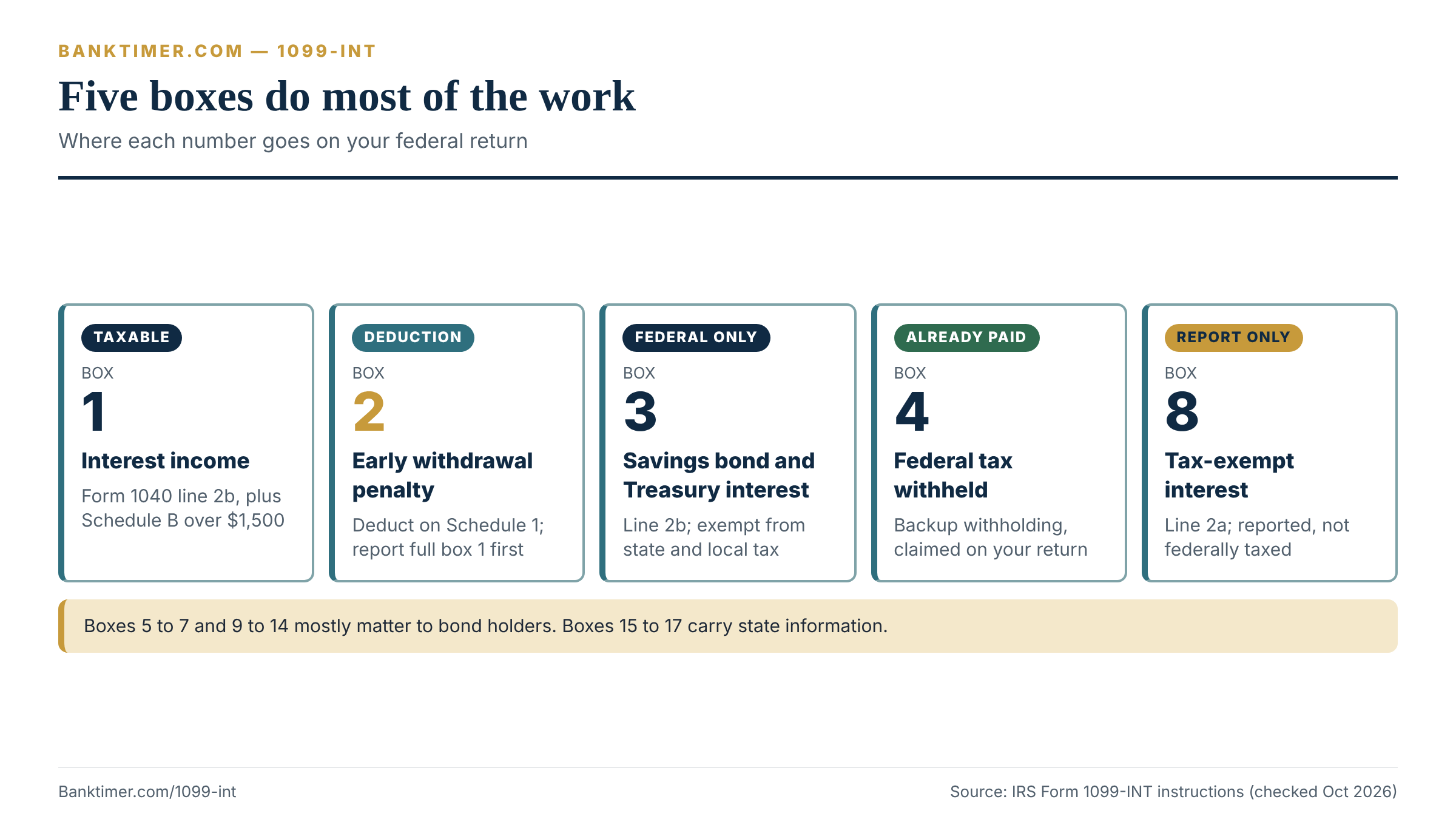
The form has 17 numbered boxes, but a typical saver sees values in only a few. Knowing which ones matter saves you from worrying about the empty ones. The IRS defines each box in its instructions, and we checked them on October 15, 2026.
The table below groups the boxes by how often a saver meets them. Read it by asking “does this number change my return?” Boxes 1 and 3 add income. Box 2 creates a deduction. Box 4 is tax already paid, and box 8 is reportable but not federally taxable.
| Box | What the IRS calls it | What it means in plain English | Where it usually goes |
|---|---|---|---|
| 1 | Interest income | Taxable interest from deposits, CDs and similar accounts | Form 1040 line 2b (Schedule B if over $1,500) |
| 2 | Early withdrawal penalty | Interest or principal you forfeited by taking money out of a time deposit early | Deduction on Schedule 1 |
| 3 | Interest on U.S. Savings Bonds and Treasury obligations | Federally taxable interest, usually exempt from state and local income tax | Line 2b (and Schedule B) |
| 4 | Federal income tax withheld | Backup withholding the payer took out | Withholding line on your Form 1040 |
| 5 | Investment expenses | Expenses of a single-class REMIC, not deductible | Rarely relevant to savers |
| 6 and 7 | Foreign tax paid and country | Foreign tax on interest, and where it was paid | Foreign tax credit rules |
| 8 | Tax-exempt interest | Interest such as certain municipal bond interest | Line 2a (not federally taxable) |
| 9 | Specified private activity bond interest | A tax-exempt subset that can matter for the alternative minimum tax | Form 6251 rules |
| 10 to 14 | Market discount, bond premium, CUSIP | Bond-specific details | Bond holders only |
| 15 to 17 | State information | State, payer’s state ID and state tax withheld | State return |
Notice how much of the form is irrelevant to a checking and savings customer. Most readers will see a payer name, a recipient name, a taxpayer identification number and a figure in box 1.
Box 1: interest income
Box 1 is the heart of the form for everyday savers. The IRS describes it as taxable interest not reported in box 3. For bank customers, it includes interest on savings, interest-bearing checking, money market deposit accounts and CDs, to the extent the payer treats them as deposits.
The IRS instructions say box 1 covers amounts of $10 or more paid or credited to an account. The payers include savings and loan associations, mutual savings banks, credit unions and similar institutions. Credited is the key word. Interest that lands in your account counts, even if you leave it there to compound.
Box 2: early withdrawal penalty
Box 2 shows forfeited interest or principal on a time deposit, such as a CD you cashed out before maturity. The IRS describes it as deductible by the recipient. Banks usually charge the penalty to your account, so the net interest you see in your statement can look smaller than box 1.
Do not skip the nuance. Box 1 shows the full interest credited, and Publication 550 says you report that full amount without subtracting the penalty. You claim the penalty separately as an adjustment. We run the numbers on this in a worked example later.
Box 3: Treasury and savings bond interest
Box 3 holds interest on U.S. Savings Bonds and Treasury obligations. It is federally taxable, but IRS Topic 403 says Treasury bill, note and bond interest is exempt from state and local income tax. That is why box 3 is separate from box 1 on your form.
If you hold Series EE or Series I bonds, the timing differs. The IRS says you generally do not include that interest until the bond matures or you redeem it. You can instead elect to report it each year. Our guide to the Series I savings bond covers how that choice works in practice.
Box 4: federal income tax withheld
Box 4 is rare, and when it is filled in, you want to notice it. It shows backup withholding, which the IRS says is taken at a flat 24% rate in certain situations. You treat that amount as tax you already paid and claim it on your return.
The usual triggers are a missing or incorrect taxpayer identification number (TIN), or an IRS instruction to withhold after an underreporting history. Both can be fixed with a Form W-9, and we explain how in the problem-solving section.
Boxes 5 to 17: the uncommon ones
Boxes 5 through 7 involve investment expenses and foreign taxes. Boxes 8 and 9 relate to tax-exempt and private activity bond interest. Boxes 10 through 14 cover market discount, bond premium and bond identification. Boxes 15 through 17 carry state information.
If you hold only bank deposits, you can usually ignore these. If you hold bonds or bond funds in a brokerage account, you may see several of them. A tax preparer or the IRS instructions for the form will help you place each number.
The Bank’s $10 Line Versus Your Duty to Report
The most common 1099-INT question is “do I report interest under $10?” The short answer is yes. The longer answer explains why people get confused. Two different rules use the same number, and they point in different directions.
One rule for the payer, one for you
The payer rule tells a bank when it must file the form. The IRS instructions say that is at least $10 of interest in boxes 1, 3 or 8. The reporting rule for you is different. IRS Topic 403 says you must report all taxable and tax-exempt interest even if you do not receive a Form 1099-INT.
So a bank that pays you $9.40 owes you no form. You still owe tax on the $9.40. The only thing that changed is that no one mailed you a reminder.
The thresholds side by side
Several other thresholds sit around this one, and readers often mix them up. Each table row controls something different. Only the first row is about whether a form shows up, and only the second is about whether you must report.
| Rule | Who it applies to | Amount | What it controls |
|---|---|---|---|
| Payer filing threshold | The bank or other payer | $10 in boxes 1, 3 or 8 | Whether the payer must file and furnish a 1099-INT |
| Your reporting duty | You | No minimum | Whether the interest is included in your income |
| Backup withholding | The payer | Any amount | A form is required whenever tax was withheld and not refunded |
| Schedule B | You | Over $1,500 of taxable interest and ordinary dividends | Whether you list each payer on a separate schedule |
| Estimated tax penalty | You | Owing under $1,000 after withholding and credits | Whether you generally avoid the underpayment penalty |
| Net investment income tax | Higher earners | $200,000 single, $250,000 married filing jointly | Whether an extra 3.8% tax may apply to interest |
Sources for each row are listed at the end of this guide. The table shows a simple pattern: a payer threshold governs paperwork, and your own thresholds govern how you file and when you pay.
If you are wondering whether you must file a return at all, that depends on your total income, filing status and age. Interest is one input among many, so check the IRS filing guidance for your situation.
A quick note on the news about a $2,000 threshold
You may have read that a 1099 reporting threshold rose to $2,000 for 2026. The IRS publication of general instructions confirms a threshold increase to $2,000 for tax years beginning after 2025. That change applies to certain other 1099 forms. The IRS page for Form 1099-INT still states the $10 threshold for interest, and we checked it on October 15, 2026.
Why small amounts add up
Say you have three small savings accounts at different institutions. Each earns under $10 this year, so none sends a form. Together they earned $28.00 (an illustrative example with made-up balances: $9.40, $8.75 and $9.85).
That $28.00 is taxable. At a 22% marginal rate, the federal tax is $6.16. The dollar amount is trivial. The pattern is not, because small accounts can tip a larger total over a line that matters.
Bank A sends a 1099-INT for $1,070.00. A credit union sends one for $410.00. Together the forms total $1,480.00, which is under the $1,500 Schedule B line.
Now add the three small accounts, $28.00 in total, with no forms. Your real taxable interest is $1,508.00, which is over $1,500. Schedule B applies, and you list every payer by name and amount. The forms alone would have suggested you did not need the schedule.
Everything in that example is illustrative. The point is the sequence: add every source first, then decide which schedule applies.

Which Accounts Produce a 1099-INT
Not every account that pays you interest uses this form. The right form depends on what the product legally is, not on what the marketing calls it. A savings account is a deposit. A money market fund is an investment. The IRS treats them differently.
An account-by-account guide
The table below shows the form that usually applies. Use it as a map, then confirm with your own statement. Providers differ, and the names on the form do not always match the brand you use.
| Account or product | Form that usually reports it | What to know |
|---|---|---|
| Savings account at a bank or credit union | 1099-INT, box 1 | Filed when interest reaches $10 for the year |
| Interest-bearing checking | 1099-INT, box 1 | Same $10 rule applies to the payer |
| Money market deposit account at a bank | Usually 1099-INT | IRS pages treat money market funds differently, so confirm with your bank |
| Money market fund (brokerage) | 1099-DIV | The IRS says money market fund amounts are reported as dividends |
| CD of one year or less | 1099-INT, box 1 | Interest is taxed when you receive it or can withdraw it without a substantial penalty |
| CD with a term over one year | May be 1099-OID | The IRS says CDs with original issue discount over one year go on Form 1099-OID |
| Early withdrawal penalty on a CD | 1099-INT, box 2 | You deduct the penalty separately |
| U.S. Savings Bonds and Treasury obligations | 1099-INT, box 3 | Federally taxable, exempt from state and local income tax |
| Tax-exempt bond interest | 1099-INT, box 8 | Report on line 2a; not federally taxable |
Two practical takeaways. First, a money market account and a money market fund share a name and little else. If your statement says “fund,” you will likely see a 1099-DIV. Our guide to the money market account explains the difference in depth.
Second, the CD row has a trap. A multi-year CD may be reported on a different form with different timing, so check which form your institution plans to send. The CD hidden fees guide and our upcoming certificate of deposit article cover the account side.
Bonuses and gifts for opening an account
Sign-up offers are common, and they are income. Publication 550 says that for noncash gifts or services received for making deposits or opening an account, the amount counts as interest when it is above certain values. For deposits under $5,000, gifts or services worth more than $10 count. For deposits of $5,000 or more, the line is $20.
Cash bonuses are less clearly covered on the pages we read. Banks decide how to report them, and the form could be a 1099-INT or another 1099. Look for the bonus on your tax documents, and report it as income whatever form it comes on.
Interest the form may miss
A few situations produce taxable interest that never reaches a bank’s 1099-INT. Interest on a personal loan you made to a friend is one. Interest on a delayed tax refund can be another, since the IRS says interest on refunds delayed beyond normal processing can be taxable. And seller financing on a home sale puts interest on Schedule B.
The IRS says you should keep a list of your investment income sources and amounts with the forms you receive. That list is what keeps the invisible items from slipping through.
Law, Bank Policy and Practice: Who Decides What
Readers often blame the bank for things the IRS controls, and credit the IRS for things the bank controls. The distinction matters because it tells you whom to contact when something goes wrong.
| Question | Who sets the rule | Type of rule | What to do |
|---|---|---|---|
| Is savings interest taxable? | Congress and the IRS | Federal tax law and IRS guidance | Report it on your federal return |
| Must the bank send a form at $10? | IRS filing instructions | Federal reporting rule | Ask the bank for a statement if none arrives and you expected one |
| When must the form be sent? | IRS | Federal deadline (January 31 or the next business day) | Check your online documents first |
| Paper or electronic delivery | Your bank, within IRS consent rules | Bank policy and your consent | Review your delivery settings |
| When interest is credited | Your account agreement | Contract term | Read the deposit agreement |
| Whether a state taxes interest | Your state | State law | Check your state tax agency |
| How fast a correction arrives | Your bank | Bank practice | Escalate in writing with documents |
We do not name or rank banks, and we do not claim any institution handles corrections faster than another. We only know the rules above from the sources we list, and the practices below vary by provider.
How 1099-INT Numbers Reach Your Federal Return
Think of the form as a source document, not an input you retype blindly. Your job is to build one total, put it on the right line, and keep the support. The steps below work whether you file with software, a preparer or paper.
The route from form to return
- Gather every source. Collect each 1099-INT, then add statements for accounts that sent no form. Include savings, CDs, credit union accounts and any bonus.
- Total taxable interest. Add box 1 and box 3 from each form, plus interest with no form. Subtract nothing yet.
- Check the $1,500 line. If your taxable interest and ordinary dividends total over $1,500, Schedule B is required. List each payer and the amount next to each name.
- Enter the total. Taxable interest goes on Form 1040 line 2b, and tax-exempt interest goes on line 2a. These line labels come from the 2025 Form 1040, so confirm them on the 2026 form when it is released.
- Handle box 2. The early withdrawal penalty is a separate adjustment. On the 2025 forms it appears on Schedule 1, and the IRS instructions list it as “Penalty on Early Withdrawal of Savings.”
- Claim withholding. Box 4 amounts go to the federal withholding line for Forms 1099, which was line 25b on the 2025 Form 1040.
Software does most of this, but you remain responsible for the numbers. Import tools can pull 1099-INT data from the IRS into your tax software, according to an IRS page updated October 6, 2026. That data comes from what payers filed, which may not match what you actually earned.
When interest counts as yours
Publication 550 gives the basic test: interest you receive, or that is credited to your account and can be withdrawn, is taxable. You do not have to spend it, move it or take it out. Credited and available is enough.
For CDs and other deferred interest accounts, the IRS has a slightly different test. You generally include interest when you receive it. You also include it when you are entitled to receive it without paying a substantial penalty. That means a CD that credits interest annually can create income each year, even if you cannot touch the money without a penalty. Check the account terms before assuming you owe tax only at maturity.
The frozen deposit exception
One narrow exception is worth knowing. Say you cannot withdraw a deposit at year-end because the institution is or may become insolvent, or because of state limits. Interest on that deposit is excluded from income that year. You include it in the year you can withdraw it.
This rarely applies, but it shows how the rule works. The test is access, not bookkeeping.
Worked Examples With Real Arithmetic
Numbers make the rules concrete. Every example here uses made-up balances and rates, and none is a market quote. Our calculations are in a script we ran and rechecked.
Example 1: a high-yield savings account for a year
Assume you keep $18,000 in a savings account for the whole year at an illustrative 4.00% APY. Interest is $18,000 × 0.04 = $720.00. The bank sends a 1099-INT with $720.00 in box 1, and you report it.
Your federal tax depends on your marginal rate, which is the rate on your next dollar of income. The table shows three illustrative brackets. The decision-driving insight: the same account keeps between 3.04% and 3.52% after federal tax, so comparing accounts by APY alone overstates what you keep.
| Federal marginal rate (illustrative) | Federal tax on $720.00 | Interest you keep | After-tax yield |
|---|---|---|---|
| 12% | $86.40 | $633.60 | 3.52% |
| 22% | $158.40 | $561.60 | 3.12% |
| 24% | $172.80 | $547.20 | 3.04% |
State tax, where it applies, comes on top. Our high-yield savings account guide covers how APY works and what to compare before you open one.
Example 2: the early withdrawal penalty
Suppose you cash out a CD early. The 1099-INT shows $540.00 in box 1 and $135.00 in box 2. The penalty is 25% of the interest credited. Both numbers are illustrative.
You report the full $540.00 as interest. Then you deduct the $135.00 penalty on Schedule 1. Your net taxable amount is $405.00. At 22%, the tax is $89.10, compared with $118.80 if you forgot the deduction. Missing it costs you $29.70.
The insight is about order. Many people look at the net amount on their bank statement, report that, and think they are done. The form still shows the gross, so a mismatch notice can follow. Report the gross, then deduct the penalty.
Example 3: Treasury interest versus a savings account
Treasury interest is taxable federally, but exempt from state and local income tax, per IRS Topic 403. That can shift the comparison in a state with an income tax. The rates below are illustrative, not quotes, and we assume 22% federal and 5% state tax.
| Option (illustrative) | Pre-tax yield | Federal tax | State tax | After-tax yield |
|---|---|---|---|---|
| High-yield savings account | 4.00% | 22% | 5% | 2.92% |
| Treasury obligation | 3.85% | 22% | None | 3.00% |
On $25,000, the savings account would cost $270.00 in combined tax and the Treasury $211.75. The Treasury pays slightly less before tax and slightly more after it. In a state with no income tax, the savings account wins: 3.12% against 3.00%.
This is a decision aid, not a recommendation. Liquidity, deposit insurance and purchase mechanics also matter, and our FDIC insurance limits guide explains how bank deposits are protected.
Example 4: how big a balance triggers each line
A table of thresholds is easier to feel with balances. At a constant 4.00% APY, here is where each line falls. Real accounts change rates, so treat this as a rough map.
| Balance (illustrative, 4.00% APY, full year) | Interest for the year | Form likely? | Schedule B? |
|---|---|---|---|
| $200 | $8.00 | No, under $10 | No |
| $250 | $10.00 | Yes, at $10 | No |
| $5,000 | $200.00 | Yes | No |
| $25,000 | $1,000.00 | Yes | No |
| $37,500 | $1,500.00 | Yes | At the line, not over it |
| $50,000 | $2,000.00 | Yes | Yes |
At 0.50% APY, the $10 line sits at a $2,000 balance. A low-rate account can leave a decent balance under the form line. You still report the interest.
Withholding, Estimated Tax and Extra Taxes
Interest income arrives without a paycheck stub. Nobody takes tax out of it automatically, so planning matters once the amounts grow.
Backup withholding at 24%
IRS Topic 307 says backup withholding is a flat 24%. It applies in three cases. You did not give the payer your TIN in the required way. Or the IRS told the payer your TIN is incorrect. Or the IRS told the payer to withhold because of underreported interest or dividends. That last case follows four notices over at least 120 days.
To stop it, fix the underlying problem and give the payer a certified TIN, usually on Form W-9. The withheld amount appears in box 4, and you claim it on your return for the year you received the income.
Estimated tax
IRS Topic 403 says additional taxable interest may require estimated tax payments. Topic 306 says most taxpayers avoid the underpayment penalty if they owe less than $1,000 after subtracting withholding and refundable credits. It also lists the safe harbors of 90% of this year’s tax or 100% of last year’s, whichever is smaller.
For example, $60,000 in savings at an illustrative 4.20% earns $2,520.00. At 22% that is $554.40 of federal tax. If you have no other tax shortfall, that alone is under the $1,000 line, but a retiree with a pension may owe more.
The net investment income tax
IRS Topic 559 says the net investment income tax is 3.8%. It applies to the lesser of net investment income or the amount by which modified adjusted gross income exceeds a threshold. The thresholds are $200,000 for single filers and $250,000 for married couples filing jointly. Interest is included.
Most savers will never meet it, and it does not change how you read the form. It does mean high-income readers should not assume that the 22% or 24% rate is the whole story.
State and local taxes
States set their own rules. Many tax interest, some do not tax income at all, and Treasury interest is exempt from state and local tax under federal law. Your state tax agency has the final word. Our overview of how bank savings and insurance are taxed gives the wider picture.
When Your 1099-INT Should Arrive
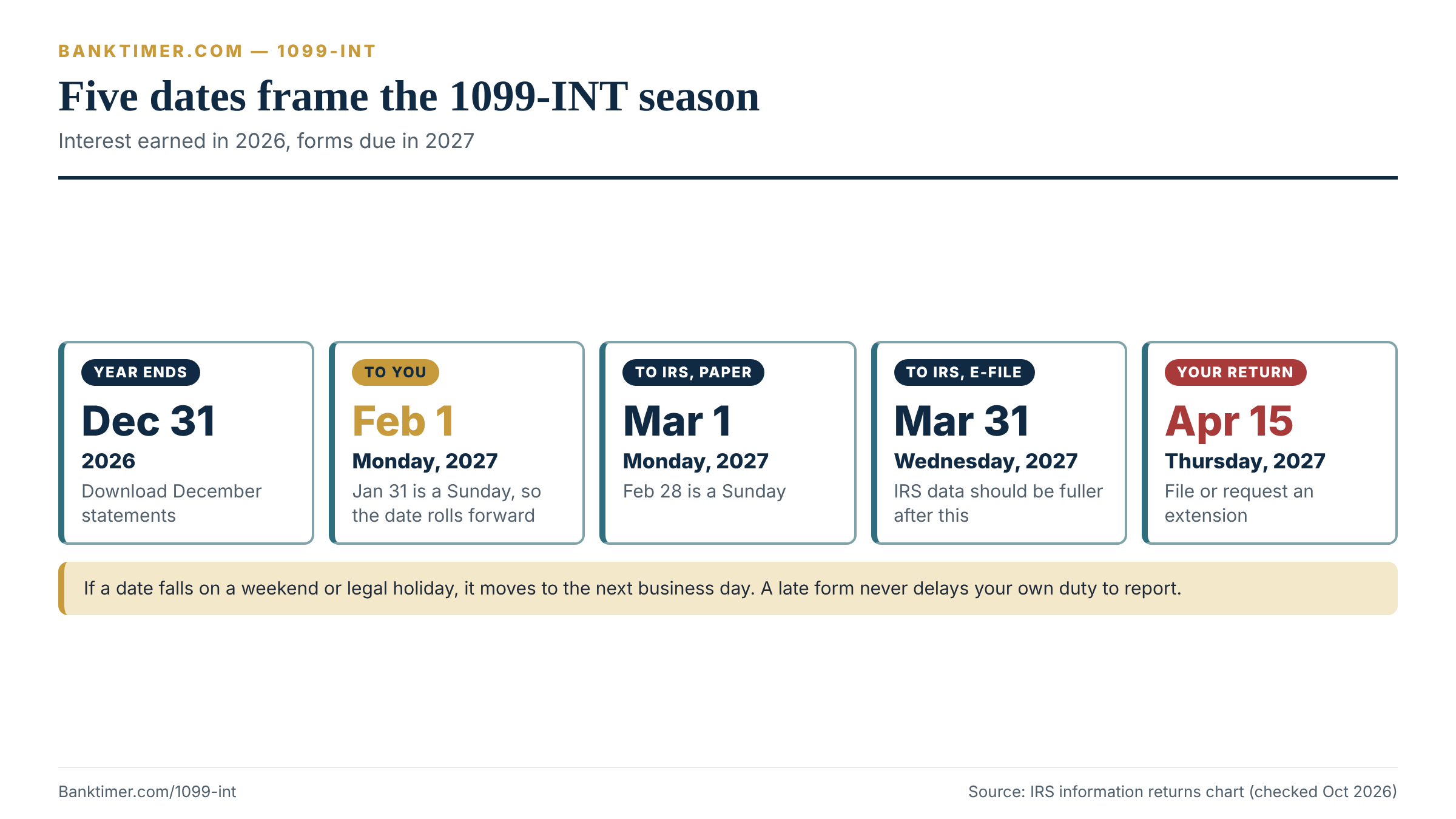
Payers have two clocks. One runs to you, and one runs to the IRS. The IRS information-return chart says a payer must furnish Form 1099-INT to the recipient by January 31. It must file with the IRS by February 28 on paper or by March 31 if filed electronically. If a date falls on a weekend or legal holiday, it moves to the next business day.
That weekend rule matters for the forms covering interest earned in 2026. January 31, 2027 is a Sunday, so the recipient deadline becomes Monday, February 1, 2027. February 28, 2027 is also a Sunday, which pushes the paper deadline to Monday, March 1.
The tax-year 2026 calendar
The table below lays out the sequence for interest earned in 2026. Read the third column first. It tells you who can actually move the date, which is usually not you.
| Date | What happens | Who controls it | Your move |
|---|---|---|---|
| December 31, 2026 | The interest year ends | Calendar | Download December statements and a year-end summary if the bank offers one |
| Monday, February 1, 2027 | Recipient deadline (January 31 is a Sunday) | Payer, under IRS rules | Check your online tax documents; wait a few days for mail |
| First week of February | IRS records may begin to show filed forms | IRS | Do not rely on this for completeness |
| Monday, March 1, 2027 | Paper filing deadline to the IRS (February 28 is a Sunday) | Payer | Few forms arrive this way |
| Wednesday, March 31, 2027 | Electronic filing deadline to the IRS | Payer | IRS data should be complete for most payers after this |
| Thursday, April 15, 2027 | Individual return due date | You | File, or request an extension |
These dates are for forms due in 2027. Electronic delivery depends on your consent. The IRS publication also says the payer must keep the form on a website through October 15. Download your copy early rather than waiting, and add the dates to your own planner or our 2027 deadlines calendar.
What a late form means
A payer that misses the January 31 date has not changed your duty. Your tax return is still due on April 15, and your interest is still taxable. If the form is late, start from your own records.
1099-INT From an Online Bank
An online bank follows the same IRS rules as a branch bank. The difference is mostly in how the form reaches you. There is rarely a paper envelope, and the document may sit in a tax center that you have to open yourself.
Electronic delivery and consent
The IRS general instructions set a condition for electronic delivery. The recipient must consent in the affirmative and must not have withdrawn that consent. The consent must be given in a way that shows you can access the statement in the format used. If you agreed to e-delivery when you opened the account, the form may never arrive by mail.
That is the first thing to check when a form seems missing. Log in, find the documents or tax center area, and look for a 1099-INT for the right year. Notification emails can land in spam, and some banks only alert you in the app.
Where the form comes from
Online banks and money apps sometimes hold your money at a partner bank. In those setups, the payer on the form might not be the brand name on your phone. Look at the payer name and TIN on the form. Compare them with the language in your account agreement about where your money is held.
We cannot say how any single provider reports, and we did not test any. The practical fix is simple: read the payer name before you decide the form is not yours.
Shared and moved accounts
Several quiet problems cause missing online-bank forms:
- A changed address. Paper forms go to the address on file at the time.
- A closed account. Interest earned before closing is still reportable, and the form may need to be requested.
- A joint account. Only one owner’s TIN may appear on the form, which we explain in the joint account section.
- A disabled login. If you cannot log in, contact the bank to request the form by mail.
Our guide to online savings accounts covers how these accounts work, and the dormant bank account article explains what can happen when an account sits idle.
1099-INT Not Received: What to Do, in Order
Start with the headline rule. IRS Topic 403 and Publication 550 both say you must report your interest even when no form arrives. So the question is never “should I report it?” The question is “how do I find the right number?”
Step 1: check where the form could be hiding
Look in the bank’s online documents area, your email spam folder, the mail at your old address, and your tax software’s import tool. Confirm that the interest was at least $10. If your total was under $10 for the payer, the lack of a form is normal.
Step 2: rebuild the number from your statements
Federal Truth in Savings rules, found in Regulation DD at 12 CFR 1030.6, require periodic statements to show the dollar amount of interest earned during the statement period. Add up those amounts for January through December. If you have an annual summary, use that as a cross-check.
The sum may not match what a bank later reports, since the bank counts interest credited in the calendar year. Small timing differences can appear at year-end.
Step 3: use IRS records as a cross-check
The IRS wage and income transcript shows data from information returns the IRS receives, including Forms 1099. It is usually available for the current year in the first week of February. It shows only documents filed with the IRS, so it may be missing forms. The IRS page also notes a limit of about 85 income documents.
The IRS import page says that when the IRS has not yet received your 1099-INT information, most payers have until March 31 to send it. If your interest was under $10, the payer is not required to send you a 1099-INT, but you still must report the income.
Step 4: ask the payer for the form
Contact the bank in writing, through secure messaging if available. Give the account number, the tax year and the mailing address you want. Ask whether the form was issued, when, and how to download it. Keep the reply.
A caution about the IRS “missing form” steps
IRS Topic 154 describes a path for missing Forms W-2 and 1099-R. Contact the payer, call the IRS at 800-829-1040 after the end of February, and use Form 4852 if needed. That guidance is written for those two forms. We did not find IRS guidance extending Form 4852 to Form 1099-INT.
For interest, your bank statements are the practical record. Report your best figure, keep your work, and amend if a different number later proves right.
The evidence table
Different records answer different questions. This table shows what each one can and cannot prove. Use more than one when the amount is large.
| Evidence | What it shows | Watch for |
|---|---|---|
| Monthly or quarterly statements | Interest earned each period | Timing differences at year-end |
| Bank tax center or year-end summary | The payer’s own annual figure | May differ from the form if corrected later |
| IRS wage and income transcript | What payers filed with the IRS | Incomplete before payers file; limited document count |
| Tax software import | 1099-INT data the IRS holds | Only works when the payer has filed |
| Last year’s return | Pattern of payers and amounts | A new account will not appear |
| Account closing letter | Final interest on a closed account | Easy to misplace |
Wrong 1099-INT Amount: Find the Error Before You File
A form with the wrong number is more common than a missing form. It is also easier to fix when you catch it early. Do not assume the form is right because it is official. Do not assume it is wrong because the number surprises you. Compare it with your records first.
Three quick comparisons
Start with the total. Add the interest earned shown on your monthly statements for the year and compare it with box 1. Then check the name and last four digits of the TIN. Finally, check the account list. A form can combine several accounts, and your memory may only hold one of them.
Publication 550 gives the basic remedy when the amount is wrong. You should ask the issuer for a corrected form, and the new Form 1099-INT should be marked “Corrected.”
Common causes and what to do
Most mismatches have an ordinary explanation. The table sorts the usual suspects by how to confirm them. Several are not errors at all, which is why a quick check can save you a call.
| Likely cause | How to confirm | What to do |
|---|---|---|
| Joint account: the full interest sits under one owner’s TIN | The account has two owners; only one SSN is on the form | Use the nominee steps; the bank has not made an error |
| A sign-up bonus is included in box 1 | The difference equals the bonus | Report it; the form is right |
| Interest from two accounts combined | The bank groups accounts under one TIN | Match the total to both accounts’ statements |
| Duplicate or misapplied credit | Statements sum to less than the form | Request a corrected form |
| Interest credited in January counted in the wrong year | Check the credit dates | Ask the bank; timing rules differ by contract |
| Wrong taxpayer name or TIN | Details on the form do not match | Ask for a corrected form and update your W-9 |
| Form is for someone else | Different name, SSN or payer you never used | See the identity theft section |
Ask the payer for a correction
Put the request in writing and include the account, year, the box and amount, and your statement total. The IRS general instructions say a filer should correct an error as soon as possible. The filer then files a corrected return with the IRS and furnishes corrected statements to recipients. You are asking the bank to follow its own obligation, not asking for a favor.
“I received a 2026 Form 1099-INT showing $1,310.40 in box 1 for account ending 1234. My statements show $860.40 of interest earned for the year. Please review the account and send a corrected form, or explain the difference in writing. I plan to file by April 15, 2027.”
Keep the reply, whatever it says. If the bank explains the difference and it holds up, you have your answer. If it issues a corrected form, keep the original too.
Your 12 monthly statements add up to $860.40 of interest. The 1099-INT shows $1,310.40, which is $450.00 higher. If you simply report the form amount and your marginal rate is 22%, you pay $99.00 of extra federal tax on income you did not earn.
If you report only the $860.40 and the bank never corrects the form, the IRS may see a mismatch and send a notice. Both choices have a cost, so the better path is a corrected form from the bank. All figures here are illustrative.
What if the bank will not correct it in time
You still file on time. There are two defensible approaches. If the amount is large, choose between them with a tax professional. One reports the form amount and documents the dispute. The other reports your supported figure and keeps your records ready for a notice.
The IRS CP2000 page says a notice is not a bill and that you can agree or disagree and include supporting documentation. That is a reason to keep your statements and your correspondence with the bank in one folder.
If a corrected form later changes what you should have reported, you generally amend the return with Form 1040-X. The IRS says to file a 1040-X when a corrected W-2 or 1099-R differs from an estimate. The same practical route applies to other corrected 1099 forms.
Joint Accounts and Nominee Interest
Joint accounts create the most confusing 1099-INT problems, because the form lists one name and one TIN. Publication 550 says each person’s share of interest from jointly held property is determined by local law. For a joint account with combined funds, the payer uses the TIN of the person listed first.
If you are the person listed first, but half the interest belongs to someone else, you are a nominee recipient. IRS Topic 403 says you report the form on your return, then use the nominee instructions in the Schedule B instructions.
How the nominee steps work
The Schedule B instructions say to report the total on line 1, even if you later gave some of the income to others. Then you enter a subtotal, show a “Nominee Distribution” with the other person’s share, and subtract it. The remainder is your taxable interest.
Generally, you must also give the real owner a Form 1099-INT and send Copy A to the IRS with a Form 1096. The exception is when the owner is your spouse. For married couples filing jointly, this usually adds no complexity.
A joint savings account shows $1,086.40 in box 1 under the parent’s TIN. Under the account’s ownership, the child’s share is $543.20. The parent reports the full amount and subtracts the child’s share as a nominee distribution.
At 22%, the tax on the full amount would be $239.01, but the parent’s real share carries $119.50. The child reports $543.20 on their own return. These numbers are illustrative, and local law determines the actual split.
Our guide to the joint bank account explains ownership and survivorship rules that affect who owns the money in the first place.
A 1099-INT for an Account You Do Not Recognize
A form from a bank where you have never had an account is not a typo to fix. It can signal identity theft. The IRS identity theft guide lists receiving a Form 1099 from a payer you never worked with as a warning sign, though it says the signs do not always mean you are affected.
The same page covers a Form 1099 from a payer you do not recognize. It says not to report that income on your return and not to amend a filed return to add it. It advises contacting the Social Security Administration. It also says to check whether Form 14039, the Identity Theft Affidavit, applies to you.
Where to go next
Contact the payer and ask which account the TIN is linked to. Then follow the IRS steps, including reporting through the IRS fraud page and the recovery plan at IdentityTheft.gov. Our identity theft recovery guide covers the wider cleanup.
This section is only for payers you do not recognize. If you simply forgot an old savings account, the interest is yours and you report it.
What Happens If You Leave Interest Off
The IRS compares what payers report with what you report. When the numbers differ, the IRS may send a notice that the income reported by others does not match your return. The CP2000 page says the notice is not a bill and that you reply by the date listed.
The tax on the missing interest is not the only cost. The IRS accuracy-related penalty is 20% of the underpayment attributable to negligence or disregard, or to a substantial understatement. The IRS lists leaving off income reported on a Form 1099 as an example of negligence. Interest also accrues on unpaid tax, and the IRS rate for individual underpayments is 7% per year for the fourth quarter of 2026.
The cost of a small omission
Here is what leaving off $1,200 of interest can cost at an illustrative 24% marginal rate. The penalty is not automatic. The IRS can remove or reduce penalties for reasonable cause, though it says interest generally cannot be removed unless the penalty is.
| Cost item | Basis (illustrative) | Amount |
|---|---|---|
| Tax on omitted interest | $1,200 × 24% | $288.00 |
| Accuracy-related penalty, if applied | 20% of the $288 underpayment | $57.60 |
| Interest on the underpayment | 7% for one year, simple | $20.16 |
| Total with penalty | $365.76 | |
| Total without penalty | $308.16 |
The insight: the tax you owed anyway is most of the bill, but the penalty and interest add about 27% on top of it. Reporting correctly costs you nothing extra.

A Decision Framework: What to Do With Your Form
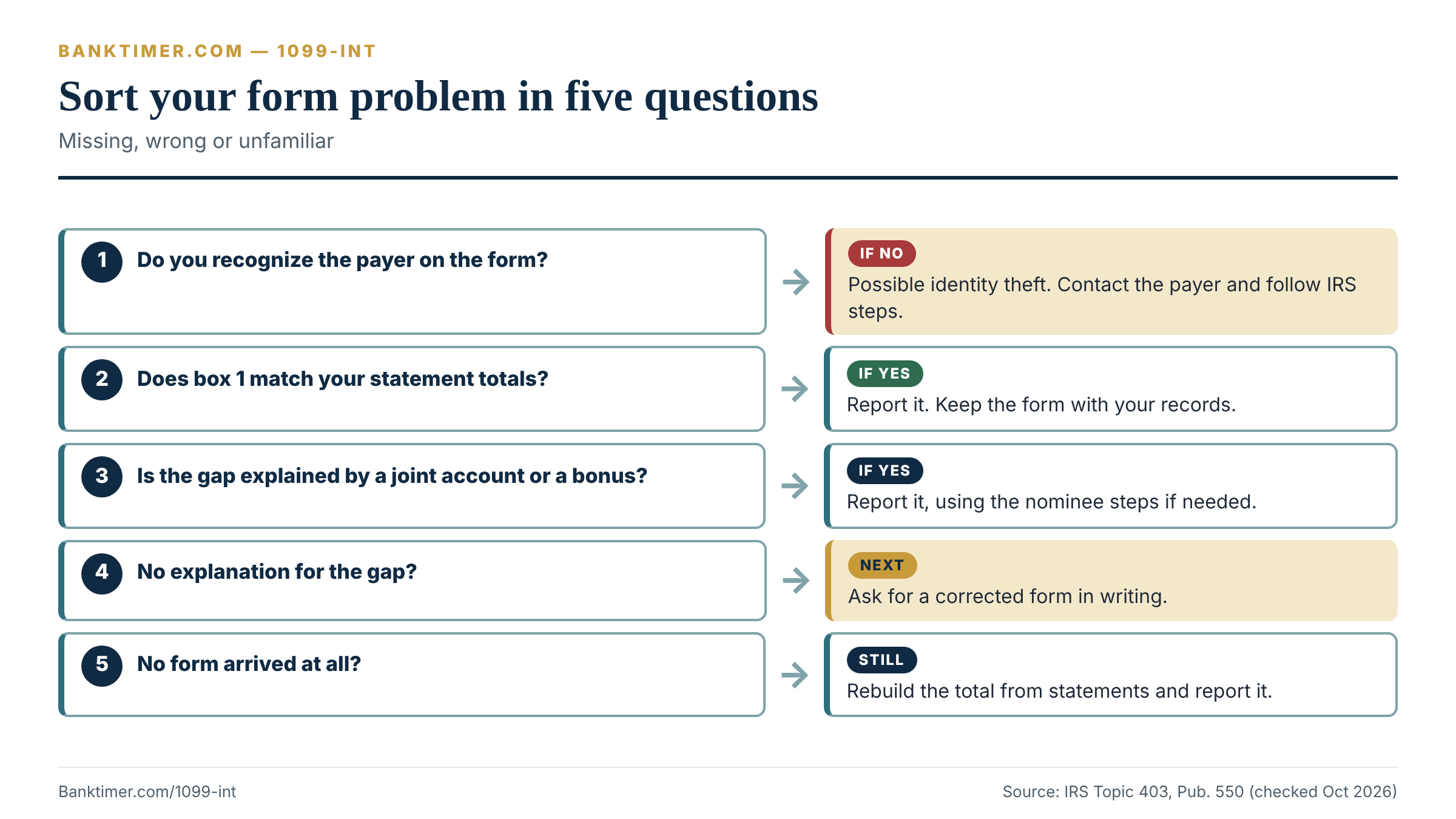
Use these questions in order. They fit most situations in about ten minutes, and they show where a call to the bank or a tax professional is worth it.
- Is the payer one you know? If not, treat it as a possible identity issue, not a reporting question.
- Do the total and name match your records? If yes, report box 1 and box 3 as shown.
- If not, is there an ordinary explanation? Joint ownership, a bonus or combined accounts are common. Use nominee steps or report the bonus.
- If there is no explanation, request a corrected form in writing. Set your own date, ahead of your filing plan.
- If the bank has not corrected it by filing time, document and decide. Discuss large differences with a tax professional.
- If no form came at all, rebuild the total from statements. Report it anyway.
Red Flags and Costly Mistakes
Most 1099-INT problems come from three habits. People wait for a form before they check anything, they trust the form without comparing it, or they treat small accounts as invisible. The table sorts the warning signs.
| Red flag | Why it matters | What to ask | Safer next step |
|---|---|---|---|
| A form from a bank you never used | Possible identity theft | Which account does this TIN link to? | Contact the payer; follow IRS identity theft steps |
| Box 4 shows tax withheld you did not expect | Backup withholding means a TIN or notice issue | Why was backup withholding applied? | Give a correct Form W-9; claim the withholding |
| Form far above your statements | Possible error or bonus | What does box 1 include? | Request a written breakdown or corrected form |
| Only one joint owner named | The nominee rules may apply | Whose TIN is on the account? | Report the total, subtract the other share |
| A text or email asking for your SSN to “send your 1099” | Classic phishing | Did I request this? | Log in directly; see our bank phishing text guide |
| A preparer says to skip interest with no form | The IRS says to report it | What is the basis for omitting it? | Report it, using your statements |
| A corrected form arrives after you filed | Your return may now be wrong | Does the amount change my tax? | Review and amend with Form 1040-X if needed |
Records to Keep
Good records turn a stressful notice into a short reply. You do not need a system, only a folder. Gather the items below before you file.
| Document | Why it matters | Where to get it |
|---|---|---|
| Every 1099-INT, including corrected versions | Shows what the payer reported | Bank tax center or mail |
| Monthly or quarterly statements | Support for interest earned | Online banking |
| Year-end or closing summary | Cross-check on the total | Bank, on request |
| Written correction requests and replies | Proof you tried to fix an error | Your email or secure messages |
| Form W-9 or TIN confirmations | Evidence behind backup withholding | Bank, or your files |
| Your filed return and schedules | What you actually reported | Tax software or preparer |
- ☐ Have I listed every account that paid me interest this year, including closed ones?
- ☐ Does each form match the interest earned on my statements?
- ☐ Is any interest under $10 at an institution that sent no form?
- ☐ Did I report any sign-up bonus on its form or as income?
- ☐ Do I have a CD early withdrawal penalty in box 2 to deduct?
- ☐ Is backup withholding in box 4 claimed on my return?
- ☐ Should a joint account be handled with the nominee steps?
- ☐ Does my total taxable interest and dividends top $1,500, so Schedule B applies?
- ☐ Have I asked the bank in writing about any difference I could not explain?
- ☐ Do I need estimated payments next year because my interest is growing?
Current Context as of October 2026
A few facts frame this guide, and we checked each on October 15, 2026. The IRS page for Form 1099-INT lists the current form revision as 01/24 and shows no recent developments, and the instructions are dated January 2024. The IRS interest rate on individual underpayments is 7% per year for October through December 2026.
The line numbers we cite for Form 1040 and Schedule 1 come from the 2025 forms, which you use for interest earned in 2025. Forms for interest earned in 2026 are filed in early 2027, so confirm the lines when the new forms are released.
Frequently Asked Questions
Do I have to report interest on my taxes if I never received a 1099-INT?
Yes. IRS Topic 403 says you must report all taxable and tax-exempt interest even if you do not receive a Form 1099-INT. A missing form changes how you find the number, not whether you owe tax on it. Use your monthly statements to total the interest earned for the year, report it on your return, and keep the statements with your records.
Do I report interest under $10?
Yes. The $10 threshold tells a payer when it must file a 1099-INT. It does not exempt you from reporting. If a bank pays you $9.40, it may send no form, but the interest is still taxable income. Small amounts from several accounts can also add up to a figure that matters for Schedule B.
What is box 1 on Form 1099-INT?
Box 1 is interest income. The IRS describes it as taxable interest not reported in box 3. For most savers it holds the interest earned on savings accounts, CDs and similar deposits. You total it with other taxable interest and enter it on Form 1040 line 2b, adding Schedule B when your interest and ordinary dividends are over $1,500.
Is savings account interest taxable?
Generally, yes. Publication 550 says any interest you receive, or that is credited to your account and can be withdrawn, is taxable income. That includes interest you leave in the account. There are narrow exceptions, such as interest on frozen deposits, and some interest, such as certain municipal bond interest, is federally tax-exempt. State rules vary.
When will I get my 1099-INT?
The payer must furnish it to you by January 31, or the next business day. For interest earned in 2026, that date is Monday, February 1, 2027, because January 31 falls on a Sunday. Many online banks post forms in an app or tax center earlier than the deadline, and some mail forms only if you did not consent to electronic delivery.
What if my 1099-INT amount is wrong?
Compare box 1 with your statement totals first. Then ask the payer for a corrected form in writing. Publication 550 says the new form should be marked “Corrected.” If it does not arrive before you file, document your records and consider speaking with a tax professional. A mismatch can trigger an IRS notice, so keep the correspondence.
Do I attach my 1099-INT to my tax return?
No. Publication 550 says you do not have to attach it to your return. You keep it with your records and report the amounts on the right lines of Form 1040, with Schedule B if you need it. If the form shows tax withheld in box 4, you report that amount on the withholding line of your return.
Will the IRS know if I do not report bank interest?
It often will. Payers file Forms 1099-INT with the IRS, and the IRS compares those reports with the income on your return. The IRS CP2000 page describes a notice sent when payer information does not match your return. Small accounts under $10 may not appear in that data, but you should report them anyway.
How is a CD early withdrawal penalty reported?
The penalty appears in box 2 of your 1099-INT. Publication 550 says you report the full interest credited, without subtracting the penalty. Then you deduct the penalty separately as an adjustment on Schedule 1. If you report only the net interest, your return will not match the form.
Is interest from an online bank reported differently?
No. An online bank follows the same IRS rules for the form, the $10 threshold and the deadlines. The difference is delivery. Online banks often provide the form through a tax center, and a payer can use electronic delivery only if you consent. Read the payer name on the form, since a partner bank may be listed.
What does backup withholding in box 4 mean?
Box 4 shows federal income tax the payer withheld, usually at 24%. The IRS says that can happen if you did not give a correct taxpayer identification number or if the IRS told the payer to withhold. You claim the amount on your return as tax already paid. Fix the cause with a Form W-9.
This week, list every account that paid you interest in 2026, including small and closed ones, and find where each bank posts its tax forms. Download December statements now so you can check the numbers when the forms arrive.
The variable that decides your outcome is the total, not the form. Your obligation is to report every dollar of taxable interest, so build one list of every account that paid you in 2026, check each 1099-INT against your statements, and ask any payer with a wrong number for a corrected form in writing. Do that before you file, because a mismatch costs more than the tax. What the form does not settle matters too. It does not tell you your state rules, does not cover interest that never reached a form, and does not decide who owns a joint account. If a payer’s name looks wrong, treat it as a possible identity problem and not a reporting question. Confirm current IRS forms and deadlines each filing season.
Methodology
We built this guide from IRS primary sources and checked each dated figure on October 15, 2026. Box definitions, the $10 threshold and the CD and money market treatment come from the IRS instructions for Forms 1099-INT and 1099-OID. Reporting duties, the nominee steps and the early withdrawal rules come from IRS Topic 403, Publication 550 and the Schedule B instructions. Deadlines come from the IRS information-return chart and Publication 1099.
Backup withholding, estimated tax and net investment income tax come from IRS tax topics. The notice, penalty and interest-rate figures come from IRS pages for CP2000, the accuracy-related penalty and fourth-quarter 2026 rates. Account balances, APYs, marginal rates, bonuses and the joint account amounts are illustrative assumptions, not live quotes. Calculations are in a script we ran and rechecked.
Rules vary by state, provider and account contract, and line numbers come from 2025 forms. We did not test any bank or app, and we did not contact any institution.
Sources
- Instructions for Forms 1099-INT and 1099-OID, IRS (01/2024)
- About Form 1099-INT, IRS
- Topic no. 403, Interest received, IRS
- Publication 550 (2025), Investment Income and Expenses, IRS
- Instructions for Schedule B (Form 1040), IRS
- Publication 1099 (2026), General Instructions for Certain Information Returns, IRS
- Information returns filing chart, IRS
- Topic no. 307, Backup withholding, IRS
- Understanding your CP2000 notice, IRS
- Accuracy-related penalty, IRS
- Interest rates remain the same for the fourth quarter of 2026, IRS, August 21, 2026
- Import your tax information into tax preparation software, IRS
- Identity theft guide for individuals, IRS
- 12 CFR 1030.6, Periodic statement disclosures, Cornell Law School
By the Banktimer Editorial Team · Published
Banktimer is an independent U.S. consumer-finance publication. Our editors draw on primary and official sources first, such as the CFPB, FDIC, Federal Reserve, and FTC, along with statutes, regulations, and providers’ own agreements and fee schedules. Then we add worked examples and decision tools. Our goal is the most useful, best-supported explanation the sources available to us at the time of writing allow.
This article is general information, not legal, tax, investment, insurance, or financial advice, and reading it does not create a professional relationship with Banktimer. Rates, fees, limits, and rules change, and they vary by state, provider, and contract, so confirm current terms with your bank, lender, insurer, or the agency named in the article before you act. Examples are illustrative unless labeled otherwise. Banktimer is not a bank, lender, insurer, or financial advisor, and we are not responsible for decisions or losses that result from relying on this content. For advice about your own situation, talk to a licensed professional.