
By the Banktimer Editorial Team · Published
Banktimer is an independent U.S. consumer-finance publication. Our editors draw on primary and official sources first, such as the CFPB, FDIC, Federal Reserve, and FTC, along with statutes, regulations, and providers’ own agreements and fee schedules. Then we add worked examples and decision tools. Our goal is the most useful, best-supported explanation the sources available to us at the time of writing allow.
This article is general information, not legal, tax, investment, insurance, or financial advice, and reading it does not create a professional relationship with Banktimer. Rates, fees, limits, and rules change, and they vary by state, provider, and contract, so confirm current terms with your bank, lender, insurer, or the agency named in the article before you act. Examples are illustrative unless labeled otherwise. Banktimer is not a bank, lender, insurer, or financial advisor, and we are not responsible for decisions or losses that result from relying on this content. For advice about your own situation, talk to a licensed professional.
Closing costs decide how much cash you actually need on closing day, and the total behaves nothing like a single line item you can shop for once and forget. This Banktimer guide explains closing costs in practical terms — what the bundle includes, the real pros and cons of paying it upfront versus rolling it into your rate, and which numbers deserve verification before you sign. You will see realistic examples, common mistakes, questions worth asking, and the trade-offs that matter for different financial situations. Where rates, loan-program rules, or disclosure regulations can change, the article points readers to current official sources instead of treating a temporary answer as permanent. Read the full guide before you accept a lender’s estimate, ask a seller for a concession, or choose a “no closing cost” loan based on the label alone.
Closing costs typically run 2% to 6% of your loan amount — on a $400,000 loan, that’s $8,000 to $24,000, and the exact figure depends heavily on your loan type, your state, and which fees you shop for versus accept from your lender’s preferred provider list.
Not every fee inside this bundle is created equal under federal disclosure rules. Some numbers can’t increase at all from your Loan Estimate to your Closing Disclosure, others can rise by up to 10% in total, and a third category has no limit whatsoever — knowing which bucket a specific charge falls into tells you which figures are actually worth disputing.
A “no closing cost” loan doesn’t make the expense disappear — it either folds the total into a higher interest rate for the life of the loan or adds it to your loan balance, and the real break-even point on that trade is often well over a decade.
Sellers can legally cover a meaningful share of what you owe at closing, but the maximum allowed contribution depends on your specific loan type and, for a conventional loan, your down payment size — a conventional loan with less than 10% down caps seller-paid amounts at 3% of the price, while a VA loan handles the cap completely differently.
Since 2024, buyers increasingly need to budget for their own real estate agent’s commission as part of this total, because sellers are no longer required to cover it automatically the way they typically did before a landmark industry settlement changed how agent compensation gets negotiated.
Where you buy changes what you’ll pay as much as what you buy. Some states require an attorney to run your closing, some don’t; and real estate transfer taxes alone can range from nothing at all in several states to well over 1% of your purchase price in others.
Key Numbers to Know
| Figure | Value | Why it matters |
|---|---|---|
| Typical closing costs as a share of the loan amount | 2% to 6% | The baseline range for estimating your total before you get a specific Loan Estimate |
| Total on a $400,000 loan at that 2%–6% range | Roughly $8,000 to $24,000 | Shows how wide the realistic spread actually is at a common loan size |
| Typical lender’s title insurance premium | Roughly 0.5% to 1% of the purchase price | One of the larger single line items in the bundle |
| Typical appraisal fee | Roughly $300 to $500 | A required charge on nearly every purchase mortgage |
| Loan Estimate delivery deadline | Within 3 business days of application | Your first official look at projected fees, required by federal law |
| Closing Disclosure delivery deadline | At least 3 business days before closing | Your final, binding look at the total before you sign |
| Conventional loan seller-paid cap (under 10% down) | 3% of the sale price | The most common seller-concession scenario for a first-time buyer with a smaller down payment |
| FHA and USDA seller-paid cap | 6% of the sale price | Meaningfully more generous than the low-down-payment conventional tier |
| VA seller concession cap for specific extras | 4% of the sale price, on top of standard fees | Applies to concessions beyond what VA otherwise lets a seller cover in full |
What Closing Costs Actually Are
Closing costs are the collection of fees, taxes, and prepaid expenses due at the closing table on top of your down payment, covering everything required to originate, underwrite, insure, and legally record your new mortgage. Unlike your down payment, this money doesn’t build equity in your home — it pays for the services and government filings that make the transaction legally valid and the lender’s investment properly secured.
The Difference Between Prepaids and Actual Fees
The bundle splits into two genuinely different categories that are easy to lump together. Fees are one-time charges for a specific service — an appraisal, a credit report, title insurance — that exist only because you’re closing this particular loan. Prepaids are money you’d eventually owe anyway — property taxes, homeowners insurance, and a few days of interest — simply collected upfront to fund your escrow account or cover the gap until your first regular payment. Treating prepaids as new spending in the same sense as a fee overstates how much of your total is genuinely additional versus money you were always going to pay on a slightly different schedule.
Who Sets Each Number — the Lender, a Third Party, or the Government
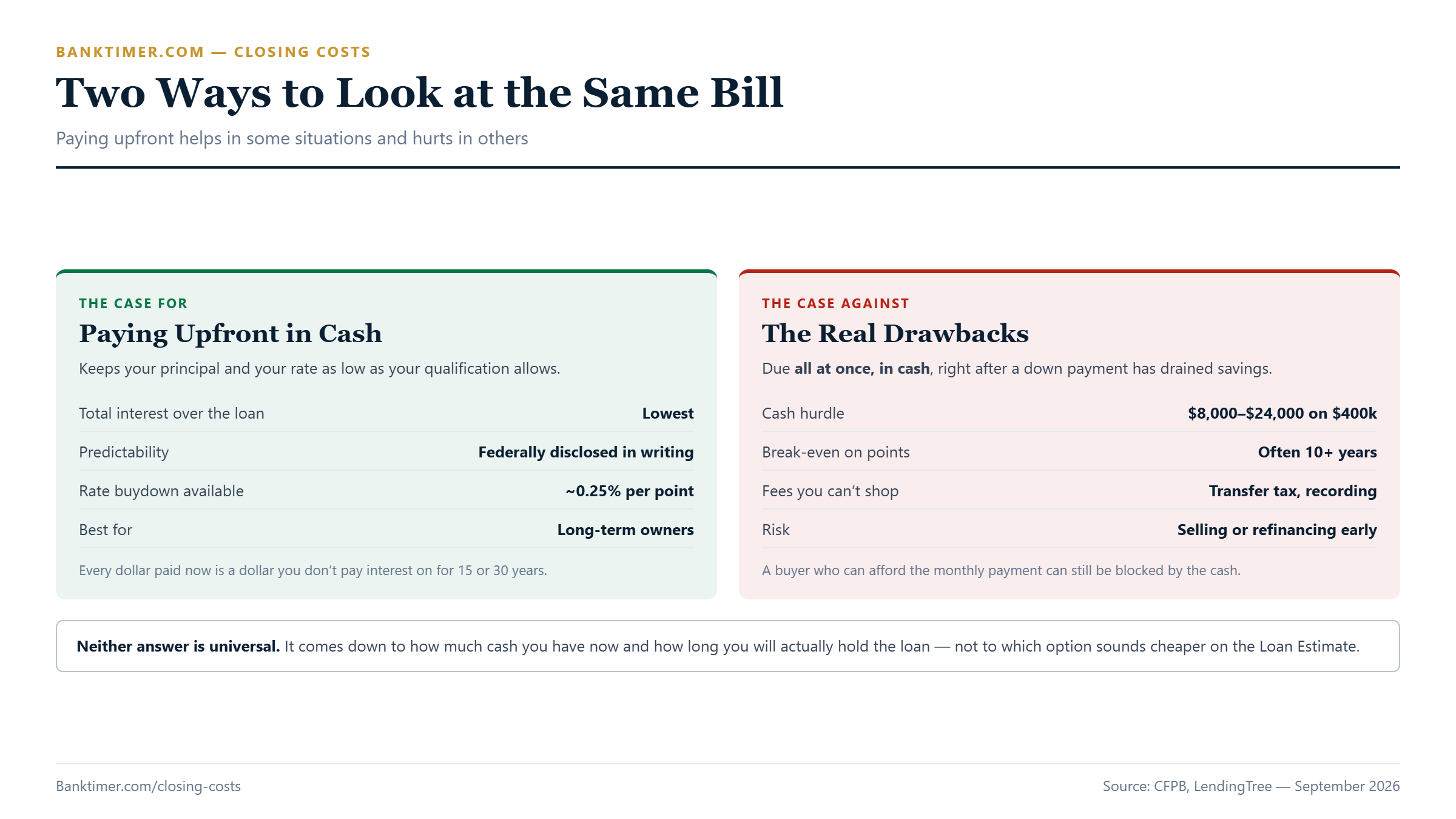
A third useful way to sort what you owe is by who actually controls the price. Some charges are set directly by your lender (origination fees, application fees). Others are set by third-party providers your lender selects or that you choose yourself (appraisers, title companies, survey companies). Still others are set entirely by state or local government (recording fees, transfer taxes) and aren’t negotiable with anyone in the transaction. Knowing which bucket a specific line item falls into tells you immediately whether it’s worth negotiating, worth shopping, or simply worth budgeting for as a fixed number.
The Pros: Why Paying Closing Costs Upfront Can Make Sense
Lower Total Interest Over the Life of the Loan
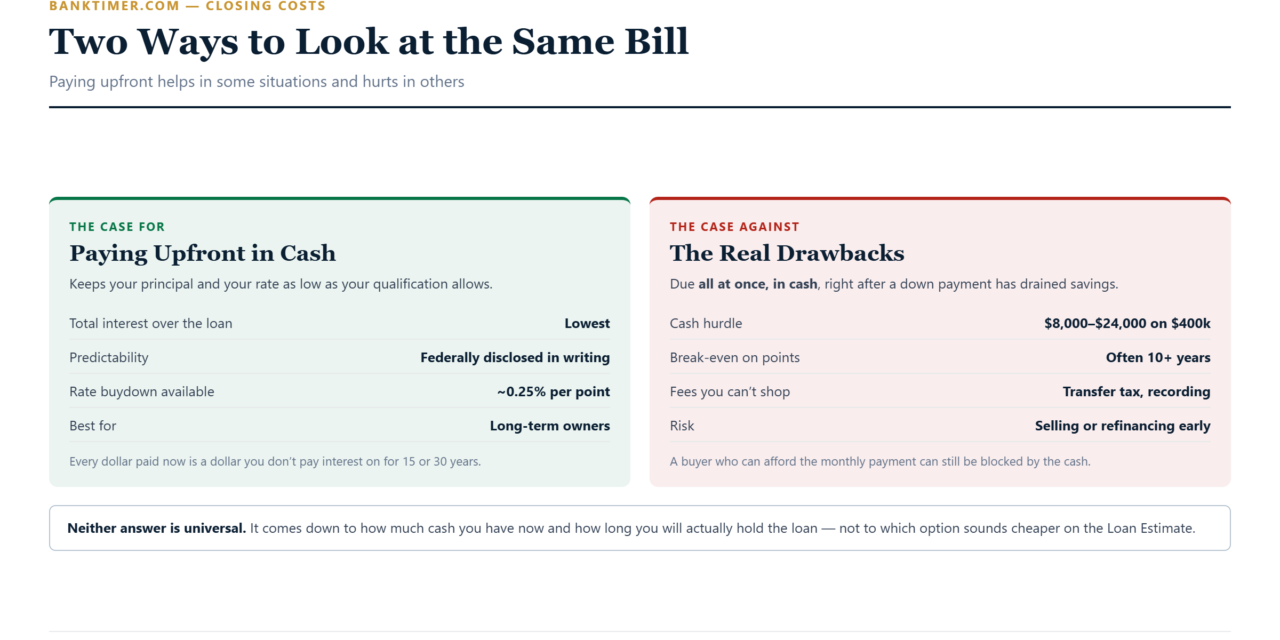
Paying this bill in cash, rather than rolling it into a higher rate or a larger balance, keeps your principal and your rate as low as your qualification allows — meaning every dollar you pay now is a dollar you’re not paying interest on for the next 15 or 30 years. For a buyer planning to stay put for the long haul, this compounding advantage is usually the single strongest argument for treating the expense as cash due now rather than cost deferred into the loan.
A Below-Market Rate You Actually Qualify For
Discount points — a specific, optional line item in the bundle — let a borrower directly buy down their interest rate, typically by roughly 0.25% per point, where one point costs 1% of the loan amount. This is one of the only pieces of the total you fully control the size of: you can choose to pay zero points, one point, or several, trading a specific, known upfront amount for a specific, known reduction in your monthly payment.
A Documented, Predictable Number Once You’re Past the Loan Estimate
Because this expense is federally required to be disclosed in writing, and because certain categories legally can’t increase between your Loan Estimate and your Closing Disclosure, paying what you were quoted gives you one of the more predictable, enforceable figures in the entire home-buying process — a genuine advantage over verbal estimates or informal fee ranges you might get from other services during a purchase.
The Cons: Where Closing Costs Work Against You
A Real Cash Hurdle Even When You Can Afford the Monthly Payment
The most common problem with this bundle isn’t that it’s unaffordable in the long run — it’s that it’s due all at once, in cash, at a moment when a buyer has often already stretched their savings to cover a down payment. A buyer who can easily afford the resulting monthly mortgage payment can still be genuinely blocked from closing by a $12,000 bill they simply don’t have liquid on hand.
The Break-Even Math Doesn’t Always Favor Paying More Upfront
Paying extra — through discount points or a larger origination fee for a lower rate — only pays off if you keep the loan long enough to recoup that upfront spending through lower monthly payments. A borrower who refinances or sells within a few years of paying thousands of dollars extra to buy down their rate can easily come out behind compared with simply accepting the lender’s standard rate and fees.
Charges You Can’t Shop Away
A meaningful share of this total — recording fees, transfer taxes, and certain lender-selected third-party services — simply isn’t negotiable or shoppable no matter how much research you do. Treating every dollar of it as something you can talk down or shop around is an unrealistic expectation that sets buyers up for frustration partway through the process.
A Full Line-by-Line Breakdown of What’s Included
Lender Fees
This portion of the bundle covers the lender’s own charges for originating and underwriting your loan: an origination fee (often a percentage of the loan amount or a flat charge), an application fee, an underwriting fee, and any discount points you’ve chosen to pay. These particular charges are the ones most directly controlled by which lender you choose, which makes comparing Loan Estimates across lenders genuinely worthwhile.
Third-Party Fees
This category pays for services performed by companies other than your lender: the appraisal, the credit report, title search and title insurance, a survey if required, and — in attorney-closing states — legal fees. Some of these line items are shoppable under federal disclosure rules; others are selected from your lender’s approved provider list, with less room for you to change the price.
Prepaid Items
As covered above, this slice of the total isn’t a new fee at all — it’s your first deposit into your escrow account (property taxes and homeowners insurance) plus prepaid daily interest between your closing date and your first mortgage payment. These items scale with your closing date and your local tax and insurance rates rather than with your lender’s pricing.
Government Recording and Transfer Fees
The final slice goes directly to state and local government: recording fees to officially register your deed and mortgage, and, in most but not all states, a real estate transfer tax calculated as a percentage of your purchase price. These charges are fixed by law in your specific jurisdiction and aren’t something any lender or agent can adjust for you.
How Much Closing Costs Actually Run in 2026
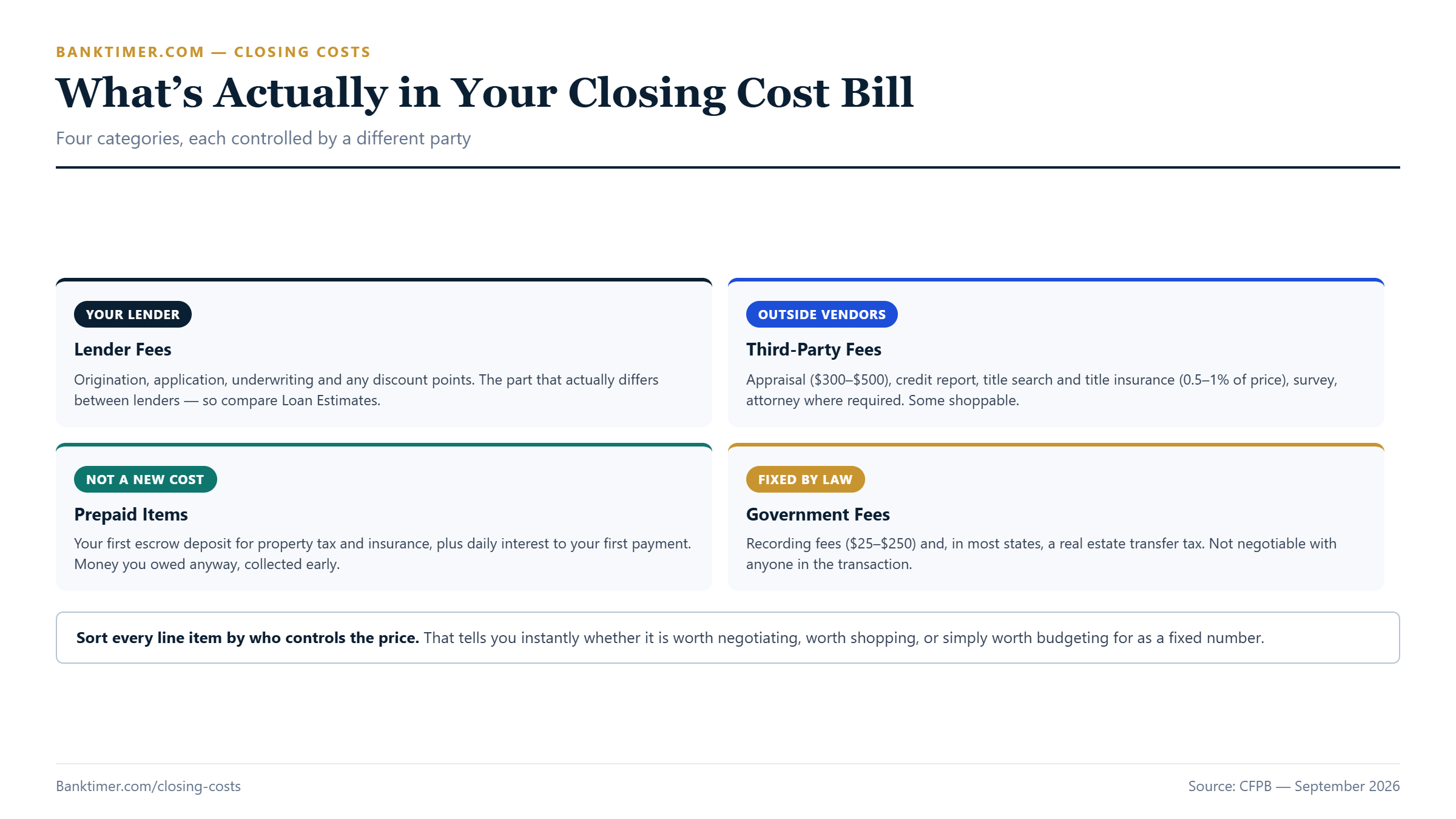
Nationally, this bundle runs roughly 2% to 6% of the loan amount on a typical purchase mortgage, though the honest answer is “it depends” — heavily — on your state, your loan size, and your specific loan program. On a $400,000 loan, that range works out to roughly $8,000 to $24,000, a wide enough spread that a generic national average is far less useful to you than your own itemized Loan Estimate once you’re actually shopping for a specific property and loan. Within that broad range, a lender’s title insurance policy (roughly 0.5% to 1% of the purchase price) and an appraisal ($300 to $500) are typically among the largest individual pieces, alongside whatever origination fee and discount points you’ve chosen to include.
Purchase Price Sensitivity: Why a Bigger Home Doesn’t Just Mean a Bigger Down Payment
Several of the largest fees in this bundle — title insurance, transfer taxes, origination fees calculated as a percentage — scale directly with your purchase price, not just your loan amount. A buyer moving from a $300,000 target to a $500,000 target isn’t only committing to a larger down payment and a larger monthly payment; they’re also very likely looking at a proportionally larger bill at the closing table, since so many of the individual fees are percentage-based rather than flat.
A Quick Estimate Before You Have a Loan Estimate
Before you’ve applied with a specific lender, a rough estimate is still useful for budgeting. Multiply your expected loan amount by 3% as a reasonable national baseline, then adjust up if you’re in a state with a real estate transfer tax or an attorney-closing requirement, or down if you’re in a state without one. On a $350,000 loan, that baseline lands around $10,500 — a number to treat as a planning figure, not a final one, since your actual Loan Estimate can move meaningfully in either direction once your specific lender, property, and state are known. This back-of-envelope approach is most useful for deciding roughly how much cash to set aside early in your search, well before you’re far enough along to request a formal, itemized Loan Estimate from an actual lender.
Closing Costs by Loan Type: Conventional, FHA, VA, and USDA
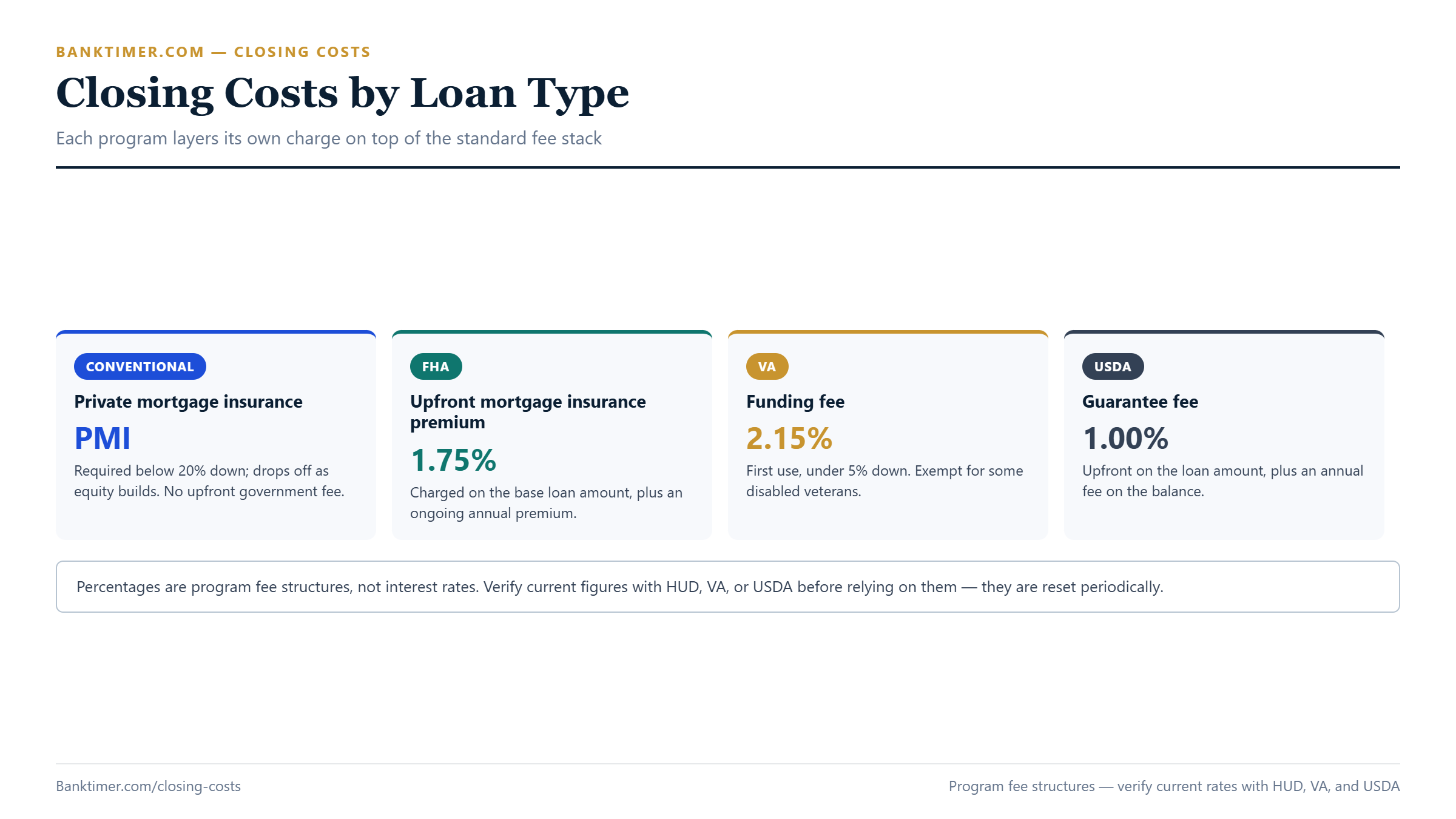
Your loan program doesn’t just set your qualification rules — it also shapes this expense directly, mainly through mortgage insurance premiums, guarantee fees, and funding fees layered on top of the standard categories every loan type shares. A conventional loan’s total can include private mortgage insurance if you’re putting down less than 20%. An FHA loan’s total includes an upfront mortgage insurance premium, currently a percentage of the loan amount financed into the loan itself, on top of standard fees. A VA loan’s total includes a funding fee, which varies by your down payment size and whether you’ve used your VA loan benefit before, though many VA disability-rated borrowers are exempt from this specific fee entirely. A USDA loan’s total similarly includes an upfront guarantee fee financed into the loan, alongside the standard third-party and government fees every loan type shares.
Seller Concessions: How Much of the Bill Someone Else Can Cover
A seller concession is money the seller agrees to contribute toward your total, negotiated as part of your purchase offer rather than paid separately. How much a seller can legally cover depends entirely on your loan type: a conventional loan caps the seller’s contribution at 3% of the sale price if you’re putting down less than 10%, 6% if you’re putting down 10% to 25%, and 9% if you’re putting down 25% or more, with investment properties capped at just 2% regardless of down payment. An FHA loan allows sellers to cover up to 6% of the sale price toward fees, prepaid items, and discount points combined. A VA loan handles this differently: a seller can cover all of a borrower’s standard fees with no percentage cap at all, while a separate 4%-of-sale-price cap applies only to specific additional concessions like payoff of existing debts or a temporary rate buydown. A USDA loan allows sellers to contribute up to 6% of the sale price as well. In every case, the concession still can’t exceed the buyer’s actual expenses — a seller can’t hand over cash beyond what the fees and prepaids genuinely total.
Negotiating a Concession Without Losing the Deal
Asking for help with the bill and asking for a lower price accomplish different things for a seller, even when the dollar amounts look similar on paper — a price reduction lowers the seller’s net proceeds directly, while a concession is sometimes easier for a seller to accept because it doesn’t change the headline sale price that shows up in neighborhood comparables. Framing the request this way, rather than as a generic discount, can make a seller more receptive in a market where they’re motivated to close but sensitive about the recorded sale price.
Down Payment and Closing Cost Assistance Programs Worth Checking First
A seller concession and a higher interest rate aren’t the only two ways to reduce what’s due in cash. A wide range of state and local housing finance agencies run programs built specifically to help with closing costs, often bundled together with down payment assistance in the same application. These programs typically take one of three forms: an outright grant that never has to be repaid, a deferred-payment second loan forgiven after a set number of years of continuous occupancy, or a low-interest second loan repaid alongside your first mortgage. Eligibility usually depends on your household income relative to the area median income for your county, and many — though not all — require you to be a first-time buyer, generally defined as not having owned a home in the past three years rather than never having owned one at all.
Where to Start Looking
Your state’s housing finance agency is the natural starting point, since nearly every state runs at least one program combining down payment help with a dedicated allowance for closing costs. Some employers, credit unions, and even certain lenders offer smaller-scale assistance of their own, sometimes structured as a credit toward this bundle tied to opening accounts or completing a homebuyer education course. Because these programs change eligibility rules and funding availability from year to year, and some run out of allocated funds partway through a calendar year, confirming current details directly with the administering agency early is worth doing well before timing becomes a pressure point in your specific transaction.
Most of these programs can be layered on top of a standard FHA or conventional first mortgage, though a few loan types or specific lenders restrict which assistance programs they’ll accept — another detail worth confirming with your loan officer before you count on a specific grant covering a specific share of what you owe. Read the fine print on any deferred or forgivable second loan carefully: selling or refinancing before the forgiveness period ends can trigger a requirement to repay some or all of the assistance, turning what looked like free help with closing costs into an unexpected repayment obligation at exactly the moment you’re already managing a transaction.
None of this replaces doing your own math. A grant covering $4,000 of an expected $11,000 bill still leaves $7,000 to plan for through cash, a seller concession, or a slightly higher rate — treat any assistance program as one input into your total budget rather than a reason to stop comparing your other options. Ask your loan officer directly, early in the process, which programs they’ve closed loans with before, since not every lender has experience layering every regional program correctly, and a lender unfamiliar with your specific program can slow down or complicate what should otherwise be a straightforward addition to your financing.
The Loan Estimate and Closing Disclosure: Your Legal Protection Against Surprise Fees
Three Categories, Three Different Tolerance Rules
Federal mortgage disclosure rules sort every fee into one of three tolerance categories that determine how much a number can legally change between your initial Loan Estimate and your final Closing Disclosure. Zero-tolerance items — fees paid to your lender or an affiliate, and government transfer taxes — cannot increase at all; if one of these numbers goes up, your lender typically has to absorb the difference. Ten-percent-tolerance items — third-party services your lender selected from its own approved list, where you didn’t shop separately — can increase, but only if the combined total of this whole category doesn’t rise by more than 10% overall. No-tolerance items — prepaid interest, homeowners insurance premiums, escrow deposits, and services you specifically chose to shop for yourself — can change without any legal limit at all, since these numbers depend on your own choices or on real-world timing rather than your lender’s estimate. Knowing which category a specific fee falls into is the single most useful piece of leverage you have if a number on your Closing Disclosure looks meaningfully higher than what your Loan Estimate showed.
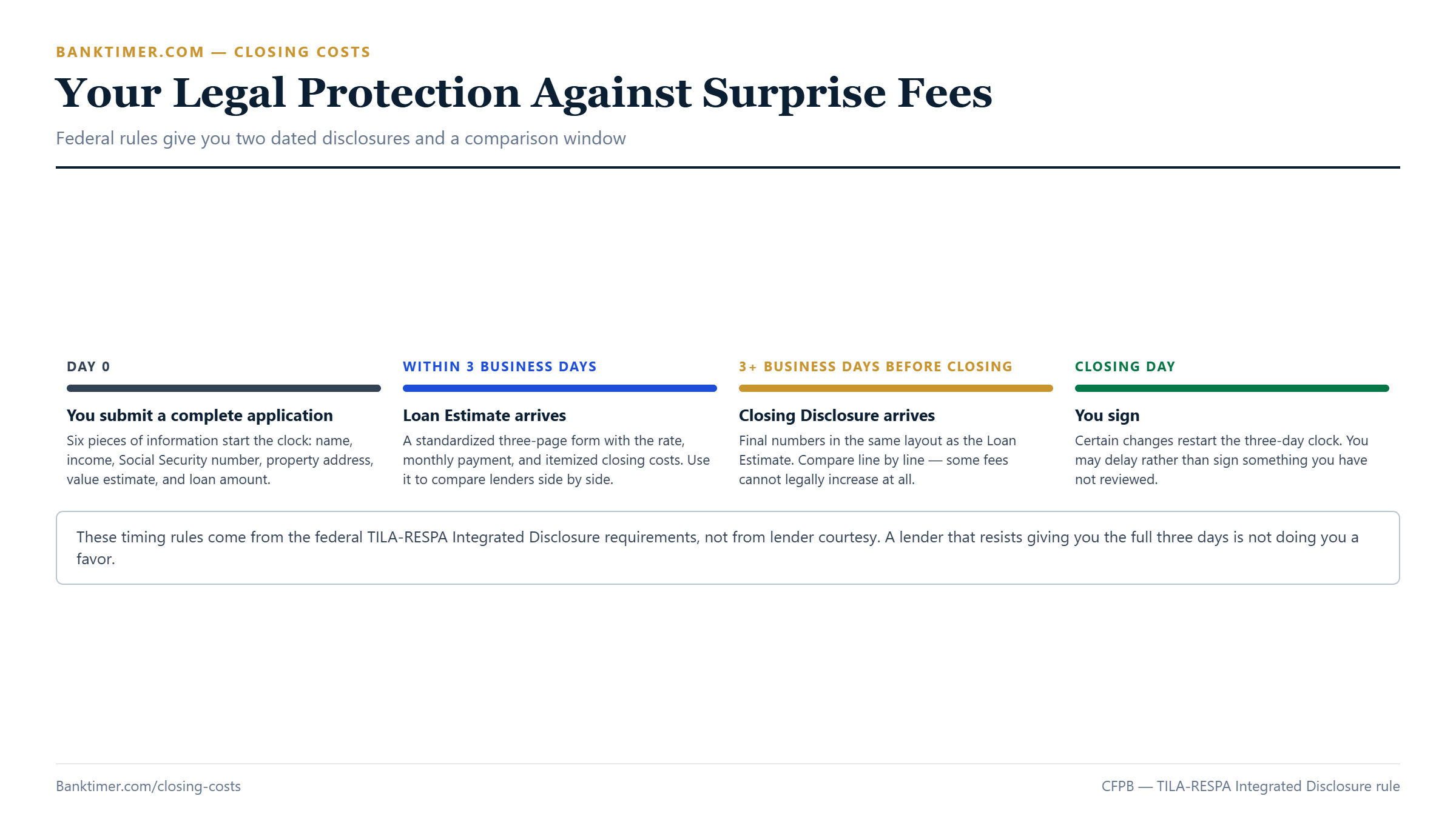
The Three-Day Waiting Period Before You Sign
Your lender is legally required to deliver your Loan Estimate within three business days of a completed application, and your Closing Disclosure at least three business days before your actual closing — a mandatory window built specifically so you have time to review the final numbers rather than seeing them for the first time at the closing table. Certain changes — the APR moving beyond a small tolerance, a change in loan product, or the addition of a prepayment penalty — restart that three-day clock entirely, which is worth knowing if your closing date suddenly seems to be moving later than expected.
No-Closing-Cost Mortgages: Rolling the Bill Into Your Rate or Your Balance
A “no closing cost” mortgage doesn’t make the expense disappear — it moves it somewhere else. The first version uses a lender credit to cover the bill in exchange for a higher interest rate, commonly 0.125 to 0.375 percentage points above what you’d otherwise qualify for, an increase that lasts for the entire time you hold the loan. The second version simply adds the amount directly to your loan balance, meaning you pay interest on it, at your regular mortgage rate, for the full loan term — and, if that pushes your loan-to-value ratio above 80%, it can also trigger private mortgage insurance you wouldn’t otherwise have owed.
A Realistic Break-Even Example
Consider $9,000 in fees rolled into a higher rate that adds about $55 to your monthly payment. The break-even point — the moment the extra $55 a month finally exceeds the $9,000 you saved by not paying upfront — lands around 13 to 14 years into the loan. A buyer confident they’ll move, sell, or refinance well before that point can come out ahead by choosing the no-cost option; a buyer planning to stay for the long haul is very likely to pay meaningfully more in total by avoiding the upfront bill.
Reading the Trade-Off on Your Own Loan Estimate
Every Loan Estimate presents at least one alternative pricing option showing the relationship between your rate and your upfront charges, so you don’t have to build this comparison from scratch — comparing the specific numbers your own lender offers, rather than a generic industry example, is what actually determines whether the trade makes sense for your situation.
Title Insurance: The One Line Item With a Real Choice Attached
Lender’s title insurance is required on nearly every mortgage, protecting your lender’s financial interest in the property against a title defect that surfaces after closing. Owner’s title insurance is a separate, optional policy that protects you, the buyer, and it’s genuinely worth adding despite being one more line on the bill — a lender’s policy pays out to your lender, not to you, if a title problem appears later. In many states, you’re legally entitled to shop for your own provider rather than automatically using whichever company your lender or real estate agent suggests, and because this is often one of the larger single fees on your Loan Estimate, comparing at least one alternative quote is a reasonable use of ten minutes before you accept the default option.
Consider a $2,200 lender’s title premium on a $400,000 purchase — shopping a second title company nearby quotes $1,850 for the same coverage, a $350 difference that costs nothing to check and takes one phone call. Because title insurance is a one-time premium rather than a recurring cost, even a modest percentage difference in quotes can be worth the extra ten minutes of research relative to nearly any other line item in the entire bundle.
Refinance Closing Costs: Same Categories, Different Math
Refinance fees draw from the same categories as a purchase — lender charges, third-party charges, prepaids, and government recording fees — but the math around them is different in two important ways. First, there’s no real estate agent commission and no owner’s title insurance re-purchase needed in many states, which offer a discounted “reissue rate” on title insurance for a refinance instead of full price. Second, because a refinance resets your loan term, the break-even analysis on this expense matters even more directly than on a purchase — you’re deliberately taking on new fees specifically to get a better rate or different terms, so the number of months until that trade pays for itself deserves the same scrutiny as any other financial decision with an upfront cost and a delayed payoff.
The 2024 Commission Settlement’s Quiet Effect on What You’ll Pay
A 2024 antitrust settlement affecting the real estate industry changed how buyer’s agent commissions get negotiated: sellers are no longer required to offer a set buyer’s agent commission through the multiple listing service, and buyers now typically sign a written agreement with their own agent spelling out how that agent gets paid. In practice, this means a seller can decline to cover any part of your buyer’s agent’s fee, potentially leaving you to pay it directly — an amount that functions much like an added line item even though it isn’t always itemized on your Closing Disclosure the same way a lender or title fee is. Early data suggests average buyer’s agent commissions haven’t meaningfully dropped since the settlement took effect, and in some market segments have even ticked up slightly, so this is a genuinely new consideration worth discussing directly with your agent before you assume your total will look like it did a few years ago.
For a practical takeaway, ask your agent directly, before you write an offer, how much their commission will be and whether your specific seller has agreed to cover any portion of it as part of the deal. Building this number into your total budget from the start avoids an uncomfortable surprise at the closing table if your seller declines to contribute anything toward this specific piece of your closing costs.
Why Where You Live Changes What You’ll Pay More Than You’d Expect
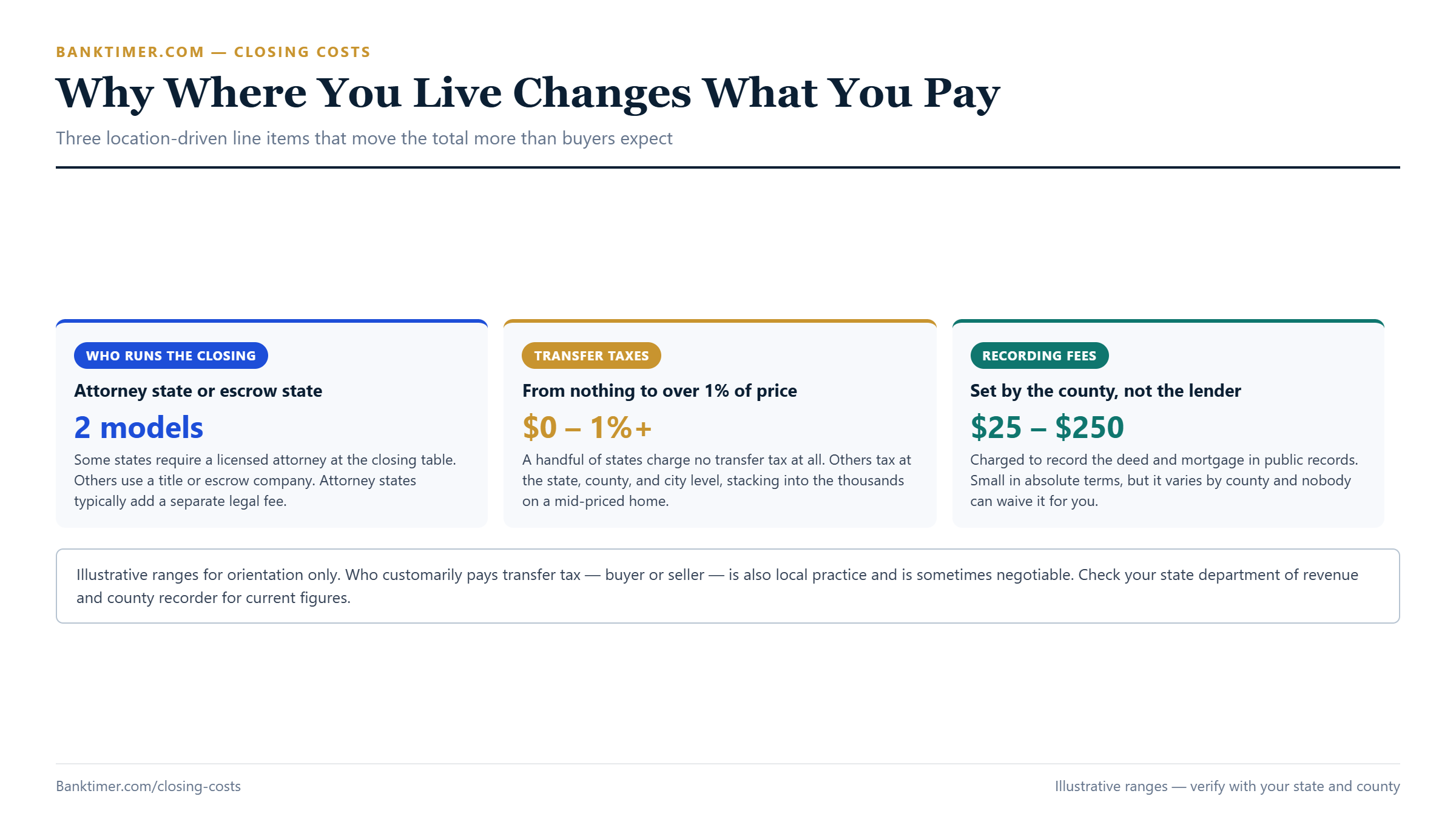
Attorney States vs. Escrow States
Depending on your state, your closing is either run by a title or escrow company or legally required to include an attorney — a structural difference, not just a pricing one, that changes which professional fees show up in your total. Attorney-state closings typically include a specific legal fee for conducting the closing that simply doesn’t exist as a line item in escrow-state closings, where a title company plays that coordinating role instead.
Transfer Tax: From Nothing to Thousands, Depending on the State
Real estate transfer taxes are one of the most dramatically variable pieces of this entire bundle. Several states charge no statewide real estate transfer tax at all, while others — and certain high-cost cities within otherwise moderate states — charge well over 1% of the purchase price, translating into thousands of dollars in fees before anything else is even considered. Because this single line item can swing your total more than almost any other factor, checking your specific state and local transfer tax rate early is one of the higher-value five-minute research tasks in the entire home-buying process.
Recording Fees: Small Individually, Still Worth Confirming
Recording fees are typically modest — often $25 to $250 depending on the number of pages and documents your county requires — but they’re a genuine, non-negotiable government charge that appears on every closing regardless of loan type, lender, or purchase price, and confirming your specific county’s current schedule takes only a quick search.
A Realistic Comparison: Paying Upfront vs. a No-Closing-Cost Loan vs. Seller Concessions
The table below lines up the main ways buyers actually handle this expense, from paying the full bill in cash to rolling it into a higher rate or negotiating help from the seller. None of these approaches is universally better — the right one depends on how much cash you have available now, how long you expect to keep the loan, and how motivated your specific seller is to negotiate.
| Approach | Cash needed at closing | Long-term cost | Best fit |
|---|---|---|---|
| Pay the bill upfront | Highest | Lowest total interest over time | Buyers with sufficient cash reserves planning to stay long-term |
| No-cost loan (higher rate) | Lowest | Highest total interest if held long-term | Buyers short on cash or planning to move or refinance within a decade |
| No-cost loan (rolled into balance) | Low | Interest accrues on the added balance for the full term | Buyers who want a lower cash requirement but a stable, standard rate |
| Negotiated seller concession | Reduced, up to loan-type caps | Neutral — doesn’t change your rate or balance | Buyers in a market where sellers are willing to negotiate |
| Discount points paid to lower rate | Higher | Lower monthly payment and lower total interest if held long enough | Buyers confident they’ll hold the loan past the specific break-even point |
A Realistic Total-Cost Example
A buyer purchasing a $400,000 home with a conventional loan and 10% down receives a Loan Estimate showing $11,500 in total fees — a $2,400 origination charge, $2,200 in lender’s title insurance, $450 for the appraisal, $1,800 in prepaid property tax and insurance, $2,200 in prepaid daily interest and escrow reserves, and the remainder in credit report, recording, and miscellaneous third-party charges. Because this buyer’s down payment falls in the 10%-to-25% tier, they negotiate a 6%-of-price seller concession — $21,600 available under the cap — of which $11,500 covers the entire bill, letting them arrive at closing needing only their down payment in cash.
A second buyer purchasing the same home with an FHA loan and 3.5% down faces a similar fee schedule but adds an upfront mortgage insurance premium financed into the loan; their seller, facing a competitive market, declines any concession, so this buyer pays the full amount out of pocket, needing roughly $25,600 in total cash to close once their down payment is included.
A third buyer, refinancing an existing mortgage to capture a lower rate, receives a Loan Estimate showing $6,200 in total fees — no real estate agent commission, no owner’s title insurance repurchase thanks to their state’s reissue rate, but the same appraisal, origination, and recording charges as any other loan. Rather than paying this amount in cash, they add it directly to their new loan balance, keeping their loan-to-value ratio safely under 80% and their monthly payment lower than what continuing under their old rate would have cost.
A Real-World Example: Four Closing Cost Scenarios
A first-time buyer with limited cash reserves chooses a no-cost loan, accepting a rate 0.25 percentage points higher in exchange for the lender covering roughly $9,000 in fees. They plan to stay in the home indefinitely, and five years later, when a job relocation forces a sale, they’ve paid only about $1,500 in extra interest from the higher rate — a clear win compared with having paid the full amount upfront.
A second buyer, refinancing to capture a lower rate, rolls $6,000 in fees into their new loan balance rather than paying cash. Because their new loan-to-value ratio comes in just under 80%, they avoid triggering private mortgage insurance, and the lower rate saves them more per month than the added balance costs them in extra interest — a straightforward win they confirm by running the specific break-even math themselves before committing.
A third buyer, purchasing in a state with no real estate transfer tax and using a VA loan, negotiates full seller coverage of standard fees, which VA rules allow without the percentage cap that applies to conventional loans. Between the favorable loan type, the state’s lack of transfer tax, and full seller coverage, this buyer’s actual cash needed at closing is close to zero beyond routine prepaid items — an outcome meaningfully shaped by loan type and state as much as by negotiation skill.
A fourth buyer skips comparing Loan Estimates and accepts the first lender they spoke with, only to discover after applying elsewhere that an identical loan from a competing lender would have carried roughly $2,000 less in origination and lender fees for the exact same rate — a gap that a single afternoon of comparison shopping would have caught before any commitment was made.
Common Mistakes People Make With Closing Costs
A common mistake is assuming this bundle is a single negotiable number, when in reality it’s made up of separately governed fees — some fixed by government, some fixed by your lender, and only some genuinely shoppable. Another is comparing lenders by interest rate alone without comparing their full Loan Estimate, since a lower rate paired with higher upfront fees can cost more overall than a slightly higher rate with lower fees, depending on how long you keep the loan. A third is assuming a “no closing cost” loan eliminates the expense entirely rather than simply relocating it into your rate or your balance. A fourth is not checking which loan type’s seller-concession caps apply to a specific purchase, potentially leaving negotiating room on the table with a seller willing to contribute more than the buyer realized was allowed. A fifth is skipping the option to shop for your own title insurance provider, treating your lender’s or agent’s suggested company as the only available choice for one of the largest single fees in the entire bundle. A sixth is forgetting that many state and local assistance programs exist specifically to help cover closing costs, and skipping that research simply because a buyer assumes they wouldn’t qualify. A seventh is waiting until the week of closing to review the Closing Disclosure line by line, rather than comparing it against the earlier Loan Estimate as soon as it arrives, which leaves far less time to question a number that increased somewhere it legally shouldn’t have.
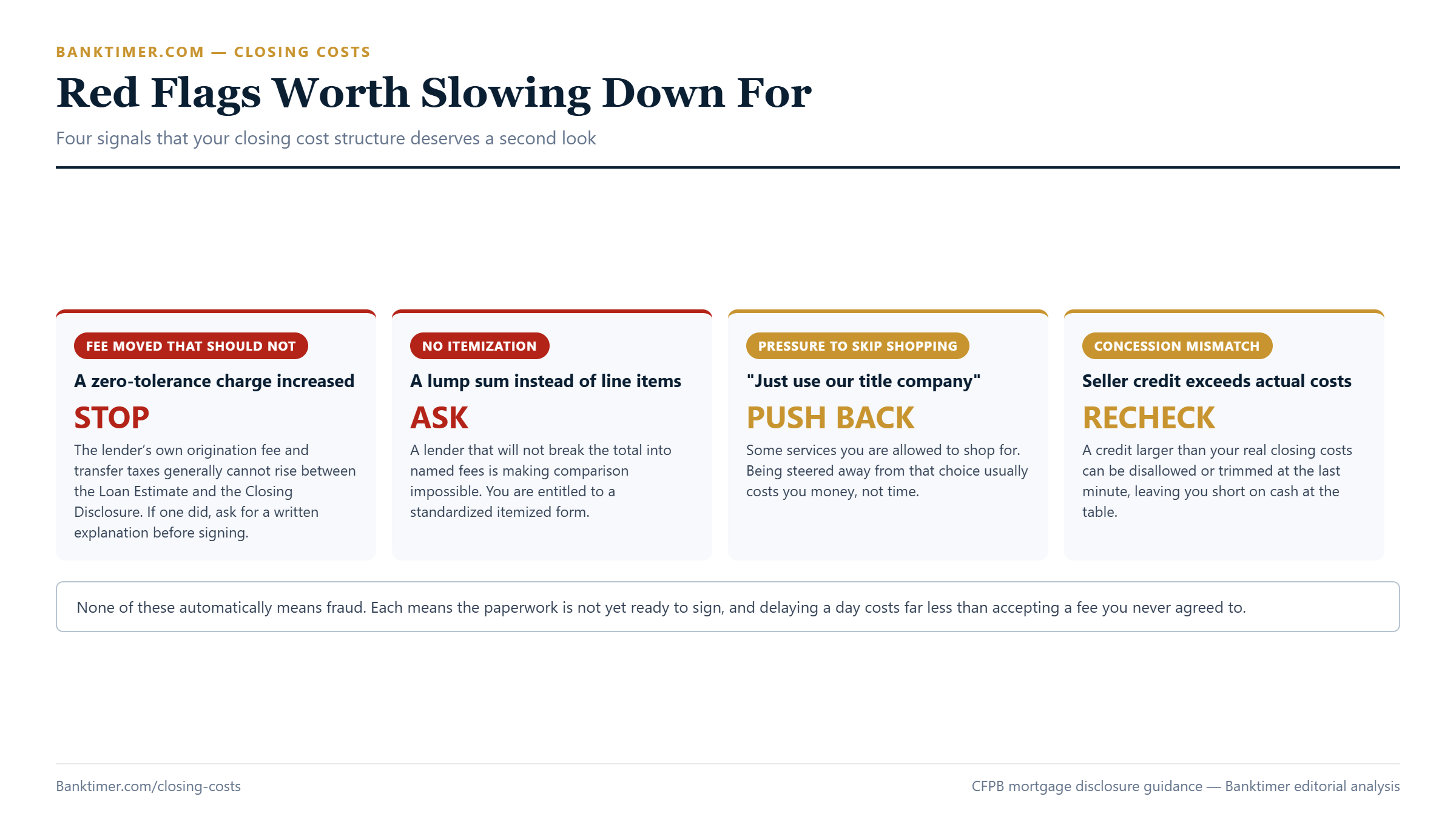
Red Flags Worth Slowing Down For
A Closing Disclosure With a Zero-Tolerance Fee That Increased
If a charge your lender controls, or a government transfer tax, shows a higher number on your Closing Disclosure than your Loan Estimate, that’s a category with no legal room to move — worth raising with your lender immediately rather than assuming it’s simply how the process works.
A Lender Unwilling to Provide an Itemized Estimate Promptly
Federal law requires a Loan Estimate within three business days of a completed application; a lender dragging that out, or providing only a vague verbal figure, is worth treating with real caution.
Pressure to Skip Shopping for Title Insurance or Other Shoppable Services
If a lender or agent discourages you from getting a second quote on a shoppable piece of the total, ask directly why — genuine cost transparency doesn’t require exclusivity.
A Seller Concession That Somehow Exceeds the Buyer’s Actual Expenses
Because a concession can’t legally exceed the buyer’s real fees and prepaids, an offer structured to hand over cash beyond that total is a sign something about the transaction’s structure needs a closer look.
Questions to Ask Before You Agree to a Closing Cost Structure
- ☐ What specific fees fall into the zero-tolerance, 10%-tolerance, and no-tolerance categories on my Loan Estimate?
- ☐ How much can a seller legally contribute under my specific loan type and down payment?
- ☐ Have I compared at least one alternative quote for a shoppable item like title insurance?
- ☐ What’s the real break-even point if I choose a no-closing-cost loan instead of paying upfront?
- ☐ Does my state require an attorney for closing, and is that fee already reflected in my estimate?
- ☐ What is my state’s and locality’s real estate transfer tax rate, and is it already included in my Loan Estimate?
- ☐ Have I confirmed directly with my agent how their commission will be paid, given the 2024 industry settlement changes?
Alternatives Worth Comparing
Negotiating a Larger Seller Concession Instead of Paying Cash
In a buyer-favorable market, asking a seller to cover more of the bill, up to your loan type’s legal cap, can be more realistic than a price reduction of the same size.
A Lender or Down Payment Assistance Grant
Some state and local housing agencies, along with certain lenders, offer grants or forgivable loans specifically earmarked for this expense, worth researching before assuming your only options are cash or a higher rate.
Choosing a Different Loan Type With Different Concession Rules
Because seller-concession caps and standard fee structures vary meaningfully by loan type, a buyer close to qualifying for more than one loan program should compare how each program’s rules actually play out for their specific purchase.
A Smaller Loan Amount or Larger Down Payment
Because several fees scale with your loan or purchase amount, adjusting your target price range or down payment size shifts your total proportionally, not just your monthly payment.
Timing Your Closing to Minimize Prepaid Interest
Since prepaid interest is calculated based on the number of days between your closing date and your first regular payment, closing near the end of the month can measurably reduce this specific slice of the bill.
A Credit Union or Community Bank Comparison Quote
Credit unions and smaller community lenders sometimes carry meaningfully lower origination and application fees than larger national lenders for a comparable rate, making at least one such quote worth collecting alongside your other estimates.
Who This Guide Suits
This guide is most useful to anyone preparing to buy or refinance a home who wants to understand what they’ll actually owe at closing, which pieces are negotiable, and how a “no closing cost” option really works before assuming it’s simply free. It’s equally relevant to a buyer already reviewing a Loan Estimate or Closing Disclosure who wants to know which specific numbers are protected by federal tolerance rules and which ones genuinely deserve a phone call.
A first-time buyer stretching to cover a down payment will get the most immediate value from the sections on seller concessions, assistance programs, and no-closing-cost structures, since those are the levers most likely to solve an actual cash shortfall. A move-up buyer with more cash on hand, by contrast, may find the break-even math on discount points and the state-by-state variation sections more directly relevant to their decision, since they’re less constrained by how much they can bring to the closing table and more focused on minimizing their total cost over time.
Frequently Asked Questions
How much are closing costs typically?
They typically run 2% to 6% of your loan amount, though your specific total depends heavily on your loan type, your state, and which services you shop for versus accept from your lender’s provider list.
Can closing costs be negotiated?
Some pieces can be negotiated or shopped — third-party services like title insurance, for instance — while others, like government recording fees and transfer taxes, are fixed by law and not negotiable with anyone in the transaction.
Who typically pays closing costs, the buyer or the seller?
The buyer typically pays most of the bill, though a seller can agree to cover a portion through a negotiated concession, subject to caps that vary by loan type and, for conventional loans, by down payment size.
What is a no-closing-cost mortgage?
It doesn’t eliminate the expense — it either raises your interest rate in exchange for a lender credit covering it, or adds it to your loan balance so you pay interest on it over the life of the loan.
Do closing costs include my down payment?
No — your down payment and this bundle are separate cash requirements; the fees and prepaids sit on top of whatever down payment your loan program requires.
How much can a seller contribute toward my closing costs?
It depends on your loan type: conventional loans cap seller contributions at 3% to 9% of the price depending on your down payment, FHA and USDA cap it at 6%, and VA handles standard fees and additional concessions under different rules entirely.
Can my closing costs increase after I receive my Loan Estimate?
It depends on the fee category — zero-tolerance items can’t increase at all, 10%-tolerance items can rise only in aggregate up to that limit, and a few categories like prepaid interest have no tolerance limit because they depend on your own choices or timing.
Is title insurance a required closing cost?
Lender’s title insurance is required by virtually every mortgage lender, while owner’s title insurance — which protects you rather than your lender — is optional but generally worth adding despite the extra line on the bill.
Are refinance closing costs the same as purchase closing costs?
They draw from the same general categories, but a refinance typically skips the real estate agent commission and may qualify for a discounted title insurance reissue rate, changing the total compared with a purchase.
Why did my real estate agent ask me to sign an agreement about how they’re paid?
Since a 2024 industry settlement, buyer’s agents are generally required to have a signed agreement specifying their compensation, which may shift some of that commission onto you as a buyer-side expense if your seller declines to cover it.
Do all states charge the same closing costs?
No — the total varies significantly by state, largely due to differences in real estate transfer taxes, whether an attorney is legally required for closing, and other state-specific fees layered on top of the standard national categories.
What happens if I can’t afford my closing costs in cash?
Options include negotiating a seller concession, choosing a no-closing-cost loan structure, researching down payment or closing cost assistance programs, or adjusting your target purchase price to reduce the total.
Are discount points considered part of closing costs?
Yes — a discount point is an optional item you choose to pay upfront in exchange for a lower interest rate, distinct from the fees required simply to originate and close the loan.
How do I know if my closing costs are reasonable?
Comparing Loan Estimates from at least two or three lenders for the same loan type and loan amount is the most direct way to judge whether your specific total is in line with the current market.
When do I find out my final closing costs?
Your Closing Disclosure, required at least three business days before your closing date, shows the final, binding number — one that should closely match, and in some fee categories must exactly match, your earlier Loan Estimate.
Are closing costs tax deductible?
Most individual fees — the appraisal, title insurance, recording fees — are not deductible. A limited few items, including prepaid mortgage interest and, in some cases, discount points, may be deductible if you itemize, subject to current IRS rules. Confirming with a tax professional before filing is safer than assuming any one line item automatically qualifies.
Can I finance closing costs into a VA or USDA loan?
VA and USDA loans allow their respective funding fee or guarantee fee to be financed directly into the loan balance — a narrower version of what a full no-closing-cost mortgage does with the entire bundle. Most remaining fees in either program still need to be covered separately, through cash, a seller concession, or a broader no-cost structure if your lender offers one.
Do closing costs differ between a 15-year and a 30-year mortgage?
Most individual fees don’t change based on your loan term — an appraisal costs the same regardless of whether you choose 15 or 30 years. Prepaid interest and your specific rate can shift slightly by term, but the core bundle of lender, third-party, and government fees is driven mainly by your loan amount and location.
Can closing costs be included in a cash-out refinance?
Yes — they’re typically either added to your new loan balance or deducted from your cash-out proceeds at closing, following the same fee categories as any other refinance rather than any special cash-out-specific rules.
Do closing costs affect my credit score?
Paying them doesn’t directly appear on your credit report or affect your score. The hard inquiry from applying for your mortgage is a separate factor, and financing part of this bundle into a larger loan balance affects your overall debt load rather than showing up as a distinct credit event.
Are there programs that help cover closing costs?
Yes — many state and local housing finance agencies, along with some employers and lenders, offer grants, forgivable loans, or credits specifically earmarked for this expense, often alongside down payment assistance, though eligibility and funding availability vary significantly by location and change over time.
How to Verify These Numbers Yourself
The Consumer Financial Protection Bureau publishes detailed guidance on closing costs, Loan Estimates, and Closing Disclosures directly at consumerfinance.gov, including its own explainer tools for reading each document line by line. Fannie Mae and Freddie Mac publish current seller-concession limits for conventional loans directly through their selling guides, while HUD, the VA, and USDA publish their own program-specific rules for fees and concessions. Because specific fee amounts, mortgage insurance premiums, and funding fees change over time, verify current figures directly against your lender’s official Loan Estimate and these program sources rather than relying on a general guide for your exact numbers.
Key Terminology
| Term | What it means |
|---|---|
| Closing costs | The bundle of fees, taxes, and prepaid items due at closing, on top of your down payment |
| Loan Estimate | A federally required disclosure of projected fees, due within 3 business days of a completed application |
| Closing Disclosure | The final, binding disclosure of fees, due at least 3 business days before closing |
| Seller concession | A negotiated contribution from the seller toward the buyer’s fees, capped by loan type |
| Discount point | An optional upfront charge, typically 1% of the loan amount, paid to lower your interest rate |
| No-closing-cost loan | A mortgage structure that shifts fees into a higher rate or a larger loan balance instead of cash due at signing |
| Zero-tolerance fee | A charge category that legally cannot increase between the Loan Estimate and the Closing Disclosure |
| Transfer tax | A state or local government tax on the transfer of real estate, one of the most variable pieces of the bundle by location |
| Origination fee | A lender’s charge for processing and underwriting your loan, often a percentage of the loan amount |
| Escrow account | A lender-managed account that holds your prepaid property tax and insurance funds |
| Reissue rate | A discounted title insurance premium available on a refinance when you keep the same property |
Closing costs are not a single fee to accept or negotiate — they’re a bundle of separately governed charges, some fixed by government, some set by your lender, and only some genuinely shoppable. The real decision most buyers face isn’t whether to pay this bill, but how: in cash upfront for the lowest long-term cost, folded into a higher rate or larger balance for lower cash needs today, or partially offset through a seller concession capped by your specific loan type. None of these paths is automatically correct — the right choice depends on how long you’ll hold the loan, how much cash you have available now, and which fees are protected by federal tolerance rules versus genuinely open to negotiation.
Sources
- Consumer Financial Protection Bureau — Owning a Home
- Consumer Financial Protection Bureau — TILA-RESPA Integrated Disclosure FAQs
- LendingTree — How Much Are Closing Costs? Average Costs and Fees
- U.S. Department of Housing and Urban Development — FHA Seller Concession Rules
- U.S. Department of Veterans Affairs — VA Home Loan Guidance
- U.S. Department of Agriculture — USDA Single Family Housing Guaranteed Loan Program
- Kiplinger — Why a Landmark Real Estate Commission Settlement Hasn’t Lowered Costs for Homebuyers
Methodology
Ranges, fee-category examples, and no-closing-cost break-even figures in this guide reflect a survey of published lender and industry guidance (LendingTree, Amerisave, and related sources) current as of access in September 2026, and are illustrative rather than a quote for any specific transaction — actual figures vary by lender, property, and location. Seller-concession caps by loan type reflect published Fannie Mae, Freddie Mac, FHA, VA, and USDA guidance current as of the same access date and are subject to change by each program. TRID disclosure timing and fee-tolerance categories reflect Regulation Z and CFPB guidance as published; the CFPB has an open request for information regarding aspects of the TRID rule as of mid-2026, so specific mechanics are worth reconfirming against the CFPB’s current guidance before relying on them for a specific transaction. This guide is educational and does not constitute financial, legal, or real estate advice.
Before your next closing, request an itemized Loan Estimate from at least two lenders for the same loan amount and loan type, then sort every line item into its tolerance category — zero, 10%, or unlimited — so you know in advance exactly which fees are protected from increasing and which ones are still worth negotiating or shopping before you sign.