Mortgage preapproval is a lender’s written, conditional statement of how much it may be willing to lend you, based on a review of your credit, income, assets, and debts. It is not a loan offer, a rate lock, or a Loan Estimate. The Consumer Financial Protection Bureau (CFPB) says such letters typically expire in 30 to 60 days. Federal law sets no standard for the terms “prequalification” and “preapproval,” so lenders use them differently.
The biggest variable is how much the lender actually verified. Check that first, then confirm the amount fits your own budget. The main risk is a change before closing, such as new debt, a job change, or a low appraisal.
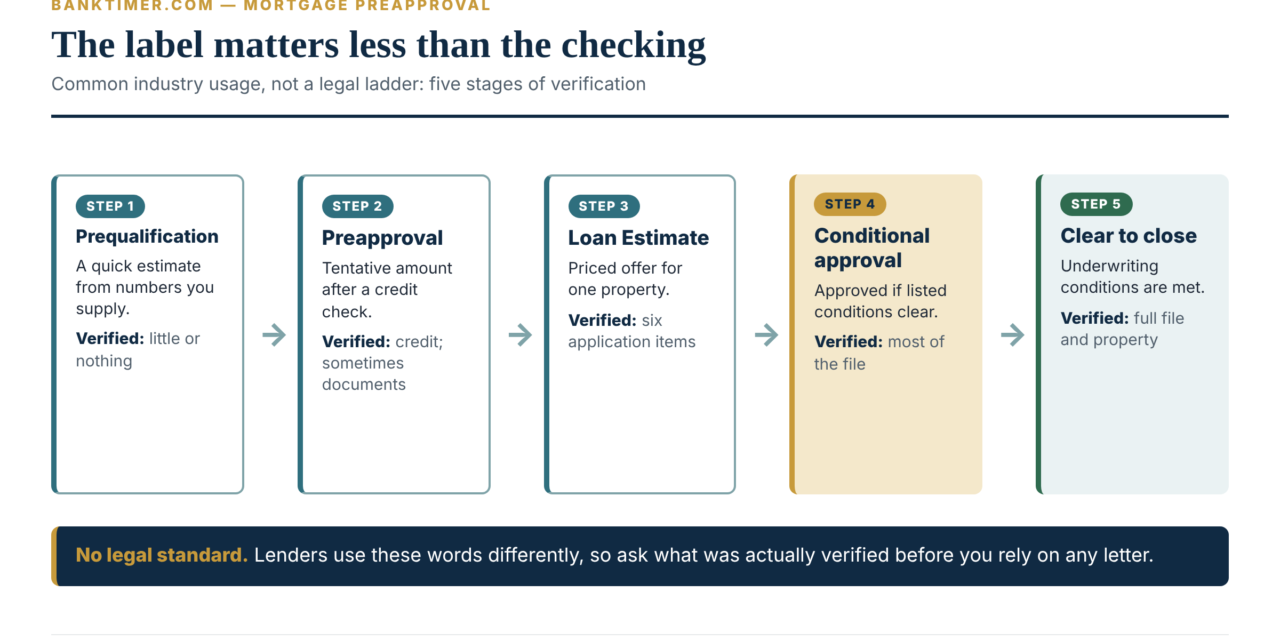
The label matters less than the verification. CFPB notes that lenders use “prequalification” and “preapproval” differently. Ask what was checked: a credit report, pay stubs, tax returns, bank statements, or only your own estimate.
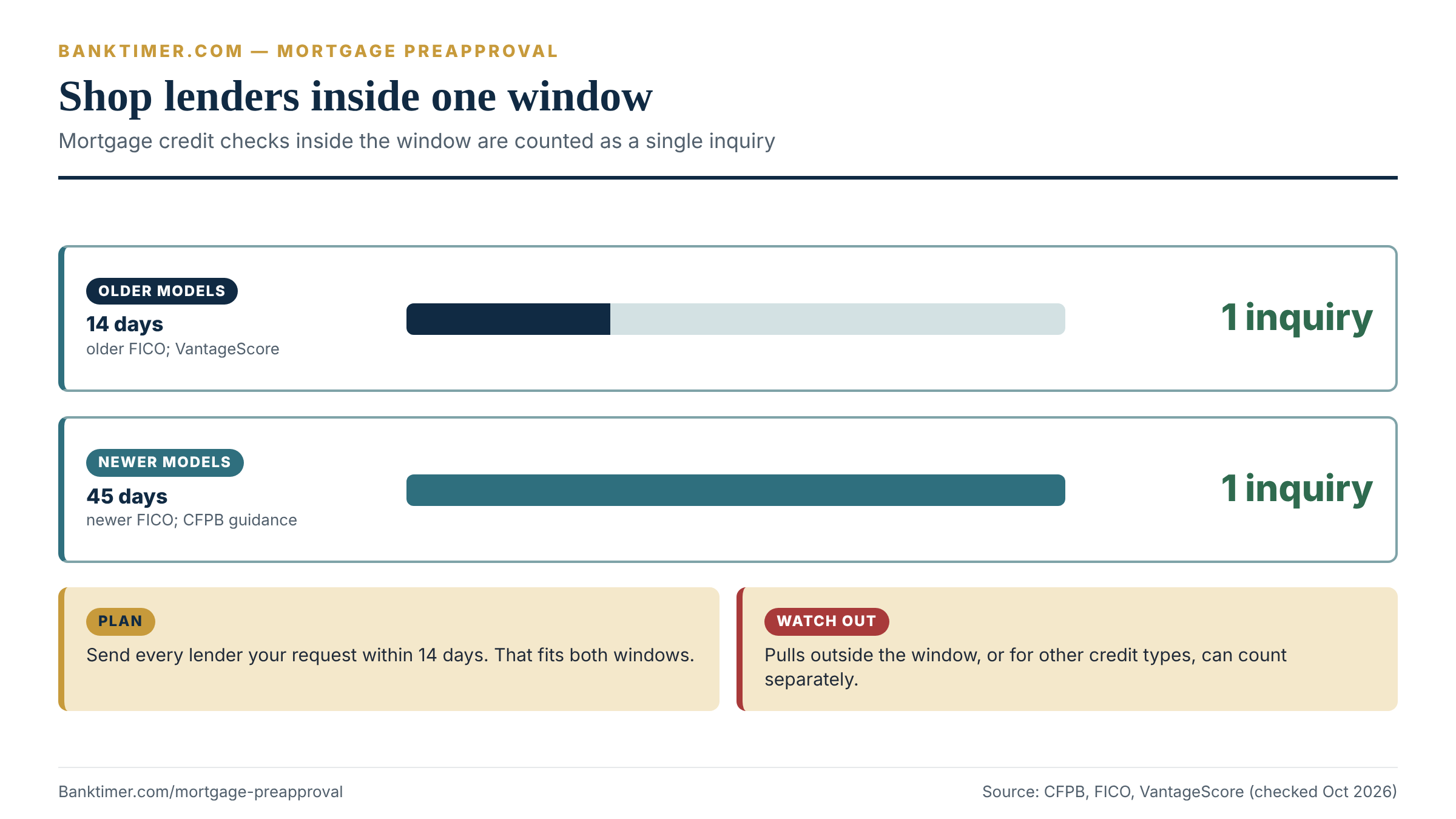
Rate shopping counts as one search, but only inside a window. CFPB describes a 45-day window for mortgage credit checks. Older FICO versions and VantageScore use 14 days, so cluster your applications.
Your approved amount is a ceiling, not a target. In our illustrative example, one household qualifies for roughly $323,000, $414,000, or $506,000 depending on which debt-to-income limit a lender applies.
A mortgage preapproval letter does not lock a rate or promise closing costs. The Loan Estimate, which lenders must send within three business days of a complete application, does that job.
Protect the file until closing. New credit, a large unexplained deposit, a job change, or an appraisal below the price can each change the answer.
What Mortgage Preapproval Is and What It Is Not
A mortgage preapproval answers one narrow question: if the house and your finances check out, how much might this lender lend you? That answer comes from reviewing your credit history, income, assets, and monthly debts. It arrives as a letter, usually addressed to you and sometimes to sellers.
CFPB describes mortgage preapproval as a statement that a lender is tentatively willing to lend you money, up to a certain amount. CFPB also calls it “not a guaranteed loan offer.” Those two phrases tell you most of what you need.
What the letter usually contains
Formats differ by lender, but most letters share a few elements:
- Your name and the date of the review.
- A maximum loan amount or purchase price range.
- A loan type, such as conventional, FHA, or VA.
- Assumptions about interest rate, down payment, and sometimes taxes and insurance.
- An expiration date.
- Conditions, such as a satisfactory appraisal and no material change in your finances.
The assumptions are the part readers skip. A letter based on a 10% down payment tells you nothing if you plan to put down 3%. A letter that assumes a lower rate than the market offers today overstates what you can borrow.
What the letter does not do
A letter does not commit you to the lender. CFPB says getting a preapproval “doesn’t commit you to a lender.” It also does not commit the lender to fund a specific house. The property still needs an appraisal, title work, and insurance, and your file still needs final underwriting.
It also does not lock your rate. A rate lock is a separate agreement, covered in our guide to the mortgage rate lock. And it is not a Loan Estimate, the standardized three-page disclosure that lists your actual rate, payment, and closing costs for a specific property.
Why sellers and agents ask for one
A seller wants to know a buyer can close. A letter signals that someone with a lending license has at least looked at the buyer’s finances. CFPB notes that getting one “helps you show sellers that you are a serious buyer.”
The signal is only as strong as the work behind it. Agents often read the letter for what was verified, who issued it, and whether it is still valid. We return to that in the section on making offers.
Where this guide fits
Banktimer published an earlier piece on the benefits, drawbacks, and questions around mortgage preapproval pros and cons. This guide takes a different angle. It follows the mechanics: what lenders review, how the credit pull works, what the amounts mean, where the rules come from, and what can break the approval. Use the older piece if you want a decision on whether to get one. Use this one to get one well.
How Mortgage Preapproval Works Step by Step
Most preapprovals follow the same arc, even when the labels differ. Knowing the arc helps you spot where a particular lender is skipping steps or adding them.
Step 1: You share basic information
You provide your name, income, employment, estimated assets, and the debts you know about. Some lenders collect this online in minutes. Others have a loan officer ask the questions by phone. At this stage the lender is working mostly from what you say.
Step 2: The lender checks your credit
CFPB says lenders typically check your credit before issuing a mortgage preapproval letter. That check is recorded as an inquiry on your credit reports, and it usually has a small effect on your scores. The credit section below explains how much, and for how long.
Step 3: The lender reviews documents, or does not
Some lenders issue a letter using only the information you provide. Others ask for pay stubs, tax documents, and bank statements up front. CFPB points out this difference directly: some lenders rely on your self-reported figures, while others verify documentation before issuing the letter.
A verified mortgage preapproval is stronger. It also takes more of your time. The trade-off is worth knowing before you choose where to start.
Step 4: You receive the letter and its conditions
The letter states an amount, an expiration, and conditions. Read the conditions twice. They tell you what the lender will still check later.
Step 5: You find a home and move to a formal application
After you choose a property and make an offer, the process changes. You apply for a specific loan on a specific house. The lender issues a Loan Estimate, orders an appraisal, and sends the file to underwriting. Our explainer on how credit underwriting works walks through that stage in more detail.
Mortgage preapproval is a lender’s early estimate of what it might lend, based on a first review of your finances. The formal application, the Loan Estimate, and final underwriting come later and carry the binding terms.
Prequalification, Preapproval, Conditional Approval, and Commitment: Who Defines These Words
Shoppers hit a vocabulary problem early. One lender calls its first letter a prequalification. Another calls the same thing a mortgage preapproval. A third issues a “commitment letter” before an appraisal. The words sound like steps on a legal ladder. They are not.
There is no legal standard
CFPB states that lenders use the terms “prequalification” and “preapproval” differently. One lender might prequalify you on the information you report and preapprove you only after verifying it. Another might use the words as synonyms. CFPB adds that some lenders issue a written commitment letter valid for a set period.
So the word on the letter tells you little. What counts is the work behind it. Compare the letters by asking four questions:
- Did the lender pull your credit, and which bureaus did it use?
- Did it see documents, or rely on what you typed in?
- Did an underwriter review the file, or did software produce the amount?
- What conditions remain before the lender would fund a loan?
A working vocabulary
The table below separates the terms as lenders commonly use them. This is industry usage, not law, so treat each row as a typical pattern and check your own lender’s meaning.
| Term | Typical meaning in practice | Usually verified | What it does not guarantee |
|---|---|---|---|
| Prequalification | A quick estimate from information you supply | Often little or nothing | A loan amount, a rate, or approval |
| Preapproval | A lender’s tentative approval up to an amount after reviewing your finances | Credit report; sometimes income and assets | That a specific property will be financed |
| Conditional approval | Approval on a specific loan, pending listed conditions | Most documents, plus the property in some cases | Final approval; conditions can fail |
| Final approval or “clear to close” | Underwriting has cleared all conditions | The full file, including appraisal and title | That nothing changes before signing |
| Commitment letter | A written promise to lend on stated terms for a stated period | Varies; usually after underwriting | Terms outside the letter, or after it expires |
The key insight in this table is the middle column. Only the bottom rows describe a lender that has examined your whole file. The top rows describe a conversation. A strong offer to a seller usually needs more than a conversation.
Dana receives two letters on the same afternoon. Lender A sends a “preapproval” for $380,000 after Dana typed in her income and checked a box allowing a credit pull. Lender B sends a “preapproval” for $350,000 after reviewing her pay stubs, W-2s, two months of bank statements, and credit reports.
Lender A’s number is higher and weaker. Lender B’s number is lower and better supported. Both are fictional and illustrative, but the pattern is common. A higher amount does not mean a better letter.

What happens if a lender says no
A declined request can trigger a legal duty. Under Regulation B, which implements the Equal Credit Opportunity Act, a prequalification request can become an “application” depending on how the creditor responds. The official commentary says a request becomes an application when the creditor evaluates information about the consumer, decides to decline, and communicates that decision. The creditor then must comply with the notification rules in section 1002.9.
In plain terms, if a lender evaluates you and turns you down, you are entitled to a notice. Regulation B generally calls for notice within 30 days of a completed application. The notice must state the reasons for the action or tell you that you can request them within 60 days. CFPB’s guidance on these letters says the lender must provide an adverse action notice if it tells you that you do not qualify.
What to do with a denial
CFPB suggests several steps if a lender declines to issue a letter:
- Ask why.
- Request the credit score the lender used.
- Check your credit reports for errors.
- Consider a HUD-approved housing counselor (CFPB lists 1-800-569-4287).
A denial from one lender is not a verdict from every lender. Underwriting standards, scoring models, and loan programs differ. The denial is useful because it tells you which part of the file to fix.
The rule is law; the label is policy
Keep the categories straight. The adverse action requirement is federal regulation. The meaning of “preapproval” is lender policy. The expiration date is a term of the letter. And your obligation to the lender is zero, unless you sign a contract. That distinction prevents a lot of confusion when two buyers compare letters at an open house.
What Lenders Review for Mortgage Preapproval
CFPB says the lender looks at your income, assets, debts, and credit record. Behind those four words sit a dozen specific checks. Knowing them helps you prepare, and it helps you notice when a lender skips one.
The table gives the full map. The third column matters most, because it shows the typical evidence behind each claim.
| What the lender checks | Question it answers | Typical evidence | Common trap |
|---|---|---|---|
| Credit reports and scores | Do you repay debts on time? | Reports from one or more bureaus | Errors, old collections, high card balances |
| Income | Is it stable and likely to continue? | Pay stubs, W-2s, tax returns | Bonus or side income without a history |
| Employment | Is your job history reliable? | Employer contact, work history | Recent change or gap |
| Assets | Can you cover the down payment and closing costs? | Bank and investment statements | Unsourced deposits |
| Monthly debts | How much income is already committed? | Credit report, loan statements | A debt missing from the credit report |
| Debt-to-income ratio | Can you carry the payment? | Calculated from the above | Different lenders count items differently |
| Property (later) | Does the home support the loan? | Appraisal, title, insurance | Appraisal below the price |
Credit reports and scores
The credit pull shows payment history, balances, the age of your accounts, and recent inquiries. It also supplies your monthly minimum payments for the debt side of the calculation. Our guide to how a credit score works covers the scoring factors.
One factor deserves attention here: card balances. High balances relative to limits raise your reported utilization. The mechanics are in our explainer on credit utilization. Paying cards down before a pull can help your score. The timing matters, because card issuers report balances once a month, usually on the statement date. A payment made after the statement closes may not show up until the next cycle. Our piece on the credit card grace period explains how statement dates and due dates interact.
Credit score thresholds also depend on the loan type and the lender. Fannie Mae removed its fixed 620 minimum for loans run through its Desktop Underwriter system, effective for new casefiles created on or after November 16, 2025. It replaced the cutoff with a credit-risk standard inside the software. Lenders can still add their own minimums, which are called overlays. That is why one lender may approve a file another declines.
Income and employment
Lenders want income that is stable, documented, and likely to continue. Fannie Mae’s Selling Guide, which sets the rules for many conventional loans, says the lender must document that income “is stable, has a documented history of receipt, and is reasonably expected to continue.”
For employment, the guide looks for a reliable pattern over the most recent two years. A shorter history can still work when other strengths offset it. Expect the lender to ask about job changes, gaps, and how long you have been in your current role.
Assets and the source of your cash
Lenders verify that you have the down payment, closing costs, and in some programs, reserves. Statements typically cover the most recent two months. Fannie Mae defines a large deposit as a single deposit that exceeds 50% of the total monthly qualifying income. For a purchase, the lender must document an acceptable source for large deposits that fund your down payment, closing costs, or reserves.
A borrower with $10,000 in monthly qualifying income would trigger that test at a single deposit above $5,000. A gift from a relative, a sale of a car, or a transfer from another account all need a paper trail. Our guide to bank transfers that sit pending helps if you are moving money between accounts and need clean records.
Debts and the debt-to-income ratio
The debt-to-income ratio (DTI) is all your monthly debt payments divided by your gross monthly income. CFPB offers a simple example: $1,500 for a mortgage, $100 for an auto loan, and $400 for other debts total $2,000 a month. On $6,000 of gross monthly income, that is a DTI of 33%.
CFPB adds that “different loan products and lenders will have different DTI limits.” Two numbers matter on a mortgage preapproval. The first is the ratio with your estimated new housing payment included. The second is the ratio with only your existing debts. The next big section runs both through a full example.
Documents You Should Gather Before You Ask
CFPB’s loan application packet guidance lists the items lenders typically request. Gathering them first speeds the process and reduces mistakes. CFPB notes, “The more organized you are, the faster the loan approval process is likely to be.”
| Document | Why the lender wants it | Who needs it | Keep in mind |
|---|---|---|---|
| Pay stubs for the last 30 days | Confirms current pay and year-to-date earnings | W-2 employees | Fannie Mae requires the stub to be dated within 30 days of the application |
| W-2 forms, last two years | Shows income history | W-2 employees | Fannie Mae accepts one or two years depending on income type |
| Signed federal tax returns, last two years | Verifies reported income | Most borrowers; essential for self-employed | Lenders may also get IRS transcripts |
| Two most recent bank statements | Verifies funds and source of deposits | Everyone | Include every page, even blank ones |
| Investment account statements | Shows down payment assets | Anyone using investments | CFPB cites at least two months of history |
| Gift letter | Confirms money is a gift, not a loan | Anyone receiving gift funds | Signed by the giver |
| Photo ID and Social Security number | Verifies identity; enables credit pull | Everyone | Needed for the credit report |
| VA certificate of eligibility | Confirms VA entitlement | Veterans and service members | Request through VA or your lender |
What changes for self-employed borrowers
CFPB says that with self-employed, irregular, or nonwage income, “you may need additional documentation.” Requirements vary by lender and by situation.
Fannie Mae’s Selling Guide generally requires a two-year history of earnings. It allows less than two years in some cases, as long as the most recent signed returns reflect a full 12 months of self-employment income from the current business. The lender generally reviews personal returns. Business returns may be required, or waived under conditions listed in the guide.
Expect the lender to look at the trend as well as the total. Falling income raises questions that rising income does not. Methods differ, so ask how the lender calculates qualifying income before you apply.
A freelance designer earned $140,000 in the earlier year and $100,000 in the most recent year. A lender that averages the two years counts $120,000, or $10,000 a month. A lender that leans on the lower recent figure counts $100,000, or about $8,333 a month.
Against a hypothetical $400,000 purchase with a total housing payment of about $3,369 and $820 in other debts, the DTI is 41.9% under the average and 50.3% under the lower figure. The same person looks comfortable to one lender and stretched to another. This example is illustrative, and no lender method is implied.
Tips that reduce friction
- Download statements as PDFs and confirm each file includes every page.
- Write a one-paragraph note explaining any unusual deposit before the lender asks.
- Keep your pay stubs current. A stub that ages past 30 days means a new request.
- Tell the loan officer about irregular income, bonuses, or recent job changes at the start.
- Do not sign anything that states a figure you cannot document.
Your credit reports are free, so check them first
The Federal Trade Commission (FTC) says each nationwide credit bureau lets you check your report once a week for free at AnnualCreditReport.com. CFPB advises reviewing your reports early so you have time to correct mistakes. Our explainer on credit report errors lays out the dispute process. A dispute can take weeks, which is why checking before you shop beats checking after a denial.
Soft Pulls, Hard Pulls, and the Rate-Shopping Window
The credit check is the part of mortgage preapproval that worries people most. They fear that asking three lenders will mean three score hits. The reality is more forgiving, with one catch: the protection has a time limit.
Soft and hard inquiries
A soft inquiry does not affect your score. Checking your own credit is one example. FICO also lists employment background checks and pre-approved card offers as soft inquiries. FICO adds that lenders’ prequalification tools often give an initial estimate of eligibility without affecting your score.
A hard inquiry happens when a lender checks your credit because you applied for credit. FICO says a hard inquiry typically stays on your report for up to two years, but FICO Scores look back only one year. For most people, one extra hard inquiry costs fewer than five points on a FICO Score. Our explainer on the hard inquiry covers the mechanics in more detail.
CFPB puts it in simple language: “An inquiry typically has a small negative effect on your credit scores.” Whether a lender uses a soft or hard pull for its first mortgage preapproval step varies. Ask before you submit, because you cannot undo a hard pull.
The rate-shopping window
Scoring models know that people compare mortgage offers. They treat several mortgage inquiries inside a short period as a single search. CFPB describes the window this way: “Within a 45-day window, multiple credit checks from mortgage lenders are recorded on your credit report as a single inquiry.” CFPB says the effect stays the same as long as the last check falls within 45 days of the first.
The 45 days comes with caveats. The scoring company decides the window, not the lender and not the regulator.
| Source | Window | Applies to | What to note |
|---|---|---|---|
| CFPB (consumer guidance) | 45 days | Mortgage lender credit checks | Recorded as a single inquiry |
| Newer FICO Score versions | 45 days | Mortgage, auto, and student loan inquiries | FICO also ignores rate-shopping inquiries under 30 days old |
| Older FICO Score versions | 14 days | Same loan types | Still used by some lenders |
| VantageScore | 14 days (rolling) | Mortgage or auto lender inquiries | Multiple inquiries count as one search |
| Other loan types or cards | Not covered | Credit cards, personal loans | Each can count separately |
The practical reading is straightforward. Mortgage lenders may use any of several score versions, and you may not know which one a given lender uses. A conservative plan fits the shortest window: run all your applications inside 14 days. If a lender uses a newer model, you will have extra room. If it uses an older one, you will still be covered.
The window covers like-for-like shopping
CFPB’s guidance on credit inquiries notes that comparison shopping across different loan types, or beyond the window, can hurt a score. Applying for a mortgage and a car loan in the same week is not “one search.” The window groups inquiries of the same type.
That matters in the weeks around a home purchase. Many buyers apply for a new card, finance furniture, or lease a car. Each action adds its own inquiry and changes your debt picture. The section on what can break an approval returns to this.
How to order your credit-related steps
- Check your reports at AnnualCreditReport.com and dispute errors first.
- Pay down card balances so the lower figures report before you apply.
- Ask each lender whether its first step is a soft or hard pull.
- Submit all applications within a few days, and no later than 14 days apart.
- Avoid any other credit applications until you close.
Does one lender’s preapproval transfer?
Usually it does not carry over in a clean way. Another lender will run its own review and may pull your credit again. CFPB advises that you do not have to choose your lender at the mortgage preapproval stage. It recommends waiting to choose until you have made an offer and received Loan Estimates from potential lenders.
That advice protects you. A mortgage preapproval is a look at your finances. A Loan Estimate is a priced offer for a specific loan. Choose on the second one.
Utilization, balances, and the month before you apply
Most credit-score improvement before a mortgage comes from two moves: fixing errors and reducing revolving balances. Neither is quick. Errors can take weeks to resolve. A balance reduction shows up only when your issuer next reports.
If your score sits just under a pricing or approval threshold, a few weeks of planning can matter more than a week of rate comparison. If it sits comfortably above, spend your effort on comparing Loan Estimates.
Preapproval Letter, Loan Estimate, Rate Lock, and Closing Disclosure Compared
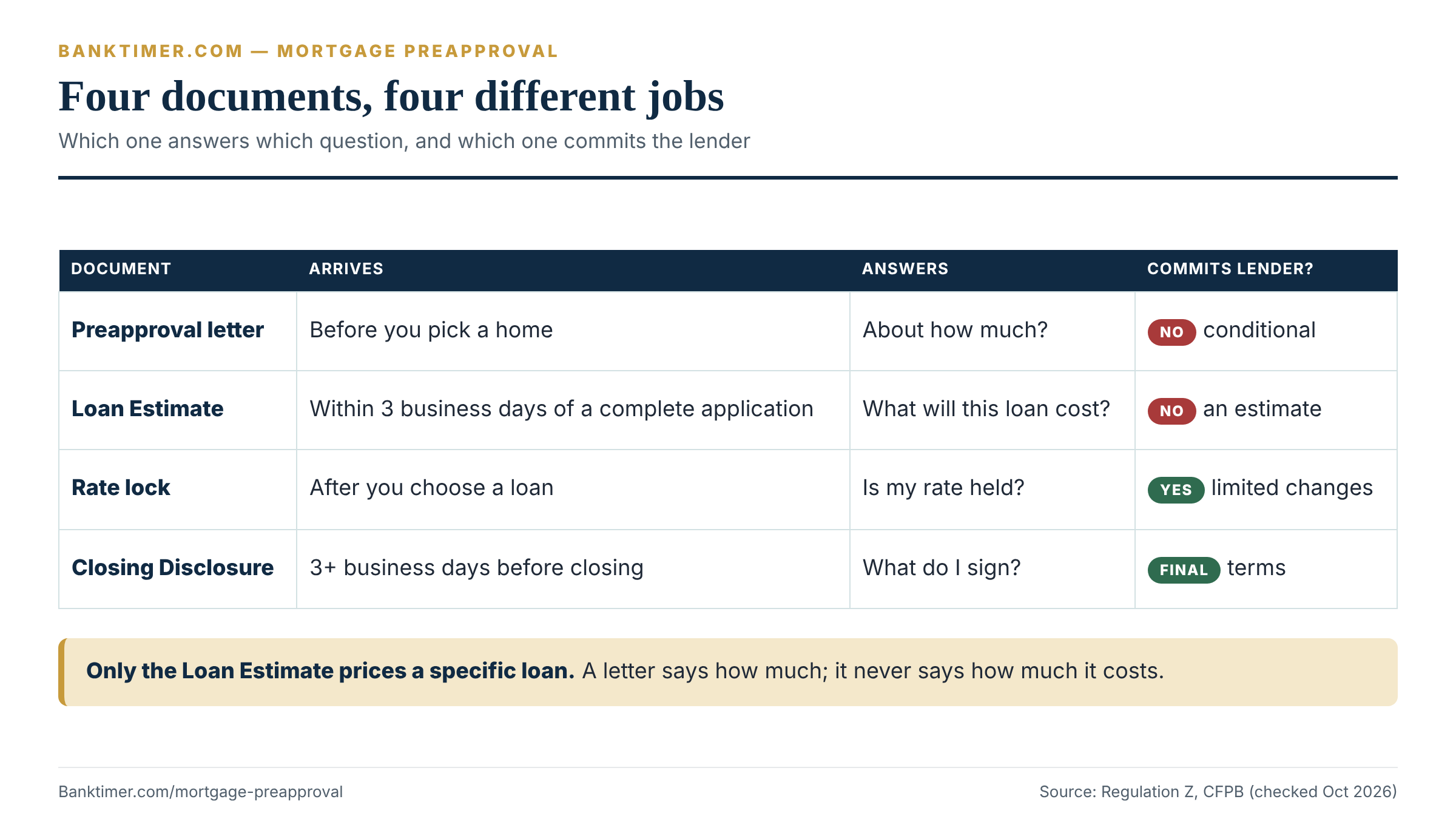
Four documents carry the word “approval” or “estimate” in a mortgage purchase, and buyers regularly confuse them. Each answers a different question at a different time. Only some of them bind a lender to anything.
| Item | When it arrives | What it tells you | Commits the lender? | Fee-related notes |
|---|---|---|---|---|
| Preapproval letter | Before you pick a home | A tentative amount the lender might lend | No; subject to conditions | Often no fee; varies |
| Loan Estimate | Within three business days of a complete application | Your rate, payment, and closing costs for one property | No; it is an estimate, and it expires if you wait too long | No fee except credit report before you say you intend to proceed |
| Rate lock | After you choose a lender and loan | A rate held for a set period | Yes; changes only in limited circumstances | Lock terms and any lock fees vary |
| Closing Disclosure | At least three business days before closing | Final loan terms and costs | Final terms you sign at closing | Compare it line by line with the Loan Estimate |
The decision-driving insight is that the Loan Estimate is your first real price. A mortgage preapproval letter is not a price. If you choose a lender based on the letter, you are picking blind.
What the formal application changes
Federal rules define an application for most mortgages by six items. Under Regulation Z (the Truth in Lending rule), an application for these loans consists of your name, your income, your Social Security number to obtain a credit report, the property address, an estimate of the property’s value, and the mortgage loan amount you are seeking.
Notice what is on that list: a property address. By that definition, a request made before you have identified a home generally does not meet the test. That helps explain why a mortgage preapproval letter arrives without a Loan Estimate. Once you supply a specific property and the other five items, the clock starts.
CFPB confirms the practical result: once you request a Loan Estimate, “each lender is required to send you a Loan Estimate within three business days.” CFPB also says you do not need a signed purchase agreement to request one. Your lender may treat mortgage preapproval and application differently, so ask how it handles the transition.
Loan Estimates before you make an offer
This is a tactic many buyers miss. If you have a specific property in mind, you can collect Loan Estimates from several lenders before you make an offer. CFPB warns that after a seller accepts, you may have “as little as a couple days to line up financing.” Comparing earlier reduces that pressure.
Our guide to the mortgage rate lock explains what happens after you pick a Loan Estimate and want to hold the rate.
Your intent to proceed
A Loan Estimate is not an approval or a commitment. CFPB says you have not committed to the lender, and the lender has not approved the loan. The regulation adds a timing rule: if you indicate your intent to proceed more than 10 business days after the Loan Estimate is provided, or after any longer period the creditor specified, the lender may be free to issue revised figures. Do not let a Loan Estimate sit.
What Mortgage Preapproval Costs
For most buyers, the direct cost of a mortgage preapproval is small. The cost that matters is the credit pull and your time. But the rules differ at the formal application stage, so the details are worth separating.
The rule on fees before a Loan Estimate
Regulation Z restricts when a lender can charge. The regulation says neither a creditor nor any other person may impose a fee on a consumer in connection with the application until the consumer has received the Loan Estimate and indicated an intent to proceed. One exception allows “a bona fide and reasonable fee for obtaining the consumer’s credit report.”
CFPB translates that rule for shoppers: lenders cannot charge you substantial upfront fees for a Loan Estimate. Apart from a small credit report fee, other fees generally wait until you choose a lender and say you want to proceed. You can express your intent in any manner you choose, unless the lender requires a particular manner of communication. The lender must document that communication.
What preapproval itself may cost
CFPB’s mortgage preapproval guidance does not address whether preapproval has a fee. Practice varies. Many lenders charge nothing beyond the credit report cost, and some fold the credit report cost into later fees. A few may charge for faster service or a more intensive review. Ask each lender directly and in writing.
| Possible cost | When it can appear | Typical basis | Avoidable? |
|---|---|---|---|
| Credit report fee | Preapproval or application | Per pull; varies by lender | Not usually; rules allow it |
| Preapproval fee | Preapproval, if charged | Varies by lender | Often avoidable by asking another lender |
| Application fee | After Loan Estimate and intent to proceed | Varies by lender | Compare across Loan Estimates |
| Appraisal | After you have a contract and proceed | Varies by property and area | No, for most purchase loans |
| Lock fee | After you choose a loan | Varies; some locks are free | Ask what the lock covers |
| Closing costs | At closing | CFPB says typically 2% to 5% of the price | Partly, through negotiation and shopping |
The pattern to remember: mortgage preapproval is cheap, but the decisions it leads to are not. A buyer who pays nothing for a letter can still spend $8,000 to $20,000 at closing on a $400,000 purchase if costs run 2% to 5% of the price. Our guide to closing costs breaks down the line items.
What to ask about money before you submit
- Is there any fee at the mortgage preapproval stage, including the credit report?
- Is the first credit check a soft or hard pull?
- Would a formal application start from this review, or from scratch?
- Which fees are refundable if I do not proceed?
Why asking costs you nothing
Questions about fees cost nothing and do not require a hard pull. A lender that answers clearly earns trust. A lender that dodges, or that asks for a payment to “reserve” an approval, is telling you something. The red-flag table later in this guide covers those situations.
How to Read the Amount: Maximum Loan Versus Comfortable Payment
The most useful number in a mortgage preapproval letter is also the most misunderstood. It is the most a lender might lend under its rules. It says nothing about the payment you can live with. Those are two different questions, and the gap between them can run to six figures.
This section builds one household from scratch and runs it through both questions. Every figure is illustrative.
The illustrative household
| Assumption | Value | Why we chose it |
|---|---|---|
| Gross income | $120,000 a year ($10,000 a month) | Round number for easy checking |
| Existing monthly debts | $820 (car $420, student loan $310, card minimums $90) | Typical mix of installment and revolving debt |
| Down payment | 10% of price | Triggers private mortgage insurance (PMI) |
| Interest rate | 7.40%, 30-year fixed | Freddie Mac’s national average on October 8, 2026, used only as an illustration |
| Property tax | 1.1% of price per year | Varies widely by county |
| Homeowners insurance | $150 a month | Varies by state, home, and coverage |
| PMI | 0.7% of the loan per year | Varies by score, down payment, and insurer |
| HOA dues | $150 a month | Zero in many areas |
| Take-home pay | 75% of gross ($7,500 a month) | Rough stand-in; your taxes and benefits differ |
The 7.40% rate is not a quote. It is a national weekly average from Freddie Mac’s Primary Mortgage Market Survey. It does not reflect your credit, your down payment, or any lender’s offer, and Freddie Mac says it cannot report average fees and points. We use it so the example reflects the market’s general level on the date we checked.
What the debt-to-income ratio allows
Lenders commonly add the new housing payment (principal, interest, taxes, insurance, PMI, and HOA dues) to your other debts. They divide the total by gross income. The result is the back-end DTI. The table solves that equation backward: given a DTI limit, how large a payment, and how large a purchase, does the household qualify for?
| DTI limit | Total monthly debt allowed | Left for housing | Maximum price (rounded) | Maximum loan | Housing as share of take-home |
|---|---|---|---|---|---|
| 36% | $3,600 | $2,780 | $323,000 | $291,000 | 37.1% |
| 43% | $4,300 | $3,480 | $414,000 | $373,000 | 46.4% |
| 50% | $5,000 | $4,180 | $506,000 | $455,000 | 55.7% |
The table’s lesson is that the same household can receive three very different letters. A lender that caps DTI at 36% will approve about $323,000. One that allows 50% will approve about $506,000. The gap of more than $180,000 comes entirely from policy, not from any change in the household.

Which limit do lenders actually use?
There is no single national number. Fannie Mae’s Selling Guide sets a maximum total DTI of 36% of stable monthly income for manually underwritten loans, which can go up to 45% if the borrower meets credit score and reserve requirements. For loans run through its Desktop Underwriter system, the maximum allowable DTI is 50%. FHA, VA, and USDA loans follow their own guidelines, and lenders can set stricter limits than any program minimum.
So a 50% DTI on a letter is not a recommendation. It is the outer edge of what a system will permit.
The 43% number you may have heard
For years, a 43% DTI figure was the best-known cutoff because it appeared in the federal definition of a Qualified Mortgage (QM). CFPB’s December 10, 2020 General QM rule removed that limit. The press release said the rule “replaces the current requirement for General QM loans that the consumer’s debt-to-income ratio (DTI) not exceed 43 percent” and adopted a price-based approach instead. The amended rule became mandatory on October 1, 2022.
That does not mean DTI stopped mattering. The ability-to-repay rule in Regulation Z still requires lenders to consider the consumer’s current debt obligations and “monthly debt-to-income ratio or residual income.” The change removed a federal bright line. It left lenders and investors free to set their own limits, which is why you will still see 43% in lender materials as a habit.
A comfortable payment starts with your budget
DTI measures what a lender can accept. It does not measure what you can sustain. Our illustrative household shows the gap. After taxes, the household has $7,500 a month. Subtract $820 for existing debts, $2,900 for living costs, and $800 for savings, and $2,980 remains. That money must cover the housing payment and a maintenance fund. Setting aside 1% of the home’s value each year for repairs, the budget supports a home of about $315,000, a payment near $2,717, and a DTI of about 35%.
| Measure | Result | What it tells you |
|---|---|---|
| Maximum price at 43% DTI | About $414,000 | The lender’s ceiling |
| Price the budget supports | About $315,000 | The household’s comfort zone |
| Gap | About $99,000 | The cushion you can decline to use |
The living-cost and savings figures here are placeholders. Yours will differ. Our guide to building a monthly budget helps you set them from real spending, which is a better starting point than any letter.
Suppose the household wants a $400,000 home with 10% down. The loan is $360,000. Principal and interest at 7.40% come to about $2,493. Add roughly $367 in property tax, $150 in insurance, $210 in PMI, and $150 in HOA dues, and the monthly housing payment is about $3,369.
With $820 in other debts, total debt is $4,189, a DTI of 41.9%. That passes a 43% limit and fails a 36% limit. The payment equals about 44.9% of take-home pay, which leaves little room for the budget above.
What moves the maximum
Small changes in assumptions shift the ceiling more than most buyers expect. The table holds income at $120,000 and the DTI limit at 43%.
| Change | Maximum price | Difference from baseline ($414,000) |
|---|---|---|
| Rate 0.50 points lower (6.90%) | About $432,000 | +$17,000 |
| Rate 0.50 points higher (7.90%) | About $398,000 | -$16,000 |
| New $500 monthly car payment | About $349,000 | -$65,000 |
| Pay off the $90 card minimum | About $426,000 | +$12,000 |
A new car payment cuts the ceiling by about $65,000, roughly four times the effect of a half-point rate change. This is why lenders and agents warn against new debt, and why paying off a small recurring debt before you apply can help more than it seems.
Questions to put to the number
- What interest rate, taxes, and insurance did the lender assume?
- Does the amount include or exclude PMI and HOA dues?
- What DTI did the lender use to reach this amount?
- Would the amount change if I put down more or less?
- Is the amount based on documents, or on my self-reported figures?
Loan Types Behind a Preapproval: Conventional, FHA, VA, and USDA
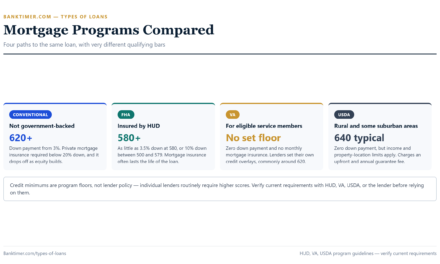
A mortgage preapproval is always for a type of loan. The type sets the minimum down payment, the mortgage insurance, and the documents. If your letter does not name the program, ask. Our broader guide to types of loans places mortgages next to every other borrowing option.
CFPB’s overview describes conventional loans as the majority of loans that typically cost less than FHA loans but can be harder to get. It describes FHA loans as offering a low down payment with more flexible credit requirements. VA loans serve veterans, service members, and surviving spouses. USDA loans serve low- to middle-income borrowers in rural areas.
| Program | Minimum down payment | Credit score | Mortgage insurance or fee | Main limits |
|---|---|---|---|---|
| Conventional | As low as 3% (CFPB; Fannie Mae and Freddie Mac loans) | Lender and automated system decide; no fixed national floor for Desktop Underwriter loans | PMI if less than 20% down; cancels at set points | Conforming loan limits; Standard 97% requires a first-time buyer |
| FHA | 3.5% (federal statute) | 580 or higher for the lowest down payment; 500 to 579 limited to 90% loan-to-value (HUD letter) | Upfront premium of 1.75% plus an annual premium | Lenders can add stricter rules |
| VA | None required on most purchases | VA lists no minimum; lenders may set one | One-time funding fee; no monthly mortgage insurance | Eligibility through service history |
| USDA | None; 100% financing | USDA states no credit score requirement; lenders still judge ability to repay | Ask the lender about fees | Rural area, household income at or below 115% of median, primary residence |
The table’s real message is that “minimum” and “typical” differ. The legal floor for an FHA down payment is 3.5%, but a lender may require more. A conventional loan can go as low as 3% down, but you pay PMI and often a higher rate. The best loan type depends on your credit, savings, and plans, not on the lowest advertised minimum.
Conventional loans
CFPB says conventional loans backed by Fannie Mae or Freddie Mac can require as little as 3% down. Fannie Mae’s page on its 97% loan-to-value options adds that its Standard 97% option requires at least one borrower to be a first-time homebuyer, while HomeReady does not. HomeReady has an income limit of 80% of area median income, and Standard 97% has none.
If you put down less than 20%, you generally pay PMI. CFPB explains that PMI protects the lender, not you. Federal law lets you request cancellation when your balance is scheduled to reach 80% of the home’s original value, and requires termination at 78% if you are current. Lenders must also end it the month after the midpoint of the loan’s amortization schedule.
FHA loans
The National Housing Act sets the minimum cash investment for FHA-insured mortgages at not less than 3.5% of the appraised value. A HUD mortgagee letter says borrowers with a minimum decision credit score at or above 580 are eligible for maximum financing, and those between 500 and 579 are limited to 90% loan-to-value. That letter dates to 2010, so ask your lender about current policy.
FHA’s mortgage insurance premium is a separate cost. HUD’s Mortgagee Letter 2023-05 sets an upfront premium of 1.75% of the base loan amount for most loans. Annual premiums range from 0.15% to 0.75% depending on loan amount, term, and loan-to-value ratio, and last either 11 years or the full term. On a $380,000 base loan, the upfront premium is $6,650.
VA loans
VA says nearly 90% of VA-backed loans are made without a down payment. VA lists no minimum credit score on its loan pages, but notes that you need the credit and income for the amount you want to borrow, and lenders can add conditions. The VA funding fee for a first-use purchase with under 5% down is 2.15% of the loan amount, or $8,600 on a $400,000 loan. VA says the program “doesn’t require down payments or monthly mortgage insurance.” You can finance the funding fee. A Certificate of Eligibility shows your lender that you qualify.
USDA loans
USDA’s Single Family Housing Guaranteed Loan Program offers 100% financing to eligible buyers. Household income cannot exceed 115% of the median for the area, the home must be your primary residence, and the property must be in an eligible rural area. USDA states the program has no credit score requirement, though borrowers must show the willingness and ability to manage debt. Individual lenders can still apply their own standards.
Why the program changes your preapproval
The same borrower can receive different letters for different programs. An FHA letter may allow a higher DTI but add an upfront premium. A conventional letter may carry a lower cost but need a stronger score. When you compare letters, make sure they describe the same program, down payment, and rate assumptions.
Conforming Loan Limits and Where Rates Stand
The 2026 conforming limit
Conventional loans backed by Fannie Mae and Freddie Mac must stay under a limit set each year by the Federal Housing Finance Agency (FHFA). On November 25, 2025, FHFA announced that the 2026 baseline limit for one-unit properties is $832,750. FHFA said house prices rose 3.26% on average between the third quarters of 2024 and 2025, and the limit rose by the same percentage. In high-cost areas, the ceiling is $1,249,125, which is 150% of the baseline. Alaska, Hawaii, Guam, and the U.S. Virgin Islands use a higher baseline of $1,249,125 and a ceiling of $1,873,675.
A loan above the limit is a jumbo loan. Lenders set their own rules for jumbo loans, so a mortgage preapproval for one may demand larger reserves and a higher credit score. If your target price pushes near the limit for your county, ask which category your letter covers.
Current context as of October 2026
On October 8, 2026, Freddie Mac’s Primary Mortgage Market Survey reported a 30-year fixed-rate average of 7.40%, up from 7.28% the prior week and from 6.30% a year earlier. The 15-year average was 6.73%. We checked it on October 14, 2026. Freddie Mac notes it cannot report average fees and points.
Three practical points follow from that.
- The survey is an average. Your offer depends on your score, down payment, loan type, points, and lender.
- The letter’s rate assumption matters. A letter drafted when rates were lower may overstate your budget today.
- Rates move weekly. A mortgage preapproval that expires in 30 to 60 days can outlive the rate it assumed.
What a quarter point is worth
Small rate gaps compound. In an illustrative comparison, a $360,000 loan at 7.40% has a principal-and-interest payment of about $2,493. At 7.15%, it is about $2,431. The $61 monthly difference adds up to roughly $733 a year, $5,100 over seven years, and $22,000 over 30 years. The comparison ignores points and fees, which can offset a lower rate.
Freddie Mac research from 2018, using survey data from 1995 to 2017 and a $250,000 loan, estimated that one additional rate quote could save borrowers an average of $1,500 over the life of the loan, and about $3,000 for five quotes. The figures are old, and the market has changed, but the direction supports shopping.
How Mortgage Preapproval Helps When You Make an Offer
A letter does three jobs once you start touring homes. It sets your search range, it supports your offer, and it exposes problems early. Each job has limits.
Setting a search range
Your range should come from your budget, with the letter as the outer fence. If the letter says $414,000 and your budget says $315,000, shop near $315,000. CFPB notes that only you can decide what you can afford. If your preapproved amount differs from your budget, CFPB suggests discussing the reasons with your lender and being clear with your real estate agent about your limits.
Supporting an offer
CFPB says a letter helps you show sellers you are a serious buyer. In a competitive market, listing agents often compare letters. They read them for four signals:
- The amount relative to your offer price.
- Whether the lender is known to local agents.
- Whether the review included documents.
- The expiration date relative to the closing date.
A letter from a lender that verified your file carries more weight than an automated one. Some agents ask for the lender’s phone number to confirm. That is another reason to work with a loan officer who answers calls.
Exposing problems early
CFPB points out that early mortgage preapproval can help you spot and fix problems sooner. A credit report error, an unusual deposit, or a debt you forgot is far cheaper to fix in a quiet month than in the middle of a contract.
What a letter cannot do
A letter cannot make the seller choose you, and it cannot make the appraisal match your price. It does not cover inspection, title, or insurance. It also does not guarantee funding. If a seller asks you to waive protections to compete, the letter provides no safety net for that risk. Read the red-flag section before you agree to waive anything.
What Can Break a Mortgage Preapproval
Lenders approve a snapshot. Between the snapshot and closing, your finances and the property can change. A change does not always sink the loan, but each one invites re-underwriting. Fannie Mae’s guidance, for instance, tells lenders to recalculate DTI when they discover new debt or reduced income, and to resubmit to its system when re-underwriting is required.
| Trigger | Why it matters | Typical effect | What to do |
|---|---|---|---|
| New debt (car loan, card, furniture financing) | Raises monthly obligations and adds an inquiry | DTI rises; the maximum amount falls | Wait until after closing, or ask first |
| Job change or income drop | Weakens stability and documented income | Re-verification; possible denial | Tell your loan officer before you accept an offer |
| Large unexplained deposit | Source of funds must be documented | Extra paperwork; possible delay | Keep a paper trail for every transfer |
| Credit score drop | Late payment or higher balances change pricing or eligibility | Higher rate or lost approval | Pay on time; keep balances low |
| Appraisal below price | Collateral is worth less than the contract assumes | Smaller loan; cash gap | Negotiate, bring cash, or exit under your contract |
| Rate increase before lock | Payment rises on the same loan | Lower purchasing power | Ask when and how you can lock |
| Letter expires | Conditions go stale | New review and credit pull | Track the date; ask about renewal |
The most common break is quiet. A buyer finances a couch, a lender runs a final check, and the DTI moves. The first rule of the closing period is simple: do not change anything about your credit or income without calling your loan officer first.
Large deposits and the paper trail
Fannie Mae defines a large deposit as a single deposit above 50% of your total monthly qualifying income. On $10,000 of monthly income, that threshold is $5,000. The lender must document the source when those funds support the down payment, closing costs, or reserves.
The safest approach is to move money early, keep it in one place, and keep the statements. If a relative gives you money, get a signed gift letter. CFPB’s checklist includes one. Wire transfers for closing carry fraud risk too. CFPB warns that scammers target homebuyers days before closing, and our guide to the bank phishing text shows what a fake message looks like.
The appraisal gap
When a home appraises below the contract price, lenders commonly size the loan against the lower appraised value. That is industry practice, and your lender and loan program determine the details. The difference lands on you unless the seller lowers the price.
A buyer agrees to pay $400,000 with 10% down, planning a $360,000 loan and $40,000 down. The appraisal comes in at $385,000. If the lender lends 90% of the appraised value, the loan falls to $346,500. The buyer now needs $53,500 in cash toward the price, which is $13,500 more than planned.
The buyer has four paths: ask the seller to reduce the price, bring the extra cash, dispute the appraisal with comparable sales, or walk away if the contract allows. Which of these is available depends on the contract, not the mortgage preapproval letter.
What a financing contingency does
A financing contingency in a purchase contract lets you exit if you cannot get a loan within a set time. An appraisal contingency does something similar for value. Contract terms vary by state and by agent, and Banktimer cannot say what yours says. Ask your real estate agent or attorney how these clauses work before you waive one.
Timeline: From Preapproval to Closing
Every closing runs on its own clock. Some steps have legal deadlines. Others depend on the lender’s queue, the appraiser’s schedule, and your responsiveness. The table separates the two.
| Stage | Timing | Who controls it | What you do |
|---|---|---|---|
| Preapproval letter issued | Varies by lender | Lender | Gather documents; ask about verification |
| Letter expires | Often 30 to 60 days (CFPB) | Lender | Track the date; renew if needed |
| Offer accepted | Your market | Buyer, seller | Move quickly on financing; you may have only days |
| Request Loan Estimates | After you identify a property | You | Give each lender the six application items |
| Loan Estimate delivered | Within three business days of a complete application (Regulation Z) | Lender | Compare estimates; call if one is late |
| Intent to proceed | Within 10 business days of delivery, unless the lender allows longer | You | Tell the lender you want to proceed |
| Underwriting and appraisal | Varies | Lender, appraiser | Respond to requests fast |
| Closing Disclosure delivered | At least three business days before closing (Regulation Z) | Lender | Compare to the Loan Estimate |
| Closing | Per your contract | Everyone | Bring ID and verified funds |
The rule-based rows are the ones to memorize. Three business days to receive a Loan Estimate. Ten business days to say you want to proceed. Three business days to review the Closing Disclosure. Everything else is a negotiation between your contract, your lender, and the calendar.
Using the Closing Disclosure as a check
CFPB tells borrowers to compare the Closing Disclosure to the Loan Estimate: loan term, product, amount, rate, total monthly payment, closing costs, and cash to close. It says to ask your lender to explain any significant change. If you locked your rate, CFPB notes, the lender is allowed to change it only under limited circumstances. The three-day review period exists so you can catch problems before you sign.
Should You Get a Mortgage Preapproval Now? Benefits and Trade-offs
Most buyers benefit from a mortgage preapproval, and the cost is low. Still, timing and type matter. The matrix compares four paths on the same criteria. Banktimer does not name a universal winner, because the right path depends on your timeline and your file.
| Path | Best for | Main upside | Main downside | What to verify |
|---|---|---|---|---|
| Quick prequalification | Early browsers and budget setting | Fast; often no hard pull | Little verification; weak with sellers | Whether the lender uses a soft pull |
| Verified preapproval | Buyers who will tour within weeks | Stronger offers; early problem-spotting | Takes documents and time; credit pull | Expiration date; documents reviewed |
| Wait and improve first | Scores or savings that are clearly short | Time to fix errors and cut balances | Delays your search | What specifically needs fixing |
| Skip the letter | Cash buyers | No credit pull | Not an option if you need financing | Whether you really need no loan |
The benefits are practical. A letter sets a range, signals seriousness, and surfaces problems. The drawbacks are also practical. A hard credit pull has a small cost, the letter expires, and a high ceiling can tempt you into a payment you do not want. The earlier Banktimer piece linked near the top of this guide goes deeper on those trade-offs.
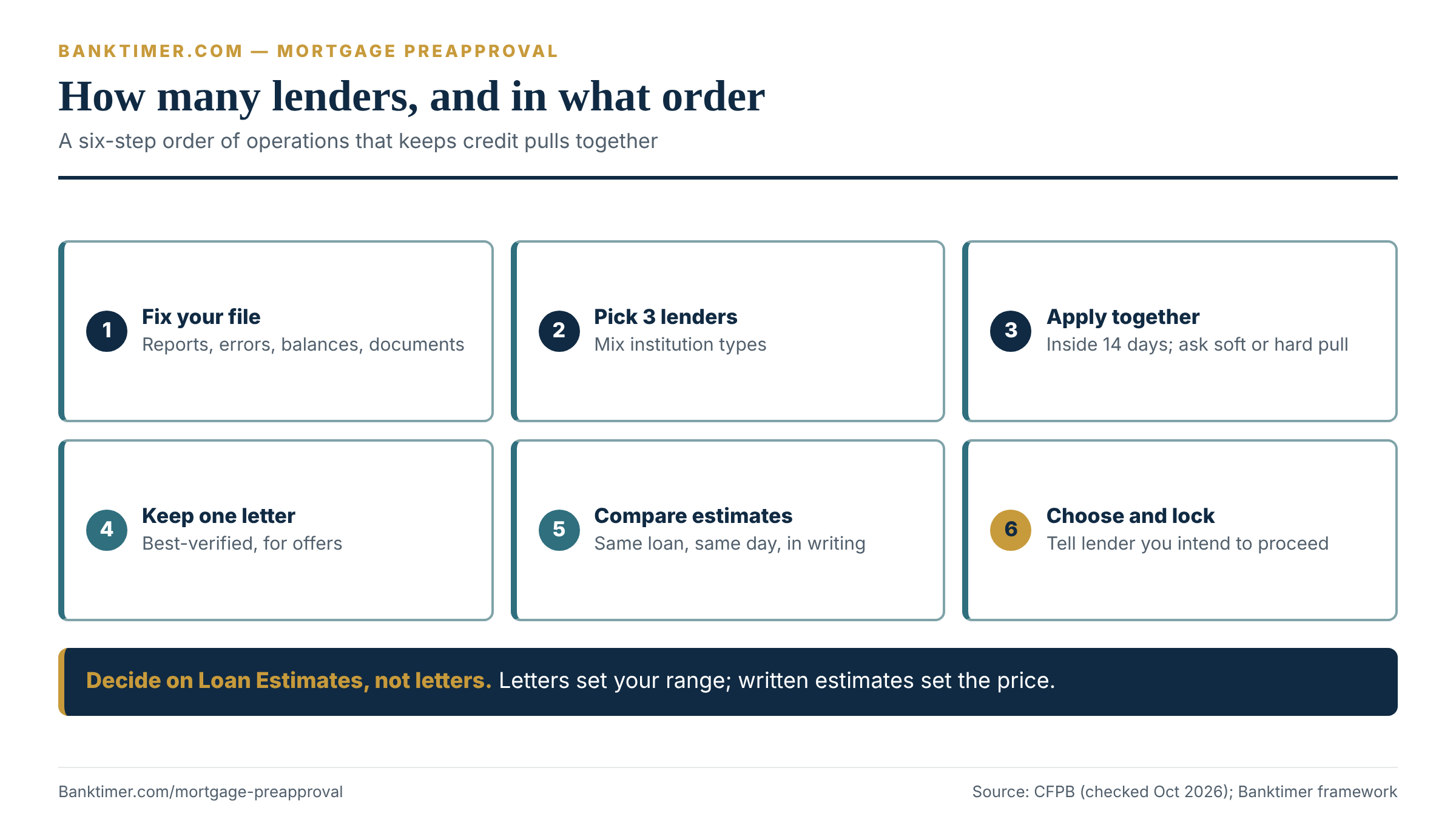
A Decision Framework: How Many Lenders, and in What Order
CFPB advises contacting at least three lenders and warns that comparing “can move quickly” after you find a home. The framework below turns that advice into an order of operations. It aims to keep your credit inquiries inside one window and your decisions tied to written numbers.
Step 1: Fix what you can in the quiet weeks
Check your credit reports, dispute errors, and bring card balances down. Gather the documents from the earlier table. Write down your budget before you talk to any lender, so a letter does not set it for you.
Step 2: Choose three lenders of different kinds
Pick at least three, as CFPB suggests. A mix helps, such as a bank or credit union where you already have an account, a mortgage company, and one more by referral. Compare more than the rate. Look at responsiveness and how clearly each explains its process.
Step 3: Ask the pull question, then apply together
Ask each whether its first review is a soft or hard pull. Then submit your requests within a few days of each other. Keep all of them inside 14 days so even older scoring models count them as one search.
Step 4: Use the best-verified letter for offers
Keep the lender with the best-documented letter as your offer lender. Hold the others as backups. Do not choose a lender by the size of the number on the letter alone.
Step 5: Request Loan Estimates for the same loan
When you have a property in mind, ask every lender for a Loan Estimate for the same loan type, term, down payment, and lock period. CFPB suggests asking each lender for the same loan type and features so you can compare directly. Compare the rate, APR, points, lender fees, estimated cash to close, and monthly payment.
Step 6: Choose, signal intent, and lock
After you pick, tell the lender you intend to proceed within the 10-business-day window and ask about a lock. Compare the Closing Disclosure to your chosen Loan Estimate when it arrives.
When the framework changes
If your credit is thin or recently damaged, talk to a HUD-approved housing counselor first. If you are a veteran, add a VA-experienced lender to your three. If you are self-employed, start with the lender most comfortable with your tax returns. If you are buying in a rural area, ask whether a USDA loan is available. These are starting points, not guarantees.
Red Flags and Costly Mistakes
Most mortgage preapproval problems are not scams. They are small misunderstandings that cost money. A few patterns do deserve alarm, and they are easier to spot when you know what normal looks like.
| Red flag | Why it matters | What to ask | Safer next step |
|---|---|---|---|
| Upfront fee to “guarantee” approval | The FTC says legitimate lenders do not promise a loan without knowing your credit history | Is this fee refundable and required by rule? | Walk away; verify the lender with your state regulator |
| Rate quoted with no Loan Estimate | A rate without points, fees, and APR is not a price | Can I have a Loan Estimate for this scenario? | Request a written estimate from each lender |
| Pressure to decide immediately | Hurried borrowers skip comparison | What happens if I decide next week? | Ask for the quote in writing and compare |
| Suggestion to overstate income or hide debt | Inflated figures can expose you to legal risk and loan trouble | What documents will you use to verify? | Decline; give accurate figures |
| Only a verbal approval | You have nothing to show a seller | Can you send a letter with conditions and an expiry? | Request a written letter |
| Letter shows no conditions or expiry | Hides what remains to be checked | What will you verify later? | Ask for the full list |
| Pressure to waive appraisal or inspection protections | The letter does not cover a bad appraisal or hidden defects | What is my exposure if the appraisal is low? | Ask your agent or attorney before waiving |
| Wire instructions arrive by email | Scammers target buyers days before closing | Can I confirm the instructions by a known phone number? | Call the title company at a number you already trust |
| Product changes between estimate and disclosure | CFPB says to call right away if the loan product changed | Why did the product change? | Do not sign until you understand it |
The FTC says no legitimate lender will tell you that paying a fee guarantees a loan, and it points to the Telemarketing Sales Rule, which makes it illegal for telemarketers to promise you a loan and ask you to pay for it up front. Federal rules also limit what a lender can charge before you receive a Loan Estimate and say you want to proceed, so a fee to “secure” an approval deserves scrutiny. If someone asks for one, stop, verify the company with your state attorney general or financial regulator, and report it at ReportFraud.ftc.gov.
Mistakes that cost real money
- Treating the maximum as the target. A letter’s ceiling can sit well above your comfort level, as the affordability section showed.
- Comparing letters instead of Loan Estimates. Letters tell you how much. Estimates tell you how much it costs.
- Spreading applications across months. Inquiries outside the window count separately.
- Opening new credit. A new car loan can cut your borrowing power sharply, by about $65,000 in our illustrative example.
- Moving money without a paper trail. Large deposits need documentation.
- Ignoring the expiration date. An expired letter may mean a new review.
- Forgetting cash for closing. Down payment is only part of the cash you need.
Cash needed: more than the down payment
CFPB says closing costs typically range from 2% to 5% of the home purchase price. The table shows what that means on a $400,000 purchase with 10% down.
| Cash item | Calculation | Amount |
|---|---|---|
| Down payment | 10% of $400,000 | $40,000 |
| Closing costs, low end | 2% of $400,000 | $8,000 |
| Closing costs, high end | 5% of $400,000 | $20,000 |
| Total cash to close, range | Down payment plus closing costs | $48,000 to $60,000 |
| Emergency cushion | CFPB suggests three to six months of expenses | Separate from the above |
The $48,000 to $60,000 range does not include moving costs, repairs, or an emergency fund. If you are building those funds, our guides to an emergency fund and a high-yield savings account cover where to hold the money safely.
Questions to Ask Before You Apply
Use these with every lender you contact. Write the answers down, or ask for them by email.
- ☐ Is this a prequalification or a preapproval, and what do you mean by each?
- ☐ Is your first credit check a soft or hard pull?
- ☐ Which credit bureaus and which scoring model do you use?
- ☐ Will you review documents now, or rely on what I report?
- ☐ What interest rate, taxes, insurance, and down payment does the amount assume?
- ☐ What DTI limit did you use for this loan type?
- ☐ Is there any fee at this stage, including the credit report?
- ☐ How long is the letter valid, and can you renew it without a new pull?
- ☐ What conditions remain before final approval?
- ☐ Which loan programs fit my situation, and what do they cost in mortgage insurance or fees?
- ☐ When will you send a Loan Estimate after I give you a property address?
- ☐ What changes in my finances should I tell you about before closing?
Frequently Asked Questions
How does a mortgage preapproval work?
A lender reviews your credit report and, depending on its process, your income, assets, and debts. It then issues a letter stating the loan amount it may be willing to lend, with conditions and an expiration date. The letter is not a loan commitment. After you choose a home, you submit a formal application, receive a Loan Estimate, and go through underwriting and appraisal.
Is prequalification the same as preapproval?
Not necessarily. CFPB says lenders use the two terms differently, and federal law does not standardize them. Many lenders treat prequalification as a quick estimate from information you supply, and preapproval as a review of your credit and documents. Because the labels vary, ask what the lender checked and what conditions remain.
How long does a mortgage preapproval last?
CFPB says a letter can carry an expiration date, typically 30 to 60 days. Your lender sets the actual period, and it may differ. If the letter expires before you find a home, the lender may refresh it, sometimes with updated documents and a new credit check. Ask in advance whether renewal triggers another hard pull.
Does getting preapproved hurt my credit score?
Slightly, if the lender runs a hard inquiry. FICO says one additional hard inquiry typically costs fewer than five points. CFPB says multiple mortgage credit checks within a 45-day window are recorded as a single inquiry. Older scoring models use 14 days. Submit your applications close together and the combined effect is usually small.
Can I get preapproved by more than one lender?
Yes, and CFPB encourages contacting at least three lenders. Mortgage preapproval does not commit you to any of them. Apply to all within a short window so scoring models count the credit checks as one search. Then request Loan Estimates from each lender for the same loan, and choose based on those written numbers.
Does mortgage preapproval cost anything?
It often costs little or nothing beyond a credit report fee, but practice varies by lender. Federal rules bar fees tied to the application until you receive a Loan Estimate and say you intend to proceed, with an exception for a reasonable credit report fee. Ask each lender whether any fee applies, and whether it is refundable.
Is a preapproval a guarantee that I will get the loan?
No. CFPB calls it “not a guaranteed loan offer.” The lender still needs a satisfactory appraisal, clear title, insurance, and final underwriting. Changes in your credit, income, debts, or assets can also change the answer. Treat the letter as a strong first step and protect your finances until closing.
What credit score do I need?
It depends on the loan type and the lender. Fannie Mae removed its fixed 620 minimum for loans run through Desktop Underwriter for new casefiles on or after November 16, 2025, and replaced it with a credit-risk standard. HUD’s FHA rules distinguish scores of 580 and above from 500 to 579. VA lists no minimum, and lenders may add their own. Ask your lender for its minimum for your program.
Can I get preapproved if I am self-employed?
Yes, but expect more documentation. CFPB says self-employed borrowers may need additional paperwork. Fannie Mae generally wants a two-year history of earnings and looks at personal tax returns, and sometimes business returns. A history of less than two years can still qualify in some cases. Ask the lender how it calculates qualifying income from your returns.
What happens if I am denied preapproval?
Ask why. CFPB suggests requesting the credit score the lender used and checking your reports for errors. If the lender evaluated you and declined, Regulation B generally requires an adverse action notice. Another lender may apply different standards, but fix the underlying issue before applying elsewhere, because each new pull adds an inquiry.
Can a lender withdraw my preapproval after I make an offer?
The letter is conditional, so a lender can revisit it if your finances change or it learns something new. New debt, a job change, a score drop, or an appraisal below the price can all trigger a reassessment. Keep your credit and income steady, and tell your loan officer about changes before they happen.
Should I spend the full amount in my preapproval letter?
Usually not. The amount reflects the most a lender may lend under its rules, not a payment that fits your budget. In our illustrative example, a household qualified for about $414,000 at a 43% DTI limit but found about $315,000 comfortable. Build your budget first, and treat the letter as an outer limit.
Pull your free credit reports at AnnualCreditReport.com this week and fix any errors. Then ask three lenders one question before you apply: is your first credit check a soft or a hard pull?
The variable that decides how much a mortgage preapproval is worth is how much the lender verified, because a letter built on documents carries weight with sellers and a letter built on self-reported numbers does not. Ask what was checked, which rate and DTI limit the amount assumes, and when it expires. Then set your own ceiling from your monthly budget, since the lender’s maximum can sit far above a payment you can sustain. Keep your credit and income steady until closing. A mortgage preapproval does not cover the appraisal, the final price of the loan, a rate lock, closing costs, your contract protections, or final underwriting. Those arrive later, in writing, and the Loan Estimate is where you compare lenders on real terms.
Methodology
This article draws on primary sources checked on October 14, 2026. They include CFPB consumer guidance on mortgage preapproval, credit inquiries, Loan Estimates, and the application packet, and the text of Regulation Z (12 CFR 1026) and Regulation B (12 CFR 1002). We also used Fannie Mae’s Selling Guide and release notes, FHFA’s 2026 loan limit announcement, HUD documents, VA and USDA program pages, FTC guidance, FICO and VantageScore explanations, and Freddie Mac’s October 8, 2026 survey and a 2018 research note.
Every dollar scenario is illustrative. It assumes $120,000 of gross income, $820 in monthly debts, 10% down, a 7.40% rate taken from the Freddie Mac survey, property tax at 1.1% of price, $150 monthly insurance, PMI at 0.7% of the loan, and $150 HOA dues. We computed the results in Python and rechecked them. They are not quotes.
Requirements vary by lender, loan program, state, and date. Fannie Mae rules apply to conventional loans sold to Fannie Mae, not to every loan. Lender overlays, contract terms, and local practice can differ. This article does not rank lenders and does not claim first-hand testing. It is general education, not legal or financial advice.
Sources
- CFPB, Get a preapproval letter (Owning a Home), last modified December 12, 2024
- CFPB, What’s the difference between a prequalification letter and a preapproval letter?, reviewed December 5, 2023
- CFPB, Request and review multiple Loan Estimates (Owning a Home)
- CFPB, Contact multiple lenders (Owning a Home)
- CFPB, What happens when a mortgage lender checks my credit?, reviewed August 28, 2026
- CFPB, Create a loan application packet (Owning a Home)
- CFPB, Determine your down payment (Owning a Home)
- CFPB, What is a debt-to-income ratio?, reviewed August 28, 2023
- CFPB, Closing Disclosure (Owning a Home)
- CFPB, When can I remove private mortgage insurance (PMI) from my loan?, reviewed August 28, 2026
- CFPB, General QM final rule press release, December 10, 2020
- 12 CFR 1026.19, Certain mortgage and variable-rate transactions, Cornell Legal Information Institute
- 12 CFR 1026.2, Definitions and rules of construction, eCFR
- 12 CFR 1026.43, Minimum standards for transactions secured by a dwelling, Cornell Legal Information Institute
- CFPB, Regulation B, section 1002.9 and official interpretations for section 1002.2
- CFPB, Regulation B, official interpretations for section 1002.2 (comment 2(f)-3)
- CFPB, Beware of mortgage closing scams (Owning a Home)
- Fannie Mae Selling Guide, B3-6-02, Debt-to-Income Ratios (04/02/2025)
- Fannie Mae Selling Guide, B3-4.2-02, Depository Accounts (12/14/2022)
- Fannie Mae Selling Guide, B3-3.2-01, Standards for Employment and Income Documentation (03/04/2026)
- Fannie Mae Selling Guide, B3-3.5-01, Underwriting Factors and Documentation for a Self-Employed Borrower (12/13/2023)
- Fannie Mae, 97% Loan to Value Options
- Fannie Mae, Desktop Underwriter release notes, DU Version 12.0 November update (September 24, 2025)
- FHFA, Conforming loan limit values for 2026, November 25, 2025
- Freddie Mac, Primary Mortgage Market Survey, week of October 8, 2026
- Freddie Mac, Why Are Consumers Leaving Money On The Table? (April 2018)
- HUD, Mortgagee Letter 2023-05, FHA mortgage insurance premiums
- HUD, Mortgagee Letter 10-29 (September 3, 2010)
- 12 U.S.C. 1709, Insurance of mortgages (FHA minimum cash investment), Cornell Legal Information Institute
- VA, Home loans overview
- VA, Funding fee and closing costs (updated October 5, 2026)
- USDA Rural Development, Single Family Housing Guaranteed Loan Program
- FTC, What to know about advance-fee loans (July 2022)
- FTC, Free credit reports (June 2026)
- myFICO, How to rate shop and minimize the impact to your FICO Scores
- myFICO, The timing of hard credit inquiries
- VantageScore, Thinking about applying for a loan? Shop around
By the Banktimer Editorial Team · Published
Banktimer is an independent U.S. consumer-finance publication. Our editors draw on primary and official sources first, such as the CFPB, FDIC, Federal Reserve, and FTC, along with statutes, regulations, and providers’ own agreements and fee schedules. Then we add worked examples and decision tools. Our goal is the most useful, best-supported explanation the sources available to us at the time of writing allow.
This article is general information, not legal, tax, investment, insurance, or financial advice, and reading it does not create a professional relationship with Banktimer. Rates, fees, limits, and rules change, and they vary by state, provider, and contract, so confirm current terms with your bank, lender, insurer, or the agency named in the article before you act. Examples are illustrative unless labeled otherwise. Banktimer is not a bank, lender, insurer, or financial advisor, and we are not responsible for decisions or losses that result from relying on this content. For advice about your own situation, talk to a licensed professional.