

SAVE plan ended what to do: find your servicer’s notice, note the deadline, and choose a new plan before it passes. The Saving on a Valuable Education (SAVE) plan is gone, so you need a plan that is legal today. Most borrowers compare Income-Based Repayment (IBR), the new Repayment Assistance Plan (RAP) and a fixed plan.
The biggest variable is your loan disbursement date. Any loan first paid out on or after July 1, 2026 changes which plans you can use. The main risk is silence: if you do nothing, you are placed in the Standard or Tiered Standard plan, and Tiered Standard payments do not count toward PSLF. Check studentaid.gov and your servicer account this week.
The deadline comes from your notice, not a calendar. The 90-day clock starts when your servicer’s notice reaches you. Servicers sent notices in groups, so two neighbors can have different dates.
Doing nothing is a choice with a price. After a final 30-day notice, you land in Standard or Tiered Standard. Your payment may jump, and autopay amounts rise with it.
Your plan options depend on loan dates. Loans from before July 1, 2026 can use IBR or RAP. A loan from July 1, 2026 or later usually points you to RAP or Tiered Standard.
Public Service Loan Forgiveness months need a qualifying plan. Months in SAVE forbearance did not count. Tiered Standard will not count either, so choose an income-driven plan early if you work in public service.
The lowest payment is not the lowest cost. In our illustrations, the plan with the smallest monthly bill was the most expensive over the full term. Run both numbers.
Never pay for help. The free application is on studentaid.gov, and the FTC says not to pay upfront for debt relief.
SAVE Plan Ended What to Do First: Where Things Stand
A federal court order ended SAVE in March 2026. The plan had given roughly 7.5 million borrowers lower payments, and the Department of Education (ED) says it will move every one of them to a plan that follows federal law. That move is happening now, in waves.
Here is the short history that matters for your decision. Borrowers who enrolled in SAVE spent a long stretch in forbearance, a pause that did not require payments. ED told servicers to begin charging interest on those loans again on August 1, 2025. The court order closed the legal fight, and the servicer notices are the practical result.
The key dates in one place
The table below separates what the court did from what ED and servicers are doing. The dates in the third column are the ones you can actually act on.
| Date | What happened | Why it matters to you |
|---|---|---|
| August 1, 2025 | ED told servicers to start charging interest on SAVE loans again | Your balance can grow while you wait |
| March 10, 2026 | A federal district court in Missouri vacated the SAVE rule | SAVE is gone and cannot be restored by waiting |
| July 1, 2026 | RAP and Tiered Standard launched; servicer notices began | New options exist, and your 90-day clock may have started |
| By end of 2026 | ED says every SAVE borrower should have been notified | If you have no notice yet, check your contact details |
| December 31, 2026 | Deadline to enroll in autopay for a 1% interest rate cut | A small, real saving, but only after you choose a plan |
| July 1, 2028 | Existing ICR and PAYE plans end no later than this date | Not your issue today, but it shapes long-term plans |
The most useful row is the last one for the long term and the first two for today. SAVE will not return through a courtroom while your interest accrues. Treat the notice as the starting gun.
What your servicer notice actually says
ED’s guidance says servicers email most borrowers. People who opted out of electronic mail get paper. Search your inbox for two subject lines: “You Have 90 Days to Select a New Repayment Plan” and “Final Notice – You will be Placed into a New Repayment Plan in 30 Days.”
The 90 days start when you receive the servicer notice, not when ED sends a general email. As ED’s own example shows, a notice received July 1, 2026 set a deadline of September 29, 2026. Your date is whatever your notice says.
If you cannot find a notice, log in to your servicer account and read the messages page. Then check the contact information on file. A wrong email address is the most common reason a deadline slips by.
The First Week: A Step-by-Step Plan
Before you compare plans, spend one afternoon gathering facts. These steps take about an hour in total, and each one prevents a specific mistake.
- Find the notice and write down the deadline. Put the date on your calendar with a reminder 30 days earlier. Note which of the two notices you hold.
- Log in to studentaid.gov. Open your dashboard and list every loan. Write down the balance, interest rate, loan type, servicer and disbursement date for each.
- Flag any loan paid out on or after July 1, 2026. This single date decides which plans you can use. A new graduate loan this fall counts.
- Check your last tax return. You will need your adjusted gross income (AGI) and your household size. If your income has dropped since then, plan to document the new figure.
- Decide whether PSLF matters. If you work for a government or qualifying nonprofit employer, your plan choice affects forgiveness months. Treat that as a hard constraint.
- Run the repayment calculator. ED’s Repayment Calculator at studentaid.gov shows plans you qualify for with payment estimates. Use it before you apply.
- Apply while you still have time. Processing takes weeks. Apply well before your deadline, not on the last day.
That list is the practical answer to “SAVE plan ended what to do” for most people. The rest of this article helps you make step six and seven well.

If you are not sure you were in SAVE
Some borrowers lose track. If your servicer account shows a “forbearance” status and a SAVE label, you were in the plan. If you applied for SAVE but never started, your application will be denied. You then get 90 days from the denial notice to choose a plan.
If you do nothing after that denial, ED says you return to the plan you used before applying for SAVE. That is the one case where inaction is mild. It does not apply to people who were actually enrolled.
You do not need to wait for a notice. ED says you can switch before it arrives by contacting your servicer. If you already know your answer, acting early ends the forbearance and starts qualifying payments sooner.
How the Notice Clock Works
Three separate notices drive this process, and borrowers often blur them together. Each has its own purpose, and only one of them starts the 90-day window. Knowing the order helps you judge where you stand today.
| Notice | What it says | Typical timing | What you should do |
|---|---|---|---|
| Servicer notice: “You Have 90 Days…” | You must choose a plan within 90 days | Sent between July 1 and the end of 2026, in groups | Write down the deadline; apply early |
| Final notice: “…Placed into a New Repayment Plan in 30 Days” | You did not choose; placement is coming | After the 90 days pass | Choose a plan right away to avoid placement |
| New payment notice | Your new payment and first due date | At least 21 days before the first due date | Check the amount; adjust autopay |
The first notice is a letter of opportunity. The second is a warning. The third is the bill. If you reach the third without having chosen, you are already on a plan someone else picked.
Worked timeline: four example notice dates
Dates below are illustrative. They apply ED’s 90-day and 30-day windows to hypothetical notice dates. Your own dates come from your notice.
| Notice received | 90-day choice deadline | End of final 30 days | Note |
|---|---|---|---|
| July 1, 2026 | September 29, 2026 | October 29, 2026 | Matches ED’s own example for the deadline |
| October 1, 2026 | December 30, 2026 | January 29, 2027 | Falls close to the year-end autopay deadline |
| October 20, 2026 | January 18, 2027 | February 17, 2027 | Deadline may land over a holiday weekend |
| December 1, 2026 | March 1, 2027 | March 31, 2027 | Notices are expected to finish by year end |
Look at the second row. A borrower notified on October 1 has a choice deadline of December 30, 2026, one day before the autopay deadline of December 31. Those two dates are easy to confuse. The plan choice comes first, because ED says SAVE borrowers must first choose a legal plan before they can use the autopay reduction.
Why the dates differ by servicer
ED said servicers would send notices “in groups.” One servicer, Edfinancial, told borrowers to expect its notice between July 1 and August 15. Another, MOHELA, sent notices between July and September. That is why a coworker’s date does not predict yours.
Your servicer also controls how it counts the first day. If your notice says September 29, use September 29. If you are unsure whether a date has passed, call and ask for the date in writing.
What If I Did Not Choose a Repayment Plan
This is the question behind many searches, and the honest answer is calmer than the fear. If you typed SAVE plan ended what to do after a missed date, start here. Missing the 90 days does not mean default. It means a fixed plan will be picked for you after a 30-day warning. You can still move.
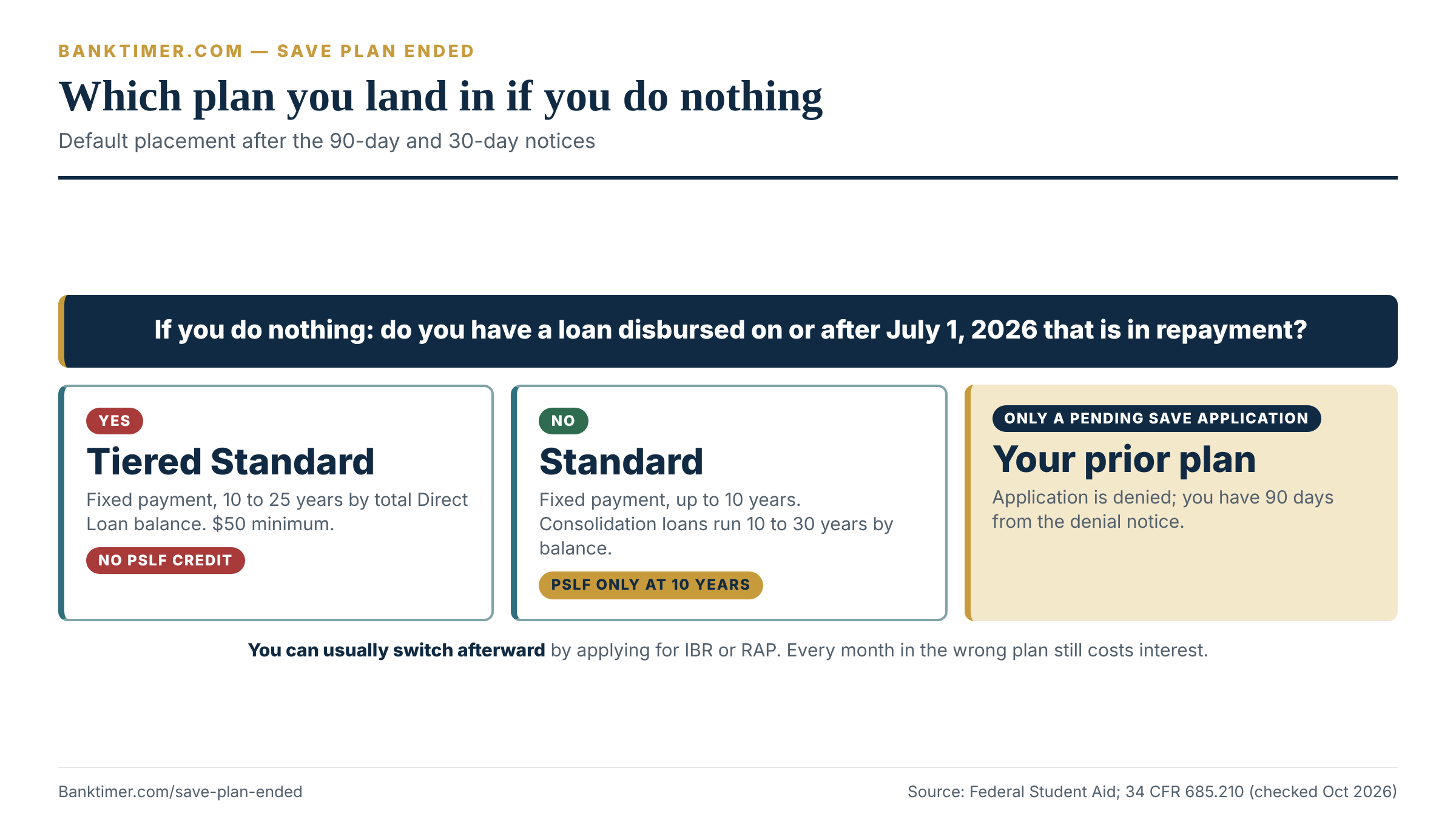
Here is what ED’s guidance says happens. After the 90 days, your servicer sends a final 30-day notice. If you still do not act, you are placed automatically:
- in the Standard Repayment Plan, if none of your loans was disbursed on or after July 1, 2026; or
- in the Tiered Standard Plan, if you have a loan disbursed on or after July 1, 2026 that has entered repayment.
The federal regulation says the same thing in legal language. Section 685.210 of the Direct Loan rules says the Secretary assigns the standard plan for loans made before July 1, 2026, and the Tiered Standard plan for loans made on or after that date. That is federal regulation. It is not a servicer’s discretion.
Standard placement: the payment shock
Both default plans have fixed payments. They do not look at your income. For a borrower who was paying little or nothing in forbearance, the first bill can be a surprise. ED warns that your payment may be higher than under an income-driven plan, and that autopay amounts rise too.
Servicers must tell you the new payment at least 21 days before the first due date. Use those 21 days. If the number does not fit your budget, apply for an income-driven plan immediately instead of waiting for the first missed payment.
Tiered Standard placement: the PSLF problem
Tiered Standard is the bigger concern for public-service workers. ED’s guidance says Tiered Standard payments do not count toward PSLF. A placement of six months there means six months of payments that earn no forgiveness credit. We cover the exact rules in the PSLF section below.
Rules and exceptions for default placement
| Situation | Placement | Exception or catch | Reader action |
|---|---|---|---|
| All loans disbursed before July 1, 2026 | Standard (fixed) | Consolidation loans get a term of 10 to 30 years based on balance | Check the term; compare with IBR or RAP |
| Any loan disbursed on or after July 1, 2026 and in repayment | Tiered Standard (fixed) | Term runs 10 to 25 years by total Direct Loan balance | Consider RAP if cash flow is tight |
| Pending SAVE application only | Back to your prior plan | You get 90 days from the denial notice | Pick a plan within the window |
| Loans still in school or grace period | No action needed yet | Plan choice comes when repayment starts | Revisit before the grace period ends |
| Borrower already switched before notice | The plan you chose | Servicer may ask for income proof | Confirm the change on your dashboard |
The practical point is in the first two rows. Standard and Tiered Standard are fixed plans, so neither adjusts to a drop in income. Only an income-driven plan does.
You can usually switch after placement
Placement is not a life sentence. Under the Direct Loan rules, a borrower with older loans may switch to any plan they qualify for by notifying the Secretary. For loans made on or after July 1, 2026, the switching rule lists changes between Tiered Standard and RAP. There are exceptions for borrowers in default and for some consolidation situations.
The catch is time. Every month spent in the wrong plan is a month of interest and, for some borrowers, a month without PSLF credit. We treat the cost of delay later, in dollars.
The Standard and Tiered Standard Plans in Detail
Neither fixed plan looks at your income, so the math is simple. The balance, the interest rate and the term set the payment. Let us look at each plan’s rules, because they decide your bill if you were placed by default.
Standard
The Standard plan charges a fixed amount for up to 10 years, with a $50 monthly minimum. That applies to Direct Loans if you have not received a Direct Loan on or after July 1, 2026. Consolidation loans are different. Their term depends on the total balance:
| Total balance | Standard term for consolidation loans |
|---|---|
| Under $7,500 | 10 years |
| $7,500 to under $10,000 | 12 years |
| $10,000 to under $20,000 | 15 years |
| $20,000 to under $40,000 | 20 years |
| $40,000 to under $60,000 | 25 years |
| $60,000 or more | 30 years |
Those thresholds come from the Direct Loan regulation at 34 CFR 685.208. A consolidated borrower with $45,000 would be placed in a 25-year Standard plan, not a 10-year one. The longer term means a smaller payment and much more interest. It also means the plan may not qualify for PSLF. The PSLF rule counts a 10-year Standard term, or a payment at least as large as a 10-year Standard payment.
Tiered Standard
Tiered Standard also has a $50 monthly minimum. Its term depends on your total Direct Loan balance when you enter repayment:
| Total Direct Loans at repayment start | Term |
|---|---|
| Under $25,000 | 10 years |
| $25,000 to under $50,000 | 15 years |
| $50,000 to under $100,000 | 20 years |
| $100,000 or more | 25 years |
Higher balances get longer terms and lower monthly payments. That is a feature for cash flow and a cost for total interest. It is still a fixed bill, which means a job loss does not change it.
Your Real Options: Which Plans Are Open to You
Plan eligibility turns on two facts: what type of loans you hold and when each one was disbursed. This is the part most borrowers get wrong, because the rules changed on July 1, 2026. ED’s student aid pages sort the plans this way.
| Plan | Who can use it | Payment basis | Term | Counts for PSLF |
|---|---|---|---|---|
| Standard | Direct and FFEL loans disbursed before July 1, 2026 | Fixed, $50 minimum | Up to 10 years (10 to 30 for consolidation) | Only at a 10-year term or higher payment |
| Tiered Standard | Loans disbursed on or after July 1, 2026 | Fixed, $50 minimum | 10 to 25 years by balance | No, per ED |
| IBR | Direct and FFEL loans disbursed before July 1, 2026 | 10% or 15% of discretionary income | 20 or 25 years | Yes |
| RAP | Direct Loans, any disbursement date; FFEL only if consolidated | 1% to 10% of AGI | 30 years | Yes |
| Graduated and Extended | Loans disbursed before July 1, 2026 | Fixed or rising | Up to 10 or 25 years | Generally no |
| ICR and PAYE | Direct Loans disbursed before July 1, 2026 | Income-based | 20 or 25 years | Yes, until they end |
Parent PLUS loans follow different rules. RAP does not accept loans that include a Parent PLUS Loan, and ICR is the only income-driven option for them, after consolidation. SAVE never covered Parent PLUS, so this article does not focus on it.
Two details deserve a second look. FFEL loans are old bank-made loans. If you hold FFEL loans, IBR is your income-driven route, and RAP opens only after you consolidate into a Direct Loan. And ICR and PAYE end no later than July 1, 2028, so choosing them now means another forced move in less than two years.
Why most SAVE borrowers compare two plans
Graduated and Extended plans cost more interest than the 10-year Standard plan and generally do not count for PSLF. ICR and PAYE close within two years. That leaves IBR and RAP as the working choices for borrowers who need an income-driven payment, with Standard and Tiered Standard as fixed alternatives.
ED’s 2025 announcement recommended IBR for borrowers leaving SAVE. Since then RAP has launched. Our companion article on IBR vs RAP goes deeper on the long-term differences. Here we focus on how each plan treats a SAVE refugee making a choice this month.
How IBR Works for a Former SAVE Borrower
Income-Based Repayment sets your payment as a share of discretionary income. ED defines discretionary income as your AGI minus 150% of the federal poverty guideline for your family size and state. The share is 15% for most borrowers and 10% if you are a newer borrower. The term is 25 years or 20 years.
ED’s plan comparison page ties the newer-borrower treatment to first loans taken on or after July 1, 2014. Your servicer will tell you which group you are in. If you are unsure, ask for the term in writing.
The IBR formula, with 2026 poverty numbers
The 2026 poverty guideline for a one-person household in the 48 contiguous states and D.C. is $15,960. For two people it is $21,640, and for three it is $27,320. The Federal Register notice says these took effect January 13, 2026. Alaska and Hawaii use higher figures, so check yours.
Take a one-person household with AGI of $58,000:
- Protected income is 150% of $15,960, which is $23,940.
- Discretionary income is $58,000 minus $23,940, which is $34,060.
- At 15%, the annual payment is $5,109, or $425.75 a month.
- At 10%, it is $3,406, or $283.83 a month.
Your payment can never exceed what you would pay on a 10-year Standard plan. That cap protects higher earners with moderate balances.
What IBR does with unpaid interest
If you have subsidized loans, ED says the government pays 100% of remaining interest for the first three consecutive years when your payment does not cover it. Unsubsidized loans do not get that help. Interest simply keeps accruing. If you leave IBR or stop qualifying for income-based payments, unpaid interest on Direct Loans can be added to your principal. That is called capitalization.
Marriage and IBR
Your spouse’s income counts under IBR only if you file a joint tax return. If you file separately, ED’s page says only your own income is used. Filing separately can change your tax bill, so weigh the tax cost before you choose a filing status for loan reasons alone. Our forms guide explains the return basics.
How RAP Works
The Repayment Assistance Plan is new. It launched July 1, 2026, and it is based on AGI rather than discretionary income. There is no poverty-line subtraction. Instead, your payment is a percentage of AGI that rises by one point for each $10,000 band.
| Annual AGI | Base payment rate |
|---|---|
| Up to $10,000 | $120 a year flat |
| $10,001 to $20,000 | 1% |
| $20,001 to $30,000 | 2% |
| $30,001 to $40,000 | 3% |
| $40,001 to $50,000 | 4% |
| $50,001 to $60,000 | 5% |
| $60,001 to $70,000 | 6% |
| $70,001 to $80,000 | 7% |
| $80,001 to $90,000 | 8% |
| $90,001 to $100,000 | 9% |
| Over $100,000 | 10% |
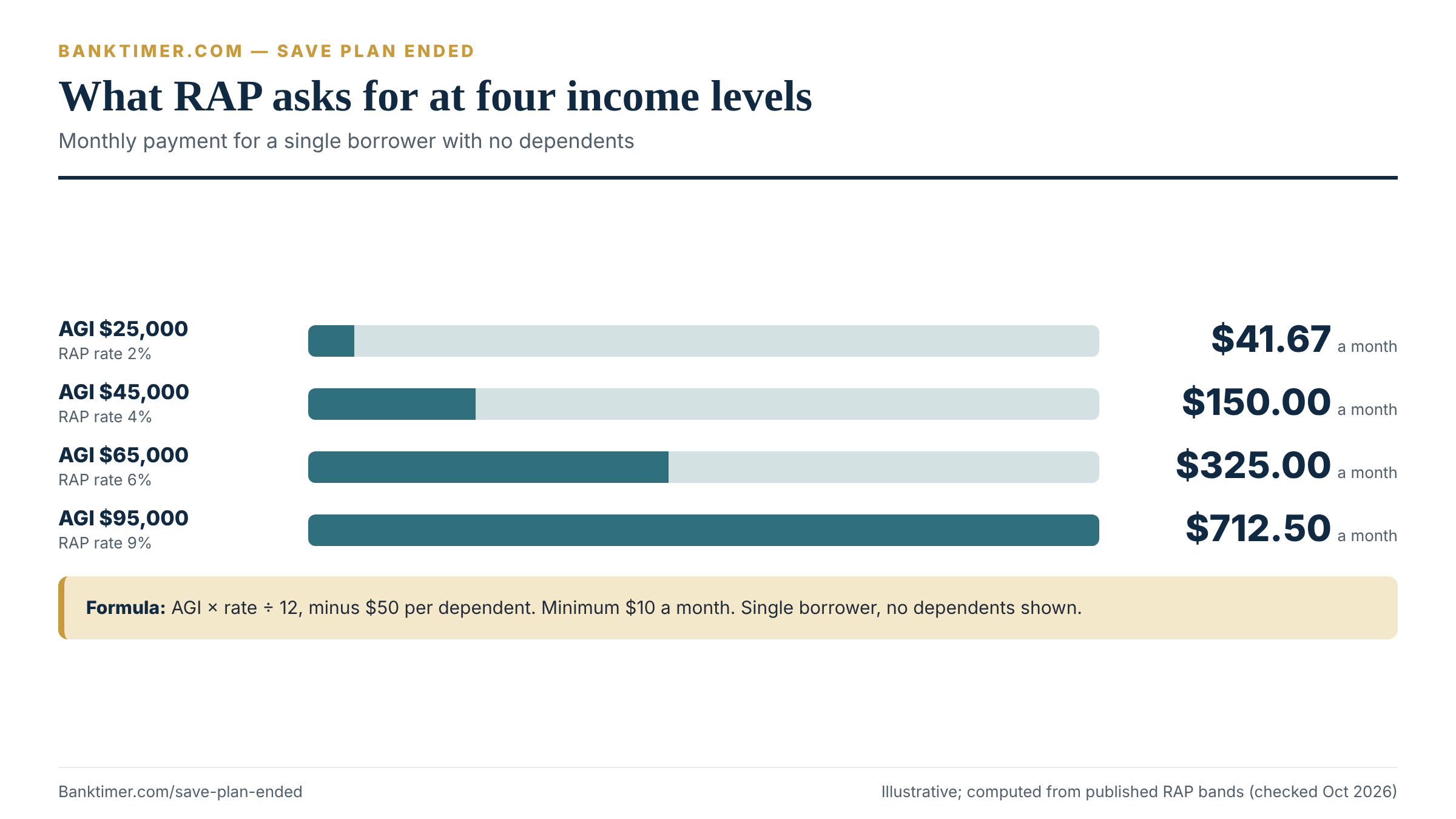
Divide the result by 12. Then subtract $50 for each dependent you claim on your tax return. The payment cannot fall below $10 a month. That is the rule in the Direct Loan regulation and on ED’s RAP page.
Three features that set RAP apart
First, the interest subsidy. If your RAP payment is smaller than the interest that accrues, the unpaid part is not charged. Your balance does not grow while you make on-time payments.
Second, the principal match. If your payment does not cut principal by at least $50, ED pays a matching amount toward principal. ED’s fact sheet describes it as reducing principal by your payment amount, up to $50, in a month.
Third, the term. Any balance left is forgiven after 360 qualifying payments, or 30 years. That is longer than IBR. Forgiven amounts may be taxable income under current federal rules.
RAP rates in dollars
The table shows RAP’s monthly payment for a single borrower with no dependents. These are our own calculations from the published rate bands. They are not quotes, and your servicer’s figure governs.
| AGI | Rate | Monthly RAP payment |
|---|---|---|
| $15,000 | 1% | $12.50 |
| $25,000 | 2% | $41.67 |
| $35,000 | 3% | $87.50 |
| $45,000 | 4% | $150.00 |
| $55,000 | 5% | $229.17 |
| $65,000 | 6% | $325.00 |
| $75,000 | 7% | $437.50 |
| $95,000 | 9% | $712.50 |
| $120,000 | 10% | $1,000.00 |
Notice the step pattern. Earning $1 more at a band edge raises the rate on your entire AGI, so the payment jumps. Moving from $50,000 to $50,001 changes the rate from 4% to 5%, a rise of about $42 a month. That feature matters if your income hovers near a boundary.
Each dependent trims $50 from the monthly figure. A borrower with $58,000 AGI and two dependents pays $241.67 minus $100, or $141.67.
Who RAP can and cannot serve
Direct Loan borrowers can use it, whether the loans came before or after July 1, 2026. Eligible loans include Direct Subsidized and Unsubsidized Loans, Direct PLUS loans for graduate or professional students, and Direct Consolidation Loans that did not repay a Parent PLUS Loan. If all your loans were disbursed on or after July 1, 2026, RAP is your only income-driven option.
Married borrowers who file jointly use combined income, and the payment is reduced if your spouse also has federal loans. Married borrowers who file separately use only their own income and dependents. ED says RAP prorates payments so one spouse’s income does not drive the other’s bill.
IBR vs RAP: A Side-by-Side for SAVE Borrowers
Both plans count toward PSLF, both forgive after a long term, and both can be paired with IRS data sharing. They differ in who pays less, who pays interest, and how long you stay. Use the same criteria for each.
| Criterion | IBR | RAP |
|---|---|---|
| Payment basis | 10% or 15% of income above 150% of poverty line | 1% to 10% of AGI, less $50 per dependent |
| Lowest possible payment | Can be $0 | $10 |
| Payment cap | 10-year Standard amount | None; 10% of AGI at high incomes |
| Unpaid interest | Accrues (subsidized loans get 3 years of help) | Waived while you pay on time |
| Principal protection | None | Up to $50 a month match |
| Term | 20 or 25 years | 30 years |
| Loans accepted | Direct and FFEL before July 1, 2026 | Direct Loans; FFEL only if consolidated |
| Best fit | Low income, high balance, pre-2026 loans | Interest-growth worry, new loans, dependents |
The row that surprises people is the payment cap. IBR has one; RAP does not. A high earner with a modest balance can pay far more under RAP than under IBR, because RAP keeps climbing to 10% of AGI. A low earner with a large balance can pay less under RAP than under IBR, depending on dependents.
We do not call one plan the winner. The better plan is the one whose cost curve fits your income path, your balance, your loan dates and your forgiveness goal.
Running the Numbers: Four Illustrative Borrowers
Any honest answer to SAVE plan ended what to do needs the math, because payments are only half the story. A plan with a small bill can cost more over time, and a plan with a large bill can end sooner. The examples below use hypothetical borrowers and round, labeled assumptions. They are Banktimer editorial examples, not real people and not quotes of any current rate.
All four use 2026 poverty guidelines and the published plan formulas. Income is held flat for each model, which real life rarely does. Raises push income-based payments up, so treat the totals as directional.
Borrower A: mid-income with no dependents
Borrower A has $42,000 in Direct Loans at a 6.0% blended rate, all disbursed before July 1, 2026. AGI is $58,000, household size is one, and she claims no dependents. She does not work in public service.
The 10-year Standard payment is $466.29. IBR at 15% is $425.75. IBR at 10%, for a newer borrower, is $283.83. RAP is 5% of AGI, or $2,900 a year, which is $241.67 a month. Interest on the balance starts near $210 a month.
The next table runs each option to the end of its term. The key result is the last column. The plan with the smallest payment is the one with the largest total.
| Plan | Monthly payment | Months to finish | Total paid | Balance left to forgive |
|---|---|---|---|---|
| 10-year Standard | $466.29 | 120 | $55,954 | $0 |
| IBR at 15% | $425.75 | 137 | $58,024 | $0 |
| IBR at 10% | $283.83 | 240 | $68,120 | $7,886 |
| RAP | $241.67 | 360 | $87,000 | $6,556 |
Look at the RAP row. The first-month bill is $225 lower than Standard, yet total payments run about $31,000 higher. That gap exists because RAP’s 30-year term keeps interest running far longer. If her income rises, her RAP payment rises with it and the gap narrows.
Look at the IBR 15% row too. Because her payment sits just below the Standard amount, she pays off the loan in about 11 years and 5 months. IBR here behaves like a slightly cheaper Standard plan.

The lesson for Borrower A: if she wants the lowest total cost and her budget can carry $466, the fixed 10-year plan wins. If she needs breathing room now, IBR 15% gives some relief at almost no extra cost. If she needs the lowest bill, RAP provides it and costs more over time.
Borrower C: placed in Tiered Standard by default
Borrower C has $85,000 of Direct Loans at 7.0%. One loan was disbursed in August 2026, so Tiered Standard is the default plan. His AGI is $52,000, household size is one, and he never answered his servicer’s notice.
An $85,000 balance falls in the 20-year tier. That fixed payment is $659.00, and total payments reach about $158,161. Interest on the balance runs roughly $496 a month at the start.
Now compare his options. At $52,000 AGI, RAP’s rate is 5%, which gives $216.67 a month. That payment is far below the $496 of monthly interest, but RAP does not charge the unpaid part, and it adds a principal match. Under Tiered Standard, he pays $442 more each month than under RAP.
The trade-offs run both ways. RAP’s low bill relieves cash flow and avoids interest growth. It also stretches payments toward 30 years. Tiered Standard pays the balance down faster at $659 a month. It does not count toward PSLF, which matters only if he works in public service.
Borrower C’s first practical step is not choosing between them. It is calling the servicer within the 21-day window, asking for his new payment in writing, and applying for RAP if $659 does not fit. Because his loans are mixed in vintage, the repayment calculator should confirm which plans he can actually use.
Borrower D: income barely above the poverty line
Borrower D owes $30,000 at 6.0% and earns $24,000 a year. Household size is one. Interest accrues at about $150 a month.
Under IBR, protected income is $23,940, so discretionary income is just $60. At 15%, the annual payment is $9, or $0.75 a month, which rounds to nearly nothing. Under RAP, 2% of $24,000 is $480 a year, so the payment is $40.00 a month.
The difference sits in the interest. With an IBR payment near $0, unpaid interest accrues. Over 12 months it would add about $1,800, taking the balance from $30,000 to about $31,800 before any subsidy for subsidized loans. With RAP, the $40 monthly payment buys an interest subsidy and a $40 principal reduction each month. After a year, her principal is about $29,520.
If Borrower D works for a qualifying employer, both plans count toward PSLF, and the $0 payment is the cheaper route to forgiveness. If she does not, RAP’s balance protection matters more. Our rule of thumb: the lower the income and the higher the balance, the more RAP’s interest waiver matters to you.
Borrower E: married with a higher-earning spouse
Borrower E has $60,000 at 6.5%. Her AGI is $55,000. Her spouse earns $65,000 and has no federal student loans. Together they file jointly with AGI of $120,000.
Under RAP, joint filing means 10% of $120,000, or $1,000.00 a month. Filing separately means 5% of her own $55,000, or $229.17 a month. The 10-year Standard payment is $681.29.
The gap is $770.83 a month, or $9,250 a year. That is a large number, but it is only one side of the ledger. Filing separately can raise the couple’s tax bill and can limit some tax credits and deductions. Only a tax comparison for their own return can show whether the loan saving beats the tax cost.
IBR works differently. At joint income, her 15% formula would give $1,094 a month, but the 10-year Standard cap holds it to $681.29. That cap is why a high-income household might prefer IBR over RAP when it qualifies. For the filing question, talk to a tax preparer before you change anything.
What a month of delay costs
Delay has a price even before you are placed in a default plan. The table shows interest that accrues in 30 and 120 days on three illustrative balances, using simple daily interest. MOHELA and other servicers use daily interest on Direct Loans, calculated as principal times the rate divided by 365.25.
| Balance and rate | Interest per day | Per 30 days | Per 120 days |
|---|---|---|---|
| $42,000 at 6.0% | $6.90 | $206.98 | $827.93 |
| $68,000 at 6.5% | $12.10 | $363.04 | $1,452.16 |
| $85,000 at 7.0% | $16.29 | $488.71 | $1,954.83 |
These are not penalties. They are the ordinary cost of an unpaid balance. But they show why a four-month wait while you “think about it” can cost the price of a used laptop. Unpaid interest can also be added to principal in some cases, such as when you leave IBR, so the true cost can be higher.
If a quick choice is not possible, pick a reasonable income-driven plan now. You can switch later. A reasonable plan chosen today usually beats a perfect plan chosen after the deadline.
The autopay discount, in dollars
ED’s announcement offers a 1% total interest rate reduction for borrowers who enroll in autopay. ED first set a September 30, 2026 enrollment deadline. Studentaid.gov now states December 31, 2026, and the reduction runs through June 30, 2028. It applies to Direct Loans originated after July 1, 2012, and you must stay enrolled to keep it.
On the $42,000 balance, one percentage point is about $420 a year in interest, or $35 a month. In practice, servicers already give 0.25% for autopay, so the new benefit is the other 0.75 percentage point, about $26 a month. SAVE borrowers must choose a legal plan first, and a higher fixed payment under Standard will also be drafted automatically. Make sure autopay matches your budget before you enroll. Our pay-cycle budgeting guide shows how to line payments up with income.
PSLF Qualifying Months After SAVE: What Counts and What Does Not
If you work for a government agency or a qualifying nonprofit, this section matters more than any payment comparison. For you, SAVE plan ended what to do has a stricter answer than for everyone else. PSLF forgives the remaining balance after 120 qualifying monthly payments. A plan choice that looks fine on a budget sheet can quietly cost you months of credit.
Start with what the federal rule says. Under 34 CFR 685.219, a qualifying repayment plan includes income-driven plans under section 685.209, the 10-year Standard plan, and RAP. It also includes other plans if the monthly payment is at least what the 10-year Standard plan would require. Income-contingent payments count only through June 30, 2028. The rule requires full-time employment with a qualifying employer, which means an average of at least 30 hours a week.
Which plans count, in plain terms
| Plan | Counts toward PSLF? | Notes |
|---|---|---|
| IBR | Yes | An income-driven plan; ED lists it as qualifying |
| RAP | Yes | Named in the PSLF regulation |
| 10-year Standard | Yes | Little left to forgive after 120 payments |
| Standard with a longer term | Generally no | Counts only if the payment is at least a 10-year Standard payment |
| Tiered Standard | No, per ED | Studentaid.gov states these payments do not count |
| Graduated and Extended | Generally no | Servicer guidance says generally not qualifying |
| SAVE forbearance | No | Months in this forbearance do not count |
The row to remember is Tiered Standard. If you are placed there by default and work in public service, each month is a month of payments with no PSLF credit. That is the strongest reason to choose an income-driven plan before the deadline.
What happened to your SAVE months
Qualifying payments you made before SAVE forbearance still count. Time spent in the SAVE forbearance does not count toward PSLF, and it does not count toward IDR forgiveness either. ED’s SAVE guidance says you may be able to buy back certain forbearance months once you have 120 months of qualifying employment.
The buyback rule is in section 685.219(g)(6). Credit is available for a month if you were employed full time at a qualifying employer and either make an additional payment equal to what you would have paid on a qualifying plan, or would have qualified for a $0 income-driven payment that month. The same paragraph says buyback does not apply during RAP repayment periods.
Two details to confirm before you rely on it. First, buyback requires that the purchase would bring you to forgiveness, so it works near the end of your path, not at the start. Second, as we read the rule, buyback covers deferment and forbearance months. It does not cover months you paid under a plan that does not qualify. A month in Tiered Standard is not a forbearance month.
Buyback is built for pauses such as forbearance. A month of payments on a non-qualifying plan is not a pause, so we do not read the rule as letting you purchase it back. Confirm with Federal Student Aid in writing if this applies to you. The safe path is to avoid default placement entirely.
The paperwork PSLF still needs
Plan choice is only one piece. ED tells borrowers to submit a PSLF form each year and whenever they change jobs. It also offers a PSLF Help Tool to check employer eligibility. PSLF forgiveness is not federally taxed, though some states may tax it, according to ED’s income-driven repayment FAQ.
Consolidation and PSLF credit
Consolidation needs care. ED says qualifying payments on Direct Loans are averaged by balance after consolidation, and other loan types do not count. The regulation uses a weighted average of qualifying payments on the underlying loans. Run the PSLF Help Tool before you consolidate, not after. Our rehabilitation vs consolidation guide explains the trade-offs for borrowers coming out of default.
Borrower B works full time at a qualifying nonprofit hospital. She has $68,000 at 6.5%, AGI of $64,000, and a household of two (herself and one dependent child). She has 60 qualifying PSLF payments from before SAVE and about 28 months of SAVE forbearance that did not count. She needs 60 more qualifying payments.
Her payments would be: IBR at 15%, $394.25, if her first loans predate July 1, 2014; IBR at 10%, $262.83, if they came later; RAP at 6% of $64,000 less $50 for her dependent, $270.00. The 10-year Standard payment would be $772.13. Interest accrues at about $368 a month.
Borrower B: the next 60 qualifying payments
The table runs the next 60 payments. We assume flat income and that she stays employed. The “balance forgiven” column is what remains after the 60th qualifying payment.
| Plan | Monthly payment | Paid over next 60 months | Balance forgiven after 60th payment |
|---|---|---|---|
| IBR at 15% (older borrower) | $394.25 | $23,655 | $66,168 |
| IBR at 10% (newer borrower) | $262.83 | $15,770 | $74,330 |
| RAP | $270.00 | $16,200 | $65,000 |
| 10-year Standard | $772.13 | $46,328 | $39,462 |
| Tiered Standard (20-year tier) | $506.99 | $30,419 | $0 qualifying; no PSLF credit |
For PSLF, the question is not the total interest. It is how much she pays out of pocket before the balance is forgiven. IBR at 10% costs her the least in cash, about $15,770, though the balance she carries grows because unpaid interest accrues. RAP costs $430 more over five years but holds her balance at $65,000 through its interest waiver. Both are far cheaper than the Standard plan.
The Tiered row is the trap. If she were placed there, she would pay $507 a month and earn no PSLF credit. Each month there delays forgiveness by a month. Her best path is to choose IBR or RAP right now.
What buyback could do for Borrower B
If she reaches 120 months of qualifying employment and the rule applies to her, she may buy back SAVE forbearance months. At an IBR 10% equivalent of $262.83, 28 months would cost about $7,359. That is almost exactly what she would pay in 28 regular payments, but it moves her forgiveness date forward by 28 months. It also stops 28 months of interest from building.
The estimate is rough. The regulation ties the purchase price to what she would have paid on a qualifying plan in those months, and ED’s own tools show the actual eligible months. Ask for the list in writing. If any of her months were during RAP enrollment, the rule is different.

If you are not in public service
PSLF is only a factor if you work for a qualifying employer. For everyone else, the long-term forgiveness feature of IBR and RAP is a weaker bet. Balances forgiven after 20, 25 or 30 years may be taxable income, and the amounts in our example run to several thousand dollars. Think of forgiveness as a safety net, not a plan.
A Decision Framework for Choosing Your New Plan
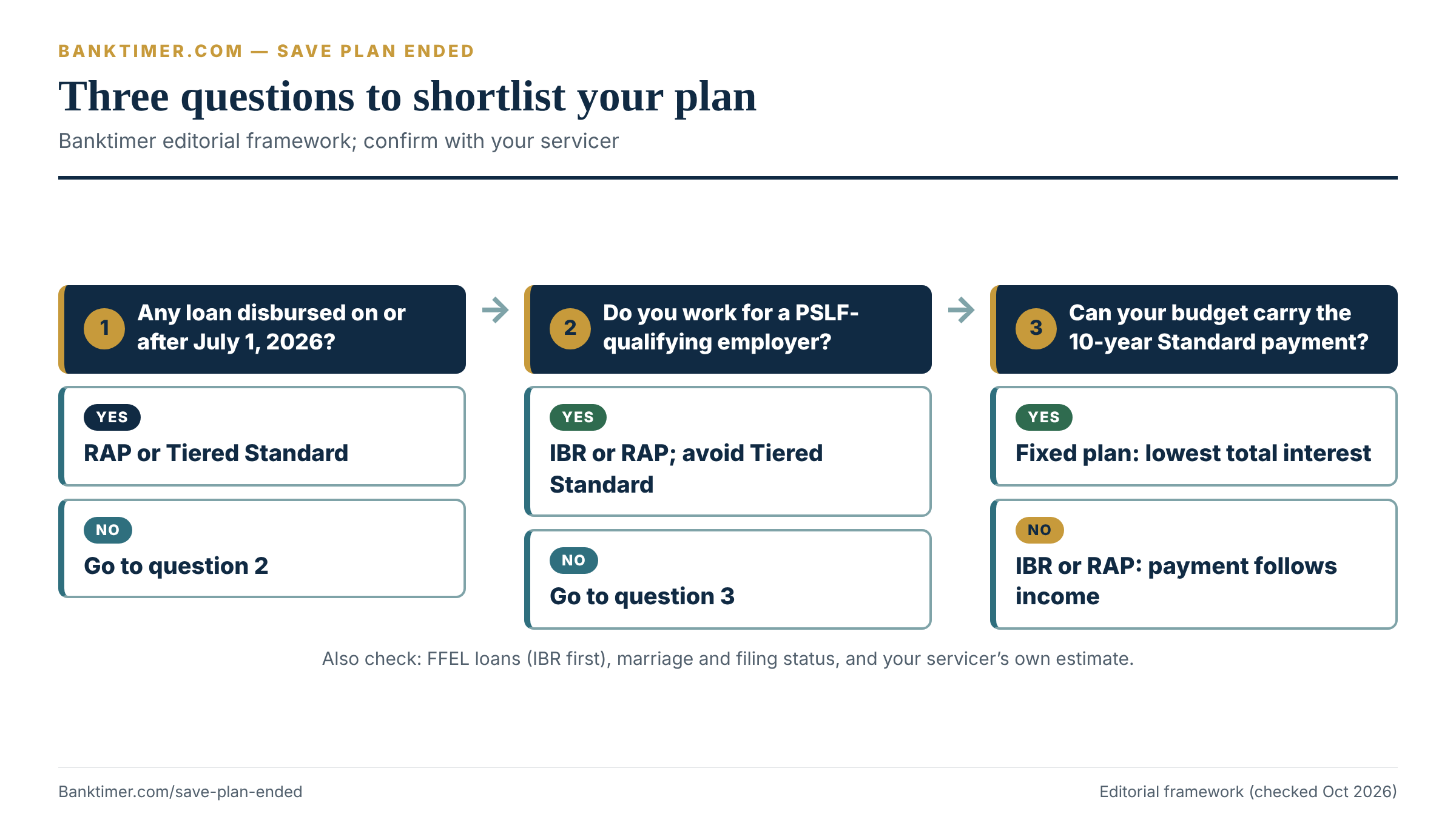
You now have the pieces, and SAVE plan ended what to do comes down to a few facts you can check today. This framework turns them into a sequence of yes-or-no questions. It is Banktimer editorial guidance, built from the published plan rules. It is not a recommendation for your specific loans, and your servicer’s figures should have the last word.
Work through the steps in order. Stop at the first one that settles your choice.
- Do you hold any loan disbursed on or after July 1, 2026? If yes, Standard is off the table and IBR may be limited. Your realistic choices narrow to RAP or Tiered Standard. Use ED’s Repayment Calculator to confirm.
- Do you work for a qualifying PSLF employer? If yes, rule out Tiered Standard and any longer-term Standard plan. Compare IBR and RAP on cash paid over your remaining qualifying months, as in the Borrower B table.
- Can your budget carry the 10-year Standard payment? If yes, and you want the lowest total interest, the fixed plan is hard to beat. If you also need flexibility, IBR at 15% cost about the same in the Borrower A example.
- Is your income low, uneven or likely to fall? If yes, choose an income-driven plan. The payment adjusts when you recertify, and RAP’s interest waiver stops your balance from growing.
- Do you have FFEL loans? If yes, IBR is your income-driven plan. RAP requires consolidation into a Direct Loan, so run the PSLF Help Tool and the calculator first.
- Are you married? If yes, compare joint and separate filing before you apply, since the choice changes your payment under every income-driven plan.
The same logic as a matrix
| Your situation | Lean toward | Why | What to verify |
|---|---|---|---|
| Public service, pre-2026 loans | IBR or RAP, whichever costs less in cash | Both count for PSLF | Your servicer’s payment estimate and employer eligibility |
| Public service, post-July 2026 loans | RAP | Only income-driven plan for new loans | PSLF Help Tool and employer certification |
| Private-sector job, stable income | Fixed plan or IBR at 15% | Lowest total interest | Whether your budget supports the payment |
| Low or uneven income | RAP or IBR | Payment follows income; RAP stops interest growth | Recertification date and income proof |
| Larger family | RAP | $50 per dependent reduces the payment | Dependents claimed on your return |
| High income, moderate balance | IBR (if eligible) or Standard | IBR is capped at the 10-year Standard payment | Whether RAP would exceed that cap |
| FFEL loans only | IBR | RAP needs a Direct Consolidation Loan | Consolidation effects on PSLF credit |
No row is a verdict. Two borrowers with the same income can land in different rows because of loan dates alone.
When to choose a lower payment on purpose
A lower payment is a legitimate choice when cash flow is the problem. Late fees, overdrafts and credit damage cost more than extra interest in most cases. Our monthly budget guide shows how to set a payment ceiling. Keep an emergency fund alongside the loan, so a car repair does not turn into a missed payment.
If you choose the lowest payment, set a calendar reminder to revisit the plan each year at recertification. Pay extra when you can. Ask your servicer how it applies extra payments, because interest is paid first.
Applying: What to Submit and How Long It Takes
Once you know your shortlist, you apply through the Repayment Calculator or at studentaid.gov/idr after logging in. ED says Direct Loan borrowers can consent to IRS income retrieval, which speeds processing and enables automatic annual recertification. You do not pay anything. If someone asks for a fee, stop.
Documents to have ready
| Document | Why it matters | Where to get it | Suggested record-keeping |
|---|---|---|---|
| Last federal tax return | Shows AGI and dependents | Your tax software or IRS account | Keep with your loan file |
| Recent paystubs | Prove current income if it has dropped | Employer or payroll portal | Must be dated within 90 days of signing |
| Employer letter | Alternative for irregular pay | Your employer | Same 90-day window |
| Servicer notice | Shows your deadline | Email or servicer account | Save a copy of the page or email |
| StudentAid.gov dashboard screenshot | Shows loans and dates | Your account | Update after each change |
| Call notes | Support disputes about what was said | Your own notes | Include date, name and answer |
ED’s IDR guidance says tax returns can be up to one year old, while pay documents must be dated within 90 days of the date you sign. Copies are acceptable. If you did not file taxes, paystubs or an employer letter can work.
The suggested record-keeping column is our editorial advice. The CFPB also tells borrowers to save every piece of servicer mail and to write down the date, representative name, question and answer after each call.
Processing time and the forbearance gap
ED says servicers usually process applications within a few weeks, though it can take longer. You can watch status under “My Activity” on studentaid.gov. The status “Action Required” means you must provide more information or a signature.
While your servicer processes the application, it may place your loans in a processing forbearance for up to 60 days. That pause is useful, but it is not free. Interest still accrues, and forbearance months generally do not count toward PSLF. Apply early so the gap stays short.
Dashboard updates can lag 7 to 14 days after your servicer makes a change. If your dashboard still shows SAVE a week after approval, wait before you worry. If it lasts longer, call.
Recertification, the part people forget
Income-driven plans require yearly recertification. Your date appears on your studentaid.gov dashboard under “My Loans.” ED recommends submitting 90 days early. Automatic recertification, if you consented to IRS data sharing, begins 120 days before the date.
Missing the deadline can raise your payment, because it is no longer based on income. The CFPB warns that unpaid interest may be added to principal. If your income falls or your household grows, recertify early instead of waiting. Our 2027 financial deadlines calendar is a useful place to log your date alongside other yearly deadlines.
Lowering your AGI, legally
The CFPB notes that contributions to a 401(k) or 403(b) lower your AGI, which can lower an income-driven payment. That is simple arithmetic: under RAP, a $4,000 reduction can move you down a band if you sit near the edge of one. Before you change your contribution, remember that retirement saving has its own trade-offs. We cover the annual limits in 401(k) contribution limit 2027.
Mistakes and Red Flags
Most damage in this process comes from small mistakes, not big ones. The first table lists patterns we see in the plan rules. The second covers scams, which spike whenever a federal program changes.
Common mistakes
- Waiting for a notice you may never see. Check your account and contact details now.
- Choosing by monthly payment alone. In Borrower A’s case, the lowest bill carried the highest total.
- Picking ICR or PAYE. They end no later than July 1, 2028, and that creates another forced move.
- Filing separately without a tax comparison. A loan saving can disappear in a higher tax bill.
- Consolidating before checking PSLF. Consolidation changes how qualifying payments are counted, because they are averaged by balance.
- Forgetting autopay amounts. A placement can raise your automatic draft with little warning.
- Stopping payments when the amount feels unfair. Apply for a different plan instead.
Red flags and safer next steps
| Red flag | Why it matters | What to ask | Safer next step |
|---|---|---|---|
| A company charges an upfront fee to “move you off SAVE” | The FTC says not to pay upfront for debt relief | What can you do that studentaid.gov cannot? | Apply free at studentaid.gov |
| Anyone asks for your FSA ID | ED does not ask for it; sharing it gives control of your account | Who exactly are you, and why? | Never share it; change it if you did |
| A text or email says “act now or lose forgiveness” | Pressure is a scam marker | Can I verify this on studentaid.gov? | Log in directly; do not click links |
| Someone promises SAVE will return | The court vacated the rule | Which court order says that? | Rely on ED and servicer notices |
| A servicer says the deadline passed and nothing can be done | Placement can usually be changed | What is the process to switch from my assigned plan? | Request the change in writing |
| A payment notice shows an amount you cannot pay | Fixed plans ignore income | Which income-driven plans do I qualify for? | Apply for IBR or RAP within 21 days |
If you meet a scammer, report it to the FTC at ReportFraud.ftc.gov and to your state attorney general. If you shared personal data, our identity theft recovery guide lists the steps, and our tech support scam article covers the pressure scripts that often come next.
If You Cannot Afford Any Plan Right Now
Sometimes no plan fits this month. Contact your servicer before you miss a payment. ED says you can request a deferment or forbearance, but interest can still accrue during these periods, and both can affect PSLF and income-driven forgiveness progress.
The CFPB suggests asking about the monthly payment, timelines, interest accrual, capitalization and any loss of benefits before you agree to a forbearance or deferment. Those five questions belong on your call sheet.
What the final rule changes for deferment
ED’s final rule fact sheet says economic hardship and unemployment deferments end for loans made on or after July 1, 2027. General forbearance remains, described as up to nine months within a 24-month period. Confirm how the rule applies to your own loans, because details vary by loan date.
Missed payments have a ladder of consequences
Missed payments move from late status to credit reporting and eventually to default. At default, collections tools such as wage garnishment become possible. We do not recite the day counts here, because ED and servicers set them, and they differ by loan type. Our student loan default article and our guide to student loan wage garnishment explain the process. For credit effects, see how credit scores work.
How to escalate a servicer problem
The CFPB lists a clear order. Start with your servicer and keep notes. If the answer seems wrong, call back and ask for a supervisor. Then file a CFPB complaint, which works for federal or private loans. For federal loans, you can also file with the Federal Student Aid feedback center, which can escalate to the FSA Ombudsman Group. Your state attorney general and your school’s financial aid office are the remaining options.
- ☐ What exact deadline appears on my servicer notice, and when did the notice reach me?
- ☐ Which of my loans were disbursed on or after July 1, 2026?
- ☐ Which plans does the Repayment Calculator show for my loan mix?
- ☐ What would my payment be under IBR, RAP and the default plan at today’s income?
- ☐ Does my payment change if I file taxes jointly or separately?
- ☐ Does my employer qualify for PSLF, and when did I last submit the form?
- ☐ How many PSLF-qualifying months do I have, and how many were in SAVE forbearance?
- ☐ When is my first payment due, and what will autopay draft?
- ☐ When is my first recertification date, and have I consented to IRS data sharing?
- ☐ Will my servicer confirm the change in writing?
Edge Cases That Change the Answer
A few situations do not fit the standard path. Each one has a rule behind it, so the answer to SAVE plan ended what to do is not guesswork.
You already applied for another plan before SAVE ended
ED told borrowers in 2025 that anyone who had already applied for IBR, PAYE or ICR did not need to reapply. If you did that and your dashboard shows an approved plan, confirm that your servicer actually moved you. Look for a new payment amount and a new due date. If the dashboard still says SAVE, call and ask for a status in writing.
You are still in school or in a grace period
ED’s guidance says borrowers who never enrolled in SAVE, such as those still in school or in a grace period, need not act yet. You can apply for an income-driven plan up to 60 days before a grace period ends. Revisit your plan choice then, with the same questions.
You have Parent PLUS loans
Parent PLUS borrowers were not part of SAVE. The CFPB says Income-Contingent Repayment (ICR) is the only income-driven option for them, after consolidating into a Direct Consolidation Loan. It also advises against consolidating other loans together with Parent PLUS loans, since you may lose benefits.
Your new payment will land before your income does
Seasonal workers and gig workers often face a gap between the date a payment is due and the month income arrives. An income-driven plan helps only after you recertify with current numbers. If your pay dropped since your last tax return, submit paystubs or an employer letter dated within 90 days. Do not rely on last year’s return if this year is lower.
Taxes on forgiven balances
IBR and RAP forgive remaining balances after 20 to 30 years, and ED’s plan pages say forgiven amounts may be taxable income. PSLF is different. ED’s income-driven repayment FAQ says PSLF forgiveness is not federally taxed, though your state may tax it. Our guide to how savings and insurance are taxed covers general reporting rules, and a tax professional can answer questions about your return.
Frequently Asked Questions
SAVE plan ended what to do if I never got a servicer notice?
Log in to your servicer account and studentaid.gov, then check your messages and contact details. ED says notices began July 1, 2026, in groups, and that every SAVE borrower should be notified before the end of 2026. You do not have to wait. ED says you can switch before your notice arrives by contacting your servicer or applying through the Repayment Calculator.
SAVE plan ended what to do if I missed my deadline?
After the 90 days, your servicer sends a final 30-day notice. If you still do not act, you are placed in the Standard plan, or in Tiered Standard if you have a loan disbursed on or after July 1, 2026. This is not default. Your servicer must tell you the new payment at least 21 days before the first due date, and you can apply for a different plan.
How long do I have to choose after my servicer notice?
You have 90 days from the date you receive the servicer notice. ED’s own example shows a notice received on July 1, 2026 with a deadline of September 29, 2026. Servicers sent notices in groups, so your date can differ from a friend’s. Use the date printed on your notice, and ask for it in writing if the notice is unclear.
Can I change plans after I am placed in Standard or Tiered Standard?
Usually, yes. Under the Direct Loan rules, a borrower with loans made before July 1, 2026 may switch to any plan they qualify for by notifying the Secretary, with exceptions for defaulted loans and some consolidation cases. Borrowers with newer loans can move between Tiered Standard and RAP. Apply as soon as you see the problem.
Do my SAVE forbearance months count toward PSLF?
No. ED says time in SAVE forbearance does not count toward PSLF or toward income-driven forgiveness. Payments you made before the forbearance still count. You may be able to buy back certain months once you have 120 months of qualifying employment. Ask FSA for your eligible months in writing before you plan around buyback.
Will Tiered Standard payments count toward PSLF?
ED says they do not. Tiered Standard is a fixed plan, and the studentaid.gov SAVE guidance tells borrowers to choose an income-driven plan proactively to avoid automatic placement there. IBR and RAP both count when you meet the other PSLF requirements. If you work in public service, treat Tiered Standard as a plan to avoid.
Is IBR or RAP better for a former SAVE borrower?
It depends on your loans and income. IBR is capped at the 10-year Standard payment and can be as low as $0. RAP waives unpaid interest and adds a principal match, but it runs 30 years and has no cap. Compare your servicer’s estimates, then read our IBR vs RAP comparison for the long-term trade-offs.
Does interest build up while I wait?
Yes. ED instructed servicers to resume charging interest on SAVE loans starting August 1, 2025. On a $42,000 balance at 6.0%, interest runs about $6.90 a day in our illustration. Interest accrues during forbearance generally, which is why a long wait costs money even if you owe no payment.
What if I cannot afford the payment on my new plan?
Ask for an income-driven plan first, because the payment follows your income and can be as low as $0 under IBR or $10 under RAP. If you still cannot pay, ask your servicer about deferment or forbearance, knowing interest can keep accruing and PSLF progress may stall. Contact your servicer before you miss a payment.
Do I need to pay a company to switch my plan?
No. The application is free at studentaid.gov, and ED says free help is available from your servicer. The FTC says not to pay upfront for debt relief, and the FTC advises keeping your FSA ID private. Report suspected scams at ReportFraud.ftc.gov and to your state attorney general.
Does the autopay interest discount still apply to me?
It can. ED announced a 1% total interest rate reduction for borrowers enrolled in autopay on Direct Loans originated after July 1, 2012. Studentaid.gov states the enrollment deadline as December 31, 2026, and the reduction runs through June 30, 2028. SAVE borrowers must first choose a legal plan, and you must stay enrolled in autopay to keep the cut.
Will SAVE come back?
Nothing we reviewed suggests it will. A federal court vacated the SAVE rule in March 2026, and ED describes the plan as ended. Waiting for a reversal while interest accrues is a costly bet. Choose a plan that fits your budget now, and revisit it if the rules change.
Today, log in to your servicer account, find the notice and write down the deadline. Then open ED’s Repayment Calculator, note the payment for IBR, RAP and the default plan, and apply for the one that fits your budget and goals.
The variable that decides your outcome is the pair of dates on your account: the deadline printed on your servicer notice and the disbursement date of your newest loan. The first tells you how long you have, and the second tells you which plans exist for you. Act on both this month. Confirm the deadline, run the repayment calculator, and apply for IBR or RAP unless a fixed plan clearly fits your budget. If you work in public service, treat Tiered Standard as a plan to avoid, because its payments earn no PSLF credit. Know the limits of this article, too. It cannot see your loans, your servicer’s exact figures, your tax situation or your state’s rules, and its examples use assumed balances and flat incomes. Plan terms, deadlines and the autopay discount can change, so confirm each one at studentaid.gov before you rely on it.
Methodology
We built this article from primary sources first. For plan rules, notice timing, PSLF treatment and the autopay discount, we read pages on studentaid.gov, ED press releases and the ED final rule fact sheet, all checked October 15, 2026. For legal text, we read the Direct Loan regulations on eCFR, covering sections 685.208, 685.209, 685.210 and 685.219. The 2026 poverty guidelines come from the Federal Register notice. The court order came from the Eastern District of Missouri docket. Servicer pages (Edfinancial and MOHELA) supplied servicer-specific notice windows and daily interest practice.
The dollar examples are Banktimer illustrations. They use assumed balances, interest rates, flat incomes and no raises, and we computed them in a script and rechecked each result. They are not quotes of any current rate, and your servicer’s figures govern.
Several details vary by loan type, disbursement date, servicer and tax situation. Studentaid.gov pages updated in October 2026 may change again, so treat dates and thresholds as a snapshot.
Sources
- SAVE Plan Borrowers: FAQs About Choosing a Different Repayment Plan, Federal Student Aid, October 2026
- Top FAQs About Income-Driven Repayment Plans, Federal Student Aid
- Repayment Assistance Plan (RAP), Edfinancial on studentaid.gov
- Income-Based Repayment (IBR), Edfinancial on studentaid.gov
- Repayment Plan Comparison, Edfinancial on studentaid.gov
- ED Announces Next Steps for Borrowers Enrolled in the SAVE Plan, U.S. Department of Education, page reviewed March 27, 2026
- ED Continues to Improve Federal Student Loan Repayment Options (SAVE interest resumes August 1, 2025), U.S. Department of Education
- ED Announces Student Loan Interest Rate Reduction (autopay), U.S. Department of Education, page reviewed June 18, 2026
- RISE Final Rule Fact Sheet, U.S. Department of Education
- 34 CFR 685.208, Repayment plans, eCFR
- 34 CFR 685.210, Choice of repayment plan, eCFR
- 34 CFR 685.219, Public Service Loan Forgiveness, eCFR
- Annual Update of the HHS Poverty Guidelines, Federal Register, January 15, 2026
- Tips for student loan borrowers, Consumer Financial Protection Bureau
By the Banktimer Editorial Team · Published
Banktimer is an independent U.S. consumer-finance publication. Our editors draw on primary and official sources first, such as the CFPB, FDIC, Federal Reserve, and FTC, along with statutes, regulations, and providers’ own agreements and fee schedules. Then we add worked examples and decision tools. Our goal is the most useful, best-supported explanation the sources available to us at the time of writing allow.
This article is general information, not legal, tax, investment, insurance, or financial advice, and reading it does not create a professional relationship with Banktimer. Rates, fees, limits, and rules change, and they vary by state, provider, and contract, so confirm current terms with your bank, lender, insurer, or the agency named in the article before you act. Examples are illustrative unless labeled otherwise. Banktimer is not a bank, lender, insurer, or financial advisor, and we are not responsible for decisions or losses that result from relying on this content. For advice about your own situation, talk to a licensed professional.