
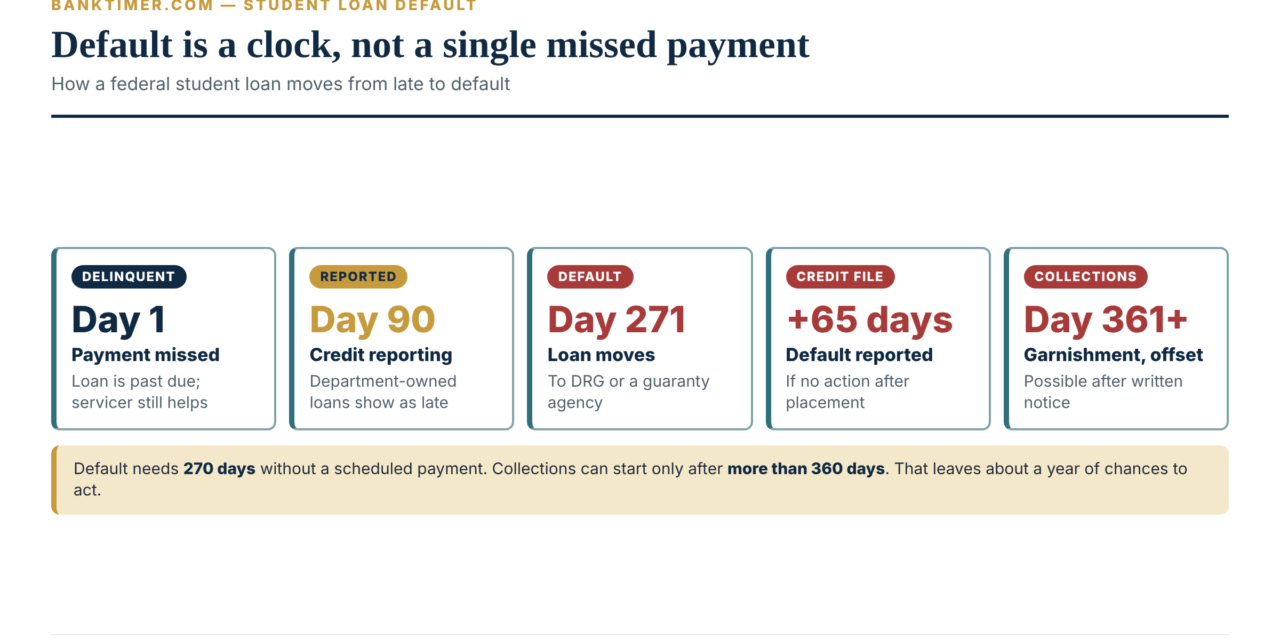
Student loan default means a federal loan has gone at least 270 days without a scheduled payment. Before that point the loan is only delinquent, and your servicer can still offer payment relief. After it, the loan moves to the Department of Education’s Default Resolution Group (DRG) or a guaranty agency. Student loan default can be reported to the credit bureaus. Involuntary collections such as wage garnishment and tax refund offset become possible once the loan is more than 360 days past due.
The biggest variable is the loan type: federal debt and private debt follow different rules. The main exception is the current collections pause, which delays garnishment and offset but does not erase the default. Check your status at StudentAid.gov first.
Delinquent is not default. A federal loan is delinquent the day after a missed due date. Default begins only after 270 days without a payment, per Federal Student Aid (FSA) and 34 CFR 685.102.
Federal and private rules differ. The government can garnish wages and take tax refunds without a court order. A private lender generally needs a lawsuit and a judgment first.
Credit damage starts early. Federal loans owned by the Department of Education are reported delinquent at day 90, long before default. Rehabilitation can remove the default record. Late payments before default stay.
Collections are delayed, not canceled. The Department of Education announced a delay of wage garnishment and Treasury offset on January 16, 2026. It gave no end date, and we found no restart date as of October 15, 2026.
There are four main exits. You can pay in full, consolidate, rehabilitate, or sign a repayment agreement. Discharge programs and bankruptcy apply in narrower cases.
Nobody should charge you to start. The Federal Trade Commission (FTC) says it is illegal for companies to collect fees before they help you with student loans.
What Student Loan Default Actually Means
Most people use the phrase “student loan default” for any bad stretch with a loan. The law uses it more narrowly. For a federal Direct Loan, 34 CFR 685.102 defines default as a failure to make an installment payment when due that persists for 270 days. FSA puts it in plain language. A loan enters default after no scheduled payments for at least 270 days, about nine months.
That definition has two practical effects. First, you have a long runway before default, and you can use it. Second, once the line is crossed, the loan leaves your servicer. It goes to a different holder with different tools.
Who holds the loan after default
FSA says defaulted Direct Loans go to the Department of Education’s Default Resolution Group (DRG). Defaulted Federal Family Education Loan (FFEL) program loans go to a guaranty agency. Those are the two federal collectors most borrowers meet. Federal Perkins Loans follow their own rules. For instance, FSA says defaulted Perkins borrowers must make nine consecutive payments to rehabilitate.
You might hear from a private collection agency as well. The CFPB notes that a collector contacting you about a student loan may be working a federal or a private debt. Before you negotiate with anyone, find out which kind it is. StudentAid.gov lists your federal loans. It does not show private ones.
Why the definition matters for your options
Because default depends on days without payment, anything that resets or pauses the count matters. A deferment, forbearance or approved payment plan can keep a loan out of default. The CFPB’s guidance is similar. Most federal loans default after 270 days without a payment, unless the loan is in deferment or forbearance. So the best time to act is before the clock runs out.
If you are already past that line, do not read it as a verdict. FSA and the CFPB both describe routes back to good standing. We cover each one below, with numbers.
Where Things Stand in October 2026
Rules for defaulted loans are shifting, so a short status check comes first. Everything here was checked on October 15, 2026.
Collections are delayed. On January 16, 2026, the Department of Education announced it was delaying involuntary collections on federal student loans, including administrative wage garnishment (AWG) and the Treasury Offset Program (TOP). The Department described the delay as temporary and tied to reforms from the Working Families Tax Cuts Act. It gave no end date. We did not find an official restart announcement as of October 15, 2026. The FSA default FAQ does not say whether either tool is active.
Credit reporting and the new portal
The default itself is still real. The same Department release says it reports defaults to credit reporting agencies. A collections pause does not cancel the debt, the default status or the credit reporting. It changes the timing of garnishment and offset.
There is a new online path. On September 30, 2026, the Department of the Treasury and the Department of Education launched the Defaulted Loans Support Center on StudentAid.gov. Treasury says borrowers can learn what default means for them, apply online for rehabilitation or consolidation, upload documents, see an estimated payment, sign electronically and make a payment on a defaulted loan. The release also said more than 5 million borrowers have been in default for over six years. Another 5 million entered default in under a year.
A second rehabilitation is coming. Under current regulations, a loan that returns to default after rehabilitation cannot be rehabilitated again before July 1, 2027. On or after that date, it cannot be rehabilitated again after a second rehabilitation. The Department’s January release also describes a second chance to rehabilitate.
A pause is a scheduling decision by an agency. It does not appear to change your balance, your credit file or your eligibility for aid. It also gives you no deadline protection. A restart notice may leave you only 30 or 65 days to act on the notices described later. Treat the quiet period as a window to resolve the loan, not as a reason to wait.
For deeper coverage of the garnishment side, see our guide to student loan wage garnishment. For the head-to-head math on the two most common exits, see student loan rehabilitation vs consolidation.
Default vs Delinquency: The Student Loan Clock Day by Day
Delinquency and student loan default are two separate stages. Mixing them up is the most common and most expensive mistake, because the options on each side of the line are different. A delinquent borrower still has a servicer, a menu of payment plans and usually no student loan default record. A defaulted borrower has a collector and a narrower set of exits.
How delinquency starts and what gets reported
The CFPB says a loan becomes delinquent the day after a missed due date. Reporting then follows the owner of the loan, not a single national rule. The CFPB lists these thresholds on its student loan tips page:
- Private loans may be reported delinquent after as little as 30 days without a payment.
- Commercially owned FFEL loans are considered delinquent at day 60.
- Federal loans owned by the Department of Education, which includes Direct Loans, are reported delinquent at day 90.
- Department-owned loans do not carry late fees, according to the same page.
So the credit damage from a missed federal payment typically begins around three months in. Student loan default is still six months away. That gap is useful. It is also why a borrower can hold a damaged credit report and still not be in default.
The milestones after day 90
FSA describes the sequence this way. A loan with fewer than 271 days past due is not yet in default. At 270 days with no scheduled payment, it enters default and transfers to DRG or a guaranty agency. If no action is taken within 65 days of default placement, the holder reports the default to Equifax, Experian, Innovis and TransUnion. Involuntary collections can begin once the loan has gone more than 360 days without a payment and the default remains open.
A written notice comes before each collection step. FSA says the Treasury offset notice schedules the offset and the negative credit reporting to begin 65 days later. For wage garnishment, federal law requires written notice mailed to your last known address at least 30 days before garnishment begins (20 U.S.C. 1095a).
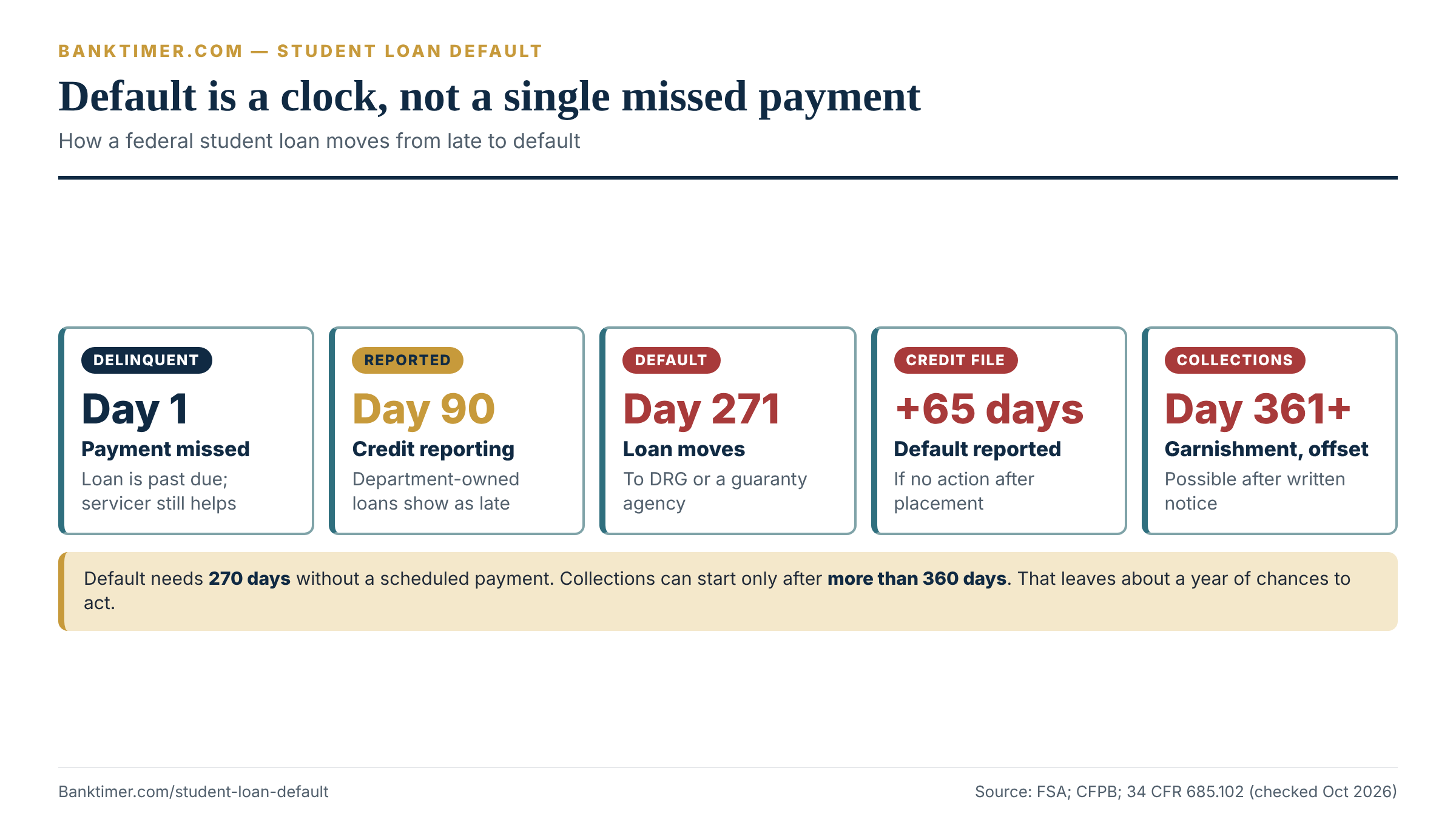
The timeline below puts dates on the same sequence. It uses an illustrative first missed due date of January 15, 2026. The dates are our own arithmetic, so yours will differ.
| Stage | Days past due | Illustrative date | What changes |
|---|---|---|---|
| Delinquent | Day 1 | January 16, 2026 | Servicer contact begins; loan is past due |
| Reported to bureaus | Day 90 | April 15, 2026 | Department-owned loans reported delinquent |
| Last day before default | Day 270 | October 12, 2026 | Still a servicer account; default is avoidable |
| Default begins | Day 271 | October 13, 2026 | Loan moves to DRG or a guaranty agency |
| Default credit report | About 65 days after placement | About mid-December 2026 | Bureaus told if no action was taken |
| Collections possible | More than 360 days | January 11, 2027 | Notice of garnishment or offset may follow |
The table’s most useful insight is how much time sits between stages. The first missed payment and the first involuntary collection are about a year apart. In practice that year holds several separate chances to fix the problem, which we map out in the decision section.
Delinquency vs default in one view
The second table compares the two stages on identical criteria. The rows come from the FSA and CFPB pages cited above, so read them as general federal-loan rules rather than a promise about your account.
| Question | Delinquent (before day 271) | In default (day 271 and after) |
|---|---|---|
| Who handles the loan? | Your servicer | DRG for Direct Loans; a guaranty agency for FFEL |
| Credit reporting | Late status reported, typically from day 90 for Department-owned loans | Default can be reported; rehabilitation can remove it |
| Payment relief | Deferment, forbearance and repayment plans through the servicer | Resolution programs: rehabilitation, consolidation, repayment agreement, payment in full |
| Federal student aid | Generally unaffected | You cannot receive more until the loan leaves default |
| Involuntary collections | None | Possible after more than 360 days, with notice first |
| Added cost | No late fees on Department-owned loans | Collection costs can be added |

What you can still do while delinquent
If you are somewhere between day 1 and day 270, the cheapest move is to contact your servicer and change the payment. The CFPB’s federal loan page lists income-driven plans, extended repayment, graduated repayment, deferment and forbearance as the federal menu. That menu is changing. The Department of Education says it is reducing the number of plans, and the former SAVE plan has ended. Our guide to the end of SAVE explains the transition. The comparison of IBR vs RAP covers the two plans many borrowers are choosing between now.
Paying a little can matter more than paying nothing. FSA says a borrower who pays before the loan reaches 271 days past due avoids transfer to DRG or a guaranty agency and avoids a student loan default record. The CFPB also warns that forbearance and some deferments can raise your principal and future payments through accrued interest and capitalization. Pausing is not free, but it is almost always cheaper than default.
Maya’s first missed due date is January 15, 2026. She does not call her servicer. Her loan shows as delinquent from January 16. By April 15 it has been reported to the bureaus as 90 days late. On October 13 it enters default and moves to DRG.
If Maya acts on October 1, she still has 12 days to make a payment or arrange relief and avoid student loan default. If she acts in December, she faces a different list of choices and, per FSA, collection costs on top of the balance. The dates are invented for the example. The structure is not.
Private loans run on a shorter fuse
A private student loan follows its contract rather than a federal definition. The CFPB says private loans often go into default when you miss monthly payments. Depending on your terms, bankruptcy or default on another loan can also trigger default. The same page says private lenders typically charge off a loan at about 120 days past due, though rules vary by lender.
That makes the first call to a private lender more urgent than the first call to a federal servicer. It also means the exits are different. Federal rehabilitation and consolidation are federal programs. For a private loan the CFPB describes negotiating a new plan or a settlement, and says to review your contract.
What Federal Student Loan Collections Can Do After Default
Federal student loans carry unusual collection powers once they reach student loan default. Congress wrote them into the Higher Education Act so the government can collect without going to court first. A private lender has none of these shortcuts. Knowing which tools belong to whom keeps you from paying the wrong party, or panicking over a threat that cannot happen.
Administrative wage garnishment
Administrative wage garnishment (AWG) lets a federal holder collect from your paycheck through your employer. Under 20 U.S.C. 1095a, the amount deducted cannot exceed 15% of disposable pay per pay period unless you consent in writing to more. Disposable pay means what remains after legally required deductions, such as taxes. The statute requires written notice mailed to your last known address at least 30 days before garnishment begins.
You have two protections worth knowing. First, you can ask for a hearing. Under 34 CFR 34.11, a request postmarked no later than the 30th day after the notice date is timely. The agency will not issue the garnishment order until it holds the hearing and issues a written decision. FSA adds that a hearing request pauses garnishment but does not resolve the student loan default. Second, an employer cannot fire, refuse to hire or discipline you because of a garnishment under the statute.
Federal law adds a narrow rule. If you are rehired within 12 months after an involuntary separation, deductions cannot begin until you have been continuously employed for 12 months. It matters if a layoff coincided with the student loan default. Garnishment for other kinds of debt follows different rules, which our general guide to wage garnishment covers.
Treasury offset of refunds and benefits
The Treasury Offset Program (TOP) matches debts against payments the federal government owes you. FSA says federal tax refunds and certain federal benefits can be withheld. A written notice comes first, and the offset and the negative credit reporting are scheduled to begin 65 days later. A request for a hearing to dispute the debt must be postmarked within 65 days of receiving the offset notice.
Social Security is the sensitive case. A January 2025 CFPB Issue Spotlight reported that federal law protects only $750 a month of Social Security income from offset, a figure set in 1996 and never adjusted. That report covers data through 2019 and survey years into 2023. We do not use it to say whether offsets of benefits are running today. Your account status on MyEdDebt will show whether a loan is “Certified for TOP” or “Account is in AWG,” per FSA.
For refund-related mistakes that compound a seizure, see our piece on tax refund direct deposit mistakes.
No expiration date on federal collection
Many borrowers hope the debt simply ages out. For federal student loans it does not. Under 20 U.S.C. 1091a, no federal or state limitation ends the period within which suit may be filed, a judgment enforced, or an offset or garnishment started. That is the text of the statute. Private loans are different, as the table below shows.
Collection costs
Default also adds cost. FSA says ignoring a default adds collection costs, which increase the total debt. The regulation behind that is 34 CFR 30.60. It lists the costs the government may charge, including collection agency fees, credit reporting costs, and court costs and attorney fees. When a collection agency works on a contingent fee, the regulation says the debt is grossed up so the agency’s fee is covered. The amount you owe can therefore rise even if you do nothing.
The rules soften at the exits. The consolidation regulation caps collection costs charged to a borrower at 18.5% of outstanding principal and interest for a defaulted Direct or FFEL loan. FSA says rehabilitation avoids collection fees. We turn those into dollar examples in the exit section.

Federal vs private collection powers
The table compares the two kinds of lender on the same actions. The decision-driving point is the first row. A federal holder can act through the paycheck without a judge. A private lender usually needs a court order first.
| Collection tool | Federal student loan | Private student loan |
|---|---|---|
| Garnish wages without a court order | Yes, up to 15% of disposable pay after notice | Generally no; collectors need a court order (CFPB) |
| Withhold federal tax refund | Yes, through Treasury offset | Generally no (CFPB) |
| Offset Social Security | Possible within legal limits, with a $750 monthly floor (CFPB) | Generally no (CFPB) |
| Block future federal student aid | Yes, while in default | Generally no (CFPB) |
| Time limit to sue | None under 20 U.S.C. 1091a | Statute of limitations, varies by state |
| Credit reporting | Yes | Yes |
Private lenders still have teeth. The CFPB says a lender can sue within the statute of limitations, win a judgment, and then pursue the usual court-ordered remedies. A cosigner shares the exposure. The CFPB says a cosigner has equal responsibility for repaying, the missed payments appear on both credit reports, and the cosigner can be sued.
Student Loan Default and Your Credit Score
The effect on your credit starts well before default and does not end the day you leave it. The CFPB says that a student loan default notation can significantly lower your credit score. Scoring models weigh payment history heavily, so the late-payment marks and the student loan default record both matter. For a fuller look at how scores are built, see our guide to how a credit score works.
Two clocks on the credit report
Two layers of negative information can appear. One is the string of late payments from delinquency, which begins around day 90 for Department-owned loans. The other is the student loan default record itself, reported if no action is taken within 65 days of default placement.
The Fair Credit Reporting Act sets a general limit on how long collection-type items can appear. Under 15 U.S.C. 1681c, accounts placed for collection or charged to profit and loss generally cannot be reported when they predate the report by more than seven years. The period starts 180 days after the delinquency that preceded the collection action began. In our illustrative case, delinquency began January 16, 2026, so the seven years would run to about July 2033.
FSA gives a more cautious warning for one route. It says consolidating a defaulted loan can leave the student loan default record and earlier late payments on your credit history for up to 10 years. We cannot tell from these sources how the bureaus date a new consolidation account. Check what actually appears on your own reports.
What each route does to the record
The third table compares what happens to the record under each route. It reflects FSA and CFPB statements, not a guarantee about any single report.
| Route | Default record | Earlier late payments | Source note |
|---|---|---|---|
| Rehabilitation | ED asks bureaus to remove it after the ninth payment | Remain | FSA default FAQ |
| Consolidation | Stays; may remain up to 10 years | Remain | FSA; CFPB |
| Paying in full | Stays on the report, shown as repaid | Remain | CFPB |
| Doing nothing | Reported if no action within 65 days of placement | Remain | FSA |
Rehabilitation is the only route here that lets the student loan default record come off. That does not mean a score jumps overnight. The late payments still count, and removal depends on the bureaus processing the request. If an error appears afterward, such as a student loan default still showing or a duplicate account, follow the steps in our guide to credit report errors.
Student aid and other consequences
Default also blocks federal student aid. The CFPB says you cannot receive more until you bring the loan out of default. Under the regulation’s definition of a satisfactory repayment arrangement, six consecutive, voluntary, on-time, full monthly payments can restore eligibility, but a borrower can use that route only once. The CFPB’s collector page says you regain aid eligibility after the sixth rehabilitation payment if you return to school. If you plan to enroll again, ask your school to confirm the status in writing. For students managing money for the first time, our guide to banking for college students covers the account side.
The Department’s January 16, 2026 release delayed AWG and TOP. It did not say the delay applies to credit reporting, and the same release says defaults are reported to credit agencies. A borrower who sits tight can arrive at the end of the pause with a worse credit file and the same balance.
How to Get Out of Student Loan Default
You have more than one way out of student loan default. FSA lists five ways out for a federal loan, and each fits a different timeline and budget. This section explains each route and what it costs. Our companion guide on student loan rehabilitation vs consolidation goes deeper on the two most common ones.
Step zero: confirm what you actually owe
Before choosing a way out of student loan default, find the facts. Sign in at StudentAid.gov to see which federal loans you have, who holds them and whether they are in default. FSA points to MyEdDebt.ed.gov for account status. It can show “Certified for TOP” or “Account is in AWG.” Write down the balance, the holder, any garnishment or offset notice dates, and whether any loan is private. A private loan will not appear in StudentAid.gov.
If a collector calls first, the CFPB says to ask for written documentation of the federal debt you owe. It also says to ask for the collector’s Special Assistance Unit if the collector will not offer an option you believe you qualify for. If that fails, the Federal Student Aid Ombudsman Group at the Department of Education is the next stop.
Route 1: pay in full
Paying the full balance is the fastest and cleanest exit when you can do it. The CFPB says a collector may be able to waive some fees and collection costs on a lump sum. The student loan default still appears on your credit report as repaid. Most borrowers cannot do this, so it is a rare fit rather than a default plan.
Route 2: consolidation
Consolidation uses a new Direct Consolidation Loan to pay off the defaulted loans. FSA calls it faster than rehabilitation, but it adds interest capitalization and collection costs to the new balance. The regulation sets two entry conditions. You must either make three consecutive on-time, full payments before consolidating or agree to repay the new loan under an income-driven plan. You also cannot be subject to a court judgment or an active wage garnishment order unless it has been vacated or lifted.
Collection costs have a ceiling. For a defaulted Direct or FFEL loan, 34 CFR 685.220 limits collection costs charged to the borrower to 18.5% of outstanding principal and interest. Treasury’s September 30, 2026 release adds one benefit: after consolidating, enrolling in autopay earns a temporary 1% interest rate reduction.
Route 3: rehabilitation
Rehabilitation is nine voluntary, reasonable and affordable payments, each made within 20 days of its due date, during 10 consecutive months (34 CFR 685.211). That window means you can miss one month and still finish. FSA says payments are applied to fees first, then interest, then principal.
The amount comes from your finances. The payment is initially set at the level of an eligible income-driven repayment plan, and it cannot be a percentage of the total loan balance. FSA says the standard amount is 15% of annual discretionary income divided by 12. If you cannot afford it, you can submit the Loan Rehabilitation Income and Expense form. An alternative amount based on your current finances will be mailed within 10 business days, possibly lower than the first offer. The regulation sets a floor of $5 before July 1, 2027, and $10 on or after that date.
When you finish, the default is removed from your credit history, collections stop and the loan moves to a new servicer. FSA says you receive an email confirming the transfer within 30 days. For Direct Loan and FFEL borrowers, the 10-month window applies, while Perkins borrowers must make nine consecutive payments.
Route 4: a repayment agreement
A repayment agreement with the holder of your loan is the quickest way to stop an incoming collection. FSA’s table says the first payment must come within 65 days of the notice to avoid Treasury offset, and within 30 days to avoid wage garnishment. It is aimed at loans more than 360 days past due. It does not remove the student loan default on its own, so think of it as a bridge to rehabilitation or consolidation.
Route 5: discharge and bankruptcy, in narrower cases
Some borrowers do not need to repay at all. FSA names Borrower Defense and Total and Permanent Disability (TPD) discharge as options with no set deadline, though decisions can take several months. Under 34 CFR 685.213, a veteran whom the VA finds unemployable because of a service-connected disability can qualify. So can a borrower receiving disability benefits from the Social Security Administration under criteria in the rule. A licensed physician or certain other clinicians can also certify. If you tell the Department you plan to claim TPD, collection can be suspended for up to 120 days while you apply.
Bankruptcy is rarer. Under 11 U.S.C. 523(a)(8), government-backed education loans are not discharged unless excepting the debt would impose an undue hardship. That is a high bar, and it takes a court proceeding. Talk to a licensed attorney or a free legal aid office before treating it as an exit.
FSA’s default FAQ says the Fresh Start program ended on October 2, 2024. Ignore any website or caller that offers it as a current option.
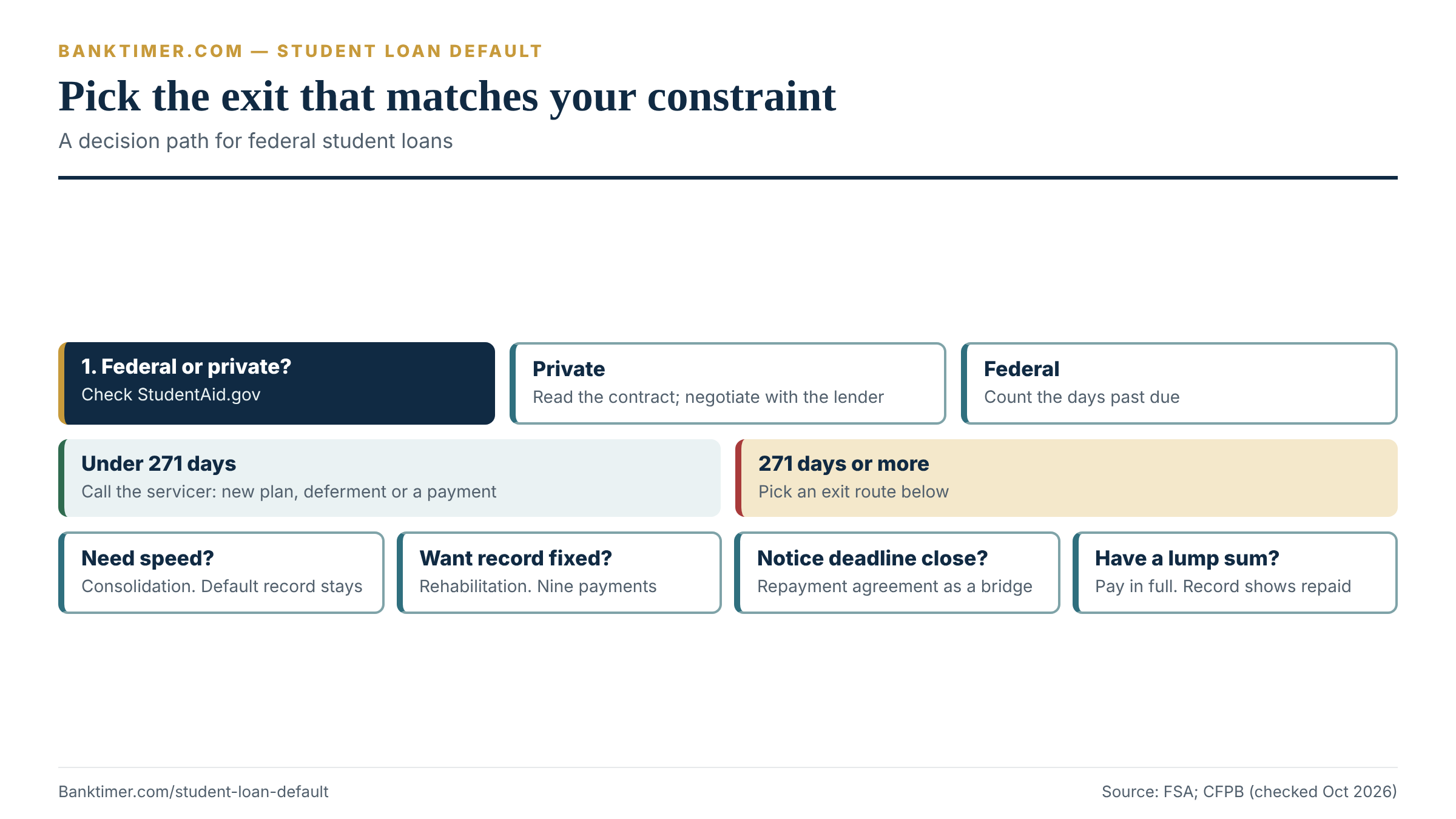
The five routes side by side
The fourth table compares the routes on one set of criteria. The key insight is the trade between speed and record repair: the fastest route is not the one that cleans the credit file.
| Route | Timing | Main requirement | Credit record | Collection costs | Best fit |
|---|---|---|---|---|---|
| Pay in full | Immediate | Full balance | Stays, shown as repaid | Some may be waived (CFPB) | You have a lump sum |
| Consolidation | Faster than rehab | 3 on-time payments or income-driven plan; no judgment or garnishment order | Default stays (FSA) | Up to 18.5% ceiling can be added | You need speed or aid soon |
| Rehabilitation | 9 payments in 10 months | Agreement, income documents | Default removed after payment 9 (FSA) | Avoided (FSA) | You can pay a small steady amount |
| Repayment agreement | First payment within 30 or 65 days of notice | Agreement with the holder | Default remains | Not addressed in FSA table | You need to stop a notice quickly |
| Discharge | Months; no set deadline | Qualifying disability or school-related claim | Depends on outcome | Not applicable | Narrow, documented cases |
What consolidation can add: a worked example
The collection cost ceiling is easy to misread, so run it with numbers. These figures are illustrative, and the actual charge depends on the holder and the loan.
| Scenario | Principal | Accrued interest | Base | 18.5% ceiling | New balance if fully charged |
|---|---|---|---|---|---|
| Smaller balance | $12,500 | $1,800 | $14,300 | $2,645.50 | $16,945.50 |
| Larger balance | $30,000 | $4,200 | $34,200 | $6,327.00 | $40,527.00 |
The ceiling is a maximum, not a promise that every borrower pays it. But for a borrower who consolidates a $14,300 base, the worst case adds $2,645.50 before the new loan even starts. Rehabilitation, by FSA’s account, avoids those fees. That gap is the reason many borrowers choose rehab when they can wait nine months, and consolidation when a school deadline or garnishment is close.
Where each route leaves your future payments
Leaving default is the start, not the end. FSA says most exits restore eligibility for income-driven repayment, deferment and forbearance. The CFPB recommends asking, for consolidation, what happens to the new rate, outstanding interest, and any progress toward Public Service Loan Forgiveness or income-driven forgiveness. For both routes, ask about collection fees, the date you exit default and the date you regain aid.
The Department of Education has said the reforms reduce the number of repayment plans, with a new income-driven plan available starting July 1, 2026. Our comparison of IBR and RAP shows how to think about that choice once you are out of default.
What Student Loan Default Costs in Real Dollars
Student loan default costs show up in three places: your paycheck, your tax refund and your balance. The examples below are illustrative. They use round numbers and stated assumptions, and they are not quotes or predictions for your loan.
Scenario 1: the paycheck cut
Assume you are paid every two weeks and your disposable pay is $1,400 per check. Disposable pay is what remains after legally required deductions. At the 15% cap in 20 U.S.C. 1095a, garnishment takes up to $210 per check. Across 26 checks that is $5,460 a year, or about $455 a month on average.
Now compare it with rehabilitation. Suppose your agreed rehabilitation payment is $120 a month. Nine payments total $1,080. Over the same nine months, a garnishment at the cap would take about $4,095. The gap is $3,015. The comparison is not perfect, because federal rules say garnishment can continue until five qualifying rehabilitation payments are made. Even so, the exercise shows how a small voluntary payment can cost less than a forced one.

The monthly amount of a rehabilitation payment is not fixed by balance. The regulation says it cannot be a percentage of the total loan balance. It is based on an income-driven plan payment and your total financial circumstances, so a larger balance does not automatically mean a larger payment.
Scenario 2: the refund offset
Assume you owe $14,000 and expect a $2,800 federal tax refund. If a Treasury offset takes the whole refund, the balance would fall to $11,200 only if every dollar went to principal. In practice FSA’s payment order for rehabilitation, fees first, then interest, then principal, suggests part of an offset can go to fees and interest. Treat $11,200 as a ceiling on progress, not a forecast.
The cost is the cash you lose. A $2,800 refund might have covered a car repair, rent or an emergency fund contribution. Our guide to building an emergency fund explains why that buffer matters most for borrowers with irregular income.
Scenario 3: the balance that grows
Interest and collection costs sit in your balance. At an illustrative 5.5% rate on $14,000, simple interest runs about $770 a year, or roughly $64 a month. A $120 monthly payment covers that and a little more. A $75 payment covers the interest and leaves little for principal. FSA also says rehabilitation payments go to fees first, then interest, then principal.
If collection costs are added on top, the base grows faster than a servicer account would. The 34 CFR 30.60 list includes collection agency fees and attorney fees, which is how a balance can rise while you wait.
Five Illustrative Borrower Situations
These are not real people. They show how the same facts point to different exits. Each uses assumptions you can swap for your own.
Priya’s Direct Loan is 120 days past due, and her credit file already shows late payments. She is 150 days short of default. She calls her servicer, asks about an income-driven plan and gets a lower payment that she can keep making. Her loan never reaches DRG. This is the cheapest outcome, and it is open only because she acted before day 271.
Borrowers already past the line
Marcus is in default, has a steady job and wants the default off his credit file. He does not need to enroll soon. Rehabilitation fits: nine payments in 10 months at an affordable amount, then a removal request to the bureaus and a new servicer. He should ask what happens to any active garnishment and when it stops.
Elena wants to return to school next term and cannot receive aid while in default. The CFPB says consolidation is faster than rehabilitation, which helps if you want to enroll in school soon. She chooses consolidation, accepts that the student loan default stays on her credit history, and confirms in writing what collection costs will be added.
Dan receives a Treasury offset notice. Per FSA, the offset is scheduled to begin 65 days later, and a request to dispute the debt must be postmarked within 65 days of receiving the notice. He offers a first payment under a repayment agreement within that window, which FSA says avoids the offset. Then he starts rehabilitation.
A parent cosigned a $20,000 private loan, and it has gone into default. The CFPB says the cosigner has equal responsibility, the missed payments hit both credit reports, and the cosigner can be sued. Federal rehabilitation does not apply. The lender may negotiate a plan or a settlement, so the parent should read the loan contract and call the lender early.
A Decision Framework for Choosing How to Respond
This five-step framework works from the cheapest option to the most disruptive. Stop at the first step that fits.
- Check whether the loan is federal or private. Federal loans appear on StudentAid.gov. The exits are different.
- Count the days. Under 271 days past due, work with the servicer. Over 270, you are in the default routes.
- Check for a notice. A garnishment notice gives you 30 days to request a hearing. An offset notice gives you 65. Write down the date.
- Match the exit to your constraint. If speed matters most, look at consolidation. If record repair matters most, look at rehabilitation. If a notice is close, use a repayment agreement as a bridge.
- Check for a bigger path. If you have a qualifying disability, a school-related claim or a legal issue, ask about discharge or get legal advice before choosing.
The fifth table turns the framework into a matrix. It lists the constraint, the likely route, the main downside and what to verify first.
| Your main constraint | Likely route | Main downside | Verify first |
|---|---|---|---|
| Under 271 days past due | Servicer plan, payment or relief | Interest may capitalize after pauses | Which plans you still qualify for |
| Need aid or enrollment soon | Consolidation | Default stays; costs capitalized | Collection costs in writing |
| Want default off your report | Rehabilitation | Nine-month wait; late history remains | Payment amount and due dates |
| Notice deadline is close | Repayment agreement, then another route | Default remains | First payment date vs notice date |
| Cannot afford any payment | Income and expense form; discharge check | Slower relief | Whether income documents are required |
| Private loan | Negotiate with lender | No federal programs | Contract terms; statute of limitations |
A matrix cannot weigh your whole situation. The next section covers what can go wrong in practice.
Mistakes and Red Flags When a Student Loan Is in Default
Most expensive errors in default are not dramatic. They are small delays and small misunderstandings that cost months. The table lists the ones that matter, with a question to ask and a safer next step.
| Red flag | Why it matters | What to ask | Safer next step |
|---|---|---|---|
| Someone asks for an upfront fee | The FTC says it is illegal to charge fees before helping | “Is this free on StudentAid.gov?” | Start at StudentAid.gov; report to ReportFraud.ftc.gov |
| A caller promises forgiveness | Forgiveness is not a service a stranger can sell | “Which program, and where is it listed?” | Hang up and check StudentAid.gov |
| A notice arrives and you wait | Hearing deadlines are 30 days for AWG and 65 days for offset | “What is the date on the notice?” | Mark the deadline; request a hearing or sign an agreement |
| You pay a collector without checking the loan | The debt may be private or the collector may be unauthorized | “Can you send written documentation?” | Confirm the loan on StudentAid.gov first |
| You pick the fast route without pricing costs | Consolidation can add up to 18.5% in collection costs | “What costs will be added?” | Get the number in writing before signing |
| You skip a rehabilitation payment | Payments must be within 20 days of the due date | “What is my due date and window?” | Set autopay and a calendar reminder |
| You assume the pause fixed your credit | Defaults are still reported | “What does my report show today?” | Pull your reports and check the status |
Student loan scams in default
Default makes borrowers targets. The FTC’s June 2025 consumer alert describes scammers who call and offer immediate forgiveness for a fee, claim to be affiliated with the Department of Education, ask for an FSA ID, and pressure you to act fast. The FTC says plainly that it is illegal for anyone to charge fees before they help you. It alleged in one case that a group of companies collected more than $16.7 million in illegal upfront fees.
You do not need a paid middleman to rehabilitate or consolidate. The FTC points borrowers to StudentAid.gov for free help, and the new Defaulted Loans Support Center lets you apply online. If you want help, free options exist, and the CFPB’s contact line is (855) 411-2372. Report scams at ReportFraud.ftc.gov and to your state attorney general. Our guide to who regulates banks and lenders explains which agency takes which complaint.
Your FSA ID is the key to your federal account. A legitimate helper may need your help to log in. A stranger who contacts you first and asks for it is a warning. Change the credentials and report the contact if you shared them.
Common Misunderstandings About Default
Some wrong beliefs persist because they are half true. The table corrects them against the sources.
| Belief | What the sources say | Why it matters |
|---|---|---|
| “Default begins when I miss a payment.” | Delinquency starts the day after; default needs 270 days (FSA, 34 CFR 685.102) | You may have months to avoid it |
| “Old student debt expires.” | No limitation ends federal collection (20 U.S.C. 1091a) | Waiting does not cure a federal default |
| “Consolidation erases the default.” | The default record stays (FSA; CFPB) | Credit repair needs rehabilitation |
| “A private collector can garnish me immediately.” | Private collectors generally need a court order (CFPB) | You have time to respond to a lawsuit |
| “The pause means I owe nothing.” | ED’s delay is temporary and has no end date | Resolve the loan while pressure is low |
| “Bankruptcy wipes out student loans.” | Undue hardship standard applies (11 U.S.C. 523(a)(8)) | It is a narrow, court-based path |
Why rehabilitation is not the end of the story
Getting out of student loan default and staying out are different tasks. A 2016 CFPB analysis projected that about one in three rehabilitated borrowers could re-default within two years, which it estimated at over 200,000 borrowers. It linked that to delays getting into income-driven plans, collector errors and “payment shock” when bills came in hundreds of dollars higher than expected. That is an archived 2016 projection, not a current rate, but the lesson holds.
So plan the exit before you finish the entry. Before the ninth payment, ask your new servicer what the first bill will be. Choose an income-driven plan if you qualify. Set the due date to follow your paycheck. A budget that works on paper but not at month-end invites a repeat. Our guide to building a monthly budget shows how to map fixed bills against your pay dates.
Documents and Evidence to Keep
Disputes with collectors hinge on paper. Keep a folder, digital or physical, with the items below. Most are available from the sources named in the table.
| Document | Why it matters | Where to get it | How long to keep it |
|---|---|---|---|
| Loan list and balances | Confirms which loans are in default | StudentAid.gov | Until the loan is closed |
| Default or collection notices | Start the 30-day and 65-day clocks | Mail; MyEdDebt account | Until resolved, then several years |
| Rehabilitation agreement letter | Sets amounts and due dates | DRG or guaranty agency | Until the loan moves servicers |
| Payment confirmations | Proves on-time payments | Online tracking ID, bank statement | Until the default record is removed |
| Tax transcript or signed 1040 | Income proof for the payment amount | IRS transcript; your tax file | Current year plus prior |
| Written cost quote | Shows collection costs added | Holder or collector | Until the new balance is verified |
| Credit reports before and after | Shows record changes | AnnualCreditReport.com | Several years |
Keep proof of every payment even if you pay by phone. FSA says online payments can take up to two business days to appear and give you a tracking ID, which is your receipt.
- ☐ Is every loan I am discussing federal, and does it appear on StudentAid.gov?
- ☐ Who holds it now: DRG, a guaranty agency or a private collector?
- ☐ How many days past due is each loan today?
- ☐ Do I have a garnishment or offset notice, and what date does it carry?
- ☐ What collection costs will be added to my balance, in dollars, in writing?
- ☐ If I rehabilitate, what is my monthly payment and every due date?
- ☐ When does any active garnishment stop?
- ☐ If I consolidate, what interest rate applies and what happens to unpaid interest?
- ☐ What happens to progress toward forgiveness programs?
- ☐ Which servicer takes the loan after I leave default, and when is the first bill due?
Special situations that change the answer
A few edge cases deserve a separate look.
- Cosigned private loans. The cosigner is equally responsible. Both credit reports show the late payments. Ask the lender about release options, because the CFPB page does not describe them.
- A court judgment on the loan. The consolidation rule bars borrowers with a judgment unless it has been vacated, and the rehabilitation rule says loans with a judgment cannot be rehabilitated.
- A new job after a layoff. The 12-month re-employment rule in 20 U.S.C. 1095a may delay garnishment after you are rehired following an involuntary separation.
- Older borrowers on Social Security. The $750 monthly floor the CFPB cites is old and low, so ask whether your benefit is subject to offset at all today.
- Debt consolidation loans. A private debt consolidation loan is a different product from a federal Direct Consolidation Loan. The federal exits above apply only to federal loans.
If you are weighing other borrowing to cover the gap, read our overview of types of loans first. Keep the core of your plan in the personal finance basics guide.
Frequently Asked Questions
How long until student loans go into default?
Student loan default begins when a federal loan goes at least 270 days without a scheduled payment, which is about nine months. FSA says loans less than 271 days past due are not yet in default. Private loans follow the contract and often default sooner, sometimes after just a few missed monthly payments, according to the CFPB. If you have a deferment or forbearance in place, the clock generally does not run against you.
What is the difference between delinquency and default on a student loan?
Delinquency means a payment is past due, starting the day after a missed due date. Student loan default is the later legal status after 270 days without payment. The practical difference is who handles the loan and which tools exist. A delinquent borrower works with a servicer on plans and relief. A defaulted federal loan moves to the Default Resolution Group or a guaranty agency, where collections become possible.
Does student loan default hurt your credit score?
Yes. The CFPB says a default notation can significantly lower your score. Federal loans owned by the Department of Education are reported delinquent at day 90, so some damage arrives earlier. If you take no action, the holder reports the default to the bureaus. Rehabilitation can remove the default record, while earlier late payments remain. The size of the drop depends on your overall credit file.
Can the government garnish my wages for a defaulted student loan right now?
Student loan default gives the government the legal authority. However, the Department of Education announced on January 16, 2026 that it was delaying involuntary collections, including wage garnishment and Treasury offset. The release gave no end date, and we found no official restart date as of October 15, 2026. Check MyEdDebt.ed.gov for your account status. If you receive a notice, count 30 days for a garnishment hearing request.
What is the fastest way out of student loan default?
Paying the balance in full ends student loan default immediately, but it is rarely realistic. Short of that, FSA and the CFPB describe consolidation as the faster route compared with rehabilitation. It requires either three on-time payments or an agreement to repay under an income-driven plan. The default record stays on your credit history. Collection costs and unpaid interest can be added to the new balance, so weigh speed against cost.
Does rehabilitating a student loan remove the default from my credit report?
FSA says that after the ninth rehabilitation payment, the Department asks the credit bureaus to remove the default record. Late payments reported before the default remain on your report. Removal depends on the bureaus acting on the request, so check your reports a month or two later. If the default still appears, keep your payment confirmations and follow the dispute steps for credit report errors.
Will a federal student loan eventually go away if I wait?
No. Under 20 U.S.C. 1091a, no federal or state limitation ends the time to sue, enforce a judgment, or start an offset or garnishment on these loans. Waiting does not cure the default, and costs can accumulate. Private loans are different, because a state statute of limitations can eventually block a lawsuit. That rule varies by state, so ask an attorney.
Can I get federal student aid while my loan is in default?
Generally no. The CFPB says you cannot receive more federal student aid until the loan leaves default. Exiting default restores eligibility. The regulation also describes a one-time route of six consecutive, voluntary, on-time, full monthly payments. The CFPB’s collector page says you regain eligibility after the sixth rehabilitation payment if you return to school. Confirm your status with the school’s financial aid office before you enroll.
What happens to a cosigner if a private student loan defaults?
The CFPB says a cosigner has equal responsibility for repaying the loan. Missed payments can appear on both credit reports. Private lenders often use collection agencies and may sue the cosigner. The CFPB page does not describe release options, so ask the lender directly. Do not assume a cosigner release exists without a written policy or contract term.
Can a private lender garnish my wages for a defaulted student loan?
Generally not without a court order. The CFPB says private student loan collectors generally cannot garnish wages without a court order, intercept tax refunds, garnish Social Security or block future federal aid. A lender can sue within the statute of limitations, and a judgment can open court-ordered collection. Respond to any lawsuit papers promptly, because ignoring them can lead to a default judgment.
Can bankruptcy discharge a defaulted student loan?
Rarely. Under 11 U.S.C. 523(a)(8), government-backed education loans are excepted from discharge unless excepting the debt would impose an undue hardship. Meeting that standard usually requires a separate court proceeding. Talk with a licensed attorney or free legal aid before filing. Ask whether other options, such as disability discharge, may fit first.
Should I pay a company to get me out of student loan default?
You do not need to. The FTC says it is illegal for anyone to charge fees before they help you with student loan debt relief, and it points borrowers to StudentAid.gov for free help. The official site now lets you apply for rehabilitation or consolidation online. Report a suspicious offer at ReportFraud.ftc.gov and to your state attorney general.
Sign in at StudentAid.gov today and write down each loan, who holds it, and how many days past due it is. Then contact the holder, ask for the written rehabilitation or consolidation numbers, and compare them before you sign anything.
The one variable that decides your student loan default outcome is timing against the 271-day line. Before it, your servicer can change the payment, and you avoid a default record and collection costs. After it, you choose between consolidation for speed, rehabilitation for a cleaner credit file, a repayment agreement as a bridge, or a lump-sum payoff. The right pick depends on whether a notice, a school deadline or your credit file is the closest pressure. Do the confirming work now, while collections are delayed. Count notice deadlines from the date on the letter, not the day you opened it. What this guide does not cover is your specific balance, state law on private lenders, or tax effects of any forgiveness. A pause in collections is not a resolution, and a private loan follows its own contract, so confirm both before relying on any step here.
Methodology
We built this guide to student loan default from primary sources checked on October 15, 2026. They include Federal Student Aid’s default and rehabilitation pages, the Department of Education’s January 16, 2026 collections release, Treasury’s September 30, 2026 release on the Defaulted Loans Support Center, CFPB consumer pages, the FTC’s student loan scam alert and the text of the cited statutes and regulations on Cornell’s Legal Information Institute. Three StudentAid.gov pages did not render in our tool, so we relied on the FSA articles that did and on the regulations for rules they did not state.
All dollar examples, dates and borrower situations are illustrative and use our own arithmetic, kept in a calculation script. They are not quotes. Several CFPB pages were last reviewed in 2023 to 2025, and the collections status can change without notice. Rules vary by loan type, holder, state and contract, and private loans follow their agreements.
Sources
- Student Loan Default and Collections: FAQs, Federal Student Aid
- Student Loan Rehabilitation for Borrowers in Default: FAQs, Federal Student Aid
- Department of Education delays involuntary collections, U.S. Department of Education, reviewed January 16, 2026
- Treasury and Education launch Defaulted Loans Support Center, U.S. Department of the Treasury, September 30, 2026
- Tips for student loan borrowers, Consumer Financial Protection Bureau
- What are my options if a debt collection agency contacts me about my student loans, CFPB
- What happens if I default on a private student loan, CFPB
- Student loan scammers won’t offer relief, Federal Trade Commission, June 2025
- 34 CFR 685.102, Definitions, Legal Information Institute
- 34 CFR 685.211, Repayment and rehabilitation, Legal Information Institute
- 34 CFR 685.220, Consolidation, Legal Information Institute
- 20 U.S.C. 1095a, Wage garnishment requirement, Legal Information Institute
- 20 U.S.C. 1091a, Statute of limitations and collection, Legal Information Institute
- 15 U.S.C. 1681c, Fair Credit Reporting Act reporting limits, Legal Information Institute
By the Banktimer Editorial Team · Published
Banktimer is an independent U.S. consumer-finance publication. Our editors draw on primary and official sources first, such as the CFPB, FDIC, Federal Reserve, and FTC, along with statutes, regulations, and providers’ own agreements and fee schedules. Then we add worked examples and decision tools. Our goal is the most useful, best-supported explanation the sources available to us at the time of writing allow.
This article is general information, not legal, tax, investment, insurance, or financial advice, and reading it does not create a professional relationship with Banktimer. Rates, fees, limits, and rules change, and they vary by state, provider, and contract, so confirm current terms with your bank, lender, insurer, or the agency named in the article before you act. Examples are illustrative unless labeled otherwise. Banktimer is not a bank, lender, insurer, or financial advisor, and we are not responsible for decisions or losses that result from relying on this content. For advice about your own situation, talk to a licensed professional.