
By the Banktimer Editorial Team · Published
Banktimer is an independent U.S. consumer-finance publication. Our editors draw on primary and official sources first, such as the CFPB, FDIC, Federal Reserve, and FTC, along with statutes, regulations, and providers’ own agreements and fee schedules. Then we add worked examples and decision tools. Our goal is the most useful, best-supported explanation the sources available to us at the time of writing allow.
This article is general information, not legal, tax, investment, insurance, or financial advice, and reading it does not create a professional relationship with Banktimer. Rates, fees, limits, and rules change, and they vary by state, provider, and contract, so confirm current terms with your bank, lender, insurer, or the agency named in the article before you act. Examples are illustrative unless labeled otherwise. Banktimer is not a bank, lender, insurer, or financial advisor, and we are not responsible for decisions or losses that result from relying on this content. For advice about your own situation, talk to a licensed professional.
Hard Inquiry: How It Works, What It Costs, and What to Check can look straightforward until timing, scoring models, and bureau differences start interacting. This Banktimer guide explains a hard inquiry in practical terms and shows which details deserve verification before you act. You will see realistic examples, common mistakes, questions worth asking, and the trade-offs that matter for different financial situations. Where scoring models, laws, or bureau policies can change, the article points readers to current official sources instead of treating a temporary answer as permanent. Read the full guide before you apply for credit, dispute an inquiry, or freeze your file based on a single headline claim.
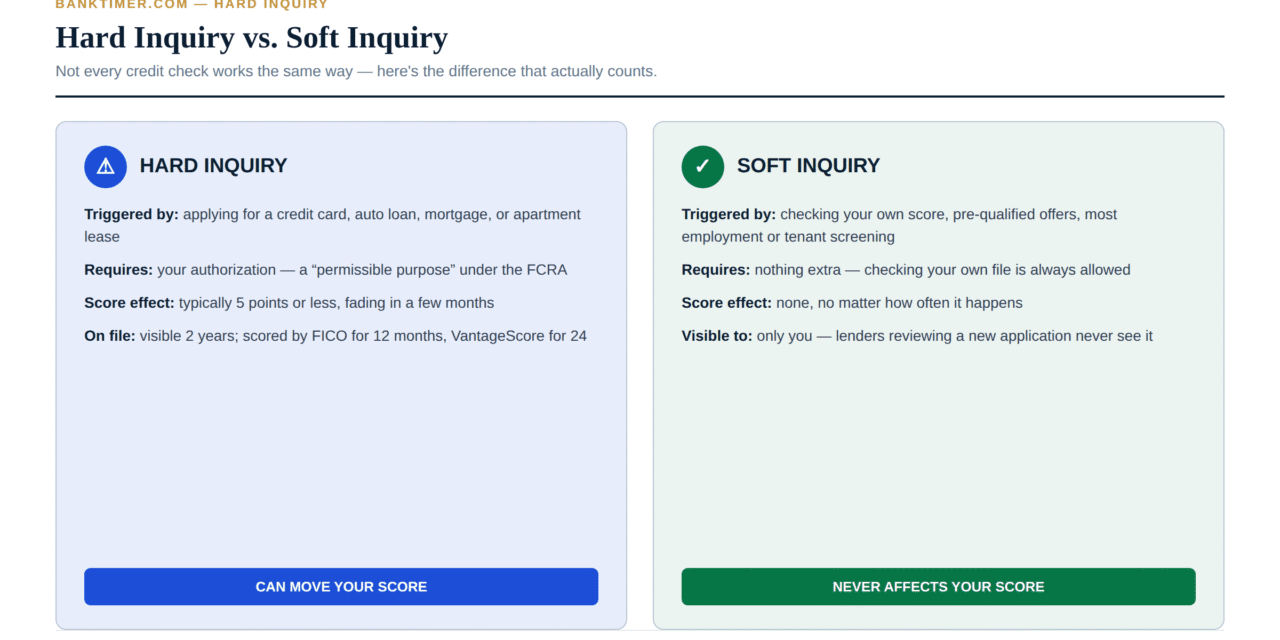
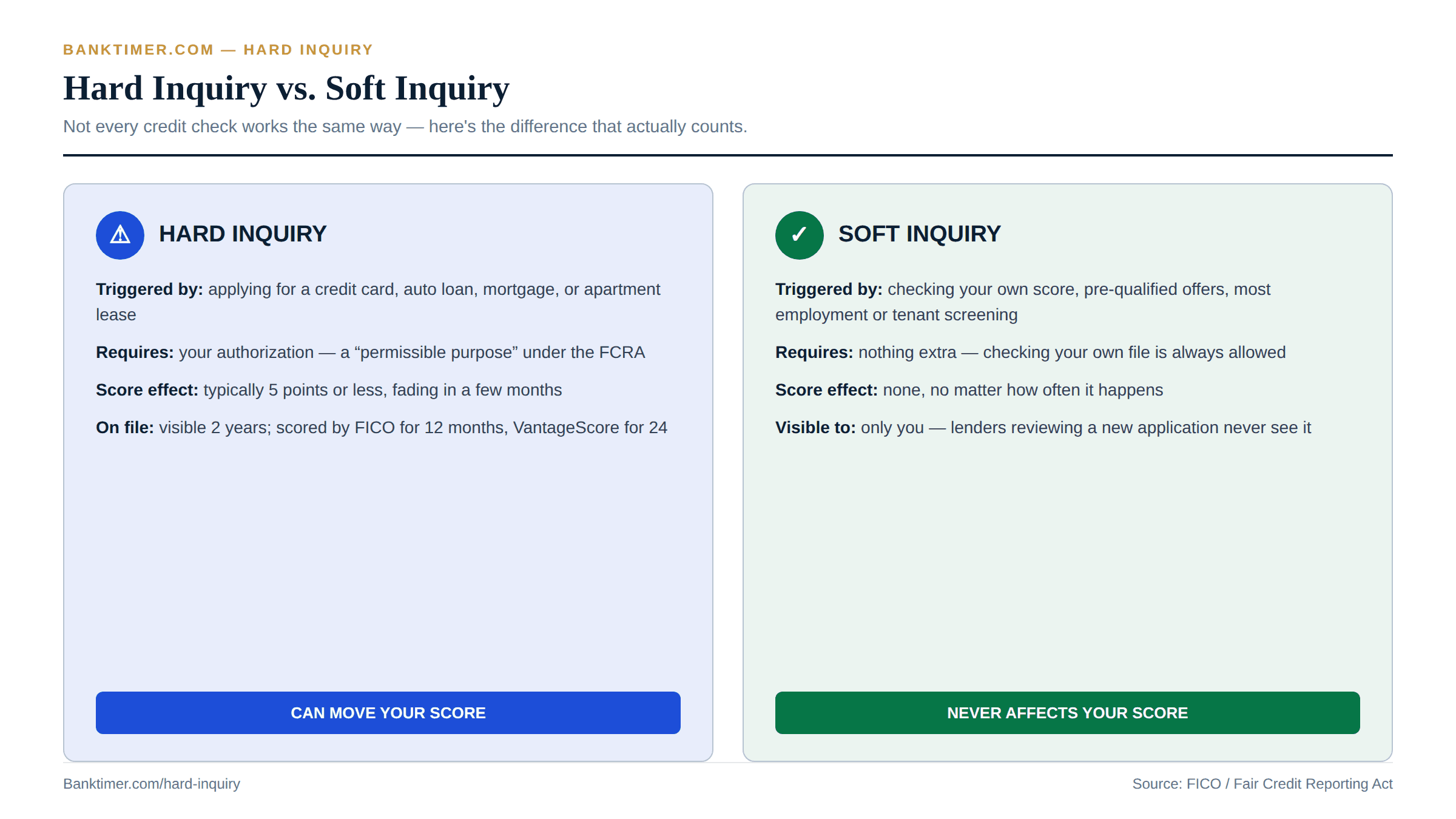
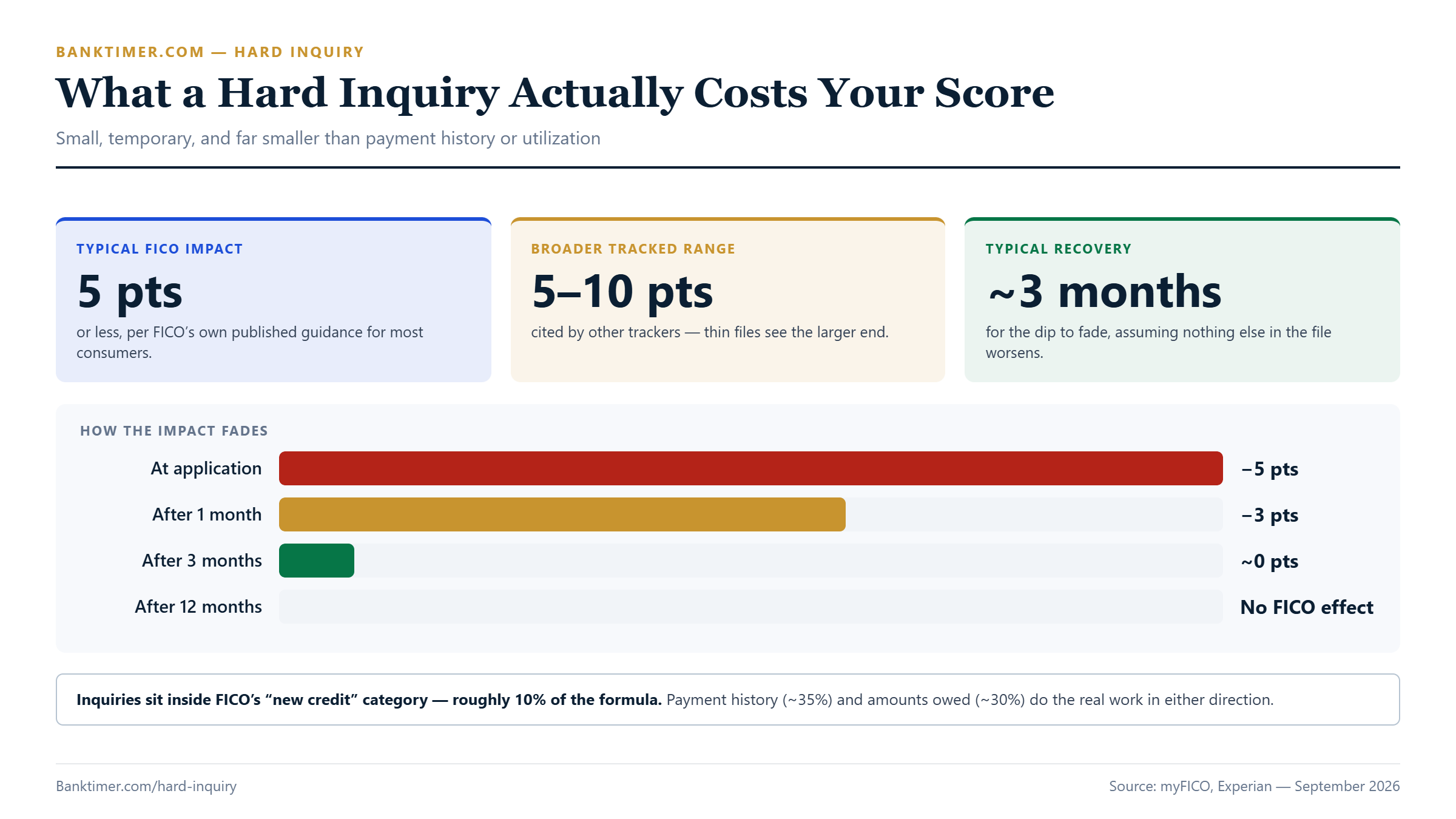
A hard inquiry typically costs five points or less on a FICO Score, and the effect usually fades within a few months — it is one of the smaller, shorter-lived factors in your credit file, not the score-wrecking event many people assume.
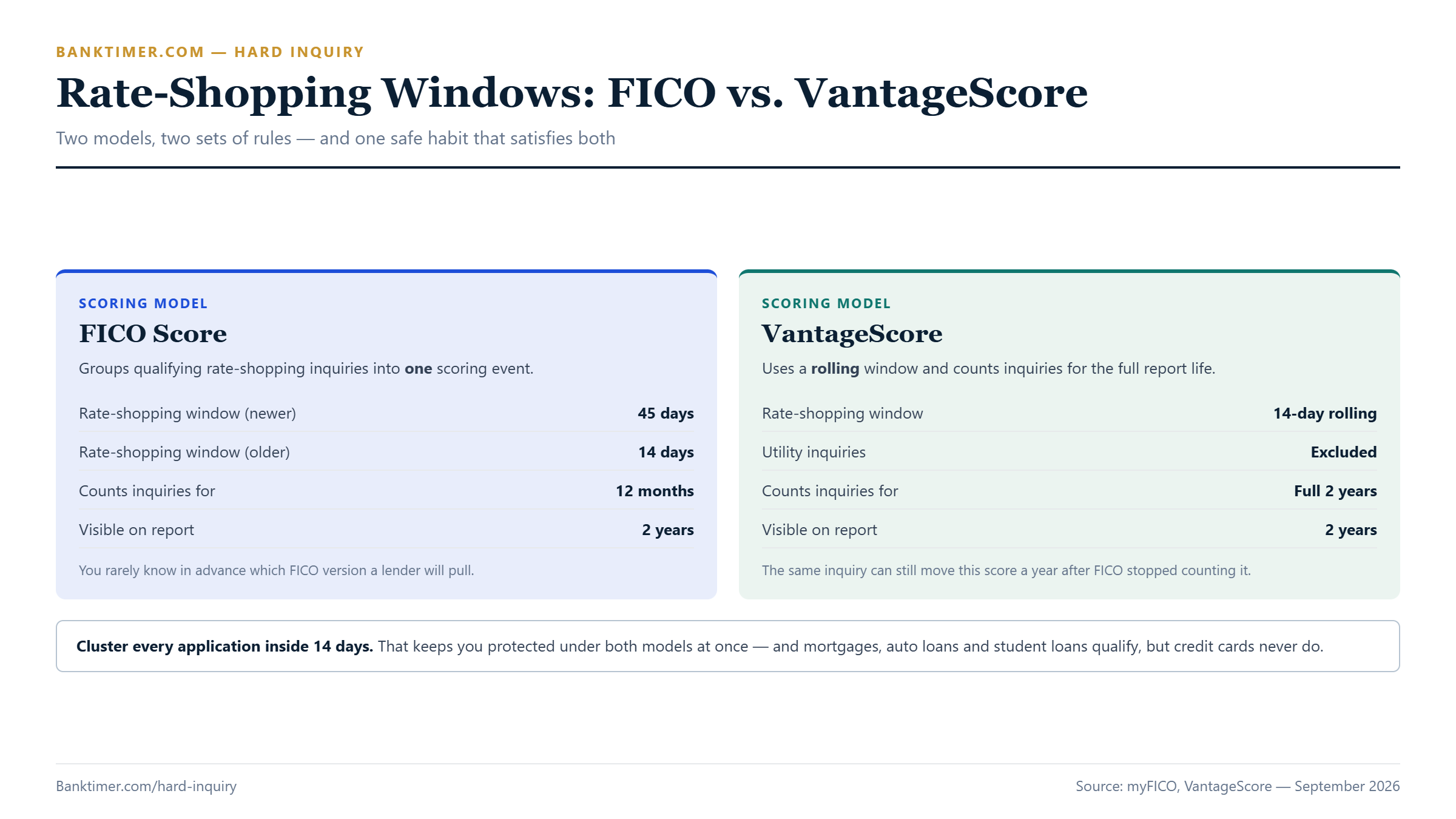
Hard inquiries stay on your credit report for two years, but FICO only counts inquiries from the most recent 12 months toward your score. VantageScore counts the full two years, which is a meaningful difference between the two models.
Rate shopping has a built-in safety net. FICO’s newer scoring models group mortgage, auto, and student loan inquiries made within a 45-day window into a single inquiry; VantageScore uses a 14-day rolling window for the same purpose.
A hard inquiry legally requires your authorization and a “permissible purpose” under the Fair Credit Reporting Act — a company generally cannot pull your full credit report just to see it, and an inquiry you never approved can be disputed.
Checking your own credit score or report never creates a hard inquiry, no matter how often you do it. Pre-qualified and pre-approved offers, along with most employment and tenant screening, also rely on soft inquiries instead.
A credit freeze blocks most new hard inquiries from being generated at all, for free, and can be lifted in minutes when you actually need it — making it one of the most effective and most underused tools for controlling who can pull your file.
Key Numbers to Know
| Figure | Value | Why it matters |
|---|---|---|
| Typical FICO Score impact of one hard inquiry | 5 points or less | FICO’s own published guidance on a single new hard inquiry for most consumers |
| Commonly cited broader range (multiple scoring trackers) | 5–10 points | Reflects that thinner credit files can see a larger relative dip than established ones |
| Time a hard inquiry remains visible on your credit report | 2 years | Set by Fair Credit Reporting Act recordkeeping limits, the same for every bureau |
| Time FICO counts a hard inquiry toward your score | 12 months | After a year, the inquiry stays on your report but stops affecting your FICO Score |
| Time VantageScore counts a hard inquiry toward your score | Full 2 years | A meaningful difference from FICO — the same inquiry can affect one score longer than the other |
| FICO’s rate-shopping window (newer score versions) | 45 days | Multiple mortgage, auto, or student loan inquiries in this window count as one inquiry |
| FICO’s rate-shopping window (older score versions) | 14 days | Some lenders still pull an older FICO version, which uses this shorter window instead |
| VantageScore’s rate-shopping window | 14-day rolling window | Applies to mortgage and auto inquiries; utility inquiries are excluded entirely |
| Typical time to recover from a single inquiry’s score dip | About 3 months | Assuming the rest of your credit file stays stable during that period |
| Cost to freeze your credit at all three bureaus | $0 | Security freezes have been free by federal law since 2018 |
What a Hard Inquiry Actually Is
A hard inquiry — sometimes called a hard pull or hard credit check — happens when a lender or creditor checks your full credit report specifically because you applied for something: a credit card, a car loan, a mortgage, an apartment lease, or a similar form of credit. It shows up on your credit report as a dated entry, tied to the company that requested it, and it becomes part of the data scoring models weigh when they calculate your score. That’s the entire mechanism — nothing more mysterious than a lender confirming your credit history before deciding whether, and on what terms, to extend you credit.
Hard Inquiry vs. Soft Inquiry: The Core Difference
A soft inquiry is any credit check that doesn’t stem from a new application you’re actively pursuing. Checking your own score, a card issuer previewing your file for a pre-approved offer, an employer running a background check with your consent, or a landlord doing a general screening often rely on soft inquiries. The distinction that actually matters: a soft inquiry never affects your credit score, no matter how many of them happen, while a hard inquiry can cause a small, temporary dip because it signals you’re seeking new credit right now.
Permissible Purpose: Why a Company Needs Your Consent
Under the Fair Credit Reporting Act, a company needs a “permissible purpose” to pull your full credit report — most commonly, that you applied for credit, insurance, employment, or housing and authorized the check as part of that process. This isn’t a formality lenders can skip. A company that pulls your report without a valid permissible purpose has violated federal law, which is exactly why an unfamiliar hard inquiry is worth investigating rather than shrugging off.
Who Can Generate a Hard Inquiry Without You Applying for Anything New
A few scenarios generate a hard inquiry even though it doesn’t feel like a new application: a landlord processing a lease that includes a credit check clause, a phone or utility company assessing whether to require a deposit, or a joint applicant on a loan you’re co-signing. Each of these still requires your authorization somewhere in the process — usually a signature or a checkbox you may not have read closely — so the pull is not literally the mysterious event it can appear to be after the fact.
How Each Bureau Displays a Hard Inquiry — and What to Check When You Read It
Checking your report for accuracy means knowing what a normal, correctly recorded inquiry actually looks like on the page.
The Fields That Should Always Be Present
A properly recorded hard inquiry lists the date of the pull, the name of the company that requested it, and sometimes a brief description of the type of credit involved. If any of these fields are missing, garbled, or clearly mismatched with the company you believe made the request, that’s worth flagging directly with the bureau rather than assuming it’s a formatting quirk.
Equifax, Experian, and TransUnion Don’t Always Show the Same List
Because a lender can choose to pull from only one or two bureaus rather than all three, your Equifax report might show an inquiry your Experian report doesn’t, and vice versa. This is completely normal and not an error on any single bureau’s part — it simply reflects which specific bureau a given lender happened to use, which is exactly why checking all three matters when you’re trying to build a complete picture.
Company Names on Your Report Often Aren’t the Brand You Recognize
The name attached to an inquiry is usually the actual creditor or financing partner underwriting the application, which can differ meaningfully from the storefront, website, or brand name you interacted with. A furniture store’s financing partner, a dealership’s lending bank, or a hospital system’s medical financing vendor are all common examples of a legitimate inquiry appearing under an unfamiliar corporate name — worth checking against your recent applications before assuming something is wrong.
Hard Inquiries Across Different Loan Types: What Actually Differs
The general rules in this guide apply everywhere, but a few practical details shift depending on exactly what you’re applying for.
Mortgages
Mortgage inquiries benefit from the longest rate-shopping window — 45 days under newer FICO models — reflecting how much time a home purchase or refinance genuinely takes to compare properly. Mortgage lenders also frequently pull all three bureaus at once and use a specific mortgage-oriented scoring model version, which can show a different number than the score you see on a free consumer app.
Auto Loans
Auto loan shopping receives the same rate-shopping protection as mortgages under both major scoring models, and dealerships often submit your application to several lenders simultaneously as part of arranging financing — which can look like several inquiries appearing at once from different bank names, all tied to the single car purchase you actually made.
Credit Cards
Credit card applications do not receive rate-shopping deduplication under either FICO or VantageScore, which means each card application generates its own separate inquiry regardless of how close together you submit them. This is the single biggest practical reason to space out credit card applications rather than treating them like a mortgage or auto loan comparison.
Personal Loans
Personal loan inquiries are treated inconsistently across scoring model versions — some newer models extend rate-shopping treatment to personal loans, while older versions and VantageScore’s standard treatment may not. Because this is one of the least consistent areas across models, confirming directly with each lender which scoring version they use is more useful here than for any other loan type covered in this guide.
How Much a Hard Inquiry Actually Costs Your Score
“Cost” here means score points, not dollars — a hard inquiry itself is free to the consumer. The real cost is a temporary, usually modest, reduction in your credit score at the exact moment a lender is deciding whether to approve you.
The Typical Point Drop: Usually Five Points or Less
FICO’s own guidance states that a hard inquiry typically lowers a score by five points or less for most people. Other credit-tracking sources cite a broader range of five to ten points, largely because the actual impact depends heavily on the rest of your credit file. Either way, a single inquiry is one of the smaller inputs into your overall score — nowhere near as consequential as a missed payment or a high balance relative to your credit limit.
Why the Same Inquiry Hits Different People Differently
Someone with a long credit history, several open accounts, and no other inquiries in the past year will often see the smaller end of that range, sometimes barely a noticeable move. Someone with a thin credit file — few accounts, a short history — can see a proportionally larger dip, simply because there’s less established data to absorb the new information point. This is why two people applying for the exact same card on the exact same day can see different score changes afterward.
How Fast the Impact Fades
The dip from a single inquiry typically recovers within a few months, often around three, provided nothing else in your credit file changes for the worse during that window. This matters for sequencing: if you’re planning several financial moves — a mortgage application, then a car purchase a few months later — understanding that the first inquiry’s effect fades helps you avoid overreacting to a small, temporary score movement.
How Much Weight Inquiries Actually Carry in Your Overall Score
A hard inquiry’s small point impact makes more sense once you see how little weight the category carries in the overall formula compared to the factors that actually drive your score.
FICO’s “New Credit” Category Is Roughly 10% of the Formula
FICO groups hard inquiries and recently opened accounts into a category often described as “new credit,” which typically makes up around 10% of the overall FICO Score calculation. That’s a real factor, but it’s dwarfed by payment history (roughly 35%) and amounts owed relative to your limits (roughly 30%) — the two categories that do the heavy lifting in either direction.
VantageScore Weighs the Same Idea Differently
VantageScore uses its own category structure and doesn’t publish an identical breakdown to FICO’s, but new credit activity — including recent inquiries — similarly sits well below payment history and credit utilization in overall influence. The practical takeaway is consistent across both models: a hard inquiry is a minor, secondary signal, not a primary driver of your score.
Why This Context Matters More Than the Raw Point Number
Knowing that inquiries sit inside a roughly 10% slice of the formula reframes the five-to-ten-point conversation. A single inquiry moving a small piece of a small category explains why the effect is both real and modest — and why a healthy payment history and low utilization can absorb a new inquiry’s impact far more easily than a credit file already under strain from a missed payment or a maxed-out card.
How Long a Hard Inquiry Actually Stays With You
There are two different clocks running on a hard inquiry, and conflating them is one of the most common sources of confusion about how this system works.
Two Years on Your Report, But Not Two Years on Your Score
The Fair Credit Reporting Act sets the recordkeeping limit: a hard inquiry stays visible on your credit report for two years from the date it happened, regardless of which bureau or which scoring model anyone uses to read that report. This is a fixed floor — no dispute or letter removes a legitimate, authorized inquiry before that window closes.
FICO’s 12-Month Scoring Window vs. VantageScore’s Full Two Years
Visibility and scoring impact are not the same thing. FICO Scores only factor inquiries from the trailing 12 months into your score calculation — after a year, the inquiry is still sitting on your report for anyone to see, but it has stopped moving your FICO Score at all. VantageScore takes a different approach and counts inquiries for the entire two years they remain on file. Practically, this means the same hard inquiry can still be nudging your VantageScore a full year after it stopped affecting your FICO Score, which is worth knowing if a lender you’re working with uses VantageScore specifically.
Rate Shopping: The Built-In Exception That Protects Comparison Shopping
Scoring models recognize that comparing loan offers is smart, not risky, and both major models build in a specific accommodation for it.
FICO’s 45-Day Window (and the Older 14-Day Version)
Newer FICO Score versions treat multiple mortgage, auto loan, or student loan inquiries made within a 45-day window as a single inquiry for scoring purposes — a practice often called “deduplication.” The catch is that some lenders still pull an older FICO Score version that uses a shorter 14-day window instead. Because you generally don’t know in advance which version a given lender will pull, the safest practice is still to compress your rate shopping into as short a period as realistically possible.
VantageScore’s 14-Day Rolling Window
VantageScore applies its own version of the same idea: a 14-day rolling window that groups multiple mortgage or auto loan inquiries into one for scoring purposes, and it excludes utility inquiries from this calculation entirely. The window functions differently from FICO’s fixed count, but the practical guidance is the same — cluster your applications tightly rather than spreading them out.
Which Loan Types Actually Qualify
The rate-shopping accommodation generally applies to mortgages, auto loans, and student loans — the loan categories where comparing multiple lenders’ rates is a normal, expected part of the process. Credit card applications do not receive this same deduplication treatment under either major scoring model, which is one reason opening several new cards in a short window behaves differently, score-wise, than shopping for one auto loan across several dealerships.
Why the Exact Number of Days Matters More Than It Seems
Missing a rate-shopping window by even a few days can mean the difference between four inquiries deduplicating into one and four inquiries counting separately, so tracking the calendar matters as much as choosing which lenders to approach. A practical habit is to start the clock from your very first application and treat that same date, plus the shorter of the two relevant windows, as your hard deadline for finishing every remaining application — that way you’re protected under both FICO’s and VantageScore’s rules regardless of which one a specific lender happens to pull.
What Actually Triggers a Hard Inquiry
Knowing what counts as an application helps you predict when a hard inquiry is coming, rather than being surprised by it later.
Credit Card and Loan Applications
Applying for a credit card, personal loan, auto loan, mortgage, or private student loan is the most direct and common trigger. The hard inquiry happens once, at the point of application, regardless of whether you’re ultimately approved or denied.
Apartment and Utility Applications That Cross the Line
Many landlords run a credit check as part of a rental application, and depending on how the landlord or their screening company structures it, this can register as a hard inquiry rather than a soft one. Utility and cell phone providers sometimes do the same when deciding whether to require a security deposit from a new customer with limited credit history.
Co-signing, Authorized User Requests, and Joint Applications
Co-signing a loan for a family member, applying jointly for a mortgage with a partner, or in some cases being added as an authorized user can generate a hard inquiry on your own report — not just the primary applicant’s. This is easy to overlook because the credit decision doesn’t feel like it’s about you, even though your credit history is part of what’s being evaluated.
Buy Now, Pay Later and Point-of-Sale Financing
A checkout-page financing offer — split into four payments, or a longer installment plan for a larger purchase — can generate a hard inquiry depending on which company underwrites it and how large the financed amount is. Shorter, smaller “pay-in-four” plans more often rely on a soft pull or a lighter-weight underwriting check, while larger point-of-sale loans for furniture, electronics, or medical procedures are more likely to involve a genuine hard inquiry. Because this varies by provider and purchase size, and because reporting practices for these products have continued to evolve, asking directly at checkout which type of check a specific offer uses is worth the extra ten seconds before you click “apply.”
What Does NOT Trigger a Hard Inquiry
Just as important as knowing what causes a hard inquiry is knowing what definitely doesn’t, since a lot of unnecessary score anxiety comes from this exact confusion.
Checking Your Own Score or Report
Pulling your own credit report — through AnnualCreditReport.com, your bank’s app, or a credit monitoring service — is always a soft inquiry. You can check as often as you’d like without any effect on your score whatsoever; this is one of the most persistent and most harmless myths in consumer credit.
Pre-Qualified and Pre-Approved Offers
When a card issuer or lender sends you a “pre-qualified” or “pre-approved” offer, that offer was generated using a soft inquiry to preview your file. The hard inquiry only happens if and when you actually complete the formal application that follows — so receiving the offer itself never costs you anything.
Employment and Tenant Screening (Usually)
Most employment background checks rely on a soft inquiry or a specialized consumer report that doesn’t function like a traditional hard credit pull, and many tenant screenings work the same way. The exception is a landlord who specifically requests a full credit report with a hard pull as part of a lease application — worth asking about directly if you’re not sure which type your prospective landlord uses.
Instant-Decision Cards That Soft-Pull First
Some card issuers run an initial soft pull to generate an instant approval decision at checkout or online, converting to a hard inquiry only after you accept the offer and formally proceed. This two-step pattern is genuinely different from a standard application, where the hard pull happens immediately — and it’s why two seemingly identical “get approved in seconds” offers can affect your score differently depending on which issuer is behind them.
Business Credit Applications and Personal Hard Inquiries
Applying for a business credit card or a small business loan often pulls the owner’s personal credit report in addition to, or instead of, any business credit file, especially for a newer or smaller business without an established business credit history of its own. Many major business card issuers report account activity only to business credit bureaus, but the application itself still frequently generates a personal hard inquiry during underwriting — a detail that surprises owners who assume “business credit” and “personal credit” stay fully separate from the moment they apply. Confirming directly with the issuer whether an application involves a personal pull, a business pull, or both is worth doing before applying for several business products in a short window.
Diagnosing an Inquiry You Don’t Recognize
Not every unfamiliar-looking inquiry is fraud. Most have a mundane explanation once you trace them back.
A Company You Forgot You Applied With
Store credit cards, financing offered at checkout for a large purchase, and loan applications submitted months earlier are the most common source of a “mystery” inquiry. The company name on your report is often the financing partner behind a retailer, not the retailer’s own name, which is why it can look unfamiliar at first glance.
A Medical or Dental Financing Plan You Forgot About
A dental procedure, an elective medical treatment, or a veterinary bill paid through a financing plan often runs through a third-party healthcare lender whose name has nothing to do with the provider’s office where you actually signed the paperwork. Because these applications sometimes happen quickly, in person, at a moment when you’re focused on the procedure rather than the financing details, the resulting inquiry can be one of the easiest to forget and the most likely to look unfamiliar months later.
A Joint Applicant’s Own Pull Showing Up Oddly
If you recently co-signed, applied jointly, or added someone as an authorized user, an inquiry tied to that transaction can appear on your report in a way that looks disconnected from anything you personally filled out. Matching the date to a recent joint financial decision usually resolves this quickly.
An Old Account You Closed but Forgot Still Generated a Pull
Occasionally an inquiry traces back to an account you closed years ago — a credit limit increase request, a product change, or a reactivation attempt initiated by the issuer rather than by you, which can still require a fresh hard pull depending on the issuer’s policy. Checking whether the company name matches any account you’ve ever held, even one you closed long ago, is worth doing before escalating an inquiry as unexplained.
A Hard Pull From an Account You Never Opened — the Fraud Scenario
The scenario that actually warrants concern is an inquiry from a company you have no connection to at all, especially if it’s followed by an account you never opened. This is the pattern consistent with identity theft, and it’s the one case where moving quickly — disputing the inquiry, freezing your file, and reviewing your full report for other unfamiliar activity — genuinely matters.
Your Rights Under the Fair Credit Reporting Act
Federal law gives you specific, enforceable rights around who can see your credit report and what you can do about it.
The Permissible Purpose Requirement
A company must have a permissible purpose — most often your application and authorization — before it can legally pull your full credit report. This requirement applies uniformly across all three major bureaus and exists specifically to prevent your credit history from being accessed casually or without your knowledge.
Your Right to Dispute an Inquiry You Didn’t Authorize
If you find a hard inquiry you’re confident you never authorized, you have the right to dispute it directly with the credit bureau that shows it, the same way you’d dispute any other inaccurate item on your report. The bureau is required to investigate, and the company that made the inquiry is required to demonstrate it had a permissible purpose for doing so.
What a Successful Dispute Actually Removes
A successful dispute removes the specific inquiry found to be unauthorized — it doesn’t retroactively restore whatever score points that inquiry may have cost you, but it does clean up your report and can matter significantly if the inquiry is tied to a broader identity theft situation rather than an isolated clerical mix-up.
Denied Applications: Does Rejection Hurt More Than Approval?
A common worry is that a denied application costs more than an approved one, since it feels like a worse outcome overall.
The Inquiry Itself Costs the Same Either Way
The hard inquiry happens the moment you apply, before the lender has made any decision, so it costs the same handful of points whether you’re approved or denied. What actually differs after a denial isn’t the inquiry’s cost — it’s that you don’t gain the potential long-term benefit a new, well-managed account can eventually add to your credit mix and history.
Your Right to a Free Report and an Adverse Action Notice
Under the Fair Credit Reporting Act and the Equal Credit Opportunity Act, a lender that denies you based on your credit report must send an adverse action notice explaining the specific reasons and identifying which bureau’s report they used. That notice also entitles you to a free copy of the report in question, separate from your normal annual free reports, specifically so you can verify the information the lender relied on.
Multiple Denials in a Short Window Are a Signal Worth Reading
A single denial is rarely cause for alarm on its own, but several denials across unrelated applications in a short period is worth pausing on — it can point to an error on your report, a score threshold you didn’t realize you were near, or in rarer cases the same identity theft pattern covered earlier in this guide, where someone else’s activity is affecting your file.
Step-by-Step: What to Do About an Inquiry You Don’t Recognize
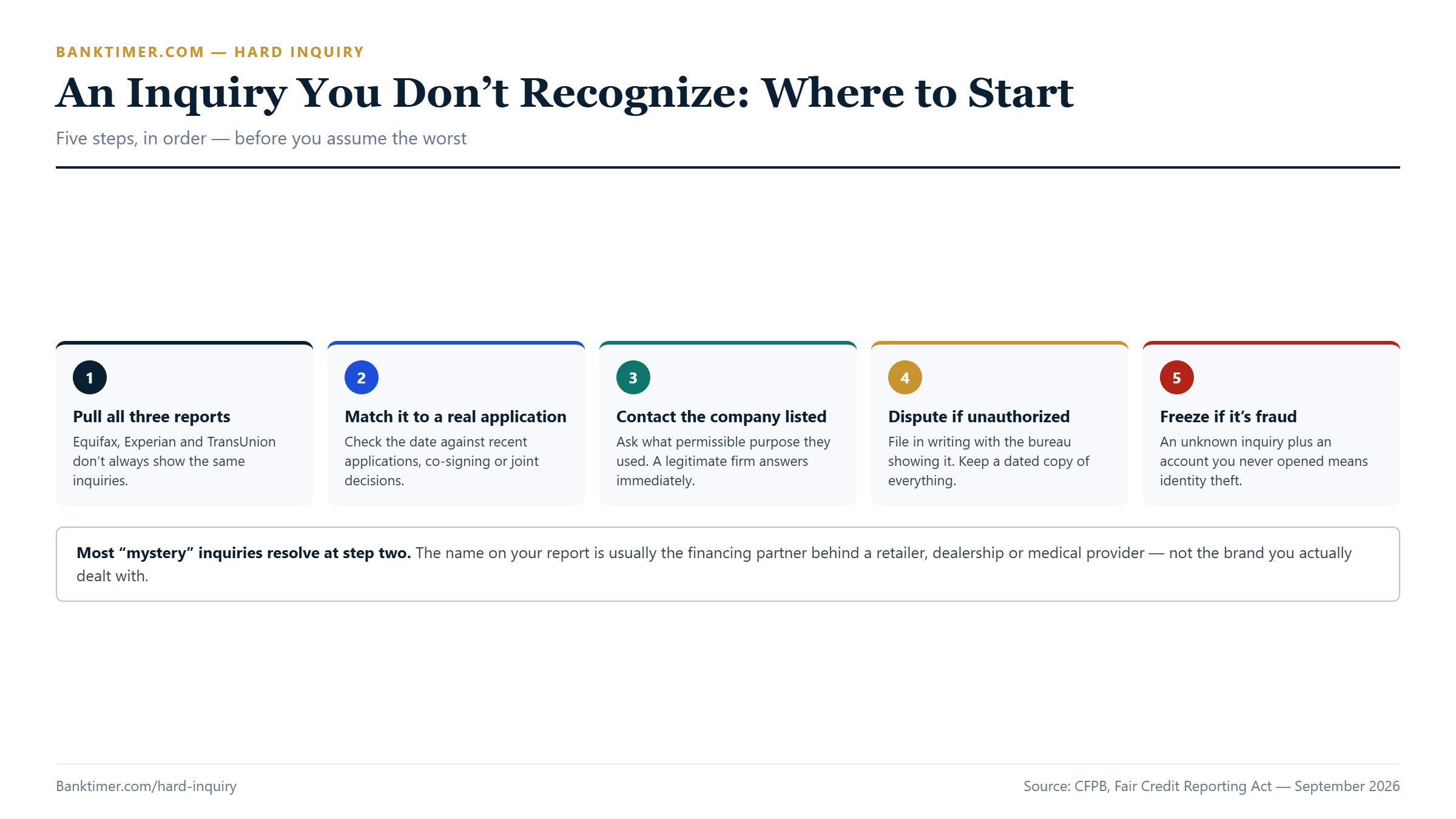
Step One: Pull All Three Reports
Get your full report from Equifax, Experian, and TransUnion, since inquiries don’t always appear on all three — a company may have only pulled from one bureau, and comparing all three gives you the complete picture before you act.
Step Two: Match the Inquiry to a Real Application
Cross-reference the date and company name against your own memory, email confirmations, and any recent applications, co-signing, or joint credit decisions. Most unfamiliar-looking inquiries resolve at this step once you connect the dots.
Step Three: Contact the Company That Pulled It
If the inquiry still doesn’t match anything, contact the company listed directly and ask what permissible purpose they used to pull your report. A legitimate company will be able to answer this immediately; difficulty getting a straight answer is itself informative.
Step Four: Dispute Directly With the Bureau If Unauthorized
If you’re confident the inquiry was unauthorized, file a formal dispute with the bureau showing it. Provide the specific date, company name, and your explanation in writing, and keep a copy of everything you submit.
Step Five: Consider a Freeze or Fraud Alert If It’s Identity Theft
If the unauthorized inquiry is paired with an account you don’t recognize, treat it as identity theft: freeze your credit at all three bureaus, consider a fraud alert as an additional layer, and review your accounts for anything else that doesn’t belong to you.
What to Document From the Start
Keep a simple log of every step: the date you noticed the inquiry, the date and content of any calls with the company or bureau, the name of anyone you spoke with, and any confirmation or case numbers you’re given. Save copies of your credit reports from the date you first noticed the issue, and screenshot anything you view online, since some interfaces don’t retain older inquiry details indefinitely. This record becomes essential if a dispute drags on or if the inquiry turns out to be connected to a larger identity theft case that takes weeks to fully unwind.
If you do end up filing a formal dispute letter or an identity theft report, keep a dated copy of exactly what you submitted, and note whether you sent it by certified mail, secure upload, or another method that gives you proof of delivery. A bureau or company that later claims it never received your dispute is far easier to correct when you have your own confirmation of when and how you sent it.
Credit Freezes and Fraud Alerts: Preventing Future Unwanted Inquiries
Once you’ve dealt with a specific problem inquiry, the next question is usually how to prevent the next one — and the two main tools work differently.
How a Freeze Actually Blocks New Hard Pulls
A credit freeze tells a bureau not to release your report to a company checking it as part of a new application review. Because most lenders won’t extend credit without seeing your report, a freeze effectively blocks new hard inquiries from resulting in a new account being opened in your name, and it’s free at all three bureaus by federal law.
What Still Gets Through a Freeze
A freeze isn’t absolute. Existing creditors you already have accounts with can continue to review your file, collections agencies can still access it, government agencies can access it under a court order, and some identity-verification checks still go through. This is normal and doesn’t indicate the freeze failed — it’s simply the set of carve-outs built into how freezes work.
A Fraud Alert as a Lighter-Touch Alternative
A fraud alert doesn’t block access the way a freeze does; instead, it requires a business to take extra steps to verify your identity before extending credit based on the report. It’s a lighter tool, easier to leave in place if you’re actively applying for things but still want an added layer of protection against someone else applying in your name.
State Law History: Freezes Were Not Always Free Everywhere
Before a 2018 federal law standardized the rule nationwide, several states had already passed their own laws making credit freezes free, while others still allowed bureaus to charge a small fee, particularly for placing or lifting a freeze at a moment’s notice. Today the free-freeze rule applies uniformly across all fifty states, but the older, inconsistent landscape is part of why some longtime consumers still assume, incorrectly, that a freeze costs money or takes days to lift.
A Realistic Comparison: Freeze vs. Fraud Alert vs. Doing Nothing
| Approach | What it does | Cost | Best fit |
|---|---|---|---|
| Credit freeze | Blocks most new hard inquiries at that bureau entirely | Free | Not actively applying for credit and want maximum protection |
| Fraud alert | Requires extra identity verification before new credit is extended | Free | Applying for credit occasionally but want a lighter safeguard |
| Doing nothing | No added protection beyond standard monitoring | Free | Confident your identity and applications are fully under your control |
| Credit monitoring service | Alerts you after an inquiry or new account appears | Often free; paid tiers add features | Wanting faster notification without blocking any access |
A Realistic Total-Cost Example: What Rate Shopping Actually Saves You
The math behind rate shopping makes the case for tolerating a small, temporary score dip better than an abstract point count does.
The Score Cost of Comparing Four Mortgage Lenders
Comparing four mortgage lenders within an 18-day window, as described in the scenario below, deduplicates into a single hard inquiry under the 45-day FICO window and the 14-day VantageScore window alike. The realistic cost is the same five points or less a single inquiry would have cost on its own — comparing four lenders instead of one adds effectively nothing extra to that cost, provided the applications land inside the window.
The Dollar Savings a Better Rate Can Produce
A difference of just 0.25 percentage points on a $350,000, 30-year fixed mortgage changes the monthly payment by roughly $50 and totals in the range of $18,000 in interest saved or lost over the full loan term, depending on which direction that quarter-point moves. A full percentage point of difference — entirely realistic across four competing lenders — can swing total interest cost by well over $70,000 across the life of the loan.
Why the Trade-Off Isn’t Close
Weighed against each other, a handful of temporary score points that recover within a few months is a trivial cost next to tens of thousands of dollars in potential interest savings from comparing lenders properly. This is precisely the trade-off scoring models were designed to protect when they built in the rate-shopping deduplication window in the first place — comparing offers is the financially responsible move, not the risky one.
A Real-World Example: Three Inquiry Scenarios
A shopper compares mortgage rates across four different lenders over an 18-day period. Because every lender pulled a current FICO Score version, the four inquiries deduplicate into one under the 45-day rate-shopping window, and the shopper’s score shows only the impact of a single inquiry rather than four separate ones.
A consumer notices an unfamiliar inquiry from a financing company two weeks after buying furniture on an in-store payment plan. After checking their email, they find the approval confirmation from that exact financing partner, whose name didn’t match the furniture store’s brand — a routine mix-up resolved in minutes, not a security problem.
A third consumer discovers a hard inquiry from a lender they’ve never contacted, followed a week later by a new credit card account they never opened. They freeze their credit at all three bureaus immediately, dispute both the inquiry and the fraudulent account, and file an identity theft report — a case where fast action limited the damage to a single unauthorized account rather than several.
A fourth consumer, eager to build credit quickly, applies for five different credit cards within a single month. Because credit card applications don’t receive the same deduplication treatment mortgage and auto loans do, each application generates its own separate hard inquiry, and the cumulative effect is a noticeably larger, longer-lasting score dip than any single card would have caused — a self-inflicted version of the exact mistake this guide is meant to help readers avoid.
A fifth consumer shops for an auto loan across three dealerships over one weekend, each of which runs its own credit check with a different lender partner behind the scenes. All three inquiries land well within both the 45-day FICO window and the 14-day VantageScore window, and the consumer’s score shows only a single small dip despite having three separate financing offers to compare and negotiate against each other.
Common Mistakes People Make With Hard Inquiries
A frequent mistake is avoiding all new credit applications out of fear that any hard inquiry will meaningfully damage a score, when the typical cost is five points or less and fades within months. Another is spreading rate-shopping applications out over many weeks instead of compressing them into the 14- to 45-day window that scoring models actually protect. A third is assuming a “pre-qualified” offer already cost them a hard inquiry, when the offer itself is generated with a soft pull. A fourth is ignoring an unfamiliar inquiry instead of tracing it, missing an early identity theft warning sign. A fifth is disputing a legitimate, authorized inquiry simply because the company name looked unfamiliar, without first checking for a financing partner or joint applicant explanation. A sixth is not knowing that VantageScore counts inquiries for a full two years while FICO stops at 12 months, leading to confusion when two different scores from the same file don’t move the same way.
Red Flags Worth Slowing Down For
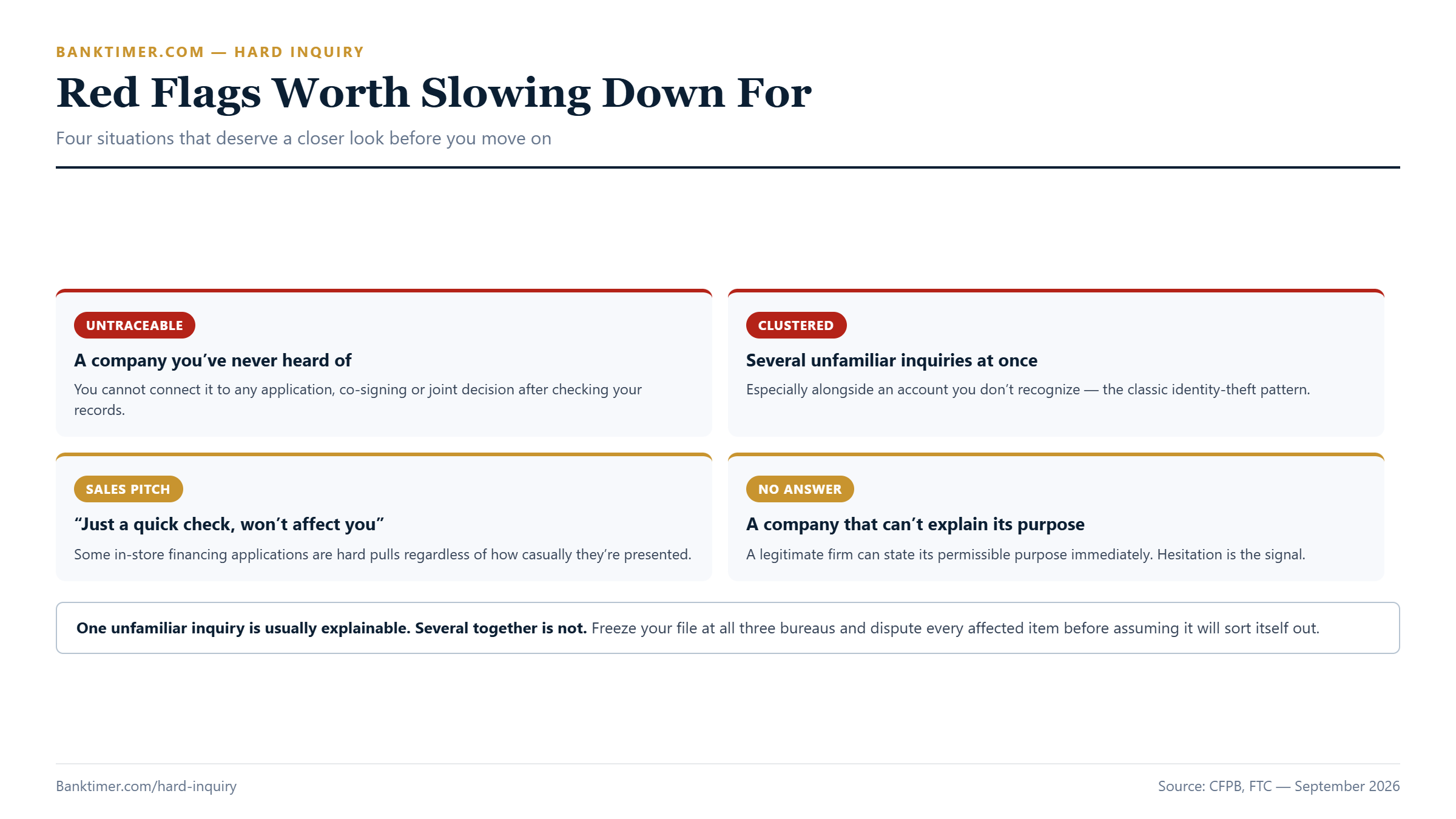
An Inquiry From a Company You’ve Never Heard Of and Can’t Trace
If you genuinely cannot connect an inquiry to any application, co-signing, or joint credit decision after checking your records, treat it as worth investigating directly with the company rather than assuming it will resolve itself.
Several Unfamiliar Inquiries Appearing at Once
A single unfamiliar inquiry is often explainable; several appearing together, especially alongside an account you don’t recognize, is a stronger signal of identity theft and worth immediate action — freezing your file and disputing every affected item.
A Retailer Insisting a “Quick Check” Won’t Affect Your Score
Any point-of-sale financing offer described as a quick, no-consequence check deserves a direct question about whether it’s a soft or hard pull before you agree — some in-store financing applications are hard inquiries regardless of how casually they’re presented.
A Company Unable to Explain Its Permissible Purpose
If you contact a company about an inquiry you don’t recognize and they can’t clearly articulate what application or authorization gave them permissible purpose to pull your report, treat that as a genuine red flag rather than a communication mix-up — a legitimate company should be able to answer this question immediately.
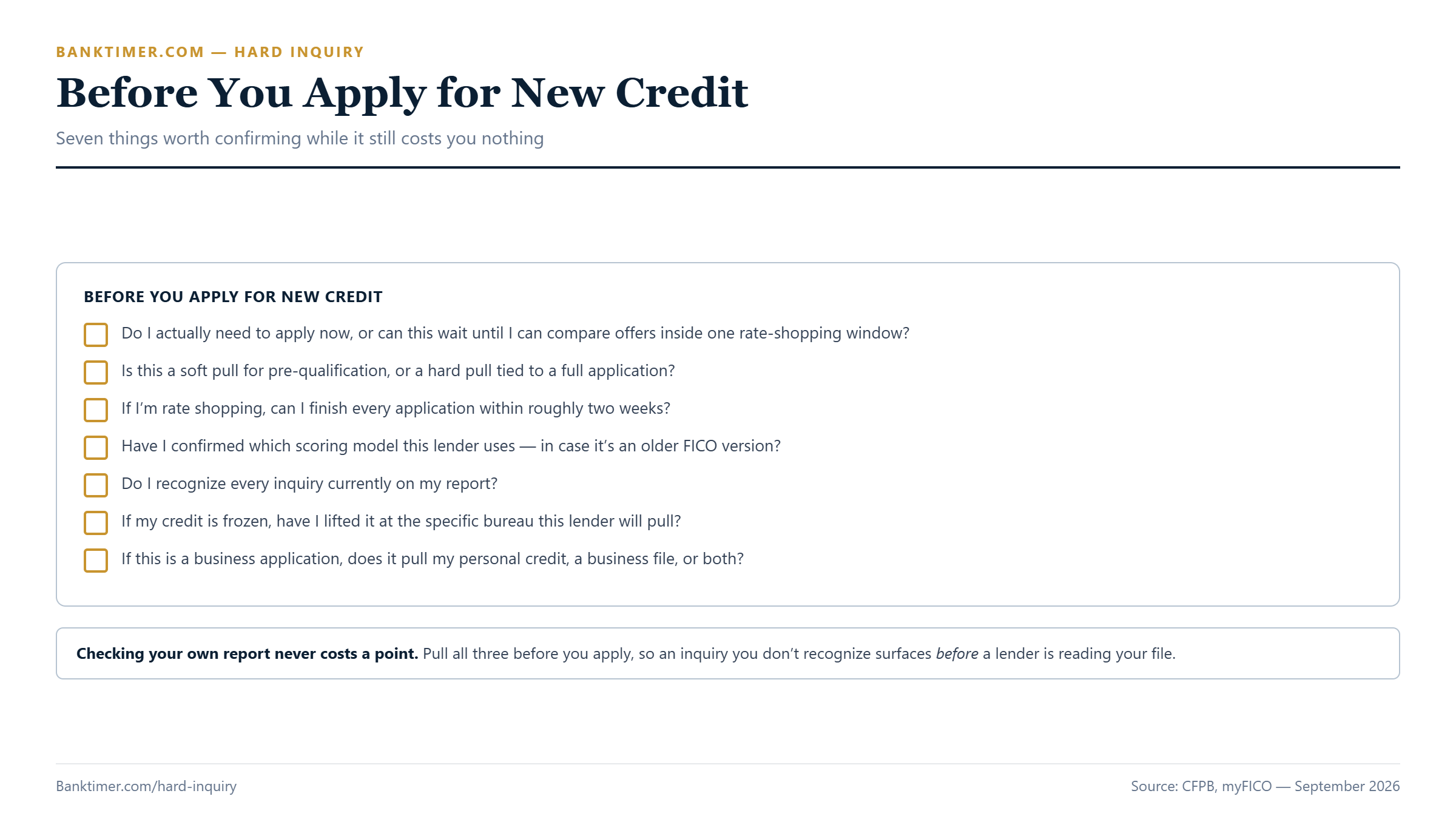
Questions to Ask Before You Apply for New Credit
- ☐ Do I actually need to apply now, or can this wait until I’m ready to compare multiple offers within a single rate-shopping window?
- ☐ Is this specific check a soft pull for pre-qualification, or a hard pull tied to a full application?
- ☐ If I’m rate shopping, can I complete all my applications within roughly two weeks to stay safely inside both major scoring models’ windows?
- ☐ Have I confirmed which scoring model this lender actually uses, in case it’s an older FICO version with a shorter shopping window?
- ☐ Do I recognize every inquiry currently on my report, or is there one I should trace before applying for anything new?
- ☐ If my credit is frozen, have I unfrozen it at the specific bureau this lender will use, with enough lead time before they pull it?
- ☐ If this is a business application, have I confirmed whether it pulls my personal credit, a business file, or both?
Alternatives Worth Comparing
Checking Pre-Qualification Tools First
Many card issuers and lenders offer a pre-qualification check that uses a soft inquiry to estimate your odds of approval before you commit to a hard pull, letting you rule out likely denials without any score cost at all.
Waiting Inside the Rate-Shopping Window
If you know you’ll need to compare several lenders, planning the applications to land within a two-week span keeps you safely inside both FICO’s and VantageScore’s deduplication windows, regardless of which specific model a given lender pulls.
Requesting a Manual Review Instead of a New Application
In some cases — particularly with an existing lender — asking for a manual review of an existing account rather than a brand-new application can avoid generating an additional hard inquiry entirely.
Using an Authorized-User Addition Instead of a New Account
If the goal is building credit history rather than accessing new credit directly, becoming an authorized user on a trusted family member’s well-managed account sometimes avoids a hard inquiry altogether, depending on the issuer’s specific policy.
Slowing Down When You’re Not Actually in a Hurry
If nothing about your situation requires an immediate application, giving yourself even a few extra days to research the right product, compare terms, and confirm you’re inside a rate-shopping window whenever one applies costs nothing and avoids the specific mistake of applying reactively, then realizing afterward a better option existed.
Building a Thin File Gradually Instead of All at Once
Someone new to credit, or rebuilding after a gap, often benefits more from opening one account, using it responsibly for several months, and only then considering a second product, rather than applying for several accounts at once in an effort to speed up the process. A thinner file absorbs each individual inquiry’s impact less easily, which makes pacing new applications more valuable early on than it is for someone with a long, established credit history.
Who This Guide Suits
This guide is most useful to anyone about to apply for a credit card, loan, or lease and wants to understand the actual score cost before doing so, as well as anyone who has spotted an unfamiliar inquiry on their credit report and needs a clear process for tracing it, disputing it if necessary, and deciding whether a freeze or fraud alert makes sense afterward.
Frequently Asked Questions
Does checking my own credit score count as a hard inquiry?
No — checking your own score or report, through any method, is always a soft inquiry and never affects your credit score, no matter how often you do it.
How many points does a hard inquiry typically cost?
FICO’s own guidance puts it at five points or less for most people, though other trackers cite a broader five-to-ten-point range depending on how thin or established the rest of your credit file is.
How long does a hard inquiry actually affect my score?
FICO stops counting an inquiry toward your score after 12 months, even though it remains visible on your report for two years. VantageScore counts the same inquiry for the full two years it’s on file.
Can I dispute a hard inquiry I don’t recognize?
Yes — if you’re confident an inquiry was made without a permissible purpose or your authorization, you can dispute it directly with the credit bureau showing it, the same way you’d dispute any inaccurate item.
Does rate shopping for a mortgage hurt my score more than one application would?
Generally no, as long as you complete your applications within the relevant window — 45 days under newer FICO models, 14 days under older FICO versions and under VantageScore — since multiple inquiries in that window count as one.
Does a pre-approved credit card offer already cost me a hard inquiry?
No — the offer itself is generated from a soft inquiry. The hard inquiry only happens if you go on to complete the actual application.
Will freezing my credit stop me from getting a hard inquiry-based approval later?
No — you can lift a freeze at a specific bureau in minutes, either temporarily or permanently, whenever you’re ready to apply for something that requires a lender to see your report.
Do all three credit bureaus show the same hard inquiries?
Not necessarily — a lender may pull from only one or two bureaus rather than all three, which is why checking all three matters when you’re tracing an unfamiliar inquiry.
Can an employer’s background check lower my credit score?
Almost never — most employment screening relies on a soft inquiry or a specialized report format that doesn’t function like a traditional hard pull affecting your score.
Is a hard inquiry the same thing as a new account on my credit report?
No — an inquiry just records that your report was checked. A new account is a separate entry that appears only if you actually open the credit line, and it affects your score differently than the inquiry itself.
What’s the difference between a credit freeze and a fraud alert?
A freeze blocks most new hard inquiries from resulting in a new account at all; a fraud alert instead requires extra identity verification before credit is extended, without blocking access outright.
Why did two different credit scores react differently to the same hard inquiry?
This usually traces back to the scoring model rather than an error — FICO and VantageScore weigh recent inquiries differently, and VantageScore’s longer two-year counting window is the most common reason for a lingering difference.
Does a denied application cost more than an approved one?
No — the hard inquiry costs the same handful of points regardless of the outcome, since it’s recorded the moment you apply, before any approval decision is made.
Can applying for a business credit card affect my personal credit score?
Often yes — many business card applications, especially for newer businesses, pull the owner’s personal credit report during underwriting, generating a personal hard inquiry even though the account itself may report only to business bureaus.
Does a “buy now, pay later” checkout offer always involve a hard inquiry?
Not always — smaller, short-term installment offers commonly use a soft pull, while larger point-of-sale financing plans are more likely to involve a genuine hard inquiry, so it’s worth confirming which type a specific offer uses before accepting it.
How to Verify These Numbers Yourself
The Consumer Financial Protection Bureau publishes consumer guidance on credit reports, inquiries, and your rights under the Fair Credit Reporting Act directly at consumerfinance.gov. FICO publishes its own current guidance on how inquiries factor into its scoring models at myfico.com, and VantageScore publishes equivalent guidance on its own rate-shopping windows at vantagescore.com. Because scoring-model rules and specific point-impact figures can be updated by either company, and because bureau-specific freeze and dispute procedures occasionally change, confirm current details directly with FICO, VantageScore, or the specific bureau involved before relying on a figure for an active decision. All figures in this guide were accessed in September 2026.
Key Terminology
| Term | What it means |
|---|---|
| Hard inquiry | A credit check tied to a new application for credit that can cause a small, temporary score dip |
| Soft inquiry | A credit check that doesn’t affect your score, including checking your own report or a pre-qualification preview |
| Permissible purpose | The legal justification, such as your application and authorization, a company needs before pulling your full credit report |
| Rate-shopping window | The period during which multiple mortgage, auto, or student loan inquiries count as a single inquiry for scoring purposes |
| Credit freeze | A free bureau-level block that prevents most new creditors from viewing your report until you lift it |
| Fraud alert | A flag on your credit file requiring extra identity verification before new credit is extended, without blocking access outright |
| Deduplication | The process by which a scoring model groups multiple qualifying inquiries within a set window into a single scoring event |
A hard inquiry is one of the smaller, shorter-lived factors in your credit file — typically five points or less, usually recovered within a few months, and specifically protected when you’re rate shopping within the right window. The real risk isn’t the routine inquiry tied to an application you actually submitted; it’s the one you can’t trace back to anything you did, which is exactly the pattern worth investigating immediately rather than dismissing. Knowing the difference between what merely looks unfamiliar and what’s genuinely unauthorized is what separates a five-minute check from a drawn-out identity theft cleanup.
Sources
- Consumer Financial Protection Bureau — Credit Reports and Scores
- myFICO — How to Rate Shop and Minimize the Impact to Your FICO Scores
- Experian — How Many Points Does an Inquiry Drop Your Credit Score?
- Capital One — How Long Do Hard Inquiries Stay on Your Credit Report?
- Capital One — Soft Inquiry vs. Hard Inquiry: Key Differences
- VantageScore — Thinking About Applying for a Loan? Shop Around to Find the Best Offer
- Experian — How to Freeze Your Credit at All 3 Credit Bureaus
- AnnualCreditReport.com
Methodology
The score-impact figures, rate-shopping windows, and inquiry-duration rules described in this guide reflect FICO’s and VantageScore’s own currently published consumer guidance, cross-checked against Consumer Financial Protection Bureau and major-bureau consumer education pages, current as of this guide’s publication. Because both scoring companies periodically update model versions and specific figures, and because lenders don’t uniformly disclose which score version they pull, confirm current details directly with FICO, VantageScore, or the relevant bureau before relying on a specific number for an active application or dispute decision. This guide is educational and does not constitute credit repair or legal advice. All figures were accessed in September 2026.
Before your next credit application, pull your reports from all three bureaus, confirm you recognize every inquiry currently listed, and if you’re comparing multiple lenders for a mortgage, auto loan, or student loan, plan to complete every application within a two-week span so you stay safely inside both major scoring models’ rate-shopping windows.