By the Banktimer Editorial Team · Published
Banktimer is an independent U.S. consumer-finance publication. Our editors draw on primary and official sources first, such as the CFPB, FDIC, Federal Reserve, and FTC, along with statutes, regulations, and providers’ own agreements and fee schedules. Then we add worked examples and decision tools. Our goal is the most useful, best-supported explanation the sources available to us at the time of writing allow.
This article is general information, not legal, tax, investment, insurance, or financial advice, and reading it does not create a professional relationship with Banktimer. Rates, fees, limits, and rules change, and they vary by state, provider, and contract, so confirm current terms with your bank, lender, insurer, or the agency named in the article before you act. Examples are illustrative unless labeled otherwise. Banktimer is not a bank, lender, insurer, or financial advisor, and we are not responsible for decisions or losses that result from relying on this content. For advice about your own situation, talk to a licensed professional.
If you’ve ever compared a mortgage rate to a personal loan APR and wondered why the two numbers look nothing alike, you’re asking the right question. The different types of loans available to American borrowers in 2026 aren’t just priced differently from each other. They’re built on different legal structures, secured by different kinds of collateral (or none at all), regulated by different sets of federal and state rules, and vulnerable to entirely different kinds of scams. A HELOC and a merchant cash advance can both put money in your account within a week, but one is secured by your home under decades of federal mortgage-disclosure law, and the other is a factor-rate product with almost none of those protections attached.
This guide is Banktimer’s complete reference to every major loan type covered on this site. It walks through Mortgages, Mortgage Refinance, Home Equity Loans, HELOC, Personal Loans, Auto Loans, Debt Consolidation Loans, Student Loans, and Business Loans one at a time, then closes with two sections that cut across all nine — how loan rates actually get set, and how to evaluate a lender before you sign anything. Every loan-type section follows the same shape: how the product works, what it costs as of September 2026, how to qualify and apply, and the specific mistakes and red flags that trip up real borrowers. Where a fact is time-sensitive — an interest rate, a federal repayment program, a regulatory deadline — this guide dates it and points you to the live source, because a number that’s accurate today can be stale in a month, and a guide this size only stays useful if you know exactly which parts to double-check.
Zoom out far enough and every type of loan in this guide is doing the same underlying job — moving money through time — but the mechanics diverge fast once you look closely. Some types of loans are secured by a specific asset you could lose; others rest entirely on your credit history and income. Some are federally regulated down to the font size on your disclosure forms; others, like a merchant cash advance, operate in a much lighter regulatory environment where the burden of due diligence falls almost entirely on you. Knowing which category a given offer falls into — before you compare its rate to anything else — is often more useful than the rate itself, because two types of loans that look similar on a rate sheet can carry completely different risk if your circumstances change. That’s the real reason this guide exists: not just to list numbers, but to make the underlying structure of each product visible enough that you can judge an actual offer against it.
Use this guide two ways: read it straight through if you’re trying to figure out which of these loan types actually fits your situation, or jump straight to the section covering the loan you’re already shopping for if you just need the current rates, the qualification bar, and the mistakes to avoid before you sign.
Not all types of loans are priced the same way. Secured loans — mortgages, auto loans, home equity products — average dramatically lower rates than unsecured ones like personal loans and most business lines of credit, because collateral shifts risk away from the lender and onto a specific asset you could lose.
Your credit score doesn’t just change your rate — it changes which loan programs will even consider you, and moving a few points can shift you into a meaningfully cheaper pricing tier on almost every product in this guide.
As of September 2026, the Federal Reserve’s newest rate move pushed mortgage and refinance rates up while home equity lines and business lending rates continued easing — the same week, in opposite directions, which is exactly the kind of divergence that makes shopping multiple loan types worthwhile before committing to one.
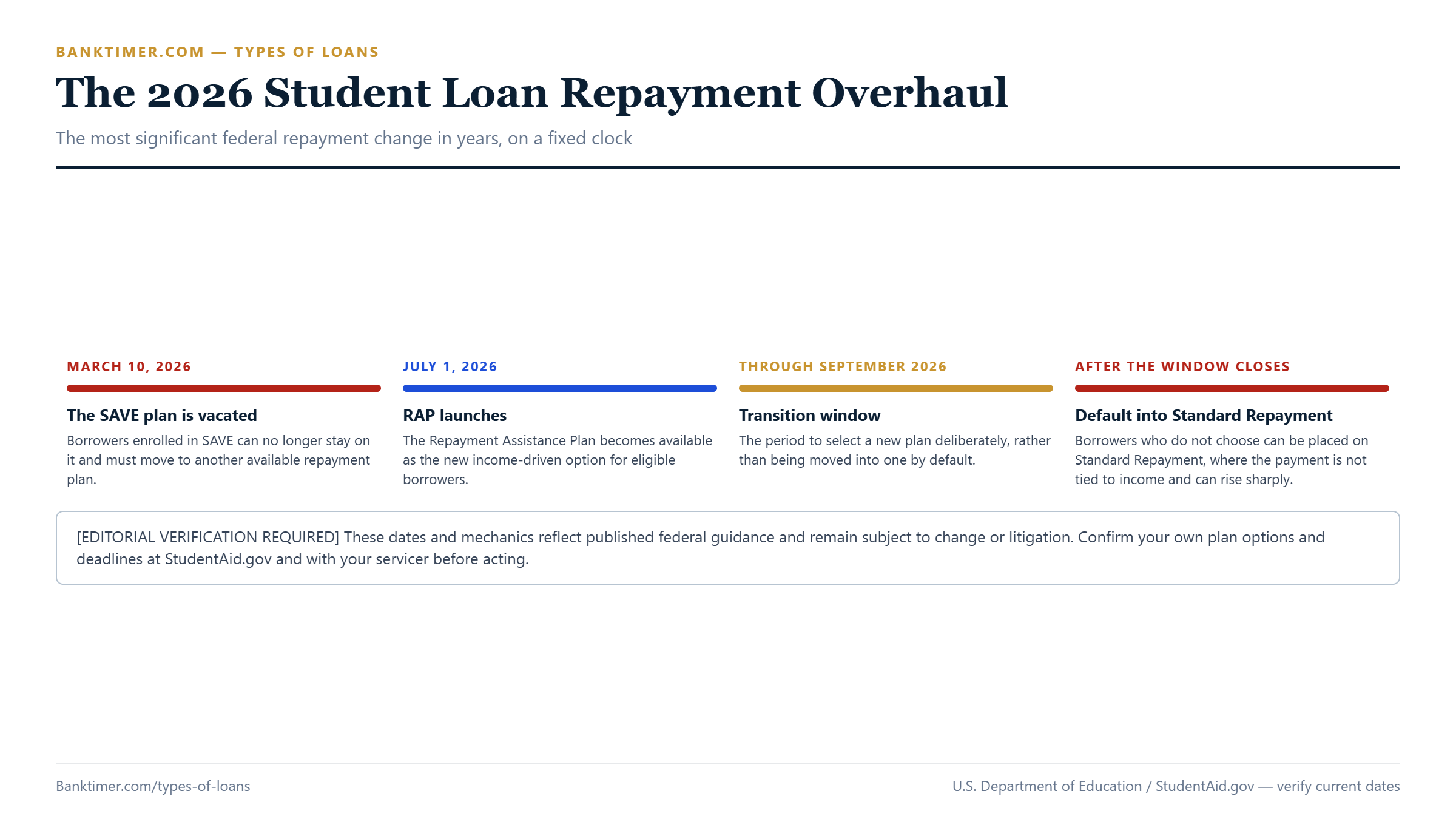
Student loan borrowers face a genuinely urgent 2026 deadline: a federal court terminated the SAVE repayment plan, and anyone who doesn’t actively choose a new plan before the transition window closes gets defaulted into a far more expensive Standard Repayment plan.
The single biggest cost mistake that shows up across every type of loan in this guide is the same one: comparing the advertised interest rate instead of the full APR, which is the only figure that bundles in fees and actually lets you compare two offers honestly.
A loan’s biggest risk often isn’t the rate on the page — it’s the structure underneath it. Balloon payments, factor-rate financing, confession-of-judgment clauses, and mislabeled products (a HELOC that behaves like a lump-sum loan, a cash advance priced to look cheaper than it is) can cost far more than a slightly higher advertised rate ever would.
Key Numbers to Know
| Loan type | Typical rate (September 2026) | Typical term |
|---|---|---|
| Mortgage (30-year fixed) | 6.76% | 30 years |
| Mortgage Refinance (30-year fixed) | 6.96% rate / 7.03% APR | 30 years |
| Home Equity Loan | 8.13%–8.28% average by term | 5–15 years (up to 30 at some lenders) |
| HELOC | 7.26% average (range 3.99%–11.60%) | 5–10 year draw + 10–20 year repayment |
| Personal Loan | 18.87% average (14.95%–27.20% by tier) | 2–7 years |
| Auto Loan (new / used) | 6.74% / 7.39% average | Up to 84 months |
| Debt Consolidation Loan | 14.76%–30.02% by credit tier | 3–7 years |
| Student Loan (federal undergrad) | 6.52% fixed | Up to 30 years under the new RAP plan |
| Business Loan (SBA 7(a)) | 9.75%–14.75% | Up to 25 years (real estate) |
| Federal Funds Rate (benchmark) | 3.75%–4.00% target range | Set by the Federal Reserve |
Rates above are national averages as of September 2026 from Freddie Mac, Bankrate, Experian, NerdWallet, and LendingTree; your own quote will depend on your credit, loan amount, term, and lender. Each section below links to the live source for its own figures so you can check whether they’ve moved. Scanning this table side by side is the fastest way to see how dramatically pricing differs across types of loans secured by different kinds of collateral — and how much of that difference comes down to risk, not lender greed.
Mortgages
A mortgage is the loan most Americans will ever take out, and it behaves unlike almost anything else in this guide: it’s secured by the home itself, spans decades rather than years, and comes wrapped in more federal disclosure paperwork than any other consumer loan type on this list. Understanding how it works is the natural starting point for a guide covering every major type of loan, since so many of the concepts here — amortization, loan-to-value ratio, rate locks — first show up in a mortgage before reappearing, in simplified form, in almost every other section below.
Of all the types of loans covered in this guide, a mortgage carries the most regulatory scaffolding by far — the Truth in Lending Act, RESPA, and a stack of federally mandated disclosures that don’t exist in anything close to the same form for, say, a personal loan or an auto loan. That extra paperwork isn’t bureaucratic friction for its own sake; it exists because a mortgage is usually the single largest debt a household will ever carry, secured by the roof over their head. Compare that to the two other real-estate-backed types of loans covered later in this guide — home equity loans and HELOCs — and you’ll notice the underwriting standards, appraisal requirements, and consumer protections all rhyme closely with what’s described below, just scaled down to a smaller loan amount layered on top of an existing first mortgage.
How a Mortgage Works
The Basic Structure
A mortgage is a loan secured by real property: you borrow a lump sum to buy a home, and the lender holds a lien against that home until the loan is repaid in full. Miss enough payments and the lender can foreclose, selling the property to recover what’s owed — which is exactly why mortgage rates run so much lower than unsecured types of loans like personal loans. The collateral protects the lender, and that protection gets priced directly into your rate.
Where to Get One
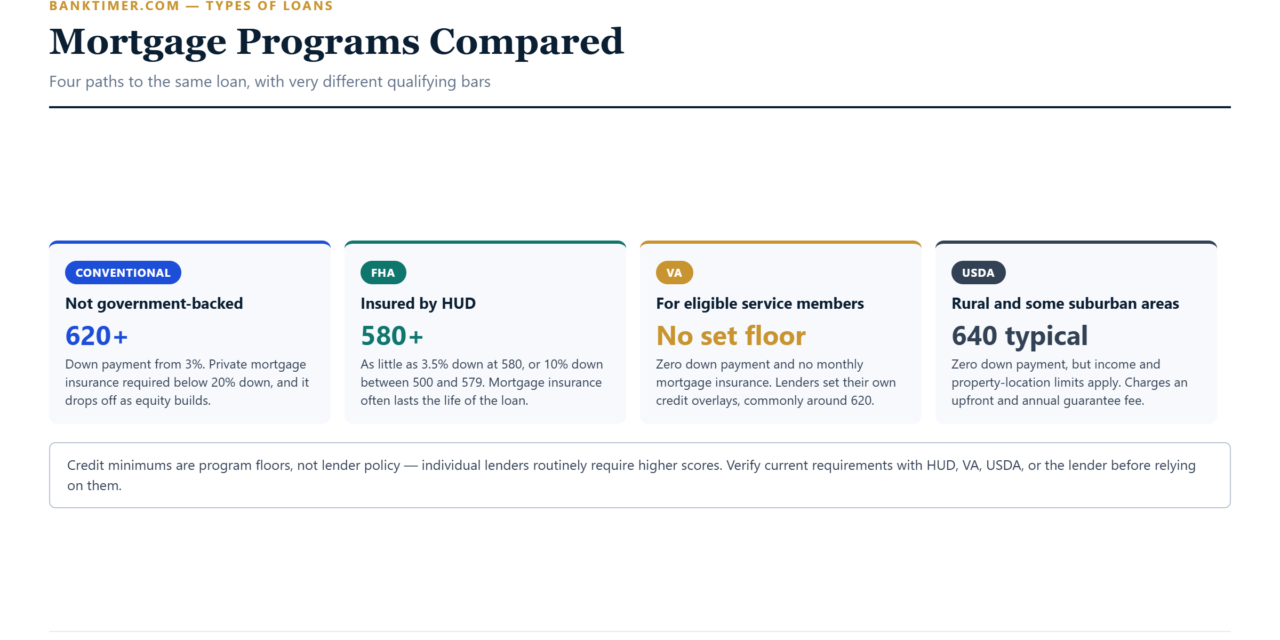
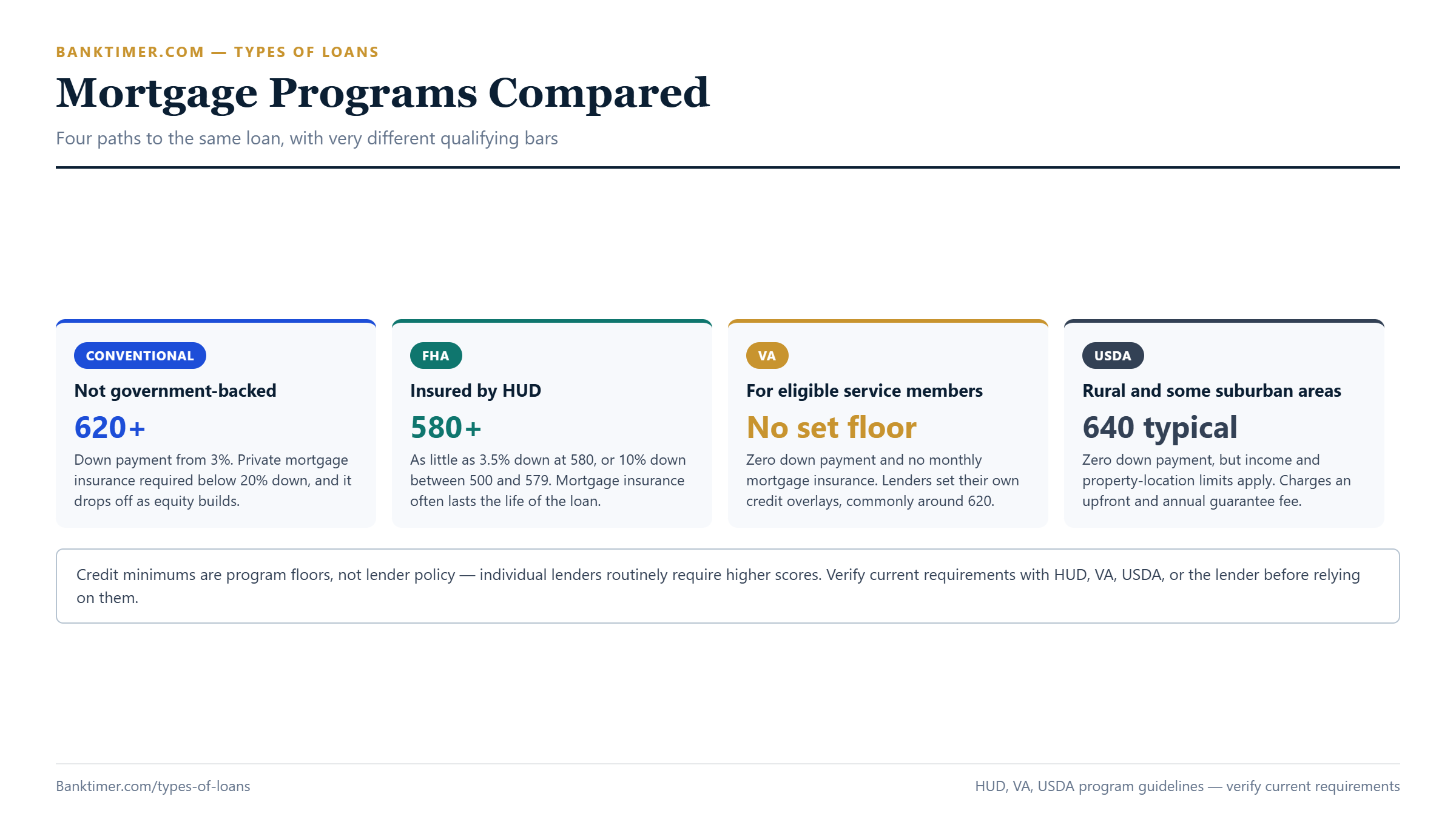
Mortgages come from banks, credit unions, online direct lenders, and mortgage brokers who shop your application across a panel of wholesale lenders. Beyond the lender type, the loan program matters just as much: conventional loans follow Fannie Mae and Freddie Mac guidelines, while FHA, VA, and USDA loans are government-backed programs with their own credit and down-payment rules, often more forgiving than a conventional loan for a first-time or lower-down-payment buyer.
Terms and Repayment Structure
The 30-year fixed-rate mortgage remains the default choice, but it isn’t the only one. A 15-year fixed loan carries a meaningfully lower rate and builds equity faster in exchange for a bigger monthly payment. Adjustable-rate mortgages — now structured as 5/6, 7/6, or 10/6 ARMs rather than the older 5/1 naming — fix an initial rate for the first several years, then adjust every six months afterward based on a market index plus the lender’s margin.
Who a Mortgage Is Best Suited For
A mortgage makes sense for anyone planning to stay in a home long enough to justify the closing costs and the time it takes equity to build — generally several years at minimum. Someone likely to relocate within a year or two, or who hasn’t stabilized their income enough to comfortably absorb property taxes, insurance, and maintenance on top of the payment, is often better served waiting or renting rather than rushing into this particular type of loan.
Mortgage Rates and Costs in 2026
Current Average Rates
As of Freddie Mac’s September 10, 2026 survey, the 30-year fixed rate averaged 6.76% and the 15-year fixed averaged 6.09%, with 5/6 ARMs running roughly 6.27% to 6.42%. Rates had been drifting toward the low 6% range earlier in 2026 before climbing back above 6.7% following the Federal Reserve’s September 16 rate hike — the first increase since 2023 — which pushed mortgage pricing in the opposite direction from where many forecasters expected it to land this year.
What Drives Your Specific Rate
Your own quote depends on your credit score tier, your down payment size, your loan program, and your specific lender’s pricing that day. A borrower with a 760+ credit score routinely qualifies for a noticeably better rate than one in the 620s, and the 2026 conforming loan limit of $832,750 in most counties ($1,249,125 in high-cost areas) determines whether your loan even qualifies for standard conventional pricing or falls into costlier jumbo territory.
Closing Costs and Fees Beyond the Rate
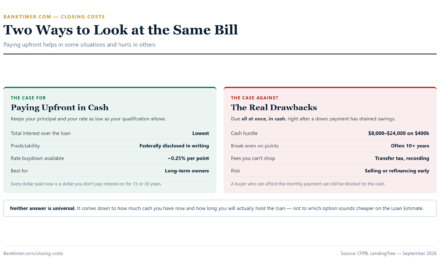
Expect total closing costs of roughly 2% to 5% of the loan amount — $7,000 to $17,500 on a $350,000 loan — covering origination fees, appraisal, title insurance, recording fees, and prepaid items like property taxes and homeowners insurance. None of these are optional extras; they’re the standard cost of originating this type of loan, and they’re disclosed in detail on your Loan Estimate and Closing Disclosure.
How to Estimate Your Real Cost
Don’t compare mortgage offers by interest rate alone. Compare the APR, which folds in points and lender fees, and compare the total monthly payment including principal, interest, taxes, and insurance (PITI) rather than just the loan payment itself. A quarter-point rate difference on a $400,000 mortgage moves your payment by roughly $65 a month — small on paper, but over 30 years it adds up to more than $23,000 in extra interest. Run that same comparison across the different types of loans you’re actually choosing between — say, a 30-year fixed against a 5/6 ARM — rather than assuming the lowest advertised number is automatically the cheapest loan over time.
Qualifying and Applying for a Mortgage
Credit, Income, and Down Payment Requirements
Conventional loans typically require a minimum credit score around 620 (740 or higher for the best pricing), a debt-to-income ratio under roughly 36%, and a down payment as low as 3%. FHA loans go lower on credit — technically down to 580, though most lenders prefer 620 in practice — in exchange for mandatory mortgage insurance. Put down less than 20% on a conventional loan and expect private mortgage insurance until you build enough equity to remove it.
Documents You’ll Need
Lenders want recent pay stubs, W-2s or tax returns, bank statements showing your down payment and reserves, and documentation of any other income or debt. Self-employed borrowers typically need two years of tax returns and a profit-and-loss statement. Getting these together before you start shopping shortens the entire process and makes a strong preapproval possible on the first pass rather than the third.
The Step-by-Step Process
Get preapproved before you shop for homes, not after — a preapproval tells sellers you’re a serious, qualified buyer and tells you your real price range. Once you’re under contract, the lender orders an appraisal, underwrites your file, and issues a Loan Estimate followed later by a Closing Disclosure at least three business days before closing. Locking your rate at the right moment in this process protects you from the rate risk that comes with a several-week closing timeline; see Banktimer’s guide to mortgage rate locks for how that works in detail.
How to Get the Best Offer
Shop at least three lenders within the same 14-to-45-day window so multiple hard inquiries count as a single pull for scoring purposes, and compare full Loan Estimates side by side, not just headline rates. Ask each lender directly about discount points, lender credits, and whether your specific down payment size triggers mortgage insurance you could avoid by adjusting it slightly.
Common Mortgage Mistakes and Red Flags
Mistake: Skipping Preapproval
House-hunting before getting preapproved is one of the most common — and most avoidable — mistakes a buyer makes. Without it, you risk falling for a home outside your real budget, losing negotiating leverage against a preapproved competing buyer, and discovering credit or income issues only after you’ve already made an offer.
Mistake: Draining Your Savings for the Down Payment
Putting every available dollar toward the down payment to avoid mortgage insurance can leave you with zero reserve for the repairs, closing surprises, or income gaps that inevitably show up in the first year of homeownership. A smaller down payment plus a healthy cash cushion is often the financially sounder choice, even though it costs slightly more each month.
Red Flag: Wire Fraud at Closing
Scammers routinely spoof title or escrow company emails in the days before closing, sending “updated” wiring instructions that route your down payment straight into a criminal’s account. Always verify wiring instructions by phone, using a number you look up independently — never one provided in the email itself — before you send a single dollar.
Red Flag: Steering Toward a Costlier Product
A loan officer who discourages you from comparing assistance programs, or who steers you toward a specific product without disclosing cheaper alternatives you might qualify for, may be optimizing for their own compensation rather than your outcome. You’re also legally entitled to a three-business-day window to review your Closing Disclosure before signing — treat any pressure to skip that review as a warning sign, not a formality.
Mortgage Refinance
Refinancing replaces your existing mortgage with a new one — ideally at a better rate, a shorter term, or with cash pulled out of your equity — but it’s still a brand-new loan with its own closing costs, its own underwriting, and its own math that has to actually work out in your favor before it’s worth doing.
Refinancing sits in an unusual spot among the types of loans in this guide: it isn’t really a new financial decision so much as a re-negotiation of one you already made. That distinction matters because the mistakes that trip up refinance borrowers are different from the mistakes that trip up first-time borrowers of other types of loans — nobody refinancing is picking a home or negotiating a purchase price, so the entire decision comes down to a single question: does the math on this new loan actually beat the math on the one you already have, once every closing cost is counted?
How Mortgage Refinance Works
The Basic Structure
A refinance pays off your current mortgage balance with a new loan, then puts you on the new loan’s rate and terms going forward. Nothing about your home’s ownership changes — you’re not selling or re-buying anything — you’re simply swapping one loan contract for another, ideally a cheaper or more useful one.
Rate-and-Term vs. Cash-Out Refinancing
A rate-and-term refinance keeps your loan balance essentially the same while chasing a better rate or a different term length. A cash-out refinance borrows more than your current balance and hands you the difference in cash, secured against your home’s equity — useful for large expenses, but it resets your amortization clock and increases what you owe against the house.
Where to Get One
The same lenders that originate purchase mortgages — banks, credit unions, online lenders, and brokers — handle refinances, and you are under no obligation to refinance with your current servicer. Shopping your refinance the same way you’d shop a purchase mortgage routinely turns up meaningfully different offers for an identical loan.
Who Refinancing Is Best Suited For
Refinancing suits homeowners who can meaningfully lower their rate, who need to convert an adjustable rate to a fixed one before it resets higher, or who have a clear, calculated use for cash-out funds. It’s a poor fit for anyone planning to move soon, since the closing costs need time to pay for themselves before the deal is actually a win.
Mortgage Refinance Rates and Costs in 2026
Current Average Rates
As of September 15, 2026, 30-year refinance rates averaged 6.96% (7.03% APR) and 15-year refinance rates averaged 6.23% (6.35% APR) — up from a 2026 low of 6.09% earlier in the year. Refinance application volume fell roughly 25% year-over-year following the Fed’s September rate hike, as the window that had briefly made refinancing attractive to more borrowers narrowed again.
Qualification Requirements
Cash-out refinances cap your loan-to-value ratio at 80% for conventional and FHA loans (90% for VA), meaning you need to keep at least that much equity in the home after cashing out. Minimum credit scores run around 640 or higher for conventional refinances, with somewhat more flexibility on FHA and VA loans. Most lenders also require you to have held your current loan for six to twelve months before refinancing, depending on the loan type.
Closing Costs and Fees
Expect the same 2% to 6% closing-cost range as a purchase mortgage, since a refinance is underwritten as a brand-new loan with its own appraisal, title work, and origination fees. There’s no way around paying these costs again, which is exactly why the math below matters so much.
The Break-Even Calculation
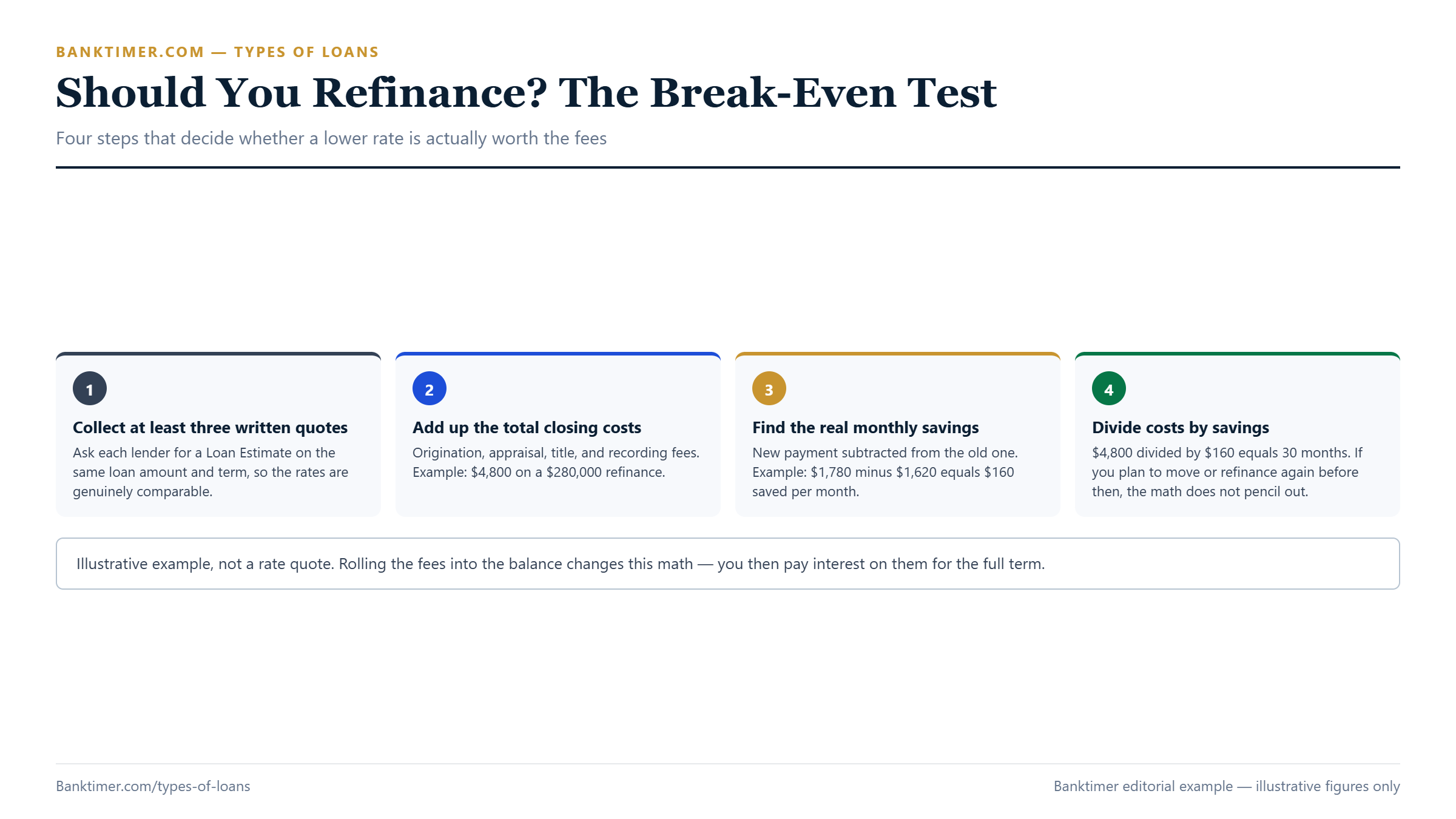
Divide your total closing costs by your monthly savings to find your break-even point in months. Spend $6,000 to save $150 a month and you break even in 40 months; stay in the home past that point and the refinance is a genuine win. Leave sooner, and you’ve paid more in closing costs than you saved. This break-even logic is worth remembering well beyond refinancing — it’s the same basic test worth applying any time you’re comparing types of loans that trade a lower rate for an upfront cost.
Qualifying and Applying for a Refinance
Credit and Equity Requirements
Beyond the loan-to-value caps above, lenders look at the same credit, income, and debt-to-income factors as a purchase mortgage — generally a debt-to-income ratio under 43%, though strong compensating factors can stretch that ceiling. The median credit score among cash-out refinance borrowers runs around 741, noticeably higher than the minimum needed to qualify at all.
Documents You’ll Need
The document list mirrors a purchase mortgage: recent pay stubs, tax returns, bank statements, and your current mortgage statement showing your existing balance and rate. Lenders will also order a fresh appraisal to confirm your home’s current value supports the new loan amount.
The Step-by-Step Process
Shop multiple lenders, lock a rate once you’ve chosen one, and expect the same appraisal-and-underwriting timeline as a purchase — typically three to six weeks. Because you already own the home, there’s no home search or contract negotiation involved, which is the one part of the process genuinely simpler than buying.
How to Get the Best Offer
Get quotes from your current servicer and at least two competitors — servicers sometimes offer a reduced-cost “rate-and-term modification” to retain your business rather than lose you to a competitor entirely. Ask every lender to itemize closing costs, since these vary more between refinance lenders than the rate itself often does.
Common Refinance Mistakes and Red Flags
Mistake: Never Calculating the Break-Even Point
Refinancing without running the break-even math is the single most common mistake in this section. A lower monthly payment feels like an obvious win until you realize the closing costs won’t be recovered for three or four years — longer than you actually plan to stay.
Mistake: Resetting Your Loan Term Without Noticing
Refinancing 20 years remaining on your original mortgage into a brand-new 30-year loan can lower your monthly payment while quietly increasing your total lifetime interest, since you’re spreading the balance over more years again. If lowering the payment is your only goal, at least compare a 20-year refinance term against resetting to 30.
Red Flag: Foreclosure-Relief Refinance Scams
Scammers targeting struggling homeowners offer “refinance” or “loan modification” help that requires an upfront fee, instructs you to stop paying your existing lender, or asks you to redirect payments to a third party — all classic signs of a foreclosure-relief scam rather than legitimate assistance, which never charges a fee before performing the service.
Red Flag: “No-Closing-Cost” Refinances That Hide the Math
A refinance advertised as having no closing costs hasn’t eliminated them — it’s rolled them into a higher rate or a larger balance. That can be a reasonable trade if you understand it clearly, but treat any refinance offer that doesn’t spell out exactly where the costs went as one that needs more questions before you sign.
Home Equity Loans
A home equity loan borrows against the value you’ve already built in your house, paid out as a single lump sum with a fixed rate and a fixed payment — the more conservative, predictable sibling of the HELOC covered next.
Home equity loans and HELOCs are frequently lumped together as though they’re the same types of loans wearing different labels, but the distinction runs deeper than lump-sum versus revolving credit. A home equity loan behaves much more like the fixed-rate, fully amortizing mortgage described earlier in this guide, just layered on top of your existing first lien. If predictability matters more to you than flexibility, that similarity to a traditional mortgage is exactly the point — you’re trading the open-ended access of a credit line for a payment that will never move, regardless of what happens to rates elsewhere in the economy.
How a Home Equity Loan Works
The Basic Structure
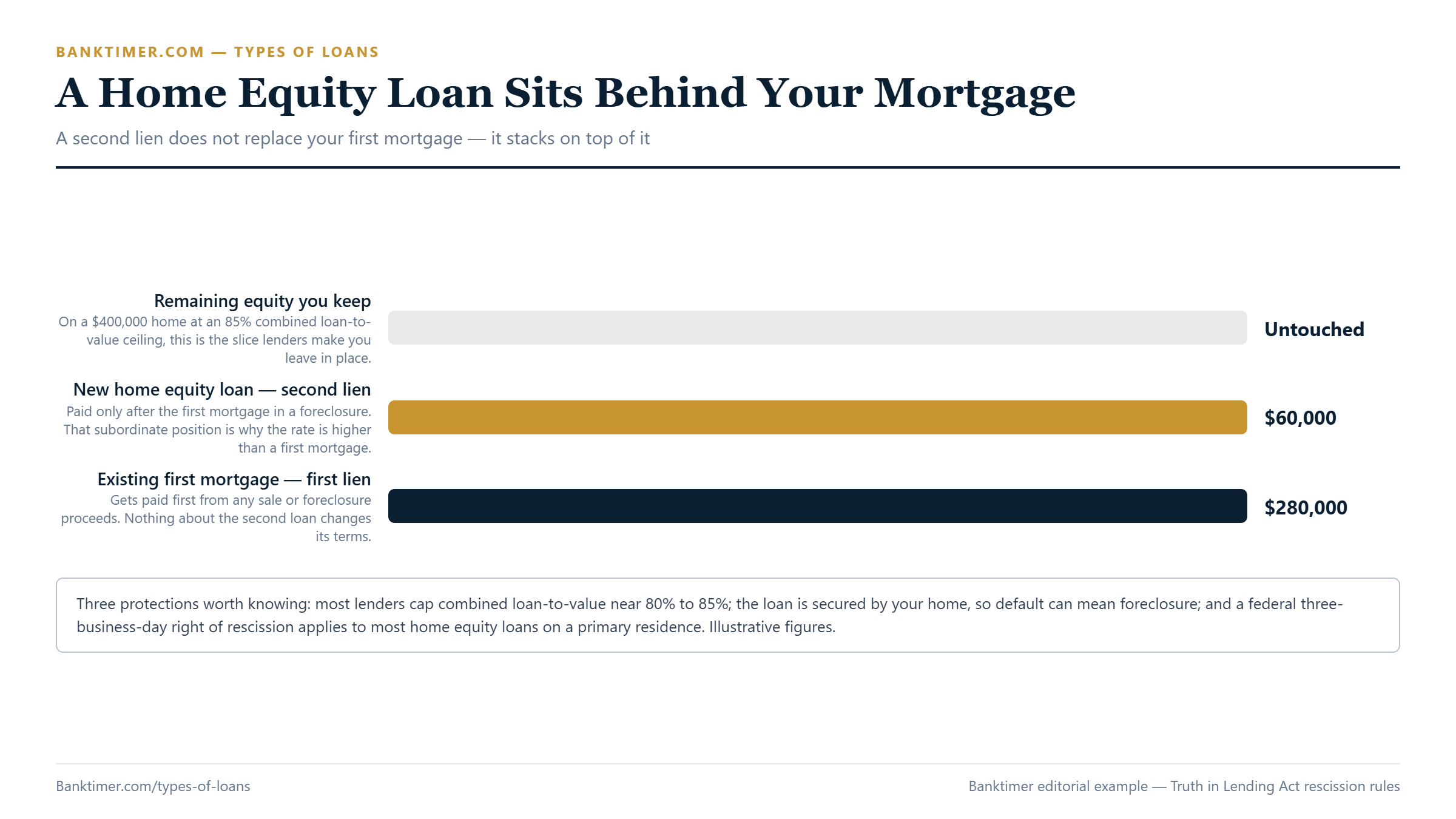
A home equity loan is a second mortgage: a new lien sits behind your existing first mortgage, secured by the same property, and you receive the entire approved amount at closing in one lump sum. You repay it on a fixed schedule alongside your regular mortgage payment, completely separate from your first loan’s rate and term.
Where to Get One
Banks, credit unions, and online lenders all offer home equity loans, and rates vary widely enough between them — a full range of 5.90% to 10.75% as of September 2026 — that shopping multiple lenders for this type of loan matters more than it might for a more commoditized product like a purchase mortgage.
Terms and Repayment Structure
Standard terms run 5, 10, or 15 years, with some lenders offering terms up to 30. Every payment is fixed for the life of the loan — there’s no adjustable-rate version of this product, which is the main structural difference between a home equity loan and the line of credit covered next.
Who a Home Equity Loan Is Best Suited For
This type of loan suits a borrower who knows exactly how much they need, wants a predictable payment, and has a specific one-time use for the money — a major renovation, a debt consolidation payoff, or a large planned expense. If your funding need is ongoing or uncertain in amount, a revolving line of credit is usually the better structural fit.
Home Equity Loan Rates and Costs in 2026
Current Average Rates
Bankrate’s September 2026 survey put 5-year home equity loans at an average 8.13%, 10-year loans at 8.28%, and 15-year loans at 8.22% — rates that have held essentially flat for three consecutive weeks even as mortgage and refinance rates moved after the Fed’s rate hike.
What Drives Your Specific Rate
Lenders price this loan off your combined loan-to-value ratio — your first mortgage balance plus the new home equity loan, measured against your home’s value — with 80% combined LTV as the standard benchmark most lenders underwrite against. Most require you to retain at least 15% to 20% equity after the new loan closes.
Closing Costs and Fees
Expect 2% to 5% of the loan amount in closing costs: appraisal fees of $300 to $500, credit report fees, origination charges of 0.4% to 1%, and title insurance similar in structure to a purchase mortgage’s. Minimum loan amounts commonly run $25,000 to $35,000, so this product doesn’t make sense for smaller borrowing needs.
How to Estimate Your Real Cost
Confirm upfront whether your specific use of funds qualifies for mortgage-interest tax deductibility — under current IRS rules, the interest is only deductible when proceeds go toward buying, building, or substantially improving the home securing the loan, not for general expenses like debt payoff or tuition.
Qualifying and Applying for a Home Equity Loan
Credit and Equity Requirements
Requirements vary meaningfully by lender: some accept borrowers with scores in the 600s, though the best pricing goes to stronger credit profiles. The combined-loan-to-value ceiling matters as much as your score — even excellent credit won’t get you approved if the math against your home’s value doesn’t leave enough equity behind.
Documents You’ll Need
Expect the same documentation as a mortgage application: income verification, tax returns, bank statements, and a current mortgage statement showing your existing balance. The lender will also order a fresh appraisal to establish your home’s current value.
The Step-by-Step Process
Apply, get appraised, get underwritten, and close — typically a two-to-six-week process, faster than a purchase mortgage since there’s no home search or seller negotiation involved. You’ll receive your funds as a single deposit shortly after closing.
How to Get the Best Offer
Given how wide the rate spread runs across lenders for this product, get at least three quotes before committing. A borrower who accepts the first offer without comparing risks paying meaningfully more than a nearly identical borrower who shopped.
Common Home Equity Loan Mistakes and Red Flags
Mistake: Borrowing More Than You Actually Need
Because approval often comes in at a higher amount than requested, it’s tempting to take the full approved sum “just in case.” Every extra dollar borrowed accrues interest immediately, whether you spend it right away or not.
Mistake: Spending It on Non-Essentials
Using home equity funds for a vacation or discretionary spending converts an asset you’ve built over years into debt secured by your house — if repayment goes wrong, the consequences are far more serious than an unpaid credit card balance.
Red Flag: Appraisal Inflation Pressure
A lender or broker who encourages you, directly or indirectly, to overstate your home’s value in order to qualify for a larger loan is setting you up for a loan you may not actually be able to support, and possibly for appraisal fraud.
Red Flag: Balloon Payments or Hidden Prepayment Penalties
A genuine home equity loan is fully amortizing at a fixed rate with no balloon payment — confirm both in writing. You’re also legally entitled to a three-business-day right of rescission on a home equity loan against your primary residence; any pressure to sign and fund the same day is worth questioning.
HELOC
A home equity line of credit works from the same collateral as a home equity loan — your house — but structures it as a revolving credit line you draw against as needed, rather than a lump sum you receive all at once.
Among the different types of loans secured by home equity, a HELOC is the one most often confused with a credit card — and the comparison isn’t entirely wrong. Both are revolving, both charge interest only on what you actually draw, and both can be paid down and redrawn during their active period. The differences that matter are the ones the credit-card comparison hides: a HELOC is secured by your home rather than unsecured, which is exactly why its rate runs a fraction of a typical credit card’s, and exactly why the consequences of falling behind are so much more serious than a ding to your credit score.
How a HELOC Works
The Basic Structure
A HELOC is a revolving credit line secured by your home, similar in structure to a credit card but backed by real property and priced far lower as a result. You draw what you need, when you need it, up to your approved limit, and you only pay interest on the amount actually drawn.
The Draw Period and Repayment Period
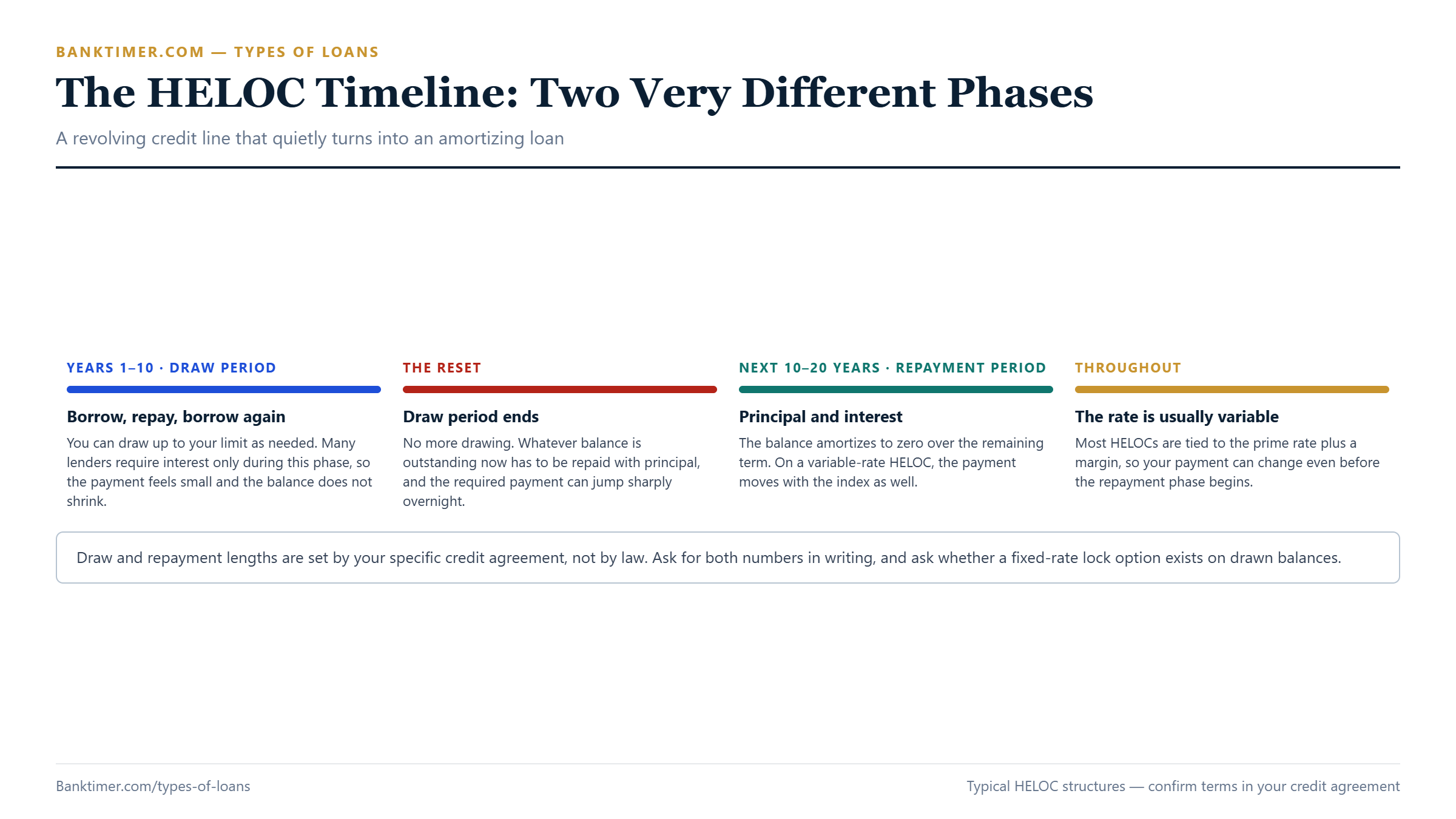
Every HELOC runs through two distinct phases: a draw period, typically 5 to 10 years, during which many lenders allow interest-only payments, followed by a repayment period, typically 10 to 20 years, during which principal gets added to the payment and the balance amortizes down to zero.
Where to Get One
Banks and credit unions dominate this market, though online lenders increasingly compete here too, some now offering fixed-rate conversion options that let you lock a portion of your drawn balance at a stable rate rather than leaving the entire line variable.
Who a HELOC Is Best Suited For
A HELOC suits ongoing or uncertain funding needs — a multi-phase renovation, a financial cushion you may or may not tap, or a business owner who wants flexible access to equity without committing to a lump sum upfront. It’s a poor fit for anyone likely to spend impulsively against an available credit line.
HELOC Rates and Costs in 2026
Current Average Rates
The national average HELOC rate stood at 7.26% as of September 9, 2026 — its third consecutive weekly decline, described by rate trackers as the most affordable HELOC pricing in months even as first-lien mortgage rates moved higher over the same stretch. The full market range runs from promotional rates as low as 3.99% up to 11.60%.
Why HELOC and Mortgage Rates Are Moving in Opposite Directions
This is one of the more interesting rate dynamics in this entire guide: HELOC pricing eased through much of 2026 while mortgage and refinance rates climbed after the Fed’s September hike, making a HELOC relatively more attractive than a cash-out refinance for homeowners who want equity access without disturbing a low rate on their existing first mortgage. It’s a useful reminder that the different types of loans in this guide don’t all move together — each one responds to its own mix of supply, demand, and lender risk appetite, even when they share the same underlying benchmark rates.
Fees Beyond the Rate
Because it’s variable and revolving, this type of loan carries fee categories a fixed home equity loan doesn’t: annual fees of $0 to $100, inactivity fees of $200 to $500 if you don’t draw enough, early-termination fees up to $500, and minimum per-withdrawal fees of $25 to $50 at some lenders. Closing costs otherwise mirror a home equity loan, at roughly 2% to 5% of your credit line.
How to Estimate Your Real Cost
Because the rate is variable, model your payment at a meaningfully higher rate than today’s average before you commit — a rate increase can nearly double payments on a large drawn balance, and budgeting only for today’s rate is one of the more expensive assumptions a HELOC borrower can make.
Qualifying and Applying for a HELOC
Credit and Equity Requirements
A 680 credit score has been the traditional benchmark, though some lenders now accept lower scores. As with a home equity loan, you’ll generally need to retain 15% to 20% equity in your home after the line is opened, and lenders verify steady income and an acceptable debt-to-income ratio.
Documents You’ll Need
Expect income verification, tax returns, and a current mortgage statement, plus a fresh appraisal to establish your home’s value and how much equity is actually available to draw against.
The Step-by-Step Process
Application and underwriting typically take two to six weeks, similar to a home equity loan. Once approved, you receive access to the line — often through checks, a card, or online transfers — rather than a single deposit, and you control when and how much you draw from that point forward.
How to Get the Best Offer
Compare not just the rate but the full fee schedule, since annual and inactivity fees vary widely and can erode the value of a seemingly cheap rate if you don’t plan to draw consistently. Ask directly whether a fixed-rate conversion option is available for balances you draw.
Common HELOC Mistakes and Red Flags
Mistake: Treating the Line as Found Money
An available HELOC balance is not savings — it’s debt the moment you draw it, accruing interest immediately. Borrowers who treat an open line as a safety net without a repayment plan routinely end up carrying balances they didn’t intend to.
Mistake: Not Budgeting for the Repayment-Period Jump
When the draw period ends and principal repayment begins, payments can rise sharply, especially on interest-only draw-period balances. Model that jump well before it arrives rather than discovering it the month your payment doubles.
Red Flag: A “HELOC” That’s Actually a Disguised Loan
Watch for products marketed as a HELOC that behave like a lump-sum loan in disguise: a mandatory large initial draw of 80% to 100% of the line at closing, no interest-only option during the draw period, a fixed rate with no draw flexibility, or an origination fee charged against the full line rather than the amount actually drawn. Two or more of these signs means you’re likely looking at a mislabeled product, not a genuine revolving line.
Red Flag: Account Takeover and Draw Fraud
HELOC accounts have become a growing fraud target — monitor draw alerts and account activity closely, since fraudsters have targeted existing lines to initiate unauthorized draws, and lenders have added extra verification steps in response.
Personal Loans
A personal loan is the most flexible type of loan in this entire guide — unsecured, usable for almost any purpose, and priced almost entirely on your credit profile rather than on any collateral you put up.
That flexibility is precisely why personal loans get compared against almost every other item in this guide at some point — against a HELOC for a renovation, against a 0% credit card offer for a purchase, against a factor-rate business loan for a business owner who’s also willing to borrow personally. Of all the types of loans covered here, this is the one most likely to be shopping against a completely different product rather than a close substitute, which makes the APR-versus-APR comparison habit described throughout this guide even more important — you’re not just comparing personal loan offers against each other, you’re often comparing this type of loan against a fundamentally different one.
How a Personal Loan Works
The Basic Structure
A personal loan is unsecured installment credit: you borrow a fixed amount, receive it as a lump sum, and repay it in equal monthly installments over a set term. Because there’s no collateral backing it, the lender’s entire risk assessment rests on your credit history, income, and existing debt.
Where to Get One
Banks, credit unions, and online lenders all compete heavily in this space, and the differences between them are large: credit unions average 6.09% to 18.00% (capped at an 18% federal APR ceiling), banks run 6.74% to 26.74%, and online lenders span the widest range at 5.96% to 35.99%, depending heavily on your credit tier.
Terms and Repayment Structure
Loan amounts commonly run from $1,000 to $50,000 or more for the strongest borrowers, with repayment terms of two to seven years — three and four-year terms are the most common middle ground between an affordable payment and a manageable total interest cost.
Who a Personal Loan Is Best Suited For
This type of loan suits a borrower who needs a fixed sum for a defined purpose — debt consolidation, a major purchase, an emergency expense — and who has strong enough credit to get a rate meaningfully below what they’re already paying on higher-cost debt like credit cards.
Personal Loan Rates and Costs in 2026
Current Average Rates
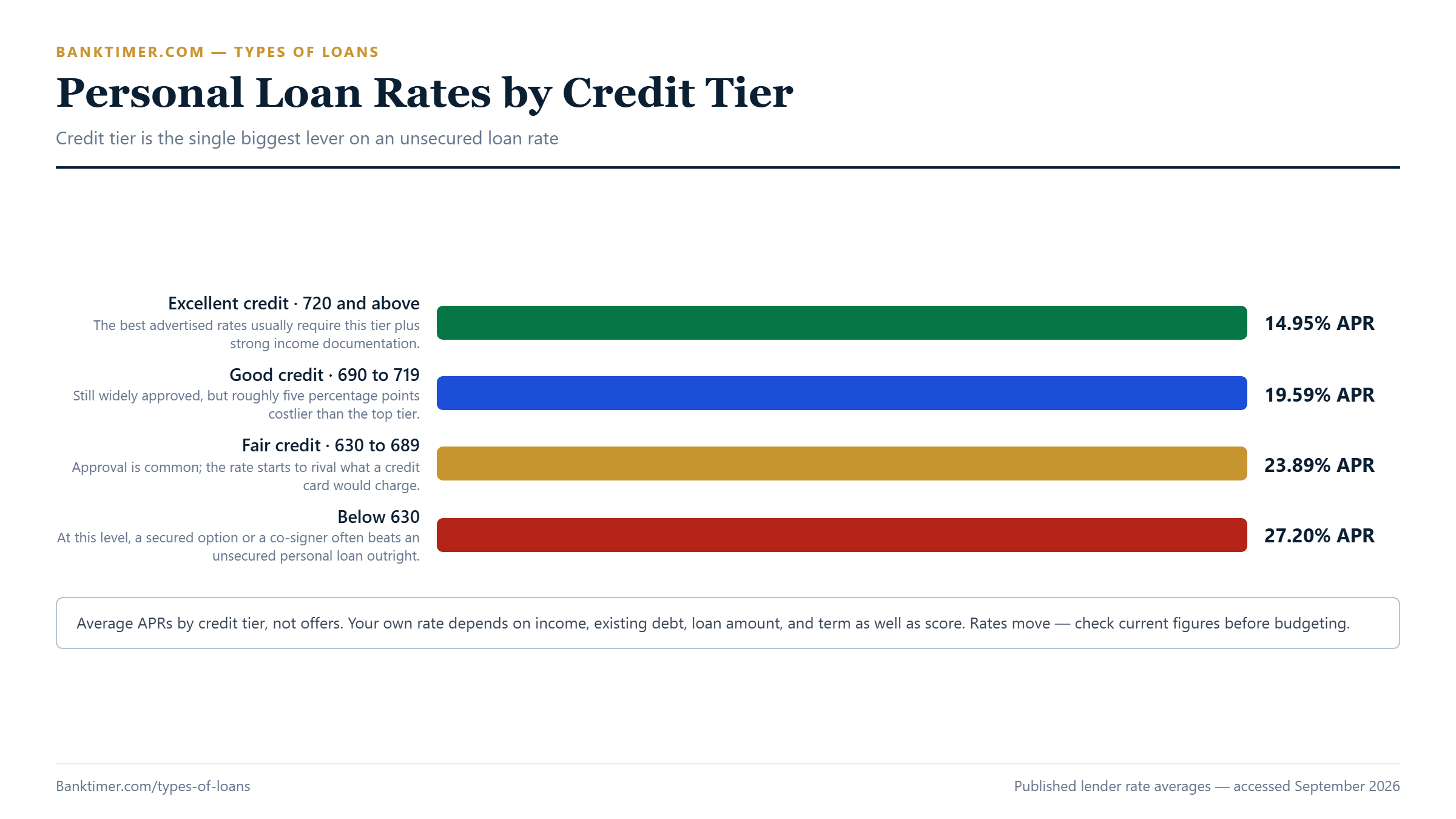
NerdWallet’s September 2026 data put the overall average personal loan rate at 18.87% APR, split sharply by credit tier: 14.95% for excellent credit (720+), 19.59% for good credit (690–719), 23.89% for fair credit (630–689), and 27.20% for borrowers below 630.
What Drives Your Specific Rate
Your credit tier is the dominant factor, but your debt-to-income ratio matters almost as much — lenders generally want it at or below 36% for the best odds and pricing, with 37% to 43% still workable and anything above 50% considered too high at most lenders regardless of credit score.
Fees Beyond the Rate
Origination fees can run surprisingly high on this type of loan — up to 12% of the loan amount at some lenders — and are deducted directly from your proceeds rather than billed separately, meaning you receive less than you borrowed even though you owe interest on the full amount. Some lenders, including several credit unions and select online lenders, charge no origination fee at all.
How to Estimate Your Real Cost
Always compare offers by APR, not the advertised interest rate alone, since the origination fee and any other mandatory charges are baked into that figure and the rate alone isn’t. A loan advertising a lower rate but a much higher origination fee can easily cost more overall than a higher-rate loan with no fee.
Qualifying and Applying for a Personal Loan
Credit and Income Requirements
Lenders evaluate your credit score, income stability, and debt-to-income ratio together — there’s no universal minimum score, since tiers and cutoffs vary by lender, but the rate table above shows how dramatically your tier affects what you’ll actually pay.
Documents You’ll Need
Expect to provide recent pay stubs, W-2s or tax returns, bank statements, and proof of identity and address. Self-employed applicants typically substitute profit-and-loss statements or 1099 forms for pay stubs.
The Step-by-Step Process
Most lenders let you prequalify with a soft credit pull that shows estimated rates without affecting your score, then move to a formal application and hard pull only once you’ve chosen an offer. Funding often arrives within one to a few business days of final approval.
How to Get the Best Offer
Prequalify with several lenders before applying formally — since prequalification uses a soft pull, there’s no credit-score cost to comparing multiple offers side by side before committing to one hard inquiry.
Common Personal Loan Mistakes and Red Flags
Mistake: Skipping Prequalification Shopping
Applying to only one lender means you have no basis for comparison and no negotiating leverage — and given how widely rates span by lender type, skipping this step is one of the most expensive shortcuts a borrower can take.
Mistake: Borrowing More Than You Need
A larger loan than necessary increases both your monthly payment and your total interest cost for no real benefit — resist any lender’s suggestion to round up “just in case.”
Red Flag: Guaranteed Approval Regardless of Credit
Any lender promising approval without a credit or income check at all is not underwriting a real loan — it’s setting up a predatory or fraudulent arrangement, often with rates and fees kept hidden until after you’ve committed.
Red Flag: Upfront Fees Demanded Before Funding
A legitimate origination fee is deducted from your proceeds at the moment of funding — never paid separately, in advance, out of your own pocket. A request for a “processing fee” before any money is disbursed is a classic advance-fee scam pattern.
Auto Loans
An auto loan finances a vehicle purchase, secured by the car itself, and it’s one of the types of loans most vulnerable to markup and fine-print games precisely because it’s usually arranged in the middle of an emotional, time-pressured purchase.
Auto loans share more in common with mortgages than with personal loans, structurally speaking — both are secured installment types of loans tied to a specific, depreciating or appreciating asset, and both involve a title that doesn’t fully clear until the balance is paid off. The difference is speed and stakes: a mortgage closing takes weeks and involves a small army of paperwork, while an auto loan can be arranged in an afternoon, at a dealership, by a finance manager whose incentives don’t always match yours — which is exactly why the preapproval habit recommended throughout this guide matters so much more here than it does for slower-moving types of loans.
How an Auto Loan Works
The Basic Structure
An auto loan is secured installment credit: the vehicle serves as collateral, meaning the lender can repossess it if you default. You repay the loan in fixed monthly installments over a set term, and the title typically doesn’t transfer fully into your name alone until the loan is paid off.
Where to Get One
You can finance through the dealership, a bank, a credit union, or an online direct lender — and the rate can vary by 2 to 3 percentage points across these options for the exact same borrower, since dealerships commonly mark up the wholesale rate a bank actually offers by 1 to 2 percentage points as their own profit margin.
Terms and Repayment Structure
Standard terms run 24 to 84 months, and the average has been stretching longer — 69.5 months for new cars and 67.9 months for used cars as of Experian’s second-quarter 2026 data — a trend driven largely by rising vehicle prices pushing buyers toward longer terms to keep payments manageable.
Who an Auto Loan Is Best Suited For
This type of loan makes sense for anyone who needs reliable transportation and has weighed the total cost against alternatives like a shorter loan, a less expensive vehicle, or a larger down payment. It’s a poor fit for anyone tempted to stretch the term primarily to make an unaffordable car look affordable on a monthly-payment basis.
Auto Loan Rates and Costs in 2026
Current Average Rates
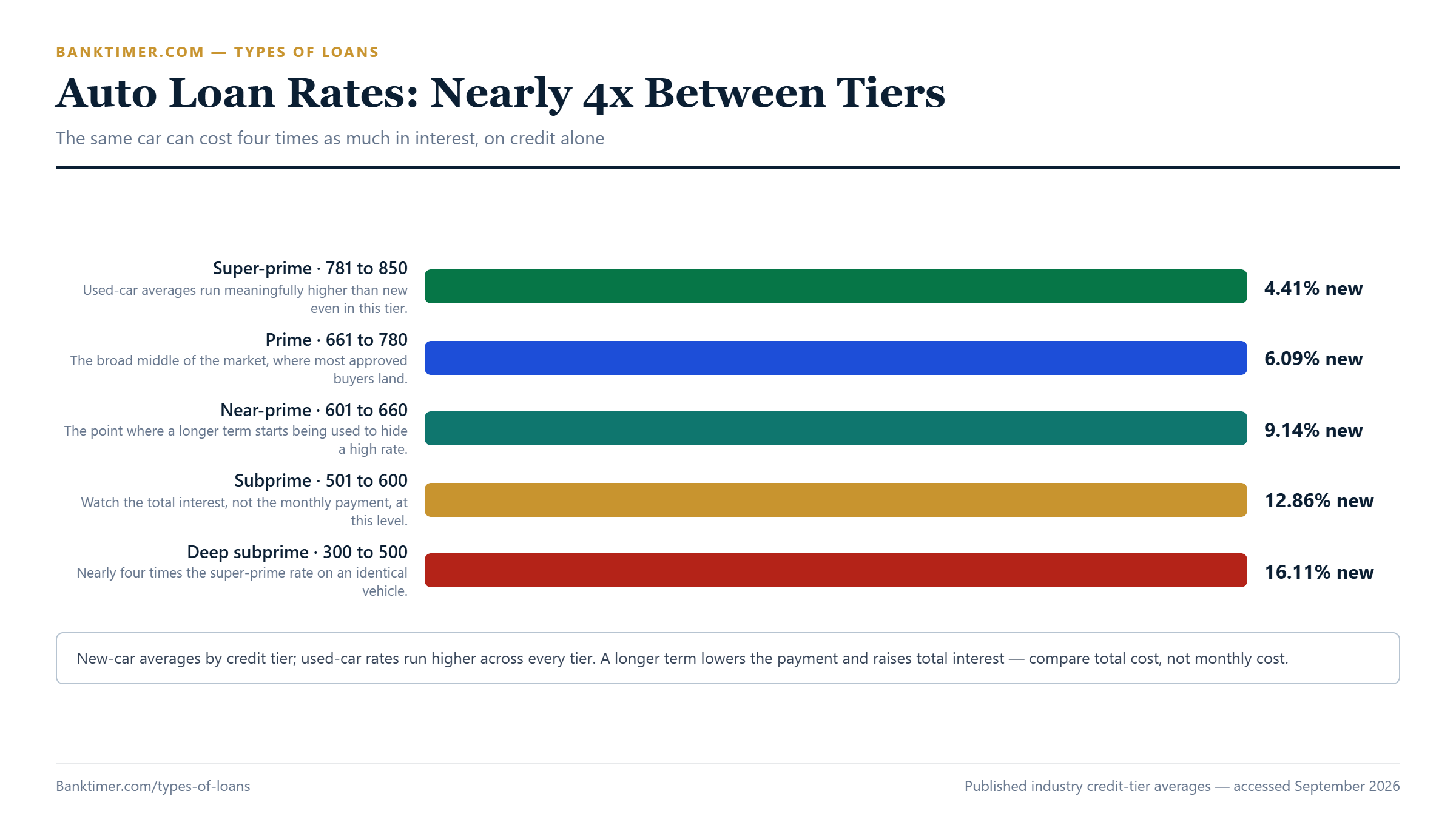
Bankrate’s September 9, 2026 survey put 60-month new-car loans at 6.90% and 48-month used-car loans at 7.39%. Experian’s tiered breakdown shows the real spread: super-prime borrowers (781+) averaged 4.41% on new cars, while deep-subprime borrowers (below 500) averaged 16.11% — nearly four times the rate for the same vehicle.
What Drives Your Specific Rate
Your credit tier is the largest factor, but loan-to-value matters too — a larger down payment lowers your rate risk to the lender and helps avoid the negative equity that comes from financing a depreciating asset at close to 100% of its value.
Fees Beyond the Rate
Beyond the dealer markup already mentioned, watch for documentation and processing fees (sometimes a flat few hundred dollars), and packed add-ons — extended warranties, GAP insurance, VIN etching — that dealers routinely bundle into the financing without always making clear that each one is optional and separately priced.
How to Estimate Your Real Cost
Stretching a $40,000 loan from 60 to 84 months might cut your payment from roughly $750 to $550, but it adds close to $5,000 in extra interest over the life of the loan — a trade that only makes sense if the shorter term genuinely doesn’t fit your budget, not simply because the bigger number looks better on the lot. This is the same stretch-the-term trade-off that shows up across nearly every one of the types of loans in this guide, from mortgages to debt consolidation loans — a lower payment today almost always means a higher total cost later.
Qualifying and Applying for an Auto Loan
Credit and Income Requirements
Lenders sort borrowers into tiers — super-prime, prime, near-prime, subprime, and deep-subprime — and your tier determines both your approval odds and your rate. Most also weigh your debt-to-income ratio, generally wanting your total monthly obligations, including the new car payment, to stay under 45% to 50% of income.
Documents You’ll Need
Expect to provide proof of income, proof of insurance, a driver’s license, and, if financing through a bank or credit union rather than the dealership, preapproval paperwork you bring with you to negotiate.
The Step-by-Step Process
Get preapproved by a bank or credit union before you visit the dealership — this single step gives you a real number to negotiate against rather than accepting whatever financing the dealership presents as your only option.
How to Get the Best Offer
Negotiate the vehicle’s price and the financing terms as two separate conversations, not one. A dealer can offer an attractive price while making it back on a marked-up interest rate, so bring your own preapproval and let the dealer beat it if they can.
Common Auto Loan Mistakes and Red Flags
Mistake: Financing at the Dealership Without Shopping First
Accepting dealership financing without a preapproval in hand means accepting whatever markup the dealer builds into the rate, with no comparison point to negotiate against.
Mistake: Minimal or No Down Payment
Cars depreciate roughly 20% in the first year alone. Financing near the full purchase price with little or no down payment routinely leaves buyers owing thousands more than the car is worth for the first year or two of the loan.
Red Flag: Buy-Here-Pay-Here Lots
These dealer-financed lots often charge 15% to 20% or more, use GPS-enabled kill switches that can disable the car remotely over a single missed payment, and frequently report only negative payment history to credit bureaus — meaning on-time payments never help build your credit, only missed ones hurt it.
Red Flag: Yo-Yo Financing and Packed Add-Ons
“Yo-yo financing” lets you drive off before your loan is finalized, then calls you back days later to sign a worse deal under pressure. Separately, watch for extended warranties, GAP insurance, and similar add-ons slipped into the paperwork without clear, itemized consent — ask for an itemized breakdown of every charge before you sign anything.
Student Loans
Student loans stand apart from every other type of loan in this guide because the federal government isn’t just a regulator here — it’s the largest lender, and 2026 has brought the most significant overhaul to federal repayment rules in years.
That federal role is what makes student loans behave so differently from every other entry among the types of loans in this guide. A private lender sets its own underwriting rules and can adjust them whenever it wants; the federal government sets student loan terms through statute and regulation, which means the rules can change dramatically with a single piece of legislation, a court ruling, or a change in administration priorities — exactly what happened twice within 2026 alone. Treat the numbers in this section with that in mind: of all the types of loans covered here, this is the one most likely to look different a year from now, simply because the policy underneath it is still actively being rewritten.
How Student Loans Work
Federal vs. Private Loans
Federal student loans come directly from the U.S. Department of Education, require no credit check for Direct Subsidized or Unsubsidized loans, and carry borrower protections — income-driven repayment, deferment, forgiveness programs — that private loans simply don’t offer. Private student loans come from banks, credit unions, and online lenders, are underwritten on credit like any other consumer loan, and usually require a cosigner for an undergraduate without an established credit history.
Where to Get One
Federal loans are applied for through the FAFSA and disbursed through your school’s financial aid office. Private loans are shopped the same way as any other consumer loan — compare multiple lenders, since rates and cosigner-release terms vary meaningfully between them.
Terms and Repayment Structure
Federal loan rates are fixed for the life of the loan and set annually by Congress based on Treasury yields. Private loan terms vary by lender, typically five to twenty years, with both fixed and variable rate options available depending on the lender.
Who Each Type Suits
Exhaust federal loan eligibility before turning to private loans — federal loans carry protections worth far more than a slightly lower private rate in most cases. Private loans make sense only after federal options (and scholarships, grants, and work-study) are genuinely maxed out.
Student Loan Rates and Costs in 2026
Current Federal Rates
For loans first disbursed between July 1, 2026 and June 30, 2027, Direct Subsidized and Unsubsidized undergraduate loans carry a fixed 6.52% rate, Direct Unsubsidized graduate loans carry 8.07%, and Direct PLUS loans (parent and graduate) carry 9.07% — all calculated from the 10-year Treasury yield plus a statutory add-on that varies by loan type.
Current Private Rates
Private lenders in September 2026 advertised fixed rates roughly between 1.94% and 17.99% APR and variable rates between 3.75% and 18%, depending heavily on the borrower’s (or cosigner’s) credit profile — the widest advertised range of any loan type in this guide, and a strong reason to compare actual offers rather than headline “as low as” rates.
Fees Beyond the Rate
Federal Direct Subsidized and Unsubsidized loans carry a 1.057% origination fee; Direct PLUS loans carry 4.228% — both deducted proportionally from each disbursement. Many private lenders charge no origination fee at all, though it’s worth confirming for any specific offer.
How to Estimate Your Real Cost
Unsubsidized loan interest accrues from disbursement, even while you’re still in school, and can capitalize — get added to your principal — at the end of deferment periods, meaningfully growing your balance before repayment even starts. Making even small interest payments while in school measurably reduces this effect.
The 2026 Repayment Plan Overhaul
SAVE Plan Termination
A federal court vacated the SAVE repayment plan on March 10, 2026, after the Department of Education settled litigation brought by Missouri and other states rather than continue defending it. Roughly seven million borrowers who had been on SAVE were required to select a new repayment plan, with a transition window running from July 1 through the end of September 2026 — right now, for anyone reading this close to publication.
The New Repayment Assistance Plan (RAP)
RAP launched July 1, 2026, as the new income-driven option: payments run 1% to 10% of adjusted gross income with a $10 minimum, unpaid monthly interest is waived rather than capitalizing, the government guarantees at least $50 a month goes toward principal, and time on RAP counts toward Public Service Loan Forgiveness. Anyone who doesn’t actively choose RAP or another plan during the transition window gets automatically defaulted into Standard Repayment — typically a far higher monthly payment.
Grad PLUS Elimination
Grad PLUS loans were eliminated for new borrowers starting July 1, 2026. Graduate students now face annual borrowing caps of $20,500 ($100,000 lifetime), and professional-degree students face $50,000 annually ($200,000 lifetime) — a sharp cut from the old cost-of-attendance-based limits. Borrowers who had already borrowed Grad PLUS loans before the cutoff get a three-year transition period.
PSLF Status
Public Service Loan Forgiveness itself remains intact — its core 120-qualifying-payment, ten-year structure can only be changed by Congress. A proposed rule that would have disqualified certain nonprofit employers was vacated by federal courts on June 30, 2026, one day before it would have taken effect, so the standard employer test still applies.
Common Student Loan Mistakes and Red Flags
Mistake: Missing the SAVE Transition Deadline
This is the single most time-sensitive mistake in this entire guide right now: failing to actively select a new repayment plan before the transition window closes results in automatic enrollment in Standard Repayment, often at a payment far higher than any income-driven option would have set.
Mistake: Not Exhausting Federal Aid First
Turning to private loans before filing the FAFSA or maxing out federal Subsidized and Unsubsidized borrowing gives up income-driven repayment, deferment, and forgiveness protections that private lenders simply don’t offer, in exchange for a rate that may not even be lower.
Red Flag: Advance-Fee Forgiveness Scams
Any company demanding an upfront fee to process loan forgiveness or consolidation is not affiliated with the federal government — legitimate federal programs and your actual loan servicer never charge a fee for this. The rule of thumb is simple: if you have to pay money to get money, treat it as a scam until proven otherwise.
Red Flag: FSA ID Phishing
Never share your StudentAid.gov FSA ID or password with anyone claiming to help manage your loans — scammers use stolen credentials to reroute your mailing address or take out fraudulent loans in your name. A newer 2026 variant exploits confusion around the SAVE transition deadline with fake “act now or lose your loan” messaging.
Business Loans
Business loans span the widest range of structures and costs of any type of loan in this guide — from a government-backed SBA loan priced barely above prime, to a merchant cash advance whose effective annualized cost can exceed 100%.
That range is worth sitting with for a moment, because it means the phrase “business loan” covers several genuinely different types of loans rather than one product with minor variations. An SBA-backed term loan and a merchant cash advance both get filed under the same broad label, but they behave almost nothing alike — one is underwritten over weeks against years of financial history, the other can fund in a day against tomorrow’s credit card receipts. Business owners comparing offers across these types of loans need to resist treating them as apples-to-apples competitors on rate alone; the speed, flexibility, and risk profile attached to each one matters just as much as the number on the term sheet.
How Business Loans Work
The Main Loan Types
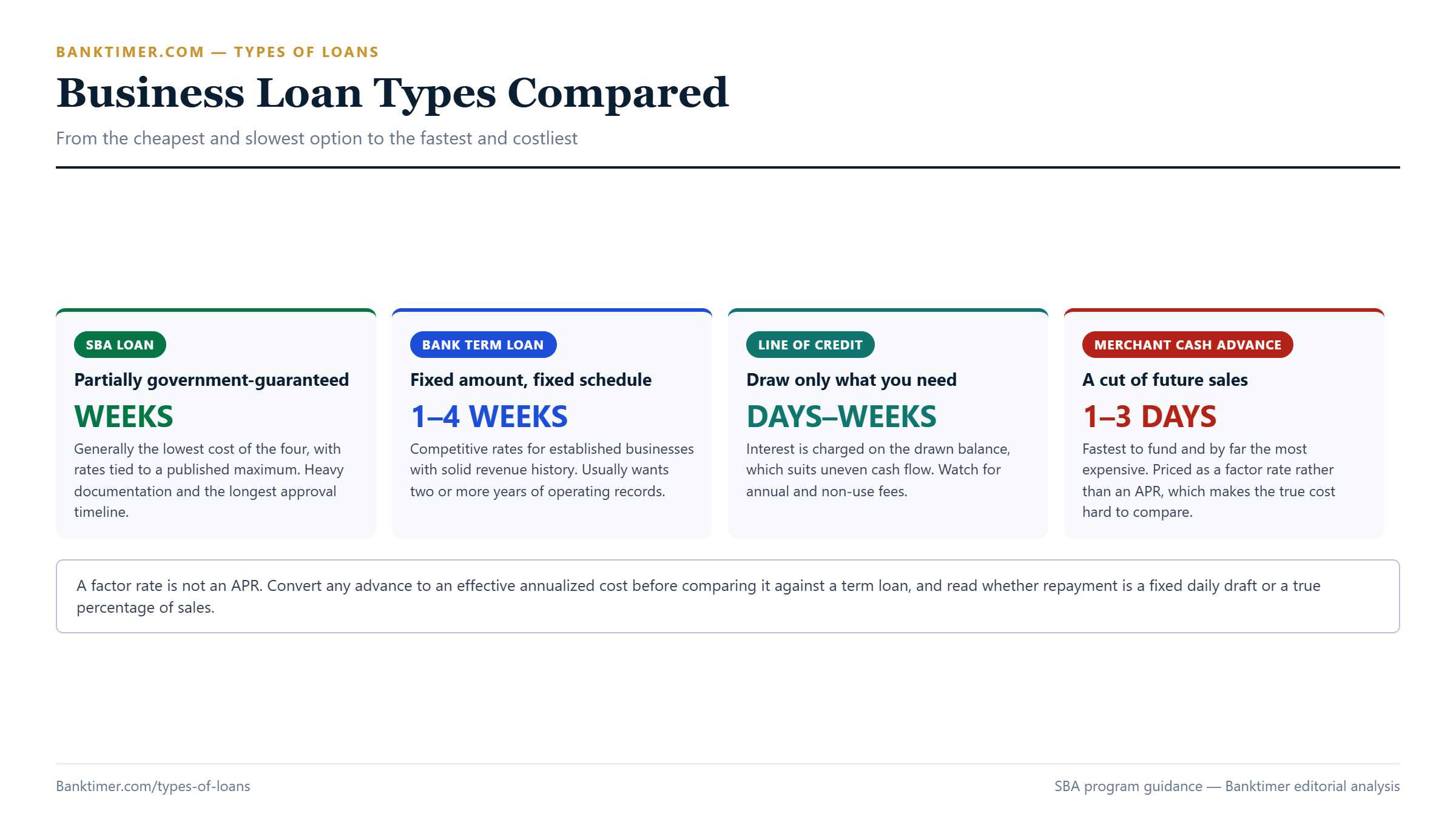
An SBA loan is a government-guaranteed loan made through a participating bank, reducing the lender’s risk and typically improving the borrower’s rate and terms. A conventional bank term loan is a straightforward lump sum with fixed repayment. A business line of credit is revolving, drawn as needed. A merchant cash advance isn’t a loan at all — it’s a purchase of your future receivables, repaid via daily or weekly debits.
Where to Get One
Banks and credit unions handle SBA and conventional term loans; a growing field of online and fintech lenders handles lines of credit and short-term loans, often faster but at meaningfully higher cost; merchant cash advance providers operate largely outside traditional banking, with lighter regulation and correspondingly higher risk.
Terms and Repayment Structure
SBA 7(a) loans run up to $5 million with terms up to ten years for working capital or twenty-five years for real estate. SBA 504 loans finance fixed assets like real estate and heavy equipment through a bank-plus-nonprofit structure, typically requiring a 10% down payment. Merchant cash advances repay over just four to twelve months, which is exactly why their effective annualized cost runs so high.
Who Each Type Suits
An SBA loan suits an established business with the patience for a longer underwriting process in exchange for the best available rate and terms. A merchant cash advance suits only a genuine, short-term cash crunch where speed outweighs cost — treating it as a routine financing tool rather than a last resort is one of the more expensive mistakes a business owner can make.
Business Loan Rates and Costs in 2026
SBA and Bank Rates
SBA 7(a) loans ran 9.75% to 13.25% variable and 11.75% to 14.75% fixed as of September 2026, with maximum allowable spreads over the prime rate (6.75%) set by loan size. SBA 504 loans, pegged to 10-year Treasury rates, ran roughly 5% to 7% — among the cheapest financing in this entire guide for the specific fixed-asset purchases they cover.
Lines of Credit and Online Term Loans
Bank-issued business lines of credit averaged 6.99% to 7.91%, while fintech lenders spanned a much wider range — from around 4.66% at the best-priced end up to 30% or more, depending heavily on the lender and the borrower’s credit and revenue profile.
Merchant Cash Advances and Factor Rates
MCAs are priced with a factor rate, typically 1.10 to 1.60 (1.20 to 1.35 is common for established businesses) — not an interest rate. Because repayment happens over such a short window, the effective annualized cost runs far higher than the factor suggests: a 1.30 factor repaid over four months works out to roughly 95% effective APR, while the same factor repaid over eight months works out to roughly 47%. No other type of loan in this guide compresses so much effective cost into so short a window, which is exactly why an MCA belongs at the bottom of the list rather than the top of it for anything other than a genuine short-term emergency.
SBA Guarantee Fees
For FY2026, SBA loans with a maturity of twelve months or less carry a flat 0.25% guarantee fee; longer loans scale from 2% (up to $150,000) to 3.75% on the portion above $1 million. Notably, the SBA has waived all upfront and annual 504 guarantee fees for FY2026 specifically for small manufacturers under NAICS codes 31 through 33 — a meaningful incentive worth checking if your business qualifies.
Qualifying and Applying for a Business Loan
Credit and Time-in-Business Requirements
The SBA sets no single mandatory minimum credit score, but lenders generally want a score in the mid-600s or higher, with approval unlikely below 620. Most lenders strongly prefer two or more years of operating history, though strong projections and documentation can sometimes offset a shorter track record.
Documents You’ll Need
Expect to provide business and personal tax returns, bank statements, a business plan or use-of-funds explanation, and financial statements. SBA loans require a personal guarantee from any owner holding 20% or more of the business.
The Step-by-Step Process
SBA loans involve the longest underwriting timeline in this guide — often several weeks to a few months — while online term loans and lines of credit can fund within days. Merchant cash advances can fund within 24 to 48 hours, which is precisely why they get chosen under time pressure despite the cost.
How to Get the Best Offer
Shop multiple lender types before defaulting to the fastest option. A 2026 industry study found approved borrowers received roughly 75% of their requested amount on average, and 20% of approvals went to businesses with sub-660 credit scores that compensated with strong revenue — meaning a weaker credit profile doesn’t automatically rule out competitive options if the rest of the application is strong.
Common Business Loan Mistakes and Red Flags
Mistake: Misjudging Funding Needs
Borrowing too little forces a second, more expensive financing round later; borrowing too much means paying interest or fees on capital that sits unused. Model your actual need carefully before applying.
Mistake: Not Understanding Factor-Rate True Cost
Confusing a 1.30 factor rate with a 30% interest rate is one of the costliest misunderstandings in small-business financing — always ask for the APR-equivalent before comparing a factor-rate product against a conventional loan or line of credit.
Red Flag: Confession of Judgment Clauses
Some merchant cash advance contracts include a confession of judgment clause, letting the funder obtain an automatic court judgment against the business — and sometimes the owner personally — without a hearing, the moment a payment is missed. These are illegal in some states but still used via out-of-state jurisdiction clauses elsewhere; have an attorney review any MCA contract before signing.
Red Flag: MCA Stacking
Taking on multiple overlapping cash advances simultaneously compounds daily-debit cash-flow strain, and each additional advance layered on top of existing ones tends to carry worse terms than the first. If you’re being offered a new advance to help cover payments on an existing one, that’s a sign the underlying cash-flow problem needs a different solution entirely.
Debt Consolidation Loans
A debt consolidation loan is, structurally, just a personal loan used for a specific purpose: paying off multiple existing debts and replacing them with one new loan, one new rate, and one new monthly payment.
It’s worth naming that structural fact upfront, because it’s easy to see “debt consolidation loan” marketed as though it’s a distinct category with its own special pricing, when really it’s the same personal-loan mechanics covered earlier in this guide, aimed at a specific use case. Understanding that connection matters practically: everything already covered about comparing personal loan offers — APR over advertised rate, prequalification with a soft pull, comparing at least two or three lenders — applies here without modification. Of all the types of loans in this guide, this is the one most often misunderstood as something more exotic than it actually is.
How a Debt Consolidation Loan Works
The Basic Structure
You borrow a lump sum sized to cover your existing balances — credit cards, other personal loans, or a mix — and use the proceeds to pay them off, leaving you with a single loan going forward instead of several separate ones.
Where to Get One
Banks, credit unions, and online lenders all offer this type of loan, often marketed specifically as “debt consolidation” even though the underlying product is a standard personal loan. Minimum credit score requirements vary widely by lender, from around 600 at some online lenders up to 720 at more conservative lenders.
Direct-to-Creditor vs. Deposit-to-You
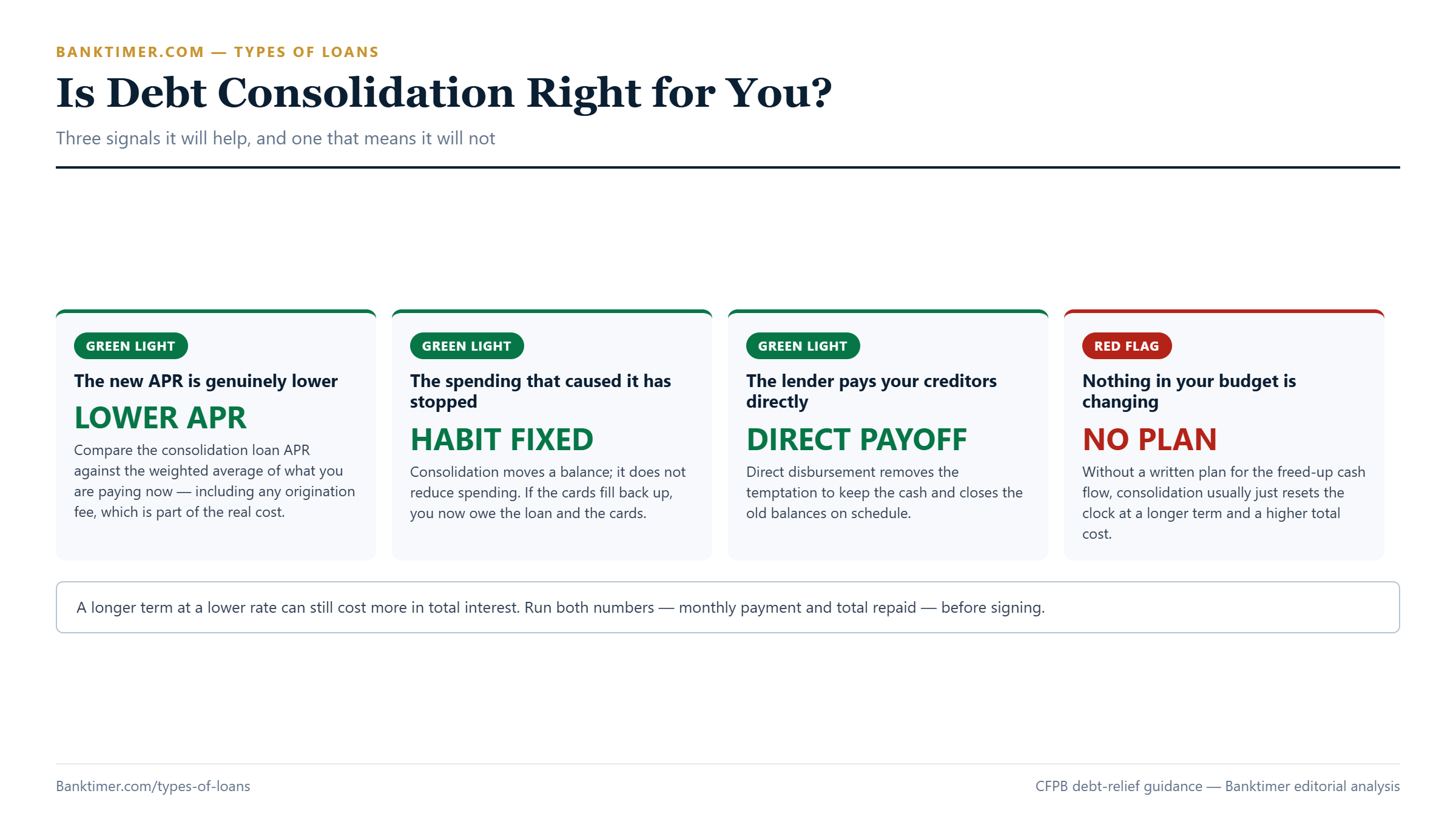
Some lenders send your loan proceeds directly to each listed creditor, closing out old balances without the money ever passing through your own account. Others simply deposit the full amount and leave the actual payoff up to you — a meaningful difference, since money sitting in your account is money that can get spent on something other than the debt it was meant to eliminate.
Who a Debt Consolidation Loan Is Best Suited For
This works best for a borrower whose new loan’s APR is genuinely lower than the blended average rate of the debts being consolidated, and who has already addressed the spending pattern that created the balances in the first place. Consolidating without fixing the underlying budget just delays the same problem.
Debt Consolidation Loan Rates and Costs in 2026
Current Average Rates
LendingTree’s 2026 data shows rates by tier: 14.76% for excellent credit (800+), 17.01% for very good (740–799), 22.75% for good (670–739), 27.59% for fair (580–669), and 30.02% for poor credit (below 580) — pricing that closely tracks general personal loan rates, since it’s fundamentally the same product.
What Drives Your Specific Rate
Beyond your credit tier, lenders weigh your existing debt-to-income ratio carefully for this type of loan, since consolidation borrowers often already carry high revolving balances — the very thing the loan is meant to address.
Fees Beyond the Rate
Origination fees typically run 1% to 10% of the loan amount, deducted from proceeds before disbursement. Critically, this means borrowing exactly your total existing debt won’t fully pay it off — divide your target payoff amount by (1 minus the fee percentage) to calculate how much you actually need to request.
How to Estimate Your Real Cost
Before consolidating, calculate the weighted-average APR of your existing debts and compare it directly against the new loan’s APR plus its origination fee. If the new loan’s true cost isn’t lower, consolidating doesn’t save you money — it just repackages the same debt under a different name.
Qualifying and Applying for Debt Consolidation
Credit and Income Requirements
Minimum scores span from roughly 600 to 720 depending on lender, with standard requirements including age 18 or older, a valid bank account, and verifiable employment or income.
Documents You’ll Need
Expect the same documentation as any personal loan application — pay stubs or tax returns, bank statements, and a list of the specific debts and balances you intend to pay off.
The Step-by-Step Process
Prequalify with a soft pull across several lenders, compare APRs and disbursement methods, then apply formally with your chosen lender. If you select a direct-to-creditor lender, confirm each old account is actually closed once the new loan funds.
How to Get the Best Offer
Compare the direct-to-creditor option against deposit-to-you if both are available — the former removes a real temptation risk, even if the rate is otherwise similar.
Common Debt Consolidation Mistakes and Red Flags
Mistake: Running the Old Balances Back Up
Seeing paid-off credit cards hit a zero balance creates a false sense of relief that leads directly back into new spending — this is the single most cited failure mode for this type of loan, and it leaves a borrower with both the new loan and fresh credit card debt.
Mistake: Choosing the Longest Term for a Lower Payment
Stretching the repayment term lowers the monthly payment but increases total interest paid — a trade that only makes sense if the shorter term genuinely doesn’t fit the budget, not simply because the payment number looks friendlier.
Red Flag: Debt Settlement Companies Posing as Consolidation
Legitimate debt consolidation is a new loan you apply for and qualify on your own credit. Debt settlement is different and riskier — a company negotiates with creditors to accept less than owed, often after instructing you to stop paying entirely, which damages your credit and invites collection lawsuits. Any company demanding an upfront fee before a settlement occurs is violating the FTC’s Telemarketing Sales Rule.
Red Flag: Fake Government-Style Debt Relief Mailers
Watch for official-looking mailers or calls using government-sounding names and seals — the FTC has shut down large-scale operations that impersonated banks, credit card companies, and government agencies specifically to target seniors and veterans with fake debt relief offers.
Loan Rates
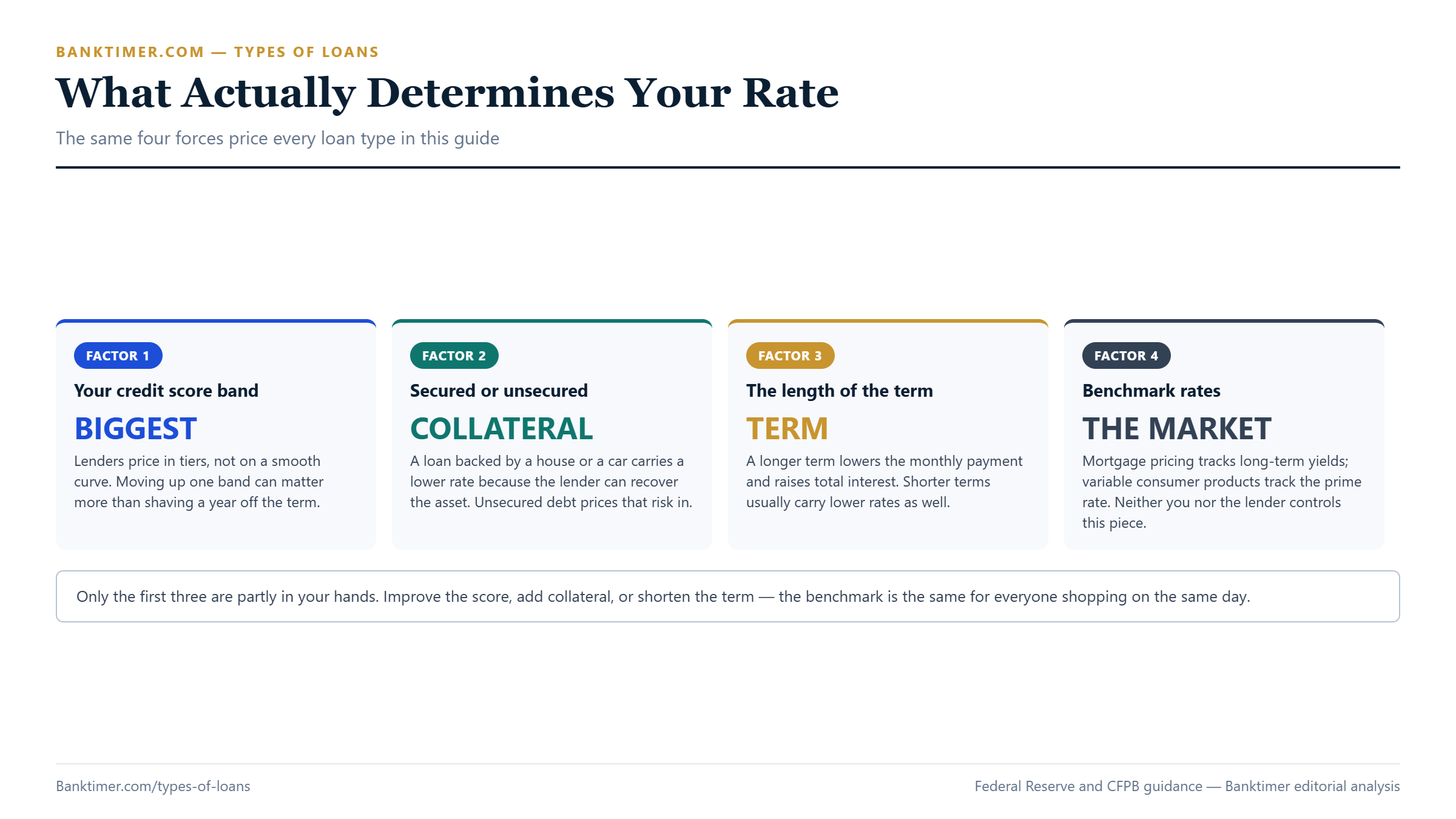
Every type of loan in this guide gets priced through the same handful of mechanisms, even though the resulting numbers look completely different from one product to the next. Understanding these mechanics is what lets you actually judge whether an offer on any of the nine loan types above is competitive. This section exists because the rate mechanics themselves rarely get explained anywhere else — most guides just list current numbers for one product at a time, without connecting the dots across the different types of loans that all draw from the same underlying benchmarks.
What Actually Determines Your Rate
Credit Score Bands
Lenders price risk in tiers, not a smooth curve — a mortgage borrower with a 760+ score averaged 6.70% in 2026 data, while a 620–639 score averaged 7.36% for an otherwise identical loan. Moving even a handful of points can shift you into a meaningfully cheaper tier, which is why checking your credit before applying for any type of loan is worth the ten minutes it takes.
Secured vs. Unsecured
Collateral is one of the biggest levers in this entire guide. Secured loans — mortgages, auto loans, home equity products — let the lender recover value from a specific asset if you default, which is why they average dramatically lower rates than unsecured personal loans, which currently average above 12% and require good-to-excellent credit for the best pricing.
Loan Term Length
A shorter term means lower lender risk and typically a lower rate — and it also means dramatically less total interest even when the rate itself is similar. Borrowing $15,000 at 10% APR costs about $2,424 in interest over three years versus $4,122 over five years, a difference of nearly $1,700 for the same loan amount and rate.
Market Benchmark Rates
Three benchmarks set the floor every lender prices from: the Federal Funds Rate (3.75% to 4.00% as of the Fed’s September 16, 2026 decision), the Prime Rate (mechanically the Fed Funds upper bound plus 3.00%, so roughly 7.00% following that hike), and the 10-year Treasury yield (around 5.00% in mid-September 2026), which mortgage rates track especially closely.
Fixed vs. Variable Rates Compared
How Fixed Rates Work
A fixed rate is locked for the entire loan term — your payment never changes regardless of what happens in the broader rate environment. Mortgages, home equity loans, and most personal and auto loans are typically offered this way.
How Variable and Adjustable Rates Work
A variable rate is calculated as an index (a market rate like SOFR that floats) plus a margin (the lender’s fixed markup, set at closing and never changing, but negotiable and worth comparing across lenders). HELOCs and adjustable-rate mortgages both use this structure, with the rate resetting periodically to the current “fully indexed rate.”
When Each Makes Sense
A fixed rate suits anyone who values payment certainty or expects to hold the loan for many years. A variable rate can make sense for a shorter expected holding period or when the initial rate is meaningfully below the fixed alternative — but only if you can absorb a higher payment if rates rise before you refinance or pay off the loan.
Rate Locks and Float-Downs
Mortgage rate locks typically run 30, 45, 60, or 90 days, with standalone lock fees of 0.25% to 0.50% of the loan amount and extensions costing another 0.125% to 0.375% each. A float-down option lets you claim a lower rate if the market drops before closing, usually requiring at least a quarter-point move to trigger, for an additional 0.125% to 0.50% of the loan.
How to Shop for the Best Rate
Soft Pulls vs. Hard Inquiries
Checking your own credit or getting prequalified uses a soft pull, which never affects your score. Formally applying triggers a hard inquiry, typically costing five to ten points and remaining on your report for up to two years, though only the most recent twelve months count toward your FICO score.
The Rate-Shopping Window
Credit scoring models give special treatment to rate shopping for mortgages, auto loans, and student loans, deduping multiple inquiries made within a short window into a single scoring event. Older FICO models use a 14-day window; newer versions extend it to 45 days — since some lenders still use older models, shopping within 14 days is the safest practice across every loan type in this guide.
APR vs. Interest Rate
The interest rate describes only the cost of borrowing your principal. The APR bundles that rate together with lender fees — origination charges, points, and similar costs — into one standardized annual figure. Because every lender must disclose APR, it’s the only number you can honestly compare across offers; never compare one lender’s rate against another lender’s APR.
Negotiating Leverage
A competing prequalified offer in hand is real leverage, particularly for personal loans, business loans, and mortgages, where origination fees and rates both have some room to move for a borrower who’s clearly done the work of comparing lenders. That leverage compounds the more types of loans you’ve successfully negotiated before, since the habit of asking directly for a better offer transfers easily from one product to the next.
Reading Rate Tables and Ads Correctly
National Averages vs. Your Real Rate
Every rate figure in this guide — and on any rate-comparison website — is a national average or a range, not a quote. Your actual rate depends on your specific credit, income, loan amount, and lender that day.
How “As Low As” Advertised Rates Work
Regulators have found cases where a lender’s real average offered rate ran more than double its advertised “as low as” teaser — because that teaser rate is reserved for the small slice of applicants with the strongest possible credit, largest down payment, or shortest term. Treat any “as low as” figure as a ceiling on optimism, not a realistic quote for your own situation.
Rate Advertising Red Flags
Prescreened mail offers are especially prone to this problem — being selected for an offer doesn’t mean you qualify for its advertised rate. Any offer that won’t disclose the full range of rates borrowers actually receive, or that pressures you to act before reviewing the real numbers, deserves extra scrutiny.
Tracking Rate Trends Over Time
Federal Reserve Economic Data (FRED) publishes historical series for mortgage rates and Fed policy rates that let you see exactly how today’s numbers compare to recent years, which is useful context before deciding whether now is a good moment to lock in any of the loan types covered in this guide.
Loan Reviews
Comparing rates is only half the job. The other half is making sure the lender offering that rate is legitimate, properly licensed, and won’t bury you in fees or fine print the advertised number never mentioned. This matters just as much across every one of the types of loans covered in this guide — a great rate from an illegitimate or poorly run lender isn’t actually a good offer, whatever the number on the page says.
How to Check Whether a Lender Is Legitimate
The CFPB Consumer Complaint Database
This free, searchable public database lets you filter complaints by company, product, and timeframe, with the large majority of complaints getting a timely company response. One important caveat straight from the CFPB itself: a low complaint count doesn’t necessarily mean low consumer harm, since larger lenders naturally generate more complaints simply from having more customers — pair this with other sources rather than relying on it alone.
NMLS Consumer Access
For any mortgage-related lender, broker, or loan originator, NMLS Consumer Access (nmlsconsumeraccess.org) is the free, official registry for verifying state licensing. The CFPB specifically directs consumers here before sharing personal or financial information with anyone claiming to originate mortgage loans.
State Regulators and Attorney General Offices
Beyond federal resources, your state’s regulator — reachable through the NMLS state-agency directory — can confirm disciplinary actions or licensing revocations against a specific lender, useful for non-mortgage lenders and for escalating a complaint beyond what CFPB or BBB channels resolve.
The Better Business Bureau — and Its Impostors
BBB ratings and complaint histories are a useful data point, but the BBB itself warns about impostor scams — fake emails and calls using lookalike addresses, unauthorized “Accredited Business” seals, and pressure tactics demanding fees or personal information. Verify any BBB contact by calling the number listed directly on BBB.org, never one provided by the caller.
Red Flags in Lender Reviews and Marketing
Fake or Scam-Adjacent Reviews
A polished lender website won’t show you its worst reviews. Search the lender’s name alongside terms like “scam” or “complaint” to surface the discussions a curated testimonials page leaves out.
Upfront-Fee Demands
Legitimate lenders deduct fees from loan proceeds at funding — they never require payment before disbursing anything. Any lender asking for money upfront, before you’ve received loan funds, is showing the single most common scam pattern across every type of loan in this guide.
Guaranteed-Approval Claims
No legitimate lender can promise approval before underwriting your application. A guarantee made before you’ve even provided your financial information is a sign the “lender” isn’t planning to actually evaluate your creditworthiness at all.
Unsafe Payment Requests
Wire transfers, payment apps, or gift cards requested for fees or “insurance” carry no recovery path if something goes wrong — legitimate lenders use traceable, reversible payment methods and never insist on these specific channels.
Comparing Lender Types
Traditional Banks
Banks offer lower rates for well-qualified or existing customers, in-person service, and strong regulatory oversight — but stricter approval standards, slower processing, and some products, like unsecured personal loans, aren’t even offered by many large banks.
Credit Unions
Credit unions often carry the lowest rates and fees of any channel in this guide, helped by a federal 18% APR ceiling on their lending, plus genuinely personalized service. The tradeoff is membership eligibility — tied to geography, employer, or association — and typically fewer branches and weaker digital tools than a large bank.
Online Lenders
Online lenders offer fast approval, widely available soft-pull prequalification, and more flexible criteria for thinner credit files — but rates can run dramatically higher, up to 36% APR on some unsecured products, and the lighter regulatory footprint means more fraud risk and a greater need to independently verify legitimacy.
Marketplaces and Brokers
A loan marketplace doesn’t lend directly — it submits your information to a panel of lenders and surfaces offers, letting one application generate several quotes. You still need to vet whichever actual lender you accept an offer from, since the marketplace itself isn’t the one setting your final rate and terms.
Questions to Ask Before You Choose Any Lender
About Rate and APR
What is the full APR, not just the advertised rate, and does it include every origination fee, point, or other mandatory charge?
About Fees and Prepayment
Are there prepayment penalties, and can you pay extra toward principal without a fee? How exactly are fees structured — rolled into the APR, charged upfront, or deducted from proceeds at funding?
About Licensing
Is the lender or loan originator licensed in your state? Verify this independently through NMLS Consumer Access rather than taking the lender’s word for it.
About Service and Complaints
What happens on a missed payment — grace periods, late fees, and reporting timing to the credit bureaus? Does prequalification use a soft or hard credit pull, and is that clearly disclosed before you’re asked for your Social Security number?
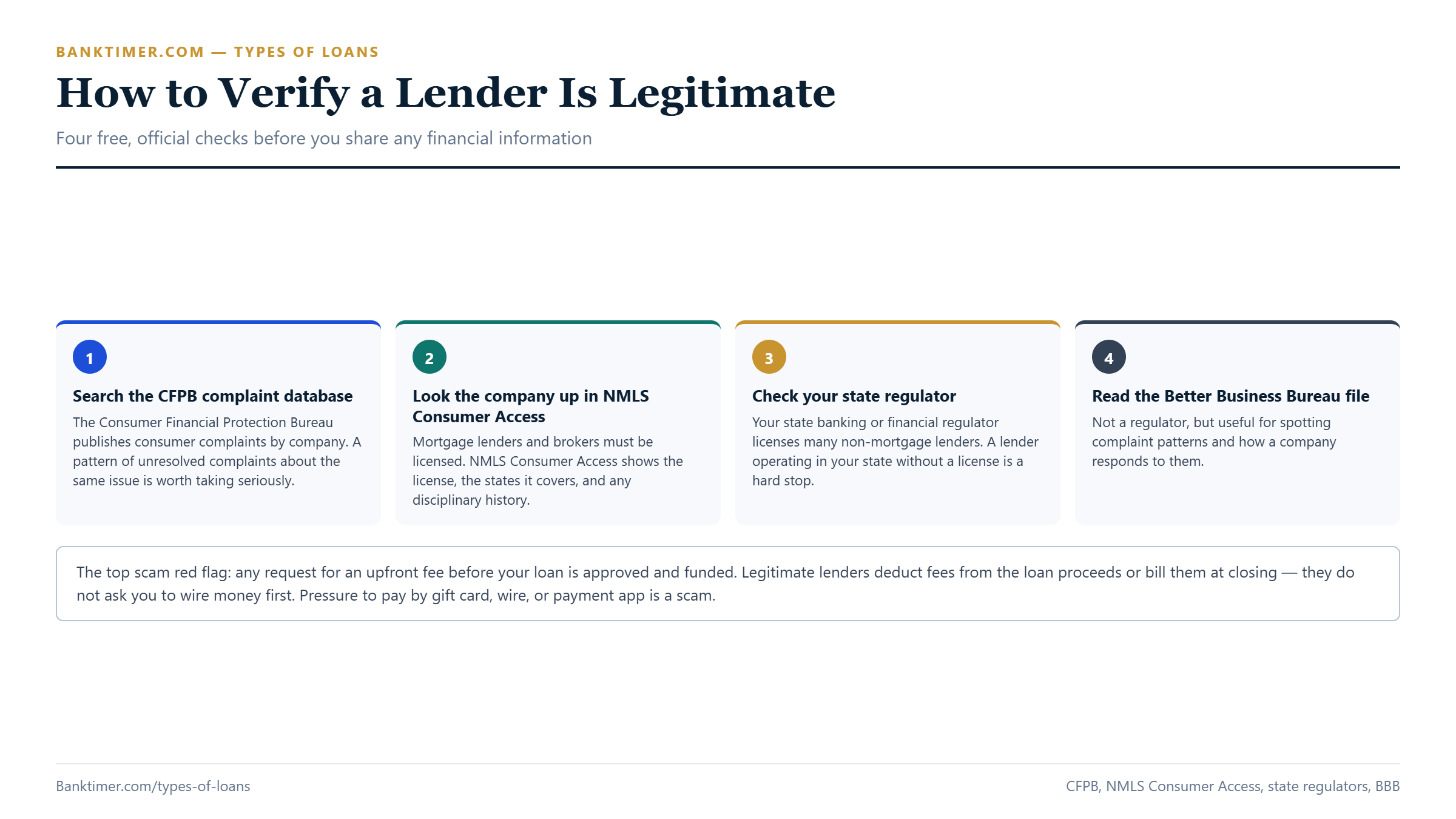
A Complete Comparison: Every Type of Loan Side by Side
Nine loan types, two cross-cutting themes, and one honest observation: the products in this guide aren’t actually competing with each other most of the time. A mortgage and a merchant cash advance solve completely different problems for completely different borrowers. The table below puts every type side by side so you can see at a glance how they differ on security, cost, and typical use — the full detail behind every figure lives in the section dedicated to that loan type above.
| Loan type | Secured by | Typical rate (Sept 2026) | Typical term | Best for |
|---|---|---|---|---|
| Mortgage | The home being purchased | 6.76% (30-yr fixed) | 30 years | Buying a home you plan to keep for years |
| Mortgage Refinance | The home you already own | 6.96% rate / 7.03% APR | 30 years | Lowering your rate or changing your term |
| Home Equity Loan | Your home’s equity | 8.13%–8.28% | 5–15 years | A one-time, known expense |
| HELOC | Your home’s equity | 7.26% average | 5–10 yr draw + 10–20 yr repay | Ongoing or uncertain funding needs |
| Personal Loan | Unsecured | 18.87% average | 2–7 years | A fixed amount for almost any purpose |
| Auto Loan | The vehicle | 6.74%–7.39% average | Up to 84 months | Financing a vehicle purchase |
| Debt Consolidation Loan | Unsecured | 14.76%–30.02% by tier | 3–7 years | Replacing several debts with one payment |
| Student Loan (federal) | Unsecured | 6.52% fixed (undergrad) | Up to 30 years (RAP) | Financing education, with borrower protections |
| Business Loan (SBA 7(a)) | Varies by program | 9.75%–14.75% | Up to 25 years | Established businesses with time to underwrite |
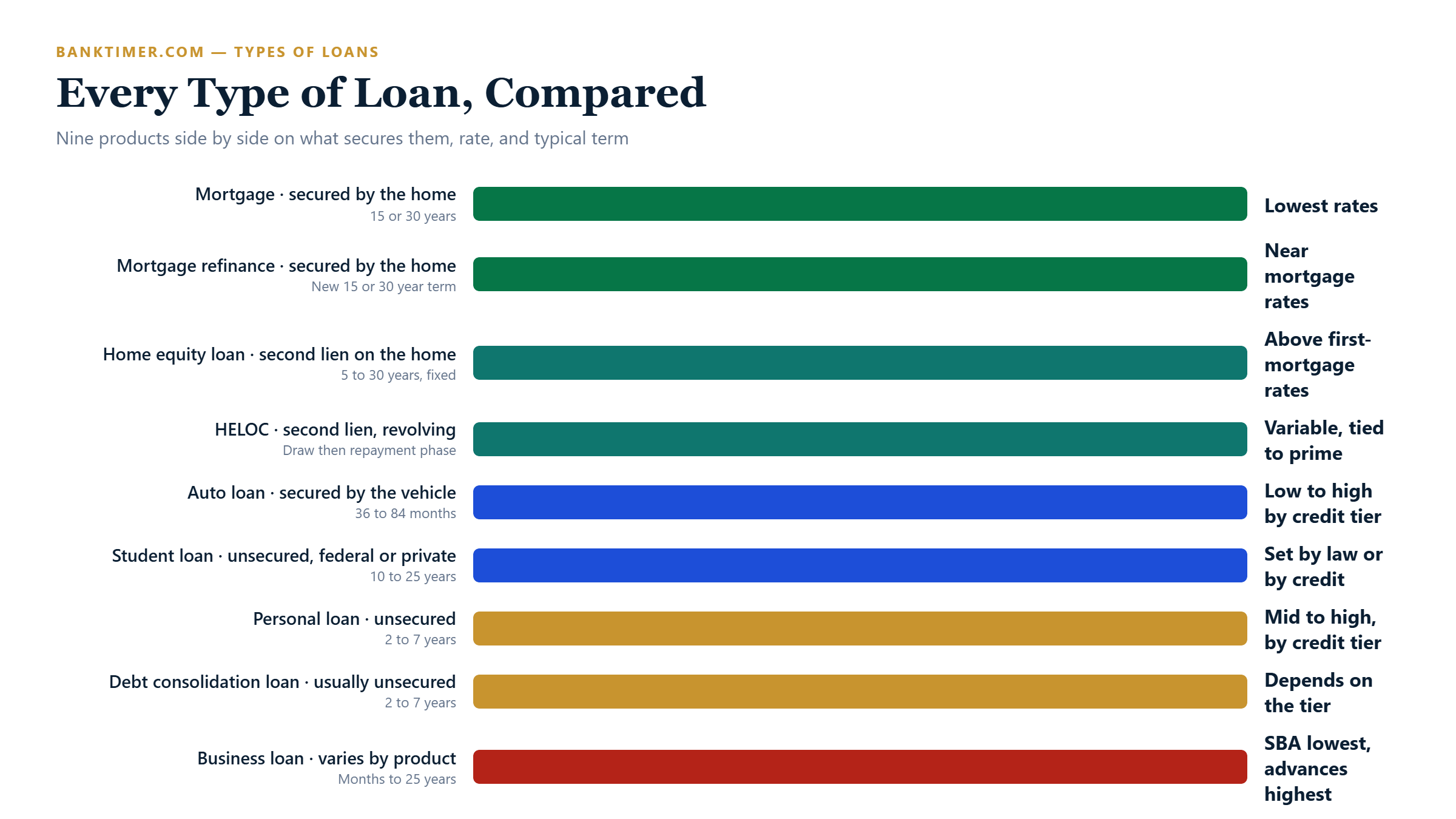
Which Types of Loans Cost the Least — and Most — Over Time
Total rate isn’t the only lens worth applying to this comparison table — total cost over the life of the loan tells a different, sometimes more useful story. Line up the types of loans in this guide by typical total interest paid on a similarly sized balance, and the ranking looks different from a simple rate comparison, because term length compounds with rate to determine what a loan actually costs you by the time it’s paid off.
A 30-year mortgage carries one of the lowest rates in this guide, but its long term means total interest paid can still run into six figures on a large loan balance — the trade-off for spreading a large purchase over three decades. A merchant cash advance sits at the opposite extreme: its rate-equivalent cost is the highest of any product covered here, but because it repays in months rather than years, the total dollar cost on a modest advance can still land below what a longer-term, lower-rate loan would cost on the same balance over a comparable window. This is exactly why comparing types of loans purely by advertised APR, without accounting for how long you’ll actually be paying, can lead you to the wrong conclusion.
Auto loans and personal loans sit in the middle of this ranking, and this is where term-length decisions matter most: stretching either of these types of loans from a five-year term to a seven-year term to lower the monthly payment routinely adds thousands of dollars in extra interest, even when the rate itself barely moves. Home equity loans and HELOCs land closer to the cheaper end, reflecting their secured status, but a HELOC’s variable rate means its true total cost isn’t fully knowable until the loan is paid off — a meaningful difference from the other, fixed-rate types of loans in this comparison.
The practical takeaway: before signing anything, run the total-cost math for your specific loan amount and term, not just the rate comparison. A loan calculator that lets you plug in principal, rate, and term will show you the real number in under a minute, and it’s worth doing for every serious offer regardless of which type of loan you’re comparing.
Which Types of Loans Are Easiest to Qualify For
Qualification difficulty is its own axis worth ranking, separate from cost. Some types of loans are engineered to be broadly accessible; others screen hard before they’ll even quote you a rate.
Federal student loans sit at the most accessible end of this spectrum — Direct Subsidized and Unsubsidized loans require no credit check at all, only enrollment in an eligible program and a completed FAFSA. Secured types of loans come next: mortgages, auto loans, home equity products, and HELOCs all extend credit more readily than unsecured products, because the underlying collateral gives the lender a fallback if you default. A borrower with a mid-600s credit score can often still get approved for one of these secured types of loans, even if the rate isn’t the best available.
Unsecured products are considerably more selective. Personal loans and debt consolidation loans lean heavily on credit score and debt-to-income ratio, with the best rates reserved for borrowers well above 700. Business loans vary enormously by type — an SBA loan involves the most document-intensive underwriting of any product in this guide, while a merchant cash advance can approve a borrower an SBA lender would reject outright, in exchange for a dramatically higher cost.
The practical implication: if your credit or documentation is still a work in progress, lean toward the more accessible end of these types of loans first, and treat the harder-to-qualify-for options as a goal to work toward rather than a starting point. Improving a credit score by even 40 or 50 points can be the difference between qualifying for several of the cheaper types of loans in this guide and being pushed toward the more expensive, more accessible end instead.
How Each Type of Loan Gets Regulated
Regulatory oversight varies just as much as pricing does, and knowing who actually polices a given lender tells you where to complain — and where to check credentials before you sign anything.
Mortgages, refinances, home equity loans, and HELOCs fall under the heaviest federal scaffolding of any types of loans in this guide: the Truth in Lending Act, RESPA, and CFPB oversight, plus state-level licensing tracked through NMLS Consumer Access. Auto loans and personal loans are regulated more unevenly — federal truth-in-lending disclosure rules apply, but day-to-day oversight often falls to state banking regulators and attorneys general, with credit unions specifically capped by an 18% federal APR ceiling that doesn’t apply to banks or online lenders.
Student loans split sharply by origin: federal loans are governed directly by the Department of Education and Congress, which is exactly why 2026’s repayment overhaul was possible at all, while private student loans are regulated more like any other consumer credit product. Business loans sit at the loosest end of the spectrum among these types of loans — SBA loans carry federal program rules, but merchant cash advances and many online business lenders operate with comparatively little federal oversight, which is precisely why independently verifying a business lender’s legitimacy matters more for this category than almost any other.
None of this is meant to suggest lighter regulation automatically means a bad lender — plenty of lightly regulated lenders are legitimate and reputable. It does mean the burden of verification shifts more heavily onto you as the regulatory scaffolding gets thinner, which is exactly the gap the lender-verification section earlier in this guide is built to help close.
How Loan Amounts Typically Compare
Minimum and maximum loan sizes vary just as widely across these types of loans as rates do, and knowing the typical range for each product saves you from shopping the wrong type of loan entirely for what you actually need.
On the small end, personal loans and debt consolidation loans commonly start around $1,000 to $2,000, making them accessible for smaller expenses that wouldn’t justify a mortgage-sized process. Home equity loans and HELOCs typically carry higher minimums — often $25,000 to $35,000 — since the closing costs and appraisal requirements involved don’t make sense to absorb for a smaller amount. On the large end, mortgages and SBA 7(a) business loans can both reach well into seven figures for a qualified borrower, while a typical auto loan or personal loan rarely exceeds the mid five figures even for the strongest applicants.
Matching your actual funding need to the right minimum and maximum for a given type of loan is a simple check that’s easy to skip — needing $8,000 for a home repair, for instance, rules out a home equity loan at most lenders before you even get to comparing rates, since you’d fall under their minimum. Checking this upfront, across whichever types of loans you’re actually considering, saves a wasted application and a needless hard inquiry.
The One Question Every Type of Loan in This Guide Comes Back To
Strip away the different rates, terms, and collateral requirements, and every section of this guide is really answering one recurring question: what does this money actually cost you, all in, by the time you’ve paid it back — and is there a cheaper or better-structured way to get the same result?
That question applies whether you’re comparing two mortgage lenders, deciding between a home equity loan and a HELOC, weighing a personal loan against a 0% credit card offer, or sizing up an SBA loan against a merchant cash advance. The types of loans differ enormously in mechanics, but the discipline for evaluating any of them barely changes: get the full APR, not just the rate; understand exactly what’s securing the loan, if anything; run the total-cost math for your actual term rather than trusting the monthly payment alone; and verify the lender is who they say they are before you hand over any personal or financial information.
Borrowers who internalize that short checklist tend to do well across every one of the types of loans in this guide, even the ones they’ve never dealt with before, because the checklist doesn’t depend on the specific product — it depends on habits that transfer. That’s the real goal of a guide this size: not to memorize eleven sets of rules, but to walk away understanding the handful of questions that make almost any type of loan decision a more informed one.
A 2026 Snapshot: How Rates on These Loan Types Got Here
Understanding today’s numbers means understanding how 2026 actually unfolded, because the pricing environment behind every one of the types of loans in this guide shifted meaningfully over the course of the year.
Coming into 2026, rates on several types of loans had drifted toward multi-year lows, with mortgage rates briefly touching the low 6% range and HELOC pricing easing on the back of a Federal Reserve that had spent the prior several years cutting rates. That backdrop changed on September 16, 2026, when the Fed raised its target range by 25 basis points to 3.75%–4.00% — its first hike since 2023, and a reversal that caught plenty of forecasters off guard.
The effect on different types of loans was anything but uniform. Mortgage and refinance rates, which track the 10-year Treasury yield more than the Fed Funds Rate directly, moved higher within days, pushing refinance application volume down roughly 25% year-over-year almost immediately. HELOC rates, by contrast, continued easing through the same stretch — their third consecutive weekly decline as of September 9 — a genuine divergence that made a HELOC relatively more attractive than a cash-out refinance for homeowners who wanted equity access without disturbing an existing low-rate first mortgage. Business lending rates showed a similar mixed picture, with bank-issued lines of credit holding relatively steady while some online lenders adjusted more quickly.
Auto and business lending told a quieter version of the same story. Auto loan rates barely budged in the days immediately after the Fed’s decision, since dealer and lender pricing on that type of loan tends to react more slowly to a single rate move than mortgage pricing does. Business lending showed the widest internal split of any category in this guide: SBA-backed loans, pegged closely to the prime rate, adjusted almost immediately, while many online business lenders and merchant cash advance providers, which price more on risk appetite than benchmark rates, barely moved at all. If you’re timing an application around a rate environment, know which of these types of loans actually responds to Fed policy quickly and which one runs on its own schedule.
The lesson for anyone reading this close to publication: don’t assume every type of loan moves in lockstep with Fed policy, or with each other. The Federal Funds Rate sets a floor and a general direction, but the actual transmission to mortgage rates, HELOC pricing, auto loan rates, and business lending terms happens through different channels, on different timelines, and sometimes in different directions entirely — which is exactly why this guide dates every rate figure and points you back to a live source rather than treating any number as permanent.
How to Choose the Right Type of Loan for Your Situation
If You’re Buying or Refinancing a Home
Start with a mortgage preapproval before you shop for homes, and treat a refinance as its own decision with its own break-even math — never assume refinancing is automatically worth it just because rates moved slightly since you bought.
If You Need Cash From Your Home’s Equity
Choose a home equity loan when you know the exact amount you need and want a predictable payment; choose a HELOC when your need is ongoing, uncertain in size, or spread out over time. Compare both against a cash-out refinance if your current mortgage rate isn’t dramatically below today’s market rate.
If You’re Financing a Vehicle, Consolidating Debt, or Covering a Personal Expense
Get preapproved by a bank or credit union before visiting a dealership for an auto loan. For debt consolidation, confirm the new loan’s APR genuinely beats the blended rate of what you’re paying now. For a general personal expense, a personal loan usually beats carrying a balance on a credit card at a comparable or higher rate.
If You’re Funding Education or a Business
Exhaust federal student aid before considering private student loans, and pick a repayment plan actively rather than letting the SAVE-plan transition default you into a more expensive option. For a business, match the loan type to your actual timeline: an SBA loan for the best rate if you can wait, a line of credit for flexibility, and a merchant cash advance only as a genuine last resort given its real cost.
If You’re Comparing Types of Loans Purely on Total Cost
Run the actual numbers before deciding on rate alone. Two types of loans with similar advertised rates can cost meaningfully different amounts once term length, fees, and whether the rate is fixed or variable are factored in — the comparison sections above and the total-cost discussion earlier in this guide both walk through exactly how to do that math.
If Your Credit Is Still a Work in Progress
Not every type of loan requires excellent credit, but your options and pricing narrow meaningfully below the high 600s. Federal student loans, credit-union personal loans, and secured products generally stay more accessible; unsecured personal loans and the best business loan rates get harder to reach. Improving your score before applying, even by a modest amount, can shift you into a meaningfully cheaper tier across almost every one of the types of loans in this guide.
What to Do If You’re Denied for a Type of Loan
A denial isn’t the end of the process for any of the types of loans covered in this guide — it’s required by law to come with an explanation, and that explanation is often the most useful diagnostic tool available for whichever product you apply for next.
Under the Equal Credit Opportunity Act, a lender must send an adverse action notice within 30 days of denying an application, spelling out the specific reasons — a low credit score, an insufficient income-to-debt ratio, a thin credit file, or a specific policy the lender applies to that type of loan. If a credit score played a role, the notice also has to disclose the score itself and the key factors that pulled it down, which you can use directly to figure out what to fix before reapplying anywhere else.
Don’t immediately reapply for the same type of loan with a different lender without addressing the reason for the denial — a fresh hard inquiry on an application likely to be denied again just costs you points for nothing. Instead, pull your full credit report, address the specific factors named in the notice, and consider whether a different one of the types of loans covered in this guide — one with a lower qualification bar, or a cosigner option — might be the better near-term fit while you work on the factors that limited you the first time.
If you believe the denial was based on your race, color, religion, national origin, sex, marital status, age, or receipt of public assistance income rather than legitimate creditworthiness factors, you have the right to file a complaint with the CFPB or your state regulator — ECOA exists specifically to prohibit discrimination in lending decisions across every one of the types of loans in this guide.
The Three Mistakes That Cost Borrowers the Most, Across Every Loan Type
Comparing Rate Instead of APR
This single habit shows up as the most expensive mistake in nearly every section of this guide, regardless of loan type. The interest rate tells you part of the story; the APR — which bundles in origination fees, points, and other mandatory charges — is the only number that lets you honestly compare two different offers.
Underestimating What Collateral and Structure Actually Mean
A secured loan’s lower rate comes with a real consequence attached: lose the asset behind it, and the lender can take that asset. An unsecured loan’s higher rate comes with the opposite trade — more flexibility, less risk to any specific possession, but a steeper cost. Understanding which type of loan you’re taking on, and what’s actually backing it, matters as much as the number on the page.
Not Shopping Multiple Lenders Within the Rate-Shopping Window
Whether it’s a mortgage, an auto loan, a personal loan, or a business loan, the pattern repeats: borrowers who compare at least two or three offers within the same short window consistently get better terms than those who accept the first offer presented, often without giving up anything on their credit score to do it.
Ignoring How Types of Loans Interact With Each Other
Borrowers often evaluate each loan in isolation, but taking on a new auto loan while carrying a heavy credit card balance, or adding a HELOC on top of a recent cash-out refinance, changes your debt-to-income ratio and can affect your eligibility and pricing on the next type of loan you apply for. Treat every application as one piece of a bigger picture, not a standalone decision, especially if you’re likely to need more than one of the types of loans covered in this guide within the same year or two.
Questions to Ask Before You Borrow
- ☐ What is the full APR on this offer, including every origination fee and point — not just the advertised interest rate?
- ☐ Is this loan secured or unsecured, and if secured, exactly what asset is on the line if I default?
- ☐ Have I compared at least two or three lenders within the same rate-shopping window?
- ☐ Is the lender or loan originator licensed in my state, verified independently through NMLS Consumer Access or my state regulator?
- ☐ Are there prepayment penalties, and can I pay extra toward principal without a fee?
- ☐ What specific documents and timeline should I expect between application and funding?
- ☐ What happens if I miss a payment — grace periods, late fees, and when it gets reported to the credit bureaus?
- ☐ Does prequalification use a soft or hard credit pull, and has that been made clear before I provide sensitive information?
- ☐ If this is a variable-rate product, have I modeled my payment at a meaningfully higher rate than today’s?
Who This Guide Suits
This guide is built for anyone trying to figure out which type of loan actually fits their situation before they start shopping lenders — a first-time homebuyer weighing mortgage programs, a homeowner deciding between a HELOC and a cash-out refinance, a borrower comparing a personal loan against a balance transfer, a family working through the 2026 student loan repayment overhaul, or a small business owner sorting an SBA loan from a merchant cash advance. It’s equally useful as a reference to return to later, whenever the next loan decision comes up and you need the current rates and rules for a specific product rather than the whole guide again. Bookmark it if you expect to be back — between now and your next major purchase, at least one of the types of loans covered here is likely to come up again.
Frequently Asked Questions
What’s the difference between a secured and an unsecured loan?
A secured loan is backed by a specific asset — a home, a car — that the lender can claim if you default, which typically earns a lower rate. An unsecured loan, like most personal loans, relies on your creditworthiness alone and carries a higher rate as a result.
Which type of loan has the lowest interest rate?
Among the loan types in this guide, mortgages typically carry the lowest rates, since they’re secured by real property and repaid over very long terms, followed closely by SBA-backed business loans and auto loans. Unsecured personal loans and merchant cash advances sit at the opposite end.
Should I choose a fixed or variable rate?
A fixed rate suits anyone who values a stable, unchanging payment or plans to hold the loan for many years. A variable rate can offer a lower starting cost but carries real risk if rates rise before you pay it off or refinance — model both scenarios before choosing.
How much does my credit score actually affect my rate?
Substantially, and across every loan type in this guide. Moving from a 620 credit score to a 760 can shift your mortgage rate by more than half a percentage point, and the gap is even larger on unsecured products like personal loans and auto loans for weaker credit tiers.
What’s the difference between a home equity loan and a HELOC?
A home equity loan pays out a lump sum with a fixed rate and fixed payment. A HELOC is a revolving line of credit, typically with a variable rate, that you draw against as needed during a set draw period before entering repayment.
Is it better to get a longer or shorter loan term?
A shorter term means a higher monthly payment but meaningfully less total interest paid. A longer term lowers the payment but increases total cost — the right choice depends on what you can comfortably afford each month versus how much you’re willing to pay in total.
What happened to the SAVE student loan repayment plan?
A federal court vacated SAVE in March 2026 after the Department of Education settled related litigation. Borrowers who were on SAVE had to select a new plan — most likely the new Repayment Assistance Plan (RAP) or a legacy income-driven option — during a transition window running through the second half of 2026, or risk being defaulted into a more expensive Standard Repayment plan.
Can I get a loan with bad credit?
Often yes, but expect a meaningfully higher rate, and in some cases a cosigner requirement. Federal student loans (aside from PLUS loans, which check for adverse credit history rather than a score) are a notable exception, since they don’t consider credit at all for Direct Subsidized and Unsubsidized loans.
What is a factor rate, and how is it different from an interest rate?
A factor rate, used mainly for merchant cash advances, is a flat multiplier (like 1.30) applied to the amount advanced rather than a percentage rate charged over time. Because MCAs repay so quickly, the effective annualized cost of a given factor rate can run far higher than the number itself suggests — often 40% to 200%-plus.
How many lenders should I compare before choosing one?
At least two or three, and ideally within the same short window — generally 14 days is the safest assumption — so that multiple hard inquiries for the same loan type count as a single event for credit-scoring purposes rather than several separate dings.
Does shopping for a loan hurt my credit score?
Prequalification with a soft pull doesn’t affect your score at all. Formally applying triggers a hard inquiry, typically costing five to ten points, but multiple inquiries for the same loan type within a short window are treated as one event by most current scoring models.
What’s the difference between APR and interest rate?
The interest rate is the cost of borrowing your principal alone. The APR bundles that rate together with mandatory fees like origination charges and points into one standardized annual figure — it’s the only number that lets you compare two different loan offers honestly.
Can I pay off any of these loan types early without a penalty?
Most mortgages, personal loans, and auto loans from mainstream lenders carry no prepayment penalty today, though it’s always worth confirming in writing. Merchant cash advances are a notable exception — most charge the full factor-rate cost regardless of how quickly you repay.
What is a debt-to-income ratio, and why does it matter for every loan type?
It’s your total monthly debt obligations divided by your gross monthly income, expressed as a percentage. Lenders across every loan type in this guide use it to judge how much additional debt you can reasonably handle — generally, the lower it is, the better your approval odds and pricing.
Is a home equity loan or a personal loan better for debt consolidation?
A home equity loan typically offers a lower rate but puts your house at risk if you can’t repay it. A personal loan carries a higher rate but no collateral risk beyond your credit. The right choice depends on how much you’re consolidating and how confident you are in your ability to repay on schedule.
What should I do if a lender asks for payment before giving me a loan?
Stop. Legitimate lenders deduct fees from your loan proceeds at the moment of funding — they never require a separate upfront payment before disbursing anything. This pattern shows up as a red flag across nearly every loan type in this guide and is one of the most reliable signs of a scam.
How do I verify a lender is actually licensed?
For mortgage-related lenders, check NMLS Consumer Access directly rather than trusting a lender’s own claims. For other loan types, your state’s financial regulator, reachable through the same NMLS directory, can confirm licensing and any disciplinary history.
What’s the safest way to compare rates without hurting my credit?
Use each lender’s soft-pull prequalification process to see estimated rates and terms, then move to a formal hard-pull application only once you’ve chosen the offer you actually want.
Why did my HELOC or mortgage rate look different this month than last?
Rates track daily and weekly movements in benchmark rates like the 10-year Treasury yield and the Federal Reserve’s policy rate. A single Fed decision, like the rate hike on September 16, 2026, can move mortgage and refinance pricing within days, even while other loan types move in the opposite direction.
What’s the difference between a business term loan and a merchant cash advance?
A term loan is a conventional loan with a stated interest rate, a fixed repayment schedule, and standard consumer-style protections. A merchant cash advance is a purchase of future receivables, priced with a factor rate rather than an interest rate, repaid via frequent debits, and subject to far less regulation.
Is it ever smart to have several different types of loans open at once?
Yes, often unavoidably — a mortgage, an auto loan, and a credit card can coexist responsibly if your total debt-to-income ratio stays in a healthy range. The risk isn’t holding multiple types of loans; it’s holding more total debt than your income can comfortably support across all of them combined.
Do all types of loans show up on my credit report the same way?
Mostly, yes — installment loans like mortgages, auto loans, personal loans, and student loans all report your payment history, balance, and original loan amount. Revolving products like a HELOC report more like a credit card, showing your credit limit and current utilization alongside payment history.
Which types of loans are hardest to get approved for right now?
As of September 2026, unsecured personal loans and merchant cash advances remain the most credit-sensitive, since lenders have no collateral to fall back on if you default. SBA loans, while not impossible, also involve the longest and most document-heavy approval process of anything in this guide.
Can I combine multiple types of loans into a single consolidation loan?
Generally only unsecured debts — credit cards, personal loans, some medical debt — get folded into a debt consolidation loan. Secured types of loans like a mortgage or auto loan aren’t typically eligible for consolidation the same way, since they’re each tied to a specific asset.
Does refinancing one of these loan types affect my ability to get another?
It can, temporarily. A refinance triggers a new hard inquiry and can briefly affect your debt-to-income calculation during underwriting. Space out applications for different types of loans when possible, and disclose any pending applications honestly, since lenders check for new debt right before closing.
Are online lenders a legitimate option across all these types of loans?
Generally yes, for personal loans, auto loans, business loans, and student loan refinancing — but legitimacy varies by individual lender, not by the online channel itself. Always verify licensing independently through NMLS Consumer Access or your state regulator before trusting an online-only lender with sensitive information.
What’s the fastest of all the types of loans to actually fund?
Merchant cash advances typically fund within 24 to 48 hours, the fastest of any product in this guide, followed by online personal loans and lines of credit within a few business days. Mortgages and SBA loans sit at the opposite end, often taking several weeks to a few months.
Do these types of loans all use the same credit score?
Not necessarily. Lenders often pull different FICO score versions depending on the product — mortgage lenders commonly use older, industry-specific FICO models, while auto lenders may use an auto-specific scoring version. Your score can genuinely differ by several points depending on which type of loan is checking it.
Is a cosigner required for any of these loan types?
It depends on your individual credit profile more than the loan type itself. Private student loans most commonly require one for borrowers without an established credit history; personal loans and auto loans can require one for thinner or weaker credit files; federal student loans generally don’t, aside from PLUS loans’ adverse-credit check.
Can my income alone qualify me for these types of loans without good credit?
Rarely on its own. Most lenders weigh income and credit together, though strong, stable income can sometimes offset a thinner credit file, particularly for secured types of loans where collateral reduces the lender’s risk regardless of your score.
How often should I recheck my credit before applying for a big loan?
Check it at least a few months before applying for any of the larger types of loans in this guide — a mortgage, an auto loan — so you have time to fix errors or pay down balances that could move you into a better pricing tier.
What happens to my existing loans if I file for bankruptcy?
Outcomes vary by loan type and bankruptcy chapter. Secured types of loans like a mortgage or auto loan may let you keep the asset if you stay current or reaffirm the debt; unsecured balances are more commonly discharged. This is a complex area — consult a bankruptcy attorney for guidance specific to your situation.
Should I pay off one type of loan before applying for another?
Not necessarily, but paying down high-utilization revolving balances first often improves your debt-to-income ratio and credit utilization enough to meaningfully help your approval odds and pricing on whichever new type of loan you’re applying for next.
Do these types of loans report to all three credit bureaus?
Most mainstream lenders across every category in this guide report to Equifax, Experian, and TransUnion, though smaller or newer online lenders sometimes report to only one or two. Confirm reporting practices before assuming a loan will help build your credit as expected.
Is it possible to negotiate the rate on any of these loan types after approval?
Rarely after the loan has closed and funded — most of these types of loans lock in their rate and terms at closing. Your leverage exists before you sign, which is exactly why comparing multiple offers up front matters so much more than trying to renegotiate later.
What’s the single best habit for managing several types of loans at once?
Automate payments wherever the lender allows it, and track every due date and balance in one place. Missing a payment on any single type of loan among several you’re carrying can drag down your score enough to raise the rate on the next one you apply for.
Why do two lenders quote such different rates for the same type of loan?
Pricing models, risk appetite, and overhead all differ by lender, even for the exact same type of loan and the exact same borrower profile. This is precisely why comparing at least two or three offers, recommended throughout this guide, consistently turns up meaningfully different numbers for what looks like an identical product.
Are credit unions really cheaper across all these types of loans?
Often, yes, particularly for personal loans, auto loans, and debt consolidation loans, partly because of their not-for-profit structure and the federal 18% APR ceiling on their lending. Mortgage pricing is more competitive across lender types generally, so the credit-union advantage is smaller there than on unsecured products.
What’s the single most important number to check across any of these loan types?
The full APR, every time. It’s the one figure that bundles in fees and lets you compare offers honestly, regardless of which of the types of loans in this guide you’re actually shopping for.
Will reading this whole guide actually help me if I only need one type of loan right now?
Yes — each section stands on its own, so you can jump straight to the type of loan you’re shopping for and get the current rates, requirements, and red flags without reading the other ten sections first. The cross-cutting sections on rates and lender reviews are worth a skim regardless of which single product brought you here.
How to Verify These Numbers Yourself
Every rate figure in this guide is a national average current as of September 2026, sourced from Freddie Mac’s Primary Mortgage Market Survey, Bankrate, Experian, NerdWallet, and LendingTree — all of which publish updated figures weekly or monthly. Because rates move, check the live source page for whichever loan type you’re actually shopping rather than treating any number in this guide as a permanent quote. For federal student loan rules, verify current details directly at studentaid.gov, since the repayment-plan landscape described here changed twice within 2026 alone and could change again. For lender licensing, use NMLS Consumer Access directly rather than relying on any claim the lender itself makes. The same discipline applies whichever of these types of loans you’re actually shopping for — treat every number in this guide as a starting point for your own research, not a final answer.
Building Your Own Side-by-Side Comparison
Reading this guide section by section is useful, but building your own simple comparison, even a five-line spreadsheet, is the single best way to apply it to a real decision. List the types of loans you’re actually considering down one column, then add columns for advertised rate, APR, term, total interest at that term, and any fees deducted before funding.
Filling in that last column — total interest over the full term — is the step most borrowers skip, and it’s the one that most often flips the “obvious” choice between two types of loans. A free online loan calculator handles the math in seconds once you have the rate, amount, and term for each offer; the effort is in gathering comparable, apples-to-apples numbers for every type of loan you’re weighing, not in the arithmetic itself.
Keep that spreadsheet even after you’ve chosen a loan. The same comparison habit — full APR, full term, full total cost — is worth reapplying every time you’re back in the market for one of the types of loans covered in this guide, rather than rebuilding your thinking from scratch each time.
Key Terminology
| Term | What it means |
|---|---|
| APR (Annual Percentage Rate) | The standardized yearly cost of a loan, combining the interest rate with mandatory fees into one comparable figure |
| Origination fee | A one-time charge, typically a percentage of the loan amount, deducted from proceeds to cover underwriting costs |
| Secured loan | A loan backed by a specific asset the lender can claim if you default |
| Unsecured loan | A loan backed only by your creditworthiness, with no specific collateral attached |
| Loan-to-value ratio (LTV) | Your loan amount divided by the value of the asset securing it, used to set eligibility and pricing |
| Debt-to-income ratio (DTI) | Your total monthly debt payments divided by your gross monthly income |
| Fixed rate | An interest rate that stays the same for the entire loan term |
| Variable / adjustable rate | An interest rate that changes periodically based on a market index plus the lender’s margin |
| Index and margin | The floating market rate (index) plus the lender’s fixed markup (margin) that together set a variable rate |
| Rate lock | A lender’s written commitment to hold a specific rate for a set window before closing |
| Float-down | A one-time right to lower a locked rate if market rates drop before closing |
| Soft pull | A credit check that does not affect your credit score, typically used for prequalification |
| Hard inquiry | A credit check tied to a formal application, which can temporarily lower your score |
| Rate-shopping window | The period (14 to 45 days, depending on the scoring model) in which multiple inquiries for the same loan type count as one event |
| Draw period | The phase of a HELOC during which you can borrow against the line, often with interest-only payments allowed |
| Factor rate | A flat multiplier applied to a merchant cash advance, distinct from a percentage-based interest rate |
| Confession of judgment | A contract clause allowing a lender to obtain an automatic court judgment without a hearing if a payment is missed |
| Seller concession | In a mortgage, a negotiated contribution from the seller toward the buyer’s closing costs |
| Prime Rate | A benchmark rate, mechanically tied to the Federal Funds Rate, that many variable-rate products are priced against |
| Repayment Assistance Plan (RAP) | The federal student loan income-driven repayment plan launched July 1, 2026, replacing SAVE |
| Public Service Loan Forgiveness (PSLF) | A federal program forgiving remaining student loan balances after 120 qualifying payments while working for a qualifying employer |
| Annual percentage yield (APY) | The effective yearly return figure used for savings and CDs — not to be confused with APR, which measures borrowing cost |
| Amortization | The process of paying down a loan’s principal and interest in scheduled installments over its term |
| Balloon payment | A large lump-sum payment due at the end of some loan terms, after smaller regular payments |
| Cosigner | A second person who agrees to repay a loan if the primary borrower doesn’t, strengthening a weak application |
| Escrow account | A lender-managed account that collects and pays property taxes and insurance on a mortgage borrower’s behalf |
| Prequalification | An informal, soft-pull estimate of loan terms you might qualify for, before a formal application |
| Underwriting | A lender’s formal review of your credit, income, and collateral before approving a loan |
| Yield spread premium | Compensation a broker can earn for placing a borrower into a higher-rate loan than they qualified for |
| Grace period | A set window after a payment due date, or after a student loan borrower leaves school, before penalties or repayment begins |
| Recourse vs. non-recourse loan | Whether a lender can pursue a borrower’s other assets (recourse) or only the collateral itself (non-recourse) after a default |
There is no single best type of loan — only the type that best fits a specific need, timeline, and risk tolerance, and this guide is built to help you match the two. Secured loans reliably cost less than unsecured ones, but they put a real asset on the line; longer terms lower your payment but raise your total cost; and the single habit that separates a good borrower from an expensive mistake, across every product in this guide, is comparing full APRs across at least two or three lenders before signing anything. Rates move with the Federal Reserve, program rules move with Congress and the courts — as 2026’s student loan overhaul demonstrates vividly — and the only durable defense against both is checking the current numbers against a live source before you commit, rather than trusting that anything in a guide this size stays accurate forever. If this guide has one job, it’s to make the differences between types of loans visible enough, and the mistakes common enough, that you walk into your next application already knowing what to check.
Sources
- Freddie Mac — Primary Mortgage Market Survey
- Federal Reserve Economic Data (FRED) — 30-Year Fixed Rate Mortgage Average
- Consumer Financial Protection Bureau — Know Before You Owe
- Consumer Financial Protection Bureau — Consumer Complaint Database
- Consumer Financial Protection Bureau — Interest Rate vs. APR
- Consumer Financial Protection Bureau — Foreclosure Relief Scams
- NMLS Consumer Access
- Bankrate — Mortgage, Auto, Personal, Home Equity, HELOC, and Student Loan Rates
- Experian — Auto Loan Rates and Financing
- NerdWallet — Average Personal Loan Interest Rates
- LendingTree — Debt Consolidation Loans
- Federal Student Aid — Interest Rates for Federal Student Loans
- NerdWallet — Repayment Assistance Plan (RAP) Explainer
- U.S. Small Business Administration — Loan Programs
- NerdWallet — SBA Loan Rates
- Federal Trade Commission — Shopping for a Mortgage FAQs
- myFICO — Managing Credit Inquiries and Rate Shopping
- Better Business Bureau — How to Spot a BBB Impostor
Methodology
Interest rate figures throughout this guide reflect national averages published by Freddie Mac, Bankrate, Experian, NerdWallet, and LendingTree, accessed in September 2026, and are current as of the specific survey dates cited in each section — these figures move weekly or monthly and should be reconfirmed against the live source before relying on them for a specific transaction. Federal student loan rate and repayment-plan information reflects official guidance from Federal Student Aid and the U.S. Department of Education current as of access in September 2026; this area of federal policy changed twice within 2026 alone (the SAVE plan’s termination and the Repayment Assistance Plan’s launch), so readers should verify current rules directly at studentaid.gov before making a repayment decision. SBA loan rates and fees reflect SBA and NerdWallet data for fiscal year 2026 and are subject to change with each new fiscal year’s guidance. Regulatory and scam-related information reflects CFPB, FTC, and BBB public guidance as published; enforcement priorities and specific rules can shift, so time-sensitive claims should be reconfirmed against the relevant agency’s current publications. This guide is educational and does not constitute financial, legal, or tax advice — a reader facing a specific loan decision should consult a qualified professional and their own lender’s current, binding disclosures.
Before you apply for any loan type covered in this guide, pull your own credit report and score, identify which tier you fall into for that specific product, and get prequalified — using a soft pull — with at least two or three lenders within the same short window. That single habit, more than any other fact in this guide, is what separates borrowers who get a competitive offer from those who accept the first number a lender happens to show them. Do that once, for whichever of the types of loans in this guide applies to you right now, and you’ll already be ahead of most borrowers who walk in relying on the first offer alone.