By the Banktimer Editorial Team · Published
Banktimer is an independent U.S. consumer-finance publication. Our editors draw on primary and official sources first, such as the CFPB, FDIC, Federal Reserve, and FTC, along with statutes, regulations, and providers’ own agreements and fee schedules. Then we add worked examples and decision tools. Our goal is the most useful, best-supported explanation the sources available to us at the time of writing allow.
This article is general information, not legal, tax, investment, insurance, or financial advice, and reading it does not create a professional relationship with Banktimer. Rates, fees, limits, and rules change, and they vary by state, provider, and contract, so confirm current terms with your bank, lender, insurer, or the agency named in the article before you act. Examples are illustrative unless labeled otherwise. Banktimer is not a bank, lender, insurer, or financial advisor, and we are not responsible for decisions or losses that result from relying on this content. For advice about your own situation, talk to a licensed professional.
Credit utilization is the share of your available revolving credit that you’re currently using, and it drives more of your credit score than anything except your payment history. The Consumer Financial Protection Bureau puts the working threshold plainly: “Keeping a low credit utilization ratio — under 30 percent — shows lenders you’re responsible.” What that guidance leaves out is the part that actually decides your number: which balance gets reported, when it gets reported, and why someone who pays every bill in full can still show 70% utilization on their credit report. This Banktimer guide covers the calculation, the statement-date timing that most people never learn, the per-card ratio that hurts even when your overall ratio looks fine, and how fast the score recovers once you fix it.
Amounts owed — the category credit utilization sits inside — accounts for 30% of a FICO Score, second only to payment history at 35%. No other single input you can change this month moves the number as much.
Utilization has no memory. Unlike a late payment, which stays on your report for years, utilization is recalculated from whatever balance appears on your report right now. A bad month disappears from the calculation as soon as a better balance is reported.
Paying your bill in full does not guarantee low reported utilization. Most issuers report the statement closing balance, not what’s left after you pay. Charge $3,000 on a $4,000 limit and pay it off on the due date, and your report can still show 75% for that month.
The 30% figure is a ceiling, not a target. It marks where damage becomes noticeable, not where optimization stops. People with the highest scores typically report utilization in the single digits.
Only revolving credit counts. Credit cards and lines of credit go into the ratio. A mortgage, auto loan, or student loan does not — those are installment accounts, evaluated on a separate basis entirely.
Closing a paid-off card can lower your score by raising utilization. Removing that card’s limit shrinks the denominator while your balances stay the same, which is why “cleaning up” unused cards often backfires.
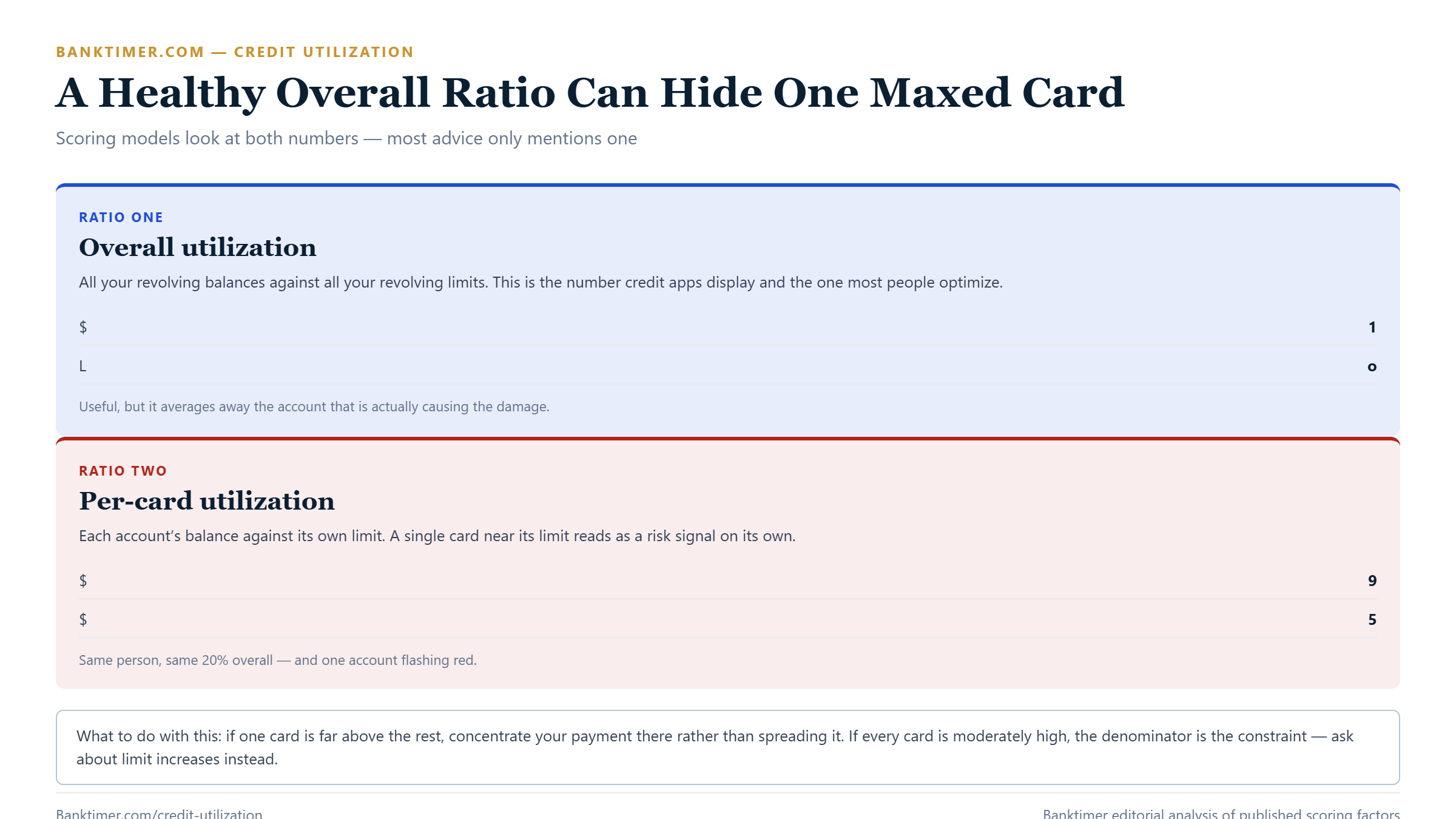
One maxed-out card can hurt even when your overall ratio looks healthy. Scoring models look at individual card utilization as well as the aggregate, so spreading a balance is not the same as hiding it.
Key Numbers to Know
| Figure | Value | Why it matters |
|---|---|---|
| Weight of amounts owed in a FICO Score | 30% | The category utilization sits in — second-largest factor after payment history |
| Weight of payment history | 35% | The only factor that outweighs utilization — and the one you can’t fix quickly |
| CFPB’s stated utilization threshold | Under 30% | A ceiling to stay under, not a target to aim for |
| Typical utilization among the highest scorers | Single digits | Shows the ratio keeps helping well below the 30% line |
| How long high utilization stays on your record | Until the next balance is reported | No lasting memory — this is what makes it the fastest lever available |
| Typical reporting frequency to the bureaus | About once a month per account | Usually tied to the statement closing date, not the payment due date |
| Accounts included in the ratio | Revolving only | Credit cards and lines of credit; mortgages and auto loans are excluded |
| Free credit reports available | From all three bureaus at AnnualCreditReport.com | The only way to see the balances and limits actually being used in your ratio |
Two rows do most of the work here. The 30% weighting explains why utilization is worth attention at all. The “until the next balance is reported” row explains why it’s worth attention now — this is the rare credit factor where a single well-timed payment produces a measurable result within weeks rather than years.
How Credit Utilization Is Calculated
The formula is simple enough to do in your head. Divide your total revolving balances by your total revolving credit limits, then multiply by 100. The CFPB states it the same way: you get your ratio by dividing your total credit card balances by your credit limits.
A Worked Example
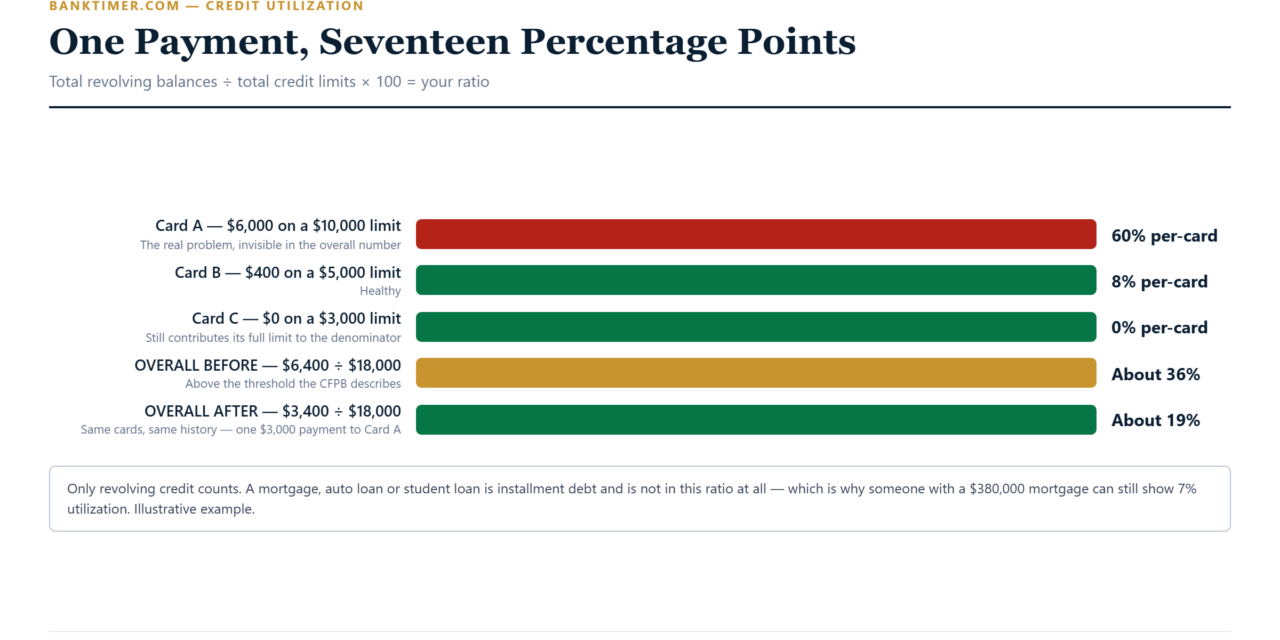
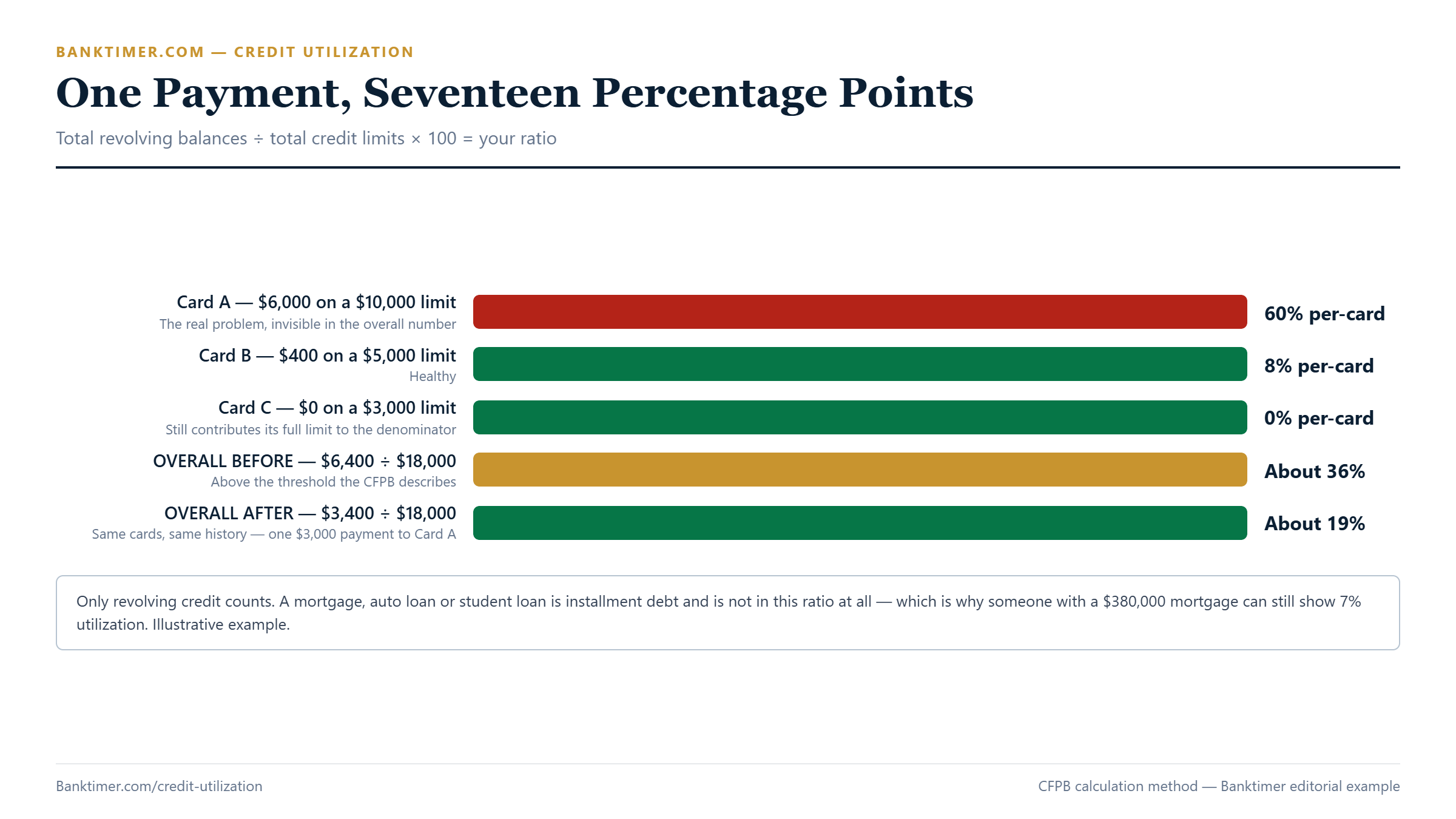
Take three cards: one with a $6,000 balance on a $10,000 limit, one with $400 on a $5,000 limit, and one with $0 on a $3,000 limit. Balances total $6,400. Limits total $18,000. Overall utilization is $6,400 divided by $18,000, or about 36% — above the threshold the CFPB describes, and enough to be holding the score down.
Now pay $3,000 toward the first card before its statement closes. Balances total $3,400 against the same $18,000 in limits, and utilization drops to roughly 19%. Nothing else about the accounts changed — same cards, same history, same payment record — and the ratio moved by 17 percentage points in one payment.
| Card | Reported balance | Credit limit | Per-card utilization |
|---|---|---|---|
| Card A | $6,000 | $10,000 | 60% — the problem card |
| Card B | $400 | $5,000 | 8% |
| Card C | $0 | $3,000 | 0% |
| Overall, before | $6,400 | $18,000 | About 36% |
| Overall, after paying $3,000 to Card A | $3,400 | $18,000 | About 19% |
Illustrative example. Note what the table reveals that a single overall number hides: Card A is at 60% on its own. Scoring models look at that individual ratio too, which is why paying down the highest-utilization card first usually does more for your score than spreading the same money across three cards.
What Goes Into the Ratio — and What Doesn’t
Utilization measures revolving credit only. Credit cards, retail store cards, and personal lines of credit all count. Installment debt does not: a mortgage, auto loan, student loan, or fixed-term personal loan is evaluated separately, on how much of the original loan amount is left rather than against a credit limit.
That distinction produces a genuinely counterintuitive result. Someone with a $380,000 mortgage balance and a $900 credit card balance on $12,000 in limits shows 7.5% utilization. The mortgage, which dwarfs everything else in dollar terms, isn’t in the ratio at all. Banktimer’s guide to the different types of loans covers how installment and revolving credit differ structurally.
| Counts toward revolving utilization | Does not count |
|---|---|
| Credit cards, including store and co-branded cards | Mortgages and home equity loans |
| Personal lines of credit | Auto loans |
| Home equity lines of credit, in most scoring treatments | Student loans |
| Overdraft lines of credit tied to a checking account | Fixed-term personal loans |
| Authorized-user card accounts, where reported | Most buy now, pay later plans, depending on the provider |
| Charge cards, in some models using a high-balance proxy | Rent, utilities, and phone bills unless enrolled in a reporting program |
The buy now, pay later row is genuinely unsettled. Reporting practices vary by provider and have been changing, and a plan that appears on your report may be treated as installment rather than revolving credit. Banktimer’s guide to buy now, pay later fees covers what these plans do and don’t do to your credit file.
The Two Ratios Scoring Models Actually Look At
Most advice treats utilization as one number. Scoring models use at least two, and the gap between them explains a lot of confused credit-score results.
Overall Utilization
Your aggregate balances against your aggregate limits. This is the headline number, the one credit-monitoring apps display, and the one most people optimize.
Per-Card Utilization
Each individual account’s balance against its own limit. A single card sitting near its limit registers as a risk signal even when the overall picture looks comfortable — which is why someone with $9,500 on a $10,000 card and $500 across $40,000 of other limits can be surprised by their score despite an overall ratio of 20%.
Why This Changes What You Should Do
If your overall ratio is fine but one card is near its limit, the most valuable payment is to that card specifically. If your overall ratio is high and spread evenly, the most valuable action may be raising limits rather than paying down, since the denominator is the problem. The two diagnoses call for different moves, and you can only tell them apart by looking at each card individually.
| Situation | Overall ratio | Highest single card | Most useful next move |
|---|---|---|---|
| Evenly spread, moderate balances | 34% | 38% | Pay down anywhere, or request limit increases across cards |
| One card carrying everything | 20% | 95% | Pay that one card down; the overall figure is misleading you |
| Low balances, small total limits | 45% | 50% | Raise limits — the denominator is the constraint, not your spending |
| Everything reported at zero | 0% | 0% | Let one small balance report; some models read all-zero slightly less favorably |
| Heavy spender who pays in full monthly | Reported at 70% | 70% | Pay before the statement closes, not on the due date |
The final row is the one that catches financially careful people, and it deserves its own section.
The Statement Date Is the Date That Matters
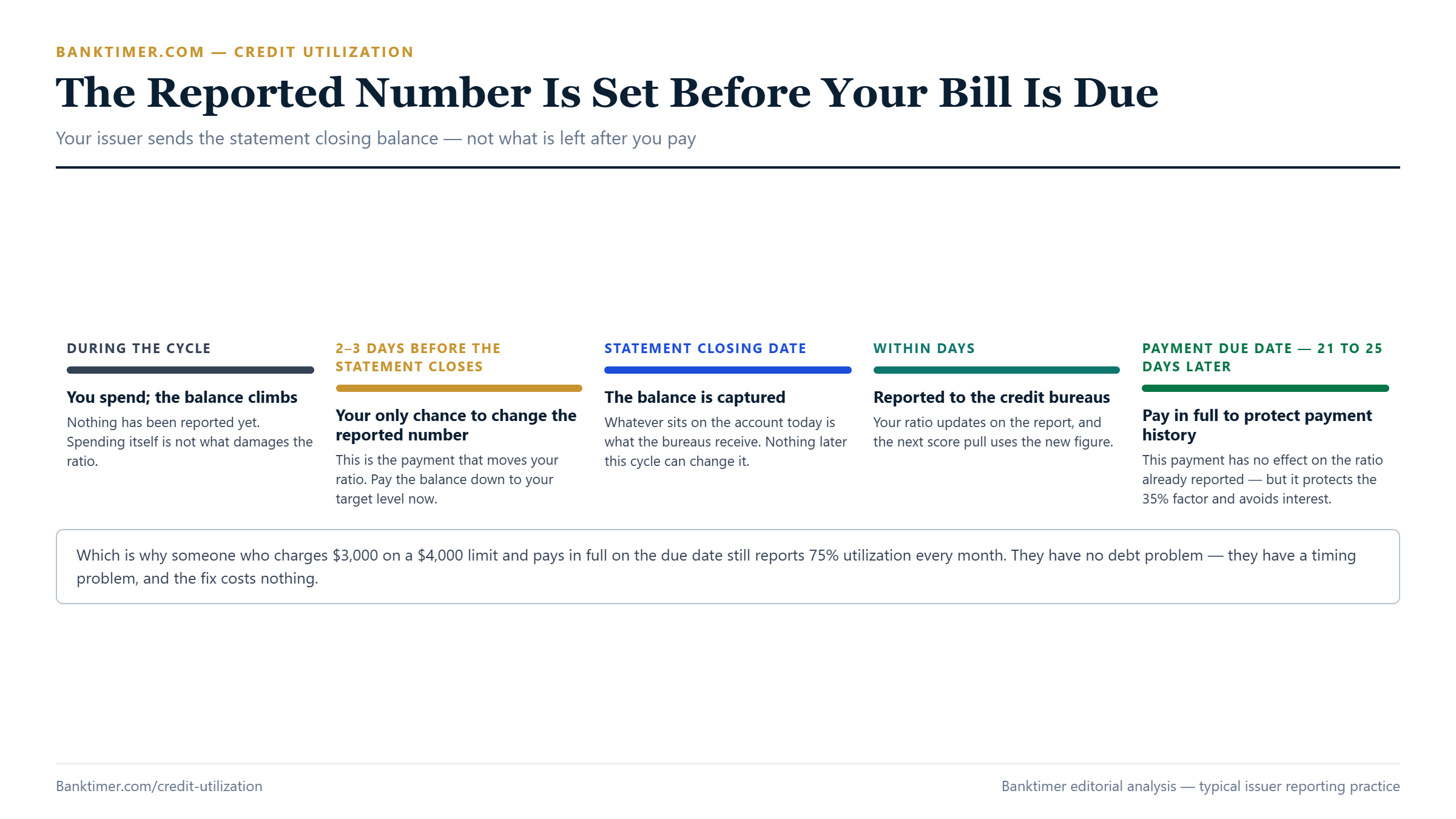
This is the single most useful mechanic in the whole subject, and almost nobody is taught it. Your card issuer reports your balance to the credit bureaus roughly once a month, and the figure it reports is generally your statement closing balance — the balance on the day your statement cuts, not the balance after you pay.
Why Paying in Full Isn’t Enough
Consider someone with a $4,000 limit who runs $3,000 of ordinary spending through the card each month and pays the full statement balance by the due date, never paying a cent of interest. Their statement closes with $3,000 on it. That’s what gets reported. Their credit report shows 75% utilization every single month, despite perfect payment behavior and zero debt.
This person is not doing anything wrong financially. They’re doing something suboptimal for their score, and the fix costs nothing.
The Fix: Pay Before the Statement Closes
Find your statement closing date — it’s on your statement and in your online account, and it is typically 21 to 25 days before the payment due date. Make a payment a few days before that date rather than waiting for the due date. The statement then closes with a much smaller balance, and that smaller number is what gets reported.
You can keep paying whatever remains by the due date as usual. Nothing about your interest situation changes, because you’re still paying the full balance within the grace period. Banktimer’s explainer on how credit card APR and grace periods work covers why this doesn’t cost you anything.
Timing Matters When You’re About to Apply for Something
If a mortgage, auto loan, or card application is coming in the next few months, this timing trick is worth using deliberately for two or three cycles beforehand. Lenders pull your report at a moment in time; what matters is the balance sitting on it that day. Banktimer’s guide to hard inquiries covers the other side of application timing.
| Stage of the cycle | What is happening | Effect on your reported ratio | What to do |
|---|---|---|---|
| During the billing cycle | You spend; the balance climbs | None yet — nothing has been reported | Nothing; spending itself isn’t the issue |
| Two to three days before the statement closes | Your last chance to change the number that gets reported | This payment is the one that moves your ratio | Pay the balance down to your target level |
| Statement closing date | The balance is captured | This figure is what the bureaus receive | Nothing more can change it this cycle |
| Reporting to the bureaus | Usually within days of the statement date | Your ratio updates on the report | Check the report if you want confirmation |
| Payment due date | Typically 21 to 25 days after the statement closed | No effect on the ratio already reported | Pay in full to avoid interest — this protects the 35% factor |
Read the last two rows together. Paying by the due date protects your payment history, which is the larger scoring factor and the one with a long memory. Paying before the statement closes protects your utilization. Both matter, they happen at different moments, and neither substitutes for the other.
How Much Does Utilization Actually Move Your Score?
There is no published table converting a utilization percentage into a point change, and anyone offering one is estimating. Scoring models are proprietary, the effect depends on everything else in your file, and the same ratio change moves a thin file differently from a thick one.
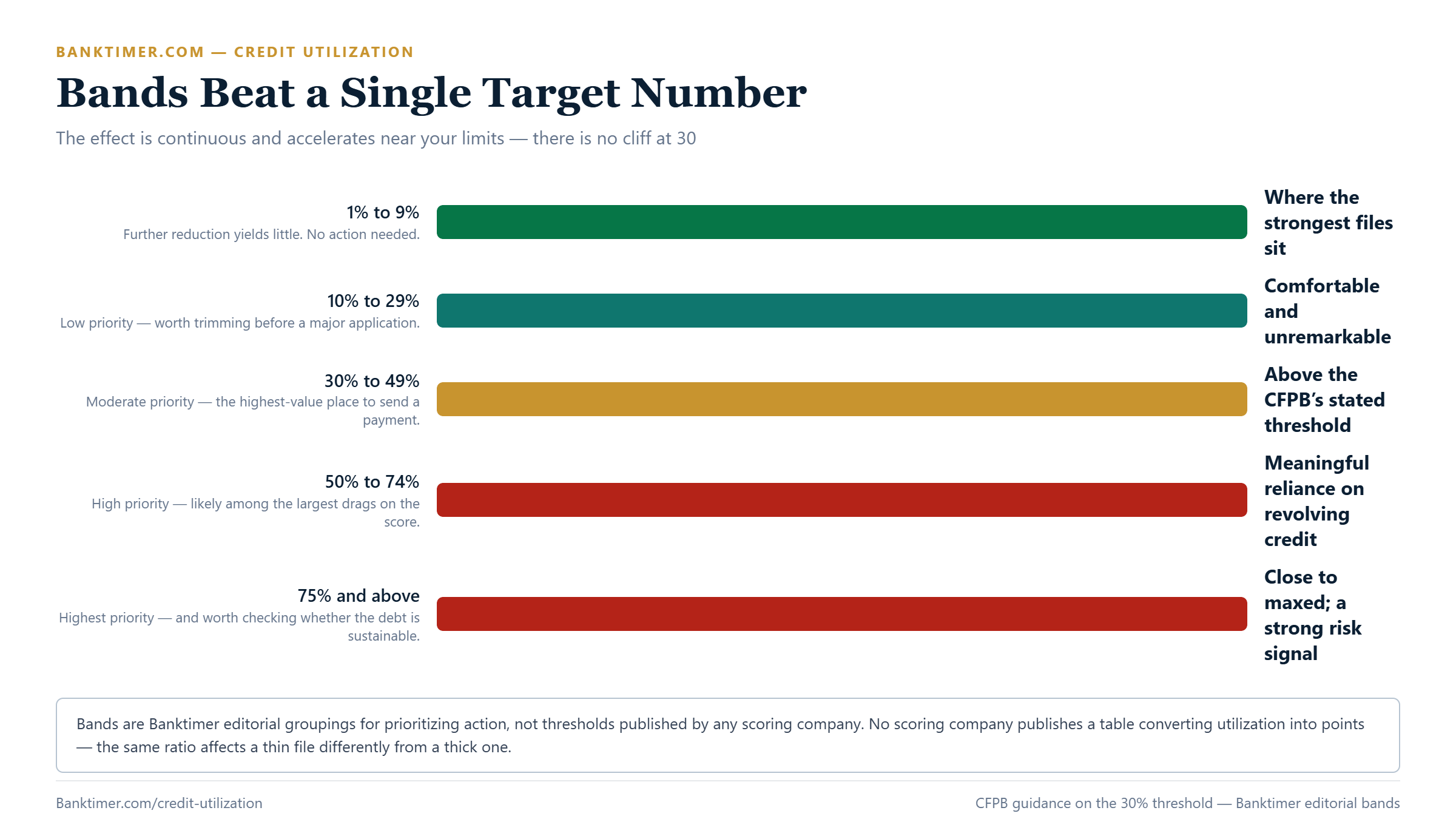
What can be said accurately is the shape of the relationship. The effect is continuous rather than a cliff — moving from 32% to 28% does not unlock a hidden bonus, and there is no switch at exactly 30. It’s also non-linear: the damage accelerates as you approach your limits, so the move from 90% to 70% typically matters more than the move from 30% to 10%.
The Practical Bands
Treating utilization as a set of rough bands is more useful than chasing a specific number. Below roughly 10%, you’re in the range associated with the strongest scores and further reduction yields little. Between 10% and 30%, you’re in acceptable territory with room to improve. Between 30% and 50%, the ratio is actively working against you. Above 50%, and especially above 70%, it’s likely one of the largest single drags on your score.
| Utilization band | How it reads to a lender | Priority of fixing it |
|---|---|---|
| 1% to 9% | Active accounts, minimal reliance on credit | None — you’re already where the strongest files sit |
| 10% to 29% | Comfortable and unremarkable | Low — worth trimming before a major application |
| 30% to 49% | Above the commonly cited threshold; a visible drag | Moderate — the highest-value place to spend a payment |
| 50% to 74% | Meaningful reliance on revolving credit | High — likely among the largest factors holding the score down |
| 75% and above | Close to maxed; a strong risk signal | Highest — and worth checking whether the underlying debt is sustainable |
| 0% across every card | No recent revolving activity to evaluate | Low — let one small balance report if you want the file to show activity |
The bands are Banktimer editorial groupings based on how scoring factors are generally described, not thresholds published by any scoring company. Use them to prioritize, not to predict a point total. If your goal is a specific score for a specific application, Banktimer’s credit score guide covers the other factors you’d be working on at the same time.
A Word on Reporting Zero
Some scoring models treat a file where every revolving account reports a zero balance slightly less favorably than one showing a small active balance, on the reasoning that there’s less recent behavior to evaluate. The difference is small and varies by model, and it is not a reason to carry debt or pay interest. If you want the effect, let one card report a modest balance and pay it in full by the due date — you get the activity without the cost.
Six Ways to Lower Your Utilization
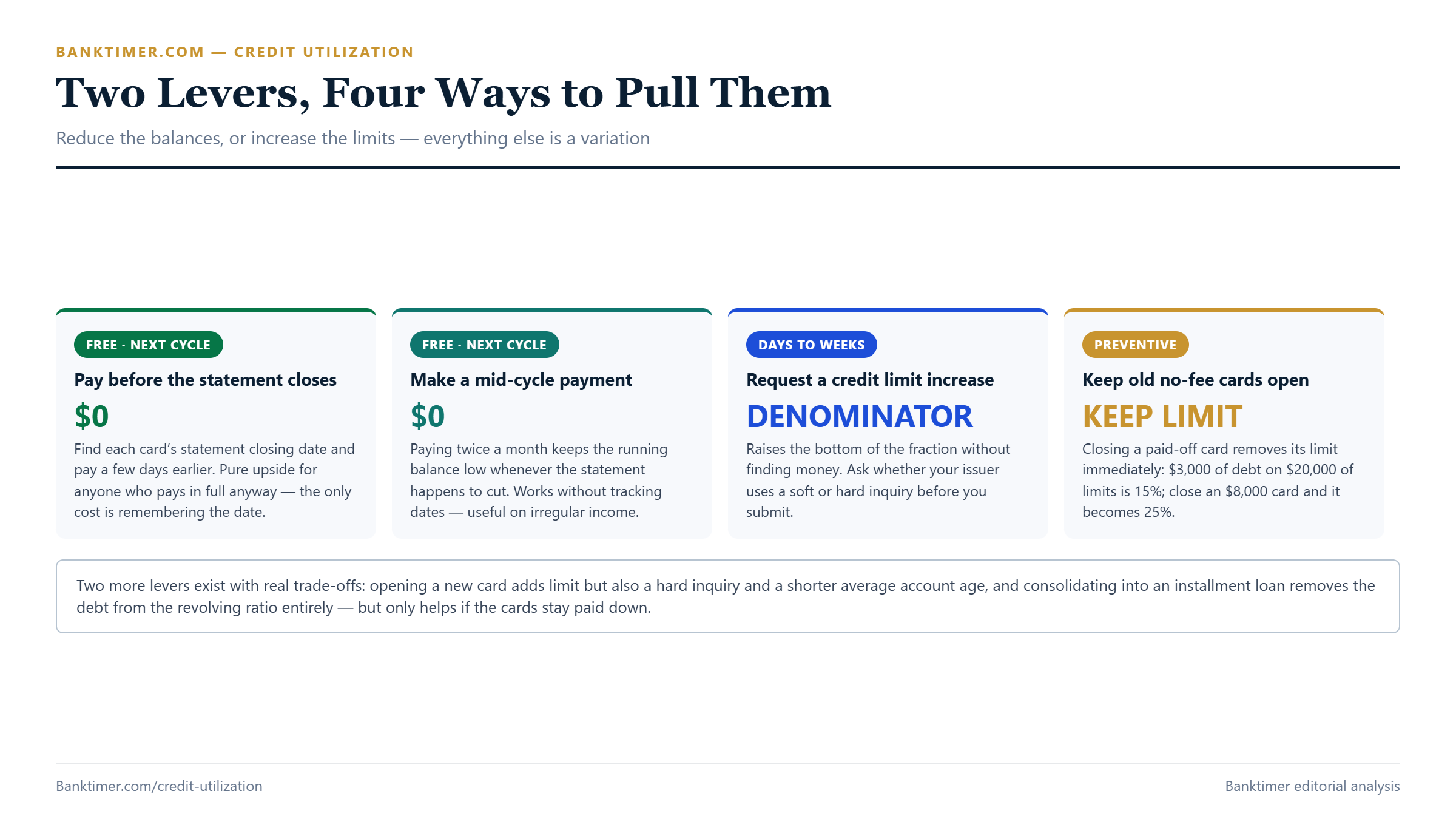
There are only two levers — reduce the numerator or increase the denominator — but six practical ways to pull them, with very different speeds and side effects.
1. Pay Before the Statement Closes
Free, instant, and requires no new accounts or applications. The only cost is remembering the date. For anyone who pays in full anyway, this is pure upside and usually the first thing to do.
2. Make a Mid-Cycle Payment
If your spending is heavy relative to your limits, paying twice a month keeps the running balance low regardless of when the statement happens to cut. This is the version that works without tracking dates.
3. Request a Credit Limit Increase
Raising the denominator lowers the ratio without requiring you to find money. Many issuers allow a limit increase request online, and some process it with a soft inquiry rather than a hard one. Ask which before submitting — the answer varies by issuer and sometimes by whether you name a specific amount.
The obvious risk is that a larger limit makes larger balances possible. If a higher limit would change your spending, this lever isn’t for you.
4. Open an Additional Card — Carefully
A new account adds its limit to your total, which lowers utilization. It also generates a hard inquiry, lowers your average account age, and takes a few months to help on net. This is a reasonable move when you’re not applying for anything soon, and a poor one in the months before a mortgage application.
5. Don’t Close Old Cards
Closing a paid-off card removes its limit from your denominator immediately. Someone with $3,000 of balances across $20,000 in limits sits at 15%; close an unused $8,000-limit card and the same debt becomes 25% on $12,000 of remaining limits. If the card has no annual fee, keeping it open with occasional small use is usually better. Banktimer’s guide to credit card annual fees covers when closing is genuinely worth the trade.
6. Move a Balance to an Installment Loan
Consolidating card debt into a fixed-term personal loan removes it from revolving utilization entirely, because installment balances aren’t in the ratio. The effect on the score can be substantial and fast — but the debt is still there, and this only works if the cards stay paid down afterward. Banktimer’s guide to debt consolidation loan fees covers the costs that make or break the arithmetic, and a balance transfer card is a different route to a similar goal with different trade-offs.
| Lever | Speed | Cost | Main risk |
|---|---|---|---|
| Pay before the statement closes | Next reporting cycle | $0 | Forgetting the date |
| Mid-cycle payments | Next reporting cycle | $0 | Requires available cash mid-month |
| Credit limit increase | Days to weeks | $0, possibly a hard inquiry | A larger limit may invite larger balances |
| Open an additional card | Helps after a few months | Hard inquiry, possible annual fee | Short-term score dip; bad timing before a mortgage |
| Keep old cards open | Preventive | $0 if no annual fee | Issuer may close a dormant card on its own |
| Consolidate into an installment loan | One to two cycles | Origination fee and interest | Cards fill back up and you owe both |
| Become an authorized user on a low-utilization card | One to two cycles | $0, depends on the primary cardholder | Their behavior now affects your file; not all issuers report |
How Fast Does It Recover?
Faster than anything else on your credit report, and this is the genuinely good news in the subject.
The Timeline
Pay a balance down today and the change shows up when that account next reports — typically within about a month, tied to the statement cycle rather than to the payment date. Once the lower balance is on the report, the score is recalculated using it the next time anyone pulls a score. There is no waiting period, no aging requirement, and no residue from the previous month’s high balance.
Compare that to a late payment, which can remain on a credit report for up to seven years, or a hard inquiry, which typically stays for two years and can be counted for a shorter period. Utilization is unique in resetting completely.
What “Rapid Rescoring” Is and When It Applies
If you’re mid-mortgage-application and need a corrected balance reflected faster than the normal cycle, lenders can sometimes request a rapid rescore through the bureaus — a process the lender initiates, not you, and one that requires documentation from the creditor that the balance actually changed. It isn’t available directly to consumers and it isn’t a way to fix an inaccurate report. For genuine errors, the dispute process is the right route, and Banktimer’s guide to credit report errors covers how that works.
| Credit event | How long it affects you | Can you undo it? |
|---|---|---|
| High credit utilization | Until the next balance is reported — about a month | Yes, completely |
| Hard inquiry | Typically on the report about two years | No, but the effect fades |
| A single late payment | Up to seven years | Only if it was reported in error |
| Collection account | Up to seven years from the original delinquency | Only if inaccurate |
| Closing an old card | Utilization effect is immediate and lasting | Rarely — some issuers will reopen a recently closed card |
The first row against the rest is the whole argument for treating utilization as your first move whenever a score needs to improve quickly. It’s the only line in the table where the answer to “can you undo it?” is an unqualified yes.
A Decision Framework: Where Should Your Next Dollar Go?
If you have a fixed amount to put toward cards this month and you want the largest score improvement, the answer depends on which of four situations you’re in.
If One Card Is Above 70% and Others Are Low
Put everything toward that card until it drops below 50%, then below 30%. Per-card utilization is doing the damage, and concentrating the payment fixes the specific signal rather than diluting it.
If Everything Is Moderately High
Your overall ratio is the binding constraint, so the distribution matters less. Pay wherever the interest rate is highest, which costs you least in dollars while producing the same ratio improvement. This is the one case where the score-optimal and cost-optimal answers coincide.
If Balances Are Small but Limits Are Smaller
Requesting limit increases will do more than a payment you can afford. A $600 balance on a $1,000 limit is 60% utilization; raising the limit to $3,000 takes it to 20% without spending anything. Ask each issuer whether the request uses a soft or hard inquiry first.
If You Pay in Full and Still Report High
You don’t have a debt problem, you have a timing problem, and no payment amount fixes it. Move your payment to a few days before the statement closes and the reported ratio drops next cycle at no cost.
| Your situation | Highest-value action | Why | Timeline to see it |
|---|---|---|---|
| One card above 70%, others low | Concentrate every dollar on that card | Per-card utilization is the signal doing the damage | Next statement cycle |
| Everything moderately high | Pay the highest interest rate first | Same ratio effect, lowest dollar cost | Next statement cycle |
| Small balances, small limits | Request limit increases | The denominator is the constraint, not your spending | Days to weeks |
| Pay in full, still report high | Move the payment before the statement date | It’s a timing problem, not a debt problem | Next statement cycle, at no cost |
| Applying for a mortgage in 60 to 90 days | Lower balances now, open nothing new | New accounts add inquiries and cut average age at the worst moment | Two to three cycles before you apply |
| Everything reports zero every month | Let one card report a small balance | Some models read an all-zero file as less informative | Next statement cycle |
Common Mistakes and Persistent Myths
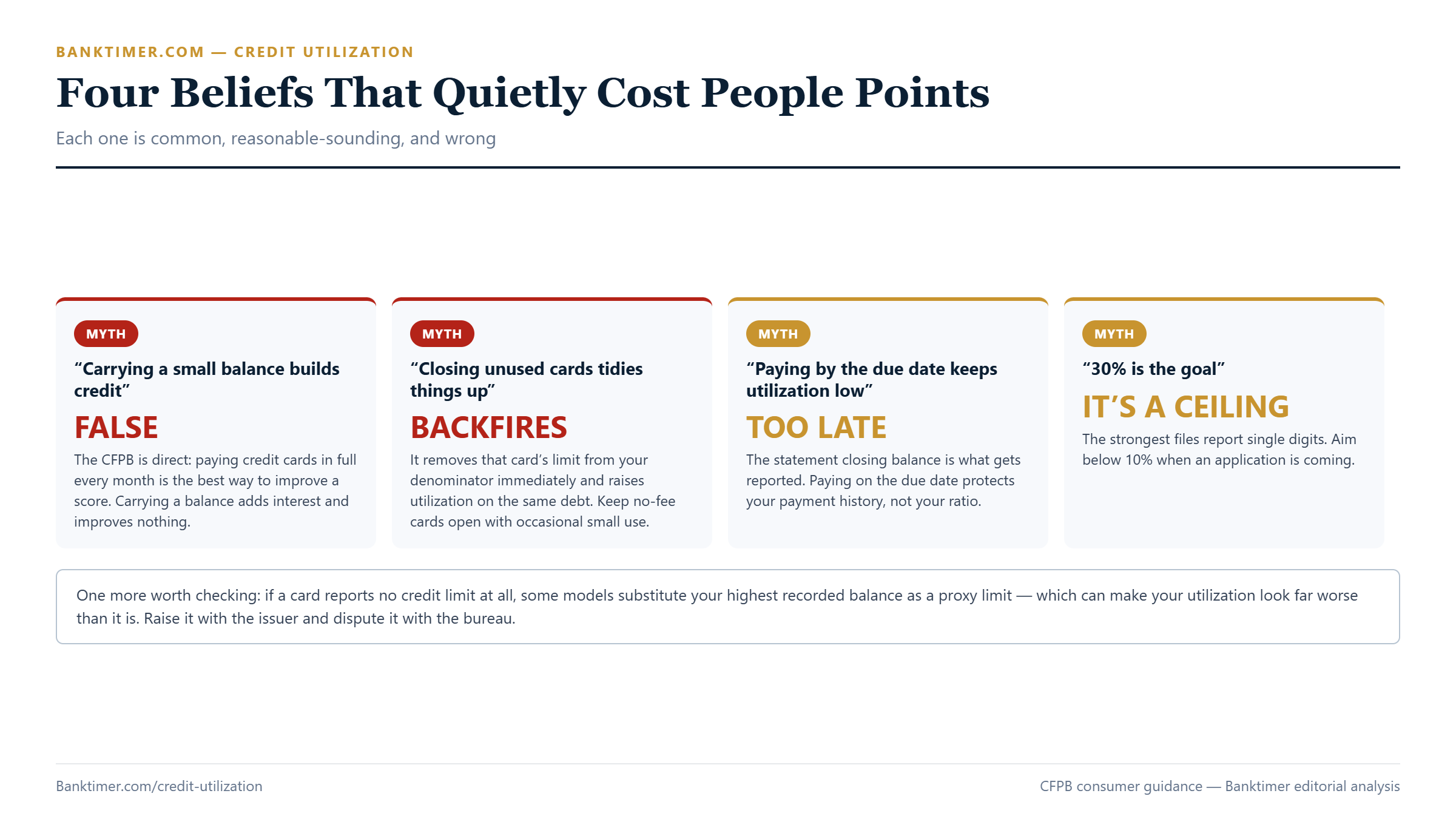
The most costly mistake is closing unused cards to simplify. It shrinks your total limit, raises utilization on the same debt, and the effect is immediate. Unless the card carries an annual fee you don’t want to pay, keeping it open and occasionally used is nearly always the better call.
A second is assuming that paying the bill in full is sufficient. It protects your payment history and saves you interest, but the reported balance is captured at the statement date, so a heavy spender who pays in full can still report high utilization every month.
A third is believing you need to carry a balance to build credit. You don’t, and the CFPB says so directly: paying off credit cards in full every month is the best way to improve a credit score. Carrying a balance costs interest and improves nothing.
A fourth is optimizing the overall ratio while ignoring a single maxed card. A fifth is treating 30% as a goal rather than a ceiling — the strongest files sit far below it. A sixth is applying for a new card to lower utilization in the same month as a mortgage application, which trades a small ratio gain for an inquiry and a shorter average account age at exactly the wrong time.
A seventh is counting installment debt in the ratio and panicking about a mortgage that has no effect on it. An eighth is assuming a business credit card affects personal utilization — whether it does depends entirely on whether that issuer reports the account to the consumer bureaus, which varies and is worth asking about directly.
| Common belief | What’s actually true | What to do instead |
|---|---|---|
| Carrying a small balance builds credit | Paying in full is better; carrying a balance only adds interest | Pay in full, and let a small balance report if you want activity shown |
| Closing cards you don’t use tidies up your credit | It removes limits and raises utilization immediately | Keep no-fee cards open with occasional small use |
| Paying by the due date keeps utilization low | The statement closing balance is what gets reported | Pay a few days before the statement closes |
| 30% is the goal | It’s a ceiling; the strongest files report single digits | Aim below 10% when an application is coming |
| My mortgage is wrecking my utilization | Installment debt isn’t in the revolving ratio at all | Focus on cards and lines of credit only |
| Checking my own utilization hurts my score | Checking your own report is a soft inquiry with no effect | Pull your free reports and read the actual balances and limits |
| A limit increase always requires a hard pull | Some issuers use a soft inquiry; practice varies | Ask which applies before you submit the request |
| Utilization damage lingers for years | It resets entirely with the next reported balance | Treat it as your fastest available fix |
Questions to Ask Before You Try to Move Your Ratio
- ☐ What is the statement closing date on each of my cards, as opposed to the payment due date?
- ☐ What balance and limit does each card actually report — have I checked my credit report rather than an app estimate?
- ☐ Is any single card above 50% of its own limit, even if my overall ratio looks fine?
- ☐ Does my issuer use a soft or a hard inquiry for a credit limit increase request?
- ☐ Am I applying for a mortgage, auto loan, or card in the next 90 days?
- ☐ Does closing this card cost me an annual fee, or cost me the limit that’s holding my ratio down?
- ☐ Does my business card report to the consumer credit bureaus, and under whose name?
- ☐ If I consolidate into a loan, what is my plan for keeping the cards at low balances afterward?
- ☐ Are the limits shown on my report accurate, or is a card reporting no limit at all?
That last question catches a real and fixable problem. When a card reports without a credit limit — which happens with some charge cards and occasionally through reporting errors — scoring models may substitute your highest recorded balance as a proxy limit, which can inflate your apparent utilization substantially. If you see a blank or missing limit on your report, raise it with the issuer and the bureau.
Three Credit Files, Worked Through
The same ratio calls for different action depending on what surrounds it. These three illustrative files use the same rules and reach three different answers.
The Careful Spender With a Bad-Looking Report
A freelancer runs $4,200 of business expenses through a personal card with a $5,500 limit every month and pays the statement in full, never carrying a balance or paying interest. Her report shows 76% utilization month after month, and her score sits noticeably below what her flawless payment history would suggest.
She has no debt problem at all. Two fixes apply, and both are free. She can split the spending across a second card to halve the per-card ratio, or she can make a payment a week before the statement closes so the reported balance lands near $800 instead of $4,200. The second fix alone takes her reported utilization from 76% to about 15% without changing a single thing about how she spends or pays.
The Rebuilder With Two Small Cards
Someone recovering from a rough period holds a $500 secured card and a $1,000 unsecured card, with $600 of balances across them. Overall utilization is 40%, and the secured card sits at 80% on its own. Payments are on time and have been for eighteen months.
Here the denominator is the constraint. Paying $300 would help, but so would a limit increase on the unsecured card, and after eighteen months of on-time payments a request is reasonable. Graduating the secured card to an unsecured version — which many issuers do automatically, returning the deposit — often raises the limit at the same time. The highest-value single action is asking both issuers what’s available, which costs nothing.
The Homeowner About to Refinance
A couple with a $340,000 mortgage, an auto loan, and $7,000 across four cards with $35,000 in combined limits sits at 20% utilization. They’re planning to refinance in roughly three months and wonder whether to open a new card to push the ratio lower.
They shouldn’t. A new account adds a hard inquiry, cuts their average account age, and helps utilization only modestly from an already reasonable 20%. The better plan is to lower balances over the next two statement cycles, request soft-pull limit increases on existing cards if their issuers offer them, and open nothing until after closing. Banktimer’s guide to mortgage rate locks covers the timing pressures on the other side of that decision.
| File | Reported ratio | Real problem | Best action, and cost |
|---|---|---|---|
| Freelancer, pays in full monthly | 76% | Timing, not debt | Pay a week before the statement closes — $0 |
| Rebuilder, two small cards | 40% overall, 80% on one card | Limits too small | Ask for increases and secured-card graduation — $0 |
| Homeowner refinancing in 90 days | 20% | Nothing urgent; timing risk if they act | Lower balances, open nothing new — patience |
| Heavy card user carrying real debt | 85% | Genuine debt load, not reporting | A repayment plan first; the ratio follows — months |
The last row is the honest caveat on this entire subject. When utilization is high because you genuinely owe a lot at high interest, the ratio is a symptom rather than the problem, and optimizing the reported number does nothing about the interest. In that case the work is a repayment plan, usually alongside an emergency fund so the next surprise does not land back on the cards, and Banktimer’s guide to building a monthly budget is the more useful starting point.
How Utilization Interacts With the Rest of Your File
No scoring factor operates alone, and a few of the interactions are worth knowing because they change what a given action is worth.
Payment History Outranks It
At 35% versus 30%, payment history is the heavier factor — and unlike utilization, its effects last for years. Never move a payment earlier in the cycle in a way that risks missing a due date on another account. The timing trick is only worth using when you can do both reliably.
New Accounts Cut Two Ways
Opening a card lowers utilization by adding limit, but it also adds a hard inquiry and reduces your average account age, both of which sit in smaller scoring categories. On net it usually helps within a few months and hurts in the first few weeks — which is why the timing relative to an upcoming application matters more than the decision itself.
Credit Mix Is a Minor Factor
Consolidating revolving debt into an installment loan improves utilization and adds account-type variety, but credit mix carries only 10% of the score. The utilization improvement is doing nearly all the work in that move; the mix benefit is a rounding detail, and not a reason to take a loan you don’t otherwise want.
Scoring Models Disagree With Each Other
FICO and VantageScore weight and treat utilization somewhat differently, and lenders in different industries use different model versions — mortgage lenders commonly use older FICO versions than a card issuer would. That’s why the score in a free app can differ from the one a lender pulls by a meaningful margin without either being wrong. Optimize the underlying behavior rather than one app’s number.
Utilization When Your Situation Isn’t Typical
If You’re New to Credit
A thin file makes every input louder, so a small balance on a small limit can register as high utilization and move your score more than the same ratio would on an established file. Starting with a secured card and keeping the reported balance under about 10% of its limit builds the payment history that eventually matters more, without the ratio working against you in the meantime.
If You’re Self-Employed
Business spending on a personal card is the most common cause of a high ratio among people with no consumer debt at all. A dedicated business card can remove that spending from your personal report — but only if the issuer doesn’t report the account to the consumer bureaus, which varies. Ask before you assume, because some business cards report the full account history to the owner’s personal file.
If You Share Finances With Someone
Joint accounts and authorized-user arrangements put someone else’s balances on your report. A partner running a card to its limit affects your ratio, and neither of you necessarily sees it until a score drops. Agreeing on a rough balance ceiling in advance is easier than diagnosing it afterward, and Banktimer’s guide to shared accounts covers the wider shared-liability picture.
If Your Income Is Irregular
When cash flow arrives unevenly, the statement-timing approach is less reliable, because you may not have money available in the right week. Mid-cycle payments whenever funds arrive work better than trying to hit a specific date, and they produce the same result: a lower balance whenever the statement happens to close.
What Lenders See Beyond the Ratio
Utilization is a scoring input, but underwriters also look at it directly, and the two uses differ in ways worth knowing before a major application.
Underwriters Read the Balances, Not Just the Score
A mortgage underwriter pulls your full report and sees each card’s balance, limit, and minimum payment. Those minimum payments feed your debt-to-income ratio, which is a separate qualification test from your credit score — and one where paying a card down helps twice, by improving the ratio and by removing its minimum payment from the calculation.
That’s a meaningful distinction. A $6,000 card balance might cost you a modest number of score points, but the $180 minimum payment attached to it can reduce how much house you qualify for by a far larger margin. Banktimer’s guide to mortgage preapproval covers how lenders build that calculation.
Recent Increases Get Noticed
A file showing balances climbing sharply in the months before an application reads differently from one showing steady low balances, even at the same final ratio. Underwriters and some scoring treatments look at trended data — the direction of your balances over time, not just the current snapshot. Paying down steadily over several months is worth more than a single large payment the week before you apply.
Available Credit Is Itself a Signal
Some lenders consider total available revolving credit when deciding how much more to extend. Someone with $80,000 in unused card limits may find a new issuer less willing to add a large line, regardless of a low utilization ratio. This cuts against the instinct to maximize limits indefinitely, and it’s a reason to think of limits as a tool for managing the ratio rather than a score to run up.
Why the Score in Your App Differs From the Lender’s
Free score apps typically show a VantageScore or a particular FICO version calculated from one bureau’s data. A mortgage lender usually pulls all three bureaus and uses older FICO versions specified by the loan program. Balances also report at different times to different bureaus, so the same person can show three different utilization figures on the same day. None of this means an app is wrong — it means the number is a directional indicator rather than the figure a lender will use.
A 90-Day Plan Before a Major Application
If a mortgage, refinance, or auto loan is coming, the work fits into three statement cycles and needs no new accounts.
Month one: pull all three credit reports free at AnnualCreditReport.com and write down each card’s reported balance, reported limit, and statement closing date. Flag any account reporting no limit, any balance that looks wrong, and any card above 50% of its own limit. Dispute genuine errors now, because the process takes time.
Month two: concentrate payments on the highest per-card ratios first, and ask each issuer whether a limit increase can be done with a soft inquiry. Move your payment date to a few days before each statement closes. Open nothing, close nothing, and co-sign nothing.
Month three: verify on your reports that the lower balances actually posted, and keep them there through the application. Lenders commonly re-pull credit shortly before closing, so a balance that creeps back up in the final weeks can undo the work at the worst possible moment.
Who This Guide Suits
This guide is most useful to anyone whose score is lower than their payment history suggests it should be, anyone preparing for a mortgage or auto loan in the next few months, and anyone who pays every card in full and cannot work out why their report shows high utilization. It’s equally relevant if you’re deciding whether to close a card you no longer use.
Someone rebuilding after missed payments will find utilization the fastest of the available levers, though not the most important — payment history carries more weight and takes longer to repair, so the two run in parallel rather than in sequence. Someone with strong credit chasing the last few points will get the most from the statement-timing section and the per-card ratio, since those are where well-managed files typically leave points on the table. Banktimer’s credit card basics guide covers the broader card decisions this sits inside.
Frequently Asked Questions
What is a good credit utilization ratio?
The CFPB describes keeping it under 30 percent as showing lenders you’re responsible. That figure is best treated as a ceiling rather than a target — people with the highest scores typically report utilization in the single digits.
How is credit utilization calculated?
Divide your total credit card balances by your total credit limits and multiply by 100. Scoring models also calculate the same ratio for each card individually, so both the aggregate and the per-card figures matter.
Does my mortgage count toward credit utilization?
No. Utilization measures revolving credit — credit cards and lines of credit. Mortgages, auto loans, and student loans are installment accounts and are evaluated on a separate basis.
I pay my card in full every month. Why is my utilization high?
Because your issuer generally reports your statement closing balance, not the balance after you pay. If you charge heavily and pay on the due date, the high statement balance is what reaches the credit bureaus. Paying a few days before the statement closes fixes it at no cost.
How quickly does paying down a card improve my score?
Usually within about a month, when that account next reports its balance. Utilization carries no memory, so the previous high balance stops counting as soon as a lower one is reported.
Should I close a credit card I don’t use?
Usually not, if it has no annual fee. Closing it removes its limit from your total available credit and raises your utilization on the same debt immediately. If it does charge an annual fee, ask the issuer about downgrading to a no-fee version of the card instead, which keeps the limit and the account age.
Does asking for a credit limit increase hurt my score?
It depends on the issuer. Some process the request with a soft inquiry, which has no effect; others use a hard inquiry, which can cost a few points temporarily. Ask before you submit the request.
Is 0% utilization bad?
Not bad, but some models treat a file where every revolving account reports zero slightly less favorably than one showing a small active balance. The difference is minor, and it’s never a reason to carry debt — let one card report a modest balance and pay it in full by the due date.
Does checking my credit utilization hurt my score?
No. Checking your own credit report or score is a soft inquiry and has no effect. You can get your reports from all three bureaus free at AnnualCreditReport.com.
Which matters more, overall or per-card utilization?
Both are used, and the one that matters more depends on your file. A single card near its limit can drag your score down even when your overall ratio is comfortable, which is why the highest-utilization card is usually the best place to send a payment.
Do business credit cards affect my personal utilization?
Only if the issuer reports that account to the consumer credit bureaus, and practice varies by issuer and card. Ask directly, because the answer determines whether business spending shows up in your personal ratio at all.
Will consolidating card debt into a personal loan lower my utilization?
Yes, because installment balances aren’t part of the revolving ratio. The debt still exists and still has to be repaid, and the benefit disappears if the cards fill back up — so this only works alongside a plan for keeping them at low balances.
Does being an authorized user affect my utilization?
It can, where the issuer reports the account to the bureaus for the authorized user. Being added to a card with a high limit and a low balance can lower your ratio; being added to a heavily used card can raise it.
My card reports no credit limit. What does that mean for my ratio?
Some scoring models substitute your highest recorded balance as a proxy limit when no limit is reported, which can make your utilization look far worse than it is. Raise it with the issuer and, if needed, dispute it with the credit bureau.
How often do credit card balances get reported?
Typically about once a month per account, usually shortly after the statement closing date. Issuers are not required to report on any particular schedule, so the exact timing varies by card.
Does paying off a card completely remove it from the calculation?
No, and that’s a good thing. A card reporting a zero balance still contributes its full credit limit to your denominator, which is exactly what lowers your overall ratio. This is the opposite of closing the card, which removes the limit entirely.
If I have a balance transfer, which card’s utilization counts?
Both, at whatever each reports. Moving $5,000 from a card with a $6,000 limit to a new card with a $10,000 limit lowers the per-card ratio on that debt from 83% to 50%, and leaves your overall ratio unchanged if the old card stays open. Closing the old card afterward undoes most of the benefit.
How many credit cards should I have for good utilization?
There’s no correct number. What matters is the relationship between your balances and your total limits, not the count of accounts. Two cards with generous limits can produce a better ratio than six small ones — and each additional card you open carries an inquiry and lowers your average account age, so opening accounts purely to add limit has a real cost.
Will my utilization affect my ability to rent an apartment or get insurance?
Possibly, indirectly. Landlords commonly check credit, and in many states insurers use credit-based insurance scores in pricing, though several states restrict or prohibit that practice. Those uses generally rely on the same underlying report, so a high ratio can affect more than lending — but the rules vary by state and by use, so treat this as a reason to keep the ratio reasonable rather than a specific prediction.
How to Verify These Numbers Yourself
Three checks confirm everything in this guide for your own file. Pull your free credit reports from all three bureaus at AnnualCreditReport.com and read the actual reported balance and credit limit on each revolving account — not the app estimate, which may lag or may use a different date. Second, find the statement closing date on each card in your online account, and note how far it sits from the due date. Third, the CFPB publishes consumer guidance on credit scores and utilization at consumerfinance.gov, and myFICO publishes the factor weights used in FICO Scores.
The 30% figure and the 30% factor weight are both stable, long-standing published positions rather than numbers that move annually. What does change is reporting practice at individual issuers — whether a limit increase uses a soft pull, whether a business card reports to consumer bureaus, when in the cycle a balance is transmitted. Those are worth confirming with your issuer rather than assuming from a general guide.
Key Terminology
| Term | What it means |
|---|---|
| Credit utilization ratio | Revolving balances divided by revolving credit limits, expressed as a percentage |
| Revolving credit | Credit you can draw, repay and redraw — cards and lines of credit |
| Installment credit | A fixed loan repaid on a schedule; not part of the revolving ratio |
| Amounts owed | The FICO category containing utilization, weighted at 30% of the score |
| Statement closing date | The day your billing cycle ends and the reported balance is captured |
| Payment due date | The deadline to pay without a late mark — typically 21 to 25 days after the statement closes |
| Grace period | The window in which paying the full statement balance avoids interest on purchases |
| Per-card utilization | One account’s balance against its own limit, evaluated alongside the overall ratio |
| Soft inquiry | A credit check that does not affect your score, such as checking your own report |
| Hard inquiry | A check tied to an application, which can lower your score slightly for a period |
| Rapid rescore | A lender-initiated process to reflect a corrected balance faster than the normal cycle |
| Proxy limit | A highest-balance figure some models substitute when no credit limit is reported |
| Authorized user | Someone permitted to use another person’s card, whose file may show that account |
Credit utilization is the fastest lever on your credit score because it is the only major factor with no memory — the number recalculates from whatever balance is reported this month, and last month’s damage vanishes. Three things follow. First, the statement closing date matters more than the due date, because that’s the balance your issuer sends to the bureaus. Second, one card near its limit can hurt even when your overall ratio looks fine, so concentrate payments rather than spreading them. Third, closing an unused card raises your utilization instantly by removing its limit, which is why tidying up your accounts so often backfires. Treat 30% as a ceiling rather than a goal, and if a mortgage or auto application is coming, work on this two or three statement cycles ahead.
Sources
- Consumer Financial Protection Bureau — Credit Score Myths That Might Be Holding You Back
- Consumer Financial Protection Bureau — Credit Reports and Scores
- myFICO — What’s in Your FICO Score
- AnnualCreditReport.com — Free Credit Reports From All Three Bureaus
- Consumer Financial Protection Bureau — Credit Inquiries
- myFICO — Managing Credit Inquiries
Methodology
The FICO factor weights cited in this guide — payment history at 35% and amounts owed at 30% — are published by myFICO and were accessed in September 2026. The utilization threshold described as under 30 percent, the calculation method, and the statement that paying credit cards in full each month is the best way to improve a credit score are drawn from Consumer Financial Protection Bureau consumer guidance. All dollar figures, card balances, limits, and resulting percentages in examples are Banktimer editorial illustrations, not data from any real account. The utilization bands presented are Banktimer editorial groupings intended to help prioritize action; they are not thresholds published by FICO, VantageScore, or any credit bureau, and no scoring company publishes a table converting a utilization percentage into a point change. Scoring models are proprietary and differ from one another, and the same ratio can affect two credit files differently depending on everything else in them. Reporting practices — when an issuer transmits a balance, whether a limit increase request uses a soft or hard inquiry, and whether a business card appears on a consumer report — are set by individual issuers, vary, and change; confirm yours directly. This guide is educational and does not constitute financial advice.
Open each of your credit card accounts and write down two things: the statement closing date and the current balance against the limit. Then set a recurring reminder three days before each statement closes. That single change costs nothing, requires no new accounts, and moves the number your credit report shows starting next cycle — which is more than almost anything else you could do this month.