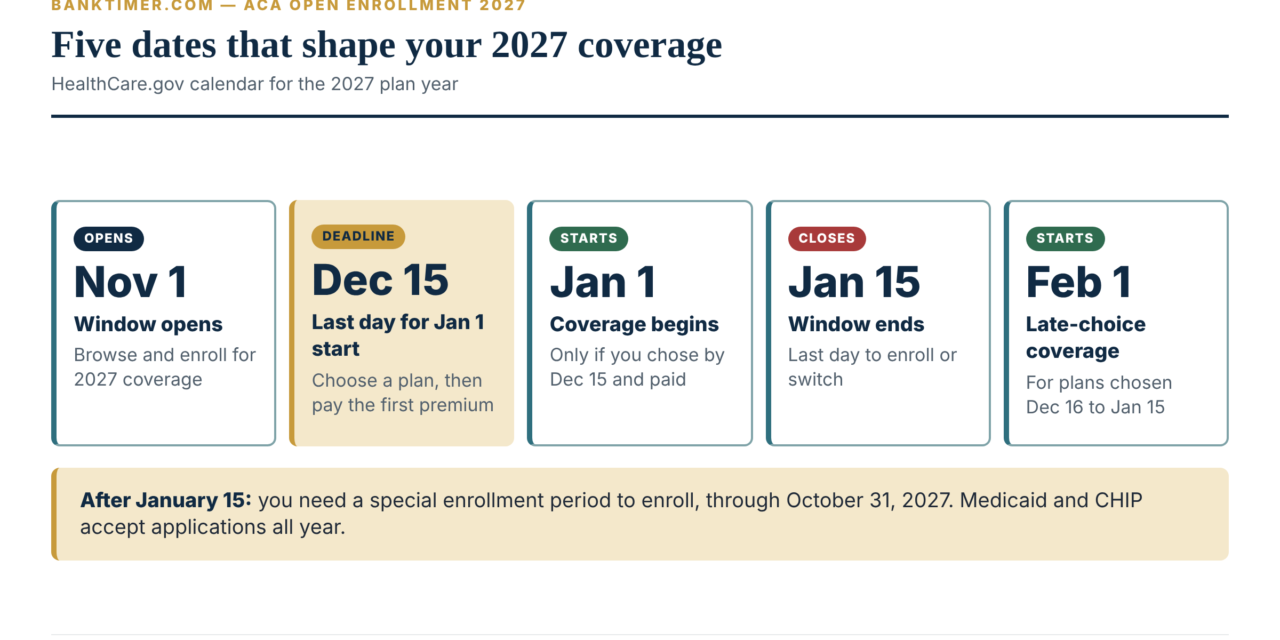
ACA open enrollment 2027 runs from November 1, 2026 to January 15, 2027 on HealthCare.gov. To have coverage on January 1, you must choose a plan by December 15, 2026 and then pay your first premium. Pick a plan from December 16 through January 15 and coverage starts February 1. Many state-run exchanges set later deadlines, and some start coverage on different days, so check your own exchange.
The biggest variable is your expected 2027 income. With the enhanced subsidies gone, a household above 400% of the federal poverty level gets no premium tax credit. After January 15, you need a special enrollment period (SEP) to enroll.
December 15 is the real deadline for most people. It is the last day to choose a plan on HealthCare.gov for coverage that starts January 1. January 15 only buys you a February 1 start.
Your state may run a different calendar. California, for example, lists a December 31 deadline for January 1 coverage and a January 31 close. New Jersey also closes January 31.
Courts changed the picture this year, but not the dates. A federal court vacated the shortened window in June 2026. HHS has appealed, so next year’s calendar is less certain than this year’s.
The enhanced credits are gone. The 400% income limit applies again, so a few dollars of extra income can erase a credit worth thousands.
Doing nothing is a choice. Automatic renewal can leave you in a plan with a higher premium and an outdated income estimate.
Compare total cost, not just the premium. A cheaper premium can come with a deductible you cannot afford.
ACA Open Enrollment 2027 at a Glance
Open enrollment is the yearly window when anyone can buy an individual health plan through the Marketplace, also called the exchange. Outside that window you need a qualifying life event. The federal calendar for 2027 coverage is straightforward, and the HealthCare.gov dates page lays it out in four steps.
| Date | What happens | When coverage starts |
|---|---|---|
| November 1, 2026 | Open enrollment begins on HealthCare.gov | Not applicable |
| December 15, 2026 | Last day to enroll or change plans for a January start | January 1, 2027, once you pay the first premium |
| December 16, 2026 to January 15, 2027 | You can still enroll or switch plans | February 1, 2027, once you pay the first premium |
| January 15, 2027 | Open enrollment ends | Not applicable |
| January 16 to October 31, 2027 | Enrollment only with a special enrollment period | Depends on the event |
Source: HealthCare.gov, “Dates and deadlines,” checked October 15, 2026. Federal Marketplace states only; state exchanges can differ.
The pattern is simple but easy to misread. The window closes on January 15, yet the January 1 cutoff arrives a full month earlier. If you read only the closing date, you can plan to be covered on a day you will miss.

Who this calendar applies to
This calendar for ACA open enrollment 2027 is for people who use HealthCare.gov. That is the federally run Marketplace, which serves residents of states that do not run their own exchange. The Centers for Medicare & Medicaid Services (CMS) confirmed in an August 4, 2026 statement that open enrollment at the federally facilitated exchange begins November 1, 2026 and ends January 15, 2027.
If your state runs its own exchange, the federal dates are a floor to compare against, not a promise. The section on state exchanges below shows how far they can differ.
Medicaid and the Children’s Health Insurance Program (CHIP) have no window
Unlike ACA open enrollment 2027, Medicaid and CHIP accept applications all year. HealthCare.gov says you can apply at any time, so a low-income household does not need to wait for November. In states that expanded Medicaid, HealthCare.gov describes the cutoff as 133% of the federal poverty level, which works out to an effective 138% after a standard income adjustment.
If your income sits near that line, apply through the Marketplace application anyway. It will route you to the right program. Our guide to Medicaid work requirements covers the rule changes now affecting some adults.
Why December 15 Matters More Than January 15
The mechanics behind the two dates explain the whole calendar. Health coverage under the ACA starts on the first day of a month, and only after the insurer receives your first premium payment. HealthCare.gov puts it plainly: coverage begins January 1 if you enroll or change plans by December 15 and pay.
That means a plan chosen on December 14 can still fail to start on time. Choosing is step one. Paying is step two.
The two-step rule: choose, then pay
After you select a plan, the insurer sends a bill, usually called the binder payment or first premium. Until it arrives, you do not have coverage. HealthCare.gov’s automatic re-enrollment page repeats the point: you must pay your first premium for the coverage to start.
For a deadline like December 15, plan a buffer. The choice must happen by the 15th. The payment timeline depends on your insurer’s rules, which vary by company and by state. Pay as soon as you are billed, and keep the confirmation.
What a missed December 15 costs
Say you pick a plan on December 20. Your start date moves to February 1, which leaves January with no coverage unless you have another source. That is a real exposure.
A household has a net premium of $468.42 a month after credits (Household B, explained later in this article). It chooses a standard silver plan with a $5,000 deductible and 30% coinsurance. It misses December 15 and starts February 1. In January, a family member has an $8,000 emergency visit.
With coverage, the person would pay the $468.42 premium plus about $5,900 in cost sharing (the $5,000 deductible plus 30% of the remaining $3,000), for roughly $6,368. Without it, the full $8,000 is the bill. Even after counting the premium you skipped, the gap cost about $1,632 more in this scenario. A larger bill widens the difference.
The numbers are illustrative, not a forecast. They show why a month without coverage is a bet, not a saving. If you lose job coverage on December 31, a special enrollment period can protect you, as covered in a later section.
Timeline Scenarios: Four Choices, Four Start Dates
Dates are easier to trust when you see them applied. These Banktimer scenarios use the HealthCare.gov calendar. Each assumes the person pays the first premium promptly and that the exchange is HealthCare.gov. State exchanges can differ.
| Scenario | Plan chosen | Coverage starts | Gap | What to do |
|---|---|---|---|---|
| Early planner | November 10, 2026 | January 1, 2027 | None | Pay the first premium when billed |
| Deadline day | December 15, 2026 | January 1, 2027 | None | Pay quickly, because payment still has to arrive |
| One day late | December 16, 2026 | February 1, 2027 | All of January | Look for a qualifying event or other January coverage |
| Last day | January 15, 2027 | February 1, 2027 | All of January | Treat it as the final chance for this window |
| After the window | January 16, 2027 or later | Depends on the event | Until an SEP applies | Needs a special enrollment period |
Source: HealthCare.gov dates and deadlines page, checked October 15, 2026. Illustrative scenarios; state exchanges can differ.
The “one day late” row is the costly one. Choosing a plan on December 16 instead of December 15 moves your start by a month. The exchange does not make an exception for a long evening at the keyboard.
A loss-of-coverage example
Suppose your employer plan ends on December 31, 2026. You have a loss-of-coverage window of 60 days before and after the end date, according to HealthCare.gov. That means you could choose a Marketplace plan in November, while open enrollment is also running, and still document the loss.
The safer play is to use open enrollment first. It does not depend on paperwork. Keep the termination notice in case you need the SEP instead.
Why January 15 still matters
The January 15 close is not a bad deadline. It gives you a month to fix an application, wait on a document, or compare plans more carefully. Many people use it that way.
Just treat it as your February 1 deadline. If you must be covered in January, finish by December 15 and pay promptly.
State Exchange Open Enrollment Dates Differ
Roughly 20 states and the District of Columbia run their own exchanges. Each sets its own open enrollment window, as long as it stays within federal rules. Some start early, some end in late January, and a few use a different cutoff for January 1 coverage.
The table below shows examples from state sources we reviewed. It is not a full list of states, and states can change dates. Confirm yours directly.
| Exchange | 2027 window shown on state source | January 1 coverage deadline shown | Note |
|---|---|---|---|
| HealthCare.gov (federal) | November 1 to January 15 | December 15 | Confirmed by CMS, August 4, 2026 |
| Covered California | November 1 to January 31 | December 31 | State page: enroll in January for February 1 |
| New Jersey (state bulletin) | November 1 to January 31 | Not stated in the bulletin | State law requires at least 90 days |
| Pennie (Pennsylvania) | November 1 to January 15 | December 15 | Pennie says to confirm; the court case is on appeal |
| Your Health Idaho | Usually October 15 to December 15 | December 15 | State page describes the usual window; confirm 2027 dates |
Sources: CMS statement of August 4, 2026; Covered California dates page; New Jersey Bulletin 26-07; Pennie explainer; Your Health Idaho FAQ. All checked October 15, 2026. State exchange dates are state policy, not federal law.
Two lessons show up in the table. First, the closing date and the January 1 cutoff can be the same day in one state and two weeks apart in another. Second, a state with a long window is not a state with a late January 1 cutoff.
Why states can set longer windows
A federal rule sets the outer limits, and states can often go longer. New Jersey illustrates the pattern: its state insurance bulletin cites a state statute requiring an open enrollment period of at least 90 days, so November 1 to January 31 satisfies it. The bulletin also notes that HHS guidance did not alter the dates for open enrollment and kept the flexibility for state exchanges to set longer periods.
That is a state-law reason, not a federal one, and it shapes ACA open enrollment 2027 in that state. If you live in a state with its own exchange, your state insurance department or exchange site is the authority on dates.
How to confirm your state in five minutes
Start at HealthCare.gov and enter your ZIP code or select your state. If you live in a state-run exchange, it sends you to the state site. There, look for three things:
- The final day to enroll.
- The last day to enroll for January 1 coverage.
- Whether a payment is due before coverage begins, and when.
Write all three down. A screenshot of the page is enough for your records.

The Court Fight Over the Shortened Window
The headline date for ACA open enrollment 2027 is stable this year. The long-term picture is not. A 2025 federal rule called the Marketplace Integrity and Affordability rule would have shortened open enrollment starting with the fall 2026 window. Under that rule, HealthCare.gov would have closed December 15 and state exchanges no later than December 31, with every plan starting January 1.
That shorter schedule did not take effect.
What the court did
In City of Columbus v. Kennedy, No. 1:25-cv-02114, the U.S. District Court for the District of Maryland vacated several provisions of the rule on June 12, 2026. A summary of the ruling by the Baldwin Group lists the shortened open enrollment window among them. CMS then confirmed in its own statements that HealthCare.gov open enrollment runs November 1, 2026 to January 15, 2027.
The government appealed. The Georgetown Law litigation tracker shows a notice of appeal filed July 16, 2026, in the Fourth Circuit (No. 26-1938), with oral argument set for October 30, 2026. A ruling could change future calendars, so a plan built around the 2028 window should not assume today’s dates.
The other rules in flux
A second case, No. 1:26-cv-02215, also in the Maryland district court, produced a July 16, 2026 order. It stayed parts of the 2027 Notice of Benefit and Payment Parameters while that litigation continues. CMS statements from July 27, July 31 and August 4, 2026 describe what that means in practice.
| Rule or provision | Status as of October 15, 2026 | What it means for you |
|---|---|---|
| Shortened open enrollment (Nov. 1 to Dec. 31) | Vacated June 12, 2026; on appeal | HealthCare.gov still closes January 15 |
| Failure to file and reconcile policy | CMS says exchanges must not operate it for plan years 2026 and 2027 | Missing a past tax reconciliation should not cost you advance credits, but the legal duty to file remains |
| $5 monthly charge for some fully subsidized re-enrollees | Vacated, per the Baldwin Group summary of the June 12 ruling | A fully subsidized re-enrollee should not face this $5 charge under the 2025 rule |
| Expanded pre-enrollment checks for special enrollment periods | Stayed; loss-of-coverage checks continue | Expect to document a loss of coverage |
| Wider income checks below 100% FPL | Stayed; CMS says it will not go into effect as finalized | The stricter income check for people whose data shows income under 100% FPL is not in force |
Sources: CMS statements dated July 27, July 31 and August 4, 2026; Baldwin Group summary of the June 12, 2026 ruling. Court-driven status can change on appeal.
The practical takeaway: do not rely on a rule you read about in 2025. Check the current HealthCare.gov or CMS page before you act on any verification or payment requirement.
How Subsidies Work for 2027 Coverage
Subsidies decide what ACA open enrollment 2027 costs you in practice, so this section comes before the plan comparison.
The premium tax credit is the main reason Marketplace coverage costs less than the sticker price. It is a federal tax credit, usually paid in advance straight to your insurer, that lowers your monthly premium. HealthCare.gov says you can use some, all or none of it each month.
For 2027, the rules are the permanent ones in the tax code. The temporary enhancements that applied for 2021 through 2025 ended. The Cornell Law School text of 26 U.S.C. 36B shows the 400% cap removal applying only to taxable years beginning after December 31, 2020 and before January 1, 2026. From 2026 on, the cap is back.
The three numbers behind your credit
Your credit comes from a simple formula. It compares what the government says you can afford to pay with the price of a benchmark plan.
- Your household income as a percentage of the federal poverty level (FPL). It must be at least 100% and no more than 400% to qualify under the general rule.
- An applicable percentage, which is the share of your income you are expected to pay toward a benchmark plan. It rises with income.
- The benchmark plan, which is the second-lowest-cost silver plan in your area.
Your expected yearly contribution is your income times your applicable percentage. Your credit is the benchmark premium minus that contribution. You can then put the credit toward any metal-level plan, and it cannot exceed the premium of the plan you choose.
The 2027 applicable percentage table
The Internal Revenue Service (IRS) published the 2027 table in Revenue Procedure 2026-26. Within each band, the percentage slides up in a straight line from the initial to the final figure as income rises.
| Household income (% of FPL) | Initial percentage | Final percentage |
|---|---|---|
| Under 133% | 2.15% | 2.15% |
| 133% to under 150% | 3.23% | 4.30% |
| 150% to under 200% | 4.30% | 6.78% |
| 200% to under 250% | 6.78% | 8.66% |
| 250% to under 300% | 8.66% | 10.22% |
| 300% to 400% | 10.22% | 10.22% |
Source: IRS Revenue Procedure 2026-26, section 3.01, checked October 15, 2026. Exchanges use the IRS tables to compute your actual credit. Our straight-line estimates are approximations.
The decision-driving detail is the last row. Above 300% of FPL the percentage stops rising, and at 400% the credit disappears entirely. A household at 399% and a household at 301% both pay 10.22% of income toward the benchmark. A household at 401% pays the full price.
The same Revenue Procedure sets 10.22% as the 2027 required contribution percentage that is used to test whether employer coverage is affordable. That is a separate test with its own consequences. Our employer open enrollment checklist walks through it.
Which poverty guideline applies
Federal regulations use the poverty guideline in effect on the first day of the annual open enrollment period. For 2027 coverage, that means the 2026 guidelines. The Department of Health and Human Services (HHS) set the figure for one person at $15,960 and added $5,680 for each additional person in the 48 contiguous states and D.C.
| Household size | 100% FPL | 138% FPL | 250% FPL | 400% FPL |
|---|---|---|---|---|
| 1 | $15,960 | $22,025 | $39,900 | $63,840 |
| 2 | $21,640 | $29,863 | $54,100 | $86,560 |
| 3 | $27,320 | $37,702 | $68,300 | $109,280 |
| 4 | $33,000 | $45,540 | $82,500 | $132,000 |
| 5 | $38,680 | $53,378 | $96,700 | $154,720 |
Source: 2026 HHS poverty guidelines (48 contiguous states and D.C.); percentages computed by Banktimer in calcs.py. Alaska and Hawaii use higher guidelines. Rounded to the nearest dollar.
Use the 400% column as a tripwire. If your household income is near it, the next few sections matter a great deal. Our ACA subsidy cliff guide goes deeper on planning around that line.
What counts as income
The Marketplace uses modified adjusted gross income (MAGI). HealthCare.gov explains that you start with adjusted gross income from Form 1040 and add untaxed foreign income, nontaxable Social Security benefits and tax-exempt interest. It counts income for your whole tax household, including dependents who do not need coverage.
Importantly, savings are based on your expected income for the year you want coverage, not last year’s income. If you are unsure, HealthCare.gov warns that you could end up repaying savings when you file taxes.
Worked Subsidy Examples for 2027
Numbers make the formula real. These examples are Banktimer illustrations, not quotes. We assumed benchmark premiums so the arithmetic is visible. Real 2027 benchmark prices vary by county, age and insurer, and you can see yours by previewing plans on HealthCare.gov.
Income is $32,000, which is 200.5% of the $15,960 guideline. The applicable percentage in the 200% to 250% band is about 6.80% (a straight-line estimate). Expected contribution is roughly $2,176 a year, or $181.30 a month.
Assume a benchmark premium of $650 a month. The estimated credit is $650 minus $181.30, or about $468.70 a month (about $5,624 for the year). Any plan priced below $468.70 a month would cost nothing after the credit, while the benchmark silver plan would cost about $181.30.
Household income is $90,000, which is 272.7% of the $33,000 guideline. The percentage in the 250% to 300% band is about 9.37%, so the family’s expected contribution is about $8,432 a year, or $702.68 a month.
Assume a family benchmark premium of $1,800 a month. The credit is about $1,097.32 a month, or roughly $13,168 over a year. If the family’s income rose above $132,000, the credit would end completely.
The cliff in dollars
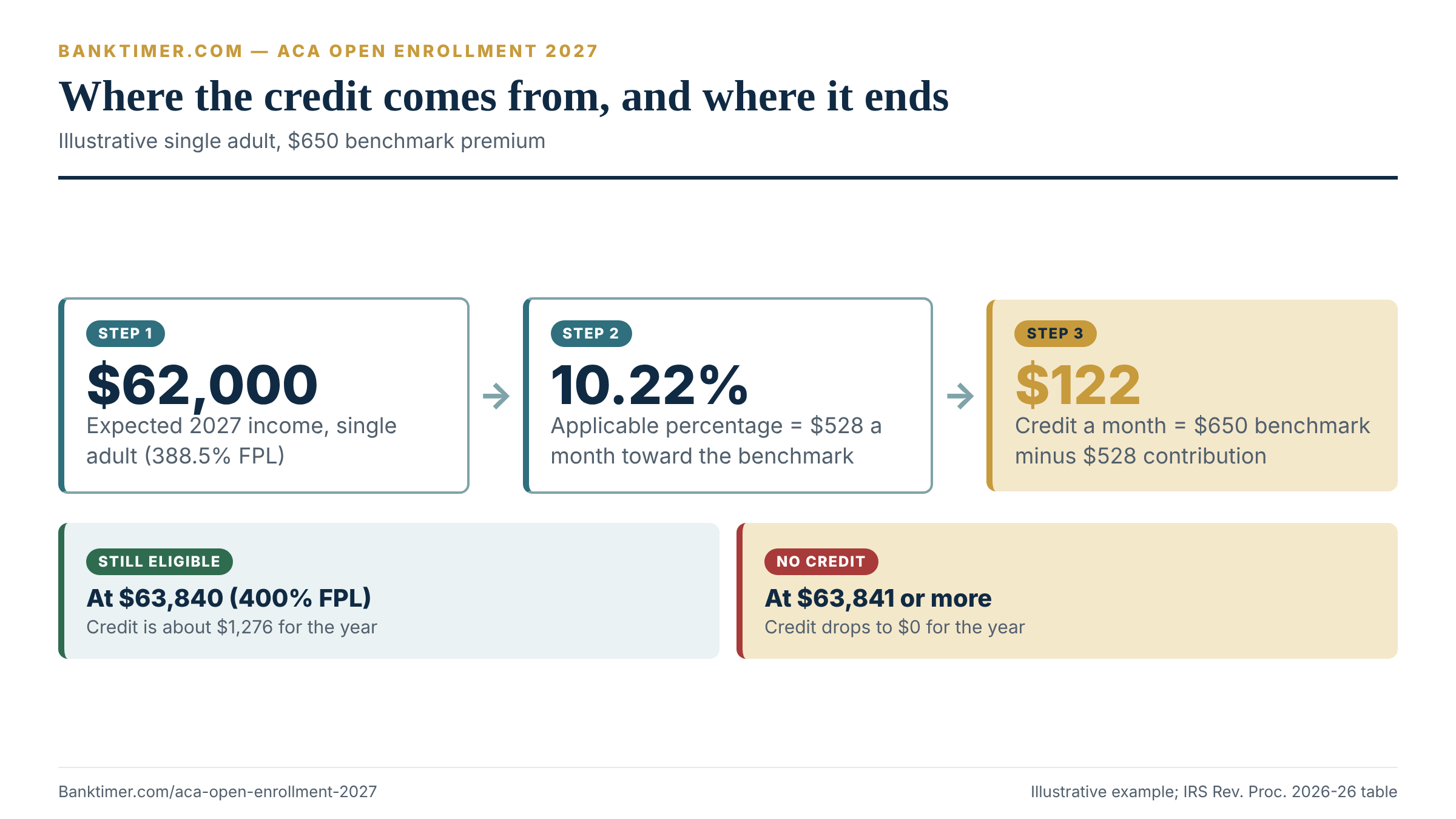
The cliff is easy to see with a single person near the line. At exactly 400% of FPL, which is $63,840, the credit in our $650 benchmark example is about $1,276 for the year. At $63,841, the credit is zero.
At $62,000 the person is at 388.5% of FPL and pays 10.22% of income toward the benchmark, or about $528 a month. The credit is about $122 a month, or $1,464 a year. At $64,000, it is zero.
| Scenario | Income | % of FPL | Estimated monthly credit | Estimated yearly credit |
|---|---|---|---|---|
| Single adult, example 1 | $32,000 | 200.5% | $468.70 | $5,624 |
| Single adult, near the cliff | $62,000 | 388.5% | $121.97 | $1,464 |
| Single adult, at the cliff | $63,840 | 400.0% | $106.30 | $1,276 |
| Single adult, just above | $63,841 | 400.01% | $0 | $0 |
| Family of four | $90,000 | 272.7% | $1,097.32 | $13,168 |
Illustrative; assumes a $650 single and $1,800 family benchmark premium. Applicable percentages interpolated from the IRS 2027 table. Computed in calcs.py.
The table shows why timing matters for self-employed workers and others with variable pay. A single extra dollar of income above the line can cost the whole credit, which is why careful income estimates are part of every smart application.
What happens if your estimate is wrong
Advance credits are based on your estimate. After the year, you reconcile on IRS Form 8962 using Form 1095-A from the Marketplace. If you received too much, you repay the difference.
Here is the part that changed. The text of 26 U.S.C. 36B shows that the old limit on repayment, which protected people under 400% of FPL, was struck by Public Law 119-21, section 71305, for taxable years beginning after December 31, 2025. That means your 2026 and 2027 returns carry no repayment cap.
A single filer estimates $48,000 of income for 2027 and receives advance credits of about $2,894 for the year. A late-year contract pushes actual income to $66,000, which is 413.5% of FPL. The credit for the year falls to zero.
Under the permanent rule, the person repays the full $2,894. If actual income had been $56,000 (350.9% of FPL) instead, the credit would be about $2,077, and the repayment would be about $818.
The lesson is not to estimate low. It is to update your Marketplace application when your income changes, and to remember that HealthCare.gov lets you use less of the credit each month if you worry about repaying.
What Else Changes for 2027 Coverage
The subsidy cliff is the biggest change for many households, but it is not the only one. Several federal law changes and market trends affect ACA open enrollment 2027. Some come from the 2025 budget law, Public Law 119-21, also known as H.R. 1. Others come from insurers.
| Change | What it is | Source type | Who feels it most |
|---|---|---|---|
| Enhanced credits ended | The 400% FPL limit applies again from 2026 | Federal law (26 U.S.C. 36B) | Households above 400% FPL; older middle-income buyers |
| No repayment cap | Excess advance credits are repaid in full, for tax years after 2025 | Federal law (Pub. L. 119-21, sec. 71305) | People with swings in income |
| Narrower immigrant eligibility | From 2027, credits are limited to lawful permanent residents, Cuban and Haitian entrants, and Compact of Free Association migrants | Federal law (Pub. L. 119-21, sec. 71301) | Lawfully present immigrants not in those groups |
| Income-based SEPs | Plans bought through an SEP that is based on income alone do not qualify for the credit | Federal law (26 U.S.C. 36B(c)(3)) | People relying on income-triggered SEPs |
| Higher out-of-pocket maximums | $12,000 self-only and $24,000 family, up from $10,600 and $21,200 | HHS and CMS guidance, January 29, 2026 | Anyone who reaches their plan’s limit |
| Premium increases | Median proposed 2027 increase of 15% across 276 insurers | Peterson-KFF analysis, updated August 3, 2026 | Everyone, especially unsubsidized buyers |
Sources: Cornell Law School text of 26 U.S.C. 36B; CMS 2027 premium adjustment guidance; Peterson-KFF Health System Tracker. Checked October 15, 2026.
Premiums and the sicker-pool effect
The Peterson-KFF analysis found a median proposed increase of 15% across 276 insurers in all 50 states and D.C., with proposals ranging from a 1% decrease to a 54% increase. Insurers cited rising medical costs, and many expect the expiration of enhanced credits to add roughly 4 percentage points because healthier people left the market.
Proposed rates are not final rates. Regulators can adjust them, and your exact price depends on your county, age and plan. Use the HealthCare.gov plan preview to see actual 2027 prices when they appear.
Enrollment fell when the enhanced credits expired
KFF reports that effectuated Marketplace enrollment, meaning people who actually paid and had coverage, fell 12% from 21.8 million in February 2025 to 19.2 million in February 2026. KFF’s October 6, 2026 update says people who stayed in the same plan paid 114% more after credits, more than $1,000 a year. Net of plan switches, average payments rose 58%.
Those are averages. Your own change could be smaller or larger. They do show why a fresh plan comparison matters this year.
A preview of 2028
Pennie says automatic renewal ends beginning with the fall 2027 enrollment period for 2028 coverage, so you will need to affirm your information annually. KFF describes new verification requirements that could effectively end automatic renewals in 2028. That does not apply to 2027 coverage, but the habit of logging in every year pays off now.
How to Compare Marketplace Plans
Choosing a plan is a three-way trade-off between what you pay each month, what you pay when you use care, and which doctors and drugs the plan covers. Most people focus on the first and regret it later. The way to compare Marketplace plans is to price all three.
Understand the metal levels
HealthCare.gov groups plans into four metal categories by how the cost of care is shared on average. These percentages are estimates, not guarantees for any one person.
| Category | Plan pays on average | You pay on average | Usual trade-off |
|---|---|---|---|
| Bronze | 60% | 40% | Lower premium, higher deductible |
| Silver | 70% | 30% | Middle premium and deductible |
| Gold | 80% | 20% | Higher premium, lower deductible |
| Platinum | 90% | 10% | Highest premium, lowest deductible |
Source: HealthCare.gov, “Plan categories,” checked October 15, 2026. Categories say nothing about quality of care.
Catastrophic plans are a fifth category, available where offered, to people under 30 and to people who qualify for a hardship or affordability exemption, according to HealthCare.gov. An effort to widen catastrophic eligibility is among the provisions CMS says will not go into effect as finalized.
Silver plans with extra savings
If your income is low enough, you may qualify for cost-sharing reductions (CSRs). They lower your deductible, copays and out-of-pocket maximum, and you get them only if you pick a silver plan. HealthCare.gov says silver plans with extra savings pay about 73% to 96% of costs on average.
The 2027 CMS guidance caps out-of-pocket maximums for people at 100% to 200% of FPL at $4,000 self-only, and for 200% to 250% of FPL at $9,600. That is far below the standard $12,000 limit. For a lower-income buyer, a CSR silver plan can beat a cheaper bronze plan on total cost.
Two households, three plans, three kinds of year
Now run the numbers. The table below uses two Banktimer example households and illustrative plans, with a $650 benchmark silver premium. Household A earns $28,800 (180.5% of FPL) and qualifies for CSRs. Household B earns $55,000 (344.6% of FPL) and does not.
The usage levels are total allowed charges for the year. Total cost is the net yearly premium after the credit plus your out-of-pocket spending.
| Plan (illustrative) | Net yearly premium A | Total A: low / moderate / high | Net yearly premium B | Total B: low / moderate / high |
|---|---|---|---|---|
| Bronze, $7,500 deductible, 40% | $0 | $1,500 / $8,100 / $10,000 | $2,381 | $3,881 / $10,481 / $12,381 |
| Silver, $650 benchmark | $1,673 (CSR version) | $2,578 / $3,703 / $5,673 | $5,621 | $7,121 / $11,821 / $14,621 |
| Gold, $1,500 deductible, 20% | $3,473 | $4,973 / $6,473 / $9,473 | $7,421 | $8,921 / $10,421 / $13,421 |
Illustrative only. Usage levels: low $1,500, moderate $9,000, high $60,000 in allowed charges. Household A’s silver plan has an $800 deductible, 15% coinsurance and a $4,000 maximum (a CSR design); Household B’s silver plan has a $5,000 deductible, 30% and a $9,000 maximum. Bronze: $380 a month, $10,000 maximum. Gold: $800 a month, $6,000 maximum. Computed in calcs.py. Real plans use copays, tiers and other designs.

The table makes three points. For Household A, the CSR silver plan costs $2,578 in a light year and $5,673 in the worst year, while bronze costs $10,000 in the worst year. A low premium can hide a very large bill.
For Household B, bronze wins in a low-usage year at $3,881 and also in a high-usage year at $12,381. Gold wins only the moderate year, at $10,421 against bronze’s $10,481. The standard silver plan is the costliest of the three in moderate and high years.
That result comes from our assumed prices, not a rule about silver. It shows why you should run your own numbers. A plan with a $7,500 deductible also needs cash behind it, so check your emergency fund before choosing the lowest premium.
Check networks and drugs before price
A plan that does not cover your doctor or medicine is a bad deal at any price. HealthCare.gov lets you search your providers and prescriptions while comparing plans and tells you if each one covers them in network. Do that before you rank by cost. Our guides on health insurance networks and on how a health insurance deductible interacts with coinsurance explain the terms.
If you use a lot of care, also read how copay versus coinsurance changes your bill. A flat $40 copay and 30% coinsurance can differ by hundreds of dollars on one imaging visit.
A bronze plan can pair with a health savings account (HSA) if its terms meet IRS rules. Our HSA versus FSA comparison explains the tax angle. Confirm eligibility with the plan’s documents before you count on it.
How to Enroll Step by Step Before the Deadline
Enrolling during ACA open enrollment 2027 takes less time than most people fear, but each step has a trap. This sequence works for HealthCare.gov and, with small label changes, for state exchanges. Treat the dates as the ones you confirmed in your state.
Eight steps that keep January 1 coverage on track
- Mark your real deadline. Write down your exchange’s January 1 cutoff, which is December 15 on HealthCare.gov. Set a reminder a week earlier.
- Estimate your 2027 income. Use your expected income for the coverage year, not last year’s. Include everyone in your tax household, and count the items HealthCare.gov lists, such as wages, self-employment income after expenses and unemployment compensation.
- Preview plans and prices. HealthCare.gov offers a way to view plans and price quotes for your area before you apply. Use it to see what your ZIP code looks like.
- Apply or update your application. Existing enrollees should log in and review household and income details. A new applicant starts a fresh application.
- Compare total cost. Use the plan-comparison method above. Search your doctors and drugs.
- Choose a plan by your cutoff. Do not wait until the last evening if you can avoid it. Sites get busy near deadlines.
- Pay your first premium. Coverage does not start until the insurer receives it. Keep the confirmation.
- Confirm and save. Download your confirmation and your plan documents. Check your insurance card arrives.
What to gather first
Gathering documents ahead of time prevents an application from stalling midstream. HealthCare.gov offers a printable checklist of what applications ask for. Here is a Banktimer working list; your own application may ask for more or less.
| Document or detail | Why it matters | Where to find it | How long to keep it |
|---|---|---|---|
| Expected 2027 income for each household member | Sets your credit and your cost-sharing reductions | Pay stubs, last year’s return, contracts | With your tax records |
| Last year’s tax return | Helps you estimate adjusted gross income | Your filing software or the IRS | With your tax records |
| Social Security numbers or document numbers for people applying | Identity and eligibility checks | Cards or immigration documents | Do not store them in plain email |
| Employer coverage details | An offer can affect credit eligibility | HR or your benefits portal | Until the plan year ends |
| Current plan and policy information | Needed to renew or switch | Your insurer’s account page | Until the plan year ends |
| Proof of loss of coverage, if using an SEP | The Marketplace may ask for it | Termination letter from the plan | Until the SEP is complete |
| Form 1095-A, after the year ends | Needed to reconcile on Form 8962 | Marketplace account, usually in early year | With your tax return |
Banktimer working checklist; your application’s requirements govern. Form 1095-A and Form 8962 are IRS forms.
Our guide to U.S. financial, tax and insurance forms explains how Form 1095-A fits into your return.
If You Do Nothing: Automatic Re-enrollment
If you already have a Marketplace plan and take no action, HealthCare.gov says it will automatically re-enroll you in a plan for the next year. That plan may be with the same insurer. If your plan is gone, it may be a comparable one from a different company.
That sounds safe, and it is better than a lapse. It also has costs.
What the page warns about
HealthCare.gov states that “plan costs can change,” even if you are auto-enrolled. It tells you to update your application so you get the savings you qualify for, and it says you must still pay the first premium for coverage to start.
For many households this year, the premium increase and the expired enhanced credits can combine. Your old plan may no longer be the right one. In our Household B example, the standard silver plan was the costliest in moderate and high years, so passive renewal could mean paying more for the same care.
Dates for existing enrollees
- December 15: Switch plans or stop re-enrollment so coverage starts January 1.
- December 31: If you were re-enrolled and do not want the coverage, log in by this date to stop it from starting.
- January 15: Change plans after coverage has started; the new plan starts February 1.
After open enrollment you can change plans only through a special enrollment period.

Grace periods if you stop paying
If you receive the premium tax credit and have paid at least one full month’s premium that benefit year, HealthCare.gov says the grace period is usually three months. If you do not pay everything you owe, you may lose coverage dating back to the first month you missed. After coverage ends for nonpayment, you generally cannot enroll in another plan until open enrollment unless you qualify for a special enrollment period.
Without the premium tax credit, the grace period may be different, and your state’s insurance department sets the rules. Do not assume.
Special Enrollment Periods After January 15
Missing ACA open enrollment 2027 is not the end of the road. A special enrollment period (SEP) is a window outside open enrollment when you can sign up or change plans after a qualifying life event. HealthCare.gov says you generally have 60 days before or after the event.
Here are common triggers, drawn from the HealthCare.gov SEP page checked October 15, 2026.
| Qualifying event | Window and timing | Documents you may need | Common catch |
|---|---|---|---|
| Loss of job-based, individual, Medicaid or CHIP coverage | 60 days before or after loss; 90-day look-back for Medicaid or CHIP | Termination letter | Without acceptable proof of the loss, you may not qualify |
| Marriage | Choose a plan by the last day of the month; coverage starts the first of the next month | Marriage information | Timing differs from other events |
| Birth, adoption or foster placement | Coverage starts on the event date, even if you enroll up to 60 days later | Proof of the event | You must still enroll within the window |
| Move to a new ZIP code or county | 60 days around the move | Proof of new address | Moving only for vacation or treatment does not count |
| COBRA ending | 60 days after COBRA coverage ends | COBRA end notice | Voluntarily dropping COBRA does not count |
| Medicare Part B or D lost alone | Not a qualifying event on its own | Not applicable | Part A loss for nonpayment also does not qualify |
Source: HealthCare.gov, “Special Enrollment Period.” Federal Marketplace rules; state exchanges may add SEPs. Pre-enrollment SEP checks beyond loss of coverage are stayed, per CMS statements.
The big message: documents matter. HealthCare.gov says that without acceptable documents about losing coverage, you will not qualify. Ask your former plan or employer for a written notice with the end date.
Plan around the 60 days
If your job coverage ends December 31 and you also miss December 15, you may still have a loss-of-coverage SEP. That is not a reason to skip open enrollment, but it is a safety net. Apply early in your window, since coverage dates depend on when you choose.
For a broader view of year-end deadlines, see our 2027 financial and insurance deadlines calendar.
A Decision Framework: Which Path Fits You
No single plan or path fits everyone in ACA open enrollment 2027. This framework starts with the facts that change the answer most, which are your income and whether anyone offers you affordable coverage.
| If this describes you | Likely path | First action | Watch for |
|---|---|---|---|
| You have an employer plan that you can afford | Employer plan | Compare it during your employer’s enrollment | Affordability tests use a percentage of income; 10.22% is the 2027 figure in the IRS table |
| Income is near or under the Medicaid line (138% FPL in expansion states) | Medicaid or CHIP | Apply any time on HealthCare.gov or your state site | Rules vary by state, and work requirements are changing |
| Income is 100% to 400% FPL | Marketplace plan with credit | Estimate 2027 income carefully, compare total cost | The cliff at 400% and full repayment of excess credits |
| Income is above 400% FPL | Marketplace plan at full price or other coverage | Compare unsubsidized premiums and employer options | Premium increases; no credit |
| You turn 65 soon | Medicare | See our Medicare guide | Medicare has its own enrollment periods |
| You lost coverage recently | SEP | Gather termination letter and apply within 60 days | Waiting can shift your start date |
Banktimer decision matrix. Rules cited from HealthCare.gov, IRS Rev. Proc. 2026-26 and Cornell Law School’s 26 U.S.C. 36B. Medicaid rules vary by state.
If you are approaching Medicare age, read our guide to Medicare open enrollment before you buy a Marketplace plan. Medicare has its own calendar and rules. For job-based coverage choices, use the employer open enrollment checklist.
Edge Cases: Income, Households and Timing
Most surprises in ACA open enrollment 2027 trace back to income. The Marketplace asks for one number, but that number has many moving parts. These cases catch people who thought the form was simple.
What counts toward your Marketplace income
HealthCare.gov lists what to count and what to leave out. The table below turns that list into a quick reference. Check the Marketplace’s own page for edge cases such as alimony.
| Income item | Counts toward Marketplace income? | Note |
|---|---|---|
| Federal taxable wages | Yes | Use the taxable figure on your pay stub |
| Self-employment income | Yes, after business expenses | Variable pay needs a careful annual estimate |
| Unemployment compensation | Yes | Part-year benefits still count |
| Investment income and capital gains | Yes | A one-time sale can push you over a line |
| Most IRA and 401(k) withdrawals | Yes | Retirees should plan withdrawal timing |
| Social Security benefits | Yes, the full amount, taxable or not | Added back to adjusted gross income |
| Child support received | No | Excluded |
| Gifts and loan proceeds | No | Excluded |
| Supplemental Security Income | No | Excluded |
| Veterans’ disability payments | No | Excluded |
Source: HealthCare.gov, “Income,” checked October 15, 2026.
The row that surprises retirees is Social Security. Even benefits that are not taxed count in the Marketplace’s definition. A one-time withdrawal or asset sale also counts in the year it happens.
Variable income and the cliff
Self-employed workers, gig workers and seasonal workers face a harder estimate. Your income might be $38,000 in a slow year and $66,000 in a strong one. The second number sits above the 400% line for a single filer ($63,840), so the full credit would vanish.
You have options. You can estimate conservatively and update your application during the year as income changes. HealthCare.gov says to report changes right away, because a rise in income usually shrinks the credit. You can also choose to use less of the advance credit each month and claim the rest when you file.
If your income sits near a threshold, talk with a tax professional about legal ways to lower adjusted gross income, such as contributions to a traditional individual retirement account or an HSA, if you qualify. The rules depend on your situation. Our ACA subsidy cliff guide walks through planning ideas.
Household changes
A marriage, a baby, a divorce or a death can change both your household size and your poverty percentage. A larger household raises the 100% and 400% dollar lines, which can restore a credit. A smaller one lowers them. Report changes within the SEP window when they qualify, and update your application when they do not.
A rough guess that lands just under 400% of FPL can look harmless until the tax return shows a higher number. Because the repayment cap no longer applies, the full excess credit comes due. Build a buffer, track income through the year and update the Marketplace as it changes.
Employer coverage and the affordability test
If your employer offers coverage, your eligibility for a premium tax credit can depend on whether that offer is considered affordable. The 2027 IRS table sets 10.22% as the required contribution percentage used in that test. How the test applies to your family depends on details such as the cost of the employee-only plan, so read your employer’s materials and the IRS guidance before you turn down a job plan.
Common Mistakes and Red Flags
The same errors show up in every enrollment season, and ACA open enrollment 2027 adds a few new ones. None is dramatic, and all can cost real money.
| Red flag | Why it matters | What to ask | Safer next step |
|---|---|---|---|
| Assuming January 15 gives you January 1 coverage | Plans chosen after December 15 start February 1 on HealthCare.gov | What is my exchange’s January 1 deadline? | Choose and pay by December 15 |
| Picking the lowest premium without checking the deductible | A $7,500 deductible can be unaffordable in a bad year | Can I pay this deductible out of pocket? | Price low, moderate and high years |
| Ignoring a re-enrollment notice | Your plan may cost more or use stale income data | Is my old plan still the best fit? | Log in and review before December 15 |
| Underestimating 2027 income | Excess credits are repaid in full | Is any income missing from my estimate? | Update when pay changes |
| Skipping the doctor and drug search | An out-of-network provider can mean a bigger bill | Are my providers and drugs in network? | Search them in the plan comparison |
| Forgetting to pay the first premium | Coverage does not start until payment arrives | When is the first payment due? | Pay as soon as billed and save proof |
| Buying from an unsolicited call or ad | The seller may not be a Marketplace-certified source | Is this plan sold through HealthCare.gov or my state exchange? | Enroll directly through HealthCare.gov or your state exchange |
Banktimer working list, using the HealthCare.gov rules cited in this article.
If you run into a surprise bill later, our guide to disputing a surprise medical bill explains where to start.
Questions to ask before you pick a plan
- ☐ What is my exchange’s last day to choose a plan for January 1 coverage?
- ☐ How much is the first premium, and when is it due?
- ☐ What is my expected 2027 household income, and have I counted every item?
- ☐ How close am I to 400% of the federal poverty level for my household size?
- ☐ Do I qualify for cost-sharing reductions, and am I looking at silver plans to get them?
- ☐ Are my doctors, hospitals and prescriptions in the plan’s network and drug list?
- ☐ What is the deductible, and could I pay it from savings in a bad year?
- ☐ What is the out-of-pocket maximum, and does it fit my budget?
- ☐ Will my 2027 monthly premium fit inside my monthly budget?
- ☐ Is coverage through an employer or family member a better or cheaper option?
Frequently Asked Questions
When does ACA open enrollment end for 2027 coverage?
On HealthCare.gov, open enrollment ends January 15, 2027. To have coverage start January 1, choose a plan by December 15, 2026. Choosing between December 16 and January 15 starts coverage February 1. State-run exchanges can set later closing dates, and some close on January 31, so check your state’s exchange.
Is December 15 the deadline for ACA open enrollment 2027?
December 15 is the deadline for a January 1 start on HealthCare.gov, not the end of the window. You can still enroll through January 15 and start February 1. A shorter schedule that would have ended enrollment December 15 was vacated by a federal court in June 2026 and is on appeal.
Can I enroll after January 15?
Only if you qualify for a special enrollment period, such as losing other coverage, moving, marriage or having a baby. HealthCare.gov generally gives you 60 days around the event, and you may need to show documents. Medicaid and CHIP accept applications at any time, so a low-income household does not need an SEP.
What happens if I miss the January 1 deadline?
Your coverage starts February 1 if you enroll by January 15 and pay the first premium, which leaves January uncovered. You may be able to avoid the gap if you have a qualifying event, such as losing job coverage, that triggers an SEP. Otherwise, cover January through another source if you can.
Do state exchanges have the same dates as HealthCare.gov?
Not always. Covered California lists a November 1 to January 31 window with a December 31 deadline for January 1 coverage, New Jersey runs November 1 to January 31, and Pennie runs November 1 to January 15. Idaho’s exchange describes a usual window of October 15 to December 15. Confirm your own state’s dates.
Are the enhanced ACA subsidies still available for 2027?
No. The enhanced premium tax credits expired at the end of 2025, and the 400% of FPL limit applies again to 2026 and later. Credits still exist below that line, and the 2027 IRS table sets how much of your income you are expected to pay. Congress could act, but KFF’s October 6, 2026 update describes no legislation restoring them.
What is the income limit for ACA subsidies in 2027?
In general, household income must be at least 100% and no more than 400% of the federal poverty level. Using the 2026 guideline for coverage in 2027, that is $63,840 for one person and $132,000 for a family of four. Above the limit you get no premium tax credit. Medicaid rules differ by state.
How do I compare marketplace plans?
Compare total yearly cost, not just the premium. Add twelve months of net premiums to what you would pay in a light, moderate and heavy year of care. Check whether your doctors and drugs are in network, and look at silver plans with cost-sharing reductions if your income qualifies. Metal levels say nothing about quality.
What happens if I do nothing during open enrollment?
If you already have a Marketplace plan, HealthCare.gov says it will automatically re-enroll you in a plan for next year. Costs can change, and your income information may be out of date. Update your application, and compare plans, so the renewal matches your needs. You must also pay the first premium.
Will I owe money back at tax time?
Possibly. If advance credits exceed the credit you qualify for based on actual income, you repay the difference when you file Form 8962. The former limit on repayment no longer applies for tax years after 2025, so the full excess is due. Update the Marketplace during the year when income changes.
Does ACA open enrollment apply to Medicare or job-based coverage?
No. Marketplace open enrollment covers individual plans. Medicare has its own enrollment periods, and employers set their own enrollment windows, often in the fall. A job offer can still affect your credit eligibility. Compare the employer plan with your Marketplace options, and read our Medicare open enrollment guide if you are near 65.
Should I apply for Medicaid instead of a Marketplace plan?
If your household income is low enough, yes. Medicaid and CHIP accept applications all year. HealthCare.gov describes the income cutoff in expansion states as 133% of the federal poverty level, an effective 138% after an adjustment, and a few states use a different figure. A Marketplace application screens you for both programs, so apply there if you are unsure.
For ACA open enrollment 2027, open HealthCare.gov or your state exchange this week, preview 2027 plans for your ZIP code, and write down your exchange’s January 1 deadline. Then update your expected 2027 income so your quoted subsidy is accurate.
The variable that decides your outcome is your expected 2027 household income, because it controls whether you get a premium tax credit and how large it is. Estimate it carefully, including every item the Marketplace counts, then update it during the year as it changes. Pick your plan by your exchange’s January 1 deadline, which is December 15 on HealthCare.gov, and pay the first premium promptly. Compare total yearly cost, not just the premium, and check doctors and drugs before you decide. Know the limits of this process. ACA open enrollment 2027 does not cover job-based plans, Medicare or Medicaid, which have their own calendars. Dates, credits and rules have also been moving through the courts, so confirm every figure on HealthCare.gov or your state exchange before acting.
Methodology
We built this article from primary and official sources and checked each dated figure on October 15, 2026. Marketplace dates come from HealthCare.gov and CMS statements. The subsidy percentages come from IRS Revenue Procedure 2026-26, and the poverty guidelines come from HHS. We read the statute text on Cornell Law School’s site, the CMS 2027 cost-sharing guidance and state exchange pages. Court status comes from CMS statements and the Georgetown Law litigation tracker; premium and enrollment context comes from KFF.
The households, benchmark premiums, plan designs, usage levels and income examples are illustrative assumptions, not quotes. Calculations are in a script we ran and rechecked. Interpolated applicable percentages approximate the IRS tables that exchanges use. State exchange dates, plan prices, income rules and court rulings vary and can change. We did not test any exchange or plan.
Sources
- Dates and deadlines, HealthCare.gov
- Statement regarding City of Columbus, August 4, 2026, CMS
- Statement regarding City of Columbus, July 31, 2026, CMS
- Failure-to-reconcile requirement statement, July 27, 2026, CMS
- 2027 premium adjustment percentage and cost-sharing guidance, January 29, 2026, CMS
- Revenue Procedure 2026-26, Internal Revenue Service
- 26 U.S.C. 36B, Cornell Law School
- 26 CFR 1.36B-1, Cornell Law School
- Prior HHS poverty guidelines, 2026, ASPE
- Special enrollment period, HealthCare.gov
- Automatic re-enrollment, HealthCare.gov
- Plan categories, HealthCare.gov
- How to estimate income, HealthCare.gov
- Bulletin 26-07, New Jersey Department of Banking and Insurance
By the Banktimer Editorial Team · Published
Banktimer is an independent U.S. consumer-finance publication. Our editors draw on primary and official sources first, such as the CFPB, FDIC, Federal Reserve, and FTC, along with statutes, regulations, and providers’ own agreements and fee schedules. Then we add worked examples and decision tools. Our goal is the most useful, best-supported explanation the sources available to us at the time of writing allow.
This article is general information, not legal, tax, investment, insurance, or financial advice, and reading it does not create a professional relationship with Banktimer. Rates, fees, limits, and rules change, and they vary by state, provider, and contract, so confirm current terms with your bank, lender, insurer, or the agency named in the article before you act. Examples are illustrative unless labeled otherwise. Banktimer is not a bank, lender, insurer, or financial advisor, and we are not responsible for decisions or losses that result from relying on this content. For advice about your own situation, talk to a licensed professional.