Medicare open enrollment runs from October 15 to December 7, 2026, and any change you make takes effect on January 1, 2027. To compare plans step by step, read your Annual Notice of Change, list your drugs and doctors, run them through Medicare Plan Finder, and add up premium, deductible and expected out-of-pocket costs for each plan. Then confirm the details with the plan itself.
Your biggest variable is your own drug and doctor list, because the same plan can be cheap for one person and expensive for another. The main risk is waiting. The plan must receive your request by December 7, which falls on a Monday this year. Check your 2027 drug list first.
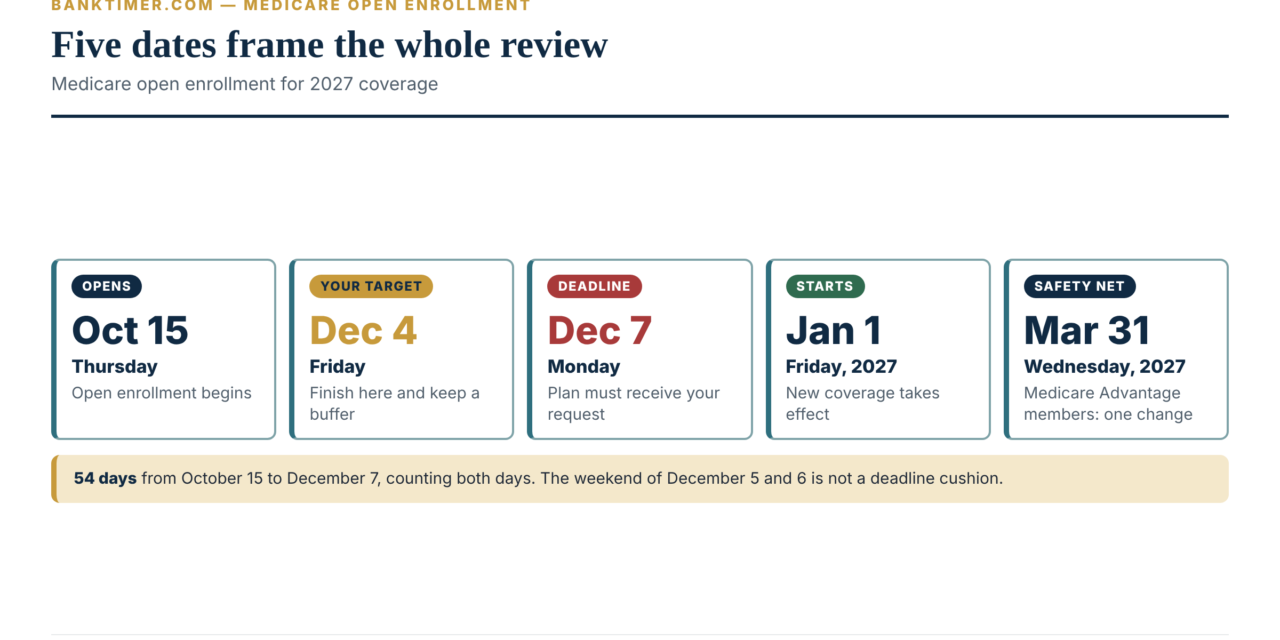
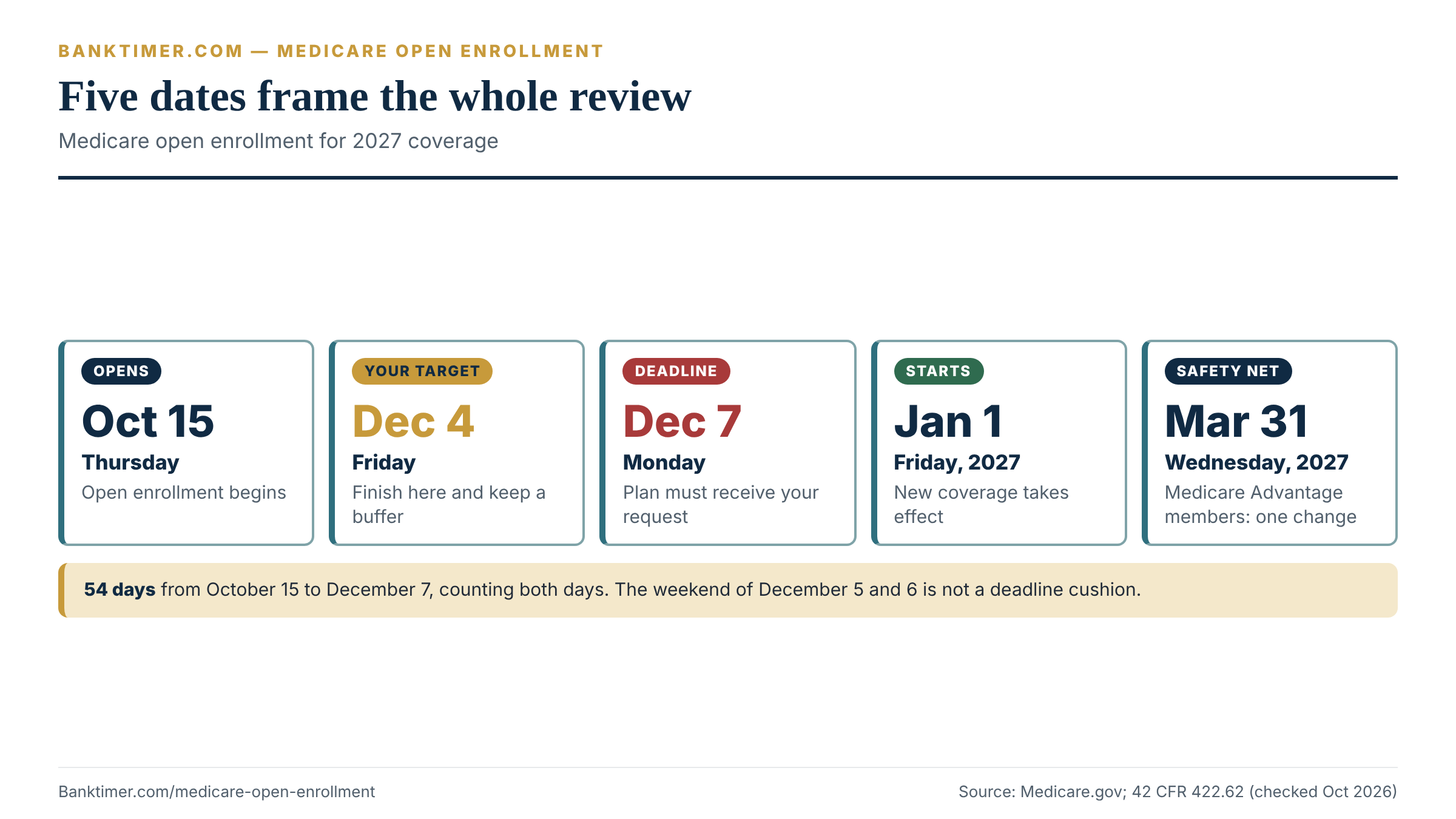
Dates are fixed. The window opens Thursday, October 15, 2026 and closes Monday, December 7, 2026. New coverage starts Friday, January 1, 2027.
The mailing is the starting point. Your plan’s Annual Notice of Change shows what is different next year. If it never arrived, ask the plan for a copy.
Your lists drive the answer. Drugs, doses, pharmacies, doctors and hospitals decide which plan costs less, not the plan’s average premium.
Total cost beats premium. Add the premium, deductible and out-of-pocket costs. In our illustration, a $0-premium plan cost $112 more per year than a plan with a $34 premium.
Some changes are hard to undo. Leaving Medicare Advantage for Original Medicare can limit your Medigap options in most states.
Scammers love this season. Medicare will not call, text or email you unexpectedly to sell you anything or ask for your numbers.
What Medicare Open Enrollment Is and What You Can Change
Medicare open enrollment is a yearly window that lets you change how you get Medicare coverage for the next calendar year. Federal rules call it the annual coordinated election period (ACEP). Many people say annual enrollment period (AEP), and Medicare.gov simply calls it the Open Enrollment Period. They are the same window.
During those weeks you can switch from one Medicare Advantage plan to another, or move from Medicare Advantage to Original Medicare. You can join, drop or switch a Medicare drug plan (Part D). You can also add drug coverage you did not have. Medicare.gov lists these options on its joining a plan page.
What this window does not do
It does not change your Part A or Part B enrollment. It does not give you Medigap rights, because Medigap has its own enrollment rules. It also does not apply to the Marketplace or to employer coverage, which run on different calendars.
If you are new to Medicare, you probably have a separate initial enrollment period. That window runs seven months, starting three months before the month you turn 65. Your first plan choice happens there, not in the fall.
Who should plan to review
Everyone with a Medicare Advantage plan or a drug plan should look. Plans can change their costs, drug lists and networks every year, and your needs change too. A new prescription, a new surgeon or a move to a different county can make last year’s best fit a poor one.
People in Original Medicare without a drug plan should also look. If you take medications, going without drug coverage can bring a penalty that lasts as long as you have Part D. We cover that penalty later in this guide.
Enrollment Periods Compared: Which Window Applies to You
The fall window is the biggest, but it is not the only one. Knowing the others tells you what you can still do if you miss it. The table below compares the periods people most often confuse.
| Period | Dates | Who can use it | What you can do | When coverage starts |
|---|---|---|---|---|
| Medicare open enrollment (ACEP) | Oct 15 to Dec 7 | Most people with Medicare | Join, drop or switch Medicare Advantage or drug plans; move between Original Medicare and Medicare Advantage | January 1 |
| Medicare Advantage open enrollment | Jan 1 to Mar 31 | Only people already in a Medicare Advantage plan | Switch to another Medicare Advantage plan or drop to Original Medicare (one election) | First of the next month |
| Initial enrollment period | 7 months around turning 65 | People newly eligible | First plan choice | Varies by when you ask |
| Five-star special enrollment | Dec 8 to Nov 30, once per contract year | Anyone who wants a plan with a 5-star rating | Join that plan | Varies |
| Extra Help or dual-eligible special enrollment | One election per month | People with Extra Help or both Medicare and Medicaid | Move into a stand-alone drug plan | Varies |
| Other special enrollment | Varies | Moves, lost coverage, plan changes | Join or switch plans | Usually first of the next month |
The key insight is the second row. If you are in a Medicare Advantage plan, January 1 through March 31 gives you one more chance to switch or leave. You get one election, so treat it as a safety net, not a plan.
Dates and rules come from Medicare.gov and the federal enrollment rules at 42 CFR 422.62 and 42 CFR 423.38. Special enrollment rules have exceptions, so ask Medicare or your State Health Insurance Assistance Program (SHIP) before you rely on one.
The Calendar: Dates That Matter This Year
Medicare open enrollment is 54 days long if you count both October 15 and December 7. That sounds like plenty. In practice, the useful part is shorter, because plan documents arrive late and appointments with counselors fill up in November.
| Date | What happens | Who controls it | What you do |
|---|---|---|---|
| By Sept 30, 2026 | Plans send the Annual Notice of Change and Evidence of Coverage | Your plan | Open it, or ask for a copy if missing |
| Thu, Oct 15 | Medicare open enrollment begins | Federal rule | Start your review |
| October | Plans leaving Medicare send non-renewal notices | Your plan | Read it closely and act early |
| Late October | Members of plans rated three stars or fewer for three or more years in a row get a notice | Your plan | Check alternatives |
| Thu, Nov 26 | Thanksgiving | Calendar | Do not leave the review for this week |
| Fri, Dec 4 | Last weekday before the final weekend | You | Aim to finish by here |
| Mon, Dec 7 | Last day; the plan must receive your request | Federal rule | Submit and save proof |
| Tue, Dec 8 | Five-star special enrollment becomes available | Federal rule | Only if a 5-star plan is in your area |
| Fri, Jan 1, 2027 | New coverage begins | You and the plan | Check your card and pharmacy |
| Jan 1 to Mar 31, 2027 | Medicare Advantage open enrollment | Federal rule | One switch if you are in an MA plan |
The September 30 date is not random. Federal rules require plans to notify enrollees of changes at least 15 days before the annual election period begins. Fifteen days before October 15 is September 30, which matches the guidance SHIP counselors give. The rule appears in 42 CFR 422.111.
Why December 4 is the practical deadline
December 7 is a Monday, so the final weekend is a trap. If your plan’s website is slow or your SHIP counselor is booked, you lose the weekend. Medicare.gov says the plan must receive a paper or phone request by the end of the period. Use your own deadline of Friday, December 4, and treat December 7 as spare.
Keep proof of what you did and when. A confirmation number, a screenshot or a dated letter is enough. If a dispute arises about the date, that record settles it.
Step-by-Step: How to Compare Plans During Medicare Open Enrollment
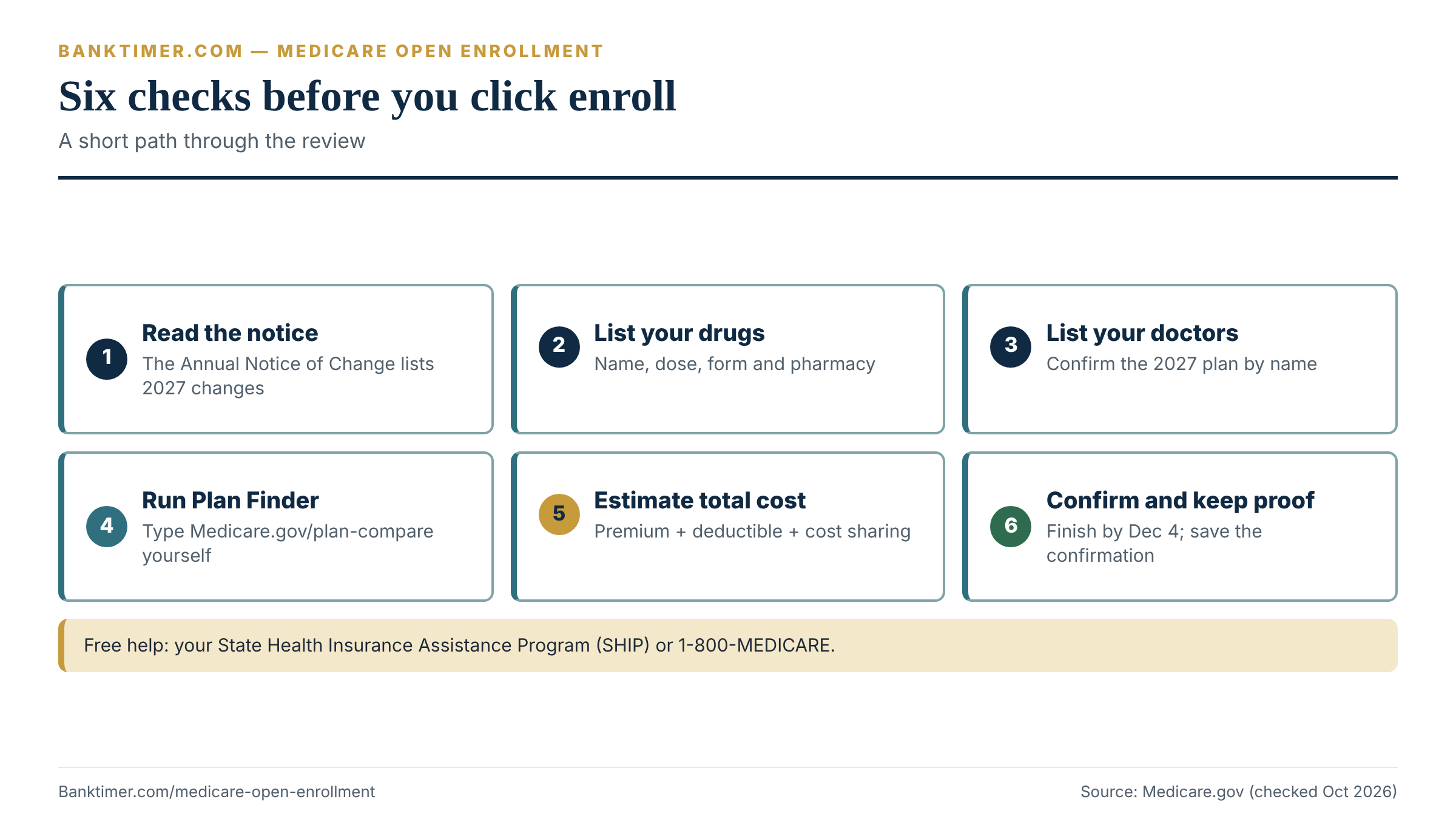
The Medicare open enrollment review has ten steps, and the first five are gathering and checking. The last five turn that information into a decision and a confirmed enrollment. Most people can finish steps one through five in an evening if their papers are in one place.
- Collect your cards, notices and lists.
- Read the Annual Notice of Change.
- Write down your exact drug list.
- List your doctors, hospitals and pharmacies.
- Run your lists through Medicare Plan Finder.
- Estimate total yearly cost for two or three finalists.
- Check networks and drug rules with each plan.
- Decide among staying, switching or leaving a plan type.
- Enroll and keep proof.
- Check that everything works after January 1.
Step 1: Collect what you need
Put these in one place before you open any website. Your Medicare card shows your Medicare Number and the start dates for Part A and Part B. Medicare.gov says you will need both to enroll. Add your current plan’s member card, because it lists the plan name and often the plan ID.
Then find the two documents your plan should have mailed by September 30: the Annual Notice of Change (ANOC) and the Evidence of Coverage (EOC). If you cannot find them, call the number on your plan card or look in your member portal. SHIP counselors advise asking the plan for copies if they never came.
Step 2: Read the Annual Notice of Change
The ANOC is a plan’s own summary of what changes for next year. It is usually a short letter, often with a table of costs. The EOC is the long contract. You do not need to read the EOC cover to cover. You do need it when the ANOC leaves a question unanswered.
SHIP counselors suggest checking three things in the notice: costs, network and drug list. That is a sound frame. The table below turns it into a reading guide.
| What to find | Why it matters | What to look for | Where to confirm |
|---|---|---|---|
| Monthly premium | A rise adds up over twelve months | Compare 2026 and 2027 side by side | ANOC cost table |
| Drug deductible | You may pay full price until you reach it | Whether it is $0 or close to the $700 maximum | ANOC, then Plan Finder |
| Copays and coinsurance | They set your cost per visit or fill | Any increase for your usual services | ANOC, then EOC |
| Yearly out-of-pocket limit | It caps medical costs in a Medicare Advantage plan | A higher limit than before | ANOC and plan website |
| Drug list changes | A drug may move to a higher tier or drop off | Each of your medicines by name | Plan formulary |
| Network changes | A doctor may leave the plan | Each doctor, hospital and pharmacy | Plan directory and the office |
| Service area | You must live in the plan’s service area | Whether your county is still included | ANOC |
The insight here is that a small premium change rarely decides your year. A drug moving to a higher tier or a specialist leaving the network often does. Read for those two things first.
Step 3: Write down your exact drug list
Plan Finder is only as accurate as the list you give it. Write down each medicine’s name, strength, form (tablet, injection, inhaler), how many you take and how often. Include the pharmacy you use and any mail-order option.
Be precise about brand and generic. A 30-day supply of one strength can cost a different amount from a 90-day supply, and a plan may treat them differently. Bring your pill bottles to the computer rather than working from memory.
Do not forget drugs you take only sometimes. A rescue inhaler, an occasional injection or a seasonal allergy drug can add up if it lands in a high tier. If your doctor is planning a new prescription for next year, add it as a likely cost.
Step 4: List your doctors, hospitals and pharmacies
Write down every doctor you see more than once a year, plus the hospital where you would go for surgery. Add specialists, a dialysis center, a physical therapist or a mental health provider if they apply. Original Medicare does not use plan networks in the same way, so this step matters most for Medicare Advantage.
Check each name against the plan’s online directory. Many Medicare Advantage plans now show their provider lists inside Plan Finder, though AARP reported that not every plan had its list posted when the feature launched and that directories can contain errors.
Then call the office. Ask whether it accepts the specific 2027 plan by its full name, and whether it expects to keep doing so all year. A directory is a starting point. A confirmation from the front desk is better.
Step 5: Run your lists through Medicare Plan Finder
Plan Finder is the federal comparison tool at Medicare.gov/plan-compare. It lets you enter your drugs and pharmacies and compare estimated yearly drug costs. Medicare.gov lists it alongside the Medicare & You handbook and a trusted agent or broker as ways to find plans.
Type the address yourself. The Federal Trade Commission warned on September 28, 2026 that scammers sometimes pay for ads that appear above real results and imitate government sites. Skip anything labeled “Ad” or “Sponsored” and look for the .gov ending.
If you prefer to talk to a person, call 1-800-MEDICARE (1-800-633-4227; TTY 1-877-486-2048) or contact your local SHIP. SHIP counseling is free, one-on-one and not tied to selling you a plan. Find your program at shiphelp.org or call 877-839-2675.
What to do with the results
Plan Finder will return a list. Do not pick the first line. Sort for estimated total cost, then pick two or three finalists that also pass your doctor and pharmacy checks. Keep your current plan on that list, since staying is a legitimate choice.
Treat the estimate as a model, not a quote. It assumes you fill the drugs you entered and use no others. Your real year can differ if you add a prescription or have a hospital stay.
Step 6: Estimate total yearly cost for your finalists
Premium is the number plans advertise. It is rarely the number that decides your year. For each finalist, add up four pieces:
- Premiums: the monthly premium times twelve, plus any Part B premium you already pay.
- Deductibles: the amount you pay before the plan shares costs.
- Expected cost sharing: copays and coinsurance for the drugs and visits you actually use.
- Risk ceiling: the most you could owe in a bad year.
The first three give you an expected cost. The fourth tells you whether you can survive the worst case. Both matter, and they point in different directions more often than people expect.
A worked example: two Medicare Advantage plans, same person
Here is an illustrative comparison. It uses made-up plans, not real quotes. Our reader takes drugs that cost $4,000 a year at the plan’s prices, makes 10 primary care visits and 6 specialist visits, and has no hospital stay.
| Cost item | Plan A ($0 premium) | Plan B ($34 premium) |
|---|---|---|
| Premiums for 12 months | $0 | $408 |
| Drug deductible | $600 | $0 |
| Drug cost sharing (25% coinsurance) | $850 after the deductible | $1,000 |
| Drug total | $1,450 | $1,000 |
| 10 primary care visits | $0 | $50 ($5 each) |
| 6 specialist visits | $300 ($50 each) | $180 ($30 each) |
| Expected yearly total | $1,750 | $1,638 |
Plan A looks cheaper on the shelf and costs $112 more over the year. The gap comes from the drug deductible and the higher specialist copay. If this reader needed no drugs and saw one specialist, Plan A would win. The same two plans give opposite answers for different people.
How the Part D design changes the math in 2027
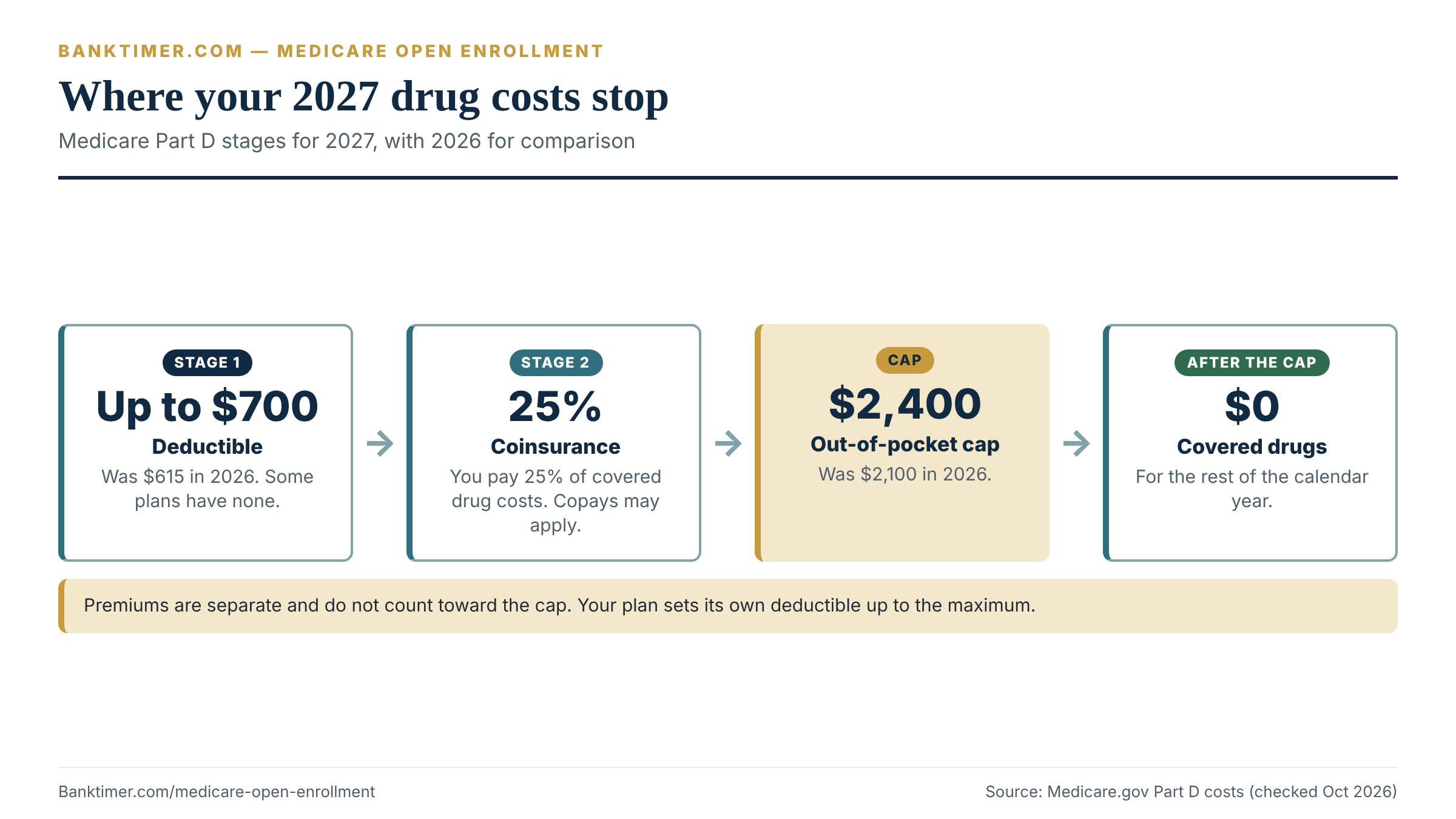
Most drug plans follow a standard structure, with the numbers set by law and updated each year. Medicare.gov lists the 2027 rules: a deductible no higher than $700 (up from $615 in 2026), then 25% coinsurance until your out-of-pocket spending reaches $2,400 (up from $2,100), and then $0 for covered drugs for the rest of the year. Your plan may use fixed copays by tier instead of 25% coinsurance. The cap still applies.
That cap creates a pattern worth seeing. Below it, a plan’s premium and deductible dominate. Above it, the plan’s design stops mattering, and the premium becomes the only difference. The next example makes that visible.
Illustrative example: premium versus cap
Take two stand-alone drug plans. Plan X has a $0 deductible and a $42 monthly premium. Plan Y has a $700 deductible and an $18 monthly premium. Both charge 25% coinsurance and both stop at the $2,400 cap. Premiums cost $504 a year for X and $216 for Y.
Compare yearly totals (premiums plus out-of-pocket) at different levels of total drug spending:
– At $300 of drugs, X costs $579 and Y costs $516. Y wins by $63. – At $1,200, X costs $804 and Y costs $1,041. X wins by $237. – At $4,000, X costs $1,504 and Y costs $1,741. X wins by $237. – At $8,000, X costs $2,504 and Y costs $2,616. X wins by $112. – At $12,000, X costs $2,904 and Y costs $2,616. Y wins by $288.
Y has the better price at the extremes (below $384 and above $8,448 of drug spending). X wins in the wide middle. All figures assume a flat 25% coinsurance and are not real plans.
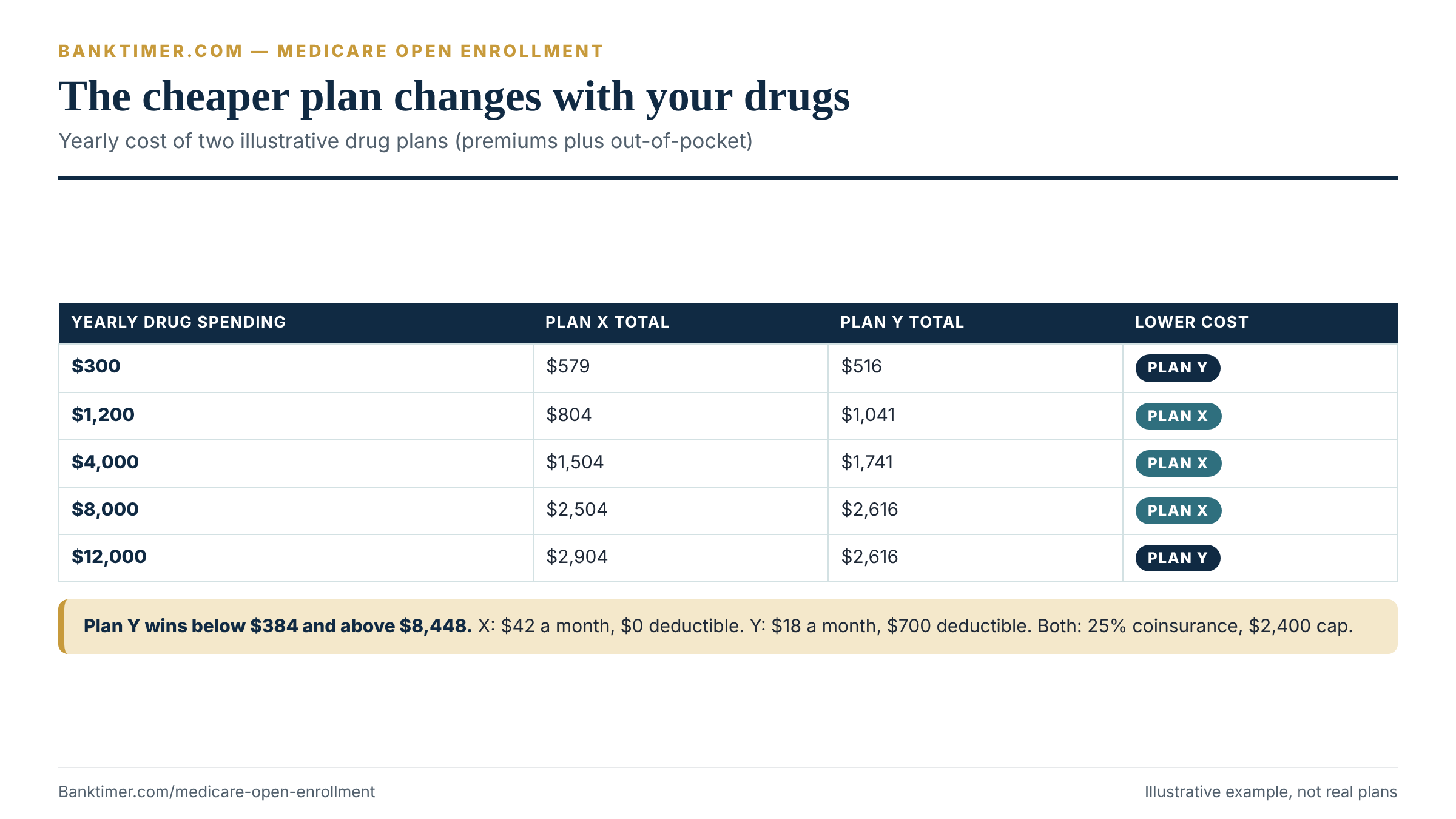
The lesson is not that one design is better. It is that the answer depends on your total drug spending, so you need an honest estimate. If you take a single expensive brand drug, the cap shapes your year. If you take a few generics, the deductible and premium shape it.
The Medicare Prescription Payment Plan
If you expect to hit the cap early, ask about the Medicare Prescription Payment Plan. Medicare.gov says it spreads your out-of-pocket drug costs across the calendar year, costs nothing to join, and does not lower what you pay in total. It only changes when you pay. All Part D plans offer it.
Here is an illustration. A specialty drug costs $1,500 a month at plan prices. With 25% coinsurance and no deductible, you would pay $375 a month and reach the $2,400 cap in July. An even spread of $2,400 over twelve months would be about $200 a month. Your plan sets the actual schedule, so ask for it in writing before you opt in.
Step 7: Check networks and drug rules with each plan
After you narrow the list, call each finalist or use its member services chat. Ask for answers by name, not in general. The questions below work for most plans.
- ☐ Is each of my doctors and my hospital in the 2027 network, and can you confirm it in writing?
- ☐ Is each of my drugs on the 2027 drug list, and in which tier?
- ☐ Do any of my drugs require prior authorization, step therapy or quantity limits?
- ☐ What is the 2027 drug deductible, and does it apply to every tier?
- ☐ What is the yearly out-of-pocket limit for medical services, in and out of network?
- ☐ Which pharmacies are in network, and do costs differ by pharmacy?
- ☐ Does the plan offer the Medicare Prescription Payment Plan, and how do I opt in?
- ☐ What happens if I travel or live in another state for part of the year?
Prior authorization means the plan must approve a service or drug before it pays. Step therapy means you try a cheaper drug first. Quantity limits cap how much you can fill. These rules can delay or block care, so a drug being “covered” does not always mean it is easy to get.
What the prior authorization data show
KFF analyzed 2024 data and found Medicare Advantage insurers made about 52.8 million prior authorization determinations. About 7.7% were fully or partly denied. Only 11.5% of denials were appealed, and 80.7% of those appeals overturned the denial in full or in part (KFF, January 28, 2026).
Two lessons follow. The rules exist in practice, so ask which services need approval. And an initial denial is not the end, since most appeals that were filed succeeded. These figures describe Medicare Advantage as a whole, not any one plan.
Step 8: Decide among staying, switching or changing plan type
By now you have a short list and a cost estimate. The decision has three branches, and the next sections of this guide cover them in depth. You can stay in your current plan if its 2027 changes are acceptable. You can switch to a different plan of the same type. Or you can move between Original Medicare and Medicare Advantage.
The third branch carries the biggest consequences, so we give it its own section below. The short version is that leaving Medicare Advantage can be hard to reverse in most states, which we explain with the KFF data.
Step 9: Enroll and keep proof
Medicare.gov lists three ways to enroll. You can choose “Enroll” in Plan Finder, contact the plan by phone or website (or request a paper form), or call 1-800-MEDICARE. Whichever you use, the plan must receive the request before the period ends.
Enroll in one plan, not several. After you submit, save the confirmation number, take a screenshot and note the date and time. Joining a new plan generally replaces the old one, but confirm this with both plans so you do not end up with overlapping coverage or a gap. Then wait for the new plan’s welcome packet and member card.
Do not give your Medicare Number to anyone who contacted you first. We cover that in the section on scams.
Step 10: Check that everything works after January 1
In the first week of January, after Medicare open enrollment ends, confirm that your new card arrived, your pharmacy has your plan on file, and your first fills price the way Plan Finder predicted. If a drug costs far more than expected, ask the plan for the tier, the deductible status and any exception process.
If you are in Medicare Advantage and the plan turns out to be wrong for you, the Medicare Advantage open enrollment period from January 1 to March 31 lets you make one change. Use it quickly, because a switch takes effect the first of the following month. Keep notes on what went wrong, since they help with any appeal.
What Changes on January 1, 2027
Some changes are set by your plan. Others come from federal rules and apply to every drug plan. The table below separates what we could confirm from official sources on October 15, 2026 from what Medicare has not yet announced.
| Item | 2026 | 2027 | Status on Oct 15, 2026 |
|---|---|---|---|
| Part D maximum deductible | $615 | $700 | Published on Medicare.gov |
| Part D out-of-pocket cap | $2,100 | $2,400 | Published on Medicare.gov |
| Part D national base beneficiary premium | $38.99 | $41.33 | Published (CMS, July 28, 2026) |
| Average Medicare Advantage premium (weighted) | $14.37 | $12.00 | CMS projection, Sept 28, 2026 |
| Average stand-alone drug plan premium | $35.09 | $36 | CMS projection |
| Average Part D premium in MA drug plans, after rebates | $11.32 | $7 | CMS projection |
| Medicare Advantage plans nationwide | 5,553 | about 5,532 | CMS projection |
| Part B monthly premium | $202.90 | Not yet announced | Check Medicare.gov |
| Part B deductible | $283 | Not yet announced | Check Medicare.gov |
| Part A deductible per benefit period | $1,736 | Not yet announced | Check Medicare.gov |
| Part D Premium Stabilization Demonstration | Operating | Ends after 2026 | Announced by CMS |
Read the table in two layers. The Part D rows are rules, so they apply to your plan whatever it is. The averages are projections across all plans, so they describe the market, not your plan. A national average can fall while your own plan’s premium rises.
The Part D numbers behind the table
Medicare.gov states that no Medicare drug plan may have a deductible above $700 in 2027, up from $615 in 2026. It also states that after your out-of-pocket drug costs reach $2,400 in 2027 ($2,100 in 2026), you pay nothing for covered Part D drugs for the rest of the calendar year. Payments made on your behalf, such as through Extra Help, count toward that threshold. See the Part D costs page.
The base beneficiary premium rose 6.0% from $38.99 to $41.33. Medicare.gov uses this benchmark in the late enrollment penalty formula (see below). CMS published the figure on July 28, 2026. For a deeper look at the cap, see our guide to the Medicare Part D out-of-pocket cap.
What CMS says about the 2027 plan landscape
CMS reported on September 28, 2026 that the weighted average Medicare Advantage premium would fall 16.5%, from $14.37 to $12.00 a month. That is a $2.37 monthly drop, or about $28 a year, on average. CMS expects supplemental benefits to stay stable, and says over 99% of people with Medicare will have at least one Medicare Advantage plan to choose from. About 97% will have ten or more (CMS press release).
Enrollment shares depend on who is counted. CMS projects 34 million Medicare Advantage enrollees in 2027, about 47.4% of all people with Medicare. KFF reports that 35.2 million people, 55% of those eligible, were enrolled in 2026 (the denominator is people with both Part A and Part B). Both are accurate for their own base.
The end of the premium stabilization demonstration
CMS ran a voluntary demonstration for stand-alone drug plans that held down premium increases starting in 2025. It will end after 2026. CMS expects the average stand-alone premium to rise from $35.09 to $36, less than a dollar. Averages can hide large moves, though, so check your own plan’s 2027 premium in the ANOC.
What we cannot tell you yet
The 2027 Part B premium and deductible had not been announced when we checked on October 15, 2026. Medicare.gov shows the 2026 figures. If your Part B premium comes out of your Social Security payment, a higher premium can shrink a cost-of-living raise. We track the numbers in our guides to the 2027 Social Security COLA and the 2027 Part B premium, and you can read about the yearly cycle in our 2027 financial and insurance deadlines calendar.
The Medicare Advantage out-of-pocket limit is also set each year. It was $9,250 in-network in 2026, and plans may set lower limits, according to Medicare Interactive. We did not find a 2027 figure in a primary source, so read the limit in your plan’s notice.
The Cost of Skipping a Drug Plan: the Late Enrollment Penalty
If you go without Part D or other creditable drug coverage after your enrollment period ends, Medicare can add a penalty to your premium. Medicare.gov explains the formula: 1% of the national base beneficiary premium, multiplied by the number of full months you were uncovered, rounded to the nearest $0.10. You pay it as long as you have Part D, even if you switch plans.
For 2027, the base premium is $41.33. The table shows what that looks like for different gaps. These are illustrations of the formula, not predictions for any person.
| Months without coverage | Penalty rate | Added monthly premium | Added cost per year |
|---|---|---|---|
| 3 | 3% | $1.20 | $14.40 |
| 14 | 14% | $5.80 | $69.60 |
| 24 | 24% | $9.90 | $118.80 |
| 36 | 36% | $14.90 | $178.80 |
The penalty looks small at first. The catch is the duration. Because it follows you for as long as you have Part D, it compounds. At a flat $41.33 base premium, a 14% penalty adds about $1,392 over twenty years and a 36% penalty adds about $3,576. The base premium may rise, so the real cost could be higher. People who receive Extra Help do not pay the penalty.
Extra Help can change the math
Extra Help is a federal program that helps with drug costs. You qualify automatically if you have Medicaid, a Medicare Savings Program or Supplemental Security Income, per Medicare.gov. Otherwise, you can apply with the Social Security Administration online or by calling 1-800-772-1213. You can apply before or after you enroll in Part D.
If you qualify, you also gain a special enrollment right to switch to a stand-alone drug plan once per month, under federal rules. That is helpful if a plan is not working. It does not remove the need to review in the fall, because the plan you are assigned or hold may still change its drug list. Our Medicare Part D out-of-pocket cap article covers how the cap interacts with these programs.
Original Medicare or Medicare Advantage: The Choice With the Longest Tail
Most fall decisions are reversible. If you pick a drug plan that disappoints you, you can switch next year. The decision between Original Medicare and Medicare Advantage is different, because one direction can be harder to undo than the other. That is why it deserves its own section in any Medicare open enrollment review.
Our separate guide to Medicare Advantage vs. Medigap compares the two paths in depth. Here we focus on what to check during the fall window and why the order of choices matters.
Comparing the two paths on the same criteria
The table uses the same criteria for each path. It describes structure, not which one is better, because the answer depends on your health, your doctors, your budget and where you live.
| Criterion | Original Medicare (with a drug plan, with or without Medigap) | Medicare Advantage |
|---|---|---|
| Drug coverage | Separate stand-alone Part D plan; you need Part A or Part B to join | Often built in (MA-PD); you need both Part A and Part B |
| Yearly cap on Part A and B costs | None without Medigap | Yes; in-network limit was $9,250 in 2026, and plans may set lower |
| Doctors and hospitals | Medicare’s own rules; confirm that your providers accept Medicare | Plan network; PPOs may add separate out-of-network limits |
| Prior authorization | Follows Medicare’s own coverage rules | Plan rules apply; see the KFF data above |
| Supplemental benefits | Not included; Medigap pays Original Medicare cost sharing | Plans may add benefits such as vision or hearing; details vary |
| Switching later | Medigap may require health questions outside protected windows | MA open enrollment Jan 1 to Mar 31 allows one change |
The sources behind these cells are Medicare.gov for drug plan and Part A and B requirements, Medicare Interactive for the limit, and KFF for the Medigap details covered below. Part D cost sharing does not count toward the Medicare Advantage out-of-pocket limit.
A worked comparison of the downside
The cap is the hidden variable. Take a bad year in which a person’s Part B services total $100,000 at Medicare-approved prices. These are illustrative numbers using the 2026 Part B deductible of $283 and the standard 20% coinsurance.
Without Medigap, Original Medicare would leave this person with $283 plus 20% of the remaining $99,717, or about $20,226. A Medicare Advantage plan with the 2026 maximum in-network limit of $9,250 would stop at that limit, a difference of roughly $10,976. Most years are far less costly. The cap protects against the tail, which is why people with serious conditions look at it first.
The trade-off runs the other way for people who see many specialists outside a plan’s network, or who travel often. Network rules, not the cap, can decide their year.
The Medigap Question: Why Leaving Medicare Advantage Can Be Hard to Undo
Medigap is private insurance that pays some of what Original Medicare leaves behind. According to Medicare.gov, a Medigap policy cannot pay Medicare Advantage deductibles, copayments, coinsurance or premiums. That makes it of little use alongside one.
KFF published a brief on October 13, 2026 explaining how Medigap rules work. At the federal level, people 65 and older get a six-month open enrollment window that starts when they first enroll in Part B. During it, insurers cannot deny a policy or charge more because of health. Other protected moments include a Medicare Advantage plan leaving your area or ending, and the end of a Medicare Advantage trial period. Generally, you have 63 days after the event to apply.
What happens after the trial period
Outside those windows, insurers in most states can use medical underwriting. KFF says that if you have a pre-existing condition and switch from Medicare Advantage to traditional Medicare after the 12-month trial period, you may be denied a Medigap policy or charged more. Without Medigap, traditional Medicare has no out-of-pocket cap for Parts A and B services.
KFF found that, based on 2023 data, about 74% of Medicare Advantage enrollees (20.9 million people) have a condition that could lead to a Medigap denial. Connecticut, Massachusetts, Maine and New York have continuous or annual guaranteed issue for people 65 and older. Delaware, Illinois, Minnesota and Rhode Island have expanded but less comprehensive protections (KFF Medigap brief).
Dropping a Medigap policy is usually permanent
Medicare.gov warns that if you drop a Medigap policy, in most cases you will not be able to get it back. Switching outside your six-month window may require answering medical questions and could cost more. Keep all letters from your Medigap insurer, because you may need them to prove your right to buy a new policy (Medicare.gov).
So the order of operations matters. If you are considering a move from Medicare Advantage to Original Medicare, check your state’s rules and get a Medigap answer before you cancel the Medicare Advantage plan. Call your State Insurance Department or SHIP. Do not rely on a salesperson’s assurance.
Cost-sharing words that cause confusion
Premiums, deductibles, copays and coinsurance behave differently in each plan, and the words get mixed up. Our guides to the health insurance deductible and copay vs. coinsurance explain the differences. If you want to understand how networks shape your bill, read our explainer on health insurance networks.
A Medicare Open Enrollment Decision Framework: Stay, Switch or Change Types
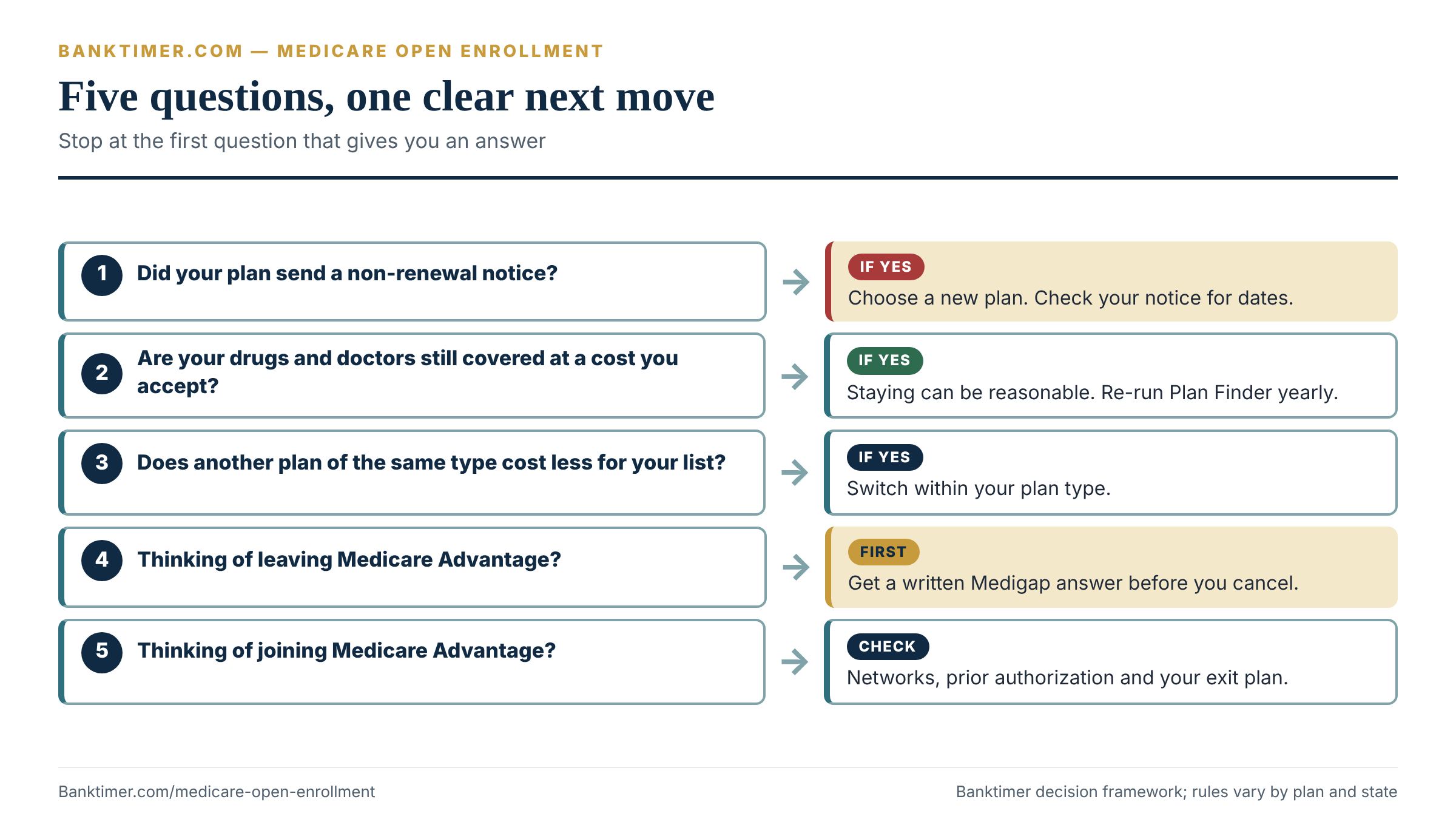
Use these questions in order. Stop at the first one that gives a clear answer.
- Did your plan send a notice that it is leaving or ending? If yes, you must choose a new plan. Read the notice for your dates.
- Are all your drugs and doctors still covered at acceptable cost in 2027? If yes, staying may be reasonable. If no, continue.
- Can another plan of the same type cover them for less? If yes, switch inside your type, which is usually the lowest-risk move.
- Are you considering leaving Medicare Advantage? If yes, find out whether you can get Medigap before you leave. If you cannot, the cap is the cost of leaving.
- Are you considering joining Medicare Advantage? If yes, check networks and prior authorization, and plan for how you would leave later.
A decision matrix for common situations
The table maps common situations to a sensible first move. It is a starting point for a conversation with a counselor, not advice for your case.
| If this is you | A reasonable first move | What to verify before you act |
|---|---|---|
| Plan sent a premium or drug list increase you can live with | Stay and re-run Plan Finder yearly | That every drug and doctor is still covered |
| One drug moved to a higher tier | Compare drug plans for that drug | Annual cost, not just copay |
| Doctor left your plan’s network | Check other plans that include the doctor | The office’s confirmation for 2027 |
| Takes a very expensive drug | Compare plans knowing you will likely hit the $2,400 cap | Premium and the payment plan option |
| In Medicare Advantage, thinking of Original Medicare | Check Medigap eligibility first | Your state’s rules and your health history |
| Low income | Check Extra Help and Medicaid eligibility | Whether the monthly special enrollment right applies |
| Live part of the year in another state | Check the plan’s service area | Out-of-area coverage rules in the Evidence of Coverage |
The most overlooked row is the fifth. It is easy to compare a Medicare Advantage premium with a Medigap premium and forget that the Medigap policy might never be offered to you.
Special Situations and Edge Cases
Most guides to Medicare open enrollment assume a simple case: a person over 65 with a basic plan. Real situations are messier. These cases come up often.
You have coverage from a current or former employer
Before you drop or change anything, ask the employer or union plan how it coordinates with Medicare. Ask whether joining a Medicare Advantage plan or a drug plan could end that coverage, and whether you could get it back. This is a plan-by-plan rule, so get the answer in writing. Our employer open enrollment checklist covers the workplace side.
You are under 65 and have Medicare
If you have Medicare because of a disability, your options may differ. KFF found that 38 states require insurers to offer at least one Medigap policy to people under 65 with disabilities during an initial open enrollment period, but rules vary by state. Ask your SHIP counselor what your state requires.
Your plan is leaving Medicare or your area
If your plan is not renewing, you should get a notice in October. Your special enrollment rights may extend beyond December 7 and differ by plan type. For cost plans that are not renewing, federal rules give a special enrollment period from December 8 to the last day of February. Check the dates in your notice, and do not assume you have extra time.
You move
A permanent move out of your plan’s service area triggers a special enrollment period under federal rules. Tell your plan, and look at the new area’s options before you move if you can. Plans in different counties can differ a lot.
You do not have Medicare yet
Medicare open enrollment does not apply to the Marketplace, which runs on its own calendar. If you are shopping for Marketplace coverage, see our guide to ACA open enrollment for 2027.
Medicare Open Enrollment Scams and Red Flags
Scammers know the calendar. The Federal Trade Commission (FTC) warned on September 28, 2026 that health insurance scams happen all year but increase during Medicare and Marketplace open enrollment. The usual goal is your Medicare Number, your bank details or a payment for something Medicare gives you free.
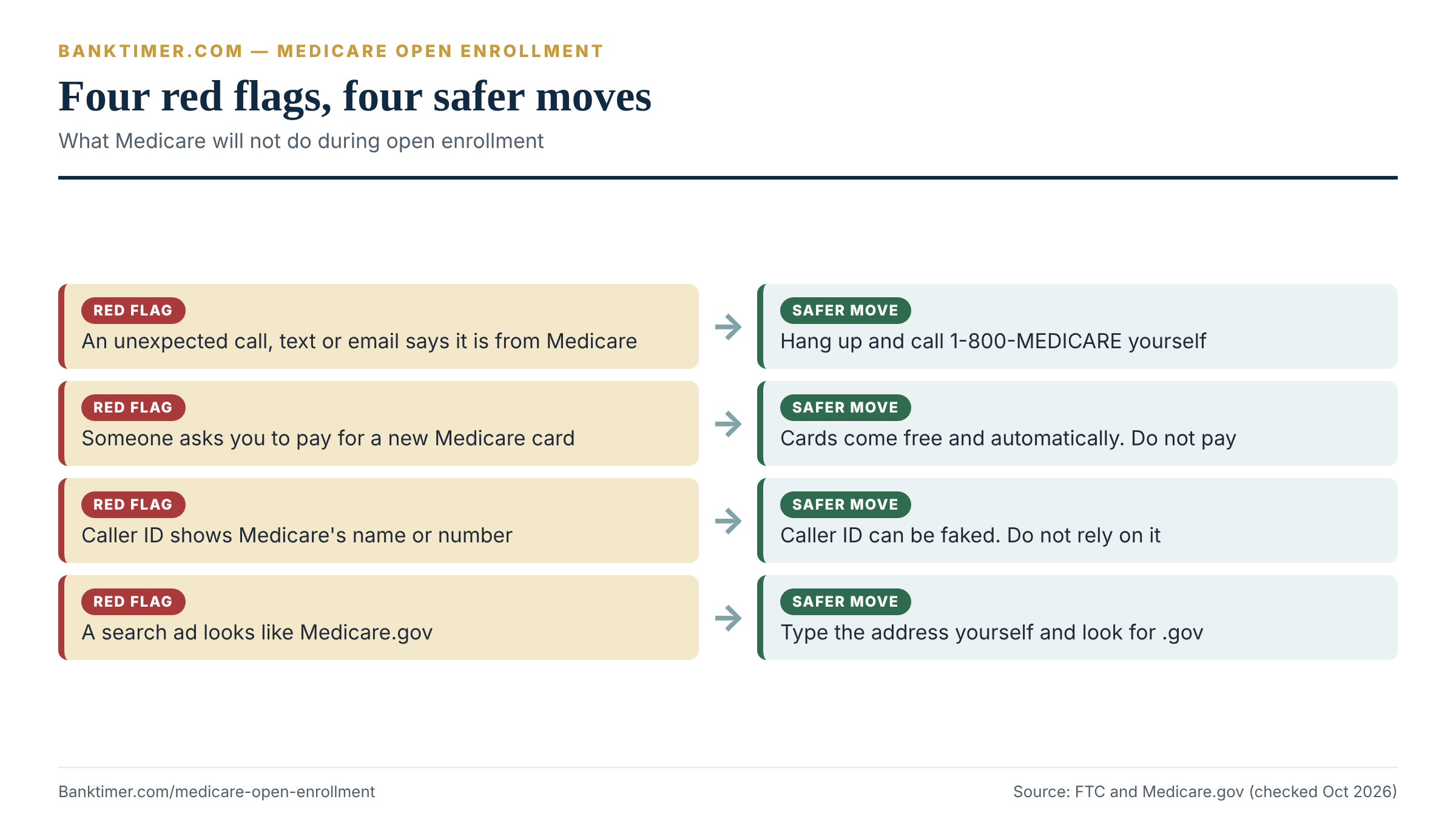
Medicare open enrollment scams share a pattern, and the official sources spell out what Medicare will and will not do. Medicare sends cards automatically and for free. It “will never unexpectedly call, email, text, or message you on social media” to ask for your Medicare, Social Security or bank account numbers, per the FTC. And caller ID can be faked.
Red flags and safer responses
| Red flag | Why it matters | What to ask | Safer next step |
|---|---|---|---|
| An unexpected call, text or email says it is from Medicare | Medicare does not contact you this way to ask for numbers | Who are you, and what is your callback number? | Hang up and call 1-800-MEDICARE (1-800-633-4227) |
| Someone asks you to pay for a “new” Medicare card | Cards are sent automatically and free | Why is a fee needed? | Do not pay; report it |
| Caller ID shows Medicare’s name or number | Caller ID can be faked | None; do not rely on it | Call 1-800-MEDICARE yourself |
| A paid search ad looks like Medicare.gov | Scammers pay to appear at the top | None | Type the address yourself; look for .gov |
| You are urged to join a plan over the phone | Medicare.gov says not to unless you called and asked for help | Did I ask for this call? | End the call and compare plans on your own |
| An offer of money or gifts for free medical care | Medicare.gov says to refuse these offers | What is the catch? | Decline and report it |
| A request for your bank account number to “reserve” a plan | Medicare will never unexpectedly ask for bank account numbers | Why is it needed now? | Give none; contact your plan directly |
The common thread is that you did not start the contact. A short rule of thumb works well: if you did not call them, do not give them a number.
What the marketing rules say
Federal rules for Medicare Advantage and Part D plans bar unsolicited telephone contact, including cold calls, robocalls, text messages and voicemail messages, according to 42 CFR 422.2264. The same rule allows contact when you consent or start the call, and lets plans contact current enrollees about plan business, so some calls are legitimate.
Marketing rules change often, and CMS finalized changes to its contract year 2027 rules in April 2026. Do not treat a rule as a shield. Treat your own checks as the safeguard. Medicare.gov advises that you should not join a Medicare health or drug plan over the phone unless you called and asked for help (Medicare.gov).
If you already shared information
Act the same day. The order below puts the most urgent steps first.
- Stop talking. Hang up and do not call back the number that contacted you.
- Call 1-800-MEDICARE to report it and ask whether your number needs protecting.
- Check your claims. Compare your Medicare statements with your own calendar, and look for services you never received. A secure Medicare.gov account lets you see claims.
- Call your bank if you gave an account or card number. Our bank impersonation scam guide covers what to say.
- Report it. Use ReportFraud.ftc.gov. For plan-related fraud, the I-MEDIC line is 1-877-7SAFERX (1-877-772-3379). For general Medicare fraud, report at oig.hhs.gov/fraud/report-fraud/.
- Watch for identity theft. If you suspect medical identity theft, report it at IdentityTheft.gov and read our identity theft recovery plan.
Your local Senior Medicare Patrol (smpresource.org) also helps people spot and report fraud. If the scammer used a technical-support angle, see our guide to the tech support scam.
Common Mistakes That Cost Money During Medicare Open Enrollment
Most costly errors are not dramatic. They are small omissions that compound over twelve months. The table lists the ones that come up most, with a better move for each.
| Mistake | What it can cost | Better move |
|---|---|---|
| Staying put without reading the notice | A tier change or network loss you could have avoided | Read the ANOC every year |
| Choosing by premium alone | Higher drug and visit costs, as in our Plan A example | Estimate total yearly cost |
| Using last year’s drug list | Missing a new prescription or a dose change | Rewrite the list before you search |
| Assuming “takes Medicare” means “takes my plan” | Out-of-network charges or a denied claim | Ask the office about the 2027 plan by name |
| Leaving Medicare Advantage without checking Medigap | Possible denial or higher premiums | Get a written Medigap answer first |
| Waiting until the last weekend | A missed deadline or an unconfirmed request | Finish by December 4 |
| Enrolling with an unsolicited caller | Wrong plan, stolen data | Start the contact yourself |
| Forgetting the January fallback | Staying in a poor fit for a year | Use Jan 1 to Mar 31 if you are in Medicare Advantage |
The first and fourth rows cause the most surprise. Both come from a quiet assumption that things stayed the same, when the notice or the directory said otherwise.
Documents to Keep
You do not need a filing cabinet, but a folder with the right pages saves time if there is a billing dispute or a coverage question. The table shows what to keep and for how long. Retention periods are suggestions, not legal requirements.
| Document | Why it matters | Where to get it | Suggested hold time |
|---|---|---|---|
| Annual Notice of Change | Proves what the plan told you would change | Plan mailing or member portal | Through the end of 2027 |
| Evidence of Coverage | The full contract terms for the year | Plan website or mailed copy | Through the end of 2027 |
| Plan Finder results (screenshots) | Shows the estimate you relied on | Your own device | Through the first quarter |
| Enrollment confirmation | Proves the date and plan you chose | Plan or Medicare.gov | Through the end of 2027 |
| Medigap letters | May prove your right to buy a policy | Your Medigap insurer | As long as you hold or may buy |
| Notes from calls with the plan | Record of what you were told | Your own notes with date and name | Through the end of 2027 |
| New plan member card | Proves coverage on January 1 | Plan mailing | While active |
Store these together, on paper or in a secure folder. If you later need an appeal, the notes from your calls often matter as much as the notices.
Where to Get Free Help
You do not have to handle Medicare open enrollment alone. Three free sources exist, and none of them is trying to sell you a plan.
- SHIP counselors give free, one-on-one, confidential help with enrollment, costs and network questions. Find yours at shiphelp.org or call 877-839-2675.
- 1-800-MEDICARE (1-800-633-4227; TTY 1-877-486-2048) can help you compare plans and enroll.
- Senior Medicare Patrol helps you spot and report fraud (smpresource.org).
Book SHIP appointments early. Counselor calendars can fill as the deadline nears.
- ☐ Have I read this year’s Annual Notice of Change for my current plan?
- ☐ Does my drug list include every dose, form and pharmacy?
- ☐ Did I confirm each doctor and hospital for the 2027 plan by name?
- ☐ Do I know the total yearly cost for my top two plans, not just the premium?
- ☐ If I am leaving Medicare Advantage, do I have a written Medigap answer?
- ☐ Do I know the deadline for my request, and did I leave a buffer before December 7?
- ☐ Did I start this contact myself, rather than responding to a call or text?
- ☐ Do I have a confirmation number and a screenshot saved?
Frequently Asked Questions
When is Medicare open enrollment for 2027 coverage?
It runs from October 15 to December 7, 2026. Any change you make takes effect on January 1, 2027. The plan must receive your request by December 7, and that day is a Monday this year. Medicare.gov and federal rules both give these dates. To leave a buffer, aim to finish by Friday, December 4.
What can I change during Medicare open enrollment?
You can join, drop or switch a Medicare Advantage plan, with or without drug coverage. You can also join, drop or switch a Part D drug plan if you have Original Medicare. And you can move between Original Medicare and Medicare Advantage. You cannot use this window to change Part A or Part B enrollment or to claim Medigap rights.
What happens if I miss the December 7 deadline?
Your current coverage generally continues into 2027 with its new terms. If you are in Medicare Advantage, you get one change between January 1 and March 31. Other options require a special enrollment period, such as a move or a loss of coverage. A drug-plan gap can bring a late enrollment penalty, so do not skip the review.
Do I have to do anything if I like my plan?
Not necessarily. If your plan is renewing, you generally keep it. Still, read the Annual Notice of Change, because the same plan can cost more or cover less in 2027. Check each drug, doctor and pharmacy. A quick Plan Finder search takes a few minutes and can reveal a cheaper plan, so staying should be a choice, not a default.
What is the Annual Notice of Change, and when should it arrive?
It is a plan’s summary of changes to costs, coverage and network for the next year. SHIP counselors say plans should send it and the Evidence of Coverage by September 30. Federal rules require notice at least 15 days before the election period starts. If yours has not arrived, call the number on your member card and ask for a copy.
How do I use Medicare Plan Finder?
Go to Medicare.gov/plan-compare by typing the address yourself. Enter your drugs, doses and pharmacies, then compare estimated yearly drug costs, premiums and plan features. Pick two or three finalists and confirm networks and drug rules with each plan. You can also call 1-800-MEDICARE or a SHIP counselor, who will walk through the tool with you.
Can I change my Medigap policy during Medicare open enrollment?
The fall window does not give you Medigap rights. Medigap follows its own rules, including a six-month open enrollment window when you first join Part B at 65 or older. Outside protected windows, insurers in most states can ask health questions. Four states have continuous or annual protections. Check before you cancel anything, and see our Medicare Advantage vs. Medigap guide.
Can I switch plans again after January 1?
If you are in a Medicare Advantage plan, you get one election between January 1 and March 31 to switch plans or return to Original Medicare. If you only have a stand-alone drug plan, you generally need a special enrollment period. People with Extra Help or both Medicare and Medicaid can make one change a month into a stand-alone drug plan.
Does the new $2,400 cap apply to every drug plan?
Medicare.gov says that after your covered drug costs reach $2,400 in 2027, you pay nothing for covered Part D drugs for the rest of the year. It applies to Part D drug coverage, including drug coverage built into Medicare Advantage. It does not cap what you pay in premiums, and it does not cover drugs your plan excludes.
How do I know a Medicare call or email is real?
Assume it is not, unless you started the contact. Medicare will not unexpectedly call, text or email to ask for your Medicare, Social Security or bank numbers. Hang up and call 1-800-MEDICARE yourself. Do not trust caller ID or a search ad. Report scams at ReportFraud.ftc.gov or by calling 1-800-MEDICARE. Our phishing text guide shows how fake messages work.
Does a SHIP counselor charge for help?
No. SHIP programs offer free, unbiased, one-on-one counseling for Medicare open enrollment and are confidential. They can help you compare costs, check coverage and confirm which providers are in network. Local capacity varies, so book early. Find your program at shiphelp.org or call 877-839-2675.
Tonight, find your Annual Notice of Change and write down every drug, dose and doctor. Tomorrow, run that list through Medicare Plan Finder or book a free SHIP appointment, and pick your own deadline before December 4.
The variable that decides your outcome is your own list: the exact drugs, doses, doctors and pharmacies you will use next year. The same plan can be a bargain for one person and a costly mistake for another, so a plan’s average premium tells you little. Run your list through Plan Finder, add premium, deductible and expected cost sharing for two or three finalists, and confirm networks with each plan before you enroll. Finish by December 4 and keep proof. Medicare open enrollment does not fix everything, though. It does not give you Medigap rights if you leave Medicare Advantage. It does not set the 2027 Part B premium, which Medicare had not announced when we checked. And it does not protect you from a caller who contacted you first. Verify every plan detail in the plan’s own documents.
Methodology
We built this Medicare open enrollment guide from primary and official sources and checked each dated figure on October 15, 2026. Enrollment dates and rules come from Medicare.gov and the federal regulations at 42 CFR 422.62, 423.38 and 422.2264. The 2027 Part D deductible and out-of-pocket cap come from Medicare.gov. The 2027 base beneficiary premium comes from CMS, dated July 28, 2026, and the plan landscape figures from the CMS release of September 28, 2026. Scam guidance comes from the FTC and Medicare.gov. Medigap and prior authorization statistics come from KFF.
Plans A and B, Plans X and Y, the drug spending levels, the hospital-year example and the penalty tables are illustrative assumptions, not quotes or real plans. Calculations are in a script we ran and rechecked. We did not find a primary-source 2027 Medicare Advantage out-of-pocket limit or a 2027 Part B premium, so the article says so. Plan terms, networks, drug lists and state Medigap rules vary by plan, state and date. We did not test any plan or tool.
Sources
- Joining a plan, Medicare.gov
- Part D costs, Medicare.gov
- Medicare costs, Medicare.gov
- Medicare Prescription Payment Plan, Medicare.gov
- Reporting Medicare fraud and abuse, Medicare.gov
- Switching or dropping Medigap, Medicare.gov
- 2027 Medicare Advantage and Part D premiums expected to remain stable, CMS, September 28, 2026
- Medicare Part D 2027 national average monthly bid amount, CMS, July 28, 2026
- 42 CFR 422.62, Election of coverage under an MA plan, Cornell Law School
- 42 CFR 423.38, Enrollment periods, Cornell Law School
- 42 CFR 422.2264, Marketing communications, Cornell Law School
- What to know ahead of Open Enrollment to avoid health insurance scams, FTC, September 28, 2026
- Medigap enrollment and consumer protections vary across states, KFF, October 13, 2026
- Medicare Advantage insurers made nearly 53 million prior authorization determinations in 2024, KFF, January 28, 2026
By the Banktimer Editorial Team · Published
Banktimer is an independent U.S. consumer-finance publication. Our editors draw on primary and official sources first, such as the CFPB, FDIC, Federal Reserve, and FTC, along with statutes, regulations, and providers’ own agreements and fee schedules. Then we add worked examples and decision tools. Our goal is the most useful, best-supported explanation the sources available to us at the time of writing allow.
This article is general information, not legal, tax, investment, insurance, or financial advice, and reading it does not create a professional relationship with Banktimer. Rates, fees, limits, and rules change, and they vary by state, provider, and contract, so confirm current terms with your bank, lender, insurer, or the agency named in the article before you act. Examples are illustrative unless labeled otherwise. Banktimer is not a bank, lender, insurer, or financial advisor, and we are not responsible for decisions or losses that result from relying on this content. For advice about your own situation, talk to a licensed professional.