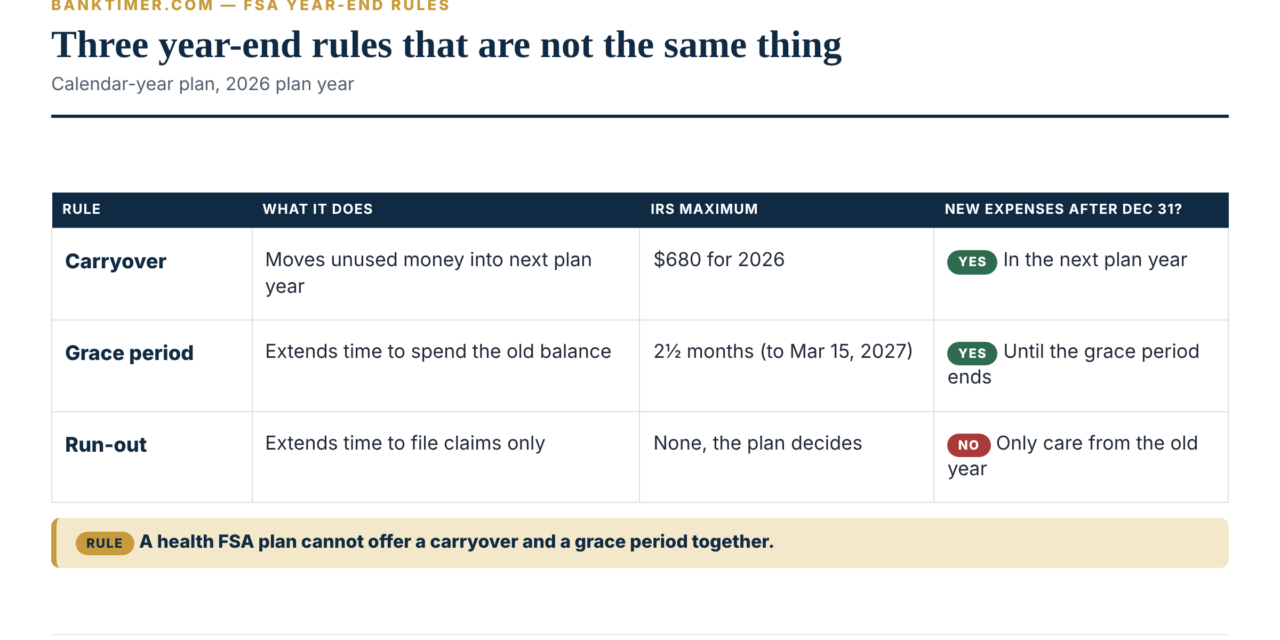
The FSA use it or lose it rule means money left in a health FSA at the end of your plan year is generally forfeited to your employer. The IRS lets an employer soften that rule in one of two ways. One is a carryover (up to $680 into 2027 if the plan allows it). The other is a grace period of up to 2½ months. A plan cannot offer both. Many plans also give a run-out period to file claims for expenses you already incurred.
Your biggest variable is which option your employer chose, if any. Read your plan document before December 31, then match your balance to eligible expenses you would buy anyway.
Your employer decides the softening rule. Federal law sets the ceiling, not the floor. A plan can offer a carryover, a grace period, or neither, and it can set a carryover cap below the IRS maximum.
Carryover and grace period are different tools. Carryover moves money into next year. A grace period extends the time to incur new expenses against this year’s balance. A plan cannot offer both for a health FSA.
Run-out is not extra spending time. It is a window to file claims for care you received before the deadline. Services after December 31 do not qualify just because the filing window is still open.
Losing money costs less than it feels like, but more than zero. With the illustrative tax rate in our math, an election of $2,400 beats skipping the FSA as long as you use about 70% of it.
Spend on needs, not on a clearance rack. Eligible expenses are wider than most people assume, so you rarely need to buy things you will not use.
What the FSA Use It or Lose It Rule Actually Says
A health FSA is an employer benefit that lets you set aside pre-tax pay for medical costs. HealthCare.gov describes it as an arrangement that lets you pay for many out-of-pocket medical expenses with tax-free dollars. You choose an annual amount during open enrollment, and your employer withholds it from each paycheck.
The trade for that tax break is a deadline. Publication 969 describes health FSAs as generally “use-it-or-lose-it” plans. A balance left at the end of the plan year typically does not roll into the next one. The employer also cannot cash you out. Publication 969 says the employer is not permitted to refund any part of the balance to you.
Plan year, not calendar year
The deadline is the end of your plan year, and that is not always December 31. Most employer plans run on the calendar year, so December 31, 2026 (a Thursday) is the date most readers face. Some employers use a July 1 to June 30 year, or a fiscal year that matches their budget.
Your plan document or administrator portal states the exact end date. Do not assume. A wrong assumption costs money either way. You could panic-buy in December when your year ends in June. Or you could miss a September deadline you did not know existed.
What “incurred” means
An FSA reimburses expenses incurred during the plan year. Publication 969 says distributions must reimburse qualified medical expenses incurred during the coverage period, and it bars advance reimbursement for future or projected expenses.
In practice, the date that counts is the date you receive the care or the item, not the date you pay. A dentist visit on December 28 counts for 2026 even if the bill arrives in January. Paying in December for a procedure scheduled in February does not.
That distinction drives almost every year-end mistake. Buying a gift card to a pharmacy, for instance, does not turn future purchases into 2026 expenses. We return to this in the section on what you can still buy.
Why your balance may be bigger than you think
Most plans follow the uniform coverage rule. You can access your full annual election early in the plan year, even before your paychecks have funded it. Publication 969 says you can receive your full elected amount at any time during the coverage period. Notice 2013-71 confirms the uniform coverage rule still applies to plans with a carryover.
That has a practical effect in November. Your portal may show a “balance available” that equals your full election minus claims paid. It does not tell you whether you have contributed that much. If you leave your job mid-year, the arithmetic matters, as the special situations section explains.
Why the Rule Exists and Who Sets Your Version
The FSA use-it-or-lose-it deadline is a condition of the tax treatment. Your contributions to a health FSA are not taxed as income. The IRS says they are also free of employment taxes. In return, the account must be spent on medical expenses within a defined period. It cannot work like a savings account that you drain in retirement.
The federal rule is the starting point. Your own plan sits on top of it, and that is where differences appear. Here are the layers, because blending them causes most confusion.
Who decides what
| Layer | What it controls | Example |
|---|---|---|
| Federal tax rules (IRS) | Annual limit, maximum carryover, maximum grace period, no refunds | $3,400 limit and $680 maximum carryover for 2026 |
| Your employer’s plan document | Whether carryover or grace period exists, the cap, the run-out window | A $500 carryover cap, or a March 15 grace period |
| The plan administrator | Claim forms, receipts, card rules, processing speed | A 90-day claim filing deadline, or a mobile app |
| Your own election | How much you contributed for the year | $2,400 elected in last year’s open enrollment |
The table shows why one friend’s “my FSA rolls over” and another’s “mine vanishes” can both be true. They work for different employers, and each employer picked a different row-two option. Federal law only draws the outer boundary.
What the IRS figures are for 2026 and 2027
The IRS set the 2026 health FSA salary reduction limit at $3,400 and the maximum carryover at $680 in Revenue Procedure 2025-32. The carryover maximum equals 20% of the salary reduction limit, a formula the IRS introduced in Notice 2020-33. Twenty percent of $3,400 is $680.
For 2027, we found no announced health FSA figure on the IRS pages we checked on October 15, 2026. Do not rely on third-party projections. If your employer’s enrollment form states a 2027 cap, the plan sets it, and you can compare it with the IRS release once published. Our guide to HSA vs. FSA explains how the FSA limit compares with HSA limits.
A note on stale numbers
Government pages do not always update at the same speed. When we read the HealthCare.gov glossary entry for flexible spending accounts on October 15, 2026, it described a carryover of up to $640. That was an earlier-year amount. The IRS figure for 2026 is $680.
Use the IRS number for the federal ceiling and your plan document for what applies to you. If two sources disagree, the plan document controls your account.
Carryover vs. Grace Period vs. Run-Out: How the Three Year-End Options Work
The FSA use it or lose it rule has three release valves, and people mix up the terms constantly, even in benefits brochures. They solve different problems. Carryover moves unused money to next year. A grace period gives you extra days to spend this year’s money. Run-out gives you extra days to file paperwork for spending you already did.
Carryover: unused money moves into next year
Under a carryover, the plan lets you keep a limited amount of unused money after the plan year ends. Notice 2013-71 created the option, starting at $500. Notice 2020-33 then tied the cap to 20% of the annual limit. For 2026, that is $680.
Several details matter. The plan may set a lower cap than the IRS allows, or none at all. The same cap must apply to all participants. Amounts above the cap are forfeited. And the carryover does not reduce your next-year election, so you can elect the full 2027 limit and still carry money in.
Carried-over dollars can pay for any eligible medical expense during the new plan year. The notice also says unused funds are measured after the run-out period ends. That timing explains why some plans make carryover money available weeks or months into the new year, a point we cover below.
Grace period: extra time to spend the old balance
A grace period lets you incur new expenses after the plan year ends and still charge them to the old balance. Publication 969 says the period can last up to 2½ months. For a calendar-year plan, that runs through March 15, 2027. A shorter grace period is also allowed.
The money does not move or change. It stays in the same account for the same purpose. If you have not spent it by the last day, it is forfeited, and the employer cannot refund it to you. A grace period removes some of the December rush. It also has a hard stop at 2½ months, while a carryover has no end date within the next plan year.
Run-out: extra time to file claims, not to spend
The run-out period is the window after the plan year ends in which you can submit claims for expenses incurred during the plan year. The IRS does not set its length for you. Each plan sets its own window, and the federal example later in this section runs about four months.
A dentist visit on December 28 and a claim filed on February 20 works under a 90-day run-out. A dentist visit on January 5 does not, because the care happened after the plan year closed. That is the difference between run-out and a grace period, and mixing them up is an expensive way to learn it.
Can a plan offer more than one?
A plan can pair a run-out period with either a carryover or a grace period. It cannot combine a carryover with a grace period for a health FSA. Notice 2013-71 states that a plan adopting the carryover is not permitted to also provide a grace period. Publication 969 repeats the same rule.
A plan can also offer neither a carryover nor a grace period. Then December 31 ends the spending window, and only the run-out, if your plan has one, gives you time to file.
Side-by-side comparison
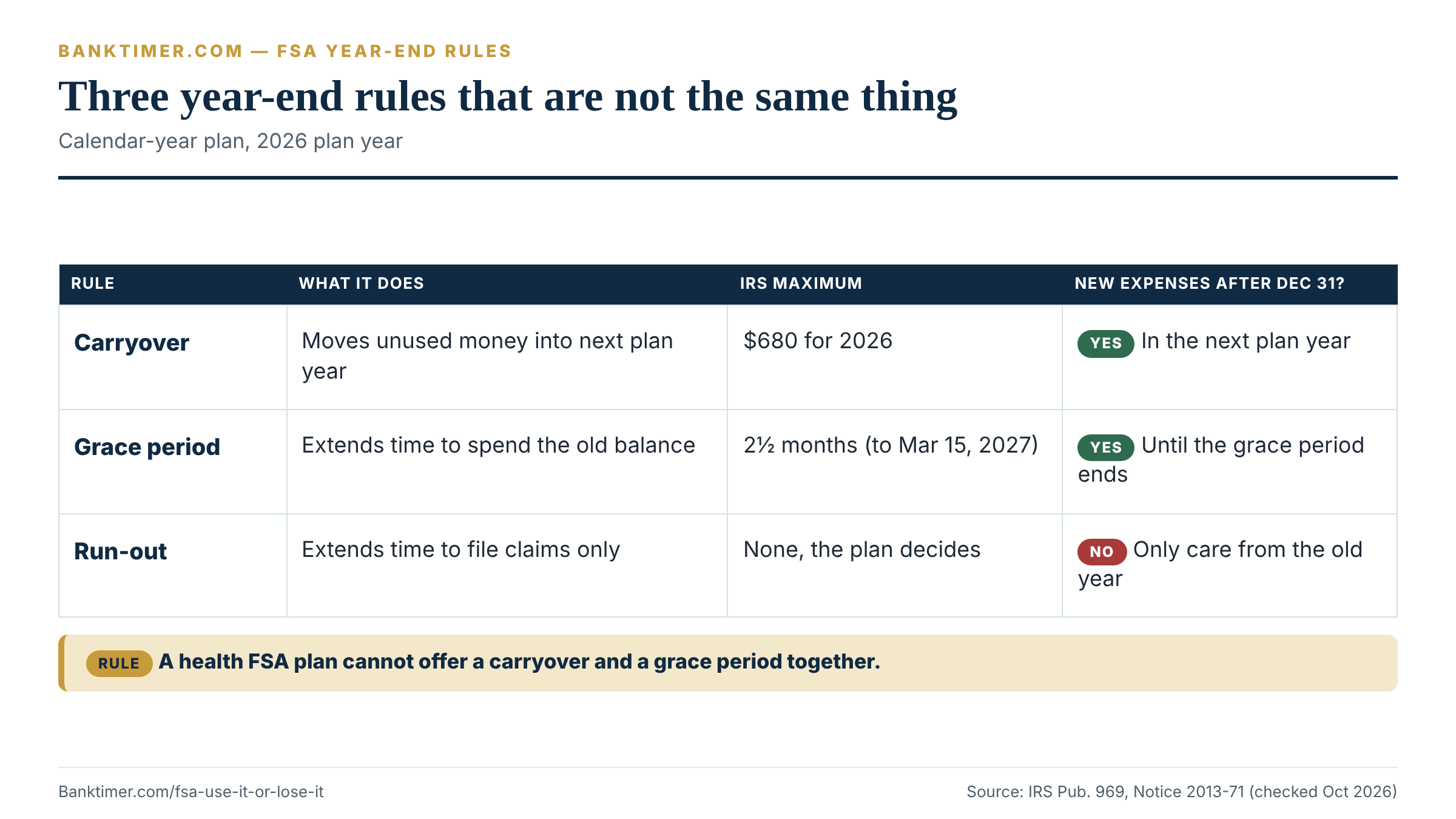
The table below puts the three tools next to each other on the same criteria. The decision-driving row is the fourth one, on whether new expenses can qualify. Only carryover moves money across the line, and only a grace period lets you buy something new after December 31.
| Question | Carryover | Grace period | Run-out period |
|---|---|---|---|
| What does it do? | Moves unused money into next plan year | Extends time to incur expenses on old balance | Extends time to file claims for expenses already incurred |
| IRS maximum | $680 for 2026 (20% of $3,400) | 2½ months after plan year ends | None set by the IRS; the plan decides |
| Who decides? | Employer (can set a lower cap) | Employer (can set a shorter period) | Employer or administrator |
| Can new expenses qualify? | Yes, in the next plan year | Yes, until the grace period ends | No, only expenses from the old plan year |
| Can it combine with the others? | Not with a grace period | Not with a carryover | Yes, with either |
| What you lose | Balance above the cap | Balance unspent by the last day | Claims filed after the deadline |
A Real Example of Plan Differences: One Federal Program’s Published Rules
Rather than describe plan variation in the abstract, consider one program that publishes its rules openly. FSAFEDS, the flexible spending program for federal employees, lists its 2026 benefit-period dates on its website. We read them on October 15, 2026. These are one provider’s terms, not federal law or a standard for private employers.
The FSAFEDS 2026 schedule
For a health care FSA, the last day to incur 2026 expenses is December 31, 2026. Claims for the 2026 benefit period must be submitted by April 30, 2027. For dependent care FSAs, the last day to incur expenses is March 15, 2027, with the same April 30 claim deadline.
That program offers a carryover for health care accounts. Its published notice for 2025 expenses adds a condition worth knowing. You keep carried-over money only if you re-enroll in a health care FSA during open season. The notice says funds in an account not re-enrolled are forfeited. It also says carryover money becomes available in late May, after prior-year claims are processed.
What this example teaches
Three lessons apply even if your employer is not the federal government. First, the run-out deadline can be four months long, so December 31 is not a filing deadline. Second, a carryover can come with conditions beyond the IRS rule, such as re-enrolling. Third, carryover money can arrive late, so it is not a substitute for planning your January expenses.
Your plan will differ in the details. Use it as a checklist. Does carryover require re-enrollment? When does the money become available? What is the final claim date?
How to Find Your Own FSA Rules in 15 Minutes
You do not need a benefits degree. You need three documents or screens and the right questions. The goal is to fill in one sentence: “My plan year ends on ___, my plan offers ___ (carryover, grace period or neither), and my claims deadline is ___.”
Where the answers live
| Where to look | What it usually tells you | Typical wording to search for |
|---|---|---|
| Plan administrator portal or app | Balance, claims status, deadlines banner | “Plan year end,” “last day to incur expenses” |
| Summary plan description (SPD) | Plain-English rules on carryover, grace, run-out | “Carryover,” “grace period,” “claims deadline” |
| Open enrollment guide | A short summary and the current-year limits | “Health care FSA,” “unused funds” |
| HR or benefits team | Confirms the plan year and any amendments | Ask for the plan year dates in writing |
| Your last year’s statements | How your own carryover or forfeiture played out | “Forfeited,” “carryover balance” |
Start with the portal, since most administrators put the deadline in a banner near the balance. If the banner and the SPD disagree, ask HR for the controlling date in writing. Plans can be amended, and the SPD may be a year old.
Five questions to answer before you spend anything
- ☐ What is the exact last day of my plan year, and does it fall on a weekend or holiday?
- ☐ Does my plan offer a carryover, a grace period, or neither, and what is the cap or end date?
- ☐ What is the last day to file claims for this year’s expenses (the run-out deadline)?
- ☐ Do I need to re-enroll for next year to keep a carryover balance?
- ☐ How will pending, denied or unsubstantiated claims count against my balance?
Write the answers in one place. A note on your phone is enough. We use those answers in the next section to build a spending plan.
Your Seven-Week Plan: How to Use What Is Left Before December 31
From Monday, November 9, 2026, you have 52 days until the end of a calendar-year plan. That is a little over seven weeks. It overlaps with holiday spending, so fold this plan into your holiday budget. It is enough time to schedule appointments, refill prescriptions and order supplies, but not enough to wait for a perfect moment. The steps below work whether you have $200 or $2,000 left.
Step 1: Find your true available balance
Log in and write down three numbers: your annual election, the total reimbursed so far, and the claims still pending. Your true balance is the election minus reimbursed claims minus pending claims. Pending claims matter because a claim in review has not been paid, but it will reduce what is left.
Then check for denied claims. A claim denied for missing documentation can often be fixed with a receipt. The fix counts the money as spent. That is free money recovered, so do it first.
Step 2: List the expenses you already know are coming
Look at the next seven weeks. Include scheduled dental cleanings, a vision exam, refills due before year-end, physical therapy sessions, specialist copays and any equipment you have been postponing. Add approximate costs. Do not add anything speculative yet.
This list matters because it shrinks the gap before you shop. Money you will spend on planned care is not money at risk.
Step 3: Compute the gap
The gap is your true balance minus your known upcoming expenses. That gap is the money that is actually in danger. Here is a worked example with Banktimer’s assumptions.
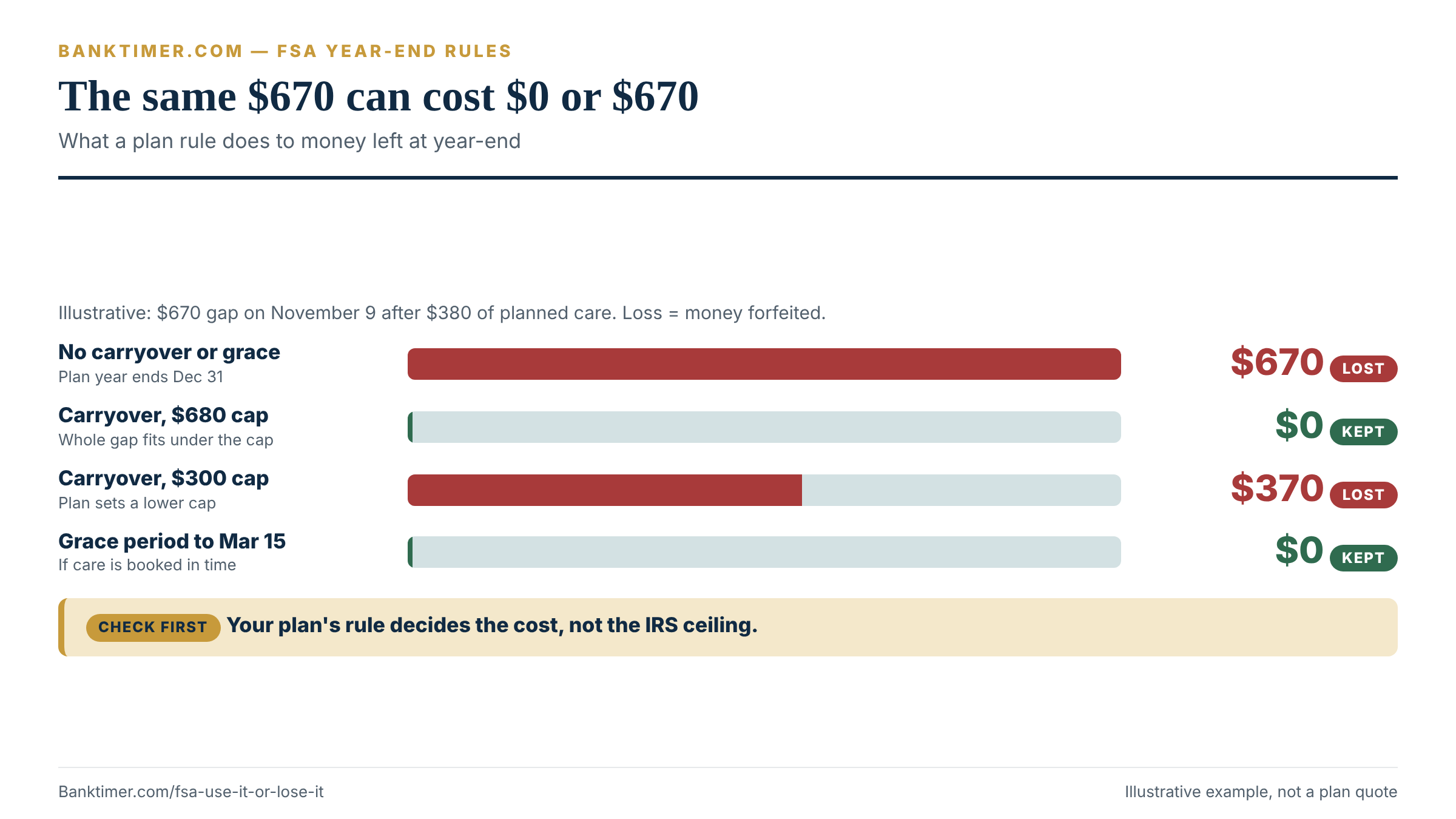
Maya elected $2,400 for 2026. By November 9, her plan has reimbursed $1,350, so her balance is $1,050. She has a $150 dental copay on November 18 and $230 of refills due in December, a total of $380.
Her gap is $1,050 minus $380, which equals $670. Spread across the 52 days, that is about $12.90 per day, or $90 a week. She does not need to find $1,050 of things to buy. She needs to decide what to do with $670.
The gap number changes the whole conversation. Maya can stop worrying about the $1,050 and focus on a smaller target. If her plan has a carryover or grace period, she may not need to spend any of it. We test that next.
Step 4: Apply your plan’s rule to the gap
Take the gap to your plan’s rule. The outcome changes sharply depending on which option you have. The table below uses Maya’s $670 gap with four illustrative plan designs. The tax value of lost dollars uses the 29.65% combined rate explained later in the cost section.
| Plan design (illustrative) | What happens to the $670 gap | Money lost | Take-home value of loss |
|---|---|---|---|
| No carryover, no grace period | Forfeited on December 31 unless spent | $670 | $471.35 |
| Carryover with a $680 cap | Entire gap carries into 2027 | $0 | $0 |
| Carryover with a $300 cap | $300 carries, rest is forfeited | $370 | $260.30 |
| Grace period through March 15, 2027 | Usable on expenses through that date; unused amount forfeited | $0 if spent in time | $0 if spent in time |
The first row is the real use-it-or-lose-it scenario. The second shows why a carryover plan is the most forgiving: Maya’s gap fits under the cap. The third shows a quiet trap, since a plan may set a cap below the IRS maximum. The fourth works only if she actually plans purchases and appointments before March 15.
Step 5: Decide what to do with money at risk
Once you know the rule, you have three choices. You can let the gap carry over if your plan allows it. You can schedule real needs inside the window. Or you can accept the loss. Letting a small amount go is sometimes the right call, and we show the math for that later.
If the gap is at risk, put your date constraints on a calendar. Everything that must be incurred by December 31 needs an appointment or an order date. Everything that can wait for a grace period needs its own deadline.
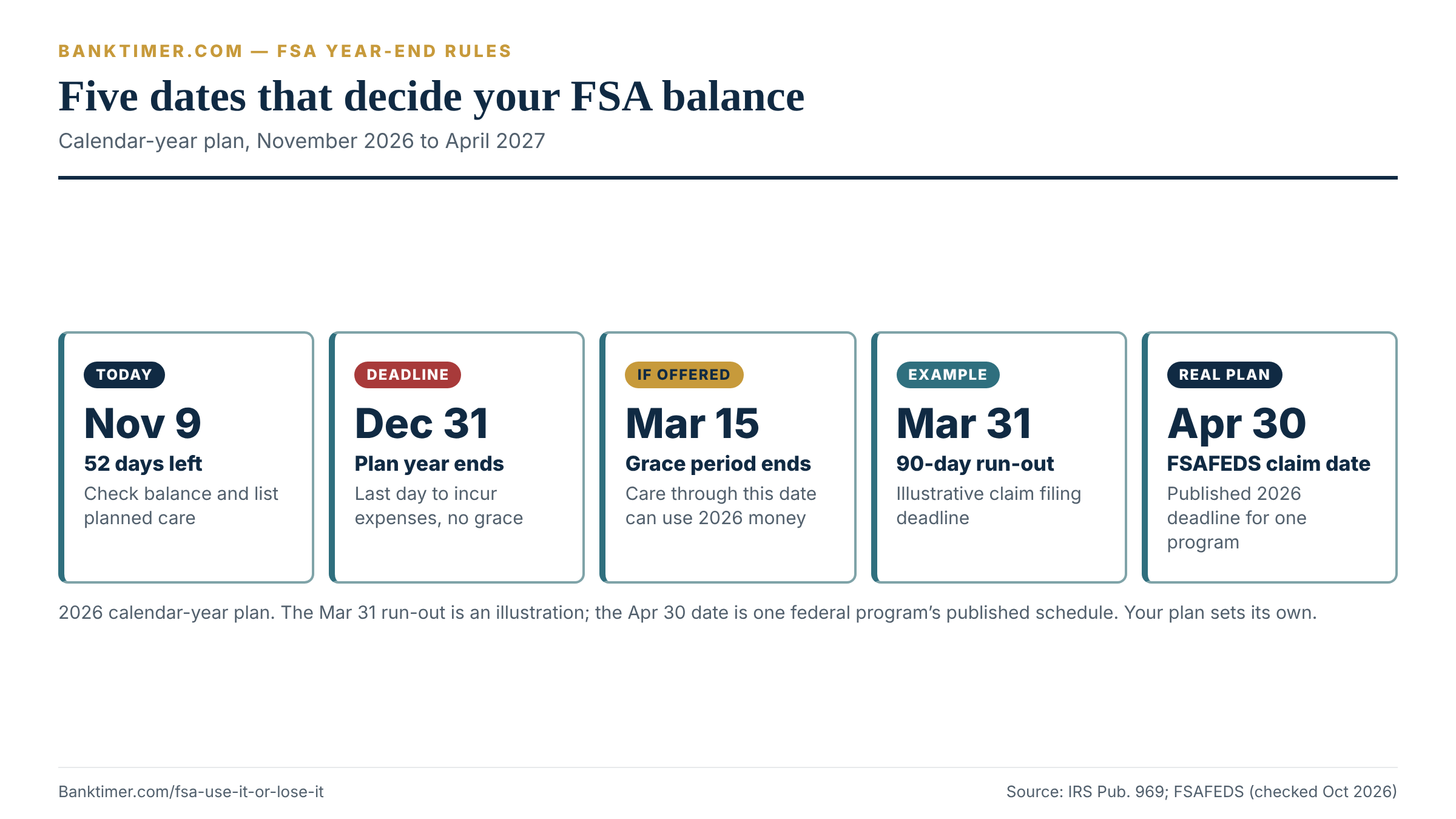
Key dates for a calendar-year plan
The timeline below uses the standard calendar-year dates and one illustrative run-out window of 90 days. Your plan’s run-out may be shorter or longer. The week-by-week view also shows how little time remains once the holidays start.
| Date | What happens | Why it matters |
|---|---|---|
| Monday, November 9, 2026 | 52 days remain | Check balance, list known expenses |
| Friday, November 27, 2026 | Black Friday | Retail deals on eligible items, but not a reason to buy extras |
| Friday, December 18, 2026 | Practical order cutoff for many items | Shipping and delivery times can slip into late December |
| Thursday, December 31, 2026 | Plan year ends | Last day to incur expenses unless a grace period applies |
| Monday, March 15, 2027 | Grace period ends (if offered) | Last day to incur expenses against the 2026 balance |
| Wednesday, March 31, 2027 | Illustrative 90-day run-out ends | Last day to file claims in this example |
The practical cutoff row is a Banktimer editorial suggestion, not a rule. It exists because the date you receive an item can matter. A package that arrives in January is likely a 2027 expense. Ask your administrator how it treats purchases delivered after year-end.
What You Can Still Buy With Unused FSA Money
You rarely need to buy things you will not use. The category of eligible expenses is wide. The IRS defines the base list through its medical-care rules, and plan administrators publish their own eligible-expense lists on top of that.
The decision test we recommend is simple. Would you pay for this item or service within the next 12 months anyway? If yes, buying it now with pre-tax dollars is a reasonable use of money that might expire. If no, think hard before buying it just because the balance exists.
Care and services
Services are often the best use of an expiring balance because you control the date of service. Eligible services generally include dental treatment, eye exams, laser eye surgery, physical examinations and diagnostic tests. Chiropractic and acupuncture visits, psychological and psychiatric care, and therapy received as medical treatment also appear on the list. These come from IRS Publication 502’s list of includible medical expenses, which health FSAs generally follow.
Schedule soon. Dental offices and eye clinics book up in December, and you cannot move an appointment into the plan year after the fact. A January 4 appointment is a 2027 expense.
Prescriptions, over-the-counter items and supplies
Publication 969 says over-the-counter medicine and menstrual care products count as covered expenses for a health FSA. That differs from Publication 502, which still says you cannot deduct nonprescription drugs on a tax return other than insulin. The two publications serve different accounts, so do not mix their rules.
Notice 2024-71 adds condoms to the eligible list for health FSAs, HSAs and similar accounts. Publication 502 also lists bandages and medical supplies, pregnancy test kits, blood sugar test kits, crutches, and hearing aids with batteries.
Vision and hearing
Eyeglasses, contact lenses and the solution needed for them for medical reasons are on the Publication 502 list, along with eye exams and laser eye surgery. Hearing aids, batteries, repairs and maintenance are also listed. These are among the most predictable expenses to move forward, since prescriptions rarely change on short notice.
If you are due for new glasses in the spring, buying them in December is reasonable, assuming the prescription is current. Be cautious about stocking multiple pairs “just in case.”
Equipment and larger purchases
Publication 502 lists items such as wheelchairs, crutches, oxygen equipment and breast pumps and lactation supplies. Some larger items need a prescription or a statement of medical necessity from a provider, depending on your plan’s rules. Ask before you buy.
Home modifications such as ramps or grab bars appear on the list as capital expenses for medical care. Plans treat them differently. For those, call the administrator first.
Eligible vs. not eligible at a glance
The table below sorts common year-end purchases. The right-hand column is the one to check, because plans can be stricter than the IRS but not looser.
| Item or service | Usually eligible? | What to confirm |
|---|---|---|
| Dental cleaning, fillings, braces | Yes | Date of service is before year-end |
| Eye exam, glasses, contact lenses | Yes | Medical need and prescription |
| Prescription copays and refills | Yes | Fill date is in the plan year |
| Over-the-counter medicine (pain relief, allergy, cold) | Yes, per Publication 969 | Whether the plan’s list or card system approves the item |
| Menstrual care products | Yes, per Publication 969 | Same as above |
| Bandages, first-aid and diagnostic supplies | Yes | Item is for medical care, not general use |
| Vitamins and supplements | Generally no | Publication 502 requires a recommendation for a diagnosed condition |
| Cosmetic surgery, teeth whitening | Generally no | Exceptions for congenital issues, injury or disease |
| Gym membership, general wellness | No | Publication 502 excludes health club dues for general health |
| Health insurance premiums | No | Publication 969 bars FSA reimbursement of premiums |
| Long-term care | No | Publication 969 bars reimbursement |
The pattern is that medical purpose decides eligibility, not the store aisle. Something sold in the pharmacy aisle is not automatically eligible, and something sold at a medical supply store may be. When in doubt, ask the administrator before buying.
How to pay and prove it
Many plans issue a debit card. Publication 969 says card use that meets certain substantiation methods may need no additional information. That is why some purchases clear automatically at a pharmacy. Others get flagged, and you must upload a receipt.
Your insurance copays and coinsurance count too. Our guide to copay vs. coinsurance shows how each one adds up. Keep itemized receipts. The rule behind the paperwork is simple. A claim needs a written statement from an independent third party showing the expense and amount. It also needs a statement that no other plan paid it. A credit card slip that says “$48.63” does not show what you bought.
The Real Cost of Losing FSA Money: Tax Math and Break-Even
Forfeiture under the FSA use it or lose it rule hurts, but it hurts less than the face amount suggests. You funded the account with pre-tax pay, so every dollar you put in cost you less than a dollar of take-home pay. That discount is why an FSA can beat no FSA even when you leave some money behind.
The calculation depends on your tax situation, so we use stated assumptions. For the wider picture of how pay and benefits are taxed, see our guide to how bank savings and insurance are taxed. They are illustrative and are not a tax estimate for you.
The assumptions behind the numbers
We assume a 22% federal marginal income tax rate. We add the 7.65% employee share of Social Security and Medicare tax (6.2% plus 1.45%, per IRS Topic 751). We assume no state income tax. The combined rate is 29.65%. Publication 969 says FSA contributions are free of income and employment taxes, so both layers matter.
Two caveats change the answer. Social Security tax stops above the 2026 wage base of $184,500, so higher earners save less. State income tax can raise the savings in states that tax wages. Your actual rate may be higher or lower than ours.
The break-even rule
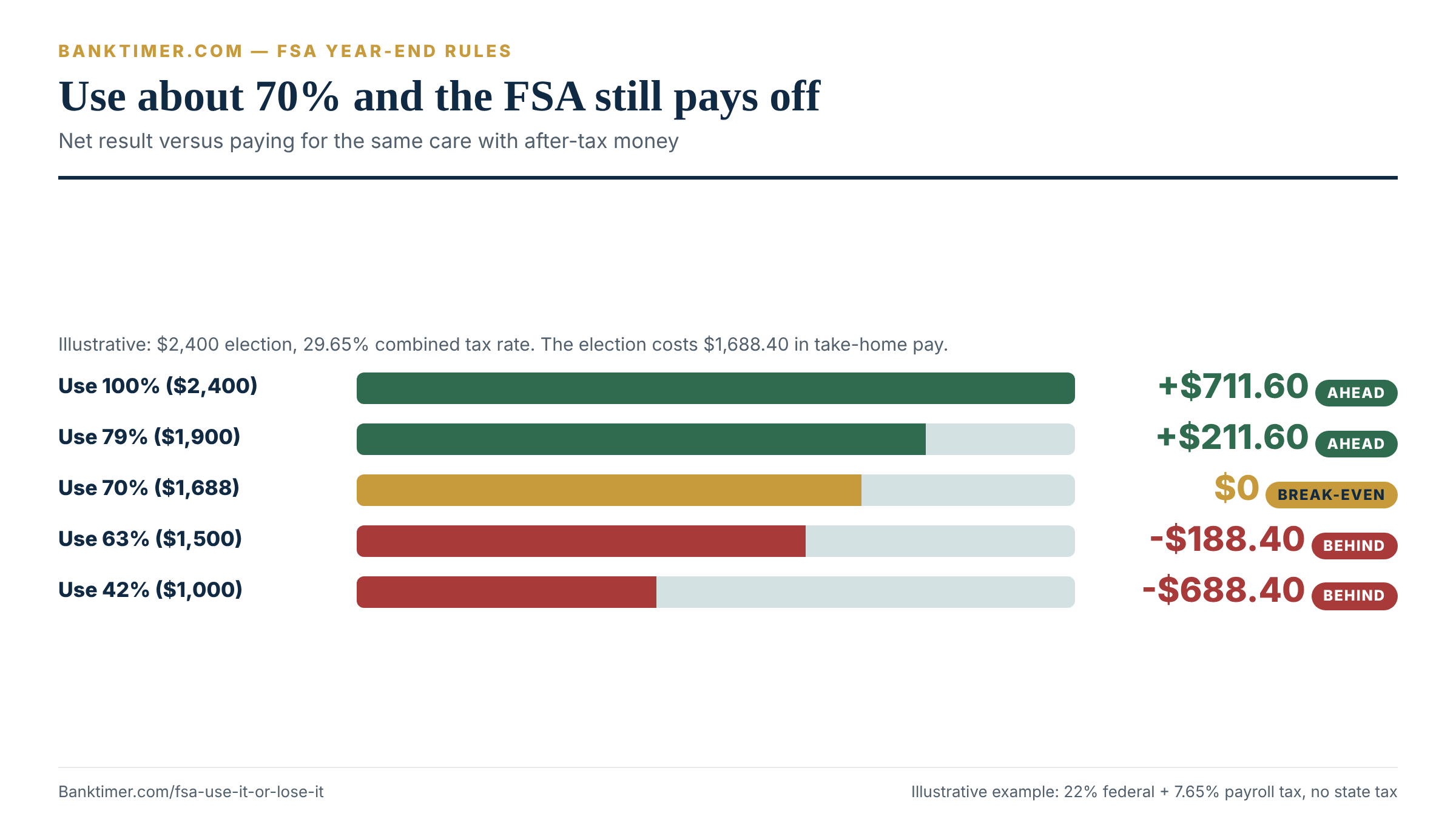
Here is the formula. If you elect $2,400, your take-home pay falls by $2,400 times (1 minus 0.2965), or $1,688.40. The FSA beats paying for the same care with after-tax money if you reimburse more than $1,688.40. That is 70.35% of the election.
Put differently, you can forfeit up to $711.60 of a $2,400 election and still break even against not having an FSA at all. This is only true for care you would have paid for anyway. An FSA does not help if you buy something you did not need.
| Share of $2,400 election used | Dollars of care reimbursed | Take-home cost of election | Net result vs. paying after tax |
|---|---|---|---|
| 100% | $2,400 | $1,688.40 | +$711.60 |
| 83% | $2,000 | $1,688.40 | +$311.60 |
| 79% | $1,900 | $1,688.40 | +$211.60 |
| 70% | $1,688 | $1,688.40 | About $0 |
| 63% | $1,500 | $1,688.40 | -$188.40 |
| 42% | $1,000 | $1,688.40 | -$688.40 |
The table shows a steep but not cliff-like loss. Falling from 100% to 79% use still leaves you ahead by $211.60. Falling below 70% is when you give back more than the tax break paid. The decision insight is that a modest shortfall is a small mistake, while a large one is a real cost.
How the break-even changes with your tax rate
The break-even percentage moves with your marginal rate. A lower rate means a smaller discount, so you need to use more of the election to come out ahead. A higher rate gives you more cushion.
| Federal marginal rate (illustrative) | Combined with 7.65% | Break-even share of election | Break-even dollars on $2,400 |
|---|---|---|---|
| 10% | 17.65% | 82% | $1,976 |
| 12% | 19.65% | 80% | $1,928 |
| 22% | 29.65% | 70% | $1,688 |
| 24% | 31.65% | 68% | $1,640 |
| 32% | 39.65% | 60% | $1,448 |
Percentages are rounded to whole numbers. A reader in the 12% bracket who elects $2,400 needs to use roughly $1,928 to come out ahead. That is a useful reason to elect carefully, since lower-bracket households have less cushion.
What to do with this math right now
Use the break-even to decide how hard to chase a shortfall. If your balance is above the break-even line, you are already ahead and the leftover is a modest forfeit. If you sit below the line, spending on real needs recovers value you would otherwise lose entirely.
Do not use the math to justify buying things you will not use. Spending $300 on items you would never otherwise purchase, with only half of them useful, burns about $150 in practice. That can be worse than letting the money expire.
Special Situations That Change the Year-End Math
The plan year and balance are the main facts. A few life events change the picture, and some of them create a cost that no calendar tip can fix.
You are leaving your job
Health FSA coverage generally ends when employment ends unless you elect COBRA continuation coverage. Funds still in the account may be forfeited. Notice 2013-71 states that funds in an employee’s health FSA at termination are forfeited unless COBRA continuation coverage applies. Plan terms govern the details, including whether you can file claims after leaving.
The uniform coverage rule creates an asymmetry. Suppose Maya elected $3,000, which is $250 a month. She leaves after six months, having contributed $1,500. If she has been reimbursed $2,200, the plan has paid out $700 more than she contributed. In this illustration the plan absorbs that difference, but your plan document controls how final claims and any shortfall are handled. If she has been reimbursed only $900, she forfeits $600. Spend before your last day if you have care scheduled.
You are switching to a high-deductible health plan with an HSA
A general-purpose health FSA and a health savings account (HSA) do not mix. Publication 969 says someone with a high-deductible health plan and a health FSA that pays qualified medical expenses generally cannot contribute to an HSA. It also says a general-purpose FSA grace period is allowed for HSA purposes only if the prior-year balance is zero.
That grace-period test creates a trap for people switching plans on January 1. A leftover balance can keep you ineligible for the HSA into the spring. Ask your administrator how they treat carried-over dollars before you open the HSA.
Limited-purpose and post-deductible accounts
A limited-purpose FSA pays only for certain items, typically dental, vision and preventive care. Publication 969 says these arrangements can pay or reimburse items allowed under other health coverage, except long-term care. They can also pay preventive care expenses. They are still FSAs, so check your plan document for how the year-end rules apply to the limited-purpose account.
The practical difference for year-end is the shorter eligible list. A limited-purpose balance cannot absorb a prescription copay. Adjust your spending list accordingly.
Dependent care FSAs follow a different path
A dependent care FSA pays for care that lets you work, such as child care. It is a separate account with a separate limit. IRS Publication 15-B (2026) says the annual exclusion rose from $5,000 to $7,500 ($3,750 if married filing separately). It is capped at the smaller of your earned income or your spouse’s.
The carryover rule we described belongs to health FSAs. Publication 15-B ties the “use-or-lose” rule and the carryover option to health FSAs, not dependent care. Dependent care plans may offer a grace period, as the FSAFEDS example showed with a March 15, 2027 end date. If you have both accounts, check each one separately.
Who cannot use an FSA
Publication 969 states that self-employed people are not eligible for FSAs. That includes owners of sole proprietorships and partners. If you are self-employed, an HSA paired with a qualifying health plan may be the path.
Spouses and dependents are different. According to Publication 969, eligible persons include you, your spouse and your claimed dependents. Certain other qualifying persons and a child under 27 at the end of the tax year also count. Your adult child’s dental work can count if the plan includes them.
A military call-up
Publication 969 describes a qualified reservist distribution. If the plan is amended to permit it, a participant can take a distribution of the unused balance. The participant must be ordered or called to active duty for more than 179 days or for an indefinite period. The distribution is reported as wages on Form W-2 and is subject to employment taxes. It is a narrow exception and not a general cash-out. Our forms guide covers the common tax and insurance forms you may see.
Mid-year changes to your election
Publication 969 says you can change or revoke an election only if the law and the plan permit it. The cafeteria plan regulations and your plan document decide which life events allow a change, so ask HR for the list. Do not count on changing an election in November because you overestimated your spending.
A Decision Framework: Spend, Carry Over or Let It Go
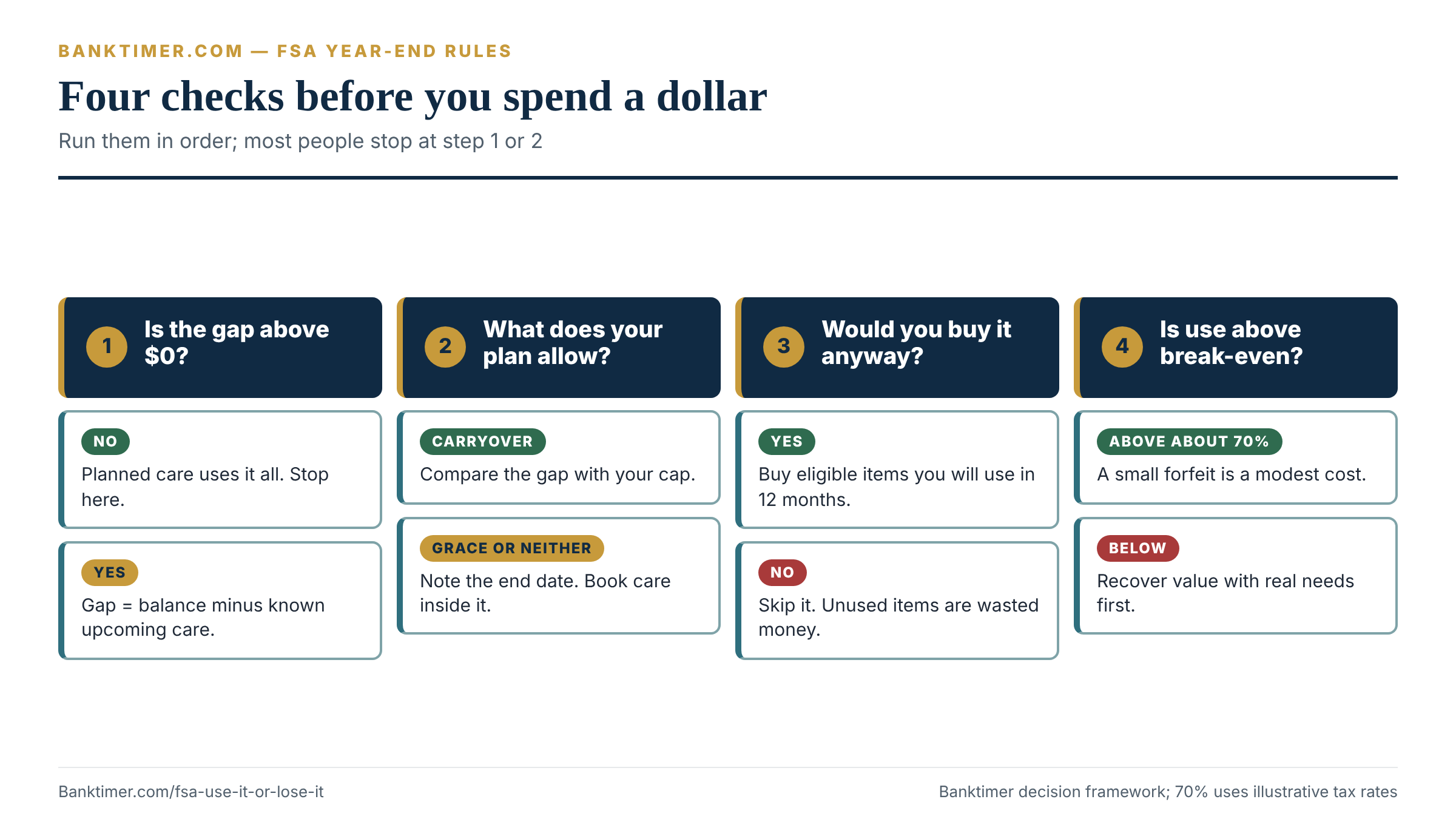
By now you know your balance, your gap and your plan’s rule. The last step is a decision about the FSA use it or lose it deadline. The framework below turns that into a short sequence you can run in about ten minutes. Each step uses a fact from your own plan rather than a rule of thumb.
Step 1: Is the gap above zero?
Subtract known upcoming care from your true balance. If the result is zero or negative, stop. You will use the full balance on planned care, and nothing is at risk. Many people with regular prescriptions or a standing therapy appointment end up here.
Step 2: Does your plan carry money over or extend time?
If the plan offers a carryover, compare the gap with the cap. A gap below the cap needs no action. If the plan offers a grace period, note the end date and schedule care inside it. If it offers neither, December 31 is the deadline for everything.
Step 3: Would you buy it anyway?
For any remaining gap, list real needs from the next 12 months. Think of glasses due in spring, a dental crown your dentist recommended, or a refill supply you use monthly. Buy those. Skip anything that fails the “would I buy this anyway” test.
Step 4: Compare the loss with the break-even line
If the remaining gap is small and the rest of your balance was used, letting it go is a reasonable outcome. Check where your total use lands against your break-even share, which is about 70% under our assumptions. If you are well above it, the cost of the leftover is modest.
The decision matrix
| Your situation | Likely best move | Main risk | What to verify first |
|---|---|---|---|
| Gap is zero after known care | Do nothing extra | Surprise denials reduce the balance | Pending and denied claims |
| Plan has a carryover and gap is below the cap | Let it carry | Re-enrollment or timing conditions | Cap amount and when money becomes available |
| Plan has a grace period | Schedule care before the end date | Missing the last date | Exact end date and whether it is shorter than 2½ months |
| No carryover or grace period, gap is large | Buy eligible items you will use | Overbuying | Eligible-expense list and delivery date |
| No relief, gap is small | Consider accepting the loss | Regret | Whether your total use is above break-even |
| You are leaving your job or switching to an HSA | Spend on planned care before the change | Forfeiture or HSA ineligibility | Termination date and HSA start date |
The matrix does not name a universal winner, because the right answer is whichever row matches your plan. Notice how many rows involve little or no extra spending. Most readers do not need to rush.
Two More Worked Scenarios
Numbers make rules concrete. Here are two more illustrations with visible assumptions. Both are Banktimer examples, not real people, and none of the figures is a quote from a plan.
Jordan’s calendar-year plan has a grace period through March 15, 2027. Jordan elected $1,800 and has $540 left on November 9. Known care in 2026 totals $160.
The gap is $380. The grace period lets Jordan incur expenses through March 15. Jordan books a dental cleaning on January 12, 2027 for $210 and an eye exam on February 3 for $120. Both charge against the 2026 balance. Jordan spends $330 of the $380 gap and forfeits $50, which is about $35 of take-home value at the 29.65% combined rate.
Jordan’s scenario shows how a grace period turns a December scramble into a calendar exercise. The only requirement is knowing the date and keeping appointments inside it.
Priya’s plan allows a carryover of up to $500, lower than the 2026 IRS maximum of $680. She elected $2,000, has used $1,200, and has $800 left on November 9. Known care in the next seven weeks is $150.
The gap is $650. At the $500 cap, the plan will carry $500 into 2027, so $150 is at risk. Priya has glasses due in the spring but no other urgent need. She buys a pair in December for $150. Her at-risk amount drops to zero, and she keeps $500 in the new year without spending extra.
Priya’s example highlights the trap in reading the IRS figure as a promise. The IRS ceiling is $680, but her plan’s cap is $500. The plan, not the IRS, sets what she keeps.
Sizing Your 2027 Election So This Does Not Repeat
Most year-end panic traces back to the election. A healthy emergency fund lets you elect a conservative amount without fear of a surprise bill. It is easier to avoid a forfeiture than to spend your way out of one. Open enrollment for 2027 runs this fall at many employers. Our employer open enrollment checklist covers the broader tasks.
Start from predictable costs
Add only expenses you are confident will occur. These include regular prescriptions, scheduled dental work, standing therapy or specialist visits and glasses or contacts you replace on a cycle. Use last year’s reimbursement history as a check.
Here is a simple illustration. A reader expects $65 a month in prescriptions ($780), $600 of dental care, $260 of vision costs and 20 therapy copays of $25 ($500). The total is $2,140.
Shade the total down
Electing the full $2,140 leaves no room for a missed appointment. A 10% shade-down gives about $1,926, which you might round to $1,900. That is still a meaningful tax discount, and the downside risk is small. Under our assumptions, electing $1,900 costs about $1,337 in take-home pay. You break even at roughly $1,337 of reimbursed care.
If you also expect an unusual large bill, such as orthodontia, consider whether it fits an FSA given its use-it-or-lose-it timing. Large planned costs are the strongest case for an FSA, because they are predictable and large.
Use a plan’s carryover as a cushion, not a strategy
If your plan offers a carryover, it makes a modest over-election less risky. A $500 or $680 cap absorbs a small surprise. It does not justify a stretch number. Anything above the cap is forfeited, and the employer chooses the cap.
If your employer offers neither, shade down further. A health FSA without carryover or grace period is the least forgiving version of the rule. A lower election is the right response.
Compare the account types before you commit
Before you enroll, compare how each account handles money left at the end of the year. The differences are the main reason people use more than one account.
| Account | Unused money at year-end | Annual limit | Who owns it |
|---|---|---|---|
| Health FSA (general-purpose) | Forfeited unless the plan allows carryover (up to $680 for 2026) or grace period (up to 2½ months) | $3,400 for 2026 | Employer plan |
| Limited-purpose health FSA | Plan rules apply; typically dental, vision and preventive only | Plan sets, within the health FSA limit | Employer plan |
| Dependent care FSA | Health FSA carryover does not apply; a grace period may be offered | $7,500 for 2026 ($3,750 if married filing separately) | Employer plan |
| Health savings account (HSA) | Stays in the account with no deadline | Set separately each year | You |
The last row is the contrast that drives the HSA vs. FSA debate. Our HSA vs. FSA decision guide covers who qualifies and how to compare the two. Eligibility for an HSA depends on your health plan, which you can review alongside the health insurance deductible basics.
Mistakes and Red Flags That Cost FSA Money
Most losses under the FSA use it or lose it rule do not come from the rule itself. They come from misreading it. The list below collects the mistakes we think matter most, with the questions that expose each one.
Your plan year might end June 30 or September 30. If you assume a calendar year and your plan year ended last month, your balance may already be gone. Confirm the exact date in writing.
The red flags table
| Red flag | Why it matters | What to ask | Safer next step |
|---|---|---|---|
| Treating a run-out period as extra time to spend | Expenses after year-end do not qualify | Is the extra time for filing or for incurring? | Book care before the plan year ends |
| Prepaying for future services | Advance reimbursement is not allowed | Does the plan count the service date? | Pay when care is delivered |
| Assuming the IRS maximum is your carryover | The plan can set a lower cap | What is the cap in my plan? | Read the plan document |
| Assuming carryover money is available on January 1 | Plans can delay release until prior claims are processed | When does carryover money become usable? | Plan January care from other sources |
| Not re-enrolling after a carryover | One published plan forfeits carryover without re-enrollment | Do I need to enroll to keep it? | Re-enroll at open enrollment |
| Buying ineligible items on the debit card | A claim can be denied or held for documentation after the swipe | Is the item on the plan’s eligible list? | Keep receipts and check the list |
| Switching to an HSA with a leftover FSA | A general-purpose FSA can block HSA contributions | When does my FSA coverage end? | Ask the administrator before January 1 |
| Waiting until December 28 to shop | Delivery can slip into January | What date counts as incurred? | Buy by mid-December |
The pattern across the table is timing. Almost every red flag is a date that someone assumed rather than checked. A five-minute call to the administrator in November fixes most of them.
A $200 purchase of low-value items to avoid a $200 forfeiture feels like a win. But you spent real money on things that sit in a drawer. The money was already gone from your paycheck. Buy only what you would purchase in the next year.
If you might return an eligible item later, ask the administrator how returns are handled. A refund after the plan year ends can leave your account out of step with your receipts.
Documentation: What to Keep and for How Long
FSA claims depend on proof. Per Publication 969, a claim needs a written statement from an independent third party showing the expense and amount. It also needs a statement that no other plan covered it. The administrator’s forms collect that.
| Document | Why it matters | Where to get it | How long to keep it |
|---|---|---|---|
| Itemized receipt | Shows what you bought, date and amount | Store or provider | At least through the claim period; many people keep tax-year records longer |
| Explanation of benefits (EOB) | Proves your copay or coinsurance | Insurer portal or mail | Same as receipts |
| Provider statement or invoice | Proves a service and its date | Dentist, optometrist, clinic | Same as receipts |
| Plan document or summary plan description | Shows your plan’s carryover, grace and run-out terms | HR or administrator portal | Until the plan year closes and claims finalize |
| Claim confirmation or denial notice | Documents what was paid or rejected | Administrator portal | Until the claim is resolved |
| Prescription or provider note for larger items | Supports medical necessity when the plan asks | Your provider | With the receipt |
We suggest keeping records through the end of the run-out period. Keep them longer if you may need them for tax questions. This is an editorial suggestion, not an IRS rule. Your plan may impose its own retention or audit requests.
If December 31 Has Already Passed
Some readers land here in January or February, after the balance has dropped to zero. You may still have options, and the order of operations matters. Work through these steps in sequence rather than assuming the money is gone.
Check the three extensions in order
- Grace period. If your plan has one, care you receive before the end date still charges against the old balance. For a calendar-year plan, that runs to March 15, 2027.
- Run-out. Find the claim filing deadline. File every claim for care received by December 31 that you have not yet submitted, including copays, prescriptions and dental bills.
- Carryover. Ask whether any balance carried over, and when it becomes available. Remember that unused money is measured after the run-out ends.
Hunt for unfiled claims
People often leave money on the table because they never filed paperwork for small expenses. Go through December and the weeks before it: pharmacy receipts, the dentist’s bill, an EOB from your insurer. Anything incurred in the plan year and filed inside the run-out window can still reduce the forfeiture.
Fix denied or pending claims
If a claim was denied for missing documentation, upload the itemized receipt before the run-out deadline. A denied claim does not restore your balance, but a corrected one does. Treat the denial letter as a to-do list, not a final answer.
Plan the next year before the lesson fades
Write down what happened: the balance, the plan rule and the amount lost, if any. Use that note when you size your next election. Our monthly budget guide shows one way to track recurring health costs alongside other fixed bills. A sinking fund for expected medical costs also works for expenses an FSA cannot cover.
Current Context as of October 15, 2026
Several facts in this article are time-sensitive. Here is what we confirmed on October 15, 2026, and what we could not.
What we confirmed
- The IRS 2026 health FSA salary reduction limit is $3,400, and the maximum carryover is $680 (Revenue Procedure 2025-32, section 4.15; Publication 15-B for 2026).
- The 2026 dependent care assistance exclusion is $7,500 ($3,750 for married filing separately), per Publication 15-B.
- A plan cannot offer both a carryover and a grace period for a health FSA (Notice 2013-71; Publication 969).
- The temporary COVID-era expansions of carryover and grace periods covered plan years ending in 2020 and 2021, and Notice 2021-15 states the normal rules apply to plan years ending in or after 2022.
What we could not confirm
We did not find an IRS announcement of the 2027 health FSA limit or maximum carryover on the pages we checked. In recent years the IRS has published these figures in the fall. If the figures come out after October 15, 2026, your employer’s enrollment materials may reflect them first. Our 2027 financial and insurance deadlines calendar tracks other year-end dates. Year-end is also when retirement limits change, as our 401(k) contribution limit 2027 guide explains.
We also did not verify any individual employer’s plan terms. Those live in your plan document.
Frequently Asked Questions
What happens to unused FSA money at the end of the year?
Under the FSA use it or lose it rule, a balance left at the end of the plan year is generally forfeited, and your employer cannot refund it to you. Your plan may soften that with a carryover (up to $680 into 2027 for the 2026 plan year) or a grace period of up to 2½ months, but not both. Check your plan document for which option applies.
Is the FSA deadline always December 31?
No. The deadline is the end of your plan year. That is December 31 for most calendar-year plans, but it can be June 30 or another date for plans on a fiscal year. Your administrator portal or summary plan description states the exact date. Confirm it before you plan purchases, since a wrong assumption can cost you the balance.
What is the FSA rollover limit for 2026?
The IRS maximum carryover for 2026 is $680, which is 20% of the $3,400 salary reduction limit (Revenue Procedure 2025-32). Your employer may set a lower cap or offer no carryover. The IRS had not announced a 2027 figure on the pages we checked on October 15, 2026, so use your plan’s stated cap.
Can a plan have both a carryover and a grace period?
No. For a health FSA, an employer can offer a carryover or a grace period, not both. Notice 2013-71 and Publication 969 state this directly. A plan can, however, pair either option with a run-out period for filing claims. If your plan describes both, ask HR which one is correct, since a document may be outdated.
Does the FSA use it or lose it rule apply to a dependent care FSA?
The tax rules differ. Carryover is a health FSA option, according to Publication 15-B’s cafeteria plan discussion, so a dependent care FSA does not get it. Some dependent care plans offer a grace period instead, such as the March 15, 2027 end date in the FSAFEDS schedule. The limit is $7,500 for 2026, so check each account separately.
What is the difference between a grace period and a run-out period?
A grace period lets you incur new expenses after the plan year ends and charge them to the old balance. A run-out period lets you file claims after year-end, but only for expenses incurred before it. If your plan year ends December 31 and you see the dentist on January 5, a run-out will not cover it, but a grace period will.
Can I use FSA money for expenses after December 31?
Only if your plan has a grace period and the date falls inside it. The other path is a plan that carries the balance over into the new year. Otherwise, expenses must be incurred by the last day of the plan year. The date of service or purchase controls, not the date you pay. Prepaying for a future service does not count.
Can I get my unused FSA money back as cash?
Generally no. Publication 969 says the employer is not permitted to refund any part of the balance to you. The one narrow exception is a qualified reservist distribution. It is available only if the plan allows it and you are called to active duty for more than 179 days or for an indefinite period. That payment counts as taxable wages.
What happens to my FSA if I quit or get laid off?
Coverage under a health FSA generally ends when employment ends, and Notice 2013-71 says funds remaining at termination are forfeited unless COBRA continuation coverage applies. Plan terms decide whether you can still file claims for care received before your last day. Spend and file before you leave when you can, and ask HR in writing about your account.
Can I use FSA money on over-the-counter items without a prescription?
Yes, for health FSAs. Publication 969 says over-the-counter medicine and menstrual care products count as covered expenses. Notice 2024-71 adds condoms. The rule differs from the tax deduction rule in Publication 502, which excludes most nonprescription drugs. Your debit card system may still flag an item, so keep the receipt.
Does a leftover FSA balance affect my HSA eligibility?
It can. Publication 969 says someone with a high-deductible health plan and a general-purpose health FSA generally cannot contribute to an HSA. It also says coverage during a grace period is allowed only if the prior-year FSA balance is zero. If you are changing plans on January 1, ask your administrator before you open the HSA.
Can I be self-employed and still use an FSA?
No. Publication 969 states that self-employed people are not eligible for FSAs, because an FSA is an employer-established cafeteria plan benefit. If you work for your own business, you may have other options, such as an HSA paired with a qualifying health plan. Eligibility there depends on the plan, so confirm it before you buy coverage.
Today, open your FSA portal and write down three things. Note your true balance, your plan year end date, and whether your plan has a carryover, a grace period or neither. Then subtract the care you already have scheduled. That gap is the only money actually at risk.
The one variable that decides your outcome is what your own plan allows. The IRS sets a ceiling of $680 for a carryover or 2½ months for a grace period. Your employer chooses whether to offer either, and which one. If your plan offers neither, December 31 is a hard stop for incurring expenses. Schedule real care and buy only what you would use anyway. If it offers a carryover or grace period, much of the pressure disappears. Check the dates, file every claim you can, and do not mistake a filing window for spending time. This guide covers the FSA use it or lose it rule for health FSAs in general. It cannot read your plan document, your employer’s amendments, your state’s tax treatment or your claims history. Confirm the final dates with your administrator in writing before you act.
Methodology
We built this article from primary IRS documents and one published provider schedule, all read on October 15, 2026. The rules come from IRS Publications 969, 15-B (2026) and 502. They also come from Revenue Procedure 2025-32 and Notices 2013-71, 2020-33, 2021-15 and 2024-71. Tax-rate inputs come from IRS Topic 751. The plan-variation example comes from the published FSAFEDS schedule and notice.
All dollar examples, including Maya, Jordan and Priya, are Banktimer illustrations. They assume a 22% federal marginal rate, the 7.65% employee payroll tax share and no state income tax. They are not quotes, and your numbers will differ. We did not test any plan, call any administrator or speak with any employer. Plan terms vary by employer, administrator and plan year. The IRS 2027 figures had not been announced on the pages we checked.
Sources
- Publication 969, Health Savings Accounts and Other Tax-Favored Health Plans (2025), IRS
- Publication 15-B, Employer’s Tax Guide to Fringe Benefits (2026), IRS
- Publication 502, Medical and Dental Expenses (2025), IRS
- Revenue Procedure 2025-32, 2026 inflation adjustments, IRS
- Notice 2013-71, health FSA carryover, IRS
- Notice 2020-33, indexed carryover limit, IRS
- Notice 2021-15, temporary COVID-era FSA relief, IRS
- Notice 2024-71, condoms as medical care, IRS
- Topic No. 751, Social Security and Medicare withholding rates, IRS
- Flexible spending account (FSA) glossary entry, HealthCare.gov
- Important dates, 2026 benefit period, FSAFEDS
- Run-out and carryover message for 2025 claims, FSAFEDS
By the Banktimer Editorial Team · Published
Banktimer is an independent U.S. consumer-finance publication. Our editors draw on primary and official sources first, such as the CFPB, FDIC, Federal Reserve, and FTC, along with statutes, regulations, and providers’ own agreements and fee schedules. Then we add worked examples and decision tools. Our goal is the most useful, best-supported explanation the sources available to us at the time of writing allow.
This article is general information, not legal, tax, investment, insurance, or financial advice, and reading it does not create a professional relationship with Banktimer. Rates, fees, limits, and rules change, and they vary by state, provider, and contract, so confirm current terms with your bank, lender, insurer, or the agency named in the article before you act. Examples are illustrative unless labeled otherwise. Banktimer is not a bank, lender, insurer, or financial advisor, and we are not responsible for decisions or losses that result from relying on this content. For advice about your own situation, talk to a licensed professional.