A credit card sign-up bonus is a one-time reward you earn by spending a set amount within a set time after the account opens. It is worth chasing only when you can hit the spending target with purchases you were already going to make, pay the full balance every month, and still come out ahead after the annual fee and the rewards you would have earned on your current card.
The biggest variable is whether you change your spending to qualify. The main risk is interest, because one carried balance can erase the bonus. Before you apply, read the offer terms for the spend window, exclusions, eligibility lookback and posting time.
The threshold is the real price. A credit card sign-up bonus that needs $5,000 in three months costs you nothing if you already spend that much, and costs a lot if you do not.
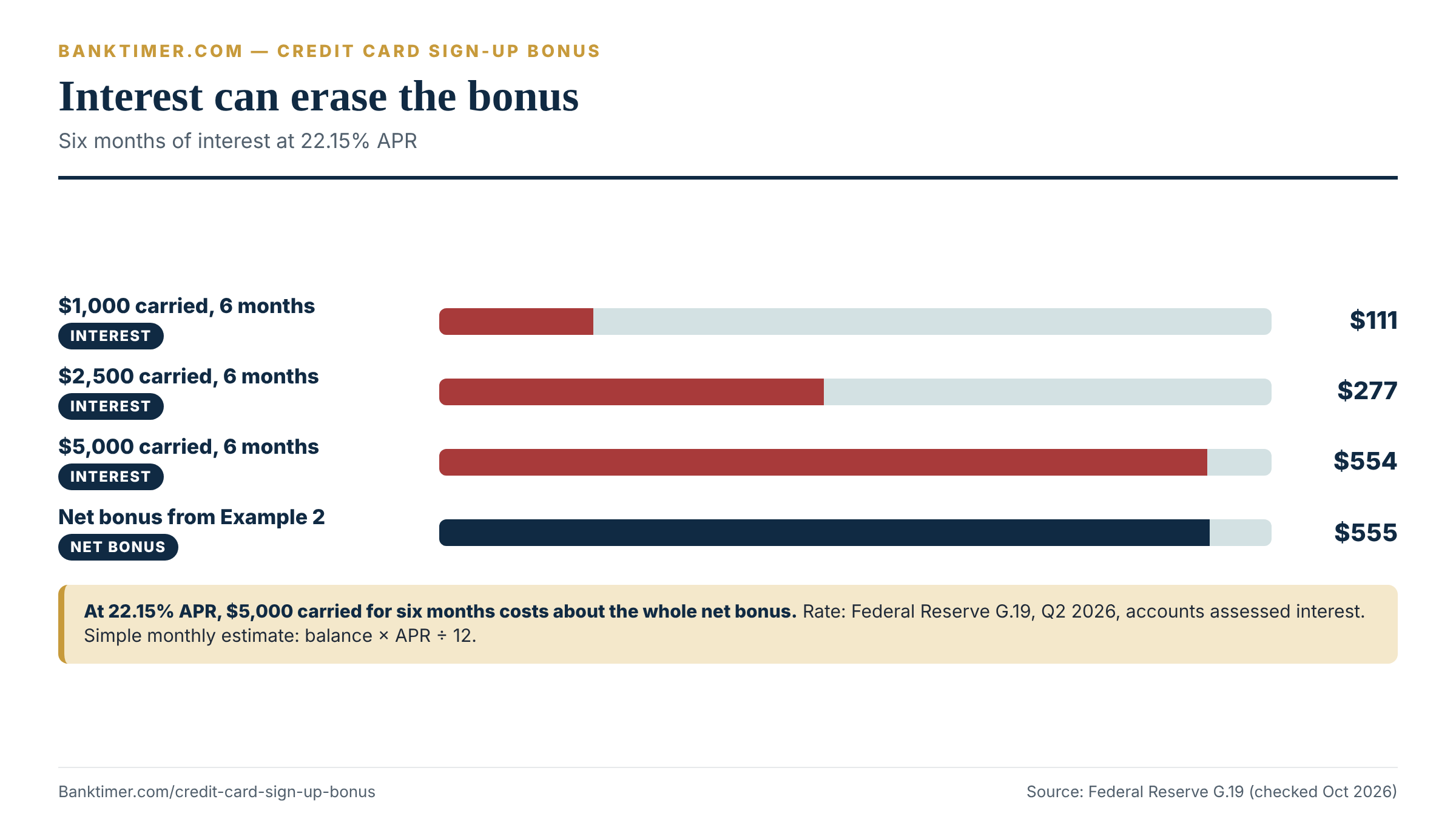
Interest beats bonuses. At the 22.15% average rate the Federal Reserve reported for accounts assessed interest in the second quarter of 2026, a $5,000 balance carried for six months costs about $554 in interest.
Eligibility can end the offer before it starts. Issuers limit how often you can earn a bonus on the same card, whether once ever, once every 48 months or by judging your recent applications.
Posting takes weeks. Issuer pages we read promise the reward six to eight weeks after you qualify, or within two billing cycles. Keep the account open until it lands.
Tax treatment is not settled in one place. The IRS pages we read do not address credit card sign-up bonuses by name. Ask a tax preparer if the amount is large.
Documentation wins disputes. Save the offer page, the terms and your statements. The Consumer Financial Protection Bureau (CFPB) has documented complaints about unpaid bonuses.
What a Credit Card Sign-Up Bonus Is and What Issuers Call It
A credit card sign-up bonus is a promotional reward. The issuer pays it to win your business, and it expects to earn the cost back from interchange fees, interest and annual fees over time. Issuers call it a welcome offer, a welcome bonus, an introductory bonus or a new cardmember bonus. The terms are interchangeable, but the fine print always uses its own wording.
The CFPB examined this market in its May 2024 rewards report. It found that almost 1 in 10 dollars consumers earn in rewards is tied to a credit card sign-up bonus. For consumers with below-prime credit scores, the share is closer to 1 in 5. That is a large slice of all rewards, so reading the conditions matters.
Why a bonus is not the same as ongoing rewards
Ongoing rewards pay a small percentage on every purchase. A credit card sign-up bonus pays a lump sum once, and only if you clear a hurdle. That difference changes how you should evaluate it. Ongoing rewards reward your habits. A bonus rewards a one-time behavior, and the hurdle sits at the start of the relationship, when the issuer knows the least about you.
Bonus formats and what to verify
A credit card sign-up bonus arrives in several formats, and each has its own friction. Cash and statement credits are simple to value. Points and miles need a valuation assumption, and that assumption can swing the answer by hundreds of dollars.
| Bonus format | How it is paid | Easy to value? | What to verify |
|---|---|---|---|
| Cash back | Statement credit or deposit | Yes, face value | Whether it posts as cash or points |
| Statement credit | Reduces your balance | Yes | Whether it counts as a payment toward the bill |
| Flexible points | Points in the issuer’s program | Partly | Redemption options, minimums, transfer partners |
| Airline or hotel points | Points in one partner’s program | No | Award prices, blackout rules, expiration |
| Intro APR offer | Lower interest for a set period | Not a bonus | Length, fee, rate after the offer ends |
The pattern in this table is simple. The more steps between you and the cash, the more you must discount the headline number. A 75,000-point bonus is not $750 until you know what a point buys. We use a clearly labeled assumption of one cent per point in the examples below, and we show how the answer moves when the assumption changes.
A zero-percent introductory APR is a different kind of promotion. It lowers borrowing costs but pays you nothing, so we treat it as an alternative later. Our guide to credit card APR explains how those rates work.
The Spending Threshold: How the Minimum Spend Requirement Works
Every credit card sign-up bonus has the same three moving parts: an amount to spend, a window to spend it in, and a definition of what counts. The minimum spend requirement on a credit card is almost always stated as “spend $X in the first Y months from account opening.” For example, a card page we read on October 15, 2026 stated the requirement as $5,000 in purchases during the first three months from account opening. Another stated $4,000 within the first three months.
When the clock starts
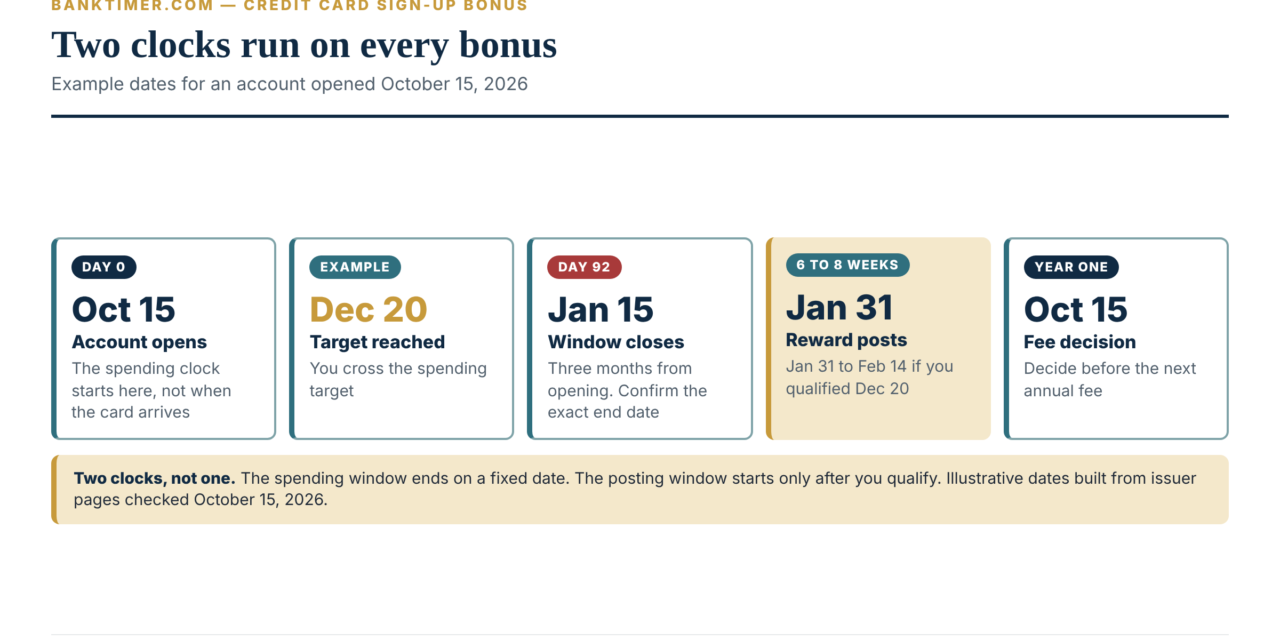
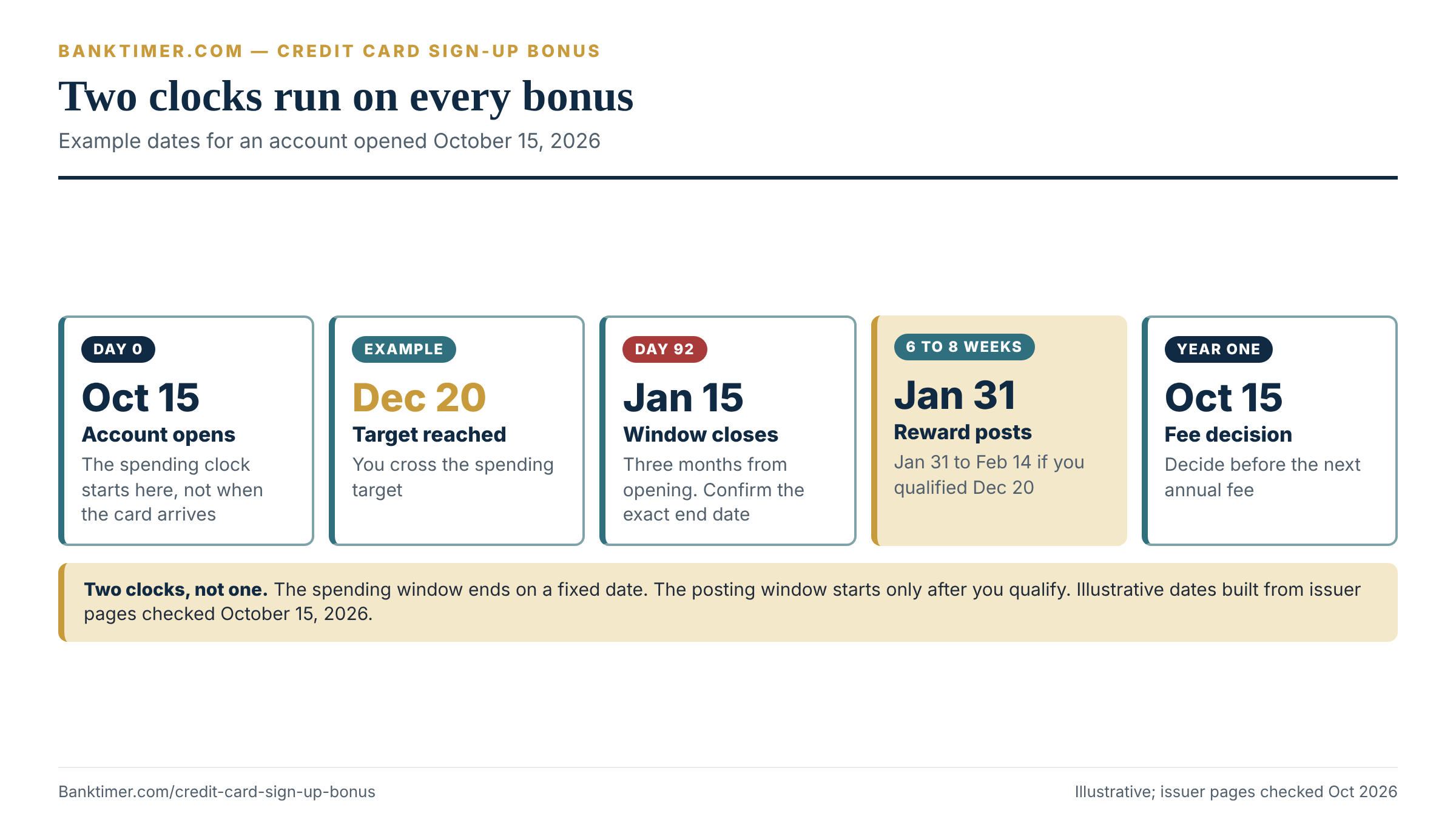
For most offers, the window starts when the account opens, not when the card arrives. That distinction costs people real time. If your account opens on October 15 and the plastic arrives a week later, you have already used seven of your roughly 92 days.
Our worked timeline assumes an account opened on October 15, 2026. A three-month window then ends on January 15, 2027. Issuers differ on whether the last day counts and in what time zone, so confirm the exact end date in your approval message.
The pace you need
Divide the target by the number of weeks. A $500 target over 92 days is about $38 a week. A $4,000 target is about $304 a week. A $5,000 target is about $380 a week, or roughly $1,667 a month. Compare that number with what you actually spend on groceries, gas, utilities, insurance and subscriptions. The gap, if any, is the amount you would have to create.
What usually counts and what usually does not
Issuers define “purchases” narrowly. Two card pages we read excluded balance transfers, cash advances, cash-like transactions and fees. One listed gambling-related charges, person-to-person transfers and the annual fee itself. The CFPB’s report adds that gift cards typically do not count and that returns or disputes can reduce your qualifying spend.
| Transaction | Usually counts toward the target? | Why it matters |
|---|---|---|
| Everyday purchases (groceries, gas, dining) | Yes | The safest way to qualify |
| Recurring bills charged to the card | Often yes | Check each biller accepts cards without a surcharge |
| Balance transfers and cash advances | No | Also carry their own fees and interest |
| Annual fee and other fees | No | The fee does not help you reach the target |
| Gift card purchases | Often no | The CFPB notes they typically do not count |
| Person-to-person payments and cash-like items | Often no | Terms vary, so read the exclusions list |
| Purchases later returned or disputed | Reduces qualifying spend | You can fall short after you thought you qualified |
| Authorized user purchases | Varies by issuer | Ask before you rely on them |
The decision-driving insight is the last column. A purchase that does not count is not neutral. It can use up cash flow or credit limit while leaving you short of the target. If you plan to reach the target with a large bill, such as a tax payment or tuition, confirm both that it counts and what fee the payee adds. Our guide to credit card surcharges explains how a 3% fee can eat a meaningful part of a bonus.
Why a refund can cost you the bonus
Suppose you hit exactly $5,000 on the last day and then return a $300 purchase. Your qualifying spend falls to $4,700. The offer terms rarely say whether qualification is measured when you cross the line or when the window ends. Keep a cushion of at least 10% above the target, and delay returns until the reward posts if you can.
Timing Rules: How Long Until the Bonus Posts
Hitting the target is only half the job. The credit card sign-up bonus still has to arrive, and that takes time. People searching for how long until the bonus posts usually find one vague answer: “a few weeks.” The offer terms are more specific, and they differ.
One large issuer’s card page, checked October 15, 2026, said to allow 6 to 8 weeks for the credit card sign-up bonus to post after you qualify. A second issuer’s page said it would apply the bonus to your rewards balance within two billing cycles once you qualify. Those are two different clocks. One counts calendar weeks. The other counts statement dates, which depend on when your billing cycle closes.
A sample timeline
Say you open an account on October 15, 2026, and you cross the spending target on December 20. A six-to-eight-week posting window then runs from about January 31 to February 14, 2027. Your three-month spending window would have closed on January 15, 2027, so you would have finished early and still wait about six weeks for the reward.
The table below turns the terms into a calendar. These dates are an illustration built from the 92-day window and the six-to-eight-week range, not a promise from any issuer.
| Stage | Example date | Who controls it | What you do |
|---|---|---|---|
| Account opens | October 15, 2026 | Issuer | Screenshot the offer and save the terms |
| Card arrives or is usable | About October 22 | Issuer and mail | Start spending as soon as you can |
| You cross the target | December 20, 2026 | You | Note the date and the statement balance |
| Spending window would close | January 15, 2027 | Issuer terms | Finish earlier, with a 10% cushion |
| Reward posts (6 to 8 weeks) | January 31 to February 14, 2027 | Issuer | Look for it on the statement |
| Follow up if missing | After the posting window | You | Message the issuer with your evidence |
| First-year anniversary | October 15, 2027 | Issuer | Decide whether the fee is worth paying again |
The decision-driving insight is the sixth row. If you wait until the posting window ends before you ask about a missing reward, you lose nothing. If you ask on day three, you will probably hear that it is too early. Calendar the follow-up date at the moment you qualify.
The account must stay open
One issuer’s page said the account must be open and not in default when the bonus is fulfilled. That condition matters if you plan to close the card quickly. Closing it before the reward posts can forfeit the reward. The CFPB’s rewards report also noted that some issuers require repayment of a bonus if the account is closed within a set period, such as 12 months. Whether yours does depends on the cardmember agreement and the offer terms, so look for words like “forfeit,” “clawback” or “reverse.”
When the annual fee posts
The annual fee is a separate timeline from the bonus. The card pages we read listed annual fees of $95. A fee shown on the offer page is a first-year commitment, not a one-time charge. Plan your decision for the anniversary now. Our guide to the credit card annual fee walks through how to judge whether a fee earns its keep, and the older annual fee pros and cons post covers alternatives.
Eligibility Rules: Once Per Lifetime, Lookbacks and Other Limits
The once per lifetime bonus rule is the best-known restriction on a credit card sign-up bonus. It is not a law. It is a condition written into each issuer’s offer, and the wording varies more than most people expect.
The table below compares the eligibility language on three card pages we read on October 15, 2026. It illustrates three common shapes of the rule. It is not a recommendation of any card.
| Issuer page (October 15, 2026) | What it said | Rule shape | Reader action |
|---|---|---|---|
| Citi Strata Premier | Offer not available if you currently have or previously had the card; may be unavailable based on your history of opening, closing and using cards | Once ever, plus a discretionary history test | Check your past accounts, including closed ones |
| Capital One Venture | Not eligible if you received a new cardmember bonus on the Venture or Venture X in the past 48 months | Fixed lookback of 48 months, covers related cards | Count back 48 months from the application date |
| Chase Sapphire Preferred | May not be available if you previously held the card; issuer may consider how many cards you have opened and closed | Prior-holder test plus discretionary history | Expect a possible denial of the bonus even if the card is approved |
Three insights come out of this table. First, the same word, “eligible,” covers three different tests. Second, product family matters: the Capital One page applies the lookback to two related cards. Third, some of the language is deliberately open-ended. A discretionary history test cannot be checked in advance, so the only reliable defense is to read the terms before you apply.
Counting back 48 months from October 15, 2026 reaches October 15, 2022. If you received a Venture bonus before that date, the lookback on that page would not block you. If you received it after, it would.
Hidden limits reported to the CFPB
The CFPB’s report describes complaints from people who learned months later that they were never eligible, often because of limits on how many times a bonus can be earned. Some consumers did not learn about the spend rules until the promotion period ended. Others reported offers revoked under vague “gaming” or “abuse” language. These patterns suggest a practical habit: after you are approved, save the offer terms that applied on the day you applied.
The offer channel can matter
One issuer page said the bonus is available only when you apply through that page, and that it “may not be available if you navigate away from or close this page.” Another page warned that offers can vary through different channels. The CFPB took an enforcement action against Bank of America in July 2023 that included findings about a rewards card sign-up bonus advertised online. The bank denied the bonus to people who applied by phone or in person, and it failed to deliver bonuses to some consumers because of employee error. The Bureau described both as deceptive acts or practices.
You do not need to fear every offer. You do need to apply through the exact link or channel that shows the offer, and screenshot it first.
The federal rules that apply to every applicant
Some eligibility rules are law, not policy. Under Regulation Z, a card issuer must consider your ability to make the required minimum payments before it opens an account. If you are under 21, the rule goes further. The issuer generally cannot open the account unless you have an independent ability to make the payments, or you have a cosigner, guarantor or joint applicant who is at least 21. See 12 CFR 1026.51.
Regulation Z also requires a standardized table of rates and fees on card applications, including the annual fee and the grace period. See 12 CFR 1026.60. The rule text we read does not require any disclosure about rewards or bonuses. In plain terms, the law makes the cost of the card visible, but it does not make the credit card sign-up bonus terms visible. The bonus conditions live in the issuer’s offer terms and your contract.
| Rule type | Example | Where it comes from | Reader action |
|---|---|---|---|
| Federal regulation | Ability-to-pay review; age 21 rule | 12 CFR 1026.51 | Expect income questions on the application |
| Federal regulation | Rate and fee table on applications | 12 CFR 1026.60 | Use the table to see annual fee and APRs |
| Issuer policy | Once-ever or 48-month bonus limits | Offer terms | Read them before you apply |
| Contract term | Bonus forfeited if the account closes early | Cardmember agreement | Search the agreement for “forfeit” |
| Marketing claim | “Easy to earn” | Advertising | Treat as unverified until the terms agree |
The table shows where the law stops. Rates, fees and the grace period are standardized by regulation. Bonuses are not, which is why the same headline can hide very different conditions.
Is Chasing a Bonus Worth It? The Net-Value Math
Headline value is not net value. To decide whether chasing a credit card sign-up bonus is worth it, subtract everything the bonus costs you. The formula has five parts, and only the first one appears in the advertisement.
Net value = bonus value − annual fee − rewards you give up − cost of spending you would not otherwise do − interest and fees.
Each term needs a number. The first three are knowable before you apply. The fourth depends on your honesty about your budget. The fifth depends on whether you pay in full.
The assumptions behind every example
The examples below are illustrative. They do not describe a live offer. We use two imaginary cards so the numbers stay clean.
| Assumption | Card A | Card C |
|---|---|---|
| Bonus | $200 cash back | 75,000 points |
| Spending target | $500 in 3 months | $5,000 in 3 months |
| Annual fee | $0 | $95 |
| Value of the bonus | $200 | $750 (assumes 1.0 cent per point) |
| Your current card | Earns 2% back on everything | Earns 2% back on everything |
| Normal spending | $1,200 a month, or $3,600 in 3 months | Same |
| Interest rate if you carry a balance | 22.15% APR | 22.15% APR |
The 22.15% figure is not a guess. It is the Federal Reserve’s commercial bank interest rate on credit card accounts assessed interest for the second quarter of 2026, from the G.19 release dated October 7, 2026. For all accounts, including those that pay in full, the Fed reported 20.94%. Your own rate can be higher or lower, so use the rate on your offer.
The 2% rate on your current card is also an assumption. If your current card earns 1.5% or 3%, change the “rewards you give up” line. Everything else follows.
Example 1: The low-spend cash bonus
Card A pays $200 after $500 in purchases. You already spend $3,600 every three months, so the target is easy. If you move $500 of normal purchases to Card A, you give up 2% of that spending on your current card. That is $10.
Your net value is $200 − $0 − $10 = $190. The math is simple because the spending target is small relative to your budget and there is no annual fee. The main risk is carrying a balance. A balance of about $10,300 for one month at 22.15% would cost $190 in interest, but a more realistic case is a smaller balance for several months. A $2,500 balance would erase the $190 in about four months.
Example 2: The high-bonus card for a natural spender
Card C pays 75,000 points after $5,000 in three months. Say your normal spending is $1,700 a month, or $5,100 over three months. The target requires no change in behavior.
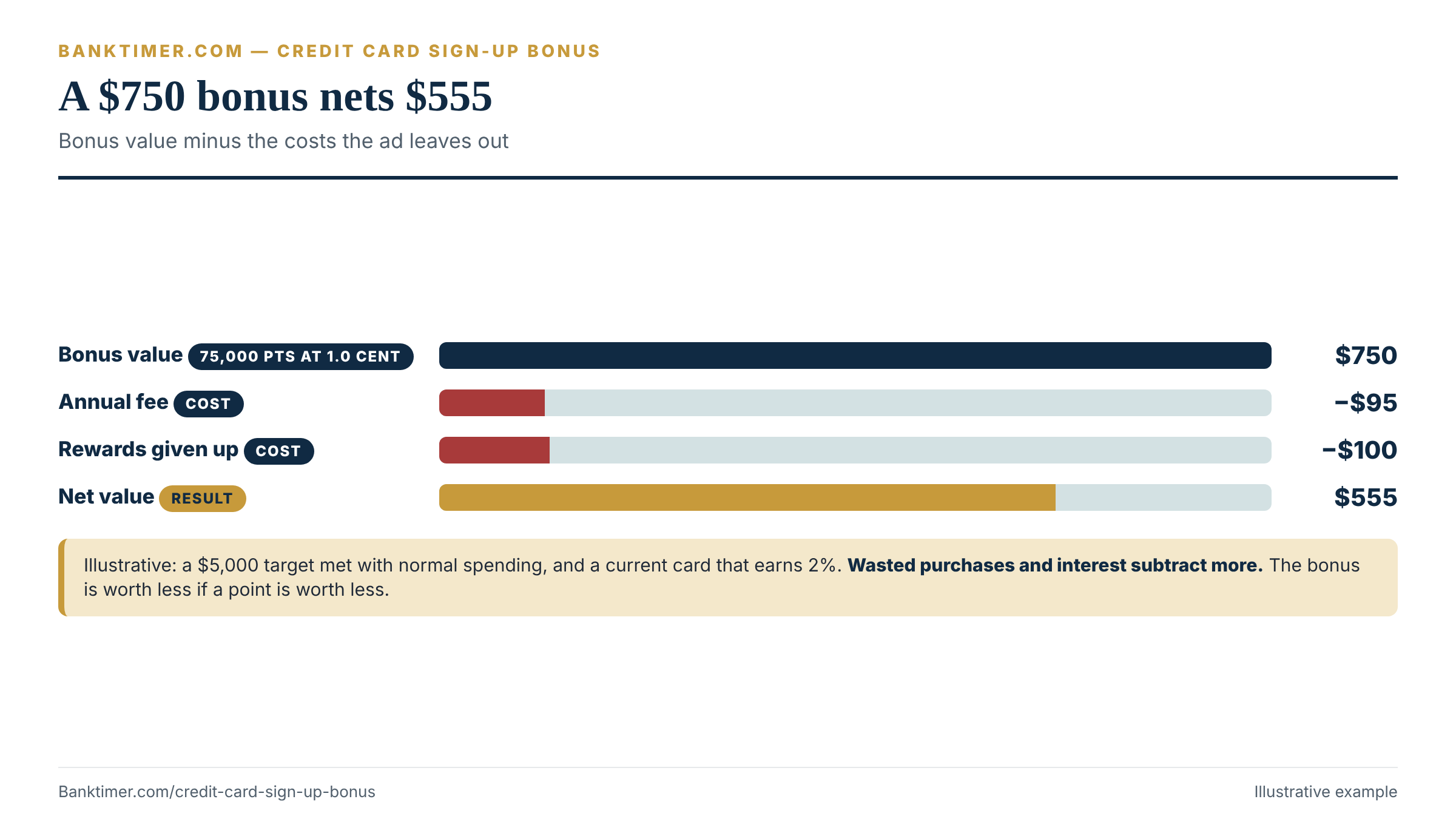
The bonus is worth $750 at one cent per point. Subtract the $95 fee and $100 in forgone rewards (2% of the $5,000 you moved). Net value is $555. The fee takes about 12.7% of the bonus. The forgone rewards take about 13.3%.
Example 3: The stretch with real bills
Now take the same card and a budget of $1,200 a month. You are $1,400 short. Suppose you can prepay an insurance premium, a dental bill and a few months of a recurring expense you would have paid anyway. The money leaves your account earlier, but no purchase is wasted.
Net value is still $555, because nothing was bought that you did not need. The cost is cash flow. You need about $1,667 a month on the card instead of $1,200, and you must have the money to pay the statement in full. If prepaying would force you to carry a balance, jump to Example 5.
Example 4: The stretch with wants
The same $1,400 gap can be filled by buying things you would not otherwise buy. The question is what fraction of that spending is truly wasted. The table below shows the result.
| Share of the extra $1,400 that is wasted | Cost of waste | Net value (from $555) | Result |
|---|---|---|---|
| 0% | $0 | $555 | Full bonus kept |
| 25% | $350 | $205 | Still ahead |
| 40% | $560 | −$5 | Roughly break-even |
| 50% | $700 | −$145 | Behind |
| 100% | $1,400 | −$845 | Bonus paid for a bad month |
The break-even point is 39.6% of the extra spending. If you would regret four of every ten dollars you add, the bonus is a wash. That is a real threshold for a real decision, and it does not depend on any issuer.
Example 5: The carried balance
Finally, assume you reach the target with normal spending, but you pay only part of the statement. We use a simple monthly interest estimate: balance × 22.15% ÷ 12. It ignores daily compounding and new purchases, so the real cost can be slightly higher.
Carrying $2,500 for three months costs about $138 in interest. Your net falls from $555 to $417. Carrying $5,000 for six months costs about $554. Your net falls to $1. The bonus is gone, and you spent six months paying the issuer.
Example 6: Missing the target by a little
You spend $4,900 of the $5,000. The bonus is $0. You still owe the $95 annual fee, and you gave up $98 in rewards on the $4,900 you moved. Your net is −$193. The CFPB found that in 2022 about 1 in 4 consumers who were eligible for a promotional bonus did not meet the requirements to earn it. A cushion and a tracker are cheap insurance.
| Scenario | Bonus value | Fee | Rewards given up | Waste or interest | Net value |
|---|---|---|---|---|---|
| 1. Card A, natural spender | $200 | $0 | $10 | $0 | $190 |
| 2. Card C, natural spender | $750 | $95 | $100 | $0 | $555 |
| 3. Card C, real bills prepaid | $750 | $95 | $100 | $0 | $555 |
| 4. Card C, 40% of extra $1,400 wasted | $750 | $95 | $100 | $560 | −$5 |
| 5. Card C, $5,000 carried 6 months | $750 | $95 | $100 | $554 | $1 |
| 6. Card C, missed by $100 | $0 | $95 | $98 | $0 | −$193 |
The pattern is consistent. The headline bonus rarely fails because the math is wrong. It fails because of the two behaviors that the math cannot see: spending more than planned and not paying in full.
How the value of a point changes the answer
For points and miles, the valuation assumption matters. The table below holds everything else constant and varies the value of a point. All figures are illustrative.
| Value per point | Bonus value | Net of $95 fee and $100 rewards given up |
|---|---|---|
| 0.8 cent | $600 | $405 |
| 1.0 cent | $750 | $555 |
| 1.25 cents | $938 | $743 |
| 1.5 cents | $1,125 | $930 |
The spread between the lowest and highest rows is $525. That is larger than the annual fee and the forgone rewards combined. The issuers’ own redemption options set the real value. The CFPB report notes that points can be devalued after you earn them, and it describes complaints in which the number of miles needed for a $100 gift card rose by 25%. If you cannot name how you will redeem the points, use the lowest row.
Interest Risk: How One Carried Balance Cancels a Bonus
Interest is the most reliable way to lose a credit card sign-up bonus. The Federal Reserve’s 22.15% figure means that carrying $1,000 costs about $18.46 a month. That sounds small until you compare it with the net bonus. The table below shows the cumulative cost of three balances over four periods.
| Balance carried | 1 month | 3 months | 6 months | 12 months |
|---|---|---|---|---|
| $1,000 | $18 | $55 | $111 | $222 |
| $2,500 | $46 | $138 | $277 | $554 |
| $5,000 | $92 | $277 | $554 | $1,108 |
At $2,500 it takes about 12 months of carrying to burn through the $555 net from Example 2. At $5,000, about six months does it. The decision-driving insight is that the bigger the spending target, the bigger the balance you could carry by accident. A larger bonus can be a bigger trap.
The grace period is the first thing you lose
The CFPB says that on most cards you can avoid paying interest on purchases if you pay your balance in full each month by the due date. That window is the grace period. Federal rules require issuers to mail or deliver statements at least 21 days before the payment due date. See 12 CFR 1026.5. If you carry a balance, many agreements stop the grace period on new purchases, so interest can start on the purchase date. Check your cardmember agreement. Our guide to the credit card grace period explains how that works.
Payments are not applied the way people expect
Under Regulation Z, any amount you pay above the required minimum must go first to the balance with the highest annual percentage rate. See 12 CFR 1026.53. That helps if you hold a promotional balance transfer and a purchase balance at different rates. It does not make a carried balance cheap. If you carry a balance, read our guide to the credit card minimum payment before you assume progress.
Rate increases in the first year
Once the account is open, Regulation Z generally bars an issuer from raising your APR or covered fees during the first year. Exceptions include a promotional rate that ends and a minimum payment that arrives more than 60 days late. See 12 CFR 1026.55. That protects the rate you were offered, but it does not protect you from the interest that rate produces.
If you already carry a balance
If you already carry credit card debt, a credit card sign-up bonus is rarely the first move. The interest on the existing balance almost always costs more than the bonus pays. The better path is to reduce the balance first. Our guides to credit card debt and the balance transfer card trade-offs cover that sequence.
What a New Card Does to Your Credit Score and Your Credit Limit
A new card touches your credit in three ways. The application triggers a hard inquiry. The new account changes the mix of accounts on your report. And the spending you run through the card changes your utilization, which is the share of your limits you are using.
The CFPB notes that applying for a card triggers a hard inquiry that appears on your report and may affect your score. It also says in its hard inquiry explainer that most scoring models look at how recently and how frequently you apply for credit. A single application is a small event. Several applications in a short period are a bigger one. Our guide to the hard inquiry explains what lenders see and how long it lingers.
Utilization: the part you can control
A credit card sign-up bonus pushes a lot of spending onto one card in a short time. If the issuer reports your balance to the credit bureaus on the statement date, a high balance can look like high utilization even if you pay it off a week later. That is a timing detail, not a debt problem.
Here is an illustrative case. You hold three cards with combined limits of $25,000 and balances of $2,000. Your utilization is 8%. You add a new card with a $10,000 limit and put $5,000 of bonus spending on it. If the statement closes with that balance, your total balance is $7,000 against $35,000 in limits, which is 20%. If you pay the new card down before the statement closes, you are at $2,000 against $35,000, or about 5.7%.
| Moment | Total balances | Total limits | Utilization |
|---|---|---|---|
| Before the new card | $2,000 | $25,000 | 8.0% |
| Statement closes with $5,000 unpaid | $7,000 | $35,000 | 20.0% |
| Paid down before the statement closes | $2,000 | $35,000 | 5.7% |
The insight is that paying before the statement date, not just before the due date, can keep reported utilization low. The effect on your score depends on the scoring model and your full file, so we do not put a point value on it. Our guides to credit utilization and credit card utilization go deeper.
Timing matters if a big loan is coming
If you plan to apply for a mortgage, auto loan or personal loan in the next several months, think about the order. A new account and a new inquiry arrive before the bonus does, and a lender may ask about both. Our guide to how credit scores work explains what to check first. If your credit is below prime, read about credit cards for bad credit before applying, because the CFPB found that for below-prime consumers bonuses make up closer to 1 in 5 reward dollars, and the terms matter even more.
Are Credit Card Sign-Up Bonuses Taxable?
The honest answer is: it depends on how the credit card sign-up bonus is structured, and we could not find a single IRS page that answers it for credit cards by name. Here is what the IRS pages we read do say, and what they leave open.
The general rule in IRS Publication 525 is that an amount included in your income is taxable unless the law specifically exempts it. Bonuses and awards you receive for outstanding work count as income, but that passage is about employment. It does not address card issuers.
For bank deposit accounts, the IRS is explicit. Publication 550 says gifts or services you receive for opening or adding to a deposit account are reported as interest when they are worth more than $10 for deposits under $5,000, or more than $20 for deposits of $5,000 or more. The institution may report the value on Form 1099-INT. Our guide to Form 1099-INT covers that form. A credit card is a loan, not a deposit, so those thresholds do not apply to it.
An older notice, IRS Announcement 2002-18, says the IRS had not pursued enforcement on promotional benefits such as frequent flyer miles earned through business travel. It excludes benefits converted to cash. It does not discuss credit card bonuses, so we cannot extend it to them.
What the reporting threshold does and does not tell you
For tax years beginning after 2025, the IRS instructions raise the minimum reporting threshold for Form 1099-MISC other income to $2,000, and say it may be adjusted for inflation beginning in 2027. A $750 bonus falls well below that amount. But a reporting threshold is a rule for the payer. It is not a statement about whether the income is taxable. You can owe tax on income that nobody reports to the IRS.
| Situation | What the IRS pages we read say | What it means for you | Action |
|---|---|---|---|
| Deposit account bonus | Gifts over $10 or $20 (by deposit size) count as interest | Taxable; may arrive on Form 1099-INT | Keep the form; see our 1099-INT guide |
| Credit card bonus | No page we read addresses it by name | Treatment is not settled on these pages | Ask a tax preparer if the amount is large |
| Issuer sends an information return | Reporting threshold is $2,000 for 1099-MISC after 2025 | A form is a strong signal to include the amount | Do not ignore a form you receive |
| Issuer sends no form | Reporting thresholds do not decide taxability | The absence of a form is not a ruling | Follow your preparer’s advice |
| Business credit card | Not covered in the pages we read | Business facts can change the analysis | Ask a tax professional |
The insight is the fourth row. No form does not equal no tax. If the amount matters to your budget, keep the bonus record with your tax papers. Our overview of how bank savings and insurance are taxed and the guide to U.S. financial forms can help you recognize the forms you might receive.
A rough tax sensitivity
If a bonus were treated as income, the cost depends on your bracket. On a $750 bonus, a 12% marginal rate means about $90 in tax and a 22% rate about $165. Using Example 2, the net value of $555 would fall to about $390 at 22%. We show this only to size the issue. It is not a prediction that any bonus will be taxed.
A Decision Framework: Five Questions Before You Apply
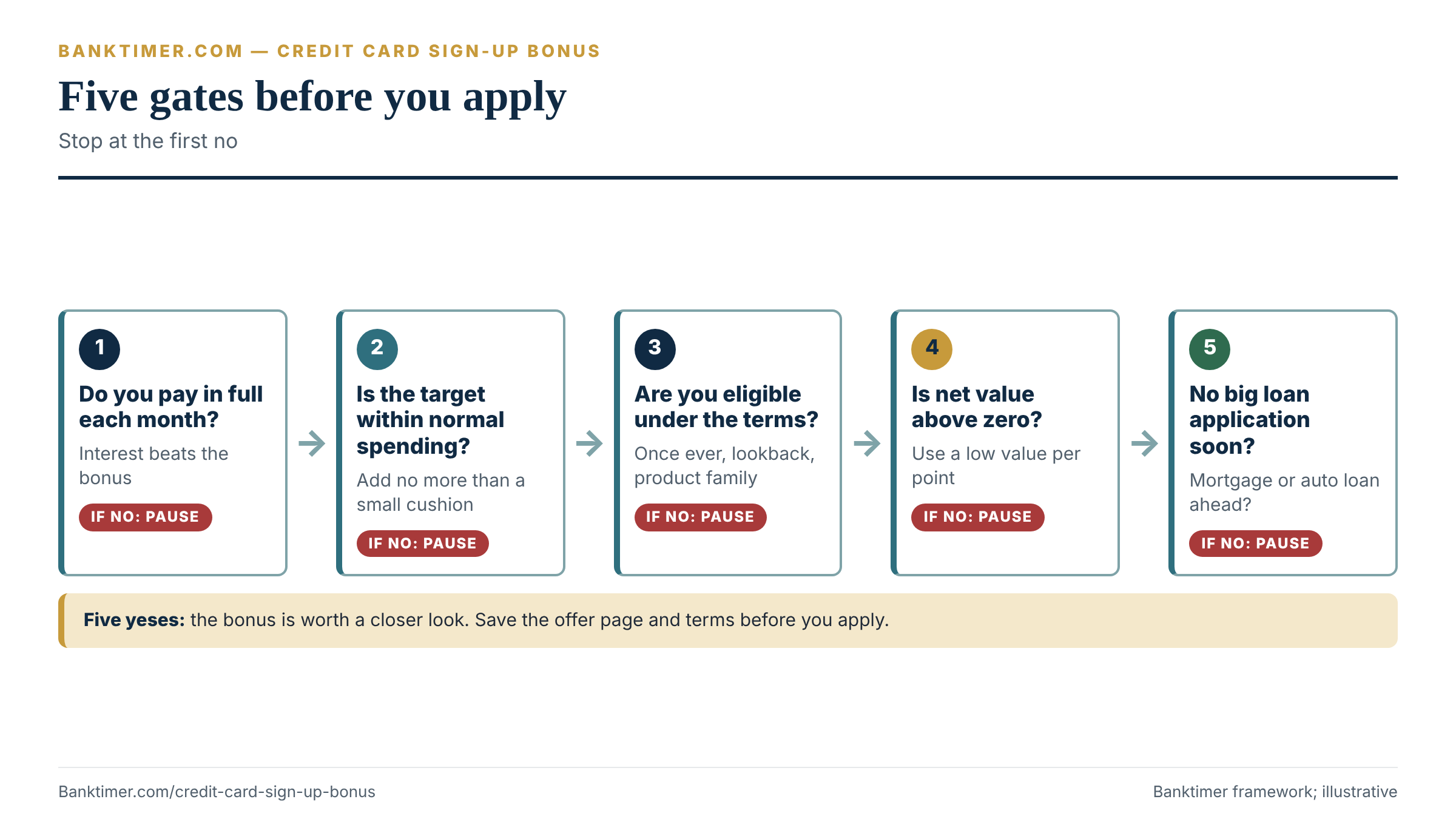
A good decision has a stopping rule. The five questions below run in order. If you fail an early question, the later ones do not matter.
- Do you pay your statement balance in full every month? If not, stop. Interest will outweigh the bonus. Pay down the balance first.
- Is the spending target within your normal spending plus a small cushion? Compare the weekly pace to your budget. If you would have to add spending that you would regret, the bonus is probably a mistake.
- Are you eligible under the issuer’s terms? Check the once-ever rule, the lookback and the product family. Save the terms.
- Is the net value positive at a conservative valuation? Use the lowest value per point you can defend. Subtract the annual fee and the rewards you give up.
- Do you need a new loan soon? If a mortgage, auto loan or other credit application is close, wait or keep the inquiry count low.
A decision matrix for common situations
| Your situation | Fit for chasing a bonus | Main upside | Main downside | What to verify |
|---|---|---|---|---|
| Pay in full, spend above target already | Strong | Bonus on spending you already do | Fee in year two | Eligibility; fee after year one |
| Pay in full, target needs a stretch with real bills | Moderate | Bonus with some cash-flow strain | Needing cash early | Can you pay the statement in full? |
| Pay in full, target needs new purchases | Weak | Possible bonus | Waste may exceed bonus | Your honest waste share (break-even 39.6% in Example 4) |
| Carry a balance month to month | Poor | Little | Interest overrides the bonus | Pay down debt first |
| Planning a mortgage soon | Pause | None until after closing | New inquiry and account | Lender guidance |
| Under 21, limited income | Limited | Possible small bonus | Approval may require a cosigner | 12 CFR 1026.51 rules |
| Many cards opened recently | Uncertain | Possible | Bonus may be denied under discretionary tests | Terms about opening and closing history |
The matrix has no universal winner. It shows that the same offer can be a bargain for one household and a cost for another. For a broader view of how cards fit together, see our credit card basics guide and the credit cards hub.
Red Flags and Mistakes That Cost Real Money
Most credit card sign-up bonus losses come from a short list of mistakes. The table below pairs each red flag with a question and a safer move.
| Red flag | Why it matters | What to ask | Safer next step |
|---|---|---|---|
| Target far above your normal spending | You may buy things you do not need | What is my weekly pace versus my budget? | Skip it or choose a lower target |
| Offer appears only on a special page or link | The bonus may not apply if you apply elsewhere | Is this the issuer’s official page? | Apply through the page and screenshot it |
| Third-party site shows a bigger bonus than the issuer | The terms may differ or be out of date | Does the issuer’s own page say the same? | Use the issuer’s page as the authority |
| Vague “abuse” or “gaming” clause | The issuer can revoke the offer at its discretion | What behavior does it name? | Do not cycle cards quickly; read the clause |
| Points with no clear redemption value | The headline may overstate the real value | What can I redeem for, and at what rate? | Use a conservative value per point |
| Bonus clawed back if you close early | Closing within the stated period may reverse it | How long must the account stay open? | Calendar the date before closing |
| A large bill paid by card with a fee | The surcharge can erase part of the bonus | What does the payee charge? | See our guide to credit card surcharges |
| Using a cash advance or balance transfer to count | Often does not count and adds fees | Does it count as a purchase? | Use ordinary purchases only |
The CFPB’s report supports several of these. It describes complaints about offers that differ from marketing, conditions that surface only after the promotion ends, and repayment requirements when accounts close early. Its advice is to read the full terms, check eligibility before applying and track spending carefully.
The CFPB’s rewards report describes consumers who applied based on one offer and then received a smaller one. If the offer in your approval does not match the page you saw, do not accept it silently. Screenshot both, then ask the issuer in writing which terms apply.
What to Do If the Bonus Does Not Post
Start with the calendar. If the posting window for your credit card sign-up bonus has not ended, wait. If it has, work through the steps below in order.
- Check the terms against your own records. Did the qualifying purchases post by the end of the window? Did a return or dispute reduce your total? Was any purchase in an excluded category?
- Message the issuer. Use a secure message or the account chat so you have a record. State the date you qualified, the offer terms and the amount you expected.
- Ask for a written reason if it is denied. Request the specific term that applies. Save the response.
- Ask for escalation. Ask for a supervisor or the issuer’s complaint department, and keep a note of names, dates and reference numbers.
- File a complaint with the CFPB. The Bureau has documented complaints about bonuses that were not paid, and its report says it will keep monitoring rewards programs.
Evidence decides most of these cases. The table below lists what to keep.
| Document | Why it matters | Where to get it | How long to keep it |
|---|---|---|---|
| Screenshot of the offer page | Shows what was advertised on the day you applied | Take it before you apply | Through your first anniversary |
| Offer terms and cardmember agreement | Shows the conditions, exclusions and forfeiture clauses | Issuer’s site or application | Through your first anniversary |
| Approval message with the date | Starts the spending clock | Email or account portal | Through your first anniversary |
| Statements showing qualifying spend | Proves you crossed the target | Account portal | Until the bonus posts and you confirm it |
| Records of returns and disputes | Explains any shortfall | Merchant and issuer | Until the bonus posts |
| Messages with the issuer | Documents the request and responses | Secure messages, chat transcripts | Until the matter is closed |
Alternatives to Chasing a Sign-Up Bonus
A credit card sign-up bonus is one way to gain from a card. It is not the only one, and sometimes it is the worst. The table compares alternatives on the same criteria.
| Alternative | Cost | Flexibility | Risk | Best fit |
|---|---|---|---|---|
| Keep using your current rewards card | No new fee | High | Low | You already earn solid rewards |
| A no-annual-fee card with a small bonus | Low | High | Low if you pay in full | You want a modest gain with little fuss |
| A higher-bonus card with a fee | Annual fee | Medium | Medium | Your normal spending clears the target |
| A 0% intro APR card | Possible transfer fee | Medium | Rate resets after the period | You need time to pay down a balance |
| A bank account bonus | Deposit requirements | Medium | Interest income reporting | You can park cash for the required period |
| Paying down existing card debt | None | High | Low | You carry a balance at a high APR |
| Doing nothing | None | High | None | The offer needs a stretch you would regret |
The last two rows deserve respect. Paying down a balance that costs about 22% a year gives a certain return that beats most bonuses. Our guide to open bank account online covers the account bonus path, with different rules and a different tax form.
- ☐ What exactly counts as a purchase, and what is excluded?
- ☐ When does the spending window start and end, and in what time zone?
- ☐ How many days or billing cycles until the bonus posts after I qualify?
- ☐ Am I eligible under the once-ever rule, the lookback and the product family?
- ☐ Does the bonus apply if I apply on a different page or by phone?
- ☐ What is the annual fee, and when does it post?
- ☐ Must the account stay open, and for how long, to keep the bonus?
- ☐ Do returns and disputes reduce my qualifying spend?
- ☐ What is my conservative value per point, and how will I redeem?
- ☐ Will the issuer send a tax form, and what will it show?
- ☐ Is a mortgage or other loan application coming soon?
- ☐ Can I pay the full statement balance every month?
Frequently Asked Questions
Is a credit card sign-up bonus worth it?
A credit card sign-up bonus is worth it when you can reach the spending target with purchases you already planned, pay the full balance every month, and still come out ahead after the annual fee and the rewards you would have earned on your current card. In our illustrative example, a $750 bonus netted $555. It stops being worth it when you buy things you do not need or carry a balance at an APR above 20%.
How long until the bonus posts?
It depends on the issuer’s terms. One card page we read on October 15, 2026 said to allow 6 to 8 weeks after you qualify. Another said it would apply the bonus within two billing cycles. Both clocks start after you meet the spending target, not when you open the account. Calendar a follow-up for the day after the stated window ends.
Is a credit card sign-up bonus taxable?
The IRS pages we read do not address credit card sign-up bonuses by name. Deposit account bonuses are different: IRS Publication 550 treats them as interest. If your issuer sends a tax form, include the amount and follow it. If it does not, the absence of a form does not settle taxability. Ask a tax preparer if the bonus is large.
What is the once per lifetime bonus rule?
It is an issuer policy, not a law. Some offers say the bonus is not available if you currently have or previously had the card. Others use a fixed lookback, such as 48 months, or reserve the right to consider your history of opening and closing cards. The wording lives in the offer terms, so read it before you apply and save a copy.
What happens to the bonus if I close the card early?
It can be forfeited or reversed, depending on the terms. One issuer page said the account must be open and not in default when the bonus is fulfilled. The CFPB’s report notes that some issuers require repayment if an account is closed within a set period, such as 12 months. Check the offer terms and cardmember agreement for words like “forfeit” and “reverse” before you close.
Does applying for a card for the bonus hurt my credit?
An application triggers a hard inquiry that appears on your credit report and may affect your score. The CFPB notes that most scoring models look at how recently and how frequently you apply for credit. One application is a small event, but several close together are larger. The size of the effect varies with your credit file, so avoid applying shortly before a major loan.
Do purchases by an authorized user count toward the minimum spend?
It varies by issuer. The card pages we read did not say. Ask before you rely on them, and get the answer in writing if the amount matters. If the terms are silent, treat only your own purchases as safe. A cushion above the target protects you if some purchases are not counted.
Can I pay a large bill with the card to reach the target?
Sometimes, but check three things. First, confirm the bill counts as a purchase and is not an excluded category such as a cash-like transaction. Second, check whether the payee adds a surcharge. Third, make sure you can pay the statement in full. A tax payment or tuition bill with a fee can cost more than the bonus is worth.
What if I miss the spending deadline by a small amount?
The bonus is generally forfeited. Nothing we read requires an issuer to extend the window or pay a partial bonus. You can ask politely, but you should not count on an exception. Track your spending weekly, aim for a 10% cushion and finish early so a late-posting transaction does not cost you the reward.
Does the bonus offer change if I apply in a branch or by phone?
It can. One issuer page said the bonus may not be available if you navigate away from the application page. The CFPB’s July 2023 order against Bank of America found the bank denied a sign-up bonus to people who applied by phone or in person after advertising it online. Apply through the page that shows the offer, and screenshot it first.
Will meeting the target raise my credit utilization?
It can, if the issuer reports a high balance on the statement date. In our example, $5,000 of unpaid spending on top of $2,000 in other balances moved utilization from 8% to 20%. Paying the new card down before the statement closes brought it to about 5.7%. Pay early, not just before the due date, if you want a low reported balance.
Before you apply, write down three numbers: your normal spending over the bonus window, the target, and the net value using a conservative value per point. If the target exceeds your normal spending by more than a small cushion, or if you carry a balance, pause.
The one variable that decides whether a credit card sign-up bonus pays is whether you change your spending or your payment habits to get it. If you hit the target with bills you were already going to pay, and you clear the statement balance in full every month, the bonus is usually a real gain after the annual fee and the rewards you give up. If you buy things you would not otherwise buy, or carry a balance at a rate near 22%, the bonus can disappear within months. Read the offer terms for the spend window, exclusions, lookback and posting time, screenshot them, and calendar the follow-up. A bonus does not improve the card itself. It does not lower the APR, waive the fee after year one or guarantee approval, and no federal rule makes issuers disclose bonus conditions the way they must disclose rates and fees.
Methodology
We reviewed primary and official sources on October 15, 2026. They include the CFPB’s May 2024 credit card rewards report and its enforcement page on Bank of America, the Federal Reserve’s G.19 consumer credit release dated October 7, 2026, the Regulation Z provisions cited in the text, IRS Publications 525 and 550, IRS Announcement 2002-18, the IRS instructions for Forms 1099-MISC and 1099-NEC, and three issuers’ public card pages. The card pages show current terms only for that day, and offers change often.
All dollar examples are illustrative. They use an assumed 22.15% APR taken from the Federal Reserve’s second-quarter 2026 figure for accounts assessed interest, an assumed 2% rate on your current card and an assumed value of one cent per point. Monthly interest is estimated as balance × APR ÷ 12 and ignores daily compounding. Eligibility language, posting times, annual fees and tax treatment vary by issuer, card, contract, state and your own tax situation. We did not apply for, call about or test any card. This article is general information, not tax or financial advice.
Sources
- Credit card rewards issue spotlight, CFPB, May 2024
- Bank of America, N.A. sales practices and credit card rewards, CFPB enforcement action, July 11, 2023
- G.19 Consumer Credit, Federal Reserve, released October 7, 2026
- 12 CFR 1026.51 Ability to pay, Legal Information Institute
- 12 CFR 1026.60 Credit and charge card applications and solicitations, Legal Information Institute
- 12 CFR 1026.5 General disclosure requirements, Legal Information Institute
- 12 CFR 1026.53 Allocation of payments, Legal Information Institute
- Publication 525, Taxable and Nontaxable Income (2025), IRS
- Publication 550, Investment Income and Expenses, IRS
- Instructions for Forms 1099-MISC and 1099-NEC, IRS
- Announcement 2002-18, IRS
- Capital One Venture Rewards card page, Capital One, checked October 15, 2026
- Chase Sapphire Preferred card page, Chase, checked October 15, 2026
- Citi Strata Premier card page, Citi, checked October 15, 2026
By the Banktimer Editorial Team · Published
Banktimer is an independent U.S. consumer-finance publication. Our editors draw on primary and official sources first, such as the CFPB, FDIC, Federal Reserve, and FTC, along with statutes, regulations, and providers’ own agreements and fee schedules. Then we add worked examples and decision tools. Our goal is the most useful, best-supported explanation the sources available to us at the time of writing allow.
This article is general information, not legal, tax, investment, insurance, or financial advice, and reading it does not create a professional relationship with Banktimer. Rates, fees, limits, and rules change, and they vary by state, provider, and contract, so confirm current terms with your bank, lender, insurer, or the agency named in the article before you act. Examples are illustrative unless labeled otherwise. Banktimer is not a bank, lender, insurer, or financial advisor, and we are not responsible for decisions or losses that result from relying on this content. For advice about your own situation, talk to a licensed professional.