A credit card for bad credit usually means one of two things. One is a secured card, where a refundable deposit becomes your limit. The other is an unsecured “subprime” card with a small limit and heavier fees. Secured cards tend to cost less and make approval easier. Unsecured cards need no deposit but can eat a quarter of a small limit in first-year fees.
Your biggest variable is the full fee schedule, not the headline limit. The main risk is a card that charges fees but does not report to the credit bureaus. Before you apply, ask about every fee. Ask which bureaus receive your payment history. Use a soft-inquiry prequalification tool if one exists.
Bad credit is a range, not a verdict. FICO labels scores below 580 as “Poor.” The CFPB groups scores of 579 or less as “deep subprime.” Issuers also weigh income and debts.
Secured usually beats unsecured on cost. A secured card ties your deposit to your limit. An unsecured subprime card can bill up to 25% of its limit in first-year fees under federal rules.
“No credit check” rarely means what it sounds like. Card issuers must consider your ability to pay. The product is often a prepaid card, a loan, or a card with no hard pull but some review.
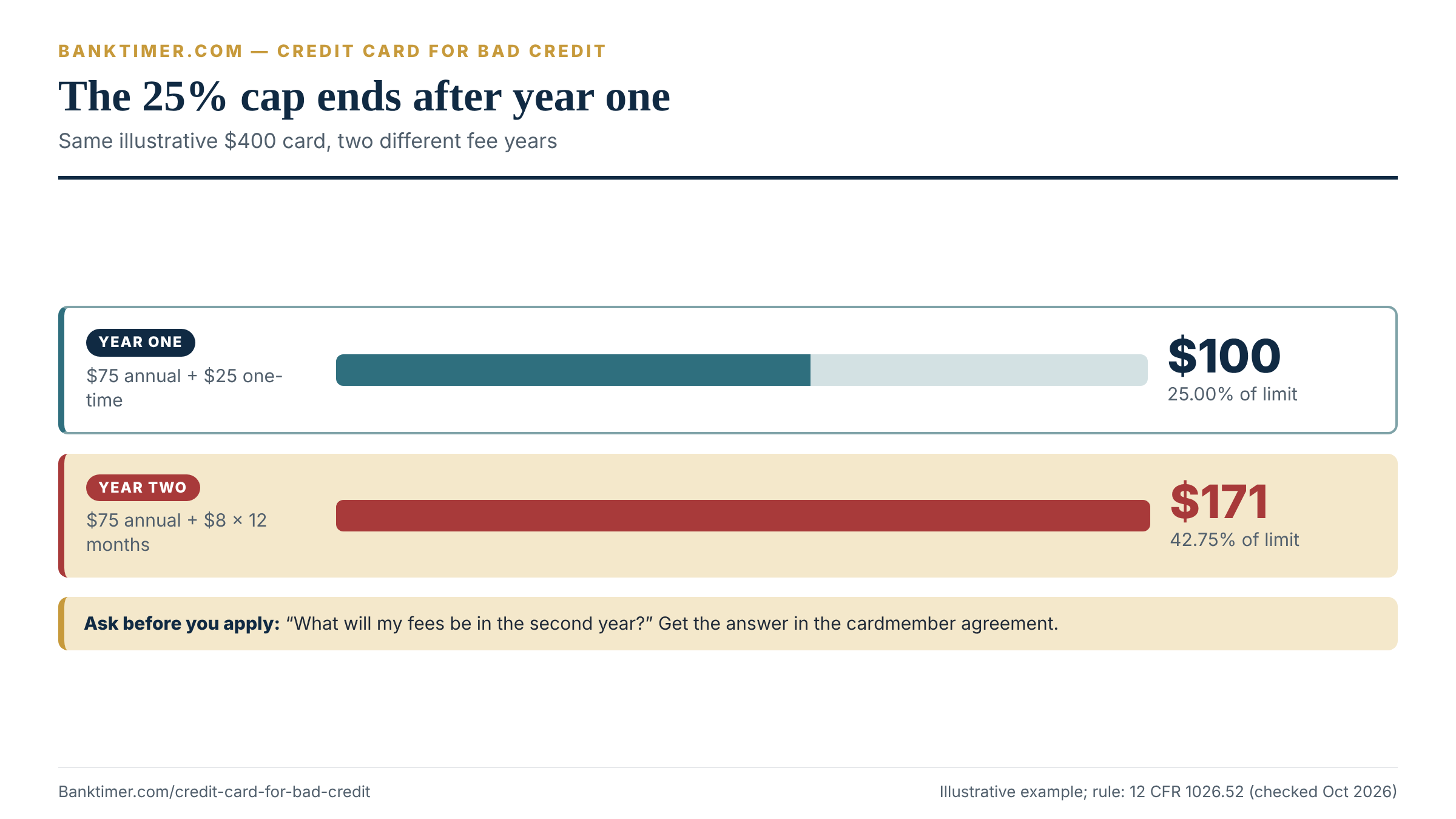
Fees can jump after year one. The 25% cap covers only the first year. A $400 limit can face $171 in year-two fees in our illustration.
Reporting decides whether the card helps. A card that does not report builds nothing. Ask which bureaus it reports to.
Never pay to be approved. A fee you cannot reject is a reason to walk away. So is a “guaranteed approval” pitch, or a credit repair promise made before any work is done.
What “Bad Credit” Means to a Card Issuer
Nobody at a bank sorts applicants into “bad” and “good.” A credit card for bad credit still goes through the same scoring model and set of policies. The result is an approve, decline or “approve with different terms” decision. Your score is one input. Your income, existing debts and recent behavior are others.
Still, the score bands give you a rough map. The table below puts the two best-documented scales side by side. FICO publishes its own labels. The CFPB uses its own tiers in its biennial credit card market report.
| Score range | FICO label | CFPB card-market tier | Banktimer reading of what it signals |
|---|---|---|---|
| 300 to 579 | Poor | Deep subprime (579 or less) | Recent serious delinquencies, collections or very high balances are common |
| 580 to 619 | Fair | Subprime (580 to 619) | Mixed history; some approvals possible, often with a low limit |
| 620 to 659 | Fair | Below prime (under 660) | Closer to mainstream terms, but still priced for risk |
| 660 to 669 | Fair | Not below prime (660 or higher) | More mainstream offers come into view |
| 670 and up | Good to Exceptional | Not below prime | Competes for standard cards |
The key insight is the band edges. A score of 578 and a score of 582 are four points apart. They sit in different labels, which can change which products you see. Treat the bands as a guide to the kind of card you will probably be shown, not as a pass-or-fail line. No single minimum score applies to all lenders, as FICO itself notes.
The labels come from FICO’s score ranges and the CFPB’s 2025 credit card market report. The CFPB defines subprime as 580 to 619 and deep subprime as 579 or less. The “what it signals” column is Banktimer’s plain-English reading, not an issuer rule.
What a score does not tell the issuer
A score cannot show your current income, your rent, or the fact that a collection was paid last month. Federal rules require a card issuer to consider your ability to make the minimum payments, using your income or assets and your current obligations. We cover that rule in the “no credit check” section below.
That means a thin paycheck can sink an application even with a decent score. It also means a steady job can help a file with a weak score. Be ready to state your income accurately and completely.
How many people are in this group
You are not an outlier. The CFPB’s report found that 91% of below-prime cardholders held at least one credit card as of July 2024. It also found that revolving subprime and deep subprime cardholders pay two to four times more in interest and fees per dollar borrowed. The comparison group is revolving cardholders with superprime scores. That cost gap is the reason this guide spends so much time on fees.
Your Real Options at a Glance
Most searches for a credit card for bad credit end up in the same six places. Each one trades cost, flexibility and credit-building power differently. The matrix below compares them on identical criteria so you can see where each fits.
| Option | Best for | Main upside | Main downside | What to verify |
|---|---|---|---|---|
| Secured credit card | Anyone who can fund a deposit | Deposit sets the limit; usually lower fees than subprime unsecured | Cash tied up; some charge annual or monthly fees | Bureau reporting, deposit refund terms, fee schedule |
| Unsecured subprime card | Applicants with no cash for a deposit | No deposit; may add a higher limit later | Small limit, heavy fees, high APR | Every fee, first-year versus later fees, reporting |
| Credit-builder loan | Building history without a card | Forces savings; fixed payments | Money locked until the term ends | Reporting, interest, fees, when you get the funds |
| Retail or store card | Frequent shoppers at one retailer | Low limits can keep balances small | Narrow use; often high APR | Where it works, APR, reporting |
| Authorized user status | People with a trusted account holder | Can add history without applying | Depends on the primary holder’s habits | Whether the issuer reports authorized users |
| Credit union card | Members with a local credit union | Federal credit unions face a rate ceiling | Membership rules; fewer products | Eligibility, secured options, current rate ceiling |
The decision-driving insight is the “main downside” column. Every row has a cost that the advertisement leaves out. Secured cards cost you liquidity. Subprime cards cost you fees. Credit-builder loans cost you access to your own money for months. We expand on each below.
The CFPB’s own guidance on starting or rebuilding credit lists secured cards, credit-builder loans and retail cards as ways to build history. It also warns that debit cards, cash and most prepaid cards do not show you can repay debt. We cite that CFPB page in the sections that follow.
For the wider picture, read our complete guide to credit cards and the Credit Card Basics guide. They cover mechanics that apply to every applicant.
Secured vs Unsecured Card for Bad Credit: How Each Works
The difference comes down to who carries the risk. On a secured card, you do. On an unsecured card, the issuer does, and it prices that risk into fees and interest.
How a secured card works
You send the issuer a deposit, and the deposit usually sets your credit limit. The CFPB’s example is a $500 deposit that lets you spend up to $500. When you pay the bill, your available credit returns to the deposit amount. The FTC adds that the deposit protects the issuer if you miss a payment. You usually get it back when you pay off the balance and close the account.
A secured card is still a credit card. The FTC notes that it carries the same protections as other cards, including a $50 cap on losses from unauthorized use and dispute rights for many problems. Its comparison of card types also warns that secured cards “generally (but not always)” have higher APRs and annual fees than unsecured cards. Some add activation or monthly maintenance fees.
How an unsecured subprime card works
You put down no deposit. The issuer gives you a small line, often a few hundred dollars. It recovers its risk through annual, one-time and monthly fees and a high APR. Federal rules limit some of those fees in the first year, which we cover in the fee section. They do not limit all of them, and they do not limit anything after year one.
An unsecured card can make sense if you cannot spare a deposit. It also tends to offer a path to a higher limit without a new deposit. That path is worth confirming in writing before you apply.
Secured versus unsecured, side by side
| Factor | Secured card | Unsecured subprime card |
|---|---|---|
| Upfront cash | Deposit, often equal to the limit | None, but fees may be billed to the card |
| Credit limit | Tied to deposit (varies by issuer) | Set by issuer, often small |
| Typical fee pressure | Annual or monthly fee on some cards | Annual, one-time and monthly fees possible |
| Interest if you carry a balance | Often high | Often high |
| Approval odds with weak credit | Generally better because the deposit covers the issuer | Lower; depends on income and file |
| Getting your money back | Deposit returned when account closes in good standing (check terms) | Not applicable |
| Biggest risk | Deposit locked up; fees reduce spending power | Fees consume the limit before you use it |
The insight is that “no deposit” is not the same as “no cost.” With an unsecured card, you may pay in fees you never get back. With a secured card, the deposit is yours to recover. Over a year, a refundable deposit can be the cheaper of the two, even though it hurts more at the start.
When you pick a credit card for bad credit, choose by asking one question: what can I afford to lock up, and what can I afford to lose? The first answer points to secured. The second answer is the one an unsecured card will test.
Where credit unions fit
Federal credit unions face a federal rate ceiling. Under NCUA’s rule at 12 CFR 701.21, the ceiling is 15% per year including finance charges. The NCUA Board may set a higher one and reviews it at least every 18 months. The current ceiling is announced through NCUA letters, so check NCUA before you rely on a number. Credit union membership rules and product offerings vary, so call or visit before you assume a secured option exists.
Other Ways to Rebuild Without a Standard Card
A card is not the only tool, and for some people it is not the best first tool. The CFPB’s guidance on starting or rebuilding credit mentions three card-adjacent routes. Each has a different cost shape.
Credit-builder loans
A credit-builder loan is offered by a bank or credit union. The money you borrow is held for you rather than given to spend. You make small payments, usually over six to 24 months, and then receive the money. Your payments are reported to the credit bureaus, which is the point of the product.
The trade-off is that you cannot touch the funds until the term ends, and you pay interest or fees for the arrangement. We model one in the cost section below.
Retail and store cards
The CFPB notes that stores, warehouses and gas stations may offer cards with low limits, which makes it less likely you will run up a large balance. Low limits cut both ways. They protect you from overspending, but they also make your utilization jump quickly.
Authorized user status
An authorized user can use someone else’s card without being legally responsible for the debt in the usual case. Whether the account helps your credit depends on whether the issuer reports authorized users to the bureaus and on how the primary holder behaves. A late payment on that account can show up on your file too, so choose the holder carefully and ask the issuer about its reporting practice. For how the underlying score math works, see credit utilization.
Products that do not rebuild credit
The CFPB is direct about this. Debit cards and cash do not involve borrowing, so they do not show you can repay debt. Prepaid cards let you spend only what you deposited and do not establish credit history. Payday loans are not reported to the nationwide bureaus even when you pay on time. “Buy here, pay here” auto loans often report only negative information.
That list matters for the next section, because many “no credit check” offers fall into those categories.
“Credit Card No Credit Check”: What the Phrase Really Means
Searchers type “credit card no credit check” hoping for a way around the score. Here is what federal rules and the CFPB’s guidance say about getting a credit card for bad credit without a review.
Why a true no-review card is unlikely
Under 12 CFR 1026.51, a card issuer cannot open an account or raise a limit without considering your ability to make the minimum payments. It uses your income or assets and your current obligations. Issuers must keep written policies that use at least one measure: a debt-to-income ratio, a debt-to-assets ratio, or the income left after debt payments. The rule’s commentary says it would be unreasonable for an issuer not to review any information about your income or assets.
The CFPB also says an issuer may ask for your Social Security number to obtain your credit report. In short, a real credit card involves some review.
What the phrase usually describes
An offer that advertises “no credit check” is usually one of these:
- A prepaid or debit-style card. You load the money yourself. There is no borrowing and no credit history building.
- A secured card with a lenient review. The deposit lowers the issuer’s risk, so it may use a soft inquiry or a lighter screen.
- A product reviewed with other data. Some products look at bank account activity instead of a bureau file. Ask whether they report to the bureaus.
- A bait advertisement. The phrase draws you in, and the real terms show up only after you pay a fee.
We cannot tell you which specific products fall in which group. The terms differ by issuer and change over time. What you can do is ask three questions before you hand over any information: Is this a credit card or a prepaid card? Will it report my payments to all three bureaus? What fees do I owe before I can use it?
The credit-check question inside your own file
Even if an issuer avoids a hard pull, it may still review your history through a soft inquiry. The CFPB explains that hard inquiries, usually made when you apply, can affect your score, while soft inquiries, such as prescreening and your own checks, do not. The hard inquiry guide on Banktimer explains how long they matter and how to avoid piling them up.
Prequalifying for a Credit Card With Bad Credit
Prequalification lets you see likely terms for a credit card for bad credit before you apply. Done well, it spares you a wasted hard inquiry. Done carelessly, it becomes the start of a shotgun round of applications.
Soft check versus hard check
A prequalification tool usually runs a soft inquiry. That means it does not affect your scores and only you can see it. A full application usually runs a hard inquiry, which can lower your scores a little, and which other lenders can see. Check the tool’s wording before you submit. If it does not say “soft,” ask.
Prescreened offers are not approvals
You may also get prescreened offers in the mail. The FTC explains that companies ask a bureau for a list of consumers whose reports meet their criteria. The CFPB adds that a prescreened offer does not obligate the company to issue a card. When you apply, the company can check an updated report and other information, including whether you earn enough to repay the debt.
Prescreening does not lower your score, and the inquiries that show who received your information do not hurt your credit. If you prefer fewer offers, you can opt out at optoutprescreen.com or by calling 1-888-5-OPT-OUT (1-888-567-8688), per the FTC.
A sensible order of operations
| Step | What to do | Why it matters |
|---|---|---|
| 1 | Pull your free reports and fix any errors | Errors can sink an application; see credit report errors |
| 2 | List your monthly income and obligations | The issuer must weigh your ability to pay |
| 3 | Use soft-inquiry prequalification where offered | You see likely terms without a score hit |
| 4 | Read the fee table on the application | Federal rules require a standard disclosure table |
| 5 | Apply to one card, not five | Each hard inquiry is visible to other lenders |
| 6 | If denied, read the notice before applying again | The reasons tell you what to fix |
The insight here is the gap between steps 3 and 5. The tools exist to help you filter. The discipline is applying only after the filter says yes.
The Fee Stack on a Credit Card for Bad Credit
Fees are where a credit card for bad credit earns its money. They arrive in layers, so a $300 limit can shrink before you swipe it once. Knowing every layer lets you compare cards honestly.
The scale is large. The CFPB’s 2025 market report found that cardholders paid $31.3 billion in fees in 2024, up 23% from $25.4 billion in 2022. Late fees were the biggest category at $17 billion. These figures cover all cardholders, not only subprime ones, but they show where card revenue comes from.
The fee types you may meet
The table below lists the fees that most often appear on cards aimed at low scores. The dollar amounts are illustrative, not quotes. Your card’s actual fee schedule is the only number that counts.
| Fee | Trigger | Typical basis | Illustrative example | Avoidable? |
|---|---|---|---|---|
| Annual fee | Billed once a year for having the card | Flat dollar amount | $75 per year | Yes, by choosing a card without one |
| One-time account fee | Opening or activating the account | Flat dollar amount | $25 once | Often; you may reject the plan before paying (see below) |
| Monthly maintenance fee | Billed each month | Flat amount per month | $8 per month | Yes, by choosing a card without one |
| Late payment fee | Minimum payment missed by the due date | Flat; cannot exceed the minimum due | Up to the lesser of the stated fee or the minimum | Yes, with autopay |
| Returned-payment fee | A payment you sent fails | Flat dollar amount | $30 | Yes, by keeping funds in the linked account |
| Over-limit fee | Spending past the limit, only if you opted in | Flat; one per cycle | $25 | Yes; do not opt in |
| Cash advance fee | Taking cash on the card | Percent of amount, often with a minimum | 5% of $100 is $5 | Yes, by not using cash advances |
| Foreign transaction fee | Purchases processed abroad | Percent of purchase | 3% of $100 is $3 | Mostly, by not using it abroad |
| Add-on products | Optional services sold at activation | Monthly or annual charge | $10 per month | Yes; they are optional |
The decision-driving insight is the “Avoidable?” column. Four of these fees are charged for having the card, whether or not you use it. Those are the ones to compare before you apply, because no good behavior removes them.
What federal rules limit in year one
Under 12 CFR 1026.52(a), required fees in the first year after account opening cannot exceed 25% of the credit limit in effect when the account opens. The rule does not apply to late payment, over-the-limit and returned-payment fees. It also does not apply to fees you are not required to pay.
The CFPB’s official interpretation adds three useful points. It applies to fees charged to the account and to fees you must pay by other means. If the limit is cut in the first year, the issuer must waive or credit fees above 25% of the reduced limit. A security deposit charged to the account counts as a fee, but a deposit funded from outside the account does not.
Why the cap still leaves you exposed
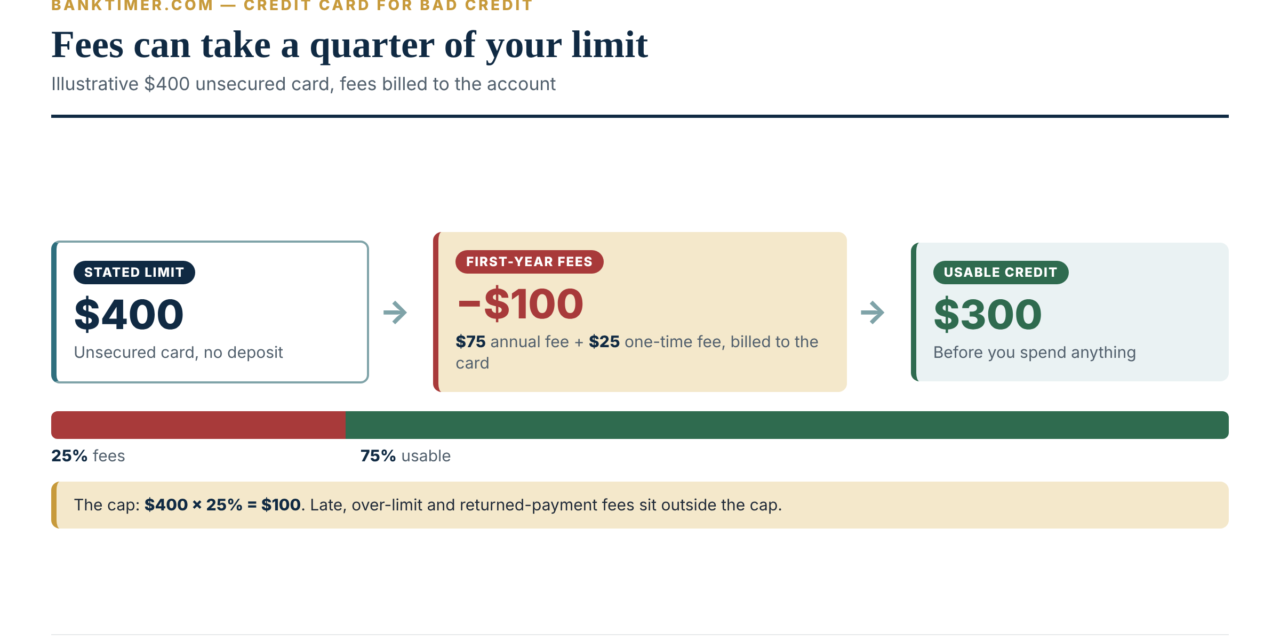
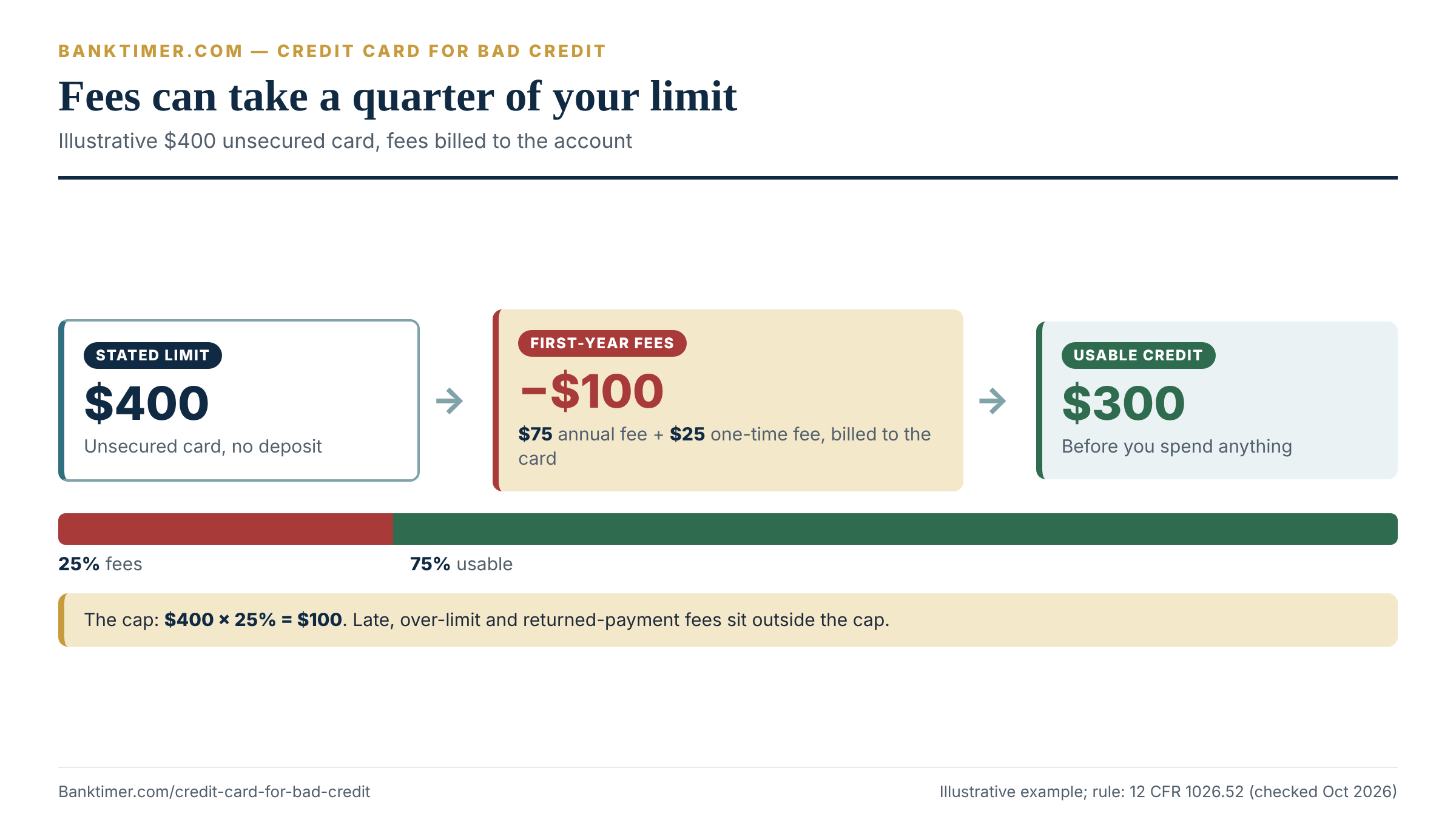
Run the math on a $400 limit. The cap is $100. An issuer can legally bill a $75 annual fee and a $25 one-time fee at opening. That leaves $300 of your $400 limit, or 25% gone before the first purchase.
Assumptions: a $400 unsecured card, a $75 annual fee and a $25 one-time fee, both billed to the account. These are invented for illustration and are not a live offer.
Fees total $100, which equals the 25% cap ($400 x 0.25), so the structure is allowed. Available credit at the start is $300. If you then spent $300, you would be at your limit with nothing left for emergencies.
Now suppose the issuer also wanted $10 a month. Over 12 months, $75 plus $120 totals $195, which is $95 over the cap. That version would not be allowed in year one.
The year-two cliff
The 25% limit covers only the first year. After that, a new fee schedule can apply, and the cap does not follow it. In our illustration, a card that cost $100 in year one could shift to a $75 annual fee plus $8 a month. That is $171 for the year, or 42.75% of a $400 limit.
This is not a prediction about any real card. It is a reason to ask one question: “What will my fees be in the second year?” Get the answer in the cardmember agreement, not on the phone.
What the application must tell you
Federal rules require card issuers to give standardized disclosures on or with an application or a solicitation. The disclosure rule at 12 CFR 1026.60 calls for the APR, any penalty APR and its triggers, and annual and other periodic fees. It also covers one-time account-opening fees, transaction fees and the grace period. Late-payment, over-limit, balance-transfer and returned-payment fees are included too.
There is a second protection hidden in the same rule. If required fees and security deposits at opening add up to 15% or more of the card’s minimum credit limit, the issuer must disclose the remaining available credit. Read that line. It tells you what you can actually spend.
The right to say no before you pay
Under 12 CFR 1026.5(b)(1)(iv), a creditor generally may not collect any fee before account-opening disclosures are provided. If you reject the plan after getting them, you owe none of those fees, including application fees. The creditor must promptly refund a membership fee already paid. If someone asks for a payment before you have seen the terms, stop.
What the Interest Actually Costs on a Small Balance
A small limit makes interest look harmless. It is not. The APR on a credit card for bad credit tends to be high, and the money builds fast relative to your limit.
Benchmarks you can check
The Federal Reserve’s G.19 release, published October 7, 2026, shows a 22.15% average APR for the second quarter of 2026. That figure covers bank card accounts assessed interest. The all-accounts figure was 20.94%. The CFPB’s 2025 report put the average general-purpose APR at 25.2% for 2024. It found an APR margin of 20.3% for subprime and deep subprime cardholders, compared with 13.7% for superprime. The Federal Reserve G.19 release updates regularly, so check it for the latest values.
Your own APR can be higher than any average. Read the rate on your application table.
A worked cost of carrying $250
Interest accrues daily. The CFPB’s credit card tools page explains that interest is typically calculated daily. Our formula divides the APR by 365 and multiplies by the balance and the number of days.
| APR (illustrative) | Source of the rate | Interest on $250 for 30 days | Interest on $250 for 12 months (flat balance) |
|---|---|---|---|
| 22.15% | Fed G.19 average for accounts assessed interest, Q2 2026 | $4.55 | $55.38 |
| 25.20% | CFPB 2024 average general-purpose APR | $5.18 | $63.00 |
| 29.99% | Illustrative subprime APR (not a quote) | $6.16 | $74.97 |
The gap between the first and last rows is about $19.59 over a year on a $250 balance. That feels small until you add fees. A $75 annual fee plus $75 of interest comes to $150, which is 60% of that $250 balance.
The practical takeaway is that fees, not interest, usually do the heaviest damage on a small limit. Interest hurts most when you carry a balance month after month. For a deeper look at how rates are built, see what a credit card APR really costs.
Late fees and the minimum-payment limit
A late fee can cost more than the interest on a small balance. Federal rules say a penalty fee cannot exceed the dollar amount associated with the violation. For a late payment, the CFPB’s official interpretation defines that amount as the required minimum payment due just before the fee is assessed.
Assumptions: the agreement lists a $30 late fee. Your minimum payment due is $25.
The fee cannot exceed the $25 minimum, so the most you could be charged is $25 for that miss. The same agreement could charge $30 once your minimum is $30 or more.
That limit protects you, but it does not make late fees small. The late fee is also excluded from the 25% first-year cap, so it can stack on top of the other fees. The CFPB adjusts the safe-harbor amounts for penalty fees over time, so read the current number in your own agreement.
Over-limit fees need your permission
A card issuer generally cannot charge an over-the-limit fee unless you have opted in to over-limit coverage. Under 12 CFR 1026.56, the issuer must give a separate notice, get your consent and confirm it in writing. It may charge only one over-limit fee per billing cycle. You can revoke consent at any time.
On a small limit, that opt-in matters. Say no. A declined purchase is annoying. An over-limit fee on a $300 line is worse.
Add-on products and the activation call
The CFPB warns that “add-on products” such as credit protection or identity monitoring are optional. You do not have to buy anything to activate your card. They usually cost a monthly or annual fee, and sales tactics can be high-pressure and confusing. Some free trials begin charging automatically when the trial ends. Get terms and costs in writing, and decline if you cannot.
What One Year Costs on Three Paths
Side-by-side math cuts through the marketing. The table below models a year on three common routes. Every figure is illustrative and rests on the assumptions listed under the table. None of it is a quote or a prediction for a real product.
| Path | Cash you put in | Fees in year one | Interest in year one | Total cost | What you get back |
|---|---|---|---|---|---|
| Secured card, balance paid in full | $200 deposit | $35 annual fee | $0 | $35 | $200 deposit at closing, if terms are met |
| Unsecured subprime card, balance paid in full | None | $100 (annual plus one-time) | $0 | $100 | Nothing |
| Unsecured subprime card, $150 average balance carried | None | $100 | $44.99 | $144.99 | Nothing |
| Credit-builder loan, $600 over 12 months | $51.92 per month | $0 assumed | $22.99 | $22.99 | The $600 held for you, at the end of the term |
Assumptions: the secured card has a $200 limit equal to the deposit and a $35 annual fee. The unsecured card has a $400 limit, a $75 annual fee and a $25 one-time fee. The carried balance averages $150 at 29.99% APR for 12 months. The loan runs 12 months at 7% APR with no admin fee, and the lender holds the principal until the end. Structures differ by lender.
The insight is that two cards can differ by more than $100 in a year with the same score and the same behavior. The credit-builder loan has the lowest direct cost, but it gives you no spending power and your cash is committed monthly. None of the three guarantees a score increase. Payment history is the heaviest factor in a FICO score, at 35%, followed by amounts owed at 30%, according to myFICO.
What the table leaves out
The deposit has an opportunity cost. The $200 you lock into a secured card could have sat in a savings account. It could also have covered a car repair. A small emergency fund matters here, because a person with no cushion who funds a deposit can end up late on a bill.
The unsecured card also carries a different risk. If you hit your limit with fees, your utilization starts high. We explain that in the section on using the card.
Predatory and Misleading Offers: Seven Red Flags
Most offers for a credit card for bad credit are legal and honestly described. A few are not, and a larger group is legal but poor value. The test is whether you can see and reject the cost before you pay.
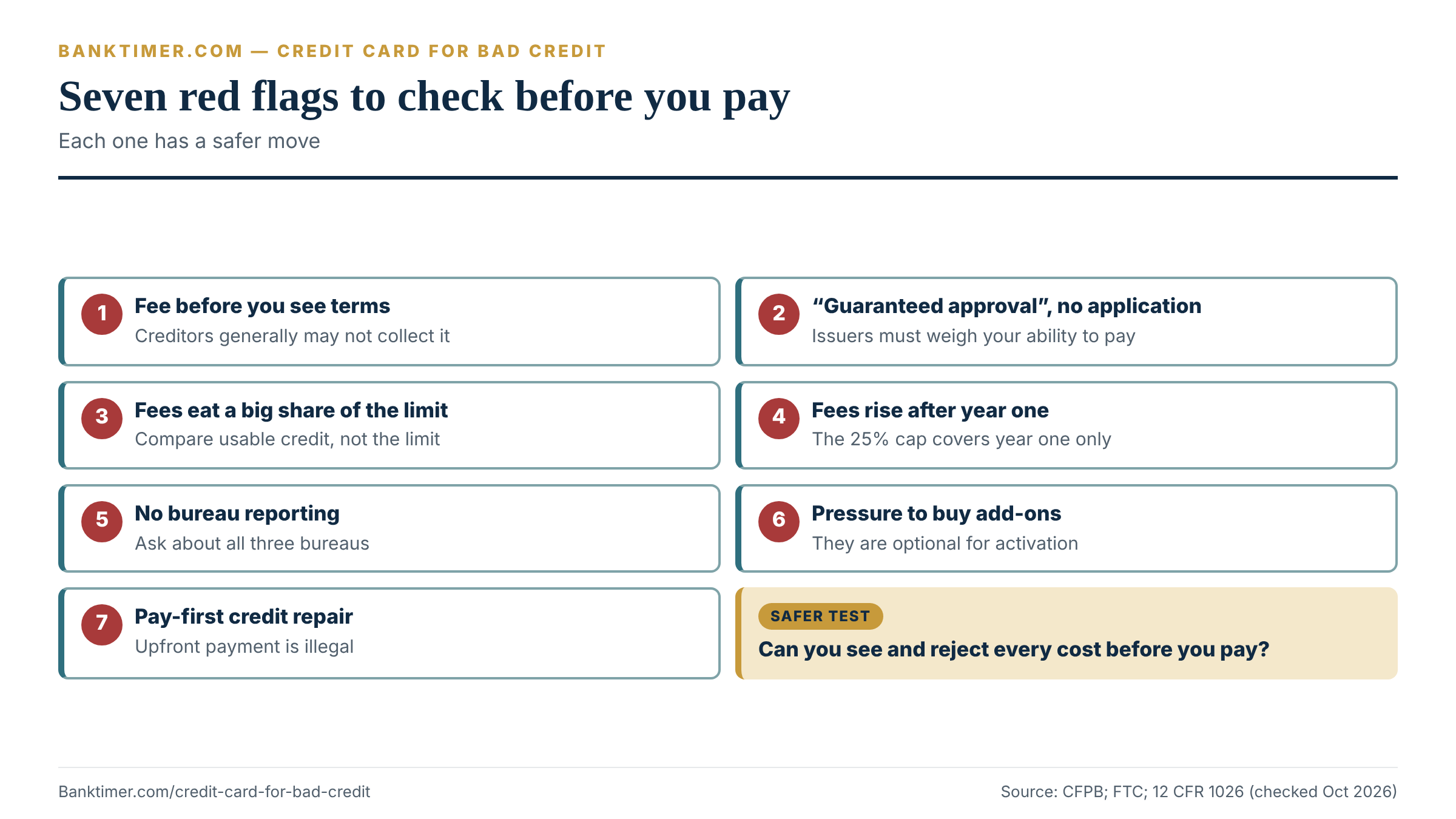
The table gives each signal, why it matters, what to ask, and a safer move.
| Red flag | Why it matters | What to ask | Safer next step |
|---|---|---|---|
| A fee demanded before you see terms | Creditors generally may not collect a fee before account-opening disclosures | “Where is the fee table, and when can I review it before paying?” | Stop and request the disclosures in writing |
| “Guaranteed approval, no application” | Issuers must consider your ability to pay | “Is this a credit card or a prepaid card?” | Look for a real application with a fee table |
| Fees that equal a large share of the limit | Your usable credit shrinks before you spend | “What is my available credit after every fee?” | Compare cards by available credit, not limit |
| Fees that rise after year one | The 25% first-year cap does not apply later | “What are the second-year fees in the agreement?” | Choose the card with flat, stated costs |
| No bureau reporting | Without reporting, payments build no history | “Do you report to Equifax, Experian and TransUnion?” | Pick a card that reports to all three |
| Pressure to buy add-on products | They are optional and cost a monthly or annual fee | “Can I activate without it?” (You can.) | Decline and keep the receipt of the call |
| A third party charging to “fix” your credit | Upfront payment for credit repair is illegal | “Will you take payment before the work is done?” | Dispute errors yourself for free |
The sections below expand the flags that need more than a table cell.
A fee before you can see the terms
This is the cleanest red flag because federal law addresses it. A creditor generally may not collect any fee before account-opening disclosures are provided. If you reject the plan after receiving them, you owe none of the fees, including application fees. A request for money before you have read the fee table is a reason to stop.
Cards that do not report your payments
A card builds credit only if the issuer sends your payment history to the bureaus. The FTC notes that many issuers report secured card activity and does not say whether they report to all three, so it advises asking directly. That advice applies to unsecured cards as well.
A card that charges you $100 and reports nothing leaves you poorer with the same file. Ask the question in writing if you can.
Credit repair pitches
If a company promises to remove accurate negative items, walk away. The FTC and the CFPB agree that no one can legally remove accurate, current negative information. Credit repair companies cannot take payment before they perform the service. If you have just signed up, you can cancel within three business days at no charge. The FTC’s January 7, 2026 alert, Spot the scams when fixing your credit, says you can dispute errors yourself for free. Contact the bureau and the business that reported them.
Accurate negative information does fade. The FTC says most negative information stays on your report for seven years, and bankruptcy information for 10 years. Time and on-time payments do more than any paid shortcut. For help with errors, see our guide to credit report errors.
Unexpected calls and look-alike offers
The FTC has warned that unsolicited callers offering a lower credit card interest rate are likely scammers who charge for shortcuts that do not exist. Never give your Social Security number or card numbers to an inbound caller. Type the issuer’s web address yourself instead of following a link in a message.
If you think your information was exposed, a credit freeze or fraud alert can limit damage. Our identity theft recovery guide walks through next steps.
If an advertisement lists a limit but not the fees, assume the fees are significant. Compare any card by what is left to spend after the first-year fees, not by the number in the headline.
Where to complain
If an issuer or a seller breaks the rules, you can submit a complaint to the CFPB or call (855) 411-2372. Keep copies of the advertisement, the application and any receipt before you do.
A Decision Framework for Choosing a Credit Card for Bad Credit
You now have the pieces. The framework below puts them in order. It does not crown a winner, because the right card depends on your cash, your timeline and what is already on your report.
Five questions in order
- Can you fund a refundable deposit without risking a bill? If yes, a secured card is usually the first thing to price. If no, skip to question three.
- Does the secured card report to all three bureaus, and is the deposit returned when you close in good standing? If the answer to either is unclear, keep looking.
- Without a deposit, what is the available credit after first-year fees? Compare unsecured cards by that figure, not by the stated limit.
- What are the fees in year two? If the agreement does not say, treat the answer as “higher.”
- Is there a stated path to a higher limit or an unsecured card? A path is worth something only if it is written down.
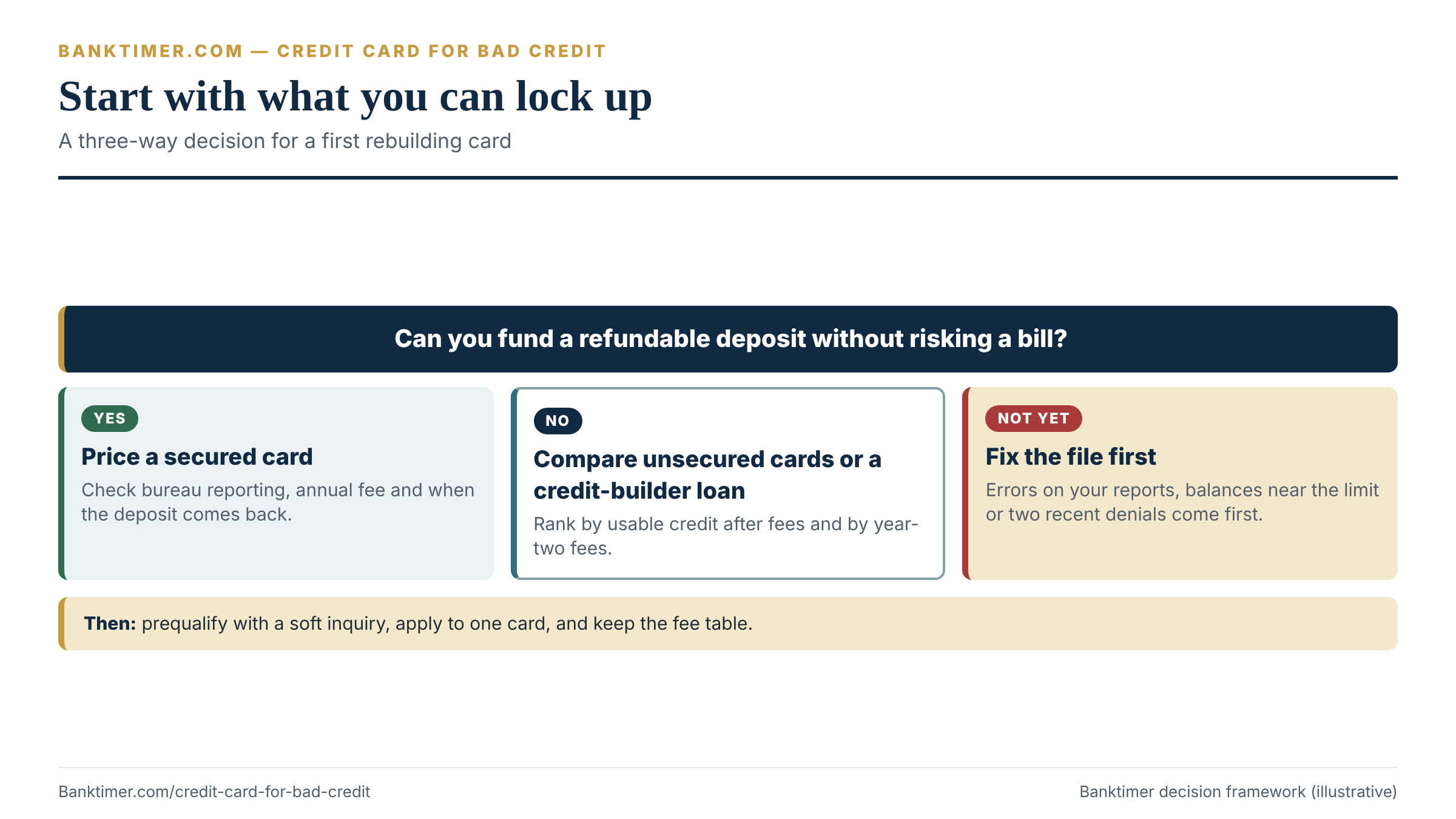
The tree reduces to one rule: lead with what you can lock up, then confirm reporting, then compare usable credit. Fees decide the close calls.
Five Illustrative Scenarios
These are invented examples to show how the framework works. They are not real people and not predictions about any card.
| Scenario | Situation | Likely best-fit route | Why | What to verify |
|---|---|---|---|---|
| A | Score in the 500s, recent collections, $300 spare cash, steady job | Secured card with a deposit of $200 to $300 | The deposit lowers the issuer’s risk, so approval is more plausible | Reporting to all three bureaus, annual fee, deposit refund |
| B | Score near 585, no spare cash for three weeks | Wait for payday, then prequalify; or a credit-builder loan | Avoids a hard pull you cannot yet back with a deposit | Soft-inquiry wording; the loan’s total cost |
| C | Score near 610, two existing cards at 90% of their limits | Pay down balances before adding a card | A new small-limit card adds little if utilization stays high | Statement dates; ability to pay more than the minimum |
| D | Denied twice in 60 days | Stop applying; read the denial reasons | Each hard inquiry is visible to lenders | Reasons in the notice; errors in your reports |
| E | Thin file, no collections, no late payments | Secured card or a store card with reporting | The problem is missing history, not bad history | Whether the issuer reports; the CFPB’s thin-file guidance |
The takeaway from the table is that scenario C and scenario D are not card problems. They are timing and balance problems. A new card does not solve either one.
Reading scenario C more closely
If two existing cards sit at 90% of their limits, the issue is the amount owed, which FICO weighs at 30% of the score. A new $300 card would lower the combined ratio only slightly, and its fees could add to what you owe. Paying down existing balances first often does more. Our guide to credit utilization explains how the ratio is measured and when it is reported.
Reading scenario D more closely
After a denial, the lender must send an adverse action notice. The CFPB says the notice gives either the specific reasons or tells you that you can ask for them within 60 days. If the denial relied on your credit report, the notice must also name the reporting company. It must tell you about your right to a free copy of the report within 60 days. Use that report. It is the cheapest diagnostic tool you will get.
What to Gather Before You Apply
Preparing the file takes an hour and spares you a stalled application. The table below lists what most card applications ask for, why it matters and where to find it.
| Item | Why it matters | Where to get it | How long to keep it |
|---|---|---|---|
| Free credit reports from all three bureaus | Shows what the issuer will see; lets you catch errors | AnnualCreditReport.com | Keep the dated copy for a year |
| Monthly income, including all legitimate sources | The issuer must consider your ability to pay | Pay stubs, benefit letters, bank deposits | Until the account is open |
| Monthly obligations (rent, loans, minimums) | Used to judge your ability to pay | Statements and leases | Until the account is open |
| Social Security number | Issuers may request it to obtain your credit report | Your own records | Do not store in email |
| Proof of the deposit source (secured card) | Funds should come from your own account | Bank statement | Until the deposit is returned |
| Fee table and cardmember agreement | The only binding record of costs | The issuer’s website or application | For the life of the account |
A short note on income: the CFPB says an issuer may ask about your income to judge whether you can make the minimum payment. State it accurately. An overstated income can lead to a limit you cannot handle and to problems later.
For the broader underwriting picture, see our explainer on how credit underwriting works. If checking-account history is part of your problem, our ChexSystems report guide covers that separate system.
- ☐ Is this a credit card, a secured card or a prepaid card?
- ☐ What is every fee, and which ones apply in the first year?
- ☐ What are the fees in year two, according to the agreement?
- ☐ What will my available credit be after fees are billed?
- ☐ Does the issuer report to Equifax, Experian and TransUnion?
- ☐ Is the inquiry soft or hard, and can I prequalify first?
- ☐ If secured, where is the deposit held and when is it returned?
- ☐ Is there a written path to a higher limit or an unsecured card?
- ☐ What is the APR, and is there a penalty APR?
- ☐ Do I have to buy any add-on product to activate the card?
Using the Card Without Paying More Than You Must
Approval is the easy half of owning a credit card for bad credit. How you use a small-limit card determines whether it builds credit or digs a hole. Four habits do most of the work.
Keep reported balances low
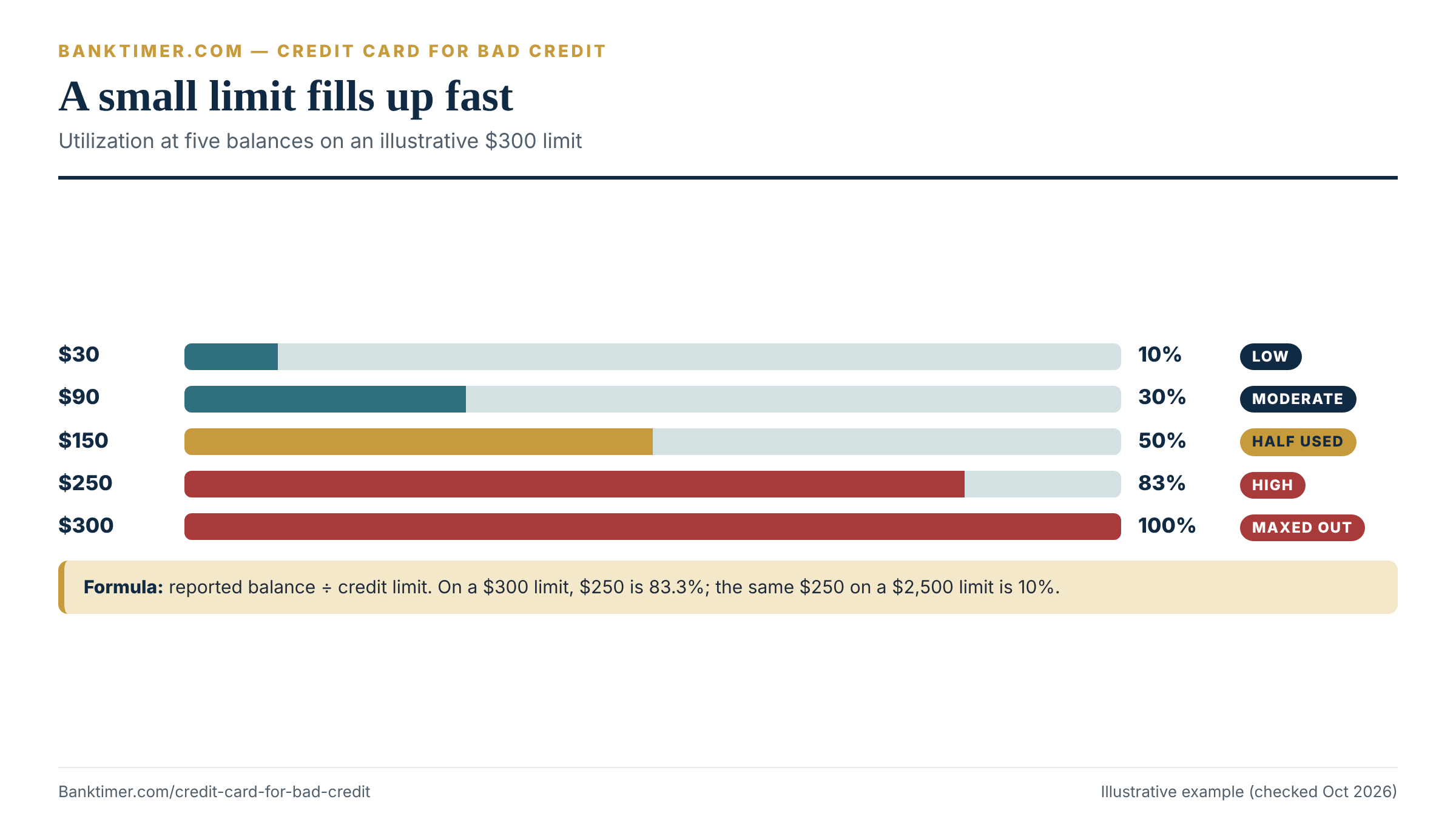
On a $300 limit, a $250 purchase puts you at 83% of your limit. The same $250 on a $2,500 limit is 10%. That is why small-limit cards punish routine spending. Payment history and amounts owed together make up 65% of a FICO score, per myFICO.
| Balance on a $300 limit | Utilization | What it tells a scoring model |
|---|---|---|
| $30 | 10% | A small balance relative to the limit |
| $90 | 30% | A moderate share of the limit in use |
| $150 | 50% | Half the line is used |
| $250 | 83% | Most of the line is used |
| $300 | 100% | The line is maxed out |
The illustration makes one point. The same behavior looks very different depending on the limit, so a tiny line works best as a place for one or two small recurring charges. How the score treats each band is model-specific, so the table shows the ratio itself, not a score effect.
Many issuers report the balance as of the statement date. Ask your issuer when it reports. If you pay down the balance before the statement closes, a lower number may be what gets reported. For the full formula and strategies, see our credit card utilization guide.
Understand the grace period
A grace period lets you avoid interest on new purchases if you pay the full statement balance by the due date. The CFPB’s key-terms page defines it as time you can pay without incurring a finance charge due to a periodic interest rate. Federal rules require card statements to be mailed or delivered at least 21 days before the payment due date. The disclosure table must also say so if a card has no grace period.
That last point matters for bad-credit cards. Some cards do not offer a grace period, which means interest can start the day you buy. Find the grace-period line on the application. Our guide to the credit card grace period explains how it works in practice.
Automate the minimum payment
Late payments cost you twice, in fees and in score. Set autopay for at least the minimum, and pay the full statement balance by hand when you can. The minimum payment guide shows how slowly a balance falls if you pay only the minimum.
Know what can raise your rate
Federal rules limit when an issuer can raise your APR. It generally cannot raise the rate during the first year. Exceptions cover variable-rate cards that follow a public index and promotional rates that expire. After the first year, an issuer can raise rates on new transactions after giving the required notice. The CFPB says issuers generally must give 45 days’ notice before significant changes to card terms.
One exception is the penalty rate. An issuer may increase your rate if it has not received the minimum payment within 60 days after the due date, after the required notice. The commentary to 12 CFR 1026.55 adds a way back. If the issuer receives six consecutive minimum payments on or before the due date, it must reduce the penalty rate. That applies to transactions made before or within 14 days after the notice. Read the penalty-APR line in your agreement. It sits in the same disclosure table as the standard rate.
Know your billing rights
A secured or subprime card is still a credit card. Federal law limits your responsibility for unauthorized charges to $50. You generally have 60 days from the first bill showing a billing error to dispute it in writing, according to the FTC. Those rights do not depend on your score.
A Realistic Rebuild Timeline
Nobody can promise how many points a credit card for bad credit will add. Scores depend on what is already on your reports, on the scoring model used and on how long the history lasts. What you can control is the order of actions. The table lists stages, who controls each and what to do.
| Stage | Typical timing | Who controls it | Your action |
|---|---|---|---|
| Prepare | Before applying | You | Pull reports, fix errors, set a budget |
| Apply and activate | Days to weeks | Issuer decides; you choose the product | Apply to one card; decline add-ons |
| First statement | About one month | Issuer reports | Pay on time; confirm the account appears on your reports |
| Build the pattern | Months 2 to 6 | You | Use the card lightly, pay in full, keep autopay on |
| Review | Around month 6 to 12 | You and the issuer | Compare the card’s fees to others; ask about upgrade rules |
| Decide | Month 12 | You | Keep, upgrade or close, based on the year-two fee schedule |
| Let history age | Years | Time | Accurate negative items fade (seven years; bankruptcy 10) |
The insight here is that nothing in the table requires a high income. It requires steady, boring behavior, which is exactly what a payment history rewards.
Closing a card is not neutral
Before you close a card, remember that closing lowers your total available credit. The CFPB says that can raise your utilization ratio and lower your score. The effect “may be temporary or minor.” Closing can still make sense if the card has annual fees or poor terms. It can also make sense if keeping it open tempts you to take on debt you cannot repay. If a secured card has a fee you no longer want to pay, ask whether the issuer converts it to an unsecured card. A conversion would keep the account open.
When a Card Does Not Fit Right Now
Sometimes the right step is not a credit card for bad credit. If your income is unstable, your reports have errors or you cannot afford a deposit, other paths may do more for less.
| Alternative | Cost | Flexibility | Risk | Best fit |
|---|---|---|---|---|
| Credit-builder loan | Interest or fees; money held until the end | Low; fixed payments | Missing payments hurts credit | People who want forced savings and history |
| Fix report errors first | Free | High | Takes time | Anyone with an inaccurate or mixed-up file |
| Authorized user | Usually free | Depends on the primary holder | Their late payments can affect you | Someone with a trusted family member |
| Store or retail card | Varies; often a high APR | Narrow use | High-APR debt on small purchases | Regular shoppers who pay in full |
| Nonprofit credit counseling | Often low-cost or free | High | Choose a nonprofit; avoid upfront fees | People with several debts |
| Wait and save a deposit | Free | High | Delays rebuilding | Those who cannot yet fund a deposit |
The FTC suggests asking a local credit union, university or military financial manager about nonprofit credit counseling. It also warns that some debt relief firms take money up front and deliver nothing. If you already carry card balances, our guides to credit card debt and a monthly budget cover the repair side. The debt consolidation loan guide covers the borrowing side.
The Mistakes That Cost the Most
Most damage comes from a short list of habits. Check yourself against it before you apply.
- Applying to several cards in a row. Each application creates a hard inquiry that other lenders can see.
- Paying a fee to be approved. A real card does not need you to pay before you read the terms.
- Spending near the limit. A small line makes 80% utilization easy to reach.
- Ignoring year two. The first-year cap ends and the fee schedule can change.
- Assuming the card reports. Confirm it reports to all three bureaus.
- Paying a credit repair firm in advance. That is illegal, and the dispute process is free.
- Letting autopay lapse. One missed due date can trigger a late fee and a mark on your file.
Frequently Asked Questions
Can I get a credit card with a 500 credit score?
Often yes, but usually a secured card or a small-limit subprime card rather than a mainstream one. A score of 500 falls in FICO’s “Poor” band, below 580. Issuers also weigh your income and debts, and no single minimum score applies to every lender. Use soft-inquiry prequalification where offered, apply to one card, and read the fee table before you submit.
Is a secured or unsecured card better for bad credit?
Neither wins every time. A secured card ties your deposit to your limit and usually costs less over a year, but it locks up cash. An unsecured card needs no deposit, but first-year fees can reach 25% of a small limit and may rise later. Compare available credit after fees, year-two costs and bureau reporting.
Do credit cards with no credit check exist?
Not in the sense of zero review. Federal rules require a card issuer to consider your ability to make the minimum payments, using your income or assets and your obligations. Offers that advertise “no credit check” are often prepaid cards, loans or cards that use other data. Ask whether the product is credit, whether it reports to the bureaus, and what fees you owe first.
Does prequalifying for a credit card hurt my credit?
Prequalification tools usually run a soft inquiry, which does not affect your scores. A full application usually runs a hard inquiry, which can. The CFPB notes that prescreening is also a soft inquiry. Check the tool’s wording before you submit anything, and remember that prequalified or prescreened does not guarantee approval.
Can a card issuer charge fees before I use the card?
It can charge some fees at opening, but a creditor generally may not collect any fee before account-opening disclosures are provided. If you reject the plan after seeing the terms, you owe no fees, including application fees, and a membership fee already paid must be refunded. Fees that are billed to the card also reduce your available credit.
What fees does federal law limit on a subprime card?
In the first year, total required fees generally cannot exceed 25% of the credit limit when the account opens. Late, over-limit and returned-payment fees are excluded, as are fees you are not required to pay. A late fee generally cannot exceed the minimum payment due, and over-limit fees require your opt-in. The first-year cap does not apply after year one.
How much deposit does a secured card need?
It varies by issuer. The FTC says the deposit is usually a percentage of the credit limit, up to 100%. The CFPB’s example is a $500 deposit that lets you spend up to $500. Some cards set the limit equal to the deposit, while others may offer more. Check the minimum, the maximum and where the deposit is held.
Will I get my secured card deposit back?
Usually, yes. The FTC says you generally get the deposit back when you pay off the balance and close the account. Terms vary, and fees or unpaid balances can reduce what comes back. Ask how and when the refund works, whether interest is paid and whether the issuer converts accounts to unsecured cards instead.
How long does it take to rebuild credit with a card?
There is no fixed time. Payment history makes up 35% of a FICO score and amounts owed 30%, so steady on-time payments and low balances matter most. Accurate negative items stay on your reports for about seven years, and bankruptcies for 10 years. The reported history from a new card helps over months and years, not days.
Should I apply for several cards at once?
No. Each full application typically creates a hard inquiry, and the CFPB notes that scoring models look at how recently and how frequently you apply. Apply to one card that fits, wait for the decision and read any adverse action notice before trying again. Prequalify first where the tool uses a soft inquiry.
What should I do if my application is denied?
Read the adverse action notice. It gives the reasons or tells you how to ask for them within 60 days. If your credit report was used, you can get a free copy from the reporting company within 60 days of the notice. Fix any errors, address the stated reasons, and wait before you apply again.
Pull your free credit reports today and compare them with your latest bank statements. Fix errors first, then list the fee table for one card you are considering, including year two.
The variable that decides whether a credit card for bad credit helps or hurts is the full fee schedule measured against the credit you actually get to use. A secured card with a refundable deposit and a flat annual fee is often the cheapest path, but it ties up cash. An unsecured card avoids the deposit and can cost more once fees and year-two changes arrive. Either way, confirm that the issuer reports to all three bureaus, decline paid add-ons, keep reported balances low and never pay to be approved. This guide does not cover bankruptcy, collections, student loans, auto loans or state-specific rules, and no card can promise a score. If a fee, a reporting practice or a path to a higher limit is not in writing in the agreement, treat it as not there and keep comparing.
Methodology
Banktimer researched this guide on October 15, 2026. We used primary and official sources first: federal regulations in Regulation Z (12 CFR 1026.5, 1026.51, 1026.52, 1026.55, 1026.56 and 1026.60) as published by the CFPB, CFPB consumer guidance, FTC consumer pages and alerts, the Federal Reserve’s G.19 release, and FICO’s published score ranges and factors. We did not test, call or open any product.
All card terms, fees, deposits, APRs and dollar scenarios are illustrative assumptions we invented to show the math. They are not quotes. The 22.15% and 20.94% figures come from the Federal Reserve’s G.19 release dated October 7, 2026. The 25.2% figure comes from the CFPB’s December 30, 2025 report on 2024 data.
Federal rules apply nationwide, but issuer policies, fee schedules, deposit requirements and reporting practices differ by provider and change often. State laws may add protections for some products. Rule text and commentary were read as published on the CFPB’s regulation pages on the date above. Dollar thresholds that the CFPB adjusts over time were not restated.
Sources
- 12 CFR 1026.52 Limitations on fees, CFPB, checked October 15, 2026
- Official interpretation of 1026.52, CFPB, checked October 15, 2026
- 12 CFR 1026.51 Ability to pay, CFPB, checked October 15, 2026
- 12 CFR 1026.55 Limitations on increasing APRs, CFPB, checked October 15, 2026
- 12 CFR 1026.60 Credit and charge card applications and solicitations, CFPB, checked October 15, 2026
- 12 CFR 1026.5 General disclosure requirements, CFPB, checked October 15, 2026
- What are some ways to start or rebuild a good credit history, CFPB, checked October 15, 2026
- The Consumer Credit Card Market report, CFPB, December 30, 2025
- Comparing credit, charge, secured credit, debit or prepaid cards, FTC, checked October 15, 2026
- What to know about prescreened offers for credit and insurance, FTC, checked October 15, 2026
- Fixing your credit FAQs, FTC, checked October 15, 2026
- G.19 Consumer Credit, Federal Reserve, released October 7, 2026
- FICO score ranges, myFICO, checked October 15, 2026
- What is in your FICO score, myFICO, checked October 15, 2026
By the Banktimer Editorial Team · Published
Banktimer is an independent U.S. consumer-finance publication. Our editors draw on primary and official sources first, such as the CFPB, FDIC, Federal Reserve, and FTC, along with statutes, regulations, and providers’ own agreements and fee schedules. Then we add worked examples and decision tools. Our goal is the most useful, best-supported explanation the sources available to us at the time of writing allow.
This article is general information, not legal, tax, investment, insurance, or financial advice, and reading it does not create a professional relationship with Banktimer. Rates, fees, limits, and rules change, and they vary by state, provider, and contract, so confirm current terms with your bank, lender, insurer, or the agency named in the article before you act. Examples are illustrative unless labeled otherwise. Banktimer is not a bank, lender, insurer, or financial advisor, and we are not responsible for decisions or losses that result from relying on this content. For advice about your own situation, talk to a licensed professional.