
By the Banktimer Editorial Team · Published
Banktimer is an independent U.S. consumer-finance publication. Our editors draw on primary and official sources first, such as the CFPB, FDIC, Federal Reserve, and FTC, along with statutes, regulations, and providers’ own agreements and fee schedules. Then we add worked examples and decision tools. Our goal is the most useful, best-supported explanation the sources available to us at the time of writing allow.
This article is general information, not legal, tax, investment, insurance, or financial advice, and reading it does not create a professional relationship with Banktimer. Rates, fees, limits, and rules change, and they vary by state, provider, and contract, so confirm current terms with your bank, lender, insurer, or the agency named in the article before you act. Examples are illustrative unless labeled otherwise. Banktimer is not a bank, lender, insurer, or financial advisor, and we are not responsible for decisions or losses that result from relying on this content. For advice about your own situation, talk to a licensed professional.
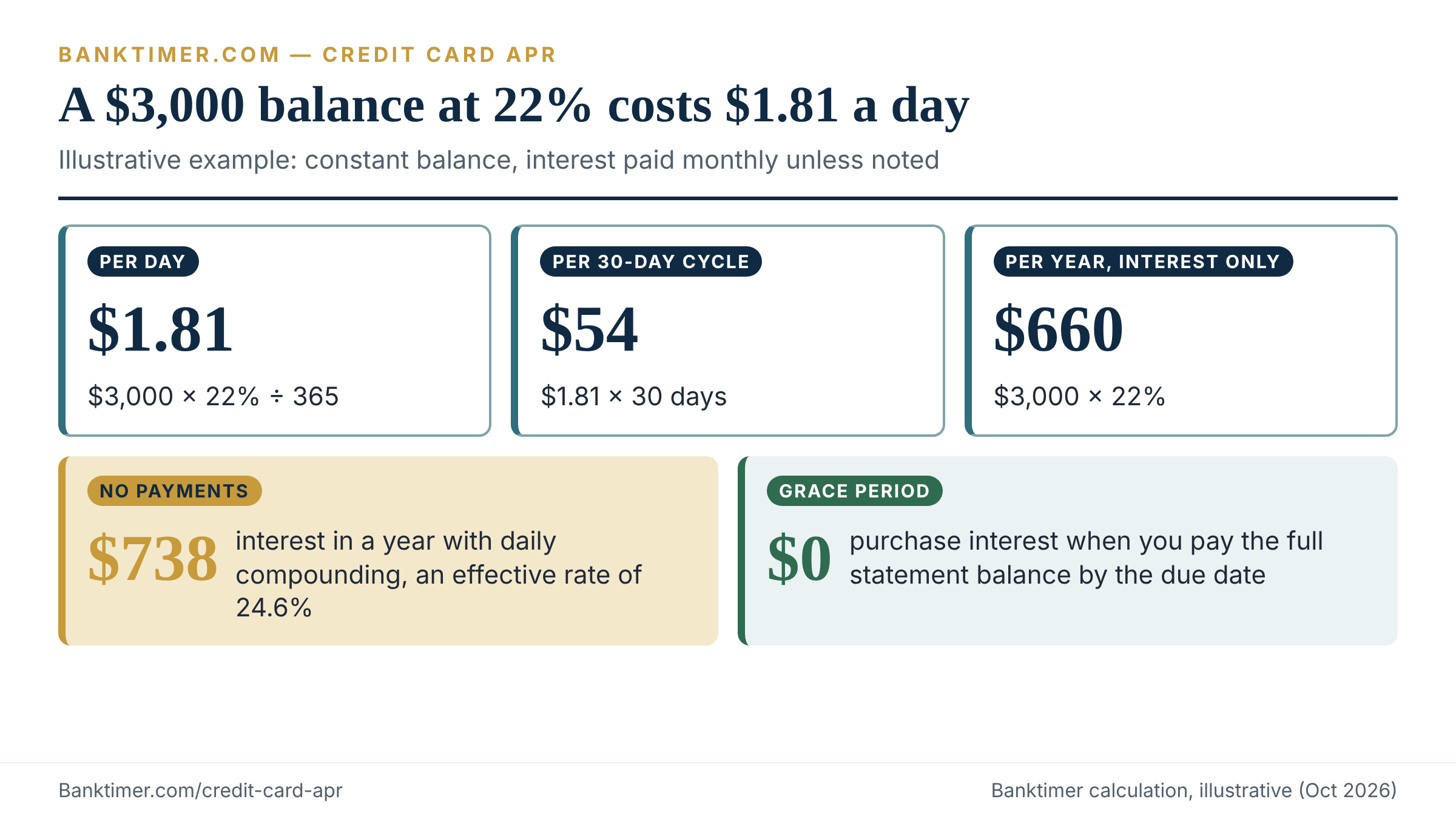
At an illustrative 22% credit card APR, a $3,000 balance costs about $1.81 per day. That is roughly $54 in a 30-day cycle. It is about $660 over a year if you pay only the interest. If you make no payments at all, daily compounding pushes the yearly charge to about $738.
Then there is the switch. Pay the full statement balance by the due date every month, and the purchase rate on most cards charges you nothing. Same card, same 22%, and an interest bill of $0. That switch decides whether APR is a rounding error or the biggest line in your budget. Comparing rates only makes sense once you know which side of the switch you live on.
Credit Card APR in Brief: The Direct Answer
Credit card APR is the yearly price of carrying a balance, but issuers charge it daily. Every 1 percentage point of APR costs about $10 a year for each $1,000 you carry. At 22%, that is roughly $220 a year per $1,000, and a bit more because interest compounds.
If you pay the statement balance in full by the due date, purchases usually cost no interest. APR then bites only on balances you carry, cash advances and balance transfers. APR is also not the whole price. Annual fees, balance transfer fees, cash advance fees and late fees sit outside it.
Six Points to Hold Onto Before the Details
The grace period is the real price switch. Paying the full statement balance by the due date generally means no interest on new purchases. Carry even $1 of the balance and that protection can disappear.
The label understates the yearly cost. Interest compounds daily, so a 22% APR behaves like roughly 24.6% over a year when you make no payments.
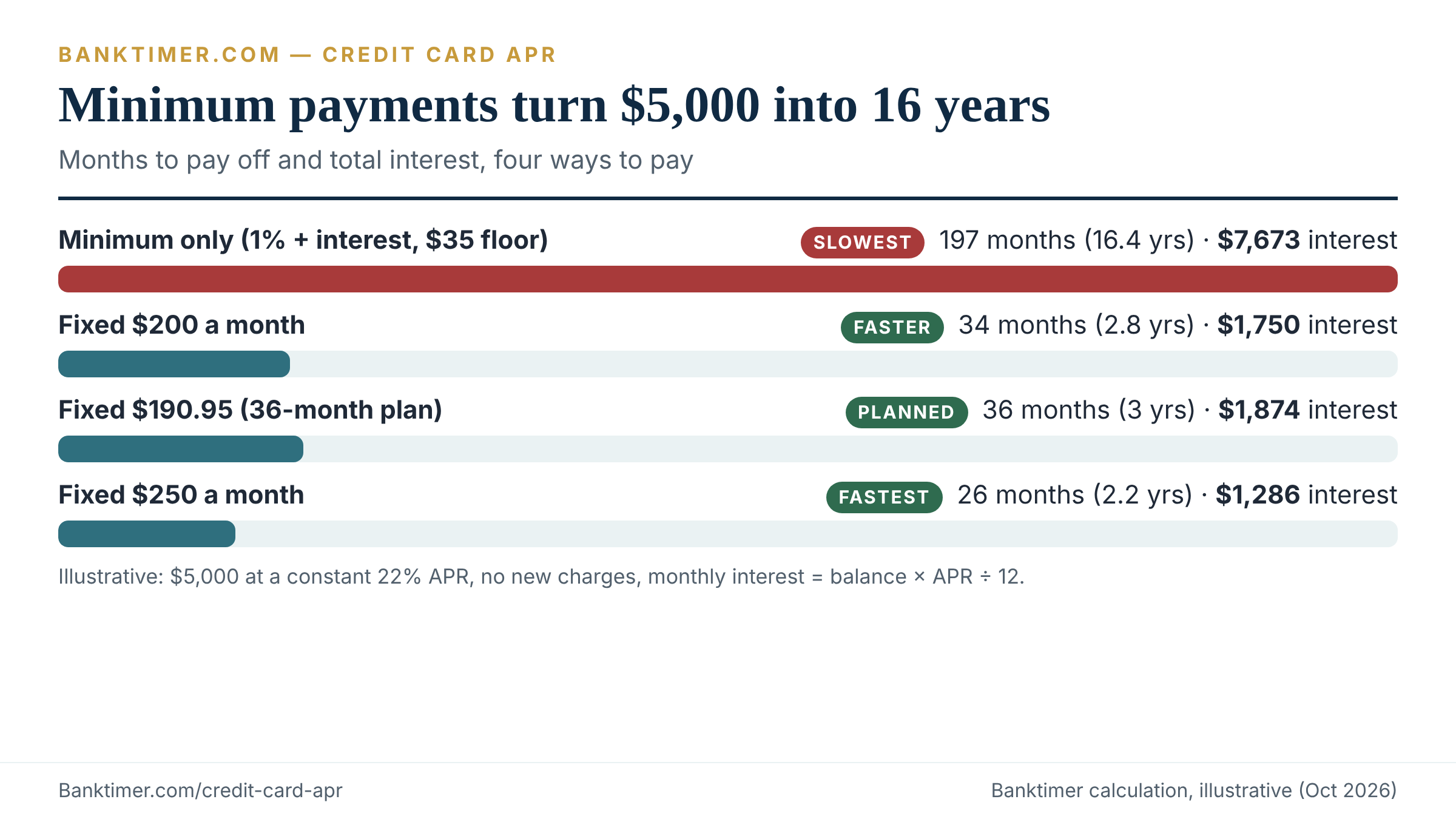
Minimum payments are the slowest, costliest route. On an illustrative $5,000 balance at 22%, a common formula takes about 16 years. The interest comes to about $7,673.
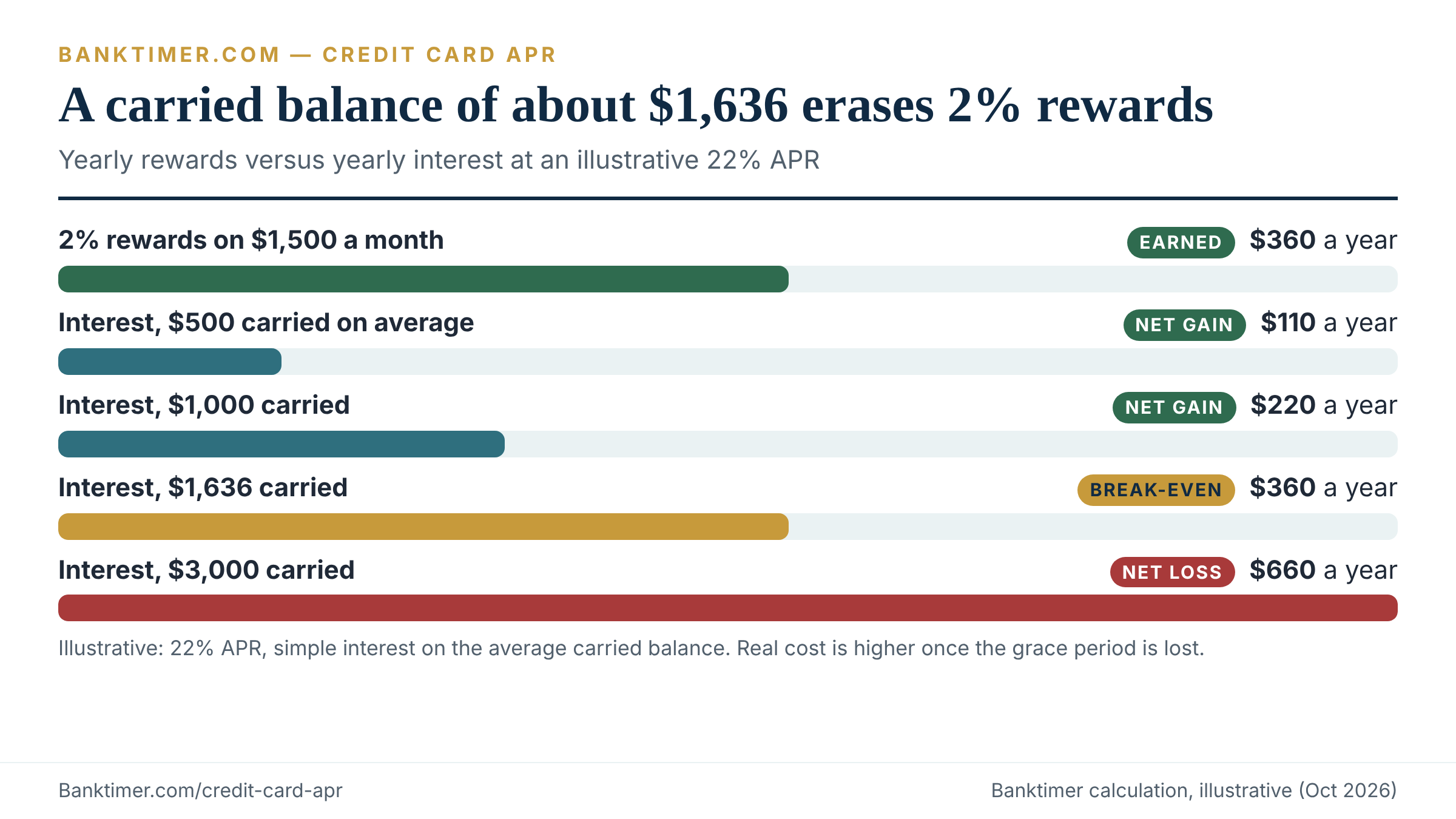
Rewards can lose to interest quickly. A 2% card earns $360 a year on $1,500 of monthly spending. An average carried balance of about $1,636 erases it.
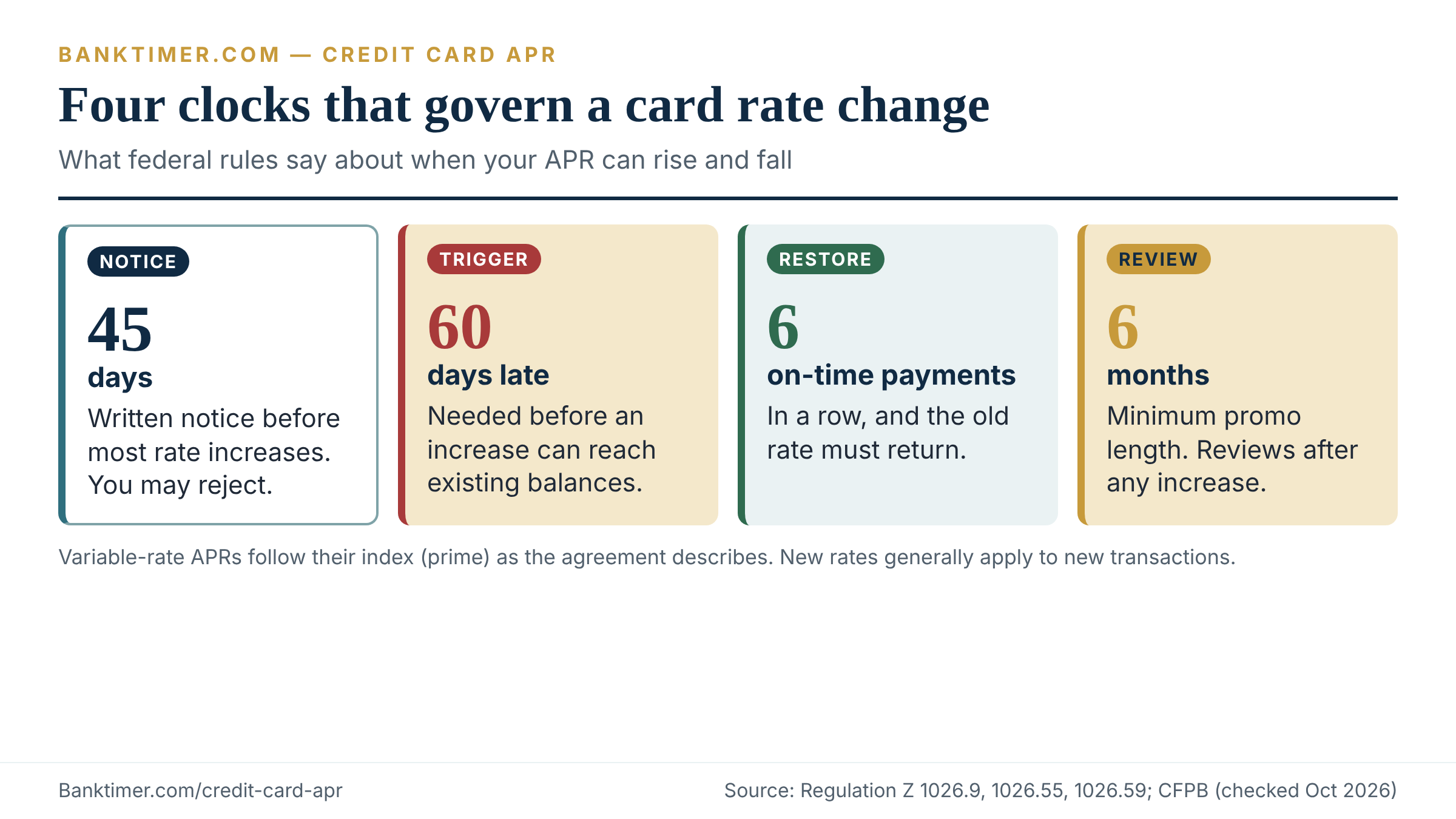
Your rate can change, but only under rules. Expect 45 days of notice for most increases. Existing balances can be hit only after a payment is 60 days late. Reviews follow every six months.
Compare cards by net annual cost at your balance. The card with the lowest APR is not automatically the cheapest for you. Fees, rewards and your payment habits move the answer.
The Numbers That Frame Credit Card APR
Before the mechanics, here is the market backdrop. These are published averages, not offers. Your own rate depends on your credit profile, the card and the date you applied. The point of the table is scale. A typical interest-bearing card balance in 2026 costs more than 20% a year.
One distinction matters in the first two rows. The Federal Reserve’s “all accounts” figure averages the stated APR across every card. The “accounts assessed interest” figure measures what revolving cardholders actually paid. It divides finance charges by the average daily balances charged.
| Measure | Latest value | Source and date |
|---|---|---|
| Average APR, all card accounts, Q2 2026 | 20.94% | Federal Reserve G.19, released September 8, 2026 |
| Average APR, accounts assessed interest, Q2 2026 | 22.15% | Federal Reserve G.19, released September 8, 2026 |
| Average APR, general purpose cards, 2024 | 25.2% | CFPB Consumer Credit Card Market report, December 30, 2025 |
| Average APR, new general purpose accounts opened in 2024 | 27.5% | CFPB Consumer Credit Card Market report, December 30, 2025 |
| Bank prime rate | 7.00%, effective September 17, 2026 | Bank notices after the September 16, 2026 FOMC decision |
| Interest assessed on U.S. credit cards in 2024 | $160 billion (up from $105 billion in 2022) | CFPB Consumer Credit Card Market report |
| Credit card balances, Q2 2026 | $1.26 trillion | New York Fed Household Debt and Credit report, August 11, 2026 |
| Personal loans, 24-month, commercial banks, May 2026 (for contrast) | 11.86% | Federal Reserve G.19 |
The gap between 22.15% and 11.86% is the first useful comparison in this article. It does not mean a personal loan is available to you at that rate. It does show how much room exists between “standard card rate” and “installment loan rate” for borrowers who qualify.
What Credit Card APR Actually Measures
APR stands for annual percentage rate. On a credit card, it is the interest rate expressed as a yearly figure. It is the standard label the law requires issuers to use, so you can compare cards on one scale. It is not the amount you pay in a year, and it is not an all-in price.
APR Is a Yearly Label on a Daily Charge
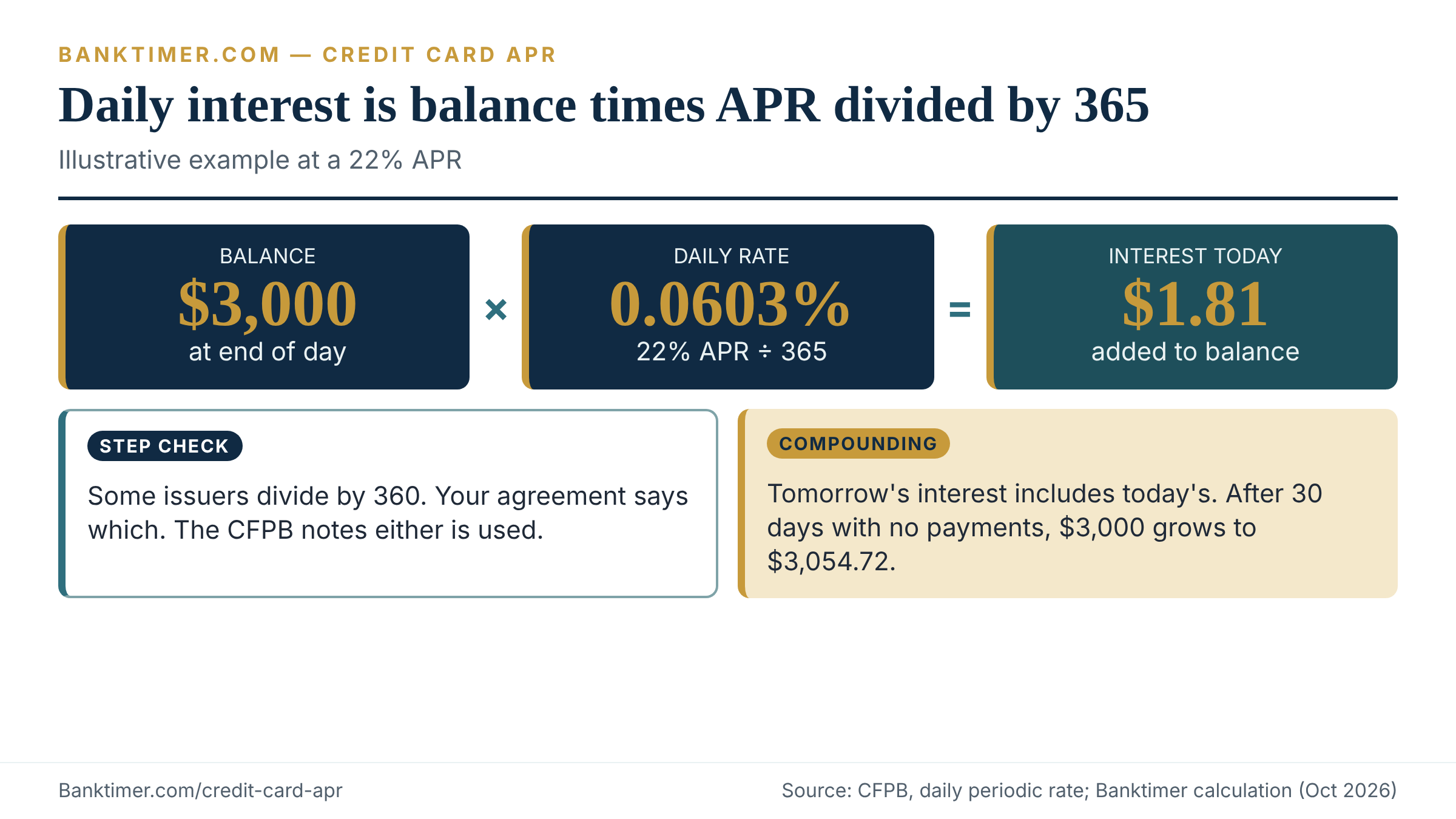
Most issuers calculate interest daily. The Consumer Financial Protection Bureau (CFPB) explains that the daily periodic rate is the APR divided by either 360 or 365. The issuer decides which. It multiplies that daily rate by your balance at the end of each day. It then adds the result to the balance, so tomorrow’s interest includes today’s interest.
The math is plain. A 22% APR divided by 365 gives a daily rate of 0.06027%. On $3,000, that is $1.81. Over 30 days it is $54.25 before compounding, and slightly more after it.
Your statement must show each periodic rate as an APR. It must also show the balance to which the rate was applied. Federal rules (Regulation Z, section 1026.7) call that figure the Balance Subject to Interest Rate. If your statement lists several rows there, you have several APRs on one card, a subject covered below.
Why the Same APR Costs More Over a Full Year
Interest is added to the balance daily. As a result, the yearly cost of an unpaid balance runs higher than the APR. The effective annual rate is (1 + APR ÷ 365) raised to the 365th power, minus 1. It is a Banktimer calculation for understanding the stakes, not a figure the issuer discloses.
The table shows what a $3,000 balance would cost at five illustrative APRs. “Interest only” means you pay each month’s interest in cash and never touch the principal. “No payments” means interest compounds all year.
| Illustrative APR | Per day | Per 30 days | Year, interest paid monthly | Year, no payments (compounding) | Effective annual rate |
|---|---|---|---|---|---|
| 15.00% | $1.23 | $36.99 | $450 | $485 | 16.2% |
| 20.00% | $1.64 | $49.32 | $600 | $664 | 22.1% |
| 22.00% | $1.81 | $54.25 | $660 | $738 | 24.6% |
| 25.00% | $2.05 | $61.64 | $750 | $852 | 28.4% |
| 29.99% | $2.46 | $73.95 | $900 | $1,049 | 35.0% |
All figures are illustrative and assume a constant $3,000 balance. The pattern is the useful part. Every 5 points of APR adds roughly $150 a year to a $3,000 balance. The compounding gap also widens as the rate climbs.
APR Is Not APY, and That Is Worth Knowing
You will see annual percentage yield (APY) on savings accounts, where compounding is part of the number. Credit cards do not quote APY. They quote APR, which leaves compounding out. A savings account paying 4.20% APY and a card charging 22% APR use different yardsticks, even though both compound.
Compare cards with other cards using APR. Use the effective rate only to size the real yearly drag of a balance you plan to carry.
What APR Leaves Out
A loan’s APR may fold in certain lender fees. A credit card’s purchase APR is essentially the interest rate. It excludes the annual fee and the balance transfer fee. It also leaves out the cash advance fee, the foreign transaction fee, late fees and returned-payment fees. Federal rules require those to be disclosed separately in the standardized application table, often called the Schumer box.
That is why a 19% card with a $95 annual fee can cost more than a 23% card with no fee. It depends on your balance. The fee section below runs those numbers.
How the Interest Is Computed, Step by Step
Your credit card APR is only a rate. The interest charge is that rate applied to your balance over time, and you can verify it yourself. The statement lists the rate, the balance subject to it and the days in the cycle. The method behind it varies by issuer. The common version is an average daily balance, and federal rules limit how far an issuer can stretch it.
The Average Daily Balance in a 30-Day Cycle
Here is an illustrative cycle. You start with a $3,000 balance at a 22% APR. On day 11 you pay $500. On day 21 you buy $200 of groceries. The issuer tracks the balance at the end of every day.
| Days in cycle | Days | Daily balance | Balance × days |
|---|---|---|---|
| Days 1 to 10 | 10 | $3,000 | $30,000 |
| Days 11 to 20 (after $500 payment) | 10 | $2,500 | $25,000 |
| Days 21 to 30 (after $200 purchase) | 10 | $2,700 | $27,000 |
| Total | 30 | Average daily balance: $2,733.33 | $82,000 |
Multiply the $2,733.33 average by the daily rate (22% ÷ 365) and by 30 days. The interest charge is $49.42. If the issuer compounds inside the cycle, it comes to $49.87. Had you made no payment and no purchase, the same 30 days would have cost $54.25.
Why a Mid-Cycle Payment Saves Less Than You Expect
The $500 payment cut that cycle’s interest by only about $4.83, after netting out the $200 purchase. A payment reduces the balance from the day it posts. A payment made 11 days into a cycle can save only about 20 days of interest on that $500. The bigger effect arrives in later cycles, when the lower balance carries forward.
This is also why paying early in the cycle beats paying on the due date, but only modestly. If your goal is to stop interest entirely, the lever is the grace period, not the payment date. We take that up in the grace period section below.
Methods Differ, and One Method Is Banned
Issuers may use a daily balance, an average daily balance or another documented method. A Chase cardmember agreement from 2017 describes a daily balance method that includes new transactions. It divides the APR by 365. Banktimer uses it only as a dated structural example. Other issuers divide by 360.
The method must appear in the application table. One method is off the table. Regulation Z, section 1026.54, bars issuers from using balances from earlier billing cycles to compute interest after you lose a grace period. People often call this the two-cycle billing rule. For a longer walk through the arithmetic, see the guide to how credit card interest is calculated.
Check Your Own Statement in Four Steps
You do not need a calculator app to test an interest charge. A short routine is enough.
- Find each periodic rate on the statement and the Balance Subject to Interest Rate beside it.
- Divide the APR by 365, or by 360 if your agreement says so, to get the daily rate.
- Multiply the daily rate by the balance and by the days in the cycle.
- Compare the result with the interest charge shown.
Small gaps are normal. Balances change daily, and compounding adds pennies. A gap of several dollars is worth a call. Ask the issuer which balance method it uses and how it treated recent payments and purchases.
How Payments Are Split Across Balances
Many cards carry several balances at several rates. How the issuer applies your payment then changes your cost. Under Regulation Z, section 1026.53, any amount above the required minimum goes first to the balance with the highest APR. The rest follows in descending order of rate. The minimum itself can be applied however the issuer’s agreement says.
Suppose you owe $2,000 in purchases at 22% and $3,000 transferred at a 0% promotional rate. Your minimum is $100, and you pay $500. The $400 above the minimum goes to the 22% purchase balance first. That order saves you the most interest.
There is one exception for deferred-interest promotions. During the two billing cycles before such a promotion ends, the excess goes to the deferred-interest balance first.
The Different APRs on One Card
A single card usually carries several rates. Banktimer’s pillar guide to credit cards puts them in the wider context of fees and fine print. The advertised credit card APR is the purchase APR. The cardmember agreement lists the others, and your periodic statement shows each one with the balance it applies to.
The APR Types and What Changes Between Them
| APR type | What it applies to | Grace period | How it can change | What to check |
|---|---|---|---|---|
| Purchase APR | New purchases | Usually yes, if you pay the full statement balance by the due date | Variable with an index, or fixed with notice | Margin over prime; whether carrying a transferred balance removes the grace period |
| Cash advance APR | Cash advances; the agreement defines which transactions count | Typically none; interest starts at once | Usually variable and often higher than purchase APR | The separate cash advance fee and the transaction definition |
| Balance transfer APR | Amounts moved from another card | Typically none on the transferred amount | Promotional rate, then a standard rate | Promo length, transfer fee, post-promo rate |
| Introductory APR | Purchases, transfers or both for a set period | Depends on the card | Must last at least six months unless you are more than 60 days late | End date, post-promo rate, and whether it is true 0% or deferred interest |
| Penalty APR | Possibly new transactions; existing balances only after 60+ days late | Depends on the agreement | Triggered by late payment as the agreement defines | The trigger language in the application table |
Two lessons come out of the table. First, the grace period belongs to purchases, not to cash advances or most transfers. Second, the lowest advertised APR on a card may apply only to one slice of what you do with it.
Fixed Versus Variable: Prime Plus a Margin
A variable APR equals an index plus a margin. The CFPB gives the prime rate published in The Wall Street Journal as a typical index. The margin is the issuer’s markup, and it stays put unless the agreement changes.
For example, a card might charge the prime rate of 7.00% plus a 15.00-point margin, which equals an illustrative 22.00% APR. When prime moves, the APR moves with it. A fixed APR does not follow an index, but the issuer can still change it after proper notice.
Neither type is cheaper by nature. A variable APR exposes you to every move in prime, up or down. A fixed APR does not track the index, but it can still rise after notice. Compare the starting rate, the margin and how long you expect to carry the balance.
Margins matter more than most shoppers realize. The CFPB reported that the average APR margin on general purpose cards reached a record 16.4 points in 2024. Because margins are an issuer decision, they explain why two cards on the same prime rate can differ by 10 points or more.
What the September 2026 Rate Increase Means for Your Card
On September 16, 2026, the Federal Open Market Committee raised its target range for the federal funds rate by 0.25 percentage point, to 3.75% to 4.00%. Banks moved prime from 6.75% to 7.00% the next day. Variable-rate card APRs generally follow within one to two billing cycles, according to guidance from one large bank.
Run the numbers before worrying. A quarter point on a $3,000 balance is $7.50 a year. On $6,000 it is $15. The increase is real, but it is small next to a 15-point margin, a $95 fee or a missed grace period.
Penalty APR: A Rate That Needs a Trigger
A penalty APR is a higher rate the issuer can apply after certain events, usually a late payment. Regulation Z, section 1026.55, limits how far it can reach. An issuer may raise the rate on an existing balance only if your minimum payment is more than 60 days late. Once you make six consecutive on-time minimum payments after the increase, the issuer must restore the previous rate.
On new transactions, an issuer may apply a higher rate after sending notice. For illustration, a move from 22% to 29.99% on a $4,000 balance adds about $320 a year, or roughly $27 a month.
The Grace Period: The Switch That Makes APR Irrelevant
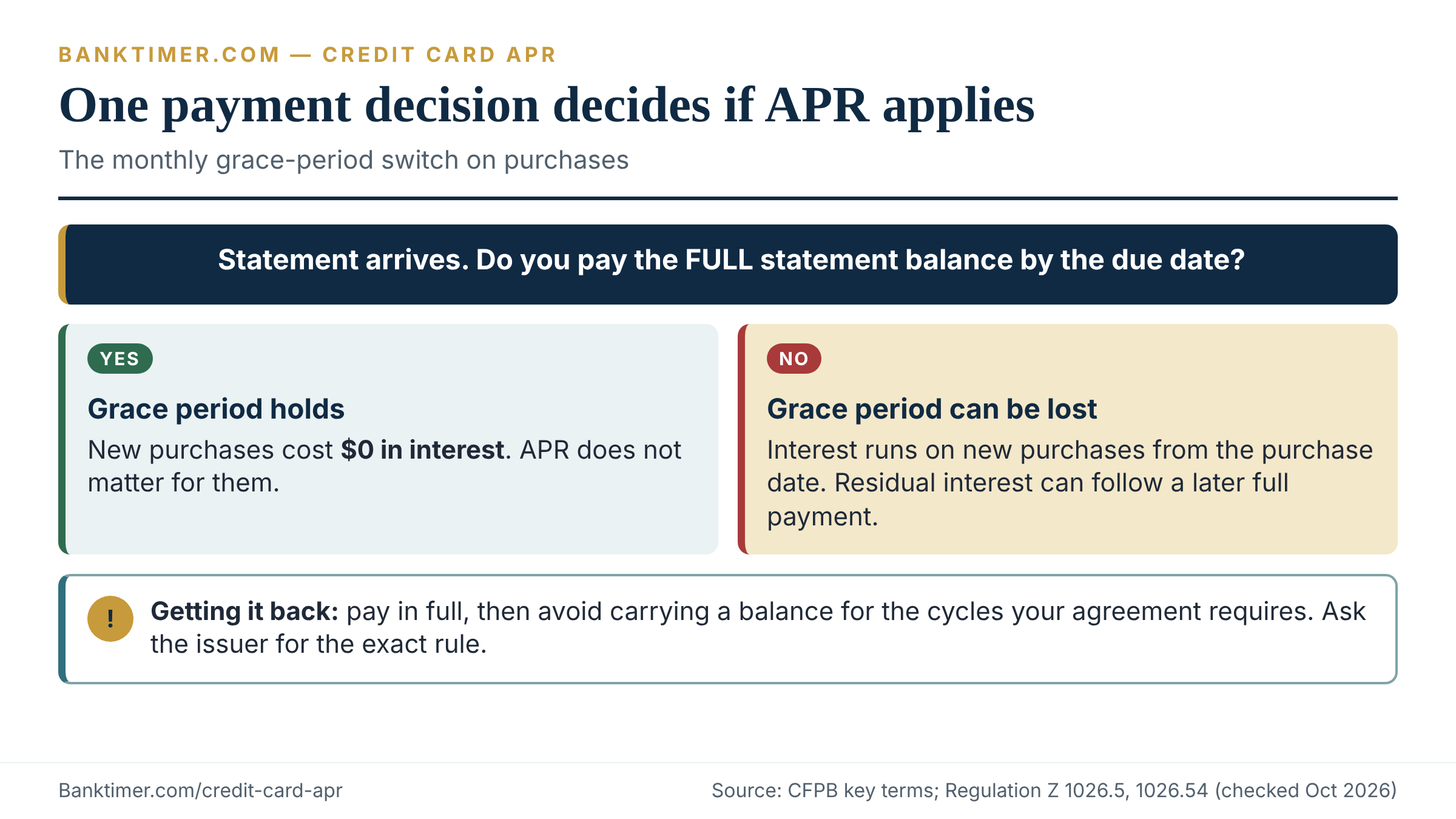
A grace period is the stretch between the end of a billing cycle and the payment due date. The CFPB defines it as the time during which you may not be charged interest. The condition is that you pay the balance in full by the due date. It is the single most valuable feature on a card for anyone who does not need to borrow. Banktimer’s guide to the credit card grace period covers the edge cases. For those cardholders, credit card APR never comes into play.
How the Grace Period Works
Two details shape it. First, Regulation Z requires issuers to deliver the periodic statement at least 21 days before the payment due date. A payment received within 21 days of delivery cannot be treated as late. Second, the CFPB explains that the grace period usually applies only to new purchases. It also applies only if you were not already carrying a balance.
Individual issuers often give more than 21 days. The 2017 Chase agreement referenced earlier describes a minimum of 25 days after the close of each billing cycle. That figure belongs to that agreement. Check yours.
How You Lose It
Pay less than the full statement balance, and the grace period typically stops covering your purchases. New purchases then start accruing interest from the date of the transaction, not the due date. The cost of the unpaid slice is small. The cost of everything else you buy while it exists is not.
Your statement balance is $1,500. You pay $1,300 and carry $200 at an illustrative 22% APR. Interest on the $200 for 30 days is about $3.62. That part looks harmless.
Now suppose you also charge $800 in new purchases. They sit for about 40 days between the purchase date and your next full payment. With no grace period, those purchases accrue about $19.29 of interest. The $200 you carried triggered a cost more than five times its own interest.
Residual Interest: Why “Paid in Full” Can Still Leave a Charge
Suppose you carried a balance last cycle. This month you pay the full statement balance of $1,200 on the due date. Many issuers still charge interest for the days between the statement closing date and the day your payment arrives. At an illustrative 22% and 25 days, that is about $18.08. It appears on the next statement. Cardholders call it residual or trailing interest.
It surprises people because they paid exactly what the statement said. The statement balance does not include the interest that builds up afterward. Your agreement describes how your issuer handles it. A call to the issuer for a payoff figure on a specific date removes the guesswork.
How to Get the Grace Period Back
Issuers set the reinstatement conditions in the cardmember agreement. The usual pattern is to pay the full balance, including any residual interest. Then you avoid carrying a balance for one or more consecutive cycles. The exact number of cycles varies, so read the agreement or ask.
While you wait, pay the whole balance as soon as it posts. Avoid new purchases on that card if you can. Those two moves limit the interest to the residual charge and then end it. A different card can carry your purchases for a cycle or two without disturbing the first one.
Grace Period Rules and Their Limits
| Rule | Applies when | Catch or exception | Source | What you do |
|---|---|---|---|---|
| Statements delivered at least 21 days before the due date | Open-end credit card accounts | A payment received within 21 days of delivery cannot be treated as late | Regulation Z, § 1026.5(b)(2)(ii) | Note the statement delivery date, not just the due date |
| No interest on purchases if you pay the full statement balance by the due date | Your card has a grace period and you paid the prior balance in full | Usually covers purchases only, not cash advances or most transfers | CFPB definitions; your agreement | Pay the statement balance, not the minimum |
| No interest charged on balances from prior cycles after you lose a grace period | You lose the grace period | Interest for days after the statement closing date can still accrue | Regulation Z, § 1026.54 | Ask for a same-day payoff amount |
| Interest on a closed account | You close the account with a balance | The issuer can keep charging interest and you owe at least the minimum | CFPB guidance | Pay the balance off before closing, where you can |
The CFPB’s 2025 market report found that roughly half of card accounts revolve a balance, a share back to pre-pandemic levels. The other half is effectively using the grace period. Issuer interest income comes from the revolving half, a point the issuer-economics section returns to.
Minimum Payments: The Slowest Way to Pay
The minimum payment keeps an account current. It does not shrink the debt at a pace anyone would choose. Federal rules do not set one universal formula, so each issuer writes its own in the cardmember agreement.
How a Minimum Payment Formula Works
Most formulas combine a flat floor with a percentage of the balance, plus the interest and any fees billed. The 2017 Chase agreement uses the larger of two figures. One is $25. The other is the sum of 1% of the new balance, the periodic interest charges and late fees. A 2016 Chase agreement lists the largest of $10, 2% of the new balance, or that same 1%-plus-interest sum. Both are dated examples. Yours may differ.
Because the formula includes interest, the first minimum on an illustrative $5,000 balance at 22% is about $141.67. That is $50 for the 1% and about $91.67 in interest. As the balance falls, the payment falls with it. That declining payment is what drags the payoff out.
Minimum Payment Versus Fixed Payments
The table compares four ways to pay the same illustrative $5,000 balance. It assumes a constant 22% APR and no new charges. It uses monthly interest of balance × APR ÷ 12, a standard simplification.
| Payment approach | Monthly payment | Months to pay off | Total interest | Total paid |
|---|---|---|---|---|
| Minimum only (1% + interest, $35 floor) | Starts near $142, then falls | 197 months (16.4 years) | $7,673 | $12,673 |
| Fixed payment to finish in 36 months | $190.95 | 36 months | $1,874 | $6,874 |
| Fixed $200 | $200 | 34 months (2.8 years) | $1,750 | $6,750 |
| Fixed $250 | $250 | 26 months (2.2 years) | $1,286 | $6,286 |
The jump from the first minimum of about $142 to a fixed $200 costs roughly $58 more per month. It trims the payoff from more than 16 years to under three and saves roughly $5,900 in interest. Each extra dollar you pay avoids a dollar of 22% interest.
The Payoff Box on Your Statement
Regulation Z requires the statement to include a Minimum Payment Warning. It must estimate how many months you would need to pay off the balance with only minimum payments. It must state the total cost of that path. It must also show the monthly payment that would clear the balance in 36 months, with its total cost.
The estimate rests on assumptions written into Appendix M1 of Regulation Z. They are no new charges, a constant APR and minimum payments only. The result must land within two months of the accurate calculation. If your APR is variable or you keep spending on the card, the real timeline will differ. Treat the 36-month figure as a benchmark that the issuer calculated for you.
When the Minimum Is a Reasonable Choice
The CFPB found that about 15% of general purpose cardholders paid only the minimum in 2024. Some people have simply never read the payoff box. Others face a cash-flow squeeze, where a late fee or a credit-report mark would cost more than the extra interest.
Paying the minimum to stay current is a rational bridge in those months. It is a weak plan for years. If you cannot pay more than the minimum, call the issuer before you miss a payment. Ask what hardship options exist. Banktimer covers the mechanics of that call in its guide to credit card minimum payments.
When to Pay: Due Date, Statement Date or Both
Match the payment to the goal. To avoid interest, pay the full statement balance by the due date. Mind the time as well as the date. The 2017 Chase agreement refers to paying by the due date and time, so check your cutoff time as well as the date.
To lower the balance that gets reported to the credit bureaus, pay part of it before the statement closes. If you carry a balance, pay as early as your cash flow allows, because each day of a lower balance saves a day of interest. Autopay of the statement balance handles the first goal without effort. A second manual payment handles the second.
When Your Credit Card APR Can Change
A credit card APR is not a lifetime promise. It can rise under several defined circumstances, and Regulation Z limits each one. Knowing the circumstances tells you which increases to expect and which you can contest.
Rate-Change Rules at a Glance
| Event | Can the issuer raise the APR? | Notice and limits | Source |
|---|---|---|---|
| Variable-rate index moves | Yes, the APR follows the index | Follows the agreement’s index and margin terms | Regulation Z, § 1026.55(b)(2) |
| Issuer raises the rate on new purchases | Yes, for new transactions only | Written notice at least 45 days before the effective date; right to reject | Regulation Z, §§ 1026.9(c), 1026.55(b)(3) |
| Introductory rate ends | Yes, to the disclosed standard rate | Promotional period must last at least six months | Regulation Z, § 1026.55(b)(1) |
| Minimum payment is more than 60 days late | Yes, on existing balances too | Must reinstate the old rate after six consecutive on-time payments | Regulation Z, § 1026.55(b)(4) |
| After any rate increase | Issuer must review the increase | Review at least every six months; reduce within 45 days of a review where appropriate | Regulation Z, § 1026.59 |
What to Do When a Rate-Increase Notice Arrives
You generally have the right to reject a significant change before it takes effect. The CFPB explains the trade-off. The issuer may respond by closing the account. You then repay the existing balance on the old terms. Closing a card can lower your available credit and raise your utilization ratio, which can affect your scores.
Run a short test before you decide. If you pay in full each month, the new rate costs you nothing. Rejecting it is rarely worth the lost account. If you carry a balance, compare the new rate against what the alternatives in this article would cost you.
Rate Reviews After an Increase
The issuer must review any increase every six months and reduce the rate where factors warrant. The word “appropriate” in the rule gives the issuer discretion, so a review is not a guarantee of relief. You can still ask about it in writing and keep a copy of the answer.
The path back after a 60-day delinquency is cleaner. Make six consecutive on-time minimum payments, and the old rate returns. That rule is in the regulation, not an issuer favor.
Fees That Change What Credit Card APR Means
Credit card APR describes interest. Fees describe everything else, and several of them can erase a lower rate. The table lists the charges that most often change the real cost of a card. Dollar figures are illustrative unless attributed to a dated source.
| Fee | Trigger | Typical basis | Illustrative example | Avoidable? |
|---|---|---|---|---|
| Annual fee | Holding the card for a year | Flat dollar amount; in the first year most fees combined are capped at 25% of the credit limit | $95 a year | Yes, by choosing a no-fee card or by using the benefits |
| Late fee | Missing the due date | Capped at the minimum payment due; safe-harbor limits apply | Often $30 or so for a first offense | Yes, with autopay of at least the minimum |
| Returned-payment fee | A payment bounces | Same cap rules; one penalty fee per event | Up to the minimum payment due | Yes, by keeping funds in the linked account |
| Cash advance fee | Cash or cash-like advance | Greater of a flat amount or a percentage (a 2016 Chase agreement: $5 or 3%) | 5% of $500 = $25 | Yes, by not taking advances |
| Balance transfer fee | Moving a balance in | Greater of a flat amount or a percentage (same 2016 agreement: $5 or 3%) | 3% of $6,000 = $180 | Only by not transferring |
| Foreign transaction fee | Purchases processed abroad | Percentage of the purchase (3% in the 2016 agreement) | $30 on $1,000 | Yes, with a card that waives it |
Annual Fees: The Break-Even Is Simple Math
A $95 annual fee must be earned back by benefits. If the benefit is a 2% reward rate, you need $4,750 of yearly spending just to cover the fee (95 ÷ 0.02). Below that, the fee costs more than it returns. Above it, the net value grows slowly.
The fee also changes the APR comparison. A card at 19% with a $95 fee costs less than a no-fee card at 23% only if you carry more than about $2,375 on average (95 ÷ 0.04). Carry less than that, and the no-fee card wins despite the higher rate. Banktimer’s guide to the credit card annual fee extends this calculation.
Late Fees and the Status of the CFPB Rule
In March 2024 the CFPB finalized a rule that would have cut the late-fee safe harbor to $8 for issuers with at least one million open accounts. A federal court in the Northern District of Texas vacated that rule on April 15, 2025. The earlier safe-harbor structure came back. It sets one dollar amount for a first late payment and a higher one for a repeat within six billing cycles, adjusted over time. Industry analyses of the order put the amounts at $30 and $41.
Two older limits still apply. A late fee cannot exceed the minimum payment that was due. A $15 minimum caps the fee at $15. And an issuer cannot charge both a late fee and a returned-payment fee for the same event. In July 2026 the CFPB sent a request for information about late fees to the federal regulatory review office. That is an early information-gathering step, not a proposed rule. See the guide to the credit card late fee for updates.
Cash Advances: The Costliest Dollar on the Card
A cash advance usually combines three costs, covered in more depth in the guide to a credit card cash advance. There is an upfront fee, a higher APR and no grace period. The 2016 Chase agreement shows the shape. Purchases ran at the prime rate plus 6.65 points. Cash advances ran at prime plus 15.74 points. The fee was the greater of $5 or 3%.
Assume an illustrative 5% fee ($25) and a 29.99% cash APR with no grace period. Thirty days of interest is about $12.32. The total is $37.32 on $500, or 7.5% for one month. Annualized, that is far more than the headline APR suggests. On short borrowing, the fee matters more than the rate.
Balance Transfer and Foreign Transaction Fees
A balance transfer fee is a percentage of the amount moved. The section on promotional rates below shows how it shapes the math. A foreign transaction fee is a percentage of purchases made abroad or processed by a foreign bank. Banktimer breaks it down in the guide to the credit card foreign transaction fee.
Promotional Rates: True 0% Versus Deferred Interest
A promotional rate is a temporary credit card APR, usually on purchases or balance transfers. The CFPB says an introductory rate has to stay in effect for at least six months. The exception is a payment more than 60 days late. After that, the standard APR applies to whatever is left. The guide to the 0% APR credit card goes deeper on purchase offers.
What a Balance Transfer Actually Saves
Take a $6,000 balance on a 22% card. Move it to a card with a 3% fee and a 0% rate for 15 months. That can save most of the interest, but only if you pay down the balance before the promotion ends. The transferred amount here is $6,180 including the fee.
| Scenario (illustrative) | Monthly payment | Balance after 15 months | Fee plus interest, total | Result vs. staying put |
|---|---|---|---|---|
| Stay on the 22% card | $400 | Paid off in 18 months | $1,081 interest | Baseline |
| Transfer: 3% fee, 0% for 15 months | $400 | $180 left, cleared in month 16 | $183 ($180 fee + $3 interest) | About $898 less |
| Stay on the 22% card | $200 | Paid off in 44 months | $2,791 interest | Baseline |
| Transfer: 3% fee, 0% for 15 months | $200 | $3,180 left at 22% | $794 ($180 fee + $614 interest) | About $1,997 less, but 34 months to finish |
To clear $6,180 in exactly 15 months, you would pay $412 a month. The transfer works best when that payment fits your budget. If it does not, a monthly budget built around paydays shows where the money can come from. It still helps when it does not, because the 15 interest-free months cut the cost. The end-of-promotion balance then compounds at the standard rate. See the guide to a balance transfer credit card for the transfer mechanics.
Deferred Interest: The Promotion That Looks Free
A true 0% offer says “0% intro APR.” A deferred-interest offer says “no interest if paid in full” within the promotional period. The difference arrives at the end. The CFPB explains the catch. If you do not pay off the entire promotional balance, interest going back to the date of purchase is added on top of what remains.
Assume you pay $90 a month for 12 months, which is $1,080 in total. A standard APR of 29.99% applies if the balance is not cleared. The offer needed $100 a month.
Under true 0%, you owe the remaining $120. Under deferred interest, the issuer adds about $211 of retroactive interest, and you owe about $331.
| Question | True 0% intro APR | Deferred interest |
|---|---|---|
| Typical wording | “0% intro APR for 12 months” | “No interest if paid in full in 12 months” |
| Balance left at the end | Interest begins on that balance only | Interest is charged back to the purchase date |
| Cost in the $1,200 example | $120 owed | About $331 owed |
| Payment split near the end | Excess goes to highest APR first | Excess goes to the deferred balance in the last two cycles |
| What to do | Confirm the post-promo rate | Divide the balance by months, pay that amount or more |
A short rule helps. Divide the promotional balance by the number of promotional months and pay at least that much. Do not rely on the minimum payment to clear it.
Rewards Versus Interest: When 2% Cash Back Loses
Rewards cards pay you a few cents per dollar spent. Interest takes more cents per dollar carried. The comparison is just arithmetic, and it is where the word “free” stops being accurate.
The Break-Even Balance
Assume $1,500 of monthly spending on a rewards card. At 2% that earns $360 a year. At a 22% credit card APR, an average carried balance of about $1,636 costs exactly $360 in interest. Any balance above that costs more than the rewards pay.
| Reward rate | Rewards on $1,500 a month | Break-even balance at 22% APR | Break-even balance at 29.99% APR |
|---|---|---|---|
| 1.5% | $270 a year | $1,227 | $900 |
| 2.0% | $360 a year | $1,636 | $1,200 |
| 3.0% | $540 a year | $2,455 | $1,801 |
The table understates the problem. Once you carry a balance, the grace period usually stops covering new purchases. Interest then accrues on the spending that earns the rewards. In practice, the break-even balance is lower than shown.
A Rule of Thumb for Rewards Cards
With a 2% rewards rate and a 22% APR, the break-even balance is about 1.1 times your monthly card spending. In plain terms, carrying roughly one month of spending as a revolving balance wipes out a year of rewards. The ratio shifts with the numbers, but the order of magnitude holds.
Banktimer’s guide to a cash back credit card covers how reward structures differ.
Who Should Not Carry a Balance on a Rewards Card
Consider avoiding that combination if any of these describe your month:
- You expect to carry more than about one month of spending, so the rewards are consumed by interest.
- You already pay a $95 or higher annual fee, which raises the bar rewards must clear.
- You are chasing a sign-up bonus that requires spending you would not otherwise do.
- Your card has a high APR and you plan a large purchase you cannot pay off within a cycle or two.
In these situations, a lower-APR card, a credit union card or a transfer offer fits better than a points card. That is a judgment about fit, not about character.
Credit Utilization, Statement Dates and Your Score
Interest and credit scores connect through your balance. Credit scoring models weigh amounts owed heavily. FICO says amounts owed make up 30% of its score, second to payment history at 35%. A major piece is utilization, which is the share of your credit limit you are using.
Issuers commonly report your balance to the credit bureaus around the statement closing date, although practices vary. A high balance at closing can make utilization look high. That can happen even if you pay in full a few days later. The table shows an illustrative $6,000 limit.
| Reported balance | Credit limit | Utilization | Reading |
|---|---|---|---|
| $5,400 | $6,000 | 90.0% | High pressure on the score |
| $1,800 | $6,000 | 30.0% | Moderate; 30% is a popular rule of thumb, not a scoring cutoff |
| $300 | $6,000 | 5.0% | Low |
| $0 reported | $6,000 | 0% | No balance shown; scoring treatment varies by model |
Paying part of the balance before the statement closes lowers the reported figure. It does not change the interest, which depends on daily balances, not on the reported balance. Utilization and APR are separate levers. Banktimer covers the first in its guide to credit card utilization.
How Issuers Make Money From Credit Card APR
A card can feel free when you pay in full. It is not free to the issuer, and the economics explain why the fine print reads the way it does.
Interest Is the Largest Revenue Line
The Federal Reserve’s annual profitability report on depository institutions’ credit card operations is a useful guide. For 2024, total interest income equaled 13.94% of average quarterly assets. All noninterest income, which includes fees, equaled 6.34%. By that measure, interest made up roughly 69% of gross income. Pretax earnings were 3.87% of average assets.
The CFPB’s 2025 market report points the same way. Consumers were assessed $160 billion in interest in 2024 and $31.3 billion in fees. Interest was therefore about five times the fee total. Both reports show that revolving balances carry the economics of the product, not annual fees.
Why Card Rates Look Similar Across the Country
Interest rates on cards do not follow the usury law of your state in the way people assume. Under section 85 of the National Bank Act, a national bank may charge the rate allowed by the state where the bank is located. In 1978 the Supreme Court decided Marquette National Bank v. First of Omaha Service Corp. It held that a national bank can charge out-of-state cardholders the rate permitted by its home state. That holds even if the cardholder’s state caps rates lower.
That ruling is part of why a national bank’s home-state law, not yours, usually decides the rate it may charge. The rule covers national banks. Other lenders sit under different charters and state laws, so treat it as background rather than a guarantee about your card.
Margin: The Part of the APR the Issuer Chooses
An issuer collects more from a revolver than from a cardholder who pays in full, although it also pays for rewards and credit losses. The CFPB reported that the average APR margin on general purpose cards hit a record 16.4 points in 2024. That margin is the part of your APR a lender chooses. Prime is the part nobody chooses.
Margins reflect your credit profile, so two shoppers can see a wide spread on the same card. Prequalification tools with a soft inquiry can show a likely rate before you apply. Banktimer covers that step in its guide to credit card preapproval.
Current Context as of October 2026
Several developments change how to read an APR right now. Each is dated, and each should be rechecked when you act.
Card Rates Have Hovered Near 22%, and Prime Just Rose
The Federal Reserve’s G.19 release puts the average APR on accounts assessed interest at 22.15% in the second quarter of 2026. That matches the 2023 level and sits a bit below the 22.89% for 2024. The all-accounts average was 20.94%. Interest-bearing balances still cost more than 22% a year on average.
On September 16, 2026, the FOMC raised the federal funds target range to 3.75% to 4.00%. Reports describe it as the first increase since July 2023. Prime moved to 7.00%. Variable-rate cards will follow.
If you carry a balance on a variable-rate card, the effect is easy to size. Every 0.25 point of prime adds $2.50 a year per $1,000 carried. A $4,000 balance costs about $10 more per year after a quarter-point increase. Check your next statement for the new rate, and check your agreement for how quickly index changes pass through.
Balances Are Large, and Delinquencies Are Steady but Elevated
The New York Fed reported card balances of $1.26 trillion in the second quarter of 2026. About 6.97% of card balances moved into serious delinquency on an annualized basis, compared with 6.93% a year earlier. Serious delinquency means 90 or more days past due. The New York Fed described card delinquency transitions as largely steady.
Those figures matter to you indirectly. Delinquency is a cost that issuers price into their margins, although no single figure shows how much. And with card delinquency at this level, hardship programs are worth asking about before you miss a payment.
Late Fees and Rate Caps in the News
The CFPB’s 2024 late-fee rule is vacated, as noted above. The agency has taken a first step toward gathering new information. Separately, proposals to cap card interest at 10% have drawn attention. President Trump called for a one-year 10% cap in January 2026. A Senate bill from Senators Sanders and Hawley has been pending since February 2025. NPR reported in January 2026 that the legal path was unclear and that the bill had not advanced.
As of early October 2026, Banktimer found no enacted law capping card interest rates. The rates in your agreement still govern, and any change would still run through the notice rules described above.
Comparing Cards: A Decision Framework
A headline credit card APR is easy to compare and easy to misuse. The framework below converts each card into a yearly net cost at your own balance and spending. That number decides the question.
Start With the Range, Then Find Your Number
Many card offers show a range, such as “19.99% to 29.99% variable.” The issuer places you inside that range based on your credit profile. For planning, use the top of the range as the worst case until the issuer confirms your rate. Prequalification tools that use a soft inquiry may show a likelier figure before you apply.
Once you are approved, your account documents state your actual credit card APR. Compare that number, not the advertised range, with any alternative you are considering.
Step 1: Decide Which Side of the Switch You Live On
If you pay the full statement balance every month, APR is nearly irrelevant to the cost. Compare annual fees, rewards, protections and the grace period. If you carry a balance in most months, APR and fees dominate, and rewards are a side issue.
Be honest about the second case. Planning to carry “just for a few months” is how many 22% balances become 22% years.
Step 2: Estimate Your Average Carried Balance and Yearly Spend
Use last year’s statements. Average the ending balances you carried, not the peak. Add up your annual spending on the card, because rewards depend on it. These two numbers drive everything else.
Step 3: Convert Each Card to Net Annual Cost
For each card, compute: carried balance × APR, plus annual fee, plus other fees you expect, minus rewards. A simple version ignores compounding and the lost grace period, which both understate the interest cost. The table below runs three illustrative cards at $1,500 of monthly spending.
| Illustrative card | Reward rate | APR | Annual fee | Net value, $0 carried | Net value, $1,000 carried | Net value, $2,500 carried |
|---|---|---|---|---|---|---|
| Card A | 2.0% | 24.99% | $0 | +$360 | +$110 | −$265 |
| Card B | 1.5% | 17.99% | $0 | +$270 | +$90 | −$180 |
| Card C | 2.0% | 21.99% | $95 | +$265 | +$45 | −$285 |
Card A wins for someone who pays in full or carries little. Card B wins once the average carried balance exceeds about $1,286 (the $90 reward gap divided by the 7-point APR gap). Card C only edges ahead of Card A once the carried balance passes about $3,167, where both lose heavily anyway.
Step 4: Check What Can Change
Look at the rate type, the margin and any trigger for a penalty APR. Look at promotion end dates and the post-promotion rate. A card can look cheap for six months and expensive for six years. Paired with a plan to pay it off in six months, it is a different product.
Step 5: Stress-Test the Plan
Ask three what-if questions. What if prime rises another point? What if I miss one payment? What if my balance doubles? A card that still works under all three is robust. A card that works only if everything goes right is not.
Which Payer Profile Fits Which Approach
| Payer profile | What to prioritize | What to verify | Common pitfall |
|---|---|---|---|
| Pays in full every month | Annual fee, rewards, protections, grace period | That the grace period is intact and the statement balance is what you pay | Paying the minimum by habit on a bad month |
| Carries a small balance occasionally | Lower APR, no annual fee | Residual interest and how to restore the grace period | Letting a small carried balance remove the grace period on all purchases |
| Carries a balance regularly | Lowest APR available, transfer offers, payment plan | Promo end dates, transfer fee, deferred-interest wording | Chasing rewards while paying more in interest |
| Planning one large purchase | 0% purchase offer with a payoff plan | True 0% versus deferred interest | Treating a minimum payment as a plan |
Alternatives When Credit Card APR Is the Problem
Sometimes the right move is not a different card. It is a different structure for the debt. Each option below trades one risk for another.
What the Alternatives Cost and Risk
| Alternative | Typical cost | Flexibility | Main risk | Best fit |
|---|---|---|---|---|
| Fixed monthly payment on the same card | Same APR, but shorter payoff | High | Requires discipline and a stable budget | You can pay more than the minimum |
| Balance transfer card | Fee of a few percent plus post-promo APR | Limited by approval and credit limit | Promotional balance left at the end | You can clear the balance during the promotion |
| Debt consolidation loan | Fixed rate; the Fed’s May 2026 average for 24-month bank personal loans was 11.86%; fees may apply | Fixed term | New debt on top of cleared cards if spending continues | Steady income and a credit profile that qualifies |
| Credit union card | Varies; federal credit unions operate under an NCUA rate ceiling; membership required | Moderate | Fewer rewards or features | You qualify for membership |
| Home equity line of credit (HELOC) | Variable rate tied to prime; closing costs may apply | Draw-period flexibility | You can lose your home if you cannot make payments | Only with a firm repayment plan |
| Nonprofit credit counseling and a debt management plan | Counselors can arrange lower rates or fee waivers with issuers | Structured | Plans typically take four years or longer and need steady payments | You cannot afford the payments but can afford a plan |
Two cautions apply. The FTC warns that a home equity loan or line puts your home at risk if you miss payments. Turning card debt into secured debt deserves a hard look. The CFPB advises asking your issuer about hardship options first. It also warns against debt-relief firms that guarantee they can make your debt go away, or that tell you to stop talking to your card company.
Banktimer’s guides to credit card debt and to a debt consolidation loan cover the structure of each path.
Mistakes and Red Flags That Cost Real Money
Most expensive mistakes are not exotic. They are small misunderstandings that run for months.
| Red flag | Why it matters | What to ask | Safer next step |
|---|---|---|---|
| “0% for 12 months” with no mention of “if paid in full” | May be true 0% or deferred interest, with very different outcomes | Is interest charged back to purchase date if I do not finish? | Divide the balance by the months and pay at least that |
| Paying only the minimum for many months | Payoff stretches into years | What does the statement’s payoff box say? | Switch to a fixed payment at or above the 36-month figure |
| “Paid in full” but a small interest charge appears | Residual interest after a lost grace period | What is the payoff amount on my payment date? | Pay the full statement balance and any residual charge |
| A cash advance used as a short-term bridge | Fee plus higher APR with no grace period | What is the fee and the cash APR? | Use a different source or ask about a hardship plan |
| Closing a card with a balance | Interest continues and utilization can rise | Will my payoff terms change? | Pay down first, then decide |
Be skeptical of any company that guarantees it can make your card debt disappear. The same goes for one that tells you to stop communicating with your issuer. The CFPB lists both as red flags. The FTC adds charging a lot of money before doing anything.
Questions to Ask Before You Apply or Carry a Balance
- ☐ What are the purchase, cash advance and balance transfer APRs, and which are variable? What index and what margin?
- ☐ If I carry a balance, do new purchases lose the grace period? What do I do to restore it?
- ☐ How is interest computed, and is the daily rate the APR divided by 365 or by 360?
- ☐ Is the promotion true 0% or deferred interest? When does it end and what rate follows?
- ☐ What triggers the penalty APR, and how long does it last?
- ☐ What are the annual, late, cash advance, balance transfer and foreign transaction fees?
- ☐ How is my payment split across balances with different APRs?
- ☐ What is the minimum payment formula, and when does my statement close and my payment come due?
- ☐ If I cannot pay, what hardship programs does the issuer offer, and what do they cost?
Where to Find Your Own APR and Fee Terms
| Document | What it shows | Where to get it | How long to keep it |
|---|---|---|---|
| Periodic statement | Each APR, the balance subject to it, interest charged, the payoff box | Online account or mailed statement | At least a year, longer if there is a dispute |
| Cardmember agreement | Margin, index, fees, penalty APR triggers, payment application | Issuer website or app; CFPB posts a database of card agreements | While the account is open |
| Application table (Schumer box) | APRs, fees, grace period, balance method at the time you applied | Issuer’s application page | Until the account closes |
| Change-in-terms notice | The new rate and its effective date, plus your right to reject | Mail or electronic delivery | Until the change has been reflected on your statement |
| Payoff quote | The exact balance on a given day | Issuer by phone or online | Until the payment posts |
Frequently Asked Questions
How much does a credit card APR cost per month?
Divide the APR by 12 and multiply by your balance for a quick estimate. At an illustrative 22% on $3,000, that is about $55 a month. The exact charge runs from roughly $54 to $56. Issuers charge daily, so it depends on the number of days in the cycle.
Is credit card APR the same as the interest rate?
For a credit card, yes in practice. APR is the stated yearly interest rate, and it excludes fees such as the annual fee and the cash advance fee. It also leaves out compounding. The effective yearly cost of an unpaid balance therefore runs higher than the quoted figure.
What is a good credit card APR?
There is no single good number, because rates depend on your credit profile and the card. For context, the Federal Reserve reported 20.94% across all card accounts in the second quarter of 2026. For accounts assessed interest, it reported 22.15%. A rate below those averages is cheaper than typical. If you pay in full each month, the APR matters far less than fees and benefits.
Do I pay interest if I pay my balance in full every month?
Usually not on purchases. If you pay the full statement balance by the due date, the grace period generally covers new purchases. That holds only if you were not already carrying a balance. Cash advances and many balance transfers typically accrue interest right away. If you carried a balance last cycle, expect residual interest even after a full payment.
Why did my credit card APR go up?
Four common reasons exist. A variable APR follows its index, and prime rose to 7.00% on September 17, 2026. A promotional rate ended. The issuer sent a change notice at least 45 days ahead. Or a minimum payment was more than 60 days late. Your statement or rate-change notice names the reason.
Can the issuer raise my APR on a balance I already owe?
Generally no, with exceptions. Regulation Z allows increases on existing balances when a promotional rate ends or when a variable rate follows its index. It also allows them when your minimum payment is more than 60 days late. After six consecutive on-time payments following a delinquency increase, the issuer must restore the old rate.
How is credit card interest calculated each day?
The issuer divides the APR by 365 (some use 360) to get a daily rate. It multiplies that rate by your balance when the day closes. It then adds the result to the balance. A 22% APR gives a daily rate of about 0.0603%, or $1.81 a day on $3,000.
Does paying early in the cycle lower my interest?
Yes, if you carry a balance, though modestly. A payment reduces your daily balance from the day it posts. In the illustrative cycle above, a $500 payment on day 11 reduced interest by about $4.83. If you pay the full statement balance by the due date, purchase interest does not apply, whenever in the cycle you pay.
Is a 0% APR offer really free?
Not always. A balance transfer usually carries a fee, such as 3% of the amount moved, which is $180 on $6,000. After the promotion, the standard APR applies to what remains. A deferred-interest offer can charge interest back to the purchase date. That happens if you do not clear the balance in time.
Does my APR affect my credit score?
No. Credit scoring models weigh payment history, amounts owed, length of history, new credit and credit mix. A high APR can still make balances shrink more slowly, which affects utilization. Applying for a new card can also add a credit inquiry, which falls under the new-credit category.
How does the September 2026 Fed increase affect my card?
If your APR is variable, it should rise about 0.25 percentage point within one to two billing cycles. On a $3,000 balance that adds about $7.50 a year. A fixed APR does not follow the index automatically, although the issuer can change it after notice.
Can I get my APR lowered?
You can ask, and the issuer decides. There is no right to a lower rate on request. Your strongest cases are a record of on-time payments or a hardship request. A rate increase that is still under its six-month review can also help. If you are struggling, the CFPB advises contacting the issuer before you miss a payment.
Pull up your most recent statement today and find three numbers: the purchase APR, the balance subject to that rate, and the 36-month payment in the payoff box. Multiply your average carried balance by the APR and divide by 12. That is your monthly cost, and it is the number to beat.
Credit card APR matters in proportion to the balance you carry. The variable that matters most is whether you pay the full statement balance every month. If you do, the grace period means new purchases cost no interest, and you should choose a card on fees, rewards and protections. If you carry a balance, the APR, any fees and the size of your payment decide the outcome, and the minimum payment is the slowest, costliest route. Compare cards by net annual cost at your own balance, not by the headline rate. Rewards stop paying for themselves once yearly interest passes yearly rewards. Treat a promotional rate as a payoff plan with a deadline, and write the end date down. APR is the price of borrowing. Late fees, annual fees and the interest-free window are separate terms, so read each one on its own.
Methodology
Banktimer prepared this article on October 6, 2026. Market data come from several sources. They are the Federal Reserve’s G.19 release of September 8, 2026, and its FOMC statement of September 16, 2026. They also include the Federal Reserve’s 2025 credit card profitability report, the New York Fed’s Q2 2026 household debt report and the CFPB’s 2025 credit card market report. Rules come from Regulation Z (12 CFR part 1026) as published on the CFPB’s website, the CARD Act of 2009 and CFPB consumer guidance.
Provider terms are used only as dated structural examples from two public Chase cardmember agreements (2016 and 2017). Their dollar figures are not current offers. Prime rate information comes from a major bank’s September 2026 notice. It was cross-checked against the Fed’s published target range.
Every dollar example is illustrative and not a live quote. Calculations assume a constant APR and balance unless stated, and no new charges. Payoff scenarios use monthly interest equal to balance × APR ÷ 12. Daily compounding is used where stated. Banktimer computed each figure with Python and rechecked it. The late-fee safe-harbor amounts and the status of rate-cap proposals can change, so check them on the day you act.
This article is general information, not legal or financial advice. Banktimer is not a law firm or a financial advisor. For decisions about your own accounts, rely on your cardmember agreement and, where appropriate, a qualified professional.
Sources
Federal Reserve and regulators
- Federal Reserve, Consumer Credit G.19 (released September 8, 2026)
- Federal Reserve, FOMC statement, September 16, 2026
- Federal Reserve, Profitability of Credit Card Operations of Depository Institutions (November 2025)
- New York Fed, Household Debt and Credit Report, Q2 2026
- CFPB, The Consumer Credit Card Market (2025)
Regulation Z and statute
- Regulation Z, 12 CFR 1026.5, general disclosure requirements
- Regulation Z, 12 CFR 1026.7, periodic statement disclosures
- Regulation Z, 12 CFR 1026.52, limitations on fees
- Regulation Z, 12 CFR 1026.53, allocation of payments
- Regulation Z, 12 CFR 1026.54, limitations on finance charges
- Regulation Z, 12 CFR 1026.55, limitations on increasing APRs
- Credit CARD Act of 2009, Public Law 111-24
Consumer guidance
- CFPB, What is a daily periodic rate on a credit card?
- CFPB, When can my credit card company increase my interest rate?
- CFPB, How to understand special promotional financing offers on credit cards
- FTC, How to Get Out of Debt
Provider documents and context