
Check clearing time has two parts. Your bank must usually make an ordinary check available within one to two business days. The first $275 comes on the next business day and the rest by the second. But the bank that issued the check has its own deadline to pay or return it. That deadline can fall on or after the day your money shows up.
The biggest variable is who wrote the check and how long your account has been open. The main risk is spending funds on a check that is later returned. Your bank can reverse the deposit even after you spent the money. Before you rely on a deposit, read your hold notice. Then ask whether the check has been paid, not just whether funds are available.
Check clearing time runs on two clocks. Funds availability is a federal schedule for when you can use the money. Final payment is when the issuing bank can no longer return the check for a routine reason.
The schedule is short for ordinary checks. Under Regulation CC, the first $275 is available the next business day and the rest by the second. Longer holds apply to new accounts, deposits over $6,725 and doubtful checks.
A bounce can follow a release. The issuer’s bank may still have time to return the check after your funds are released. Fraud claims can surface weeks later.
Spending early is your risk. If a deposit comes back, the bank can charge it back to your account whether or not you already spent the money.
Fake checks pass the first test. A counterfeit check can show as available and still be returned after you send money to a stranger.
You can ask for proof. Request your bank’s policy and any written hold notice.
Check Clearing Time vs. Funds Availability: Two Different Clocks
Most people use “the check cleared” to mean “my balance went up.” Banks and the law use the words differently. Understanding check clearing time starts with that distinction, and it is the most useful thing you can learn about depositing a check.
The availability clock
Funds availability is the day your bank lets you use the money. Federal rules set the longest wait the bank may impose. The Federal Reserve’s Regulation CC (12 CFR part 229) sets those maximum periods. It implements the Expedited Funds Availability Act. A bank is free to release money sooner than the rule requires, and many do.
Availability is about your access. It tells you nothing about whether the check will be honored. The Federal Reserve’s Regulation CC page explains why Congress passed the law: to limit how long banks hold deposited checks.
The clearing clock
Check clearing time, in the strict sense, is about the check itself. The bank where the check’s writer has an account, called the paying bank, decides whether to honor it. Under the Uniform Commercial Code (UCC), a check is finally paid in one of three ways. The paying bank pays it in cash. Or it settles for it without a right to revoke. Or it fails to revoke a provisional settlement in time.
That last test is the one most people never hear about. The paying bank has until its “midnight deadline” to return the check or send notice that it will not pay. The UCC defines that deadline as midnight on the bank’s next banking day after it receives the item. The text comes from UCC 4-104 and UCC 4-215. States adopt the UCC with small variations, so your state’s version controls.
Why the two clocks do not line up
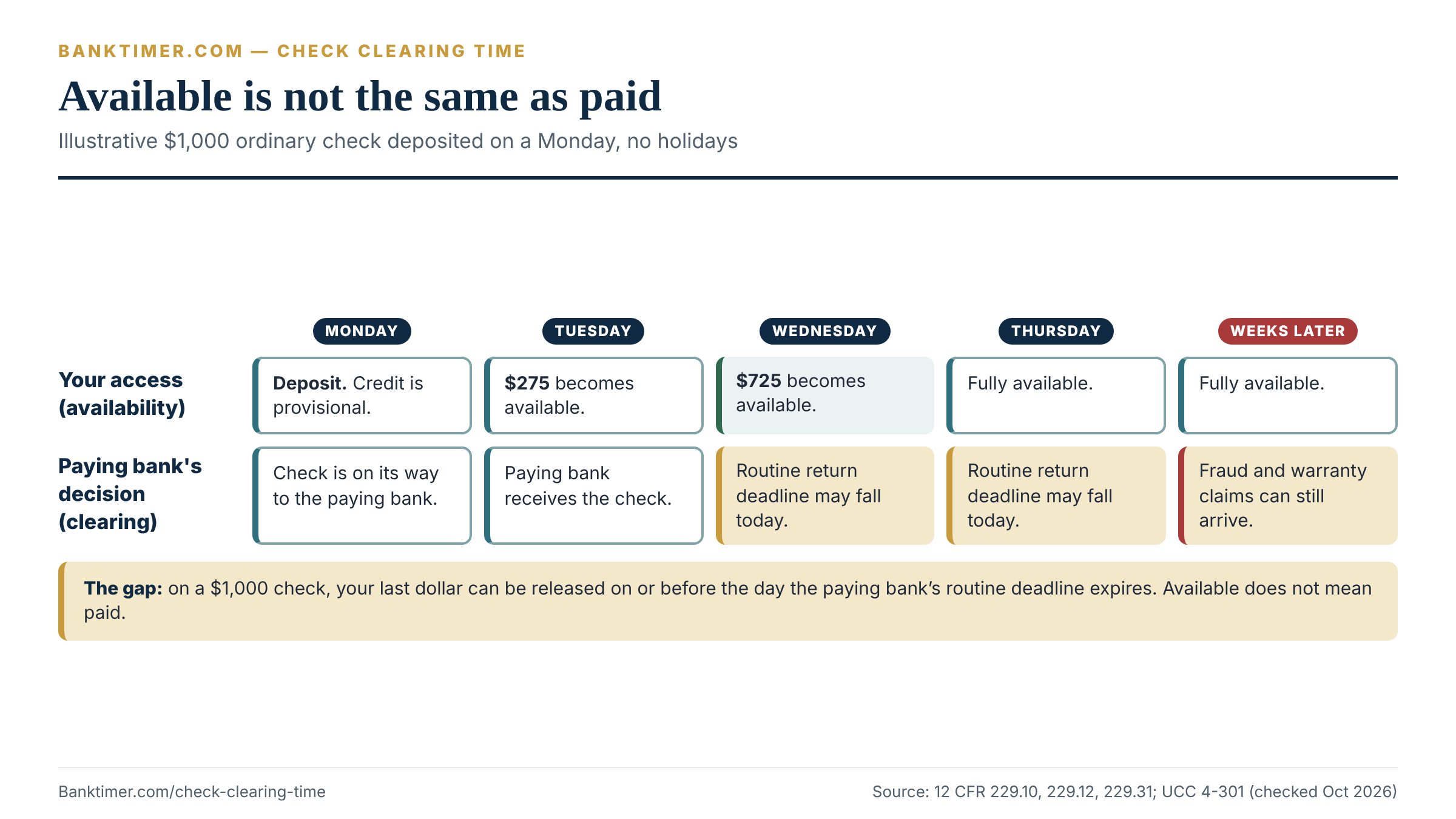
For an ordinary check, the availability clock can finish before the clearing clock does. Funds can be released on the second business day while the paying bank still has a day left to send the check back. Then there is a third, slower exposure. Claims that a check was forged, altered or counterfeit can surface well after the routine return window.
The table separates the three. Read it left to right: the “who controls it” column tells you whom to ask when something goes wrong.
| Clock | What it measures | Who controls it | Typical timing | Where the rule comes from |
|---|---|---|---|---|
| Availability | When you can spend the money | Your bank, within federal maximums | 1 to 2 business days for most checks; longer with exceptions | Regulation CC (federal) plus your account agreement |
| Routine clearing | When the paying bank can no longer return the check for ordinary reasons | The paying bank | Midnight deadline after it receives the check; Regulation CC return rules also apply | UCC (state) and Regulation CC (federal) |
| Fraud and warranty exposure | How long a forged, altered or counterfeit check can come back to you | Courts, banks and the facts of the fraud | Days to weeks; the customer’s reporting duty runs up to one year | UCC (state) |
The takeaway is the middle row. Routine clearing is quick, but “quick” can still be longer than the day your balance changes. That gap is where most surprises live.
What Happens to a Check After You Deposit It
A deposited check takes a short trip through several banks. Knowing the stops helps you read what your bank tells you. The path below describes the usual electronic route; the details vary by bank and by deposit channel.
Step 1: Your bank receives the deposit
Your bank is called the depositary bank. The deposit counts as made when the bank receives it at a staffed teller, an ATM or a mobile deposit system. If you deposit after the bank’s cutoff, it may treat the deposit as made on the next banking day. Regulation CC (section 229.19) sets the earliest cutoff at 2:00 p.m. for branches and noon for ATMs and similar channels.
Your bank then usually posts a provisional credit. That credit is not final, because the bank can revoke it if the check goes unpaid. We cover app-based deposits in more detail in our mobile check deposit guide.
Step 2: The check is sent for payment
Since 2010 the Federal Reserve has processed paper checks through a single office. Interbank collection is now almost entirely electronic. In practice your bank (or its processor) sends an image of the check onward. Because of that single processing region, the Federal Reserve says there are no longer any “nonlocal” checks for Regulation CC timing. That simplifies the schedule below.
Step 3: The paying bank decides
The paying bank checks the account. It looks for enough money, an open account, a valid signature, no stop-payment order, and signs of alteration or counterfeiting. It then pays the check or returns it. The paying bank’s decision, not your bank’s, sets the final answer.
Step 4: A return travels back
If the paying bank refuses to pay, the check or an image travels back to your bank. Regulation CC (section 229.31) sets the deadline. The paying bank must return the check so your bank would normally receive it by 2:00 p.m. on the second business day after the paying bank got it. For checks of $5,000 or more, the paying bank must also send a notice of nonpayment on the same timetable.
Step 5: Your bank reverses the credit
Your bank can then reverse the provisional credit, a step called a chargeback. UCC 4-214 says the right survives even if you already spent the money. That is the moment a “bounced” check becomes your problem.

Reading Your Balance: Pending, Ledger and Available
Banks show several balances, and each tells you something different about a deposit. The labels vary, so read the fine print in your app.
| Balance label | What it usually means | Does it prove the check is good? | What to do |
|---|---|---|---|
| Pending | The deposit was received and is waiting to post or be reviewed | No | Do not count on it |
| Ledger or current | Includes posted items, sometimes including deposits still on hold | No | Treat as an accounting number, not spending money |
| Available | What you may spend now under your bank’s policy | No | Spend only what you can replace if the check returns |
| Held amount | A part of the deposit your bank has delayed | No | Read the hold notice for the release date |
The most useful number is the available balance, and it is also the most misleading. It reflects the bank’s risk decision and the law’s schedule. It does not reflect a final answer from the paying bank. For the wider rules on account fees and access, see our checking account guide. Our guide to debit card holds explains a related hold that many people confuse with a deposit hold.
The Regulation CC Hold Schedule: What Your Bank Must Release and When
Regulation CC is the federal rule that caps how long a bank may hold a deposit, and so it sets the outer limit on check clearing time as you experience it. It applies to banks and credit unions alike, and the National Credit Union Administration (NCUA) enforces it for credit unions. The schedule below is the ceiling for consumer and business transaction accounts. Your bank may be faster, but it generally may not be slower unless an exception applies.
The standard schedule
The table lists the common deposit types. Notice how many routes lead to next-business-day access, and how few ordinary checks qualify for it beyond the first $275.
| Deposit type | Funds must be available | Rule |
|---|---|---|
| Cash deposited in person to a bank employee | Next business day | 12 CFR 229.10(a) |
| Cash deposited another way (own ATM, mail) | Second business day | 12 CFR 229.10(a) |
| Electronic payments (ACH credits, wires) | Next business day, once the bank has the collected funds | 12 CFR 229.10(b) |
| Treasury, Federal Reserve, state or local government, cashier’s, certified and teller’s checks, deposited in person (some conditions apply) | Next business day | 12 CFR 229.10(c)(1) |
| Same checks deposited by mail or ATM | Second business day | 12 CFR 229.10(c)(2) |
| Check drawn on a branch of your own bank, deposited at a branch (same state or check-processing region) | Next business day | 12 CFR 229.10(c)(1)(vi) |
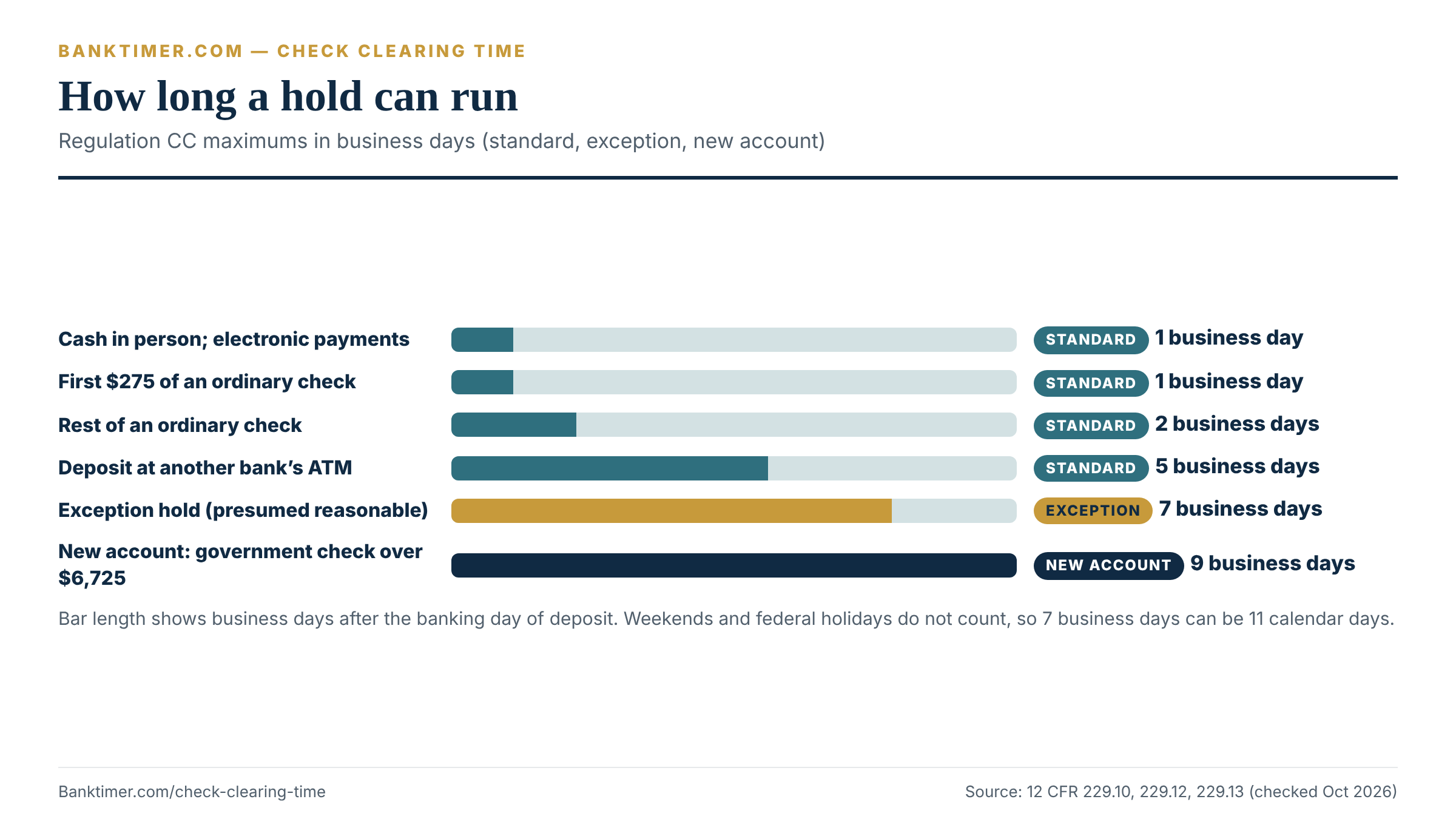
| Ordinary personal or business check | First $275 next business day; the rest by the second business day | 12 CFR 229.10(c)(1)(vii) and 229.12(b) |
| Any deposit at another bank’s ATM | Fifth business day | 12 CFR 229.12(f) |
The insight is in the last two rows. An ordinary check from a stranger or an employer usually gives you $275 the next day and everything else on day two. A deposit at another bank’s ATM can take five business days.
Two clarifications keep people from miscounting. A “business day” is any day except Saturday, Sunday and the federal holidays listed in 12 CFR 229.2(g). And the clock starts on the “banking day” the deposit counts as made, which depends on the cutoff.
The cash-out extension
There is one more wrinkle. A bank may delay check funds by one business day when you withdraw them in cash or by a similar irrevocable method, such as a cashier’s check or wire. Even then, the bank must release $550 by 5:00 p.m. on the day the funds would otherwise be available (12 CFR 229.12(d)). That amount comes on top of the $275.
The numbers changed on July 1, 2025
The Board of Governors and the Consumer Financial Protection Bureau (CFPB) adjust these dollar amounts for inflation every five years. The adjustment that took effect on July 1, 2025 raised each figure by about 22 percent. The next adjustment is scheduled for July 1, 2030.
| Threshold | Before July 1, 2025 | Since July 1, 2025 | Used for |
|---|---|---|---|
| Next-day amount | $225 | $275 | First dollars of an ordinary check |
| Cash withdrawal amount | $450 | $550 | Cash you can take out on a delayed check |
| New-account, large-deposit and repeated-overdraft amount | $5,525 | $6,725 | Exception holds |
You may still see $225 and $5,525 in consumer guides. We checked on October 15, 2026. A CFPB consumer page last reviewed August 28, 2026 still shows the older figures. So do the FDIC examination manual and the NCUA examiner guide. The regulation text is what banks must follow, and it uses $275 and $6,725. If your bank’s disclosure shows the old numbers, ask whether the policy was updated.
When a Bank Can Hold a Check Longer
The standard schedule has six formal exceptions. Each one lets a bank add time to a particular deposit. None is automatic. The bank must have a reason that fits the rule, and in most cases it must tell you in writing.
The exceptions at a glance
| Exception | Applies when | What the bank may do | Notice needed |
|---|---|---|---|
| New account | Account open fewer than 30 calendar days | Hold most checks beyond the standard schedule | Yes, in the account disclosure and hold notice |
| Large deposit | Checks totaling more than $6,725 on one banking day | Hold the amount over $6,725 for a reasonable period | Yes |
| Redeposited check | You deposit a check that was already returned unpaid | Hold it, with two narrow carve-outs | Yes |
| Repeated overdrafts | Account negative on 6 or more banking days in the past 6 months, or by $6,725 or more on 2 or more days | Hold checks for 6 months after the last overdraft | Yes, may be a standing notice |
| Reasonable cause to doubt | Facts that would lead a reasonable person to doubt the check will be paid | Hold that check for a reasonable period | Yes, with the reason stated |
| Emergency | Communications failure, another bank’s suspension of payments, or similar | Hold as needed during the emergency | Reasonable notice |
Each row is a separate rule with its own conditions. Banks cannot use “reasonable cause” because of a customer’s race, location or the type of check alone. The doubt must rest on facts about the particular check. The Federal Reserve’s compliance guide gives examples. They include postdated checks, checks dated more than six months earlier, and checks the paying bank has said it will not honor.
How long is a “reasonable period”?
Regulation CC does not set a single number. It presumes that up to one extra business day is reasonable for checks drawn on your own bank. For local checks, it presumes up to five extra business days. For an ordinary check, that stacks onto the second business day for a presumed seven business days in total.
A longer hold is allowed, but the bank carries the burden of showing it was reasonable. Our worked example later shows that seven business days can feel like eleven calendar days once a weekend is in the way.
New accounts: the rule most people miss
In your first 30 calendar days, your bank gets the most room. Cash and electronic payments still arrive on the next business day. Government and cashier’s-type checks get the standard schedule only up to $6,725 per banking day, with any excess available by the ninth business day.
Here is the part that surprises people. For ordinary personal and business checks in a new account, Regulation CC sets no fixed schedule at all. The bank’s own policy, which it must disclose, controls. An account is not “new” in one case. Every owner must already have had another account at the bank for at least 30 days, ending within 30 days before the new one opened. We cover opening an account safely in our guide to how to open a bank account online.
Notices, Fees and Your Rights When a Hold Applies
A hold is supposed to come with paperwork. If your bank holds a check beyond what its normal policy would allow, the rule requires a written notice that gives you real information.
What the hold notice must say
The notice must include an account number or code and the deposit date. It must also state the amount delayed, the reason for the hold, and the date the funds will be available. If you deposit in person with a bank employee, you should receive it then. Otherwise, the bank must send it no later than the business day after the deposit or after it learns the facts that justify the hold. Banks must keep copies of reasonable-cause notices for two years.
Banks must also give you their funds availability policy before you open an account. They must post notices at tellers and ATMs, and they must give 30 days’ notice of adverse changes to the policy.
Fees caused by a hold
Suppose a bank delays a check for reasonable cause but does not tell you in writing at the time of deposit. It generally cannot charge overdraft or returned-item fees that result from the delay, as long as the check is later paid. It can charge them only if its notice says you may be entitled to a refund and explains how to ask. It must then refund them on request (12 CFR 229.13(e)).
What a bank cannot do
A bank may not place a hold on other funds in your account that exceeds the amount of the deposited check. Section 229.19(e) also bars holds on those funds beyond the periods the rule allows. If your bank freezes a whole balance because of a single $300 check, ask why.
Law, state law and your bank’s policy
These three layers are easy to blur, so keep them straight:
- Federal law (Regulation CC) sets the maximum hold periods and notice rules.
- Your bank’s policy and account agreement can be faster than the rule, and they set the rules for ordinary checks in a new account.
- State law can apply. Section 229.20 says a state law in effect on or before September 1, 1989 that requires faster availability can override the federal timing. Later state changes cannot override it. We do not list state rules because they vary, so check with your state banking regulator.
If a hold seems wrong, ask for the notice first and ask the bank to explain its policy. The CFPB’s consumer guidance gives no hold-specific dispute steps, but you can submit a complaint at the CFPB complaint portal.
Why a Deposited Check Can Bounce After the Money Shows Up
A returned deposit is not a sign that your bank made a mistake. It is the system working as designed. The bank gave you access to the money before it knew the check was good. The law lets it take the money back if the check fails.
The reasons fall into two groups. Some are ordinary account problems at the payer’s bank. Others involve fraud, which can take longer to surface.
Common reasons a check comes back
The table sorts the usual causes by who caused them and how fast they tend to appear. Routine problems show up inside the paying bank’s return window. Fraud problems often do not.
| Reason for return | What happened | How fast it usually surfaces | Your realistic move |
|---|---|---|---|
| Insufficient funds | The writer’s account lacked the money when the check arrived | Within the routine return window | Contact the writer; ask for a replacement payment |
| Account closed | The writer closed the account before the check reached the paying bank | Within the routine return window | Ask for a new form of payment |
| Stop payment | The writer told their bank not to pay the check | Within the routine return window | Contact the writer; find out why |
| Postdated or stale-dated | The date is in the future, or more than six months old | Within the routine return window | Ask for a reissued check |
| Signature or endorsement problem | The signature does not match, or your endorsement is missing | Within the routine return window | Fix and redeposit if the return reason allows it |
| Altered or forged | Someone changed the payee or amount, or signed without authority | Can take days to weeks | Report to your bank right away |
| Counterfeit or fake | The check never came from a real, funded account | Can take days to weeks | Stop sending money; report to your bank and the FTC |
| Duplicate deposit | The same check was deposited twice, for example by app and at a branch | Usually quickly | Deposit each check once; keep the paper until it posts |
The pattern is clear. The first five rows are the writer’s account problems. The last three come from deliberate fraud or your own error, and they are the ones that surprise people.
The routine window: deadlines that look short
For an ordinary check, the paying bank’s deadline is brief. Regulation CC (section 229.31) sets the return deadline. Your bank should normally receive a returned check by 2:00 p.m. on the second business day after the paying bank got it. The UCC’s midnight deadline (UCC 4-301) points the same direction. The paying bank must act by midnight of its next banking day. Otherwise it may become accountable for the amount under UCC 4-302.
Run this against the availability schedule. Say you deposit an ordinary $1,000 check on a Monday morning. You get $275 on Tuesday and the other $725 on Wednesday. The paying bank probably receives the check Monday night or Tuesday, which puts its return deadline on Wednesday or Thursday afternoon.
So your last dollar can become available on the same day, or even the day before, the paying bank’s deadline expires. That is the gap described at the top of this article. The dates assume no federal holidays.
When a return lands later: fraud and warranty claims
The routine window does not end the story, and check clearing time for a fraudulent item can run far longer. UCC presentment warranties let a paying bank recover money from whoever presented the item if the check was altered or the signature was unauthorized. The bank must give notice of the claim within 30 days after it has reason to know of the breach (UCC 4-208). Read your deposit agreement to see how your bank handles such losses.
Account holders have their own duty. Under UCC 4-406, a customer must review statements with reasonable promptness and report an unauthorized signature or alteration. A customer who fails to report within one year after the statement is made available is barred from raising it against the bank.
Why your bank can reverse the deposit even if you spent it
Many people believe that once the money was “available,” it was theirs, and that check clearing time had run out. The law says otherwise. UCC 4-214 lets a collecting bank that gave you provisional credit charge the credit back if it does not receive final settlement. It adds that the right is not lost because you used the credit.
Regulation CC says the same thing in plainer terms. Section 229.19(c) says the availability rules do not stop a bank from charging back your account when a check is returned. Availability is a limit on delay. It is not a guarantee of payment.
One Check, Three Outcomes: A Timeline
The same $1,800 check can follow three different paths. The table traces each path from the Monday deposit. Dates are illustrative and assume no federal holidays.
| Stage | Routine good check | Routine bounced check | Fake or altered check |
|---|---|---|---|
| Monday: you deposit | Provisional credit | Provisional credit | Provisional credit |
| Tuesday: first $275 released | Available | Available | Available |
| Wednesday: balance released | Available | Available | Available |
| Wednesday or Thursday: paying bank’s routine deadline | Check paid | Returned unpaid | Often not yet detected |
| Following week | Final payment | Chargeback on your account | May still look fine |
| Weeks later | Done | Done | Chargeback after the fraud is found |
Read the bottom row twice. A routine bounce usually reveals itself in the first few days. A fake check can pass the routine window and fail later, which is why scammers prefer it. The FTC says fake checks can take weeks to uncover. In its words: “Even if you see the funds in your account, that doesn’t mean it’s a good check.”
What a Returned Check Costs: Chargebacks, Fees and Fallout
When a deposit comes back, the first cost is the money itself. Check clearing time explains why: the bank released funds before the check was final. The fees and side effects arrive second, and they are often the part that hurts. This section lays out each piece. You can then see where the damage comes from and where you can limit it.
The cost anatomy of a returned deposit
Not every cost applies to every returned check. The table separates costs you cannot avoid after the return from costs you can often reduce by acting quickly.
| Cost item | Trigger | Basis | Illustrative amount | Avoidable? |
|---|---|---|---|---|
| Chargeback | The paying bank returns the check | Face value of the check | $1,800 | Not after the return; avoid by not spending unverified funds |
| Returned deposited item fee | Your bank processes the return | Your fee schedule; varies by bank | $12 (assumed) | Sometimes waived on request |
| Overdraft or NSF fee | A payment posts against a balance made negative by the chargeback | Per item, per your fee schedule | $35 each (assumed) | Partly, if you cover the balance fast |
| Bill late fees | A bill payment fails after the chargeback | Set by the biller | Varies | Yes, by paying with other funds |
| Account closure | A negative balance stays unpaid | Your account agreement | Loss of the account | Yes, by repaying promptly |
| Money you sent a third party | You wired or sent funds before the return | The amount you sent | $3,500 in our scam example | No, wires and gift cards are hard to reverse |
The last row dwarfs the others. A fee can be $12 or $35. A wire to a scammer can be thousands of dollars. Our guide to overdraft fees explains how per-item fees stack. Our bank account fees guide shows where returned-item charges appear on a fee schedule.
A note on returned deposited item fees
In October 2022, the CFPB issued a bulletin on returned deposited item fees. It said blanket policies of charging the fee on every returned check were likely unfair. The CFPB withdrew that bulletin on May 12, 2025, along with much other guidance. Do not assume the bulletin protects you today. Whether your bank charges the fee, and whether it will waive it, depends on your account agreement and your fee schedule.
Four Worked Examples With Real Arithmetic
The examples below use illustrative balances and fees. They are not any bank’s schedule, and they are not live quotes. Every figure comes from the script we ran for this article, and the dates assume no federal holidays.
Example 1: The $1,800 check and the rent autopay
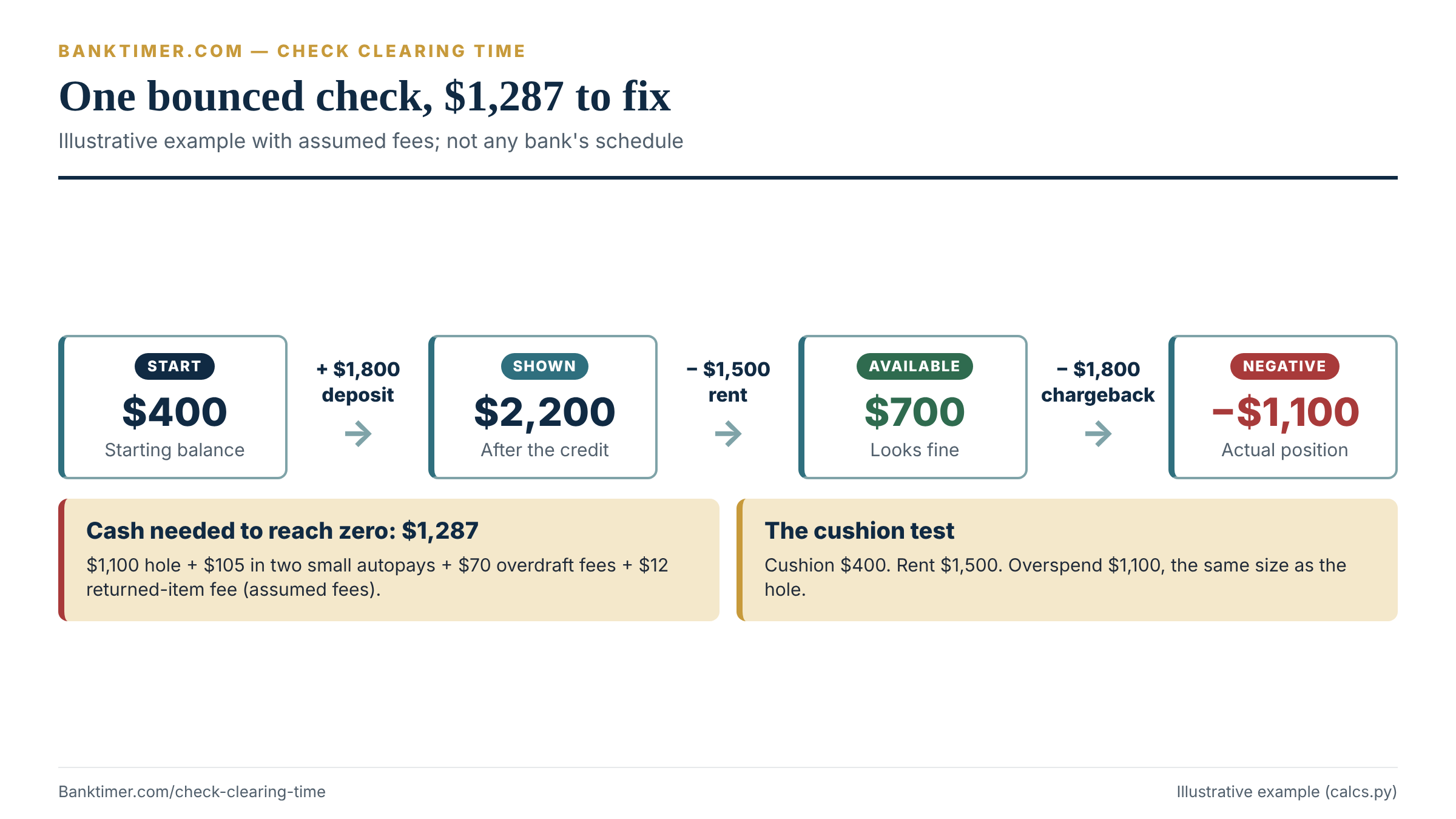
Dana has $400 in checking. On Monday she deposits a $1,800 personal check from a client. On Wednesday the full amount is available. On Thursday her $1,500 rent autopay posts, which leaves $700.
The client’s account turns out to be short. The following Monday, the check is returned unpaid. The chargeback takes $1,800 from Dana’s account, which leaves negative $1,100.
Two small autopays of $60 and $45 then post against the negative balance. Assume a $35 overdraft fee on each bill and a $12 returned-item fee. Dana then needs $1,287 in new money to bring the account back to zero. That is $1,100 for the hole, $105 for the two bills, $70 in overdraft fees and $12 for the returned item.
The insight is not the fee. It is the order of events. Dana spent only what her bank called available, and she still ended up $1,100 short plus fees. The same sequence would apply to a smaller check and a smaller bill.
Example 2: The fake cashier’s check
Marcus lists a used laptop for $700. A buyer sends a cashier’s check for $4,200 and says it was a typing mistake. The buyer asks him to wire the $3,500 difference back right away.
Marcus has $1,000 in his account. After the deposit he sees $5,200. He wires $3,500 and keeps what looks like his $700 sale. Twelve days later, the bank learns the check is counterfeit and charges back $4,200.
His balance falls from $1,700 to negative $2,500. Compared with where he started, he is out $3,500 of real money, and he owes the bank the $2,500 shortfall.
The FTC describes this pattern as a fake check scam. The scammer asks you to deposit a check for more than the amount owed and send some of the money back. Once the check is found to be fake, the FTC says, you are “stuck paying the money back to the bank.” The warning signs and what to do next are in the red flags section later in this guide.
Example 3: A government check in a brand-new account
Priya opens a new checking account this week. On Monday she deposits a $9,000 state-issued check in person, in the same state that issued it.
Because it is a government check deposited in person, it gets the standard schedule. But a new account caps that treatment at $6,725 per banking day. The remaining $2,275 must be available by the ninth business day, which in this example is Friday of the following week. That is 11 calendar days after the Monday deposit.
Suppose Priya had also deposited a $1,500 personal check. It is an ordinary check in a new account, so the federal rule sets no fixed availability date for it. Her bank’s disclosed policy would control.
This example shows why timing a big deposit to a new account is risky. Do you need the money by a specific date, such as a closing or a security deposit? Ask for the bank’s schedule in writing before you rely on it.
Example 4: A $10,000 check in an established account
Sam has had his account for years. He deposits a $10,000 personal check from the buyer of a used car on a Monday.
The first $6,725 follows the normal schedule: $275 on Tuesday and $6,450 on Wednesday. The other $3,275 is a large-deposit exception. The bank may hold it for a reasonable period. Under the presumption in the rule, that is up to five extra business days beyond the second, so Wednesday of the following week.
If Sam had deposited on a Thursday instead, the same seven business days would stretch to the Monday after next. That is 11 calendar days, because the weekends do not count.
Large checks often come from car sales, home repairs and insurance claims. If you expect one, ask the payer for a cashier’s check drawn on a bank you can verify. Or ask your own bank how it will treat the deposit before you hand over the keys.
The table that ties the four examples together
| Example | Deposit | Available on the standard schedule | Held or exposed | Why |
|---|---|---|---|---|
| Dana’s client check | $1,800 | $275 next day, $1,525 on day two | All $1,800 returned on day 5 | Account lacked funds |
| Marcus’s cashier’s check | $4,200 | Available quickly | All $4,200 charged back on day 12 | Counterfeit check |
| Priya’s state check | $9,000 | $6,725 next day | $2,275 until the ninth business day | New-account excess |
| Sam’s car-sale check | $10,000 | $6,725 over two days | $3,275 for up to seven business days | Large-deposit exception |
Compare the second column with the third. In none of these cases did the bank break the rule. The risk lived in the gap between access and finality. The two largest losses had nothing to do with fees.
A Decision Framework: How Much of a Deposited Check Can You Spend?
You cannot control check clearing time at the paying bank. You can control how much you stake on its answer. The framework below turns that idea into four questions. You can answer them in a minute, before you spend a dollar of a new deposit.
The cushion test
Your bank decides when money is available. You decide how much of it you can afford to lose if the check comes back. The simplest measure is your cushion: the balance you would have if the deposit had never happened.
Spend up to your cushion and a returned check costs you fees at worst. Spend beyond it and the chargeback leaves a hole equal to the overspend. In Dana’s example, her cushion was $400 and she spent $1,500 on rent. The overspend of $1,100 is exactly the size of her negative balance after the chargeback.
Four questions, in order
- Who wrote the check? An employer’s payroll check or a government check carries a different risk than a personal check from a stranger. The FTC’s fake check scams start with a stranger’s check, so the identity of the payer matters most.
- How big is the check compared with your cushion? A $200 check you can absorb. A $9,000 check you probably cannot.
- How old is the account? In the first 30 days, your bank has the widest room to hold funds. It also has the most reason to be cautious. Ordinary checks in a new account follow the bank’s own policy.
- Can you verify it? Three steps turn a guess into a fact. Call the issuing bank. Ask for a cashier’s check. Or cash the check at the paying bank.
If the answer to any of these is “I don’t know,” spend only your cushion until the check is paid.
The decision matrix
The matrix groups common check sources by what you can verify and what you should do. The risk labels are qualitative judgments, not statistics. They describe what you know about the payer, not a prediction.
| Check source | What you can verify | Risk of a later return | Sensible approach |
|---|---|---|---|
| Employer payroll check | Employer name, payroll history | Lower | Spend normally; keep pay stubs |
| U.S. Treasury or state government check | Issuer, purpose of payment | Lower | Spend normally; ask your bank about new-account limits |
| Cashier’s check from a known buyer or seller | Issuing bank, through its official number | Moderate | Verify with the issuing bank before you hand over goods |
| Personal check from someone you know | Their account and track record | Moderate | Wait for the routine window if the amount is large |
| Personal check from an online buyer | Little | Higher | Prefer a payment method that is final; do not ship on the check alone |
| Any check with an “overpayment” you must send back | Nothing reliable | Highest | Do not deposit; see the red flags below |
The most counterintuitive row is the cashier’s check. People trust it because a bank “issued” it. The FTC warns that fake checks “generally look just like real checks, even to bank employees.” Verify before you rely on it.

Ways to turn a guess into a fact
None of these is a legal guarantee. They are industry practices, and your bank’s policies vary.
- Call the issuing bank. Use the number on the bank’s official website. Do not use a number printed on the check or provided by the person who gave it to you.
- Cash or deposit at the paying bank. If you can visit a branch of the bank that issued the check, the teller can often confirm funds. Fees for non-customers vary.
- Ask for a wire or an electronic payment. An incoming wire or ACH credit is available on the next business day. That applies only once your bank has the collected funds (12 CFR 229.10(b)). Electronic payments have their own failure modes, which our ACH transfer guide covers. Our Regulation E guide explains consumer rights for unauthorized electronic transfers.
- Wait past the routine window. Waiting a few business days before you spend beyond your cushion costs little. It covers the routine-return risk, though not a counterfeit that surfaces later.
- Ask your bank about the item’s status. Ask whether the check has been paid, not only when the funds are available. Some banks can answer that question and some cannot, so get the answer in writing if you can.
Red Flags: When a Check Is Probably Not What It Seems
Fake check scams exploit the gap this guide explains, and they depend on a victim misreading check clearing time. The scammer needs you to believe that “available” means “good.” The FTC lists the usual stories. They include a mystery shopping job, a personal assistant job, a car wrap offer, a prize, or an overpayment for something you sold.
| Red flag | Why it matters | What to ask | Safer next step |
|---|---|---|---|
| The check is for more than you are owed | The scam depends on you sending back the difference | “Why not send the exact amount?” | Decline the check and ask for a correct one |
| You must send part of it by wire, gift card, money order or crypto | These methods are hard to reverse | “Why this payment method?” | Refuse; no legitimate payer needs this |
| The payer pushes you to act today | Urgency prevents verification | “Can this wait until the check is paid?” | Slow down and verify |
| The sender is a stranger who contacted you first | You have no way to vouch for them | “How did you find me?” | Do not deposit |
| Your bank says the funds are “available” and the payer cites it | Availability is not payment | “Has the check been paid?” | Treat as unpaid |
| The check name or address does not match the payer | Fraudsters use stolen account details | “Who is the account holder?” | Verify with the issuing bank |
| A job or prize requires you to pay “fees” first | Real jobs and prizes do not | “Where is this rule written?” | Walk away and report it |
If several of these appear together, assume the check will fail. Our guides to gift card scams and mail theft and stolen checks explain how fraudsters get and use the checks in these schemes.
Scammers coach victims to say this to a skeptical friend or bank teller. It reverses the real sequence. Your bank released the money under a federal schedule. The paying bank may not have decided yet, and a counterfeit can surface weeks later. If a stranger relies on the word “cleared,” stop and verify.
If you already sent money
Speed matters most in the first hours. The FTC advises contacting the company that handled the money you sent. For a gift card, call the issuer. For a wire, call the wire company. For a money order, call the issuer. For crypto, contact the platform. Tell your bank what happened. The FTC lists three places to report: ReportFraud.ftc.gov, the U.S. Postal Inspection Service, and your state attorney general.
Do not keep spending against the deposit while you wait. The chargeback is coming, and the sooner you stop other payments, the smaller the overdraft cascade.
- ☐ Do I know the payer, and can I confirm their identity independently?
- ☐ What is the exact amount, and does it match what I am owed?
- ☐ What does my bank’s funds availability policy say about this type of check and my account age?
- ☐ Did I receive a hold notice, and does it name a release date?
- ☐ Has the check been paid, or only made available?
- ☐ How much can I lose without missing rent or a bill?
- ☐ Is anyone asking me to send money back, buy a gift card or wire funds?
- ☐ What happens to my account if the check is returned: fees, negative balance, account closure?
- ☐ Is there a faster, final way to be paid?
If Your Deposit Comes Back: A Practical Recovery Plan
A returned check feels like an emergency, and it deserves prompt action. It is also a solvable problem. The steps below move from stopping further damage to recovering the money when check clearing time ends in a return.
The first day
- Read the notice or the transaction detail. Find the return reason. “Insufficient funds,” “account closed” and “altered” lead to different next steps.
- Stop new payments against the deposit. Pause autopays you can pause. Every payment that posts against a negative balance can add a fee.
- Check your balance, not just your available balance. Work out how far below zero you are, including fees.
- Cover the negative balance if you can. Moving money in quickly limits fee stacking and may protect the account. Ask the bank how it applies deposits to a negative balance.
- Contact the payer. A returned check is often an honest mistake. Ask for a replacement by a final method, such as a cashier’s check verified with the issuing bank, or an electronic payment.
- Call your bank. Ask for the return reason in writing, the exact fees charged, and whether any fee can be waived.
Do these in order. Step 2 comes before step 5 because the bank’s fees run on its schedule, not the payer’s.
A short script for the fee conversation
Banks have discretion on many returned-item and overdraft charges. A calm request often works better than a complaint. Try something like this:
“A check I deposited on the 19th was returned unpaid, and the chargeback caused two overdraft fees and a returned-item fee. I did not know the check was bad. I have covered the balance. Can you refund the fees as a one-time courtesy, and can you note the account as in good standing?”
If the bank gave you a hold notice, mention it. Suppose it gave none and the delay was a reasonable-cause hold. Then point to 12 CFR 229.13(e) and ask whether fees tied to that hold can be refunded.
Escalation: when the bank says no
Many problems end with a call. When yours does not, move up one step at a time and keep a record at each stage.
| Step | Who | What to bring | Move on when |
|---|---|---|---|
| 1 | Branch or phone support | Account number, deposit date, return notice | You get no written answer within a few business days |
| 2 | Bank’s complaints or resolution team | Your written summary, fee amounts, hold notice | The reply ignores the rule you cited |
| 3 | The bank’s primary regulator or the CFPB | The same file, plus the bank’s responses | You need an outside review |
| 4 | Small claims or a lawyer | Complete record, payer details | The amount justifies it |
The CFPB accepts complaints about checking accounts and deposit holds at its complaint portal. Which regulator supervises your bank depends on its charter and size.
Documents worth keeping
| Document | Why it matters | Where to get it | How long to keep |
|---|---|---|---|
| Photo or copy of the check, front and back | Shows payer, amount, date and your endorsement | Your camera, or the bank’s image archive | Until the matter is closed, then at least a year |
| Deposit receipt or mobile deposit confirmation | Proves the date and channel | Branch, ATM or app | Same |
| Hold notice | Shows reason and release date | Branch, mail or app notification | Same |
| Account statements | Show fees, balances and timing | Online banking | At least a year |
| Messages with the payer | Show what you were told | Your email or phone | Until resolved |
| Your bank’s fee schedule and availability policy | Shows what you agreed to | Bank website or branch | Current copy plus any changes |
The one-year suggestion is an editorial habit, not a legal requirement. We chose it because the UCC’s outer limit for reporting an unauthorized signature or alteration is one year after the statement is made available.
Edge Cases That Change the Answer
The standard schedule is a good map, but a few terrain features can change your check clearing time. Check whether any of these describe your deposit.
Mobile and ATM deposits
The CFPB notes that mobile check deposits may follow a different timetable from in-person deposits. Ask your bank about its policy. Deposits at your own bank’s ATM get second-business-day access for check types that would get next-day access at a teller. Deposits at a bank ATM that is not your own can take until the fifth business day. Our mobile check deposit guide covers limits, fees and how long to keep the paper check.
Credit unions and online banks
Regulation CC applies to credit unions, and the NCUA enforces it for federal and federally insured state-chartered credit unions. Online banks and apps that partner with a chartered bank typically follow the partner bank’s policy and your account agreement. Read the agreement for the actual hold rules rather than assuming the app matches a big bank’s. Our credit union vs bank guide explains how these institution types differ.
Joint and business accounts
A bank may combine your deposits across all of your accounts when it tests the $6,725 large-deposit threshold. That holds even if the account holders are not identical. Business accounts have a few extra flexibilities. A bank may base their availability on a sample of the customer’s typical deposits. The terms must be at least as prompt as the rule requires. It may also use one-time notices for certain exceptions.
Territories and out-of-state checks
A bank may add one business day for certain checks deposited in Alaska, Hawaii, Puerto Rico, American Samoa, the Northern Mariana Islands, Guam or the U.S. Virgin Islands. The check must be drawn on or payable at a bank in another state. Most readers will not need this, but it explains an extra day that otherwise looks arbitrary.
Stale-dated and postdated checks
A bank has no duty to pay a check that is more than six months old, except a certified check (UCC 4-404). A bank can pay one in good faith, though. A postdated check is also a common reason for a “reasonable cause” hold. If you hold an old check, ask the writer for a new one rather than hoping it clears.
Holidays and weekends
Business days exclude weekends and federal holidays, so a hold that spans a holiday weekend takes longer in calendar days. We work through the 2026-27 calendar in our guide to holiday deposit hold times. If an unexpected deposit appears that you did not cause, our guide to money deposited by mistake explains why spending it is risky.
Interest on returned checks
In an interest-bearing account, interest begins to accrue no later than the business day the bank receives credit for the funds. The bank is not required to pay interest on funds from a check that is returned unpaid (12 CFR 229.14). If the check is returned, expect any interest on it to vanish with the credit.
Five Beliefs That Cost People Money
Misconceptions about check clearing time cause most of the preventable losses. The table matches each belief with what the sources actually say.
| Common belief | What is true | Source |
|---|---|---|
| “If the money is available, the check cleared” | Availability follows a schedule; final payment follows the paying bank’s decision | Regulation CC; UCC 4-215 |
| “A bank cannot take back money I spent” | A bank can charge back a returned check even after you spend the credit | UCC 4-214; 12 CFR 229.19(c) |
| “A cashier’s check can’t bounce” | A real one is the bank’s own obligation, but a fake one is not, and fakes can look real even to bank employees | 12 CFR 229.2(i); FTC |
| “FDIC insurance covers a bad check” | FDIC insurance protects deposits if an insured bank fails; it does not make a bad check good | FDIC |
| “Banks hold checks for a fixed number of days” | Holds vary by check type, account age, deposit size and bank policy | Regulation CC |
The fourth row deserves a sentence of its own. The FDIC describes deposit insurance as protection if an insured bank fails. Our FDIC insurance limits guide covers the details. A fraudulent check is a different problem with a different remedy.
Frequently Asked Questions
How long does a check take to clear?
Check clearing time has two answers. For most ordinary checks, funds become available within one to two business days: $275 on the next business day and the rest by the second. The paying bank’s routine deadline to return the check falls around the same time. Holds for new accounts, large deposits or doubtful checks can add days. A counterfeit or altered check can be returned weeks later, so “available” is never the same as “paid.”
Is funds availability the same as a check clearing?
No. Check clearing time and availability run separately. Availability is the day your bank lets you use the money under Regulation CC and its own policy. Clearing, in the UCC sense, is final payment by the bank the check is drawn on. Your balance can rise before that decision is final, and the bank can reverse the credit if the check is returned.
Why did my deposited check bounce after the money was available?
The paying bank decided not to pay, or it found a problem after your bank released the funds. Common causes are insufficient funds, a closed account, a stop-payment order, a bad signature, or a counterfeit check. Your bank then charges the deposit back to your account. Ask for the return reason in writing, because it tells you whether to contact the payer or report fraud.
Can a bank take money back after I spent it?
Yes. UCC 4-214 lets a bank charge back a provisional credit when it does not receive final payment. It says the right is not lost because you already used the credit. Regulation CC section 229.19 also preserves a bank’s right to charge back a returned check. If you spent the money, the chargeback can leave your account negative, and you will owe the bank.
How long can a bank legally hold a check?
For an ordinary check in an established account, the schedule is the second business day. When an exception applies, a presumed reasonable extension of up to five business days follows. That is seven business days in total. A bank can hold longer if it proves the longer period is reasonable. New accounts have a separate set of rules.
How long can a bank hold a check in a new account?
An account is new for its first 30 calendar days. Cash and electronic payments still get next-day access. Government and cashier’s-type checks get the standard schedule up to $6,725 per day, with the rest by the ninth business day. For ordinary personal and business checks, Regulation CC sets no fixed schedule, so your bank’s disclosed policy controls.
Why do some sources still say $225 and $5,525?
Those were the Regulation CC amounts before July 1, 2025. The current amounts are $275, $550 and $6,725. We found the older figures on several consumer and examiner pages when we checked on October 15, 2026. The regulation text governs. If your bank’s disclosure uses the old numbers, ask whether it has updated its policy.
Does my bank have to tell me about a hold?
Usually yes. If the bank holds a check beyond its normal policy, it must give written notice. The notice states the deposit date, the amount delayed, the reason and the release date. In person, you should get it at the time of deposit. Otherwise it must arrive by the business day after the deposit or after the facts become known.
Do mobile deposits clear faster or slower than branch deposits?
Neither is guaranteed. The CFPB notes that mobile deposits may follow a different timetable, so check your bank’s policy. Cutoff times matter more than many people expect. A deposit made after the cutoff can count as made on the next banking day. Our mobile check deposit guide covers the details.
Can a cashier’s check bounce?
A real cashier’s check is a direct obligation of the bank that issued it. A fake one is not, and the FTC says fake checks can look real even to bank employees. If a stranger sends one, verify it with the issuing bank using a phone number you find yourself. Never send money back to the sender.
Can a returned check get my account closed?
It can. Your account agreement decides. If a chargeback leaves a negative balance and you do not repay it, the bank may close the account. Repay quickly and ask the bank in writing to note the account as in good standing. Our ChexSystems report guide explains how closures can be reported and how they can affect later applications.
Who pays if the check I deposited was fake?
In practice, you do. Your bank charges the deposit back, and money you already sent to the scammer is usually gone. The FTC says that by the time the fake is found, the scammer has the money you sent. In its words, “you’re stuck paying the money back to the bank.” Report it to the FTC and your bank right away.
Before your next deposit, open your bank’s funds availability policy and find three things: the cutoff time, the new-account rule and the large-deposit rule. Then write down your cushion, the balance you would have without the deposit. Spend no more than that until the check is paid.
The variable that decides your outcome is the gap in check clearing time between “available” and “paid.” Regulation CC controls how long your bank may make you wait. It says nothing about whether the check is good. That decision belongs to the paying bank, and a counterfeit can surface weeks after your balance rises. So treat every new deposit as spendable only up to your cushion: the money you could lose without missing rent. Verify unfamiliar checks with the issuing bank, keep your hold notice, and decline any check that asks you to send money back. Be aware of what this guide does not cover. State law can change deadlines. Your bank’s agreement can be stricter than the rule. Business accounts follow some different terms. Confirm your own bank’s current policy before you rely on a deposit.
Methodology
We built this check clearing time guide from primary sources and checked each dated figure on October 15, 2026. Funds availability rules and dollar thresholds come from the Federal Reserve’s Regulation CC guidance and 12 CFR part 229, including the July 1, 2025 adjustment. Final payment, chargeback and warranty rules come from Article 4 of the Uniform Commercial Code, which each state adopts with variations. Consumer guidance comes from the CFPB, the FTC, the FDIC and the NCUA. We read the CFPB’s returned-item bulletin page and its withdrawn-guidance list to confirm the bulletin’s status.
Every example in the article is an illustrative assumption. That includes Dana’s $1,800 check, Marcus’s cashier’s check, Priya’s government check and Sam’s $10,000 check. The fees shown are assumed, not any bank’s schedule. Dates assume no federal holidays, and the arithmetic comes from a script we reran. Bank policies, state law, and your account agreement vary and can differ from the federal minimums. We did not test any bank’s process or contact any bank.
Sources
- Guide to Regulation CC Compliance, Federal Reserve Board
- Regulation CC final rule: adjustment of dollar amounts effective July 1, 2025, Federal Reserve Board and CFPB
- 12 CFR 229.10, Next-day availability, Legal Information Institute
- 12 CFR 229.12, Availability schedule, Legal Information Institute
- 12 CFR 229.13, Exceptions, Legal Information Institute
- 12 CFR 229.19, Miscellaneous, Legal Information Institute
- 12 CFR 229.31, Paying bank’s responsibility for return of checks, Legal Information Institute
- UCC 4-215, Final payment of item by payor bank, Legal Information Institute
- UCC 4-214, Right of charge-back or refund, Legal Information Institute
- UCC 4-208, Presentment warranties, Legal Information Institute
- When will my deposit be available? CFPB, reviewed August 28, 2026
- Withdrawn guidance, CFPB
- How to spot, avoid and report fake check scams, FTC
- Expedited Funds Availability Act, FDIC Consumer Compliance Examination Manual
By the Banktimer Editorial Team · Published
Banktimer is an independent U.S. consumer-finance publication. Our editors draw on primary and official sources first, such as the CFPB, FDIC, Federal Reserve, and FTC, along with statutes, regulations, and providers’ own agreements and fee schedules. Then we add worked examples and decision tools. Our goal is the most useful, best-supported explanation the sources available to us at the time of writing allow.
This article is general information, not legal, tax, investment, insurance, or financial advice, and reading it does not create a professional relationship with Banktimer. Rates, fees, limits, and rules change, and they vary by state, provider, and contract, so confirm current terms with your bank, lender, insurer, or the agency named in the article before you act. Examples are illustrative unless labeled otherwise. Banktimer is not a bank, lender, insurer, or financial advisor, and we are not responsible for decisions or losses that result from relying on this content. For advice about your own situation, talk to a licensed professional.