

By the Banktimer Editorial Team · Published
Banktimer is an independent U.S. consumer-finance publication. Our editors draw on primary and official sources first, such as the CFPB, FDIC, Federal Reserve, and FTC, along with statutes, regulations, and providers’ own agreements and fee schedules. Then we add worked examples and decision tools. Our goal is the most useful, best-supported explanation the sources available to us at the time of writing allow.
This article is general information, not legal, tax, investment, insurance, or financial advice, and reading it does not create a professional relationship with Banktimer. Rates, fees, limits, and rules change, and they vary by state, provider, and contract, so confirm current terms with your bank, lender, insurer, or the agency named in the article before you act. Examples are illustrative unless labeled otherwise. Banktimer is not a bank, lender, insurer, or financial advisor, and we are not responsible for decisions or losses that result from relying on this content. For advice about your own situation, talk to a licensed professional.
Cryptocurrency stopped being a niche hobby years ago. Roughly a quarter of American adults now own some form of digital asset. Bitcoin trades on the same watchlists as blue-chip stocks. But mainstream adoption hasn’t made the subject simple. If anything, it’s gotten more layered. A dozen interlocking systems now shape the space: blockchains, wallets, exchanges, smart contracts, stablecoins, and staking protocols. On top of that, a regulatory framework is still being written in real time.
That’s the gap this guide is built to close. You don’t need to become a blockchain engineer to use crypto responsibly. But you do need a working understanding of how the pieces fit together and where the real risks hide. Crypto basics, done right, means knowing how Bitcoin‘s supply cap actually works. It means knowing why a hardware wallet beats leaving coins on an exchange. It means understanding how the IRS treats a crypto-to-crypto trade. And it means knowing what “not your keys, not your coins” really means when an exchange fails.
We built this guide the way we build every Banktimer cornerstone piece. First, we work to understand the mechanics and compare the real options. Then we run the numbers and weigh the risk honestly before you decide anything. Crypto earns extra caution here — more than a typical investing topic. That’s because the downside includes things conventional assets don’t. Those include irreversible transactions, unregulated counterparties, and permanent loss of access if a private key goes missing. We won’t sugarcoat that, and we won’t hype the upside either.
Maybe you’re buying your first fraction of Bitcoin. Maybe you’re trying to understand a staking reward on your tax return. Or maybe you’re just tired of half-explained jargon. Either way, this guide is built to be the one page you keep coming back to. Bookmark it, and use the table of contents to jump to what you need. Then come back when the next regulatory deadline or market cycle raises a new question.
Key Takeaways
Crypto basics start with custody. Whoever holds the private keys controls the asset. That’s why “not your keys, not your coins” is the single most important rule in this guide.
Volatility is a feature, not a bug, of most cryptocurrencies. Bitcoin and Ethereum have both seen 70%+ drawdowns more than once. Position sizing matters more here than in almost any other asset class.
Every crypto-to-crypto trade is a taxable event in the eyes of the IRS. Swapping Bitcoin for Ethereum triggers a capital gain or loss calculation, even if you never touch a bank account.
Regulation is arriving in pieces, not all at once. The GENIUS Act’s stablecoin rules and new Form 1099-DA broker reporting are two examples. Evolving SEC/CFTC jurisdiction also changes the risk picture year to year.
Exchange counterparty risk is real and has already cost users billions. Proof of reserves and licensing help, but they don’t eliminate the risk of keeping assets on a centralized platform.
The biggest beginner losses rarely come from bad market timing. They come from lost seed phrases, phishing scams, and skipping basic security habits that take minutes to set up.
Key Numbers to Know
| Metric | Figure |
|---|---|
| Bitcoin price (early September 2026) | ~$78,300 per BTC |
| Ethereum price (early September 2026) | ~$2,450 per ETH |
| Share of U.S. adults who own cryptocurrency | ~25% (about 1 in 4), per 2026 Harris Poll research |
| Bitcoin’s fixed supply cap | 21 million BTC |
| Current Bitcoin block reward | 3.125 BTC per block (post-2024 halving) |
| Next Bitcoin halving | Expected in 2028, cutting the reward to 1.5625 BTC |
| GENIUS Act stablecoin rules — effective date | January 18, 2027 (statutory backstop, absent earlier final rules) |
| Form 1099-DA — first tax year covered | 2025 sales, first forms issued in early 2026 |
| Form 1099-DA — cost basis reporting begins | 2026 sales (forms arriving in early 2027) |
| Typical centralized exchange trading fee | ~0.1%-0.6% per trade (maker/taker, varies by platform and volume) |
| Ethereum consensus mechanism | Proof-of-stake (since the September 2022 Merge) |
Bitcoin
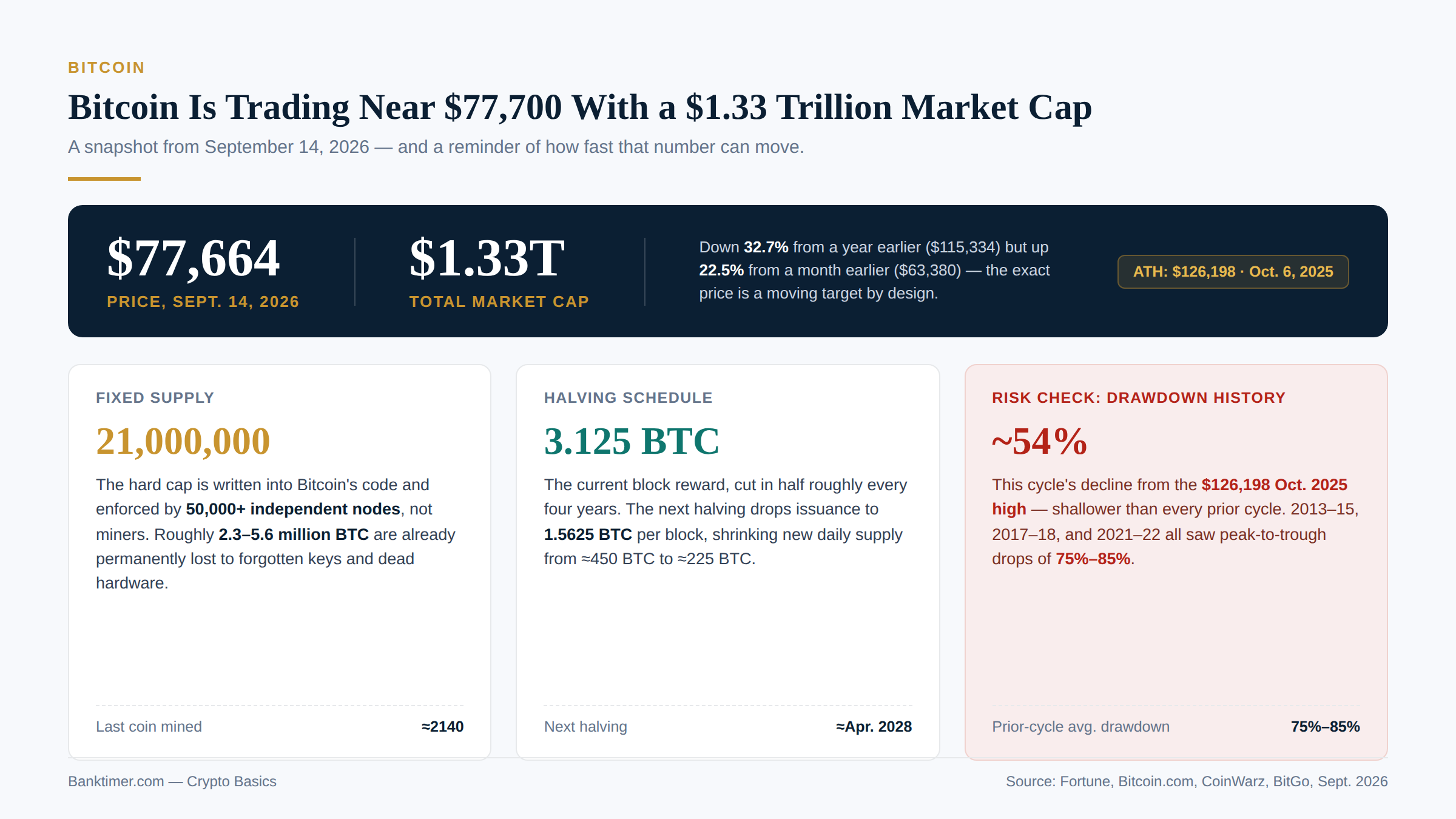
Bitcoin is where most people start, and for good reason. Launched in 2009, it’s still the largest cryptocurrency by market value. It’s also the asset that introduced the world to blockchain technology in the first place. As of September 14, 2026, Bitcoin traded at $77,664.27, with a market cap near $1.33 trillion. That’s down sharply from its all-time high of $126,198.07, set on October 6, 2025.
That price swing in less than a year tells you something important before you learn anything else. Bitcoin moves fast, in both directions. One month before that September snapshot, it traded near $63,380; one year before, it sat at $115,334. Numbers like these go stale within weeks, and that’s itself a lesson about the asset you’re about to study. Treat any single price you read as a moment in time, not a fact you can bank on.
This section covers how Bitcoin actually works under the hood. It also covers how to buy and store it without losing it, and what really drives its price. Then there are the risks — custody, volatility, regulation, scams — every beginner needs to understand before putting real money in. We’ll lean on verified 2026 data throughout, because vague reassurance isn’t useful here. You’re deciding whether to buy an asset that’s dropped 80% before and could again.
Crypto Basics: How Bitcoin Actually Works
What Bitcoin Is (and Isn’t)
Bitcoin runs on a shared public ledger that the entire network depends on. The blockchain records every confirmed transaction, so any wallet can calculate spendable balances. It can also verify that whoever’s sending coins is actually authorized to spend them. Cryptography protects that record’s integrity and chronological order — not a bank, not a company, not a government. Each wallet holds a private key, a piece of secret data used to cryptographically sign transactions. Therefore, consider this part of your crypto basics due diligence, not an afterthought.
That key proves ownership without a central authority vouching for you. New transactions get confirmed by the network within roughly 10 to 60 minutes through mining. Mining works like a competitive lottery: thousands of independent participants compete to add the next block. No single one of them can control the ledger or rewrite history. That last part is the real distinction beginners miss. Bitcoin isn’t a company, isn’t issued by a government, and isn’t controlled by any single entity. Given that beginners often miss this, treat it as basic crypto basics hygiene, not an advanced strategy.
The Blockchain Ledger Behind Every Bitcoin Transaction
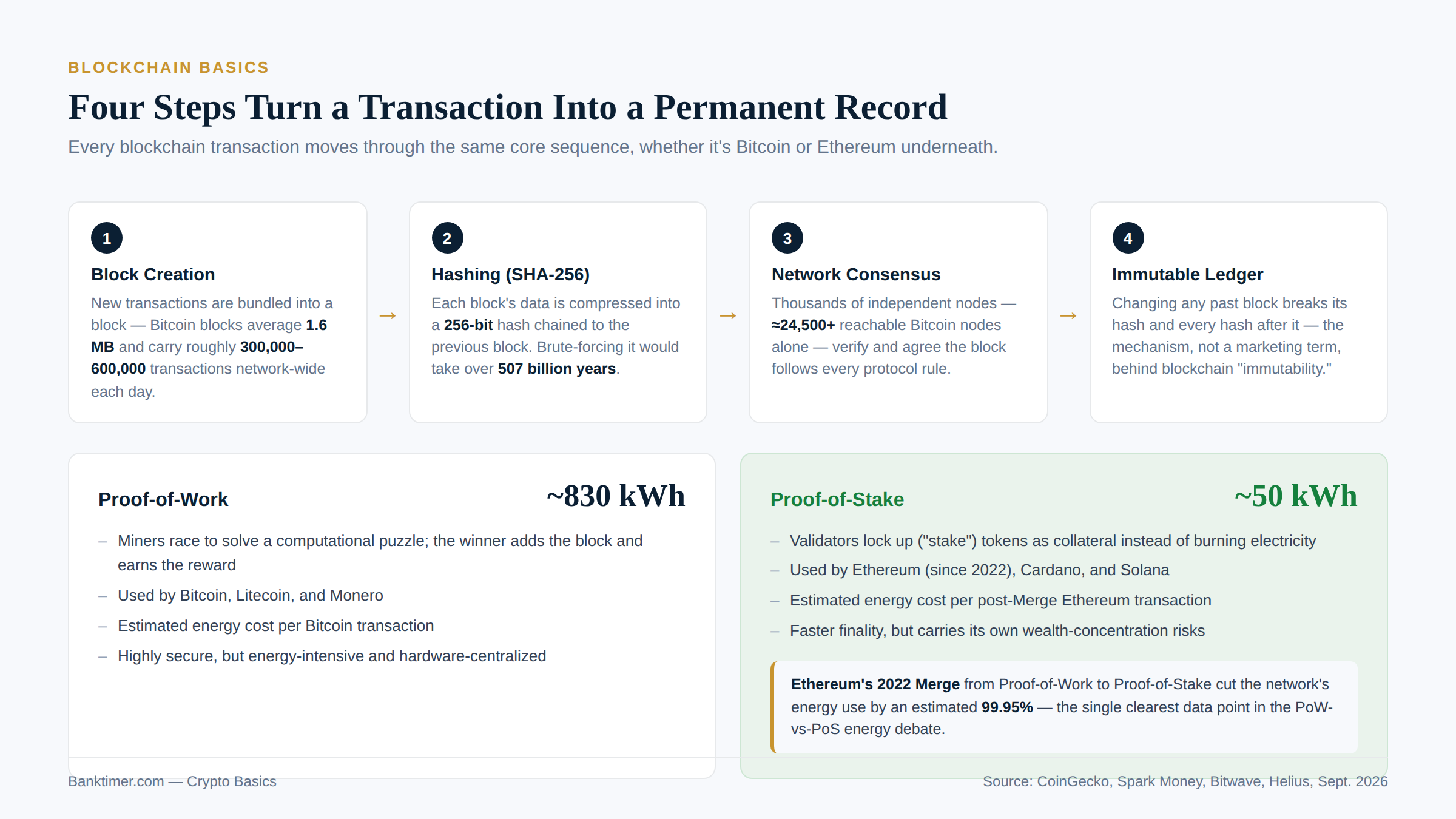
Every Bitcoin block is secured by SHA-256, a hash function that turns any input into exactly 256 bits, or 64 characters, of output. That input can be a single letter or an entire database — the output length never changes. Each block also contains the hash of the block before it, chaining them together in sequence. Change one transaction from years ago, and that block’s hash changes too. That single change breaks every subsequent link in the chain.
That’s the actual mechanism behind blockchain “immutability” — not a marketing term, but math. Brute-forcing SHA-256 would take up to 2^256 attempts. Pool every computer on Earth together, and it would still take over 507 billion years to land a matching hash by chance. By mid-2026, the network was processing 300,000 to 600,000 transactions daily. Roughly 173 million unspent transaction outputs were on record, with SegWit adoption near 85% — a system built for security first, speed second. It’s worth repeating because crypto basics like this one rarely get enough attention.
Mining, Proof-of-Work, and the 21 Million Supply Cap
Satoshi Nakamoto encoded a hard cap of 21 million bitcoin directly into the source code. It isn’t enforced by a company — it’s enforced by tens of thousands of independent full nodes. Those nodes simply reject any block trying to mint more than the allowed supply. Miners have no override, no matter how much hashing power they control. Given that beginners often miss this, treat it as basic crypto basics hygiene, not an advanced strategy.
That held up under real pressure during 2017’s “Blocksize War.” As of September 2026, network hashrate sits around 839 exahashes per second. It had fallen roughly 13.2% over the prior 30 days, though — proof that miners are price-sensitive too, not an unstoppable machine. Mining difficulty runs near 136.6 trillion, with several downward adjustments earlier in 2026 as miners went offline. The last bitcoin won’t be mined until around the year 2140. As with most crypto basics principles, this one is worth keeping in mind going forward.
Bitcoin Halving Cycles and Why They Matter
Roughly every four years, Bitcoin’s block reward cuts in half. That mechanism enforces the 21 million cap by progressively shrinking new supply. The first halving hit in November 2012, dropping the reward from 50 to 25 BTC when Bitcoin traded near $12. By the fourth halving in April 2024, the reward fell to 3.125 BTC with Bitcoin near $63,800. The fifth is projected for April 14, 2028, cutting daily issuance from roughly 450 BTC to 225 BTC.
Historically, a bull market has followed each halving. Bull-market tops landed near $1,150 in 2013, $19,800 in 2017, and $69,000 in 2021 — a rough four-year rhythm. But treat that pattern carefully: cycles “are not precisely 4 years long.” Schwab ties long-term price drivers more to money-supply growth and adoption than to the halving calendar alone. That adoption trend has grown at a median 17% annually since 2017. However, crypto basics like this one are exactly where beginners get tripped up.
Buying, Storing, and Using Bitcoin
How to Buy Bitcoin Safely
Start with a reputable centralized exchange, not a peer-to-peer platform. Institutional custody, mandatory ID checks, and two-factor authentication ship as defaults there. Before you fund an account, bookmark the exchange’s real URL by typing it manually once. Lookalike domains are a common phishing trap. Use an authenticator app for 2FA instead of SMS, which is vulnerable to SIM-swap attacks. Also set a unique 20-plus-character password through a password manager.
KYC verification typically asks for a government ID and a selfie. Approval runs anywhere from five minutes to 48 hours. Once you’re funded, run a small test first: a $20–50 purchase, then a $5–10 withdrawal to your own wallet. Wait for three to six confirmations before you trust it. That sequence catches the costliest beginner mistakes — a wrong address, the wrong network, or a lost seed phrase. It catches them before you’ve moved anything that actually hurts to lose.
Custody Choices: Self-Custody vs. Exchange Custody
Who actually holds your private keys determines who actually controls your bitcoin. The SEC’s own investor guidance draws the line plainly. With self-custody, you control the keys directly. But if your wallet is lost, stolen, or hacked, “you may permanently lose access to your crypto assets.” Full stop — there’s no recovery mechanism. With exchange custody, a third party holds the keys on your behalf. If “the third-party custodian is hacked, shuts down, or goes bankrupt, you may lose access to your crypto assets” too.
The SEC specifically flags rehypothecation — a custodian lending out your assets — as a red flag worth investigating. It flags commingling customer holdings the same way, before you trust any platform. This is a genuinely different risk model than parking money at an FDIC-insured bank. It’s worth understanding through our banking basics guide before you assume crypto custody works the same way deposit insurance does.
Bitcoin as Payment vs. Bitcoin as an Investment
These are two different jobs, and confusing them is a common beginner mistake. As payment infrastructure, Bitcoin’s Lightning Network handled roughly 4,870 BTC in public channel capacity across more than 40,000 channels as of May 2026. Its median routing fee ran near 0.01% — genuinely cheap for small transfers. It’s available through platforms like Strike, Cash App, and Kraken. As an investment, institutions treat Bitcoin completely differently.
BlackRock’s Investment Institute frames a reasonable portfolio allocation at just 1–2%. Even at that small size, the firm argues, Bitcoin’s volatility gives it a risk contribution comparable to a concentrated “Magnificent Seven” tech-stock bet. Low-friction payments and a volatility-aware sliver of a portfolio are not the same use case. Treating “Bitcoin is money” and “Bitcoin is a speculative asset” as interchangeable is a real confusion. It’s exactly the kind that leads to sizing mistakes later on. Instead of skipping it, treat this as non-negotiable crypto basics.
Bitcoin ETFs and Regulated Access Points
For investors who’d rather skip private keys altogether, spot Bitcoin ETFs offer price exposure through an ordinary brokerage account. As of September 4, 2026, U.S. spot-Bitcoin ETFs held roughly $103.3 billion in aggregate net assets. Cumulative inflows totaled near $55.4 billion since their January 2024 launch. On September 3 alone, the category pulled in $731 million, led by BlackRock’s IBIT at $454 million. Named funds include IBIT, Fidelity’s FBTC, Grayscale’s GBTC, ARK’s ARKB, and several others.
The trade-off is straightforward: you get regulated, familiar securities-wrapper access without touching custody or a crypto exchange account directly. But you’re now trusting the ETF issuer’s chosen custodian instead — a different flavor of counterparty risk, not the absence of one. It’s a reasonable on-ramp for anyone who wants exposure while still building out the fundamentals. Our personal finance basics guide covers those in depth.
Bitcoin Price, Volatility, and Market Behavior
What Actually Moves Bitcoin’s Price
Long term, three forces dominate. Growth in the money supply (M2) has historically tracked Bitcoin’s price closely. The halving cycle’s shrinking new supply matters too, along with adoption, which has grown at a median 17% a year since 2017. Short term, the list gets longer and noisier. Interest rates and dollar strength matter — a strong dollar typically pressures Bitcoin. Central-bank liquidity plays a role too, as does seasonality: March, August, and September have historically run weaker, though that’s no guarantee.
Whale concentration matters as well, since large holders control over half of circulating supply and can move price just by moving coins. ETF flows have become a first-order short-term driver too. That single-day $731 million inflow in September 2026 moved alongside real price action, not independently of it. None of these factors work in isolation, and none of them predict the next move with any real confidence.
Historical Volatility and Drawdowns
This is the single most important number in this entire guide. Every full Bitcoin cycle to date has included a drawdown of 75% or more from its peak. The only exception is the current, still-unresolved cycle. From November 2013’s $1,150 peak, Bitcoin fell roughly 85% to a 2015 trough. From December 2017’s $19,783 peak, it fell about 84% by December 2018. From November 2021’s $68,789 peak, it fell roughly 77% by November 2022. We keep coming back to this because crypto basics start with getting the fundamentals right.
The current cycle peaked near $126,000 in October 2025 and had fallen to around $57,950 by July 2026 — a drawdown near 54%. That’s the shallowest of the four cycles so far. It’s still more than half your money gone, though, if you bought at the top. If you take one fact about Bitcoin’s volatility away from this guide, make it this one. That’s crypto basics 101, and it’s still worth restating, since so many people skip it.
Bitcoin’s Correlation With Traditional Markets
Bitcoin’s 30-day rolling correlation with the S&P 500 hit 0.74 in early March 2026, the highest reading of the year. Some intraday windows even showed an r² of 0.94 — near-lockstep movement. That correlation isn’t permanent, though; Bitcoin has decoupled before. It gained 62% in mid-2019 while the S&P fell 6.5%, and rose 147% across all of 2023 against equities’ 26%. But at the high-correlation extreme, Bitcoin behaves like a high-beta stock, not a hedge. When equities fall 2%, Bitcoin “typically falls 6 to 10%,” amplifying losses rather than offsetting them. A correlation of 0.74 adds volatility to an equity-heavy portfolio without providing a meaningful diversification benefit. That’s a structural effect of shared institutional ownership and liquidity pipelines, not some fundamental similarity between stocks and a decentralized currency. It’s worth repeating because crypto basics like this one rarely get enough attention.
Reading Bitcoin Market Cycles Without the Hype
The “four-year cycle” thesis ties bull-market peaks to Bitcoin’s roughly-four-year halving rhythm. Those peaks landed at $1,150 in 2013, $19,800 in 2017, $69,000 in 2021, and $126,000 in October 2025. It’s a real pattern worth knowing, and it’s also not a mechanical trading signal. Cycles “are not precisely 4 years long, and have varied in length” from one to the next. There’s no guarantee the pattern holds going forward. As of September 2026, analysts are genuinely split on whether the traditional cycle still applies at all. That’s partly because the current ~54% drawdown looks so much shallower next to prior 80%-plus busts. Some attribute that gap to ETF-driven institutional demand smoothing out volatility. Treat the four-year story as useful context, not a forecast you can set your calendar by.
Bitcoin Risks Every Beginner Must Understand
Volatility Risk and Position Sizing
BlackRock’s Investment Institute, through CIO Samara Cohen, recommends capping Bitcoin at just 1–2% of a diversified multi-asset portfolio. That’s not because Bitcoin’s correlation with other assets is high — it isn’t. It’s because its sheer volatility is so high. Even a small position carries a risk contribution comparable to holding a concentrated basket of “Magnificent Seven” tech stocks. Exceed that narrow range, and total portfolio risk climbs disproportionately faster than the position size would suggest.
The basis for that caution is exactly the drawdown history covered above: historical Bitcoin drawdowns of 70–80% from peak, repeated across multiple cycles. Position sizing isn’t a technicality here. It’s the difference between an interesting satellite bet and a position large enough to derail a retirement timeline. That’s especially true if it happens to peak right before you need the money.
Custody and Loss-of-Access Risk
An estimated 2.3 to 5.6 million bitcoin — 11% to 18%-plus of the entire 21 million supply — is permanently lost. It’s gone through forgotten keys, discarded hardware, and holders who died without a succession plan. The cases are concrete and painful. James Howells accidentally threw out a hard drive holding 8,000 BTC in 2013. Stefan Thomas locked himself out of 7,000-plus BTC after forgetting his IronKey password.
A 2020 survey found nearly 90% of crypto holders worry about inheritance planning, yet few had actually formalized one. Unlike a forgotten bank password, there’s no customer-service line that can reset a lost private key. Self-custody’s core promise is that no one can take your bitcoin. That promise comes bundled with a flip side: no one can give it back to you either. Specifically, this is where crypto basics knowledge translates into fewer costly surprises.
Regulatory and Tax Exposure
The IRS treats Bitcoin as property, and the numbers have gotten sharper. Short-term gains (held one year or less) get taxed at ordinary rates of 10–37%. Long-term gains are taxed at 0%, 15%, or 20%, with the 2026 single-filer 0% bracket running up to $49,450 in taxable income. Starting with 2025 tax-year sales, exchanges must now file Form 1099-DA, reporting your gross proceeds directly to the IRS.
That means the agency now sees exchange-reported data whether or not you report it yourself. A newer 2025 rule also requires cost basis to be tracked wallet-by-wallet rather than pooled together. FIFO applies by default. Spending Bitcoin on a purchase, not just selling it, triggers a taxable capital gain. That’s a real friction point that undercuts “Bitcoin as everyday money” for anyone trying to actually use it that way.
Common Bitcoin Scams and Red Flags
Pig-butchering scams cost victims $1.14 billion across more than 64,000 cases in 2026, per FTC data. Losses averaged roughly $177,000 per victim over a six-to-12-month grooming period. The pattern is consistent: an unsolicited “wrong number” text, weeks of trust-building, then introduction to a fake trading platform. Victims see fabricated 20–40% weekly gains, with small withdrawals allowed to build confidence. Then comes a large withdrawal attempt that triggers fake fees and total loss of access. While it sounds minor, solid crypto basics habits here can save real money down the line.
Tellingly, victims skew toward educated professionals aged 30–49 with disposable income and existing investment experience. That’s not the naive target the stereotype suggests. The defense is simple and non-negotiable: never share a seed phrase, private key, or API key with anyone, including “support.” Never click exchange links from email or social media. Verify any transaction independently through a public block explorer rather than trusting a platform’s own claim.
Bitcoin is the foundation of crypto basics for a reason. It’s the asset most people encounter first. It’s also the one whose mechanics — mining, halvings, custody, volatility — show up in some form across every other coin and platform this guide covers. Before you move on to how blockchains actually work underneath Bitcoin and everything built after it, hold onto one lesson. The technology is genuinely powerful, and the downside is genuinely real.
Bitcoin Is Trading Near $77,700 With a $1.33 Trillion Market Cap
Blockchain Basics
Bitcoin runs on a blockchain, but blockchain itself is bigger than any one coin. It’s the underlying technology — a shared, cryptographically secured ledger — that thousands of different networks and applications now build on. That includes everything from payment rails to supply-chain tracking to lending protocols that have never touched a bank. Understanding how it actually works, not just what it’s marketed as, matters. Do that before you pick a coin to buy.
This section breaks blockchain down into its real components. We’ll cover how blocks and consensus actually secure a network, and the different flavors of blockchain you’ll encounter. We’ll also cover what smart contracts actually do once deployed. And we’ll cover where the technology’s real limitations — not the hype, the actual limitations — show up in practice. Some of this will sound abstract. The dollar figures attached to it, from ETF assets to hack losses, are not. As a result, skipping this step is one of the more common crypto basics mistakes we see.
None of this requires a computer science degree, just the same skepticism you’d bring to any other financial product. A blockchain’s core promise — a tamper-evident, decentralized record that no single party controls — is real and verifiable. Where that promise breaks down is just as real. Throughput, energy use, and exploits that drained over a billion dollars in 2026 alone all show the limits. It’s just as worth knowing before you decide how much to trust it. However, crypto basics like this one are exactly where beginners get tripped up.
What a Blockchain Is and How It Works
Blocks, Chains, and Cryptographic Hashing
Every blockchain, not just Bitcoin’s, runs on the same core mechanic. Each block carries a cryptographic hash — for most major chains, SHA-256’s 256-bit, 64-character output. That hash derives from the block before it plus its own transaction data. That link is what “chains” the blocks together. Alter any historical entry, and that block’s hash changes. That breaks every subsequent link and gets the block rejected by the rest of the network.
The math behind this isn’t a metaphor. Brute-forcing a single SHA-256 hash would take up to 2^256 attempts. That’s more than 507 billion years, even with every computer on Earth working the problem at once. That’s what makes tampering computationally infeasible rather than merely discouraged. It’s the actual engineering underneath the word “immutable” that gets thrown around so loosely in crypto marketing.
Distributed Ledgers vs. Traditional Databases
Blockchains and ordinary databases solve overlapping problems very differently. A blockchain distributes control across many participants who collectively validate transactions through consensus. A traditional database, by contrast, centralizes control in administrators who set access permissions directly. Blockchain data is immutable by design once it’s hashed into a block — genuinely tamper-resistant. Database records stay mutable by default, which enables useful things like GDPR-compliant deletion, but also opens the door to insider edits.
The performance gap is the part beginners find most surprising. A well-indexed database can handle thousands to millions of transactions per second, while blockchains sacrifice that raw throughput for security and decentralized verification. That trade-off is exactly why blockchain feels “slow” next to your bank’s backend. It’s not a bug — it’s the price of not needing to trust a single administrator.
Public, Private, and Permissioned Blockchains
Public blockchains like Bitcoin and Ethereum are open, decentralized, and censorship-resistant — anyone can participate without permission. But that openness comes with transaction-throughput bottlenecks, gas fees, and a larger security surface, simply because anyone can try to attack it. Permissioned blockchains flip that trade-off: participation is restricted to authorized entities. That restriction lets the network run with zero gas fees and far higher throughput. It’s built for regulatory compliance and back-office automation rather than open access. Neither model is objectively better; they’re built for different jobs. A growing trend worth watching is convergence. Enterprises increasingly bridge their permissioned chains to public ecosystems to reach new customers, while keeping controlled access internally. That’s a hybrid approach, and it’s likely to become more common as both models mature.
Nodes, Validators, and Network Consensus
A validator node actively checks new transactions against protocol rules and creates new blocks. It earns rewards while putting staked collateral at risk if it misbehaves. A full node maintains a complete copy of the ledger and validates transactions, but doesn’t create blocks or earn a direct reward. It’s participation for the sake of decentralization itself. Bitcoin’s scale here is real: roughly 24,500 reachable full nodes as of early 2026. In other words, this crypto basics detail is easy to overlook until you’re the one who skipped it.
An estimated 50,000 to 100,000 total exist, including private ones. Ethereum’s proof-of-stake network runs differently but at even larger scale — roughly 39 million ETH staked. That’s about 32% of the entire 121.7 million ETH supply, supporting around 1.22 million validator slots. Current staking yields cluster tightly around 2.0% to 2.2% APR across major providers. It’s a modest but real return for helping secure the network. Therefore, consider this part of your crypto basics due diligence, not an afterthought.
Consensus Mechanisms Explained
Proof-of-Work Explained
Proof-of-work is the mechanism Bitcoin popularized. Network participants race to solve a computationally hard puzzle using raw hashing power. Whoever solves it first adds the next block and earns the reward. Litecoin, Monero, and Ethereum Classic all still run on it too. The security case is straightforward. A 51% attack requires controlling a majority of global hash power, which is prohibitively expensive on any large PoW network. It’s also fully permissionless, since anyone with hardware can join. The cost is equally straightforward: proof-of-work is genuinely energy-intensive. The economics of cheap electricity have pushed mining toward geographic concentration in a handful of low-cost-power regions, rather than staying evenly distributed. That’s a real tension with the “no single point of failure” ideal the model is supposed to guarantee.
Proof-of-Stake Explained
Proof-of-stake replaces mining’s electricity bill with locked-up capital. Validators stake tokens as collateral instead of burning power on puzzles. The protocol then selects who proposes the next block based on stake size and duration. Propose something dishonest or invalid, and “slashing” claws back part of that staked collateral. Ethereum switched to this model with its 2022 Merge, and Cardano and Algorand run on it natively. This is precisely why crypto basics education emphasizes caution over speed, especially since mistakes here are expensive.
The upside is dramatic energy efficiency — Ethereum’s own switch cut its energy consumption by roughly 99.8%. It also brings faster finality and better scalability than proof-of-work typically offers. The downside is a real “rich get richer” concentration risk if the initial token distribution was uneven. Larger stakes, after all, earn proportionally larger rewards. There’s also a genuine need for well-designed slashing rules to stop validators from supporting competing forks.
Other Consensus Models (DPoS, PoH, and More)
Delegated proof-of-stake (DPoS) lets token holders vote for a smaller set of delegates who validate blocks on everyone’s behalf. Rewards flow to delegates and their backers, and underperforming delegates get voted out. EOS, TRON, and SUI all run this way. It’s more efficient than plain proof-of-stake, with fewer active validators to coordinate. But it concentrates real power in a small delegate set, raising both attack risk and vulnerability to voter apathy or delegate bribery. Proof of History, Solana’s signature innovation, isn’t actually a consensus mechanism on its own. It’s a cryptographic timestamping layer that establishes verifiable event ordering through sequential hash chains. That lets the network agree on “when” something happened without constant back-and-forth between nodes. It enables genuinely high throughput and parallel transaction processing, at the cost of more architectural complexity and steeper hardware requirements for participants.
Energy Use and the Environmental Debate
Bitcoin’s annual energy footprint genuinely depends on who’s measuring it. Cambridge’s hashrate-weighted model puts it near 138 terawatt-hours a year — about 0.5% of global electricity demand. Digiconomist’s economic model, by contrast, estimates 204 TWh, comparable to Thailand’s entire national power draw. Both can be right; they’re measuring different things. What’s less disputed: roughly 52.4% of Bitcoin mining now runs on sustainable sources, per Cambridge’s April 2025 report.
Natural gas is the single largest source at 38.2%, with coal down sharply to 8.9%. The proof-of-work-versus-proof-of-stake gap is the more decisive comparison for the industry’s future, though. Ethereum’s post-Merge network draws roughly what 2,100 American homes use. Per-transaction, Bitcoin runs near 830 kWh against post-Merge Ethereum’s roughly 50 kWh. That’s a difference too large to wave away as a rounding error.
Smart Contracts and Blockchain Applications
What a Smart Contract Actually Does
A smart contract, in Ethereum’s own framing, is simply a program deployed on a blockchain. It’s code and data living at a specific address, capable of holding a balance and receiving transactions. There’s no human owner or operator once it’s live. Execution is deterministic: Ethereum’s own vending-machine analogy holds up well. Correct inputs guarantee a specific, predetermined output every time, with zero human discretion involved.
That determinism cuts both ways. Once deployed, interactions are generally irreversible, and the contract itself can’t be deleted by default. There’s no customer-service override if the code does something unintended. Smart contracts gain real power through composability: they can call and interact with other smart contracts. That’s the actual technical foundation underneath the entire layered DeFi ecosystem, from lending protocols to the price oracles they depend on.
Tokens vs. Coins vs. NFTs
Fungible assets — coins and tokens — are interchangeable, identical-value units. Bitcoin, Ethereum, and stablecoins like USDC are the canonical examples, functioning like ordinary currency where any unit substitutes for another. NFTs are the opposite: unique, non-interchangeable digital assets, each carrying distinct characteristics and value. That could be a piece of digital art or a one-of-a-kind in-game item. A middle category, semi-fungible tokens, covers things like an in-game sword with a specific durability level. It’s interchangeable with identical swords, but not with different ones. One more distinction worth locking in early: a coin, like BTC or ETH, is native to and secures its own independent blockchain. A token, by contrast, is built on top of someone else’s chain — an ERC-20 token running on Ethereum, for instance. It borrows that base chain’s security instead of maintaining its own.
Real-World Blockchain Use Cases Beyond Currency
Blockchain’s real-world footprint extends well past speculation, even if that’s where most headlines focus. Oracle’s Intelligent Track and Trace monitors shipped-goods temperature and origin. DHL uses blockchain to record shipment data and digitize ocean-freight documentation. In healthcare, BurstIQ’s LifeGraph platform combines the technology with AI to manage sensitive patient data while staying HIPAA-compliant. In voting, Voatz has piloted biometric mobile voting with a tamper-resistant, blockchain-recorded audit trail.
Perhaps the most credibility-building example for skeptics is JPMorgan Chase’s Onyx initiative, which uses distributed-ledger technology for real-time interbank settlement. It was demonstrated through 2023 pilot programs with Indian banks. That’s a major, conservative, traditional bank actively putting blockchain rails into production, not just running a speculative side project. None of this makes blockchain a solved problem everywhere. But it does undercut the idea that the technology is purely a trading toy. It’s worth repeating because crypto basics like this one rarely get enough attention.
Layer 1 vs. Layer 2 Networks
Layer 1 networks — Bitcoin and Ethereum, primarily — handle security and settlement directly. They process every transaction themselves under their own independent consensus. Layer 2 networks process transactions off that main chain and periodically settle back to it. They inherit the base layer’s security rather than building their own from scratch. That’s the practical way blockchains sidestep the scalability trilemma without rewriting the base protocol’s rules. The cost difference is genuinely vivid. A DeFi transaction that might run $15 directly on Ethereum can cost just a few cents on a Layer 2 like Polygon. Arbitrum and Base currently lead Ethereum’s Layer 2 field by transaction volume. The Lightning Network is Bitcoin’s own Layer 2, built on state channels rather than rollups. The honest trade-off: Layer 2s are faster and cheaper, but they’re generally considered less secure than the Layer 1 they settle back to. Speed has a price.
Blockchain Limitations and Risks
The Scalability Trilemma
The trilemma holds that a blockchain can realistically optimize only two of three properties at once. Those are security (resistance to takeover), scalability (throughput and speed as usage grows), and decentralization (control spread across independent participants rather than concentrated). Proposed fixes remain largely experimental. Sharding splits a chain into pieces that process transactions in parallel. Side-chains offload specific tasks to separate chains, and state channels batch transactions off-chain before settling later — the same idea behind Lightning.
Bitcoin’s own design choice prioritizes security and decentralization at the cost of throughput. Many Layer 2 networks, and some newer Layer 1s, prioritize scalability and security at some real cost to decentralization instead. There’s no free lunch here. Any project claiming to have fully “solved” the trilemma is worth a healthy dose of skepticism before you believe it. In other words, this crypto basics detail is easy to overlook until you’re the one who skipped it.
Immutability Cuts Both Ways
Transactions are irreversible for compounding reasons. Reversing one would require convincing a majority of thousands of independent node operators worldwide to rewrite history. Each transaction’s hash links to prior blocks, so altering any of it breaks the chain and gets rejected outright. In proof-of-work specifically, rewriting confirmed history becomes mathematically and financially impossible, as computational cost compounds with every new block. That same protection has an ugly flip side.
A fat-fingered send to the wrong address is typically just as permanent as a legitimate one. So is a transfer sent on the wrong network, or a scam transaction. There’s no bank fraud department, no chargeback, no “undo” button. Recovery is possible only in narrow cases. Generally, that means the error happened entirely inside a single exchange’s internal ledger, before it ever touched the actual blockchain. Immutability protects you and abandons you with the exact same mechanism.
Smart Contract Bugs and Exploits
DeFi protocols lost at least $1.3 billion to hacks and exploits in the first eight months of 2026 alone, per CertiK’s Hack3d report. The bigger story is what’s driving that number now. For the first time, compromised private keys and credentials — not broken smart-contract code — became the leading cause of crypto theft by dollar value. That overtook pure code vulnerabilities. The named incidents are stark.
Drift Protocol lost $285 million on April 1, 2026, drained in 128 seconds. Attackers social-engineered admin credentials over months to pull it off. KelpDAO lost $290 million on April 18, 2026, through compromised session keys that let attackers mint unbacked tokens. That triggered a $6.28 billion TVL decline across Aave. North Korea’s Lazarus Group was linked to $575 million combined across both incidents. That’s roughly 44% of the year’s total DeFi theft from one state-backed actor.
Where Blockchain Hype Outpaces Reality
Gartner’s now-infamous 2019 forecast predicted that 90% of enterprise blockchain platforms would become obsolete within two years. It cited “a lack of strong use cases.” Survey data backed the skepticism up. Only 19% of businesses at the time called blockchain “very important,” and just 9% were actually investing in it. Gartner placed the technology squarely in the “trough of disillusionment” on its hype cycle. That’s a genuinely useful shorthand for the gap between marketing claims and real enterprise traction. Instead of treating this as advanced strategy, file it under crypto basics — everyone needs it.
It’s worth drawing a distinction, though. That enterprise-blockchain hype cycle — quiet, failed private-chain pilots — is one story. Public blockchain and DeFi tell a different one: messier, but real usage growth. You can see that growth in ETF assets, Lightning payment volume, and DeFi activity that persists even amid the hacks covered above. Don’t let one hype cycle’s collapse convince you the other one never had substance.
Blockchain isn’t one technology so much as a family of trade-offs. Security trades against speed, openness against control, and immutability protects you right up until it doesn’t. Grasping those trade-offs is one of the more technical crypto basics in this guide. It’s the piece that makes everything downstream actually make sense. That includes why an exchange charges what it charges, and why a hack happens the way it happens.
Crypto Exchanges
Almost everyone’s first real crypto decision isn’t which coin to buy — it’s which exchange to trust with the transaction. Exchanges are where fiat currency actually becomes crypto. Understanding how they work is one of the more practical crypto basics you’ll use immediately, not just in theory. Get this part wrong, and even a sound investment thesis can get undone by a platform that mishandles your funds.
This section covers how centralized and decentralized exchanges actually differ, and what to check before trusting one with real money. It also covers the counterparty risk that’s sunk some of the industry’s biggest names — FTX, Mt. Gox, Celsius. All three took real customer funds down with them. We’ll close with the practical habits that keep your account, and your coins, actually safe.
How Crypto Exchanges Work
Centralized Exchanges (CEX) Explained
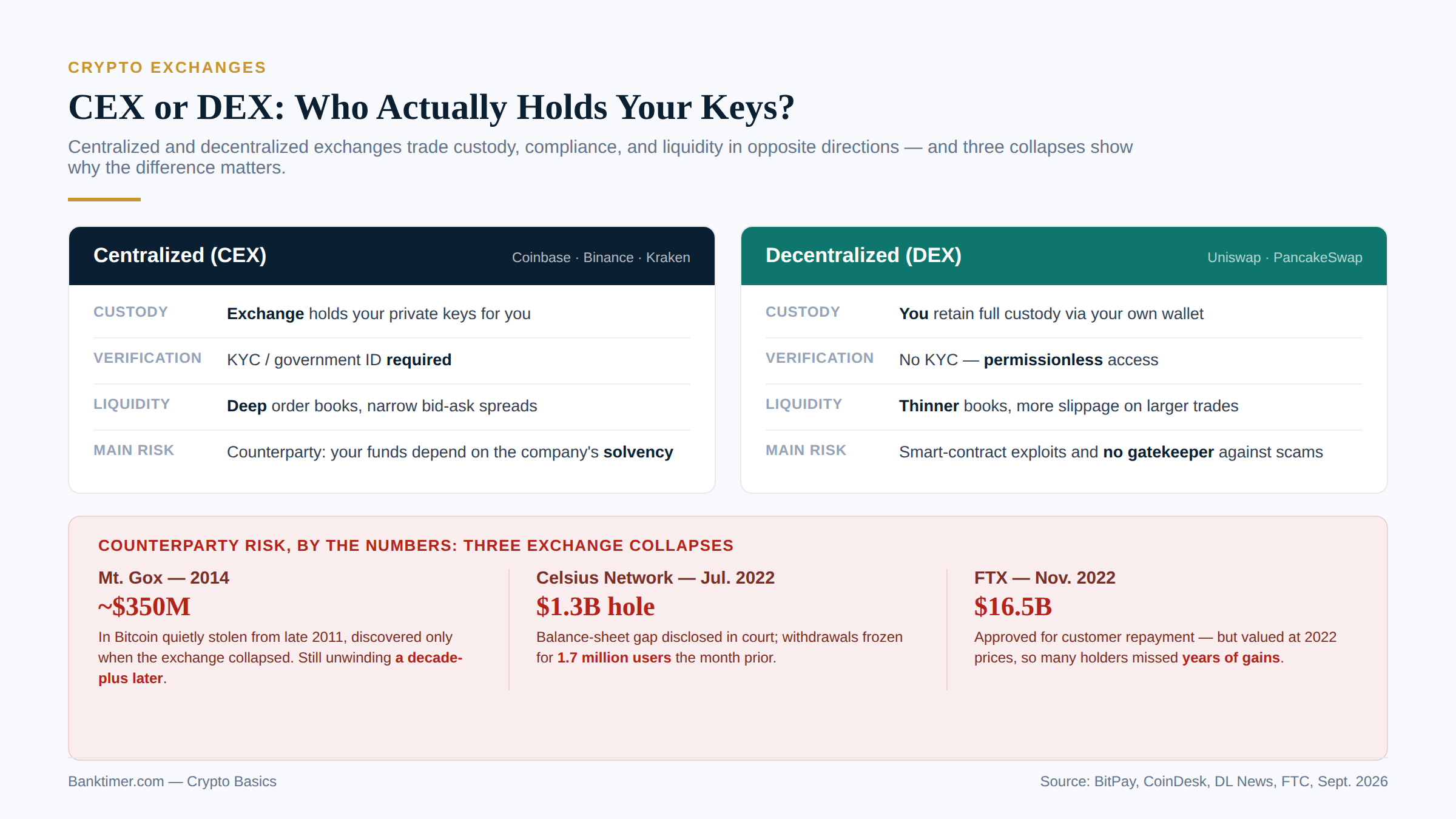
Centralized exchanges act as intermediaries. They hold your assets in custody and match trades through an internal order book, structurally similar to a traditional stock exchange. Coinbase, Binance, and Kraken are the obvious names here. Because the exchange controls the private keys, trading feels fast and frictionless. But that convenience concentrates real custodial and security risk on the platform itself, not on you directly.
CEXs also mandate KYC verification, which improves regulatory compliance and fraud traceability. The real cost is handing over personal information and giving up a measure of privacy. The trade-off pays off in one clear way. Centralized order matching across a large user base generally means deeper liquidity and tighter spreads. Execution is also easier than you’ll typically find on a decentralized alternative, especially for a major asset like Bitcoin.
Decentralized Exchanges (DEX) Explained
Decentralized exchanges cut out the custodial middleman entirely. Trades execute peer-to-peer through smart contracts rather than a company-run order book, with Uniswap and PancakeSwap as the best-known examples. You retain full custody throughout; trades are conducted directly from your own wallet. No KYC or personal information is required to participate. That permissionless access is the whole appeal, and it’s also the whole risk.
With no gatekeeper checking who’s on the other side of a trade, fraud exposure runs meaningfully higher. So does scam exposure, compared with a regulated CEX. DEXs also typically carry lower liquidity than major centralized platforms. That means larger trades can move the price against you more than they would on Coinbase or Kraken. It’s a real, measurable cost, not just a theoretical inconvenience for active traders. Instead of treating this as advanced strategy, file it under crypto basics — everyone needs it.
Order Books, Liquidity, and Spreads
An order book is a real-time list of every open buy (bid) and sell (ask) order for an asset. Market orders execute immediately against it, while limit orders wait until they’re matched. The bid-ask spread is the gap between the highest bid and lowest ask. It stays narrow in genuinely liquid markets, like Bitcoin trading on a major exchange. That signals close agreement between buyers and sellers on price. Similarly, this is a foundational piece of crypto basics that too many guides gloss over.
That liquidity matters in a very concrete way. Deep order books absorb large trades with minimal slippage. Thin order books, typical of smaller-cap altcoins, mean even modest trades can move the price significantly. That translates directly into higher effective trading costs and sharper volatility for less-liquid assets. This is why the same-sized trade can feel completely different depending purely on which asset you’re moving.
Fiat On-Ramps and Off-Ramps
A fiat on-ramp converts ordinary currency into crypto — the entry point for nearly every new buyer. A fiat off-ramp reverses it, converting crypto back into withdrawable bank funds. The method you choose changes both cost and speed. ACH bank transfers carry the lowest fees but move slowest, typically three to five business days. Debit or credit card purchases land in minutes but can add 1.5% to 3.5% in fees on top of the price.
Wire transfers suit large amounts at a moderate flat fee over one to two business days. Digital wallets like Apple Pay run fast at roughly card-level fees. Comparing these costs is exactly the same discipline our credit card basics guide recommends for any card purchase. Check the all-in cost, not just the number that’s easiest to see. While it sounds minor, solid crypto basics habits here can save real money down the line.
Choosing a Crypto Exchange
Regulation, Licensing, and Where an Exchange Operates
New York’s BitLicense has been in effect since June 2015, administered by the state’s Department of Financial Services. It’s one of the strictest exchange-licensing regimes in the country. It’s required for any business doing virtual-currency work with New York or its residents. It demands risk-based capital requirements, a surety bond or customer-protection account of at least $500,000, real cybersecurity standards, and AML transaction monitoring. Only 39 entities currently hold a BitLicense or equivalent trust charter, including Coinbase, Kraken, Gemini, and PayPal. That short list is itself useful information. Many exchanges simply exit the New York market rather than comply. That makes “does this exchange operate in New York” a legitimate, checkable due-diligence question. It’s not a formality — it’s a real signal about how seriously a platform treats regulation.
Security Track Record and Proof of Reserves
Proof of Reserves (PoR) is an independent audit verifying that an exchange’s actual on-chain holdings match what it owes customers. It typically uses a Merkle tree, so individual users can confirm their own balance was included. It’s a genuinely useful check, but it has a real limitation worth stressing. PoR verifies assets exist at a single snapshot in time, but it can’t confirm exclusive ownership of the underlying keys. It also can’t detect whether an exchange temporarily borrowed assets just to pass that snapshot. It addresses collateralization, not full solvency. That gap matters because exchange hacks are not rare history. Mt. Gox lost roughly $350 million, and Coincheck lost about $400 million in 2018. In February 2025, Bybit lost $1.5 billion in ether, reported at the time as the largest crypto heist ever recorded.
Fee Structures Compared
Fee comparisons across exchanges are genuinely apples-to-oranges. Kraken’s published schedule runs from 0.40%/0.80% maker/taker at the lowest volume tier, down to essentially free at its top tier. Binance charges a flat 0.10%/0.10%, reduced further if you pay fees in its own token. Coinbase doesn’t publish a simple maker/taker rate for retail users at all. Instead, it layers a spread into the quoted price.
On top of that comes a 1% limit-order execution fee and a payment-method fee that can run close to 1.875%. Its Coinbase One subscription does offer zero trading fees, with some limitations. The lesson matters more than any single number. Check the all-in cost — spread, trading fee, withdrawal fee, and network fee combined. Don’t just compare headline percentages, since they aren’t actually measuring the same thing across platforms. That trade-off, in short, sits at the center of crypto basics for anyone new to digital assets.
Supported Assets and Liquidity Depth
Coinbase’s own price page tracks market data for nearly 18,895 assets — a huge number. It’s worth reading carefully, though. That’s the count of assets it displays pricing for, not necessarily the smaller number actually tradeable on the platform. Listing breadth and liquidity depth are two different things entirely. Major pairs like BTC/USD and ETH/USD on large centralized exchanges carry the tightest spreads. They also carry the deepest order books you’ll find anywhere in crypto. Long-tail listed assets, even on a large exchange, can have genuinely thin books. Before assuming a platform’s size guarantees easy execution on whatever you want to trade, check the specific asset’s liquidity directly. An exchange listing thousands of coins doesn’t mean all of them trade like Bitcoin does.
Counterparty Risk and Exchange Failures
What Counterparty Risk Means on an Exchange
The SEC states the core exposure plainly: “if the third-party custodian is hacked, shuts down, or goes bankrupt, you may lose access to your crypto assets.” Two specific practices turn that theoretical risk into a real one. Rehypothecation is a custodian lending out or otherwise using your deposited assets as its own collateral. Commingling means mixing customer holdings together instead of keeping them segregated. Both convert a depositor into an unsecured creditor rather than someone with a clean claim to specific, ring-fenced assets. That distinction isn’t academic. It’s the exact mechanism that explains why FTX and Celsius, two of the industry’s largest collapses, happened the way they did. It wasn’t simple theft, but a business model built on quietly using customer money as if it were the exchange’s own. Meanwhile, crypto basics like this one separate cautious investors from careless ones.
Lessons From Major Exchange Collapses
FTX filed for bankruptcy in November 2022 as the third-largest exchange by volume, with $1–2 billion in customer deposits unaccounted for. Alameda Research, owned by CEO Sam Bankman-Fried, had received over half of FTX’s customer funds. It held roughly 40% of its assets in FTX’s own illiquid token. Bankman-Fried was sentenced to 25 years in prison. Mt. Gox lost roughly 650,000 BTC to gradual theft starting in late 2011, worth about $473 million at its 2014 bankruptcy filing. Creditors weren’t fully repaid until a full decade later. Celsius paused withdrawals in June 2022, owing users $4.7 billion against just $167 million in cash. It was undone by aggressive rehypothecation, and its founder is now serving 12 years for fraud. All three cascaded from the same 2022 stress that began with Terra/Luna’s collapse. That collapse erased nearly $45 billion in a single week.
Insurance, Reserves, and What They Actually Cover
Crypto held on an exchange is explicitly not FDIC-insured. The FDIC states directly that it “does not insure assets issued by non-bank entities, such as crypto companies.” Coverage applies only to deposits at an insured bank if that bank fails. It never covers crypto holdings at an exchange or crypto firm, no matter how the platform markets itself. The FDIC has actually had to warn that some crypto companies misrepresented their products as FDIC-insured.
It directed partner banks to stop making those claims. That’s arguably the single most important regulatory fact in this whole guide. A “FDIC-insured” bank partnership some crypto platforms advertise does not mean your crypto itself is insured. Proof of reserves, covered above, isn’t a substitute either. It’s a point-in-time asset check, not deposit insurance and not a solvency audit.
Signs an Exchange Is in Trouble
The case studies above translate into a checkable list. Withdrawal delays or sudden “temporary” pauses are the clearest warning. Celsius froze withdrawals abruptly one month before its bankruptcy filing. Unsustainably high advertised yields on deposited assets were the hallmark of Celsius’s rehypothecation model. Heavy reliance on a platform’s own native token as balance-sheet backing was central to FTX’s collapse. Alameda, after all, held roughly 40% of its assets in FTX’s own illiquid token. Opacity around reserves and audits — no regular, third-party-verified proof-of-reserves reporting — is itself a red flag. That transparency gap was central to both collapses going undetected. Add rapid executive departures or regulatory inquiries reported in the financial press. Together, those signs make a genuinely useful early-warning checklist. Instead of skipping it, treat this as non-negotiable crypto basics.
Using Exchanges Safely
Account Security Best Practices
Use an authenticator app for two-factor authentication, never SMS, which remains vulnerable to SIM-swap attacks. Generate a unique password of 20-plus characters through a password manager. Also use a dedicated email address just for crypto accounts, to contain the damage if one account is ever compromised. Download exchange apps only through links from the official website, never a search-engine ad or an unsolicited link.
Bookmark the real URL by typing it manually once, checking it character-for-character against lookalike domains. Never share a seed phrase, private key, or API key with anyone — including “support,” since legitimate support never needs them. Never click exchange links delivered through email, social media, or ads, either. Verify official support channels before an emergency happens, not while you’re in the middle of one and panicking.
Why “Not Your Keys, Not Your Coins” Matters
Without controlling the private keys yourself, through a non-custodial wallet, you don’t hold direct ownership of your crypto. You hold a claim against whoever does control the keys instead. If that custodian “goes bankrupt or otherwise fails, you could lose access to your funds through no fault of your own.” Combined with blockchain’s inherent transaction irreversibility, that makes trusting a custodian a fundamentally different, arguably larger, risk than ordinary market volatility. In turn, add this to the growing list of crypto basics every new holder should know cold.
Every collapse in this section proves the same point the hard way. Customers who held Bitcoin in self-custodied wallets, rather than on FTX, Mt. Gox, or Celsius, were completely unaffected by those platforms’ failures. Customers who left assets sitting on the exchange became unsecured creditors instead. They waited years for partial recovery, if they got anything back at all.
Withdrawal Limits and Verification Tiers
KYC verification on a regulated exchange typically requires a government-issued ID, a selfie or liveness check, and sometimes proof of address. Approval runs anywhere from five minutes to 48 hours. Most regulated exchanges layer this into tiers. A minimal, email-only tier offers little or no fiat withdrawal ability. A standard, ID-verified tier unlocks meaningful daily and monthly limits. An enhanced tier requires proof of address or source-of-funds documentation for the highest limits.
That friction is a feature, not a bug, from a risk-management standpoint. It’s precisely the due diligence — real identity checks, transparent limits, actual licensing — that legitimate platforms are required to do. Scam operations typically skip it. Worth noting: this verification process doesn’t generate a hard inquiry on your credit report. That’s unlike opening a credit card or applying for a loan. It’s identity verification, not a credit check.
Moving Funds Off an Exchange Safely
Before moving anything meaningful, run a small test first — a modest test withdrawal to your destination wallet. Wait for three to six network confirmations before trusting the transaction is final. Verify the receiving address by copy-paste, never manual retyping. Double-check that the first six and last six characters match on both ends. Confirm you’ve selected the correct network. A mismatch between, say, Bitcoin’s mainnet and a wrapped version on another chain is a common and irreversible source of permanent loss. Write down and store the destination wallet’s seed phrase offline, before you fund it. Never store it as a photo, a cloud note, or an email. Use an independent block explorer to confirm a transaction’s actual on-chain status, rather than trusting the exchange’s own interface alone.
Exchanges are the layer where crypto basics stop being abstract. Here, it becomes a real decision about who you trust with real money. Every collapse covered here — FTX, Mt. Gox, Celsius — came down to the same underlying lesson. Convenience and counterparty risk trade off directly. The safest habit is treating an exchange as a temporary stop, not a permanent home, for anything you can’t afford to lose.
Crypto Fees
Every crypto transaction carries a cost, even when nothing on the screen calls it a fee. Buy Bitcoin with a debit card, and you’re paying a card-processing surcharge stacked on top of the exchange’s own markup. Send Ethereum, and a validator collects whatever gas the network demands that minute. Understanding these costs is one of the more overlooked pieces of crypto basics. The sticker price rarely matches what actually leaves your account. A $100 purchase can cost anywhere from a few cents to more than $7. That depends entirely on how you pay and where.
This section breaks fees into four layers. Network fees pay miners and validators to process your transaction on-chain — sat/vByte for Bitcoin, gwei for Ethereum. Exchange fees cover the maker-taker structure platforms use to match buyers and sellers. Hidden costs like slippage, bridging, and staking commissions rarely show up on a receipt. They chip away at returns anyway. And a handful of practical habits can cut your total cost without cutting corners on custody or security. Treat each layer separately, because stacking them together is where real money disappears. This theme runs through every section of crypto basics, since the fine print rarely gets read.
Understanding Network (Gas) Fees
What a Network Fee Actually Pays For
A network fee isn’t a charge from any company. It’s a payment to whoever secures the blockchain that processes your transaction. On Bitcoin, the fee is technically just leftover satoshis. It’s the difference between what you put in and what comes out. Send inputs totaling 2,699,815 sats and specify outputs of 2,654,815 sats. The 45,000-sat gap becomes the miner’s fee, collected through the block’s coinbase transaction. Ethereum works differently but for a similar reason. Gas measures the computational effort your transaction demands. Under EIP-1559, the fee splits into two parts. A base fee gets burned outright, permanently reducing ETH supply. A priority tip goes to whichever validator includes your transaction fastest. Either way, you’re bidding for limited block space, not paying a toll to a business.
Bitcoin Transaction Fees Explained
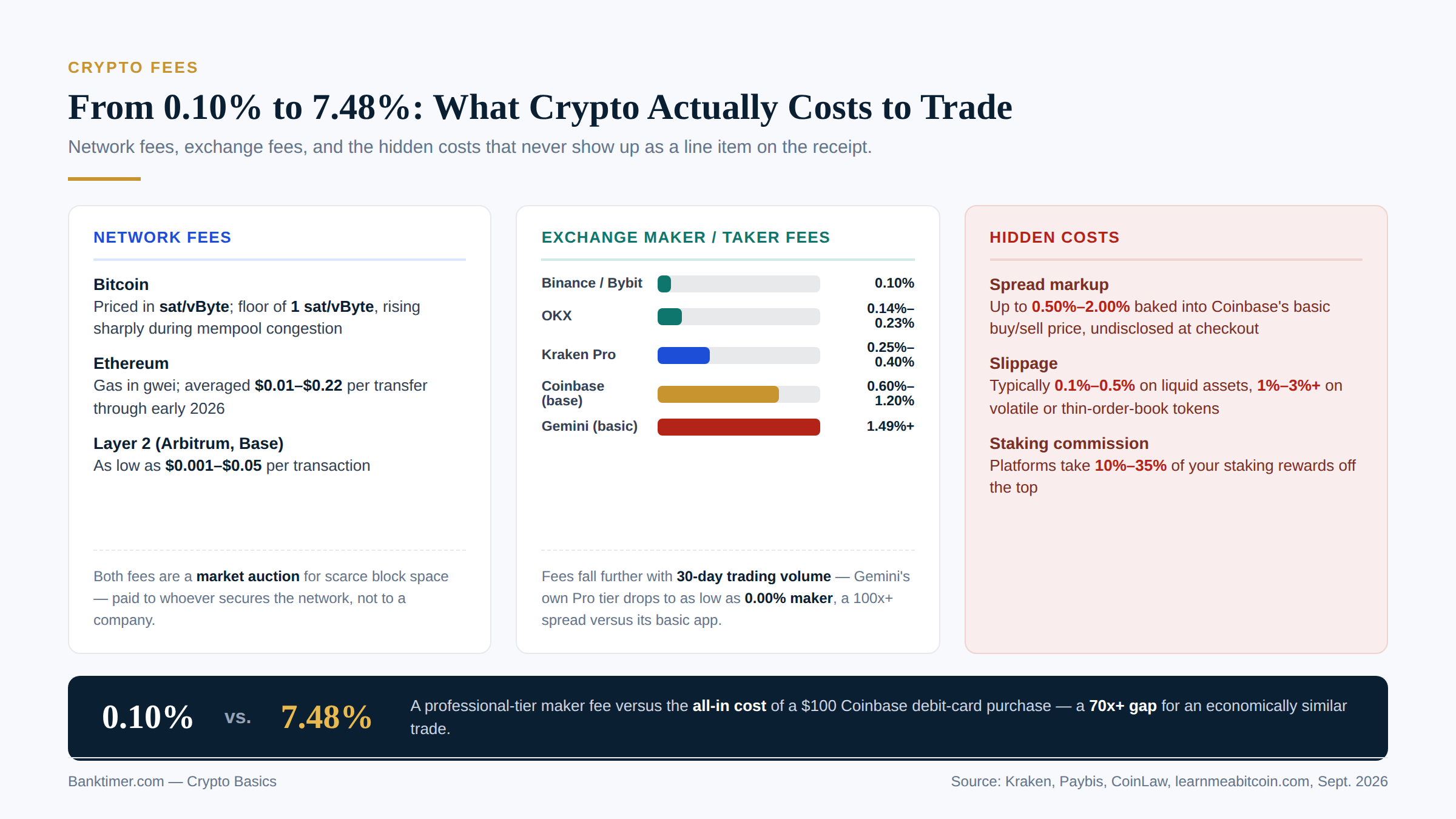
Bitcoin fees are priced in satoshis per virtual byte (sat/vByte), not as a flat dollar amount. Miners rank transactions by fee density — the fee divided by the transaction’s virtual size. They fill blocks with the highest-density transactions first. Virtual bytes exist because of the 2017 SegWit upgrade, which changed how block capacity gets measured — weight units divided by four. That let legacy and SegWit transactions be priced on the same scale. Bitcoin Core’s default minimum relay fee sits at just 1 sat/vByte. But during congestion, the fee needed to confirm within a block or two can climb well beyond that floor. Trackers like Blockchain.com, Blockchair, and Statista publish rolling averages. The going rate shifts with mempool conditions hour to hour, not month to month.
Ethereum Gas Fees Explained
Ethereum prices gas in gwei, a billionth of one ETH. The trend over the past two years has run sharply downward. Average gas price fell to roughly 0.052 Gwei by April 7, 2026, down from 1.67 Gwei just a year earlier. In dollar terms, a basic ETH transfer cost about $0.01 in January 2026. Typical transactions ran $0.15 to $0.22 through the first quarter. Therefore, consider this part of your crypto basics due diligence, not an afterthought.
Layer 2 networks priced transactions as low as a fraction of a cent. That decline traces back to the March 2024 Dencun upgrade, which opened a cheaper data-availability lane for rollups. Mainnet fees dropped roughly 95% afterward. Ethereum’s daily gas revenue fell from a peak near $23 million to about $6.3 million. Layer 2 networks now carry an estimated 95% of all Ethereum transaction volume. Check Etherscan’s Gas Tracker for a live read before sending anything large. Crypto basics coverage that skips this point isn’t doing readers any favors, given that it matters more than most guides admit.
Why Fees Spike During Network Congestion
Gas prices rise the same way any auction does. More people want block space than the network can provide in the next block. The highest bidders win first. The mempool — the waiting room of unconfirmed transactions — is the visible proof of that competition. A thin mempool means low fees and fast confirmations. One 2026 tracker described congestion at just 0.12%, correlating with some of the lowest gas fees on record. A crowded one means the opposite. NFT mints, token launches, and airdrops can spike fees within minutes. That’s true regardless of the time of day or how calm the network looked an hour earlier. That unpredictability is exactly why checking a live gas tracker beats relying on habit. Do that before a large or time-sensitive transaction. Instead of skipping it, treat this as non-negotiable crypto basics.
Exchange and Trading Fees
Maker vs. Taker Fees
Exchanges charge two different rates depending on how your order fills. A maker order adds liquidity — a limit order sitting on the book, waiting to be matched. A taker order removes it by filling immediately, which is why takers almost always pay more. Binance and Bybit charge a flat 0.10% on both sides. OKX runs 0.140% maker / 0.230% taker. Kraken Pro starts makers at 0.25% and takers at 0.40%. Similarly, this is a foundational piece of crypto basics that too many guides gloss over.
Kraken’s simplified standard platform charges a flat 1% plus spread instead. Coinbase’s Advanced Trade tier ranges from 0.60% maker / 1.20% taker at the base level. That drops to 0.25%/0.40% once you clear $10,000 in monthly volume. But Coinbase’s basic app layers on an additional 0.50%–2.00% spread markup that never shows up as a line item. Gemini’s basic order carries a 1.49% fee plus up to a 1% “convenience fee.”
Spread Costs You Don’t See on the Receipt
The spread is the gap between what buyers are bidding and what sellers are asking. It’s baked directly into your execution price rather than itemized as a separate charge. You won’t find it printed on a receipt the way you’d find a trading fee. That’s exactly why it’s easy to miss. Coinbase’s basic buy-and-sell flow embeds an estimated 0.50% to 2.00% spread markup on top of its stated fee. That markup stays invisible at checkout. Illiquid markets make this worse: fewer competing buy and sell orders near the current price means a wider gap between them. Trading a thinly-traded token costs more than the advertised fee suggests, even before slippage enters the picture. While it sounds minor, solid crypto basics habits here can save real money down the line.
Deposit, Withdrawal, and Conversion Fees
Funding method changes your total cost more than almost any other variable. Coinbase charges $10 for an incoming wire and $25 for an outgoing one, but ACH deposits are free. That’s true until you buy more than $200 with ACH funds, which triggers a 1.49% fee. Credit and debit card purchases are the most expensive path by far. A 3.99% processing fee plus a tiered flat charge ($0.99 to $2.99) together push a $100 debit-card buy to roughly $7.48 in total fees. Since markets can turn volatile fast, crypto basics here pay off the moment things get rocky.
That’s near 7.48%. Compare that to a $500 bank-funded purchase, which costs about $9.95, under 2%. It’s a similar dynamic to funding a purchase with a credit card generally. Card networks charge more for the convenience, the way our credit card basics guide covers in more detail. ACH and bank transfer are consistently the cheapest way onto an exchange; a card swipe is consistently the priciest.
How Fee Tiers Reward High-Volume Traders
Nearly every exchange rewards volume with lower fees, and the gap between casual and active traders can be enormous. Kraken tiers its discounts off 30-day USD trading volume. Accounts under $50,000 sit in the base structure before fees start declining. Binance layers a further discount for traders willing to pay fees in its native BNB token. Gemini shows the starkest example: its ActiveTrader tier can push maker fees down to 0.00% at high volume. Compare that with 1.49% or more on its basic consumer app. That’s a gap of more than 100 times for functionally the same trade. If you trade occasionally, tiered pricing barely matters. If you trade often, it’s usually the single biggest lever on your total cost. Similarly, this is a foundational piece of crypto basics that too many guides gloss over.
Hidden and Indirect Crypto Costs
Slippage on Large or Illiquid Trades
Slippage is the gap between the price you expected and the price you actually paid. It shows up most in volatile or thinly-traded markets. Expect to buy 1 ETH at $2,000 and end up paying $2,020 instead, and you’ve just absorbed 1% slippage. The mechanism is simple: a large order eats through the order book. It fills progressively worse-priced levels as it exhausts what’s available at each price point. A big buy might fill partly at $100, then $101, then $102, pushing your average cost up as it goes. Recommended slippage tolerance settings reflect that risk. Aim for roughly 0.1% to 0.5% for liquid, large-cap assets like Bitcoin or Ethereum. Volatile or low-liquidity tokens call for 1% to 3% or more. The bigger your order relative to available liquidity, the worse the damage.
Bridging and Cross-Chain Fees
Moving assets between blockchains, called bridging, layers two costs on top of each other. One is a destination-chain gas reimbursement; the other is the bridge’s own protocol fee. A May 2026 benchmark on a Base-to-Arbitrum USDC route makes the spread concrete. On a $500 transfer, the cheapest option, Circle’s CCTP, cost $0.24, or 0.05%. Across cost $0.31. The priciest, Synapse, cost $1.40, or 0.28%. Scale that transfer to $5,000, and CCTP’s percentage cost actually falls, to roughly 0.005%.
Synapse’s stays close to proportional, at 0.136%. That’s because fixed-fee bridges barely scale with transfer size. Liquidity-pool bridges, by contrast, charge something closer to a flat percentage regardless of amount. Speed varies just as much. Across settles in as little as 2 to 15 seconds, while CCTP’s older version can take 13 to 19 minutes. Bridges are also one of crypto’s biggest attack surfaces. This guide covers that risk in more depth in the next section.
Staking and Custody Fees
Staking your crypto to earn rewards sounds free. But the platform running it takes a cut before you see a cent. Coinbase keeps roughly 25% to 35% of staking rewards as commission. Kraken takes about 20%. Liquid-staking protocols tend to charge less. Lido’s flat fee is 10%, Rocket Pool’s node-operator commission runs around 14%, and Solana’s Jito charges closer to 4%. Uphold sits higher, around 15% to 25%. Self-directed options like Ledger Live or Trust Wallet only pass along the validator’s own commission, typically 5% to 10%, with no extra platform markup on top.
The advertised APY you see quoted is an estimate, not a promise. It moves with live network conditions. Your actual yield always equals the network’s base reward rate minus whatever cut your platform keeps. In fact, this is the kind of crypto basics detail that only matters until the day it matters a lot.
Tax-Preparation and Software Costs
Even after you’ve paid every trading and network fee, crypto adds one more cost most investors don’t budget for. It’s tax software. Koinly’s paid tier starts at $49 per tax year for 100 transactions; CoinLedger and ZenLedger charge the same. CoinTracker runs $59 for 100 transactions, with a premium tier starting at $199 a year. TokenTax’s baseline is $65 a year, but its margin-trading Pro plan jumps to $1,999 annually. This is precisely why crypto basics education emphasizes caution over speed, especially since mistakes here are expensive.
CoinTracking charges $49 for 200 transactions, or $839 a year for unlimited. Active traders with hundreds of transactions across multiple wallets and exchanges face a real cost here. They routinely spend more reconciling a single tax year than they spent on trading fees for that year. It’s an easy cost to forget until the software’s price tiers force you to notice it. However, crypto basics like this one are exactly where beginners get tripped up.
Minimizing Fees Without Cutting Corners on Safety
Timing Transactions to Avoid Congestion
Gas fees follow a rough weekly rhythm. That’s because most on-chain activity traces back to trading desks and offices running on normal business hours. On Ethereum, the cheapest windows tend to land around 9 to 11 PM UTC on weekdays. Weekends run a bit later, 10 to 11 PM UTC, when fewer people are competing for block space. The priciest window is usually 1 AM to 5 AM UTC, Monday through Friday. Fridays specifically get flagged as the single most expensive day to transact. That pattern isn’t ironclad, though. A surprise NFT drop, token launch, or airdrop can spike fees at any hour, wiping out the usual schedule. Check a live gas tracker before a large or time-sensitive send instead of trusting the calendar alone.
Choosing Layer 2 Networks for Lower Costs
Layer 2 networks exist specifically to undercut Ethereum mainnet’s cost, and the gap is large. Optimistic rollups like Arbitrum and Optimism typically run 3 to 8 times cheaper than mainnet. ZK-rollups go further, landing 40 to 100 times cheaper under normal conditions. Arbitrum One and Base are generally considered the most mature, economical options, with transaction costs routinely under a cent. A DeFi swap on either network can cost fractions of a cent. We keep coming back to this because crypto basics start with getting the fundamentals right.
NFT minting has dropped to roughly $0.10 a token, down from dollars per mint in mainnet’s earlier years. The mechanism behind that drop is the March 2024 Dencun upgrade, which gave rollups a separate, cheaper data-availability lane. Layer 2 networks now handle an estimated 95% of all Ethereum transaction volume. For cost-conscious users, that’s no longer a niche workaround; it’s the default.
Comparing All-In Cost, Not Just the Sticker Fee
The advertised maker or taker percentage is only one line in the real bill. Spread markup, funding-method surcharges, network withdrawal fees, and slippage on the actual fill all stack on top of it. Run the comparison honestly, and the gap is staggering. A $100 Coinbase debit-card purchase costs roughly 7.48% all-in. A professional-tier exchange’s maker fee runs 0.10% or lower for an economically similar trade. That’s a difference of more than 70 times for essentially the same transaction. The same logic applies to bridging. A fixed-fee bridge and a percentage-fee bridge can look identical on a small transfer. But they diverge sharply once the amount grows. Compare total cost, not the number in the headline. While it sounds minor, solid crypto basics habits here can save real money down the line.
When Paying More for Security Is Worth It
Not every fee is worth avoiding. Kraken’s simplified standard tier costs more than its Pro tier. But that premium buys a guided, less error-prone experience. It suits someone who isn’t ready to manage limit orders and API keys directly. The bigger lesson came from Bybit’s February 2025 hack, the largest crypto theft on record at roughly $1.5 billion. Bybit used multisig cold storage — genuinely careful security by most standards. We keep coming back to this because crypto basics start with getting the fundamentals right.
Attackers still got in, by compromising a signing vendor’s interface and spoofing what the approvers saw on screen. A $50 to $250 hardware wallet, an audited custodian, or proof-of-reserves verification each cost something up front. None of it is wasted money. Crypto held anywhere but your own wallet carries no FDIC insurance. A cost of doing nothing is still a cost, and it’s usually the bigger one.
Add it all up, and fees are rarely the single number advertised on an app’s homepage. Network costs, trading percentages, spreads, and staking cuts compound quietly. The biggest savings usually come from timing, network choice, and funding method rather than chasing the lowest sticker rate. Understanding what you’re actually paying, layer by layer, is worth the effort. It matters just as much as understanding what you’re buying in the first place.
Crypto Risk
Every asset carries risk. But crypto concentrates several kinds of risk that most investors have never had to weigh together in one place. There’s market risk, the kind that swings a portfolio’s value day to day. There’s custody risk, the question of who actually controls your coins. There’s counterparty risk, the chance that an exchange or lending platform fails outright. And there’s regulatory and liquidity risk, both of which can move faster than most people expect. Crypto basics can’t skip any of these. The asset class has produced real, well-documented losses in every category — not hypothetical ones.
This section doesn’t sugarcoat any of it. Bitcoin has posted peak-to-trough drawdowns above 70% twice in less than a decade. FTX and Celsius, two large, seemingly reputable platforms, both collapsed within the same 2022 cycle. Together they trapped billions of dollars in customer funds. Crypto fraud losses reported to the FBI topped $11 billion in 2025 alone. None of that means crypto is uninvestable — plenty of people hold it responsibly. But understanding the real numbers behind the risk is what separates a calculated position from a reckless one. This belongs in every serious crypto basics discussion, for example when a beginner picks a first exchange.
We’ll walk through four layers. First: how volatile and how deep the drawdowns actually run. Second: who can lose your coins even when you never click the wrong link. Third: how regulation and liquidity move markets in ways you can’t control. Fourth: how to build an actual risk management plan instead of hoping for the best. Treat every dollar figure below as a floor for what can go wrong, not a ceiling.
Market and Volatility Risk
Why Crypto Is More Volatile Than Stocks
Bitcoin has run three to nearly four times as volatile as major stock indices between 2020 and 2024. Morgan Stanley’s Global Investment Committee puts crypto’s annualized volatility at roughly 55%, about four times the S&P 500’s. That volatility has cut in crypto’s favor more often than not, historically. Bitcoin’s Sharpe ratio from February 2020 through early 2024 was 0.96, against the S&P 500’s 0.65. Its Sortino ratio — which measures only downside volatility — came in at 1.86.
That suggests a disproportionate share of the swings have been upside ones. Bitcoin’s mean monthly return over 2016–2024 was 7.8%, versus 1.1% for the S&P 500. That said, the “always more volatile than stocks” framing isn’t absolute. As of October 2023, Bitcoin actually had lower 90-day volatility than 92 individual S&P 500 constituents. What matters more for position sizing: Morgan Stanley found something striking. Adding just a 6% crypto allocation nearly doubled a growth portfolio’s overall volatility.
Drawdown History Across Major Cycles
Two full cycles tell the same story. In the 2018 bear market, Bitcoin fell 83% from its December 2017 peak near $19,100. That’s a trough around $3,200. Ethereum fell even harder, 93.8%, from a January 2018 high of $1,396 to roughly $86.54 by December 2018. The 2022 cycle wasn’t gentler: Bitcoin dropped 73% from its 2021 all-time high. Ethereum fell 81%, from $4,812 to $896, over about seven months. That’s crypto basics 101, and it’s still worth restating, since so many people skip it.
Put the two cycles side by side, and Bitcoin’s worst drawdowns cluster in the 70% to 85% range. Ethereum ran even steeper, 80% to 94%. For comparison, the S&P 500’s worst modern bear markets, in 2000–02 and 2008–09, topped out around 50% to 57%. If you’re sizing a crypto position, plan for a drawdown deeper than anything the stock market has produced in decades. It has already happened twice. In other words, this crypto basics detail is easy to overlook until you’re the one who skipped it.
Position Sizing and Risk Tolerance
Position sizing is where risk tolerance turns into an actual number. The widely-cited 1% rule says never risk more than 1% of your account on a single trade. A $10,000 account risking $100 per trade can absorb 10 straight losses and still keep 90% of its capital. Beginners are generally steered toward 0.5% to 1%. A more aggressive 2% rule is typically reserved for traders with a proven track record. The math: divide your dollar risk by the gap between entry price and stop-loss.
A $10,000 account risking 1% ($100) entering Bitcoin at $65,000 with a stop at $62,000 works out to about 0.0333 BTC. That’s roughly a $2,167 position. On broader portfolio allocation, Morgan Stanley recommends 0% to 4% depending on risk profile. Advisor Ric Edelman has publicly argued for 10% to 40% instead — a genuinely wide disagreement. That gap underscores why this is a personal finance basics decision, not a fixed industry standard.
Diversification Limits Within Crypto Itself
Holding ten different cryptocurrencies feels diversified, but it usually isn’t. Altcoins tend to move in the same direction as Bitcoin during major swings. Correlation between major tokens climbs high in both bull and bear phases. It only decouples during narrower “altcoin season” stretches. That’s a real difference from traditional stock diversification, where uncorrelated sectors genuinely dampen a portfolio’s swings. In crypto, the 2018 and 2022 drawdown data above tells the story directly. Both Bitcoin and Ethereum fell 70% or more in each cycle, together, not separately. Adding more tokens to a crypto-only portfolio does relatively little to reduce that systemic risk. Real diversification for a crypto holder comes from allocating outside crypto entirely, into other asset classes. It doesn’t come from spreading further within crypto itself.
Custody and Counterparty Risk
Self-Custody Risk vs. Third-Party Custody Risk
“Not your keys, not your coins” is the industry’s oldest maxim, and it draws a hard line. If an exchange or custodian holds your private keys, you don’t actually control the asset. You hold a claim against that company, subject to its solvency and its security practices. Self-custody flips the arrangement entirely: it removes counterparty risk, but it hands you 100% of the responsibility. Lose your seed phrase, and there’s no password reset, no customer-support line, no way back in. Custodial wallets offer real conveniences in exchange — account recovery, sometimes private insurance. But that convenience rests on trust in the company behind it. That trust failed catastrophically for both FTX and Celsius customers, covered next.
Counterparty Risk on Exchanges and Lending Platforms
FTX’s November 2022 collapse and Celsius Network’s implosion happened the same year. Together, they remain the two clearest cautionary tales in crypto history. FTX’s bankruptcy plan approved distributing up to $16.5 billion in cash to creditors. But compensation is calculated at collapse-era prices — Bitcoin near $20,000, Ethereum near $1,200. Most customers are set to receive roughly 119% of their original cash value. That figure misses out on years of subsequent price appreciation.
Celsius froze withdrawals, swaps, and transfers on June 12, 2022, trapping 1.7 million users’ funds. It cited “extreme market conditions.” The real trigger was the May 2022 Terra/LUNA collapse, which erased roughly $300 billion across crypto in weeks. Celsius disclosed a $1.3 billion hole in its balance sheet that July. It filed Chapter 11 bankruptcy after cutting nearly a quarter of its workforce. The FTC later charged former Celsius executives with deceiving customers about the safety of their deposits. Both were large, trusted platforms — and both failed within the same cycle. This belongs in every serious crypto basics discussion, for example when a beginner picks a first exchange.
Smart Contract and Protocol Risk
Smart contract and protocol risk hasn’t gone away, even as the total dollar toll has fallen. Crypto hacking losses in the first half of 2026 totaled $972 million across 207 incidents. That’s down 58% from $2.3 billion in the first half of 2025, even though incident count more than doubled. Average loss per incident was $4.7 million, but the median was only $219,000. A handful of enormous exploits skew the total, including the single largest, the KelpDAO exploit, at roughly $292 million.
Smart contract bugs caused 60% of incidents but only a small share of dollar losses. Infrastructure and operational compromises — stolen keys, compromised signing systems — made up just 15% of incidents but 76% of the money lost. North Korea-linked hackers were behind an estimated $643 million, or 66%, of all H1 2026 theft. That activity concentrated in two April attacks on Drift Protocol and KelpDAO. A separate tracker put total 2026 DeFi hacking losses at $1.3 billion. Instead of treating this as advanced strategy, file it under crypto basics — everyone needs it.
Bridge and Cross-Chain Risk
Bridges — the software that moves assets between blockchains — are among the most exploited pieces of infrastructure in crypto. Ronin lost $624 million in March 2022 to a validator-node compromise. Poly Network lost $611 million that August to a smart-contract flaw. Binance Bridge lost $586 million in October 2022. Wormhole lost $320 million that February. Nomad lost $190 million. Together with BitMart’s $196 million theft, these incidents alone add up to well over $2.3 billion.
Then came Bybit, in February 2025: $1.5 billion stolen, the largest single crypto theft in history. It’s attributed by the FBI and Chainalysis to North Korean state-linked hackers. Attackers compromised a Safe{Wallet} developer’s credentials and injected malicious code into the multisig interface Bybit’s signers relied on. That code altered what displayed on screen versus what actually got approved. Every signer followed procedure correctly. The interface lied to all of them at once. That’s proof that multisig protection is only as strong as your ability to verify what you’re actually signing. Although it looks like a small line item, crypto basics discipline means not ignoring it.
Regulatory and Liquidity Risk
How Regulatory Changes Move Markets
Regulatory headlines move crypto prices in real time, not eventually. On August 18, 2026, the SEC proposed a new “Regulation Crypto Assets” framework. The framework includes two new securities-offering exemptions and a conditional safe harbor shielding certain tokens from “investment contract” classification. SEC Chairman Paul Atkins framed it as an effort to “onshore innovation in crypto asset markets.” Bitcoin and Ethereum both rose the very next day, August 19, 2026, directly in response to the announcement. We keep coming back to this because crypto basics start with getting the fundamentals right.
That’s not an isolated case. The industry has been heading into 2026 with what analysts call “regulatory tailwinds.” That includes new SEC guidelines on staking and altcoin-fund ETF approvals. For a holder, that means regulatory clarity, or the lack of it, has become a first-order price driver. It’s every bit as real as supply and demand, and far harder to predict.
Liquidity Risk in Smaller-Cap Tokens
Small-cap tokens trade on thin order books. That means even a moderate-sized trade can move the price meaningfully on its own. That’s the direct cause of the wider slippage tolerances — 1% to 3% or more — recommended for volatile, low-liquidity tokens. Compare that with 0.1% to 0.5% for deep, liquid markets like Bitcoin or Ethereum. Thin liquidity cuts both ways: it makes a token more susceptible to price manipulation too. A relatively small pool of capital can push the price disproportionately, compared with a market that has real depth behind it. Before buying a small-cap token, check its order book, not just its chart.
Exit Risk During Market Stress
Exit risk is the possibility that you can’t actually sell when you want to. Celsius’s June 2022 freeze is the clearest real-world example on record. 1.7 million users found withdrawals, swaps, and transfers simultaneously halted during a period of acute market stress. No individual risk assessment mattered once the platform itself locked the doors. “Exit liquidity” as a broader concept describes a related risk. A sharp downturn can leave too little buy-side demand for holders to sell near the last-quoted price. That problem compounds on smaller exchanges and thinner tokens. The Terra/LUNA collapse that triggered Celsius’s freeze wiped out an estimated $300 billion across crypto in a matter of weeks. That shows how fast this kind of contagion can spread between platforms that otherwise look unrelated.
Jurisdiction Risk and Where You Hold Assets
Where an exchange is incorporated matters more than most users realize. The FATF Travel Rule requires exchanges and custodians to collect and share sender and recipient information above a threshold. That’s similar to a wire transfer. But enforcement rigor varies sharply by country. That affects both which exchanges can legally serve you and what recourse you have if something goes wrong. The starkest jurisdiction gap, though, has nothing to do with where a company is based. This belongs in every serious crypto basics discussion, for example when a beginner picks a first exchange.
Crypto held at any exchange or custodian carries no FDIC deposit insurance, full stop. The FDIC’s own fact sheet states plainly that it “does not insure assets issued by non-bank entities, such as crypto companies.” That protection underpins the banking basics of a traditional deposit account. It only activates if an FDIC-insured bank itself fails. It never applies to a crypto exchange, broker, or wallet provider. Private theft insurance exists at some platforms, but it’s limited and typically excludes market losses altogether.
Building a Risk Management Plan
Setting a Crypto Allocation Limit
Morgan Stanley’s Global Investment Committee ties its crypto allocation guidance directly to risk profile. It ranges from 0% for conservative, income-focused portfolios to 2% for balanced growth and 3% for market growth. Aggressive, opportunistic growth portfolios can go up to 4%. That guidance is grounded in the volatility numbers above — roughly 55% annualized, about four times the S&P 500.
It’s also grounded in the finding that a mere 6% position nearly doubled a growth portfolio’s overall volatility. Not everyone agrees with that range. Advisor Ric Edelman has publicly recommended 10% to 40% allocations for some investors. That’s a strikingly different number from the same industry. Morgan Stanley also stresses disciplined rebalancing — trimming back to your target percentage regularly. Crypto’s swings can push a position far outside its intended weight within months. However, crypto basics like this one are exactly where beginners get tripped up.
Using Dollar-Cost Averaging to Manage Timing Risk
Dollar-cost averaging — buying a fixed dollar amount on a regular schedule regardless of price — spreads your entry across time. It avoids betting everything on a single price point, which matters given how far Bitcoin has swung in past cycles. It’s worth being honest about what DCA actually buys you, though. One study found that “value averaging,” a more active strategy, produced higher returns than plain DCA. That held in 10 out of 10 years tested on Bitcoin. DCA’s real value proposition is behavioral, not mathematical. It removes the temptation to time an asset that has posted 70%-plus drawdowns multiple times in its history. That reduces the odds of going all-in right before a peak, rather than promising a higher expected return.
Stop-Losses and Their Limits in Crypto Markets
A standard stop-loss triggers a market sell once price crosses a threshold. But in a fast-moving or illiquid crypto market, the actual fill can land well below that trigger because of slippage. A stop-limit order avoids that by only filling at or better than a set price. That introduces a different risk: it might not fill at all if the price gaps straight through your limit. Crypto’s 24/7 trading makes this worse than it would be in traditional markets, which pause overnight and on weekends. That gives a stop order fewer chances to gap past unnoticed. Stop-losses are a useful discipline, not a guarantee. Position sizing, the 1% rule covered above, matters more than stop placement for controlling your actual worst-case loss.
When to Walk Away From a Position
There’s no universal signal that tells you when to exit a crypto position. But there is a responsible way to decide in advance, rather than in the middle of a crash. Set the terms before you buy: a predefined allocation limit that, once breached, triggers a trim. Consider also a thesis-invalidating event, like a regulatory crackdown, a protocol failure, or a custodian’s insolvency. Or set a hard capital-loss threshold you commit to in writing. Bitcoin and Ethereum have both posted drawdowns in the 70% to 94% range twice in less than a decade. “Just wait it out” is a genuinely risky default, not a safe one. A plan made calmly beats a decision made in a panic.
None of this is meant to scare you away from crypto. It’s meant to make sure you go in with your eyes open. Volatility, custody, counterparty exposure, regulation, and liquidity aren’t edge cases in this asset class. They’re the crypto basics every serious holder needs to plan around before the next drawdown, not during it.
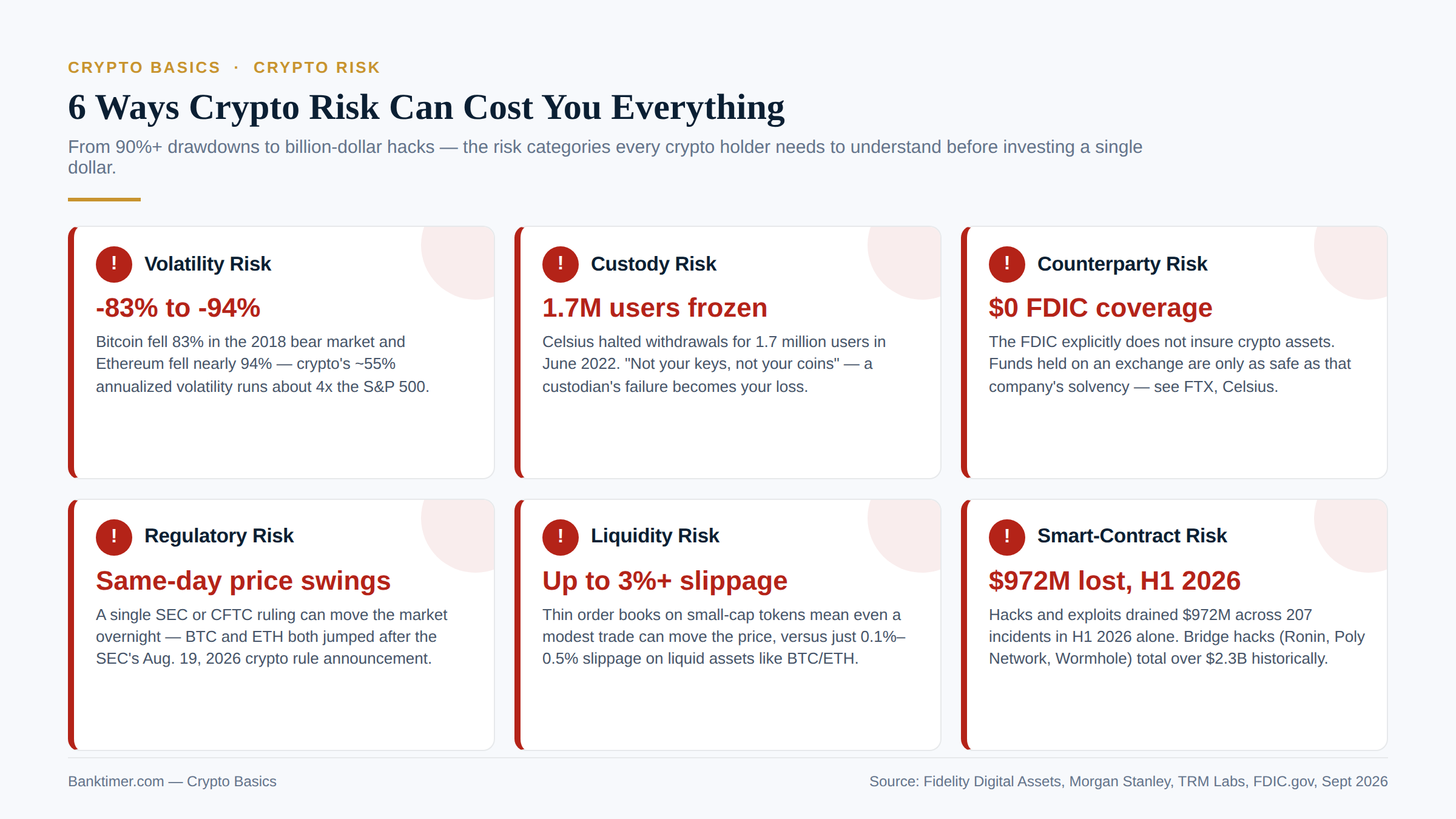
Crypto Security
Security in crypto works differently than security anywhere else in personal finance. There’s no institution standing behind a mistake. Lose your online banking password, and your bank can verify your identity and restore access. Lose a crypto seed phrase, or send funds to the wrong address, and it’s simply gone. No customer service line reverses a blockchain transaction. That single fact changes how you should think about crypto basics from day one. The responsibility for security sits almost entirely with you, whether you realize it or not.
The threats are real and well-documented, not theoretical. Crypto wallet-drainer phishing alone cost victims $494 million in 2024. SIM-swap attacks have drained individual wallets of $15 million to $20 million in a single incident. “Pig-butchering” romance-investment scams cost victims more than $75 billion globally between 2020 and 2024. And the FBI’s Internet Crime Complaint Center logged $11 billion in crypto fraud losses in 2025 alone. Every one of those numbers traces back to a security gap that a specific habit could have closed. Given that beginners often miss this, treat it as basic crypto basics hygiene, not an advanced strategy.
This section covers four layers. First, the fundamentals of protecting your private keys and wallets. Second, the attack methods scammers actually use. Third, how to lock down an exchange account. Fourth, the personal habits that turn all of the above into a routine instead of a one-time fix. None of it requires technical expertise. It requires consistency.
Wallet and Key Security Fundamentals
Private Keys, Seed Phrases, and Why They’re Everything
Every crypto wallet reduces to one secret. It’s a 12- or 24-word seed phrase that generates the private key controlling your funds. Whoever holds that phrase has full, irreversible control. There’s no password reset and no “forgot my seed phrase” recovery flow. There’s no support ticket that gets your coins back if it’s lost or stolen. This is true whether you’re using a free mobile app or a $200 hardware device. The wallet type changes where the key is stored, not how much the phrase itself matters. Treat those words the way you’d treat the deed to a house. They’re not a login you can reset with an email link. Functionally, that’s exactly what they are.
Hot Wallets vs. Cold Wallets
Hot wallets — software wallets connected to the internet — are free and convenient for frequent trading or day-to-day use. But that same connectivity makes them a target for malware and phishing around the clock. Cold wallets, physical hardware devices typically costing $50 to $250, keep your keys offline entirely during normal use. That’s why they’re the more secure option, even though they’re less convenient to reach for. Custodial wallets, the kind an exchange holds for you, add real convenience — password recovery, sometimes insurance. But they require trusting that company’s solvency and security, the way FTX’s and Celsius’s customers once did. The common-sense split: keep only what you’re actively trading in a hot wallet. Move the bulk of anything you’re holding long-term into cold storage.
Multi-Signature and Hardware Wallet Protections
Multisig wallets require multiple independent signatures — commonly a 2-of-3 or 3-of-5 setup — before a transaction can move. That way, no single compromised key can drain the funds alone. That protection has a real limit, though, and Bybit’s February 2025 hack proved it at a $1.5 billion scale. Bybit’s signers all relied on the same compromised interface to see what they were approving. Attackers altered what displayed on screen while the underlying transaction did something different. Every signer followed the process correctly and still lost the funds. That’s exactly why hardware wallets matter beyond just storing keys offline. Their independent physical screen shows the actual transaction details being signed. That’s a layer that malware controlling your computer or a compromised web interface simply can’t fake. Multisig plus a hardware wallet’s out-of-band verification is meaningfully stronger than either one alone.
Backing Up a Seed Phrase Correctly
Paper is a bad long-term home for a seed phrase — it burns, it floods, and it fades. That’s specifically why hardware wallet makers like Trezor and Ledger sell metal backup plates. Those plates are built to survive a house fire or a flooded basement. Beyond the material, the rules are consistent across every reputable source in the industry. Never photograph your seed phrase. Never store it in cloud storage or a password manager connected to the internet. And never type it into a website or app that claims to “verify” or “restore” it — that’s a classic phishing setup. And never keep the only copy in one place. A single point of failure defeats the entire purpose of a backup.
Common Attack Vectors
Phishing and Fake Wallet Sites
Wallet “drainer” phishing kits turned stealing crypto into a service business. In their peak year, 2024, drainers cost victims $494 million across more than 332,000 affected wallets. The single largest incident hit $55.4 million. The number dropped sharply in 2025, to $83.85 million across 106,106 wallets — an 83% decline in dollars. The average loss per affected wallet still ran close to $790, though.
Two named operations show the scale. Inferno Drainer stole more than $80 million through over 16,000 phishing domains. It took a 20% cut from affiliate scammers before shutting down. Pink Drainer took more than $85 million from over 21,000 victims before retiring in May 2024. CISA has separately warned about impersonation scams, including fraudsters posing as CISA staff. Those scams tie to romance-adjacent fraud that generated at least $4.6 billion in 2023 revenue. Its recommended defense: two-factor authentication and hardware wallets.
SIM-Swap Attacks
A SIM swap works by tricking, or bribing, a mobile carrier employee. The goal: move your phone number onto a SIM card the attacker controls. Your phone loses service, SMS verification codes route straight to the attacker, and resetting your exchange password becomes trivial. The FBI’s IC3 logged $25.98 million in U.S. crypto-linked SIM-swap losses in 2024 across 982 complaints. The UK saw a sharper spike — nearly 3,000 cases in 2024, up from just 289 the year before. On the other hand, crypto basics territory like this is simple to state but easy to overlook.
That’s a 1,055% increase. In March 2025, T-Mobile was ordered to pay $33 million in arbitration. A single SIM swap let thieves drain a customer’s wallet — a landmark case for carrier liability. Research found 96% of SIM-swap cases involve social engineering or an insider at the carrier. Individual thefts have run $15 million to $20 million in a single swap, on record.
Malware and Clipboard Hijackers
Clipboard hijackers, sometimes called “clippers,” sit quietly on an infected device and watch for a copied crypto wallet address. The moment you paste it, the malware swaps it for a visually similar address the attacker controls. You only find out after the transaction’s confirmed, since crypto sends can’t be reversed. This isn’t a legacy threat. Microsoft’s Security Blog documented an active 2026 “Crypto Clipper” campaign using Tor and worm-like propagation. That campaign keeps spreading and persists on infected machines. The defense is simple but easy to skip in practice. Check the entire copied address, character by character, against the address you actually intended to send to. Don’t just check the first and last few characters — that’s exactly what a lookalike address is built to pass.
Social Engineering and Impersonation Scams
“Pig-butchering” scams are long-con romance-and-investment fraud that starts with a seemingly wrong-number text. They’ve cost victims more than $75 billion globally between January 2020 and February 2024. That figure comes from a research study led by finance professor John Griffin. Tether (USDT) accounted for 84% of transaction volume tied to scammer-controlled addresses. Researchers traced $15 billion originating from five major exchanges including Coinbase. Binance was identified as the primary platform used to convert stolen crypto back into cash. An estimated 200,000-plus people are held in human-trafficking compounds across Southeast Asia, forced to run these scams.
Official numbers back it up. The FBI’s IC3 reported $11 billion in crypto fraud losses across 181,565 complaints in 2025, a 22% jump from 2024. Investment scams alone caused $8.6 billion, 72% of it crypto-linked. Americans aged 60 and older were hit hardest, accounting for $7.7 billion in losses. The average victim lost just under $20,700.
Exchange and Account Security
Two-Factor Authentication Done Right
SMS-based two-factor authentication is the weakest common option, for one simple reason. It assumes only you control your phone number. A SIM swap defeats that assumption instantly, as the data above shows. App-based authenticators — Google Authenticator, Authy in non-SMS mode, Microsoft Authenticator — generate codes locally on your device with no carrier dependency. They stay secure as long as the device itself isn’t compromised. Hardware security keys, like a YubiKey, go a step further. They’re described as the strongest protection available to consumers, since they eliminate SMS dependency entirely and resist carrier-based social engineering outright. Passkeys tied to secure hardware offer similar protection. But that’s only true if SMS-based account recovery is disabled, since a weak fallback undermines even the strongest primary method.
API Key Risks for Active Traders
Any active trader connecting a bot or third-party tool to an exchange is handing over an API key. That key deserves the same caution as a password, arguably more. Exchanges publish consistent guidance: restrict the key to specific IP addresses through whitelisting. Never enable withdrawal permission on a key used for trading automation — grant only read and trade access. A leaked API key with withdrawal rights can drain an account without needing your 2FA code or login credentials at all. That’s because the exchange treats the key itself as authorization. Scope every key to the minimum permission it needs, and whitelist it to a known server. Rotate it periodically so a leak becomes a contained problem instead of a total loss.
Recognizing Account Takeover Warning Signs
Uphold’s own security guidance lays out concrete warning signs worth memorizing. Catching one early can stop a takeover before it finishes. Watch for a sudden loss of expected email, SMS, or call communication — a possible SIM-swap signal. Login notifications from unfamiliar locations are another red flag. So are two-factor codes that suddenly stop working, or 2FA prompts appearing on an account that never had them enabled. As with most crypto basics principles, this one is worth keeping in mind going forward.
Add to the list unsolicited “forgot password” emails and unauthorized conversions or charges you don’t recognize. Unexpected changes to your registered email or phone number matter too. So do phishing emails impersonating the platform, and sudden, unexplained lockouts. Any one alone could be nothing. Two or three together, in a short window, is worth acting on immediately. Uphold is explicit that it will never ask a customer to transfer funds or share a 2FA code. Neither will any legitimate platform. Meanwhile, crypto basics like this one separate cautious investors from careless ones.
What to Do Immediately After a Breach
If you suspect your account’s been compromised, speed matters more than almost anything else. First, change your password immediately to something new and unique. Second, switch to app-based 2FA if you haven’t already. Freeze or disable withdrawals on the account if the platform allows it. Third, contact the exchange’s official support channel directly — never a phone number or link from an unsolicited message.
Include specific transaction IDs and timestamps, and formally request an account freeze. Fourth, keep monitoring the account for further suspicious activity and set up login and withdrawal alerts going forward. Fifth, report the theft to both the exchange and law enforcement. Blockchain transactions can’t be reversed, but timely reporting can still help investigators trace where the funds moved. Acting within minutes, not hours, is what actually gives any of this a chance to work. In fact, that distinction is exactly what crypto basics coverage should make clear.
Building Personal Security Habits
Segmenting Funds Across Wallets
The practical synthesis of everything above is simple: keep only what you’re actively trading or spending in a hot wallet. Move the bulk of your holdings into cold storage. That single habit bounds the maximum damage from any one hot-wallet compromise, phishing incident, or exchange failure. It caps your loss at an amount you can actually afford, rather than everything you own. Multisig setups extend the same idea further, splitting control across multiple independent keys or devices. That way, no single lost or stolen key results in total loss. Keep the Bybit caveat firmly in mind, though. The verification layer — what you actually see and sign — matters just as much as how many signers are required.
Verifying Addresses Before Every Transaction
Two of the attacks covered above — clipboard hijacking and address poisoning — both rely on the same blind spot. Both assume a pasted or copied address is automatically correct. Address poisoning takes it a step further, planting a lookalike address in your own transaction history. The hope is that you’ll copy the wrong one later. One whale nearly lost $68 million in wrapped Bitcoin this way, before the funds were eventually returned.
The fix is a habit, not a tool. Visually verify the complete destination address, character by character, against a trusted source before confirming any send. For large or first-time transfers, send a small test amount first and confirm it arrives before moving the rest. A hardware wallet’s independent screen adds a real layer here too. It shows the actual transaction being signed in a way malware on your computer simply can’t spoof. Once you’ve got this down, add it to your crypto basics checklist before moving real money.
Keeping Software and Firmware Updated
Hardware wallet updates aren’t just about new features, though they do enable those too. Ledger needed specific firmware updates just to support new cryptocurrencies like Cardano and Zilliqa, since they required new signature schemes. The bigger reason is security. Ledger’s in-house research team, Ledger Donjon, continuously hunts for and patches vulnerabilities. One update, firmware version 1.4.2, extended PIN protection from 4 characters to 8. Updates also fix ordinary compatibility bugs, like the time a problematic Windows 10 update broke third-party wallet integrations. Ledger’s own guidance is direct: keep firmware and app versions current to keep the device as secure as possible. Skipping updates on a device holding real money is a habit worth breaking.
A Simple Security Checklist for Beginners
Put the full picture into nine habits. Store your seed phrase offline only, ideally on a metal backup plate. Keep long-term holdings on a hardware wallet, with only trading-amount funds on an exchange. Use an app-based authenticator or hardware security key for 2FA, never SMS alone. Scope any exchange API key to read-and-trade-only, IP-whitelisted, withdrawal disabled. Verify every destination address character-by-character before sending, testing large or new transfers with a small amount first.
Keep hardware wallet firmware and wallet software current. Treat any unsolicited request for your seed phrase, 2FA code, or a fund transfer as a scam by default. No legitimate platform asks for these. Know your breach-response steps before you need them. And remember that crypto held anywhere but a wallet you control carries no FDIC insurance. That should shape how much you keep on any single platform.
Every habit in this section costs a few minutes; every breach above cost real money, sometimes a life’s savings. That trade-off is the clearest argument in all of crypto basics for treating security as routine, not optional. The same discipline, applied consistently, transaction after transaction, is what actually keeps your coins yours.
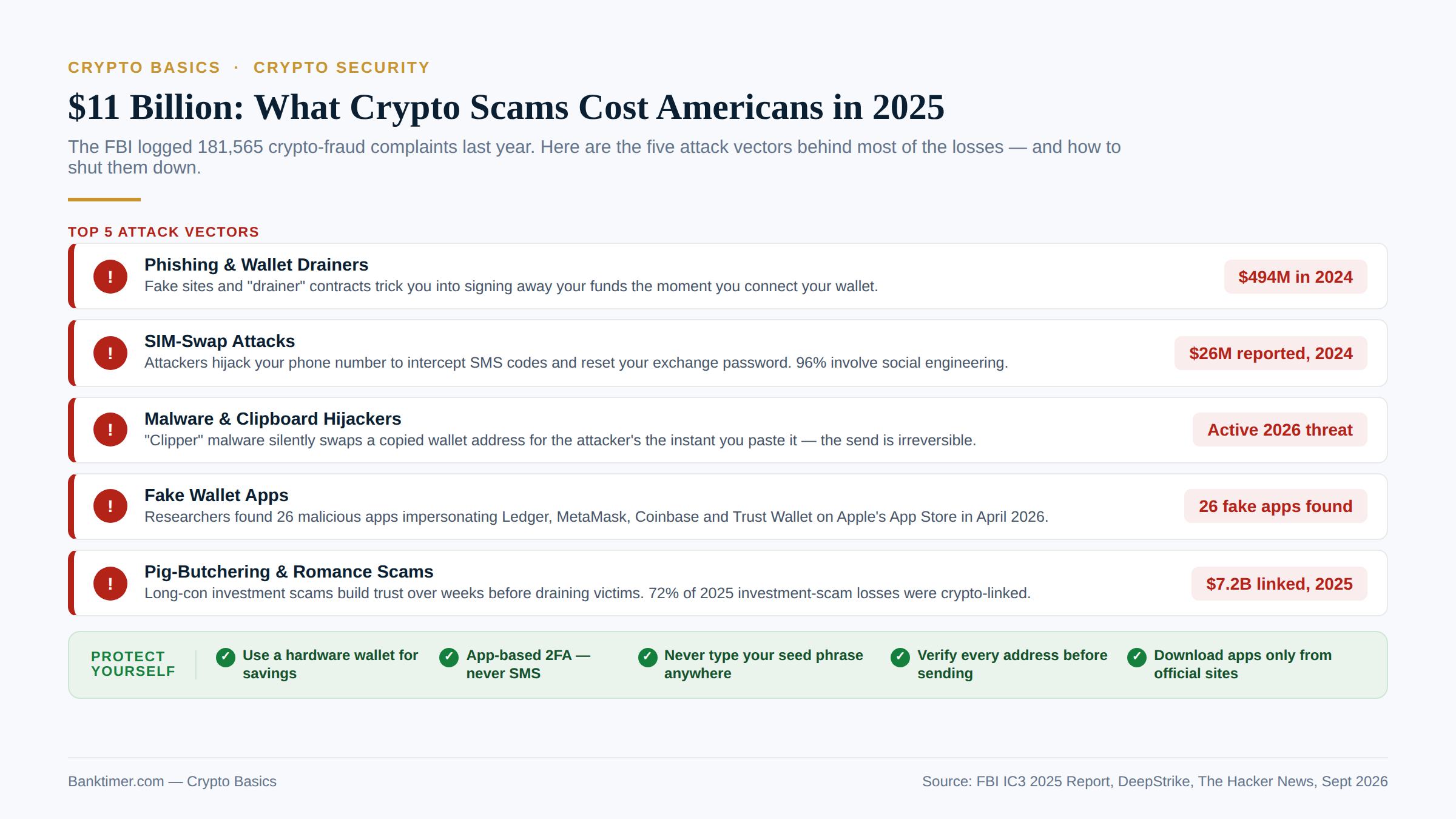
Crypto Taxes
Buying crypto is the easy part. Reporting it to the IRS is where most people stumble, and getting it wrong is expensive. The IRS doesn’t treat Bitcoin, Ethereum, or any other digital asset as currency. It treats them as property instead, the same category as a stock or a rental house. That single classification matters more than it sounds. Swapping one coin for another, or even paying for a coffee with crypto, can trigger a tax bill you never saw coming. This section walks through how the IRS actually treats crypto and how to calculate what you owe. It also covers the mistakes that turn a manageable filing into an audit. These are crypto basics you can’t afford to skip.
That property classification traces back to Notice 2014-21, the IRS’s first cryptocurrency guidance. It has consequences most investors never think about until tax season arrives. Because crypto counts as property rather than a “security,” it sits outside the wash-sale rule that governs stock trading — for now. It also means nearly every transaction, not just a straightforward sale, can be taxable. Selling for cash, trading one coin for another, and paying for goods or services all count. Only a handful of moves, like buying with dollars or moving coins between your own wallets, stay off the IRS’s radar.
2026 adds new urgency. A new broker-reporting form, Form 1099-DA, means exchanges now send the IRS your trading data directly. Undocumented history is far riskier than it used to be, especially if your trades lived on a platform that later collapsed — FTX, Celsius, Voyager, or BlockFi all come to mind. This section covers the calculations and mistakes that trip up even careful filers.
How the IRS Treats Cryptocurrency
Crypto as Property, Not Currency
The IRS defines virtual currency as “a digital representation of value… that functions as a unit of account, a store of value, and a medium of exchange.” But it isn’t dollars, and it isn’t a foreign currency either. It’s property. The same tax principles apply whether you’re selling a stock, a piece of art, or a parcel of land. They apply to your Bitcoin too. This classification dates to Notice 2014-21, the agency’s first real guidance on crypto, and it has been reaffirmed and expanded since. One overlooked consequence: the wash-sale rule (IRC Section 1091) applies only to “stocks and securities.” Crypto is neither, so that rule doesn’t currently reach crypto trades. We’ll come back to why that might not last.
Taxable Events vs. Non-Taxable Events
Three transaction types generate a capital gain or loss: selling crypto for dollars, trading one cryptocurrency for another, and paying for goods or services with it. Two more generate ordinary income instead: getting paid in crypto for work, and receiving an airdrop after a hard fork. That airdrop counts once you have “dominion and control” over the new coins. Several common moves, on the other hand, create no tax event at all. Instead of treating this as advanced strategy, file it under crypto basics — everyone needs it.
Buying crypto with cash doesn’t. Moving coins between your own wallets doesn’t. A soft fork that creates no new coin doesn’t. Receiving crypto as a genuine gift doesn’t, until you later sell it. Donating crypto to a qualifying charity doesn’t either — you recognize no income, gain, or loss on the donation itself. Knowing which bucket a transaction falls into, before you make it, is half the battle. In addition, that single fact captures a lot of what crypto basics is really about.
Short-Term vs. Long-Term Capital Gains
How long you hold a coin before selling changes your tax bill dramatically. Sell within a year, and the gain counts as short-term, taxed at your ordinary income rate, anywhere from 10% up to 37%. Hold past the one-year mark, and it becomes long-term, taxed at the far friendlier 0%, 15%, or 20% instead. For 2026, the 0% bracket covers long-term gains up to $49,450 for single filers ($98,900 married filing jointly). In addition, that single fact captures a lot of what crypto basics is really about.
The 15% bracket runs from there up to $545,500 single ($613,700 joint), and anything above lands at 20%. That’s up from 2025’s thresholds of $48,350 and $533,400 single, reflecting the annual inflation adjustment. The gap between a 37% short-term rate and a 20% long-term one is one of the biggest levers in crypto tax planning. Patience alone can cut your bill nearly in half. Since markets can turn volatile fast, crypto basics here pay off the moment things get rocky.
Form 1099-DA and the New Broker Reporting Rules
2026 is the first year crypto brokers report your trades directly to the IRS. They’ll do it through a new form called 1099-DA. It rolls out in two phases. For 2025 transactions, filed in early 2026, brokers report only your gross proceeds. Starting with 2026 transactions, filed in early 2027, they’ll also report your cost basis. “Broker” here means custodial exchanges, hosted-wallet providers, and certain payment processors.
Decentralized platforms that never take custody of your assets are explicitly excluded. The IRS is giving some grace during the transition. Notice 2024-56 waives backup-withholding penalties for 2025 and select 2026 scenarios for brokers filing in good faith. Notice 2026-20 separately lets you satisfy cost-basis identification through your own records through the end of 2026. After that, the permanent broker-communication requirement is expected to take effect around January 1, 2027.
Calculating Crypto Gains and Losses
Cost Basis Methods (FIFO, LIFO, HIFO)
Absent any other election, the IRS assumes you sold your oldest coins first. That’s FIFO, First-In-First-Out, the default method whenever you can’t specifically identify which units you sold. If you can document exactly which coins you disposed of, including acquisition date, cost, and fair market value at the time, you’re allowed to use Specific Identification instead. That method opens the door to strategies like HIFO or LIFO aimed at minimizing your taxable gain. By contrast, this is exactly the sort of crypto basics question worth asking before you commit funds.
Under the current relief window, you can document HIFO or LIFO through your own standing order and records. Once that relief expires, brokers will need to actually process those elections themselves. One caution: a tax professional who promises guaranteed savings from HIFO with no downside is waving a red flag. Used incorrectly, non-default cost-basis methods increase audit exposure, not just your refund.
Tracking Basis Across Multiple Wallets and Exchanges
Move coins between exchanges and wallets enough times, and cost-basis tracking turns into a real headache. Tax professionals bluntly call it a nightmare. Your tax software sees a disposal on one platform but can’t find the matching acquisition record. That often happens because you, or your importer, only pulled data from the destination wallet, not the origin. The result is a “zero-basis” error that overstates your gain, sometimes dramatically. The IRS doesn’t grade on a curve here, either. You’re required to maintain records establishing acquisition date, basis, and fair market value for every unit you hold. That’s true regardless of how many platforms it passed through. Complex on-chain activity, liquidity positions, wrapped tokens, bridged assets, and liquid staking routinely needs manual review even with the best automated software.
Handling Staking and Mining Income
Staking rewards are taxable the moment you gain “dominion and control” over them. That means you could sell, exchange, or otherwise use them, even if a temporary lockup restricts moving them right away. That’s the rule the IRS laid out in Revenue Ruling 2023-14. It applies whether you’re staking directly as a validator or through an exchange. Your income equals fair market value at that moment, and that same figure becomes your cost basis going forward. Mining income works similarly: it’s ordinary income at fair market value when received. If your mining activity rises to the level of a business rather than a hobby, though, self-employment tax can also apply. That’s on top of ordinary income tax. For instance, crypto basics like this one matter more than chasing any single trade.
Airdrops, Forks, and Other Edge Cases
An airdrop that follows a hard fork counts as ordinary income, valued the moment it’s recorded on the distributed ledger. That same amount becomes your basis in the new coin. A hard fork producing no airdrop generates no income, since you never actually received anything new. Soft forks never trigger a tax event either, because no new coin is created. Gifts and donations follow their own rules. For a gift, your basis for calculating a gain is the donor’s basis plus any gift tax paid. A loss, though, uses the lower of the donor’s basis or fair market value at receipt. Donate to a qualifying charity after holding more than a year, and your deduction equals full fair market value.
Common Crypto Tax Mistakes
Forgetting Crypto-to-Crypto Trades Are Taxable
Swap Bitcoin for Ethereum, and no dollars ever touch your bank account. The IRS doesn’t care. It still treats the swap as if you sold the Bitcoin for cash and used it to buy Ethereum. Because crypto is property, every crypto-to-crypto trade is a taxable event, full stop. This trips up a specific group of investors more than most. It’s anyone who assumed, pre-2018, that crypto swaps qualified for tax-deferred “like-kind exchange” treatment under Section 1031. This is precisely why crypto basics education emphasizes caution over speed, especially since mistakes here are expensive.
They didn’t, even before the 2017 Tax Cuts and Jobs Act formally restricted Section 1031 to real property. The IRS confirmed in 2021 that pre-2018 crypto swaps never qualified. That left investors who relied on that theory owing back taxes and penalties on trades made years earlier. The gain or loss is simple math: fair market value of what you received, minus cost basis of what you gave up.
Not Reporting Small Transactions
There’s currently no de minimis exemption in U.S. tax law for small crypto transactions. Buy a $6 coffee with Bitcoin, and technically, that’s a taxable event. It requires the same reporting as a $60,000 trade. Lawmakers know this is unworkable for everyday use. The bipartisan PARITY Act was reintroduced in late May 2026 by Reps. Steven Horsford, Max Miller, Suzan DelBene, and Mike Carey. It doesn’t set a fixed exemption itself. Instead, it directs the IRS to study how many transactions under $200 get swept up under current law. As of this writing, it hasn’t become law. Rep. Horsford put it plainly: the tax code is “outdated” and leaves basic questions about small crypto purchases “entirely unresolved.” Until Congress acts, every transaction counts, regardless of size. As a result, skipping this step is one of the more common crypto basics mistakes we see.
Misapplying Wash-Sale Assumptions That Don’t Apply (Yet)
Stock investors know the wash-sale rule well: sell a losing stock, buy it back within 30 days, and you can’t claim the loss. Instead, that loss gets added to your new position’s basis. That rule, IRC Section 1091, applies only to “stocks and securities.” Since crypto is property, the wash-sale rule does not currently apply to crypto trades. That technically lets you sell at a loss and immediately buy back in. As with most crypto basics principles, this one is worth keeping in mind going forward.
That’s the legal reality in 2026, but it isn’t guaranteed to stay that way. Multiple bills in Congress would extend wash-sale treatment to digital assets, and none have passed yet. Still, the legislative intent to close this loophole is clear. Even under today’s permissive rules, aggressive same-day sell-and-rebuy patterns draw more IRS scrutiny than they used to. That’s because 1099-DA now gives the agency far better visibility into your trading. In fact, that distinction is exactly what crypto basics coverage should make clear.
Losing Records After Moving Platforms
Major exchange failures — FTX, Celsius, Voyager, BlockFi — have wiped out transaction histories for huge numbers of investors. Practitioners now call exchange bankruptcies the single most disruptive source of missing crypto tax data. Losing the records doesn’t waive your obligation to substantiate what you owe, though. The IRS applies a “best available evidence” standard. And courts have limited use of loss-estimation shortcuts when digital records were reasonably retrievable in the first place.
If you’re rebuilding history, work down an evidence hierarchy. Start with complete exchange reports and verified on-chain data. Then move to email confirmations and bank statements, then spreadsheets and screenshots as a last resort. Tax professionals recommend keeping a documented “assumptions register,” noting each gap and the conservative treatment applied. That turns an unavoidable hole into a defensible position if the IRS ever asks. Therefore, consider this part of your crypto basics due diligence, not an afterthought.
Filing and Tax-Loss Strategies
Using Crypto Tax Software Effectively
A handful of platforms now dominate crypto tax prep. CoinTracking covers 400-plus exchange and wallet integrations, with an unlimited-transaction tier around $899 a year. Koinly‘s free tier handles up to 10,000 imported transactions, with paid plans running $49 to $199. Summ targets high-volume traders, processing up to 500,000 transactions and handling DeFi activity well. CoinLedger specializes in reconciling the new Form 1099-DA against your own records. None of them are foolproof, though. The same three problems keep showing up: missing cost basis on cross-platform transfers, and zero-basis errors when only a destination wallet gets imported. Complex on-chain transactions typically need a human to sort out, too. Expert review runs roughly $700 to $1,000; full-service reconciliation from a firm like CoinTracker starts around $3,500 a year.
Tax-Loss Harvesting in Crypto
Selling a losing position on purpose, to offset gains elsewhere, is standard tax strategy. Say you have a $2,000 loss on Bitcoin. It can zero out the tax on a $2,000 gain from Ethereum in the same year. In the U.S., you can use up to $3,000 in net capital losses each year to offset ordinary income. Anything beyond that carries forward indefinitely to future tax years. Crypto offers one genuine edge over stocks here: the wash-sale rule doesn’t currently apply. That means you can sell at a loss and buy the same coin back immediately. Stock investors face a 30-day wait; you don’t. That flexibility is real under today’s rules. But as covered above, it’s a rule Congress is actively trying to change.
Working With a Crypto-Savvy Tax Professional
Not every accountant understands crypto, and the wrong one can cost you more than they save you. Look for six things. Real, current knowledge of how token standards and liquidity pools actually work, tested on your own activity. Fluency with crypto tax software, plus a manual process for whatever the software can’t handle. Honesty about the multiple treatment options available given limited IRS guidance. Year-round planning rather than a once-a-year scramble. Strict use of IRS-sanctioned cost-basis methods, not unsupported shortcuts. And a track record defending crypto cases specifically under audit. Start the search early — qualified crypto-specialist preparers book up fast once tax season begins.
What Happens If You Don’t Report
Failure to report can trigger fines up to 75% of the tax owed, with maximum penalties of $100,000 for individuals ($500,000 for corporations). Outright evasion can bring up to five years in prison. This isn’t theoretical. Frank Richard Ahlgren III received a two-year federal prison sentence plus over $1 million in restitution in 2024. He’d underreported roughly $4 million in Bitcoin sales, in the IRS’s first cryptocurrency tax-evasion prosecution. As with most crypto basics principles, this one is worth keeping in mind going forward.
The agency has more tools than most assume. Exchange KYC data-sharing is one. So are 1099 forms already issued by Coinbase and Kraken. “John Doe” summonses forced Coinbase, Kraken, and Poloniex to hand over user records. Blockchain analytics now match wallets to real identities, and 1099-DA feeds broker data straight to the IRS. Assuming crypto is untraceable is, at this point, simply wrong.
Crypto tax season really comes down to a handful of crypto basics. Know what counts as a taxable event, and keep records you can defend. And don’t assume today’s rules — no wash sale, no de minimis exemption — will still hold next year. Get this part right, and the next form the IRS sends your way won’t catch you off guard.
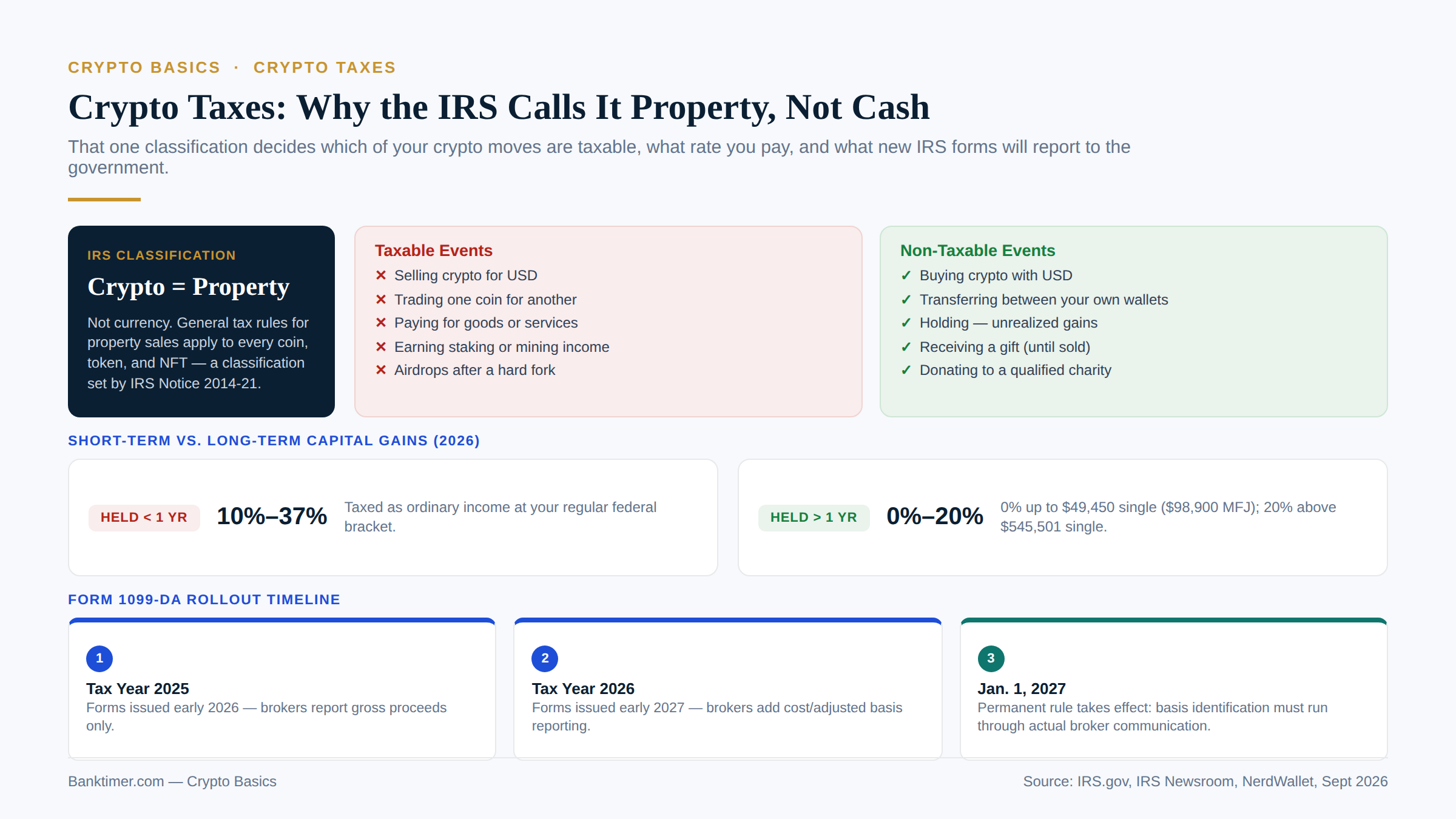
Crypto Wallets
Every crypto holding comes down to one question: who actually controls the private key? Get that answer right, and you own your crypto in the fullest sense. No bank, no exchange, no third party stands between you and your money. Get it wrong, and you’re one lost password, one phishing email, or one bankrupt exchange away from losing everything. Wallets are where crypto basics stop being abstract and start being personal. A single mistake made once here can be permanent. This section covers how wallets actually work and which type fits your situation. It also covers the real losses that make custody the most consequential decision in crypto.
The core mechanic is always the same, whether you’re using a $20 mobile app or a $200 hardware device. There’s a private key only you should ever see, and a public key mathematically derived from it. There’s also a wallet address you can safely share to receive funds. Custodial wallets hand that key to someone else, usually an exchange. Non-custodial wallets put it entirely in your hands. Neither option eliminates risk. It just moves where the risk lives. Similarly, this is a foundational piece of crypto basics that too many guides gloss over.
That’s worth sitting with, because the mistakes covered later in this section aren’t rare edge cases. A British IT worker threw away a hard drive holding what’s now worth hundreds of millions of dollars. Security researchers found dozens of fake wallet apps sitting on Apple’s own App Store, actively stealing recovery phrases. These aren’t cautionary tales from crypto’s early, reckless years — some happened in 2026, and custody decisions carry real, permanent stakes.
How Crypto Wallets Actually Work
Public Keys, Private Keys, and Addresses
Ownership in crypto runs through a simple chain: private key → public key → wallet address. The private key is the actual asset. When someone says they “own” Bitcoin, what they really own is the private key controlling the wallet that holds it. The relationship between the two keys is a one-way mathematical function. You can derive a public key from a private key, but it’s mathematically impossible to reverse the process.
That one-way property is the entire foundation of crypto security. A wallet address is the string you share to receive funds. It’s typically just a hashed version of your public key. When you send a transaction, your private key signs it digitally. The network then checks that signature against your public key, confirming ownership without ever exposing the private key itself. For instance, crypto basics like this one matter more than chasing any single trade.
Custodial vs. Non-Custodial Wallets
Custodial wallets hand your private keys to a third party, usually an exchange like Coinbase or Kraken. That’s much the way our banking basics guide describes handing deposits to a bank. In exchange, you get convenience: easier setup, customer support, no seed phrase to lose. That convenience carries real counterparty risk: exposure to a hack, fraud, insolvency, a freeze, or a policy change. None of it is something you control. Non-custodial wallets flip the arrangement.
You alone hold the private key. That means full control, with no third party standing between you and your funds, but also full responsibility. Lose your keys with a non-custodial wallet, and there’s no customer support line to call, and no password reset. The self-custody community sums it up in five words: “not your keys, not your coins.” A custodial wallet gives you account access. A non-custodial one gives you actual cryptographic ownership.
Software Wallets Explained
Software wallets are often called hot wallets because they stay connected to the internet. They come as mobile apps, desktop programs, or browser extensions. Mobile options like Trust Wallet, Phantom, and Coinbase Wallet suit everyday, on-the-go use and typically add biometric login. Desktop wallets like Exodus fit more complex workflows across multiple windows. Browser extensions like MetaMask connect directly to decentralized apps and DeFi protocols, though they’re tied to whichever computer they’re installed on. The constant internet connection that makes hot wallets convenient is also what makes them riskier than offline storage. The common-sense fix: keep a hot wallet for active spending. Move anything above your comfort level into cold storage.
Hardware Wallets Explained
Hardware wallets keep your private keys completely offline, isolated from any internet-connected device. That architecture blocks remote malware from ever reaching the cryptographic material needed to authorize a transaction. Two security philosophies dominate the market. One is open-source, publicly auditable firmware, Trezor’s approach. The other is a dedicated secure element chip, a tamper-resistant processor built to generate and store keys — Ledger’s approach. Every transaction requires physical confirmation on the device itself, a PIN plus a button press. That means a human has to be present to approve anything leaving the wallet. That said, a hardware wallet has real limits: it cannot make a malicious smart contract safe. The device protects your key from remote theft, but you’re still responsible for reading what you’re signing and avoiding phishing links.
Choosing the Right Wallet Type
Matching Wallet Type to Use Case
Match the wallet to how you actually use crypto, not to whatever looks most impressive. Frequent traders and DeFi users lean on browser-extension and mobile hot wallets. MetaMask offers deep access to the Ethereum ecosystem, while Trust Wallet suits high-frequency activity. Long-term holders are usually better served by a simple Bitcoin-focused hot wallet for small amounts. For anything you don’t touch often, a hardware wallet works better. Beginners tend to do best with Coinbase Wallet or Exodus, both known for clean interfaces and approachable documentation. The general guidance holds up regardless of experience level. Keep a small “spending” balance in a hot wallet, and put your real “savings” balance in a hardware wallet.
Multi-Chain and Multi-Asset Wallets
Portfolios today spread across more blockchains than ever — Ethereum, Solana, half a dozen Layer 2 networks. Managing a separate wallet for each one gets old fast. Multi-chain wallets solve that problem. A single interface, often built on one seed phrase, can interact with dozens of networks at once. Trust Wallet supports more than 110 native blockchains; Atomic Wallet goes further still, covering over 1,200 coins and tokens. Comparisons of “best multi-chain wallets” have become a recurring content category in 2026. That tells you something about where demand is heading. Fewer users hold a single asset on one chain now; more juggle positions across an expanding multi-chain landscape. Although it looks like a small line item, crypto basics discipline means not ignoring it.
Mobile vs. Desktop vs. Browser-Extension Wallets
Each hot-wallet format fits a different habit. Mobile wallets win on accessibility, letting you send, receive, and check balances anywhere. That’s usually behind a fingerprint or face scan. Desktop wallets suit heavier workflows. Exodus, for instance, syncs across Windows, macOS, and Linux, which is useful if you manage positions from more than one machine. Browser extensions are purpose-built for connecting to decentralized apps, and MetaMask dominates this category for exactly that reason. But an extension only works on the computer and browser where you installed it. None of the three is objectively best. They’re optimized for different daily habits, and plenty of people end up using all three for different purposes.
Paper Wallets and Why They’ve Fallen Out of Favor
A paper wallet, a printed private key and address, sounded clever a decade ago and looks fragile today. It’s highly susceptible to fire, water, sunlight, and plain human error. Misplace it once, and the funds it controls are gone for good. There’s no PIN, no biometric lock, no backup path. Lose it, and recovery is impossible — and a thief who finds it has immediate, unguarded access. There’s also a sweep-risk problem most people don’t anticipate. Actually spending from a paper wallet means importing that private key into an online hot wallet. That briefly exposes it to every internet-based threat the paper was supposed to avoid. Generating one securely demands more operational discipline than most casual users apply. That’s exactly why hardware wallets replaced them. Instead of treating this as advanced strategy, file it under crypto basics — everyone needs it.
Wallet Custody and Recovery
What “Self-Custody” Really Means
Self-custody means holding your own private keys instead of trusting an exchange or a bank to hold them for you. You, and only you, can authorize a transaction. That control comes with real weight. Your Secret Recovery Phrase is the only way back into your wallet if a device is lost or broken. There’s no “forgot password” support line here. Although it looks like a small line item, crypto basics discipline means not ignoring it.
And if your backup is lost or compromised, you can permanently lose access to your own assets. The trade-off is worth stating plainly. Custodial wallets carry counterparty risk, an institution’s solvency and policies sitting outside your control. Self-custody replaces that with personal security risk instead — you have to personally avoid every mistake, with no institutional safety net underneath you. Neither risk disappears. Self-custody just moves it onto your own shoulders.
Seed Phrase Recovery Best Practices
How you back up your seed phrase matters almost as much as generating it correctly in the first place. Metal beats paper for durability. A metal backup survives fire and flooding in ways a paper one, explicitly described as fragile, simply doesn’t. The rule that matters more than any other: never store a seed phrase digitally. That means not on a computer, a phone, a cloud account, a notes app, a photo, or even a password manager.
Any of those creates a remote attack surface that a physical backup avoids entirely. Skip “brain wallets” too — that means memorizing your phrase as your only backup. And skip “seedless” setups that deliberately go without one. Store your backup separate from the hardware wallet itself, and consider a tamper-evident seal. Stamp or engrave the phrase yourself, too, rather than handing it to a third-party service.
Multi-Signature Wallet Setups
Multi-signature, or multi-sig, spreads signing authority across several keys instead of resting it on one. In a typical 2-of-3 setup, any two of three key-holders have to approve a transaction before it executes. No single person can move funds alone. And even if one key is lost or compromised, the wallet stays secure. Larger configurations, like 3-of-5 or 4-of-7, scale up for institutions that need broader internal controls. That’s exactly who adopts multi-sig most: exchanges, investment firms, DAOs managing shared treasuries, custodians, and corporate finance departments. The trend is accelerating. An estimated 9 million enterprise-grade multi-sig wallets were in use by 2025, up 47% year over year. The multi-sig market itself, valued at $1.27 billion in 2024, is projected to reach $4.37 billion by 2033.
Social Recovery and Smart-Contract Wallets
A newer standard called ERC-4337, or “account abstraction,” turns an Ethereum wallet into a programmable smart contract instead of a traditional key-controlled account. It does this without requiring any change to Ethereum’s core protocol. Its most practical feature is social recovery: you designate trusted “guardian” contacts who can help restore access if you lose your device or key. That’s a real improvement over betting everything on a single seed phrase written on paper. It brings other conveniences too. You can pay gas fees in stablecoins like USDC instead of ETH, and batch several actions into one transaction. It also allows custom authentication logic beyond a simple signature. Since its March 2023 launch, ERC-4337 has processed more than 100 million UserOperations and seen over 40 million smart accounts deployed.
Wallet Mistakes That Cost People Money
Losing a Seed Phrase With No Backup
Two stories capture the stakes better than any statistic. James Howells, a British IT worker, accidentally discarded a hard drive holding 8,000 BTC during a 2013 clear-out. It ended up in a landfill in Newport, Wales. As of August 2026, with Bitcoin around $63,804, that drive would be worth roughly $510 million. He spent over a decade pursuing excavation plans and an offer to buy the landfill outright. A UK judge dismissed his ownership claim in January 2025, and an appeal was refused two months later.
By August 2025, Howells abandoned recovery entirely, pivoting to a token project tied to his legal claim. The drive remains unrecovered. Stefan Thomas has his own version: 7,002 BTC, worth over $220 million, locked behind a forgotten password on an encrypted IronKey drive. That drive permanently wipes itself after 10 failed attempts. He had already used 8, leaving two guesses between him and either full recovery or permanent loss. In fact, that distinction is exactly what crypto basics coverage should make clear.
Sending to the Wrong Network or Address
Confirmed blockchain transactions can’t truly be reversed by anyone. Say you send tokens on an incompatible network, like Ethereum tokens to an address an exchange only monitors on a different chain. The receiving platform’s systems never see the deposit, and the funds just sit there, unretrievable. Your odds of recovery depend heavily on where the mistake happened. In a self-custody wallet, where you control the private key, recovery is often possible. Add the correct network in your wallet settings, then import the token by its contract address. Specifically, this is where crypto basics knowledge translates into fewer costly surprises.
That works because the same seed phrase governs your address across compatible chains. On a centralized exchange, recovery depends entirely on internal policy. Some offer manual recovery for roughly a $100 fee, with no guarantee of success. Prevention beats any recovery attempt: send a small test transaction first, confirm it lands, then send the rest. Be wary of anyone who claims they can “reverse” a confirmed transaction, since that’s always a scam.
Storing Seed Phrases Digitally (and Why Not To)
Security guidance here doesn’t leave much room for interpretation. Never store a seed phrase on a computer, phone, cloud service, notes app, photo library, or password manager. Every one of those creates a remote-attack surface that a purely physical, offline backup avoids entirely. Hardware wallets are built specifically to close this gap. They generate seed phrases in an air-gapped process, so the phrase never touches an internet-connected device in the first place. It’s a small habit that costs nothing and closes one of the most common, most avoidable paths to losing everything you hold. If a screenshot of your seed phrase exists anywhere online, treat that wallet as already compromised. Move funds to a fresh one immediately. Crypto basics coverage that skips this point isn’t doing readers any favors, given that it matters more than most guides admit.
Falling for Fake Wallet Apps
In April 2026, security researchers uncovered a campaign called “FakeWallet.” It involved 26 malicious apps on Apple’s own App Store impersonating legitimate wallets, including Bitpie, Coinbase, imToken, Ledger, MetaMask, TokenPocket, and Trust Wallet. Some used deliberate name typos, like “LeddgerNew.” Others posed as an unrelated game or calculator before prompting an install. Once opened, the apps stole recovery phrases. They did this by hijacking the phrase-entry screen, or by serving a phishing page instructing victims to type in their mnemonic.
It wasn’t isolated, either. Apple was separately accused of letting a fake wallet app stay listed and steal $1.8 million, despite a developer having spent a year warning the company. The defense is simple: verify the publisher, and download only from the wallet company’s own official site. Never type a seed phrase into any app you weren’t already expecting to ask for one.
Custody is where crypto basics stop being theoretical. A private key is either something only you control, or it isn’t. There’s no partial version of that fact. Every story in this section traces back to it. Whichever wallet type you choose, treat the seed phrase behind it as the single most valuable thing you own. In every real sense, it is.
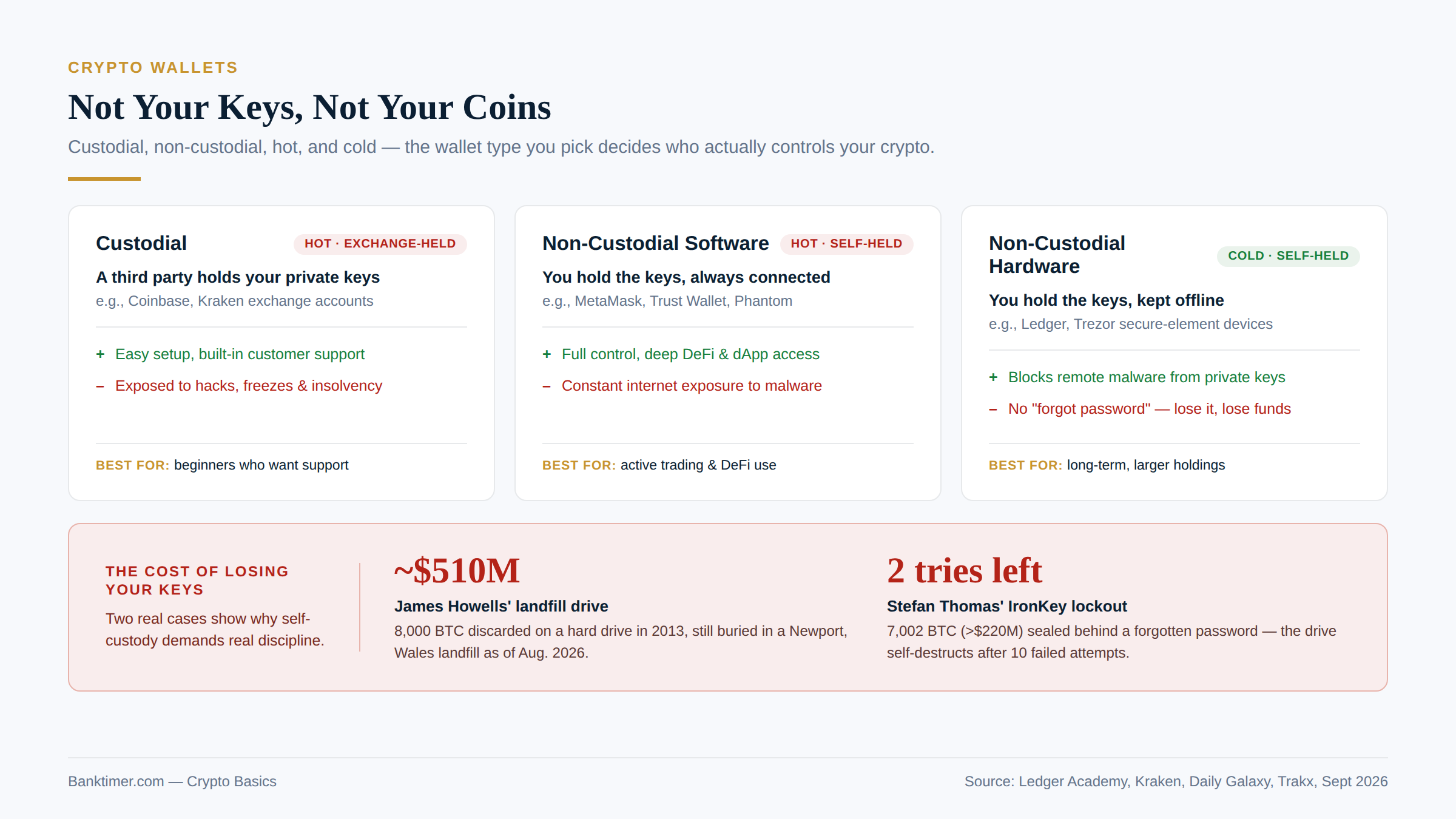
Digital Asset Regulation
Ask five people which agency regulates a given crypto asset, and you might get five different answers. For over a decade, that confusion was arguably correct, because nobody had a definitive one. That started changing in March 2026. That’s when the SEC and CFTC jointly issued the clearest guidance the industry has ever received. The guidance covered which digital assets count as securities, commodities, or something else entirely. Regulation shapes nearly everything else in this guide. That includes which exchanges you can legally use and how your taxes get reported. This section covers the U.S. rulebook as it stands today. It also looks at how other countries are handling the same questions. And it explains what regulatory uncertainty actually means for your own risk.
None of this is settled the way securities law around stocks is settled. Much of what looks like clarity right now is guidance and interpretation, not statute. That means a future set of regulators could reverse it without Congress passing a single new law. Meanwhile, real consequences are already playing out. Platforms have lost licenses within months of winning them. Stablecoin issuers face a hard new rulebook, and countries from Japan to the UAE are pulling in genuinely different directions. Treat this section as a live snapshot, not a fixed set of rules. In crypto regulation, things rarely stay fixed for long.
The U.S. Regulatory Landscape
SEC vs. CFTC Jurisdiction Disputes
On March 17, 2026, the SEC and CFTC jointly clarified how federal securities law actually applies to crypto assets. This ended more than a decade of ambiguity. CFTC Chairman Michael Selig put it bluntly: “With today’s interpretation, the wait is over.” SEC Chairman Paul Atkins added that “most crypto assets are not themselves securities.” The joint guidance built a token taxonomy: digital commodities, collectibles, tools, stablecoins, and securities. In turn, add this to the growing list of crypto basics every new holder should know cold.
It also spelled out how airdrops, mining, staking, and asset wrapping should each be treated. The CFTC aligned its own Commodity Exchange Act reading with the SEC’s. That confirms certain non-security crypto assets can qualify as commodities. That’s meaningful progress, but it’s worth a caveat right away: this is an interpretive release, not a law. A future set of commissioners could narrow, reinterpret, or withdraw it entirely. Crypto basics coverage that skips this point isn’t doing readers any favors, given that it matters more than most guides admit.
The Securities vs. Commodity Question
The classic legal test for whether a crypto asset counts as a security is the Howey test. It comes from a 1946 Supreme Court case about Florida orange groves, and it’s still the backbone of crypto securities analysis today. The pending CLARITY Act would formalize a dual-track system. The CFTC would oversee “digital commodities” — tokens whose value comes from a functioning, sufficiently decentralized blockchain. The SEC would keep authority over securities and early-stage token sales. In fact, this is the kind of crypto basics detail that only matters until the day it matters a lot.
A “mature blockchain” test would let a project graduate from SEC to CFTC oversight once it proves no single party controls it. The March 2026 joint interpretation separately named 16 assets as digital commodities, including Bitcoin, Ethereum, Solana, and Cardano. The bill passed the House in July 2025 and cleared the Senate Banking Committee in May 2026. It hadn’t passed the full Senate as of early August 2026. Analysts now expect it to slip into 2027.
The GENIUS Act and Stablecoin Regulation
The GENIUS Act, enacted July 18, 2025, is the first comprehensive federal rulebook for stablecoin issuers. Its effective date is the earlier of January 18, 2027, or 120 days after regulators finalize implementing rules. As of mid-2026, regulators had issued 11 proposed rulemakings and zero final ones. That makes January 2027 the realistic planning date. Once it kicks in, issuers face strict requirements. Once you’ve got this down, add it to your crypto basics checklist before moving real money.
Reserves must be backed 1:1 by specific assets like short-maturity Treasuries. Issuers also need monthly independent audits, with criminal-liability certifications from the CEO and CFO personally. Redemption policies must use plain language, with at least seven days’ notice before any fee change. Issuers also need full Bank Secrecy Act compliance as a regulated financial institution. And a flat prohibition on paying interest or yield to stablecoin holders applies as well.
State-Level Regulation (BitLicense and Beyond)
New York’s BitLicense, now a decade old, remains the toughest state-level crypto license in the country. The published application fee is a modest $5,000, but real compliance costs run far higher. Firms typically need a surety bond or funded account of at least $500,000. That’s on top of legal, cybersecurity, and AML build-out costs. Despite ten years in force, the list of holders stays short. By contrast, this is exactly the sort of crypto basics question worth asking before you commit funds.
It includes Circle, Coinbase, Gemini, PayPal, Ripple-related entities, Robinhood Crypto, NYDIG, MoonPay, and Zero Hash. Mastercard Transaction Services joined the list in May 2026. Most other states rely instead on money transmitter licenses. The Money Transmission Modernization Act has harmonized standards across 31 states as of February 2026. Still, a license approved in one state generally doesn’t automatically grant permission in another. That leaves multi-state operators navigating a genuine patchwork.
Global Regulatory Approaches
The EU’s MiCA Framework
Europe’s MiCA (Markets in Crypto-Assets Regulation) rolled out in phases. It entered into force in June 2023, and stablecoin rules applied a year later. Crypto-asset service providers needed authorization starting December 2024, and the transitional period ends July 1, 2026. After that date, any platform serving EU customers without a valid MiCA license operates in breach of EU law. Getting licensed demands real infrastructure: cybersecurity controls, strong governance, anti-money-laundering compliance, proof of financial stability, and customer due diligence. One detail catches firms off guard: companies grandfathered in before MiCA don’t automatically get a cross-border “passport” to operate EU-wide. They need an actual license. MiCA also recognizes two stablecoin categories, asset-referenced tokens and e-money tokens, and standardizes custodial safeguards across every member state. That’s crypto basics 101, and it’s still worth restating, since so many people skip it.
How Asia-Pacific Markets Regulate Crypto
Three of Asia’s biggest markets are taking three different paths. Japan is reclassifying crypto under its stricter Financial Instruments and Exchange Act. That covers 105 cryptocurrencies and roughly 13 million domestic accounts holding about ¥5 trillion (around $33 billion). Separately, Japan is planning to cut its crypto tax rate from as high as 55% down to a flat 20%. Hong Kong favors gradual licensing expansion: 12 virtual-asset trading platforms currently operate there.
Its first stablecoin-issuer licenses went out in March 2026, to applicants including Standard Chartered and Ant Group. South Korea’s approach is reactive, shaped directly by Bithumb’s staggering $56 billion accidental bitcoin transfer in February 2026. That transfer forced emergency rules by May. Those rules include five-minute automated balance reconciliation, automatic kill-switches, monthly external audits, and a move to a zero-threshold Travel Rule.
Regulatory Havens and Their Trade-Offs
A handful of jurisdictions market themselves as crypto-friendly, and the tax math can be genuinely attractive. The UAE charges no personal income or capital-gains tax on individual crypto investing. Singapore treats crypto as intangible property, so individual investors pay no capital-gains tax there either. Portugal taxes short-term gains under a year at 28% but leaves long-term gains untouched. Malta exempts individual investors but taxes anyone classified as a “professional” trader at standard rates. El Salvador, famous for adopting Bitcoin as legal tender, softened that stance in 2025. It made merchant acceptance voluntary rather than mandatory. The Cayman Islands skips corporate and capital-gains tax entirely. It more than makes up for that with one of the highest costs of living anywhere in the world. On the other hand, crypto basics territory like this is simple to state but easy to overlook.
Why Jurisdiction Shopping Carries Its Own Risk
Relocating for friendlier crypto rules sounds like a clean solution, but it comes with catches worth taking seriously. Most “friendly” jurisdictions are themselves still writing their rules. That means these frameworks are evolving, not settled law you can permanently rely on. Genuine tax-residency relocation typically demands meeting a real 183-day physical-presence threshold — a substantial lifestyle commitment. That still doesn’t eliminate home-country obligations. A U.S. citizen generally owes tax on worldwide income no matter where they live. And even a freshly granted license offers no guarantee of continuity. KuCoin EU won MiCA authorization in November 2025, then hit operational restrictions just three months later over compliance staffing gaps. A license or a residency change can look like safety. Neither one is a permanent shield. On the other hand, crypto basics territory like this is simple to state but easy to overlook.
Compliance Requirements That Affect You
KYC and AML Rules on Exchanges
Identity verification and transaction monitoring aren’t optional extras on a regulated exchange anymore. They’re the baseline cost of doing business almost everywhere. KYC (Know Your Customer) confirms who you actually are. AML (Anti-Money Laundering) monitoring flags suspicious transaction patterns. 2026 guidance across the industry treats both as the default operating standard for any platform serving retail customers. This requirement echoes through nearly every framework covered in this section: MiCA’s authorization rules, New York’s BitLicense, Japan’s disclosure regime. That confirms KYC and AML compliance is now a near-universal prerequisite for operating a legal crypto exchange, not a regional quirk. It’s a lower-friction check than, say, a loan application. Opening an exchange account won’t generate a hard inquiry on your credit file, the way financing a car would.
The Travel Rule and Transaction Reporting
The Travel Rule requires exchanges and custodians to share originator and beneficiary information. That requirement kicks in whenever a transaction crosses a set threshold. In the U.S., FinCEN sets that threshold at $3,000. Internationally, there’s no single agreed-upon number; most implementations land around $1,000 to $1,500. The EU’s MiCA framework requires full information above €1,000 but basic information on every transfer, regardless of size.
The data that has to travel with a transaction is substantial. It includes full legal names, account numbers or wallet addresses, and physical addresses for both sender and recipient. Individuals trading for themselves and non-custodial wallet developers are explicitly excluded. Enforcement has been genuinely expensive for platforms that got it wrong. Binance’s 2023 settlement reached $4.3 billion, and BitMEX paid $100 million, both partly over Travel Rule deficiencies.
How Regulation Affects Which Coins Get Listed
Exchanges delist tokens that run into regulatory trouble. That can mean a classification dispute over unregistered-security status. It can also mean an inability to meet AML and KYC obligations in key markets. Privacy coins are the clearest example: Zcash and Monero have faced sustained delisting pressure tied to Travel Rule compliance. Binance required Zcash to switch to “exchange-only” transparent addresses by February 2024. That demand ran fundamentally at odds with how a privacy coin is designed to work. Although it looks like a small line item, crypto basics discipline means not ignoring it.
When the community rejected the workaround, Binance delisted ZEC across several EU regions. Security incidents can trigger the same outcome. WazirX’s own token came under pressure after the exchange suffered a major hack in 2024. The takeaway: a coin staying listed on a major exchange isn’t permanent. It’s contingent, and that contingency is itself part of the liquidity risk of holding smaller or legally ambiguous tokens. Crypto basics coverage that skips this point isn’t doing readers any favors, given that it matters more than most guides admit.
What Happens When a Platform Loses Its License
Using MiCA as the model, losing a license follows a predictable, unforgiving sequence. Trading halts first, then the platform moves to withdrawal-only status, and finally accounts close with remaining positions liquidated automatically. MiCA doesn’t mandate any specific minimum notice period along the way. In Gemini’s EU exit, roughly one month passed between withdrawal-only status and full closure. Regulators can compress that timeline sharply under acute pressure, though. This is a custody risk in the most literal sense.
In a custodial model, the exchange controls the private keys to your assets. So when you leave crypto sitting on an exchange, you don’t fully control it, license or no license. KuCoin EU’s experience, authorized in November 2025, restricted three months later, makes the point concretely. The mitigation is the same one this whole guide keeps returning to. Move assets you care about into your own non-custodial wallet. That’s crypto basics 101, and it’s still worth restating, since so many people skip it.
Where Regulation Is Headed
Pending U.S. Legislation to Watch
Four pieces of pending legislation are worth tracking. The CLARITY Act would formally split “digital commodity” oversight (CFTC) from “securities” oversight (SEC). It passed the House in July 2025 and cleared the Senate Banking Committee in May 2026. But it stalled short of a full Senate vote by early August 2026. Realistic passage is now expected to slip into 2027. The GENIUS Act is already law.
But its full effectiveness still hinges on regulators finalizing implementing rules. Otherwise, the January 18, 2027 statutory backstop kicks in, whichever comes first. The PARITY Act, reintroduced in May 2026, would direct the IRS to formally study a small-transaction tax exemption. It would not create one outright. And multiple wash-sale extension proposals aim to close the loophole covered earlier in this guide. None have passed as of 2026, but the direction of travel is clear. In turn, add this to the growing list of crypto basics every new holder should know cold.
Central Bank Digital Currencies (CBDCs)
The world’s two largest economies are moving in opposite directions on central bank digital currency. In the U.S., President Trump signed a January 2025 executive order barring any administration pursuit of a CBDC. He called it a threat to financial stability and individual privacy. The Senate went further in June 2026, passing the 21st Century ROAD to Housing Act 85–5. That law statutorily bars the Federal Reserve from issuing a CBDC through the end of 2030. This is precisely why crypto basics education emphasizes caution over speed, especially since mistakes here are expensive.
New Fed Chair Kevin Warsh has separately called a U.S. CBDC “bad policy.” As of mid-2026, the Fed has no active development project underway. China is heading the opposite way. Its e-CNY had processed more than 7 trillion yuan (roughly $986 billion) by mid-2024. Starting January 1, 2026, it added interest-bearing wallet balances, a first among major CBDCs. That shift moves China toward full integration with the broader money supply. By contrast, this is exactly the sort of crypto basics question worth asking before you commit funds.
How Regulatory Clarity Changes Institutional Adoption
The March 2026 joint SEC-CFTC interpretation marks a shift. Both agencies are selling it as the moment institutional money stops sitting on the sidelines. Chair Selig’s “the wait is over,” and Chair Atkins’s read that most crypto assets aren’t securities, both signal exactly that. A clear taxonomy spells out digital commodities, securities, stablecoins, and collectibles as distinct categories. It also gives explicit treatment to staking, airdrops, and mining. In addition, that single fact captures a lot of what crypto basics is really about.
Together, that gives institutional compliance and risk teams something concrete to build policy around. It’s the first time that’s been possible in over a decade. But durability matters more than the announcement itself. Because this framework is guidance, not statute, it reflects how the current leadership reads the law. Real, lasting institutional confidence would require the CLARITY Act, or something like it, to actually pass.
What Regulatory Uncertainty Means for Your Risk
Here’s the single most important point in this section. Current U.S. clarity about which crypto assets count as securities versus commodities is a leadership-dependent interpretation, not a locked-in law. A change in SEC or CFTC leadership could reclassify an asset like ether without Congress passing anything new. That creates compliance and portfolio risk you don’t fully control. That uncertainty touches liquidity directly, since assets under active securities scrutiny carry real delisting risk.
Losing a major listing can gut an asset’s tradability overnight. It touches custody just as directly, as the MiCA license-loss sequence and the KuCoin EU example both show. Your ability to access your own holdings can change abruptly because of a platform’s regulatory standing. That has nothing to do with anything you did. Regulatory uncertainty doesn’t replace crypto’s price volatility. It compounds it. We keep coming back to this because crypto basics start with getting the fundamentals right.
Regulation isn’t a footnote to crypto basics. It’s one of the load-bearing walls. The rules governing custody, taxes, and which platforms can legally operate keep shifting, sometimes within months. A license that looks solid today can be gone by next year. Treat every regulatory fact in this guide as something worth re-checking before you rely on it. That’s the same discipline our personal finance basics guide recommends for any fast-moving corner of money management.
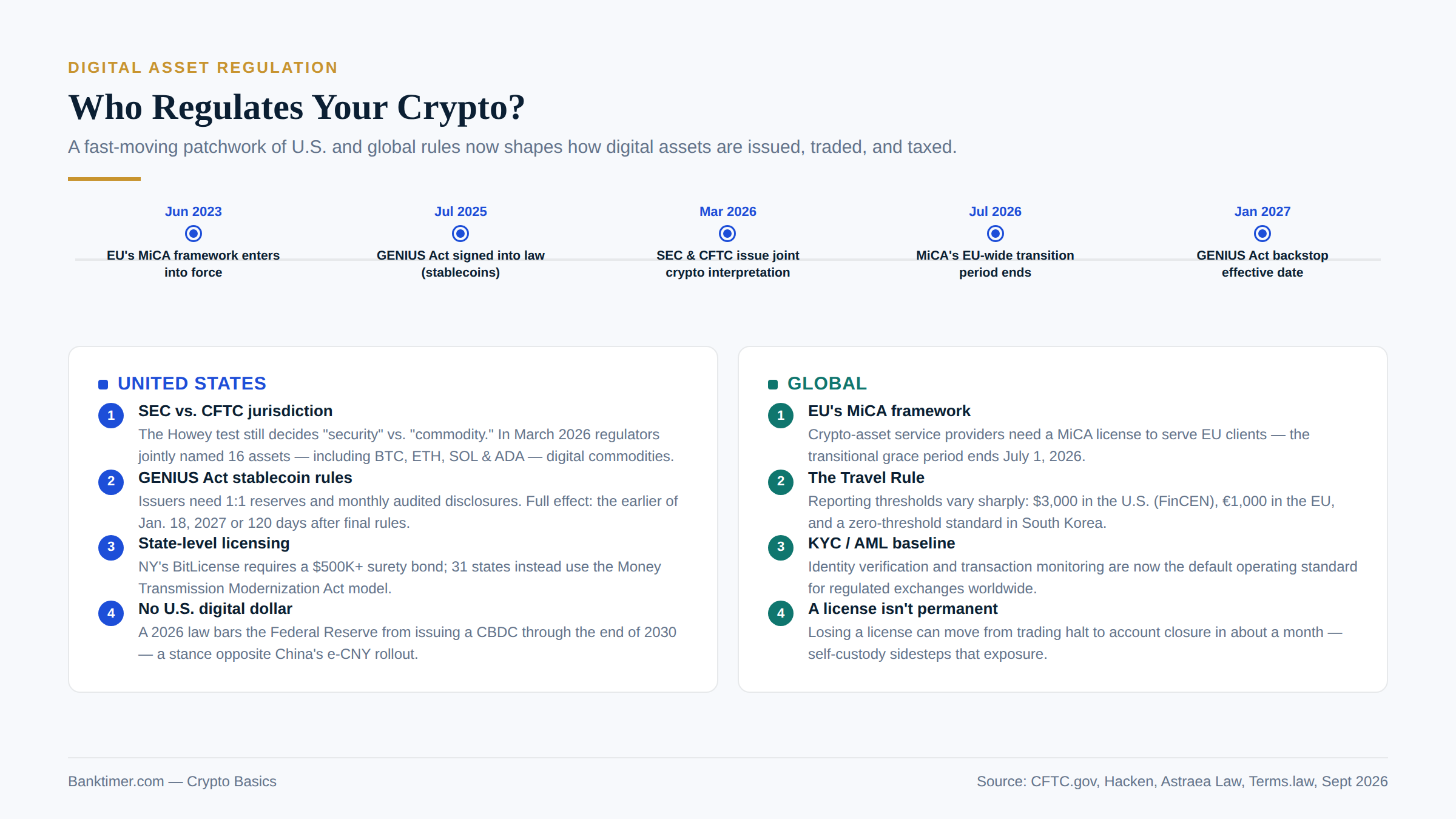
Ethereum
Ethereum is the second-largest cryptocurrency by market value, and understanding it means understanding something fundamentally different from Bitcoin. Where Bitcoin set out to be digital cash, Ethereum set out to be a programmable platform. It’s a global computer that anyone can build on. As of September 8, 2026, ETH traded around $2,471.99, giving it a market cap near $233 billion. That’s well behind Bitcoin’s $1.33 trillion but still ahead of Tether. If you’re just getting comfortable with crypto basics, Ethereum is usually the second asset people study after Bitcoin. And that’s for good reason.
That programmability is what makes Ethereum interesting and risky at the same time. This guide covers decentralized finance apps, NFT marketplaces, and stablecoins. Every one of them runs on some flavor of Ethereum’s technology. But more code running on more contracts means more places for something to break — and it has, repeatedly. We’ll walk through how the network actually works and what you can do with it. Just as important, we’ll cover where the real risks sit.
A quick note before we go further. Ethereum, like any crypto asset, belongs after your financial foundation is set, not instead of it. If you haven’t built an emergency fund or paid down high-interest debt, that comes first. Our personal finance basics guide is the better starting point. Everything below assumes you’re allocating money you can genuinely afford to risk.
What Ethereum Is and How It Works
Ethereum vs. Bitcoin: Core Differences
Bitcoin and Ethereum often get lumped together, but they solve different problems. Bitcoin exists as peer-to-peer digital cash and a store of value. Ethereum exists as a programmable platform for building apps and digital economies. Bitcoin secures its network through proof-of-work mining. Ethereum switched to proof-of-stake, where validators lock up ETH as collateral and risk losing it if they act dishonestly. Supply mechanics differ too. Bitcoin caps out at 21 million coins, with rewards halving roughly every four years.
Ethereum, by contrast, has no fixed supply cap at all. It burns a portion of transaction fees while issuing new ETH to stakers. As a result, net supply direction shifts with network activity. Finality also differs. Bitcoin needs about six confirmations, roughly an hour, to feel secure, while Ethereum reaches finality in about 15 minutes. And Bitcoin’s scripting language stays deliberately simple, whereas Ethereum supports full smart contracts.
The Ethereum Virtual Machine (EVM) Explained
Underneath every Ethereum transaction sits the Ethereum Virtual Machine, or EVM. It’s a decentralized environment that runs smart contract code identically on every node in the network. Think of Ethereum less as a ledger and more as a distributed state machine. It takes an old valid state and a batch of transactions. Then it deterministically produces a new state. Technically, the EVM operates as a stack machine that can hold 1,024 items at once, each a 256-bit word. As a result, skipping this step is one of the more common crypto basics mistakes we see.
That’s backed by temporary memory and persistent storage, organized as a Merkle Patricia trie. Contract code runs through low-level instructions called opcodes — things like ADD, XOR, and BALANCE. Every operation costs a metered amount of computational effort called gas. The EVM’s design has become a portable standard, too. Chains including Polygon, Arbitrum, and Avalanche run EVM-compatible environments. That lets developers deploy the same contract code across multiple networks without rewriting it. Specifically, this is where crypto basics knowledge translates into fewer costly surprises.
Gas, Gwei, and Transaction Mechanics
Gas measures the computational effort behind any Ethereum operation, and every transaction has to pay for it. That design keeps the network from being spammed with infinite loops. Gas prices are usually quoted in gwei, one-billionth of an ETH. Since the EIP-1559 upgrade, every fee splits into two pieces. The first is a protocol-set base fee that adjusts by up to 12.5% per block based on congestion and gets burned outright. The second is a priority fee, or tip, paid directly to the validator.
A simple ETH transfer costs 21,000 gas units. At a 10 gwei base fee plus a 2 gwei tip, that works out to 252,000 gwei, or 0.000252 ETH. During the 2021 NFT boom, gas spiked above 1,000 gwei and average fees topped $70. One viral NFT mint even pushed OpenSea fees past $3,500. By 2026, gas has fallen to roughly 0.16 gwei, and a simple transfer now costs under a penny. That trade-off, in short, sits at the center of crypto basics for anyone new to digital assets.
The Merge and the Shift to Proof-of-Stake
On September 15, 2022, Ethereum executed what’s now simply called “the Merge.” Its original proof-of-work mainnet merged with the Beacon Chain. That’s a separate proof-of-stake chain that had been running quietly since December 1, 2020. Mining disappeared overnight, and energy consumption fell by roughly 99.95%. For ordinary holders, almost nothing changed in the moment. No transaction history was lost, and wallets and balances carried over untouched. Gas fees didn’t move either, because the Merge was a consensus-layer change, not a fee-mechanism change. Behind the scenes, though, the shift was massive. Validators now run both an execution client and a consensus client, communicating through a shared JWT secret. That replaced the energy-hungry mining race with an economic-security model built on staked capital instead of computing power. Given that beginners often miss this, treat it as basic crypto basics hygiene, not an advanced strategy.
Ethereum’s Ecosystem
DeFi Built on Ethereum
Total decentralized finance value locked across all chains stood at $71.77 billion as of June 18, 2026. That’s down sharply from $114.49 billion at the start of the year — a 37.3% decline spread across 453 tracked chains. Ethereum still dominates that market, holding $38.24 billion, or 53.1% of all DeFi TVL. That’s more than any other single chain.
The next tier trails well behind: BNB Smart Chain ($5.08 billion, 7.1%), Solana ($4.77 billion, 6.6%), Tron ($4.50 billion), Bitcoin ($4.13 billion), and Base ($4.12 billion) round out the top six. The leading five chains together account for 78.8% of the market. That concentration matters for risk, not just prestige. When most of DeFi’s locked value sits on one chain, a serious Ethereum-level bug or congestion event can have outsized ripple effects. Those effects reach across the entire ecosystem, not just one protocol.
NFTs and Token Standards (ERC-20, ERC-721)
Ethereum’s token standards are what make NFTs and fungible tokens interoperable across wallets and marketplaces. ERC-721 is the standard for non-fungible tokens: each token carries a unique ID. The combination of contract address plus token ID is globally unique. That’s unlike ERC-20 tokens, where every unit is interchangeable with every other. ERC-721 contracts define standard functions for transferring ownership, checking balances, and granting third-party permission through approve() and setApprovalForAll(). They also define standard events like Transfer and Approval that let wallets and explorers track activity consistently. In practice, this standard powers everything from collectibles like CryptoKitties to domain names through ENS. It also underpins event-attendance badges through POAP, in-game assets, and even numbered event tickets.
Layer 2 Scaling Solutions
Rollups execute transactions off Ethereum’s main chain, then post compressed data back to Layer 1. That inherits Ethereum’s security while dramatically boosting throughput and cutting cost. Optimistic rollups assume transactions are valid unless someone challenges them. Zero-knowledge rollups instead submit cryptographic proofs upfront, skipping the challenge period entirely.
Three networks dominate this landscape. Arbitrum leads in DeFi depth, with roughly $15.5 billion secured and about 38% of L2 DeFi market share. It also has the lowest median fees (around $0.005 per simple transaction) and the fastest block time, at 0.25 seconds. Base, Coinbase’s L2, dominates raw activity, handling more than 37% of all L2 transactions. It leans on Coinbase’s 120-million-plus verified user base to do it. Optimism anchors the OP Stack “Superchain,” a federation of more than 30 chains including Unichain and Kraken’s Ink. Together, these three handle close to 90% of all Layer 2 traffic. The March 2024 Dencun upgrade cut their transaction costs by more than 90% in a matter of days.
DAOs and On-Chain Governance
A DAO — decentralized autonomous organization — is a software system organized through smart contracts. It lets token holders make collective decisions without a traditional management layer. Voting power is usually proportional to how many governance tokens you hold. That creates its own centralization risk: whales get outsized influence, and thin participation from smaller holders can disrupt quorum entirely. The concept’s history includes real cautionary tales. The original “The DAO” launched in 2016 as a venture fund. Specifically, this is where crypto basics knowledge translates into fewer costly surprises.
It raised 3.6 million ETH, worth more than $70 million at the time. A hacker then drained $50 million from it, an event that led directly to the Ethereum/Ethereum Classic chain split. Later DAOs fared better operationally. MakerDAO has governed the DAI stablecoin since December 2017. Uniswap, meanwhile, has been governed by UNI token holders since November 2018. Not every DAO succeeds, though. ConstitutionDAO famously crowdfunded millions in November 2021 to bid on an original copy of the U.S. Constitution. It lost the auction and wound down soon after.
Holding and Using Ethereum
Buying and Storing ETH Safely
How you store ETH matters more than most beginners realize. Hardware wallets (cold storage) keep your private key completely offline, physically out of reach of internet-based attacks. They often use the same secure-element chips banks and governments rely on. Hot wallets, software wallets connected to an app or exchange, are far more convenient for everyday use. That convenience comes from keeping your keys reachable by internet-connected systems, which meaningfully widens your attack surface.
This choice is really the single biggest controllable security variable for a retail ETH holder. Leave your coins on an exchange, and you’re exposed to counterparty risk. If that exchange gets hacked or becomes insolvent, your funds can vanish with it. Move to self-custody, and you trade that risk for a different one. Lose your seed phrase, and nobody can recover it for you.
Staking ETH: Solo, Pooled, and Liquid Staking
Staking lets ETH holders earn yield by helping secure the network, and there are three practical paths in. Solo staking requires 32 ETH and your own validator hardware. You get full control and no third-party counterparty risk, but you face a real capital and technical bar. Pooled staking, through protocols like Rocket Pool, lets you stake with far less ETH by combining your stake with others’. Liquid staking, through providers like Lido or Coinbase, issues a tradeable receipt token, stETH or cbETH, representing your staked position plus rewards.
That means your capital stays usable elsewhere in DeFi while it keeps earning. As for actual yield, sources cluster around 2% to 4% gross APY depending on provider and fee structure. Lido charges roughly a 10% fee, and Coinbase’s cbETH charges about 25%. After fees, net yields commonly land closer to 2% to 2.2%. We’ll unpack real, inflation-adjusted returns in the Staking section below.
ETH as “Digital Oil” vs. Store of Value
For a while, Ethereum marketed itself as “ultrasound money.” The August 2021 EIP-1559 upgrade started burning a portion of every transaction fee. That helped Ethereum hit its first net-deflationary day that September, and the narrative took off. Maybe ETH wasn’t just sound money like Bitcoin’s fixed 21-million supply — maybe it was better. That story has since reversed. The March 2024 Dencun upgrade slashed transaction fees by moving activity to Layer 2s.
That meant less fee-burning and, in turn, rising inflation, up to 0.74% by September 2024. As of May 2026, ETH’s net supply is growing at roughly 0.85% a year. That officially ends the ultrasound-money period (inflation is capped at a maximum of 1.5%). The lesson for readers: crypto narratives like “ultrasound money” or “digital oil” are marketing framings, not guarantees. Supply dynamics are protocol parameters, and protocols change. For instance, crypto basics like this one matter more than chasing any single trade.
Ethereum ETFs and Institutional Access
Wall Street got direct access to Ethereum on July 23, 2024, when spot Ether ETFs began trading across nine issuers. That came a day after the SEC approved their registration statements. That made ETH the second digital asset, after Bitcoin, approved in January 2024, to land a U.S. spot ETF. These funds are structured as commodity-based products rather than securities ETFs. Pinning down total ETH ETF assets under management is harder than it should be. This theme runs through every section of crypto basics, since the fine print rarely gets read.
Figures shift fast, and trackers don’t always agree. What we do know: BlackRock’s iShares Ethereum Trust offered a discounted 0.12% fee “until assets under management reach $2.5 billion.” That tells you the early scale was meaningful. And 2026 reporting has pointed to strong recent inflows. Treat any specific AUM number you see as a moving target. Check it against a live tracker before relying on it.
Ethereum-Specific Risks
Smart Contract Risk on Ethereum
Smart contracts don’t just carry theoretical risk. They carry a running body count. In 2025, DeFi protocols lost $680 million to hacks, up from $534 million in 2024. Exchange infrastructure losses topped $1.6 billion in the same period, led by the Bybit hack. The pace hasn’t slowed. In the first half of 2026 alone, roughly $972 million was stolen across 207 separate incidents industry-wide. Of those 207 incidents, 125 were smart-contract exploits specifically. Similarly, this is a foundational piece of crypto basics that too many guides gloss over.
Two North Korea-linked attacks stand out. Drift Protocol lost $285 million, and KelpDAO, which operates on Ethereum mainnet, lost $292 million. Here’s the part beginners often miss: smart contract risk is separate from custody risk. You can do everything right with self-custody, hardware wallet, offline seed phrase, the works. You can still lose funds simply by approving or interacting with a contract that later gets exploited.
Gas Fee Volatility Risk
Today’s gas fees look almost negligible, roughly 0.16 gwei, with simple transfers costing well under a penny. But that’s a snapshot of normal conditions, not a permanent floor. During the 2021 NFT and DeFi boom, gas spiked past 1,000 gwei and average fees exceeded $70. Some NFT mint transactions even ran past $3,500. The base fee can still climb by up to 12.5% per block under sustained demand. A sudden surge in network activity, like a hot NFT mint or a wave of DeFi liquidations, can push costs sharply higher. That can happen within minutes. If you’re doing anything time-sensitive, like avoiding a liquidation, the gas estimate you see when you submit a transaction matters. It can look very different by the time the transaction actually confirms. That trade-off, in short, sits at the center of crypto basics for anyone new to digital assets.
Competition From Other Layer 1 Networks
Ethereum isn’t the only programmable blockchain competing for developers and capital. Solana, its leading rival, holds roughly $4.77 billion to $8 billion in DeFi TVL against Ethereum’s $38 billion-plus. But it wins clearly on cost and speed: transaction fees run around $0.00025 versus Ethereum’s variable Layer-1 fees. And Solana handles 600 to 700 real-world transactions per second versus Ethereum Layer 1’s 15 to 20. Ethereum still dwarfs Solana on market cap, roughly four to five times larger. As a result, skipping this step is one of the more common crypto basics mistakes we see.
It also dwarfs Solana on validator count, with about 1.1 to 1.22 million validator slots versus Solana’s roughly 795 active validators in early 2026. Staking yield tells an important story here, too. Solana’s headline 6% to 8% APY sounds better than Ethereum’s 2.8% to 4%. But after netting out Solana’s 5% to 6% inflation, real yield falls to just 0% to 3%. That’s comparable to, or worse than, what Ethereum actually delivers. Meanwhile, crypto basics like this one separate cautious investors from careless ones.
Centralization Concerns in Staking
Proof-of-stake was supposed to decentralize Ethereum’s security, but staking has its own concentration problem. The numbers depend heavily on which slice you measure. One 2026 estimate puts Lido at 62.3% of the liquid staking token market specifically ($18.71 billion, or 8.86 million ETH). Lido plus Binance’s wBETH together cover roughly 88% of that market. A broader measure puts Lido’s share of all staked ETH at 24.45%. That’s out of an overall staking rate of 28.91% of supply.
An earlier estimate had put Lido as high as 38% of validators. That’s more than double the level Vitalik Buterin has said is safe for any single entity to control. Why it matters: Ethereum needs 66% validator agreement to finalize blocks. So a single entity approaching a third of stake poses a real risk. In an attack or bug scenario, it could theoretically block the network from finalizing at all. Diversifying across providers like Rocket Pool and StakeWise is the practical mitigation. While it sounds minor, solid crypto basics habits here can save real money down the line.
Ethereum’s flexibility is exactly what makes it powerful. It’s also exactly what makes it harder to evaluate than a simpler asset like Bitcoin. Gas mechanics, staking yields, and layer-2 competition all add moving parts most crypto basics coverage skips over. Understanding those moving parts, though, sets you up well for the next piece of the puzzle. That’s the stablecoins that let people move value around this ecosystem without riding Ethereum’s own volatility.
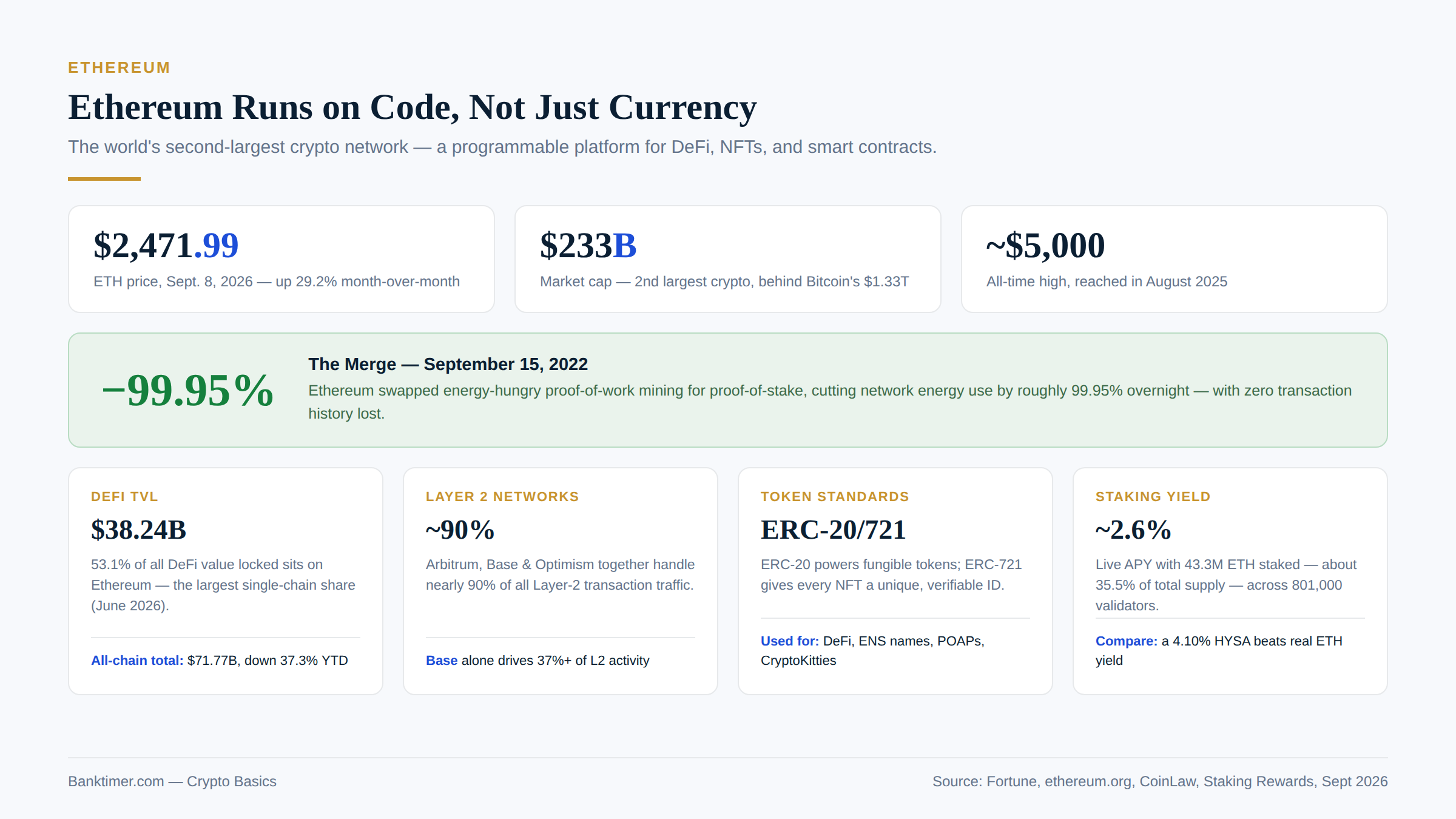
Stablecoins
Everything we’ve covered so far — Ethereum’s price swings, gas spikes, staking risk — points to the same underlying problem. Most crypto assets move too much to use as everyday money. Stablecoins exist to solve that, pegging their value to something steady, almost always the U.S. dollar. The category has grown enormous: total stablecoin market capitalization sits at $314.68 billion spread across 382 tracked coins. That scale makes stablecoins the plumbing of the entire crypto economy — the asset traders park cash in, the collateral DeFi runs on. Increasingly, they’re a real payments rail, too.
But “stable” is doing a lot of work in that name, and it hasn’t always held up. Some stablecoins are backed dollar-for-dollar by real reserves. Others were backed by nothing more than an algorithm and market confidence, and several of those have collapsed to zero. We’ll walk through how pegs are actually maintained and compare the two giants, USDT and USDC, against smaller competitors. We’ll also unpack the new federal rules under the GENIUS Act. And we’ll cover exactly what can still go wrong, even with a “stable” asset sitting in your wallet.
What Stablecoins Are and How They Work
Fiat-Collateralized Stablecoins
The simplest and most widely used stablecoin design is fiat-collateralized. An issuer holds a reserve of dollars and dollar-equivalent assets, like Treasuries, equal to the number of tokens in circulation. Users mint new tokens by depositing fiat directly with the issuer. They redeem them the same way in reverse, trading tokens back for cash. This model underpins the two dominant stablecoins by far, USDT and USDC. It’s the design most people picture when they hear the word “stablecoin.” Even so, it’s really just one approach among several. Each one carries a different risk profile, depending on what actually backs the peg. For instance, crypto basics like this one matter more than chasing any single trade.
Crypto-Collateralized Stablecoins
Not every stablecoin leans on a bank account. DAI, launched by MakerDAO in December 2017, is backed instead by overcollateralized crypto assets locked in smart contracts. The entire system is governed on-chain through the MKR token, rather than by a company holding cash reserves. The collateral is volatile crypto rather than stable fiat. That’s why DAI’s system requires borrowers to lock in more value than they mint, a buffer meant to absorb price swings in the underlying collateral. DAI has held up as a smaller but durable player in the space. It currently carries a market cap around $4.47 billion, roughly 1.42% of the total stablecoin market. Since markets can turn volatile fast, crypto basics here pay off the moment things get rocky.
Algorithmic Stablecoins and Why Many Failed
Algorithmic stablecoins try to hold their peg through code and incentives alone, with no hard collateral behind them. The track record is genuinely bad. The defining failure is TerraUSD (UST) in May 2022. UST began decoupling from the dollar on May 10. By May 11, it had fallen below $0.30; by May 16, it traded under $0.12. It was on its way to effectively zero within days. The collapse wiped out more than $40 billion for Terra ecosystem holders. Founder Do Kwon was later sentenced to 15 years in connection with it.
UST wasn’t alone. Iron Finance’s TITAN token triggered a redemption run in June 2021 that wiped out more than $1 billion combined. Basis Cash lost its peg to roughly $0.30 when bond demand dried up. NuBits collapsed to pennies during the 2018 bear market. Every one of these shared the same flaw. The peg depended on market confidence and a secondary token’s value, not hard 1:1 reserves. Once redemption demand outran the system, it spiraled.
How a Peg Is Actually Maintained
A well-designed peg holds together through arbitrage, not magic. When a stablecoin trades below $1, arbitrageurs buy it cheap on the open market. They redeem it directly with the issuer for a full dollar, pocketing the spread. That buying pressure pushes the price back toward $1. When it trades above $1, arbitrageurs do the reverse. They mint new tokens at par and sell them at the premium, adding supply that pushes the price back down. The catch is that this mechanism only works if redemption is actually available and reliable in real time. That’s precisely the assumption that breaks down during a genuine de-peg crisis. That’s why redemption access matters so much in practice. In turn, add this to the growing list of crypto basics every new holder should know cold.
Major Stablecoins Compared
USDT (Tether) Explained
Tether (USDT) is the largest stablecoin by a wide margin. Its circulating supply sits around $183.4 billion as of early September 2026, roughly 59% of the entire stablecoin market. As of June 30, 2026, Tether reported total reserves of $187.75 billion against $183.64 billion in liabilities. That’s a comfortable buffer on paper. The breakdown matters: U.S. Treasury bills make up the largest chunk, at $114.96 billion. Overnight reverse repos add another $18.63 billion. But Tether also holds $18.84 billion in gold and $5.80 billion in Bitcoin, assets meaningfully more volatile than cash. Nearly all of USDT circulates on two chains: Tron (50.3%, $92.28 billion) and Ethereum (40.1%, $73.43 billion). On transparency, KPMG gave Tether’s 2025 financials an unqualified audit opinion. A Q2 2026 attestation showed a $4.11 billion excess reserve buffer, down 50.1% from the prior quarter. That’s worth watching rather than ignoring.
USDC (Circle) Explained
USDC, issued by Circle, is the second-largest stablecoin, with circulation around $74.2 billion as of mid-September 2026. That’s roughly a 23.8% market share. Circle Internet Financial operates as a licensed money transmitter in New York. USDC’s reserves sit mostly in the Circle Reserve Fund, an SEC-registered money market fund managed by BlackRock. That fund provides daily independent reporting on its holdings. On the transparency front, USDC gets monthly attestations from a Big Four accounting firm. Deloitte & Touche has also audited Circle’s financials every year since 2022. USDC also runs live on 38 different blockchain networks. That spreads out, rather than concentrates, the operational risk tied to any single chain going down or getting congested.
Other Notable Stablecoins
Beyond the two giants, a handful of smaller stablecoins round out the market. USDS (Sky) holds about $8.16 billion, a 2.59% share. USD1, from World Liberty Financial, sits around $4.83 billion (1.54%). USDe (Ethena) carries roughly $4.48 billion (1.42%), but it uses a synthetic-dollar design rather than simple fiat backing.
That’s a genuinely different risk profile worth understanding before you hold it. DAI sits close behind, at $4.47 billion (1.42%). PYUSD, PayPal’s stablecoin issued through Paxos Trust, carries a smaller $2.81 billion market cap. But it comes with NYDFS regulation and monthly third-party attestations. Zoom out, and the concentration is stark. USDT and USDC together make up 83.02% of the entire $314.68 billion stablecoin market. The top five issuers combined control 88.57%. This is an industry with very few load-bearing players. In fact, this is the kind of crypto basics detail that only matters until the day it matters a lot.
Reserve Transparency and Attestations
Not all “we’re fully backed” claims mean the same thing. An attestation checks a single assertion at one point in time. An audit delivers a full annual opinion — a meaningfully higher bar. Most stablecoin issuers rely on the lighter attestation model for their regular disclosures. Circle publishes weekly reserve updates plus a monthly third-party attestation. Tether updates circulation daily but only issues periodic, roughly quarterly, reserve reports. Paxos, which issues PYUSD, publishes two documents monthly. One is an unreviewed self-report shortly after month-end. The other is an independent KPMG examination it adopted in February 2025 for deeper scrutiny. The honest takeaway across the industry: disclosure frequency has improved faster than disclosure depth. Issuers report more often without necessarily becoming easier to compare against each other.
Stablecoin Regulation and the GENIUS Act
What the GENIUS Act Requires
Stablecoins finally got a federal rulebook when the GENIUS Act was signed into law on July 18, 2025. Under the Act, only three types of entities can legally issue “payment stablecoins.” Those are subsidiaries of insured depository institutions, federally qualified issuers approved by the OCC, and state-qualified issuers with less than $10 billion outstanding operating under certified state oversight. That structure effectively closes the door on issuing a compliant payment stablecoin outside a narrow set of paths. You need a bank, a federal regulator, or a state framework that meets federal standards. It’s a significant shift from the largely unregulated environment stablecoins operated in for most of their history.
Reserve and Redemption Requirements
The Act’s core protection is mandatory 1:1 backing with a defined list of permitted assets. That list includes U.S. currency, insured-depository demand deposits, Treasury bills, notes, and bonds maturing in 93 days or less, overnight repos backed by Treasuries, and qualifying money market funds. Reserves can’t be pledged, rehypothecated, or reused for other purposes, with narrow exceptions like margin obligations. Issuers also have to maintain clear, timely redemption procedures, with every fee disclosed in plain language. Any fee change requires seven days’ advance notice. On top of that, monthly public disclosure of reserve composition and total outstanding tokens is now required. That disclosure is examined by a third-party auditor, with issuer CEOs and CFOs personally certifying the numbers’ accuracy to regulators.
How Regulation Changes Counterparty Risk
Before the GENIUS Act, most stablecoin issuance operated in a regulatory gray zone. No uniform federal standard for reserves or disclosure existed. The Act creates a genuine federal floor. Compliant issuers now face codified 1:1 backing rules, monthly disclosure, and defined redemption procedures. That meaningfully reduces — though doesn’t eliminate — the risk that an issuer is secretly under-reserved or parking your dollars in something illiquid. It’s worth noting stablecoins now sit in their own regulatory lane, separate from both banking and securities law. They have no direct access to the Federal Reserve. That’s a materially different, and in some ways weaker, protection than holding an actual bank deposit. The Act also carves compliant stablecoins out of SEC and CFTC oversight entirely.
What Regulation Doesn’t Guarantee
Here’s what the GENIUS Act does not do, and it matters. GENIUS Act stablecoins are explicitly not FDIC-insured and carry no federal government guarantee, full stop. The law doesn’t prevent de-pegging, and it doesn’t guarantee protection if an issuer becomes insolvent. New York prosecutors have flagged a specific gap. The Act contains no provision requiring issuers to return stolen funds to fraud victims. Consumer Reports has gone further, arguing publicly that the law doesn’t provide enough consumer protection overall. The practical takeaway is simple: regulation lowers certain risks around reserve quality and disclosure. But it doesn’t turn a stablecoin into a savings account. And it shouldn’t be mistaken for one when you’re deciding how much of your money to hold in one.
Using Stablecoins Safely
Common Stablecoin Use Cases
Stablecoins have grown well beyond their original job as a trading-desk convenience. People use them today for cross-border payments and remittances, and as trading pairs and collateral on exchanges. They’re also collateral for DeFi lending. Increasingly, they serve as a payment rail for businesses that want dollar-denominated settlement without a traditional bank wire. That range of uses is exactly why the concentration numbers from the last section matter. When this much everyday activity depends on a small handful of issuers, problems at any one of them can ripple widely. Those ripples reach far beyond crypto traders.
De-Pegging Risk and Historical Examples
Even well-collateralized stablecoins can break their peg under stress. Two 2023 events show exactly why the cause matters as much as the result. In March 2023, USDC fell to a low of $0.87. That happened after Circle disclosed that $3.3 billion of its reserves were stuck at the failing Silicon Valley Bank. It recovered to roughly $0.94 within hours and fully restored its peg within days. That happened once the government backstopped SVB depositors. Compare that to Terra’s UST. As a result, skipping this step is one of the more common crypto basics mistakes we see.
It fell from $1 to under $0.30 within a day, and toward $0.12 within a week. It ultimately wiped out over $40 billion, with no real collateral to fall back on. TrueUSD had its own scare in 2024. $456 million of its reserves turned out to be tied up in illiquid investments. The lesson: USDC’s de-peg was a liquidity scare that resolved because the collateral was real. Terra’s was a structural collapse, because it never was. That distinction is the single most important stablecoin risk concept to internalize.
Yield Offers on Stablecoins: What’s Really Happening
Any stablecoin yield meaningfully above a Treasury-bill or high-yield savings rate isn’t free money. It’s compensation for risk you’re taking on somewhere. That risk usually shows up as counterparty exposure — the lending platform could default. It can also be smart contract risk, where the DeFi protocol could get exploited. Or it can be an unsustainable subsidy. Terra’s Anchor Protocol offered roughly 19.5% APY on UST deposits right up until the whole system collapsed in May 2022. Before treating any “stablecoin yield” product as low-risk, ask where the yield actually comes from. It could be real lending demand, token emissions, or a platform subsidy that can vanish overnight. A stable price tells you nothing about the safety of whatever’s generating the yield on top of it. That trade-off, in short, sits at the center of crypto basics for anyone new to digital assets.
Choosing a Stablecoin for Your Purpose
With more than 380 stablecoins to choose from, a few criteria do most of the work. Start with issuer transparency: how often, and how rigorously, does the issuer get attested or audited? Check regulatory status: is the issuer GENIUS Act-compliant, operating under OCC or state oversight, or sitting outside that framework entirely? Look at reserve composition. Cash and Treasuries (USDC’s approach) versus a mix that includes Bitcoin and gold (USDT’s approach) carry different volatility profiles. Weigh liquidity and redemption reliability, since larger, more liquid coins tend to redeem more smoothly under stress. And match the coin to your actual use case. A trader may prioritize exchange liquidity. A business handling cross-border payments may care more about regulatory clarity and redemption speed.
Stablecoins solve real problems, but “stable” was never a synonym for “risk-free.” The GENIUS Act narrows some of that risk without erasing it. That distinction is one of the more counterintuitive parts of crypto basics. The assets designed to feel boring can still carry issuer, regulatory, and liquidity risk worth taking seriously. With that context in hand, it’s worth looking at staking. That’s where many of the same ETH holders discussed earlier put their coins to work for yield.
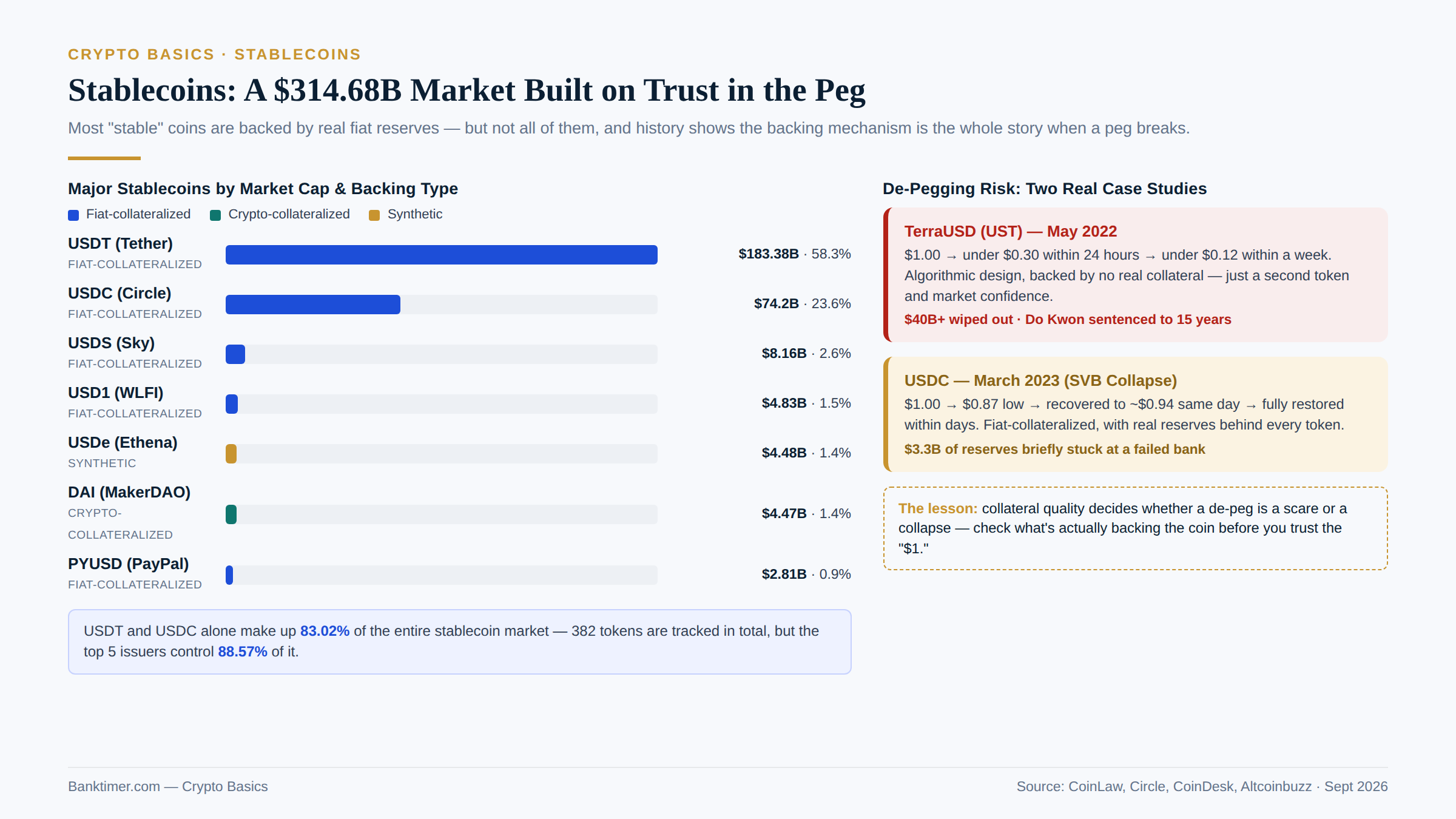
Staking
Staking is how proof-of-stake networks like Ethereum pay people for helping secure the chain. Lock up your coins, and the network rewards you for doing it honestly. It’s one of the more approachable ways to put crypto basics into practice. It doesn’t require trading skill, just patience and a willingness to understand what you’re locking up. But staking gets marketed as “crypto’s version of a savings account,” and that comparison undersells the real differences. A savings account is federally insured and liquid on demand. A staked position can be neither, depending on how and where you stake.
We already touched on Ethereum’s shift to proof-of-stake and its basic staking options earlier in this guide. Here, we go deeper. We’ll cover how rewards actually get calculated and what realistic yield looks like once you account for fees and inflation. Critically, we’ll also cover the specific risks that make staking meaningfully different from parking cash in a bank account. Slashing, lock-up periods, smart contract risk, and platform failures are all real, documented events, not hypotheticals. We’ll walk through each one with actual numbers.
How Staking Actually Works
Proof-of-Stake Mechanics Explained
Proof-of-stake replaces mining with a simpler economic bargain. Validators lock up capital as collateral for the right to propose and confirm new blocks. Behave honestly, and you earn rewards for your trouble. Behave dishonestly, or make a costly technical mistake. The network can then seize (slash) part or all of your stake as a penalty. That built-in cost to bad behavior is what makes the system secure. It doesn’t require burning enormous amounts of electricity, the way proof-of-work mining does. It’s a fundamentally different security model: instead of outcompeting attackers with computing power, the network makes attacking economically irrational.
Validators, Delegators, and Rewards
Validators run the actual infrastructure — the servers, the software, the uptime. They’re the ones directly exposed to slashing if something goes wrong. Delegators are a role more common on non-Ethereum proof-of-stake chains. They’re functionally present, though, in Ethereum’s pooled and liquid staking options. Delegators hand their stake to a validator without running any infrastructure themselves. In return, they earn a share of the rewards minus that validator’s commission. Those commissions aren’t trivial: Lido charges a 10% fee on staking rewards, while Coinbase’s cbETH charges 25%. On the same underlying yield, that gap alone can be the difference between a mediocre and a genuinely poor net return.
Solo Staking vs. Pooled Staking
Solo staking on Ethereum requires 32 ETH and your own independent validator setup. That gives you the maximum control available, with zero third-party counterparty risk. But it also comes with the highest capital and technical bar of any staking method. And it offers the least diversification against a single hardware or connectivity failure taking your validator offline. Pooled staking flips that trade-off. It lowers the capital requirement dramatically, letting you stake with a fraction of 32 ETH. But it introduces smart contract risk from the pooling protocol itself. In some cases, it also adds operator concentration risk if too much stake concentrates with one provider. That’s a concern we detailed earlier with Lido’s outsized share of the market.
Liquid Staking Tokens Explained
Liquid staking tokens, like Lido’s stETH or Coinbase’s cbETH, are receipt tokens that represent your staked position plus accruing rewards. The appeal is capital efficiency. Instead of your ETH sitting locked and untouchable, the receipt token stays tradeable and usable as collateral elsewhere in DeFi. Meanwhile, the underlying ETH keeps earning staking rewards in the background. That’s a real advantage over plain staking, where your capital is simply frozen until you unstake. But that liquidity isn’t free. It comes with an added layer of smart contract risk and market risk. The receipt token can trade at a discount to the ETH it represents during periods of stress. We cover that risk in detail shortly.
Staking Rewards and Realistic Returns
How Staking Yield Is Calculated
ETH staking rewards come from three distinct sources, not one. Consensus-layer issuance is new ETH minted directly as block rewards for validators. Execution-layer priority fees are the tips users pay to get their transactions included faster. And MEV, maximal extractable value, is additional value block proposers capture from how they order transactions within a block. It’s sometimes worth more than the base reward itself. Understanding this breakdown matters because each piece moves independently. That’s exactly why your actual staking return can vary meaningfully from one period to the next.
What Affects Your Actual Reward Rate
The biggest driver of headline yield trending down over time is simple supply and demand. Ethereum’s issuance is roughly fixed, so as more ETH gets staked, that fixed reward pool gets split across more validators. As a result, per-validator APY falls. The staking ratio has climbed sharply since the Merge. It now sits somewhere around 28% to 35% of total supply by 2026, depending on the source. Provider fees are the second major factor; recall Lido’s 10% versus Coinbase’s 25% on comparable gross yield. This theme runs through every section of crypto basics, since the fine print rarely gets read.
Network activity and MEV opportunity swing results too. The number that actually matters, though, is real yield — headline yield minus token inflation. It diverges sharply across chains. Solana’s flashy 6% to 8% headline nets to just 0% to 3% real after inflation. Cosmos’s eye-catching 10% to 19% headline nets to only 2% to 8% real. Ethereum’s smaller 2.8% to 4% headline sits much closer to its real yield of roughly 2% to 3%. That’s simply because ETH’s own inflation is lower. Since markets can turn volatile fast, crypto basics here pay off the moment things get rocky.
Compounding and Reward Volatility
Staking rewards aren’t a smooth, predictable drip. Individual payouts vary block by block. That depends on which validators get selected to propose and how much MEV shows up in that particular block. As a result, solo stakers experience noticeably “lumpier,” more volatile reward timing than pooled or liquid stakers. Pooled and liquid stakers see their returns smoothed across a much larger pool of validators. On top of that, whether you auto-compound rewards (reinvesting them automatically) or claim manually matters. That choice meaningfully changes your effective annualized return over time. The same compounding math that applies to any other interest-bearing asset applies here too.
Comparing Staking Yield to Other Income Options
Here’s the comparison every staking pitch conveniently leaves out. As of September 2026, top U.S. high-yield savings accounts pay around 4.10% APY (CIT Bank tops the list). Solid accounts cluster between 3.85% and 4.10%, roughly six times the 0.64% national average. Our banking basics guide breaks down how to find and vet those accounts. That means a federally insured HYSA currently pays more than Ethereum’s roughly 2% to 3% real staking yield.
And it comes with none of staking’s lock-up periods, slashing risk, smart contract exposure, or platform custody risk. Other chains don’t necessarily do better on a real-yield basis either. Cardano runs about 2% to 4% with no lock-up at all, and Solana nets roughly 0% to 3%. Cosmos can reach 2% to 8%, but it forces a 21-day unbonding wait to get there. Yield alone rarely tells the whole story.
Staking Risks You Can’t Ignore
Slashing Risk Explained
Slashing only happens for provably dishonest validator behavior, not for simple downtime. Three specific offenses trigger it: proposing two different blocks for the same slot, “surrounding” attestations that effectively try to rewrite history, and double-voting on two candidates for the same block. The penalty starts around 1 ETH, about 1/32 of a validator’s effective balance. Add roughly 0.07 ETH more that accrues during the approximately 36-day forced exit period. On top of that, a variable “correlation” penalty scales up sharply if many validators get slashed in the same window. In extreme, coordinated cases, slashing can theoretically wipe out a validator’s entire stake. In practice, it’s rare. As of February 2024, only 414 of roughly 1,174,000 deposited validators had ever been slashed, under 0.04%. Nearly all documented cases trace back to operational mistakes, like running duplicate validator keys, rather than actual attacks.
Lock-Up and Unbonding Periods
Ethereum’s exit process isn’t a fixed waiting period. It’s variable and demand-dependent, gated by a network “churn limit” of 256 ETH per epoch, about 6.4 minutes. Under normal conditions, that means a typical exit takes roughly 1 to 5 days. But “typical” isn’t a guarantee. In September 2025, the exit queue hit a record 46-plus days. At that point, 2.5 million ETH, about $11.25 billion, was waiting in line. The trigger: staking provider Kiln pushed a mass precautionary exit of 1.6 million ETH. In addition, that single fact captures a lot of what crypto basics is really about.
That followed a security scare tied to an NPM supply-chain attack, compounded by a separate $41.5 million SwissBorg exploit. Profit-taking after ETH’s 160%-plus rally since April 2025 made the backlog worse. Analysts warned that if a large share of that exiting ETH tried to re-stake at once, new entrants could face longer activation waits. Those waits could stretch to 129 days. For comparison, Cosmos imposes a fixed 21-day unbonding period with no rewards accruing during the wait. Solana’s exit runs 2 to 3 days, and Cardano has no lock-up at all.
Smart Contract Risk in Liquid Staking
Liquid staking tokens add convenience, but they also add a failure mode plain staking doesn’t have. In June 2022, during the broader Celsius-driven liquidity crunch, Lido’s stETH traded as low as roughly $0.95. That’s about a nickel under parity with ETH. Importantly, that was a liquidity-and-timing event, not a solvency event. The underlying staked ETH was fully intact. But holders who needed to exit faster than the withdrawal queue allowed had to sell at a market discount instead. In fact, that distinction is exactly what crypto basics coverage should make clear.
The risk compounds when leverage enters the picture. A common DeFi strategy stakes ETH for an LST, borrows against that LST as collateral, and re-stakes the borrowed funds. That creates a self-reinforcing spiral of cascading liquidations if the LST depegs even modestly. And because one protocol, Lido, dominates the LST market, a depeg or bug there doesn’t stay contained. It propagates across every DeFi platform that has integrated its token as collateral.
Platform and Custodial Staking Risk
Handing your ETH to a platform to stake for you can reintroduce the counterparty risk self-custody was supposed to eliminate. Regulators have already made an example of it. In February 2023, the SEC charged Kraken with running an unregistered securities offering through its staking-as-a-service product. That product had advertised returns up to 21% annually since 2019. Kraken settled for $30 million and agreed to immediately and permanently stop offering staking-as-a-service to U.S. customers. SEC Chair Gary Gensler’s framing is worth remembering: when you hand tokens to a platform for staking, “they lose control of those tokens and take on risks associated with those platforms, with very little protection.” Custodial staking convenience always comes bundled with that same trade-off. It’s worth repeating because crypto basics like this one rarely get enough attention.
Getting Started With Staking Safely
Choosing a Reputable Validator or Provider
A few concrete factors separate a reasonable staking provider from a risky one. Check the fee: Lido’s 10% versus Coinbase’s 25% on similar gross yield is a meaningful, quantifiable difference. Check the slashing track record. Consensys, for instance, reports zero slashes across its own validators since launching in December 2020. That’s well below the industry’s already-low 0.04% historical rate. Consider the provider’s contribution to concentration risk. Smaller operators like Rocket Pool or StakeWise help reduce the systemic centralization concern we covered earlier with Lido. Confirm regulatory status. Is this a compliant, registered offering, or does it resemble the unregistered product the SEC shut down at Kraken? And look at withdrawal mechanics and how the provider’s exit queue actually behaved during real stress, like September 2025.
Tax Treatment of Staking Rewards
The IRS has been clear, at least for now. Staking rewards count as taxable income the moment you gain “dominion and control” over them. That’s under Revenue Ruling 2023-14, issued August 2023. It means tax applies at receipt, not at eventual sale, valued at fair market value on that receipt date. That applies whether you’re self-custody staking or staking through an exchange. There’s an active legal challenge worth knowing about. The original Jarrett v. United States case argued staking rewards are self-created property, like a harvested crop. In fact, this is the kind of crypto basics detail that only matters until the day it matters a lot.
It argued they should be taxable only when sold. The government sidestepped it by granting the Jarretts’ refund rather than litigating. So no binding precedent was actually set. The Jarretts filed a second suit, “Jarrett 2.0,” in October 2024. As of this writing in September 2026, it remains unresolved. Until it is, Revenue Ruling 2023-14 stands. You can owe tax on staking income in a year you never sold anything, even if the price later falls.
Questions to Ask Before You Stake
Before locking anything up, work through a short list of questions:
- What’s the actual unbonding period for this asset, and how long could it stretch under stress? Ethereum’s queue hit 46-plus days in September 2025, not the “typical” 1 to 5.
- What fee does this specific provider charge, and what’s its documented slashing and uptime history?
- Is this a regulated, compliant offering, or does it resemble the unregistered product the SEC shut down at Kraken?
- How is the advertised yield actually generated? Is it real network issuance and fees, or something closer to Terra’s unsustainable 19.5% Anchor Protocol subsidy?
- If you’re using a liquid staking token, do you understand it can trade at a discount during stress? And are you avoiding leveraged, looped DeFi strategies that would amplify that risk?
- Do you understand that rewards are taxed as income the moment you receive them, not when you eventually sell?
When Staking Isn’t the Right Fit
Staking isn’t automatically the better choice just because the yield number looks bigger. If you might need the funds on short notice, think about unbonding periods. Those run a fixed 21 days for Cosmos-style chains, and historically as long as 46-plus days for Ethereum under stress. They make staked assets meaningfully less liquid than cash or even a standard brokerage account. If you have low tolerance for losing principal, remember this. Slashing, smart contract exploits, and platform failure are all documented, real possibilities, not scare stories. This theme runs through every section of crypto basics, since the fine print rarely gets read.
Smart contract exploits alone cost $972 million across 207 incidents in H1 2026. And if you’re weighing whether borrowed money belongs anywhere near a staked position, check our personal loan basics guide first. It explains why leverage and locked-up, volatile assets rarely mix well. A federally insured HYSA paying around 4.10% APY can match or beat ETH’s roughly 2% to 3% real staking yield. It does that without any of that risk. Skipping staking entirely is a perfectly legitimate choice for a risk-averse saver, not a missed opportunity.
Staking can be a reasonable way to put idle ETH to work. But it’s not a savings account with better branding. The lock-ups, slashing rules, and platform risks are real and documented, not fine print you can skip. That’s the throughline across this entire guide. Solid crypto basics means understanding the mechanism behind a yield number, not just the number itself. Understand that before you commit a single dollar to it.
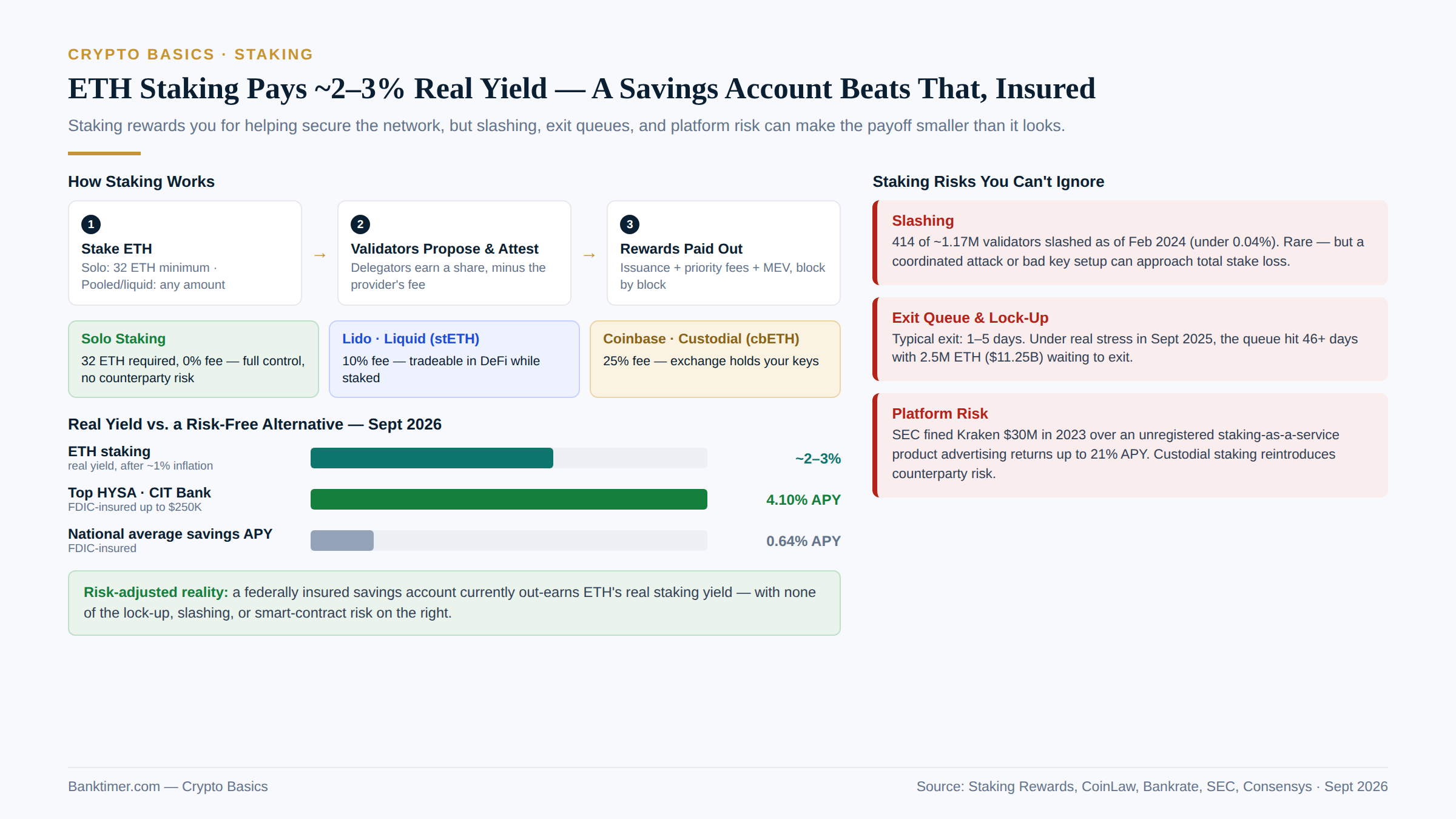
How the Twelve Crypto Elements Compare
Twelve topics, one connected picture. Each one covers a different piece of how digital assets actually work. They share a common thread, too: every element carries its own specific risk. And every risk has a specific audience who needs to understand it before acting. Bitcoin, blockchain, exchanges, fees, risk, security, taxes, wallets, regulation, Ethereum, stablecoins, and staking — here’s how they compare.
The Core Building Blocks
| Element | What It Is | Primary Risk | Who Needs to Know It |
|---|---|---|---|
| Bitcoin | The original cryptocurrency; a decentralized store of value capped at 21 million coins | Extreme volatility; every full cycle to date has posted a 70%+ drawdown from peak | Anyone considering any long-term crypto allocation |
| Blockchain Basics | The shared, tamper-evident ledger technology underlying Bitcoin, Ethereum, and most digital assets | The scalability trilemma forces trade-offs between security, speed, and decentralization | Anyone who wants to understand how a crypto asset actually works |
| Crypto Exchanges | Platforms, centralized or decentralized, where you buy, sell, and trade digital assets | Counterparty risk; a hacked or insolvent exchange can freeze or lose customer funds | First-time buyers and anyone holding assets on a trading platform |
| Crypto Fees | The layered costs of buying, trading, moving, and staking crypto | Hidden costs can exceed 7% of a purchase on some retail platforms | Active traders and anyone comparing platforms before funding an account |
| Ethereum | A programmable blockchain powering smart contracts, DeFi, NFTs, and stablecoins | Smart contract exploits can drain funds even from an otherwise secure wallet | Anyone interested in DeFi, NFTs, or crypto beyond simple payments |
| Crypto Wallets | Software or hardware tools that store the private keys controlling your crypto | Losing a seed phrase with no backup means permanent, unrecoverable loss | Anyone moving assets off an exchange into self-custody |
The Risk, Compliance, and Yield Layer
| Element | What It Is | Primary Risk | Who Needs to Know It |
|---|---|---|---|
| Crypto Risk | The volatility, custody, counterparty, regulatory, and liquidity exposures unique to digital assets | Several risk types compound at once, unlike single-factor stock market risk | Every crypto holder, regardless of experience level |
| Crypto Security | The practices that protect private keys, accounts, and transactions from theft | Phishing, SIM-swaps, and fake apps can drain a wallet instantly and irreversibly | Anyone who owns or plans to own crypto directly |
| Crypto Taxes | IRS property-tax rules that apply to every sale, trade, or crypto-based income event | Crypto-to-crypto trades are taxable even without ever touching U.S. dollars | Every U.S. crypto holder who buys, sells, trades, or earns crypto |
| Digital Asset Regulation | The evolving patchwork of SEC, CFTC, state, and federal rules governing crypto | Today’s guidance can shift with new regulators; little of it is locked-in statute | Anyone assuming current rules will hold steady indefinitely |
| Stablecoins | Tokens designed to hold a steady value, usually pegged to the U.S. dollar | De-pegging risk; some “stable” coins have collapsed to near zero | Traders, DeFi users, and anyone moving funds between exchanges |
| Staking | Locking crypto to help secure a proof-of-stake network in exchange for rewards | Slashing, lock-up periods, and platform risk can erode or freeze your principal | Long-term holders weighing yield options beyond simply holding |
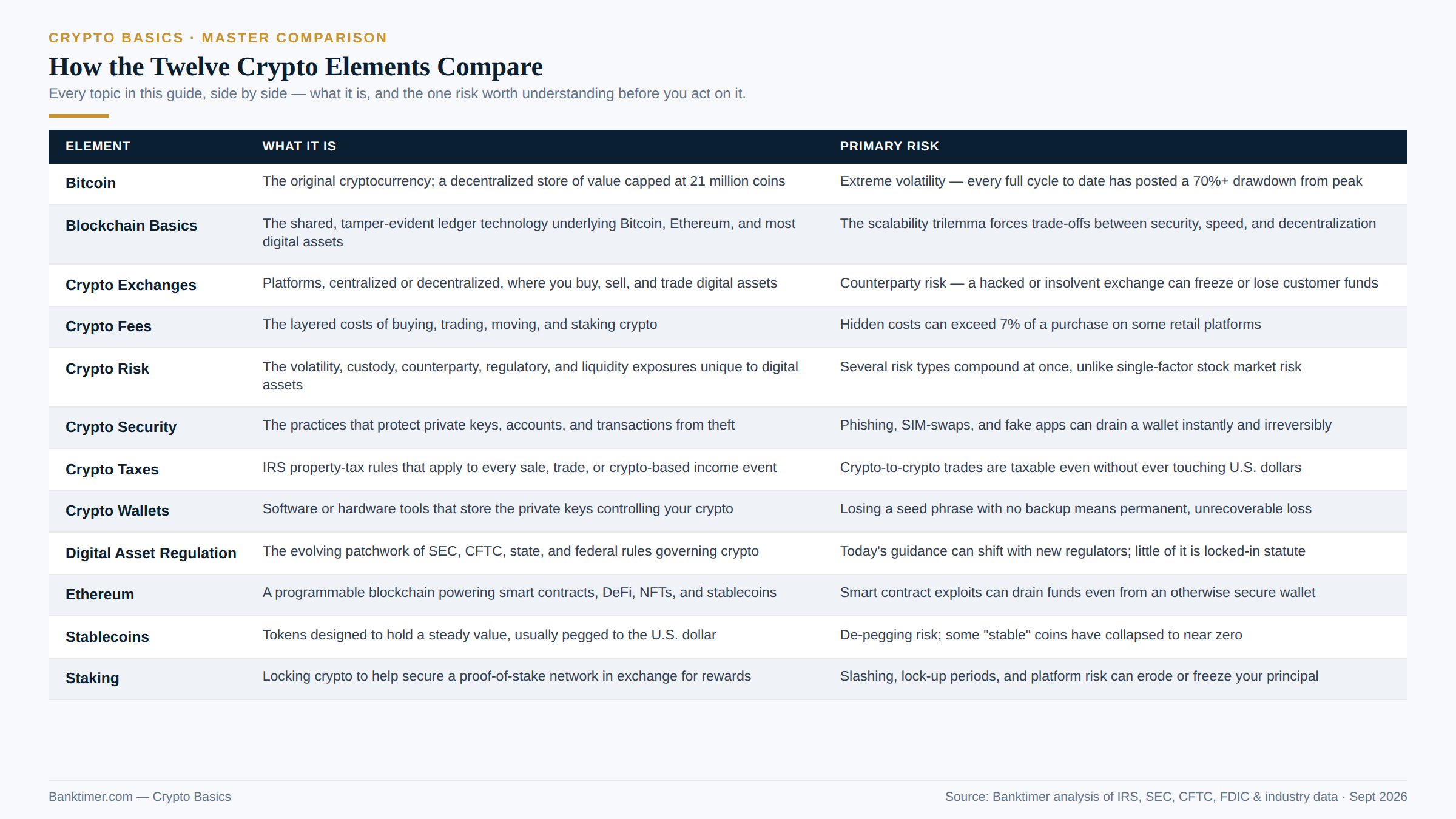
A 2026 Snapshot
Crypto basics don’t sit still, and any number in this guide is a photograph of a moving target.
Where the Market Stands
As of mid-September 2026, Bitcoin trades around $77,664, with a total market capitalization near $1.33 trillion. That’s down roughly a third from its October 2025 all-time high of $126,198. It’s a reminder of how fast “current price” framing goes stale. Ethereum sits near $2,472, valued at about $233 billion. That makes it the second-largest crypto asset, behind Bitcoin and ahead of Tether. Spot Bitcoin ETFs now hold roughly $103.3 billion in net assets. That gives traditional brokerage investors regulated exposure without touching a private key directly.
The stablecoin market has grown to $314.68 billion across 382 tracked tokens. Tether and USD Coin together control over 83% of it. That concentration is worth noting. Both play an outsized role in how money actually moves through crypto markets day to day. Total decentralized finance value locked sits near $71.77 billion. That’s down sharply from $114.49 billion at the start of the year. It’s evidence that crypto markets can contract as fast as they expand.
Where Regulation and Adoption Stand
Regulation is catching up, unevenly and often slower than the technology itself. The GENIUS Act, which sets federal rules for stablecoin issuers, becomes fully effective no later than January 18, 2027. Form 1099-DA now requires brokers to report crypto sale proceeds to the IRS, starting with 2025 transactions. Cost-basis reporting follows starting in 2026. The CLARITY Act would formally split SEC and CFTC oversight of digital assets. It passed the House in 2025 but remains stalled in the Senate. Analysts now expect it to slip into 2027. None of this is settled; treat every figure here as a snapshot, not a permanent fact.
Adoption keeps climbing even as prices swing. Institutional research has tracked median crypto adoption growth of roughly 17% per year since 2017. That pace predates and outlasts any single price cycle. Bitcoin’s 30-day correlation with the S&P 500 has also drifted higher this year, touching 0.74 in early 2026. That’s a reminder: crypto increasingly moves with, not independently of, traditional markets. That undercuts the old “uncorrelated hedge” pitch some early adopters made. Whatever narrative you hear about where this market is headed, check it against current data. Don’t just trust a headline from a prior cycle.
How to Prioritize Crypto Basics for Your Situation
Not every reader needs the same starting point. Trying to absorb all twelve topics at once is a good way to stall out. That’s true especially before you’ve secured a single wallet. Here’s where to focus first, based on where you actually stand today.
If You’re Buying Your First Crypto
Start with custody and security, not price charts. Use a reputable, regulated exchange with mandatory ID verification. Enable an app-based authenticator instead of SMS. Then make a small test purchase of $20 to $50 before committing real money. Learn the difference between a hot wallet and a hardware wallet early. Where you store crypto matters more than which coin you buy. Follow with a small test withdrawal to a wallet you control, and wait for several confirmations before scaling up. Read Crypto Security and Crypto Wallets closely before you fund an account. Instead of skipping it, treat this as non-negotiable crypto basics.
If You’re an Active Trader
Prioritize fee structures, spreads, and slippage over headline trading percentages, since the advertised rate is rarely the whole cost. Maker and taker fees range from under 0.1% to over 1%, depending on the exchange and volume tier. Hidden spreads can also add several percentage points on retail apps. Understand order-book depth before trading anything beyond Bitcoin or Ethereum. Thin liquidity in smaller tokens amplifies both cost and price swings. Scope any exchange API key to read-and-trade only, with withdrawal access disabled. Review Crypto Fees and Crypto Exchanges before scaling up trade size.
If You’re a Long-Term Holder
Focus on custody discipline and position sizing over short-term price moves. Institutional guidance generally caps crypto at 1% to 4% of a diversified portfolio. That reflects volatility roughly four times that of the S&P 500. Move long-term holdings into cold storage rather than leaving them on an exchange. Write a succession plan, too. Nearly 90% of holders worry about inheritance, yet few document one. Resist checking prices daily. Crypto’s historical cycles have included multiple 70%-plus drawdowns that fully recovered over years, not days. Read Crypto Risk and Bitcoin’s volatility data before deciding how much to hold.
If You’re Filing Taxes This Season
Every crypto-to-crypto trade is a taxable event, even if you never touched U.S. dollars. Staking rewards count as ordinary income the moment you gain control of them, not when you sell. That’s true regardless of what the token is worth later. Form 1099-DA means the IRS increasingly sees your exchange activity directly. So reconcile your own records before you file, rather than after a mismatch notice arrives. Read Crypto Taxes closely. Consider crypto-specific tax software or a specialist preparer if you’ve traded across multiple platforms or wallets.
The Five Mistakes That Cost Crypto Beginners the Most
Most crypto losses aren’t caused by bad luck or bad timing. They follow a handful of avoidable, well-documented patterns. Those patterns repeat across thousands of cases and hundreds of millions of dollars in losses every year.
Custody and Security Mistakes
- Losing a seed phrase with no backup. James Howells accidentally discarded a hard drive holding 8,000 BTC in 2013. As of August 2026, that coin would be worth roughly $510 million. It remains unrecovered in a Welsh landfill. Stefan Thomas locked himself out of 7,002 BTC after forgetting his IronKey password. He has only two failed attempts left before permanent erasure. Neither man had a business or a hacker to blame; both simply had no durable backup. Fix: stamp your seed phrase into a metal backup plate and store it offline. Never photograph it or type it into any website.
- Falling for phishing and fake wallet apps. Crypto “drainer” phishing kits stole hundreds of millions of dollars from over 300,000 wallets at their 2024 peak. In April 2026, researchers found 26 fake wallet apps impersonating Coinbase, Ledger, MetaMask, and others. They found them on the Apple App Store. Some disguised themselves as calculators or games until they prompted a fake “wallet” install. Fix: download wallet apps only from links on the official company website. Never enter a seed phrase into an app you weren’t specifically expecting to ask for one.
Financial and Tax Mistakes
- Leaving large balances on a failing exchange. FTX, Celsius, and Mt. Gox each collapsed while holding customer funds. That left over a million users frozen out of their own money for months or years. Celsius alone owed users $4.7 billion against just $167 million in cash when it filed for bankruptcy in 2022. Mt. Gox creditors waited a full decade for a partial repayment plan. Fix: keep only actively-traded funds on an exchange, and move long-term holdings to a wallet you personally control.
- Forgetting crypto-to-crypto trades are taxable. Swapping Bitcoin for Ethereum is a taxable event under IRS rules, even though no dollars change hands. Some investors mistakenly assumed pre-2018 swaps qualified for tax-deferred treatment. The IRS confirmed in 2021 that they never did. That left people owing back taxes plus interest years later. Fix: log every trade’s date, cost basis, and fair market value as it happens, not at tax time.
- Chasing yield on unregulated platforms. Terra’s Anchor Protocol offered roughly 19.5% APY on its algorithmic stablecoin before collapsing in May 2022. That collapse wiped out over $40 billion in barely a week. The SEC separately fined Kraken $30 million in 2023. That was for running an unregistered staking-as-a-service product advertising returns up to 21%. Fix: ask where a yield actually comes from before trusting it. Treat any return far above a savings-account rate as compensation for real, specific risk.
Questions to Ask Yourself Before You Buy, Stake, or Trade Crypto
Crypto rewards preparation and punishes improvisation. Before you buy, stake, or trade anything, work through these questions honestly. Do it on paper if that helps you resist acting on impulse.
Before you buy, stake, or trade, check every item
- Do I understand the difference between custody on an exchange and self-custody in my own wallet, and which one this decision involves?
- Have I written down and safely stored my seed phrase somewhere fire- and water-resistant, offline, separate from the device itself?
- What percentage of my total portfolio am I putting into crypto, and could I genuinely afford to lose all of it?
- Am I using an app-based authenticator or a hardware security key instead of SMS for two-factor authentication?
- Do I know how crypto-to-crypto trades, staking rewards, and airdrops are taxed in my specific situation?
- Have I independently verified that this exchange or platform is properly licensed where I live?
- Do I understand this asset carries no FDIC insurance, regardless of any bank-sounding name or partnership it advertises?
- If I’m considering staking, do I know the actual unbonding period and exactly what triggers slashing?
- Have I tested a small transaction before sending a large one to a new address or wallet?
- Am I chasing a specific yield or return without understanding where that yield actually comes from?
Who This Guide Suits
This guide fits anyone starting from zero. It offers a clear, honest foundation in crypto basics before you risk real money. It suits the reader who’s heard about Bitcoin or Ethereum for years but never opened an account. It also suits the cautious saver weighing a small allocation against a traditional portfolio. And it suits the taxpayer who bought crypto once and now needs to understand what they owe. It’s built for people who want facts and risk context over hype. They’d rather read one thorough resource than piece together a dozen conflicting videos. If you want a shortcut to guaranteed riches, this isn’t it. If you want a grounded starting point, it is.
Frequently Asked Questions
Is crypto basics hard to learn?
Not if you take it piece by piece. The core ideas — private keys, blockchains, wallets, and taxable events — are genuinely learnable in a weekend. None of them require a technical or financial background to understand at a working level. What takes longer is building the habits: securing a seed phrase, verifying an exchange’s licensing, and resisting yield chasing. Treat it as an ongoing practice, not a one-time reading assignment. Do that, and you’ll avoid most beginner mistakes covered in this guide.
How much money do I need to start investing in crypto?
There’s no minimum. Most regulated exchanges let you buy fractional amounts of Bitcoin or Ethereum for as little as $10 to $20. You don’t need to buy a whole coin to get started. The better question is how much you can afford to lose entirely, given crypto’s volatility. A common starting guideline from institutional research caps crypto at roughly 1% to 4% of a diversified portfolio. Scale that to your own risk tolerance and time horizon.
Is Bitcoin a good investment for beginners?
It can be part of a diversified portfolio. But treat it as a small, volatile satellite position rather than a core holding. Bitcoin’s annualized volatility runs roughly four times that of the S&P 500. Every full market cycle to date has included a drawdown of 70% or more from its peak. Sometimes that recovery takes years. Beginners should size any position accordingly and expect large swings. Avoid checking the price so often that volatility drives poor decisions.
What happens if I lose my seed phrase?
Suppose you’ve lost your only backup, and no device you own still has your wallet saved. In that case, the funds are typically gone permanently. There’s no password reset and no customer support line that can recover it. No company or authority holds a copy of your private key. This is exactly what happened to early Bitcoin holders James Howells and Stefan Thomas. Their combined lost coins are worth hundreds of millions of dollars today. Both remain inaccessible as of this writing. This belongs in every serious crypto basics discussion, for example when a beginner picks a first exchange.
Do I have to pay taxes on crypto I haven’t sold?
Sometimes, yes. Simply buying and holding crypto isn’t taxable, and neither is moving assets between wallets you own. But trading one crypto for another, earning staking rewards, or receiving an airdrop can all trigger a tax obligation. That’s true even if you never converted anything to U.S. dollars. Staking rewards, specifically, are taxed as ordinary income the moment you gain control over them. That’s not when you eventually sell. This distinction catches many first-time filers off guard.
Is staking crypto safe?
Safer than some marketing suggests, but not risk-free. Staking carries slashing risk for validator misbehavior. It also carries lock-up periods that can stretch far longer than advertised during network stress. And it carries platform risk if you stake through a custodial provider rather than a validator you control. In September 2026, Ethereum’s exit queue hit a record 46-plus days during a stress event. That’s well beyond the typical one- to five-day range. Compare the realistic, after-fee yield against a federally insured savings account before assuming staking is automatically the better deal. Once you’ve got this down, add it to your crypto basics checklist before moving real money.
What’s the difference between a coin and a token?
A coin, like Bitcoin or Ether, is native to its own independent blockchain and secures that network directly. A token is built on top of someone else’s blockchain, such as an ERC-20 token running on Ethereum. It relies on that base chain’s security rather than having its own. Non-fungible tokens (NFTs) are a further subcategory: unique, non-interchangeable assets. That’s unlike coins and standard tokens, where every unit is identical. The distinction matters because a token inherits its host chain’s risks, fees, and even its outages.
What’s the difference between a hot wallet and a cold wallet?
A hot wallet stays connected to the internet through an app, browser extension, or exchange account. That makes it convenient, but more exposed to remote attacks like malware and phishing. A cold wallet, typically a $50 to $250 hardware device, keeps your private keys offline entirely. It requires physical confirmation before any transaction can go through. Common guidance is to keep only actively-traded funds in a hot wallet and move long-term holdings into cold storage.
Is crypto insured like a bank account?
No. Crypto held at an exchange or wallet provider carries no FDIC deposit insurance. That’s true regardless of what the platform’s marketing implies or which bank it partners with. The FDIC has explicitly warned that some crypto companies misrepresented their products as insured. It has directed partner banks to stop such claims. FDIC coverage only applies if an insured bank itself fails. It has never covered crypto asset losses from a hack, insolvency, or simple price decline.
What’s the safest way to buy Bitcoin for the first time?
Use a reputable, regulated exchange rather than a peer-to-peer platform. Complete identity verification, and enable app-based two-factor authentication instead of SMS. Make a small test purchase first, then a small test withdrawal to a personal wallet. Confirm both work before moving larger amounts. Bookmark the exchange’s real URL by typing it manually once. Don’t click a search result or a link from an email. That avoids phishing lookalikes designed to steal your login credentials. On the other hand, crypto basics territory like this is simple to state but easy to overlook.
Do I owe taxes if I trade one crypto for another?
Yes. The IRS treats crypto as property, not currency. So exchanging Bitcoin for Ethereum is a taxable event. It’s calculated as the fair market value of what you received. Then subtract your cost basis in what you gave up. This surprises many beginners who assume taxes only apply when converting crypto back to dollars. The rule applies equally whether you traded on a centralized exchange or through a decentralized protocol. It doesn’t matter that no company was involved at all. By contrast, this is exactly the sort of crypto basics question worth asking before you commit funds.
What is a stablecoin, and can it lose its peg?
A stablecoin is a token designed to hold a steady value, usually one U.S. dollar. It’s backed by reserves or an algorithmic mechanism. Yes, it can lose its peg, and not all de-pegs are equal. TerraUSD collapsed from $1 to under 12 cents within a week in May 2022. That wiped out more than $40 billion, because it had no real collateral behind it. USD Coin, by contrast, briefly dipped to 87 cents in March 2023. It fully recovered within days once its reserve exposure to a failed bank resolved.
How is crypto taxed if I earn it through staking?
Staking rewards are taxed as ordinary income at their fair market value. That’s the moment you gain the ability to sell, transfer, or otherwise control them, per IRS Revenue Ruling 2023-14. This applies whether you stake directly or through an exchange. It’s separate from any later capital gains tax when you eventually sell. If the asset’s price later falls, you may still owe tax based on its higher value. That’s the value at the time you received it. It’s a genuinely under-appreciated risk of frequent or auto-compounding rewards. Once you’ve got this down, add it to your crypto basics checklist before moving real money.
What’s the difference between a crypto exchange and a crypto wallet?
An exchange is a platform for buying, selling, and trading crypto. It typically holds your assets in custody unless you withdraw them. A wallet is a tool for storing the private keys that control crypto you already own. That could be a phone app or an offline hardware device. Many beginners conflate the two. Understanding the difference is the first step toward deciding how much control you want over your own assets. It also shows how much convenience you’re willing to trade for it. On the other hand, crypto basics territory like this is simple to state but easy to overlook.
Can the government track my crypto transactions?
Often, yes. Exchanges operating legally must collect identity information under KYC rules. They also must report large transactions under the Travel Rule. That rule requires sharing sender and recipient details for transfers above a set threshold. Blockchain analytics firms also trace wallet activity across the public ledger, matching addresses to real identities over time. The IRS has used legal “John Doe” summonses to obtain user records directly from major exchanges. Coinbase and Kraken are examples. Meanwhile, crypto basics like this one separate cautious investors from careless ones.
What’s the biggest risk in crypto right now?
There’s no single answer, because several risk types compound simultaneously. They include price volatility, custody and counterparty risk, evolving regulation, and security threats like phishing and SIM-swapping. In the first half of 2026 alone, the industry lost roughly $972 million across 207 hacking incidents. Infrastructure and key compromises, not code bugs, accounted for most of the dollar losses. Treat crypto risk as multi-dimensional rather than assuming price swings are the only thing to watch. It’s worth repeating because crypto basics like this one rarely get enough attention.
Should I use a centralized or decentralized exchange?
Centralized exchanges (CEXs) like Coinbase or Kraken offer deeper liquidity and easier onboarding. But they require trusting the platform with custody of your assets. Decentralized exchanges (DEXs) like Uniswap let you trade directly from your own wallet with no custodial middleman. But they typically carry lower liquidity and more price slippage on larger trades. There’s also no customer support if something goes wrong. Beginners generally start with a regulated CEX and move toward DEXs once they’re comfortable managing their own wallet security.
How do I know if an exchange is legitimate?
Check whether it holds a real license in your jurisdiction. That could be New York’s BitLicense or a state money transmitter license. Also look for regular proof-of-reserves reporting from an independent auditor. Be cautious of platforms advertising unusually high returns or pressuring off-platform payment methods. Watch too for any platform lacking visible regulatory registration or a physical company address. Also check independent news coverage for any history of withdrawal delays or regulatory action. Legitimate platforms are checkable in minutes; scams typically aren’t built to survive that kind of scrutiny.
What happens to my crypto if an exchange goes bankrupt?
You become an unsecured creditor waiting on a bankruptcy court, not a depositor with guaranteed access to your funds. FTX customers waited roughly a year for a repayment plan. Mt. Gox creditors waited a full decade. Even a “successful” recovery can mean receiving your claim’s value at the price on the day the exchange failed. That means missing out on any recovery since. Assets held in your own self-custody wallet aren’t affected by an exchange’s collapse. That’s the core argument for moving long-term holdings off any platform.
Is it too late to get into crypto?
No, but the “easy money” framing that once surrounded early adoption doesn’t reflect where the market is today. Regulation is tightening, and institutional infrastructure like spot ETFs now exists. Volatility remains real, even for the largest, most established assets. Entering thoughtfully matters far more than timing your entry to any particular price level or news cycle. That means proper security, realistic position sizing, and clear expectations about tax obligations. There’s no evidence that later entrants are structurally disadvantaged compared to earlier ones, once you account for price.
How to Verify These Numbers Yourself
Crypto prices, fees, and rules change fast, often within weeks of publication. Before acting on any figure in this guide, confirm it against a primary source. Use IRS.gov for tax rules, and SEC.gov or CFTC.gov for federal securities and commodities guidance. Check the Federal Reserve’s own research notes for monetary policy context. For live prices and market capitalization, use CoinMarketCap or CoinGecko. For fees, check the specific exchange’s published fee schedule directly. These change without notice and vary by account tier. When a statistic sounds dramatic, that’s precisely when it deserves a second look. Check its original source rather than trusting a repost. Once you’ve got this down, add it to your crypto basics checklist before moving real money.
Building Your Own Crypto Basics Checklist
Turning what you’ve read into action doesn’t require a huge first step. None of these tasks demand technical expertise. Work through this list in order. Treat each item as a one-time setup task rather than an ongoing chore. Revisit it whenever you add a new platform or asset. This belongs in every serious crypto basics discussion, for example when a beginner picks a first exchange.
- Choose a reputable, regulated exchange and complete identity verification before funding an account.
- Enable an app-based authenticator or hardware security key for two-factor authentication, never SMS alone.
- Buy a hardware wallet if you plan to hold more than a small, actively-traded amount long-term.
- Write your seed phrase on a metal backup plate and store it offline, away from your device.
- Verify the exchange’s licensing status in your state or country before depositing significant funds.
- Check your state’s crypto tax filing requirements and start logging every trade’s date, cost, and value.
- Set up transaction and login alerts, and know your exchange’s official support channel before you ever need it.
- Test every new wallet address or withdrawal with a small amount before sending the full sum.
Key Terminology
Wallet and Custody Terms
| Term | Definition |
|---|---|
| Private key | A secret cryptographic code that proves ownership of crypto and authorizes spending it. Whoever holds it controls the funds, and a public wallet address is derived from it. |
| Seed phrase | A 12- or 24-word backup phrase that can restore access to a wallet. Losing it with no backup means permanent loss. |
| Cold wallet | A hardware device that stores private keys completely offline, protecting them from remote hacking attempts. |
| Hot wallet | A software wallet connected to the internet, more convenient for frequent use but more exposed to attack. |
| Custodial wallet | A wallet where a third party, usually an exchange, holds the private keys on your behalf, trading control for convenience. |
| Non-custodial wallet | A wallet where you alone control the private keys, with no third party able to freeze, recover, or reverse access. |
| Multi-sig | Multi-signature; a wallet setup requiring approval from multiple independent keys before a transaction can execute, reducing single-point-of-failure risk. |
Network and Asset Terms
| Term | Definition |
|---|---|
| Gas fee | The fee paid to compensate a blockchain network for the computational effort of processing a transaction. On Ethereum, it’s denominated in gwei. |
| Staking | Locking crypto as collateral to help secure a proof-of-stake network, in exchange for rewards. Rewards vary with network conditions and provider fees. |
| Slashing | A penalty that destroys part of a staked validator’s collateral for dishonest or faulty network behavior, such as double-signing a block. |
| Stablecoin | A crypto token designed to hold a steady value, usually pegged one-to-one with the U.S. dollar, backed by reserves or an algorithm. |
| De-pegging | When a stablecoin’s market price drifts away from its intended fixed value, sometimes temporarily and sometimes permanently. |
| DeFi | Decentralized finance; financial services like lending and trading built on blockchains without a central intermediary such as a bank. |
| Smart contract | Self-executing code deployed on a blockchain that runs automatically once its conditions are met, without a human operator in the loop. |
| Blockchain | A shared, cryptographically linked ledger that records transactions across a distributed network of computers rather than one central database. |
| Node | A computer that maintains a copy of a blockchain’s data and helps validate network activity, reinforcing decentralization. |
Consensus and Compliance Terms
| Term | Definition |
|---|---|
| Consensus | The process by which a decentralized network agrees on which transactions are valid and in what order, without a central referee. |
| Proof-of-work | A consensus method where participants compete to solve computational puzzles to add new blocks, used by Bitcoin. |
| Proof-of-stake | A consensus method where validators lock up capital as collateral instead of using computational power, used by Ethereum. |
| KYC | Know Your Customer; identity verification exchanges must perform under regulation before letting users trade. |
| AML | Anti-Money Laundering; rules and monitoring systems designed to detect and prevent illicit use of crypto platforms. |
| Custody | Who actually controls an asset’s private keys: you, in self-custody, or a third party, in custodial storage. This is the core risk distinction in crypto. |
| Counterparty risk | The risk that another party in a transaction, like an exchange or custodian, fails, defaults, or misuses your assets. |
Tax and Trading Terms
| Term | Definition |
|---|---|
| Cost basis | The original value of an asset for tax purposes, used to calculate gain or loss on disposal. |
| FIFO | First-In-First-Out; the IRS’s default method for determining which units of crypto were sold in a transaction absent other documentation. |
| Airdrop | A distribution of new tokens directly to existing wallet holders, often used to bootstrap a project’s user base. It can be taxable income. |
| Fork | A change to a blockchain’s protocol rules, which can split the network into two separate chains with shared history. |
| Layer 2 | A network built on top of a base blockchain to process transactions faster and cheaper, settling back to the base chain for security. |
| DEX | Decentralized exchange; a platform where users trade directly from their own wallets via smart contracts, without a custodian holding their funds. |
| CEX | Centralized exchange; a company-operated trading platform that holds customer assets in custody, like Coinbase or Kraken. |
Banktimer Bottom Line
Crypto basics come down to a simple trade-off. More control means more personal responsibility, and more potential upside means more real, documented downside. Bitcoin and Ethereum have matured into assets with regulated on-ramps and institutional infrastructure. Their tax and legal treatment is clearer today than a few years ago, even though it’s still evolving. None of that erases the risk history covered in this guide. That history includes lost fortunes from forgotten seed phrases. It includes exchanges that failed with customer funds still on the books. And it includes stablecoins that broke their promised peg. Approach crypto the way you’d approach any volatile, still-maturing asset class. Size your position deliberately, and secure your keys before you worry about returns. Verify claims independently, rather than taking a platform’s marketing at face value. That’s the entire philosophy behind how Banktimer covers digital assets.
Sources
- IRS: Frequently Asked Questions on Virtual Currency Transactions
- IRS Newsroom: Final Regulations on Digital Asset Broker Reporting
- SEC/Investor.gov: Crypto Asset Custody Basics
- SEC Newsroom: Proposed Regulation Crypto Assets
- SEC: Kraken Staking-as-a-Service Settlement
- CFTC Press Release: Joint SEC-CFTC Crypto Interpretation
- CFTC: Learn and Protect Consumer Resources
- FDIC: Crypto-Asset Risks Fact Sheet
- FDIC: Financial Institution Letter FIL-2022-35
- Federal Reserve: Runs on Algorithmic Stablecoins
- Chainalysis: 2026 Crypto Crime Report
- Chainalysis: Travel Rule Glossary
- TRM Labs: H1 2026 Crypto Hacks Report
- FBI IC3: Bybit Hack Public Service Announcement
- Fortune: Bitcoin Price, September 14, 2026
- Fortune: Ethereum Price, September 8, 2026
- Wikipedia: Bankruptcy of FTX
- Wikipedia: Mt. Gox
- Wikipedia: Celsius Network
- Wikipedia: GENIUS Act
- Bankrate: Savings Account Rates
- CoinDesk: The Fall of Celsius Network
- Gibson Dunn: The GENIUS Act — A New Era of Stablecoin Regulation
- Koinly: Crypto Tax Evasion Penalties
- Morgan Stanley: How to Invest in Crypto
Methodology
This guide was built by aggregating primary regulatory sources — the IRS, SEC, CFTC, and FDIC. We also drew on published exchange fee schedules and blockchain analytics reports from firms like Chainalysis and TRM Labs. Market data is current as of September 2026. Every statistic carries an original source. Where sources disagreed on a figure, both were noted rather than quietly averaged into one number. Crypto prices, fee schedules, and regulatory guidance change quickly. Readers should re-verify any time-sensitive figure, especially prices, staking yields, and tax thresholds. Check against a live source before making a financial decision.
Your next step
Pick one thing and do it today. If you hold any crypto on an exchange right now, check whether that platform publishes independent proof-of-reserves reporting. Also check whether it holds a real license in your state. If it doesn’t, or you can’t find an answer within a few minutes of searching, that tells you something. It’s your answer about how much you should be keeping there long-term. Move on to a hardware wallet from there, and don’t wait for a headline to force the decision. Therefore, consider this part of your crypto basics due diligence, not an afterthought.
