A political donation scam is any request for campaign money that lies about who is asking, where the money goes, or what you agreed to pay. Real campaigns text and email too, so style proves nothing. Instead, skip the link and type the campaign’s own web address yourself. Then look the group up in the Federal Election Commission (FEC) database before you give.
Your biggest variable is the payment method. A credit card gives you the strongest federal dispute rights. Payment apps, wire transfers, gift cards and crypto give you the least. The main exception: if you authorize a payment to a real but misleading committee, federal “unauthorized charge” rules may not apply. Check the destination first, and pay last.
Never pay from the message. Text and email links can be faked, and caller ID can be spoofed. Open the campaign’s website yourself, then donate there.
Look the committee up. The FEC lets you search by name, committee ID, treasurer and type. A group with no record, or a name one word off a famous one, deserves a pause.
Pay with a credit card, if you give at all. Federal rules cap your liability for unauthorized credit card use at $50 and give you 60 days to dispute errors. Debit cards, apps and transfers protect you less.
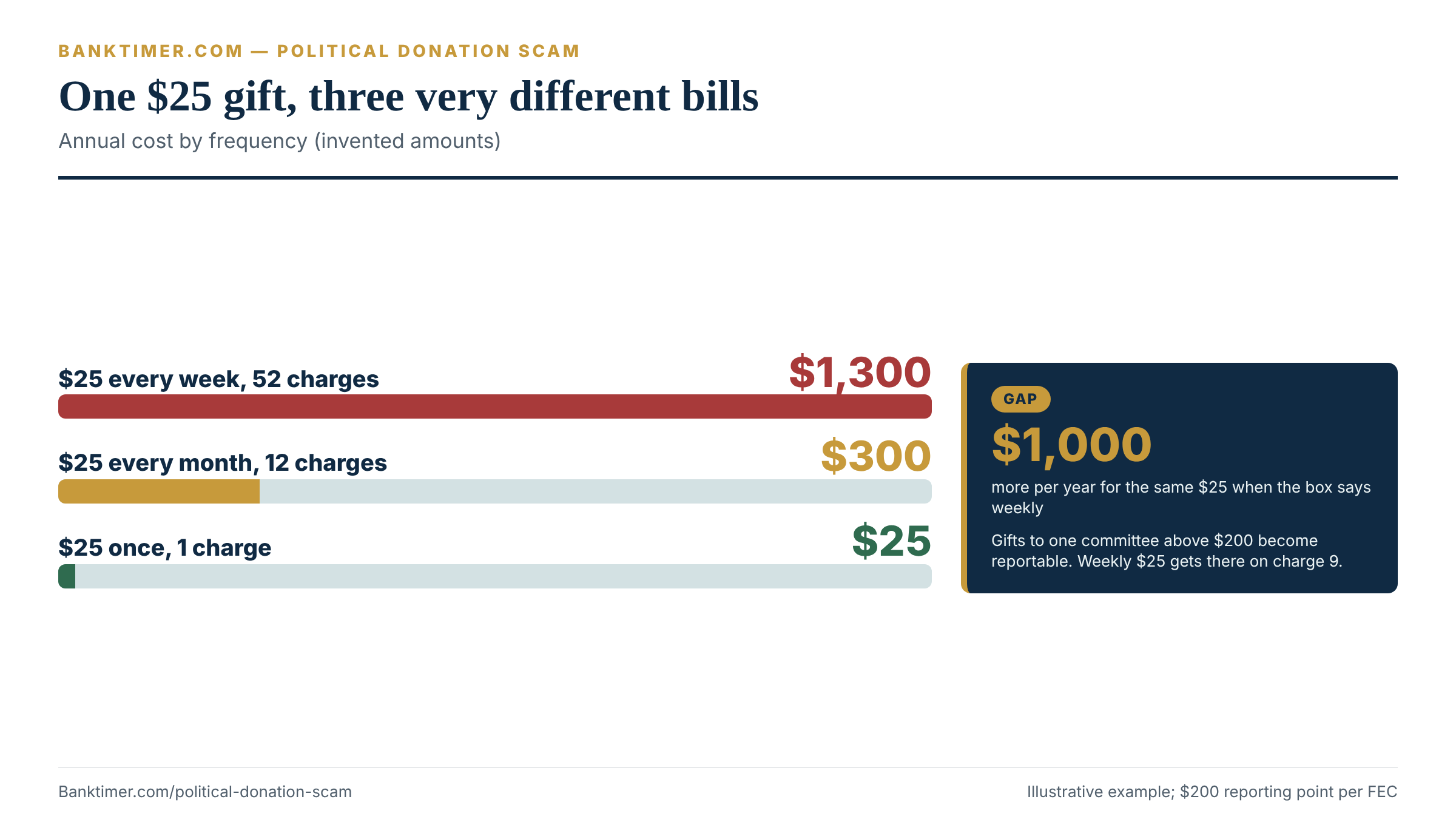
Watch for the monthly box. A recurring gift of $25 a week costs $1,300 a year. The same $25 monthly costs $300. Read the frequency before you tap.
Act fast if you paid. Speed helps after a political donation scam. Call your card issuer or bank on the number printed on your card. Change any password you typed. Then report to the FTC at ReportFraud.ftc.gov.
Giving is not a tax deduction. The IRS lists political organizations and candidates among recipients you cannot deduct.
What a Political Donation Scam Is, and What It Is Not
A political donation scam follows the news cycle. Scammers know that people feel strongly about candidates, that deadlines create urgency, and that most voters cannot tell a real committee name from a look-alike. The result is a crowded space where genuine fundraising and outright theft use almost the same words.
A useful working definition: a political donation scam is a solicitation where the recipient, the purpose, or the payment terms are misrepresented. That covers three different problems, and they call for different responses.
Three problems that look alike
The first is impersonation. Someone claims to speak for a candidate, party or committee and collects money for themselves. Federal law addresses this directly. Under 52 U.S.C. § 30124, no person may fraudulently misrepresent themselves as acting for or on behalf of a candidate in order to solicit contributions.
The second is a look-alike or “scam PAC.” A real, registered committee uses a name close to a well-known cause and spends most of what it raises on fundraising costs and staff. The FEC has discussed this pattern publicly. In an April 22, 2021 meeting release, it described a staff working group aimed at helping the public identify possible “Scam PACs.” Being low-spending is not automatically illegal, which is why this one is the hardest to spot.
The third is a terms trap. The committee is real and the money does go to it. But you did not understand that the gift would repeat, that the amount was larger than you meant, or that a “match” was only a marketing line. This is the territory of the recurring-gift problem we cover later.
What is not a scam
Plenty of annoying messages are legal. The Federal Communications Commission (FCC) explains that autodialed campaign texts to a mobile phone require the called party’s prior consent. Texts sent manually do not. Political calls and texts are also exempt from the National Do Not Call Registry. So an unwanted text from a real campaign can be irritating and still lawful.
You can stop the lawful ones. The FCC says you can revoke consent in any reasonable manner and that replying STOP is a valid opt-out. Do not bother replying STOP to a message you believe is fake, though. Delete it and forward it to 7726 instead.
This guide separates federal statutes and regulations, FEC and FCC guidance, payment-network and app policies, and Banktimer’s own illustrative examples. States add their own campaign-finance and consumer-protection laws, and those vary. Your state attorney general and state election office are the places to check.
Why Election Season Is Prime Time for Fraud
Fraud in general is large and growing. The Federal Trade Commission (FTC) reported on March 25, 2026 that consumers reported $15.9 billion in fraud losses for 2025 across about 3 million reports. Imposter scams, where someone pretends to be a trusted person or group, were the most frequently reported type. The FTC figure does not isolate political giving, so we do not claim a political total.
Election season adds four accelerants.
- Deadlines are real. Campaigns do face reporting periods and fundraising goals, so a deadline in a message sounds plausible even when it is invented.
- Strong feelings lower caution. People give faster when they are angry or hopeful.
- Names are easy to imitate. A committee name is just a few words, and the FEC database holds many registered committees.
- Small amounts feel safe. A $19 request seems too small to check. Scammers count on that, and they repeat the trick across thousands of phones.
The table below sorts the main kinds of political donation scam by what the victim sees, who is harmed and who can act. The decision-driving point: only some are crimes in the strict sense. So the right first call depends on the family.
| Scam family | What you see | Typical harm | Main legal hook | Where to report |
|---|---|---|---|---|
| Impersonation of a candidate or party | Text, call or email “from” the campaign | Money goes to a stranger | Federal fraudulent-solicitation law (52 U.S.C. § 30124) | FTC, FBI IC3, state attorney general |
| Look-alike website | Page that copies a campaign’s logo and donate button | Card number and name captured | Federal and state fraud laws | Card issuer, FTC, IC3 |
| Fake text “match” or deadline | Short link, countdown, “triple your gift” | Payment and personal data | Varies by facts | Carrier (7726), FCC, FTC |
| Scam PAC | Real registered committee, emotional email | Most of your gift covers fundraising costs | Often legal; disclosure rules apply | FEC data review, state regulators |
| Recurring terms trap | Real committee, pre-selected or easily missed monthly option | Repeat charges you did not expect | Contract and card rules | Committee platform, bank, card issuer |
| Second-wave “refund” scam | Caller offers to recover your donation for a fee | A second loss | Federal and state fraud laws | FTC, IC3, state attorney general |
Treat that table as a map, not a verdict. A single scheme can touch several rows at once.
If You Already Clicked or Paid: The First Hour
Start here if a political donation scam has already taken your money. Speed matters, and calm matters more. The steps below follow the Federal Trade Commission’s guidance on what to do if you were scammed and its advice on phishing messages.
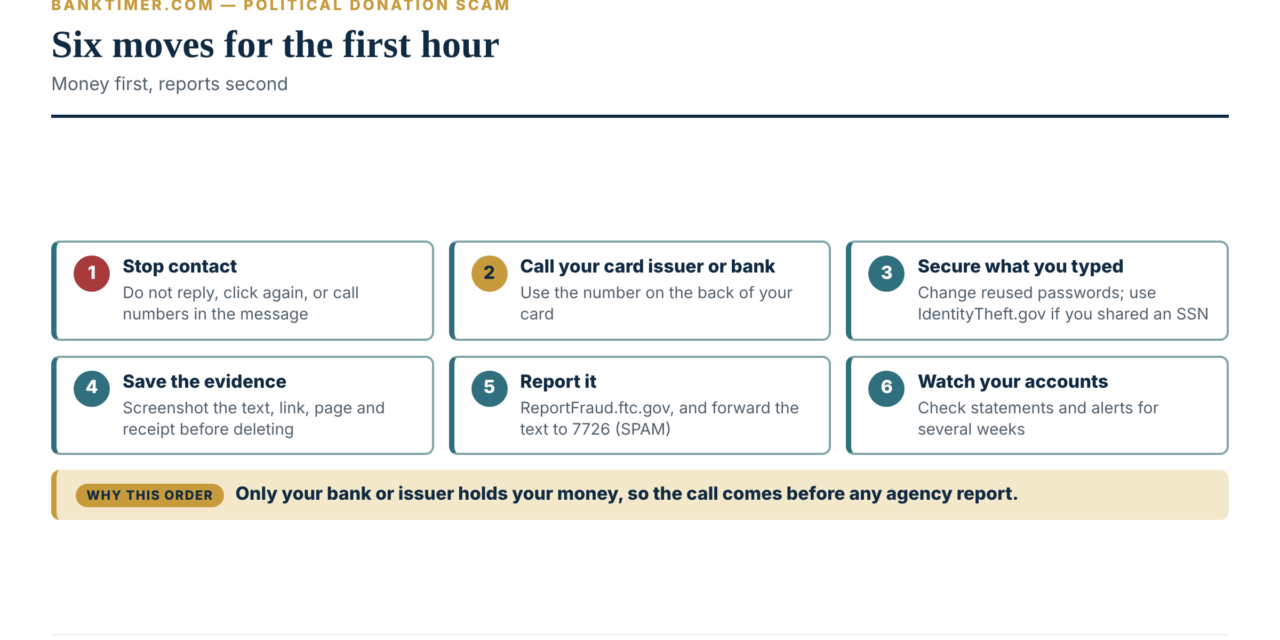
- Stop all contact. Do not reply, do not click again, and do not call a number inside the message. Follow-up messages, including offers of help, may come from the same people.
- Call the company that holds the money. Use the number on the back of your card or the official app. Say what happened in plain words.
- Secure what you typed. If you entered a password, change it everywhere you reuse it. If you shared a Social Security number or bank account number, go to IdentityTheft.gov for a recovery plan matched to what you lost.
- Save the evidence. Screenshot the message, the sender’s number, the web address, the donation page and any receipt. Do this before you delete anything.
- Report it. File at ReportFraud.ftc.gov and forward the text to 7726 (SPAM). The FTC says reports help it spot trends and build cases.
- Watch your accounts. Check statements and alerts for several weeks. Charges can post days after the first one.
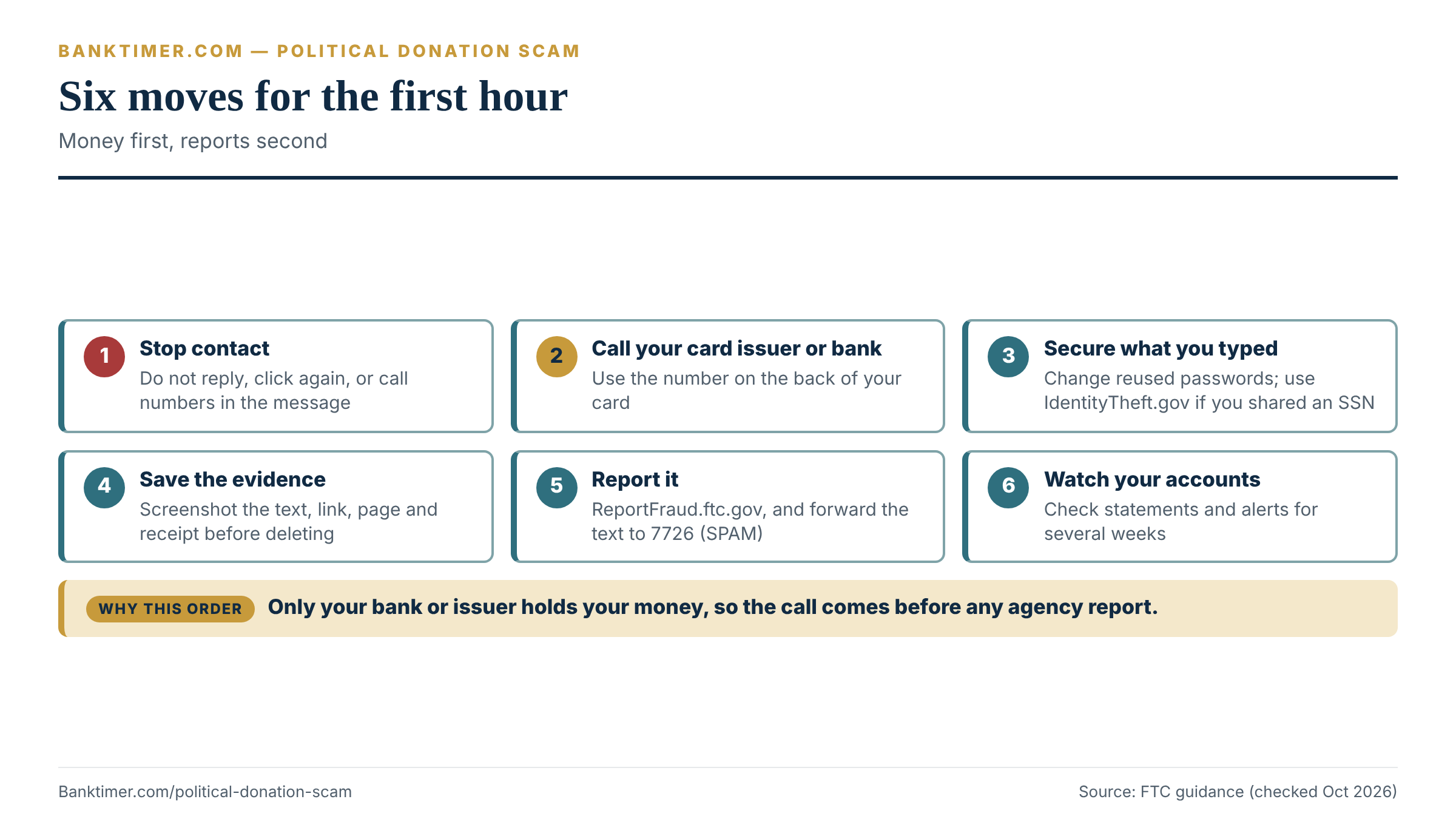
The graphic puts the call to your payment provider ahead of the report to any agency. That order is deliberate. Your bank or card issuer can act on your account in minutes. An agency report builds a record and helps others. It does not return your money.
Who to call, by payment method
The FTC gives specific instructions for each way of paying. The second column is the one most people miss: the exact company that can still do something.
| How you paid | Who to contact first | What the FTC says to ask for | Federal rule that may apply |
|---|---|---|---|
| Credit card | Card issuer | A refund of the charge | Regulation Z: $50 cap on unauthorized use; 60-day billing-error notice |
| Debit card | Your bank or credit union | A refund | Regulation E: tiered liability for unauthorized transfers |
| Payment app | The app, then your bank | Report the payment and ask the app to reverse it | Regulation E can cover some app transfers; app terms govern the rest |
| Wire transfer | The wire company | Tell them a scammer tricked you; ask for a refund | Hard to reverse; act at once |
| Gift card | The card issuer | A refund; keep the card and receipt | Hard to reverse; act at once |
| Cryptocurrency | The exchange or ATM operator | Reverse and refund; report to the FTC | Fewer protections than cards; some state laws may help |
| Cash mailed | U.S. Postal Inspection Service, 1-877-876-2455 | Possible interception, for a fee | No banking rule; time-sensitive |
Read the last column as a hint, not a promise. A rule that “may apply” depends on how your bank or issuer classifies the transaction. Our guide to Regulation E explains how electronic transfers are classified, and the payment app scam article covers the app side in more depth.
How to describe what happened
Tell the truth and keep it specific. Say that you were asked to donate by a text, that you now believe the request was fraudulent, and what you entered or approved. Do not guess at legal labels. Your issuer decides whether a charge is “unauthorized” or a “billing error.” The answer depends on the facts. Did someone else use your card details, or did you approve the payment yourself?
Dana gets a text on a Friday evening: “Your $25 gift will be matched 6x before midnight.” She taps the link, enters her debit card number, and sees a thank-you page. On Saturday morning she notices a bank alert for $25 and, later, two more small charges to unfamiliar names. This is an invented scenario, not a real case.
Her best sequence: call the bank on the card’s number, report the card as compromised, request a replacement, and ask how to dispute each charge. Then she changes the password she reused on that page and files the FTC report. Because the later charges were made by someone who obtained her card details, they look like unauthorized transfers. The first $25 she entered herself, so it may be classified differently. She should say exactly that.
If the message asked for your Social Security number or date of birth
A donation does not need either one. Campaigns collect a name and an address and, for larger gifts, your occupation and employer. A request for your Social Security number is a red flag that the sender wants more than a gift. Place a free credit freeze, which blocks new credit in your name. Our comparison of a credit freeze and a fraud alert helps you pick, and the identity theft recovery guide walks through the rest.
What not to do
- Do not pay a “recovery agent.” Someone who contacts you offering to get your donation back for a fee is usually running a second scam.
- Do not move money to a “safe account.” The FTC says it will never tell you to transfer money to protect it. Any caller who does is a scammer.
- Do not delete your evidence in embarrassment. Many people feel foolish. These schemes work on careful people, and your report helps others.
Spotting a Political Donation Scam: Eight Warning Signs
No single sign proves a political donation scam, and a real campaign can trip one or two. Look for clusters. A message that combines three or more of the signs below deserves a hard stop, however polished it looks.
- The sender is a stranger or a shortened link. You did not sign up, and you cannot see where the link goes.
- A clock and a “match.” “Doubled until midnight” or “6X matched” is built to rush you. Real fundraising can include matching pledges, but a claim you cannot verify on the committee’s own site is only a claim.
- A strange way to pay. The FTC treats a demand for a bank transfer, wire transfer, cryptocurrency, payment app or gift card as a scam signal. The Consumer Financial Protection Bureau (CFPB) makes the same point: scammers favor payment methods that are hard to trace or reverse.
- Requests for data a gift does not need. A Social Security number, a bank login or a one-time passcode has nothing to do with a donation.
- A name that is almost right. “Americans for Fair Elections” and “American Fair Election Fund” can both exist, and only one is the group you mean.
- No clear sponsor. FEC rules require disclaimers on many committee communications, including solicitations. The disclaimer says who paid and gives a street address and a phone number or website. The FEC’s guidance does not spell out text messages specifically, so a missing disclaimer in a text proves little. A missing identity on the landing page proves more.
- Pressure to keep it quiet or act now. A request that discourages you from checking is a request that cannot survive checking.
- A second contact about “getting your money back.” A refund offer that arrives after you gave is a classic follow-on scheme.
The fake political donation text, line by line
Here is an invented message built from the patterns above. It is an illustration, not a quote from a real campaign.
“Patriot Action Fund: Your $19 gift is MATCHED 6X until midnight tonight. Final chance to stop them. Give now: (short link). Reply STOP to end.”
Count the signals. The sender name sounds familiar but is generic. The match is unverifiable. The deadline is artificial. The link hides its destination. The text includes a STOP line, which makes it look compliant. None of the individual features is illegal, and some real campaigns use similar language. That is why the check has to happen outside the message.
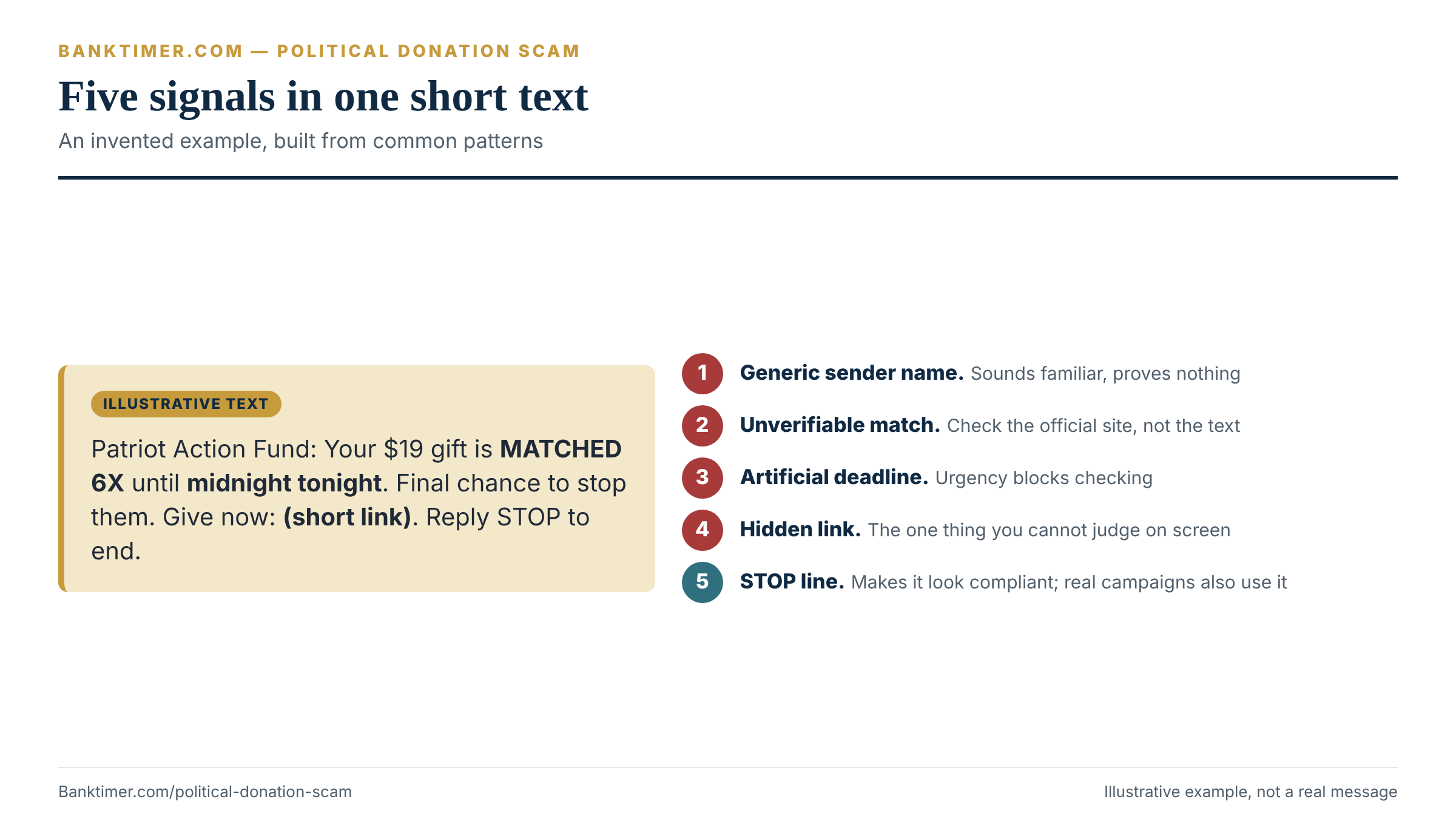
The annotated version makes one point clearly: the part you cannot judge from the screen is the link. Real and fake messages can match on tone, grammar, logo and deadline. The destination is the difference, and it is exactly the thing the message asks you to skip checking.
Why you cannot trust the sender line, the logo or the voice
A political donation scam can fake every visible layer of a message. The CFPB notes that caller ID, text messages and emails can all be faked. It also warns that voice cloning with artificial intelligence makes some impostor calls harder to spot. A familiar candidate’s voice on a robocall is therefore not proof of anything.
For the same reason, ignore what the message says about itself. “Official,” “verified,” and “authorized” cost nothing to type. Verify with something the sender does not control, such as a web address you typed yourself or a record in a government database.
QR codes and “scan to give”
QR codes now appear on yard signs, flyers and mailers. The CFPB advises against clicking QR codes, links or attachments from unexpected texts or emails. The FTC has warned that scammers cover legitimate parking-meter QR codes with their own, and the same trick could be used on printed material. If you want to give at an event, ask a staff member for the official web address, then type it.
A message that claims you made a pledge you do not remember is trying to manufacture a commitment. Do not reply. Look up your actual giving history by logging into the platform you remember using, or by checking your card statement, and report the text to 7726.
Red flags, questions and safer moves
The table turns the signs into actions. Use the right-hand columns in the moment, because the useful behavior is a question you ask a real person or a check you run yourself.
| Red flag | Why it matters | What to ask | Safer next step |
|---|---|---|---|
| Shortened link in a text | You cannot see the destination | Does this campaign list this number or link on its site? | Type the campaign’s web address yourself |
| “Matched 6X until midnight” | Urgency blocks checking | Is the match described in the committee’s own terms? | Ignore the clock; confirm on the official site |
| Payment by gift card, crypto, wire or app | Hard to trace or reverse | Why can’t I use a credit card? | Walk away; most committees accept cards |
| Name almost matches a famous group | Look-alike names are cheap | What is the committee ID and treasurer? | Search the FEC committee database |
| Asks for Social Security number or login | A gift does not need it | Why is this needed? | Close the page; use the identity-theft steps if you shared it |
| No physical address or sponsor | Disclaimers normally name the payor | Who paid for this message? | Look for “paid for by” on the landing page |
| Offer to recover a lost donation | Often a second scam | Who is calling and from what number? | Hang up; call your bank directly |
Row three is the one to memorize. Most committees take cards through a standard donation platform, so a refusal of cards tells you something about the sender.
Where this overlaps with other text scams
A political donation scam uses the same tricks as a bank alert or a delivery notice. To practice spotting them, read our article on bank phishing texts. The older breakdown of a phishing text from your bank shows the pattern from the bank side. Holiday shopping brings another wave, which our Black Friday scams guide covers.
How to Verify a PAC Before Donating
Checking a group is the best defense against a political donation scam. It takes about five minutes and uses free government data. You do not need to be a campaign-finance expert. You need to answer four questions: Does this committee exist? Is it the one I mean? Who runs it? Where does the money go?
Know what you are looking up
Political committees come in several types, and the type changes what a donor can expect. The FEC’s overview of political action committees describes the main ones, and its contribution limits page sets the caps.
| Committee type | Who sets it up | Who it may ask for money | Limit on what you can give | Why the type matters to you |
|---|---|---|---|---|
| Candidate campaign committee | A candidate | The general public | $3,500 per election | The most direct way to support one candidate |
| Nonconnected PAC | Individuals, no sponsor | The general public | $5,000 per year | No sponsor vouches for it; check the treasurer |
| Separate segregated fund (SSF) | A corporation, union or association | Only people tied to the sponsor | $5,000 per year | A stranger’s text from an SSF is a red flag |
| Super PAC (independent expenditure-only) | Individuals or groups | The general public | No federal limit on gifts to it | Large gifts are legal, so size alone is no warning sign |
| Leadership PAC | A candidate or officeholder | The general public | $5,000 per year | Tied to a politician but not that person’s campaign committee |
The column to study is the third one. An SSF can solicit only people associated with its sponsor, according to the FEC. If a text from an unknown “employees’ PAC” lands on your phone and you have no tie to that employer, the message already contradicts the committee’s own rules. The limits column reflects the FEC’s 2025-2026 figures, which the agency indexes for inflation in odd-numbered years. National party committees have their own caps, covered in the next section.
The five-step check
- Find the official website without the message. Search for the candidate or cause, then confirm the address with a source you already trust, such as the candidate’s profile in a voter guide. Do not use the link in the text.
- Search the FEC committee database. The FEC committee search lets you filter by committee name or ID, years active, treasurer, party, state and registration date. The results table shows the name, committee ID, treasurer, type, designation and registration date.
- Match the record to the page. The name, address and type on the donation page should match the FEC record. A page that names a different treasurer or committee than the database is a stop sign.
- Read the money trail. Open the committee’s reports and compare receipts to disbursements. The worked example below shows what to look for.
- Check your state. Federal records cover federal committees. A state or local race has its own registration office, and the rules vary by state. Your state election agency or attorney general can tell you where to look.
Step three catches the most common fake: a page that copies a famous committee’s look but sits on a different web address and lists no real treasurer. If the page does not state who paid for it, treat that as a negative.
Read the filing calendar so you know what the data can tell you
Campaign finance data lags. The reports you read today describe past periods, and a committee created last month may have no reports at all. The FEC’s October 2026 reporting reminder and its pre-general notice for PACs and party committees set the dates.
| Date (2026) | What happens | What it means for a donor |
|---|---|---|
| October 14 | Books close for the pre-general report | Activity after this day will not appear in it |
| October 15 | Quarterly reports due for July 1 to September 30 | Gives a picture of summer fundraising |
| October 20 | Monthly reports due for September activity | Applies to monthly filers only |
| October 22 | Pre-general reports due | First look at October 1 to 14 for many committees |
| November 3 | Election Day | Gifts made after this date cannot help this election |
| December 3 | Post-general reports due | Covers October 15 to November 23 for committees that filed a pre-general report |
Two lessons follow. First, a donor checking a committee on October 23 sees pre-general data that stops on October 14, and for some committees only data through September 30. Second, a quarterly-filing PAC that made no general-election contributions or expenditures from October 1 to 14 does not file a pre-general report. Its next report, due December 3, would cover October 1 to November 23. For a brand-new group, silence in the database is itself information.
A worked example: reading a PAC’s spending
The numbers below are invented. They show the method, not any real committee.
A nonconnected PAC reports $400,000 raised over one year. Its disbursements: $290,000 to fundraising vendors (list rental, text and mail programs) and $60,000 for operating costs. Candidates received $10,000. Independent expenditures took $20,000, and $20,000 stayed in the bank.
Shares: fundraising vendors 72.5%, operating costs 15%, contributions to candidates 2.5%, independent expenditures 5%, cash 5%. On a $25 gift, about $1.88 reaches candidates or independent expenditures, and about $18.12 goes to fundraising vendors.
| Spending line | Amount | Share of receipts | On a $25 gift |
|---|---|---|---|
| Fundraising vendors | $290,000 | 72.5% | $18.12 |
| Operating costs | $60,000 | 15.0% | $3.75 |
| Contributions to candidates | $10,000 | 2.5% | $0.63 |
| Independent expenditures | $20,000 | 5.0% | $1.25 |
| Cash on hand | $20,000 | 5.0% | $1.25 |
The decision-driving insight sits in the first row. Heavy fundraising spending is not illegal, and a young committee often spends heavily to build a donor list. But if a group shows this pattern year after year and its candidate-facing spending stays tiny, you are paying a fundraising machine, not a political cause. No federal rule sets a minimum percentage, so the judgment is yours.
What the database cannot tell you
The FEC record shows that a committee is registered and what it reports. It cannot tell you whether a specific text came from that committee. A political donation scam can name a real committee. It then sends you to a payment page that has nothing to do with that committee. That is why step one, finding the official site on your own, comes before everything else.
It also cannot rank committees for you. Our guide does not name or rate individual groups. If you want an outside view, check what independent watchdogs and local news have published, and weigh the committee’s own filings against any claims it makes about impact.
- ☐ Did I find the donation page myself, or did a message send me here?
- ☐ Does the FEC record show the same name, treasurer and committee type as the page?
- ☐ Does the page say who paid for it and give a street address or phone number?
- ☐ Is the committee new, with no reports to read?
- ☐ How much of the committee’s spending goes to fundraising vendors?
- ☐ Is this a one-time gift or a recurring one, and can I see the frequency before I submit?
- ☐ Which payment method am I using, and what can I reverse if this goes wrong?
- ☐ Do I understand that my name, address, occupation and employer may become public if I give more than $200?
Donate to a Campaign Safely: A Four-Gate Test
Verification tells you whether a committee exists. A safe gift needs more: the right channel, the right amount, the right frequency and the right payment method. The test below puts those checks in a fixed order, so a political donation scam has to beat all four gates.
- Gate 1, source. Did you reach the donation page by typing the address yourself or through a site you already trust? If a text, call or email delivered the link, go back and start over.
- Gate 2, entity. Does the FEC record, or your state’s record, match the name, treasurer and committee type on the page? If not, stop.
- Gate 3, terms. Can you see the amount, the frequency and any “make it monthly” option before you submit, and is the box set the way you want it?
- Gate 4, payment. Are you paying with a method you can dispute, which in practice means a credit card?
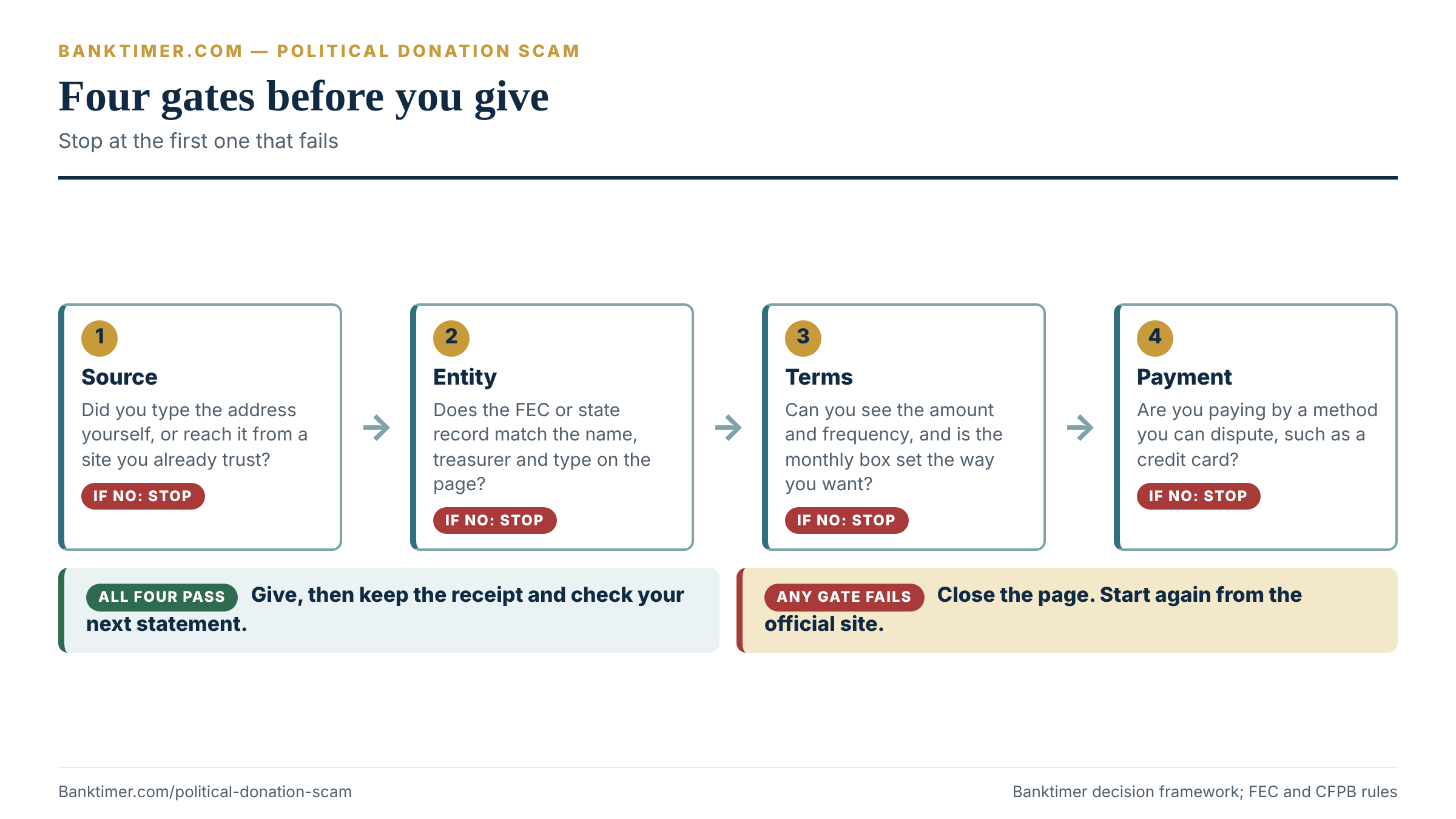
The tree is deliberately strict. Failing a gate does not mean the committee is a fraud. It means you lack enough confidence to pay yet. A missing answer is easy to fix by going to the official site and starting again.
Contribution limits that protect you from yourself
Federal law caps what individuals can give, and the caps matter even if you are not a big donor. A recurring gift can pass a limit without you noticing. The FEC’s 2025-2026 limits are below.
| Recipient | Limit for an individual | Period | Note |
|---|---|---|---|
| Candidate committee | $3,500 | Per election | Primary, general, runoff and special elections each count separately |
| PAC (SSF or nonconnected) | $5,000 | Per year | Super PACs accept gifts without this cap |
| State, district or local party committee | $10,000 | Per year, combined | Covers all those committees together |
| National party committee | $44,300 | Per year | Indexed for inflation in odd-numbered years |
| Additional national party accounts | $132,900 | Per account, per year | Each additional account has its own cap |
Most readers will never approach these numbers, so why mention them? Because they expose a quiet failure mode. A recurring donation set up in a rush can quietly cross the line. Committees track limits too, but you are the one who knows what you meant to give.
Marcus signs up for a $400 monthly gift to one candidate’s general-election fund. Eight charges total $3,200. The ninth would bring the total to $3,600, which is $100 over the $3,500 per-election limit.
He did not mean to give that much. The amounts are invented for illustration. The arithmetic is the point: $3,500 divided by $400 is 8.75, so the ninth charge breaks the rule. If you set up recurring gifts, write down the end date or the total you intend to give.
Who cannot give
The FEC’s page on who can and cannot contribute lists three limits worth knowing as a donor:
- Foreign nationals. Federal law prohibits foreign nationals from making contributions or donations in connection with any federal, state or local election, directly or indirectly.
- Corporate treasury money. Campaigns may not accept contributions from the treasury funds of corporations, labor organizations or national banks.
- Gifts in someone else’s name. A contribution made by one person in the name of another is prohibited. A person who has hit the limit cannot hand money to a friend to give. A company cannot reimburse employees for their gifts.
The third item surprises people most. Offers that sound like “I’ll cover your donation if you give in your name” are not clever workarounds. They are the prohibited behavior the FEC describes.
What becomes public when you give
Donations are not private. The FEC’s page on sale or use of contributor information explains that committees must report the name, address, occupation and employer of individuals whose gifts add up to more than $200. The period is a cycle. For PACs and party committees, the period is the calendar year. The FEC makes reports public, including online, within 48 hours of receipt.
The same page says contributor information from FEC reports cannot be sold or used to solicit contributions. It also says a committee can donate, sell, rent or trade its own contributor list to other committees. So a gift can lead to more solicitations from other groups, even though copying names out of FEC reports to ask for money is barred.
Practically, that means:
- A $25 weekly gift crosses $200 on the ninth charge, which is when your details can enter the public record.
- A recurring gift to a PAC resets each calendar year.
- Anyone can search the database for your name, including a neighbor or an employer.
Political gifts are not tax deductions
The IRS lists “political organizations and candidates” among the recipients whose gifts you cannot deduct in Publication 526, which covers 2025 returns. That is separate from charity rules, and our article on the charitable deduction without itemizing explains what does qualify. Any message that promises a tax break for a campaign or PAC gift is a red flag worth questioning.
The rules above are federal. State and local campaigns follow state contribution limits and registration rules, and those differ widely. If you are giving to a state or local race, check the state’s election or ethics agency for its limits and its committee search.
Credit Card vs Payment App for Donations: What Protection You Actually Get
The choice of payment method changes your options if something goes wrong, sometimes by a wide margin. Before the comparison, one distinction runs through every row: unauthorized versus authorized but deceived.
- Unauthorized means someone else used your card number, login or account without your permission. Federal rules were written for this case.
- Authorized but deceived means you personally approved a payment because of a false claim. This case is harder, and the rules do not clearly cover it.
A typical political donation scam sits in the second category, because the victim presses the button. Some sit in the first, such as a look-alike page that captures your card number and then charges it again. Knowing which one you are in helps you describe the problem accurately to your issuer.
Credit cards: Regulation Z
Two federal rules matter for credit cards, both in the CFPB’s Regulation Z. Section 1026.12(b) limits a cardholder’s liability for unauthorized use to the lesser of $50 or the value of what was obtained through the unauthorized use. Section 1026.13 sets up the billing-error process.
Under the billing-error rule:
- You must get written notice to the creditor no later than 60 days after it sent the first statement showing the error.
- The creditor must acknowledge your notice within 30 days, unless it resolves the issue sooner.
- It must resolve the dispute within two complete billing cycles, and in no event later than 90 days.
- You need not pay the disputed amount, or related finance charges, while the dispute is open. The creditor may not report that amount as delinquent in the meantime.
Billing errors in the rule include charges not made by you or anyone with authority. They also include charges for property or services not accepted or not delivered as agreed. A political donation is neither a product nor a service in the ordinary sense. A gift you approved to a real committee may not fit those categories. An unauthorized charge on a look-alike page does fit. Many issuers also run their own dispute programs under card-network rules, which Banktimer did not review here, so your options can be wider than the federal minimum. Ask.
Debit cards and many payment apps: Regulation E
Debit cards, prepaid cards and many bank transfers fall under Regulation E, which implements the Electronic Fund Transfer Act. The liability tiers are in section 1005.6:
- $50 if you notify the institution within two business days after learning of the loss or theft of the access device.
- $500 if you notify later, because liability can include later unauthorized transfers that timely notice would have prevented.
- Unlimited exposure for transfers after 60 days if an unauthorized transfer appears on a statement and you do not report within 60 days.
The difference from credit is simple and costly. Money from a debit card leaves your checking account immediately, and the faster tiers depend on how quickly you speak up. Our guide to debit card fraud walks through that timeline, and the older debit card fraud recovery piece lists documents to gather.
The CFPB’s electronic fund transfer FAQs address two points that matter here. A transfer is unauthorized when a consumer is fraudulently induced into sharing account access information, for example through phishing. And a person-to-person payment that meets the definition of an electronic fund transfer is covered by Regulation E. The FAQs do not clearly address a consumer who is tricked into personally sending money. That gap is the reason app payments to strangers carry the most risk.
The real-world gap: when you press “donate” yourself
If you approved a card or app payment after a false claim, you may not have a federal right to an automatic refund. You can still ask. Report the payment, describe what happened, and request a reversal. The FTC’s guidance for payment apps tells you to report the payment to the app and ask for a reversal. Its card guidance tells you to ask your issuer for a refund.
Outcomes then depend on your issuer’s or app’s policy, the evidence you provide, and whether the recipient actually misrepresented itself. A real committee that sent an aggressive but truthful email is a different case from a fake page. Present the facts and let the provider classify them.
Side-by-side comparison
The matrix below uses the same criteria for every method. It describes federal rules and general practice, not any specific bank, issuer or app.
| Method | Main federal rule | Time to report | Cap if unauthorized | If you were deceived into approving | Fit for donations |
|---|---|---|---|---|---|
| Credit card | Regulation Z | Written notice within 60 days of the statement | $50 | No automatic right; ask the issuer | Best default for most donors |
| Debit card | Regulation E | 2 business days for the lowest tier; 60 days after the statement | $50, $500 or more by timing | Same gap; money already left your account | Use only if you cannot use credit |
| Payment app | Regulation E may apply to some transfers | Check the app’s terms and your bank’s | Depends on funding source and terms | Weak; payments to strangers are hard to reverse | Avoid for unverified recipients |
| Bank transfer or wire | Depends on the transfer type | Immediately | Varies | Very hard to reverse | Avoid |
| Gift card, crypto, crypto ATM | No banking rule; contact the issuer or operator | Immediately | Not applicable | Very hard to reverse | Never for donations |
| Check by mail | Bank check rules | Immediately | Varies | You control the payee and address | Slow but traceable; use a verified address |
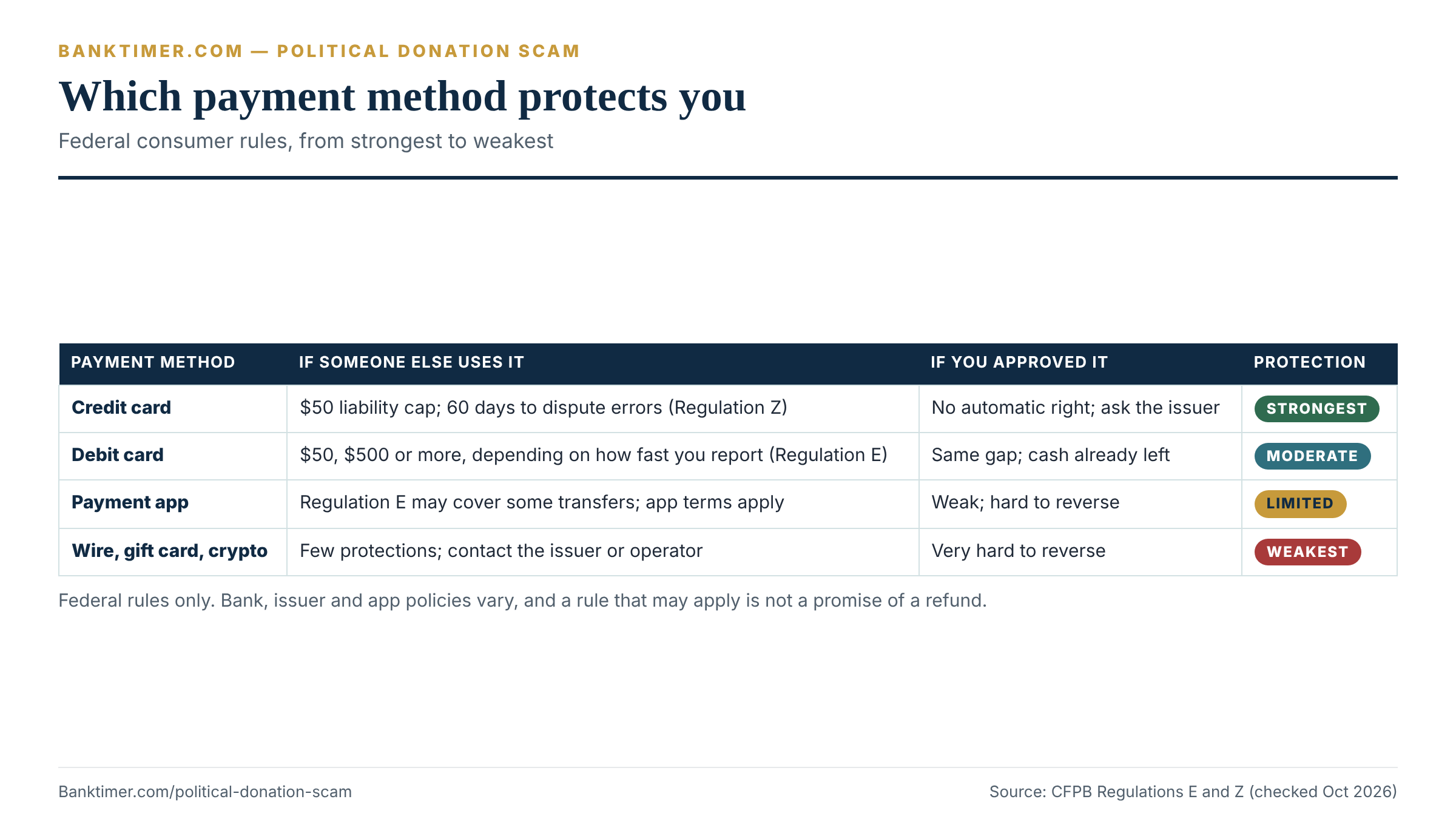
The matrix shows why the credit card is the default recommendation. That recommendation is about leverage, not safety from scams. The card does not stop a scammer, but it keeps your own cash out of the fight. For more on the gift card and crypto rows, see our guides to gift card scams and crypto ATM scams.
Three worked scenarios
The figures are invented for illustration. They show how the federal tiers could apply.
| Scenario | Assumptions | What the rules say | Your likely exposure | First move |
|---|---|---|---|---|
| A. Debit card captured on a look-alike page | Three unauthorized charges of $120: Monday, Tuesday and Thursday. You learned of the loss on Monday and reported on Friday. | Regulation E tier two: $50 plus later transfers that timely notice would have prevented | Up to $170 | Call the bank, request a new card, dispute each charge |
| B. Credit card captured on the same page | Unauthorized charges total $360 | Regulation Z: lesser of $50 or the amount obtained | Up to $50 | Call the issuer; dispute in writing within 60 days |
| C. You approve $100 to a real committee after a misleading claim | You pressed donate; the committee exists | No clear “unauthorized” status | Possibly the full $100 | Ask the committee in writing for a refund, then ask your issuer about a dispute |
The tiers are written around the loss or theft of an access device, so ask your bank how it treats a captured card number. In scenario A, the first two charges total $240 within the first two business days. The tier-two formula uses the lesser of $50 or that amount, which is $50, plus the $120 charged after the two-day window. So exposure is $50 plus $120, or $170. A report on Tuesday instead of Friday would have prevented the Thursday charge, which is why speed pays. Scenario B shows how much cleaner the credit card rule is: the $50 cap applies regardless of how many charges post.
Scenario C is the honest middle. The charge was authorized, the committee is real, and the dispute depends on evidence of misrepresentation. Save screenshots of the claim you relied on.
How long the dispute takes
Banks and issuers must follow set clocks, such as the ones in section 1005.11 for electronic transfers. The table converts them into dates for a report made on Monday, October 26, 2026. The dates are examples, not promises, and holidays and mailing time can shift them.
| Stage | Regulation E (debit or app) | Regulation Z (credit) | Your action |
|---|---|---|---|
| Notice window | Within 60 days of the statement showing the error | Written notice within 60 days of the first statement showing the error | Report in writing as well as by phone |
| First answer | Investigate within 10 business days (by Monday, November 9, 2026 in this example) | Acknowledge within 30 days | Keep the reference number |
| Provisional credit | If the bank needs up to 45 days, it must provisionally credit the account | You need not pay the disputed amount while it is open | Confirm what you owe |
| Final answer | Up to 45 days (Thursday, December 10, 2026 in this example) | Two billing cycles, no more than 90 days | Calendar the date |
For many transfers the 45-day period becomes 90 days, including point-of-sale debit transactions and transfers not initiated within a state. If the bank denies your claim, ask for the written findings and escalate with the evidence file we describe below.
The Recurring Donation Trap: How a $25 Gift Becomes $1,300
Not every bad outcome involves a criminal. Many donors regret a gift because it repeated. A donation platform stores your payment details and charges them again on a schedule. If you did not notice the schedule, the charges can feel like theft even when the committee did nothing wrong.
How recurring gifts work on a major platform
ActBlue’s help center is a useful public example. It says a recurring donation repeats on a weekly or monthly schedule and reuses stored payment details. A donor starts one from a campaign’s email or text link, or from a contribution form. Clicking “Yes, count me in!” in the “Make it monthly” section makes the gift recurring. Each time a donation is processed, the platform sends an email receipt with links to review, update or cancel it.
Three details from that page matter for your planning:
- Changes apply only to future recurrences.
- A cancelled donation cannot be reactivated.
- To change the recipient, the process date, or your personal details, you cancel and set up a new gift.
Other platforms and committees run their own systems, so check the help pages for the one you use. We reviewed ActBlue’s pages only as one example.
The math that surprises people
Frequency matters more than amount. A weekly gift has 52 chances to charge you in a year, and a monthly gift has 12. The table below uses invented amounts.
| Gift | Frequency | Charges per year | Cost per year | Cost over 18 months | Charge that passes $200 |
|---|---|---|---|---|---|
| $10 | Weekly | 52 | $520 | $780 | 21st |
| $25 | Weekly | 52 | $1,300 | $1,950 | 9th |
| $25 | Monthly | 12 | $300 | $450 | 9th |
| $50 | Monthly | 12 | $600 | $900 | 5th |
| $100 | Monthly | 12 | $1,200 | $1,800 | 3rd |
The first insight is the gap between rows two and three. The same $25 costs $1,300 a year weekly and $300 monthly, a difference of $1,000. The last column links the math to disclosure. Once your gifts to one committee exceed $200 in the reporting period, your name, address, occupation and employer are reportable. Weekly gifts get you there in nine weeks.
Seven checks before you submit
- Find the frequency setting and read it twice.
- Look at the total at the bottom of the form, not only the amount on the button.
- Check whether the “monthly” choice is already selected.
- Look for the words “weekly,” “every,” “each month” or “recurring.”
- Read the confirmation page and the first receipt email.
- Set a calendar reminder for the day after your first scheduled charge.
- Decide the end date now, and write down the total you intend to give.
The fifth check catches many problems. ActBlue’s recurring-gift receipts carry a subject line that begins “Thank you for your recurring contribution.” If a receipt arrives and you expected a single gift, cancel immediately instead of waiting for the next charge.
How to stop a recurring gift
Work from the closest point to the farthest.
- Cancel at the platform. ActBlue says to open the recurring receipt email, click the “Edit payment details” link, and choose to cancel. If you have no receipt, the help page describes a contribution lookup tool and a support form.
- Ask the committee for a refund in writing. Give the dates and amounts. Whether it agrees is up to the committee and its platform.
- Tell your bank or card issuer. If you pay by debit, Regulation E gives you a right to stop a preauthorized transfer. Notify your bank, orally or in writing, at least three business days before the scheduled date. The bank may require written confirmation within 14 days of an oral notice, and it must tell you so. Whether your recurring card payment counts as a preauthorized transfer is a question for your bank. See section 1005.10(c) for the rule itself.
- Replace the card if you cannot get a clear answer. Ask your issuer about a new number and about disputing charges you did not approve.
A recurring $50 gift is scheduled for Friday, November 6, 2026. Counting back three business days gives Tuesday, November 3, which is Election Day. A notice given on that day is the latest you can safely give, and an earlier call is better. If you miss the window, the bank may still help, but it is no longer required to stop the transfer under that rule. Our article on recurring charges on a debit card goes deeper on the stop-payment process.
Why this is a terms trap and not necessarily a scam
The distinction matters for your next step. A political donation scam gets you to pay a fraudster. A terms trap gets you to agree to something you did not understand. The remedies differ. For a scam, you report fraud and dispute charges as unauthorized. For a terms trap, you cancel, ask for a refund, and complain about the disclosure if you believe it was unclear.
Complaints still help. If a form hid the frequency or pre-selected the repeat option in a misleading way, tell your state attorney general and the FTC. Describe the layout. Screenshot it before the page changes.
Evidence, Reporting and Recovery After a Political Donation Scam
Recovery from a political donation scam works best when you treat it as a file you are building. Each agency and provider asks the same questions: what happened, when, how much, through which method, and what proof exists. Collect the answers once and reuse them.
The evidence file
| Document | Why it matters | Where to get it | How long to keep it |
|---|---|---|---|
| Screenshot of the text or email | Shows the claim you relied on | Your phone or inbox, before deleting | Until the case closes, then about a year |
| Sender number or address and the link | Lets carriers and investigators trace it | Message details; do not tap the link | Same |
| Donation page screenshot | Shows the committee name, address and terms | Browser, if you reached the page | Same |
| Payment confirmation or receipt | Proves date, amount and recipient | Email or the page itself | Same |
| Bank or card statement | Starts the billing-error clock | Your online account | At least through the tax year, longer if disputed |
| Chat or call notes with your provider | Documents what you reported and when | Your own log; add reference numbers | Until resolved |
| FTC report number | Shows you reported the fraud | ReportFraud.ftc.gov confirmation | Until resolved |
Keep the evidence file in one place, such as a folder in your email. Name each file with a date. If the dispute reaches a regulator, the file is your case.
Where to report, and what each report does
No single agency handles every political donation scam. Each report goes to a different audience, so file more than one.
| Where | What it handles | What to include | What it does and does not do |
|---|---|---|---|
| Your card issuer or bank | The money | Dates, amounts, evidence | Can refund or dispute; the only party that holds your funds |
| ReportFraud.ftc.gov | Consumer fraud | Message, link, payment method | Builds cases and tracks trends; does not recover individual funds |
| Forward to 7726 (SPAM) | Unwanted or fake texts | The text itself | Helps carriers block senders |
| FCC consumer complaints | Unwanted political calls and texts | Number, date, content | Addresses rule violations, such as robocalls without consent |
| FBI Internet Crime Complaint Center (ic3.gov) | Online scams | Payment details, website | Records the crime for investigators |
| State attorney general | State consumer law | Same documents | Can act on local patterns; check your state’s complaint process |
| IdentityTheft.gov | Stolen personal data | What you shared | Creates a recovery plan |
The CFPB’s list of reporting options for scams includes local police, state attorneys general, the FBI’s Internet Crime Complaint Center and the FTC. It adds a step people skip. Tell your bank or payment provider that the transaction may be unauthorized.
For misuse by a campaign-finance participant, such as someone falsely claiming to act for a candidate, check the FEC’s website for how to submit a complaint about possible violations. The FEC regulates campaign finance; it does not process consumer refunds.
Timeline: what to expect after you report
Some steps are fast. Others take weeks. The table sets expectations for a typical card or bank dispute.
| Stage | Typical timing | Who controls it | What you do |
|---|---|---|---|
| Report to bank or issuer | Same day | You | Call, then follow up in writing |
| Replacement card issued | Days | Issuer | Update recurring bills you want to keep |
| Written dispute filed | Within 60 days of the statement | You | Send by the method the issuer names |
| First decision | 10 business days (debit) or 30 days to acknowledge (credit) | Bank or issuer | Keep reference numbers |
| Final decision | Up to 45 or 90 days (debit) or two billing cycles (credit) | Bank or issuer | Review the findings in writing |
| Agency follow-up | Not guaranteed | Agency | Do not wait for it |
Notice the last row. Agencies use reports to find patterns. They may not reply to each one, so silence is not a sign you did something wrong.
If your bank says no
A denial is not always the end. Ask for the reason in writing, check whether it relied on a misreading of the facts, and send any new evidence. Then use these channels:
- Contact your state banking regulator or attorney general. Your account agreement or the bank’s website names the agency that supervises it, and that agency may take complaints.
- Check for a federal complaint option. The agency that supervises your bank or card issuer may accept complaints, so look for its current process.
- Ask for a review by a supervisor and document the name and time.
Be realistic about outcomes. If you approved the payment, a refund is not guaranteed, even when you were deceived. The route with the best odds is early, honest, documented and specific. Our bank impersonation scam guide covers a related case in which victims approve the payment themselves.
Do not become a second-time victim
Recovery scammers watch for victims. After you report, you may get a call from someone claiming to be from the FTC, the FBI or a “fraud recovery unit.” The caller promises your money back for a fee. The FTC says it will never ask you to transfer money to protect it, withdraw cash or buy gold. Be wary of anyone who wants a fee up front to return your money. Hang up and call the agency on a number you looked up yourself.
Safer Ways to Give Before Election Day
If the goal is to support a candidate or cause, you have more good options than a link in a text. Each has trade-offs, and the right pick depends on how much time you have and how much you care about speed.
| Way to give | Upside | Downside | What to verify first |
|---|---|---|---|
| Official website, typed by you, credit card | Fast; strongest federal dispute rights | You must be sure the address is real | Address from a trusted source; FEC record |
| Mailed check to the committee address | No card data shared; traceable | Slow; mail can be lost or stolen | Mailing address in the FEC record |
| In person at an event, by card | You can ask staff directly | Printed QR codes can be swapped, as the FTC has warned for parking meters | Ask staff for the web address; type it yourself |
| Payment app to a person | Convenient | Hard to reverse; a person is not a committee | Avoid unless you personally know the recipient |
| Wire, gift card or crypto | None for donors | Very hard to reverse | Do not use |
The check row deserves a sentence. A check mailed to an address you took from the FEC record avoids card data entirely, but the mail itself is a risk. Our guide to mail theft and stolen checks covers precautions. If time is short, a credit card on the official site beats a check that may arrive after the deadline.
A timing note for the last two weeks
The closing days of a campaign generate a flood of asks. Legitimate committees do send many messages, often in the final stretch. Volume alone is not a warning sign. What does change is haste, which leads people to skip checks. If you want to give, do it on a day when you can verify, not in a hurry between meetings.
Common Mistakes and Edge Cases
Most losses to a political donation scam come from a handful of repeated errors. The table lists the common ones, along with the cost and the fix.
| Mistake | Typical cost | Why it happens | Fix |
|---|---|---|---|
| Paying through a link in a text | The full gift, plus card exposure | The message looks personal | Type the address yourself |
| Choosing a debit card | Money out of checking at once | Habit | Use a credit card when possible |
| Ignoring the “monthly” option | $300 to $1,300 a year on a $25 gift | Small buttons, fast taps | Read frequency before submitting |
| Replying STOP to a text you think is fake | Nothing gained | Wanting to opt out | Delete and report it; keep STOP for real campaigns |
| Giving the same gift to several look-alike committees | Multiple small losses | Similar names | Look up the committee ID |
| Paying a “recovery” fee | A second loss | Hope | Hang up; call your bank directly |
| Skipping the evidence file | Weaker disputes | Embarrassment | Screenshot before deleting |
The table makes a point that is easy to miss. Mistakes cluster at the payment step and the follow-up, not at the moment you first saw the message. You can often recover at those stages.
Edge case: the real committee with a misleading email
Sometimes the committee is real and the email is simply aggressive. Subject lines may overstate a deadline or imply a gift is tied to a specific vote. This is distasteful, yet it may not be a political donation scam. As we read the statute, the legal test is a fraudulent claim that the sender speaks for a candidate, not a hyperbolic pitch. If you feel misled, unsubscribe and ask for a refund of a recent gift. Then file a complaint about the practice with your state attorney general.
Edge case: your friend’s account sends the link
Account takeovers can turn a trusted name into a delivery system for a political donation scam. A friend’s hacked social account or text thread may send a “donate here” link that looks like a normal share. Before you give, ask the friend through a different channel, such as a phone call, whether they sent it. Do not ask in the same thread, because the scammer can answer.
Edge case: you are helping a parent or relative
Older relatives are frequent targets of repeated small asks, and the pattern can be hard to see because each gift is small. Consider this invented case.
A retired parent gives $35 each time to a series of urgent texts. Over six weeks, 14 gifts total $490, spread across five committees with similar names. No single committee passes $200 from the parent, so the parent’s name is not itemized in any committee’s report, and no one statement looks unusual.
Together, the pattern is clear. The family steps in with a statement review and a list of the committees’ names. Each name gets a lookup in the FEC database. The conversation avoids blame. Practical fixes: move giving to one credit card with alerts, unsubscribe from lists together, and set a rule that nothing gets paid from a text.
Keep the conversation about the system, not the person. The messages are engineered to be hard to resist. A parent who feels judged will hide the next one.
Edge case: you gave to a committee that later looked suspicious
If you gave through a real platform to a committee you now doubt, you cannot undo the donation by yourself. Ask the committee in writing for a refund and tell your card issuer what you found. Report the group’s tactics to your state attorney general and the FTC. Then look at your other gifts. If you are on a recurring schedule, cancel it first, because every additional charge makes the loss bigger.
Frequently Asked Questions
How can you tell if a political donation request is a scam?
A political donation scam usually shows several warning signs together. Common ones are a link you did not ask for, a countdown or “match,” a near-miss committee name, and a request for a Social Security number. Another is a demand for a gift card, wire, crypto or payment app. Then check outside the message. Type the campaign’s address yourself, and look up the committee in the FEC database. A real group survives both checks.
Is a political text from a campaign I never joined automatically a scam?
No. The FCC says campaigns may send manually typed texts without prior consent, while autodialed texts to mobile phones need consent. A real campaign can therefore text you unprompted. Because a fake can look identical, treat the link, not the sender, as the test. Open the campaign’s own website instead.
How do I verify a PAC before donating?
Search the FEC committee database by name or committee ID and compare the treasurer, committee type and registration date with what the donation page shows. Check that the page names who paid for it. Then read the committee’s receipts and disbursements. A new committee may have no filings yet, which is a reason to wait, not proof of fraud.
Can I get my money back if I donated to a fake committee?
Sometimes. If someone used your card details without permission, credit card and debit card rules give you dispute rights with strict time limits. If you approved the payment yourself, a refund is a request that depends on your issuer’s or app’s policy and your evidence. Report right away, in writing, and keep every screenshot.
Is it safer to donate with a credit card or a payment app?
A credit card is generally safer. Regulation Z caps liability for unauthorized use at $50 and gives you 60 days to dispute billing errors. Payment apps vary by app terms and funding source, and payments to strangers are hard to reverse. Use an app only for people you know personally, not for committees or campaigns you reached through a message.
How do I cancel a recurring political donation?
Use the link in the recurring receipt email to cancel at the platform, then check your next statement. If you cannot find the receipt, use the platform’s lookup tool or support form. For debit payments, you can tell your bank to stop a preauthorized transfer at least three business days before the scheduled date. Ask the committee for a refund of unwanted charges in writing.
Are political donations tax deductible?
Generally no. The IRS lists political organizations and candidates among recipients whose gifts you cannot deduct in Publication 526. Charitable donations to qualified organizations follow different rules. A solicitation that promises a tax deduction for a campaign or PAC gift should make you stop and verify. The claim runs against the IRS’s own guidance.
What happens to my personal information when I donate?
If your gifts to one committee add up to more than $200 in the reporting period, the committee must report your name, address, occupation and employer. The FEC makes reports public online. Copying names from FEC reports to solicit gifts is barred. A committee may still trade or rent its own list, so more requests can follow a gift.
Should I reply STOP to a political text?
For a real campaign, yes. The FCC says STOP is a valid opt-out and campaigns should honor it. For a text you believe is fake, do not engage. Delete it, forward it to 7726 (SPAM), and report it at ReportFraud.ftc.gov. If you already clicked or paid, follow the first-hour steps above.
What is a scam PAC, and is it illegal?
“Scam PAC” is an informal label, not a legal category. People generally use it for a registered committee that raises money from small donors and spends little on political activity. The FEC has discussed the term in public meetings. Low spending on political activity is not automatically illegal, which is why donors need to read the filings. Outright impersonation of a candidate to collect money is a different matter and is prohibited by federal law.
Who do I report a political donation scam to?
Start with your card issuer or bank, because only they can act on your money. Then file at ReportFraud.ftc.gov, forward texts to 7726 and file with the FBI’s Internet Crime Complaint Center for online scams. Tell your state attorney general as well. Unwanted political calls and texts can also go to the FCC’s consumer complaint center.
Can I donate to a campaign safely by text?
You can, but the safe version is narrow. Use text-to-give only if you started it yourself. Choose an option on the campaign’s own website or a printed official flyer you trust. Or use a number you looked up independently. A text that arrives unprompted with a link is the pattern to avoid. When in doubt, take the web route and pay by credit card.
Before you give anything this week, open the FEC committee search and look up the one committee you want to support. Then save its official donation page as a bookmark. Then, the next time a text arrives, you already have a safe route.
The one variable that decides the outcome is who controls the path to the payment page. If you type the address yourself and pay with a credit card, a political donation scam loses most of its power. A charge you did not make can then be disputed under billing-error and unauthorized-use rules. If a message supplies the link, or you pay with an app, wire, gift card or crypto, you give up the check and most of the safety net. So look the committee up in the FEC database, read the frequency setting before you submit, and cancel any recurring gift you did not intend. The boundary matters as well. These steps do not guarantee a refund when you approved a payment to a real committee after a misleading pitch. They also do not settle state or local races, which follow their own registration and contribution rules.
Methodology
We built this political donation scam guide from primary and official sources, and we checked them on October 15, 2026. They include Federal Trade Commission consumer guidance and its March 25, 2026 release on 2025 fraud reports. They also include Consumer Financial Protection Bureau pages for Regulations E and Z and the CFPB’s electronic fund transfer FAQs. We read Federal Election Commission pages on contribution limits, committee types, disclosure and the October 2026 reporting calendar, the FCC’s rules for political calls and texts, IRS Publication 526, 52 U.S.C. § 30124, and ActBlue’s public help pages as one example of platform terms.
Every dollar figure in the worked examples, including the PAC spending split, the Regulation E liability case, the contribution-limit case and the recurring-gift costs, is an invented illustration, computed in a script and checked twice. None is a quote or a live offer. Federal rules are described as written. State law, payment-network rulebooks, and individual bank, card and app policies vary, and we did not review network rulebooks or other platforms’ terms. We have not tested any donation page, and nothing here is legal advice.
Sources
- What To Do If You Were Scammed, Federal Trade Commission
- How To Recognize and Avoid Phishing Scams, Federal Trade Commission
- FTC Testifies Before the Joint Economic Committee on Efforts To Combat Fraud, Federal Trade Commission, March 25, 2026
- Electronic Fund Transfers FAQs, Consumer Financial Protection Bureau
- 12 CFR 1026.13 Billing error resolution, Consumer Financial Protection Bureau
- 12 CFR 1005.6 Liability of consumer for unauthorized transfers, Consumer Financial Protection Bureau
- 12 CFR 1005.10 Preauthorized transfers, Consumer Financial Protection Bureau
- Contribution limits for 2025-2026 federal elections, Federal Election Commission
- Sale or use of contributor information, Federal Election Commission
- October reporting reminder 2026, Federal Election Commission, September 28, 2026
- Rules for political campaign calls and texts, Federal Communications Commission
- 52 U.S.C. § 30124 Fraudulent misrepresentation of campaign authority, Legal Information Institute
- Publication 526 Charitable Contributions (2025 returns), Internal Revenue Service
- What is a recurring donation, ActBlue Help Center
By the Banktimer Editorial Team · Published
Banktimer is an independent U.S. consumer-finance publication. Our editors draw on primary and official sources first, such as the CFPB, FDIC, Federal Reserve, and FTC, along with statutes, regulations, and providers’ own agreements and fee schedules. Then we add worked examples and decision tools. Our goal is the most useful, best-supported explanation the sources available to us at the time of writing allow.
This article is general information, not legal, tax, investment, insurance, or financial advice, and reading it does not create a professional relationship with Banktimer. Rates, fees, limits, and rules change, and they vary by state, provider, and contract, so confirm current terms with your bank, lender, insurer, or the agency named in the article before you act. Examples are illustrative unless labeled otherwise. Banktimer is not a bank, lender, insurer, or financial advisor, and we are not responsible for decisions or losses that result from relying on this content. For advice about your own situation, talk to a licensed professional.