
IBR vs RAP comes down to your income, your household size, and your loan dates. Income-Based Repayment (IBR) charges 10% or 15% of income above 150% of the poverty guideline, never more than the 10-year Standard amount. The Repayment Assistance Plan (RAP) charges 1% to 10% of your whole adjusted gross income (AGI), minus $50 per dependent, with a $10 floor and no cap.
In our single-borrower examples, RAP is often cheaper in the middle income range and IBR is cheaper for families and high earners. The forgiveness clock is shorter under IBR (20 or 25 years versus 30). Run both in the federal Loan Simulator before you choose.
The formulas differ at the root. IBR taxes only income above 150% of the poverty guideline. RAP applies a percentage to every dollar of AGI, so low and middle incomes pay something even where IBR pays little or nothing.
Families usually favor IBR. In our four-person example at $65,000 AGI, IBR at 10% costs $129.17 a month and RAP costs $225.00.
High earners favor IBR on cash flow, RAP on total cost. IBR caps at the 10-year Standard payment. RAP has no cap, so it pays a $50,000 balance off in about 49 months in our example.
RAP stops unpaid interest from growing your balance. Under IBR, interest you do not cover keeps accruing. That difference drives the largest forgiven balances in our low-income example.
The clocks are not equal. IBR forgives after 20 or 25 years of qualifying payments. RAP takes 30. Switching can add years, and RAP months may not count if you move back to IBR.
Only some borrowers get a choice. Loans made on or after July 1, 2026 cannot use IBR at all.
IBR vs RAP at a Glance: What Each Plan Is
Income-Based Repayment is an income-driven repayment (IDR) plan that predates 2026. Your monthly payment is a share of discretionary income, which the regulation defines as AGI above 150% of the federal poverty guideline for your family size. The share is 15% for most borrowers and 10% for newer ones.
The Repayment Assistance Plan is the new IDR plan created by the 2025 reconciliation law (Public Law 119-21, signed July 4, 2025). The Department of Education (ED) opened RAP to Direct Loan borrowers on July 1, 2026. Your payment is a percentage of AGI that rises with each $10,000 of income, reduced by $50 for each dependent you claim.
Both plans recalculate every year (our financial abbreviations glossary decodes the acronyms). Both can forgive a remaining balance. Both count toward Public Service Loan Forgiveness (PSLF) if you work for a qualifying employer. Beyond that, they behave very differently, and the first table lays the differences out on identical criteria.
| Criterion | IBR | RAP |
|---|---|---|
| Loans that qualify | Direct and FFEL loans made before July 1, 2026 | Direct Subsidized, Unsubsidized, graduate PLUS, and Direct Consolidation Loans without Parent PLUS |
| Payment basis | 10% or 15% of AGI above 150% of poverty guideline | 1% to 10% of total AGI by bracket |
| Dependents | Raise family size, which raises protected income | $50 off the monthly payment per dependent |
| Lowest payment | $0 | $10 |
| Highest payment | The 10-year Standard amount | No cap |
| Unpaid interest | Accrues; first 3 years paid by ED on subsidized loans | Not charged on on-time payments; principal match up to $50 |
| Forgiveness | 240 payments (20 years) or 300 payments (25 years) | 360 payments (30 years) |
| PSLF credit | Yes | Yes |
| Missed recertification | Payment becomes the Standard-cap amount | Payment becomes the 10-year Standard amount |
The decision-driving rows are the payment basis, the cap, and the interest treatment. Those three explain almost every result later in this article. The clock row explains the rest.
We checked these terms against the regulation (34 CFR 685.209), ED’s plan pages, and the 2026 poverty guidelines on October 15, 2026. They describe federal rules, not any one servicer’s policy.
Why the same income gives such different bills
IBR works like a protected allowance. The first 150% of the poverty guideline is yours to live on, and only the excess is exposed to the percentage. For a single borrower in 2026, that allowance is $23,940.
RAP works like a bracket lookup. It finds your AGI band, takes that percentage of your entire AGI, and divides by 12. There is no allowance, though the $50 dependent credit softens it for households with children.
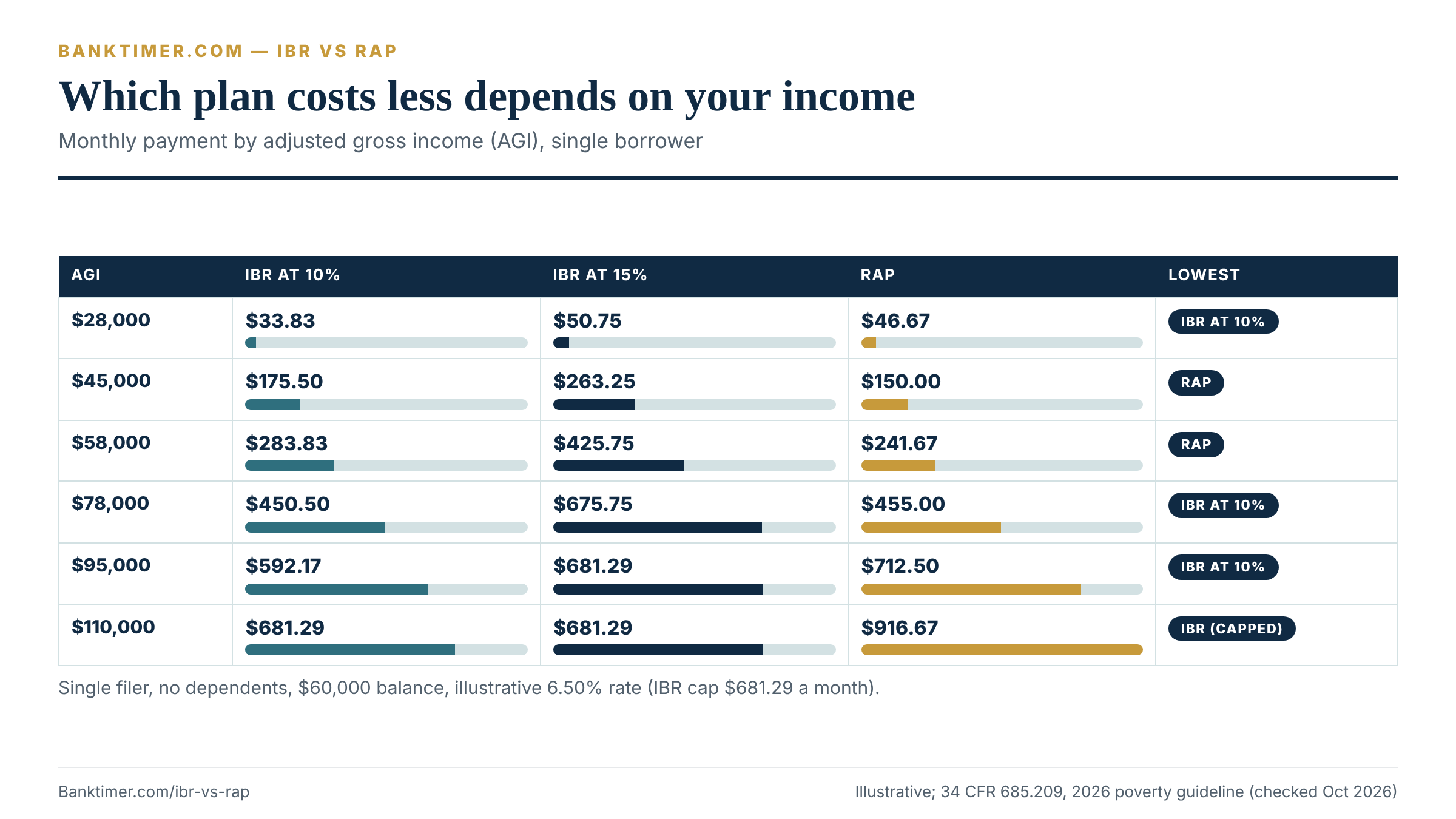
That is why a borrower earning $28,000 can pay $33.83 a month under IBR at 10% and $46.67 under RAP. The same borrower at $45,000 pays $175.50 under IBR and $150.00 under RAP. The curves cross, and they cross again.
Who Can Use IBR, RAP, or Both
Eligibility turns on when each loan was made and what type it is. Getting this wrong wastes weeks, so check it before you start any IBR vs RAP comparison.
If every loan you hold was made before July 1, 2026, you can generally choose between IBR and RAP, as long as the loan types qualify. If any of your loans were made on or after July 1, 2026, those loans cannot be repaid under IBR. ED’s plan comparison page says RAP is the only income-driven plan available for them, with Tiered Standard as the fixed-payment alternative.
The regulation also affects who counts as a “new borrower” for IBR’s 10% rate and 20-year clock. As written, the definition requires that you had no outstanding Direct or FFEL balance before July 1, 2014 and that you obtain no new loan on or after July 1, 2026. Other paths exist for people who borrowed between those dates. If you plan to borrow again this year, ask your servicer how a new loan would change your status before you sign.
| Situation | IBR available? | RAP available? | Note |
|---|---|---|---|
| All Direct loans made before July 1, 2026 | Yes | Yes | You can compare freely |
| Any Direct loan made on or after July 1, 2026 | Not for that loan | Yes | Tiered Standard is the fixed-payment option |
| FFEL loans (not consolidated) | Yes | No | RAP requires Direct Loans |
| Direct Consolidation Loan that repaid a Parent PLUS Loan | No | No | Regulation excludes it from both |
| Direct Parent PLUS Loan | No | No | Different plans apply |
| Graduate PLUS Loan | Yes | Yes | Grad PLUS qualifies for both |
The Parent PLUS exclusion is the one that surprises families most. If you consolidated a Parent PLUS Loan together with your own loans, the consolidation loan is shut out of both plans. Our guide to types of loans explains how those loan categories differ, and the CFPB advises against mixing Parent PLUS loans into a consolidation that includes other federal loans.
What changed on July 1, 2026 and what did not
RAP launched on July 1, 2026 for new and current borrowers. The Tiered Standard plan launched the same day for loans made on or after that date. IBR itself did not change its formula, but the regulation limits it to loans made before July 1, 2026.
Older plans are on a clock too. The regulation requires borrowers in the Pay As You Earn (PAYE) and Income-Contingent Repayment (ICR) plans to choose a new plan before July 1, 2028. Borrowers who do not choose are moved to IBR if they hold loans RAP cannot take, or to RAP otherwise.
If you were in the SAVE plan, a court order ended it on March 10, 2026. ED said servicers would notify SAVE borrowers starting July 1 and give them at least 90 days to pick a plan. Borrowers who do not choose are placed in a Standard-type plan. Our SAVE plan ended guide covers that notice window step by step. This article picks up after you have decided to compare the two income-driven options.
The plan structures come from federal law as amended in 2025. The formulas, dates and counting rules we cite come from the federal regulation at 34 CFR 685.209 and 685.210. Servicer pages, such as Edfinancial’s, apply those rules. Your servicer’s own screens and letters decide how your specific account is processed, so confirm anything that affects your payment.
How IBR Calculates Your Monthly Payment
The IBR formula has four moving parts: your AGI, the poverty guideline for your family size, the percentage you qualify for, and the Standard-plan cap. We take them in that order.
Step 1: Find your protected income
ED multiplies the federal poverty guideline for your family size by 1.5. The Department of Health and Human Services published the 2026 guidelines on January 15, 2026. The figures below are for the 48 contiguous states and the District of Columbia. Alaska and Hawaii use higher guidelines, which protect more income.
| Family size | 2026 poverty guideline | Protected income (150%) |
|---|---|---|
| 1 | $15,960 | $23,940 |
| 2 | $21,640 | $32,460 |
| 3 | $27,320 | $40,980 |
| 4 | $33,000 | $49,500 |
| 5 | $38,680 | $58,020 |
Family size includes you, a spouse if you file jointly, your qualifying children, and anyone else who gets more than half their support from you. Each added person raises your protected income by about $8,520 in the 48 states. That is the quiet reason IBR treats families well.
Step 2: Apply 10% or 15% and divide by 12
Subtract protected income from AGI. Multiply what is left by your rate. Divide by 12.
The 15% rate applies to most borrowers. The 10% rate applies to “new borrowers,” which in practice means people who took their first federal loans on or after July 1, 2014, subject to the regulation’s wording on later loans. Our IBR 10 percent vs 15 percent comparison later in this article shows how much that choice moves the bill.
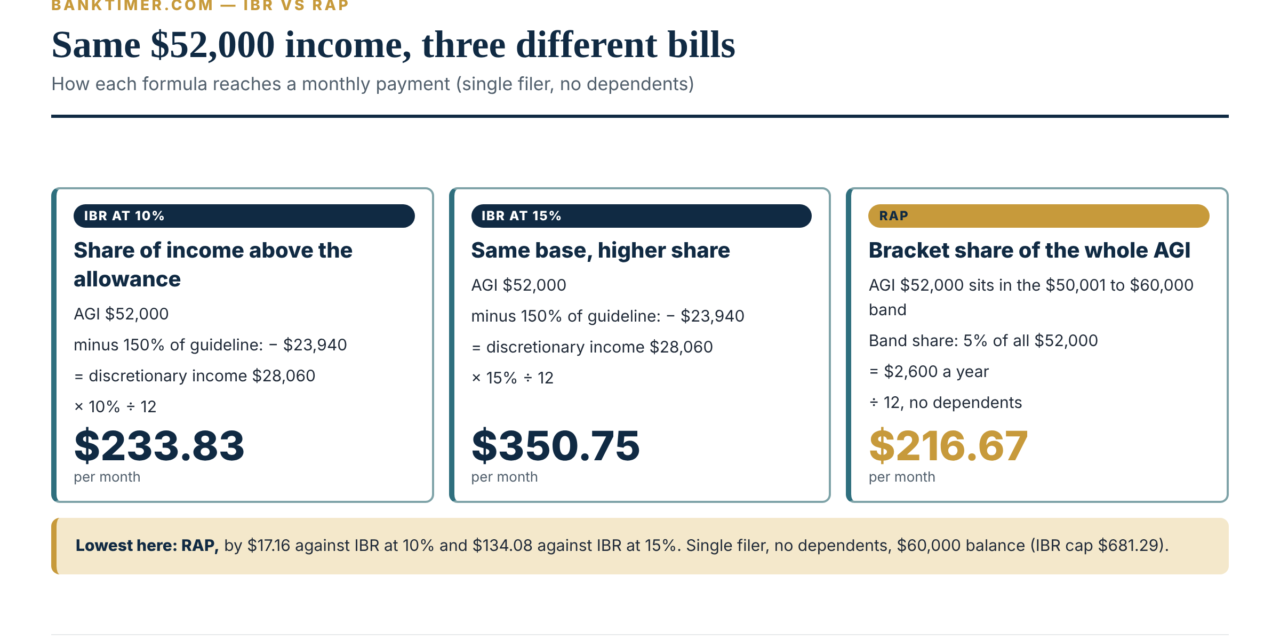
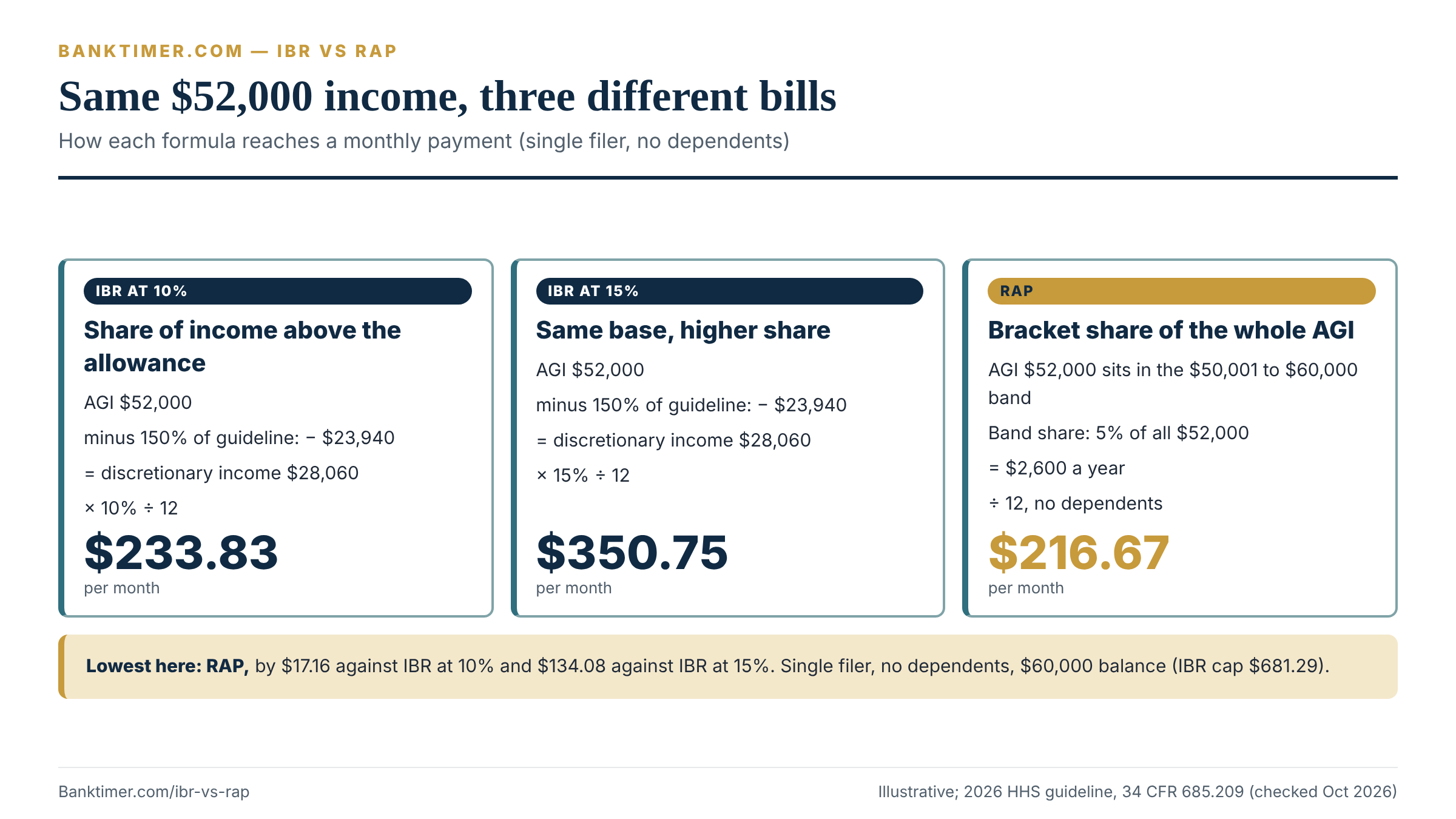
Take a single borrower with AGI of $52,000:
- Protected income is $23,940.
- Discretionary income is $52,000 minus $23,940, or $28,060.
- At 10%, the annual payment is $2,806, or $233.83 a month.
- At 15%, the annual payment is $4,209, or $350.75 a month.
Step 3: Check the cap and the small-payment rule
Your IBR payment can never exceed what you would owe on the 10-year Standard plan. The regulation sets the cap at the amount you would have paid on a 10-year Standard plan, even if repayment runs longer. On a $60,000 balance at an illustrative 6.50% rate, that cap is $681.29 a month.
The regulation also rounds tiny payments. A calculated payment under $5 becomes $0. A payment from $5 up to $10 becomes $10. A borrower with AGI below protected income pays nothing and still earns a qualifying month toward forgiveness.
Step 4: Add the married-borrower rules
If you file a joint federal return, your spouse’s income counts. If you file separately, only yours does, unless the regulation’s exceptions for separation or no access to your spouse’s income apply. When a spouse’s income counts, their eligible federal loan debt enters the calculation too, and your payment is adjusted in proportion.
A borrower earns $50,000 and has $60,000 in federal loans. Her spouse earns $40,000 and has no loans. Filing jointly puts $90,000 of AGI into the IBR formula, with a family size of two. Filing separately puts only $50,000 in, with a family size of one. The tax cost of filing separately may exceed the student loan savings, so run both returns’ totals before you decide. This example is illustrative, not tax advice.
How RAP Calculates Your Monthly Payment
RAP is simpler to describe and harder to predict. It reads your AGI, finds the matching bracket, and applies that percentage to the entire amount. The regulation calls the result your base payment.
The bracket table
The first bracket is a flat number. Borrowers with AGI of $10,000 or less owe a base payment of $120 a year, which is the $10 monthly minimum. Above $10,000, the percentage steps up by one point for each additional $10,000 of AGI, until it reaches 10% above $100,000.
| AGI range | Share of AGI | Example AGI | Base payment per year | Monthly, before dependents |
|---|---|---|---|---|
| Up to $10,000 | Flat $120 | $9,000 | $120 | $10.00 |
| $10,001 to $20,000 | 1% | $15,000 | $150 | $12.50 |
| $20,001 to $30,000 | 2% | $25,000 | $500 | $41.67 |
| $30,001 to $40,000 | 3% | $35,000 | $1,050 | $87.50 |
| $40,001 to $50,000 | 4% | $45,000 | $1,800 | $150.00 |
| $50,001 to $60,000 | 5% | $55,000 | $2,750 | $229.17 |
| $60,001 to $70,000 | 6% | $65,000 | $3,900 | $325.00 |
| $70,001 to $80,000 | 7% | $75,000 | $5,250 | $437.50 |
| $80,001 to $90,000 | 8% | $85,000 | $6,800 | $566.67 |
| $90,001 to $100,000 | 9% | $95,000 | $8,550 | $712.50 |
| Over $100,000 | 10% | $120,000 | $12,000 | $1,000.00 |
Read the table as a lookup, not as tax brackets. A borrower with $55,000 of AGI does not pay 5% on the part above $50,000. She pays 5% of all $55,000. We return to that distinction in the section on the RAP step below, because it creates abrupt jumps.
Dependents, the floor, and the family adjustment
After you divide the base payment by 12, subtract $50 for each dependent claimed on your federal return. The result cannot fall below $10. A borrower may count only dependents claimed on their own return, which matters for married couples filing separately.
If you file jointly and your spouse also has eligible federal loans, the regulation shrinks your share. It multiplies your payment by your loan balance divided by the couple’s combined balance. ED’s summary says the goal is that your payment is not increased by your spouse’s income. Our worked examples assume a spouse with no loans.
Principal match and interest waiver
RAP adds two balance protections that IBR lacks. If your on-time payment does not cover the month’s interest, ED does not charge the unpaid interest. And if your payment reduces principal by less than $50, ED adds a matching principal reduction, capped at $50.
ED’s pages describe the effect plainly: balances should decline with each on-time payment. We model it conservatively in this article, so that principal falls by the lesser of $50 or your payment when your payment is small. The regulation’s formula is more detailed, and your servicer’s statement is the final word on any month.
The graphic shows why the first question in IBR vs RAP is never “which plan is cheaper.” It is “cheaper at what income, in what household, and over what clock?” The next section answers the first two.
IBR vs RAP Monthly Payments at Real Incomes
Formulas are abstract until you plug in an income, so the IBR vs RAP tables below do exactly that. The tables below hold the loan balance at $60,000 and the rate at an illustrative 6.50%. That balance matters only for the IBR cap, which is $681.29 a month. Every income is AGI, not salary, and every figure is a first-year payment before annual raises.
These are Banktimer examples, not quotes. Your payment will use your actual AGI, family size, loan dates and servicer calculation.
Single borrower, no dependents
| AGI | IBR at 10% | IBR at 15% | RAP | Lowest of the three |
|---|---|---|---|---|
| $28,000 | $33.83 | $50.75 | $46.67 | IBR at 10% |
| $38,000 | $117.17 | $175.75 | $95.00 | RAP |
| $45,000 | $175.50 | $263.25 | $150.00 | RAP |
| $58,000 | $283.83 | $425.75 | $241.67 | RAP |
| $66,000 | $350.50 | $525.75 | $330.00 | RAP |
| $78,000 | $450.50 | $675.75 | $455.00 | IBR at 10% |
| $95,000 | $592.17 | $681.29 | $712.50 | IBR at 10% |
| $110,000 | $681.29 | $681.29 | $916.67 | IBR (capped) |
Three patterns stand out. First, RAP undercuts both IBR rates in the middle of the range, roughly from $34,000 to $70,000. Second, IBR at 10% is cheaper at the bottom and again above about $70,000, because RAP’s percentage keeps climbing while IBR’s protected allowance stays fixed. Third, in every row up to $78,000 the 15% rate is the most expensive of the three.
The gap is not small. At $58,000, a borrower on IBR at 15% pays $425.75 against RAP’s $241.67. That is $184.08 a month or about $2,209 a year. If you are in the 15% group, RAP deserves a serious look.
IBR 10 percent vs 15 percent
The rate you get under IBR depends on when you borrowed, so you cannot pick it. But you can see what it is worth. At $58,000 of AGI, the 10% rate saves $141.92 a month compared with 15%. At $78,000 it saves $225.25.
That saving is also why the “new borrower” definition matters. Your servicer assigns the rate based on your loan history. If you think it assigned the wrong group, ask for the date basis in writing.
Family of four, two dependents
The picture changes when children enter the household. In this table the borrower files jointly, the family size is four, and two dependents are claimed. The $60,000 balance is the same.
| AGI | IBR at 10% | IBR at 15% | RAP | Lowest of the three |
|---|---|---|---|---|
| $45,000 | $0.00 | $0.00 | $50.00 | IBR |
| $55,000 | $45.83 | $68.75 | $129.17 | IBR at 10% |
| $65,000 | $129.17 | $193.75 | $225.00 | IBR at 10% |
| $85,000 | $295.83 | $443.75 | $466.67 | IBR at 10% |
| $120,000 | $587.50 | $681.29 | $900.00 | IBR at 10% |
IBR wins every row. The reason is arithmetic. A family of four protects $49,500 of income under IBR, while RAP gives back only $100 a month for two dependents, which is $1,200 a year. At $65,000, IBR counts just $15,500 as discretionary. RAP counts all $65,000 at 6%.
This is the single most important finding for parents. RAP’s dependent credit is real but small. If you have two or more dependents and a moderate income, IBR is often the cheaper monthly choice.
Where the IBR vs RAP comparison breaks down
Two cautions apply to every table here. The first is that our examples hold AGI flat. Real incomes move, and so does the poverty guideline, which HHS updates each year. The second is that monthly payment is only one lens. The balance, interest and forgiveness effects come later in this article.
The RAP Step: Why One Dollar Can Add $33 a Month
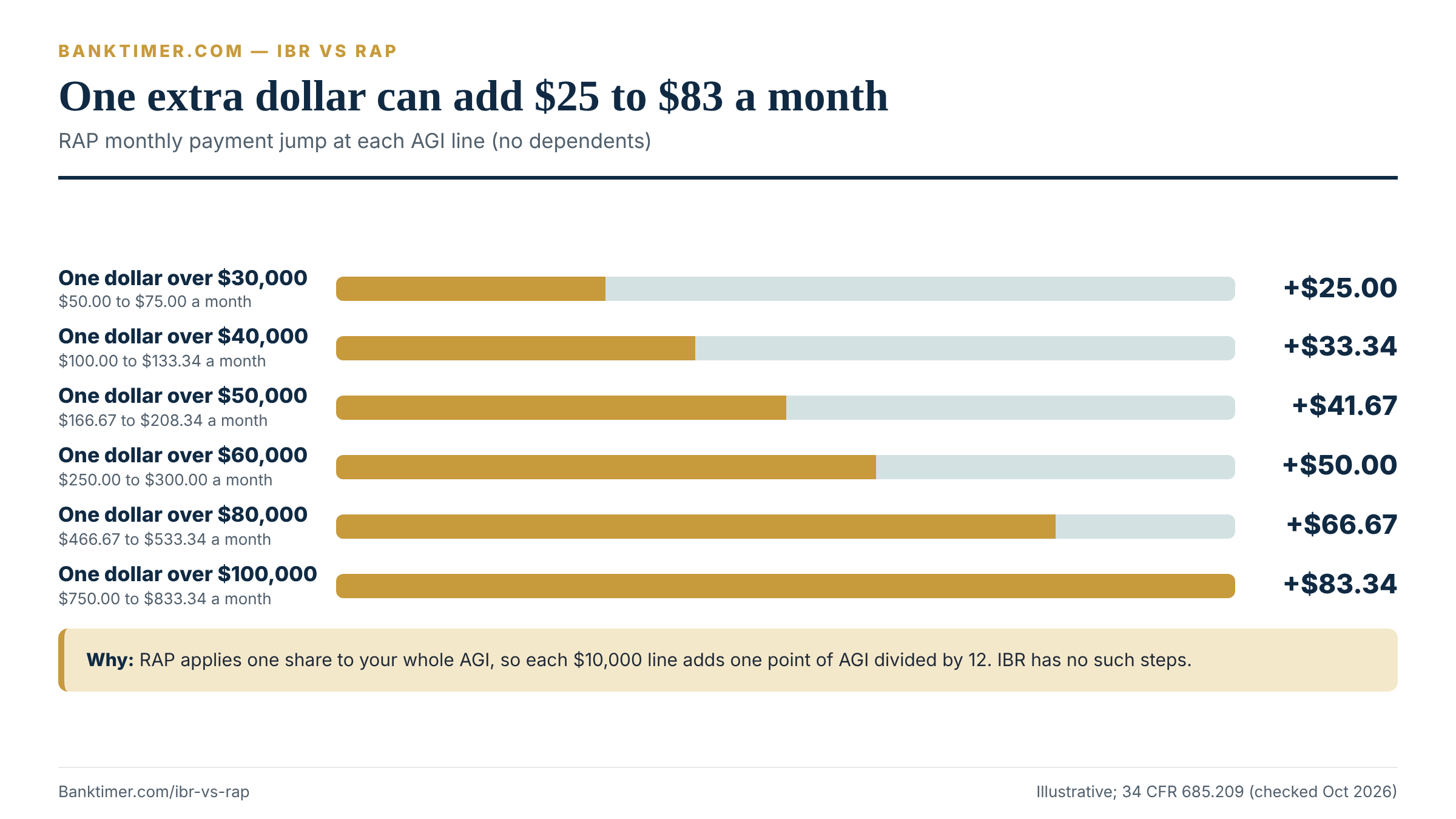
Because RAP applies one percentage to the whole of your AGI, your payment jumps whenever you cross a $10,000 line. The jump equals one percentage point of your AGI, divided by 12. That is a feature of the formula as the regulation writes it, so planning around it makes sense.
| AGI before | AGI after | Monthly before | Monthly after | Jump |
|---|---|---|---|---|
| $30,000 | $30,001 | $50.00 | $75.00 | $25.00 |
| $40,000 | $40,001 | $100.00 | $133.34 | $33.34 |
| $50,000 | $50,001 | $166.67 | $208.34 | $41.67 |
| $60,000 | $60,001 | $250.00 | $300.00 | $50.00 |
| $80,000 | $80,001 | $466.67 | $533.34 | $66.67 |
| $100,000 | $100,001 | $750.00 | $833.34 | $83.34 |
The step grows with income. At $100,000 a single extra dollar of AGI adds more than $83 to the monthly bill, or about $1,000 a year.
IBR has no such cliffs. Its payment rises smoothly at 10% or 15% of each added dollar above the allowance. An extra $1,000 of AGI adds $8.33 a month at 10% and $12.50 at 15%.
What a borrower near a bracket line can do
If your AGI sits just above a line, lowering it can lower your payment. AGI falls with pre-tax retirement contributions and contributions to a health savings account (HSA), among other adjustments. Our HSA vs FSA guide explains how that account works, and the personal retirement savings guide covers workplace plans. Annual contribution limits change each year, so check the IRS figures before you plan around them, and see our 2027 401(k) contribution limit guide for the next figures.
Two cautions apply. A contribution that drops you across a line saves student loan payments, but it also locks money away or changes your take-home pay. And RAP reads the AGI on your tax return or on the documents you submit, so the timing of contributions must line up with the tax year your servicer uses. Ask your tax preparer before you change anything.
Other programs use AGI lines too. Health insurance subsidies have their own cliff, which our ACA subsidy cliff guide explains. The same logic cuts the other way for RAP. If you expect a raise or a bonus that pushes you over a line, budget for the jump. A one-time bonus can raise AGI for the year the servicer reads. For help turning that into a plan, see our monthly budget guide.
High Earners: The IBR Cap Against RAP’s Open Ceiling
IBR’s cap is the single biggest structural difference at higher incomes. Your payment cannot exceed the 10-year Standard amount, no matter how high your income climbs. RAP has no ceiling. Above $100,000 it takes 10% of every dollar of AGI.
A single borrower with a $50,000 balance at an illustrative 6.50% rate earns $140,000. IBR at 10% would ask for $967 a month before the cap, so the cap applies: the 10-year Standard payment is $567.74. RAP asks for 10% of $140,000, which is $14,000 a year, or $1,166.67 a month.
IBR is cheaper each month by $598.93. But RAP’s larger payment retires the loan in about 49 months and costs roughly $57,048 in total, with about $7,048 of interest. IBR at the cap takes 120 months and costs about $68,129, with about $18,129 of interest.
The lesson is that cheaper monthly does not mean cheaper overall. A borrower who can afford the larger RAP payment pays far less interest. A borrower who needs the cash for a mortgage down payment or an emergency cushion may reasonably take the capped IBR bill. Neither choice is wrong.
If your goal is to retire the loan, you can also make extra payments on IBR. That gives you the lower required payment as a safety net. See our emergency fund guide for how much cushion to hold before you pay debt down aggressively.
What Happens to Your Balance: Interest Under IBR and RAP
A low payment feels like relief until you look at the balance. When your payment is smaller than the monthly interest, the loan can grow or shrink depending on the plan. This is where IBR vs RAP separates most sharply for low-income, high-balance borrowers.
How IBR treats unpaid interest
Under IBR, interest that your payment does not cover stays on the account as accrued interest. For Direct Subsidized Loans, the regulation says ED does not charge that unpaid interest for the first three consecutive years of repayment under the plan. Months in an economic hardship deferment do not count toward those three years.
After the subsidy ends, or on unsubsidized loans from day one, the interest keeps accruing. The regulation capitalizes unpaid interest, meaning it adds to your principal, in a few listed situations. Two matter most: when your payment equals the capped Standard amount, and when you leave IBR. Leaving the plan with a large pile of accrued interest can therefore raise your principal overnight.
How RAP treats unpaid interest
RAP takes the opposite approach. If an on-time payment does not cover the month’s interest, ED does not charge the shortfall. Your balance cannot grow from interest you could not afford. On top of that, ED reduces principal by a matching amount, up to $50 a month, when your payment alone would not.
The waiver has a condition. It applies to on-time payments. The regulation says that if you pay ahead and your payment is credited to a future month, uncovered interest is charged. So the protection works best when you pay the amount due each month rather than prepaying.
A single borrower owes $90,000 at an illustrative 6.50% on unsubsidized loans, so interest is about $487.50 a month. Her AGI is $26,000 and does not change. Under IBR at 10% she owes $17.17 a month, and under RAP she owes $43.33.
IBR keeps her payment tiny but lets $470 of interest pile up each month. After 10 years she has paid $2,060 and owes about $146,440. Under RAP she has paid $5,200 and owes about $84,800 in principal. RAP costs her $26.16 more each month and leaves her roughly $61,640 better off on the balance after a decade.
The table follows the same borrower out to year 20, when the IBR clock ends in this example.
| Year | Plan | Total paid so far | Principal | Unpaid interest | Total owed |
|---|---|---|---|---|---|
| 5 | IBR at 10% | $1,030 | $90,000 | $28,220 | $118,220 |
| 5 | RAP | $2,600 | $87,400 | $0 | $87,400 |
| 10 | IBR at 10% | $2,060 | $90,000 | $56,440 | $146,440 |
| 10 | RAP | $5,200 | $84,800 | $0 | $84,800 |
| 20 | IBR at 10% | $4,120 | $90,000 | $112,880 | $202,880 |
| 20 | RAP | $10,400 | $79,600 | $0 | $79,600 |
The IBR rows show what servicers sometimes call negative amortization: the amount owed grows even though you pay every month. The RAP rows show a slow decline. Neither is a path to payoff at this income. The question is what you carry into forgiveness, and what happens if your income rises.

A limit on this example
Our model uses simple interest on principal and holds income flat for decades. Real borrowers get raises, change jobs, marry, and leave plans. If this borrower’s income grows, her IBR payment grows too, and the accrued interest starts to be paid down. Treat the example as a stress test, not a forecast.
The Forgiveness Timeline Gap: 20, 25 or 30 Years
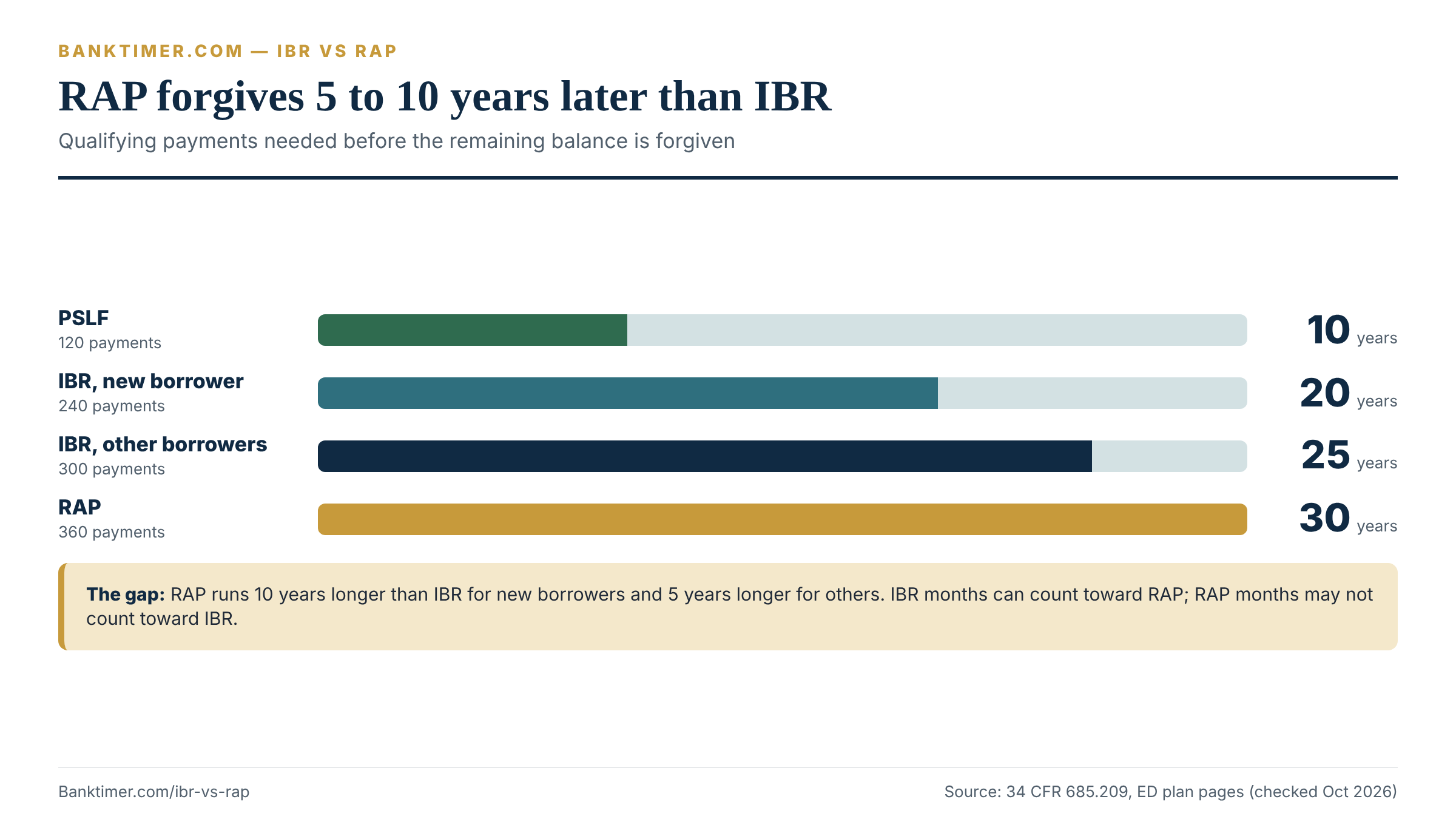
The headline difference in IBR vs RAP forgiveness is the calendar. IBR forgives what remains after 240 monthly payments (20 years) for new borrowers or 300 (25 years) for everyone else. RAP forgiveness takes 30 years, which is 360 monthly payments.
| Route | Qualifying payments | Years | Gap against RAP |
|---|---|---|---|
| PSLF (either plan) | 120 | 10 | 20 years shorter |
| IBR, new borrower | 240 | 20 | 10 years shorter |
| IBR, other borrowers | 300 | 25 | 5 years shorter |
| RAP | 360 | 30 | None |
PSLF is the exception that makes all of this academic for many public servants. ED’s pages say you may qualify for forgiveness after 10 years of qualifying payments and employment under either plan. The regulation lists RAP as a qualifying plan for PSLF. It also says that during RAP enrollment, deferment and forbearance months stop earning PSLF credit, so keep payments current if PSLF is your goal.
If PSLF fits you, the plan that gives the lowest monthly payment is usually the better PSLF vehicle, because you want to repay as little as possible before the 120th payment. Our worked tables show where that is IBR and where it is RAP. Confirm your employer’s eligibility with ED before you rely on any plan.
What counts as a qualifying month
Months must be qualifying to count, and the two plans do not count the same things. Under RAP, the regulation counts an on-time RAP payment, an on-time Tiered Standard payment, an IBR payment that meets the required amount, and payments under certain other plans that equal the 10-year Standard amount. It also counts months of unemployment or economic hardship deferment, plus certain deferment and forbearance months that ended before July 1, 2026.
The regulation does not say that a $0 payment counts under RAP, and RAP’s $10 floor makes $0 months unlikely. Under IBR, a month with a $0 required payment counts. That matters for borrowers who may have income below the protected amount for several years.
The counting rules run in one direction more easily than the other. IBR months can count toward RAP’s 360. RAP months are excluded from IBR’s list of qualifying payments, with one route back in: a payment at least as large as the 10-year Standard amount qualifies. We explain that trap in the switching section.
Is forgiveness taxable?
Possibly, and usually at the federal level. Section 108(f) of the Internal Revenue Code, as amended by Public Law 119-21, excludes certain student loan discharges from income. Service-based programs such as PSLF are covered, and so are discharges for death or total and permanent disability. We found no general exclusion for balances forgiven at the end of an income-driven plan in the current text of that section. ED’s pages tell borrowers that forgiven amounts may be taxable.
The insolvency exclusion can reduce the bill. If your liabilities exceed the fair market value of your assets right before the discharge, the exclusion covers the discharged amount up to the extent of insolvency. State tax treatment varies by state, so check your state’s rules. Our guide to how savings and insurance are taxed covers the basics of income reporting, and the forms guide lists the tax forms involved.
For scale, a forgiven balance of $202,880 taxed at an illustrative flat 22% would produce a $44,634 bill. A large amount received in one year could push part of it into higher brackets. A forgiven $74,400 at the same illustrative 22% is $16,368. Smaller forgiven balances under RAP mean smaller tax events, but 10 years later.
Total Cost Over the Life of the Loan: Five Scenarios
In any IBR vs RAP decision, monthly payment, total paid, and forgiven balance each tell a different story. We ran five borrowers through both plans using the same assumptions: an illustrative 6.50% fixed rate, flat AGI, a single filer unless noted, and unsubsidized loans. “Total paid” is cash out of your pocket. “Forgiven” is the balance ED wipes at the end, including any unpaid interest.
| Scenario | Plan | First payment | Months | Total paid | Forgiven at end |
|---|---|---|---|---|---|
| 1. $45,000 owed, $42,000 AGI | IBR at 10% | $150.50 | 240 | $36,120 | $67,380 |
| 1. $45,000 owed, $42,000 AGI | RAP | $140.00 | 360 | $50,400 | $27,000 |
| 2. $120,000 owed, $72,000 AGI | IBR at 10% | $400.50 | 240 | $96,120 | $179,880 |
| 2. $120,000 owed, $72,000 AGI | IBR at 15% | $600.75 | 300 | $180,225 | $134,775 |
| 2. $120,000 owed, $72,000 AGI | RAP | $420.00 | 360 | $151,200 | $102,000 |
| 3. $60,000 owed, $65,000 AGI, family of 4 | IBR at 10% | $129.17 | 240 | $31,000 | $107,000 |
| 3. $60,000 owed, $65,000 AGI, family of 4 | RAP | $225.00 | 360 | $81,000 | $42,000 |
| 4. $50,000 owed, $140,000 AGI | IBR (capped) | $567.74 | 120 | $68,129 | $0 |
| 4. $50,000 owed, $140,000 AGI | RAP | $1,166.67 | 49 | $57,048 | $0 |
| 5. $90,000 owed, $26,000 AGI | IBR at 10% | $17.17 | 240 | $4,120 | $202,880 |
| 5. $90,000 owed, $26,000 AGI | RAP | $43.33 | 360 | $15,600 | $74,400 |
Read the table by column, not by row. The IBR at 10% rows pay less in total in four of five scenarios because the clock is shorter and the payments are smaller. The RAP rows leave far smaller forgiven balances in every scenario with forgiveness, because the interest waiver and the match keep the balance from growing.
Scenario 2 shows the trade-off most clearly. At $72,000, a borrower in the 15% group pays $600.75 a month and $180,225 in total. The same borrower on RAP pays $420.00 and $151,200. RAP saves $29,025 in total and $180.75 a month, but it runs five years longer.
These results depend on flat income
Flat AGI for 20 to 30 years is a simplification, and it exaggerates forgiveness. We reran Scenario 2 with 3% annual raises and a poverty guideline that grows 2.5% a year. The outcome changes completely.
| Scenario 2 with raises | First payment | Result | Total paid |
|---|---|---|---|
| IBR at 10% | $400.50 | Forgiven at month 240, balance $143,687 | $132,313 |
| IBR at 15% | $600.75 | Paid off at month 298 | $267,444 |
| RAP | $420.00 | Paid off at month 310 | $255,047 |
With raises, the borrower on IBR at 15% and the borrower on RAP both repay in full. IBR at 10% still reaches forgiveness at 20 years because its payments stay lower relative to the interest. The total paid under the first two is high because a $120,000 balance takes decades to retire at these payments.
That is the planning problem in miniature. Whether you reach forgiveness depends on your future income, which you do not know. If you expect to repay in full, the plan that costs the least in total interest and time is the one with the higher early payments. If you expect to reach forgiveness, the plan with the lowest payments and the shortest clock wins. Federal Student Aid’s Loan Simulator lets you test both paths with your own loans.
Five ways to ask which plan is cheaper
| Lens | Question | Usually favors |
|---|---|---|
| Monthly cash flow | What is my required payment this year? | RAP in the mid-income range, IBR for families and high earners |
| Total paid | How much leaves my account in all? | IBR when forgiveness comes at 20 or 25 years, RAP when you repay fast |
| Balance risk | How much could I owe or have forgiven? | RAP, because unpaid interest is not charged |
| Tax risk | How large might a forgiven balance be? | RAP, in most of our examples |
| Time | When am I done? | IBR, because its clock is 5 to 10 years shorter |
No single lens is the right one. A borrower with a newborn and a thin cash cushion cares about the first row. A borrower in their 50s who will retire before year 30 cares about the last.
Can You Switch From IBR to RAP?
Yes, with limits that matter. The regulation says a borrower repaying under an income-driven plan may change at any time to any other repayment plan for which they are eligible. ED’s RAP page says any Direct Loan borrower with an eligible loan type may choose the plan. You apply online through StudentAid.gov.
FFEL loans are the exception. RAP requires Direct Loans, so FFEL borrowers must consolidate into a Direct Consolidation Loan first. Consolidation has its own side effects on your payment history and interest, so read our guide to rehabilitation vs consolidation before you do it for this reason alone.
What happens to your forgiveness clock
The regulation counts qualifying months for RAP in a list. One item is an IBR payment “at least equal to the required amount.” In plain terms, months you already spent in IBR should count toward RAP’s 360, provided you made the required payments. If some of your IBR months carried a $0 payment, ask how those months are counted. Ask your servicer to show the count before you switch.
Going the other way is less friendly. IBR’s list of qualifying payments covers payments under income-driven plans “except the Repayment Assistance Plan.” Months in RAP can still count toward IBR if each payment was at least as large as the 10-year Standard amount. Most RAP payments in our examples are far below that. So a borrower who switches to RAP and later returns to IBR may find the RAP months do not count.
A borrower has made 144 qualifying payments under IBR at 15%. She owes $70,000 at an illustrative 6.50%, earns $58,000 as a single filer, and pays $425.75 a month. Staying means 156 more payments.
If she switches to RAP and all 144 months count, she needs 216 more payments. Her RAP payment is $241.67, which is $184.08 less per month. Over the remaining term she pays about $52,200 under RAP against about $66,417 under IBR, a saving of about $14,217. But she makes payments for 60 more months, and about $59,200 is forgiven at the end instead of about $58,625.
Her saving is real, and so is the delay. If her budget handles $425.75 comfortably, staying put finishes the job five years sooner. If cash flow is the problem, the lower payment may be worth the extra years.
Leaving IBR can capitalize interest
The regulation adds unpaid accrued interest to principal when you leave IBR. A borrower who let $28,220 of interest build up over five years, like the Scenario 5 borrower earlier, would see the balance jump from $90,000 to $118,220 on the day of the switch. RAP then waives uncovered interest going forward. But interest accrues on the larger principal from that point.
That does not make switching wrong. It means the order of events matters. Someone with a large accrued interest balance should ask what the post-switch principal will be before approving the change.
| Move | Allowed? | Clock effect | Interest effect | Ask your servicer |
|---|---|---|---|---|
| IBR to RAP | Yes, for eligible Direct Loans | IBR months should count toward 360 | Unpaid interest capitalizes on leaving IBR | New principal and payment in writing |
| RAP to IBR | Yes for loans made before July 1, 2026 | RAP months may not count toward IBR | Capitalization rules apply on exit | Whether past RAP months count |
| SAVE to IBR or RAP | Yes, required | Depends on your payment history | Check your account | Your plan-choice deadline |
| PAYE or ICR to IBR or RAP | Yes, before July 1, 2028 | Months generally keep counting under the listed rules | Check capitalization | Date you must choose |
| Standard to RAP | Yes | Starts RAP counting | Payment drops, interest may rise | Total cost comparison |
| Tiered Standard to RAP | Yes, any time after repayment starts | Starts RAP counting | Check how interest is treated | Whether PSLF counts matter |
| FFEL to RAP | After consolidation only | New loan, review counts | Ask how interest on the old loans is treated | Payment-count credit |
The “Allowed?” column reflects the regulation as we read it on October 15, 2026. ED can change servicer procedures faster than it changes the regulation, so treat the table as a map for questions rather than a ruling on your file.
If you came from SAVE
Borrowers leaving SAVE face the same IBR vs RAP choice, with a deadline attached. Servicers were to notify SAVE borrowers between July 1 and August 15, 2026, and give at least 90 days to choose. If you have a notice with a date, that date controls. Our SAVE plan ended article walks through the notice and the default placement, and this comparison supplies the math. The key takeaway for a SAVE refugee: SAVE’s old payment formula is gone, so do not anchor on what you paid before.
A Decision Framework for IBR vs RAP
The tables above show IBR vs RAP patterns, not your answer. Use these steps to turn the patterns into a decision. Most borrowers can finish them in an afternoon with a recent tax return and a loan statement.
- Confirm which plans your loans can use. List each loan, its type and its first-disbursement date. Any loan made on or after July 1, 2026 rules out IBR for that loan. Parent PLUS Loans rule out both plans.
- Gather three numbers. You need your AGI from the latest return, your family size, and the number of dependents you claim. If your income changed since that return, you can submit alternative documentation.
- Run both plans in the Loan Simulator. Federal Student Aid’s tool compares payments, total interest and forgiveness for your actual loans. Our tables help you interpret what it shows.
- Check the lenses. Compare monthly payment, total paid, balance risk, tax risk and time. Write down which plan wins each one.
- Apply the PSLF test. If you will work in public service for 10 years, choose the lowest required payment among the plans that count. The forgiveness clock under each plan stops mattering.
- Stress-test your income. Ask what happens if your income drops 30%, if it rises 20%, or if you cross a RAP bracket line. A plan that works only if nothing changes is fragile.
- Set a review date. Both plans recalculate every year. Put your recertification month on your calendar and re-run the comparison when your household changes.
Which borrower profiles tend to favor which plan
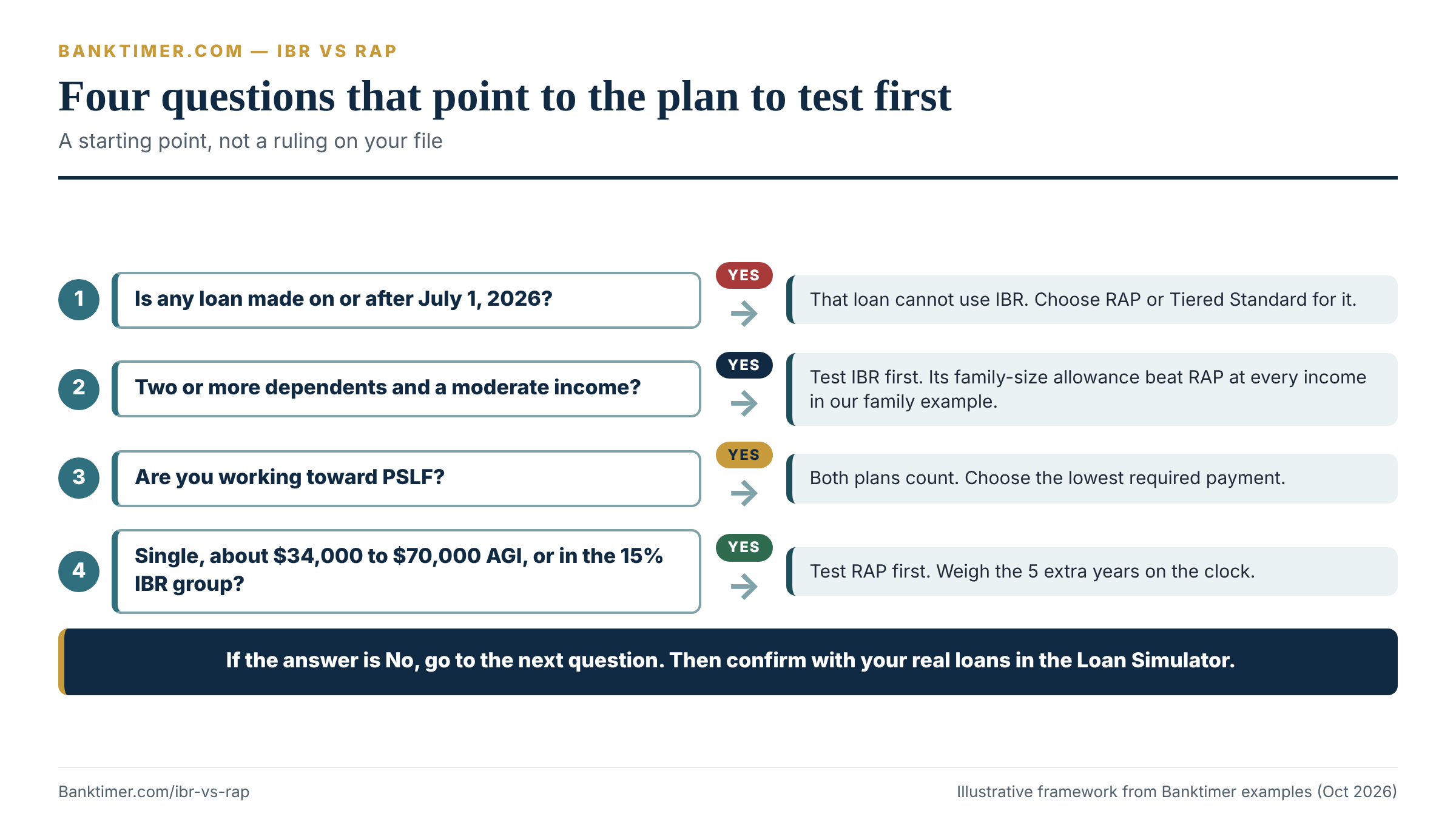
| Profile | Often lower monthly payment | Why | What to verify |
|---|---|---|---|
| Single, $35,000 to $70,000 AGI, no dependents | RAP | Percentage applies without 150% allowance, but rate is only 3% to 6% | Your bracket line and loan dates |
| Two or more dependents, moderate income | IBR | Larger family size raises protected income | IBR rate group (10% or 15%) |
| 15% IBR group, mid income | RAP | RAP undercut 15% IBR by $184 a month at $58,000 | Added years on the forgiveness clock |
| High income, modest balance | IBR (capped) | Cap holds payment at the 10-year Standard amount | Whether you prefer faster payoff |
| Very low income, large balance | IBR for payment, RAP for balance | IBR charges less; RAP stops interest growth | Expected raises and tax on forgiveness |
| Pursuing PSLF | Whichever is lowest | Only 120 qualifying payments are needed | Employer eligibility and payment counts |
| Loans made on or after July 1, 2026 | RAP or Tiered Standard | IBR does not accept these loans | Tiered Standard term by balance |
Use the third column as a hypothesis, not a verdict. A different balance or a different state can reverse it.
A note on Tiered Standard
Tiered Standard is the fixed-payment alternative for loans made on or after July 1, 2026. Terms run 10 years for balances under $25,000, 15 years for $25,000 to $49,999, 20 years for $50,000 to $99,999, and 25 years for $100,000 or more, with a $50 monthly minimum. ED says it does not count for PSLF. It builds no forgiveness and charges interest normally, so it suits borrowers who can afford the payment and want a defined end date.
Edge Cases That Change the Answer
Several situations bend the general IBR vs RAP rules. Check each against your own file.
- Married filing separately. Under both plans, only your own income counts if you file a separate return. For RAP, you claim only dependents on your own return. The tax cost of filing separately can exceed the loan savings, so price both.
- Spouse with federal loans. When a joint return puts your spouse’s income into the formula, their eligible debt is included and your payment is adjusted in proportion. Each plan applies its own version of that adjustment, so run it through the simulator.
- Alaska and Hawaii. The poverty guidelines are higher there, which raises IBR’s protected income. RAP has no regional adjustment in its brackets.
- Self-employed or variable income. AGI after business deductions drives both formulas. Use your most recent return or submit documentation of current income, and expect annual recalculation.
- Defaulted loans. Plan rules for defaulted loans are changing and were described inconsistently in the pages we read. Resolve the default first. Our student loan default and wage garnishment guides explain the exits.
- A very large balance. Under IBR, the cap equals the 10-year Standard payment on your balance. A $120,000 balance has a cap of $1,362.58 in our example, so the cap rarely binds until income is high.
Recertification, documents and deadlines
Both plans run in 12-month cycles. The regulation says that when three payments remain in your cycle, ED requests updated information. If you do not provide documentation by the deadline, your payment resets. For IBR, it becomes the capped Standard amount. For RAP, it becomes the 10-year Standard amount based on your balance when you entered repayment.
The CFPB says failing to recertify can significantly raise your payment and may cause interest to capitalize. It also points out that consenting to IRS data sharing lets ED recertify automatically. You can still submit documents if your income has fallen.
| Document | Why it matters | Where to get it | How long to keep it |
|---|---|---|---|
| Latest federal tax return | Source of AGI and dependents for both plans | Your files, IRS account, tax software | At least 3 years |
| Recent pay stubs | Show current income if the return is out of date | Employer portal | Until the next recertification |
| Spouse’s income documents | Needed if a joint return puts their income in | Spouse’s employer or return | Until recertified |
| Servicer plan letters | Prove the plan, payment and effective date | Servicer inbox and mail | Until loans are paid or forgiven |
| Payment-count records | Show your qualifying months | Servicer account, StudentAid.gov | Until loans are paid or forgiven |
| Employer certification for PSLF | Supports your 120-payment claim | Your employer, StudentAid.gov | Permanently |
Keep digital copies of every confirmation email. Servicer transfers and system changes can scramble records, and your own file is the best evidence.
Autopay and your interest rate
ED announced that eligible Direct Loans can get up to a 1 percentage point interest rate reduction for enrolling in auto pay, starting July 1, 2026 and running through June 30, 2028. You must stay enrolled to keep it. ED’s release and a servicer page we read gave different enrollment deadlines, so confirm yours with your servicer. A lower rate reduces how much interest your payment must cover under either plan.
Mistakes and Red Flags
Most expensive student loan mistakes happen at the moment of switching or signing. The red flags below come from the plan rules and from federal consumer warnings.
| Red flag | Why it matters | What to ask | Safer next step |
|---|---|---|---|
| A company charges a fee to enroll you in RAP or IBR | The FTC says charging upfront fees for debt relief is illegal | Is this a fee for something StudentAid.gov does at no charge? | Apply directly at StudentAid.gov |
| Someone asks for your FSA ID | The FTC says ED will not ask for it; scammers do | Who exactly am I speaking to? | Hang up and contact your servicer |
| A promise of forgiveness “in 90 days” | Plan forgiveness takes 10, 20, 25 or 30 years of payments | Which federal program is this? | Check the program on StudentAid.gov |
| You switch plans without checking capitalization | Leaving IBR can add accrued interest to principal | What will my principal be after the change? | Get the new balance in writing first |
| You assume RAP counts months toward IBR | RAP months may not count toward IBR forgiveness | How will my past months be counted? | Ask for a payment-count statement |
| You miss the recertification window | Payment resets to a Standard amount | When is my deadline? | Consent to IRS data sharing and set reminders |
| You pay federal loans with a credit card or home equity | CFPB warns you lose federal repayment protections | What protections do I give up? | Use an income-driven plan instead |
| A private lender calls refinancing “better than RAP” | Refinancing federal loans ends federal plans and forgiveness | What do I give up? | Compare it with the federal options first |
Scammers claim you will miss out on repayment plans or forgiveness unless you act fast, according to the FTC. Real deadlines exist, such as a SAVE plan-choice date printed on your servicer notice. Verify any deadline on StudentAid.gov or by logging in to your servicer account before you pay or share anything.
If something goes wrong, contact your servicer first and keep records of every call. The CFPB suggests asking for a supervisor if an answer seems wrong. You can also file a complaint with the CFPB and with Federal Student Aid, and escalate to the FSA Ombudsman Group. Your state attorney general may also help.
- ☐ Which of my loans are eligible for IBR, and which are eligible for RAP?
- ☐ What IBR rate group am I in (10% or 15%), and which dates did you use?
- ☐ How many qualifying payments do I have today, and how will they carry over?
- ☐ What will my new monthly payment be, and what AGI and family size did you use?
- ☐ Will unpaid interest be added to my principal when I leave my current plan?
- ☐ When is my next recertification deadline, and is IRS data sharing on?
- ☐ If I return to IBR later, will my RAP months count?
- ☐ Is auto pay active on my account, and does the interest rate reduction apply?
Frequently Asked Questions
Is IBR or RAP cheaper for my income and loan balance?
It depends on your AGI and household. In our single-borrower examples with no dependents, RAP had the lower monthly payment from roughly $34,000 to $70,000 of AGI, and IBR at 10% was lower below and above that band. With two or more dependents, IBR was cheaper at every income in our table. Over the life of the loan, the answer also depends on the forgiveness clock, interest treatment and your future raises. Run both in the Loan Simulator.
What is the RAP monthly payment formula?
Find your AGI bracket, multiply your entire AGI by the bracket percentage (1% to 10%), and divide by 12. Subtract $50 for each dependent you claim. The result cannot fall below $10. Borrowers with AGI of $10,000 or less owe a flat $120 a year. For example, $45,000 of AGI sits in the 4% bracket, so the base payment is $1,800 a year, or $150.00 a month before dependents.
Can I switch from IBR to RAP?
Yes, if your loans are eligible. The regulation lets you change to any plan you qualify for at any time. Eligible RAP loans are Direct Subsidized, Unsubsidized, graduate PLUS and Direct Consolidation Loans without Parent PLUS. IBR months should count toward RAP’s 360 months if you made the required payments. Leaving IBR can capitalize unpaid interest, so ask your servicer for your new principal first.
What is the difference between IBR at 10% and 15%?
The percentage applies to your discretionary income, which is AGI above 150% of the poverty guideline. Newer borrowers pay 10% and forgive after 20 years. Others pay 15% and forgive after 25. At $58,000 of AGI for a single borrower, 10% costs $283.83 a month and 15% costs $425.75. Your servicer assigns the group from your loan history, so ask which dates it used.
Which repayment plan should I choose after SAVE?
SAVE ended under a court order on March 10, 2026, and servicers must give SAVE borrowers at least 90 days to choose a legal plan. Your realistic options are IBR and RAP, with Standard or Tiered Standard as fixed-payment choices. Compare your payment, total cost and forgiveness date under each in the Loan Simulator. If you do nothing, ED says you will be placed in a Standard-type plan.
Does RAP really forgive after 30 years?
Yes. The regulation forgives any remaining balance after 360 qualifying monthly payments over at least 30 years. If you work in public service, PSLF can forgive sooner, after 120 qualifying payments. Forgiven amounts at the end of an income-driven plan may be taxable income. Months under IBR can count toward the 360 if you made the required payments, so a borrower who switches late may not start from zero.
Do IBR and RAP count toward PSLF?
Both are qualifying plans for PSLF, according to ED’s plan pages and the regulation. You need 120 qualifying payments while working full time for a qualifying employer. During RAP enrollment, deferment and forbearance months stop earning PSLF credit, so stay current on payments. Tiered Standard does not count, per ED. Confirm your employer’s eligibility on StudentAid.gov before relying on any plan.
Does my spouse’s income count?
Only if you file a joint federal return, with exceptions for separation or no access to a spouse’s income. If you file separately, only your income counts under both plans. When a spouse’s income is included, their eligible federal loans are included too, and your payment is adjusted in proportion. Compare the loan savings from filing separately with the extra tax cost before you choose.
Can I still use IBR if I take out a new loan after July 1, 2026?
IBR accepts only loans made before July 1, 2026, so the new loan cannot be repaid under IBR. It could be repaid under RAP or Tiered Standard. The regulation also defines a “new borrower” for IBR’s 10% rate by reference to loans after that date, so a new loan could change your status. Ask your servicer how before you borrow.
Can I make extra payments under IBR or RAP?
Yes, but the effects differ. Under RAP, ED waives uncovered interest only for on-time payments. If you pay ahead and the payment is credited to a future month, uncovered interest is charged and no matching principal payment applies. Under IBR, extra money reduces accrued interest first and then principal. Ask your servicer how it applies extra funds before you send them.
Open the Loan Simulator at StudentAid.gov with your latest tax return in hand, and run IBR vs RAP side by side using your real loans, AGI and household size. Write down the monthly payment, the total paid, and the forgiveness date under each before you apply for anything.
The variable that decides IBR vs RAP is your income relative to your household size, not the plan names. IBR shelters 150% of the poverty guideline and caps your payment, so families and high earners usually pay less each month. RAP applies one percentage to all of your income and has no cap, so single borrowers in the middle of the range often pay less, and unpaid interest never swells the balance. Run both plans in the Loan Simulator, count the years each one adds to the forgiveness clock, and choose the lowest payment if PSLF is your goal. Neither plan changes a private loan, cures a default, or erases a forgiven balance’s tax bill. Servicer calculations and ED rules can change, so confirm your numbers before you act.
Methodology
We checked the plan rules on October 15, 2026 against 34 CFR 685.209, 685.210 and 685.219 on eCFR, Federal Student Aid plan pages published through an official federal servicer, ED’s press releases and the RISE final rule fact sheet. Poverty guidelines come from the HHS notice in the Federal Register. Tax treatment comes from section 108 of the Internal Revenue Code. Consumer guidance comes from the CFPB and the FTC.
Every payment, balance and total in this IBR vs RAP comparison is an illustrative calculation, built in a Python script from the regulation’s formulas. We assumed a fixed 6.50% rate, flat AGI unless noted, unsubsidized loans, interest applied before principal, and simple accrual for IBR. Our RAP principal match uses the lesser of $50 or the payment. The regulation’s exact language governs real accounts.
These examples are not quotes, and they do not use any live rate. Servicers calculate payments from your actual loans and documents. No servicer system was used and no one was called. Rules differ by loan date, loan type, filing status and state tax law, and ED can change servicer procedures at any time.
Sources
- 34 CFR 685.209, Income-driven repayment plans, eCFR, current as of October 15, 2026
- 34 CFR 685.210, Choice of repayment plan, eCFR, current as of October 15, 2026
- 34 CFR 685.219, Public Service Loan Forgiveness, eCFR, current as of October 15, 2026
- Repayment Assistance Plan (RAP), Edfinancial on studentaid.gov, 2026
- Income-Based Repayment (IBR), Edfinancial on studentaid.gov, 2026
- Repayment plan comparison, Edfinancial on studentaid.gov, 2026
- Lower payment options, Edfinancial on studentaid.gov, 2026
- Annual Update of the HHS Poverty Guidelines, Federal Register, January 15, 2026
- RISE final rule fact sheet, U.S. Department of Education
- Next steps for borrowers enrolled in the SAVE plan, U.S. Department of Education, March 2026
- Student loan interest rate reduction announcement, U.S. Department of Education, 2026
- Student loan debt tips, Consumer Financial Protection Bureau
- Student loan scammers won’t offer relief, Federal Trade Commission, June 2025
- 26 U.S.C. 108, Income from discharge of indebtedness, Cornell Legal Information Institute
By the Banktimer Editorial Team · Published
Banktimer is an independent U.S. consumer-finance publication. Our editors draw on primary and official sources first, such as the CFPB, FDIC, Federal Reserve, and FTC, along with statutes, regulations, and providers’ own agreements and fee schedules. Then we add worked examples and decision tools. Our goal is the most useful, best-supported explanation the sources available to us at the time of writing allow.
This article is general information, not legal, tax, investment, insurance, or financial advice, and reading it does not create a professional relationship with Banktimer. Rates, fees, limits, and rules change, and they vary by state, provider, and contract, so confirm current terms with your bank, lender, insurer, or the agency named in the article before you act. Examples are illustrative unless labeled otherwise. Banktimer is not a bank, lender, insurer, or financial advisor, and we are not responsible for decisions or losses that result from relying on this content. For advice about your own situation, talk to a licensed professional.