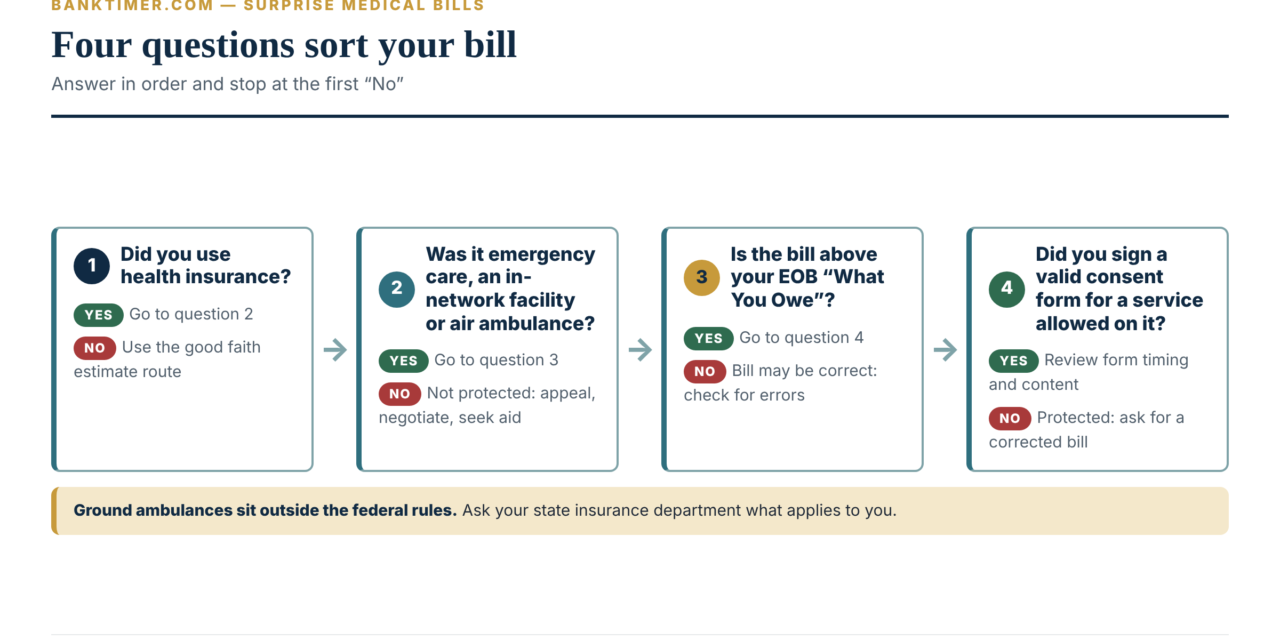
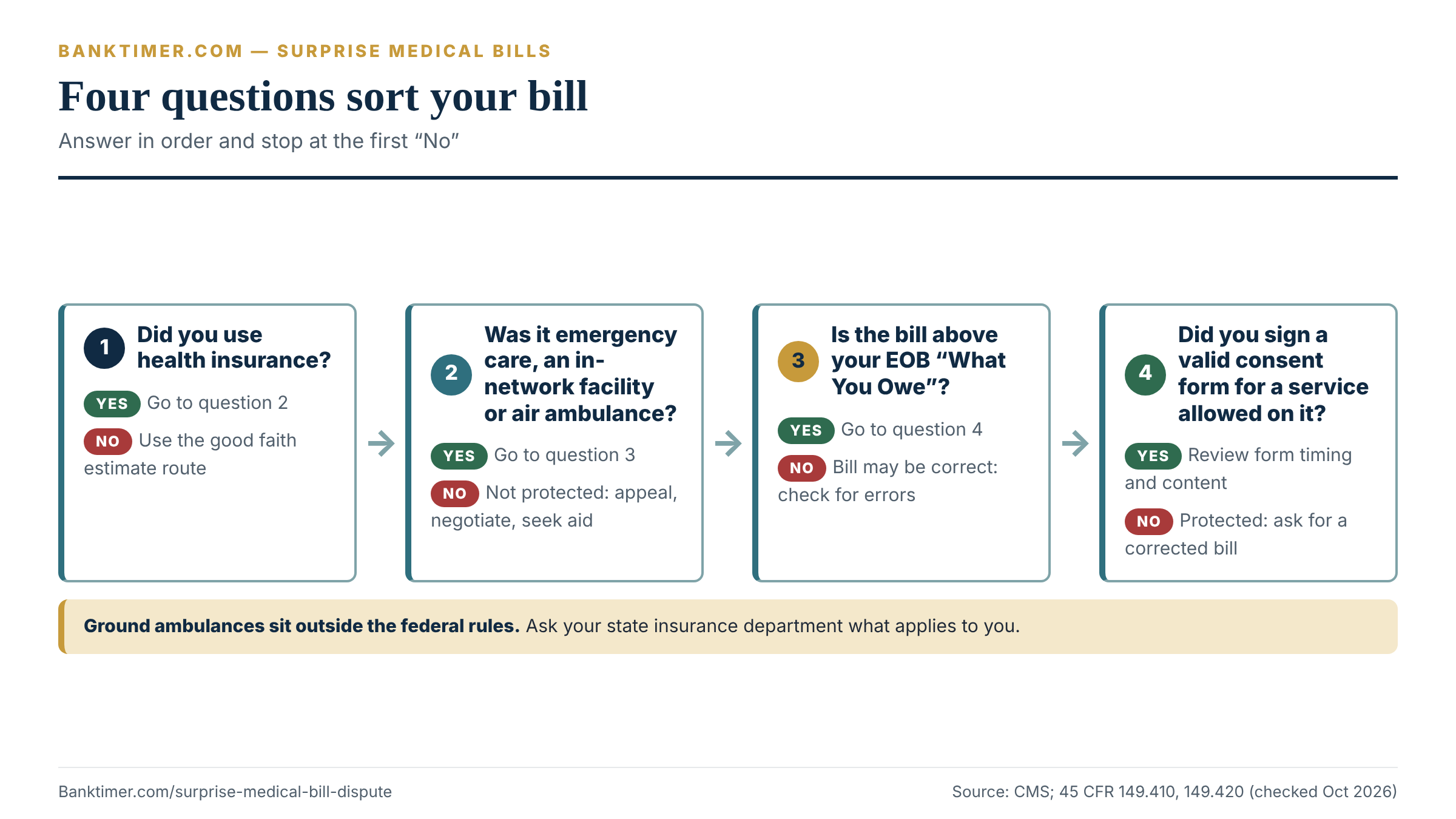
A surprise medical bill dispute works when your bill falls into a situation the No Surprises Act protects: emergency care, out-of-network providers at an in-network hospital or surgery center, or air ambulance transport. In those cases, you owe only your in-network cost sharing (copay, coinsurance and deductible), and the provider cannot bill you for the rest. Start by asking for an itemized bill and your explanation of benefits, then call the provider’s billing office and your insurer. If they will not fix it, file a complaint with the No Surprises Help Desk at 1-800-985-3059.
Your biggest variable is the type of care and the type of plan. The main risk is paying before you check. Look at your bill’s date first.
Check the category before you start a surprise medical bill dispute. Federal protection covers emergency care, certain non-emergency care at in-network facilities, and air ambulance flights. It does not cover ground ambulances.
Your share is capped at in-network levels. For a protected bill, the out-of-network provider cannot charge more than your in-network cost sharing, and what you pay counts toward your in-network deductible and out-of-pocket maximum.
Do not pay the balance bill yet. Pay nothing on the disputed amount until you have compared the bill with your explanation of benefits (EOB).
The insurer-provider fight is not yours. The federal independent dispute resolution (IDR) process settles payment between providers and plans. Patients are not parties to it.
Uninsured and self-pay patients have a separate process. If a bill runs at least $400 over your good faith estimate, you can start a dispute within 120 calendar days of the initial bill.
Keep paper. Bills, EOBs, call dates, names and confirmation numbers decide most of these cases.
What a Surprise Medical Bill Dispute Actually Covers
A surprise medical bill is usually a balance bill. That is the gap between what a provider charges and what your plan pays, billed to you. When a provider is in your network, a contract limits that gap. When a provider is out of network, no contract limits it, so the bill can be much larger than you expected.
The No Surprises Act took effect on January 1, 2022. The Centers for Medicare & Medicaid Services (CMS) describes it on its medical bill rights page as a federal law that protects you from some unexpected out-of-network bills. The word “some” matters. Federal protection applies to specific situations, not to every bill that feels unfair.
So a successful surprise medical bill dispute rests on two questions. Was this care in a protected situation? And does your bill charge more than the law allows? If the answer to both is yes, you have a strong case.
Three words that cause most of the confusion
Three terms shape every dispute, and billing offices use them without explaining them.
- Cost sharing. CMS and the regulations use this for your copayment, coinsurance and deductible. All three are cost sharing.
- Recognized amount. This is the figure your cost sharing is based on for out-of-network care. Where no state law or all-payer agreement sets it, the regulation defines it as the lesser of the qualifying payment amount or the amount billed (45 CFR 149.30).
- Qualifying payment amount (QPA). This is generally your plan’s median contracted rate for the same service in your area. You rarely see it on a bill, but it drives the math.
What you are really disputing
Most readers think a surprise medical bill dispute is about price. In practice, you are disputing a billing category. The service may have been worth every dollar of the charge. The point is that, for a protected bill, the provider may not collect more than your in-network share from you.
That is why price comparisons rarely win a surprise medical bill dispute. A coding error or an unprotected situation can sink an otherwise strong argument. The sections below help you sort that out before you open a surprise medical bill dispute.
Who Is Protected: Plan Types and Care Settings
Federal protection depends on how you pay and where you were treated. CMS says the protections apply to people with job-based coverage (including the Federal Employees Health Benefits program), Marketplace plans and other individual market coverage. Vision-only, dental-only, short-term, health care sharing ministry and fixed indemnity plans are generally excluded (CMS, I’m using insurance).
Medicare, Medicaid, Indian Health Service, VA and TRICARE patients follow different billing rules. CMS sends those patients to its action plan tool for their situation. This article focuses on private coverage and on people paying without insurance.
| Your situation | Federal No Surprises Act protection | What to use first |
|---|---|---|
| Job-based plan, Marketplace plan or other individual plan | Yes, for the three protected situations | Your EOB, then provider billing, then insurer |
| Short-term, dental-only, vision-only, fixed indemnity or sharing ministry plan | Generally no | Your plan documents and state insurance department |
| Medicare, Medicaid, VA, TRICARE or Indian Health Service | Different rules apply | CMS action plan tool and your program’s help line |
| No insurance, or choosing not to use it | Good faith estimate and patient-provider dispute process instead | Your written estimate and the dispute portal |
| Self-funded employer plan | Federal law applies; many state laws generally do not | Plan administrator, then CMS Help Desk |
The table’s key insight is the fifth row. If your employer pays claims itself, your state’s surprise billing law may not reach you. CMS notes that federal law generally preempts state laws that regulate self-insured group health plans (CMS fact sheet). The federal rule is your floor.
Why the plan type matters for who enforces
State insurance departments regulate fully insured plans. A federal agency or the CMS Help Desk handles most complaints that a state cannot. The Help Desk can review a complaint, investigate compliance with federal laws within its jurisdiction, and refer the complaint to another federal or state authority (CMS, submit a complaint).
If you are unsure which kind of plan you have, ask your employer’s benefits office whether the plan is “fully insured” or “self-funded.” The member services number on your card can also tell you. For a broader view of who oversees what, see our guide to who regulates banks, insurance and investments in the U.S..
The Three Situations the No Surprises Act Protects
CMS lists three protected situations for people with insurance, and each one anchors a surprise medical bill dispute: emergency care, non-emergency care tied to a visit at an in-network facility, and air ambulance services. Each has its own rules, so we take them one at a time.
Emergency care, including post-stabilization
For emergency services, the rule is direct. A nonparticipating emergency facility or provider may not bill you for more than the cost-sharing requirement (45 CFR 149.410). That covers hospital emergency departments and independent freestanding emergency departments.
Your plan cannot require prior authorization for emergency services. It also cannot apply stricter limits to out-of-network emergency care than to in-network care (45 CFR 149.110). You do not have to find an in-network hospital while you are having a medical emergency.
Protection continues after you are stabilized, with one narrow exception. A provider can ask you to sign a notice and consent form for post-stabilization care, but only if you can travel to an in-network provider without medical transport and can give informed consent. We cover that exception in its own section below.
Non-emergency care at an in-network facility
This is the classic surprise. You choose an in-network hospital, outpatient department or ambulatory surgical center. A provider inside that facility turns out to be out of network.
The regulation defines the facilities that count: a hospital, a hospital outpatient department, a critical access hospital and an ambulatory surgical center (45 CFR 149.30). A nonparticipating provider at one of those places may not bill you above your cost sharing unless the notice and consent rules are met (45 CFR 149.420).
Protection does not extend to a private doctor’s office or to an out-of-network facility. CMS says the rules do not apply “at other settings, such as a non-hospital doctor’s office, or at an out-of-network facility.”
Air ambulance
If you are flown to a hospital, the air ambulance provider cannot charge more than the in-network cost-sharing rate. CMS applies this to air ambulance bills from out-of-network providers. The cost sharing for air ambulance uses the lesser of the billed charge or the QPA, according to the CMS fact sheet linked above.
Ground ambulances are the gap. We discuss them in the next section because they cause more billing disputes than any other category that falls outside the law.
What the three situations look like side by side
The table compares the three situations on the same criteria. The decision-driving insight is the last column: only non-emergency care allows a consent form, and even there the form is blocked for the most common surprise-bill specialties.
| Situation | Protected from balance billing? | Your cost sharing based on | Counts toward in-network deductible and out-of-pocket maximum? | Can the provider ask you to waive protection? |
|---|---|---|---|---|
| Emergency room or freestanding emergency department | Yes | Recognized amount | Yes | Only for limited post-stabilization care |
| Non-emergency care at in-network hospital, outpatient department or surgery center | Yes | Recognized amount | Yes | Only if notice and consent rules are met, and never for ancillary services |
| Air ambulance (out-of-network provider) | Yes | Lesser of billed charge or QPA | Yes | No |
| Ground ambulance | Not under the federal act | Plan rules and state law | Depends on plan | Not applicable |
| Out-of-network doctor’s office visit you chose | No | Your plan’s out-of-network benefits | Usually separate out-of-network limits | Not applicable |
The cost-sharing counting rule comes from the statute. Under 42 U.S.C. 300gg-111, cost sharing paid for out-of-network emergency care counts toward your in-network deductible and out-of-pocket maximum, and the plan must send an initial payment or a denial notice within 30 calendar days after the bill is transmitted.
Ancillary Providers: The Specialists You Never Chose
A classic surprise bill comes from a specialist you did not pick. You chose the surgeon. You did not choose the anesthesiologist, the pathologist who read your biopsy or the radiologist who read your scan.
The regulation lists these services as ones where the consent route is closed. A provider cannot ask you to give up protection for emergency medicine, anesthesiology, pathology, radiology and neonatology services. The same applies to assistant surgeons, hospitalists, intensivists and diagnostic services including laboratory work (45 CFR 149.420(b)).
A provider also cannot use the consent route if no participating provider can furnish the service at that facility. So a signed form for any of these services does not shield the provider.
Why a signed form for ancillary services may not hold
Suppose the intake packet at your surgery center included a form that said you accepted out-of-network anesthesia charges. You signed it because it was one of 14 pages. CMS says providers cannot ask you to sign for care from assistant surgeons, hospitalists, intensivists, or for emergency medicine, anesthesiology, pathology, radiology, neonatology or diagnostic services.
If that happened to you, the form is a strong point in your surprise medical bill dispute. Keep a copy, and tell both the provider’s billing office and the Help Desk that a form was presented for a service where federal rules do not allow one.
Notice and Consent: The One Way Protection Can Be Waived
Notice and consent is the main exception to the law, and it decides many a surprise medical bill dispute. If you sign a compliant form for non-emergency care by an out-of-network provider, the provider may bill you above in-network levels. This is a legitimate choice for some patients, for example someone who wants a particular surgeon.
CMS warns that signing “means you agree to out-of-network care and give up billing protections, which may increase your costs.” It advises you not to sign for non-emergency care if an in-network option exists, even if that means rescheduling.
What a valid notice must include
The regulation sets a detailed list. The notice must state that the provider is nonparticipating, include a good faith estimate of charges, and say that the estimate is not a contract. It must also say that consent is optional and that you may choose a participating provider instead (45 CFR 149.420(d)).
Timing matters too. If the appointment was scheduled at least 72 hours ahead, the notice is due at least 72 hours before the service. If it was scheduled within 72 hours, notice is due on the day of scheduling. If you receive notice on the day of service, it must arrive no later than three hours before the service. The form must be available in the 15 most common languages in your state or region, with an interpreter if you cannot understand the available language.
Red flags on a consent form
| Red flag | Why it matters | What to ask | Safer next step |
|---|---|---|---|
| Form handed to you at check-in on the day of surgery | Late notice may not meet the 72-hour or three-hour timing rules | When was this scheduled, and when did you first send notice? | Ask to reschedule or request an in-network provider |
| Form covers anesthesia, radiology, pathology or lab work | Consent is not allowed for these services | Is this service on the excluded list? | Do not sign; report it to the Help Desk afterward if you did |
| Form bundled inside a stack of other paperwork | CMS says providers must give the form separately | Can you give me this form on its own? | Ask for a separate copy and read it at home |
| No cost estimate on the form | Required notice content includes a good faith estimate | What will the out-of-network charge be? | Ask for the estimate in writing |
| Pressure to sign now or lose the appointment | Consent must be voluntary | Is an in-network provider available? | Call your insurer to find one |
Providers must keep a signed notice and consent for at least seven years after the service (45 CFR 149.420(h)). If you disagree that you signed it, you can ask for a copy.
What the Law Does Not Protect You From
Knowing the limits saves you from a long, frustrating surprise medical bill dispute over a bill that federal law never covered. Several expensive bills fall outside the No Surprises Act. Some of them have other remedies, so “not protected” does not always mean “no options.”
Ground ambulance bills
CMS is blunt on this point: ground ambulance services “aren’t covered by billing protections in the No Surprises Act.” An out-of-network ground ambulance can still charge out-of-network rates and cost sharing, unless state law says otherwise (CMS, I’m using insurance).
That makes ground ambulance billing a state-by-state question. Check your state insurance department’s website for balance billing rules covering ambulances. Also ask your insurer how it processed the claim, and whether it can pay the bill at an in-network level in your case.
Care you chose to get out of network
If you picked an out-of-network surgeon at an out-of-network facility, the surprise is not federal. You used the plan’s out-of-network benefits, which typically carry higher cost sharing and no limit on balance billing. Your EOB will show whether the plan treated the claim as in-network or out-of-network.
Services your plan does not cover
A bill for a noncovered service is not a balance bill. It is the full price of something your plan excludes. In that case, the question becomes whether the exclusion was correct, and the route is an appeal, not a No Surprises Act complaint.
Plan types outside the rules
The coverage list we saw earlier excludes short-term, dental-only, vision-only, fixed indemnity and health care sharing ministry plans. Those plans have their own contract terms and state law. Your state insurance department can tell you what applies.
Bills that look like surprises but are normal
Many painful bills are not surprise bills at all. They come from the ordinary structure of your plan. The table separates the common look-alikes from the ones the law covers.
| What you see | What it likely is | Dispute route |
|---|---|---|
| Large bill from an out-of-network anesthesiologist after surgery at an in-network hospital | Protected balance bill | No Surprises Act; ask provider and insurer to reprocess |
| Bill equal to your full deductible after an in-network visit | In-network cost sharing | Check EOB; no dispute if it matches |
| Separate facility bill from an out-of-network emergency department | Protected balance bill | No Surprises Act; ask insurer to reprocess |
| Ground ambulance bill after an in-network ER visit | Outside federal protection | State law, insurer review, hospital or ambulance billing office |
| Bill for a service the plan denied as not covered | Coverage denial | Insurer appeal, then external review |
| Bill from a specialist office you visited by choice, out of network | Out-of-network benefits | Negotiate with the provider |
| Bill for the same service twice | Billing error | Provider billing department, itemized bill |
The key insight is that the dispute route follows the cause. A balance bill goes to the provider and the Help Desk. A denial goes to the insurer’s appeal process. A billing error goes back to the billing office.
What You Should Owe: Worked Examples
Numbers make the rule concrete. These examples are illustrative. They use made-up prices and a made-up plan, not a real quote or a real insurer’s rates. We calculated each one in a script and checked the totals.
For all examples, assume an in-network recognized amount equal to the plan’s median rate for the service (the qualifying payment amount), because no state law or all-payer model sets a different figure. In practice, the amount depends on your state and plan.
Maya goes to an in-network emergency room. The ER doctor on duty is out of network and bills $2,400. Her plan’s QPA for that service is $900. She has met her deductible, and her coinsurance is 20%.
The recognized amount is the lesser of $2,400 and $900, which is $900. Her cost sharing is 20% of $900, or $180. The plan’s initial payment to the doctor is $720.
If the doctor bills Maya for everything the plan did not pay, she receives a bill for $1,680. Only $180 of that is hers. The other $1,500 is a balance bill the law does not allow her to be charged.
Example two: the specialist you never chose
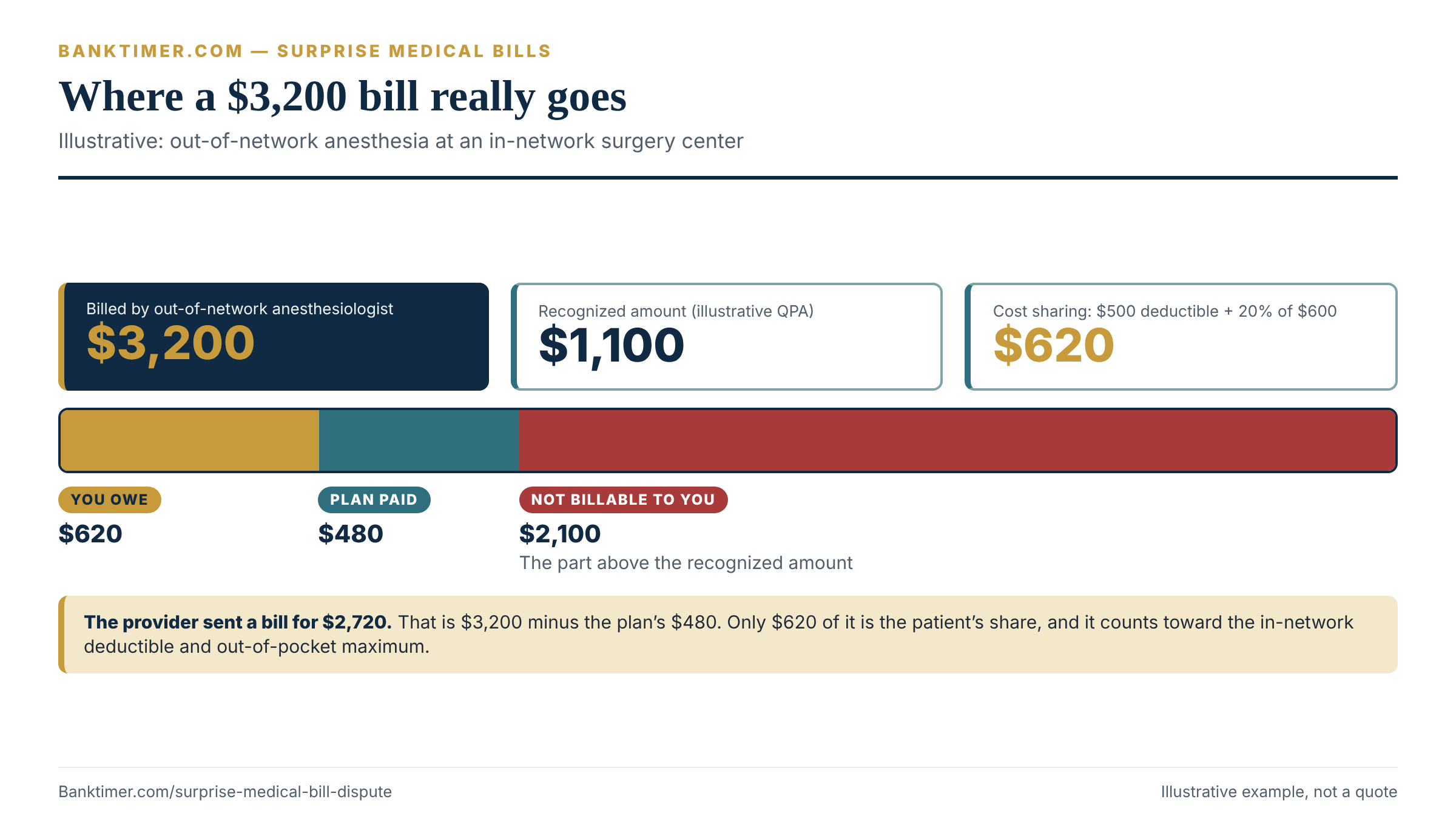
Daniel schedules a procedure at an in-network surgery center. The anesthesiologist is out of network and bills $3,200. The QPA is $1,100. Daniel still has $500 of his deductible left and pays 20% coinsurance after that.
His cost sharing is $500 plus 20% of the remaining $600, which is $120, for a total of $620. The plan’s initial payment is $480. The provider bills Daniel $2,720 for the rest.
Daniel should owe $620. The other $2,100 is the amount above the recognized amount. His $620 also counts toward his in-network deductible and out-of-pocket maximum. If he had already paid $1,800 toward a $5,000 maximum, he now stands at $2,420.
The second example shows why the EOB matters. Daniel’s EOB would show the plan’s allowed amount and “What You Owe.” If the provider’s bill is $2,720 and the EOB says $620, the gap is your surprise medical bill dispute.
Priya takes a ground ambulance from an in-network ER to a specialty hospital. The ambulance company is out of network and bills $1,650. Her plan allows $900, pays 80% ($720), and leaves her 20% coinsurance of $180.
The company then bills Priya for the $750 difference between its charge and the allowed amount. She owes $930 in total, which is 56% of the bill. No federal protection caps this unless her state law does.
How the plan’s payment to the provider works
You may wonder why the plan pays only $480 in Daniel’s example when the doctor billed $3,200. Under the statute, the plan pays the provider the difference between the out-of-network rate and your cost sharing (42 U.S.C. 300gg-111). The out-of-network rate can be a negotiated amount, a state-law amount or a figure set through federal independent dispute resolution.
That means the provider may still collect more from the plan later. What it may not do is send the remainder to you. The fight over the extra money happens between the provider and the insurer.
The scenarios side by side
| Scenario | Billed | Recognized amount | You should owe | Removed from your share | Protected federally? |
|---|---|---|---|---|---|
| Maya: ER physician (deductible met, 20%) | $2,400 | $900 | $180 | $1,500 | Yes |
| Daniel: anesthesiologist ($500 deductible left, 20%) | $3,200 | $1,100 | $620 | $2,100 | Yes |
| Priya: ground ambulance (20% of $900 allowed) | $1,650 | Not applicable | $930 | $0 | No |
The pattern is simple. Protected bills shrink to a fraction of the amount billed. Unprotected bills stay large. Priya’s ground ambulance bill is more than five times what Maya owes, even though the sticker prices are in the same range.
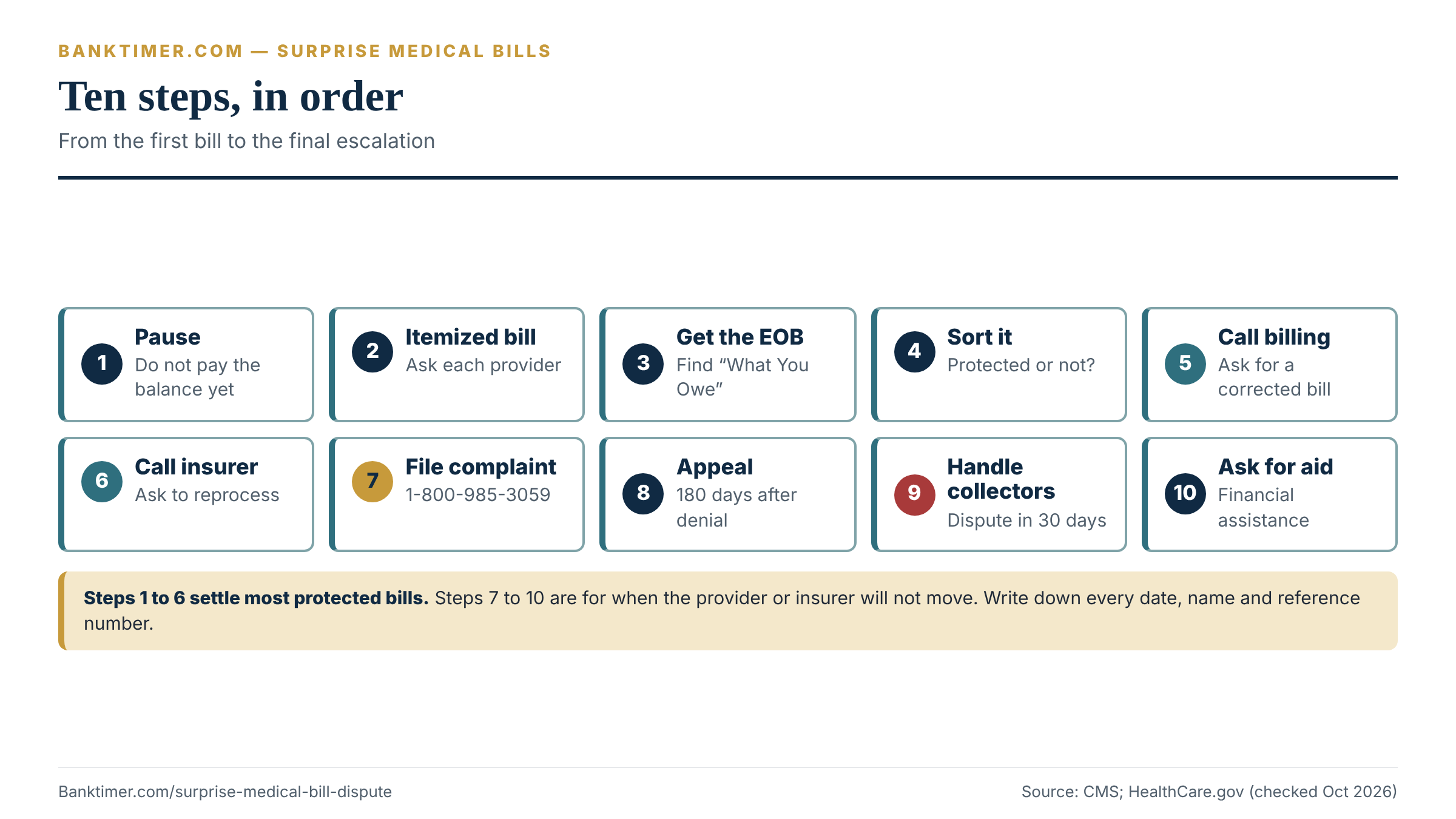
How to Dispute a Surprise Medical Bill: Ten Steps in Order
The steps below carry a surprise medical bill dispute from the first hour to the final escalation. Most people settle a protected surprise medical bill dispute in the first five or six. The later steps matter when the provider or insurer will not move.
Two rules hold throughout a surprise medical bill dispute. First, put every request in writing or follow a phone call with a short email or portal message. Second, write down the date, the name of the person you spoke with and a reference number.
Step 1: Pause, but do not ignore
Do not pay the full balance bill yet. Paying can look like agreement, and a refund takes effort to win back. Do not ignore it either, because an unanswered bill can move toward collections.
Write down three dates: the date of service, the date on the bill, and the date you received it. The date you received the initial bill starts the clock for the uninsured dispute process described later. For an insured bill, the date of the insurer’s denial notice starts your appeal clock.
Step 2: Ask for an itemized bill
A summary bill with one total hides the detail you need. Ask the provider’s billing department for an itemized bill that lists each service with its code and price. CMS suggests asking for “a list of the costs for each medical item or service you’re being billed for” (CMS, check your medical bill for errors).
Ask for the provider’s legal name and its network status with your plan too. If you had several providers at one facility, request a separate itemized bill from each. The hospital bill and the physician bills usually arrive separately.
Step 3: Get the explanation of benefits
The EOB is the insurer’s record of how it processed the claim. CMS says plainly that an EOB “isn’t a bill,” and that the bill should not be higher than the “What You Owe” or “Patient Balance” line (CMS, how to read an EOB). If the bill is higher, you have found your surprise medical bill dispute.
Check four lines on the EOB:
- Whether the claim was processed as in-network or out-of-network
- The allowed amount
- The amount the plan paid
- The amount you may owe
If an out-of-network claim at an in-network facility shows you owing more than in-network cost sharing, ask the insurer why.
Step 4: Sort the bill into a category
Use the decision tree earlier in this article. Was it emergency care? Was it care at an in-network hospital, outpatient department or surgery center? Was it an air ambulance? Was it a ground ambulance, a private office or a plan type the law excludes?
Write the category at the top of your notes. Everything you say in a surprise medical bill dispute should name it, whether you speak to the provider, the insurer or the Help Desk.
Step 5: Call the provider’s billing office
Billing staff can fix many protected-bill errors on a single call, because the problem is often an account that was never flagged. Stay polite and specific. A short script works:
- “I received a bill dated [date] for [service] on [date of service]. This was [emergency care / care at an in-network facility].”
- “My plan is [plan name]. My EOB shows an amount I owe of [amount], but this bill is for [amount].”
- “I believe this is covered by the No Surprises Act. Can you review the account for balance billing and send me a corrected bill?”
- “Please place the account on hold while you review it, and confirm that in writing.”
Ask for the name of the person you speak with. Ask when you should expect a corrected bill. If you paid more than your in-network share, ask for a refund of the difference.
Step 6: Call your insurer
Your insurer controls how the claim was processed. Ask it to review whether the claim should be reprocessed under federal protections, and ask for a written explanation if it refuses. The call goes better when you cite the EOB line you are questioning.
- “Claim number [number] shows an out-of-network provider at an in-network facility. Was this claim processed under No Surprises Act protections?”
- “What was the recognized amount, and how was my cost sharing calculated?”
- “Has the full amount I paid counted toward my in-network deductible and out-of-pocket maximum?”
If the insurer says the claim is correct, ask it to put that decision in writing. A written denial opens the formal appeal route in Step 8.
Step 7: File a complaint with the No Surprises Help Desk
If the provider keeps billing you, or the insurer refuses to reprocess a protected claim, file a complaint. You can submit it online or by phone. The Help Desk number is 1-800-985-3059, and it is open seven days a week: weekdays from 8:00 a.m. to 8:00 p.m. Eastern Time and weekends from 10:00 a.m. to 6:00 p.m. (CMS, get help).
The online form is at the CMS complaint page. It resets after 15 minutes of inactivity, so gather your documents first. CMS asks for your medical bill, a photo of your insurance card and your EOB if you have them. It also welcomes a good faith estimate, a signed notice and consent form, correspondence with your provider and any appeal decision.
After you submit, write down the confirmation number. CMS says it will contact you within 60 days if it needs more information. It gives no resolution timeline, and the page states no filing deadline. Do not wait on a complaint to protect your other deadlines.
What the Help Desk can and cannot do
The Help Desk answers questions, helps you file a complaint and points you to other agencies when federal law does not apply. It does not act as your lawyer, give medical advice or provide financial assistance. Complaints may be reviewed for compliance with federal law and referred to another federal or state authority.
Step 8: Use the insurer’s appeal process
If your insurer denied the claim, or processed it as out-of-network when the law required in-network cost sharing, you can appeal. HealthCare.gov says you must file an internal appeal “within 180 days (6 months) of receiving notice that your claim was denied” (HealthCare.gov, internal appeals).
The insurer must finish an internal appeal within 30 days if you have not yet received the service, and within 60 days if you already have. Urgent appeals move faster.
If the insurer upholds its decision, you can ask for an external review. You must request it within four months of the final denial. The reviewer decides within 45 days, or within 72 hours for urgent cases. Under the federal process, there is no charge. If your insurer uses an independent review organization or state process, the fee cannot exceed $25 per review (HealthCare.gov, external review).
These timelines come from HealthCare.gov, which describes the process for Marketplace and similar plans. A plan you receive through an employer follows federal claim rules plus any state requirements, and the details can differ. Your denial letter should state your plan’s deadlines, so follow the letter if it gives a shorter window.
Step 9: Handle collections calmly
If the bill reaches a collection agency, do not panic. A debt collector must give you validation information. Under the CFPB’s rule, your validation period ends 30 days after you receive or are assumed to receive that information (12 CFR 1006.34).
If you dispute the debt in writing within that window, the collector must stop collecting the disputed amount until it sends verification. Send the dispute by a method that gives you proof of delivery. Also tell the collector that the bill is under review for No Surprises Act protections.
CMS notes that, for the uninsured dispute process, the provider cannot send the bill to collections or threaten to once the dispute is pending, and must stop if collection has begun. For insured bills, the protection comes from the law’s prohibition on billing you above cost sharing. A collector pursuing a balance bill the law forbids is an issue to put in your Help Desk complaint.
Medical collections can also affect your credit file. Our guide to credit report errors explains how to dispute inaccurate items, and our overview of how a credit score works shows what such items can cost you. If wage garnishment is a concern, our wage garnishment guide covers what a collector can and cannot do after a court judgment.
Step 10: Ask for financial help for what remains
Some bills remain after a dispute: your real cost sharing, an unprotected ground ambulance or a noncovered service. For those, ask about help. CMS says nonprofit hospitals must give financial assistance to eligible patients who cannot afford to pay, and that care received elsewhere may still qualify (CMS, financial assistance).
Ask the hospital for its financial assistance policy, the eligibility rules, the application deadline and what happens to your bill while the application is pending. CMS also suggests asking any provider for a lower price or a payment plan.
If a payment plan is the answer, compare it with other borrowing before you take on interest. Our guide to emergency funds and our monthly budget guide can help you plan the payments. Be cautious with credit cards or loans for medical bills, since they usually carry interest that a hospital payment plan may not.
The Deadlines That Can Cost You Your Rights
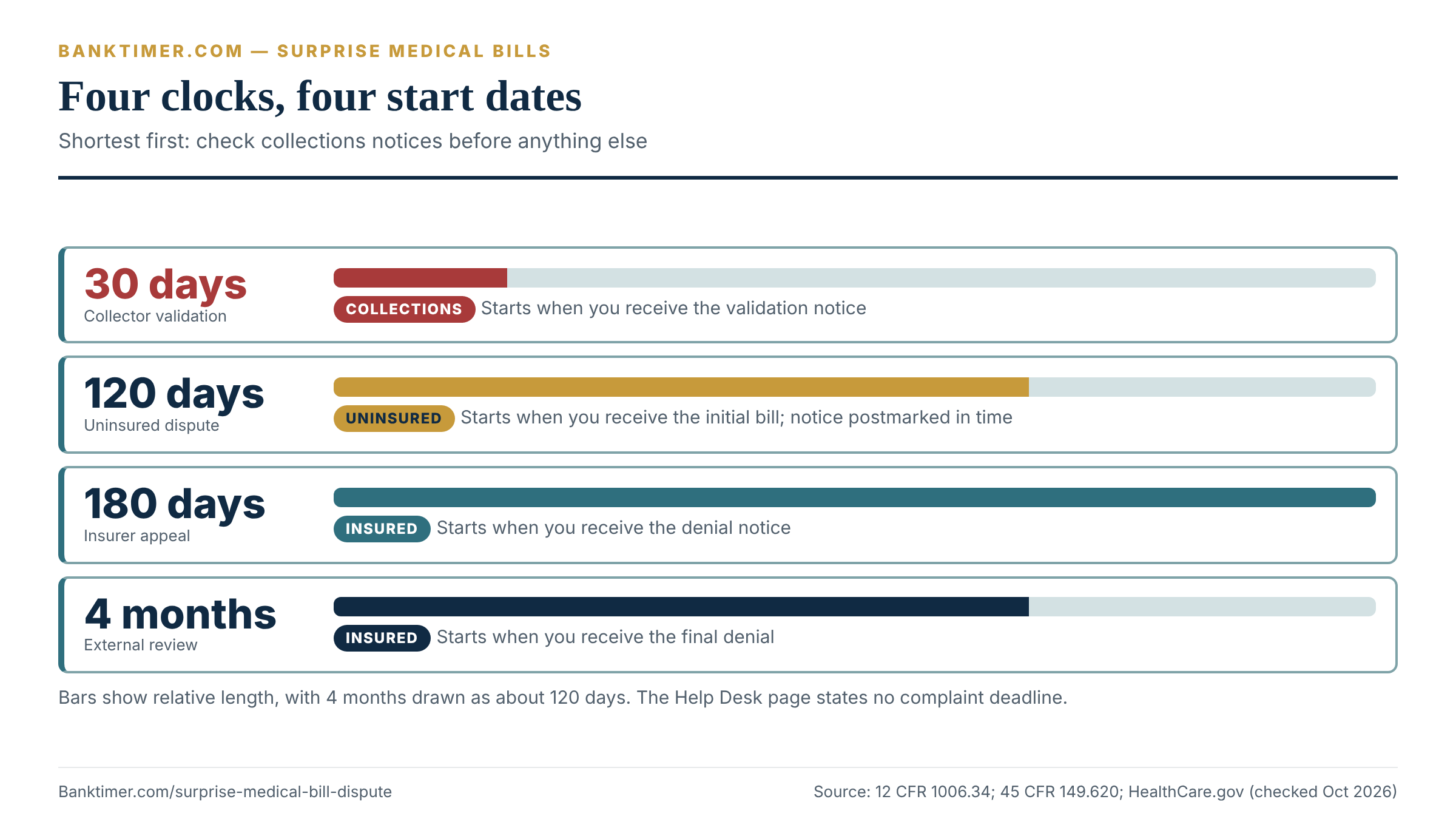
Some deadlines are firm, and others are open-ended. The firm ones are easy to miss when you are focused on the bill. The table lists the clocks that matter, with the source for each.
| Clock | Applies to | Length | Starts when | Source |
|---|---|---|---|---|
| Insurer’s initial payment or denial | Insured claims for protected services | 30 calendar days after the bill is transmitted | Provider sends bill to the plan | 42 U.S.C. 300gg-111 |
| Internal appeal | Insured, claim denied | 180 days (about 6 months) | You receive the denial notice | HealthCare.gov |
| Insurer’s appeal decision | Insured, after you appeal | 30 days before care, 60 days after care | Insurer receives your appeal | HealthCare.gov |
| External review request | Insured, after final internal denial | 4 months | You receive the final denial | HealthCare.gov |
| Debt collector validation window | Any debt in collection | 30 days after you receive the validation notice | Notice delivered | 12 CFR 1006.34 |
| Patient-provider dispute | Uninsured or self-pay patients | 120 calendar days | You receive the initial bill | 45 CFR 149.620 |
| Help Desk complaint | Any protected bill | No filing deadline stated | Not applicable | CMS |
The takeaway is that the shortest practical clock is not the 120 or 180 days. It is the collector’s 30-day validation window, and the uninsured patient’s 120-day clock. If either applies, act within weeks, not months.
Worked deadline examples
Here are three illustrative date calculations, which we checked with a script.
- You are uninsured and receive an initial bill dated October 1, 2026. Your 120 calendar days run through Friday, January 29, 2027. The notice must be postmarked within that window.
- Your insurer sends a denial notice on October 15, 2026. You have 180 days to appeal, which runs to Tuesday, April 13, 2027.
- A debt collector’s validation notice reaches you on November 2, 2026. The 30-day validation window ends Wednesday, December 2, 2026.
For a wider calendar of insurance and financial dates, see our 2027 financial and insurance deadlines calendar.
Where Independent Dispute Resolution Fits, and Why It Is Not Your Process
Search results for a surprise medical bill dispute mix up two different processes. One is the federal independent dispute resolution (IDR) process. The other is the patient-provider dispute resolution process for people without insurance. Only the second is yours.
The federal IDR process
Federal IDR decides how much an insurer must pay an out-of-network provider when the two sides cannot agree. CMS describes it as a process between providers, facilities or air ambulance providers and health plans after open negotiation fails. The parties must meet deadlines, attest to no conflicts of interest, choose a certified IDR entity and submit payment offers (CMS, overview of rules and fact sheets). The page does not describe patients as participants.
This is good news for you. The argument over how much the provider deserves from the plan happens while your balance stays at your in-network share. You cannot start a federal IDR case as a patient, and you do not need to.
What changed on August 3, 2026
A final rule on Federal Independent Dispute Resolution operations appeared in the Federal Register on June 4, 2026. It took effect on August 3, 2026. A correcting amendment followed on August 28, 2026 (Federal Register, June 4, 2026).
The rule adds disclosure requirements for plans and issuers, changes open negotiation and IDR initiation, defines bundled payment arrangements, and requires plans and issuers to register in the Federal IDR portal. It also requires plans to use remittance codes that show whether a claim is subject to No Surprises Act protections. The specific codes will be set in later guidance.
What it means for your bill
As far as the published summary shows, the rule does not change what a patient owes. The cost-sharing rules are described as existing policy, and the rule does not require the new codes on remittance information sent directly to patients. Treat the rule as a change in how providers and plans settle their side. Your protections and your dispute steps stay the same.
One practical effect may help you later. The disclosures and codes are designed to make it clearer whether a claim fell under the law. If your insurer’s paperwork refers to No Surprises Act treatment, keep it with your records.
| Process | Who uses it | Who pays the cost | Your role | Where to look |
|---|---|---|---|---|
| Federal IDR | Providers, facilities, air ambulance providers and health plans | The parties, not you | None | CMS IDR pages |
| Patient-provider dispute resolution | Uninsured and self-pay patients, and providers | You pay a $25 fee, refunded in part if you win | You start it | CMS dispute portal |
| Insurer internal appeal and external review | Insured patients | You; external review is free or capped at $25 | You start it | HealthCare.gov or your plan |
| No Surprises Help Desk complaint | Anyone who believes the rules were broken | No cost | You file it | CMS Help Desk |
The table’s takeaway is that three of the four routes are yours to start, and the fourth is not. If a billing office tells you to “go to IDR,” that is the wrong forum for a patient.
If You Are Uninsured or Paying Yourself: The Good Faith Estimate Dispute
People without insurance, or who choose not to use it, have a different protection. Providers must give you a good faith estimate of expected charges. If your bill runs far above it, you can start a patient-provider dispute. This is the only surprise medical bill dispute in this article where an independent reviewer decides your bill.
Your right to an estimate
You can get a good faith estimate when you schedule care at least three business days ahead, or when you ask for one. CMS says to get the estimate in writing, and that you do not need the exact words “good faith estimate” when you ask. Estimates cover one provider or facility at a time, so ask each one involved (CMS, I’m not using insurance).
The regulation sets the timing. If the primary service is scheduled at least three business days ahead, the estimate is due within one business day of scheduling. If it is scheduled at least 10 business days ahead, it is due within three business days. If you request it, the provider has three business days (45 CFR 149.610).
You will not get an estimate for emergency care. The law does not require one in that situation.
What the estimate must contain
The estimate must itemize services and charges, show diagnosis and service codes, and name each provider and facility. It must also state that it is not a guarantee of actual charges and not a contract. A single estimate can cover recurring services for up to 12 months. Providers must give copies of estimates issued in the past six years on request.
If the scope of care changes, the provider must issue a new estimate no later than one business day before the changed services. Keep every version.
When you can dispute the bill
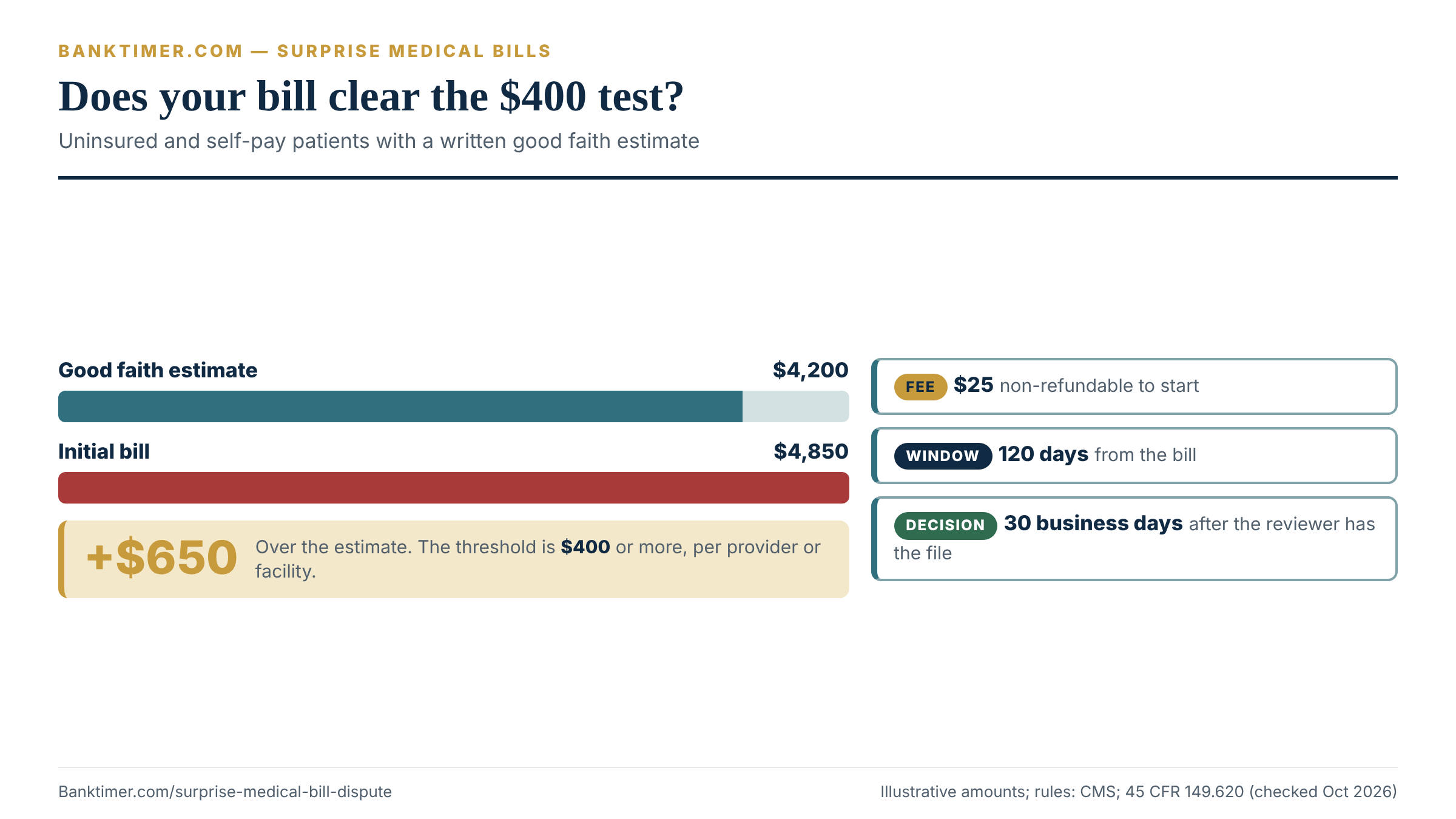
CMS lists the conditions for starting a dispute. You did not have insurance, or did not use it, and you told your provider so before care. You received care on or after January 1, 2022. You received a good faith estimate at least three days before the appointment. Your initial bill is dated within the last 120 calendar days. And a provider or facility charged at least $400 more than its estimate (CMS, dispute a bill).
The $400 threshold is judged per provider or facility listed on the estimate. A big total is not enough if each provider’s bill is within $400 of its own estimate. The regulation says eligibility is determined for each provider or facility (45 CFR 149.620).
The $25 fee and what happens next
The administrative fee is $25, it is non-refundable, and the process does not begin until you pay it. CMS accepts payment by credit card, PayPal or Venmo online, or by money order or cashier’s check by mail. It does not accept cash or personal checks.
You submit your good faith estimate, the provider’s contact information and the bill. Do not mail original documents. You can start online with a one-time PIN or by mail or fax with the billing dispute initiation form.
An independent reviewer, called a selected dispute resolution entity, decides the case. The provider has 10 business days after the entity is selected to send its documents, and the entity must decide within 30 business days after it receives the information (45 CFR 149.620).
How the reviewer decides
The regulation sets the outcomes. If the billed charge is at or below the estimate, you pay the billed charge. If the billed charge is above the estimate and the provider offers no credible justification, you pay the estimated amount. If the provider shows credible justification, such as unforeseen circumstances, you pay the lesser of the billed charge or a median payment from an independent database, but not less than the estimate.
Items that were not on the estimate get separate treatment. Without credible justification, you pay $0 for them. With it, you pay the lesser of the billed charge or the median database payment.
Sam is uninsured and receives a good faith estimate of $4,200 from a surgical facility. The initial bill is $4,850, which is $650 above the estimate. That clears the $400 threshold.
Sam pays the $25 fee and files within the 120-day window. If the reviewer finds no credible justification for the extra $650, Sam pays $4,200. The fee is deducted from what Sam owes, so the net saving is about $625.
If the bill had been $4,500, it would be only $300 above the estimate. That is below the threshold, so this process would not be available.
Protections while the dispute is pending
While the dispute is pending, the provider cannot send the bill to collections or threaten to. It must stop collection if it has started, and it cannot collect late fees. It also cannot retaliate against you for using the process (45 CFR 149.620).
You can settle with the provider before the reviewer decides. CMS says the provider must reduce the bill by at least $12.50 if you agree on an amount. If you win and the provider keeps billing you, file a complaint with the Help Desk.
| Test | What counts | Example | If you fail it |
|---|---|---|---|
| Insurance status | No insurance, or not using it, and you told the provider | Self-pay patient | Use the insured routes instead |
| Estimate | Written estimate received at least three days before care | $4,200 estimate | No process; file a Help Desk complaint |
| Gap | Bill at least $400 above the estimate, per provider | $4,850 minus $4,200 is $650 | No process at $300 over |
| Timing | Initial bill within 120 calendar days | Bill dated October 1, 2026; deadline January 29, 2027 | Process closed; negotiate directly |
| Fee | $25 administrative fee | Paid online | Process does not start |
The hard edge is the estimate. If you never received a written estimate, the process is closed to you. CMS suggests finding an action plan and submitting a complaint instead.
Where State Law and Your Plan Type Change the Answer
Federal law sets a floor for a surprise medical bill dispute, not the whole picture. States also regulate balance billing, and the mix of federal and state rules depends on your plan.
CMS explains that the amount used for your cost sharing can come from an all-payer model agreement, a specified state law, or the federal lesser-of-QPA-or-billed formula. Where a state has a specified law, the state method sets the amount. Providers must also tell patients about “any applicable state balance billing limitations or prohibitions.”
Fully insured versus self-funded plans
A plan that buys insurance from a carrier is “fully insured,” and state insurance law applies. A “self-funded” plan pays claims out of the employer’s own funds, and CMS notes that federal law generally preempts state laws that regulate self-insured group health plans. State protections typically reach only insured individuals.
So the same hospital bill can follow two different rules depending on whether your employer self-funds. In either case, the federal protections for the three covered situations apply. State law may add protection, for example for ground ambulances, only if it applies to your plan.
Who to call, by plan type
| Plan type | First contact | Escalate to | Why |
|---|---|---|---|
| Fully insured employer or individual plan | Insurer and provider | State department of insurance, then CMS Help Desk | State law may add protection |
| Self-funded employer plan | Plan administrator and provider | CMS Help Desk | State insurance law generally does not reach the plan |
| Marketplace plan | Insurer and provider | State department of insurance, CMS Help Desk, HealthCare.gov appeal | Both federal and state rules can apply |
| Uninsured or self-pay | Provider billing office | CMS dispute portal and Help Desk | Good faith estimate process applies |
You can find your state insurance department through the National Association of Insurance Commissioners (NAIC), which lists contact information for every state, the District of Columbia and the territories at its state insurance departments page. The NAIC’s complaint page explains how to file a complaint with your state department.
State rules differ widely, and we did not check every state’s balance billing law. Treat your state department as the authority on what extra protections you have. For a related look at how network rules work, see our guide to health insurance networks.
Before Your Next Procedure: Cutting the Odds of a Surprise
Most of this article deals with a surprise medical bill dispute you already face. A few habits reduce the chance you receive one. None of them replaces the legal protections, but they give you a paper trail if something goes wrong.
In-network facility does not mean in-network providers
Confirm the facility and each provider. Ask the surgeon’s office which anesthesia group, pathology lab and radiology group will be involved, then ask your insurer whether each is in network. Under the law, you are protected from balance billing for those ancillary services at an in-network facility anyway. Still, knowing the answer in advance lets you ask for an in-network option if you prefer one.
Get network answers in writing
The provider directory rules give you a useful tool. Plans must verify and update their provider directory at least every 90 days, and must update it within two business days after receiving new information. If you call and ask whether a provider is in network, the plan must answer within one business day, in writing if you ask, and keep the response for at least two years (42 U.S.C. 300gg-115).
If you rely on wrong information from the directory or the plan’s response, the plan cannot charge you more cost sharing than for a participating provider. It must also apply the in-network deductible and out-of-pocket maximum. Save the screenshot or the written reply. This protection is for you, not the provider.
Continuing care when a provider leaves your network
If your provider leaves your plan’s network in the middle of treatment, you may qualify as a “continuing care patient.” CMS says you may get up to 90 days of in-network rates in that case. The statute describes a person undergoing treatment for a serious and complex condition, and sets the 90-day period (42 U.S.C. 300gg-113). Ask your plan and provider whether you qualify.
Ask whether it is a hospital outpatient department
The word “facility” carries legal weight. The protection for non-emergency care at an in-network facility covers hospitals, hospital outpatient departments, critical access hospitals and ambulatory surgical centers. A private doctor’s office is not on that list. Before a procedure, ask where it will be billed.
Understand your plan’s cost sharing first
Protected balance billing never removes your regular cost sharing. If you do not know your deductible, coinsurance and out-of-pocket maximum, the numbers on a bill will feel like a shock even when they are correct. Our guides to the health insurance deductible and to copays versus coinsurance explain how those pieces add up. If you are choosing a plan, our employer open enrollment checklist and ACA open enrollment guide list what to compare, and the HSA versus FSA guide shows how to pay for the share you do owe with pretax dollars.
Mistakes and Red Flags That Cost Money
Some errors are easy to avoid once you know them. The table collects the ones that turn a winnable surprise medical bill dispute into an expensive one.
| Red flag or mistake | Why it matters | What to ask or do | Safer next step |
|---|---|---|---|
| Paying the full balance bill immediately | Hard to reverse; may look like agreement | Is this amount the same as the EOB “What You Owe”? | Pay only the verified in-network share |
| Assuming the first bill is final | Amounts can change once the plan finishes processing | Has the plan finished processing? | Wait for the EOB before paying |
| Skipping the EOB | You cannot tell protected from unprotected | Where is my EOB for this claim? | Request it from the insurer |
| Missing the 120-day uninsured window | Closes the dispute process | When did I receive the initial bill? | Calendar the date on day one |
| Ignoring a collection letter | The 30-day validation window passes | Did I send a written dispute? | Dispute in writing, proof of delivery |
| Signing a consent form for ancillary services | Form may not be valid for those services | Is this service on the excluded list? | Do not sign; report if you did |
| Paying someone to “erase” the bill | CFPB warns about upfront-fee scams | Is this a guarantee or upfront fee? | Use free federal and state resources |
| Treating a ground ambulance like a protected bill | No federal protection applies | What does my state say? | Contact your state insurance department |
The most expensive mistake on this list is the first one. A protected bill that you pay in full can take weeks to unwind, even when you are right.
Scams around medical bills
The CFPB has warned consumers to avoid anyone who promises to keep medical bills off a credit report or charges an upfront fee to resolve debts. That warning appears in a CFPB post that is now archived, so treat the date as 2022 and check CFPB’s current pages for updates (CFPB, know your rights).
The Help Desk and the dispute portal are free federal resources, apart from the $25 fee for the uninsured process. If a company charges you thousands to “negotiate” a protected bill, ask what it does that the Help Desk would not.
A Decision Framework: Which Route Fits Your Bill
Use this framework to pick a route for your surprise medical bill dispute. Answer the questions in order, and stop at the first one that applies.
- Did you use insurance? If not, go to the good faith estimate route and check the $400 and 120-day tests.
- Was the care emergency care, care at an in-network hospital, outpatient department or surgery center, or air ambulance? If not, treat the bill as unprotected and negotiate, appeal or seek financial help.
- Does the bill charge you more than your in-network cost sharing on the EOB? If not, the bill may be correct, and you check for billing errors instead.
- Did you sign a notice and consent form for a service that is not on the excluded list? If yes, review the form for timing and content problems. If the service was an ancillary one, the form may not hold.
- Has the provider fixed the bill after one call and one written request? If yes, confirm the correction and get a refund if you overpaid. If not, file a Help Desk complaint.
- Did the insurer process the claim wrongly or deny it? If yes, start the internal appeal within 180 days.
| If this is true | Best first move | Backup move |
|---|---|---|
| Insured, protected setting, bill above EOB amount | Provider billing office, in writing | Help Desk complaint |
| Insured, ground ambulance | State insurance department | Insurer review, financial assistance |
| Insured, claim denied | Internal appeal | External review |
| Uninsured, bill $400+ above estimate | Dispute portal within 120 days | Help Desk complaint |
| Uninsured, no written estimate | Negotiate; ask for financial assistance | Help Desk complaint |
| Collections notice arrived | Written dispute within 30 days | Help Desk complaint |
The framework works because each step eliminates one wrong route. People often skip step 2 and fight a battle the law never covered.
Documents to Keep and Questions to Ask
A surprise medical bill dispute is only as strong as your records. Start a folder, paper or digital, on the day the first bill arrives. Keep it until the account is closed and the issue is settled.
| Document | Why it matters | Where to get it | How long to keep it |
|---|---|---|---|
| Itemized bill from each provider | Shows exactly what you are charged | Provider billing office | Until the account is closed and a year after |
| Explanation of benefits | Shows how the plan processed the claim | Insurer portal or mail | Same |
| Good faith estimate (if uninsured) | Required for the uninsured dispute | Provider | Same |
| Signed notice and consent form | Shows what you agreed to | Provider or facility | Same |
| Call log with names and reference numbers | Proves what you were told | Your notes | Same |
| Denial letter and appeal decisions | Starts and documents your appeal | Insurer | Same |
| Collection letters and your dispute letter | Shows your 30-day response | Mail, certified receipt | Same |
| Provider directory screenshots or written network replies | Supports a network-information claim | Insurer website or response | Same |
The records are most useful when they are dated. A phone log with “spoke with Alex, July 12” beats a memory of “I called last summer.”
- ☐ Was this care emergency care, care at an in-network facility, air ambulance or ground ambulance?
- ☐ Does my EOB show the same amount you are billing me?
- ☐ Was this claim processed under No Surprises Act protections, and what was the recognized amount?
- ☐ Did I count my payment toward my in-network deductible and out-of-pocket maximum?
- ☐ Was I given a notice and consent form, and for which services?
- ☐ Is the provider sending this account to collections while it is under review?
- ☐ What is the deadline for any appeal or dispute that applies to me?
- ☐ Do you have a financial assistance policy, and what is its application deadline?
- ☐ Can you put this correction or refund promise in writing?
Providers cannot threaten collections while an uninsured patient-provider dispute is pending. For insured patients, billing you above cost sharing in a protected situation is itself a rule violation. If you receive such a threat, save it and include it in your Help Desk complaint.
Current Context as of October 15, 2026
For a surprise medical bill dispute on October 15, 2026, the CMS pages we reviewed gave the 1-800-985-3059 Help Desk number, the $400 threshold, the 120-day window and the $25 fee. The IDR operations rule was in effect, having taken effect on August 3, 2026. The CMS No Surprise Billing page showed a last modified date of September 10, 2026.
These details can change. The dispute fee and portal procedures are set by CMS guidance, not by the statute, so check the dispute page before you pay.
Frequently Asked Questions
Can I dispute a surprise medical bill under the No Surprises Act?
Yes, a surprise medical bill dispute works if the bill falls into a protected situation: emergency care, non-emergency care by an out-of-network provider at an in-network hospital, outpatient department or surgery center, or air ambulance. In those cases, you owe only in-network cost sharing. Start with the provider’s billing office and your insurer. If they will not correct the bill, file a complaint with the No Surprises Help Desk at 1-800-985-3059 or on the CMS complaint form.
How do I dispute a surprise medical bill step by step?
A surprise medical bill dispute starts when you ask for an itemized bill and your explanation of benefits. Compare the “What You Owe” line with the bill. Sort the care into protected or unprotected. Call the provider, then your insurer, and ask for a corrected bill in writing. File a Help Desk complaint if neither fixes it. Appeal a claim denial within 180 days. Keep dates, names and reference numbers for every contact.
Does the No Surprises Act cover ground ambulance bills?
No, so a surprise medical bill dispute over ground ambulance charges rests on state law. CMS states that ground ambulance services are not covered by the Act’s billing protections. An out-of-network ground ambulance can still charge out-of-network rates unless state law says otherwise. Check your state insurance department’s rules, ask your insurer how it processed the claim, and ask the ambulance provider and the hospital about financial assistance or a payment plan.
What can I do about an out-of-network bill at an in-network hospital?
If the provider treated you at an in-network hospital, hospital outpatient department, critical access hospital or surgery center, the provider generally cannot bill you above your in-network cost sharing. Exceptions apply if you signed a valid notice and consent form, which is not allowed for services such as anesthesiology, pathology, radiology and assistant surgeon care. Ask for a corrected bill and keep your EOB.
Do I have to pay during a surprise medical bill dispute?
Pay your verified in-network share if you can, since that is what you owe. Hold the disputed balance while the provider and insurer review it, and ask the billing office to place the account on hold in writing. For the uninsured dispute process, the provider cannot send the bill to collections while the dispute is pending. If a collector contacts you, dispute in writing within 30 days.
What is a good faith estimate dispute, and who qualifies?
It is a process for uninsured and self-pay patients whose bill runs at least $400 above a written good faith estimate from a provider or facility. You must start it within 120 calendar days of the initial bill and pay a $25 fee. An independent reviewer then decides what you owe. You cannot use the process without a written estimate.
Can patients use independent dispute resolution?
Not the federal IDR process, and a patient’s surprise medical bill dispute runs elsewhere. Federal IDR settles payment between providers, facilities or air ambulance providers and health plans. Patients do not take part. Uninsured and self-pay patients have a separate patient-provider dispute process with its own reviewer. Insured patients use the provider, the insurer, the Help Desk and the insurer appeal and external review routes.
How long do I have to start a surprise medical bill dispute?
It depends on the route. The uninsured process needs a notice postmarked within 120 calendar days of the initial bill. An insurer appeal must start within 180 days of a denial notice. External review must be requested within four months of the final denial. A collector’s validation window is 30 days. The Help Desk page states no complaint deadline, but do not wait.
Will a surprise medical bill dispute hurt my credit?
A surprise medical bill dispute can hurt if it goes to collections and is reported. Collectors generally cannot report a medical bill to the credit bureaus before trying to collect from you, and you can dispute errors on your credit report, according to a 2022 CFPB post that is now archived. Credit reporting practices for medical debt have changed over time, so check CFPB’s current guidance. Our credit report errors guide explains disputes.
What if I already paid a bill I should not have owed?
Ask the provider for a refund of the amount above your in-network cost sharing, and ask in writing. Send the EOB and the bill. If the provider refuses, add it to a Help Desk complaint and include proof of payment. Also check that your insurer counted the correct cost sharing toward your in-network deductible and out-of-pocket maximum.
Does the law protect me if I have Medicare, Medicaid, VA or TRICARE?
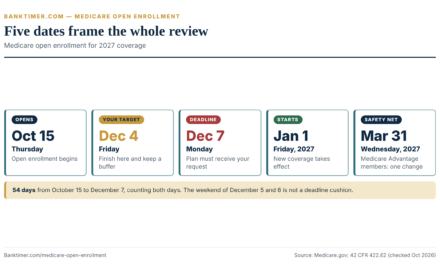
Those programs follow different billing rules. CMS directs people with Medicare, Medicaid, Indian Health Service, VA or TRICARE coverage to its action plan tool for billing issues. If you are choosing Medicare coverage this fall, our Medicare open enrollment guide explains the review window and what to compare.
Do surprise bill payments count toward my deductible?
Yes. For protected emergency and non-emergency care, cost sharing counts toward your in-network deductible and in-network out-of-pocket maximum. The rule appears in the federal regulation and the statute. If your insurer processed the claim under out-of-network accumulators, ask it to correct the accumulators and send you an updated EOB.
To start your surprise medical bill dispute, find the oldest unpaid medical bill in your pile, write the date you received it, and request the itemized bill and your EOB today. Then check the bill against the decision tree in this article before you pay anything beyond your verified share.
The variable that decides your surprise medical bill dispute is whether the care falls into a protected situation. If it was emergency care, non-emergency care at an in-network hospital or surgery center, or an air ambulance, you owe only your in-network cost sharing, and the provider has no right to send you the rest. Put that request in writing, compare the bill with your explanation of benefits, and escalate to the Help Desk if the provider will not correct it. Watch the clocks: 30 days with a collector, 120 days if you are uninsured, 180 days after a denial. The law does not protect ground ambulance bills, private-office visits you chose, plans it excludes, or services your plan simply does not cover, and it does not turn a correct deductible into a surprise. For those, negotiation, appeals and financial assistance are your tools.
Methodology
We built this guide from primary federal sources, which we read on October 15, 2026. They include the CMS medical bill rights and No Surprises Help Desk pages, the federal regulations at 45 CFR Part 149, 42 U.S.C. 300gg-111, 300gg-113 and 300gg-115, the Federal Register IDR operations rule, HealthCare.gov appeal pages and the CFPB debt collection rule at 12 CFR 1006.34. We also used an archived CFPB post for context on medical debt and credit reporting.
All dollar examples are illustrative and use made-up prices, plan terms and a made-up recognized amount. They are not quotes or live rates, and we computed them in a script. We did not test any provider, call an insurer or review a real bill.
Several points vary: your plan type, your state’s balance billing law, whether your employer plan is self-funded, the provider’s billing practices and the dates on your documents. The CMS dispute fee and portal steps are set by agency guidance and can change. We did not review every state’s law. Confirm current terms with CMS, your state insurance department and your plan before you rely on a deadline.
Sources
- Medical Bill Rights: I’m using insurance, CMS
- Medical Bill Rights: I’m not using insurance, CMS
- Dispute a bill (patient-provider dispute resolution), CMS
- Get help and the No Surprises Help Desk, CMS
- Submit a complaint, CMS
- Requirements related to surprise billing, Part I fact sheet, CMS
- 45 CFR 149.420, Balancing billing in cases of non-emergency services at certain facilities, eCFR via Cornell LII
- 45 CFR 149.610, Good faith estimates for uninsured or self-pay individuals, Cornell LII
- 45 CFR 149.620, Patient-provider dispute resolution, Cornell LII
- 42 U.S.C. 300gg-111, Preventing surprise medical bills, Cornell LII
- Federal Independent Dispute Resolution Operations, Federal Register, June 4, 2026
- Internal appeals, HealthCare.gov
- External review, HealthCare.gov
- 12 CFR 1006.34, Validation information, Cornell LII
By the Banktimer Editorial Team · Published
Banktimer is an independent U.S. consumer-finance publication. Our editors draw on primary and official sources first, such as the CFPB, FDIC, Federal Reserve, and FTC, along with statutes, regulations, and providers’ own agreements and fee schedules. Then we add worked examples and decision tools. Our goal is the most useful, best-supported explanation the sources available to us at the time of writing allow.
This article is general information, not legal, tax, investment, insurance, or financial advice, and reading it does not create a professional relationship with Banktimer. Rates, fees, limits, and rules change, and they vary by state, provider, and contract, so confirm current terms with your bank, lender, insurer, or the agency named in the article before you act. Examples are illustrative unless labeled otherwise. Banktimer is not a bank, lender, insurer, or financial advisor, and we are not responsible for decisions or losses that result from relying on this content. For advice about your own situation, talk to a licensed professional.