Copay vs coinsurance is a choice between a flat dollar amount and a percentage. A copay is a fixed fee, such as $40 per visit. Coinsurance is your share, such as 20%, of the plan’s allowed amount for a covered service.
A copay is easier to budget on routine care. Coinsurance costs less on small bills and more on large ones, until your out-of-pocket maximum stops it. The biggest variable is the deductible, because coinsurance usually starts after it and some copays do too. The main risk is judging a plan by its office-visit copay while ignoring hospital coinsurance. Read the plan’s Summary of Benefits and Coverage first.
A copay is a price tag. Coinsurance is a share. The same $40 copay stays $40 on a $200 bill or a $2,000 bill. A 20% share grows with the bill.
The crossover is simple division. Divide the copay by the coinsurance rate. A $40 copay equals 20% coinsurance on a $200 allowed amount.
The deductible comes first on many plans. If the deductible is unmet, you may owe the full allowed amount whether the plan lists a copay or coinsurance.
The out-of-pocket maximum is the real ceiling. For 2026 the federal limit is $10,600 for one person and $21,200 for a family. It rises to $12,000 and $24,000 in 2027.
Network status can outweigh both. Out-of-network care can add balance bills that never count toward your limit, unless the No Surprises Act applies.
Seven Criteria for Comparing Copay vs Coinsurance
Most articles on copay vs coinsurance define the two terms and stop. That leaves you with vocabulary but no way to choose. So we start with the yardsticks, then measure both options against each one.
We will use the same seven criteria in every section that follows. Each criterion answers a question you can ask about a real plan when you weigh copay vs coinsurance.
The yardsticks
- Predictability. Can you know the price before you walk in? A copay usually answers yes. Coinsurance depends on a price you often cannot see in advance.
- Exposure on expensive care. What happens to your share when the bill reaches $10,000 or $100,000? This is where the two structures diverge most.
- Interaction with the deductible. Does the charge start on day one, or only after you pay the deductible?
- Effect on the out-of-pocket maximum. Do your payments count toward the yearly cap, and what sits outside it?
- Where it commonly applies. Primary care, specialists, urgent care, the emergency room, imaging, surgery, hospital stays and prescriptions each tend to use one structure or the other.
- Network and allowed-amount sensitivity. Coinsurance is a percentage of the allowed amount. If you go out of network, the base and the rules both change.
- Total yearly cost. Premiums plus what you expect to pay, plus what you would pay in a bad year.
Why total cost decides copay vs coinsurance
The first six describe how a single claim behaves. The seventh describes your year. A plan with generous copays can carry a higher premium. A plan with a low premium can lean on coinsurance. Neither label tells you which one costs less for your household.
We therefore compare plans on total yearly cost in a later section, using clearly labeled illustrative numbers. For now, keep the yardsticks in mind. They make every plan summary easier to read.
What a Copay and Coinsurance Actually Are
Insurers and regulators use the terms consistently, even if plan documents do not. The federal Uniform Glossary of Health Coverage and Medical Terms, published by the Department of Labor and used in plan summaries, defines both.
Copay: a fixed dollar amount
A copayment is a fixed dollar amount you pay for a covered service, usually when you receive it. The Uniform Glossary gives $15 per visit as its example and notes that the amount can differ by type of service. HealthCare.gov adds that plans with lower monthly premiums generally have higher copayments.
Copays often show up as a single number on your insurance card: $25 primary care, $50 specialist, $75 urgent care. Prescription drugs also use copays, usually by tier.
Coinsurance: a percentage of the allowed amount
Coinsurance is your percentage share of the allowed amount for a covered service. HealthCare.gov describes it as the percentage of the cost you pay after you have met your deductible. Its example: an office visit with a $100 allowed amount and 20% coinsurance costs you $20 once the deductible is met. If the deductible is not met, you pay the full $100.
Notice the base. Coinsurance applies to the allowed amount, not the sticker price on a hospital’s bill. That distinction drives the next section.
The allowed amount: the hidden variable
HealthCare.gov defines the allowed amount as the maximum amount a plan will pay for a covered service. It may also be called an eligible expense, payment allowance or negotiated rate. In-network providers agree to accept that amount, so they write off the rest.
Suppose a clinic bills $500 and your plan’s negotiated rate is $300. Your 20% coinsurance is $60, not $100. Two plans can list the same 20%, yet charge different dollars because their negotiated rates differ.
Terms that travel with these two
Six related terms appear in every plan summary. The table shows how they connect and where readers trip.
| Term | Plain-English meaning | Why it matters here | Common confusion |
|---|---|---|---|
| Premium | What you pay monthly to keep coverage | Never counts toward your deductible or out-of-pocket limit | Low premiums often come with higher cost sharing |
| Deductible | What you pay for covered services before the plan starts paying its share | Coinsurance usually starts after it | Some copays apply before it; others do not |
| Copayment | Fixed dollar amount per service | Predictable on routine care | Whether it applies before the deductible depends on the plan |
| Coinsurance | Your percentage of the allowed amount | Grows with the bill until the cap | It applies to the allowed amount, not the billed charge |
| Allowed amount | The plan’s maximum payment for a covered service | Sets the base for coinsurance | Out-of-network allowed amounts can be lower than the bill |
| Out-of-pocket maximum | Most you pay for covered in-network care in a plan year | Ends copays and coinsurance for covered services | Excludes premiums, balance bills and non-covered services |
Our companion guide to the health insurance deductible goes deeper on that threshold. Here we focus on how the deductible changes copay vs coinsurance outcomes.
A quick vocabulary check
The terms sound similar, so readers mix them up. A copay is a fixed fee. A deductible is a threshold you reach once a year. Coinsurance is a share that continues until you hit the out-of-pocket maximum. Only the first two have a fixed dollar size you can see on your insurance card. Unlike a car insurance deductible, which applies to each claim, a health deductible usually resets once a plan year.
Copay vs Coinsurance Differences Side by Side
Here is the copay vs coinsurance head-to-head on the seven criteria. Read the table first, then the notes under it, because several cells hide an exception.
| Criterion | Copay (fixed dollar amount) | Coinsurance (percentage of allowed amount) |
|---|---|---|
| Predictability | High. The number is printed on your card. | Lower. Depends on the allowed amount, which you may not see in advance. |
| Exposure on expensive care | Flat per service, so a larger bill does not raise it. | Rises with the bill until the out-of-pocket maximum. |
| Deductible interaction | Varies. Some copays skip the deductible; others start after it. | Usually starts after the deductible is met. |
| Out-of-pocket maximum | In-network copays count toward the maximum on ACA-compliant plans. | In-network coinsurance counts toward the same maximum. |
| Common services | Office visits, urgent care, many generic drugs, some imaging. | Hospital stays, surgery, specialty drugs, out-of-network care. |
| Network sensitivity | Often unavailable out of network (HMO, EPO) or higher (PPO). | Often a higher rate out of network, applied to the plan’s allowed amount, not the bill. |
| Total yearly cost | Often paired with higher premiums. | Often paired with lower premiums and more exposure. |
Copay vs coinsurance on predictability
A copay turns a service into a price. You know a specialist visit costs $50 before you book it. That makes budgeting simple and helps people with steady, repeat care.
Coinsurance is a rate, not a price. Ask the plan for the allowed amount before a scan and it may give you a range. Ask the clinic and it may quote the sticker price. Those two numbers can differ by a wide margin.
Copay vs coinsurance on exposure
The exposure row is the one that surprises people. A copay is the same on a $200 bill and a $20,000 bill. Coinsurance on the $20,000 bill is $4,000 at 20%, unless the out-of-pocket maximum steps in first.
That does not make coinsurance a trap. It makes the out-of-pocket maximum the number to read first on any plan that uses it for big-ticket care.
What it says about the common services row
Plans do not choose one structure and apply it everywhere. Most mix them. The KFF 2025 Employer Health Benefits Survey found that the average copayment was $27 for a primary care visit and $45 for a specialist visit. For hospital admissions, 65% of covered workers had coinsurance only, 11% had a copayment only and 8% had both.
The service-by-service map of copay vs coinsurance comes later. First we need to settle how the deductible and the out-of-pocket maximum interact with both.
How Copay vs Coinsurance Works With the Deductible and the Out-of-Pocket Maximum
A copay and coinsurance rarely stand alone. They sit between two other numbers: the deductible before them and the out-of-pocket maximum after them. Misreading that sequence causes most billing surprises.
Three common sequences
Plans use at least three patterns. The same $200 allowed-amount visit costs you a different amount under each one.
| Sequence | How it works | You pay on a $200 visit, deductible unmet | You pay on a $200 visit, deductible met | Where you often see it |
|---|---|---|---|---|
| Copay, deductible waived | Flat fee from the first visit | $30 | $30 | Primary care, some prescriptions |
| Deductible, then copay | Full allowed amount until the deductible is met, then a flat fee | $200 | $30 | Specialist and urgent care on some plans |
| Deductible, then coinsurance | Full allowed amount, then a percentage | $200 | $40 (20%) | Hospital, imaging, most HDHP care |
The dollar figures are illustrative. The pattern is the point. In the first row, the deductible never touches the visit. In the second and third, a plan with a “$30 copay” can still charge $200 in January.
HealthCare.gov confirms the underlying rule. The glossary notes that many plans cover certain services, such as checkups, before you meet the deductible, and tells you to check your plan details. It also says every Marketplace plan covers certain preventive services before the deductible.
Preventive care is the exception to both
Under federal rules, Marketplace plans cover certain preventive services with no copayment or coinsurance when an in-network provider delivers them, even before you meet the deductible. HealthCare.gov adds that a $0 cost is not guaranteed in every case. A screening that turns into diagnostic testing can change how the claim is billed.
Ask the provider whether the service will be billed as preventive. Then check the explanation of benefits (EOB) afterward.
Do copays count toward the deductible?
No single federal rule decides this for every plan. Some plans apply copay dollars to the deductible. Others treat copays as a separate payment that builds only toward the out-of-pocket maximum. The plan document and the Summary of Benefits and Coverage (SBC) should say which.
For the out-of-pocket maximum, the answer is clearer. HealthCare.gov describes the limit as the most you pay for covered services in a plan year, built from your deductibles, copayments and coinsurance for in-network care. So a copay that does not reduce your deductible can still move you toward the cap.
What counts toward the maximum and what does not
The out-of-pocket maximum is a narrower promise than it sounds. The table shows what builds it and what sits outside.
| Payment | Counts toward the out-of-pocket maximum? | Note |
|---|---|---|
| In-network deductible | Yes | HealthCare.gov lists deductibles among the building blocks |
| In-network copayments | Yes | Same source |
| In-network coinsurance | Yes | Same source |
| Monthly premiums | No | Paid whether or not you use care |
| Services your plan does not cover | No | Excluded services cost 100% of the price |
| Out-of-network care | Generally no | Federal rules do not require plans to count it |
| Charges above the allowed amount (balance bills) | No | Providers outside your network may bill the difference |
| Protected surprise-bill cost sharing | Yes, toward in-network limits | Required by the No Surprises Act rules |
The last row comes from the federal rules at 45 CFR 149.110 (emergency services) and 149.120 (certain non-emergency services), and the statute behind them. Each requires plans to count protected cost sharing toward in-network deductibles and out-of-pocket maximums.
The federal ceiling on out-of-pocket costs
Most ACA-compliant plans cap what you can pay for in-network essential care. HealthCare.gov lists the Marketplace limits as $10,600 for an individual and $21,200 for a family in 2026. CMS guidance dated January 29, 2026 sets the 2027 limits at $12,000 and $24,000, a 13.2% increase for self-only coverage.
Plans can, and often do, set lower caps. These federal figures are ceilings, not what a given plan charges. Grandfathered individual plans, which date from March 23, 2010 or earlier, may not include every ACA protection, according to HealthCare.gov. If you hold an older policy, ask the insurer whether the cap applies.
The family plan twist
A family cap does not mean one person can owe the whole family amount. CMS has told insurers that the self-only limit applies to each individual, even on a family plan. In 2026, that means no single family member can be asked to pay more than $10,600 for covered in-network care.
Here is a labeled example. Suppose a family plan has a $12,000 family maximum and a $6,000 embedded individual maximum. One child’s treatment reaches $6,000 in out-of-pocket costs. She stops paying for covered care. The rest of the family still has $6,000 of the family maximum to work through before everyone stops.
Copay Accumulators and Manufacturer Coupons
Drug makers offer coupons and assistance cards that cover part or all of a patient’s copay or coinsurance. A copay accumulator program is a plan or pharmacy-benefit design that does not count that outside money toward your deductible or out-of-pocket maximum. The coupon pays, but your own clock does not move.
What the rule says today
This area has changed more than once, so precision matters.
- 2020 payment notice. The 2020 federal rule allowed plans to leave manufacturer assistance out of the annual cost-sharing limit only for brand-name drugs that have an available generic equivalent. For other drugs, the assistance had to count.
- 2021 payment notice. A later rule let plans decide for themselves whether to count it.
- September 29, 2023. In HIV and Hepatitis Policy Institute v. HHS, a federal district court in Washington, D.C. set aside the 2021 provision. The court clarified that the 2020 rule is back in effect.
- Enforcement. HHS said it would not take enforcement action based on how plans treat manufacturer assistance, and that it intends to address the question through new rulemaking.
As of October 14, 2026, the sources we reviewed describe that non-enforcement position as still in place. A legal timeline from Frier Levitt covers the 2023 ruling and HHS’s later filings. A May 2026 law-firm summary of the final 2027 payment notice does not list a provision on manufacturer assistance. Treat the federal position as unsettled and check the current status before relying on it.
What states do
About 26 states, plus the District of Columbia and Puerto Rico, restrict accumulators through laws or regulatory enforcement, according to an August 2026 news report. The restrictions vary. Some are outright bans. Others apply only when no cheaper generic exists.
Self-funded employer plans, which are regulated federally under ERISA, are generally exempt from state insurance laws. If your coverage comes from a large employer that pays claims itself, a state ban may not reach it. Your plan documents or HR team can tell you whether the plan is insured or self-funded.
How to find out whether your plan uses one
The SBC may not mention accumulators at all. Ask your plan or pharmacy benefit manager three direct questions. Does manufacturer assistance count toward my deductible? Does it count toward my out-of-pocket maximum? Does the answer change if the drug has a generic? Get the answers in writing. We run a numbers example in the decision framework section.
Where Copay vs Coinsurance Commonly Applies
Plan designers match the structure to the service. Routine, frequent and low-cost care tends to carry copays. Rare, expensive care tends to carry coinsurance. The match is a habit, not a law, so every plan needs its own check.
A map by type of care
The table summarizes common patterns. It is a guide to what to look for, not a prediction for your plan.
| Service | Common structure | Typical logic | What to verify |
|---|---|---|---|
| Primary care visit | Copay (KFF 2025 average: $27) | Low, steady price on frequent visits | Whether the deductible applies first |
| Specialist visit | Copay (KFF 2025 average: $45) | Frequent enough to price as a flat fee | Referral rules and network status |
| Urgent care | Copay or coinsurance | Varies widely by plan | Whether freestanding clinics are in network |
| Emergency room | Copay, coinsurance, or both | Varies by plan; facility and physician bills are separate | Whether a copay is waived if you are admitted |
| Imaging (MRI, CT) | Copay per test or coinsurance | Prices differ widely between sites | Allowed amount at your imaging center |
| Outpatient surgery | Copay or coinsurance (KFF 2025 average copay: $186) | Large bills, several providers | Surgeon, facility and anesthesia network status |
| Hospital stay | Coinsurance (65% of workers), copay only (11%), both (8%) | Large bills need a percentage or per-day fee | The out-of-pocket maximum and any per-day copay cap |
| Generic drugs | Flat copay by tier | Low cost, high volume | Whether a deductible applies to drugs |
| Brand and specialty drugs | Higher copay or coinsurance | High prices, formulary tiers | Tier placement and any per-fill maximum |
Those hospital percentages come from the KFF 2025 Employer Health Benefits Survey of employer-sponsored plans. They describe what workers face, not every individual policy. The survey’s average hospital coinsurance rate was 20%, and the average hospital copayment was $313.
One real-world sample of a mixed plan
The Department of Labor publishes a sample completed Summary of Benefits and Coverage for a hypothetical preferred provider organization (PPO) plan. It is a teaching document, not a market quote, but it shows how mixing works. It uses a $35 copay for primary care, $50 for a specialist visit and $50 per imaging test, a $10 copay for generic drugs, and 20% coinsurance for urgent care, emergency room services and hospital stays. Specialty drugs carry 50% coinsurance.
That copay vs coinsurance pattern is typical in structure. Small, frequent services get flat fees. Big or unusual services get percentages. The sample also carries a deductible and an out-of-pocket limit, so the percentages end somewhere.
Prescription tiers and specialty drugs
A formulary is a plan’s list of covered drugs. The Uniform Glossary notes that drugs are often grouped into tiers with different cost-sharing amounts, such as separate tiers for generic and brand-name drugs. The top tier is usually where specialty drugs sit.
That top tier is where the copay vs coinsurance choice can swing most. A flat $200 copay on a $3,000 monthly drug is a bargain. A 25% share of the same drug is $750 a month until you hit the cap. We price that case in the decision framework section.
The Crossover Math: When a $40 Copay Beats 20% Coinsurance
Neither structure always costs less. Which one wins depends on the size of the allowed amount. The crossover point is the bill at which they cost the same, and the formula is simple.
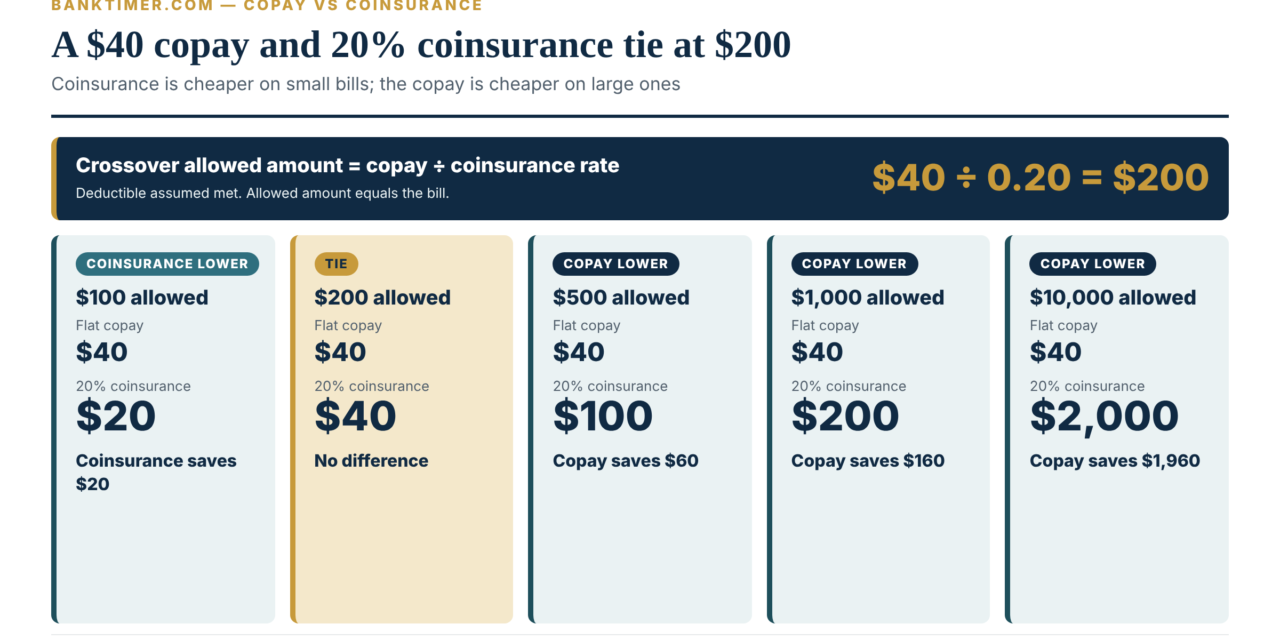
Crossover allowed amount = copay ÷ coinsurance rate.
For a $40 copay and 20% coinsurance, that is $40 ÷ 0.20 = $200. Below $200 the coinsurance costs less. Above it, the copay costs less.
A worked table: $40 copay vs 20% coinsurance
The table assumes the deductible is already met and that the allowed amount equals the bill, for simplicity. The numbers are illustrative.
| Allowed amount | Copay ($40) | 20% coinsurance | Difference (coinsurance minus copay) | Lower cost |
|---|---|---|---|---|
| $100 | $40 | $20 | -$20 | Coinsurance |
| $200 | $40 | $40 | $0 | Tie |
| $500 | $40 | $100 | +$60 | Copay |
| $1,000 | $40 | $200 | +$160 | Copay |
| $10,000 | $40 | $2,000 | +$1,960 | Copay |
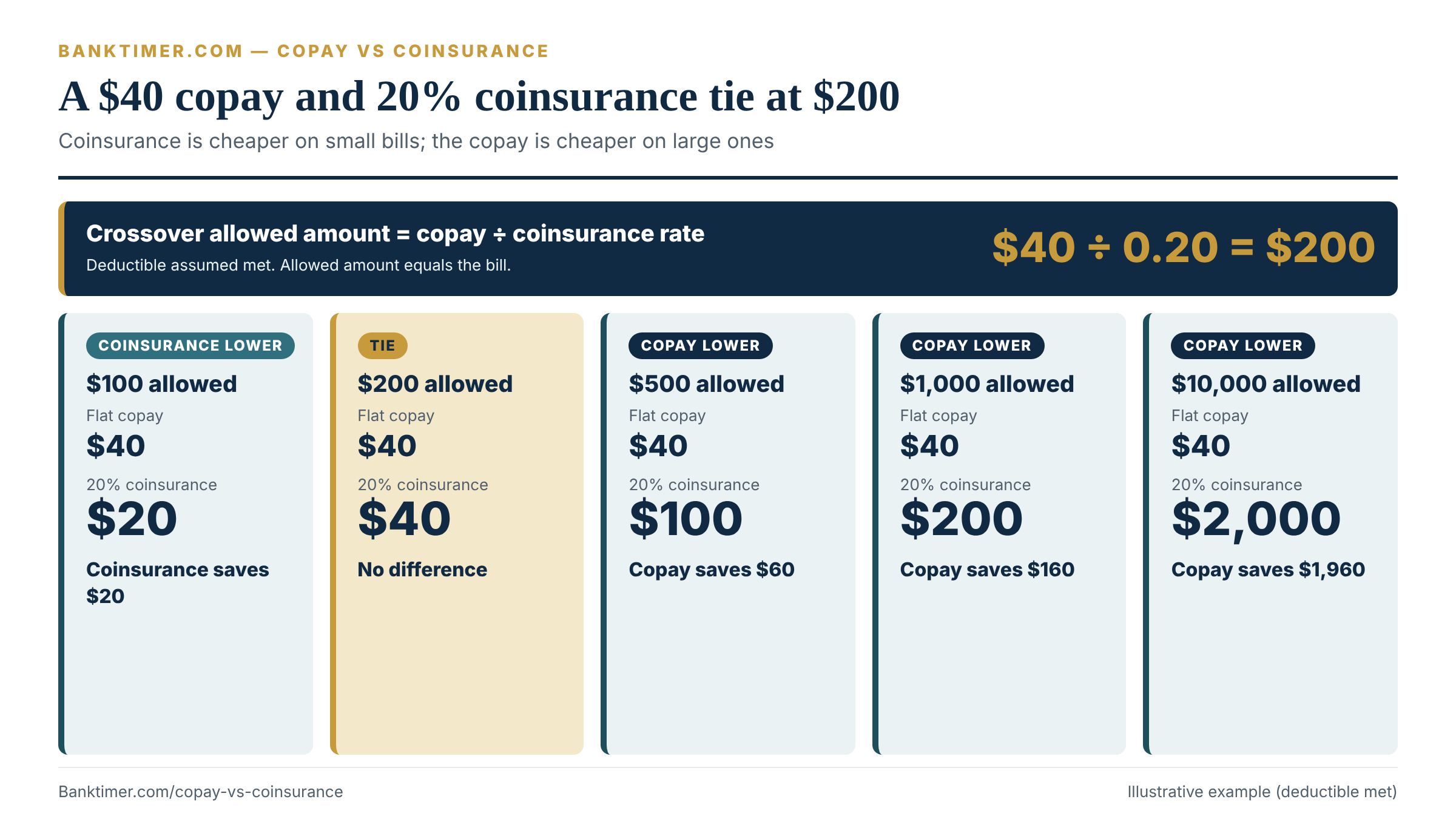
The table has two lessons. First, coinsurance is the cheaper structure on cheap care. Second, the gap widens fast. At $10,000, the difference is $1,960, which is nearly the whole cost of the percentage.
A real plan would stop the coinsurance at the out-of-pocket maximum. The $10,000 line shows what the percentage does before the cap, not what you would end up paying all year.
The allowed-amount subtlety
The crossover uses the allowed amount, not the sticker price. That changes the result. Suppose a clinic’s billed charge is $400, and the plan’s negotiated rates differ.
| Billed charge | Allowed amount | 20% coinsurance | $40 copay | Lower cost |
|---|---|---|---|---|
| $400 | $400 | $80 | $40 | Copay |
| $400 | $250 | $50 | $40 | Copay |
| $400 | $150 | $30 | $40 | Coinsurance |
The billed charge is the same in every row. Only the negotiated rate changes. A plan with deep discounts can make coinsurance cheaper even on a service that looks expensive on paper. The reverse is also true.
This is why comparing plans by percentage alone misleads. A 20% rate at a plan with strong negotiated rates can cost less than a 10% rate at a plan with weak ones. You rarely see the allowed amount before the service. After the claim, it appears on your EOB.
Crossover points for other plan designs
The same division works for any pair. The table shows where several common combinations tie. The designs are illustrative, not quotes.
| Copay | Coinsurance rate | Crossover allowed amount | Reading it |
|---|---|---|---|
| $25 | 10% | $250 | Coinsurance is cheaper below $250 |
| $40 | 20% | $200 | Coinsurance is cheaper below $200 |
| $50 | 20% | $250 | Coinsurance is cheaper below $250 |
| $75 | 30% | $250 | Coinsurance is cheaper below $250 |
| $30 | 40% | $75 | Coinsurance is cheaper below $75 |
| $150 | 20% | $750 | Coinsurance is cheaper below $750 |
Notice how often the answer lands near $200 to $250. A routine office visit can have an allowed amount near that range, so the two structures may cost about the same on primary care. The difference grows on imaging, surgery and hospital care.
The deductible changes the crossover
Everything above assumed the deductible was met. It often is not. In January, a plan with a $1,500 deductible and 20% coinsurance charges the full allowed amount on most services. A $40 copay plan might still charge $40.
The crossover therefore shifts through the year. Early on, copays win more often when they skip the deductible. Later, when the deductible is satisfied, coinsurance on small bills can look cheaper. A single comparison at one moment in the year is incomplete.
Example: A Three-Visit Month Under Copay vs Coinsurance
Let us run one month with three visits. The allowed amounts are illustrative: $140 for primary care, $260 for a specialist and $230 for urgent care, totaling $630. Compare a copay design with a coinsurance design.
The copay design charges $25 for primary care, $50 for the specialist and $75 for urgent care, with no deductible on these services. The coinsurance design charges 20% after a $1,500 deductible.
The copay design costs $150 whenever the visits happen. The coinsurance design costs $630 if the visits come before the deductible is met, because you owe the full allowed amount. It costs $126 if the deductible is already met. If only $300 of the deductible remains, it costs $366.
The calendar matters more than the rate. The coinsurance design costs $504 more in January than in a month after the deductible is met. The copay design never moves. Households with steady monthly care often prefer that stability, even when the average cost is similar.
Now the other side. If you rarely use care, the coinsurance design may cost less over the year because you pay nothing until you need something. The next section shows the same trade-off on an expensive stay.
A $25,000 Hospital Stay: Where the Out-of-Pocket Maximum Does the Work
Small-bill math is easy. The harder test is a big claim. Take a three-day, in-network hospital stay with an allowed amount of $25,000, including facility and physician charges.
The assumptions are illustrative, and they stay fixed throughout this section:
- Deductible: $2,000, unmet at admission.
- Coinsurance: 20% of the allowed amount after the deductible.
- Out-of-pocket maximum: $5,000 for the plan year, well below the federal ceiling.
- Network: every provider is in network, so there are no balance bills.
The coinsurance plan, step by step
You pay the deductible first. Then you pay 20% of what remains, but only until total spending hits the cap. The table traces each step.
| Step | Calculation | You pay | Running total |
|---|---|---|---|
| 1. Deductible | You pay 100% of the first $2,000 | $2,000 | $2,000 |
| 2. Coinsurance, uncapped | 20% of the remaining $23,000 would be $4,600 | $4,600 (not reached) | $6,600 (not reached) |
| 3. Coinsurance, capped | The $5,000 maximum leaves $3,000 of room | $3,000 | $5,000 |
| 4. Plan pays | $25,000 minus $5,000 | $0 | Plan covers $20,000 |
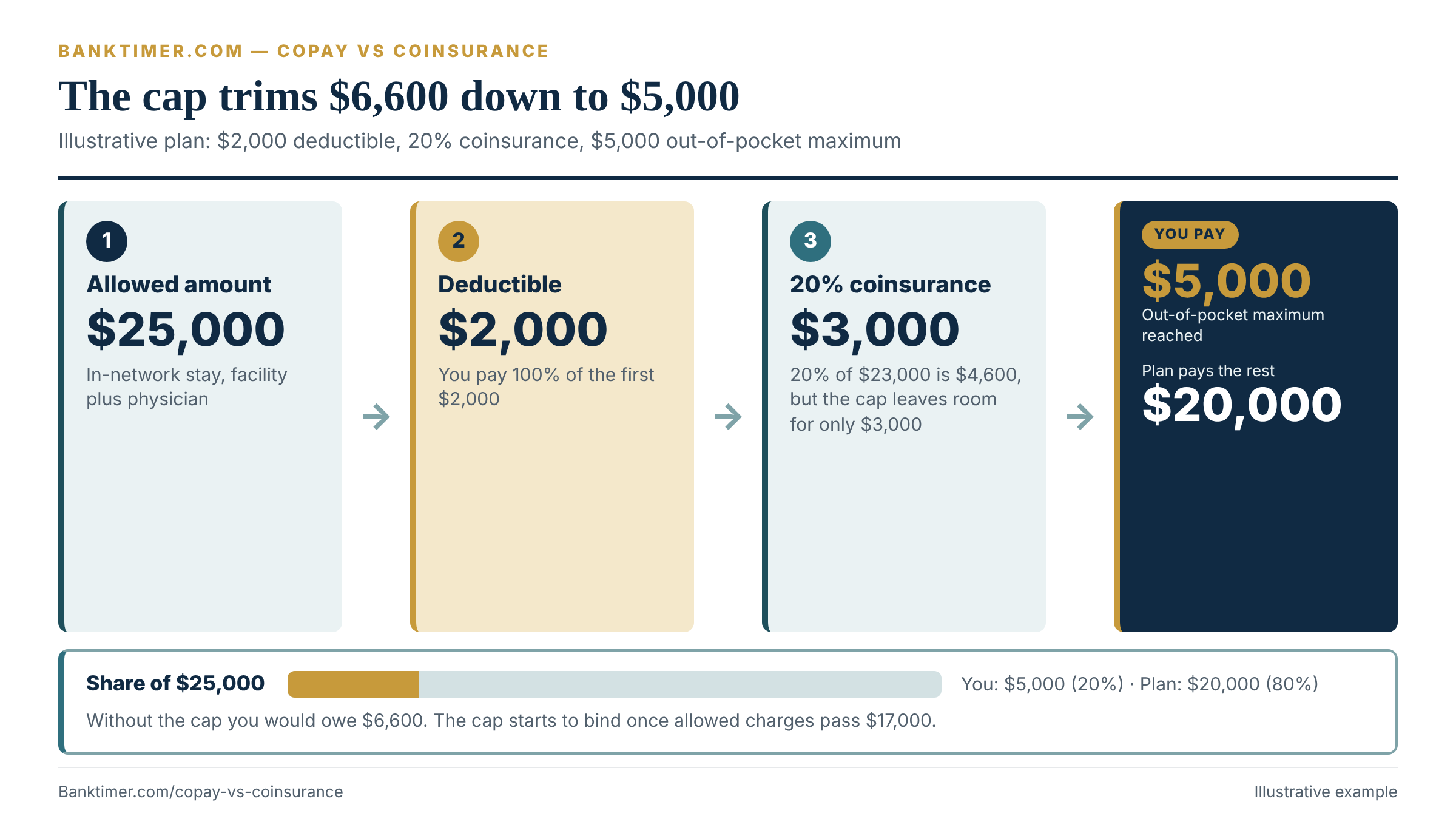
Without the cap, the stay would cost you $6,600. The maximum saves $1,600. In this example the plan pays $20,000, which is 80% of the allowed amount, and you pay $5,000.
Where the cap starts to bind
The maximum matters once total allowed charges reach $17,000. That is $2,000 for the deductible plus $15,000 of charges at 20%, which produces $3,000 of coinsurance. Beyond $17,000 of allowed charges, every additional covered dollar is paid by the plan.
At $10,000 of allowed charges, you would pay $2,000 plus 20% of $8,000, or $3,600. At $17,000 you reach the full $5,000. At $100,000, you still pay $5,000. The percentage in the plan summary describes the middle of the range, not the ends.
The same stay under a copay-style design
Some plans charge a flat fee for a hospital admission. The sample here is a $500 copay per admission, with no deductible on inpatient care. That is illustrative and higher than the KFF 2025 survey’s average hospital copayment of $313.
On the same $25,000 stay, you would pay $500. The gap in this copay vs coinsurance example is $4,500. If that were the whole story, the copay plan would always win. It is not the whole story, because the plans usually have different premiums.
Premiums Change the Verdict: Three Different Years
A plan summary lists cost sharing and premiums in separate places. You pay for both. To compare fairly, add the premium to what you would pay out of pocket in each kind of year.
The assumptions
Two illustrative plans, one household, three kinds of years. Allowed amounts per service are $140 for primary care, $260 for a specialist, $230 for urgent care, $20 per generic fill, $1,200 for an MRI and $25,000 for a hospital stay.
- Copay-heavy plan: $660 a month ($7,920 a year). Copays of $25 primary care, $50 specialist, $75 urgent care, $10 generic, $100 MRI and $500 per hospital admission. No deductible on these services.
- Coinsurance-heavy plan: $500 a month ($6,000 a year). A $2,000 deductible that covers all services, then 20% coinsurance, with a $5,000 out-of-pocket maximum.
The premium gap is $1,920 a year. That is what the extra cost sharing is worth in this example.
Three years, same two plans
The household has a quiet year, a busy year and a hospital year. The quiet year has two primary care visits, one urgent care visit and twelve generic fills. The busy year adds six specialist visits, four more primary care visits, one more urgent care visit and one MRI. The hospital year is the busy year plus the $25,000 stay.
| Year | Total allowed charges | Copay-heavy plan: out of pocket | Copay-heavy plan: with premium | Coinsurance-heavy plan: out of pocket | Coinsurance-heavy plan: with premium | Cheaper plan |
|---|---|---|---|---|---|---|
| Quiet | $750 | $245 | $8,165 | $750 | $6,750 | Coinsurance, by $1,415 |
| Busy | $4,300 | $820 | $8,740 | $2,460 | $8,460 | Coinsurance, by $280 |
| Hospital | $29,300 | $1,320 | $9,240 | $5,000 | $11,000 | Copay, by $1,760 |
The result flips with the year. The coinsurance-heavy plan wins two of three years because its lower premium covers its higher cost sharing. The copay-heavy plan wins only in the year with a large claim.
How often does the big year have to come?
You can solve for the break-even. Holding every other year quiet, the copay-heavy plan costs $1,415 more in a quiet year and saves $1,760 in a hospital year. That makes the break-even about 45%: a hospital-sized year in roughly four of every nine years.
Most households do not expect that. But the figure is not a prediction. It is a way to see how much risk the extra premium is buying. If a single hospital year would strain your savings, the copay-heavy plan is buying protection you may value beyond its expected cost.
What the table leaves out
The worst case also differs. With a $5,000 cap on both plans, the coinsurance-heavy plan tops out at $11,000 for the year including premiums. The copay-heavy plan tops out at $12,920 if it also reaches the cap. Where cost sharing is flat, it may never reach the cap, and the result depends on how many services you use.
The table also ignores factors you cannot price here: network breadth, drug coverage, an employer premium contribution and a health savings account. Treat it as a method, not a verdict. Our guide to building a monthly budget shows how to pencil in the premium plus a realistic out-of-pocket line, and our emergency fund guide covers how much cash to hold against the deductible. If you set the money aside in advance, a high-yield savings account or a sinking fund keeps it separate from everyday spending.
In-Network vs Out-of-Network: Allowed Amount, Balance Billing and the No Surprises Act
In copay vs coinsurance terms, a plan’s promise is about in-network care. Step outside the network and the base, the rate and the protections can all change. This is where a modest percentage turns into a large bill.
Network type decides what out-of-network even means
HealthCare.gov describes four common plan types. HMO and EPO plans generally do not cover out-of-network care except in an emergency. PPO plans let you see out-of-network providers without a referral, at an additional cost. POS plans charge less in network and require a referral from your primary care doctor for specialists.
So the first question is not “copay or coinsurance?” It is “which providers are in my network, and what does my plan do if I leave it?” The provider directory is the starting point. Directories can be out of date, so confirm with the provider and the plan before a scheduled service.
Billed amount, allowed amount and balance billing
Three numbers appear on most claims. The billed amount is what the provider charges. The allowed amount is the most the plan will recognize. The balance bill is the gap, and only some providers can send it.
HealthCare.gov defines balance billing as a provider charging you the difference between its charge and the allowed amount. Its example: a $100 charge and a $70 allowed amount leaves $30. The Uniform Glossary adds that this most often happens with out-of-network providers and that network providers may not balance bill you for covered services.
One $1,000 bill, three outcomes
The scenario below uses illustrative numbers. An in-network provider has a contracted rate of $600 for a service it bills at $1,000. The plan charges 20% coinsurance in network and 40% out of network. We assume the plan’s out-of-network allowed amount is the same $600.
| Situation | Billed | Allowed | Your coinsurance | Balance bill | You pay | Counts toward in-network cap? |
|---|---|---|---|---|---|---|
| In-network provider | $1,000 | $600 | $120 (20%) | $0 (provider writes off $400) | $120 | Yes |
| Out-of-network by choice | $1,000 | $600 | $240 (40%) | $400 | $640 | No |
| Emergency, protected by the No Surprises Act | $1,000 | $600 | $120 (in-network rate) | $0 | $120 | Yes |
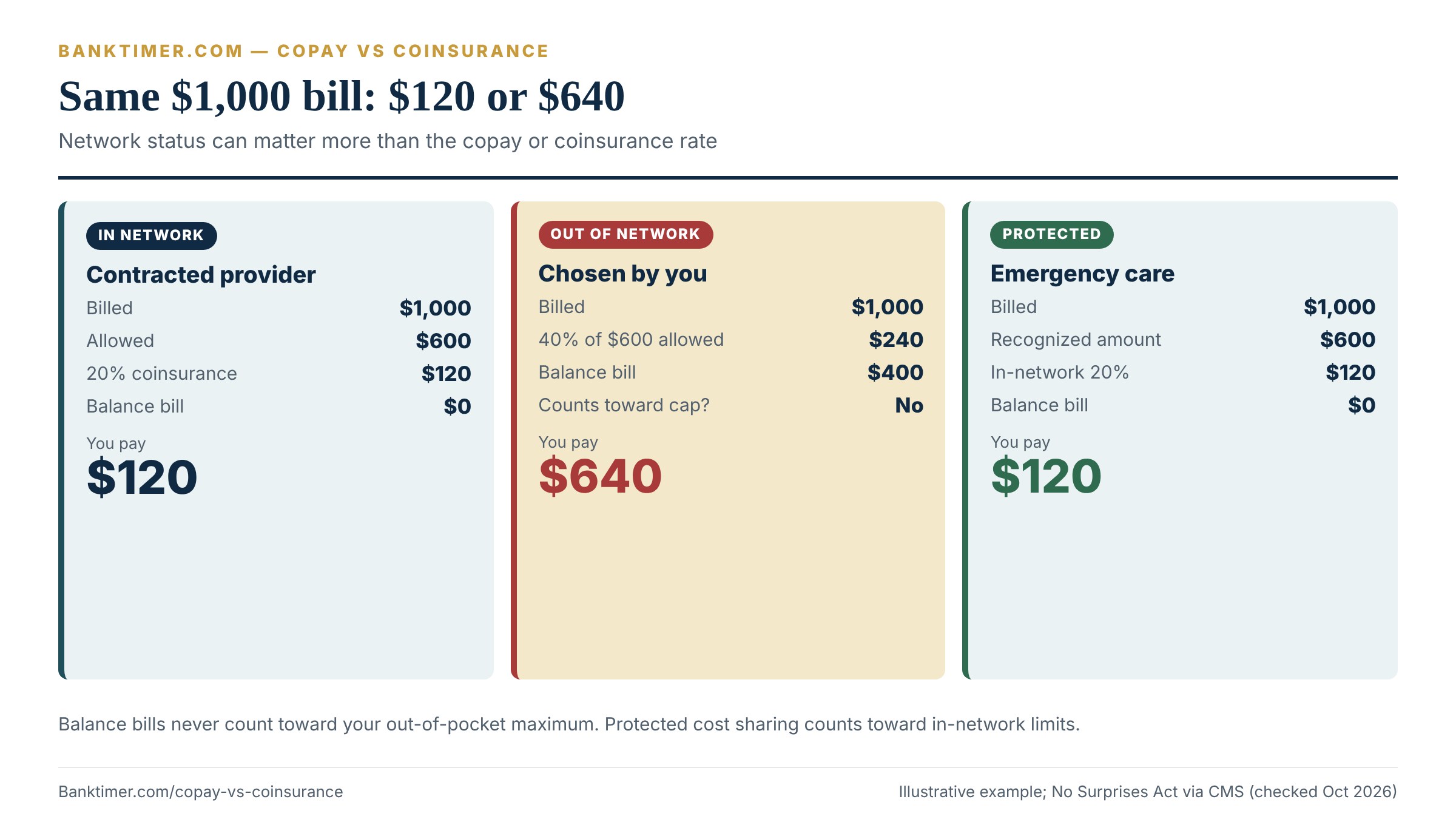
Network status can swamp the copay vs coinsurance choice. The out-of-network line costs more than five times the in-network line. Most of the $520 difference is the $400 balance bill, which sits outside the plan entirely. The higher coinsurance rate adds the other $120.
In practice, plans calculate out-of-network allowed amounts in different ways, and some set them lower than the in-network rate. This example holds them equal to isolate the balance-bill effect.
What the No Surprises Act Covers, and What It Does Not
The federal No Surprises Act, which applies to most types of health insurance, limits surprise out-of-network bills. CMS describes it as protecting you from unexpected out-of-network bills for emergency room visits and for certain non-emergency care at in-network hospitals, hospital outpatient departments and ambulatory surgical centers. It also covers air ambulance services.
The cost-sharing rule
For protected services, your cost sharing generally cannot exceed what you would pay in network. The statute and the Department of Health and Human Services rules calculate it as if the total charge were the “recognized amount.” That amount depends on the state: a specified state law, the plan’s qualifying payment amount, or an all-payer model agreement.
The rule also requires plans to count what you pay toward your in-network deductible and in-network out-of-pocket maximum. The rules apply to plan years that began on or after January 1, 2022.
The services and situations table
Protection depends on where you were treated, who treated you and how you got there. The table sorts common cases.
| Situation | Federal protection? | What you generally pay | Notes |
|---|---|---|---|
| Emergency care at an out-of-network hospital | Yes | In-network cost sharing | Plan must cover the same emergency services it covers in network |
| Out-of-network anesthesiologist at an in-network hospital | Yes | In-network cost sharing | Cannot be waived by a consent form |
| Out-of-network surgeon at an in-network surgery center | Yes, unless you give valid notice and consent | In-network cost sharing, or balance bill if you consent | Consent has timing and content requirements |
| Air ambulance | Yes | In-network cost sharing | Applies when the plan covers air ambulance |
| Ground ambulance | No federal protection | Plan terms and any state law | The act directed a federal advisory committee to study the issue |
| Elective care you choose at an out-of-network provider | No | Out-of-network cost sharing plus balance bill | You chose the provider |
| Out-of-network facility for non-emergency care | No | Out-of-network cost sharing plus balance bill | Protection covers providers at in-network facilities |
Two details deserve emphasis. The first is that ground ambulance is outside the federal protections, according to KFF. The second is that state law can fill gaps, but coverage varies, and self-funded employer plans are generally outside state insurance laws.
Notice and consent: the exception
Some out-of-network providers at an in-network facility can ask you to waive the protection. They must give written notice and get your consent. For appointments scheduled at least 72 hours ahead, the notice is due no later than 72 hours before the service, according to 45 CFR 149.420.
Many services cannot be waived at all. Under that regulation, the exception does not apply to emergency medicine, anesthesiology, pathology, radiology, neonatology, assistant surgeons, hospitalists or intensivists. Diagnostic services such as radiology and laboratory work are also excluded, as are services for unforeseen, urgent medical needs.
Read any form that asks you to give up billing protections. If you cannot tell what you are agreeing to, ask for the provider’s in-network alternatives and the estimated charge before signing.
If a surprise bill arrives
Compare the bill to your EOB. CMS notes that an EOB is not a bill and that your provider’s bill should not exceed the patient balance shown on it. If it does, call the provider first, then your plan.
CMS says you can submit a complaint about a facility, provider or insurer that may not be following the rules, or call 1-800-985-3059. If you are uninsured or paying yourself, providers generally must give a good faith estimate when you ask for one or schedule care at least three business days ahead. You may be able to dispute a bill that is at least $400 above that estimate.
How to Read a Summary of Benefits and Coverage (SBC)
The Summary of Benefits and Coverage is the most useful document most people never open. HealthCare.gov calls it an easy-to-read summary that lets you make apples-to-apples comparisons of costs and coverage between health plans. Federal rules require a standard format, so every plan’s SBC looks the same.
Your right to one
Under the Department of Labor’s rule for group health plans at 29 CFR 2590.715-2715, an SBC must run no more than four double-sided pages in a font no smaller than 12 points. It must describe your deductible, copayments and coinsurance for each benefit category, along with exceptions and limitations. It must also include coverage examples and a web address and phone number for the glossary.
You do not have to wait for open enrollment to see one. The table shows when the rule requires delivery.
| Stage | When the SBC is due | Who controls it | What you do |
|---|---|---|---|
| Shopping or applying | Issuer must provide it to a group plan within 7 business days of an application | Insurer or employer | Ask for the SBC of every option you are considering |
| Enrollment | With enrollment materials, or by the first day you are eligible | Employer plan | Compare options before the enrollment window closes |
| Automatic renewal | At least 30 days before the new plan year, with some exceptions for insured plans | Plan | Compare the new SBC with last year’s |
| Renewal requiring an application | When the renewal materials are distributed | Plan | Check for changed deductibles and copays |
| Special enrollment | By the summary plan description deadline, 90 days from enrollment | Plan | Request it earlier if you need to choose |
| On request | Within 7 business days | Plan or issuer | Ask in writing and keep a copy |
The four parts of an SBC
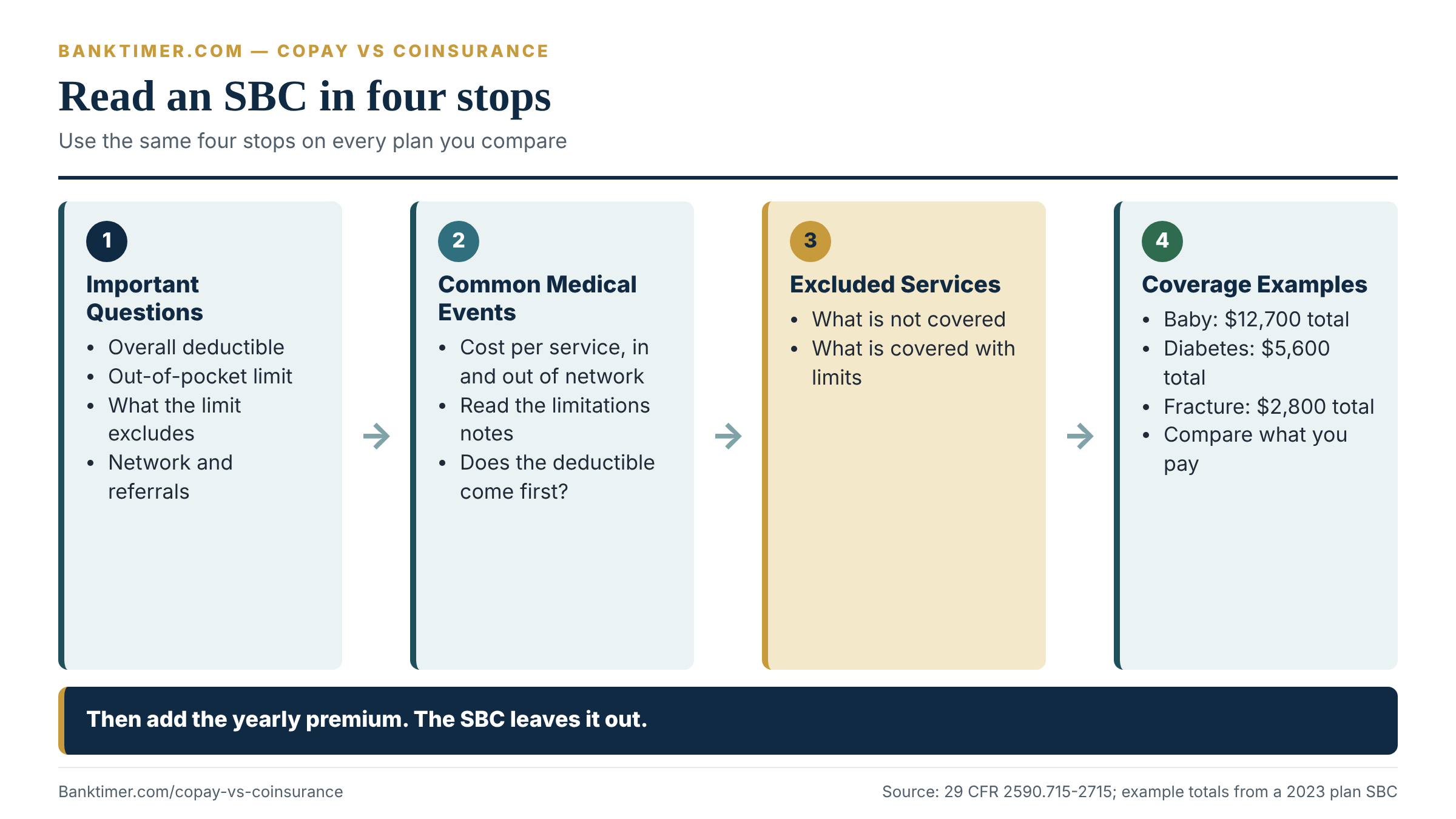
An SBC has four major sections: Important Questions, Common Medical Events, Excluded Services and Other Covered Services, and Coverage Examples. Each answers a different part of the copay vs coinsurance question.
- Important Questions tells you the overall deductible, whether specific services have their own deductibles, the out-of-pocket limit, what the limit excludes and whether you need a referral to see a specialist.
- Common Medical Events lists typical services in rows, with columns for your cost in network and out of network, plus limitations and exceptions.
- Excluded Services and Other Covered Services names what the plan will not cover and what it covers only in limited ways.
- Coverage Examples shows what a sample patient would pay for a set scenario under this plan.
Read the first block before the cost table
Start with the deductible, the out-of-pocket limit and what the limit excludes. Those lines tell you how far the copays and coinsurance in the next table can run. Then read the Common Medical Events table with one question in mind: does the number in this row apply before or after the deductible?
Check the notes in the limitations column for any statement about the deductible. If the SBC is silent, ask the plan in writing. A $30 specialist copay that applies only after a $3,000 deductible is not a $30 specialist visit in February.
Reading the coverage examples
The coverage examples are the part of the SBC built for comparison. Regulation allows up to six examples, and they cover common situations such as pregnancy and serious or chronic conditions. The plan or issuer estimates what an individual might pay after applying cost sharing, exclusions and other limits.
In the 2023 employer SBC reviewed below, the three scenarios carry total example costs of $12,700 for having a baby, $5,600 for a year of routine type 2 diabetes care and $2,800 for an in-network emergency room visit and follow-up care for a simple fracture. The totals are fixed by the SBC template, so only the patient share changes between plans.
What one real SBC shows
A 2023 employer-plan SBC, posted by the City of Dover for a consumer-directed gold option, breaks down each example. The plan has a $1,500 deductible and 10% coinsurance on the services the examples use. The patient shares look like this.
| Example | Total example cost | Deductible | Copays | Coinsurance | Not covered | You pay | Deductible as share of what you pay |
|---|---|---|---|---|---|---|---|
| Having a baby | $12,700 | $1,500 | $10 | $1,100 | $60 | $2,670 | 56% |
| Type 2 diabetes | $5,600 | $1,500 | $500 | $40 | $20 | $2,060 | 73% |
| Simple fracture | $2,800 | $1,500 | $10 | $100 | $0 | $1,610 | 93% |
The pattern is the lesson. In a plan with a $1,500 deductible, the deductible is the largest piece of every example. For the fracture, 93% of what the patient pays is the deductible. Copays and coinsurance barely register.
Use that pattern when you compare. If two plans have the same copays, the one with the lower deductible can produce a much smaller total in the examples. The examples are not a cost estimator, as the SBC itself notes, but they let you compare plans on identical assumptions.
What the coverage examples cannot tell you
The examples assume in-network care and typical treatment. They do not model your drugs, your specialists or your out-of-network risk. A plan can look good in all three scenarios and still be a poor fit for a household with a high-cost specialty drug.
Use the examples to rank plans, not to forecast your year. Then add the premium for each plan before you decide, because the SBC leaves it out.
Plans That Combine Copays and Coinsurance
Few plans are pure. Most combine flat fees for routine care with percentages for big-ticket care, and a single claim can use both. That makes the combined structure the real subject of any copay vs coinsurance decision.
How a mixed plan prices one claim
An emergency room visit is the classic mix. The facility may charge a flat copay while the physician and the imaging center bill separately and trigger the deductible and coinsurance. Here is an illustrative claim.
The plan charges a flat $300 emergency room copay for the facility. The physician’s allowed amount is $700 and a CT scan’s allowed amount is $1,100. Both are subject to the deductible and then 20% coinsurance. The deductible is $2,000.
If you have not met the deductible, you pay the $300 copay plus the full $1,800 for the physician and scan, for $2,100. If you have met it, you pay $300 plus $140 (20% of $700) plus $220 (20% of $1,100), for $660.
The $1,440 gap between those two results comes entirely from the deductible, not from copay vs coinsurance. The copay did not change. This is why reading the copay alone misleads you on any service that involves more than one bill.
Why separate bills matter
A single visit can produce separate claims from the hospital, the emergency physician, a radiologist and a lab. Each claim gets its own EOB line. Your plan may apply the copay to one and the deductible to the others.
Check every line on the EOB against the plan’s rules. If a claim looks wrong, ask the plan to explain how it applied each cost-sharing amount. The CMS guide to reading an EOB lists the fields to compare.
HDHP and HSA Plans: Copay vs Coinsurance After a Deductible
High-deductible health plans (HDHPs) are the clearest case where coinsurance comes after a deductible and flat copays are limited. They pair with health savings accounts (HSAs), which let you set aside pre-tax money for qualified medical costs. HealthCare.gov notes that you can use HSA funds for deductibles, copayments and coinsurance, but generally not for premiums.
What the IRS requires of an HDHP
An HDHP must have a minimum annual deductible and a cap on out-of-pocket expenses. IRS Publication 969 explains that out-of-pocket expenses include copayments and other amounts but not premiums. The plan generally cannot pay for non-preventive care before the minimum deductible is met.
Preventive care is the main exception. For other abbreviations in this section, see our financial abbreviations glossary. An HDHP may cover it before the deductible. Telehealth and other remote care can also be covered before the deductible, and a 2025 federal tax law made that safe harbor permanent for plan years beginning after December 31, 2024, according to IRS Notice 2026-5.
The same notice says bronze and catastrophic plans sold as individual coverage through an Exchange count as HDHPs for months beginning after December 31, 2025. That widened the pool of plans that can be paired with an HSA.
The numbers for 2026 and 2027
| Measure | 2026 | 2027 | Source |
|---|---|---|---|
| HDHP minimum deductible, self-only / family | $1,700 / $3,400 | $1,750 / $3,500 | IRS Rev. Proc. 2025-19; Rev. Proc. 2026-24 |
| HDHP maximum out-of-pocket, self-only / family | $8,500 / $17,000 | $8,700 / $17,400 | Same |
| HSA contribution limit, self-only / family | $4,400 / $8,750 | $4,500 / $9,000 | Same |
| ACA out-of-pocket limit, self-only / other than self-only | $10,600 / $21,200 | $12,000 / $24,000 | HealthCare.gov; CMS guidance of January 29, 2026 |
The IRS cap for an HDHP is lower than the ACA ceiling. A plan built to be HSA-compatible must hold its out-of-pocket cap at or under the IRS figure, except for the bronze and catastrophic exception noted above. Other HSA eligibility rules apply, so confirm your own status in Publication 969.
How an HDHP prices a big claim
Take an illustrative HDHP with a $3,500 deductible, 20% coinsurance and a $7,000 out-of-pocket maximum. A $5,000 outpatient surgery costs you $3,500 plus 20% of $1,500, which is $3,800. The cap would not bind until allowed charges reach $21,000.
For a $500 specialist visit early in the year, you pay the full $500. A $50 specialist copay that applies before the deductible would generally disqualify a plan as an HDHP under the IRS rules summarized in Publication 969. The pre-deductible exceptions are narrow.
What the HDHP trade really is
An HDHP usually swaps a lower premium for more exposure early in the year, with an HSA to absorb it. The premium saving and HSA tax advantage matter, but only if you can fund the account. Our guide to how insurance and savings are taxed gives the general tax picture. If you cannot cover the deductible, a plan with predictable copays may protect your cash flow better. The emergency fund guide helps size that cushion.
Medicare Sidebar: Coinsurance Without a Cap
Original Medicare uses coinsurance for much of its outpatient coverage. Medicare.gov lists the 2026 Part B deductible at $283 and says Part B coinsurance is usually 20% of the Medicare-approved amount after you pay the deductible.
The Part B table adds that there is no yearly limit on what you pay out of pocket unless you have supplemental coverage, such as a Medigap policy, or join a Medicare Advantage plan. On $5,000 of approved Part B services, you would pay $283 plus 20% of $4,717, or about $1,226.
Hospital care under Part A works differently. The 2026 deductible is $1,736 per benefit period, with daily coinsurance of $434 for days 61 to 90. Medicare Advantage plans have an out-of-pocket limit that varies by plan. Medicare figures reset each year, so check Medicare.gov before you rely on them.
Copay vs Coinsurance: Which Is Better for You?
There is no universal winner in copay vs coinsurance, and any article that names one is guessing. The better structure is the one that costs you less in the years you actually live, with a worst case you can survive. Three numbers decide that: your expected use of care, the size of your bad year and the cash you hold.
A six-step decision framework
Work through these steps for each plan you are comparing on copay vs coinsurance. They take an hour with an SBC and a pen.
- List your expected care. Count recurring visits, monthly drugs, planned procedures and anything you know is coming, such as a pregnancy or a surgery.
- Price it at the plan’s rates. Use the allowed amounts on last year’s EOBs. If you have none, ask the plan for the allowed amount for your top three services.
- Add the premium. Use the yearly figure after any employer contribution.
- Add the bad year. Take the out-of-pocket maximum plus the premium. That is your worst in-network case.
- Check the network and the formulary. Confirm your doctors, hospital and drugs are in. A cheaper plan that excludes your clinician is not cheaper.
- Test your cash. Could you fund the deductible and the early-year coinsurance without borrowing? If not, favor flat fees or a lower deductible.
Steps 1 to 3 give the expected cost. Step 4 gives the downside. Steps 5 and 6 check whether the plan works in real life. A plan that wins on expected cost but fails step 6 is a risk, not a bargain.
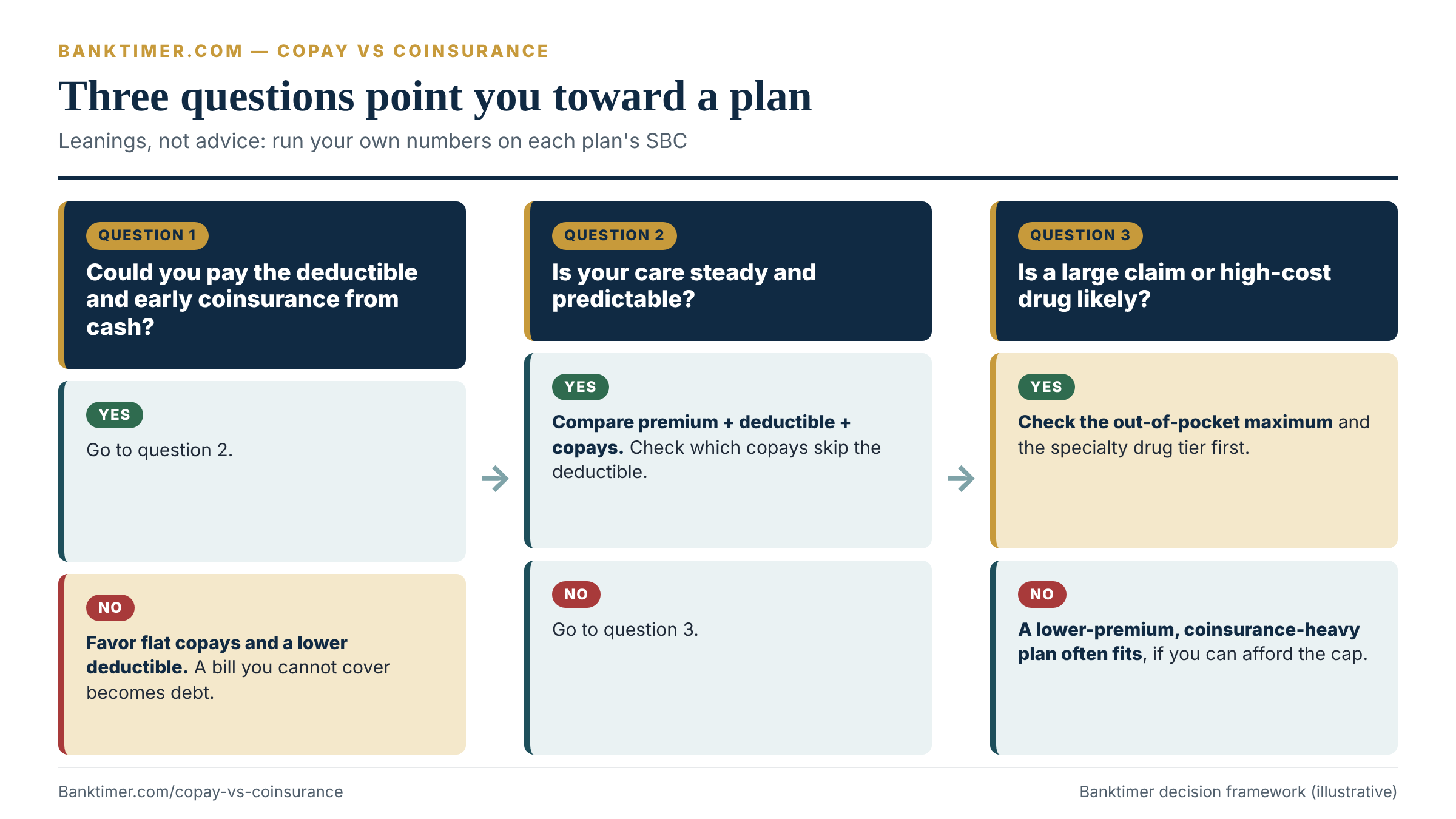
How the profiles usually land
The matrix shows how four common household profiles tend to weigh the structures. These are leanings, not recommendations for any individual.
| Profile | What usually matters most | Copay-heavy design tends to help when | Coinsurance-heavy design tends to help when | What to verify |
|---|---|---|---|---|
| Healthy adult, few visits | Premium and the worst-case year | You want predictable cost on a few visits | The premium is meaningfully lower and you have savings | Preventive care at $0 in network; the out-of-pocket maximum |
| Chronic condition, steady care | Total of premium, deductible and drugs | Visits and generic drugs carry flat copays from day one | You will hit the cap anyway and the premium is lower | Drug tiers; whether copays skip the deductible |
| Family with children | Frequent visits and one big-event risk | Many pediatric visits, urgent care and prescriptions | A low premium helps and you can fund the deductible | Embedded individual limit; family deductible type |
| High-cost drug | The tier the drug sits in | A flat specialty copay replaces a large percentage | The cap is low and assistance counts toward it | Accumulator policy; specialty tier cost sharing |
Copay vs coinsurance for a healthy adult
A healthy adult uses a few visits a year. The earlier three-year table shows what that means: the lower-premium, coinsurance-heavy plan won the quiet year by $1,415 in our example. The copay-heavy plan won only when a large claim arrived.
So a healthy adult with a rainy-day fund often leans toward the lower premium, as long as the out-of-pocket maximum is affordable. An HSA-eligible HDHP can strengthen that case. See our guide to the health insurance deductible for how to size the deductible against savings.
Copay vs coinsurance with a chronic condition
Predictable care changes the copay vs coinsurance math. If you know you will meet the deductible every year, the deductible is a fixed cost, not a risk. In the SBC example for type 2 diabetes, the patient pays $2,060 of $5,600, and $1,500 of that is the deductible.
For a household like that, compare plans on premium plus deductible plus copays. The coinsurance rate matters less than whether routine visits and generic drugs skip the deductible. Ask for the formulary and confirm which tier your drugs sit on.
The family with children
Children bring frequent, low-cost visits: checkups, sick visits, urgent care and prescriptions. Flat copays suit that pattern, and preventive care is generally covered at no charge in network. A family also faces the “one big event” risk, which a low out-of-pocket maximum caps.
Ask whether the family deductible is embedded or aggregate. With an embedded design, one child’s claims stop at the individual limit. With an aggregate design, the family may need to reach the full family deductible before coinsurance starts, which the plan documents will state.
Example: A High-Cost Drug Under Two Structures
A specialty drug is where copay vs coinsurance has the largest effect on a budget. This example uses a drug with an allowed amount of $3,000 a month, no separate drug deductible and a $5,000 out-of-pocket maximum. All terms are illustrative.
Flat copay or percentage
Under 25% coinsurance, you pay $750 a month. After six fills you have paid $4,500. The seventh fill costs $500 and reaches the $5,000 cap. Fills eight through twelve cost $0. Your year totals $5,000.
Under a flat $200 specialty copay, you pay $200 a month, or $2,400 for the year, and the cap is never reached.
The flat copay costs $2,600 less. The coinsurance plan costs more, but it front-loads the cost. You pay $750 each month at the start of the year, then nothing.
That timing is a cash-flow squeeze. A household paying $750 a month in January through June needs that cash on hand. Our monthly budget guide shows how to build a line for it.
What a coupon changes, and what an accumulator takes back
Now add a manufacturer assistance program. Suppose the program pays your share each month up to $6,000 a year. The question is whether your plan counts that money toward your out-of-pocket maximum.
| Plan treatment | Coupon pays | You pay | When you pay |
|---|---|---|---|
| Assistance counts toward the maximum | $5,000 | $0 | Never; the cap is reached in month 7 |
| Accumulator program: assistance does not count | $6,000 | $3,000 | Months 9 to 12, at $750 each |
When the assistance counts, it covers $5,000 of cost sharing, reaches the cap and leaves you at $0. When an accumulator excludes it, the assistance runs out after month 8 while your own total sits at $0. You then owe $750 a month in months 9 through 12.
That is a $3,000 difference for the same drug, the same coupon and the same plan on paper. It is the main reason to ask the plan about accumulators before you enroll. State rules and federal enforcement both bear on it, as described earlier.
Copay vs Coinsurance Pros and Cons
Each side of copay vs coinsurance has a real upside and a real downside. The matrix summarizes them, along with the mixed and HDHP designs.
| Option | Main upside | Main downside | Best fit | What to verify |
|---|---|---|---|---|
| Copay-heavy plan | Known price on routine care; easy budgeting | Often a higher premium; copays may still follow a deductible | Frequent, predictable care | Which services skip the deductible |
| Coinsurance-heavy plan | Usually a lower premium; cheap when bills are small | Exposure grows with the bill until the cap | Few claims and savings to cover a bad year | Out-of-pocket maximum; allowed amounts |
| Mixed plan | Flat fees for routine care, percentages for big events | Hard to compare across plans | Most households | How each service is billed |
| HDHP with HSA | Lower premium plus tax-advantaged savings | Full allowed amount until the deductible | Households that can fund the account | Deductible, HSA contributions, preventive coverage |
Reading the matrix
Notice that the “downside” column rarely says “costs more.” It says what you are exposed to. Copays expose you to higher premiums. Coinsurance exposes you to larger bills. Neither exposure is a flaw. The question is whether you can carry it.
Which side of copay vs coinsurance is better for you is therefore a question about your finances, not the plan’s marketing. If you hold three months of expenses and rarely see a doctor, coinsurance with a lower premium may be rational. If a $5,000 bill would force you onto a credit card, a plan with a lower cap and flat fees may be cheaper in the way that counts. The credit card APR guide shows what carrying a medical balance can cost, and personal finance basics covers the wider picture.
Red Flags in Plan Design and Billing
Most expensive copay vs coinsurance surprises trace back to a handful of patterns. The table lists the ones that cost real money, with the question to ask and the safer move.
| Red flag | Why it matters | What to ask | Safer next step |
|---|---|---|---|
| A low copay on the card, but a high deductible that applies to it | The copay may not start until you pay the deductible, so early-year visits cost the full allowed amount | Does this copay apply before the deductible? | Read the SBC’s cost column and limitations notes; ask in writing |
| Coinsurance with an out-of-pocket maximum near the federal ceiling | A 20% rate sounds modest, but the cap sets the worst case | What is the in-network maximum for one person and for a family? | Compare the cap, not only the rate |
| Specialty drug on a coinsurance tier | A percentage of a very high price is a large monthly bill | What is my cost on the specialty tier, and is there a per-fill limit? | Price the drug at the plan’s allowed amount before enrolling |
| An out-of-network provider quotes only a sticker price | The balance bill may sit outside your plan and your cap | What is the plan’s allowed amount for this service? | Get the estimate from both the provider and the plan |
| A form asks you to waive balance-billing protections | You may be giving up federal protection for a service that could have been protected | Is this service one that cannot be waived? | Do not sign until you know; ask for an in-network alternative |
| Assuming a coupon counts toward your cap | An accumulator program can leave your own total at zero | Does manufacturer assistance count toward my deductible and maximum? | Get the answer in writing |
| A directory listing that does not match the plan’s network | Using a provider you thought was in network can produce out-of-network cost sharing | Is this provider in network for my plan today? | Verify with the plan and the provider before the visit |
| An ambulance ride | Ground ambulance is outside the federal protection | Is this ambulance in network, and what does my state require? | Ask your plan and your state insurance department about ambulance coverage |
A plan can advertise a $20 primary care copay and still charge you the full $250 allowed amount for a visit in February. The advertised number is accurate. It simply does not tell you whether the deductible comes first.
Before you compare plans, find the deductible and the note beside each service that says whether it applies. The cheapest-looking copay is not cheap if it starts after a $4,000 deductible.
Preventive versus diagnostic billing
HealthCare.gov says preventive services are generally covered with no copayment or coinsurance in network, but a $0 cost is not guaranteed in all cases. A routine screening that finds a problem can become diagnostic care, which may trigger cost sharing. Ask the provider how the visit will be coded and review the EOB.
The plan year may not match the calendar year
The Uniform Glossary describes the deductible and out-of-pocket limit as applying over a coverage period, usually one year. That period may not start in January, because some plans, including employer plans, use a different cycle. Knowing your plan-year start date tells you when your counters reset.
Switching plans mid-year
If you change plans, expect the new plan to start its own deductible and out-of-pocket count. Ask whether the plan credits what you paid under a prior plan. Some plans do not, so a mid-year switch can cost you twice for the same year.
Self-funded employer plans
A self-funded employer plan pays claims from the employer’s own money. These plans are generally outside state insurance laws, as noted earlier. That affects state accumulator bans and some state-specific billing rules. Your benefits team can tell you whether your plan is insured or self-funded.
Documents to Keep and Where to Find Them
Good records let you check a bill against the plan’s rules and support an appeal. The table lists what to gather, where it comes from and how long it stays useful.
| Document | Why it matters | Where to get it | How long to keep it |
|---|---|---|---|
| Summary of Benefits and Coverage (SBC) | Shows cost sharing, the out-of-pocket limit and coverage examples | Insurer or employer; due within 7 business days of a request | Until the next renewal replaces it |
| Full plan document or certificate of coverage | Controls the rules the SBC summarizes | Plan portal or HR | Until the plan year ends and any dispute closes |
| Explanation of benefits (EOB) | Shows billed amount, allowed amount, plan payment and what you owe | Plan portal or mail after each claim | Until the provider bill is paid and the claim is closed |
| Provider bill or itemized statement | Should not exceed the EOB patient balance | Provider billing office | Until the account is settled |
| Formulary | Lists covered drugs and their tiers | Plan website or member services | Until the next plan year |
| Provider directory screenshot | Evidence that a provider was listed as in network on a date | Plan website | Until related claims are settled |
| Written answers from the plan | Records of what you were told about coverage | Email or portal message | Until the claim and any appeal are closed |
| HSA statements and receipts | Show qualified expenses paid from the account | HSA custodian | Keep with your tax records |
The CMS guide to reading an EOB says to check that the provider’s bill does not exceed the patient balance, and to account for payments you already made, since the EOB does not show them. Confirm the dates of service, the provider and the claim number match.
Questions to Ask Before You Choose a Plan
These copay vs coinsurance questions work for a benefits administrator, an insurance agent or a plan’s member services line. Write the answers down.
- ☐ What is the overall deductible for one person and for a family, and is the family deductible embedded or aggregate?
- ☐ Which services skip the deductible, and which copays apply only after it?
- ☐ Do copay payments count toward the deductible, the out-of-pocket maximum, or both?
- ☐ What is the in-network out-of-pocket maximum for one person and for a family?
- ☐ Is coinsurance calculated on the plan’s allowed amount, and can I see the allowed amount for my top three services?
- ☐ What are the copay and coinsurance for urgent care, the emergency room, imaging, outpatient surgery and a hospital stay?
- ☐ How does the formulary tier my drugs, and what is the specialty tier cost?
- ☐ Does manufacturer assistance count toward my deductible and out-of-pocket maximum?
- ☐ What happens if I use an out-of-network provider, and is there a separate out-of-network deductible and limit?
- ☐ Are my doctors, hospital and imaging center in network today?
- ☐ Does my plan cover ground ambulance in network, and how is it billed?
- ☐ Is the plan insured or self-funded, and which state rules apply?
- ☐ What is the total of premium plus out-of-pocket maximum for the year?
- ☐ If I enroll in an HDHP, how much can I contribute to an HSA and does the plan cover preventive care before the deductible?
Current Context as of October 2026
Several numbers that frame the copay vs coinsurance decision changed in the past year. We checked each one on October 14, 2026.
Federal limits and plan trends
The Marketplace out-of-pocket limit is $10,600 for one person and $21,200 for a family in 2026. It rises to $12,000 and $24,000 in 2027, according to CMS guidance dated January 29, 2026. The jump is 13.2% for self-only coverage.
The most recent KFF Employer Health Benefits Survey we reviewed is the 2025 edition. It found that 88% of covered workers with single coverage have a general annual deductible, averaging $1,886. About 34% face a deductible of $2,000 or more, and 33% are in a high-deductible plan with a savings option. Higher deductibles make the copay vs coinsurance question matter more each year, especially whether a copay comes before or after the deductible.
Rules still in motion
Two areas remain unsettled. The first is manufacturer assistance and accumulator programs, where a 2023 court ruling and a federal non-enforcement position have left plans, states and patients with different practices. The second is ground ambulance billing, which the No Surprises Act did not cover.
Plan documents, your state insurance department and the CMS complaint line are the places to confirm how these apply to you. For the regulators behind each area, see our overview of who regulates banks, insurance and investments.
Frequently Asked Questions
What is the difference between a copay and coinsurance?
In the copay vs coinsurance comparison, a copay is a fixed dollar amount, such as $30, that you pay for a covered service. Coinsurance is a percentage, such as 20%, of the plan’s allowed amount. A copay stays the same whatever the bill. Coinsurance rises with it until you reach your out-of-pocket maximum. Many plans use copays for office visits and coinsurance for hospital care.
Do copays count toward my deductible?
It depends on the plan. No single federal rule decides it. Some plans apply copay dollars to the deductible, and others count them only toward the out-of-pocket maximum. The Summary of Benefits and Coverage and the full plan document should say which. If they do not, ask the plan in writing and keep the reply with your records.
Do copays and coinsurance count toward the out-of-pocket maximum?
For in-network covered care, yes. HealthCare.gov lists deductibles, copayments and coinsurance as the payments that build toward the limit. Premiums, services your plan does not cover, out-of-network care and amounts above the allowed amount do not count. Protected surprise-bill cost sharing counts toward in-network limits under federal rules.
Is coinsurance calculated on the bill or the allowed amount?
On the allowed amount, which is the most your plan will recognize for a covered service. It is not a percentage of the sticker price. If a clinic bills $400 and the negotiated rate is $250, 20% coinsurance is $50, not $80. Your EOB shows both figures, so compare it with the bill before you pay.
Why was I charged the full price when my plan has a copay?
The deductible is the most common reason. Many plans charge the full allowed amount until you meet it, and a copay may start only afterward. HealthCare.gov’s example is a $100 visit that costs the full $100 when the deductible is unmet. Check the cost column and limitations notes in your SBC, then the EOB.
What happens to coinsurance after I reach the out-of-pocket maximum?
Your plan generally pays 100% of the allowed amount for covered in-network services for the rest of the plan year. Premiums, balance bills, out-of-network care and non-covered services still cost you. The counter resets when the next plan year begins, and some plans use a year that does not start in January.
Can one plan have both a copay and coinsurance?
Yes, and mixed plans are common. The KFF 2025 survey found that 8% of covered workers had both a copayment and coinsurance for hospital admission, while 65% had coinsurance only. A single claim can use both, such as a flat emergency room copay for the facility plus coinsurance for the physician and the scan.
Do manufacturer coupons count toward my out-of-pocket maximum?
Not always, and it depends on your plan and your state. A federal court set aside a 2021 rule in 2023, and the earlier 2020 rule, which generally requires assistance to count except for some brand drugs with generic equivalents, is back in effect. HHS has said it will not enforce it. About 26 states restrict accumulators. Ask your plan in writing.
Does the No Surprises Act cover ground ambulance bills?
No. The federal law protects emergency services, certain non-emergency services at in-network facilities and air ambulance, but not ground ambulance, according to KFF. Some states may have their own rules, and plan terms vary. Ask your plan whether the ambulance provider is in network and check with your state insurance department.
Does Medicare use copays or coinsurance?
Original Medicare uses deductibles and coinsurance. Medicare.gov lists a 2026 Part B deductible of $283 and usually 20% coinsurance after it, with no yearly limit unless you have supplemental coverage or Medicare Advantage. Part A has a $1,736 deductible per benefit period. Medicare Advantage plans have an out-of-pocket limit that varies by plan.
Can I pay copays and coinsurance with an HSA?
Generally yes. HealthCare.gov says HSA money can pay deductibles, copayments and coinsurance but generally not premiums, and that you need an HSA-eligible plan. The IRS 2026 contribution limits are $4,400 for self-only coverage and $8,750 for family coverage, rising to $4,500 and $9,000 in 2027. Other eligibility rules apply.
Pull the Summary of Benefits and Coverage for your current plan and one alternative. For each, write down the deductible, the out-of-pocket maximum and your cost for the three services you use most. Add the yearly premium, then compare the totals for a quiet year and a bad one.
The variable that decides copay vs coinsurance is not the rate on your card. It is whether the deductible comes first and how large your bad year can get. A flat copay buys predictability on routine care, usually at a higher premium. Coinsurance trims the premium and exposes you to bigger bills until the out-of-pocket maximum stops them. So compare plans on premium plus expected costs, then check the cap, your network and your drugs on the formulary. Use your own allowed amounts, because a $40 copay and 20% coinsurance tie at $200. The numbers here are illustrative, and the maximum excludes premiums, balance bills, out-of-network care and services your plan does not cover. Federal rules on accumulators and ambulances remain unsettled, so read the Summary of Benefits and Coverage before you enroll.
Methodology
We built this copay vs coinsurance comparison from primary and official sources, all checked on October 14, 2026. They include the HealthCare.gov glossary, the Department of Labor’s Uniform Glossary and SBC regulation, CMS guidance and consumer pages, the No Surprises Act statute and implementing regulations, IRS revenue procedures, a notice and Publication 969, and Medicare.gov. KFF’s 2025 Employer Health Benefits Survey supplied plan-design averages. Reports on court rulings and state laws about accumulators are secondary context, and we describe their status cautiously.
Every plan in the worked examples is illustrative. We chose the copays, coinsurance rates, deductibles, premiums, allowed amounts and out-of-pocket maximums to show how the mechanics work. They are not quotes and not market averages. The Summary of Benefits and Coverage example comes from one published 2023 employer plan, and we did not test, call or enroll in any plan. Calculations were run in Python and rechecked.
Rules vary by state, plan type, insurer, employer and plan year. Self-funded employer plans, grandfathered individual plans and Medicare follow different rules. This article is general education, not insurance, tax or legal advice. Confirm terms in your plan documents.
Sources
- HealthCare.gov, Coinsurance (glossary)
- HealthCare.gov, Out-of-pocket maximum/limit (glossary)
- U.S. Department of Labor, EBSA, Uniform Glossary of Coverage and Medical Terms (PDF)
- CMS, 2027 Premium Adjustment Percentage, Maximum Annual Limitation on Cost Sharing guidance, January 29, 2026 (PDF)
- CMS, No Surprises Act: consumer protections
- 42 U.S.C. 300gg-111, Preventing certain cases of balance billing, Cornell Legal Information Institute
- 45 CFR 149.420, Balance billing in cases of non-emergency services, Cornell Legal Information Institute
- 29 CFR 2590.715-2715, Summary of benefits and coverage, Cornell Legal Information Institute
- IRS, Publication 969, Health Savings Accounts and Other Tax-Favored Health Plans
- IRS, Revenue Procedure 2026-24, 2027 HSA and HDHP amounts (PDF)
- IRS, Notice 2026-5, HSA provisions of the 2025 tax law (PDF)
- Medicare.gov, Medicare costs
- KFF, 2025 Employer Health Benefits Survey, Summary of Findings (PDF)
- Insurance News Net, Drugmakers, health insurers battle over coupons for high-cost medicine, August 13, 2026
By the Banktimer Editorial Team · Published
Banktimer is an independent U.S. consumer-finance publication. Our editors draw on primary and official sources first, such as the CFPB, FDIC, Federal Reserve, and FTC, along with statutes, regulations, and providers’ own agreements and fee schedules. Then we add worked examples and decision tools. Our goal is the most useful, best-supported explanation the sources available to us at the time of writing allow.
This article is general information, not legal, tax, investment, insurance, or financial advice, and reading it does not create a professional relationship with Banktimer. Rates, fees, limits, and rules change, and they vary by state, provider, and contract, so confirm current terms with your bank, lender, insurer, or the agency named in the article before you act. Examples are illustrative unless labeled otherwise. Banktimer is not a bank, lender, insurer, or financial advisor, and we are not responsible for decisions or losses that result from relying on this content. For advice about your own situation, talk to a licensed professional.