
Wage garnishment is a court-ordered process that makes your employer send part of each paycheck to a creditor. For ordinary consumer debt, federal law caps it at the lesser of two numbers. One is 25% of your disposable earnings. The other is the amount by which those earnings exceed 30 times the federal minimum wage. At $7.25 an hour, the first $217.50 of weekly disposable pay is always protected.
Your biggest variable is your state, because some states set lower caps and a few block most consumer garnishments. The main risk is ignoring a lawsuit, since a default judgment is what opens the door. Check your court papers, your state’s exemptions and every deadline.
A court judgment usually comes first. For credit cards, medical bills and personal loans, the creditor generally has to sue and win. Only then is your employer told to withhold anything.
Federal law sets a ceiling, not a floor. At most 25% of disposable earnings can go, and less when your pay is low. States can set lower limits or prohibit garnishment.
Some money is off limits. Social Security, Supplemental Security Income (SSI) and veterans benefits are generally exempt, and banks must protect two months of directly deposited federal benefits.
Your job has limited protection. Federal law bars firing you over garnishment for any one debt. A second, separate debt is not covered by that rule.
You have ways to push back. You can claim an exemption, negotiate, ask a court to undo a default judgment, or file for bankruptcy. Each has costs and catches.
Speed matters. Exemption claims, hearings and responses run on short clocks that differ by state, so read the paperwork the day it arrives.
What Wage Garnishment Is and Who Can Order It
Wage garnishment is a legal process that makes your employer withhold part of your earnings and send it to someone you owe. Federal law defines garnishment as any legal or equitable procedure that requires earnings to be withheld to pay a debt. That covers wages, salary, commissions and bonuses. It also reaches periodic pension or retirement payments, according to the definitions in 15 U.S.C. 1672.
A creditor calling your boss is not garnishment. Neither is a collector threatening to “take your check,” or a payment plan you agreed to. Garnishment starts with a legal document and ends with a deduction on your pay stub.
Why a court order usually comes first
The Consumer Financial Protection Bureau (CFPB) explains that most creditors can garnish wages or benefits only after a court issues a judgment. The judgment must say you owe the debt. The Federal Trade Commission (FTC) puts it plainly: a collector must sue you and get a court order before taking money from your paycheck. You can read both in the CFPB’s garnishment guidance and the FTC’s debt collection FAQs.
So a threatening letter alone cannot reach your paycheck. A debt collector who says it will garnish tomorrow, without ever having sued, is either bluffing or misusing a legal term. The FTC notes that collectors cannot claim they will take legal action if that is not true.
Who can garnish without a lawsuit
A few creditors skip the ordinary lawsuit. Government agencies and child support offices run their own processes. The CFPB points out that the Internal Revenue Service and the Department of Education can take up to 15% of Social Security or Social Security Disability Insurance benefits. States can generally garnish wages or bank money for child support.
The table below sorts the main debt types by whether a court order comes first and which federal cap applies. The insight to take from it: the familiar 25% cap covers ordinary consumer debt only. Support and taxes follow different math. Student loans follow a separate federal process, which we cover in our student loan wage garnishment guide.
| Debt type | Court order first? | Federal cap on wages | Source |
|---|---|---|---|
| Credit card, medical bill, personal loan, other consumer debt | Yes, lawsuit and judgment in most cases | Lesser of 25% of disposable earnings or the excess over 30 times the minimum wage | 15 U.S.C. 1673(a) |
| Child or spousal support | Court or state agency order | Up to 50% or 60% of disposable earnings, rising to 55% or 65% for older arrears | 15 U.S.C. 1673(b)(2) |
| State or federal taxes | Agency process, often no consumer-debt lawsuit | Not limited by the federal consumer cap | 15 U.S.C. 1673(b)(1) |
| Federal student loans | Federal administrative process | Separate federal rules | See sibling guide |
| Chapter 13 bankruptcy court orders | Bankruptcy court order | Not limited by the federal consumer cap | 15 U.S.C. 1673(b)(1) |
Why this matters for your plan
If your debt is a credit card balance, a medical bill or a personal loan, you probably have time before wage garnishment can start. The sequence is lawsuit, judgment, then a garnishment order served on your employer. Each step has a window where you can act, and later steps are harder to reverse. Our credit card debt guide covers how balances become lawsuits in the first place.
The CFPB warns that a judgment is a court order. Once the case is over, it can be very difficult to change or set aside. That is why this guide spends so much time on what happens before the garnishment.
How Much Can Be Taken: The Federal Wage Garnishment Formula
The federal limit comes from Title III of the Consumer Credit Protection Act, codified at 15 U.S.C. 1673. It applies to ordinary consumer debts nationwide. It sets a ceiling on what a creditor can take. It also leaves room for states to protect you more.
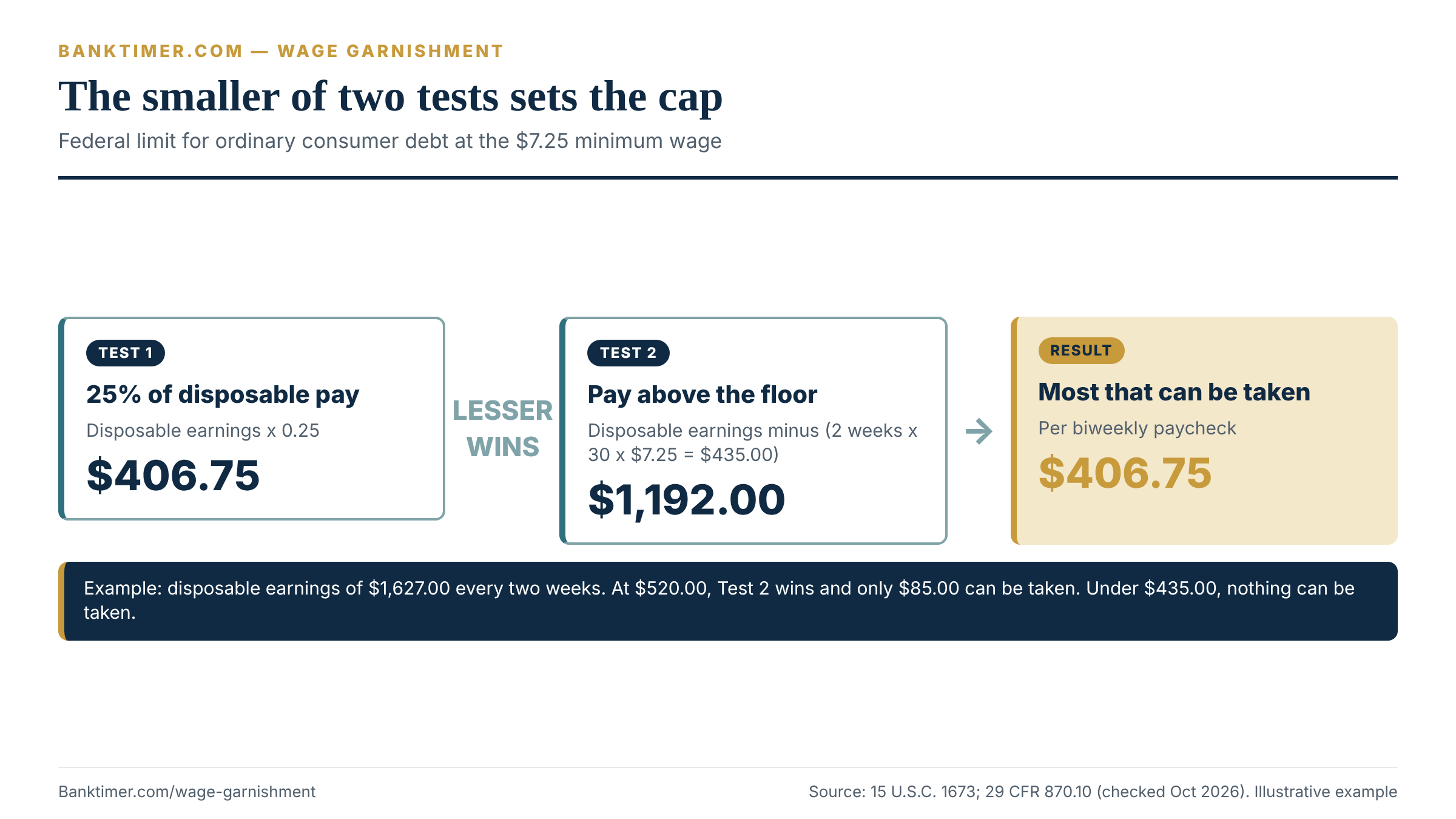
Two tests run side by side, and the smaller result wins. The first test takes 25% of your disposable earnings for the week. The second takes the amount by which your disposable earnings exceed 30 times the federal minimum hourly wage. The Department of Labor’s regulation at 29 CFR 870.10 turns that into dollar figures for each pay period.
Step 1: Find your disposable earnings
Disposable earnings are not your gross pay and not your take-home pay. The statute defines them as the part of your earnings left after deducting amounts required by law to be withheld. Think federal and state income tax withholding, Social Security and Medicare taxes, and similar mandatory items.
Voluntary deductions are a different story. A health insurance premium you chose is not “required by law.” Neither is a 401(k) contribution. So they generally do not shrink the base that the 25% applies to. Ask your payroll department how it computed your figure, and ask for the worksheet in writing.
Step 2: Apply the two tests
Say your weekly disposable earnings are $400. Test one gives 25% of $400, which is $100. Test two gives $400 minus $217.50 (30 times $7.25), which is $182.50. The smaller number is $100, so $100 is the most that can be garnished.
Now drop your weekly disposable earnings to $250. Test one gives $62.50. Test two gives $250 minus $217.50, which is $32.50. The smaller number is $32.50. At low pay, the second test protects far more of your check than the 25% rule would.
Where the protected floor comes from
The federal minimum wage is set by statute at $7.25 an hour, effective July 24, 2009. Congress, not a state or an employer, controls that number. As of October 15, 2026, the figure used in these calculations is $7.25. If Congress changes it, the protected amount changes with it.
Protected Amounts by Pay Period
Most people are not paid weekly, so the weekly floor does not fit their stub. The regulation multiplies the number of weeks in your pay period by 30 times the minimum wage. A calendar month counts as 4⅓ weeks, and a semimonthly period as 2⅙ weeks.
| Pay period | Weeks used | Fully protected up to (30 times $7.25) | 25% test takes over at (40 times $7.25) |
|---|---|---|---|
| Weekly | 1 | $217.50 | $290.00 |
| Biweekly | 2 | $435.00 | $580.00 |
| Semimonthly | 2⅙ | $471.25 | $628.33 |
| Monthly | 4⅓ | $942.50 | $1,256.67 |
Read the table this way. If your disposable pay for the period is at or below the second column, nothing can be garnished under the federal rule. Between the second and third columns, only the excess over the floor can go. Above the third column, the plain 25% applies. The third column is our calculation. The two tests meet when disposable pay equals 40 times the minimum wage, because 25% of that figure equals the excess over 30 times.
A worked example from gross pay to garnishment
Dana earns $2,000 gross every two weeks. Mandatory withholding takes $153.00 for Social Security and Medicare, $160.00 for federal income tax and $60.00 for state income tax. Her disposable earnings are $1,627.00.
She also pays $90 for health insurance and contributes $100 to a 401(k), so her take-home pay is $1,437.00. Under the federal rule, 25% of $1,627.00 is $406.75. The excess over the $435.00 biweekly floor is $1,192.00, which is larger, so the 25% test wins. The most a creditor can take is $406.75 per paycheck.
Dana’s take-home falls to $1,030.25. The garnishment equals 20.3% of her gross pay. It is 28.3% of what she actually brings home, and that number drives her budget. All figures are assumptions for illustration, not a quote or a real paystub.
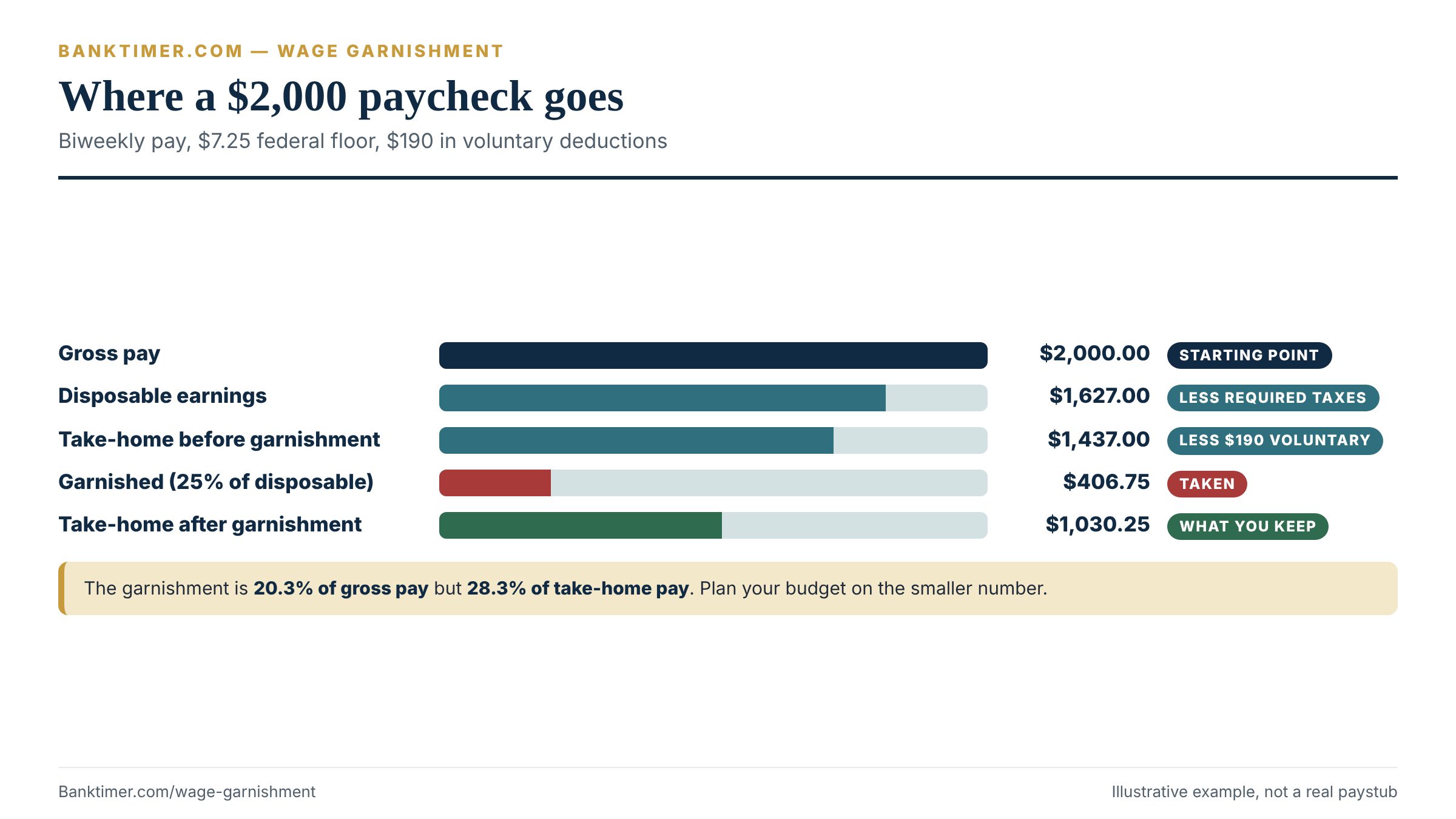
The gap between 20.3% and 28.3% explains why garnishment hurts more than the headline 25% suggests. The cap is a share of disposable earnings, and your voluntary deductions come out of what is left for you. A budget built on take-home pay needs to absorb the full amount.
What the Numbers Look Like at Different Income Levels
A single formula looks abstract until you run it across incomes. The table below uses a biweekly pay period, the $7.25 minimum wage and several illustrative disposable-earnings levels. The insight: at the lowest incomes the floor does the protecting. At higher incomes the cap tops out at a flat 25%.
| Biweekly disposable earnings | 25% test | Excess over $435 | Most that can be garnished | Left for you |
|---|---|---|---|---|
| $400.00 | $100.00 | $0.00 | $0.00 | $400.00 |
| $520.00 | $130.00 | $85.00 | $85.00 | $435.00 |
| $700.00 | $175.00 | $265.00 | $175.00 | $525.00 |
| $1,100.00 | $275.00 | $665.00 | $275.00 | $825.00 |
| $1,627.00 | $406.75 | $1,192.00 | $406.75 | $1,220.25 |
| $2,400.00 | $600.00 | $1,965.00 | $600.00 | $1,800.00 |
Notice the $520 row. A creditor can reach only $85, and you keep exactly $435.00, the protected floor. Anyone whose disposable pay is under $435 for a two-week period keeps all of it. These are illustrative paychecks, and your own result depends on your actual disposable earnings.
What the formula does not do
The formula caps the total across all ordinary garnishments, not each one. Federal rules do not set a priority among creditors. The regulation says the CCPA has no provisions controlling the priorities of garnishments. State law or other federal law decides who goes first. Two creditors cannot each take 25%.
It also does not limit what you agree to pay voluntarily. A payment plan is a contract, not a garnishment, so read the amount carefully before you sign one.
Bonuses and lump sums
Earnings include wages, salary, commissions and bonuses, so a bonus counts in the pay period when it is paid. A large year-end bonus can push one paycheck’s disposable earnings well above normal. The 25% test then applies to the higher figure. Plan for that if your pay is uneven.
When higher limits apply
Support orders and tax debts follow different rules. For child or spousal support, the statute allows up to 50% of disposable earnings if you support another spouse or dependent child. It allows up to 60% if you do not. Those figures rise to 55% and 65% when the support covers a period older than 12 weeks. The statute and the Labor Department’s regulation also say the consumer cap does not apply to tax debts. Chapter 13 bankruptcy court orders are outside it too.
From Lawsuit to Paycheck: How a Creditor Gets There
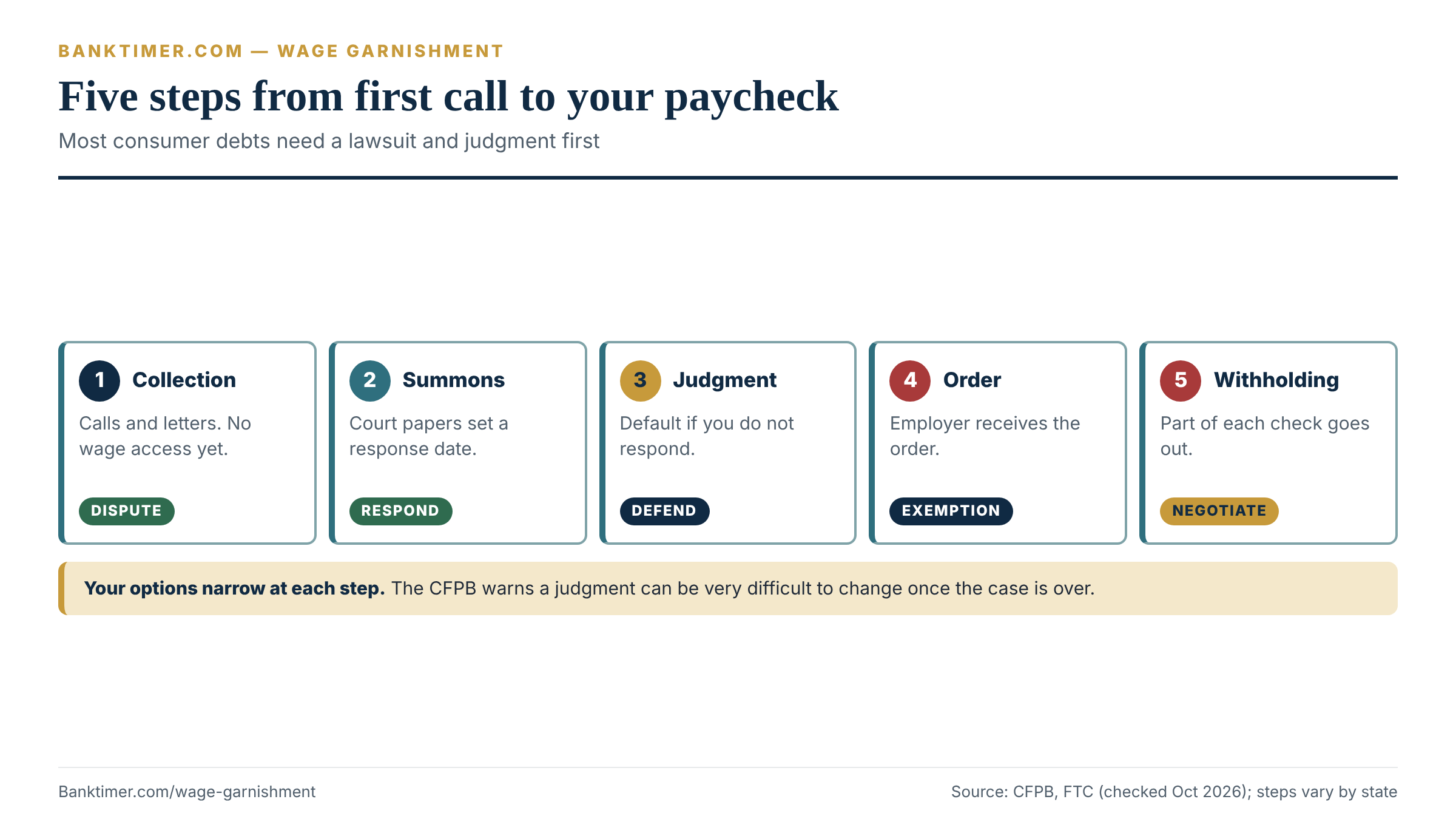
Understanding the path matters because your best options sit at the start of it. By the time your employer gets an order, you have already lost the cheapest chances to stop it. Here is how the process usually runs for ordinary consumer debt. Details differ by state and court, so treat the stages as a map, not a schedule.
Stage 1: Collection attempts
Before any lawsuit, a creditor or collector will call, write or email. Federal law limits what they can say. The FTC lists the basics. Collectors cannot threaten to hurt you or misstate what you owe. They cannot pretend to be an attorney or the government. They cannot falsely threaten arrest or legal action.
This stage is where a written dispute or a payment arrangement is cheapest. It is also where many people stop opening mail. Please do not. Unopened mail can hide the one envelope that matters, a court summons.
Stage 2: The summons and complaint
If collection fails, the creditor can file a lawsuit. You receive court papers that name the creditor, state the amount claimed and give a date by which you must respond. Both the CFPB and the FTC say to respond by the date specified in the court papers. They do not give a fixed number of days because courts set their own.
Responding does not mean you admit the debt. The CFPB says the collector still has to prove to the court that the debt is valid. If you skip the response, you may lose the chance to dispute the debt or the amount.
Stage 3: Judgment
If you respond, the case goes forward. You may settle, argue a defense, or lose and have a judgment entered. If you do not respond, the court can issue a default judgment. The CFPB says a judgment can include the claimed amount plus collection costs, interest and attorney fees that the judgment allows.
A judgment is the key that unlocks collection tools. The CFPB lists wage garnishment, bank garnishment and a lien on your home as options for a creditor. What applies depends on your situation and state law.
Stage 4: The garnishment order
With a judgment in hand, the creditor asks the court or a sheriff to issue a garnishment order or earnings withholding order. Names vary by state. The order goes to your employer, who must follow it. In California, for example, the form is the Earnings Withholding Order. The court self-help site explains that the sheriff or another levying officer handles it.
Stage 5: Withholding
Your employer takes the legally allowed amount from each paycheck and sends it to the levying officer or creditor. The order generally stays in force until the debt is paid or a court changes it. Interest, fees and costs can add to the balance while it runs.
| Stage | What happens | Who controls the clock | What you can do |
|---|---|---|---|
| Collection attempts | Calls, letters, possible threats | Collector | Dispute in writing, ask for details, negotiate |
| Summons served | Court papers arrive with a response date | Court | Respond on time, personally or through a lawyer |
| Judgment entered | Court orders payment, often with costs and interest | Court | Settle, defend, or ask to set it aside |
| Garnishment order issued | Employer receives the order | Creditor and court | Claim an exemption, ask for a hearing |
| Withholding begins | Part of each paycheck is sent to the creditor | Employer, within the legal cap | Check the math, track the balance |
| Debt paid or ended | Order ends or is released | Creditor and court | Get a written release and keep it |
The table’s takeaway is that you have a lever at every row, but the levers get weaker as you move down. Responding on time is far easier than undoing a judgment later. The CFPB says a judgment can be very difficult to change once the case is over. Undoing a default usually takes a motion and a reason the court accepts.
What a Creditor Needs Before Garnishing
Think of a garnishment order as a chain of links. Each one has to hold. If a link is weak, you may have grounds to challenge it. Ask these questions in writing when you can.
- Is the judgment against you? Mistaken identity and mixed-up names happen, especially with common surnames.
- Is the amount right? Judgments can add interest and costs. Ask for an itemized balance.
- Was the case properly served? If you never received the summons, that can matter when you ask to vacate a default judgment. State rules decide how.
- Is the debt within the time limit? The FTC says a collector cannot sue you for a time-barred debt.
- Is the order within the legal cap? Check the withholding against the formula in the previous section.
Time-barred debt and the revival trap
Every state sets a statute of limitations, the period during which a creditor can sue. The FTC explains that suing you over a time-barred debt is against the law for a debt collector. Rules differ by state on whether collectors may still contact you.
Here is the trap. In some states, paying any amount or even promising to pay can revive the debt and restart the clock. The FTC says written acknowledgment can do the same in some states. Suppose a collector pushes a small “good faith” payment on an old debt. Ask for the date of last payment. Check your state’s rule before you send a dollar. If you are sued over a time-barred debt, do not ignore it. Show up, tell the court the debt is time-barred and bring your records.
Judgments are not forever, but do not count on that
The CFPB’s judgment page confirms a court can order you to pay interest, but it gives no rate and no duration. Both vary by state. Ask the court clerk or a legal aid office how long your judgment lasts, whether it can be renewed and how interest is calculated.
What Collectors Can and Cannot Say About Garnishment
Collectors use the word “garnishment” as leverage. Knowing the rules removes much of that leverage.
| Statement you may hear | What the rules say | Your safer move |
|---|---|---|
| “We will garnish your wages tomorrow.” | Most creditors need a court judgment first | Ask for the case number and check the court record |
| “Pay today or we will have you arrested.” | Collectors cannot falsely threaten arrest or legal action | Write down the date, caller and exact words used |
| “You can’t do anything about it.” | You may be able to respond to a lawsuit or claim exemptions | Ask for the claim in writing and get legal help |
| “This old debt is still valid, so pay a little.” | Time-barred debts cannot be sued on, and payments can revive some | Ask for the last payment date before paying |
| “We can only settle if you pay by phone today.” | You can ask for settlement terms in writing | Say you will respond after you review them |
The FTC adds that if a collector breaks the law, you generally have one year to file your own lawsuit. A judge can award up to $1,000 even without proof of damages, plus attorney’s fees and court costs. Even if a court finds a collector violated the law, you may still owe the debt.
Keep a log of every contact. Dates, names and quotes matter if you later dispute a call, a threat or a balance. Our guide to bank phishing texts shows how fake payment demands work, so you can verify any unexpected message before you pay.
Wage Garnishment Limits by State
The federal cap is a ceiling. It sets the most a creditor may take, and states are free to go lower. Federal law says so directly: the statute at 15 U.S.C. 1677 preserves state laws that prohibit garnishment or provide for more limited garnishment than the federal rule allows. Where state law protects you more, the state rule is the one that matters.
That makes your state the biggest variable in this article. Some states copy the federal formula. Some use a smaller percentage. Some protect most wages for consumer debts. And some have rewritten their rules recently. For instance, the Minnesota House reports that a 2024 law changed many garnishment and exemption rules there. The garnishment law took effect June 1, 2025.
A snapshot of seven rules
The table below compares the federal baseline with several states whose statutes or official pages we read on October 15, 2026. It is a sample, not a ranking, and it covers ordinary consumer judgments. Child support, taxes and some federal debts follow other rules in every state.
| Jurisdiction | Rule for ordinary consumer debt | Source |
|---|---|---|
| Federal baseline | Lesser of 25% of disposable earnings or the excess over 30 times the minimum wage | 15 U.S.C. 1673 |
| Texas | Current wages for personal services are exempt from seizure, except for court-ordered child support | Tex. Prop. Code 42.001(b)(1) |
| Florida | A head of family keeps disposable earnings up to $750 a week, and above that they are protected unless a written waiver exists | Fla. Stat. 222.11 |
| New York | An income execution is limited to 10% of gross income, with a weekly cap tied to disposable earnings | N.Y. CPLR 5231 |
| Illinois | Lesser of 15% of gross wages or the excess over 45 times the minimum wage | 735 ILCS 5/12-803 |
| Connecticut | Lesser of 25% of disposable earnings or the excess over 40 times the higher minimum wage | Conn. Gen. Stat. 52-361a(f) |
| California | Up to 20% of wages, with a claim of exemption if the withholding leaves too little for family needs | California Courts Self-Help Guide |
The statutes behind the table are Texas Property Code 42.001, 735 ILCS 5/12-803 and Connecticut General Statutes 52-361a. Two patterns stand out. First, some states, Texas among them, protect current wages from most consumer judgments. The same debt can cost you nothing from your paycheck in one state and 25% in another. Second, some states, such as New York and Illinois, apply their percentage to gross pay. That can lower the number.
Florida’s wording is the trickiest. Its statute defines a head of family as someone who provides over half the support for a child or other dependent. Even with a written waiver, the amount garnished cannot exceed the federal cap. A person who is not a head of family gets the federal limit.
The same paycheck in different places
Here is Dana’s biweekly paycheck from earlier, run through each rule. The assumption: $2,000 gross, $1,627 disposable, and a $7.25 floor wherever a minimum wage enters the math. Where a state’s minimum wage is higher than $7.25, its floor is higher too. The true result can then be lower than the figure shown.
| Rule applied | Most that can be taken per paycheck | Share of $2,000 gross |
|---|---|---|
| Federal baseline | $406.75 | 20.3% |
| New York style (10% of gross) | $200.00 | 10.0% |
| Illinois style (15% of gross) | $300.00 | 15.0% |
| Connecticut style (25% or excess over 40 times) | $406.75 | 20.3% |
| Texas (ordinary consumer debt) | $0 | 0% |
| Florida head of family (no waiver) | $0 | 0% |
The insight is the range. Dana’s cost ranges from nothing to more than $400 every two weeks. The pay and the debt stay the same. Only the state changes. If you live near a state line, find out which state’s law governs. Which state’s law applies can be a legal question, and the answer may not be obvious. A legal aid office can tell you.
State minimum wages also move the floors in several of these formulas. Our guide to minimum wage increases for 2027 lists how those numbers shift.
How to find your state’s rule
Start with your state court’s self-help website, which usually explains wage garnishment and the exemption forms in plain language. The CFPB points readers to LawHelp.org for state exemption rules and how to claim them. State legal aid offices and bar association referral services can confirm details for your case.
Exempt Income: What Wage Garnishment Cannot Reach
Not all money is fair game. Some income is protected by federal law, and states add more. The key is knowing which protections are automatic and which you must claim.
Federal benefits
Social Security benefits are shielded by 42 U.S.C. 407, which says benefits are not subject to execution, levy, attachment, garnishment or other legal process. The FTC says many federal benefits are generally exempt from court-ordered garnishment, including Social Security, SSI and veterans benefits. It lists exceptions for delinquent taxes, child or spousal support and student loans.
That matters even if your paycheck is the target, because benefits can end up in the same bank account. A garnishment order cannot reach the benefit, but a careless transfer can blur the line.
What the exemption looks like in practice
| Income or money | Protection | Basis | Catch |
|---|---|---|---|
| Social Security benefits | Generally exempt from garnishment | 42 U.S.C. 407 | Tax debts and some federal agencies can still take part |
| SSI, veterans benefits | Generally exempt | FTC guidance | Exceptions for taxes, support and student loans |
| Directly deposited federal benefits in a bank account | Bank must protect up to two months of benefits | 31 CFR Part 212 | Applies to the benefit amount in the lookback period, not all funds |
| Wages in some states | Fully or partly exempt | State law | Varies by state, debt type and household |
| Earnings you deposit (Florida) | Exempt for 6 months if traceable | Fla. Stat. 222.11 | Tracing and head-of-family rules apply |
| Wages earned in last 60 days (New York) | 90% exempt from debt collection | NY Attorney General | Does not cover government debt, support or student debt |
Read the last column before you assume you are covered. Most protections have carve-outs for support, taxes and government debts.
The two-month rule for bank accounts
If you receive federal benefits by direct deposit, a federal rule at 31 CFR Part 212 requires banks to run an account review when a garnishment order arrives. The lookback period is the two months before the review. The protected amount is the lesser of two figures. One is the benefit payments deposited in that period. The other is the account balance on the day of the review.
The bank cannot freeze that protected amount, and you do not have to claim an exemption first. The regulation says it is conclusively considered exempt from garnishment under law. The review happens once per garnishment order, and a bank cannot charge a garnishment fee against the protected amount. The CFPB adds that you may claim the same protection for up to two months of federal benefits paid by check.
Sam receives $1,800 in Social Security each month by direct deposit. His account holds $5,000, of which $3,600 arrived as benefits in the past two months. A bank levy arrives. The protected amount is the lesser of $3,600 or $5,000, so $3,600 stays available and $1,400 is exposed.
Suppose Sam’s balance had fallen to $2,900 before the review. The protected amount would be the lesser of $3,600 or $2,900, which is $2,900. Nothing would be exposed. The numbers are illustrative.
Mixed money and tracing
The risk comes from mixing. If you put benefits and wages in the same account, or move benefits into a joint account, protection can get harder to prove. Florida’s statute shows the idea. Exempt earnings stay exempt for six months after receipt if you can trace and identify them. Mixing alone does not defeat tracing for a head of family. Other states have different tracing rules or none.
A separate account for exempt benefits is a simple precaution. Keep statements that show where each deposit came from. If you share an account, read our joint bank account guide before you add or remove anyone. Ask a legal aid office how your state treats a co-owner’s money.
Wage Garnishment vs. Bank Levy: Two Tools, Different Rules
A judgment creditor can often choose how to collect. A wage garnishment goes through your employer. A bank levy, sometimes called a bank garnishment or account freeze, goes through your bank. The CFPB explains that money in a bank account can be frozen or taken after a judgment. It adds that some federal and state laws protect a minimum amount in an account, even if you do not receive federal benefits.
The practical difference is how the cap works. The federal percentage limit is written for earnings withheld by an employer. For money sitting in an account, protection comes from federal benefit rules and your state’s exemptions. That is why a creditor who cannot reach much of your pay may still go after your account.
| Feature | Wage garnishment | Bank levy |
|---|---|---|
| Who receives the order | Your employer | Your bank or credit union |
| What it reaches | Part of each paycheck | Money in the account at the time |
| Federal cap | 25% or the 30 times floor test | No percentage cap; benefit rules and state exemptions apply |
| Typical effect | Smaller amounts over many pay periods | A one-time freeze that can hit all non-exempt funds |
| Federal benefit protection | Benefits are exempt | Two-month protected amount for direct deposits |
| How you challenge it | Claim of exemption or hardship request | Exemption claim forms, proof of exempt funds |
| Main risk | Long-running deductions | Bounced payments while funds are frozen |

What a bank levy looks like in New York
New York’s Attorney General publishes a clear example. For 2026, a set amount is automatically protected in each account. It is $4,080 in New York City, Long Island and Westchester, and $3,840 elsewhere in the state. The protection applies separately to each account you own. The amount is based on the minimum wage and may change.
If your balance is higher, the bank must keep the protected amount available but may freeze the rest. The bank must send you two copies of an exemption claim form. You have 20 days from the day the bank mailed them to return the forms. The debt collector then has 8 days to object. With no objection, the bank must release the account 8 days after getting your form.
Those steps and numbers belong to New York. Other states use different amounts and clocks, and some have no automatic protection. The point is that a freeze runs on a short clock, so read every notice the day it comes.
How to Stop a Wage Garnishment: Six Options in Order
“Stop” can mean several things. You might end the garnishment completely, reduce it, pause it, or replace it with a deal you can afford. Each option below does a different job, and each has a cost. Work through them in order, because the earlier ones are cheaper and faster.
The options are general information, not legal advice. A consumer lawyer or legal aid office can tell you which ones fit your state and your case. The CFPB suggests an attorney experienced in consumer law or debt collection. It also points to state legal aid for people with low income, and to a local JAG office for servicemembers.
Option 1: Check the order and the math
Start with the paperwork. Confirm your name, the case number, the creditor and the amount. Then compare the withholding on your pay stub with the formula in this guide and with your state’s rule. Employers make mistakes, and a withholding above the legal cap is a problem worth fixing immediately.
Ask your payroll department for the garnishment order and the calculation. Keep copies. If the amount exceeds the limit, give your employer and the levying officer a written explanation and ask for a correction.
Option 2: File a claim of exemption
A claim of exemption asks the court to reduce or stop the garnishment. The reason is either that you need the money for basic expenses or that the income is protected. The process is state specific, and California’s court self-help site shows what one version looks like.
In California you complete a Claim of Exemption and a Financial Statement. You then deliver the original and a copy to the levying officer named on the Earnings Withholding Order. The debt collector then has 10 days to respond. If the collector does not respond, the claim is granted. If the collector opposes it, the court sets a hearing, and you must file your reply at least five court days before.
At the hearing, you show that the garnishment would make it impossible to pay for your family’s basic needs. Bring paychecks, bank statements and bills. California’s guide also notes that wages may still be taken while you wait, but they are returned if you win.
Option 3: Ask the court to set aside a default judgment
Maybe a judgment was entered because you never received the summons. Or you had a serious reason for missing the deadline. In either case, you may be able to ask the court to undo it. California’s self-help site lists a motion to set aside the judgment as an option. Other states use different names and standards.
The CFPB warns that a judgment can be very difficult to change after the case is over. That is why timing matters. A prompt motion with documents, such as proof of your address on the service date, has a better chance than a late request with no evidence.
Option 4: Negotiate a settlement or payment plan
Many creditors will accept a lump sum for less than the full judgment or a structured payment plan. The CFPB notes that an attorney can help negotiate a settlement or repayment plan. You may also be able to compromise with the collector before judgment.
Whatever you agree to, get it in writing before you pay. The FTC advises getting a signed letter confirming that the payment settles the entire debt. Ask the creditor to withdraw or release the garnishment order, and confirm in writing that your employer will be told to stop.
“I’m calling about case number [number]. I want to resolve this, and I can pay [amount] now or [amount] a month. Please send the offer in writing, including how the garnishment will be released and that the payment settles the entire balance. I’ll review it and respond by [date].”
Option 5: Pay it off or refinance
If you can lay your hands on a lump sum, paying the judgment ends the process. A debt consolidation loan can sometimes replace a judgment with a single payment. It only helps if its total cost, including fees and interest, is lower than what the judgment will cost you. Read our guide to debt consolidation loan fees before you sign. Avoid any lender who asks for an upfront fee or pressures you to decide today.
Option 6: Bankruptcy
Filing for bankruptcy triggers the automatic stay. The federal courts explain that filing a Chapter 7 petition halts most collection actions. Creditors generally may not start or continue lawsuits, wage garnishments or demand calls. Filing a Chapter 13 petition also automatically stays most collection actions, and the Bankruptcy Code spells out the stay and its exceptions.
Both chapters carry costs and consequences. The Chapter 7 total is $335 ($245 filing fee, $75 administrative fee and $15 trustee surcharge). Individuals generally need credit counseling from an approved agency within 180 days before filing. The Chapter 13 filing and administrative fees total $310 ($235 plus $75). A Chapter 13 plan runs three to five years. The automatic stay has exceptions, including certain domestic support collection. It can also be limited if you filed before and your case was dismissed. Talk to a bankruptcy attorney or legal aid office before you decide.
Comparing the Six Options
The table below puts the options on the same criteria. The insight: the cheapest options depend on speed, while the most powerful options carry the longest-lasting costs.
| Option | Best when | Cost | Speed | Main catch |
|---|---|---|---|---|
| Check order and math | Withholding looks too high | Free | Fast | Does not help if the order is correct |
| Claim of exemption | Money is needed for basic family expenses or is protected | Varies by court | Varies by state | Requires evidence, and wages may be taken while you wait |
| Set aside default judgment | You were not properly served or had a good reason | Court fees, possible lawyer | Weeks | Hard once time passes |
| Settlement or payment plan | You can pay a lump sum or steady amount | The agreed amount | Days to weeks | Must be in writing, may not bind other creditors |
| Pay off or refinance | You can get a loan at a fair cost | Interest and fees | Weeks | May replace one burden with another |
| Bankruptcy | Debts exceed your ability to pay | $335 (Ch. 7) or $310 (Ch. 13) plus legal fees | Immediate stay | Credit and legal consequences, some debts survive |

A Decision Framework: Which Move First?
Use these five questions in order. Stop at the first one that gives you an answer.
- Is the order valid and the amount correct? If not, challenge it in writing right away.
- Is any of your income exempt? Benefits and, in some states, wages may be protected. File the claim.
- Do you have a reason to undo the judgment? If you were never served, move quickly.
- Can you afford a deal? If yes, negotiate in writing. If not, document your budget.
- Are your debts larger than you can ever repay? Then ask a bankruptcy attorney about the stay.
Here is how the framework plays out for four common situations.
| Situation | First move | Second move | What to verify |
|---|---|---|---|
| Employer withholds more than the cap | Ask payroll for the calculation | Written correction request | Your disposable earnings and state rule |
| Social Security is the only income | Confirm the bank applied the protected amount | File exemption forms if it did not | Whether the money is in a mixed account |
| You never received the summons | Gather proof of address and mail records | Motion to set aside | Filing deadline in your state |
| Several judgments, low pay | Prioritize with a legal aid office | Consider bankruptcy | Priority rules in your state |
What a Garnishment Costs Over Time
The headline cap hides the timeline. A smaller garnishment lasts longer, and interest keeps running. Here is a simple illustration of a $6,000 judgment with 6% annual interest (an assumption, not a typical rate). Deductions come out each pay period.
| Amount garnished per biweekly paycheck | Paychecks to pay off | Years | Total paid | Interest paid |
|---|---|---|---|---|
| $175.00 | 36 | 1.4 | $6,257.92 | $257.92 |
| $250.00 | 25 | 1.0 | $6,179.73 | $179.73 |
| $375.00 | 17 | 0.7 | $6,120.72 | $120.72 |
| $406.75 | 16 | 0.6 | $6,111.55 | $111.55 |
The lesson is not that smaller deductions are cheaper. They cost a bit more in interest. The lesson is that the real cost is the cash flow squeeze. Losing $375 every two weeks is a lot for a household living near its limits. Compare that with an illustrative 60% settlement of $3,600 paid in a lump sum. It would cost $2,520.72 less than garnishing $375 per paycheck until the balance is gone. Settlement amounts are negotiable and the 60% figure is an assumption, not a typical outcome. Interest rates on judgments vary by state.
If a garnishment would strain your housing or food budget, build a plan before the first deduction. Our monthly budget guide and budget by paycheck guide show how to rebuild a plan around a smaller check. Our emergency fund guide explains how even a small cushion can keep you out of a second default.
Can Your Employer Fire You for Wage Garnishment?
Federal law gives you some protection, but not unlimited protection. The statute at 15 U.S.C. 1674 says an employer may not discharge an employee because earnings “have been subjected to garnishment for any one indebtedness.” A willful violation can bring a fine of up to $1,000, up to one year in prison, or both.
The phrase “any one indebtedness” is the catch. The federal rule protects you from being fired over a garnishment for one debt. It does not clearly protect you when garnishments for more than one debt pile up. Federal law also preserves state laws that protect employees further, so your state may bar discharge for more than one debt. California’s court self-help site, for example, says an employer cannot fire you for a single wage garnishment.
What the protection does not cover
The law does not stop an employer from acting for other reasons, such as attendance or performance problems. The garnishment itself just cannot be the reason. It also does not make an employer’s payroll team easier to deal with. Garnishment orders add work, and some managers resent that.
If you think you were fired because of a garnishment, write down the dates, who said what, and any messages. Then contact the Labor Department’s Wage and Hour Division, your state labor agency or an employment lawyer. Do not wait. Time limits can apply.
Talking to your employer
Your employer will learn about the debt because the order arrives at payroll. You can limit the awkwardness. Ask HR, in writing, for a copy of the order, the withholding calculation and the expected end date. Keep the conversation about process rather than the debt itself. If you plan to claim an exemption, tell HR and give them the case number. They can then confirm the status when the court responds.
After a Court Judgment: Your First 48 Hours and 30 Days
If a judgment has already been entered, the next weeks decide how much it costs. Move in this order.
| When | What to do | Why |
|---|---|---|
| Day 1 | Read the judgment and any garnishment papers; note every date | Deadlines run from service or filing, and they are short |
| Day 1 to 2 | Check the amount, interest and fees against the original claim | Judgments can add costs, and errors happen |
| Day 2 to 3 | Gather pay stubs, benefit letters, bank statements and bills | Exemption claims need proof |
| Week 1 | Call legal aid or a consumer lawyer; file any exemption claim the order lets you file | Claims often have short windows |
| Week 1 to 2 | Offer a written settlement or payment plan if you can afford one | Creditors may release a garnishment as part of a deal |
| Week 2 to 4 | Review your budget under the garnishment; decide whether bankruptcy deserves a consultation | A garnishment can last until the debt is paid |
| Ongoing | Track every deduction and request a payoff statement each quarter | You need proof when the debt is satisfied |
The common thread is documentation. A judgment lives in the court file, but your proof of payment, your pay stubs and your letters live with you.
Check your credit reports for related errors
A lawsuit or judgment may involve a debt that appears on your credit reports. If an account looks wrong, dispute it with the credit bureau and the furnisher. Our guide to credit report errors walks through that process, and our credit score guide explains how scoring works.
Wage Garnishment Red Flags and Costly Mistakes
Most garnishment damage comes from a few repeating mistakes. Some are errors by creditors or collectors, and some are habits that make a manageable situation worse.
| Red flag | Why it matters | What to ask | Safer next step |
|---|---|---|---|
| A threat to garnish with no lawsuit | Most creditors need a judgment first | “What is the court and case number?” | Check the court record yourself |
| A summons you have not answered | A default judgment can follow | “What is the response deadline?” | Respond by the date in the papers |
| Withholding above the legal cap | Your employer or the creditor may have the math wrong | “Show me the calculation” | Send a written correction request |
| A demand for payment by gift card, wire or crypto | These payments are hard to reverse or trace | “Can you send a written statement?” | Stop and verify the debt through a number you look up |
| Pressure to pay a small amount on an old debt | Payment may revive a time-barred debt in some states | “What was the date of last payment?” | Check your state’s statute of limitations first |
| A settlement offer by phone only | You may have no proof of what was agreed | “Please send terms in writing” | Pay only after you have a signed letter |
A caller who claims you owe money and insists you pay today by gift card, wire or cryptocurrency is a warning sign. Those payments are hard to get back. Hang up, then look up the creditor’s number yourself and ask for written validation. The FTC notes that collectors cannot pretend to be an attorney or from the government, or falsely threaten legal action.
Mistakes that cost the most
- Ignoring the lawsuit. This creates the default judgment that makes everything else harder.
- Treating the 25% as a target. It is the ceiling. Your state or your income may lower it.
- Mixing exempt money into an account with other funds. That can make protection harder to prove.
- Agreeing to a deal verbally. If it is not in writing, you may not be able to prove it.
- Letting an exemption deadline slip. Claims run on short clocks, such as New York’s 20 days for a bank freeze.
- Skipping the written payoff. Without a release, the order may continue longer than it should.
- Quitting a job in frustration. The judgment does not go away when you change jobs, and the creditor can ask for a new order.
Edge cases that change the answer
Some situations do not fit the standard picture. The statute defines earnings to include periodic pension or retirement payments. A private pension can therefore fall under the federal cap, even though Social Security benefits are protected. Some states protect pensions separately, and New York’s Attorney General lists them among claimable exemptions, so check yours.
If you are paid as an independent contractor, the employer-based process may not work the same way. A creditor may look at your bank account instead. Ask a legal aid office how your state treats contractor income. If you have a vehicle loan, a past-due medical bill or a defaulted student loan, each follows its own rules. See our guides on car repossession rights, surprise medical bill disputes and student loan default.
Documents to Keep
Garnishment disputes are won or lost on paper. Keep a folder, digital or physical, and add to it every time something arrives.
| Document | Why it matters | Where to get it | How long to keep it |
|---|---|---|---|
| Summons and complaint | Shows the claim, the creditor and your deadline | The papers served on you or the court clerk | Until the case is closed and released |
| Judgment | Sets the amount, interest and costs | The court clerk | Until you have a release |
| Garnishment or withholding order | Tells your employer what to take | Your employer or the court | Until you have a release |
| Pay stubs | Show disposable earnings and each deduction | Payroll | At least until the debt is satisfied |
| Benefit award letters | Prove the source of exempt income | Social Security, VA or other agency | Keep indefinitely |
| Bank statements | Show where deposits came from | Your bank | At least until the debt is satisfied |
| Settlement letter and release | Prove the debt is resolved | The creditor or its attorney | Keep indefinitely |
| Contact log | Records calls, threats and dates | You | Until the case is closed |
- ☐ What is the case number, court and creditor name on the order?
- ☐ Which date is my response or exemption deadline?
- ☐ How did my employer calculate my disposable earnings?
- ☐ Does my state cap or ban garnishment for this kind of debt?
- ☐ Is any of my income or bank balance exempt, and do I have to claim it?
- ☐ What is the total owed today, including interest and costs?
- ☐ Is the debt within the statute of limitations?
- ☐ Will the creditor release the order in writing if I settle?
- ☐ Does a payment plan stop the garnishment or only reduce it?
- ☐ Who can give me free legal help in my county?
A fresh checking account or a safer way to handle money may help after a levy. Our checking account guide explains accounts and fees. Our overdraft fees guide shows why a frozen account can trigger more charges. If a levy hits and you need a place to receive exempt benefits, ask the bank what a new account would cost. Compare options in our bank account fees guide.
Frequently Asked Questions
How much of my paycheck can be garnished?
For ordinary consumer debt, federal law caps garnishment at the lesser of two numbers. One is 25% of your disposable earnings. The other is the excess over 30 times the federal minimum wage. At $7.25 an hour, that protects $217.50 of weekly disposable pay. Your state may set a lower limit or ban garnishment for this kind of debt. Support orders and tax debts can take a larger share.
Can a creditor garnish my wages without a court order?
For most consumer debts, no. The CFPB and the FTC both say a creditor generally has to sue and win a judgment first. Exceptions include child support, federal and state tax debts and some federal debts, which follow their own administrative processes. A collector who threatens garnishment without ever suing you may be bluffing, so ask for the case number and check the court record.
What income is exempt from wage garnishment?
Federal law protects Social Security benefits. The FTC lists SSI and veterans benefits as generally exempt, with exceptions for taxes, support and student loans. States add their own exemptions, such as New York’s rule that 90% of wages earned in the last 60 days are exempt from debt collection. Some exemptions apply automatically, while others require you to file a claim.
Can my employer fire me because of a wage garnishment?
Federal law bars an employer from firing you because your earnings were garnished for any one debt. A willful violation can bring a fine of up to $1,000, up to a year in prison, or both. The rule says “one indebtedness,” so it may not cover garnishments for several debts. Your state may give you more protection. Document everything if you think you were fired over it.
What is the difference between wage garnishment and a bank levy?
Wage garnishment takes a capped share of each paycheck through your employer. A bank levy freezes or takes money already in your account through your bank. The federal percentage cap is written for earnings, while account protection comes from benefit rules and state exemptions. Banks must protect up to two months of directly deposited federal benefits, so mixed accounts need extra care.
Do all states allow wage garnishment?
No. Federal law lets states prohibit garnishment or limit it more than the federal rule allows. Texas, for instance, exempts current wages for personal services from seizure, except for court-ordered child support. Other states use lower percentages or protect heads of household. A state’s protection does not necessarily stop the Internal Revenue Service or federal agencies from collecting by their own methods.
How long does a wage garnishment last?
Usually until the debt is paid, the creditor releases the order or a court changes it. Interest, fees and costs can add to the balance while deductions continue, so a small withholding may last longer than you expect. We cannot give you one number, because judgment duration and interest rates vary by state. Ask the court clerk for your payoff amount and get a written release at the end.
Can I stop a wage garnishment by paying a lump sum?
Often, yes. If you pay the judgment in full or settle for a lump sum, the creditor can release the garnishment. Get the agreement in writing first, including how the order will be withdrawn and that the payment satisfies the entire debt. The FTC recommends a signed letter confirming that the payment settles the whole balance. Keep that letter permanently.
Does bankruptcy stop wage garnishment?
Filing under Chapter 7 or Chapter 13 triggers an automatic stay that generally stops creditors from starting or continuing wage garnishments. The stay has exceptions, including certain domestic support collection, and it can be limited if you have filed before. Bankruptcy has fees, credit counseling requirements and long-term consequences, so speak with a bankruptcy attorney or legal aid office before you file.
What if I never received the lawsuit papers?
Act quickly. If a default judgment was entered after you were never properly served, you may be able to ask the court to set it aside. Gather proof of your address on the service date, any mail issues and the date you first learned of the case. Rules and deadlines vary by state, and the CFPB warns that a judgment can be very difficult to change later.
Can they garnish my Social Security?
Generally not for ordinary consumer debt. Federal law says Social Security benefits are not subject to garnishment or other legal process. The CFPB notes that the IRS and the Department of Education can take up to 15% of Social Security or SSDI benefits for certain debts. Banks must also protect two months of directly deposited federal benefits from a levy.
Is there a time limit on suing me for an old debt?
Yes. Every state sets a statute of limitations. The FTC says it is against the law for a collector to sue you on a time-barred debt. In some states a small payment or a written acknowledgment can revive the debt. Before you pay anything on an old balance, ask for the date of last payment and check your state’s rule.
Today, find your court papers or garnishment notice and write down the case number and every deadline. Then call your state’s legal aid office or court self-help center for free guidance on your exemption claim.
The one variable that decides your outcome is the clock on your court papers. Wage garnishment is the end of a process. The cheapest chances to stop it come early: responding to the summons, challenging a wrong amount, claiming an exemption and negotiating a written deal. Federal law caps ordinary consumer garnishment at the lesser of 25% of disposable earnings or the excess over 30 times the minimum wage. Your state may protect you more. So find your deadline, check the math and gather proof of any exempt income. This guide does not cover support orders, tax levies or federal student loan collections, which follow different rules. It also cannot tell you your state’s deadlines or your odds in court. A legal aid office or consumer attorney can.
Methodology
We built this wage garnishment guide from statutes, federal regulations and official government pages. We checked each source on October 15, 2026. The federal cap and job protection come from the Consumer Credit Protection Act and the Labor Department’s regulation. Debt collection and judgment guidance comes from the CFPB and the FTC. Benefit protection comes from Social Security law and the Treasury’s account review rule. State examples come from statutes and official state pages for Texas, Florida, New York, Illinois, Connecticut and California.
Every dollar example is an illustrative assumption. That includes the $2,000 biweekly paycheck, the $6,000 judgment with 6% interest, the 60% settlement and the benefit-account balances. They are not quotes or real cases. Calculations are in a script we ran and rechecked. Rules, protected amounts and deadlines vary by state, court, creditor and date. We did not test any court process or call any agency.
Sources
- 15 U.S.C. 1673, Restriction on garnishment, Cornell Law School
- 15 U.S.C. 1674, Restriction on discharge from employment by reason of garnishment, Cornell Law School
- 15 U.S.C. 1677, Effect on State laws, Cornell Law School
- 29 CFR 870.10, Garnishment limits, Cornell Law School
- Can a debt collector take or garnish my wages or benefits?, CFPB, reviewed August 2, 2023
- What should I do if I’m sued by a debt collector or creditor?, CFPB, reviewed August 2, 2023
- Debt Collection FAQs, FTC, modified December 9, 2025
- 31 CFR 212.3, Definitions, Cornell Law School
- 42 U.S.C. 407, Assignment of benefits, Cornell Law School
- Funds protected against debt collection, New York Attorney General
- Wage garnishment, California Courts Self-Help Guide
- N.Y. CPLR 5231, Income execution, New York State Senate
- Florida Statutes 222.11, Exemption of wages from garnishment
- Chapter 7 bankruptcy basics, U.S. Courts
By the Banktimer Editorial Team · Published
Banktimer is an independent U.S. consumer-finance publication. Our editors draw on primary and official sources first, such as the CFPB, FDIC, Federal Reserve, and FTC, along with statutes, regulations, and providers’ own agreements and fee schedules. Then we add worked examples and decision tools. Our goal is the most useful, best-supported explanation the sources available to us at the time of writing allow.
This article is general information, not legal, tax, investment, insurance, or financial advice, and reading it does not create a professional relationship with Banktimer. Rates, fees, limits, and rules change, and they vary by state, provider, and contract, so confirm current terms with your bank, lender, insurer, or the agency named in the article before you act. Examples are illustrative unless labeled otherwise. Banktimer is not a bank, lender, insurer, or financial advisor, and we are not responsible for decisions or losses that result from relying on this content. For advice about your own situation, talk to a licensed professional.