

The HSA vs FSA choice usually starts with one fact: whether your plan is a high-deductible health plan (HDHP). An HSA requires one. A health FSA does not. If you have a qualifying HDHP, an HSA is often the stronger tool, because you own it, the balance never expires and unused money can grow. If you have a traditional plan, a health FSA may be your only pre-tax option.
The biggest variable is how much care you can predict. The main risk is forfeiture: you can lose unspent FSA money, while HSA money stays yours. Before you enroll, confirm your plan’s HDHP status and read the FSA plan document for carryover or a grace period.
The health plan decides first. You can contribute to an HSA only while covered by a qualifying HDHP, and only if you have no disqualifying second coverage. An FSA has no such test.
Ownership is the biggest difference. An HSA is your account and travels with you. A health FSA belongs to your employer’s plan, and you generally lose access when coverage ends.
Rollover rules differ sharply. For 2026, a health FSA may carry over at most $680 if the plan allows it. An HSA balance carries over with no cap and no deadline, which is the sharpest split in the HSA vs FSA comparison.
You can sometimes have both. A general-purpose health FSA blocks HSA contributions. A limited-purpose FSA, a post-deductible FSA and a dependent care FSA do not.
A tax saving is not a free gain. An FSA election you cannot use costs more than the tax it saves, as the worked numbers below show.
The Numbers That Frame the HSA vs FSA Decision
Every limit below comes from the IRS or HealthCare.gov. We checked each one on October 15, 2026. Two dates matter here. Most employers open enrollment this fall for the 2027 plan year, so the 2027 column is the one you will use. The IRS has not yet announced the 2027 health FSA limit on the pages we checked, so that cell stays empty rather than guessed.
| Measure | 2026 | 2027 | Source |
|---|---|---|---|
| HSA contribution limit, self-only HDHP | $4,400 | $4,500 | IRS Pub. 969; Rev. Proc. 2026-24 |
| HSA contribution limit, family HDHP | $8,750 | $9,000 | IRS Pub. 969; Rev. Proc. 2026-24 |
| HSA catch-up, age 55 or older | $1,000 | $1,000 | IRS Pub. 969 (2025 edition) |
| HDHP minimum deductible, self-only / family | $1,700 / $3,400 | $1,750 / $3,500 | IRS Pub. 969; Rev. Proc. 2026-24 |
| HDHP out-of-pocket maximum, self-only / family | $8,500 / $17,000 | $8,700 / $17,400 | IRS Pub. 969; Rev. Proc. 2026-24 |
| Health FSA salary reduction limit | $3,400 | Not yet announced | IRS Rev. Proc. 2025-32 |
| Health FSA maximum carryover (if the plan allows) | $680 | Not yet announced | IRS Rev. Proc. 2025-32 |
| Dependent care FSA limit | $7,500 ($3,750 if married filing separately) | $7,500 per the statute’s text | 26 U.S.C. 129 |
| ACA out-of-pocket maximum, self-only / family | $10,600 / $21,200 | $12,000 / $24,000 | HealthCare.gov |
What the numbers say about your choice
The HSA limit is higher than the FSA limit, and the gap widens in 2027. A self-only HSA can take $4,500 in 2027, while the 2026 health FSA cap is $3,400. That extra room matters only if you can afford to fill it.
The HDHP out-of-pocket ceiling is the less obvious number. For 2027, an HSA-qualified plan cannot exceed $8,700 for one person. The ACA cap on a plan’s out-of-pocket maximum is $12,000. So a plan can satisfy the ACA ceiling and still fail the HDHP test. Always check the plan itself, not just the label.
One more point on the table. The 2026 dependent care FSA limit rose to $7,500 from $5,000 under the 2025 tax law, according to 26 U.S.C. 129. That account pays for child and dependent care, not medical bills, so it plays a separate role later in this guide.
What an HSA and an FSA Actually Are
Both accounts let you pay for medical costs with money that skipped income tax. That shared feature hides a structural difference. One is a bank-style account in your name. The other is a benefit your employer runs.
A health savings account is yours
A health savings account (HSA) is a tax-advantaged account that you own, according to IRS Publication 969. You open it with a custodian, such as a bank or an HSA provider. You can fund it through payroll or on your own. Earnings inside it are free of federal tax, and withdrawals for qualified medical expenses are tax free.
Because the account is yours, it moves with you. The SEC’s investor bulletin says you can take your HSA with you when you leave a job or retire. You can also move the assets to a different provider. And you never need to empty it by year-end.
A health FSA belongs to the plan
A health flexible spending arrangement (FSA) is an employer-established plan, often offered inside a cafeteria plan. Self-employed people cannot have one, Publication 969 says. You choose a salary reduction before the year starts, and the plan reimburses qualified expenses you incur during the coverage period.
There is a quirk that helps you early in the year. Under the uniform coverage rule, the full annual election is available on day one, even though your paychecks fund it gradually. The flip side is real too. Publication 969 describes FSAs as generally “use-it-or-lose-it,” so unspent money is at risk unless the plan offers carryover or a grace period.
The two accounts side by side
The table below compares them on the criteria that usually decide the question. The plan document for your own FSA can narrow some of these rows, so read it before you rely on any single cell.
| Criterion | HSA | Health FSA |
|---|---|---|
| Needs an HDHP? | Yes | No |
| Who owns it | You | Your employer’s plan |
| 2026 limit | $4,400 self-only; $8,750 family | $3,400 per employee |
| 2027 limit | $4,500 self-only; $9,000 family | Not yet announced |
| Age 55+ catch-up | Yes, $1,000 | No |
| Unspent money at year-end | Stays in the account, no cap | Forfeited unless the plan allows carryover (up to $680 for 2026) or a grace period (up to 2.5 months) |
| Money available on day one | Only what has been deposited | Full annual election |
| When you leave the job | Keep the account | Reimburses only expenses incurred while you are covered; plan terms control what happens after |
| Investing allowed | Often, if the provider offers it | No |
| Withdrawals for non-medical use | Taxable, plus 20% before age 65 | Not permitted |
| Payroll tax savings | Yes, through payroll | Yes |

In any HSA vs FSA comparison, the pair of rows about year-end and job changes matters most. Those two rows describe where most real losses happen. A row about “tax savings” looks the same for both accounts, so it rarely decides anything.
The HDHP Requirement for HSA Eligibility
The HDHP requirement for HSA eligibility is the gate in any HSA vs FSA decision. If your plan does not qualify, nothing else in this guide changes that. You cannot contribute to an HSA, however attractive the tax treatment looks.
What makes a plan an HDHP
A high-deductible health plan is defined by two numbers that the IRS resets each year. The plan’s annual deductible must be at least the minimum. Its annual out-of-pocket limit must be no higher than the maximum. Publication 969 gives the 2026 figures, and Rev. Proc. 2026-24 gives the 2027 figures.
| Plan year | Minimum deductible (self-only / family) | Maximum out-of-pocket (self-only / family) |
|---|---|---|
| 2026 | $1,700 / $3,400 | $8,500 / $17,000 |
| 2027 | $1,750 / $3,500 | $8,700 / $17,400 |
Two details trip people up. First, premiums do not count toward the out-of-pocket maximum. Second, when a plan uses a provider network, the maximum may leave out-of-network costs out of the test, according to Publication 969. A plan with a $3,000 deductible and a $7,000 in-network limit can therefore qualify even though out-of-network bills could run higher.
For a deeper look at how the deductible, copays and coinsurance stack, see our guide to the health insurance deductible and the explainer on copay vs. coinsurance.
Services a plan may cover before the deductible
An HDHP can still pay for some care from the first dollar. Publication 969 says a plan may cover preventive care without a deductible and keep its HDHP status. Routine exams, immunizations and screenings are examples. Notice 2024-75 added over-the-counter oral contraceptives and male condoms to that list.
Telehealth got a permanent fix in 2025. Under IRS Notice 2026-5, the One, Big, Beautiful Bill Act made permanent the safe harbor that lets an HDHP cover telehealth and other remote care before the deductible. It applies to plan years beginning after December 31, 2024. In-person services, equipment and drugs furnished alongside a telehealth visit generally do not get the same treatment.
Bronze and catastrophic plans changed in 2026
Notice 2026-5 also covers a Marketplace change that matters if you buy your own coverage. Bronze and catastrophic plans sold through an Exchange are treated as HDHPs for months beginning after December 31, 2025. They count even if they miss the usual deductible or out-of-pocket tests.
Off-Exchange versions qualify when the same plan is available on an Exchange. The notice says plans bought with an employer individual coverage HRA still count. Small business SHOP coverage generally does not. If you shop on HealthCare.gov or a state exchange, confirm the plan’s metal tier before you assume anything. Our ACA open enrollment 2027 guide covers the Marketplace timeline.
Direct primary care no longer blocks an HSA
A direct primary care service arrangement is a flat monthly fee for a primary care practice. Before 2026, enrolling in one could disqualify you from HSA contributions. For months beginning after December 31, 2025, a qualifying arrangement no longer does, per Notice 2026-5.
The fee limit is $150 a month, or $300 a month for an arrangement covering more than one person. That works out to $1,800 a year for one person in 2026. Fees can be billed annually or semiannually if they stay within the monthly limit on an annualized basis. The notice also says an HSA can reimburse those fees, while employer-paid fees cannot be reimbursed.
Who Can and Cannot Contribute to an HSA
An HDHP is necessary but not sufficient. Publication 969 lists four conditions you must meet at the same time. A failure on any one of them closes the door for that month.
| Requirement | The rule | Common exception or wrinkle | What to do |
|---|---|---|---|
| Covered by an HDHP | You are covered on the first day of the month | Bronze and catastrophic Exchange plans qualify from 2026 | Ask HR or the carrier to confirm HSA eligibility in writing |
| No other health coverage | You generally cannot have other coverage | Dental, vision, accident, disability and long-term care are allowed; limited-purpose FSAs and some HRAs are allowed | List every plan that covers you, including a spouse’s |
| Not enrolled in Medicare | Your limit is zero starting the first month you are enrolled | Applies to retroactive Medicare coverage too | Plan the stop date before age 65 |
| Not a dependent | You cannot be claimed as a dependent on another person’s return | Rule is tested on the tax return | Check with whoever claims you |
The Medicare row deserves a pause. Publication 969 says your contribution limit is zero starting the first month you are enrolled in Medicare, and that includes retroactive coverage. Medicare.gov says premium-free Part A coverage that you sign up for later starts 6 months back from when you sign up, and no earlier than the month you turned 65. So an HSA contribution made in those six months can become an excess contribution. Our Medicare open enrollment guide covers the signup rules.
The spouse question
Family coverage adds a second layer. Publication 969 says you cannot have a joint HSA. Each eligible spouse who wants one must open a separate account. If both spouses have family HDHP coverage under separate plans, the family limit is split equally unless you agree otherwise.
A spouse’s coverage can also help or hurt. The publication says you can still be an eligible individual if your spouse has non-HDHP coverage, as long as that coverage does not cover you. Read that sentence from the other direction. If your spouse’s general-purpose health FSA can reimburse your expenses, it covers you, and the HSA door may close. Confirm with the plan administrator before you elect.
The last-month rule and its testing period
Many people start an HDHP mid-year. The last-month rule lets you contribute the full annual amount if you are eligible on December 1, as if you had been covered all year. The price is a testing period. You must stay eligible through December 31 of the following year.
Break the test and the extra contribution becomes income, plus a 10% additional tax, according to Publication 969 and Form 8889. The worked example below puts numbers on it.
Priya, single, enrolls in a self-only HDHP on July 1, 2027. The 2027 self-only limit is $4,500. Pro-rated for six months, her limit would be $2,250.
Under the last-month rule, she can contribute the full $4,500 because she is eligible on December 1, 2027. Her testing period runs through December 31, 2028.
Suppose she leaves the HDHP in March 2028. The $2,250 she could not otherwise have contributed becomes income. She also owes a 10% additional tax of $225. Her income tax on the $2,250 depends on her bracket. This is an illustration, not tax advice.
Can I Have an HSA and an FSA at the Same Time?
Sometimes, yes. The answer depends on which kind of FSA you mean. Publication 969 says an employee covered by an HDHP and a health FSA or health reimbursement arrangement (HRA) that pays or reimburses qualified medical expenses generally cannot make HSA contributions. That sentence blocks the most common FSA, the general-purpose one. It also leaves several doors open.
The FSA types that work with an HSA
The key is what the FSA can pay for. A general-purpose FSA reimburses almost any qualified medical cost, so it acts as second health coverage before you reach the HDHP deductible. The other types are narrower on purpose.
| FSA or HRA type | What it can pay for | HSA contributions allowed? | Note |
|---|---|---|---|
| General-purpose health FSA | Most qualified medical expenses | No, generally | The standard choice if you have no HDHP |
| Limited-purpose health FSA | Items allowed under other coverage, such as dental and vision, plus preventive care | Yes | Not offered by every employer |
| Post-deductible health FSA | Nothing until the minimum annual HDHP deductible is met | Yes | Its deductible need not match the HDHP’s |
| Dependent care FSA | Child and dependent care, not medical bills | Yes, as it pays no medical expenses | Separate $7,500 limit |
| General-purpose FSA in a grace period | Prior-year expenses | Only if the prior-year balance was zero | Zero balance is the condition |
| Suspended or retiree-only HRA | Varies | Yes | Publication 969 lists both as exceptions |
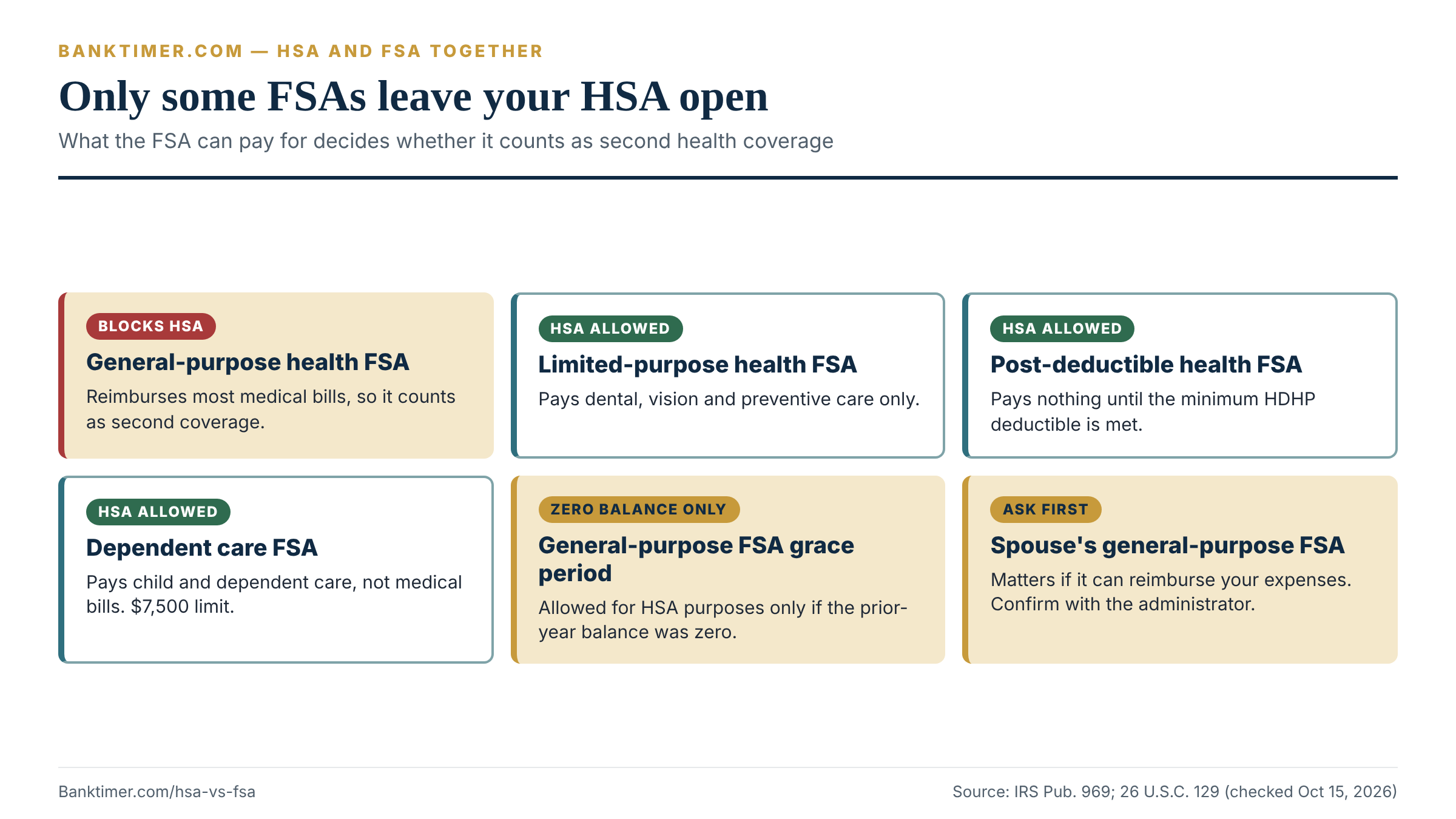
The pattern is simple. If the account could reimburse a $90 doctor visit before you meet the HDHP deductible, it blocks the HSA. If it is limited to dental and vision, or waits for the deductible, it does not. The dependent care row works for a different reason: it pays child care, so it is not health coverage at all. That last row is our reading of Publication 969’s rule, which targets arrangements that pay medical expenses.
How a limited-purpose FSA works with an HSA
A limited-purpose health FSA is still a health FSA, so the same Section 125 limit applies and the same forfeiture risk comes with it. What changes is the menu. Publication 969 says it can reimburse items allowed under other health coverage, except long-term care, and it can pay for preventive care without the deductible being met.
In practice, the pairing divides the work. You use the limited-purpose FSA for braces, eyeglasses and dental cleanings. You use the HSA for the medical deductible and prescriptions. That split can stretch your pre-tax room. It also gives the FSA a reliable job, which lowers the chance you forfeit money.
Marcus has a self-only HDHP in 2027 and an HSA. His employer also offers a limited-purpose FSA. He expects $1,100 of dental work and glasses.
He elects $1,100 into the limited-purpose FSA and lets the HSA cover medical costs. At an assumed 29.65% combined tax rate (22% federal plus 7.65% payroll tax), the FSA election saves about $326 in taxes. That rate is an assumption, not his actual rate.
If he elected $1,500 and spent only $1,100, the extra $400 could be lost unless the plan permits a carryover.
What a mistake costs
Contributing to an HSA while a general-purpose FSA covers you is an excess contribution. Publication 969 says excess contributions generally face a 6% excise tax for each year the excess stays in the account. You can avoid the tax by withdrawing the excess and its earnings by the return due date, including extensions.
For a $500 excess, the tax is $30 a year. That sounds small. The bigger cost is the lost deduction and the cleanup work on your return. Catching the conflict before you enroll is far cheaper.
The calendar-year handoff
Switching from an FSA to an HSA at open enrollment creates a quiet trap. Suppose you keep a general-purpose FSA through December 31, 2026 and start an HDHP on January 1, 2027. The FSA’s grace period, if your plan has one, can stretch coverage into March. Publication 969 says coverage during a grace period by a general-purpose FSA is allowed for HSA purposes only if the prior-year balance is zero.
Carryover raises a similar question. Notice 2013-71 says a plan with a carryover cannot also offer a grace period for the carryover year. Your plan document decides whether carried money would still act as general-purpose coverage in an HSA year. Ask your administrator in writing. Spending the account down to zero is the safest answer.
HSA or FSA: Which Is Better for You?
The honest answer to “HSA or FSA, which is better” is that neither wins in every situation. Each fits a different health plan and a different appetite for risk. The structure below puts the sequence of questions in the order they actually matter.
A five-step decision framework
Work through these in order. Stop at the first step that settles the question.
- Do you have a qualifying HDHP offered? If no, an HSA is off the table. Your choice is a health FSA or nothing.
- Do you have any disqualifying coverage? Medicare, a general-purpose FSA, or a spouse’s plan that covers you each end the question for the HSA.
- Can you fund the deductible from cash? An HDHP asks you to pay more before insurance starts. If an unplanned bill would force you onto a credit card, build your emergency fund first or weigh a lower-deductible plan.
- Is your care predictable? Known prescriptions, planned dental work or a scheduled procedure make an FSA safe to size. Unpredictable care favors the HSA, because unused money stays.
- Do you want long-run flexibility? If you might invest the balance or use it in retirement, only the HSA lets you.

An HSA vs FSA decision matrix by situation
The matrix below turns that framework into common situations. It does not rank products, and your plan’s actual numbers can change the answer.
| Situation | Usually a better fit | Why | What to verify |
|---|---|---|---|
| HDHP offered, healthy, some cash saved | HSA | Balance stays yours and can grow | Plan meets the HDHP test; custodian fees |
| No HDHP offered, predictable prescriptions | Health FSA | Only pre-tax option, easy to size | Carryover or grace period; run-out deadline |
| HDHP offered, planned dental and vision work | HSA plus limited-purpose FSA | Splits costs across both accounts | Employer offers the limited-purpose type |
| HDHP offered, thin cash cushion | Compare plans before choosing | A large deductible can strain cash | Worst-case year: premiums plus out-of-pocket maximum |
| Turning 65 soon | HSA planning, then stop before Medicare | Contributions end with Medicare enrollment | Six-month look-back on Part A |
| Self-employed | HSA, if HDHP covered | Self-employed people cannot have an FSA | Plan qualifies; Form 8889 filing |
| Spouse has a general-purpose FSA that covers you | Talk to the administrator first | May block your HSA | Whether the FSA reimburses your expenses |
The matrix shows that the HSA vs FSA question is mostly a plan-selection question. The account follows the plan. If you are still comparing plans, our employer open enrollment checklist lays out the full set of benefit choices.
FSA Carryover Rules, Grace Periods and the Use-It-or-Lose-It Deadline
The FSA carryover rules decide how much of the tax saving you actually keep. They are the part of the HSA vs FSA comparison where a small plan detail can turn into real money. Your employer chooses which option to offer, and the choice is written into the plan document.
Carryover, grace period or neither
Publication 969 says health FSAs are generally “use-it-or-lose-it.” A plan may soften that rule in one of two ways. It cannot do both for a health FSA.
| Plan design | What it allows | Limit | Catch |
|---|---|---|---|
| Neither | Nothing; unspent money is forfeited at year-end | Not applicable | Highest forfeiture risk |
| Carryover | Unused money rolls into the next plan year | Up to $680 for plan years beginning in 2026; plan may set a lower cap | Amounts above the cap are forfeited |
| Grace period | Extra time to incur new expenses against last year’s balance | Up to 2.5 months after the plan year ends | Does not extend the dollar limit; balance after the period is forfeited |
Notice 2013-71 states the rule plainly: a plan that adopts the carryover provision is not permitted to also provide a grace period for health FSAs. The same notice says unused amounts cannot be cashed out or converted into other benefits. Your employer cannot hand the leftover back to you as pay. The carryover also does not count against the salary reduction limit.
How the 2026 numbers work
The 2026 health FSA limit is $3,400, up $100 from 2025. The maximum carryover is $680, up $20, according to the IRS announcement of the 2026 inflation adjustments. Those numbers come from Rev. Proc. 2025-32. They apply to plan years beginning in 2026, which is the year-end you are heading toward now.
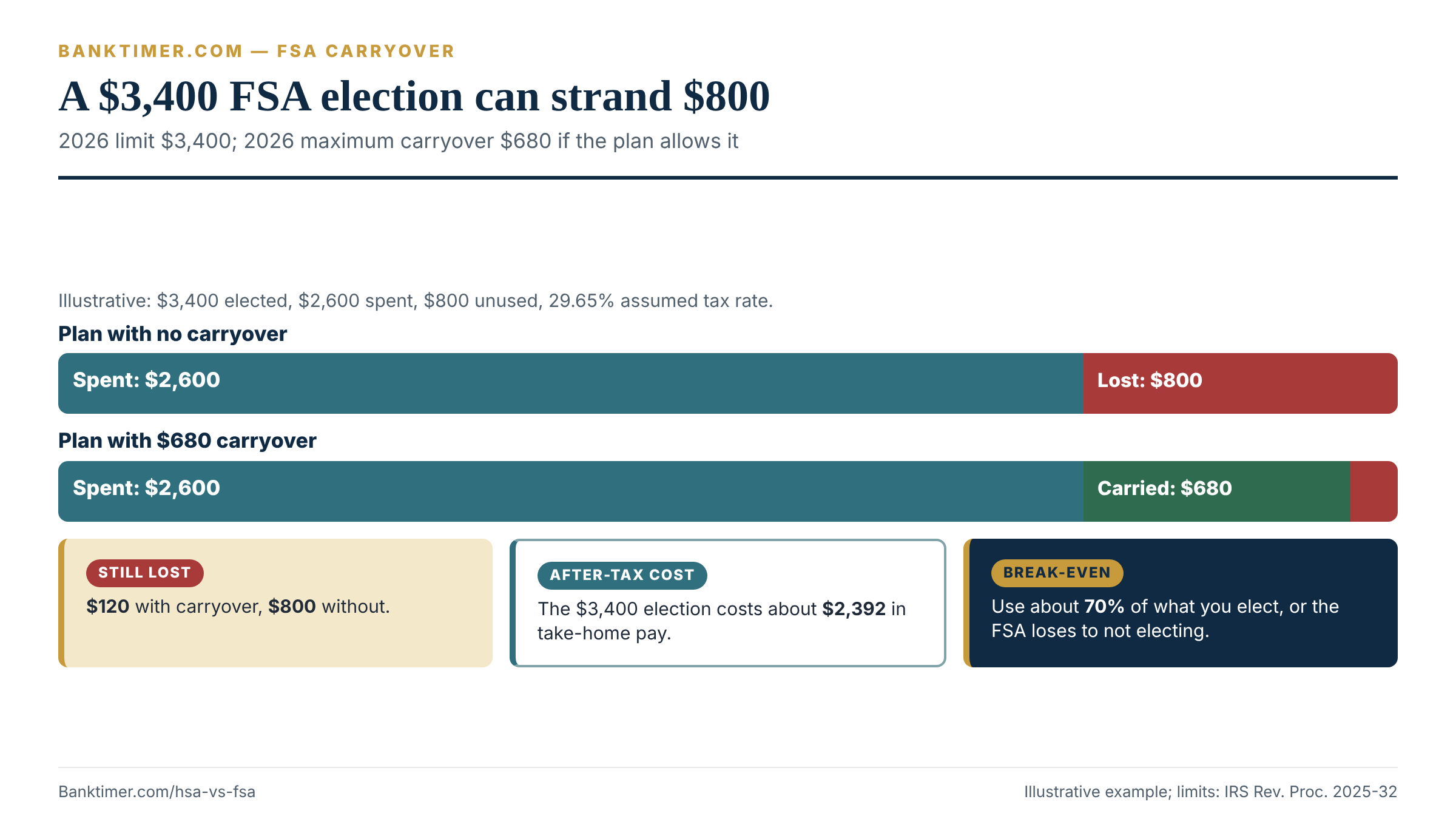
Here is why that matters at open enrollment. If you elect $3,400 for 2026 and spend $2,600, the unused $800 is at risk. A plan with the carryover can save up to $680 of it. You still lose $120. A plan with neither feature loses all $800.
The IRS indexes the FSA figures each year, but it had not published the 2027 amounts on the pages we checked on October 15, 2026. Last year the 2026 figures came out on October 9, 2025. If your enrollment form asks for a 2027 election before the IRS announces its figure, the plan will state its own cap.
What forfeiture costs in real dollars
Forfeiture is the sharpest cost in the HSA vs FSA trade-off. A forfeited balance sounds like pure loss. The math is more nuanced, because you already received a tax break on every dollar you set aside. Using an assumed combined tax rate of 29.65%, a $3,400 election costs you about $2,392 after tax. Your take-home pay falls by that amount, not by $3,400.
| Scenario | Elected | Spent | Forfeited | After-tax cost of election | Value received | Net result |
|---|---|---|---|---|---|---|
| Fully used | $3,400 | $3,400 | $0 | $2,392 | $3,400 | +$1,008 |
| Sized to need | $2,600 | $2,600 | $0 | $1,829 | $2,600 | +$771 |
| Over-elected, no carryover | $3,400 | $2,600 | $800 | $2,392 | $2,600 | +$208 |
| Over-elected, $680 carried and used | $3,400 | $2,600 | $120 | $2,392 | $3,280 | +$888 |
| Badly over-elected, no carryover | $3,400 | $1,500 | $1,900 | $2,392 | $1,500 | -$892 |
All figures are illustrative and use a 22% federal rate plus 7.65% payroll tax, with no state tax. The insight is the break-even point. You must use roughly 70% of your election for the FSA to beat not electing at all, because that is the share of each dollar you actually give up after tax. Below it, you lose.
The run-out period and other deadlines
Two deadlines matter besides year-end. The first is the plan’s claims deadline. Plans commonly set a window after year-end for submitting claims for expenses you incurred during the plan year. The plan document sets that window, and we cannot state a standard number for it.
The second is the date you incur an expense, not the date you pay. Publication 969 says FSA distributions cover expenses incurred during the coverage period. Buying next year’s supplies in December and paying early does not usually make them a current-year expense. Check the “incurred” rule with your administrator.
Our dedicated guide on FSA use-it-or-lose-it walks through year-end spending strategy in more detail.
Timeline for a calendar-year plan
The table below uses a calendar-year plan for 2027 as an illustration. Your own dates will differ if your plan year starts on another day.
| Date | Event | Who controls it | What you do |
|---|---|---|---|
| Fall 2026 | Open enrollment for the 2027 plan year | Employer | Choose HDHP or traditional plan; set FSA or HSA amounts |
| January 1, 2027 | Plan year starts; full FSA election available | Plan | Use the account for qualified expenses |
| December 31, 2027 | Plan year ends | Plan | Incur remaining expenses |
| Up to March 15, 2028 | Longest possible grace period (2.5 months) | Plan, if offered | Incur expenses against the old balance |
| Plan-set date | Claims submission window closes | Plan | File receipts |
| April 15, 2028 | Deadline to make 2027 HSA contributions | IRS | Top up the HSA before filing |
Publication 969 says contributions for 2025 could be made through April 15, 2026. The same logic points to April 15, 2028 for 2027, though April 15, 2028 falls on a Saturday. Check the actual due date when you file.
Mid-year changes
Once you elect, you generally cannot change it until the next enrollment. The cafeteria plan rules in 26 CFR 1.125-4 allow a mid-year change after a qualifying status event. Marriage, divorce, birth, adoption, death of a spouse or dependent, and employment changes all appear on the list.
The regulation adds a consistency rule: the change must correspond with the event. It also says plans are not required to allow any of these changes. And the cost-and-coverage rules do not apply to health FSAs, so a premium change alone does not let you adjust your FSA. Do not count on changing the election later.
HSA Eligible Expenses and What an FSA Will Pay For
Both accounts pay for qualified medical expenses, which the IRS defines through its medical-expense rules. In practice, the lists overlap heavily. They differ at the edges, and the edges are where reimbursement requests get denied.
Where the lists overlap and where they split
HealthCare.gov says HSA money can pay deductibles, copayments and coinsurance, but generally not premiums. Publication 969 says a health FSA can also cover over-the-counter medicine and menstrual care products. The table below sorts common items. It reflects IRS Publications 969 and 502 and Notice 2026-5, and your plan’s own list can be stricter.
| Expense | HSA | Health FSA | Note |
|---|---|---|---|
| Deductible, copay, coinsurance | Yes | Yes | The core use of both accounts |
| Prescription drugs | Yes | Yes | Insulin counts even without a prescription (Pub. 502) |
| Over-the-counter medicine | Check the custodian’s list | Yes | Pub. 969 names OTC medicine as a qualified FSA expense |
| Menstrual care products | Yes | Yes | Treated as medical care (Pub. 969) |
| Dental and vision care | Yes | Yes | The only items a limited-purpose FSA usually covers |
| Health insurance premiums | Generally no | No | HSA exceptions: long-term care, COBRA, coverage while on unemployment, Medicare at 65+ (not Medigap) |
| Direct primary care fees | Yes, within Notice 2026-5 limits | Ask the plan | Employer-paid fees cannot be reimbursed from an HSA |
| Gym membership | No | No | Pub. 502 excludes health club dues |
| General-health vitamins | Generally no | Generally no | Qualify only if a practitioner recommends them for a diagnosed condition |
| Cosmetic procedures | Generally no | Generally no | Exception for deformity from a congenital condition, accident or disease |
| Expenses before the account existed | No | Only if incurred in the coverage period | HSA rule is firm (Pub. 969) |
Two rows deserve a closer look. The premium row is where HSA owners over the age of 65 gain an edge. Publication 969 lists Medicare coverage for people 65 or older as an allowed premium use, though Medigap is excluded. And the first-day rule for new HSAs catches people off guard: an expense that happened the week before you opened the account does not qualify, even if you pay the bill afterward from the HSA.
Whose expenses count
Publication 969 says HSA funds can cover qualified expenses for you, your spouse and any dependent you claim. For a health FSA, the covered group includes you, your spouse, claimed dependents and a child under age 27. The age-27 rule is a feature of FSAs, not HSAs, so a grown child on your plan might be eligible for FSA reimbursement but not HSA reimbursement.
Proof you need to keep
For an HSA, you need records that show the withdrawal paid a qualified expense, that nothing else reimbursed it and that you did not deduct it. Publication 969 says not to send these records with your return. Keep them with your tax records. It gives no retention period, so a conservative habit is to keep them as long as you keep the return.
For an FSA, the plan requires third-party documentation, and advance reimbursements are not allowed. A debit card swipe can still trigger a request for the itemized receipt. Our overview of U.S. tax and insurance forms shows where the HSA forms fit.
What the Tax Break Is Actually Worth
Both accounts reduce taxable pay. How much that is worth depends on your tax rate, your payroll taxes and your state. The calculation is mechanical. The honest result is smaller than the marketing suggests. In the HSA vs FSA tax comparison, the saving is the same for both accounts when you use payroll deduction.
Three layers of savings
A payroll contribution to an FSA avoids federal income tax and employment taxes, according to Publication 969. Employment taxes for an employee are 6.2% for Social Security and 1.45% for Medicare, a combined 7.65%, according to IRS Topic 751. The Social Security part stops above the wage base, which is $184,500 for 2026.
For an HSA funded through payroll, Publication 969 treats cafeteria plan contributions as employer contributions. Amounts employers contribute generally avoid employment taxes. If you fund the HSA yourself and claim a deduction on Form 8889, you get the income tax break but typically not the payroll tax saving.
| Assumed federal rate | State rate | Combined rate | Tax saved on $2,000 | After-tax cost of $2,000 |
|---|---|---|---|---|
| 12% | 0% | 19.65% | $393 | $1,607 |
| 12% | 5% | 24.65% | $493 | $1,507 |
| 22% | 0% | 29.65% | $593 | $1,407 |
| 22% | 5% | 34.65% | $693 | $1,307 |
| 24% | 5% | 36.65% | $733 | $1,267 |
The table is illustrative. It assumes payroll contributions, so the 7.65% applies. A self-funded HSA at a 22% federal rate saves about $440 on $2,000, because there is no payroll tax saving. That gap of roughly $150 is why a payroll election is often worth setting up even for an account you manage yourself.
State taxes are not uniform
Federal treatment is clear. State treatment varies. The California Franchise Tax Board said in a 2025 bill analysis that California law has no provisions comparable to the federal HSA provisions. The bill that would have added them, AB 781, died on January 31, 2026, according to LegiScan. A California resident should therefore expect the state to reverse the federal HSA treatment.
Other states differ, so check your state’s rules before you count a state tax saving. For broader tax context, see our guide to how bank savings and insurance are taxed.
What happens if you withdraw for something else
An HSA lets you take money out for any reason. The cost is steep before age 65. Publication 969 says a non-qualified distribution is taxable and subject to an additional 20% tax. That additional tax does not apply after you become disabled, reach age 65 or die.
At a 22% federal rate, a $1,000 non-medical withdrawal before 65 costs about $420 ($220 plus $200), before any state tax. After 65, the same withdrawal costs about $220 in income tax and no additional tax. A health FSA, by contrast, does not allow non-medical withdrawals at all.
Running the Numbers: HDHP With an HSA vs a Traditional Plan With an FSA
The HSA vs FSA choice is only half the story, because the health plan underneath it carries most of the cost. This model compares two illustrative 2027 plans for a single employee. Every number is a Banktimer assumption, not a quote, and real plans add copays, tiers and network limits that the model leaves out.
The assumptions
- Plan A, HDHP with an HSA: $250 monthly premium ($3,000 a year), $3,000 deductible, 20% coinsurance, $6,500 out-of-pocket maximum. The employer deposits $300 in the HSA.
- Plan B, traditional plan with a health FSA: $300 monthly premium ($3,600 a year), $500 deductible, 20% coinsurance, $4,500 out-of-pocket maximum. You elect an FSA amount equal to your expected costs.
- Tax rate: 22% federal plus 7.65% payroll tax, or 29.65%, applied only to the out-of-pocket money you route through the accounts. Premiums are assumed pre-tax in both plans, so they cancel out.
- Care: all in-network, shown at four levels of allowed charges.
Plan A passes the HDHP test for 2027. Its deductible exceeds the $1,750 minimum, and its $6,500 out-of-pocket limit sits below the $8,700 maximum.
What each plan costs at four levels of care
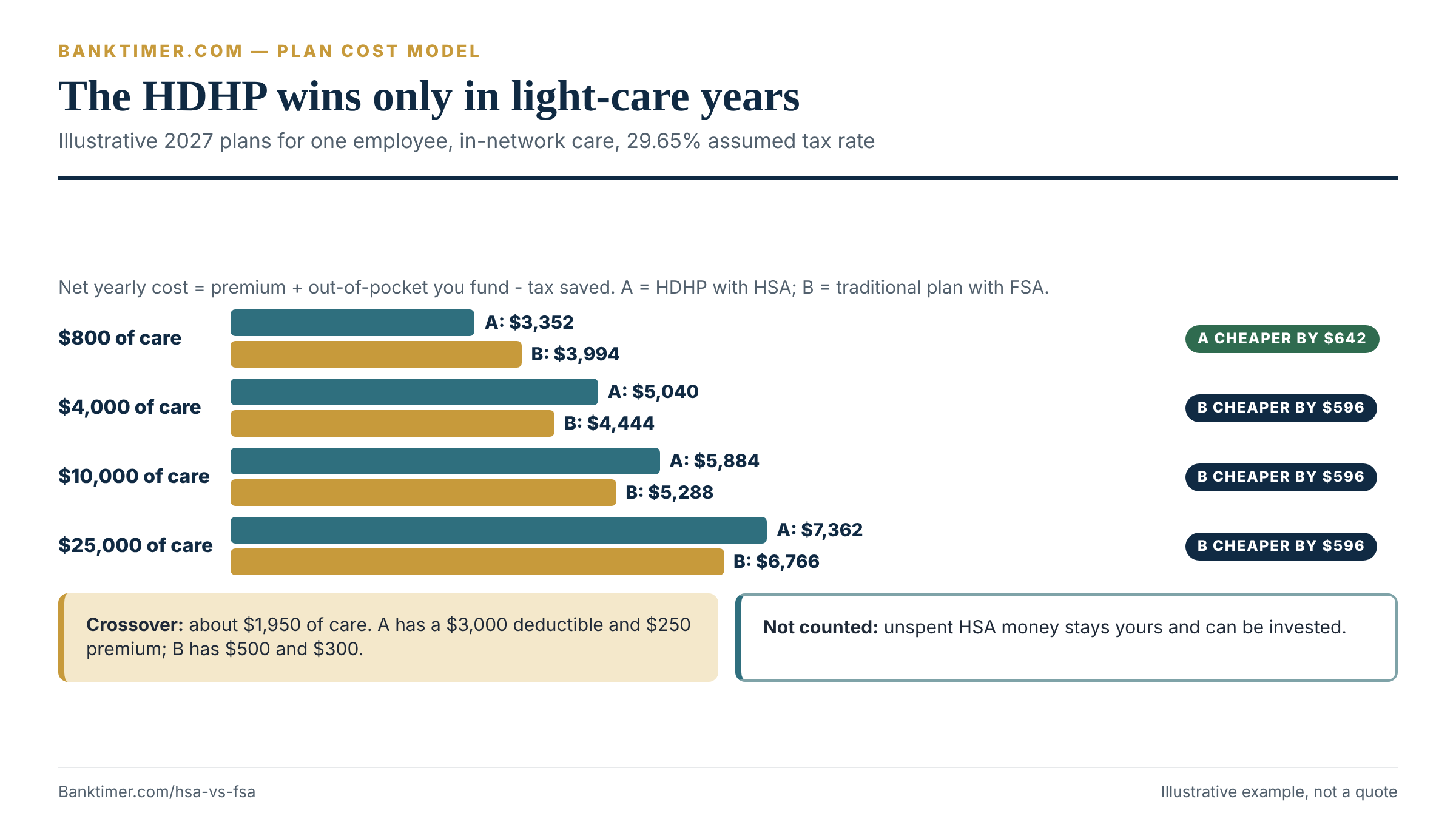
| Allowed charges for the year | Plan A: you pay | Plan A: net cost | Plan B: you pay | Plan B: net cost | Cheaper plan |
|---|---|---|---|---|---|
| $800 | $800 | $3,352 | $560 | $3,994 | Plan A by $642 |
| $4,000 | $3,200 | $5,040 | $1,200 | $4,444 | Plan B by $596 |
| $10,000 | $4,400 | $5,884 | $2,400 | $5,288 | Plan B by $596 |
| $25,000 | $6,500 | $7,362 | $4,500 | $6,766 | Plan B by $596 |
Net cost equals the annual premium plus the out-of-pocket money you fund yourself, minus the tax saved on it. For Plan A, the first $300 of bills comes from the employer deposit, so it carries no tax saving. The results are rounded to the nearest dollar.
What the model teaches
The HDHP wins only when you use little care. The crossover lands at about $1,950 of allowed charges. Above that, Plan B wins by a flat $596. The gap stops growing because both plans share the same 20% coinsurance once each deductible is met. The extra $2,500 of deductible in Plan A means you pay $2,000 more out of pocket. After the $300 employer deposit and the tax saving, that is about $1,196. The $600 premium saving offsets only about half of it.
Two things the model leaves out favor the HSA. The first is that unspent HSA money stays yours. If you contribute $1,500 more than you spend, that cash is still in the account next year. The second is the investing option. Neither shows up in the first-year math.
The worst year tells another story. At the out-of-pocket maximum, Plan A costs about $7,362 after tax, against $6,766 for Plan B. That worst-case total includes the premium. It also assumes you can front the deductible, which is why the HDHP is not a universal answer. Our monthly budget guide helps you test whether a $3,000 bill would strain your cash.
What unspent HSA money can become
This illustration is not a forecast. Suppose you leave $1,500 a year unspent in an HSA. At an assumed 3% annual return, 20 years of deposits grow to about $40,306, of which $30,000 is your own money. At an assumed 5%, it reaches about $49,599. Returns are not guaranteed, and investments in an HSA can lose value. The SEC’s bulletin also says some HSAs charge account maintenance fees and investment fees, which reduce returns over time.
Four Worked Scenarios
The scenarios below use the 2027 limits and the same 29.65% combined rate unless noted. They are illustrations, not real people.
A family with predictable costs
The Okafors’ employer offers only a traditional plan. They expect $1,200 of prescriptions and $2,800 of orthodontia payments in 2027, a total of $4,000. They elect $3,400, which is the 2026 limit (the 2027 limit is not yet announced), and pay the remaining $600 from after-tax money.
At 29.65%, the $3,400 election saves about $1,008 in taxes. Because both expenses are scheduled, forfeiture risk is low.
If a spouse’s employer also offers an FSA, ask both plans about their own caps and any coordination rules before electing.
A freelancer with a bronze plan
Dana is self-employed and buys an Exchange bronze plan for 2027. Under Notice 2026-5, Exchange bronze plans are treated as HDHPs from 2026, so she can open an HSA. She cannot use an FSA, because Publication 969 says self-employed people are not eligible.
She contributes $4,500, the 2027 self-only limit, and claims the deduction on Form 8889. At an assumed 22% federal rate, the income tax saving is about $990. She keeps the receipts for every withdrawal and leaves unused money in the account.
A worker who turns 65 and enrolls late in Medicare
Elena turns 65 in January 2027 and keeps working with an HDHP and an HSA. She signs up for premium-free Part A in October 2027. Medicare.gov says that coverage starts 6 months back, so it begins in April 2027.
Her HSA contribution limit is zero from April onward. If she contributed $400 a month from April through October, that is $2,800 of excess. The 6% excise tax is about $168 a year until corrected. A simplified count like this one ignores month-by-month limit math, so a tax professional should run the real figures.
A spouse’s FSA that blocks the HSA
Maria has a family HDHP and plans to fund an HSA. Her husband Dan’s employer offers a general-purpose health FSA that can reimburse Maria’s and the children’s costs.
If Dan elects it, Maria’s HSA contributions are generally blocked, according to the “other health coverage” rule in Publication 969. The family limit is $9,000. At a 22% federal rate, that is about $1,980 of income tax benefit at stake, plus up to $689 in payroll tax if the HSA runs through payroll. Dan can decline the FSA, or ask whether a limited-purpose option exists.
Mistakes and Red Flags in the HSA vs FSA Choice
Most losses here come from a handful of avoidable errors. Few are dramatic. They are expensive because they repeat for a full year or show up months later on a tax return. The table lists the ones worth checking before you click “submit” on your enrollment.
| Red flag | Why it matters | What to ask | Safer next step |
|---|---|---|---|
| Electing an HSA while a general-purpose FSA covers you | Contributions become excess and face a 6% excise tax each year | Does any plan covering me or my spouse reimburse medical bills? | Choose a limited-purpose FSA or decline the general one |
| Assuming “high deductible” means HSA-qualified | Plan must meet the IRS deductible and out-of-pocket tests, or be a bronze or catastrophic Exchange plan | Is this plan HSA-eligible for 2027? | Get the answer in writing from the carrier or HR |
| Electing the full FSA limit without a list | Unspent money may be forfeited | What do I know I will spend? | Elect your confirmed expenses, then stop |
| Contributing to an HSA near Medicare enrollment | Limit is zero from the first Medicare month, including retroactive Part A | When does my Part A start? | Stop HSA contributions six months before you sign up |
| Paying a bill that predates the HSA | HSA withdrawals for expenses before the account exists are not tax free | When did I open the account? | Open the HSA before the care happens |
| Believing spouses can share one HSA | Joint HSAs do not exist; each spouse opens their own | Whose name is on each account? | Open two accounts if both are eligible |
| Ignoring HSA custodian fees | Maintenance and investment fees can erode small balances | What are the monthly and investment fees? | Compare the fee schedule before you pick a custodian |
| Skipping receipts | You must be able to prove qualified use | Where will I store records? | Keep a folder tied to each tax year |
| Counting a state tax break that may not exist | Some states do not follow federal HSA treatment | Does my state tax HSA contributions or earnings? | Check your state revenue department |
Some HSAs hold cash, and some hold investments. The SEC’s HSA bulletin does not address deposit insurance, so do not assume protection from the word “account.” Ask your custodian whether cash balances are FDIC insured and whether invested balances can lose value. Our guide to FDIC insurance limits explains how deposit coverage works at a bank.
How to avoid the biggest mistake
The top error in the HSA vs FSA decision is mismatching the account and the plan. Check the plan first, the account second, and your spouse’s coverage third. Write down each plan that could pay a medical bill for you or your family. If any of them is a general-purpose FSA or an HRA, stop and ask before you open an HSA.
Edge Cases That Change the Answer
The rules above cover most HSA vs FSA decisions. A few situations bend them. Each one below is a place where a short call to the plan administrator saves a correction later.
Age 55 and older
Anyone who is 55 or older by year-end can add the $1,000 catch-up to the annual limit. Publication 969 says that when both spouses are 55 or older and each has an HSA, each spouse’s catch-up goes into their own account. For 2027, a couple with family coverage could contribute up to $9,000 for the family limit plus $1,000 for each spouse, for $11,000 combined across two accounts. A health FSA has no catch-up.
Moving an HSA
Moving HSA money between custodians follows its own rules. Publication 969 says an HSA-to-HSA rollover must be completed within 60 days and is limited to one per 1-year period. A direct trustee-to-trustee transfer is not a rollover, and there is no limit on how many you do. A transfer is usually the safer route.
The publication also allows a one-time transfer from an IRA to an HSA, called a qualified HSA funding distribution. It is generally allowed only once in a lifetime and reduces your contribution limit.
What happens to an HSA at death
Beneficiary choices matter more than most people expect. Publication 969 says that if your spouse is the designated beneficiary, the HSA becomes the spouse’s HSA. If anyone else inherits it, the account stops being an HSA and its fair market value is taxable to the beneficiary in the year of death. Keep your beneficiary form current. Our guide to beneficiary designation covers the paperwork.
Leaving a job or losing coverage
An HSA is unaffected by job changes. You can keep contributing as long as you remain eligible, and the money stays yours. A health FSA is different. It reimburses expenses incurred while you were covered, so a midyear departure can strand an unspent balance. A reservist called to active duty for more than 179 days can take a distribution of the unused balance if the plan allows it, according to Publication 969. Ask HR how your plan handles termination before you elect a large amount.
Employer contributions
Employer deposits count toward your HSA limit. Publication 969 says employer contributions reduce what you or others can add. If your employer puts in $500 and the 2027 self-only limit is $4,500, you have $4,000 of room left. Form 8889 reconciles the total, so track your payroll elections against the annual limit.
Records to Keep and Forms You Will See
Every year you use an HSA, a paper trail follows. The forms are short, but they are your proof if a withdrawal is questioned. The table below shows what to expect.
| Document | Why it matters | Where it comes from | How long to keep it |
|---|---|---|---|
| Form 8889 | Reports HSA contributions, deduction and distributions; required if there was any HSA activity | You file it with your return | With your tax records |
| Form 5498-SA | Shows HSA contributions for the year | The HSA trustee | With your tax records |
| Form 1099-SA | Reports distributions from the HSA | The HSA trustee | With your tax records |
| W-2, box 12, code W | Shows employer HSA contributions, including cafeteria plan elections | Your employer | With your tax records |
| Receipts and Explanation of Benefits | Prove each withdrawal paid a qualified expense | Provider and insurer | Publication 969 sets no period; keep them with the return |
| FSA plan document | States your carryover, grace period and claims deadline | Your employer | Until the plan year closes |
| Medicare enrollment date | Sets the date your HSA limit drops to zero | Medicare notice | Until you stop contributing |
Form 8889 is required even if only your employer contributed, according to Publication 969. The IRS page for the form listed the 2025 revision as current when we checked on October 15, 2026.
Questions to ask before you enroll
- ☐ Is my plan an HDHP, or an Exchange bronze or catastrophic plan, and is it HSA-eligible for 2027?
- ☐ Does any other plan, including a spouse’s, cover me and reimburse medical costs?
- ☐ Does my employer offer a limited-purpose or post-deductible FSA?
- ☐ Does my FSA offer a carryover or a grace period, and what are the exact limits?
- ☐ When is the claims deadline for last year’s FSA expenses?
- ☐ Will my employer contribute to an HSA, and does it need an election to start?
- ☐ What are the HSA custodian’s monthly and investment fees?
- ☐ Can I change my payroll HSA amount during the year?
- ☐ Is cash in the HSA FDIC insured, and can I invest above a minimum balance?
- ☐ Will I turn 65 or join Medicare within the next 12 months?
Frequently Asked Questions
Should I choose an HSA or an FSA at open enrollment?
Start with your health plan. If you are choosing a qualifying high-deductible plan and have no disqualifying coverage, an HSA usually gives you more flexibility because you own it and the balance never expires. If you are staying on a traditional plan, a health FSA is the pre-tax option, and you should size it to expenses you are sure about. Choosing both is possible only with a limited-purpose or post-deductible FSA.
Can I have an HSA and an FSA at the same time?
Yes, with a catch. A general-purpose health FSA generally blocks HSA contributions, according to IRS Publication 969. A limited-purpose FSA, a post-deductible FSA and a dependent care FSA do not. The limited-purpose version usually pays only for dental, vision and preventive care. Ask your employer which FSA types it offers before you enroll in both.
What is the HDHP requirement for an HSA?
You must be covered by a high-deductible health plan. For 2027, that means a deductible of at least $1,750 for self-only coverage or $3,500 for family coverage, and an out-of-pocket limit of no more than $8,700 or $17,400. Bronze and catastrophic plans sold through an Exchange also qualify from 2026. Your insurer or HR can confirm in writing whether your plan meets the test.
What are the FSA carryover rules?
If your employer allows it, a health FSA can roll over a limited amount of unused money into the next plan year. The 2026 cap is $680, and your plan may set a lower one or none. A plan that offers carryover cannot also offer a grace period. Anything above the cap is forfeited, and employers cannot refund it to you.
What is a limited-purpose FSA?
It is a health FSA that pays only for a narrow set of costs, mainly dental, vision and preventive care. Because it cannot cover general medical bills, it does not conflict with HSA eligibility. The same federal health FSA limit applies to it, and it carries the same forfeiture risk. Not every employer offers one, so ask HR whether it is available.
What happens to my HSA if I change jobs?
Nothing happens to the money. The account is yours, so you keep the balance and can keep using it for qualified expenses. You can leave it with the same custodian or transfer it to another. You can only keep contributing if you still have qualifying HDHP coverage and no disqualifying coverage. Your old employer’s deposits stop when employment ends.
HSA vs FSA limits: how much can I contribute in 2027?
For an HSA in 2027, the limit is $4,500 for self-only coverage and $9,000 for family coverage, plus $1,000 if you are 55 or older. The IRS had not announced the 2027 health FSA limit on the pages we checked on October 15, 2026. The 2026 figure is $3,400. Your employer may set a lower cap than the IRS allows.
What are HSA eligible expenses?
They include deductibles, copays, coinsurance, prescriptions, dental care, vision care and menstrual care products for you, your spouse and your claimed dependents. Health insurance premiums are generally excluded, with exceptions such as COBRA and Medicare at 65 or older. Cosmetic procedures, gym dues and general-health vitamins generally do not qualify. IRS Publications 969 and 502 define the rules.
Can I use my HSA for my spouse or kids?
Yes, for qualified expenses. Publication 969 says HSA funds can cover the account holder, a spouse and any dependent the holder claims on their tax return. Your spouse does not need to be covered by your HDHP for you to pay their qualified costs. Check each person’s dependency status before you reimburse.
What happens if I use HSA money for something that is not medical?
The withdrawal is taxable income. Before age 65, you also owe an additional 20% tax, according to Publication 969. At a 22% federal bracket, a $1,000 non-medical withdrawal costs about $420 before state tax. The extra 20% tax does not apply after age 65, disability or death. Keep records so you can prove which withdrawals were medical.
Can I contribute to an HSA after I enroll in Medicare?
No. Your contribution limit is zero starting the first month you are enrolled in Medicare, Publication 969 says. That includes retroactive coverage. Medicare.gov says premium-free Part A that you sign up for later starts 6 months back. So plan to stop contributing at least six months before you apply. You can still spend the existing HSA balance on qualified expenses.
HSA vs FSA: which is better if I rarely use care?
If you qualify for an HSA, it usually fits a light-care year better. Unspent money stays yours, and a lower premium on an HDHP can add to the saving. In our illustration, the HDHP came out cheaper only below about $1,950 of care. A health FSA is riskier here because unspent money can be forfeited, so elect only what you are sure to use.
Before enrollment closes, write down every plan that covers you or your spouse and ask HR two questions in one email: is my plan HSA-eligible for 2027, and does my FSA allow carryover or a grace period? Their written answers decide which account is available to you.
The variable that decides the HSA vs FSA outcome is your health plan, because an HSA exists only alongside a qualifying high-deductible plan or an Exchange bronze or catastrophic plan, and no second general-purpose coverage can sit on top of it. If that gate is open, an HSA gives you ownership, no expiration and a larger 2027 limit of $4,500 self-only or $9,000 family. If it is closed, a health FSA is the tool, and the job is to elect only what you are sure to spend. Our illustration found the HDHP cheaper only in light years, so run your own plan numbers first. This guide does not cover Medicare-specific rules in depth, employer plan documents, state tax treatment, or investment risk inside an HSA. Confirm those with your plan administrator and a tax professional.
Methodology
We built this HSA vs FSA guide from primary sources. The IRS documents we read on October 15, 2026 include Publication 969 (2025), Publication 502, Revenue Procedures 2025-32 and 2026-24, Notices 2026-5 and 2013-71, and the IRS announcement of 2026 inflation adjustments. We also used 26 U.S.C. 129, 26 CFR 1.125-4, HealthCare.gov, Medicare.gov, the SEC investor bulletin on HSAs and the California Franchise Tax Board’s bill analysis.
All dollar examples are Banktimer illustrations. They use an assumed 22% federal rate, 7.65% payroll tax and no state tax unless stated, and they ignore copays and network limits. The calculations are in our working file and were rechecked before publication. We did not test products, call providers or contact employers.
What varies: your employer sets FSA carryover, grace period and claims deadlines. HSA custodians set fees and investment menus. States differ on HSA taxation. Publication 969 is the 2025 edition, so 2026 return rules may be updated in the next edition.
Sources
- IRS Publication 969, Health Savings Accounts and Other Tax-Favored Health Plans (2025), IRS
- Rev. Proc. 2026-24, 2027 HSA and HDHP inflation-adjusted amounts, IRS
- Rev. Proc. 2025-32, 2026 inflation adjustments including health FSA limits, IRS
- IRS releases tax inflation adjustments for tax year 2026 (IR-2025-103), October 9, 2025
- Notice 2026-5, HSA provisions of the One, Big, Beautiful Bill Act, IRS
- Notice 2013-71, health FSA carryover, IRS
- IRS Publication 502, Medical and Dental Expenses (2025)
- Topic no. 751, Social Security and Medicare withholding rates, IRS
- 26 U.S.C. 129, Dependent care assistance programs, Cornell Legal Information Institute
- 26 CFR 1.125-4, Permitted election changes, Cornell Legal Information Institute
- Out-of-pocket maximum/limit glossary, HealthCare.gov
- When does Medicare coverage start, Medicare.gov
- Health Savings Accounts (HSAs) investor bulletin, SEC Office of Investor Education, December 9, 2025
- AB 781 bill analysis, California Franchise Tax Board, 2025
By the Banktimer Editorial Team · Published
Banktimer is an independent U.S. consumer-finance publication. Our editors draw on primary and official sources first, such as the CFPB, FDIC, Federal Reserve, and FTC, along with statutes, regulations, and providers’ own agreements and fee schedules. Then we add worked examples and decision tools. Our goal is the most useful, best-supported explanation the sources available to us at the time of writing allow.
This article is general information, not legal, tax, investment, insurance, or financial advice, and reading it does not create a professional relationship with Banktimer. Rates, fees, limits, and rules change, and they vary by state, provider, and contract, so confirm current terms with your bank, lender, insurer, or the agency named in the article before you act. Examples are illustrative unless labeled otherwise. Banktimer is not a bank, lender, insurer, or financial advisor, and we are not responsible for decisions or losses that result from relying on this content. For advice about your own situation, talk to a licensed professional.