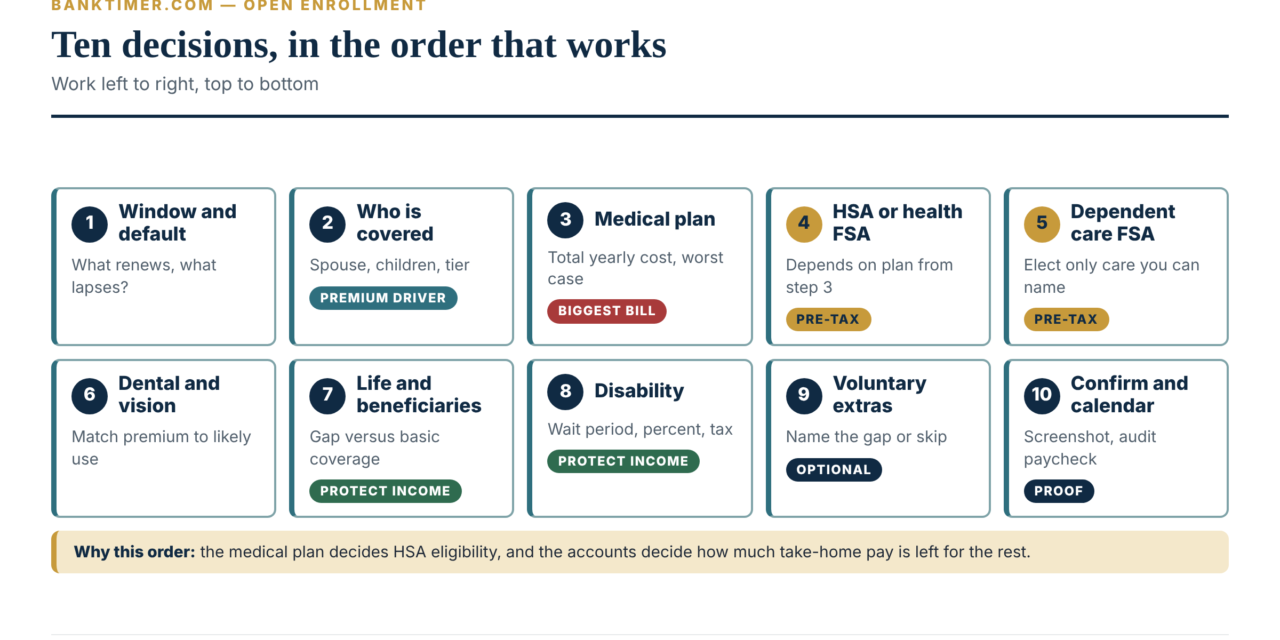
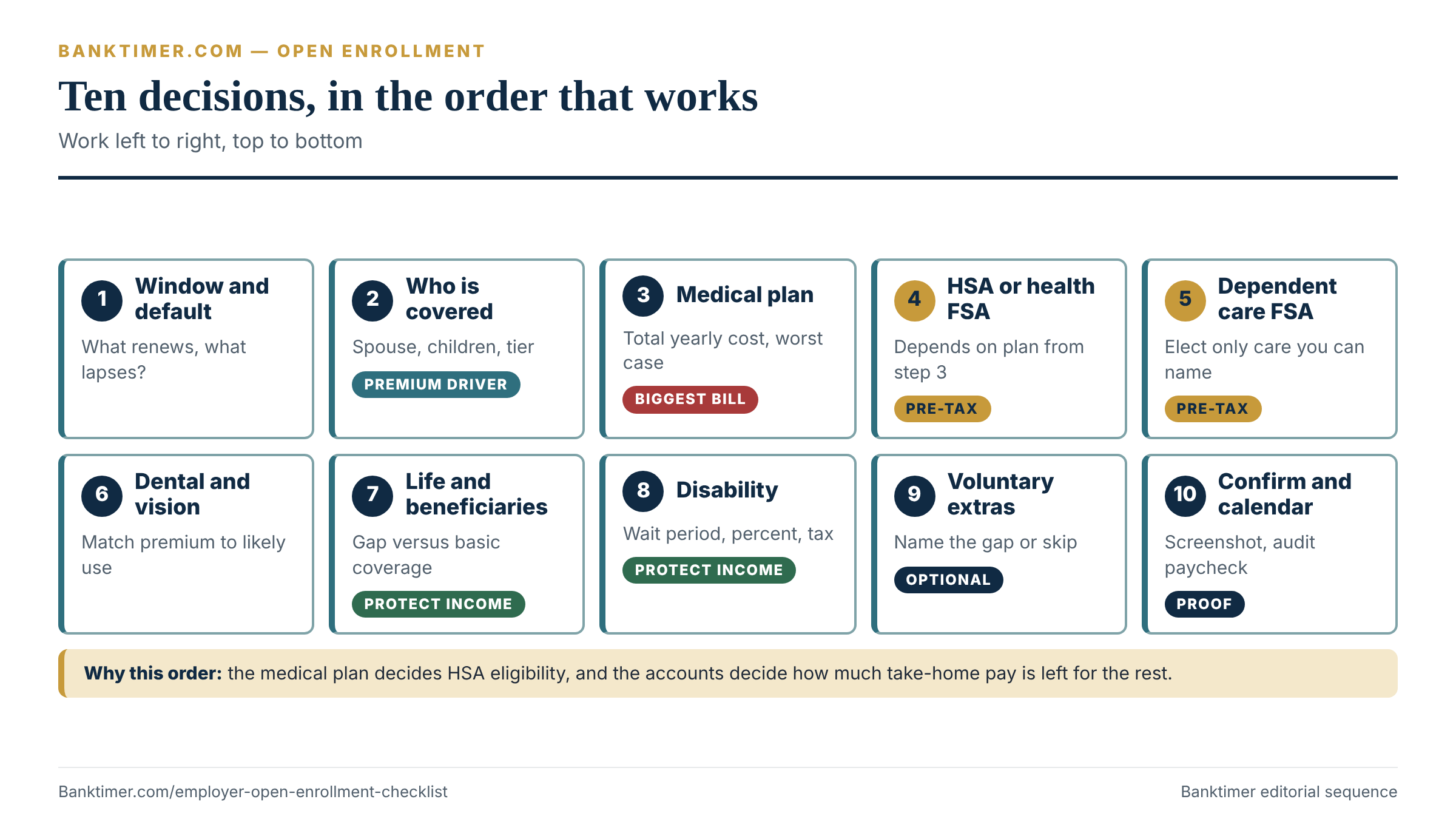
An employer open enrollment checklist puts your choices in a fixed order. Confirm your window and what happens if you do nothing. Decide who is covered. Pick the medical plan, choose a health account and size a dependent care account. Then handle dental and vision, life insurance, disability, optional extras and a final confirmation. Order matters because each decision sets the budget for the next one.
The biggest variable is your employer’s own rules. The window, the defaults, the plan limits and the claim deadlines come from your plan documents. Federal law does not set them. Before you click anything, get the dates and the 2027 plan summary in writing.
Start with the window and the default. Some benefits renew on their own. Others, such as flexible spending accounts (FSAs), often need a fresh election every year. Learn which is which before the deadline, not after.
Decide who is covered before you compare plans. A spouse, a partner or an adult child changes the premium math more than any copay does.
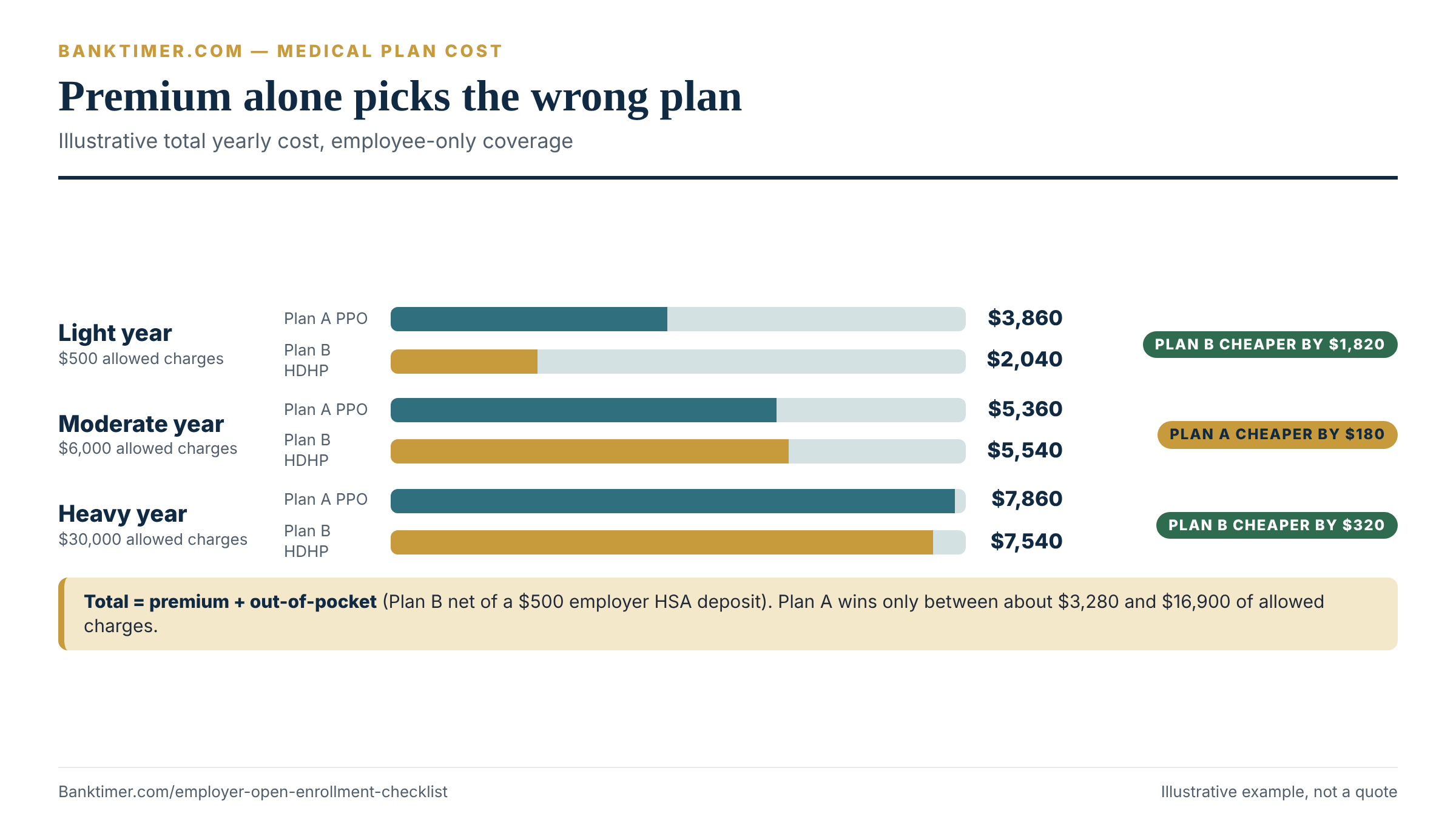
Compare plans on total yearly cost, not premium alone. In our illustration, a lower-premium plan wins in a light year and a heavy year, and loses in between.
Treat FSA elections as a forecast. The 2026 dependent care limit is $7,500, but unspent money can be forfeited, so elect what you can document.
Pay for gaps, not frills. Disability and life coverage protect income. Many voluntary extras duplicate coverage you already have.
Write down the mid-year rules. After the window closes, you can usually change elections only after a qualifying life event. The clock can be as short as 30 days.
What an Employer Open Enrollment Checklist Has to Cover
Open enrollment is the yearly window when your employer lets you enroll in, change or drop benefits. It covers the coming plan year. In many workplaces, the window opens in the fall for a January 1 start. Some employers run different plan years, so the dates on your own calendar matter more than the season.
A useful employer open enrollment checklist does three jobs. It sorts decisions so you do not compare plans before you know who needs coverage. It attaches a number to each choice. “Pay more now to risk less later” becomes a figure you can see. And it lists deadlines that sit outside the window, such as the last day to submit FSA receipts.
Why the order matters
Think of the ten decisions on any employer open enrollment checklist as a chain. Your medical plan choice sets the deductible. That decides whether a health savings account (HSA) is even available to you. The HSA or FSA decision then changes your take-home pay. That decides how much you can afford for dependent care, life insurance and disability. Skip a link and you end up re-doing earlier work.
Here are the ten decisions on our employer open enrollment checklist, in order:
- Confirm your window and your default.
- Decide who is covered.
- Choose a medical plan.
- Choose a health account (HSA or health FSA).
- Size a dependent care FSA.
- Pick dental and vision.
- Set life insurance (basic and supplemental) and beneficiaries.
- Review short-term and long-term disability.
- Screen voluntary extras.
- Confirm, document and calendar the mid-year rules.
What this employer open enrollment checklist does not cover
Medicare has its own enrollment period, and the Affordable Care Act (ACA) Marketplace has another. If you or a covered family member is turning 65, read our guide to Medicare open enrollment alongside this one. If you are weighing Marketplace coverage instead of your employer plan, our ACA open enrollment 2027 guide covers that route.
Retirement plan elections, such as a 401(k) contribution rate, can usually change on a different schedule than benefits. We touch on them only where they affect your take-home pay.
How Employer Open Enrollment Works: Windows, Defaults and the Lock-In
Your employer sets the window. Federal law does not give every worker a standard open enrollment period for job-based coverage. The company picks the plan year, the dates and the carriers. It then publishes them in an enrollment guide or a benefits portal. Windows commonly run for a few weeks, but yours may be shorter or longer.
Two rules explain why the window matters so much. First, elections made through a payroll tax-advantaged arrangement, called a cafeteria plan, are made ahead of time and are hard to undo. IRS Publication 969 puts it plainly. At the beginning of the plan year, you must designate how much you want to contribute. You can change or revoke the election only if specifically allowed by law and the plan. Second, the tax regulations let a plan allow certain mid-year changes, but they do not require it. Your employer can be stricter than the maximum the rules permit.
Passive enrollment and auto-renewal: what “do nothing” really does
Many employers use passive enrollment. Last year’s medical, dental and vision choices roll forward if you take no action. That is convenient. It is also where costly mistakes hide. The plan may cost more next year, cover different doctors or change its deductible. You will not see any of that unless you open the guide.
Other benefits work the opposite way. Health FSAs and dependent care FSAs often require a new election each year. Doing nothing means you simply have no account. Supplemental life and voluntary extras may renew at the old amount or lapse. The table below sorts the usual patterns. They are industry practice, not law, so confirm each line with your plan administrator.
| Benefit | What “do nothing” often means | Why it matters | Confirm with HR |
|---|---|---|---|
| Medical, dental, vision | Prior-year plan and coverage tier roll forward | Premiums and deductibles may have changed | New rates, network list, plan summary |
| HSA payroll contribution | Prior amount may continue, or it may stop | Contribution limits change each year | Whether your amount carries over |
| Health FSA | Often no account unless you re-elect | You lose the tax savings and a spending pool | Re-election rule and 2027 plan limit |
| Dependent care FSA | Often no account unless you re-elect | Daycare costs still arrive, without pre-tax pay | Re-election rule and claim deadline |
| Basic life and disability | Usually employer-paid and automatic | Coverage may still need beneficiary updates | Current beneficiary on file |
| Supplemental life, voluntary extras | May renew at the old amount or lapse | Premiums can rise with age bands | Renewal rule and new rates |
| New hires or newly eligible staff | No coverage until you enroll | A missed window can mean waiting a year | Your exact enrollment deadline |
The insight in this table is simple: “do nothing” is not one outcome. It is a different outcome for each benefit, and the expensive ones are the accounts that quietly disappear. Note every line where the answer is “not sure.” Then email your benefits team before the window opens.
The lock-in has exceptions, but they are narrow
After the window closes, your elections generally stay put for the plan year. The exceptions are qualifying life events and a few other permitted changes, covered in a later section. They require a specific trigger and a deadline. A rough year is not a trigger. Neither is finding a cheaper plan in November.
Gather Five Things Before You Open the Portal
The enrollment portal rewards speed, and your wallet rewards preparation. Treat this prep as step zero of your employer open enrollment checklist. Spend 30 minutes collecting what follows before you compare a single plan. You will make faster choices, and you will have a paper trail if something goes wrong.
- Last year’s confirmation statement. It shows what you elected and what you pay per paycheck.
- The 2027 plan summaries and rate sheet. These show the new premiums, deductibles and limits side by side.
- A list of your doctors, prescriptions and expected care. Include planned surgery, pregnancy, therapy and recurring prescriptions.
- Your actual spending from this year. Pull explanation of benefits (EOB) statements, pharmacy history, FSA claims and child care invoices.
- Your spouse’s or partner’s benefits. Their employer may offer a better plan, or a plan that makes yours redundant.
The table below shows what each document is for. The decision-driving point is the first row. Last year’s statement is the one people skip, and it exposes silent price increases.
| Document | Why it matters | Where to get it | How long to keep it |
|---|---|---|---|
| Last year’s confirmation | Shows current elections and paycheck cost | Benefits portal or HR | Until the next plan year starts |
| 2027 plan summary (SBC) | Standard format for comparing plans | HR, carrier site, portal | Through the plan year |
| EOB statements | Shows what care really cost you | Carrier portal or mail | At least until tax filing |
| FSA and HSA statements | Shows balance, claims and deadlines | Account administrator | Until the account closes plus tax year |
| Child care receipts and provider tax ID | Needed for dependent care claims and Form 2441 | Provider | Three years after filing is a common practice |
| Beneficiary confirmation | Shows who gets life and retirement money | Portal or HR | Update after any life event |
| Spouse’s plan summary | Lets you compare coverage and avoid overlap | Spouse’s employer | Through the plan year |
The summary of benefits and coverage is your best comparison tool
The summary of benefits and coverage (SBC) is a standardized document. It shows deductibles, copays, coinsurance and a few worked cost examples in the same layout for every plan. A CMS overview of the SBC rules, written for insurers, says a copy is due within seven business days of a request. It also says mid-year changes affecting SBC content generally need 60 days’ notice. Group health plans have their own parallel obligations. If your employer has not posted the SBCs, ask for them by email. The request will then carry a date.
Decision 1: Confirm Your Window, Your Default and Every Deadline
The first item on an employer open enrollment checklist is not a choice at all. It is a set of facts you need before choosing anything else. Write down four items and keep them where you will see them. These are the last day to enroll, whether you can edit until then, what happens if you do nothing, and how you will get a confirmation.
Questions that settle the default
Ask your benefits team whether your medical, dental and vision elections roll forward automatically. Then ask the same about HSA contributions, health FSA, dependent care FSA, supplemental life and voluntary extras. The earlier table shows why one answer is never enough. You also want the plan year dates, because a non-calendar plan year changes when FSA balances expire.
If you hear “it should carry over,” ask where that is written. A line in the enrollment guide beats a verbal reassurance. A screenshot of the portal after you finish beats both.
Treat the deadline as hard, even when HR is friendly
Employers can allow late changes in some cases, but the tax rules push the other way. A cafeteria plan election is generally made before the benefit period starts. A mid-year revocation is allowed only in situations the regulations and the plan permit. Do not count on an exception. If you miss the window, the usual next stop is a qualifying life event. That needs a trigger you cannot create on purpose.
Decision 2: Decide Who Is Covered Before You Compare Plans
Coverage tiers drive cost. Employee-only, employee plus spouse, employee plus children and family tiers are priced differently. The gap between tiers is often bigger than the gap between plans. Decide who needs coverage first, then compare plans at that tier.
Adult children, spouses and partners
For job-based plans that offer dependent coverage, HealthCare.gov says you can generally stay on a parent’s plan until age 26. That holds whether or not you are married, have a child, are in school, or live at home. It also notes that some states and plans have different rules. Check the exact cutoff with the employer. Marketplace plans differ slightly: they run through December 31 of the year the child turns 26.
Spouses and domestic partners follow plan rules. Many employers charge a spouse surcharge. Some restrict spouse coverage when the spouse has their own employer plan. Others ask for proof of marriage. Those are employer policies, not federal rules. They can be significant. In our illustration, adding a spouse raises the paycheck cost from $140 to $330. That is $4,560 a year.
Document your dependents early
New dependents and newly added spouses often require documents such as a marriage certificate or birth certificate. Open enrollment is the wrong time to hunt for them. Verify Social Security numbers, birth dates and addresses in the portal too, because a typo can delay claims.
When another plan may fit better
If your spouse’s employer plan is cheaper or broader, compare the two at the household level. You might cover the children on one plan and the adults on another. Or you might put everyone on one plan to share a single deductible. Neither route is automatically better. Check that both employers allow the arrangement. Then see how each plan handles coordination of benefits when two plans cover one person.
The ACA affordability test and why it matters here
Could you buy Marketplace coverage instead? HealthCare.gov says that if job-based coverage is affordable and meets minimum standards, you generally cannot get Marketplace savings. For plan years beginning in 2027, the IRS sets the required contribution percentage for that affordability test at 10.22%, according to Rev. Proc. 2026-26. That percentage is a test of what you pay for the employer’s coverage compared with household income. It is not a cap on what your employer can charge. If the employer plan is unaffordable for you, our guide to the ACA subsidy cliff explains how Marketplace savings work.
Decision 3: Choose a Medical Plan on Total Yearly Cost
Medical coverage is the largest benefit decision and the one most often made on premium alone. On an employer open enrollment checklist, it is the line with the most dollars attached. The premium is the cost you are sure to pay. The rest of the cost depends on whether you use care, and how much.
For context, the Kaiser Family Foundation’s 2025 Employer Health Benefits Survey, released October 22, 2025, found an average annual premium of $9,325 for single coverage and $26,993 for family coverage. Workers paid an average of $6,850 toward family coverage. Covered workers with a general annual deductible faced an average single-coverage deductible of $1,886. And 33% of covered workers were in a high-deductible plan with a savings option. Your employer’s numbers will differ. The shape is the same: a large share of the bill sits in the deductible and coinsurance, not in the paycheck.
The six numbers on every plan
Before comparing plans, write down six numbers for each. They are the paycheck premium, the deductible, the copays, the coinsurance rate, the out-of-pocket maximum and any employer HSA contribution. The table below turns those numbers into annual costs.
| Cost component | Trigger | How it adds up | Avoidable? |
|---|---|---|---|
| Premium | Every paycheck | Per-paycheck amount times pay periods | No, once you enroll |
| Deductible | Covered care, before the plan shares cost | You pay allowed charges up to the deductible | Partly, with preventive or copay-only care |
| Copay | Visits, prescriptions | Flat fee per service | Partly, with lower-tier choices |
| Coinsurance | After deductible | A percentage of allowed charges | Not directly |
| Out-of-pocket maximum | After heavy use | Caps in-network covered costs for the year | Not applicable |
| Out-of-network charges | Using providers outside the network | May not count toward the cap | Yes, if you check first |
| Employer HSA contribution | Eligible HDHP election | Reduces your net cost | Not applicable |
The key line is the out-of-pocket maximum. It caps your in-network cost for covered services in a bad year. Premiums, uncovered services and out-of-network care generally do not count toward it. HealthCare.gov lists the 2027 out-of-pocket maximum for Marketplace plans at $12,000 for an individual and $24,000 for a family. Non-grandfathered job-based plans are generally subject to the same ACA cap. Your plan summary shows the actual figure. If a plan is paired with an HSA, the IRS caps the 2027 out-of-pocket maximum at $8,700 for self-only and $17,400 for family coverage (Rev. Proc. 2026-24).
For the mechanics, see our guides to the health insurance deductible and copay vs coinsurance.
A worked comparison: PPO versus high-deductible plan
Assumptions: employee-only coverage, 24 paychecks a year, no copays (to keep the arithmetic visible), and all care in network. These plan terms are made up for illustration and are not quotes.
Plan A (PPO): $140 per paycheck ($3,360 a year), $1,000 deductible, 20% coinsurance, $4,500 out-of-pocket maximum.
Plan B (HDHP with HSA): $85 per paycheck ($2,040 a year), $3,500 deductible, 20% coinsurance, $6,000 out-of-pocket maximum. The employer adds a $500 HSA deposit.
The table runs each plan through a light year ($500 of allowed charges), a moderate year ($6,000) and a heavy year ($30,000). Plan totals add premium and out-of-pocket cost.
| Year type | Allowed charges | Plan A total (premium + out-of-pocket) | Plan B total (net of $500 HSA deposit) | Cheaper plan |
|---|---|---|---|---|
| Light | $500 | $3,860 | $2,040 | Plan B by $1,820 |
| Moderate | $6,000 | $5,360 | $5,540 | Plan A by $180 |
| Heavy | $30,000 | $7,860 | $7,540 | Plan B by $320 |
The surprise is the middle row. Plan B is cheaper in a quiet year. The premium savings are $1,320 and the employer deposit adds $500. It is cheaper again in a catastrophic year because its lower premium outweighs its higher cap. Plan A wins only in the band between roughly $3,280 and $16,900 of allowed charges. That is where a deductible gap bites hardest. That band is where many families with a surgery, a pregnancy or a chronic condition land.
What the table does not show
Cash flow matters as much as the total. Plan B’s worst case asks you to find $6,000 in a year, versus $4,500 for Plan A. If an emergency fund covers that difference, the high-deductible plan looks better. If not, the lower cap on Plan A may be worth its higher premium. Our emergency fund guide helps you size that cushion.
The HSA also adds a tax advantage the table leaves out. In our illustration, a $2,000 payroll contribution saves about $593. That assumes a 22% federal rate plus 7.65% Social Security and Medicare tax. That is a rough figure. Your state, bracket and pay level change it. Some employers handle HSA contributions through payroll and others do not.
A passive-enrollment trap in the same example
Suppose you do nothing, and Plan A’s premium rises from $140 to $165 per paycheck. That quiet change adds $600 a year. Moving to Plan B at $85 per paycheck would cut premiums by $1,920 a year compared with Plan A at the new price. The default is not neutral. It is a decision made for you at the new price.
Check the network and the drugs before the price
A cheaper plan with the wrong doctors is not cheaper. Search each regular provider in the 2027 network directory. Then confirm by phone with the provider’s billing office. Check the formulary for each prescription, including the tier, any prior authorization and any quantity limit. Our guide to health insurance networks explains what in-network and out-of-network mean for your bill. Our surprise medical bill dispute guide covers what to do when a bill still arrives wrong.
Medical plan decision frame
Use this five-step frame to turn the numbers into a choice. It is Banktimer editorial guidance, not a rule.
- Estimate your usage band. Light, moderate or heavy, based on last year’s EOBs and known events.
- Compute total cost for each plan at that band and at the next band up. Include the employer HSA deposit.
- Check the worst case. Can you pay each plan’s out-of-pocket maximum without borrowing?
- Check the network and the drugs. Remove plans that fail on a doctor or medication you cannot replace.
- Pick the plan that wins on total cost and passes the worst-case test. If two plans tie, pick the one with the lower worst-case cash need.
The frame deliberately puts the worst case before the winner. A plan that is $180 cheaper on paper is a poor trade if the downside is a credit card balance.
Decision 4: Choose a Health Account (HSA or Health FSA)
Most employer open enrollment checklist templates list HSA and FSA together. Your medical plan choice decides which one you can use. If you pick a qualifying high-deductible health plan (HDHP), you may be able to open and fund an HSA. If you pick a traditional plan, a health FSA may be your tax-advantaged option. You generally cannot have both a general-purpose health FSA and an HSA. That is why this decision follows the medical plan.
Publication 969 explains the conflict. An employee with an HDHP who also has a health FSA generally cannot contribute to an HSA. Two narrow exceptions preserve HSA eligibility, a limited-purpose FSA and a post-deductible FSA. Our HSA vs FSA guide goes deeper on the comparison. This section covers the open enrollment angle.
The limits to know for the 2027 plan year
The IRS published the 2027 HSA figures in Rev. Proc. 2026-24. The table puts them beside the 2026 numbers so you can see the change.
| Item | 2026 | 2027 | Source |
|---|---|---|---|
| HSA contribution limit, self-only | $4,400 | $4,500 | Rev. Proc. 2025-19; Rev. Proc. 2026-24 |
| HSA contribution limit, family | $8,750 | $9,000 | Same |
| HDHP minimum deductible, self-only | $1,700 | $1,750 | Same |
| HDHP minimum deductible, family | $3,400 | $3,500 | Same |
| HDHP out-of-pocket maximum, self-only | $8,500 | $8,700 | Same |
| HDHP out-of-pocket maximum, family | $17,000 | $17,400 | Same |
| Health FSA salary reduction limit | $3,400 | Not found as announced | Rev. Proc. 2025-32 |
| Health FSA carryover maximum (if plan allows) | $680 | Not found as announced | Rev. Proc. 2025-32 |
Read the last two rows carefully. We found the 2026 health FSA limit and carryover in Rev. Proc. 2025-32, but we did not find an IRS announcement of 2027 figures as of October 15, 2026. Your employer may also set a lower limit than the federal cap. Use the number in your plan documents. HSA owners age 55 or older can add a $1,000 catch-up, according to Publication 969.
How an HSA behaves differently from an FSA
An HSA belongs to you. Publication 969 describes it as a trust or custodial account set up with a qualified trustee. It is portable if you change jobs. Balances generally carry over from year to year. Withdrawals for non-medical purposes before age 65 face a 20% additional tax on top of regular income tax. Contributions stop once you are enrolled in Medicare, starting with the first month of enrollment.
A health FSA belongs to the plan. The IRS describes FSAs as generally “use-it-or-lose-it.” Plans may add one of two relief valves: a grace period of up to 2 1/2 months or a limited carryover. A plan cannot offer both. Our guide to FSA use it or lose it rules covers what to do with leftover balances.
| Feature | HSA | Health FSA | Limited-purpose FSA |
|---|---|---|---|
| Needs an HDHP | Yes | No | Often paired with an HDHP |
| Who owns it | You | Plan, tied to the employer | Plan, tied to the employer |
| Year-end balance | Generally carries over | Forfeited unless plan allows grace or carryover | Same as health FSA |
| Pays for | Qualified medical costs | Qualified medical costs | Dental and vision, and some preventive care |
| Moves with you | Yes | Generally no | Generally no |
| Main risk | Low balance in a bad year | Forfeiting unspent money | Same as health FSA |
The comparison points to one rule of thumb. If you can choose an HDHP and tolerate the deductible, an HSA is the more flexible account. The money stays yours. If you cannot, a health FSA is worth considering only for expenses you are sure to have.
Sizing a health FSA: elect only what you can name
You expect new glasses at $300 and dental work at $600. Prescription copays run $30 a month, or $360 a year. Total predictable spending: $1,260.
At an assumed 22% federal rate plus 7.65% payroll tax, electing $1,260 saves about $374. If you had elected $2,000 and spent only $1,260, you would have forfeited $740 to save about $219 more. That is a losing trade.
The example shows the asymmetry. Each dollar you elect saves roughly 30 cents in taxes if you spend it. It costs a full dollar if you do not. Elect conservatively, and add more only for expenses you have already scheduled.
Decision 5: Size a Dependent Care FSA Before the Deadline
A dependent care FSA pays child or adult care costs with pre-tax money. Add it to your employer open enrollment checklist with three dates attached. For 2026, IRS Publication 15-B says an employee can generally exclude up to $7,500 through a dependent care assistance program. The limit is $3,750 if married filing separately, and the prior limit was $5,000. The figure comes from the law rather than an annual inflation table. We found no IRS change announced for 2027. Treat $7,500 as a ceiling for your employer’s plan and confirm the 2027 limit in writing.
Who and what qualifies
Publication 503 describes the qualifying person tests. A child must be under age 13 when the care is provided. A spouse or dependent who cannot care for themselves can also qualify if they lived with you more than half the year. The expense must let you, and your spouse if you are married, work or look for work. Your exclusion cannot exceed the smallest of five amounts. These are the benefits received, qualified expenses, your earned income, your spouse’s earned income and the plan maximum.
Benefits you receive show up in box 10 of your Form W-2, and you report them on Form 2441. You will need each provider’s name, address and taxpayer identification number.
The dependent care FSA versus the child and dependent care credit
You cannot double-dip. Publication 503 explains that excluded benefits reduce the expense limit for the credit. That limit is $3,000 for one qualifying person or $6,000 for two or more. Excluding $7,500 therefore eliminates the credit for a household with two children, since $7,500 exceeds $6,000.
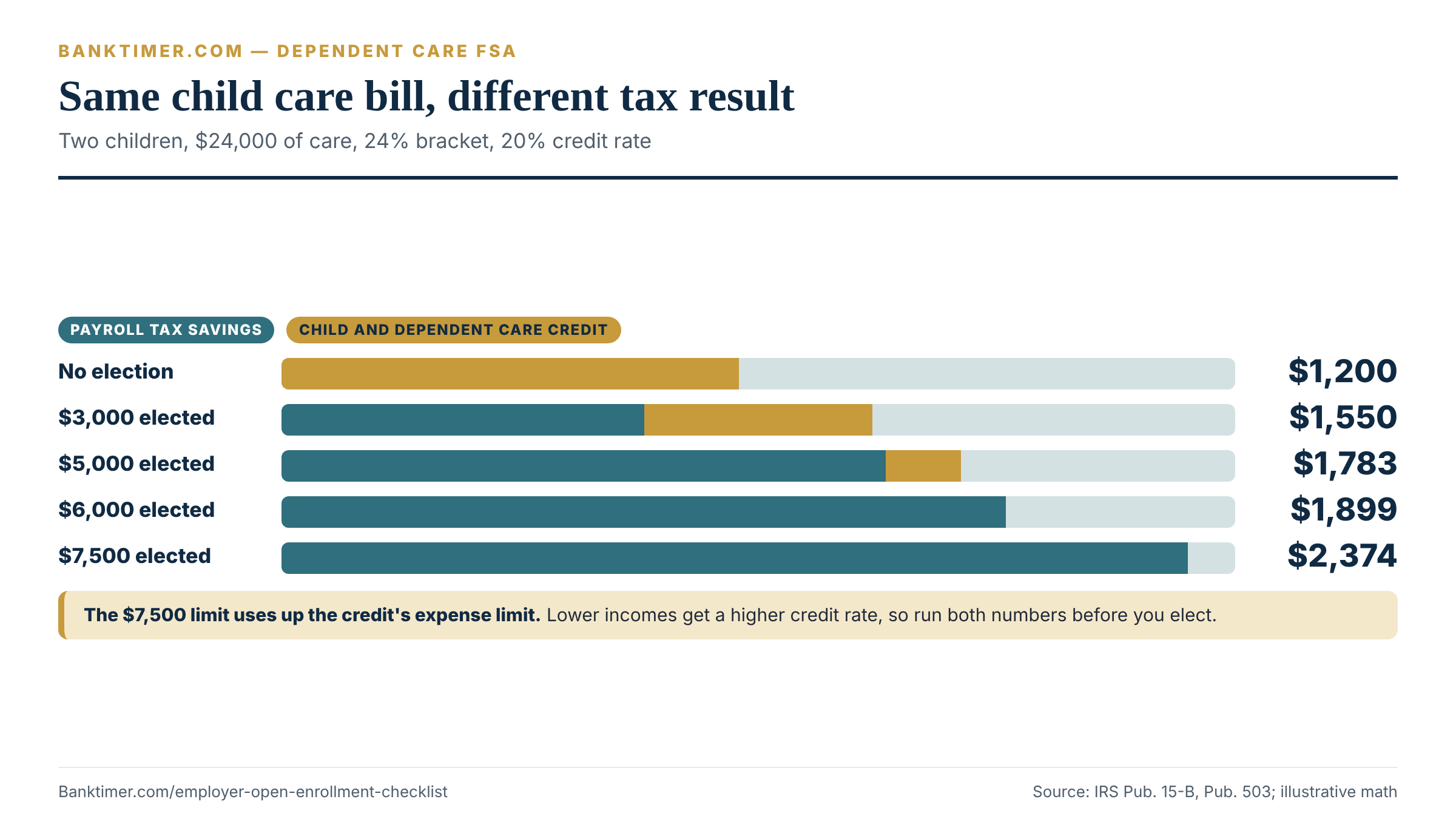
A married couple pays $24,000 a year for child care. Assume a 24% federal bracket, 7.65% payroll tax and a 20% credit rate. That is the floor rate for higher incomes. Your actual credit percentage depends on income and may be higher.
With a $7,500 election, payroll tax savings are about $2,374 and the credit is $0. With no election, the credit is 20% of the $6,000 limit, or $1,200. The FSA wins by about $1,174 in this example.
Lower-income households may see the opposite result, because the credit percentage rises as income falls. The table below shows a partial election mixes the two benefits.
| Election amount | Payroll tax savings | Credit on remaining $6,000 limit | Total benefit |
|---|---|---|---|
| $0 | $0 | $1,200 | $1,200 |
| $3,000 | $950 | $600 | $1,550 |
| $5,000 | $1,583 | $200 | $1,783 |
| $6,000 | $1,899 | $0 | $1,899 |
| $7,500 | $2,374 | $0 | $2,374 |
All figures are rounded and illustrative. The decision-driving insight is that in this high-bracket example every added dollar of election beats the credit. In your case, run both numbers with your own bracket and credit percentage. A tax preparer can do it before you commit.
The forfeiture risk
The danger with a dependent care FSA is not the tax math. It is a life change that ends your care costs mid-year.
You elect $7,500 in October. A child starts kindergarten and daycare ends after eight months at $750 a month, so you incur $6,000. You forfeit $1,500. The tax savings on that forfeited amount were only about $475, so the net loss is about $1,025.
Model the whole year, including school start dates, camp weeks, a spouse’s job change and any gap in care.
Dependent care FSA deadlines to confirm
The phrase “dependent care FSA deadline” covers three different dates, and each one has caused forfeitures. Get all three in writing.
- The enrollment deadline. The last day to elect for the new plan year, and whether you must re-elect.
- The service deadline. The last day expenses can be incurred for the plan year, and whether your plan offers any extra time.
- The claim deadline. The last day to submit receipts for reimbursement, often called the run-out period.
Many plans reimburse only up to the amount you have contributed so far. A large daycare bill in January may not be fully reimbursed until later in the year. Ask how your plan handles that timing.
Mid-year changes are limited. Tax regulations allow a dependent care election change when a status change corresponds to it, such as a child turning 13. A cost increase imposed by a provider who is not a relative can also support a change. The plan has to allow it. If you expect a new baby or a school change, plan around those dates now.
Decision 6: Pick Dental and Vision by Doing Simple Math
Dental and vision plans rarely decide a financial year. Still, they deserve a quick calculation because they work more like prepaid discounts than insurance. You pay a premium, and in exchange you get lower prices at in-network providers up to an annual maximum.
Start with what you will use. Add up routine cleanings and exams. Include any fillings or crowns your dentist has flagged, braces for a child, and glasses or contacts. Then compare that spending with the yearly premium.
Assume dental costs $14 per paycheck ($336 a year) and vision costs $4 per paycheck ($96 a year). These figures are made up for illustration.
If you and your spouse have two cleanings each and no other work, preventive care might cost $600 to $800 at full price. The plan roughly breaks even. If a dentist has already told you that you need a crown, the plan can pay for itself within the year. If you expect no care, the premium is a pure cost.
Dental plan features that change the answer
| Feature | What to ask | Why it matters |
|---|---|---|
| Annual maximum | How much will the plan pay per person per year? | A crown plus a root canal can exceed a low maximum |
| Waiting periods | Do major services wait 6 to 12 months? | A new plan may not help a planned procedure |
| Orthodontia | Is there a lifetime maximum and an age limit? | Braces are often capped separately |
| Coverage tiers | What share is paid for preventive, basic and major work? | The 100/80/50 pattern is common but not universal |
| Network | Is your dentist in network? | Out-of-network balance billing can erase savings |
| Pairing with accounts | Can a limited-purpose FSA or HSA cover the remainder? | Lets you fund the gap pre-tax |
The deciding variable is a procedure you already know you need. A plan with a waiting period offers little for a crown scheduled in February. In that case, a plan with a shorter wait or a fixed-price payment option may be worth more than a lower premium. Dental and vision pair easily with a limited-purpose FSA. Those accounts can cover dental and vision costs while preserving HSA eligibility.
Decision 7: Set Life Insurance and Update Beneficiaries
Employer life insurance usually comes in two layers. Basic coverage is paid for or subsidized by the employer and often equals one times salary or a flat amount. Supplemental coverage is optional, paid by you, and often available in multiples of salary. A third layer, individual term life, sits outside your employer entirely.
The U.S. Bureau of Labor Statistics reported that 59% of private industry workers had access to employer life insurance plans in March 2026. Access is not the same as adequacy. The NAIC’s consumer page notes that workplace coverage may not be enough. It suggests weighing the income your family relies on, debts, final expenses and future costs such as education.
Basic versus supplemental: what you are really choosing
The question behind “employer life insurance basic vs supplemental” is simple. Is the amount your employer gives you enough? If not, where do you buy the rest? The table below compares the three layers on the same criteria.
| Criterion | Basic (employer-paid) | Supplemental (employee-paid) | Individual term policy |
|---|---|---|---|
| Who pays | Employer | You, usually after tax | You |
| Typical amount | Often a flat amount or one times salary | Multiples of salary up to a plan cap | You choose the amount |
| Health questions | Usually none | Often required above a guaranteed amount | Yes, underwriting |
| Portable after you leave | Check conversion or portability rules | Same | Yes, if you keep paying |
| Rate changes | Set by the employer | Often rise with age bands | Fixed during the term |
| Best for | Baseline cover at no cost | Closing a moderate gap | Large, long-term needs |
“Evidence of insurability” is the key term. Supplemental plans often guarantee a modest amount without health questions, and ask for a health statement above it. Whether that applies to you is a plan rule, so ask. Also ask what happens when you leave the job. Some group policies allow conversion to an individual policy or porting of the coverage. The window is usually short, and rules vary by policy and state.
A worked coverage-gap example
A 47-year-old employee earns $72,000. The family owes $240,000 on a mortgage and $15,000 on other debts. They want five years of income replacement ($360,000), $15,000 for final expenses and $60,000 toward college. The total need is $690,000.
Existing resources: $40,000 in savings and $72,000 of basic employer life insurance. The gap is $578,000.
Supplemental coverage at three times salary adds $216,000 and leaves a gap of $362,000. At five times salary ($360,000), the gap is still $218,000. Rates are assumed at $0.10 per $1,000 per month. Three times salary costs about $259 a year and five times about $432. These are illustrative rates, not quotes.
Two lessons come out of this example. First, a plan cap can leave a large gap, so employer coverage may need a term policy beside it. Second, group supplemental coverage is easy to buy. The price can rise with age bands, and the coverage can disappear if you leave the job. Compare the long-term cost against an individual quote before relying on it for a mortgage-sized need.
Taxes on employer-paid life coverage
Under Section 79 rules explained in IRS Publication 15-B, the cost of up to $50,000 of employer-provided group-term life coverage is generally excluded from wages. The cost of coverage above $50,000, reduced by anything you paid, is included in your wages. The IRS uses a table of monthly cost per $1,000 by age. For ages 45 to 49 the table shows $0.15.
In the example above, basic coverage of $72,000 puts $22,000 over the threshold. That is $39.60 of imputed income for the year ($22 × $0.15 × 12). It costs about $12 in tax at the rates we assumed. It is small, but you will see it on your W-2 and may wonder where it came from. Death benefits themselves are generally not taxable income to a beneficiary, according to the IRS.
Update your beneficiaries during open enrollment
Beneficiary designations override your will for life insurance. If you divorced, married, had a child or lost a beneficiary, a stale form can send money to the wrong person. The NAIC notes that you can name several beneficiaries and should specify percentages. It also notes that insurers may not pay benefits directly to minors. For children, consider a trust or an adult custodian arrangement. Our beneficiary designation guide walks through the details and the mistakes to avoid.
Decision 8: Review Short-Term and Long-Term Disability
Short-term disability (STD) and long-term disability (LTD) replace part of your paycheck when you cannot work. Causes include illness, injury and, in some plans, recovery from childbirth. Check how your plan treats it. Disability coverage gets less attention than medical coverage, yet it protects the paycheck that pays for everything else. The BLS reported that in March 2026, 44% of private industry workers had access to short-term disability plans. Another 37% had access to long-term plans.
If you search for “short-term disability open enrollment,” you usually need one short list. What share of pay does the plan replace? When does it start? How long does it last? How is it taxed?
The terms that decide what you receive
| Term | Plain-English meaning | Why it matters | Common confusion |
|---|---|---|---|
| Elimination period | Days you wait before benefits begin | You need other pay to cover it | Often differs for illness and accident |
| Benefit percentage | Share of pay replaced, such as 60% | Sets your actual cash | May apply to base pay only |
| Benefit period | How long benefits last | Short-term may run weeks to months | Ends before long-term begins |
| Definition of disability | When you qualify | Own-occupation is easier than any-occupation | Definition may change after a set period |
| Offsets | Reductions for other income | Reduces your check | Includes state or other benefits in some plans |
| Pre-existing condition limit | Look-back and exclusion | Can delay coverage | Applies mainly to new enrollment |
The tax rule is worth understanding before you choose between employer-paid and employee-paid coverage. IRS Publication 525 says insurer benefits are included in income if your employer paid for the plan. They generally are not taxable if you paid the premiums. Ask whether your premium is deducted before or after tax, because the answer changes whether the benefit is taxable. Our guide on how bank savings and insurance are taxed gives more background.
State disability programs
California, Hawaii, New Jersey, New York and Rhode Island, plus Puerto Rico, run state temporary disability programs. That is according to the Social Security Administration’s statistical supplement, a 2016 edition. Rules, benefit amounts and funding differ by state, and some employer plans coordinate with the state benefit. If you live in one of those states, ask HR how the employer’s short-term plan interacts with the state program. Do not assume the two stack.
A worked 12-week absence
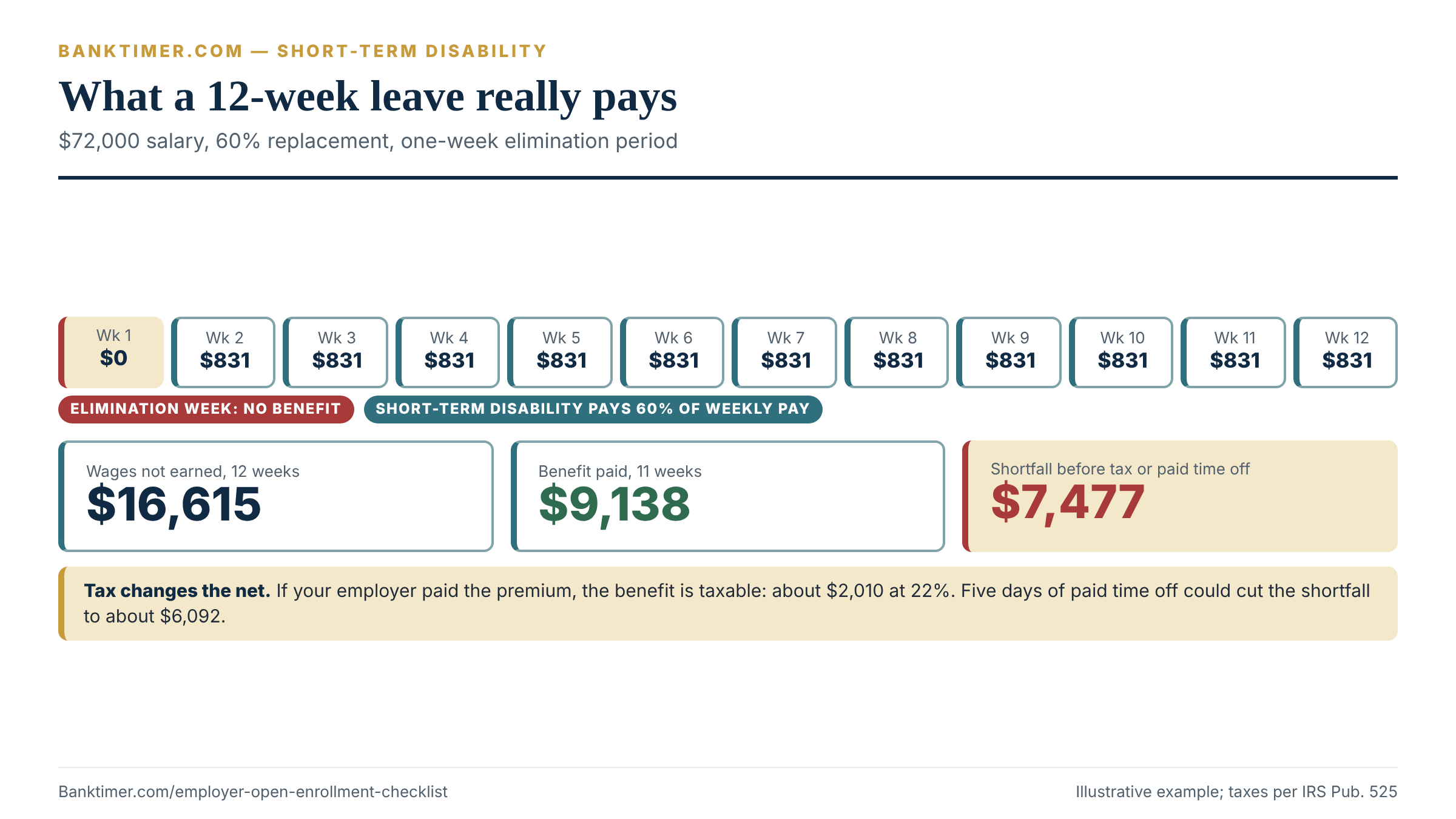
An employee earns $72,000, or $1,385 a week. The plan replaces 60%, which is $831 a week, after a one-week elimination period.
Over 12 weeks, wages not earned total $16,615. The plan pays for 11 weeks, which is $9,138. The shortfall is $7,477. Five days of paid time off covering the waiting week would shrink it to about $6,092.
If the employer paid the premium, the benefit is taxable. A 22% federal rate takes about $2,010, leaving $7,128. If you paid premiums with after-tax dollars, the benefit is generally not taxable.
The example shows why the elimination period matters as much as the percentage. A one-week wait costs a full week of pay unless you have paid time off. It also shows that a plan replacing 60% of pay can still leave a gap. After taxes and fixed bills, it can feel like a pay cut of more than 40%. Plan for it in your monthly budget. Keep a cash cushion in case the first payment is delayed.
Long-term disability: the part that starts later
Long-term disability usually begins after short-term benefits end. In many plans that is around six months. It can last for years. Look for four terms. They are the benefit cap, the offset rules, the definition of disability after the first period, and whether benefits are taxable. In our example, 60% of $6,000 monthly pay is $3,600. A monthly cap can reduce that for higher earners.
If you must choose, consider long-term coverage first, because a long absence costs far more than a few weeks. That is Banktimer editorial reasoning, not a rule. Employer-paid LTD is often automatic. Check the beneficiary and enrollment forms to see whether you need to do anything.
Decision 9: Screen Voluntary Extras Before You Say Yes
Voluntary benefits are the optional products at the end of the menu. Examples include accident insurance, hospital indemnity, critical illness, legal plans, identity protection and pet insurance. Some are worth having. Many solve a problem you have already solved. They are priced per paycheck, so the cost is easy to ignore.
The test is simple. A voluntary product should cover a specific gap. It should pay out in a way that matches the gap. And it should cost less over a few years than the gap itself. Run that test on each one.
A four-question screen
- Which gap does it cover? Name the dollar amount, such as a $3,500 deductible.
- Does another benefit already cover it? Medical plan caps, disability and an emergency fund may already handle the same event.
- How does it pay? Many voluntary plans pay fixed cash amounts, not actual bills.
- What happens when you leave? Some are portable and many are not.
A plan costs $15 per paycheck ($360 a year) and pays a fixed $1,500 per hospital admission. On a cash basis you would need roughly one admission every four years just to break even on the premium.
If your medical plan already caps yearly out-of-pocket cost at $4,500, the extra $1,500 helps cash flow. It does not reduce your maximum exposure. If you do not have cash set aside for a deductible, the plan fills a real gap. If you do, it may not.
Where voluntary benefits help and where they do not
| Benefit | What it usually pays | Gap it can fill | Duplicate risk | What to ask |
|---|---|---|---|---|
| Accident insurance | Fixed amounts per injury or service | Deductible and incidental costs | Medical plan and emergency fund | Which injuries and amounts are listed? |
| Hospital indemnity | Fixed cash per admission or day | High deductible exposure | Medical out-of-pocket cap | Is there a waiting period? |
| Critical illness | Lump sum on diagnosis | Income and non-medical bills | Disability and savings | Which conditions qualify, and what is excluded? |
| Legal plan | Access to attorneys at set rates | Wills, simple legal work | Other legal resources you already use | What matters are covered? |
| Identity protection | Monitoring and recovery support | Early fraud alerts | Credit freezes, which you can place yourself | What does it add that a freeze does not? |
| Pet insurance | Reimbursement of vet bills | Large surprise vet costs | Savings | Is there an annual cap and a deductible? |
A few of these overlap with things you can do for yourself. Credit freezes, for example, are a separate tool from paid monitoring. Our comparison of a credit freeze vs fraud alert shows what each does. Fixed-payment products also do not behave like medical coverage. They are not a substitute for a medical plan, and a salesperson who suggests otherwise is a red flag.
Decision 10: Confirm, Document and Calendar the Rest of the Year
The last decision is not about a benefit. It is about proving what you chose. Treat the confirmation as the final box on your employer open enrollment checklist. Most disputes come from a mismatch between what you meant to elect and what the system recorded. The person with the screenshot usually wins the conversation.
Make the confirmation airtight
After you submit, do five things the same day:
- Save the confirmation page as a PDF or take screenshots.
- Check every coverage tier and every dependent listed.
- Confirm beneficiary names and percentages.
- Note the per-paycheck cost of each election.
- Email yourself the file, so the date is stamped.
Audit the first January paycheck
Your first paycheck of the new plan year works as a built-in audit. Compare each deduction with your confirmation. If a deduction is missing, wrong or doubled, tell HR immediately. Many employers can correct payroll errors, but the longer you wait, the more catch-up you owe.
What the new paycheck can look like
Assume $72,000 salary paid on 24 paychecks ($3,000 gross), a 22% federal rate and 7.65% payroll tax. The employee chooses the high-deductible plan at $85, dental at $14 and vision at $4. The HSA contribution is $83.33 and the dependent care FSA is $312.50. After tax, the employee adds supplemental life at $10.80 and short-term disability at $6. The spouse’s plan covers the children.
| Line | Per paycheck | Per year | Pre-tax or after-tax |
|---|---|---|---|
| Medical premium | $85.00 | $2,040 | Pre-tax |
| Dental and vision | $18.00 | $432 | Pre-tax |
| HSA contribution | $83.33 | $2,000 | Pre-tax |
| Dependent care FSA | $312.50 | $7,500 | Pre-tax |
| Supplemental life | $10.80 | $259 | After-tax |
| Short-term disability | $6.00 | $144 | After-tax |
| Total deductions | $515.63 | $12,375 | Mixed |
| Estimated tax savings on pre-tax items | About $147.90 | About $3,550 | Assumption-based |
| Net drop in take-home pay | About $367.73 | About $8,826 | Estimate |
The decision-driving insight is that the pre-tax items, not the premiums, take the biggest bite. The dependent care FSA alone is more than half of the deductions. If your budget is tight, size that line carefully. It also saves the most tax. Build the new number into your monthly budget before January, not after.
Calendar the dates that live outside the window
| Stage | Typical timing | Who controls it | What to do |
|---|---|---|---|
| Window closes | Set by employer | Employer | Submit and save confirmation |
| ID cards and portal access | Late in the year or early January | Carrier | Confirm the cards arrive |
| First paycheck | Early January | Payroll | Audit each deduction |
| Mid-year event | Any time | You, then the plan | Notify HR within the plan deadline |
| Receipts for FSA claims | During the plan year | You | File claims regularly |
| Claim run-out deadline | After the plan year ends | Plan document | Submit remaining claims |
| W-2 reporting | Following January | Employer | Check box 10 and imputed life income |
A Master Decision Framework for Your Employer Open Enrollment Checklist
The ten decisions on an employer open enrollment checklist are not equal. A simple priority ladder keeps you from over-optimizing the small ones. It is editorial guidance, not a formula.
- Protect income and health first. Medical coverage, disability and a basic level of life insurance come before any optional product.
- Use tax-advantaged accounts second. Fund the HSA or FSAs after you know you can afford the medical plan’s worst case.
- Right-size routine coverage third. Dental and vision should match your expected use.
- Add optional extras last. Only add them if each passes the four-question screen.
- Check cash flow at every step. After each choice, ask whether your take-home pay still covers your regular bills.
If a choice fails step five, go back and shrink the least protective item, not the most. In our paycheck example, a smaller dependent care election hurts less than dropping disability coverage.
Mid-Year Changes: What a Qualifying Life Event Allows
Your employer open enrollment checklist does not end when the window closes. If you miss the window or your situation changes, the next door is a qualifying life event. In job-based coverage, three different rule sets overlap, and people often mix them up. Our 2027 financial and insurance deadlines calendar helps you mark the dates, and this section covers the rules.
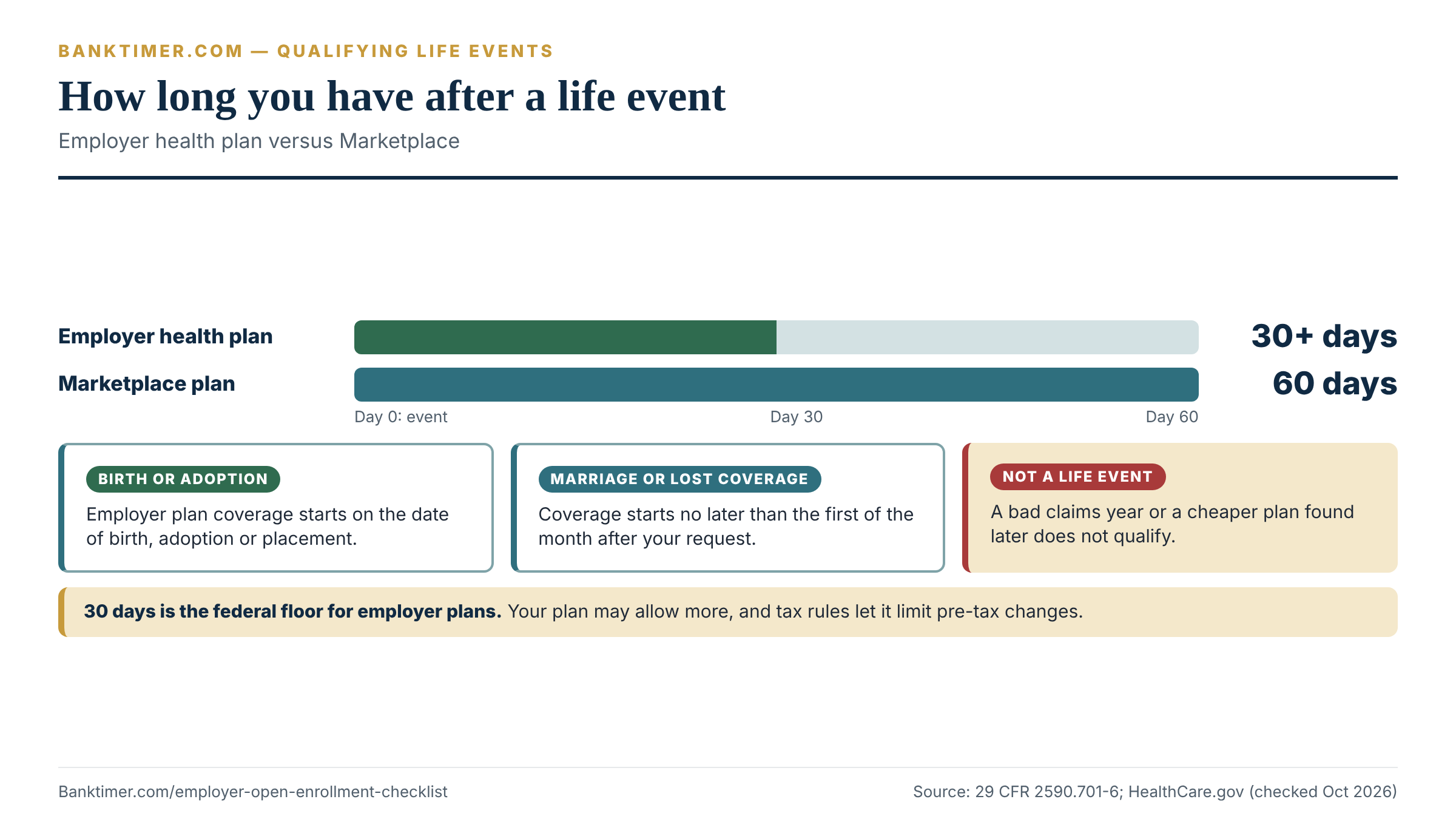
- Employer plan special enrollment. Federal rules require group health plans to let eligible people enroll after certain events. The plan must allow at least 30 days to request enrollment after losing other coverage or after a marriage, birth, adoption or placement.
- Cafeteria plan election changes. Tax regulations allow a plan to let you change pre-tax elections after a change in status, if the change fits the event. The plan is not required to offer these changes.
- Marketplace special enrollment. HealthCare.gov says most qualifying events give a 60-day window.
What each rule says in practice
| Event | Employer plan rule | Cafeteria plan rule | Marketplace window |
|---|---|---|---|
| Marriage | At least 30 days to request; coverage by the first of the month after the request | Change in marital status is a listed status event | Generally 60 days |
| Birth, adoption, placement | At least 30 days; coverage from the date of birth or placement | Change in dependents is a listed status event | Generally 60 days |
| Loss of other coverage | At least 30 days after the loss, with limits for non-payment or for-cause loss | Allowed if plan permits | Generally 60 days; voluntarily dropping COBRA does not qualify |
| Divorce | Loss of coverage through an ex-spouse’s plan can trigger special enrollment in yours | You can usually remove the spouse, but not yourself or a child | Listed as a life event; loss of coverage may qualify |
| Change in work status | Plan-specific | Employment status change is a listed event | Depends on coverage change |
| Move to a new area | Plan-specific | Residence change is a listed event | Often qualifies |
The key insight is that a change must fit the event. Under the consistency rule in 26 CFR 1.125-4, a divorce lets you move to a smaller tier. It does not let you cancel your own coverage. Likewise, the cost-change rule that sometimes lets you adjust elections does not apply to health FSAs.
What a qualifying life event does not cover
A bad claims year does not qualify. Neither does discovering a cheaper plan or deciding you mis-sized your FSA. A significant cost increase or a loss of coverage can allow changes in some cases. Your plan must allow them. If you rely on this route, write down the event date the day it happens and contact HR within a week.
COBRA is a related option when you lose coverage. The Department of Labor says covered individuals may have to pay the entire premium, up to 102% of the plan’s cost. It adds that employer plans with 20 or more employees generally must offer COBRA. Compare it with Marketplace coverage before you decide.
Red Flags and Expensive Mistakes at Open Enrollment
Most open enrollment errors share a pattern. Someone assumed a default, skipped a document or chose under deadline pressure. The table below lists the ones that cost the most money, with a safer move for each. Use it to audit your employer open enrollment checklist before you submit.
| Red flag | Why it matters | What to ask | Safer next step |
|---|---|---|---|
| “No action required” with no written default | You may lose an account or keep a plan with new prices | What exactly renews, and what lapses? | Ask for the rule in writing and screenshot your final screen |
| You never saw the 2027 rates | Premiums and deductibles change quietly | Where is the new rate sheet? | Compare last year’s pay stub with the new figures |
| FSA election above predictable spending | Unspent money may be forfeited | What is my plan’s grace period or carryover? | Elect only expenses you can name and date |
| Beneficiary blank or outdated | Money may go to the wrong person or to probate | Who is on file today? | Update percentages, contingent names and guardians |
| Voluntary plan described as “health insurance” | Fixed-payment plans do not replace medical coverage | Does it pay actual bills or fixed amounts? | Decline until you understand how it pays |
| Pressure to sign up on the spot | Real deadlines come from the employer | What is the official deadline? | Take the materials home and compare |
| Waiving coverage without proof of other coverage | Re-entry may require documentation | Do I need a written statement? | Keep a copy of the other plan’s card and dates |
| Outdated provider directory | The doctor you chose may be out of network | Is this directory current? | Call the provider’s billing office to confirm |
The waiver trap
Federal special enrollment rules say a plan may require a written statement that other coverage was the reason you declined. It can do that only if it gave notice of the requirement at or before the time you declined. If you waive and your other coverage ends later, you may need that statement to re-enter midyear.
Keep proof of the other coverage, including start and end dates. Ask HR whether a written statement is required and file it with your confirmation.
Five habits that prevent most problems
- Compare plans on total yearly cost, not premium alone.
- Elect FSA money only for expenses you can name.
- Update beneficiaries every year, not only after a life event.
- Take screenshots of the confirmation and the dependents listed.
- Check your first January paycheck against the confirmation.
These are the benefits open enrollment tips that matter most. They are unglamorous, and they prevent the expensive surprises.
Questions to Ask Your Benefits Team
Add these questions to your employer open enrollment checklist, send them by email and keep the replies. A written answer from HR does not override a plan document. It is still useful evidence of what you were told.
- ☐ What is the exact last day and time to enroll, and can I edit until then?
- ☐ Which benefits renew automatically, and which require a new election?
- ☐ What are the 2027 premiums for each tier, and how did they change from this year?
- ☐ Can you send the summary of benefits and coverage for each medical option?
- ☐ Does the HDHP include an employer HSA contribution, and when is it deposited?
- ☐ What is the 2027 health FSA limit in our plan, and do we have a grace period or carryover?
- ☐ What is the 2027 dependent care FSA limit, the service deadline and the claim deadline?
- ☐ Is basic life insurance a flat amount or a multiple of salary, and is there imputed income?
- ☐ What health questions apply to supplemental life above the guaranteed amount?
- ☐ How long is the elimination period for short-term disability, and who pays the premium?
- ☐ How many days do I have to report a qualifying life event?
- ☐ What documents do I need for new dependents, and by what date?
Deadlines to Confirm in Writing
This employer open enrollment checklist promises deadlines to confirm. Here they are in one place. Your employer or plan administrator sets each one, so there are no universal numbers. Use this table to turn “I think it’s the end of the month” into a date.
| Deadline | Who sets it | What to ask | Where to find it |
|---|---|---|---|
| Enrollment close | Employer | Date, time and time zone | Enrollment guide or portal |
| Re-election required | Plan document | Which accounts need a new election? | Summary plan description |
| Dependent documents | Carrier or employer | Which proof, by when? | HR or carrier |
| Dependent care FSA service period | Plan document | Extra time after year-end? | Plan document |
| FSA claim deadline | Plan administrator | Last day to file receipts | Administrator site |
| Qualifying life event report | Plan document | Days to report | Plan document |
| Supplemental life evidence of insurability | Carrier | Date for health statement | Carrier forms |
| Beneficiary updates | Employer or carrier | Can I change anytime? | Portal |
Frequently Asked Questions
What should you decide during employer open enrollment, and in what order?
Work through the employer open enrollment checklist in this order. Confirm the window and default, then choose who is covered. Pick the medical plan, then an HSA or health FSA, then size a dependent care FSA. Handle dental and vision, life insurance, disability and voluntary extras next. Finish with confirmation. The medical plan determines HSA eligibility. The accounts change your take-home pay, which limits what you can afford for the rest.
What happens if you do nothing during open enrollment?
It depends on the benefit and your employer. Medical, dental and vision elections often renew at the new price. Health and dependent care FSAs often lapse unless you re-elect. New hires and newly eligible employees usually get no coverage without enrolling. Ask HR for the default rule for each benefit in writing. Passive enrollment is a plan rule, not a federal one.
Can you change your benefits after open enrollment ends?
Usually only after a qualifying life event, and only if your plan allows the change. Federal special enrollment rules require group health plans to allow at least 30 days to request enrollment. That applies after losing other coverage or after a marriage, birth, adoption or placement. Tax regulations let a plan permit certain pre-tax election changes, but plans are not required to offer them.
What is the dependent care FSA limit and deadline?
For 2026, IRS Publication 15-B says an employee can generally exclude up to $7,500 ($3,750 if married filing separately). We did not find an IRS change for 2027, so confirm your employer’s 2027 limit. Your plan sets the election, service and claim deadlines. Ask for all three dates in writing and file claims during the year.
Do you lose unspent FSA money?
Often yes. The IRS describes FSAs as generally use-it-or-lose-it. A health FSA may add a grace period of up to 2 1/2 months or allow a limited carryover. It cannot offer both. For 2026 the carryover maximum is $680 if the plan permits it. Dependent care FSAs follow your plan document, so ask what extra time, if any, you get.
What is the difference between basic and supplemental life insurance at work?
Basic life insurance is usually paid for by the employer and set at a flat amount or a multiple of salary. Supplemental coverage is optional, paid by you, and often available in salary multiples up to a cap. Supplemental plans may require health questions above a guaranteed amount. Compare both with your actual need, and ask what happens to the coverage if you leave the job.
Is short-term disability worth it at open enrollment?
It can be, if a few weeks without pay would strain your budget. Compare the elimination period, the percentage of pay replaced, the benefit period and who pays the premium. IRS Publication 525 says benefits are generally taxable if your employer paid for the plan and generally not taxable if you paid the premiums. Check whether your state runs its own temporary disability program.
Can you have both an HSA and a health FSA?
Generally no, if the FSA is a general-purpose health FSA. IRS Publication 969 says an employee with an HDHP who also has a health FSA generally cannot contribute to an HSA. A limited-purpose FSA or a post-deductible FSA can preserve HSA eligibility. Ask whether your plan offers one, and confirm the rules for 2027 before you elect.
How long do you have to add a spouse or new baby?
Federal special enrollment rules require group health plans to allow at least 30 days after a marriage, birth, adoption or placement. Coverage for a birth starts on the date of birth. Coverage after marriage must start no later than the first of the month after the request. Your plan may allow more time, so check the number of days in your own plan documents.
Which benefits open enrollment tips save the most money?
The biggest savings usually come from three habits. Compare total yearly cost instead of premium. Confirm defaults. Elect FSA money only for expenses you can name. Checking whether your spouse’s plan is cheaper and auditing the first January paycheck also catch common errors. None of these is a guarantee, because every employer plan and every household differs.
Can you skip employer coverage and buy a Marketplace plan instead?
You can. But HealthCare.gov says that if your job-based plan is affordable and meets minimum standards, you generally cannot get Marketplace savings. For plan years starting in 2027, the IRS sets the affordability percentage at 10.22% (Rev. Proc. 2026-26). Compare the full cost of both routes, and remember that dropping job-based coverage midyear usually needs a qualifying event.
Email your benefits team today and ask three things. What is the exact enrollment deadline? Which benefits renew by default? What are the 2027 limits for your FSAs? Put the dates on your calendar before the window opens.
The one variable that decides how this goes is your employer’s own rulebook. Federal numbers, such as the $7,500 dependent care limit for 2026 and the 2027 HSA caps, set the ceiling. Your plan document sets the window, defaults, grace periods and claim deadlines. So treat every “I think” as a question to send in writing. Decide in order and compare medical plans on total yearly cost. Elect FSA money only for expenses you can name, and screenshot the final confirmation. What this employer open enrollment checklist cannot do is quote your premiums, predict your health costs or decide your taxes. Those depend on your employer, household, state and bracket. Check your plan summary, ask a tax preparer about the dependent care math, and use a licensed agent or advisor when a coverage gap is large.
Methodology
We prepared this employer open enrollment checklist from primary and official sources, checked October 15, 2026. They include IRS publications and revenue procedures for FSA, HSA and dependent care figures. Federal regulations cover cafeteria plan changes and special enrollment. HealthCare.gov covers Marketplace rules, the Bureau of Labor Statistics covers benefit access, and the Kaiser Family Foundation’s 2025 employer survey adds context. We did not find an IRS announcement of the 2027 health FSA limit. The article says so instead of guessing.
Every plan, premium, deductible, income figure and tax rate in the worked examples is an illustrative assumption. They are not quotes and do not represent any employer’s plan. Calculations were run in a script and rechecked. Employer window dates, defaults, plan limits, grace periods, state programs and carrier terms vary. The article tells you what to ask instead of stating them as fact. Banktimer did not test, call or enroll with any plan.
Sources
- Publication 15-B (2026), Employer’s Tax Guide to Fringe Benefits, IRS
- Rev. Proc. 2025-32 (2026 inflation adjustments, health FSA), IRS
- Rev. Proc. 2026-24 (2027 HSA and HDHP limits), IRS
- Rev. Proc. 2026-26 (2027 required contribution percentage), IRS
- Publication 969 (2025), Health Savings Accounts and Other Tax-Favored Health Plans, IRS
- Publication 503 (2025), Child and Dependent Care Expenses, IRS
- Publication 525 (2025), Taxable and Nontaxable Income, IRS
- 26 CFR 1.125-4, Permitted election changes, Legal Information Institute
- 29 CFR 2590.701-6, Special enrollment periods, Legal Information Institute
- Special Enrollment Period, HealthCare.gov
- Out-of-pocket maximum/limit, HealthCare.gov glossary
- Employee Benefits in the United States, March 2026, Bureau of Labor Statistics, September 25, 2026
- 2025 Employer Health Benefits Survey, KFF, October 22, 2025
- Life Insurance and Annuities, NAIC consumer page
By the Banktimer Editorial Team · Published
Banktimer is an independent U.S. consumer-finance publication. Our editors draw on primary and official sources first, such as the CFPB, FDIC, Federal Reserve, and FTC, along with statutes, regulations, and providers’ own agreements and fee schedules. Then we add worked examples and decision tools. Our goal is the most useful, best-supported explanation the sources available to us at the time of writing allow.
This article is general information, not legal, tax, investment, insurance, or financial advice, and reading it does not create a professional relationship with Banktimer. Rates, fees, limits, and rules change, and they vary by state, provider, and contract, so confirm current terms with your bank, lender, insurer, or the agency named in the article before you act. Examples are illustrative unless labeled otherwise. Banktimer is not a bank, lender, insurer, or financial advisor, and we are not responsible for decisions or losses that result from relying on this content. For advice about your own situation, talk to a licensed professional.