
A ChexSystems report is your banking-history file, kept by a specialty consumer reporting company that banks and credit unions use to screen account applicants. You can get a free copy once every 12 months, and again within 60 days after a bank denies you because of it, by requesting it from ChexSystems by phone, mail or its website. Read every entry, then dispute errors with both ChexSystems and the bank that reported them.
Your biggest variable is whether the record is accurate. The main risk is assuming a denial is final. Check the adverse action notice first.
It is not a credit report. ChexSystems tracks account applications, openings, closures and check-writing history. Credit bureaus track loans and cards. A bank may look at one, the other or both.
The copy is free. Federal law gives you one free disclosure every 12 months. A denial based on the file adds a separate 60-day window to ask.
Time limits exist. Most negative items can stay for seven years under federal law, and the CFPB notes that some companies disregard items older than five.
Errors are fixable. A reporting company generally must finish a reinvestigation within 30 days, or 45 if you send more information.
An accurate record is not the end. Paying an old balance and opening a second-chance account can restore access while the record ages.
Wording matters. Ask the bank which company it used. ChexSystems is the best known, but Early Warning Services and others do similar work.
What a ChexSystems Report Is and Who Uses It
A ChexSystems report is a consumer file about how you have handled checking and savings accounts. Banks and credit unions send ChexSystems data when you apply for, open or close an account. Other banks then pull that file when you apply. The CFPB company listing describes it as check and bank account screening.
Federal law treats these companies as consumer reporting agencies. The Fair Credit Reporting Act (FCRA) defines a “nationwide specialty consumer reporting agency” to include one that keeps files on check writing history. That label matters because it triggers your rights to a free copy, an accuracy dispute and notice of denial.
Two names you may see on a denial letter
ChexSystems is the name most people search for. Early Warning Services (often shortened to Early Warning or EWS) is a second screening company, and the CFPB lists it in the same category. It holds deposit account data and bank-account fraud information. A bank may use either company, both, or neither.
Retailers use a third group of services for check acceptance. TeleCheck is one the CFPB lists in that category. Those files affect whether a store takes your check, not whether a bank opens your account.
Why this file exists
Banks lose money when an account goes negative and the customer never repays. They also worry about check fraud and identity theft. Screening gives them a fast read on whether you left another bank with unpaid fees or a fraud flag. The bank, not ChexSystems, makes the yes or no decision.
That last point is easy to miss. ChexSystems does not approve or deny anyone. It supplies information, and each bank applies its own standards. Two banks can read the same file and reach different answers.
ChexSystems Report vs. Credit Report: Where They Differ
The two files overlap in law but not in content. Your credit report lists loans, cards and payment history. A ChexSystems report lists deposit account events. Mixing them up sends people to the wrong place to fix an error.
| Feature | ChexSystems report | Credit report (Equifax, Experian, TransUnion) | Early Warning file |
|---|---|---|---|
| Main data | Account applications, openings, closures, closure reasons, check-writing history | Credit accounts, balances, payment history, inquiries, public records | Deposit account data and account-fraud information |
| Who uses it | Banks and credit unions screening applicants; some lenders | Lenders, card issuers, landlords, insurers, employers | Banks, check acceptors, payment processors, some lenders |
| Free copy | One every 12 months, plus after a denial | One every 12 months from each company at AnnualCreditReport.com | Free file disclosure on request |
| Who fixes errors | ChexSystems and the bank that reported it | The bureau and the lender that reported it | Early Warning and the bank that reported it |
| Credit score impact of requesting your own | None, per the CFPB | None | None, per the CFPB |
The practical lesson sits in the “who fixes errors” row. Dispute with the company that holds the file and with the bank that fed it. If a bank denies you, ask which file it used, then request that one first.
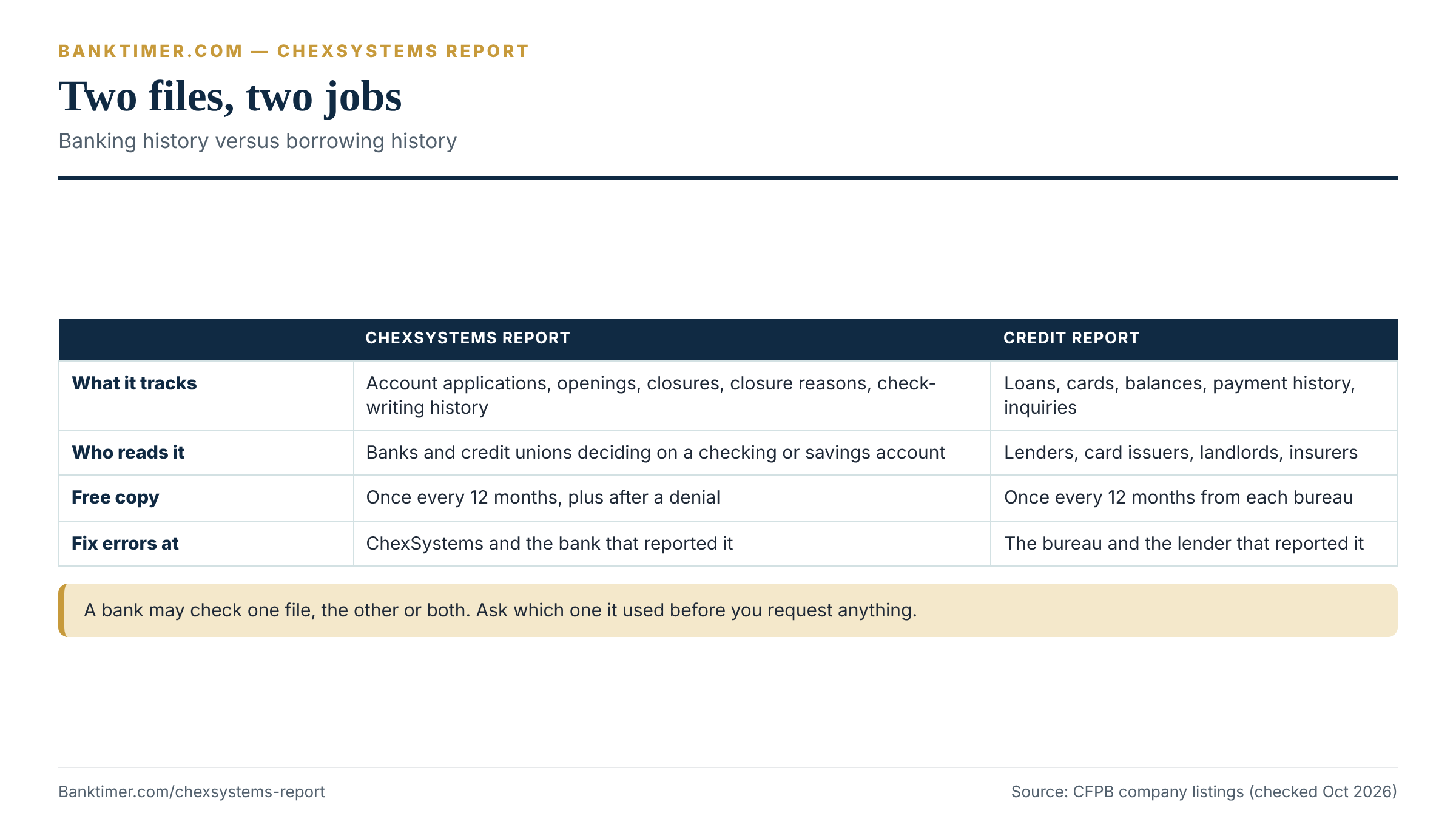
A credit report can also matter for account opening. The CFPB advises people denied a checking account to look at their traditional credit reports as well, because some banks use them alongside or instead of banking reports. A bank that only checks ChexSystems will not see your credit card history, and the reverse is true too.
What the file does not show
ChexSystems does not hold your savings balance, your income or your credit score. It is not a measure of how much money you have. A person with a healthy balance can have a record, and a person with little money can have a clean one. The record reflects past account behavior, such as an unpaid overdraft or a suspected fraud flag.
If you want the bigger picture on how a checking account works, including fees and rights, start there. This guide stays on the reporting side.
What Is Inside a ChexSystems Report
Your report is a consumer disclosure, and the FCRA sets a floor for what it must include. Under 15 U.S.C. 1681g, a reporting company must disclose all information in your file when you ask, plus the sources of that information. It must also name each person who obtained a report about you in the past year for a purpose other than employment.
ChexSystems does not publish its page layout in the sources we reviewed, so treat the table below as a map of what the law and the CFPB say a file can contain, not as a screenshot. Your own copy may label things differently.
| File element | What it may show | Why it matters | What to check |
|---|---|---|---|
| Identity details | Name, address history, Social Security number, date of birth | A mixed-up identity can attach someone else’s record to you | Every name, address and digit; remove accounts you never held |
| Account applications | Which institutions you applied to and when | Many applications in a short stretch can look like a risk signal | That each application is one you actually made |
| Account closures | The institution, date and reason the account closed | Closure reason often drives a denial more than the amount | Whether the reason is accurate and the date is right |
| Unpaid balances | Amount owed after an involuntary closure | Some banks require payment before they will open an account | Amount, date of last update, any payments you made |
| Check-writing history | Dates, payees and amounts of checks behind an adverse note | The statute requires these details when a check supports a negative entry | That the check was actually yours and not forged |
| Inquiries | Who obtained your report in the past year | Shows which banks looked and when | Any inquiry you do not recognize |
| Source information | The institution that reported each item | Tells you whom to dispute with | Contact details for the furnisher |
The check details row comes straight from the statute. When a negative note rests on a bad check, the file must show the dates, original payees and amounts of the checks. That gives you something concrete to compare with your statements.
Closure reasons carry the weight
The CFPB lists what typically leads to a denial: an unpaid negative balance after the institution closed the account (an “involuntary closure”), suspicion of fraud, a history of bad checks, or a joint account with someone who had these problems. Its denied-account guide says the same.
The joint-account point is a surprise to many readers. If you shared an account and your co-owner ran it into the red, that history can attach to you as well. Our guide to the joint bank account explains why shared liability cuts both ways.
If a Bank Denied You: The First 24 Hours
A denial feels final, but it starts a short clock and gives you paper to work with. The first day is about gathering facts, not arguing. Do these steps in order.
- Save the denial. Keep the letter, email or screenshot. It may be the adverse action notice, and it has dates you will need.
- Find the screening company. The notice should name it. If it does not, ask the bank which consumer reporting company supplied the report.
- Hold off on new applications. Each application can add an inquiry to your file, and a pile of recent applications can look like a risk signal. Wait until you have read the report.
- Request your ChexSystems report. Use the denial window, covered below, so you do not burn your annual copy.
- Pull your credit reports too. The CFPB suggests this because some banks look at both kinds of file.
What the bank must tell you
When a bank turns you down based in whole or in part on a consumer report, 15 U.S.C. 1681m requires an adverse action notice. It must give the reporting company’s name, address and a toll-free number if the company keeps nationwide files. It must say the company did not make the decision and cannot explain the reasons. And it must tell you about your right to a free copy within 60 days and your right to dispute.
That second point deserves a pause. ChexSystems cannot tell you why the bank said no. Only the bank can, and it may decline to give details. Your ChexSystems report shows what the bank could see, which is usually enough to find the cause.
“I was denied an account on [date]. Which consumer reporting company did you use? Was it ChexSystems, Early Warning, a credit bureau, or an internal check? Can you send me the adverse action notice in writing?”
Write down the date, the name of the person and anything they say. Ask for the notice by email if you did not get one.
Why you should not ignore a soft “no”
Some denials are not about ChexSystems at all. A bank may fail an identity check, see a mismatched address, or flag a Social Security number problem. In that case, a clean banking-history report will not change the result. This is why the bank’s answer to “which company?” is the first question to ask.

Your Rights, Sorted by Source
Readers often blur federal law, company policy and bank discretion. They are different things, and each calls for a different action. The table separates them.
| Rule or practice | What it is | Applies when | What you do |
|---|---|---|---|
| Free annual disclosure | Federal law, 15 U.S.C. 1681j(a); streamlined process and toll-free line under 12 CFR 1022.137 | Once in any 12-month period, on request | Request your report; the company must deliver within 15 days |
| Free copy after a denial | Federal law, 15 U.S.C. 1681j(b) | You ask within 60 days of receiving the adverse action notice | Count 60 days from receipt of the notice |
| Adverse action notice | Federal law, 15 U.S.C. 1681m(a) | A bank denies you based in whole or in part on a report | Ask for the notice if you did not get one |
| Reinvestigation of a dispute | Federal law, 15 U.S.C. 1681i | You dispute an item with the reporting company | Expect a result in 30 days, or 45 if you add information |
| Seven-year ceiling on most negative items | Federal law, 15 U.S.C. 1681c | Reports used for typical consumer purposes | Check the dates in your file |
| Shorter internal retention | Company policy; the CFPB notes some companies disregard items older than five years | Varies by company | Ask the company in writing how long it keeps items |
| Whether to open an account | Bank policy | Every application | Ask about lower-risk accounts |
| Payment of old balances first | Bank policy; the CFPB says some institutions require it | Varies by bank | Ask before you pay anything |
| Faster delivery in some states | State law, as noted by Early Warning for CA, CT, LA, RI and ME | Where your state sets a shorter deadline | Check your state rules |
The key insight sits in the middle of the table. The law governs the reporting company’s duties: show you the file, fix errors, respect time limits. It does not decide whether a particular bank must open your account. That choice belongs to the bank.
For the federal framework behind those duties, the CFPB’s overview of consumer reporting companies explains that companies must give you a copy of your report on request and must investigate disputes at no cost.
How to Get a ChexSystems Report Free
Federal law makes your first copy each year free. The statute sets the pace: delivery within 15 days of the request. The CFPB listing says the same and adds that requesting your own report does not hurt your credit scores.
There are two free routes, and they do different jobs.
- Annual copy. You may ask once in any 12-month period, with no denial needed. Use it for a checkup before you apply.
- Denial copy. If you ask within 60 days after getting an adverse action notice, the company must give you the file without charge. The statute lists this as its own entitlement, so you can use it and still keep your annual one. Confirm how ChexSystems counts them when you ask.
Where to request it
ChexSystems lists a “Request Consumer Disclosure Report” option on its website and says the free report comes once every 12 months. The CFPB company page lists a phone line and mailing address too. Early Warning, the other major company, offers several channels of its own. The table compares the ones we could read.
| Channel | ChexSystems | Early Warning Services |
|---|---|---|
| Website | chexsystems.com, “Request Consumer Disclosure Report” | earlywarning.com, file disclosure request pages |
| Phone | 800-428-9623 (per the CFPB listing) | 1-800-745-1560, Monday to Friday, 9 a.m. to 8 p.m. Eastern; no file details given by phone |
| Chex Systems, Inc., Attn: Consumer Relations, P.O. Box 583399, Minneapolis, MN 55458 | Early Warning, Attn: Consumer Services, 5801 N. Pima Rd., Scottsdale, AZ 85250 | |
| Other | Free consumer score report also offered | Fax 480-656-6850; secure document portal |
| Delivery time | Within 15 days under federal law | Within 15 calendar days after identity verification; shorter in some states |
| Cost | Free | Free; no fee for file disclosure |
The contact details come from the company sites and the CFPB’s company listings as of October 15, 2026. Phone numbers and addresses change, so confirm them on the company’s own website before you mail anything.
What to expect when you ask
Expect an identity check. Early Warning, for example, asks for your full name, Social Security number, date of birth, current and previous address, phone number and a copy of a government-issued ID. ChexSystems may ask for similar items. Send only what the company’s own official page or form requests, and use its official portal or mailing address.
Both companies describe a disclosure as a copy of the information they hold on you. A “score” is a separate item. ChexSystems says its consumer score reports are free. Early Warning offers a Deposit Score by phone and says it is not a credit score. Neither score is the same as a FICO or VantageScore, and a bank is free to use the score or ignore it.
Watch for lookalike sites and paid fixes
Because the report is free, anyone charging you for it deserves suspicion. Scammers build lookalike pages and sell “ChexSystems removal” or “report repair.” ChexSystems itself warns about credit repair scams on its site. Type the address yourself, do not click an ad, and do not pay to see your own file. Our bank impersonation scam guide covers how fake bank and service pages work.
How to Read Your ChexSystems Report Line by Line
Do not skim. A single wrong date or an account that is not yours can keep you out of every bank. Spend twenty minutes with your ChexSystems report and your own records side by side.
Start with the top of the file, where your identity details live. Then move to each account entry, one at a time. Mark anything you cannot match to a bank statement, a closure letter or a payment record.
The four-pass review
- Identity pass. Check your name spelling, every address, your date of birth and the last four digits of your Social Security number. A transposed digit can pull in a stranger’s record.
- Account pass. Confirm that you opened each listed account. Note the institution, open date and close date.
- Reason and amount pass. Read each closure reason. Compare any balance shown with your last statement and any payments you made.
- Inquiry pass. Look at who obtained your report in the past year. Each should match an application you made.
Keep a notes page as you go. For each problem, write what the file says, what your records say and which document proves it. That page becomes your dispute letter later.
Common errors and who fixes them
The table sorts typical problems by what proves them. The deciding factor is almost always a document that shows what really happened.
| Problem | How it shows up | Evidence that settles it | Dispute with |
|---|---|---|---|
| Account is not yours | An institution you never used | Identity theft report, proof you never applied | ChexSystems and the bank |
| Wrong closure reason | “Fraud” or “abuse” with no basis | Closure letter, statements, bank correspondence | The bank, then ChexSystems |
| Balance already paid | Unpaid amount still listed | Receipt, zero-balance letter, cleared payment | The bank and ChexSystems |
| Wrong amount or date | Figure differs from your statement | Final statement, fee schedule | The bank and ChexSystems |
| Duplicate entry | Same event listed twice | Single closure letter | ChexSystems |
| Joint account blame | Co-owner’s overdraft on your file | Account agreement, who withdrew funds | The bank |
| Forged or stolen check | A check you did not write | Check image, police or identity theft report | The bank and ChexSystems |
| Item past its time limit | Old entry still showing | Dates in the file | ChexSystems |
Notice the pattern. For every row, the bank that reported the item holds the original records. ChexSystems stores what the bank sent, so a correction usually needs the bank to agree. That is why a dispute works best on two tracks, which we cover below.
For a sense of how errors creep in on credit files, our guide to credit report errors walks through the same process.
How Long ChexSystems Records Stay on Your File
This is the question people search most, and it has three layers: a federal ceiling, company policy and the bank’s own memory. The ceiling comes from 15 U.S.C. 1681c. Most adverse items must drop off after seven years.
The CFPB’s denied-account guide describes the same limit in plain terms. Reporting companies “can’t include most negative information that’s more than seven years old,” and the Bureau adds that some disregard information older than five years. Whether ChexSystems applies a shorter window to a given item is a matter of its own policy. The dates printed on your copy are the best evidence.
When the clock starts
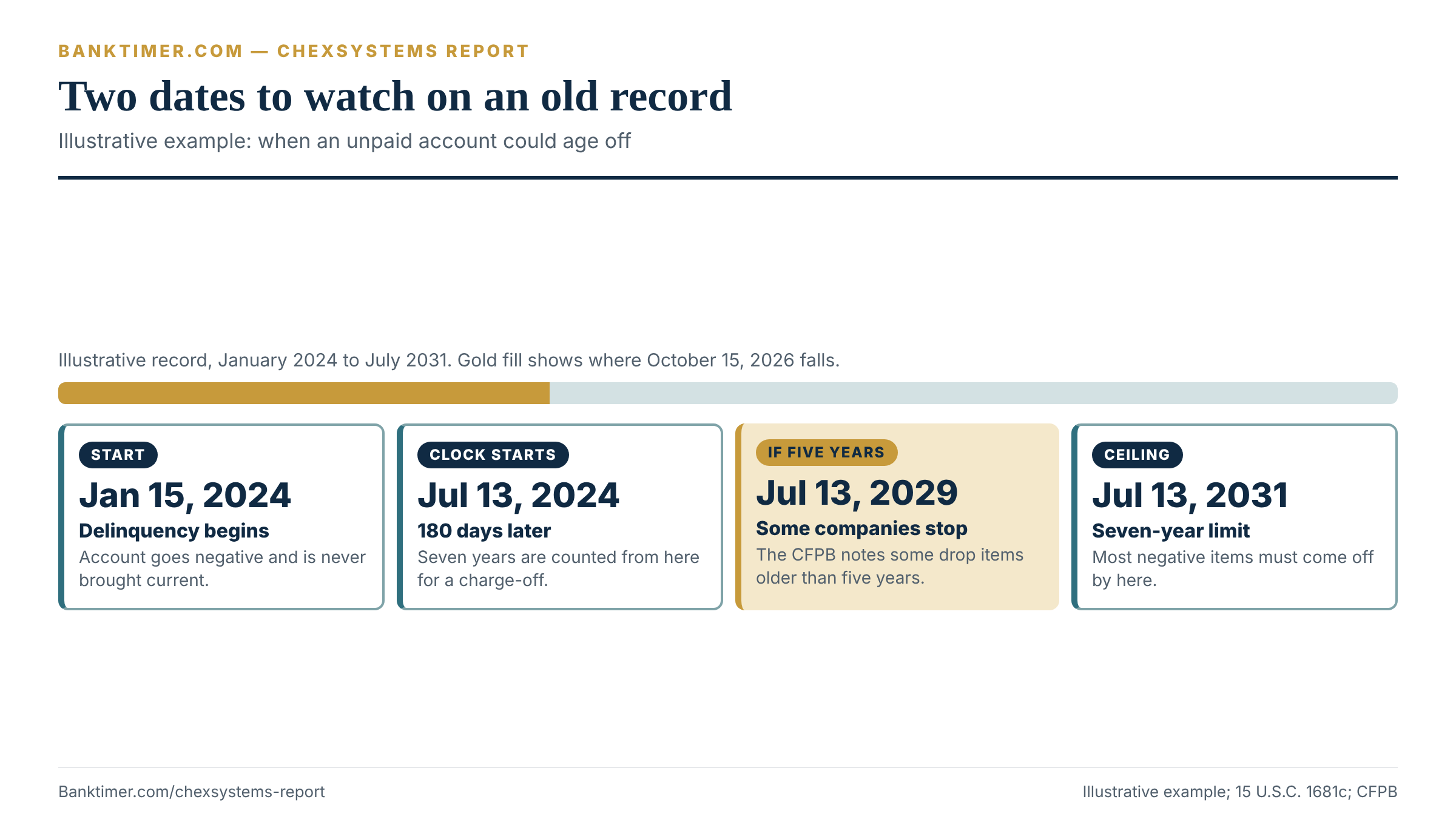
For an account charged off or placed for collection, the seven years do not start on the day the bank closes the account. Under section 1681c(c)(1), the period begins 180 days after the delinquency began. The delinquency date is the first missed obligation, such as the day an account went negative and was never brought current.
A bank that reports an account this way must tell the reporting company the month and year the delinquency began, within 90 days, under 15 U.S.C. 1681s-2(a)(5). So check that date. If the bank gives a later date than the real one, the record could stay on your ChexSystems report longer than the law allows.
Paying the balance later does not restart the statutory clock, because the statute ties it to the delinquency, not to payment. Payment can change how the record reads, if the bank updates the status. It does not, by itself, erase a lawful record.
A worked example of the clocks
The numbers below are illustrative, not a prediction. Suppose an account went negative on January 15, 2024 and the bank charged it off. The statutory clock starts 180 days later, on July 13, 2024.
| Milestone | Illustrative date | Time left from October 15, 2026 |
|---|---|---|
| Delinquency begins | January 15, 2024 | Already passed |
| Statutory clock starts (180 days later) | July 13, 2024 | Already passed |
| Five-year mark if a company uses five years from that start | July 13, 2029 | About 2.7 years |
| Seven-year federal ceiling | July 13, 2031 | About 4.7 years |
The spread between the last two rows is two years, and that gap is why you should ask. Counting methods differ, and a company may measure from the delinquency date, the closure date or the charge-off date. Your file’s own dates and the company’s written answer settle it.
What does not change when an item ages out
A bank can keep its own records of what happened at that bank. When ChexSystems stops reporting an item, a bank where you left a balance may still decline you based on its internal history. Paying the old balance or asking the bank directly about reapplying can matter more than waiting.
The seven-year ceiling has a few exceptions for reports used in large transactions: credit worth $150,000 or more, life insurance of $150,000 or more, or employment at a salary of $75,000 or more. Those exceptions apply to specific report uses and rarely matter for a checking account application.
Security Freeze, Alerts and Identity Theft on a Banking File
Someone who steals your identity can open accounts and run them into the ground in your name. Those accounts can appear in your ChexSystems report, and you may not learn about it until a denial.
The CFPB’s company list shows ChexSystems offers a freeze on request, and says it will freeze your consumer report if you ask. A freeze at the three credit bureaus is a separate action. For the difference between a freeze and an alert on your credit files, see our credit freeze vs. fraud alert guide.
| Tool | What it does | Where to ask | Watch for |
|---|---|---|---|
| Security freeze on your banking file | Restricts access to the file, per the company | ChexSystems (freeze option on its site) | You must lift it before you apply for an account |
| Free report after suspected fraud | Extra free disclosure if you believe the file is inaccurate because of fraud (15 U.S.C. 1681j(c)) | The reporting company | You certify in writing |
| Identity theft block | Company blocks the item within 4 business days of receiving the required proof | The reporting company | Needs an identity theft report and proof of identity |
| Credit bureau freeze | Limits access to credit reports only | Equifax, Experian, TransUnion | Does not cover a banking-history file |
The block rule is in 15 U.S.C. 1681c-2. You supply proof of identity, a copy of an identity theft report, the specific items to block, and a statement that they do not relate to any transaction by you. The company must block the information within four business days of getting those items. It may decline if it finds a material misrepresentation or that you got goods, services or money from the blocked transaction.
If fraud is behind the record, work the identity side first. Our identity theft recovery plan covers reports and credit steps, and the bank account takeover guide covers the case where a criminal gets into an account you already hold.
How to Dispute a ChexSystems Error
A good dispute is specific, documented and sent to two places. The reporting company must reinvestigate, and the bank that supplied the item must review it too. Sending to both gives you two chances to be heard. The CFPB’s dispute guide describes this same two-track approach for credit reports, and the logic carries over to a ChexSystems report.
Step 1: Build the evidence packet
Pull together every document that shows what really happened. Make copies and keep the originals. The table lists what usually helps.
| Document | Why it matters | Where to get it | How long to keep it |
|---|---|---|---|
| Your ChexSystems report | Shows the exact item, its date and its source | Free request to the company | Until the dispute closes plus a year |
| Final account statement | Proves the balance and last activity | Your old bank, online or by request | At least seven years |
| Closure or termination letter | States the bank’s own stated reason | Your mail or email, or the bank on request | At least seven years |
| Proof of payment | Shows a balance was paid or settled | Receipt, cancelled check, bank confirmation | At least seven years |
| Identity theft report | Supports a block on accounts you never opened | IdentityTheft.gov or police | Permanently, if practical |
| Government ID copy | Lets the company confirm you are you | Your own records | Send a copy, never the original |
| Dispute log | Records dates, names and what was said | You | Until the file is clean |
The first two rows are the core. Without the report you cannot point to the item, and without the statement you cannot prove the amount.
Step 2: Dispute with the reporting company
Contact ChexSystems through its dispute option, or write to the mailing address on the CFPB company page. Early Warning gives a clear checklist, and it is a good model for any dispute. It asks for your Consumer ID Number (on page one of your file disclosure), a description of the specific inaccurate or incomplete item, a detailed explanation, and copies of supporting documents.
The CFPB recommends putting disputes in writing and keeping copies. Certified mail with a return receipt costs extra, but it gives you a delivery date to point to.
Your name, address and phone number. Date. The reporting company’s dispute address.
“I am disputing the following item in my consumer disclosure dated [date]: [institution], account closed [date], balance shown $[amount]. The item is inaccurate because [one clear reason, such as ‘I paid this balance on [date]’ or ‘I never opened this account’]. I enclose [list documents]. Please reinvestigate and send me written results, a corrected report, and a description of the procedure used. Please also notify [the bank that denied me] of any correction.”
Keep it to one page, circle the disputed item on the enclosed copy and send copies, not originals.
Step 3: Dispute with the bank that reported it
A consumer can also dispute directly with the furnisher, the bank that supplied the item. Under 12 CFR 1022.43, the furnisher must investigate a direct dispute that meets the rule’s conditions. The notice must go to an address the furnisher gave you or published for disputes, and it must identify the account, state the disputed information and the basis, and include supporting documents.
There are limits. A furnisher does not have to investigate a dispute it reasonably believes was prepared by a credit repair organization. It may also decline a dispute it finds frivolous, but then it must notify you within five business days and say what it needs.
What the reporting company must do
The timetable in 15 U.S.C. 1681i is the backbone of any dispute. The company must reinvestigate free of charge within 30 days of receiving your dispute. If you send relevant information during that first 30 days, it may take up to 15 more. Within five business days of receiving the dispute, it must notify the bank that supplied the item and pass along what you sent.
When the work is done, the company must send written results within five business days. The notice includes a revised report and tells you how to add a statement. Deleted information generally cannot return unless the bank certifies it is complete and accurate, and the company must tell you within five business days if it does.
| Stage | Typical timing | Who controls it | What you do |
|---|---|---|---|
| Company receives dispute | Day 0 | You (date you mail or submit) | Keep proof of delivery |
| Company notifies the bank | Within 5 business days | Reporting company | Confirm the bank got your documents |
| Reinvestigation window | 30 days, up to 45 if you add information | Reporting company and bank | Reply fast to any request for more proof |
| Results sent to you | Within 5 business days after completion | Reporting company | Compare the new report to your list |
| Early Warning’s own limit | Up to 30 calendar days, unless state law differs | Early Warning | Watch for the written outcome |
| Optional 100-word statement | After a result you still dispute | You | File it if the item stays |
An illustrative calendar
Say a company receives your dispute on Monday, November 2, 2026. It should tell the bank by Monday, November 9. The 30-day window ends Wednesday, December 2, and the 45-day extension would end Thursday, December 17. These dates ignore federal holidays and assume the clock starts when the company receives your dispute. Your own dates will differ.

If the item stays or comes back
Not every dispute ends in a deletion. If the company keeps an item, ask for the description of its reinvestigation procedure and the contact details of the bank that verified it. You also have the right to add a short statement of dispute, which the company may limit to 100 words. Anyone who pulls your file later will see the statement.
After a correction, you can ask the company to notify banks that received your report in the past six months (two years for employment). Name the bank that denied you, so it sees the corrected file. Then reapply, rather than waiting for the bank to check again.
Escalating When the Dispute Stalls
If a company ignores the deadline or repeats an error, you have options. You can file a complaint with the CFPB at its complaint portal. The CFPB says most companies respond within 15 days, and some give a final answer within 60. For credit-reporting complaints about inaccurate information, you must first dispute the error directly with the reporting company.
The FCRA also allows private lawsuits, with a time limit. Under 15 U.S.C. 1681p, a case must be brought no later than the earlier of two years after you discover the violation or five years after it occurs. A consumer-law attorney can tell you whether your facts justify a case.
Keep one rule in mind: save everything. A date-stamped paper trail turns “I sent it” into “I sent it on November 2 and here is the receipt.” The debit card fraud guide shows how to organize evidence when a dispute involves an unauthorized transaction.
If the Record Is Accurate: Ways to Get a Checking Account Anyway
Sometimes your ChexSystems report is right. You left a bank with a negative balance, or an account closed for a reason you cannot dispute. That does not lock you out for years. It narrows your choices and changes the order you should try them in.
The CFPB’s denied-account steps are a good map. Ask the bank which company supplied the information, get your free report, check it for errors, ask whether the institution has a path to open an account, and consider another institution. The pages below turn those steps into specifics.
Pay the old balance, in writing
The CFPB notes that some institutions “require you to pay any old, unpaid charges and fees” before they will open a new account. That makes the old bank your first call. Ask for a payoff figure, and ask what the bank will report once you pay.
Before you send money, get three things in writing: the exact amount, a statement that the balance will be reported as paid, and the date it will update the reporting company. Ask the bank to correct the delinquency date if it is wrong. Then check your report in about two months to confirm the change.
Payment does not erase the record under the statute we reviewed, which sets time limits rather than payment-based deletion. What payment can do is change the status from unpaid to paid, which some banks treat more favorably. Treat that as a bank policy question, not a legal right.
Second-chance checking accounts
“Second chance checking” is an industry term for accounts built for people with a banking-history record. The CFPB does not use the phrase in its denied-account guide. It points instead to lower-risk accounts and prepaid cards that help you avoid overdraft fees. In practice, banks and credit unions label their own versions differently, so ask for it by description.
Features vary. Expect a debit card and online bill pay, and watch for a monthly fee, limits on features and a switch to a standard account after a period of good behavior. Read the fee schedule before you open one. Our bank account fees guide lists charges worth finding.
Bank On certified accounts
Bank On is a national program, run by the Cities for Financial Empowerment Fund, that certifies low-cost accounts. The CFE Fund’s Bank On page says certified accounts meet national standards, with the core features once described as low costs, no overdraft fees, a debit or prepaid card and online bill pay. The standards were updated for 2025 to 2026.
The directory at joinbankon.org listed 522 certified accounts at 50,361 branches on October 15, 2026. Certification covers the product’s features, not whether a particular bank will approve you. A certified account may still screen applicants, so ask directly.
Other paths
- Credit unions. Some credit unions run their own screening rules. See credit union vs. bank for the trade-offs, including membership rules.
- Prepaid cards. The CFPB lists these as an alternative that can prevent overdraft fees. Check fees and how funds are held.
- A co-owner. Adding a joint owner with a clean record can help, but the risks are real. Both owners are responsible for the account, and the other person’s record comes with the deal.
- Online account applications. Some online banks screen as well. Our open a bank account online guide covers what they ask for.
Alternatives Compared on the Same Criteria
The table uses the same four questions for every option. No row is the winner; the right choice depends on your record, your cash flow and what a bank will accept.
| Option | Screening | Cost pattern | Main risk | Best fit |
|---|---|---|---|---|
| Second-chance account | Often lighter than standard accounts, varies | Monthly fee common, varies | Fees and feature limits | People who can bring the balance current |
| Bank On certified account | Varies by bank | Certified to meet cost standards | Not a guarantee of approval | Cost-sensitive households |
| Credit union account | Varies by credit union | Varies; compare fee schedules | Membership rules | People near a local credit union |
| Prepaid card | Varies; some programs screen lightly or not at all | Monthly and load fees vary | Fees add up; protections vary | Short-term access to electronic payments |
| Check cashing and money orders | None | Percent fee on each check, plus per-order fees | Cost and cash-theft risk | Last resort for a short time |
| Joint account with a co-owner | Both owners screened | Same as any account | Shared liability | Trusted family with clean records |
Read the “cost pattern” column as a prompt to ask, not a quote. Every fee in it varies by provider, so get the fee schedule in writing.
What Going Without an Account Costs You: Illustrative Numbers
Cash has a price. Walk through the arithmetic with assumptions you can change.
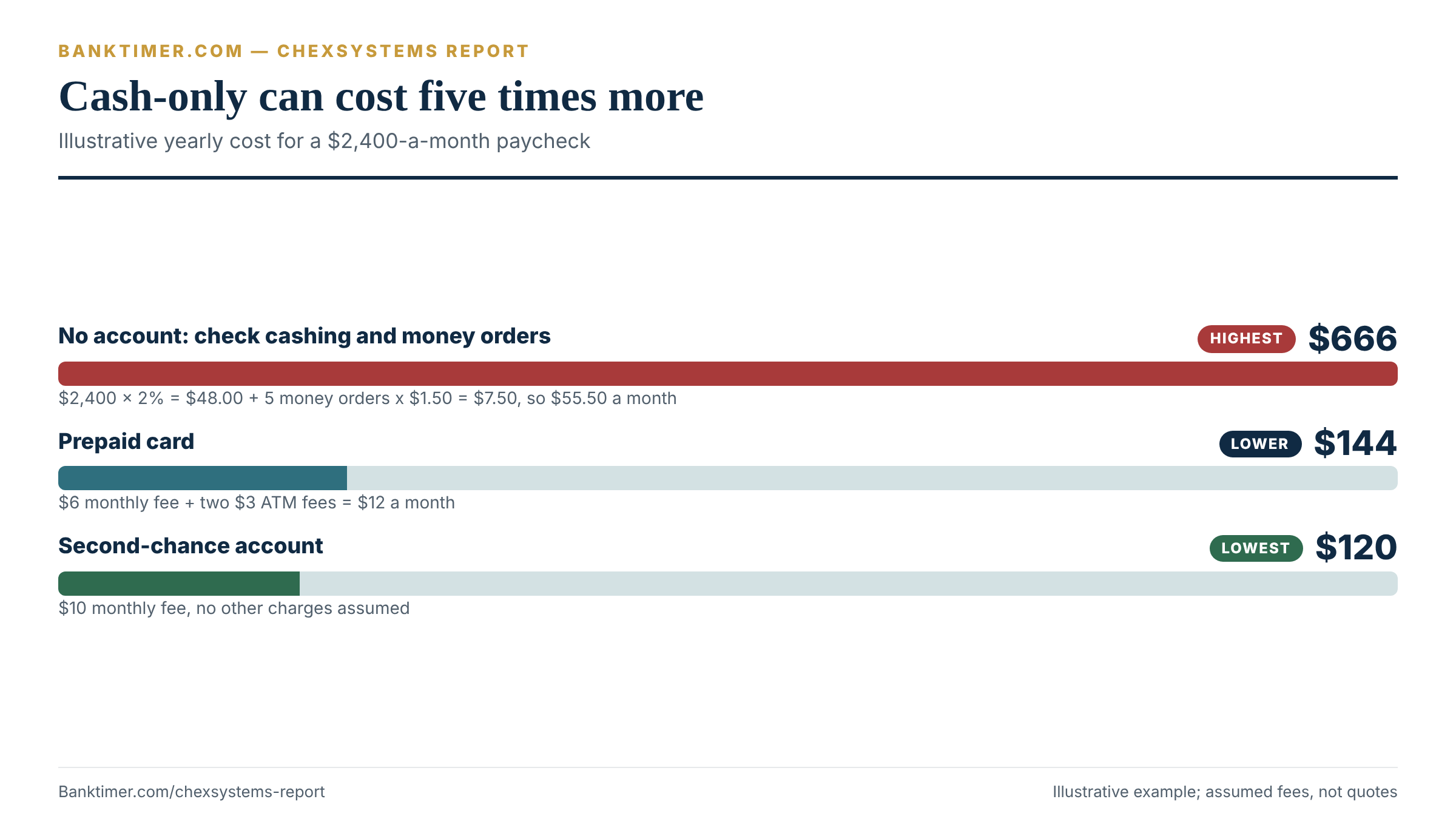
Assumptions: you take home $2,400 a month. A check casher charges 2% of each check. You buy five money orders a month at $1.50 each to pay bills. These are example numbers, not quotes.
Check cashing: $2,400 × 2% = $48.00 a month. Money orders: 5 × $1.50 = $7.50. Total: $55.50 a month, or $666 a year.
A second-chance account at $10 a month costs $120 a year. A prepaid card at $6 a month plus two $3 ATM fees a month costs $144 a year. The yearly gap versus going without is $546 and $522.
The takeaway is not that any one product wins. It is that the monthly cost of staying cash-only can be several times the cost of a modest account, so a few months of waiting can cost more than a fix.
| Scenario (illustrative) | Monthly cost | Yearly cost | Difference from cash-only |
|---|---|---|---|
| No account (check cashing and money orders) | $55.50 | $666 | Baseline |
| Second-chance account, $10 monthly fee | $10.00 | $120 | $546 less |
| Prepaid card, $6 fee plus two $3 ATM fees | $12.00 | $144 | $522 less |
Should you pay the old balance first?
Assume you owe the old bank $412 and a new account needs it paid. Paying the balance and then opening a $10-a-month account costs $412 + $120 = $532 in year one. Going cash-only costs $666. You come out $134 ahead in the first year, and the break-even is about 9 months ($412 ÷ $45.50 monthly savings).
Over two years the gap is wider. Cash-only costs $1,332. Paying and keeping the account costs $412 + $240 = $652, which is $680 less. These figures ignore other benefits, such as direct deposit, bill pay and a debit card. Your numbers will differ, so replace the assumptions with yours.
A Decision Framework: Which Path Fits Your Situation
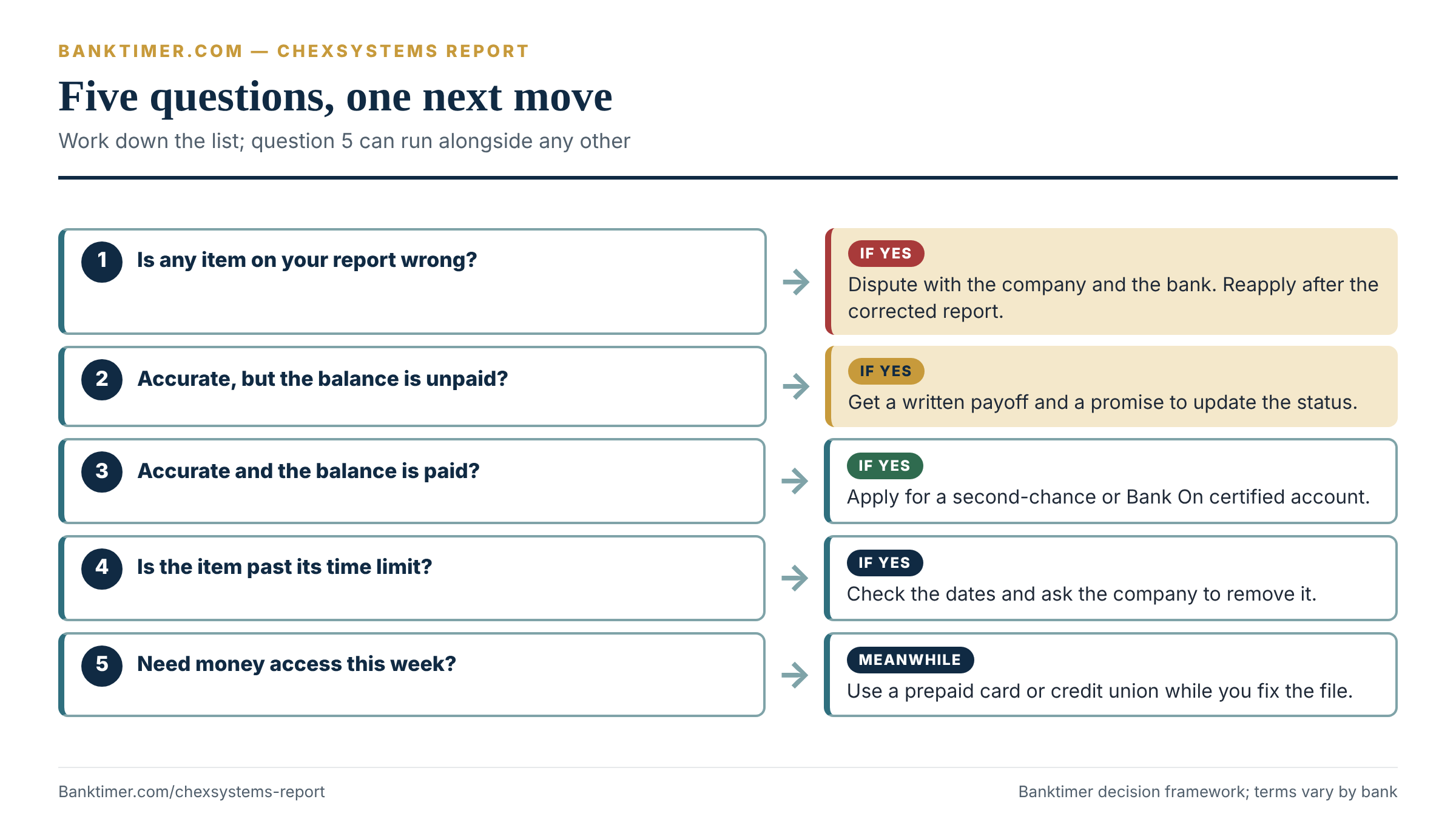
Work through these questions in order. Step 4 can run alongside any of the others.
- Is any item wrong? If yes, dispute it first. A correction may be all you need.
- Is the record accurate but the balance unpaid? Ask the old bank for a payoff and a written update. Compare the cost with the table above.
- Is the record accurate and the balance paid? Ask for a second-chance or Bank On certified account. Reapply once you have the written update.
- Do you need money access this week? Use a prepaid card or a credit union that will take your application while you work the file.
- Is identity theft involved? Report it, request a block, and use the dispute steps above.
| If this describes you | Then do this first | Then |
|---|---|---|
| The report lists an account you never opened | Dispute and request a block | Reapply after the corrected report |
| The balance is accurate and unpaid | Get a payoff and written terms | Pay, confirm the update, open a lower-risk account |
| The record is accurate and paid | Apply for a second-chance account | Ask about upgrade rules |
| The record is old (past five or seven years) | Check dates, ask the company to remove it | Reapply to a standard account |
| You need money access now | Open a prepaid or credit union account | Fix the file in parallel |
Is Your Money Covered at These Accounts?
Deposit insurance does not depend on your banking history. The FDIC says coverage is at least $250,000 per depositor, per FDIC-insured bank, for each ownership category. A second-chance checking account at an FDIC-insured bank is a deposit account like any other.
Check that the institution is insured with the FDIC’s BankFind tool. Credit unions carry separate federal share insurance through the NCUA, and prepaid cards depend on how the program holds funds, so ask the issuer. Our FDIC insurance limits guide explains the categories, and what happens when a bank fails covers the rest.
How to Avoid a New Record
The best repair is not needing one. Most records start with a small negative balance that nobody cleared. A few habits cut the risk.
| Trigger | How it turns into a record | Prevention |
|---|---|---|
| Overdraft left unpaid | The balance stays negative, the bank closes the account and reports it | Clear negatives fast; consider opting out of overdraft coverage |
| Fees on a low balance | Monthly fees push a thin account below zero | Read the fee schedule; choose a no-fee account |
| Closing an account carelessly | Pending payments or fees post after you leave | Zero the balance, stop automatic payments and get a closing confirmation |
| Mistaken deposit spent | The bank reverses it and the account goes negative | Read our guide on money deposited by mistake |
| Returned deposited check | You spent funds that never cleared | Wait for clearance; see check clearing time |
| Fraud on your account | Unauthorized activity leaves a negative balance | Report within the stated time; see Regulation E |
For the mechanics behind the first row, our overdraft fees guide explains how one negative balance can grow with fees. In an illustrative case, three $35 fees on a $60 overdraft leave $165 owed, which is how a small slip becomes a closure.
Red Flags and Costly Mistakes
Most losses in this area come from a handful of repeat patterns. Some cost money, and some cost months. The table pairs each with a safer move.
| Red flag | Why it matters | What to ask | Safer next step |
|---|---|---|---|
| A site or caller charges to “remove” a ChexSystems record | Your right to see your file is free, and no outsider can force a lawful item off | Is there any fee to see my own report? | Request it yourself from the company’s official channel |
| A promise to delete accurate items for a fee | Accurate items can lawfully stay until their time limit | Can you put that guarantee in writing? | Dispute only what is wrong, using your own evidence |
| A bank denies you but will not name the company | Law requires the notice to identify the reporting company | Which company, and can I have the notice? | Ask in writing, then file a CFPB complaint if needed |
| Paying an old balance with no written terms | The bank may not update the status or date | Will you report it as paid, and by when? | Get the payoff and the update promise in writing |
| Mailing original documents | You may never see them again | Can I send copies? | Send copies and keep the originals |
| A rush of new applications | Each one can add an inquiry to your file | What will you see about other applications? | Pause and read your report first |
| A text or email asking for your ID to “fix” your file | Common impersonation tactic | Did I start this contact? | Go to the official website yourself |
The first red flag appears again and again. Because the report is free by law, any price tag is a cue to stop. Paid “credit repair” outreach often targets people right after a denial.
No company can lawfully guarantee the removal of accurate, timely information. A real dispute asks the company to correct or delete what is wrong. Anyone selling a shortcut may be asking you to dispute true items, and a furnisher can decline disputes it believes were prepared by a credit repair organization. If a pitch uses the word “guaranteed,” walk away.
Mistakes that cost time
- Disputing everything. Challenging accurate entries invites a “frivolous” label under the dispute rules. Dispute what you can prove wrong.
- Waiting until you need an account. Request your ChexSystems report before you apply. A dispute takes 30 days or more.
- Skipping the bank. The reporting company stores what the bank sent. A correction often needs the bank to agree.
- Ignoring your credit reports. A denial may rest on a credit report, not a banking file.
- Forgetting the deadline. Count 60 days from receiving the denial notice, not from the day you read it.
Questions to Ask Before You Apply, Pay or Dispute
- ☐ Which consumer reporting company do you use to screen applicants: ChexSystems, Early Warning, a credit bureau, or something else?
- ☐ If I have an old record, do you offer a second-chance or Bank On certified account?
- ☐ What is the monthly fee, and how can I avoid it? Is there a minimum opening deposit?
- ☐ Does this account allow overdrafts, and what do they cost? Can I opt out?
- ☐ After a stretch of good behavior, can I move to a standard account, and when?
- ☐ (Old bank) What is the exact payoff amount, and will you report the account as paid?
- ☐ (Old bank) What delinquency date did you report, and can you send me a copy?
- ☐ (Reporting company) How long do you keep items like this, and where is that policy written?
- ☐ (Reporting company) What date did you receive my dispute, and when is the reinvestigation due?
- ☐ Is the institution FDIC-insured or NCUA-insured, and how do I verify it?
Frequently Asked Questions
How do I get my ChexSystems report for free?
Ask ChexSystems for your consumer disclosure report through its website, by phone at 800-428-9623 or by mail. Federal law makes one copy free in any 12-month period, and delivery is due within 15 days. If a bank denied you because of the report, you can ask for a free copy within 60 days of receiving the notice. Use only the company’s official channels, and never pay to see your own file.
How long do ChexSystems records stay on your report?
Federal law caps most negative items at seven years. The CFPB notes that some reporting companies disregard items older than five. For charged-off accounts, the seven years start 180 days after the delinquency began, not on the closure date. Your own report shows the dates, and the company can tell you its retention policy. A bank can still use its own internal records after an item ages out.
Does checking my ChexSystems report hurt my credit score?
No. The CFPB’s company listing says requesting your own reports does not hurt your credit scores. An application for a bank account is different: the bank may pull your file, and that pull can show as an inquiry on your banking report. Check the report before you apply, not after a string of applications.
Is a ChexSystems report the same as a credit report?
No. A ChexSystems report tracks account applications, openings, closures and check-writing history. A credit report tracks loans, cards and payment history at the three credit bureaus. Some banks look at one, some at both. If you were denied, ask which file the bank used. For the other side, see our credit score guide and the hard inquiry explainer.
How long does a ChexSystems dispute take?
A reporting company generally must reinvestigate within 30 days of receiving your dispute, or 45 if you send more information during the first 30. It must notify the bank within five business days and send written results within five business days of finishing. Early Warning says it has up to 30 calendar days. State law may shorten some deadlines.
Can a bank deny me an account because of ChexSystems?
Yes. Each bank sets its own screening rules, and the law does not require every bank to approve every applicant. But if a bank denies you based in whole or in part on a report, it must send an adverse action notice naming the company, and you get a free copy and the right to dispute. If the record is wrong, a correction can reverse the outcome.
Will paying the debt remove it from my ChexSystems report?
Not automatically. The federal statute sets time limits for how long most negative items may stay, and it ties the clock to when the delinquency began. Payment can change the status from unpaid to paid, and some banks require payment before opening a new account. Get any payment terms in writing, including how and when the bank will update the report.
Can I get a checking account with a ChexSystems record?
Often yes, though your choices narrow. Second-chance accounts, Bank On certified accounts, credit unions and prepaid cards are common routes. Terms vary, and fees are typical, so read the fee schedule. A new account that you handle well builds a better record. Our checking account guide covers what to check on any account.
What if I find an account on my report that I never opened?
Treat it as possible identity theft. Dispute the item with ChexSystems and the bank that reported it, and request a block with an identity theft report and proof of identity. The company must block the item within four business days of receiving those items, unless an exception applies. Also review your credit reports and consider a freeze or alert. See our identity theft recovery guide.
Can I freeze my ChexSystems report?
According to the CFPB’s company listing, ChexSystems will freeze your consumer report if you ask. A freeze restricts access to the file, so plan to lift it before you apply for a new account. A credit freeze at Equifax, Experian or TransUnion is separate and does not cover a banking file. Ask each company how to place and lift a freeze.
Do all banks use ChexSystems?
No. Some banks use Early Warning Services, some use both and some use neither or rely on credit reports or internal checks. The CFPB says banks and credit unions report to and use ChexSystems and Early Warning, and some lenders also use deposit account data. The adverse action notice and the application disclosures should name the company, so ask before you apply.
This week, request your free ChexSystems report and, if you have been denied, write down the date on your adverse action notice and add 60 days. Then match every entry against a statement or letter, and circle anything you can prove wrong.
The variable that decides your outcome is whether each item in your ChexSystems report is accurate and current. If something is wrong, dispute it with both the reporting company and the bank that supplied it, using documents instead of arguments, and expect an answer in about 30 days. If the record is accurate, ask the old bank for a written payoff, then look at a second-chance or Bank On certified account while the item ages toward its time limit. The cost of waiting can outrun the cost of a fix, as the illustrative numbers above show. This guide does not cover every screening company, a bank’s own internal records, or a lender’s use of deposit data. It also cannot predict whether a given bank will approve you. Confirm terms in each bank’s written disclosures before you apply.
Methodology
We built this ChexSystems report guide from primary and official sources and checked each dated figure on October 15, 2026. The federal rules come from the Fair Credit Reporting Act sections cited in the text and from 12 CFR 1022.43. Descriptions of ChexSystems and Early Warning come from the CFPB’s company listings, the CFPB’s denied-account guidance and the Early Warning consumer pages. ChexSystems’ own site was readable only in part, so we did not rely on any retention period it may publish. The 522 certified Bank On accounts are the count shown on the Bank On directory that day.
The dispute calendar, the record clocks, the cost-of-cash example and the $412 balance are illustrative assumptions computed in a script we ran and rechecked. They are not quotes, forecasts or real accounts. Phone numbers, addresses, deadlines and fees change, and state law and individual bank policy vary. We did not test any request, dispute or account application.
Sources
- ChexSystems consumer information page, ChexSystems
- Chex Systems, Inc. company listing, CFPB
- Early Warning Services, LLC company listing, CFPB
- You have options if you have been denied a checking account, CFPB
- How do I dispute an error on my credit report, CFPB
- Submit a complaint, CFPB
- 15 U.S.C. 1681j, Charges for certain disclosures, Cornell Law School
- 15 U.S.C. 1681i, Procedure in case of disputed accuracy, Cornell Law School
- 15 U.S.C. 1681c, Requirements relating to information contained in consumer reports, Cornell Law School
- 15 U.S.C. 1681g, Disclosures to consumers, Cornell Law School
- 15 U.S.C. 1681m, Requirements on users of consumer reports, Cornell Law School
- 15 U.S.C. 1681s-2, Responsibilities of furnishers of information, Cornell Law School
- File disclosure and dispute pages, Early Warning Services
- Understanding deposit insurance, FDIC
By the Banktimer Editorial Team · Published
Banktimer is an independent U.S. consumer-finance publication. Our editors draw on primary and official sources first, such as the CFPB, FDIC, Federal Reserve, and FTC, along with statutes, regulations, and providers’ own agreements and fee schedules. Then we add worked examples and decision tools. Our goal is the most useful, best-supported explanation the sources available to us at the time of writing allow.
This article is general information, not legal, tax, investment, insurance, or financial advice, and reading it does not create a professional relationship with Banktimer. Rates, fees, limits, and rules change, and they vary by state, provider, and contract, so confirm current terms with your bank, lender, insurer, or the agency named in the article before you act. Examples are illustrative unless labeled otherwise. Banktimer is not a bank, lender, insurer, or financial advisor, and we are not responsible for decisions or losses that result from relying on this content. For advice about your own situation, talk to a licensed professional.